
Town of Mount Royal (TMR) · just south of Highway 40
Speech therapy in the Town of Mount Royal (TMR): your CLSC is in Côte-des-Neiges, our clinic is just across the Metropolitan Expressway, and you can start both routes at the same time
The Town of Mount Royal has no CLSC of its own: the Town lists the one in Côte-des-Neiges. Our clinic is just north of the Metropolitan Expressway, at Marché Central. Here is how to start the public and private routes at the same time, and what changes when your child learns at school in a language that is not the one spoken at home.
Which Mount Royal, and how far is our clinic?
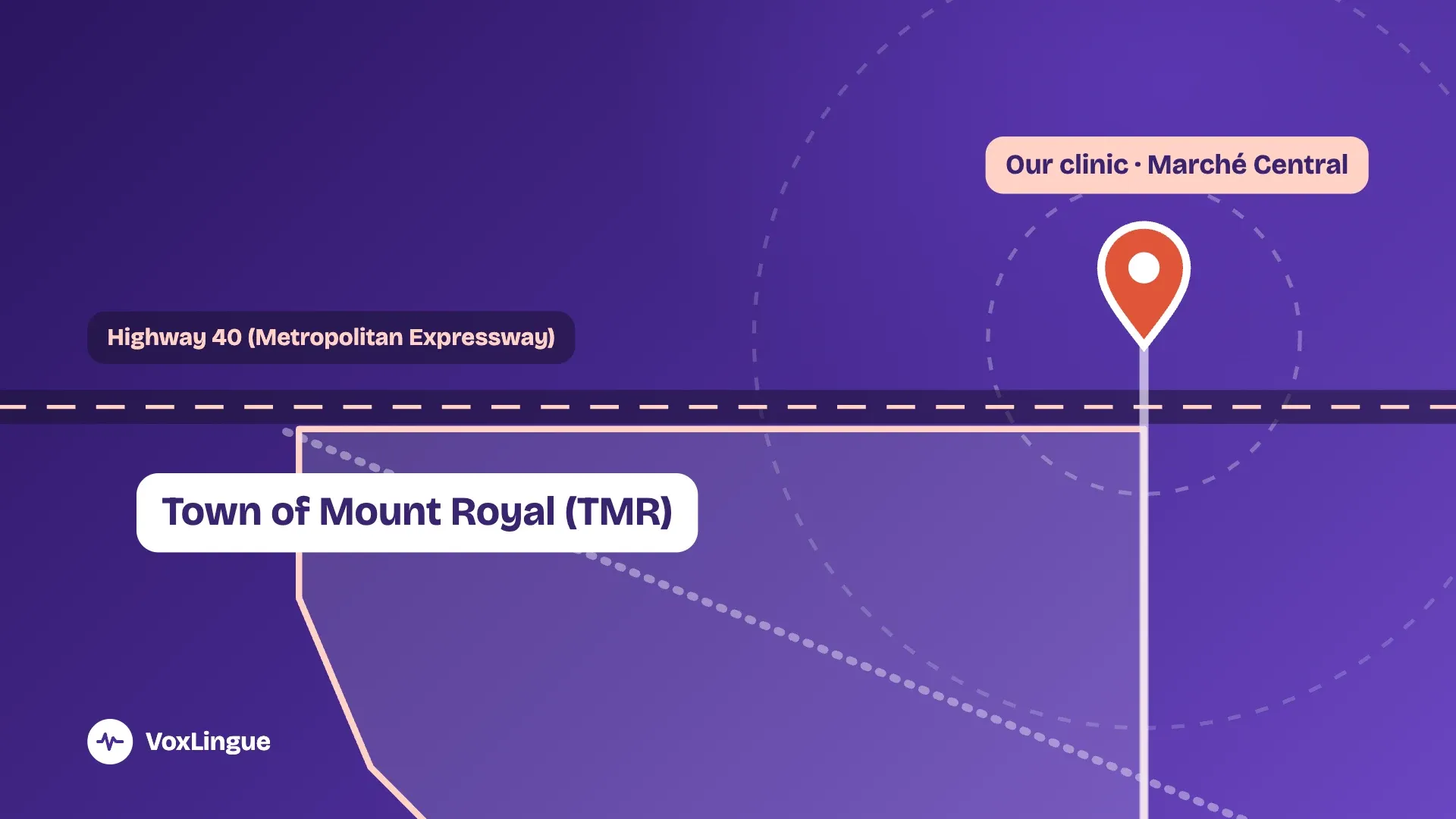
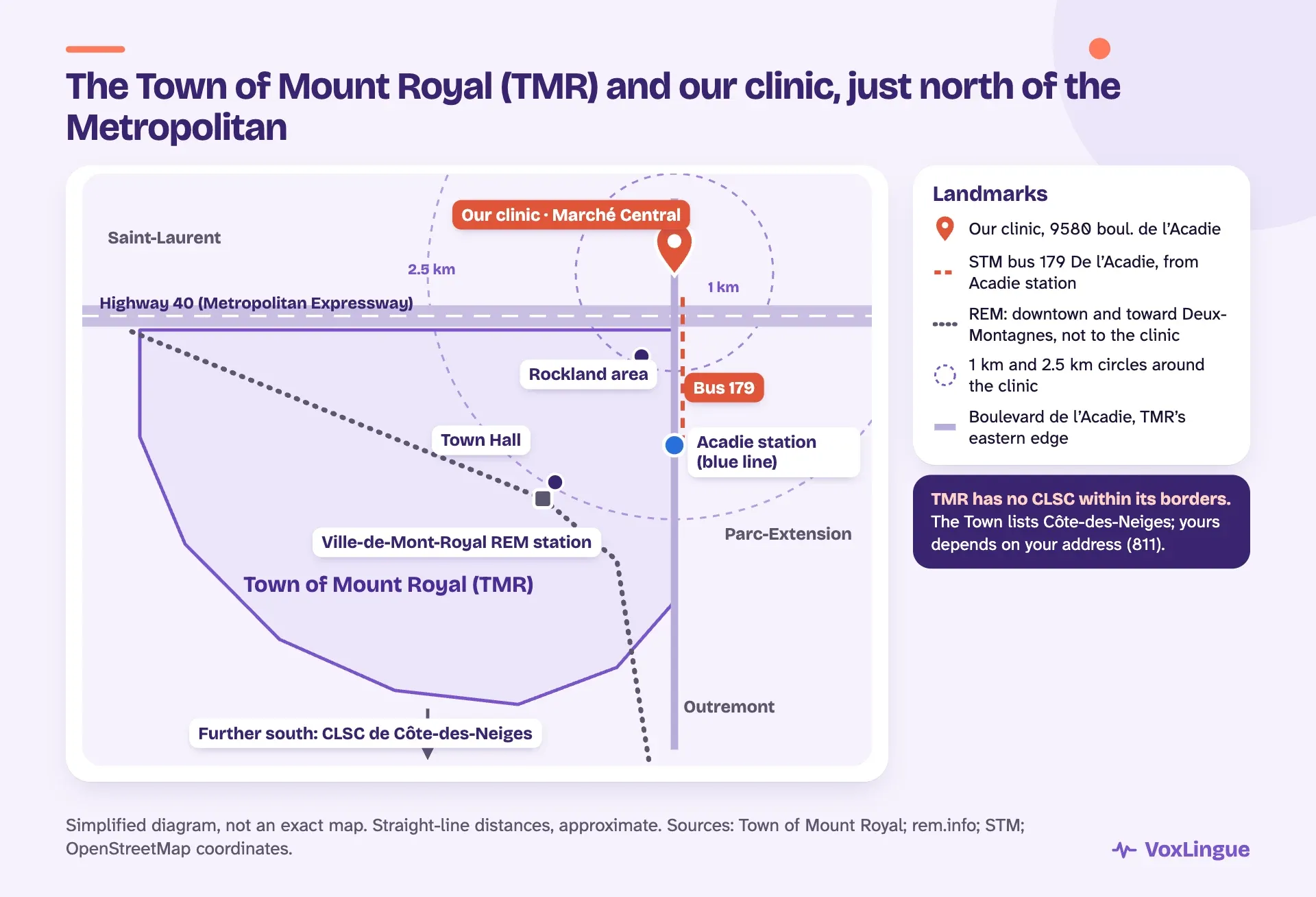
This page is about the Town of Mount Royal (TMR), the independent town just south of Highway 40. It is not the Plateau-Mont-Royal, not the mountain park, and not Mount Royal in Calgary. Our clinic at Marché Central sits just across Highway 40, which is TMR’s northern edge: about 1 km from the Rockland area and 2.5 km from Town Hall, as the crow flies.
TMR has its own Town Hall on Roosevelt Avenue, its own library and its own resident services, without being a Montréal borough. So some services come from the Town, others from the health network or the school: this page puts them side by side.
A word on the REM: Ville-de-Mont-Royal station, in the heart of town, does not run to our clinic. Driving or bus 179 from Acadie station is simpler. For everyday language life in town, read our earlier article on everyday language life in TMR, and see our neighbours in Parc-Extension, across boulevard de l’Acadie.
Which CLSC serves the Town of Mount Royal (TMR)?
TMR has no CLSC within its borders. The Town lists CLSC de Côte-des-Neiges for its residents, part of the de la Montagne local services network with Côte-des-Neiges, Parc-Extension, Outremont and Westmount. The CLSC that serves you still depends on your address: check the official Find a CLSC directory (in French) or call 811.
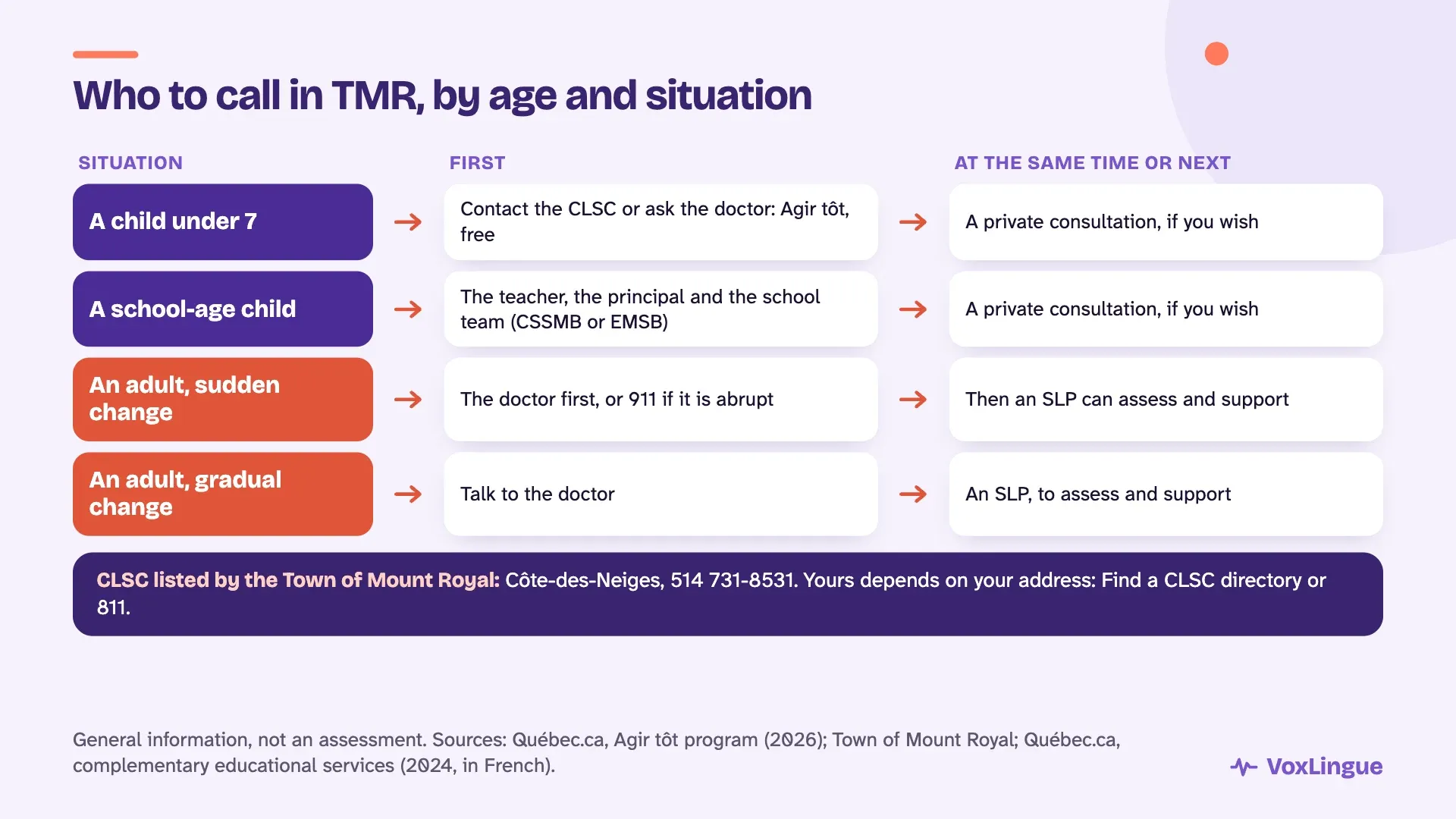
The CLSC is the public way in when you are worried about a young child’s speech or language. The message is simple: contact the CLSC or ask the doctor. When you call, give your child’s age, what worries you and since when, and the languages your child hears at home.
If the first call does not get you to the right place, Info-Santé 811 can point you in the right direction. For what comes next, read about what happens on the public waiting list and what you can do in the meantime.
Can a TMR family start the public and private routes at the same time?
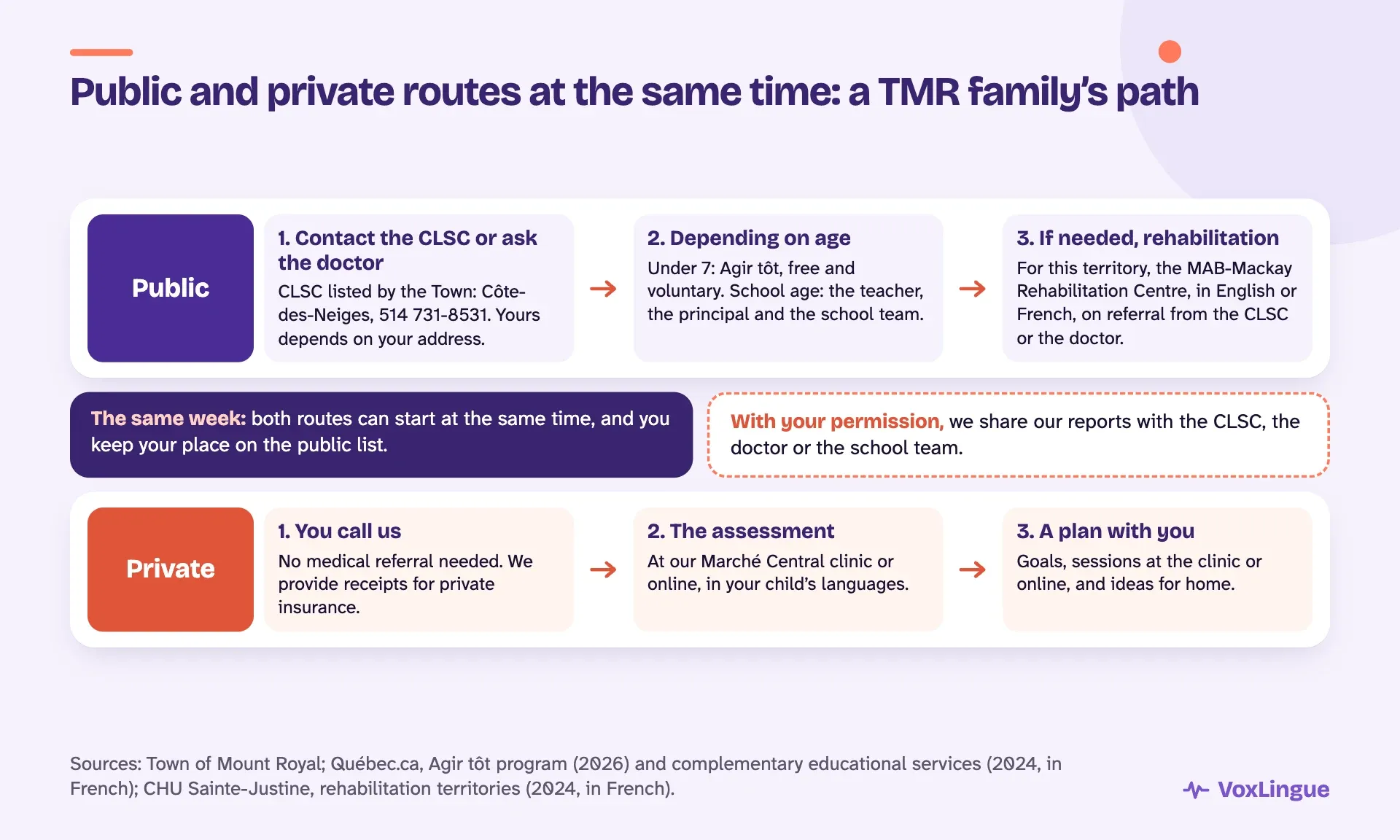
Yes, both routes can start in the same week. You can contact the CLSC or ask the doctor, and see a private speech therapist at the same time. The public route depends on age: Agir tôt before age 7, the school team after that. Privately, the assessment happens at our clinic or online. With your permission, we share our reports.
Privately, you can book a speech-language assessment at our clinic or online. To know what to expect, see the steps of a speech-language assessment in Québec. Receipts, insurance and tax credits are covered in a separate article.
Under 7: Agir tôt, through the CLSC or the doctor
Agir tôt is a free, voluntary program for children under 7 and their families, from birth until school entry. To access it, contact the CLSC or ask the doctor. Another professional can also refer you, with your consent.
At the 18-month vaccination visit, with your consent, the nurse can fill out the ABCdaire 18 mois+ with you, a check-in on your child’s development. It is a good moment to talk about language, in every language your child hears.
School age: your child’s school team
Speech-language pathology is one of the complementary educational services in Québec schools (in French). How these services are organised varies from school to school. Start with the teacher, then the principal: they can ask for the school team’s view and, if needed, set up an intervention plan. See also who does what at school: speech therapist or orthopédagogue.
Public services also exist in English
For the de la Montagne local network, which includes TMR, public language rehabilitation referrals go to the MAB-Mackay Rehabilitation Centre, which works in English and in French. You cannot apply directly: the request goes through the CLSC or the doctor.
My child learns in French at school and we speak English or another language at home: is that a problem?
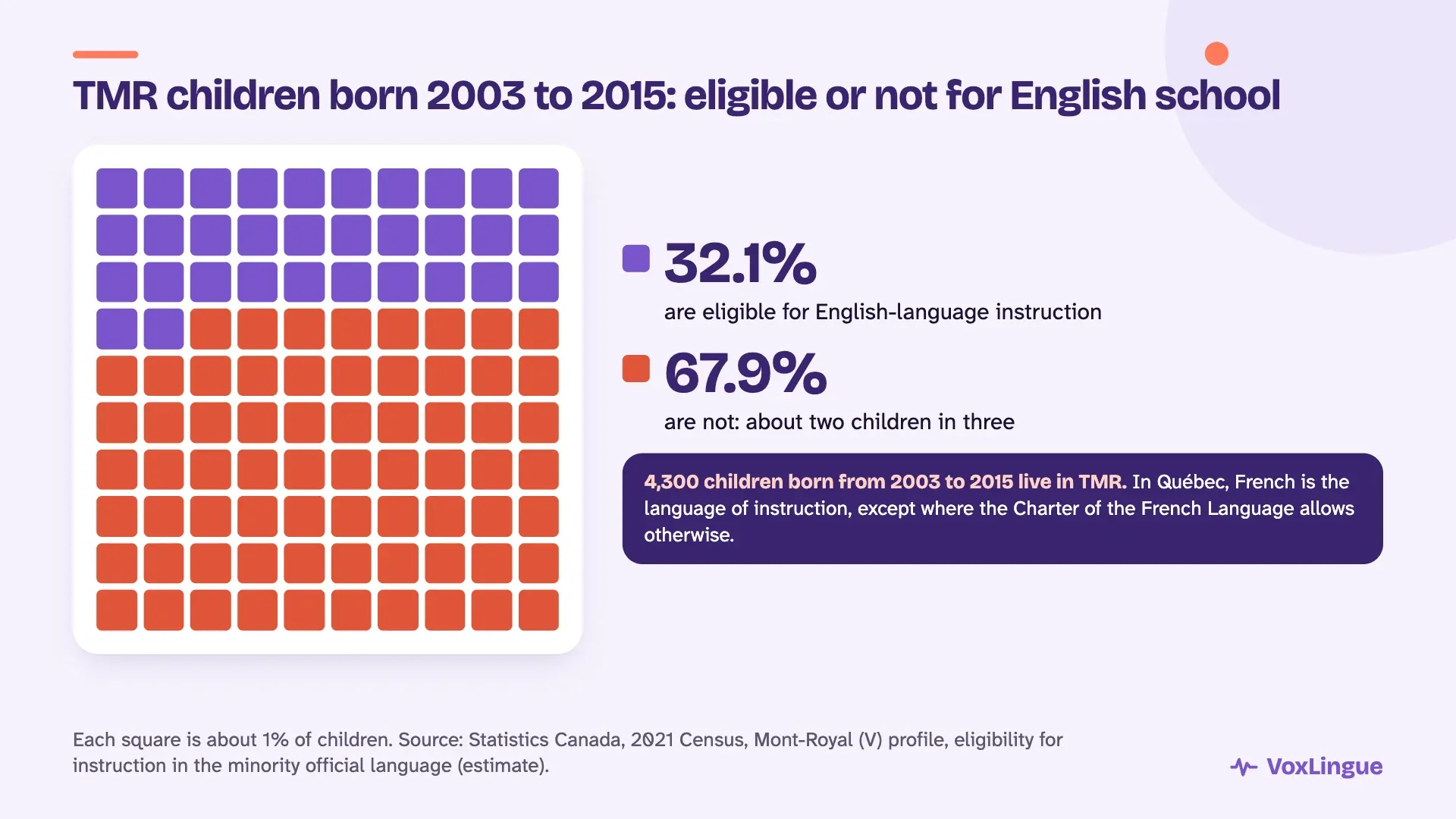
No, not in itself. In TMR it is a common situation: about two school-age children in three are not eligible for English school, while more than one resident in three uses a language other than French or English at home. Learning the school language takes time. A language difficulty, on the other hand, shows up in every language.
What the 2021 census shows for TMR
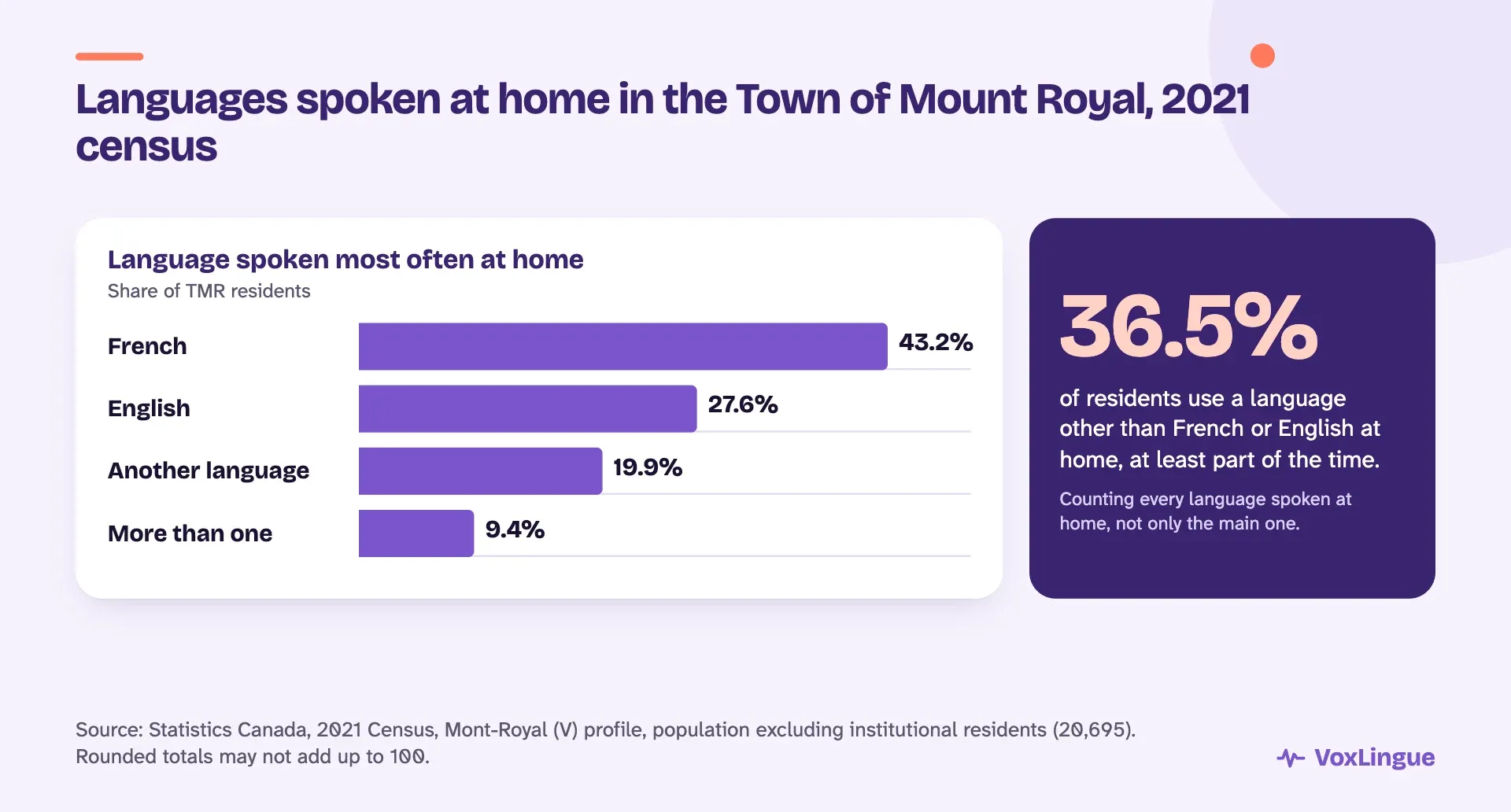
If you speak English at home and your child learns in French, the census suggests you are far from alone in TMR. At home, 27.6% of residents speak English most often, 43.2% French, 19.9% another language and 9.4% more than one language. Counting every language spoken at home, 36.5% of residents use a language other than French or English at least part of the time. And 77.9% know both French and English.
TMR is a municipality with bilingual status recognized under the Charter of the French Language. Its most common non-official mother tongues are Arabic, Mandarin, Vietnamese, Italian, Greek and Spanish. Our team does not speak them all; see below how we work when no one speaks yours.
The census also estimates eligibility for English-language instruction. Of the 4,300 children born from 2003 to 2015 who live in TMR, 32.1% are eligible and 67.9% are not. In Québec, French is the language of instruction in preschool, elementary and secondary school, except where the Charter of the French Language allows otherwise. Public English school requires a certificate of eligibility.
So many TMR children learn in French while hearing English or another language at home. See the kindergarten language form and what to tell the school.
CSSMB, EMSB or immersion: who to talk to
Two public networks serve TMR children, and each has its own way in.
| Network | Schools in TMR | Language of instruction | Who to talk to about a concern |
|---|---|---|---|
| CSSMB, elementary | Académie Saint-Clément, École Saint-Clément-Est, École Saint-Clément-Ouest | French | The teacher, then the principal and the school team |
| CSSMB, secondary | École Mont-Royal, École Pierre-Laporte | French | The teacher, then the principal and the school team |
| EMSB, elementary | Carlyle (International Baccalaureate program) | English (EMSB school) | The teacher, then the principal |
| EMSB, elementary | Dunrae Gardens | French immersion | The teacher, then the principal |
If the teacher notices something in French, ask what they see and in which situations. Tell them which languages your child hears at home, since when, and how your child speaks in the home language. Then ask whether the school team can look at the situation. You can also share a speech-language report, if you have one.
What the speech therapist looks at when your child lives in several languages
The SLP looks at all of your child’s languages, not only French, and asks which ones your child hears, from whom, since when and how much. According to CHU Sainte-Justine, a multilingual child with a language disorder has difficulties in every language they are exposed to. A difficulty that shows only in French often reflects how long your child has been learning it. See how to tell a language difference from a language disorder in bilingual children.
Learning two or more languages does not cause a language disorder, notes the Ordre des orthophonistes et audiologistes du Québec (in French). You do not need to stop speaking your language at home: the Order suggests using the language you know best, for more frequent and richer conversations. And a child who mixes French and English is often doing something very ordinary.
Our clinicians work in English and French, and some also speak Greek, Spanish, Portuguese, Arabic or Armenian, depending on availability. If no one speaks your language, your clinician will learn how it works and how your child uses it. They then coach you in the language you are most comfortable with. See speech therapy in your family’s languages and our articles for bilingual and multilingual families.
Why do TMR children and adults see a speech therapist?
Reasons to consult change with age. TMR has about 4,260 children under 15, one resident in five, and 18.7% of its residents are 65 or older. Both children and adults can see a speech therapist.
Common reasons to consult include:
- A toddler who says few words, in all of the family’s languages
- Speech that is clear to the family but hard for the teacher or friends to understand
- Trouble following instructions, telling a story or learning to read in French
- Stuttering, in children and adults
- An adult whose speech, language, voice or swallowing has changed after a stroke or an illness
For an adult, a sudden change in speech, language, voice or swallowing goes to the doctor first, or to 911 if it is abrupt. For a gradual change, talk to the doctor; an SLP can then assess and support. See also supporting a loved one after a stroke. And see speech and language difficulties in children and in adults.
In person or online: what works for a TMR family?
Both work, and you can switch along the way. The Marché Central clinic is a few minutes from TMR, just north of Highway 40. Online speech therapy by secure video suits many goals, including coaching parents of toddlers. The choice depends on your child, your schedule and what the SLP needs to observe.
The clinic is upstairs, up a flight of stairs, with no elevator. If stairs are hard, for example for an older family member, online sessions are a good option. Our clinic page covers parking, the entrance and access to the clinic.
Online, we work anywhere in Québec and Ontario. With a child under 3, read our article on online speech therapy with a toddler, or see how telepractice in Québec works.
Before your first call, the sheet below helps you jot down the languages your child hears and from whom, their school and network, where you are with the CLSC or Agir tôt, any past reports, and your three questions.
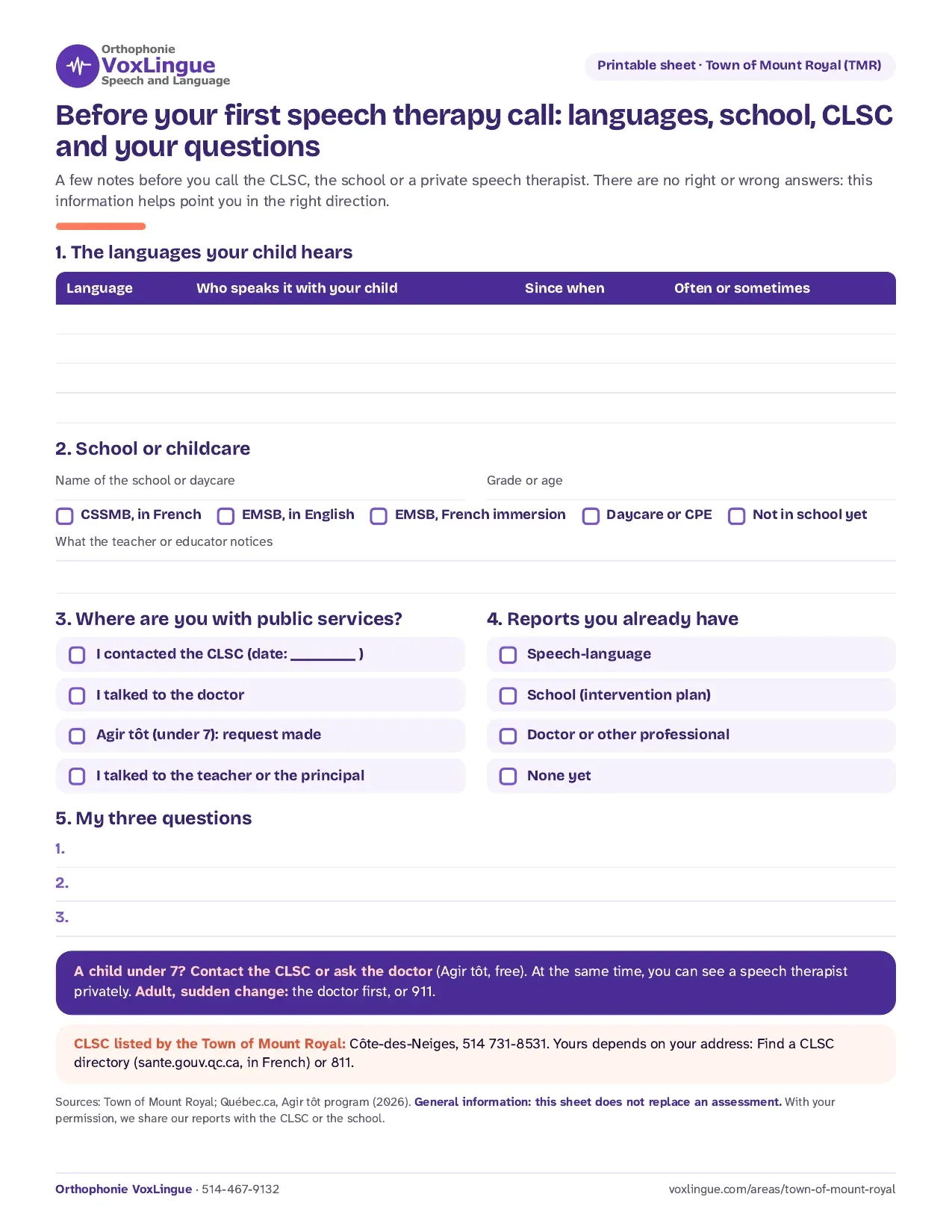
Printable sheet: Before your first speech therapy call: languages, school, CLSC and your questions (PDF, 1 page).
Public and community services for Town of Mount Royal (TMR) families
Private and public services work well together. Many families keep their place on a public waiting list while starting with us, and we share reports with your permission.
CLSC de Côte-des-Neiges (depending on your address)
5700 Côte-des-Neiges Road, 514 731-8531. This is the CLSC the Town of Mount Royal lists for its residents, in Santé Québec's de la Montagne local network, CIUSSS du Centre-Ouest-de-l'Île-de-Montréal. To confirm the CLSC for your address, use the official Find a CLSC directory (in French) or call 811.
Agir tôt program
Free and voluntary, for children under 7 and their families, until they start school. Contact the CLSC or ask the doctor; another professional can also refer you with your consent. At the 18-month vaccination visit, the nurse can go over your child's development with you.
French schools of the Centre de services scolaire Marguerite-Bourgeoys
Académie Saint-Clément, École Saint-Clément-Est and École Saint-Clément-Ouest (elementary); École Mont-Royal and École Pierre-Laporte (secondary). Speech-language pathology is one of the complementary services in Québec schools: ask the school team. With your permission, we share our reports with them.
English Montreal School Board schools
Carlyle (International Baccalaureate program) and Dunrae Gardens (French immersion). For a speech or language question, start with the teacher and the principal. With your permission, we share our reports with the school team.
Reginald-J.-P.-Dawson Library
1967 Graham Boulevard. The youth section runs activities all year; check the library's calendar. Reading together, in every language your family speaks, feeds language.
Town of Mount Royal community support
60 Roosevelt Avenue, 514 734-2937. This free Town service welcomes, guides and supports residents, newcomers included, and tells them about the resources available.
Information checked in November 2026. The health network is being reorganised under Santé Québec: check with each service where to go and how to apply.
How we can help
Common questions
Is there a speech therapist near the Town of Mount Royal (TMR)?
Yes. Our clinic is at Marché Central, 9580 boulevard de l'Acadie, just north of Highway 40. It is a few minutes from TMR, by car or by bus from Acadie métro station. We also offer online sessions by secure video, anywhere in Québec and Ontario.
Which CLSC serves the Town of Mount Royal?
The Town of Mount Royal lists CLSC de Côte-des-Neiges for its residents, at 514 731-8531. TMR has no CLSC within its borders, and the CLSC that serves you depends on your address. To confirm, use the Québec government's official Find a CLSC directory (in French), or call 811.
Do I need a doctor's referral to see a private speech therapist?
No. You can contact us directly, without a medical referral, and we provide receipts for private insurance. Public services work differently: contact the CLSC or ask the doctor. You can see a private SLP while a public request is under way.
Can I keep my place at the CLSC and start privately?
Yes. Many families keep their place on the public waiting list while they start privately, and the two routes move forward at the same time. With your permission, we share our reports with public services or the school team. The public list and private follow-up do not exclude each other.
My child is under 7: how do I apply to Agir tôt?
Contact the CLSC or ask the doctor. Agir tôt is a free, voluntary program for children under 7 and their families, until they start school. Another professional can also refer you with your consent. At the 18-month vaccination visit, the nurse can go over your child's development with you.
My child goes to a French school and we speak English at home: should we worry?
Not in itself. In TMR, many children learn in French at school and speak another language at home. Learning the school language takes time. A language difficulty, on the other hand, shows up in all of a child's languages. Consult if you have doubts.
My child is in French immersion at Dunrae Gardens: will the speech therapist assess in English and French?
Yes. The SLP looks at English and French, and at any other language your child hears at home. Our team works in English and French, and some clinicians also speak other languages. Comparing languages helps tell learning time apart from a language difficulty.
Does my child's school have a speech therapist?
Speech-language pathology is one of the complementary educational services in Québec schools, but how it is organised varies from school to school. To find out, talk to the teacher and the principal, at a CSSMB school or an EMSB school. With your permission, we can share our reports with your child's school team.
Can my child get speech therapy in English through the public system?
In some cases, yes. For the de la Montagne local network, which includes TMR, public language rehabilitation referrals go to the MAB-Mackay Rehabilitation Centre, which works in English and in French. You cannot apply directly: the request goes through the CLSC or the doctor.
We speak Arabic, Greek or another language at home: can you help?
Yes. Our clinicians work in English and French, and some also speak Greek, Spanish, Portuguese, Arabic or Armenian, depending on availability. If no one speaks your language, your clinician will learn how it works and how your child uses it. You should not stop using your home language.
Do you see adults from TMR?
Yes. We see adults for speech, language, voice, stuttering and swallowing, for example after a stroke. A sudden change in speech, voice or swallowing goes to the doctor first, or to 911 if it is abrupt. The clinic is upstairs with no elevator, so online sessions are an option.
Does the REM stop near your clinic?
No. The REM's Ville-de-Mont-Royal station takes you downtown and toward Deux-Montagnes, not to Marché Central. To reach us, take STM bus 179 De l'Acadie from Acadie métro station, or drive up boulevard de l'Acadie. Parking at the building is free.
Nearby areas
Let's talk about what you're noticing.
No referral needed. Call the clinic or send us a request, and we'll match you with the right clinician.