What to expect at a speech therapy assessment in Quebec
Clinically reviewed by Kimberly Martins, M.A. CCC-SLP · · Editorial policy

This guide explains how a speech-language assessment works in Quebec, from the first call to the report that follows. It is written for parents, for adults exploring services for themselves, and for anyone who has been told to “see an orthophoniste” without knowing what that involves.
Most readers arrive at this question a little tired. A teacher mentioned a concern. A doctor suggested a referral. An adult noticed that conversations feel harder than they used to. The next step is rarely obvious, especially in Quebec, where public and private services coexist and use different words for the same process.
You will learn who is qualified to assess, how to access an assessment publicly or privately, what the appointment looks like, what the written report contains, and what usually happens next. It is useful whether you are still exploring or already booked.
Who can perform a speech-language assessment in Quebec?
A speech-language assessment in Quebec is performed by an orthophoniste, a regulated health professional. An orthophoniste holds a master’s degree in speech-language pathology and is a member of the Ordre des orthophonistes et audiologistes du Québec (OOAQ), which grants the right to use the title and practise.
The OOAQ keeps a public directory you can search to confirm that a speech-language pathologist is a member. If a name does not appear there, the person is not authorized to perform a speech-language assessment in Quebec.
It helps to know the neighbouring professions. Audiologists assess hearing. Neuropsychologists assess cognition and behaviour through detailed testing. Occupational therapists support motor skills, sensory processing and feeding posture. These professions overlap at points, but only an orthophoniste performs a speech-language assessment.
You may also meet a speech-language pathology intern or a communication assistant during a session. Their work supports a clinician but does not replace one. Only a licensed orthophoniste signs the assessment and stands behind it. The Government of Quebec’s profile of the profession summarizes the role and training.
How do you access an assessment: public or private?
Families and adults in Quebec can access speech-language services through the public network or through private clinics. Both routes are legitimate. They differ in cost, waiting time and how you get in.

The public route runs through your local CISSS or CIUSSS. For young children, the entry point is often the CLSC, whose intake team directs families toward early-childhood services such as the Agir tôt program. For school-age children, services are sometimes offered through the school network, depending on the school service centre and available staff.
For adults, public services exist in hospitals and rehabilitation centres, particularly after a stroke, a brain injury, surgery or a progressive diagnosis.
Public waiting times vary widely by region. According to Santé Québec data released in June 2026, the median wait for children’s speech therapy in CLSCs was about 125 days across Quebec in 2025, and close to 500 days in Laval. The system is not slow through carelessness. Demand exceeds clinical capacity, and priority goes to the most urgent situations.
The private route works differently. You contact a private clinic directly; no physician referral is needed to see an orthophoniste in Quebec. Waits are often shorter. The RAMQ does not cover private speech-language services, but many employer group insurance plans reimburse part of the fee, depending on the plan.
Many families combine both routes. They stay on the public waiting list and book a first private assessment to begin understanding the situation while they wait. Our guide to the speech therapy waiting list in Québec explains how to combine the two and what to do at home in the meantime. Families outside Montréal can also see a clinician online, anywhere in Quebec.
What happens during the assessment appointment?
An assessment is not a single test. It is a structured session that looks at communication from several angles, usually over 60 to 90 minutes for a first appointment. Some clinicians split it across two visits, especially with young children who need time to settle.
Before the appointment, you receive an intake form. For a child, it asks about pregnancy and birth, early development, hearing, the languages spoken at home, daycare or school, and the concern that brought you in. For an adult, it asks about health history, work, language background, recent neurological events and the change you have noticed.
The session usually starts with an interview. The clinician asks open questions to understand the concern and its context. This part is not a test of you. It is the most efficient way to understand what brought you in and what you hope to learn.
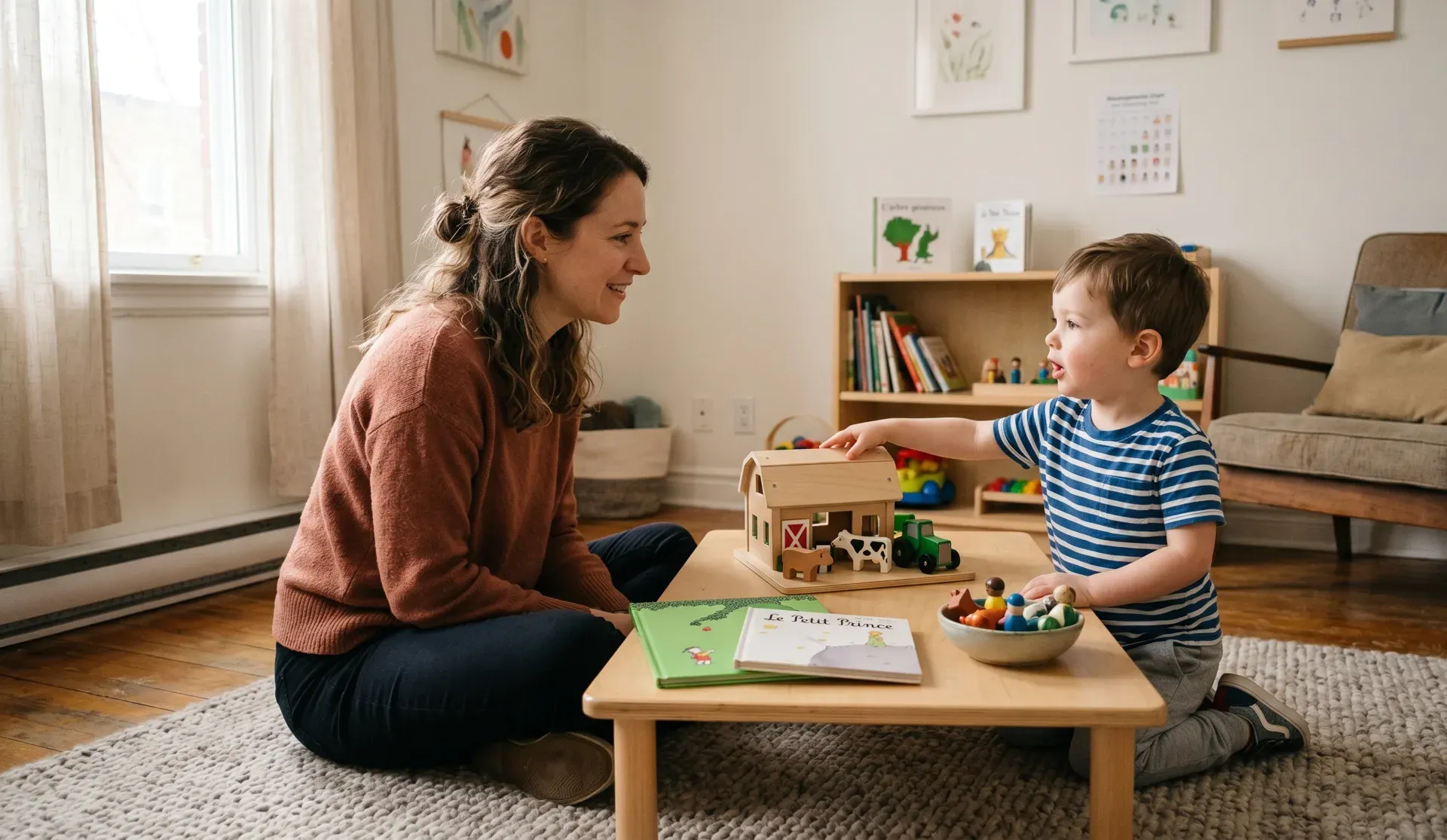
Direct observation comes next. With a young child, it often looks like play, picture books, conversation and short language games, rarely like a school test. A skilled clinician creates a setting where the child shows everyday communication, not their best behaviour under pressure.
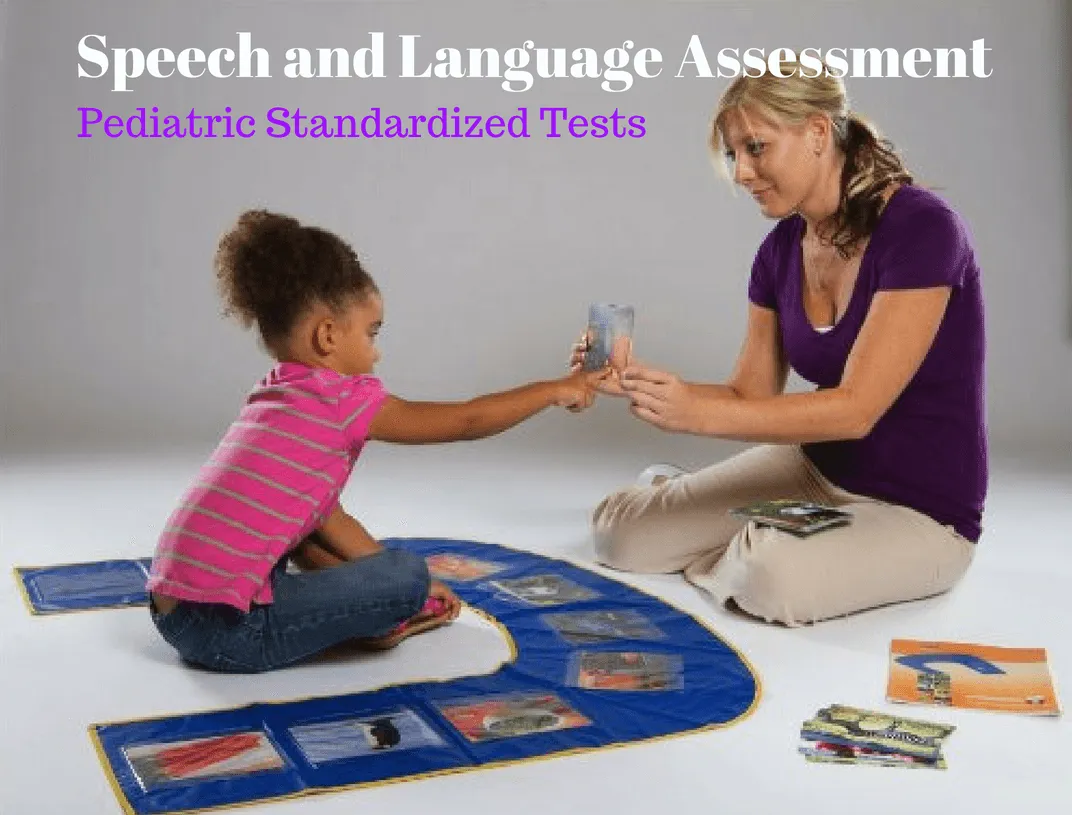
Standardized tests are used when they suit the age, the language profile and the concern. Our article on pediatric standardized speech and language tests explains how these tools work and where their limits are.
Languages matter in Quebec. Many orthophonistes assess in French, English or both, and they account for every language a child uses when interpreting results. A bilingual child is not simply compared with a monolingual norm.
For adults, the session may include conversation samples, reading and writing tasks, voice recordings or a cognitive-communication screening. The shape of the appointment follows the concern, not a fixed template.
A good assessment listens as carefully as it tests, because daily communication is where the real picture lives.
What does the assessment report contain?
A useful report explains what the clinician observed, what it likely means and what could help. It includes the reason for consulting, the developmental or health history, observations, any test results, clinical impressions and recommendations. You usually receive it a few weeks after the appointment.

The clinical impressions section is often the most informative. It is where observations and scores become a coherent picture in plain language.
Recommendations vary. They may include therapy at a given frequency, strategies for home or work, school accommodations, referrals to other professionals, or monitoring with a follow-up date. Not every assessment leads to therapy. Sometimes the most appropriate recommendation is reassurance and a check-in three to six months later.
Most clinics offer a meeting or a call to walk through the report. If you receive a report without explanation, it is reasonable to ask for that conversation. Reports can be dense, and a short walkthrough often saves weeks of confusion.
Reports are confidential. They are shared only with your consent, whether with a school, another professional or an insurer. A careful clinician explains who will see the report and why.
What happens after the assessment?
The next steps depend on what the assessment showed and on what the family or adult wants to prioritize. The clinician proposes a direction; you decide what fits.
If therapy is recommended, the orthophoniste usually outlines first goals, a suggested frequency and a starting plan. For young children, this often means weekly sessions with a parent involved. For school-age children, it may include coordination with the school. For adults, therapy goals are linked to work and daily life.
If monitoring is recommended, you receive a clear timeline. A follow-up at three or six months shows whether development has continued on its expected path or whether the picture has changed. This option is sensible and underused, because development naturally varies.
Coordination with other professionals is common: the daycare, the school, an audiologist or an occupational therapist for a child; a return-to-work team or a rehabilitation program for an adult. You can always ask questions afterward or request a second meeting to clarify a recommendation. Our newsletter on what communication really looks like shows how much there is to notice in everyday moments.
How can you prepare for the assessment?
The most useful preparation is not coaching or rehearsing. It is gathering a few specific observations. A short list of real moments gives the clinician far more to work with than a general worry.

Before the appointment, write down two or three moments when communication felt hard and two or three when it felt easier. The contrast matters as much as the difficulty. Bring previous reports, hearing test results, comments from daycare or school, and relevant health history.
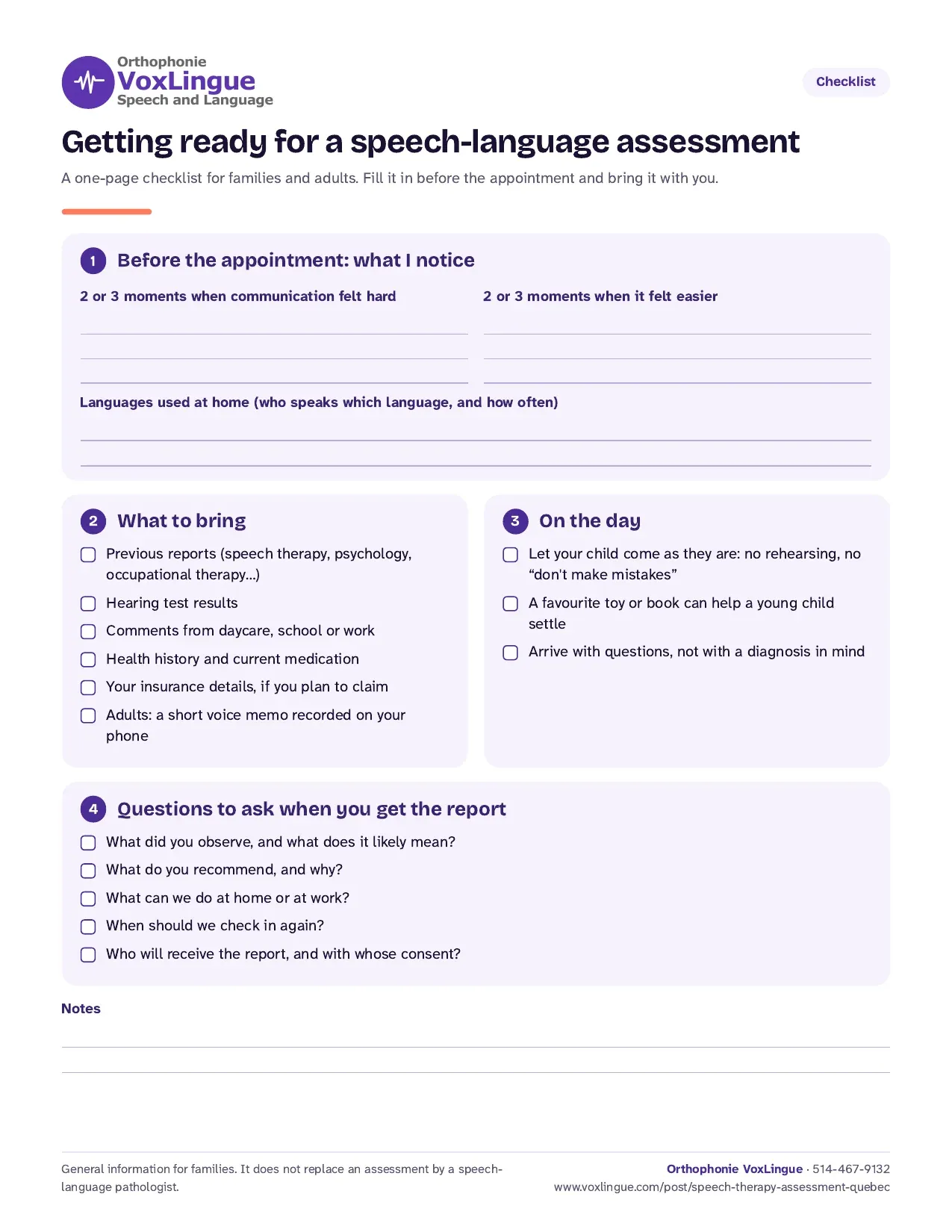
Printable checklist: Getting ready for a speech-language assessment (PDF, 1 page). Fill it in before the appointment and bring it with you.
Let young children come as themselves. Do not rehearse the visit or warn them not to make mistakes. A nervous child is fine; a coached child is harder to understand.
Adults can bring a short voice memo recorded on a phone, and a list of the situations where the concern shows up most: meetings, phone calls, family dinners, speaking in a second language.
Try not to arrive with a diagnosis already in mind. Even when a label seems likely, leave room for the clinician’s reading. An assessment is there to inform you, not to confirm what you expect.
When is it time to consider an assessment?
You do not need a crisis to consider an assessment. Several common patterns are reasonable grounds for talking to an orthophoniste, even when the situation feels mild.
For young children, these include few words or no word combinations by around age two, and speech that stays hard to understand past the usual ages. Stuttering that lasts more than a few months, or a sudden change in communication after an illness, are also good reasons.
For school-age children and teens, look at patterns rather than isolated moments. Repeated comments from teachers about understanding, written expression or social communication are worth looking at together.
For adults, a voice change lasting more than a few weeks, new difficulty finding words, or communication difficulties after a stroke, brain injury or surgery all justify a conversation. Sudden changes in speech, swallowing or voice should be checked by a doctor first; a speech-language pathologist can help afterward.
An assessment is not a commitment to therapy. It is a way to understand, and that distinction is the most important point in this guide.
Common questions
Do I need a doctor’s referral for a private speech-language assessment in Quebec? No. You can contact a private orthophoniste directly. Some insurance plans ask for a referral for reimbursement, but the profession does not require one.
How long does a speech-language assessment take? A first appointment usually lasts 60 to 90 minutes. Some clinicians split it across two visits, especially with young children.
Does the RAMQ cover a private speech-language assessment? No. The RAMQ does not cover private speech-language services. Many employer group insurance plans reimburse part of the fee, depending on the plan.
What is the difference between an orthophoniste and an audiologist? An orthophoniste assesses and treats speech, language, voice, fluency, swallowing and cognitive communication. An audiologist assesses hearing. Both professions are regulated by the OOAQ.
Can my child be assessed in English in Quebec? Yes. Many orthophonistes assess in English, French or both, and they consider every language a child uses.
If you would like to see how a private clinic organizes an assessment, from intake to the report meeting, our assessment page describes each step. More articles on this topic are in our assessment section. You can read them without any commitment; the value of an assessment lies in the clarity it brings, whatever route you choose.