Your child hears two or three languages: how to count words across all of them to know whether language is developing well, and when to ask for help
Clinically reviewed by Kimberly Martins, M.A. CCC-SLP · · Editorial policy
All Their Languages · Issue 4 · November 17, 2026 · 15-min read
The Brief
When we assess a child who’s growing up with two or three languages, we add up their words across every language. Here’s an example: a 2-year-old who says 30 words in English with her parents and 30 in Tagalog with her grandmother says 60 words, and that total is what we compare with the markers for her age. Counted in one language, a bilingual child’s vocabulary nearly always looks thin. Added up, it looks like a child who speaks only one.
That’s the reality for a lot of families here. In the 2021 census, 26.9% of children under 15 in the Montréal area spoke more than one language at home, more than one in four (Statistics Canada, our calculation).
This week in 60 seconds
- What’s changing: two US studies published in late October show that the home language is the more fragile one when school runs in another language. Québec’s order of speech-language pathologists gets a new president on Friday, and the Grande semaine des tout-petits runs until Sunday.
- The Deep Dive: add up words in every language. What justifies a call is difficulty that shows up in each of your child’s languages.
- Try this week: the same bath every night, with the same words in your home language, and a 10-second pause.
- Myth or fact: “Learning two languages causes language difficulties.” Myth, even for children who have a language disorder.
- Your question: how many words does your child say in each language?
What’s changing
October 29 and 30, 2026: two studies on the home language when school is in another language
A study published October 29 in Frontiers in Education followed 54 Spanish-English bilingual children in the Phoenix area of Arizona from pre-kindergarten (around age 5) to Grade 3. All of them went to English-only schools, and 15 had developmental language disorder (DLD).
In English, the two groups grew in similar ways. In Spanish, the home language, the gaps were wider: the children with DLD made little progress after Grade 1. The authors conclude that Spanish “showed greater vulnerability than English.” Two limits: the DLD group has only 15 children, and the study didn’t measure how much Spanish each child heard.
The next day, a second US study by Janelle Flores and Anny Castilla-Earls followed 113 Spanish-English bilingual children aged 4 to 8. Over the years, the children rated their own Spanish lower and lower, especially when they said they used it little.
What it means for your family: in Québec, daycare and school mostly run in French, so the home language lives at home. If your child is ever assessed, ask that the home language be assessed too: in the Phoenix study, that’s where the difficulties showed most.
November 20, 2026: a new president at the OOAQ
The Ordre des orthophonistes et audiologistes du Québec announced on October 13 that Karina Ismail had been elected president by acclamation. She’s a bilingual speech-language pathologist with more than 20 years of experience in health, education and private practice. She succeeds Paul-André Gallant and takes office this Friday. In the announcement, she calls better access to quality speech-language and audiology services, suited to Quebecers’ needs, « indispensable » (essential). The order has 3,620 speech-language pathologists and more than 575 audiologists.
What it means for your family: nothing changes in your steps this week. The OOAQ did gather its resources on children’s communication on November 16, including a page on communication from 0 to 6 and a podcast. They’re in French, and reliable.
November 16 to 22, 2026: the Grande semaine des tout-petits, in Montréal too
The Collectif petite enfance is holding the Grande semaine des tout-petits (early childhood week) this week, under the theme « Un grand Québec commence petit » (a great Québec starts small). On Friday at noon, a webinar in French with Québec’s children’s commissioner (the Commissaire au bien-être et aux droits des enfants) looks at new tools for children’s rights.
A few Montréal libraries are marking the week. On Saturday, November 21 at 10:30 a.m., there’s a musical story time at the Marie-Uguay library in the Sud-Ouest. On Sunday, November 22 at 10:15 a.m., the Saul-Bellow library in Lachine has a free music session for children 0 to 3, with registration.
What it means for your family: a story time is French heard in a group, with songs that come back. At bedtime, sing a rhyme from your own childhood in your language. Both count.
The Deep Dive
How many words should a 2-year-old say? The language charts Québec speech-language pathologists hand to parents give a clear marker: fewer than 50 words at 2, you ask for an opinion. But 50 words in which language? For a toddler who hears French at daycare, Spanish with his parents and English with his cousins, that question changes everything.
That toddler is no exception here. In Montréal, 69.8% of people can hold a conversation in two or more languages, and Spanish and Arabic are the languages other than French and English spoken most often at home (Statistics Canada, 2021 census).
Why one language at a time undercounts your child
A bilingual child doesn’t learn every word twice. Daycare words, like nap, snowsuit or friends, often come in French. Home words, like bath, favourite dishes or pet names, come in the home language. Count one language and you’re counting part of what he knows.
The numbers from one study in South Florida make it plain. Researchers followed 47 Spanish-English toddlers from 22 to 30 months and compared them with 56 children who spoke only English (Core and colleagues, 2013). Parents checked off their child’s words on a long list. At 22 months, the English-only toddlers said 198 words on average. The bilingual toddlers said 121 in English and 86 in Spanish. Added up: 208.
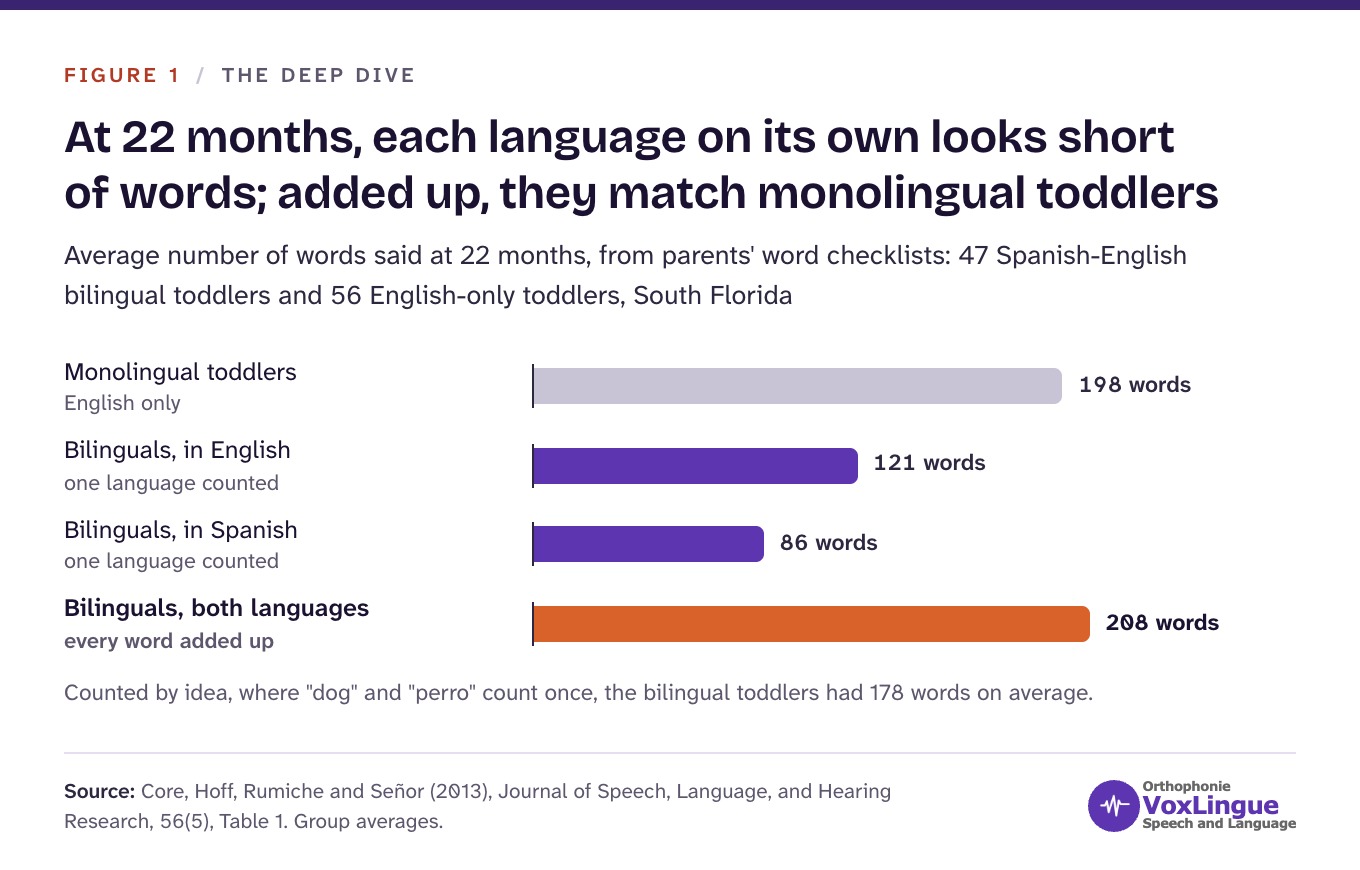
In one language, a bilingual toddler looks far behind; with both languages added up, they say as many words as a monolingual toddler.
The authors draw a conclusion for assessment: use the total. Comparing a bilingual child with one-language norms underestimates what the child knows and flags too many children as at risk.
In Montréal, a 2024 study pooled 743 children aged 8 to 33 months who were learning French, English or both (Byers-Heinlein and colleagues). Same pattern. In one language, bilingual children had fewer words than monolingual children. With all their words counted, they had more. The researchers also looked at a second count, by idea, where “dog” and “chien” count as one. On that stricter count, bilingual children said slightly fewer words than monolinguals.
For parents, the Québec rule is clear. The API-Enfance language development charts (in French), supported by the CIUSSS de la Capitale-Nationale, say they were designed for French-only children. For a bilingual child, you add up the words he uses in all his languages, and you can check whether he does what’s expected for his age in at least one language. So “dog” and “chien” count as two words.
And with three languages? A Montréal team compared 20 trilingual and 170 bilingual toddlers aged 17 to 33 months (Côté and colleagues, 2022). The third languages ranged from Arabic and Creole to Spanish, Italian and Portuguese. In French and English only, the trilingual toddlers said about two thirds as many words as the bilingual ones. The gap wasn’t statistically solid, because children varied so much. And their third language wasn’t counted at all. The researchers conclude that these children likely need to be assessed in all three languages.
How to count, this week
Take a sheet of paper or a note on your phone, with one column per language. For a week, write down every word your child says, and who he says it to. A few rules, from the Québec charts and Naître et grandir:
- every word counts, even if it’s mispronounced: “nana” for banana is a word;
- sound words like “yum” and “uh-oh” count too;
- a word in two languages counts twice: “water” and “agua” make two;
- a little mixed sentence, like “more leche”, is a real two-word sentence.
Then compare the total with the charts’ markers for asking a speech-language pathologist’s opinion: fewer than 14 words around 18 months; fewer than 50 words, or no two-word sentences, around age 2. Look at what he understands, too, and which language is moving fastest. In the 2024 Montréal study, the researchers point out that a toddler who understands little, with both languages counted together, needs particular attention.
What’s normal in a child with several languages
One language stronger than the other. CHU Sainte-Justine, Montréal’s children’s hospital, says it plainly: it’s entirely normal for a child who speaks several languages not to have the same strengths in each. Naître et grandir adds that the stronger language can change over time, for example when a child spends more hours at daycare than at home.
How big a gap is still normal? A study followed 112 children from Spanish-speaking homes from 30 to 60 months, also in South Florida (Hoff and Ribot, 2017). Their English could trail English-only children’s by 6 months to a year. The authors offer a concrete rule. A gap of up to 6 months in the community language shouldn’t be a concern if the child also has skills in the other language. Beyond 6 months, or with no skills in the other language, see a speech-language pathologist with experience assessing bilingual children.
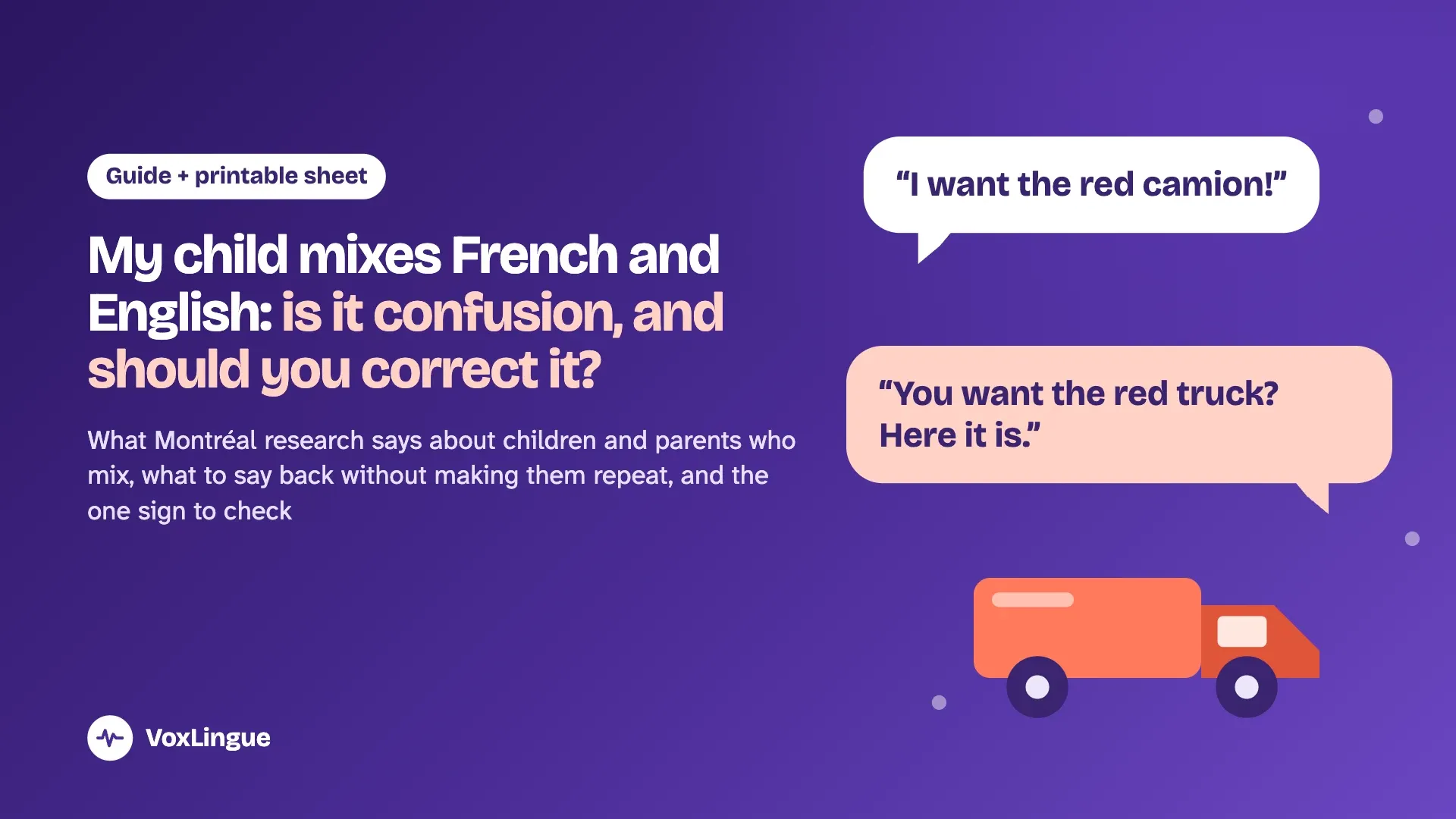
Mixing languages. CHU Sainte-Justine also calls it normal for a multilingual child to mix languages when speaking, and Naître et grandir notes that bilingual adults do it too. Our article on children who mix French and English gives examples of how to respond.
A silent period in a new language. When French arrives at daycare, many children say very little in it at first. API-Enfance’s sheet on learning a second language (in French) describes a silent period of up to 6 months. The Canadian Paediatric Society puts it at 3 to 6 months, and adds that the home language should keep growing at home. Meanwhile, the home language shows where your child really is. Our issue 3 covered what to expect from French at daycare.
What bilingualism doesn’t explain
Difficulty that shows up in every language. CHU Sainte-Justine (in French) puts it this way: a multilingual child with a language disorder has difficulties in every language he’s exposed to. If the difficulties show up in only one language, it isn’t a language disorder. The OOAQ (in French) agrees: developmental language disorder, which affects 7% of the population, isn’t caused by learning several languages.
These signs are reasons to ask for an opinion, with all languages counted together:
- around 18 months, fewer than 14 words, all languages added up;
- around 2, fewer than 50 words added up, no two-word sentences in any language, or he communicates mostly with gestures;
- around 2, he doesn’t understand simple everyday instructions like “go wash your hands” in the language he hears most;
- around 2½, he isn’t regularly learning new words in any of his languages;
- around 3, only his parents understand him.
The OOAQ adds that you can consult when language is moving slowly despite enough steady exposure to each language over several months. And your own worry is enough reason to ask. Before age 4, CHU Sainte-Justine notes, it’s hard to settle whether a child has a disorder; the term then is language difficulties, and that’s exactly the time to act.
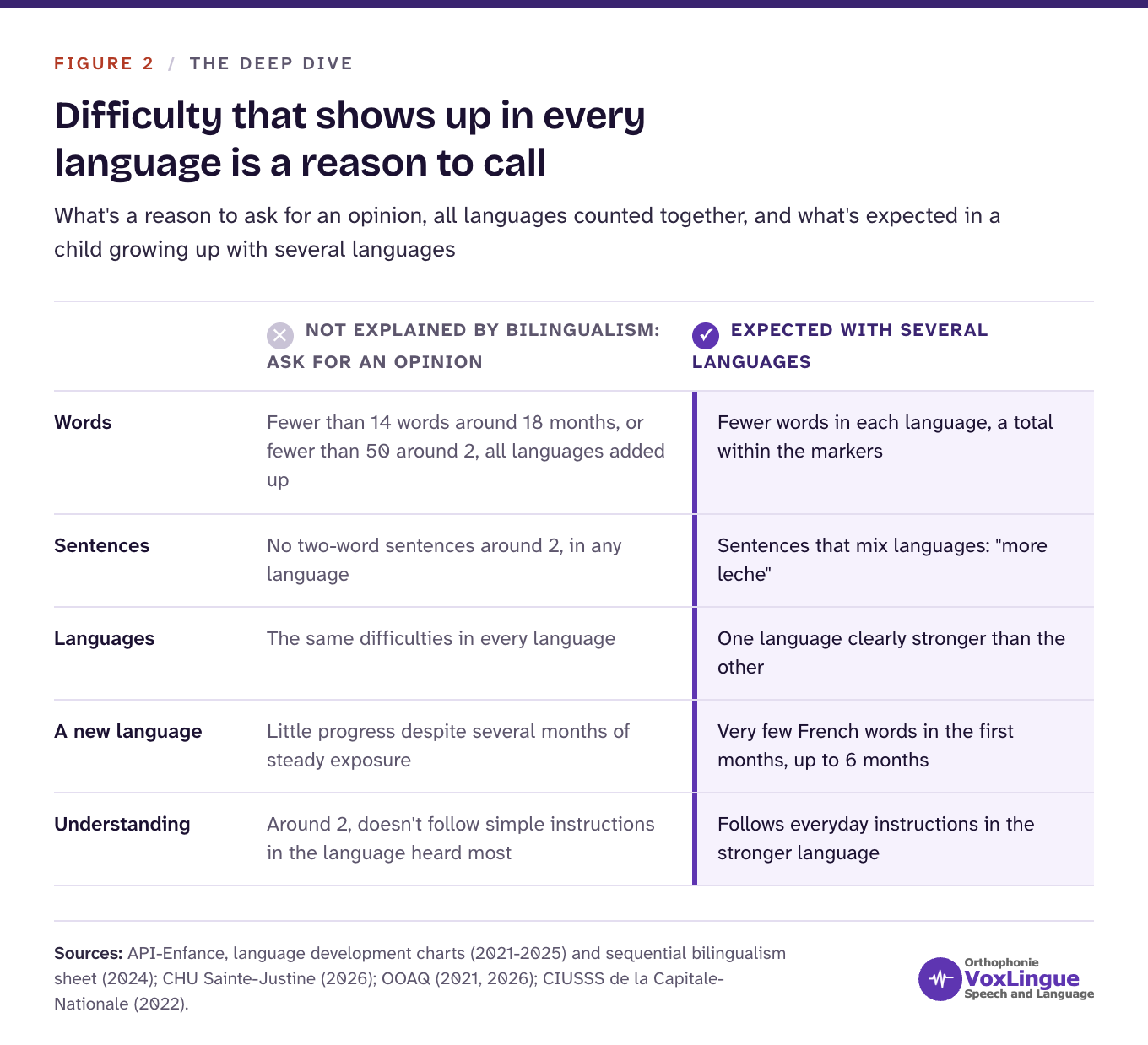
Look for the sign across all of your child’s languages: slower French on its own isn’t one.
How an assessment takes every language into account
In 2022, the CIUSSS de la Capitale-Nationale (Québec City’s health network) published a guide to speech-language assessment of bilingual children (in French). It leaves no room for doubt: assessing one language gives an incomplete picture, and the speech-language pathologist must assess the child in every language that matters to them. In practice, the guide calls for:
- a detailed language history: the age the child started hearing each language, how many hours a week, the language of daycare or school;
- an interpreter or someone who knows the language, when the speech-language pathologist doesn’t speak it;
- no norms built on monolingual children to conclude there’s a disorder;
- tasks that show how the child learns something new, not only what they already know.
The same guide notes that a profile where one language is clearly better than the other may point away from a disorder.
When we assess a child who speaks several languages, we start with that history: who speaks which language to him, since when, at home, at daycare and at the grandparents’. We also talk with the educator when we can. Your week of word lists is useful from the first meeting. Our article on identifying language disorders in bilingual children goes further.
Keep the home language
Our view: keep the home language. Always, even if your child has language difficulties. Kimberly Martins, our founder, grew up with English, French and Portuguese from birth, as she wrote in one of her articles.
The sources agree. Naître et grandir advises immigrant parents to speak to their child in their mother tongue, and notes that there’s no need to switch to one language when a child has difficulties. The Canadian Paediatric Society tells doctors never to recommend limiting a bilingual child to one language, even after a language disorder diagnosis. Hoff and Ribot, too, write that parents shouldn’t be pushed to speak the community language but supported in using their stronger, more comfortable one.
A 2013 research review by Krista Byers-Heinlein and Casey Lew-Williams is just as clear: advice to drop a language “is not supported by the science of bilingualism.” Bilingual children with a language disorder, Down syndrome or autism don’t face more difficulties than monolingual children with the same diagnosis.
And October’s studies are a reminder: when school runs in French, it’s the home language that risks fading.
If a sign worries you, start with the public system: contact the CLSC or ask the doctor. Québec’s Agir tôt program is for children under 7, and it’s free. At the same time, a private consultation, with no doctor’s referral needed, tells you what to do while you wait. At our clinic, the assessment takes all your child’s languages into account.
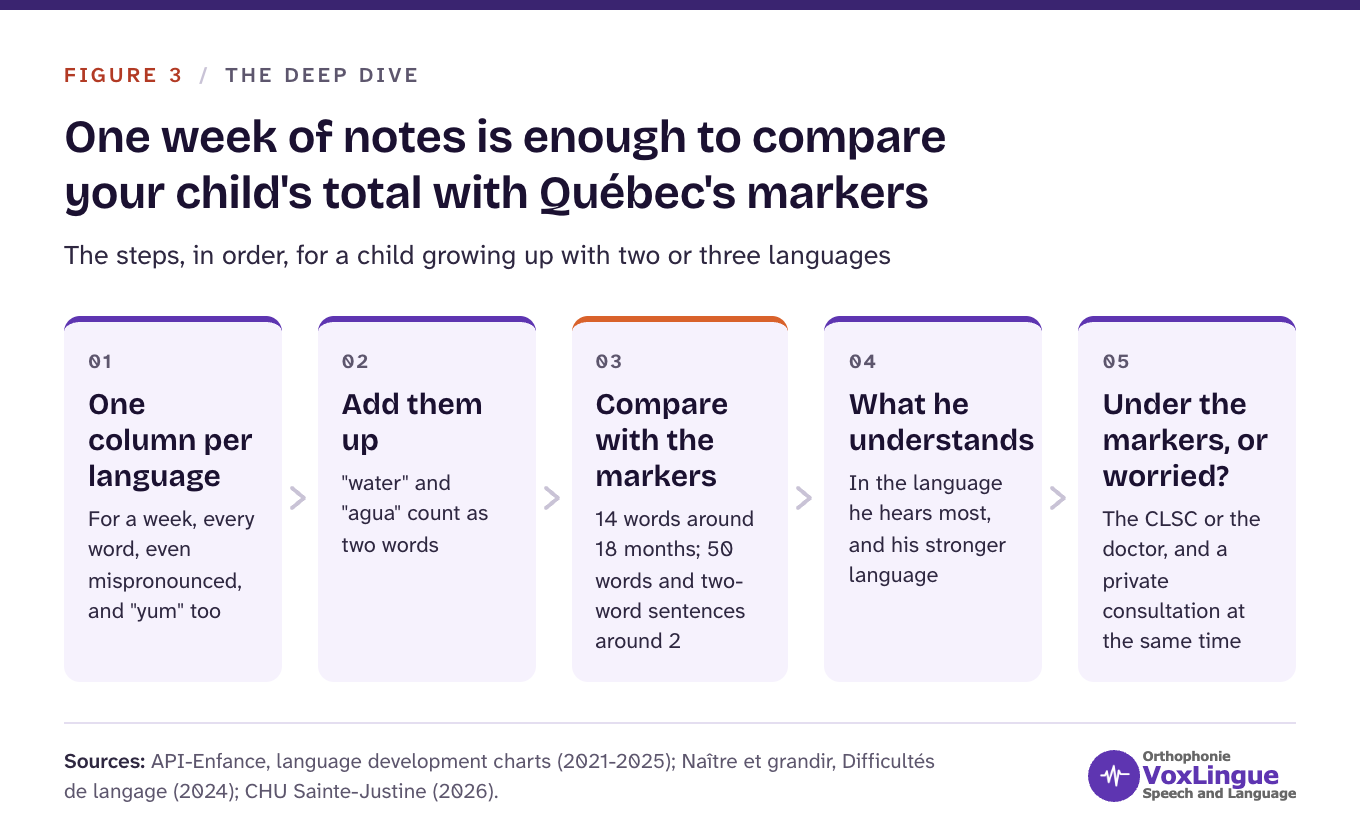
Count for a week, add up, compare: if the total is under the markers or you’re worried, contact the CLSC or ask the doctor.
What we suggest to families
- This week, write down every word your child says, one column per language, mispronounced words and “yum” included.
- Add them up, then compare with the markers: 14 words around 18 months, 50 words and two-word sentences around 2.
- Look at what he understands in the language he hears most, and which language is stronger.
- Keep your language at home, with a routine that comes back every night (see Try this week).
- Total under the markers, little understanding in every language, or a worry? Contact the CLSC or ask the doctor, and book a private consultation at the same time.
Try this week
The same bath, every night, in your language
For: 12 months to 4 years. Time: the first five minutes of bath time, every night this week.
For our speech-language pathologists, bath time and bedtime are the routines that work best: they come back every day, in the same order. Pick three steps of the bath and always give them the same words, in your language.
In Spanish, for example: “¡Al agua!” as he gets in, “Lava, lava, lava” as you wash, “¡Adiós, agua!” as the water drains. In Portuguese: “Pra água!”, “Lava, lava, lava”, “Tchau, água!”. In Arabic, Tagalog or Creole, use your own words, the ones from your childhood.
After three or four nights, start the line and stop: “Lava, lava…”. Then wait. Count to 10 in your head while you look at him. A look, a sound, a splash: it all counts as his turn. Finish the line together.
If he says a word, add one. He says “agua”? Answer “¡Sí, agua caliente!”. If he answers in English or French (“water!”), take his idea back into your language: “Sí, agua.” Don’t ask him to repeat or to translate. If he says nothing, finish the line yourself and carry on with the bath.
What to watch for: does he anticipate? Does he look at the drain before “¡Adiós, agua!”? The words he says in the bath go on your list, in your language’s column.
Around 3 or 4, swap roles one night: he says the three lines, and you “forget” the ending.
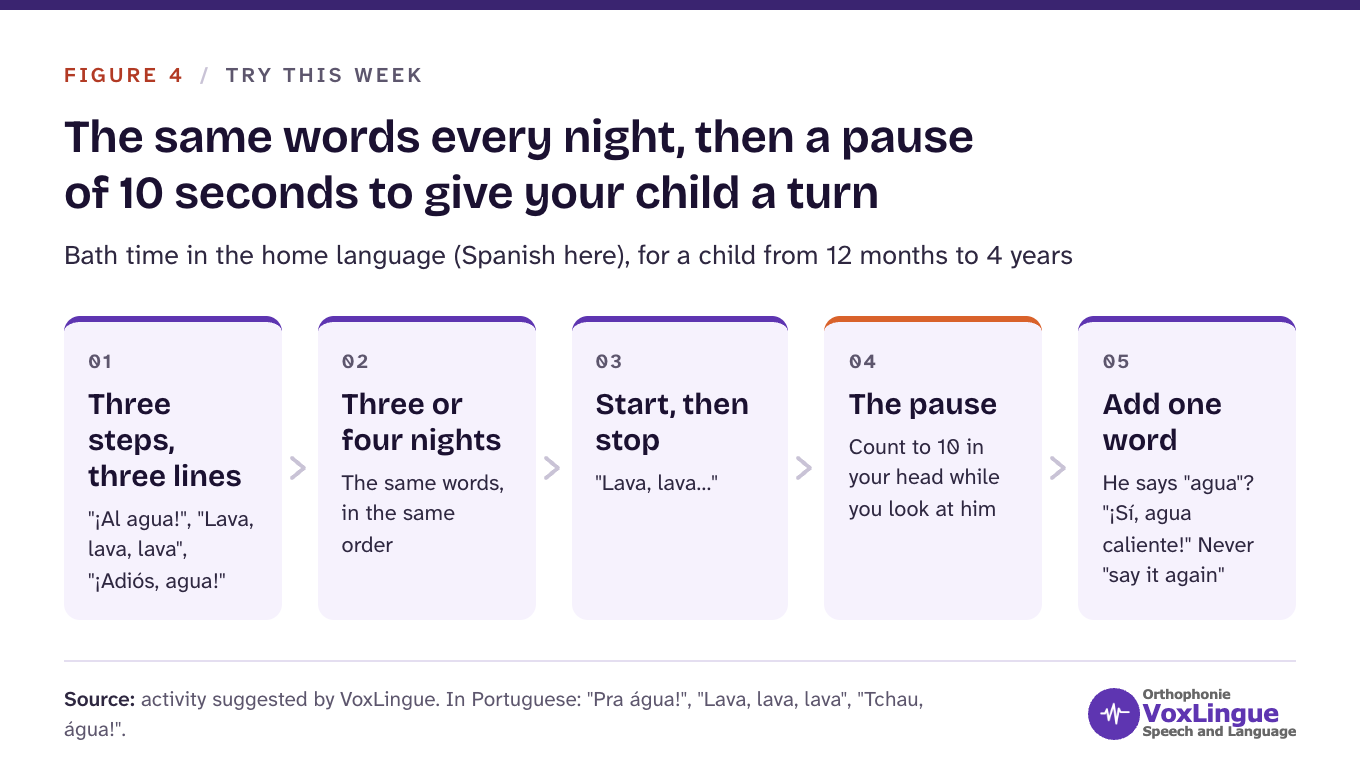
The pause is where your child can take a turn: a look, a sound, a gesture or a word, in any of their languages.
Myth or fact
“Learning two languages causes language difficulties”
Myth. The OOAQ lists it among its myths about bilingualism: learning more than one language doesn’t cause a language disorder, and doesn’t make difficulties worse in children who have them.
Research backs this up on the big milestones. A 2025 study compared 302 bilingual and 302 monolingual children, based on their parents’ reports. The bilingual children spoke Polish at home and lived in the United Kingdom, Norway or elsewhere; the monolingual children lived in Poland. Both groups babbled, said their first word, their tenth word and their first word combinations at the same ages.
What about children who really do have a language disorder? One study compared 8 French-English bilingual children with a language disorder with monolingual children of the same age with the same disorder, in English and in French (Paradis and colleagues, 2003). On verb tense endings, the bilingual children did as well as the monolingual ones. Their difficulties weren’t more severe.
The 2013 review cited above sums it up: bilingual children aren’t more likely than other children to have a language disorder. A similar share of children have one, with one language or with two.
So where does the myth come from? Mostly from counting. Compare a bilingual child’s words in one language with a monolingual child’s and he looks behind. What stays true: a bilingual child can have language difficulties, like any child. Then they show up in all his languages, and they’re a reason to call.
Worth your time
- Bilingualism in the early years: what the science says. The 2013 review by Byers-Heinlein and Lew-Williams, written for parents and educators, free to read. The section on mixing is the clearest we know.
- Language development charts, API-Enfance. In French, one page per age from 0 to 5, with the box for bilingual children. Print it even if you read French slowly: the ages and word counts are easy to follow.
- Developmental language disorder, CHU Sainte-Justine. In French, updated March 2026, with a section on multilingual children.
- Learning several languages, Naître et grandir. In French, reviewed by a Université de Montréal speech-language pathologist. The section for newcomers answers questions about French daycare.
From VoxLingue
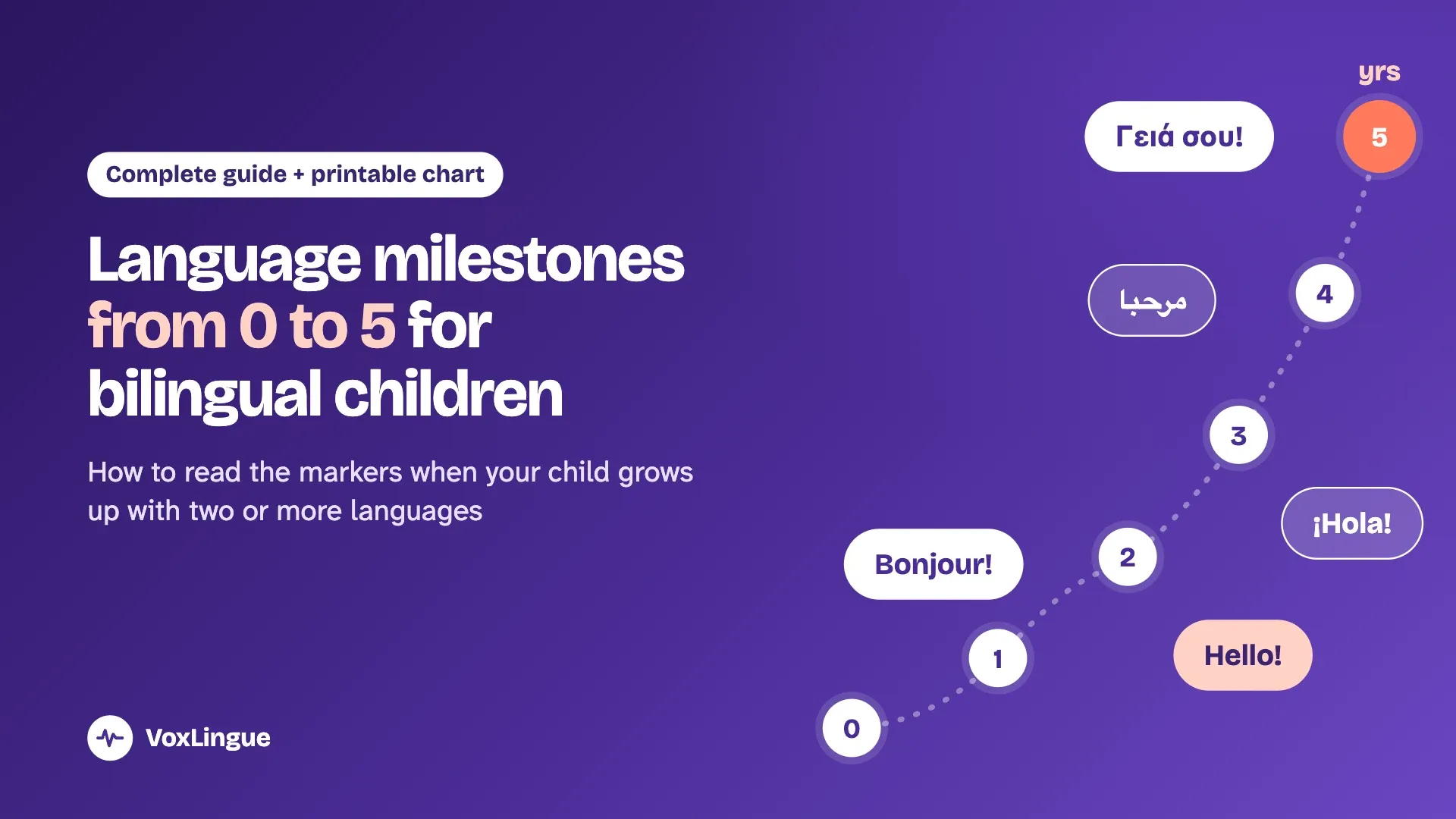
Our guide to language milestones from 0 to 5 for bilingual children sets out the markers by age with this issue’s counting rule. Its printable chart fits on one page and leaves room to log words.
A word on our name: this newsletter is now called “All Their Languages”, because most of the children we see are growing up with more than one language.
Your question
How many words does your child say in each language, and which one has the most? Send us your numbers, rough is fine, with your child’s age.
Send us your question through our contact page.
Vladimir Romanov, for the VoxLingue team
Clinically reviewed by Kimberly Martins, M.A. CCC-SLP
Orthophonie VoxLingue · 514-467-9132 · Book a consultation
This newsletter informs and does not replace an assessment.