Signs to look for
- Your toddler rarely shares attention by pointing, showing or looking back and forth between you and a toy
- Your child has many words but finds back-and-forth conversation hard to keep going
- Your child repeats phrases from shows, books or other people, and you are not sure what they mean by them
- Your child often takes figurative language, jokes or teasing literally and feels confused or hurt
- Your child or teen wants friendships but finds group conversations tiring or hard to join
- Your teen's messages or replies often land differently than they intended
- As an adult, you want clearer strategies for workplace communication or for explaining what you need
What it is
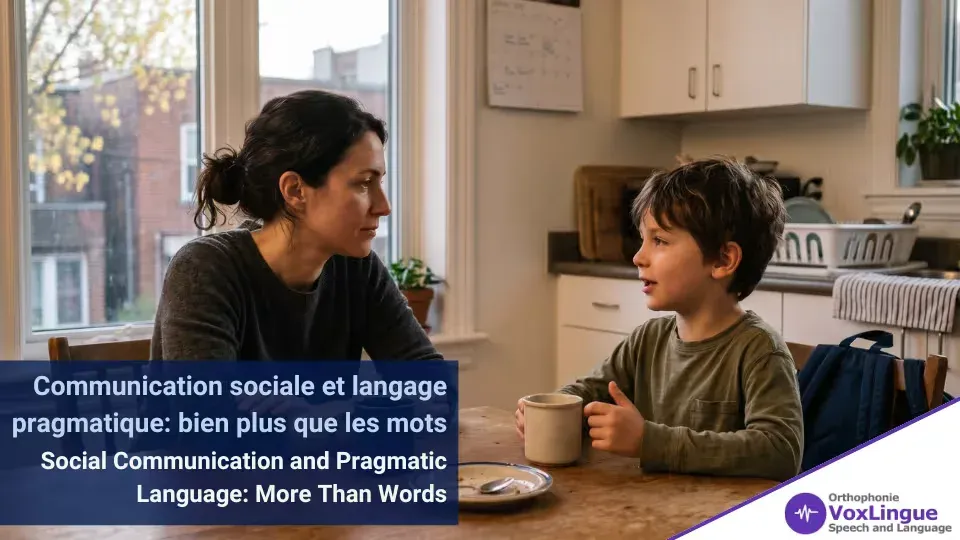
Social communication is how we use language with other people. It includes sharing attention, taking turns, starting and ending conversations, reading context, understanding jokes and figurative language, and repairing a misunderstanding. Speech-language pathologists also call this pragmatic language.
Some people find these skills come easily. Others, including many autistic people and people with ADHD, communicate in ways that differ from what the people around them expect. Those differences are not a lack of intelligence or caring. They often reflect a different way of processing language, sensory input and social information.
At VoxLingue, our approach is neurodiversity-affirming. We do not try to make anyone look or sound “less autistic.” We help children, teens and adults be understood, understand others, and say what they need, in ways that respect who they are.
Who we see
We work with people at every stage of life:
- Toddlers and preschoolers who are not yet sharing attention, using gestures, or using words to connect, with or without an autism diagnosis
- School-age children who have words but find conversation, play with peers or figurative language hard
- Teens navigating friendships, group chats, class discussions and growing independence
- Adults who want support with workplace communication, self-advocacy or conversations that feel draining
Many people we see are autistic or have ADHD. Others have developmental language disorder or a social communication difficulty without another diagnosis. You do not need a diagnosis to book an assessment.
How we assess it
A speech-language assessment builds a clear picture of how a person communicates. It is not an autism diagnosis. In Quebec and Ontario, autism is diagnosed by physicians and psychologists, and our report can add useful information to that process.
For a young child, the assessment usually includes:
- A conversation with you about your child’s history, strengths and how they communicate at home
- Observation in play: shared attention, gestures, sounds, words and how your child starts and responds to interaction
- Attention to repeated phrases, sometimes called echolalia, and what they seem to mean for your child
For older children, teens and adults, we also look at conversation, storytelling, understanding of figurative language and inference, and how communication works at school, at work and with friends. With permission, we may gather information from teachers or other professionals.
How therapy works at VoxLingue
Therapy starts from the person’s strengths, interests and own goals. For a young child, that might be trains, music or water play. For a teen, it might be a game, a hobby or a real situation they want to handle differently.
For young children
- Following your child’s lead in play so that interaction feels rewarding, not demanding
- Building shared moments through routines, songs and turn-taking games
- Responding to all forms of communication, including gestures, sounds, signs, pictures and repeated phrases
- AAC when it helps. Some children benefit from picture boards or speech-generating devices alongside speech. Research does not support the worry that AAC stops a child from talking.
Gestalt language processing
Some children learn language in larger chunks, such as whole phrases from a song or show, before breaking them into smaller parts. This is sometimes called gestalt language processing. Research on specific therapy frameworks for this pattern is still developing. Our clinicians treat these phrases as meaningful communication, notice what they are doing for your child, and model flexible language from there.
For school-age children, teens and adults
- Conversation skills that the person wants, such as joining a group, staying on a shared topic or checking for understanding
- Figurative language and inference through books, stories and real examples
- Self-advocacy, such as explaining sensory needs, asking for a break or requesting written instructions
- Literacy-based work that uses stories to explore perspective, problem solving and narrative
We do not train eye contact, ask anyone to stop stimming, or teach scripts meant to hide who a person is. Some children also benefit from our group programs, where they can practise with peers.
Your role at home
Families are partners in therapy. Most of a child’s communication happens outside our sessions, so we coach parents directly on strategies that fit daily routines such as meals, bath time and the drive to school.
For parents of young autistic children, some of our clinicians are trained in the Hanen More Than Words program, which teaches parents to build interaction into everyday moments. You can read more on our parent coaching and Hanen page.
At home, it often helps to:
- Join your child in what they enjoy before asking for words
- Pause and wait so your child has time to respond in their own way
- Treat repeated phrases as attempts to communicate
- Name social moments calmly, for example “I think she was joking”
Bilingual and multilingual families
Many families are told to drop their home language when a child is autistic. Research to date does not support that advice. Studies have not found that bilingual exposure slows language development in autistic children, and the home language carries relationships with grandparents, culture and identity.
Social expectations also vary across cultures, from how much eye contact is polite to how directly people speak. Our clinicians consider your family’s culture when they decide what is a difference and what is a difficulty. Our team speaks many languages, and we will try to match you with a clinician who fits your family. Availability varies.
In person or by telepractice
We offer sessions in person at our Marché Central clinic in Montréal, or by telepractice anywhere in Quebec and Ontario. Telepractice suits many families, especially for parent coaching, because we can see your child in their own space with their own toys. Some children are more at ease at home. Others do better in the clinic. We will help you choose.
Getting started
You do not need a physician’s referral. The first step is usually an assessment, which gives you a clear picture and a plan.
Call our Marché Central clinic at 514-467-9132, or request an appointment through our contact form. We provide receipts for private insurance.
Frequently asked questions
Do you diagnose autism?
No. In Quebec and Ontario, autism is diagnosed by physicians and psychologists. A speech-language assessment describes how a person communicates, and our report can contribute useful information to a diagnostic process. You do not need a diagnosis to start with us.
What does neurodiversity-affirming mean in practice?
It means we treat autistic and ADHD ways of communicating as valid differences, not errors to erase. We do not train eye contact or ask children to hide stimming. Goals focus on being understood, understanding others, and advocating for what you need, and they are chosen with the person and their family.
My child repeats lines from shows. Is that a problem?
Repeated phrases, sometimes called echolalia, are often meaningful. Many children use them to request, comment or regulate. Some clinicians describe this pattern as gestalt language processing. Our clinicians look at what the phrase is doing for your child and build from it rather than trying to stop it.
Is social communication difficulty always autism?
No. Social communication can be affected in autism, ADHD and developmental language disorder, and it can also exist on its own. An assessment helps clarify the communication picture so support fits your child.
Should we stop speaking our home language?
Research to date does not show that bilingual exposure slows language development in autistic children. Your home language carries connection and culture. We help families keep using the languages that feel natural to them.
Do you see autistic adults?
Yes. Some adults come for help with workplace communication, self-advocacy, or conversations that feel draining. Goals are set by you, and we never aim to make you appear less autistic.
Related areas of care
- Parent coaching and Hanen programsCoaching that helps parents and caregivers use proven strategies in daily routines, drawing on Hanen programs such as It Takes Two to Talk and More Than Words.
- Language delays and language disordersSupport for children and teens who have difficulty understanding or using language, from late talkers to school-age developmental language disorder.
- Augmentative and alternative communication (AAC)Support for people whose speech does not yet meet all their communication needs, using signs, pictures or speech-generating devices alongside speech.
- Speech and language assessment for children, teens and adultsA careful look at speech, language, voice, fluency or swallowing to find out whether you or your child can benefit from speech-language therapy, and what would help most.