Speech therapist or remedial teacher (orthopédagogue): who to call for your child in Québec
Up to date as of November 2, 2026. General information: services change, and only an assessment can say what your child needs.
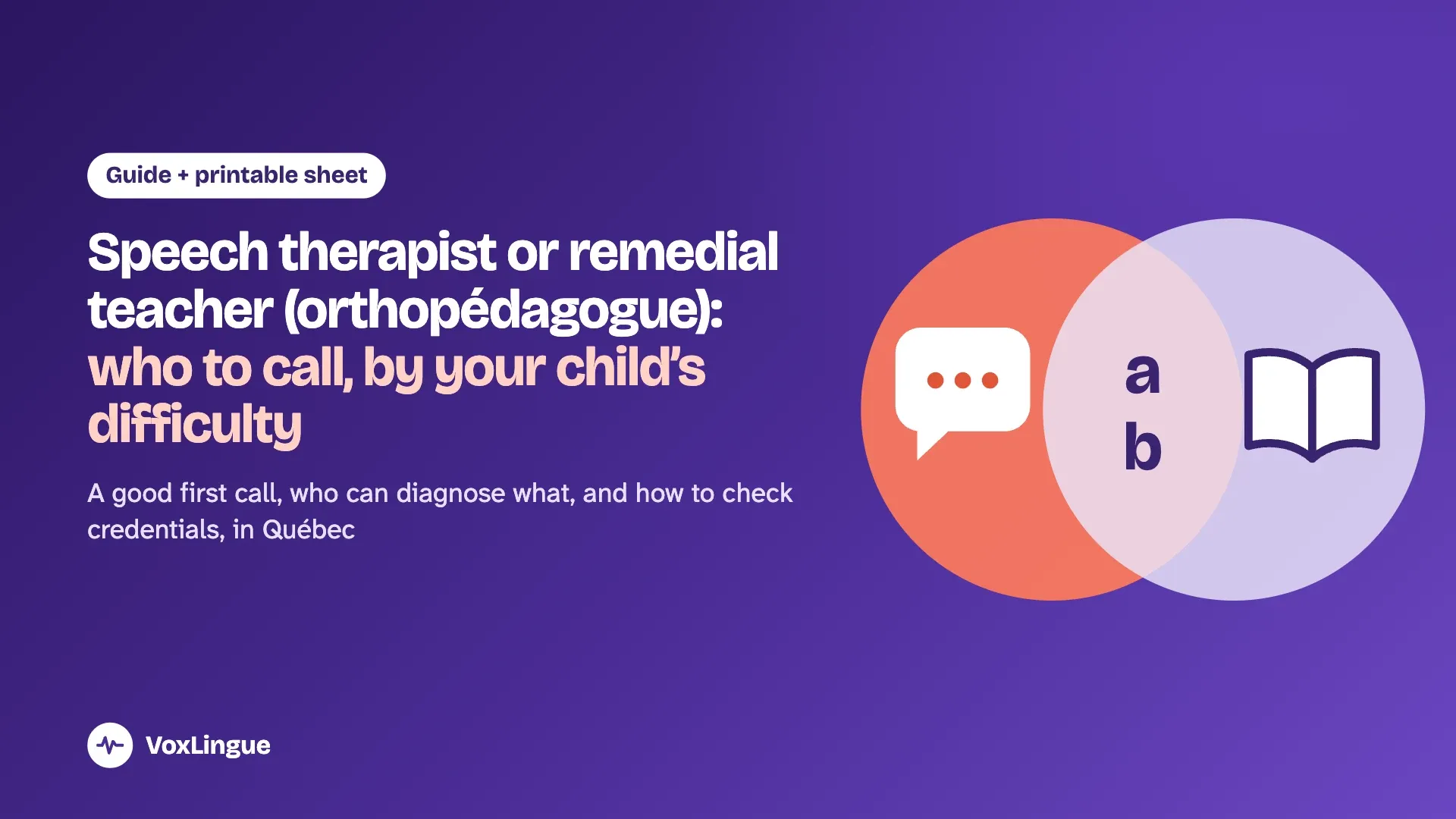
Speech therapist or remedial teacher? That is often how English-speaking parents put the question when a child in Québec struggles to talk, read or keep up in class. The teacher mentions an orthopédagogue, a friend recommends her speech therapist, and you don’t know who to call first. Nobody has told you what the French word means, and the two roles really do overlap.
This guide doesn’t argue that one profession is better than the other. It gives you a starting point based on your child’s difficulty, in Québec. It also explains who has been able to diagnose what since November 2024, what “évaluation diagnostique” means on a report, and how to check someone’s title and training.
One thing to know up front: we are a speech therapy clinic. So we have tried to be fair, and we say plainly when an orthopédagogue or the school is the right first door. Ontario gets a short section of its own.
What is an orthopédagogue, and how is that different from a speech therapist?
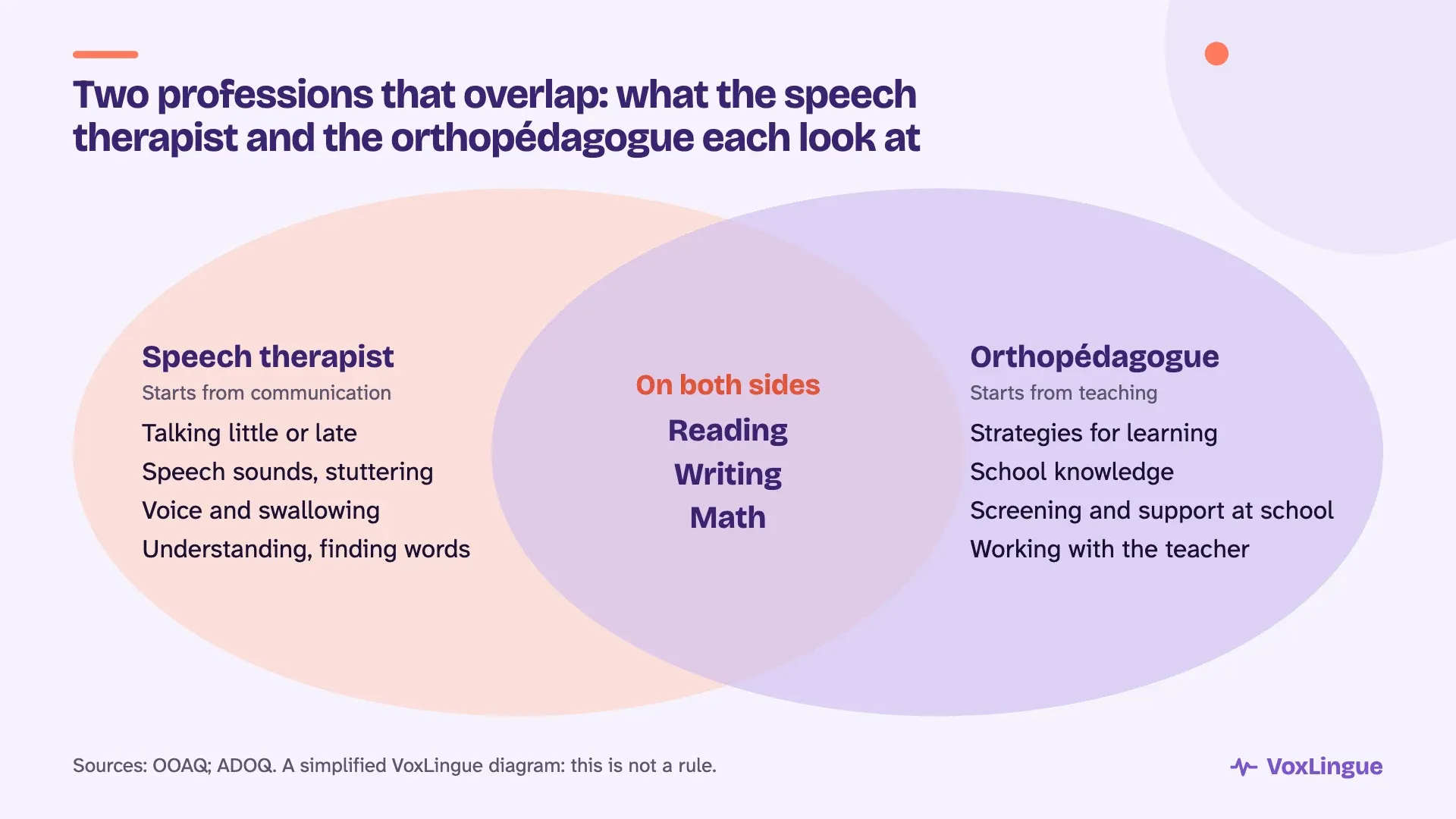
A speech therapist assesses and treats communication: understanding, talking, reading, writing, voice and speech. An orthopédagogue assesses and supports school learning: reading, writing and math. The first belongs to a professional order. The second comes from the field of education. Their roles overlap, especially in written language.
A word on vocabulary, because it trips up many English-speaking families. Québec’s language office, the OQLF (in French), gives “resource teacher”, “learning assistance teacher” and “special education teacher” as English equivalents. “Remedial teacher” isn’t on its list, although parents often search for it. In many Québec schools, you will hear “orthopédagogue”, so this guide uses that word. “Speech therapist” means a speech-language pathologist (SLP), or “orthophoniste” in French.
The Québec order for SLPs, the OOAQ, describes the role (in French) as helping people who have trouble following instructions, expressing themselves clearly, finding words, reading or writing. Speech, stuttering, voice and swallowing are part of it too.
The Québec association of orthopédagogues, the ADOQ, defines the orthopédagogue (in French) as an educator from the education sciences who both assesses and intervenes. The assessment pins down a learner’s difficulties with knowledge, strategies and cognitive processes, mainly in reading, writing and math. The intervention can be preventive, corrective or compensatory.
| Speech therapist (orthophoniste) | Orthopédagogue | |
|---|---|---|
| Field | Communication: spoken and written language, speech, voice, swallowing | School learning: reading, writing, math |
| Training | A master’s degree, according to the OOAQ | According to the ADOQ, usually a bachelor’s in teaching in adapted education, or teacher training combined with graduate studies in orthopédagogie |
| Oversight | A professional order, the OOAQ | According to the ADOQ, no professional order to date. A voluntary association |
| Where they work | The health network, some schools, private practice | Mainly schools, according to Québec’s Office des professions (2014), and also private practice |
| How an assessment ends | A diagnosis for language and language-related learning, or a speech-language conclusion | A precise picture of the difficulties, which guides the intervention |
The two lists meet in the middle. Reading, writing and math appear in both the OOAQ’s description and the ADOQ’s. One starts from communication, the other from teaching, and the same difficulty can concern both. That is why this question doesn’t always have one right answer.
Who should you call first, based on your child’s difficulty?
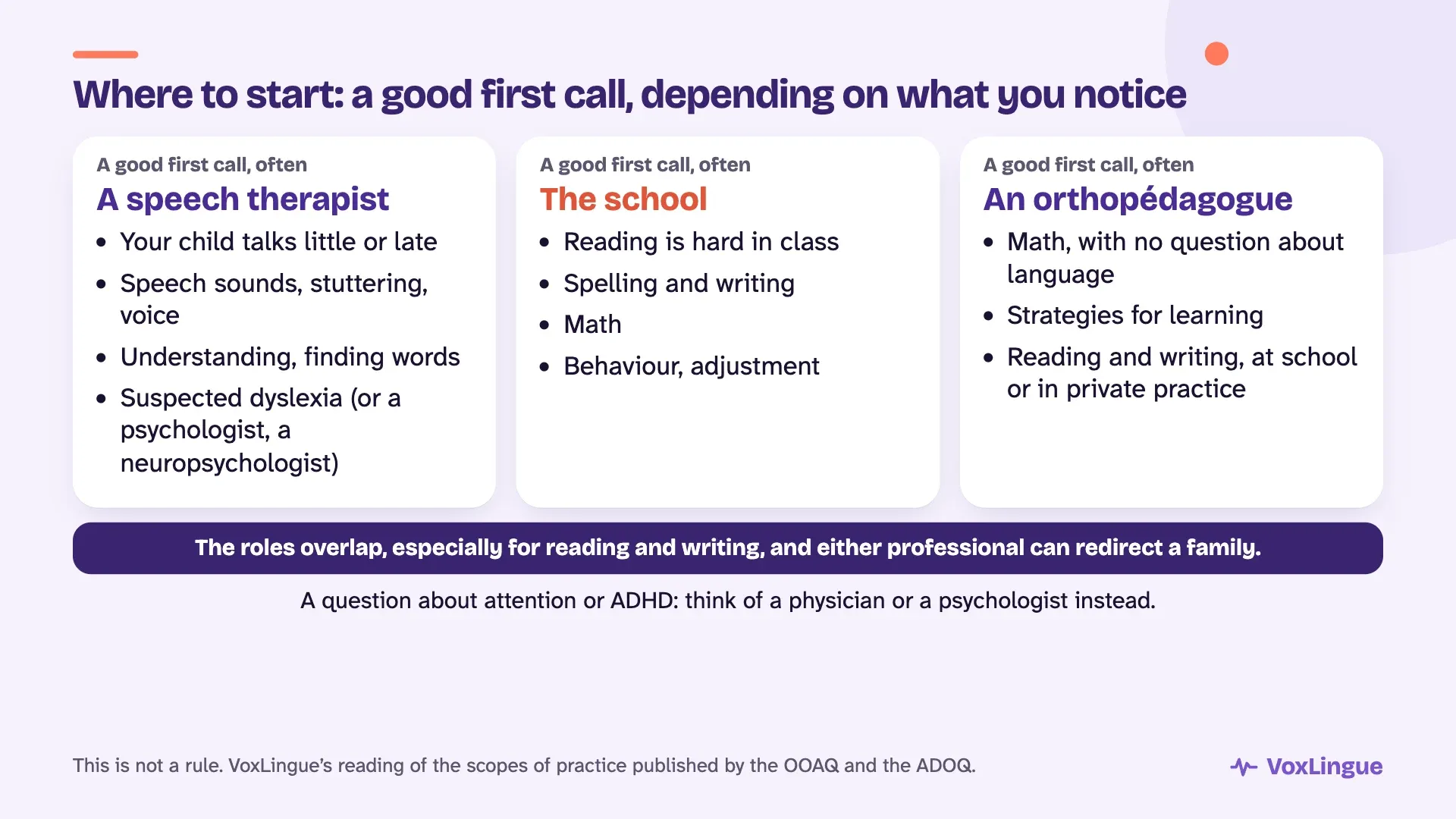
For talking, pronouncing, stuttering or understanding, a speech therapist is often a good first call. For reading, writing or math in class, the school is often the first door. In private practice, an orthopédagogue often suits math and learning strategies. None of these is a rule, and every family’s situation differs.
This table is our own reading of the published scopes of practice. It doesn’t come from a professional order or an association. Start from what you notice, not from a diagnosis you think you recognize.
| What you notice | A good first call, often | Also worth knowing |
|---|---|---|
| Your preschooler talks little or late | A speech therapist. In the public system, your CLSC (Agir tôt, under 7) | Our guide to the wait explains the public route |
| Speech sounds, stuttering, voice, swallowing | A speech therapist | The assessment ends in a speech-language conclusion, not a diagnosis |
| Understanding instructions, finding words, building sentences | A speech therapist | This applies at school age too |
| Reading is hard in class | The teacher, then the school’s orthopédagogue | No diagnosis is needed to ask for help. In private practice, an orthopédagogue or a speech therapist can also assess |
| You suspect dyslexia and want a clear answer | A speech therapist, a psychologist or a neuropsychologist | Physicians share this activity too, according to the OOAQ. An orthopédagogue’s report can contribute |
| Spelling and writing | The school first. After that, either one | A speech therapist if spoken language also seems affected. An orthopédagogue if the question is about strategies |
| Math | The school, or an orthopédagogue | A speech therapist if language seems involved, or if dyscalculia is suspected. This is the least clear-cut row |
| Strategies for learning: how to approach a text, a problem, studying | An orthopédagogue, at school or in private practice | According to the ADOQ, the assessment covers strategies too |
| Attention, a question about ADHD | A physician or a psychologist | A speech therapist can’t make this diagnosis, according to the OOAQ. See below |
| Behaviour or adjustment at school | The school team, which may include a psychoeducator | See below |
The roles overlap, especially for reading and writing, and either professional can redirect a family. Reaching the “wrong” person first is no big deal. Describe what you notice, and ask who to turn to if they aren’t the right service.
When is an orthopédagogue or the school the right first door?
The school is often the first door for a learning difficulty in class. Talk to the teacher, then ask whether the orthopédagogue can see your child. In private practice, an orthopédagogue is often a good first call for math or learning strategies, especially if language doesn’t seem to be involved.
The school sees your child in the act of learning. The teacher notices the difficulties every day, and the orthopédagogue can pin down what is getting in the way. According to the ADOQ, this work includes screening and takes in other factors, such as motivation and teaching approaches. The intervention is with the student directly, working with the teacher, the parents and other professionals.
An orthopédagogue in private practice has a place too. She can be a good first call if math is the main difficulty and language isn’t in question. The same goes if your child understands well when listening, but doesn’t know how to go about learning. The ADOQ notes that some also work online.
School roles vary from one setting to another. According to the Office des professions (2014), a school’s orthopédagogue may be on the teaching staff or the professional staff. In high school, you may also hear about a resource teacher (“enseignante-ressource”), a role governed by the teachers’ collective agreement, according to UQAM researchers (2014). Ask the school who does what there.
Before school age, an orthopédagogue is less often the right door. According to the same Office report, she works mainly in schools, and only occasionally in early childhood centres. For a toddler who talks little, the CLSC or a speech therapist remains the usual starting point.
Who can diagnose what in Québec since November 2024?
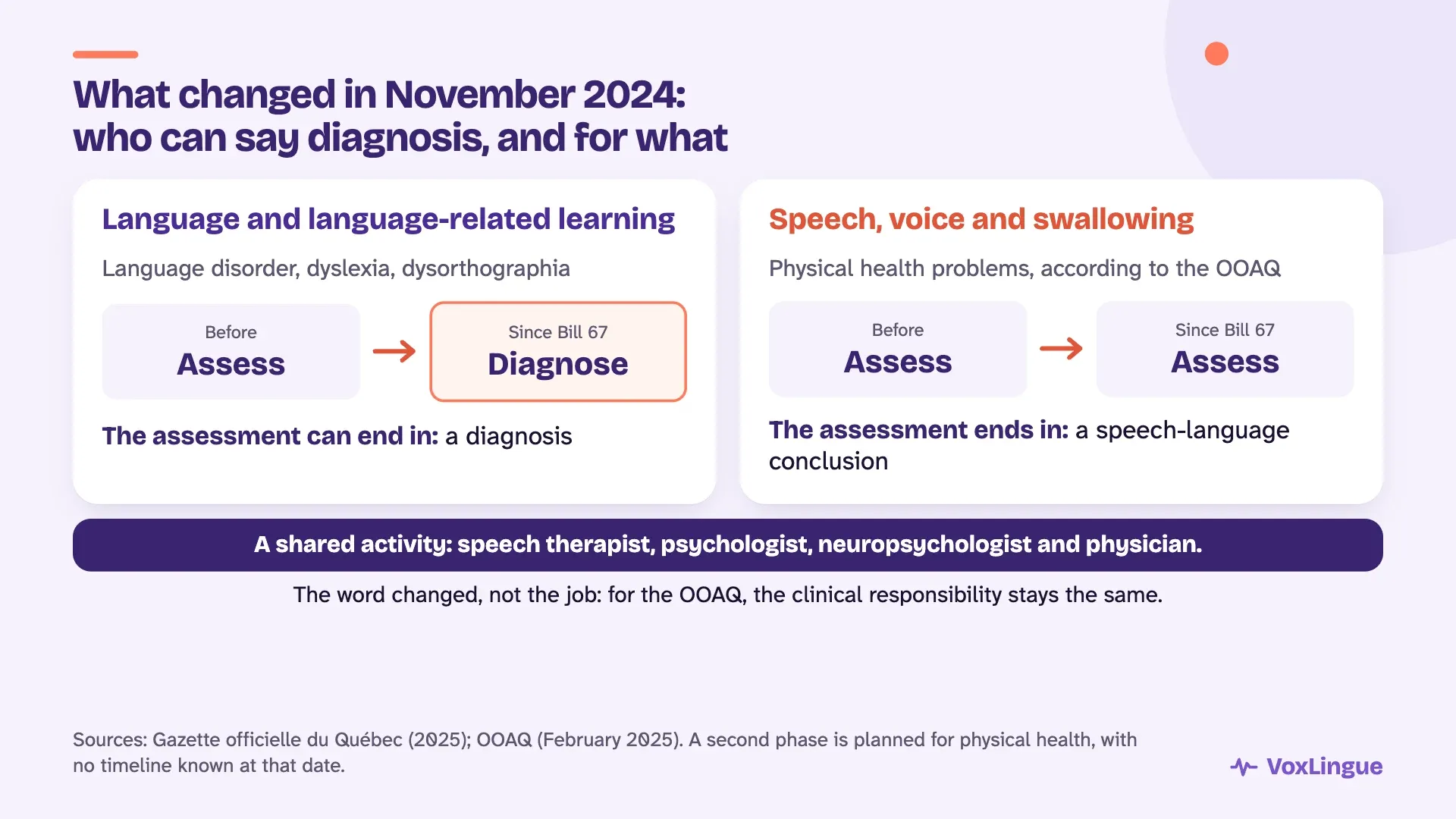
Four professions can diagnose dyslexia or a language disorder in Québec. They are the speech therapist, the psychologist, the neuropsychologist and the physician, according to the OOAQ. Bill 67, passed in November 2024, gave speech therapists the word “diagnose” for these disorders. Speech and voice stay separate, for now.
Here is the change in plain terms. Before, the text said speech therapists “assess” these disorders. Since Bill 67, the text published in the Gazette officielle (in French) says they may diagnose language disorders and learning disorders related to language.
The word changed, but the job didn’t. The OOAQ explains (in French) that this isn’t a different clinical responsibility: speech therapists could already conclude whether or not such a disorder was present. The scope of practice remains the same.
No single profession owns this diagnosis. The OOAQ says that psychologists, neuropsychologists and physicians share the activity, as they did before the law. The order of psychologists (in French) writes that a learning disorder can be diagnosed by any psychologist with the skills to do so. A neuropsychologist is a psychologist who holds a specific attestation.
These professions don’t look at quite the same things. Our article on the early signs of dyslexia explains the differences, and from when a diagnosis becomes possible.
What does this change for you? Some programs used to ask for a diagnosis or a medical certificate. For these disorders, the OOAQ writes that a speech therapist’s diagnosis may be recognized as if a physician had made it. That is a possibility, not a guarantee for every program. Ask the program in question what it accepts.
Speech, voice and swallowing follow a different rule for now. The OOAQ classes them as physical health problems, where the word “diagnosis” can’t be used yet. The assessment ends in a speech-language conclusion (“conclusion orthophonique”). A second phase of work is planned, with no timeline known as of February 2025. So a report on speech sounds won’t say “diagnosis”, and that’s normal.
What does “évaluation diagnostique” mean on an orthopédagogue’s report?
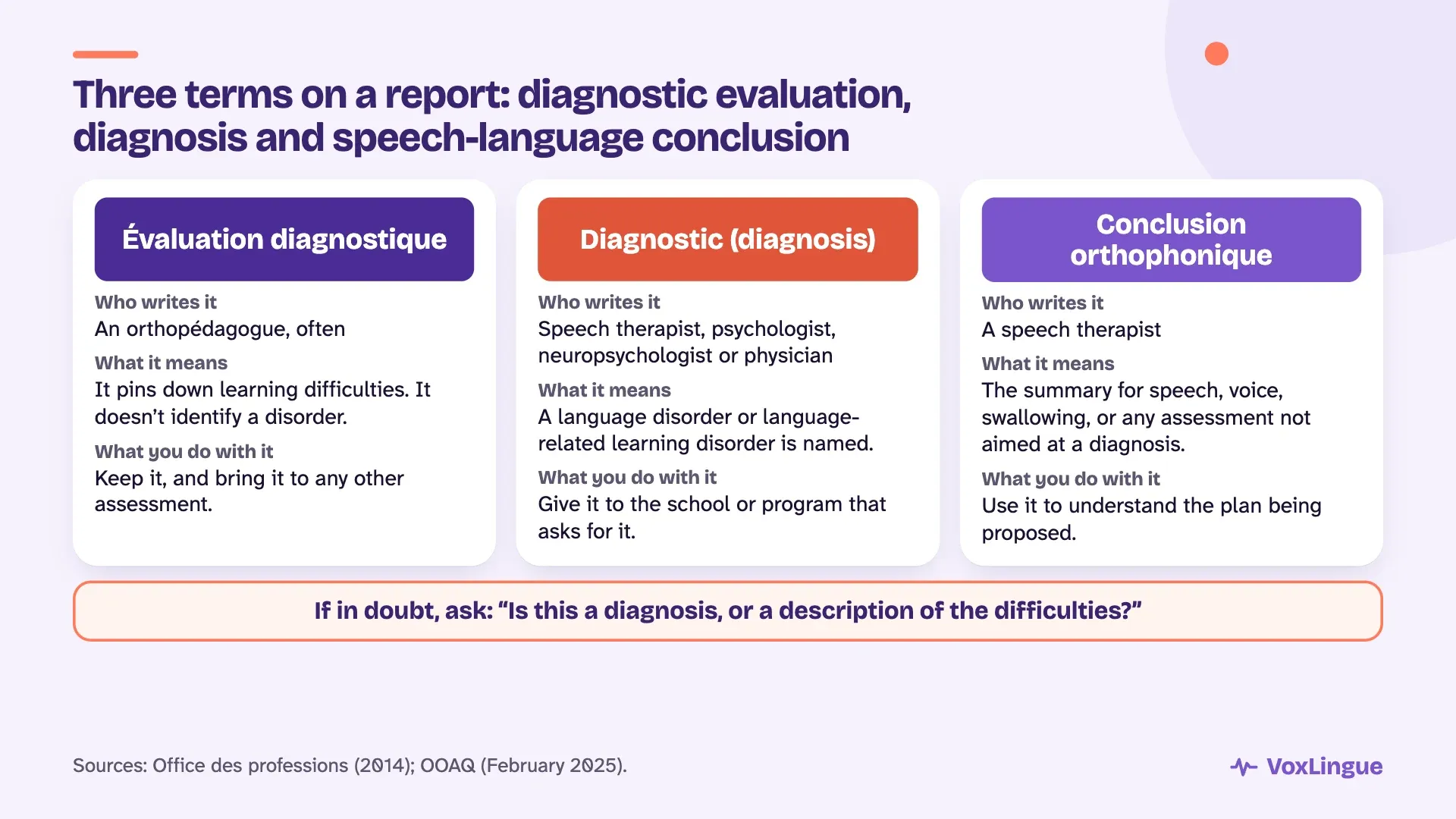
The phrase describes an evaluation that pins down learning difficulties. It doesn’t mean a disorder has been diagnosed. Québec’s Office des professions explains this in a 2014 report. A diagnosis of dyslexia comes instead from one of the four professions named above. The orthopédagogue’s report remains very useful to them.
It is an easy mix-up, especially if French is your second language. In teaching, the word “diagnostique” is used for working out where a student is stuck. The Office des professions report (in French; 2014, pp. 102 and 103) says the “évaluation orthopédagogique diagnostique” aims to pin down learning difficulties. It brings them to light, rather than identifying a disorder.
There is a nuance, and it is better to say so. The same report notes that some orthopédagogues may be called on to identify a specific learning disorder. That passage predates the word “diagnose” in 2024. The ADOQ’s competency framework (in French; 2018) speaks instead of contributing to a diagnosis, within an interdisciplinary assessment.
That contribution matters. The order of psychologists writes that working with teachers, orthopédagogues and parents is what lets psychologists draw their conclusions. The OOAQ also calls collaboration essential in its 2024 brief (in French). So keep the orthopédagogue’s report, and bring it to any other assessment.
When you read a report, look at who signed it and how it ends. If the last sentence leaves you unsure, ask the question just as it is: “Is this a diagnosis, or a description of the difficulties?” It’s a fair question, and it helps everyone talk about the same thing.
What about ADHD or behaviour: who do you call?
For a question about attention or ADHD, think of a physician or a psychologist first. A speech therapist or an orthopédagogue isn’t the usual door here. The OOAQ states that speech therapists can’t diagnose a mental disorder. For adjustment or behaviour at school, talk to the school team, which may include a psychoeducator.
According to INESSS (in French; 2018), assessing a mental disorder falls to physicians and psychologists, along with certain professionals authorized by their orders. The order of psychologists (in French; 2019) adds that competent psychologists can diagnose ADHD. Both texts predate Bill 67. Since orthopédagogues have no professional order, this isn’t the door to choose for this question.
That doesn’t shut anyone out of the follow-up. If your child also has trouble talking or reading, those difficulties deserve a look on their own, whatever the answer on attention turns out to be.
A psychoeducator (in French) works with people who have difficulties with adjustment, and the title is protected. In schools, their order says they can assess these difficulties as part of an intervention plan.
Do you need a diagnosis to get help at school?
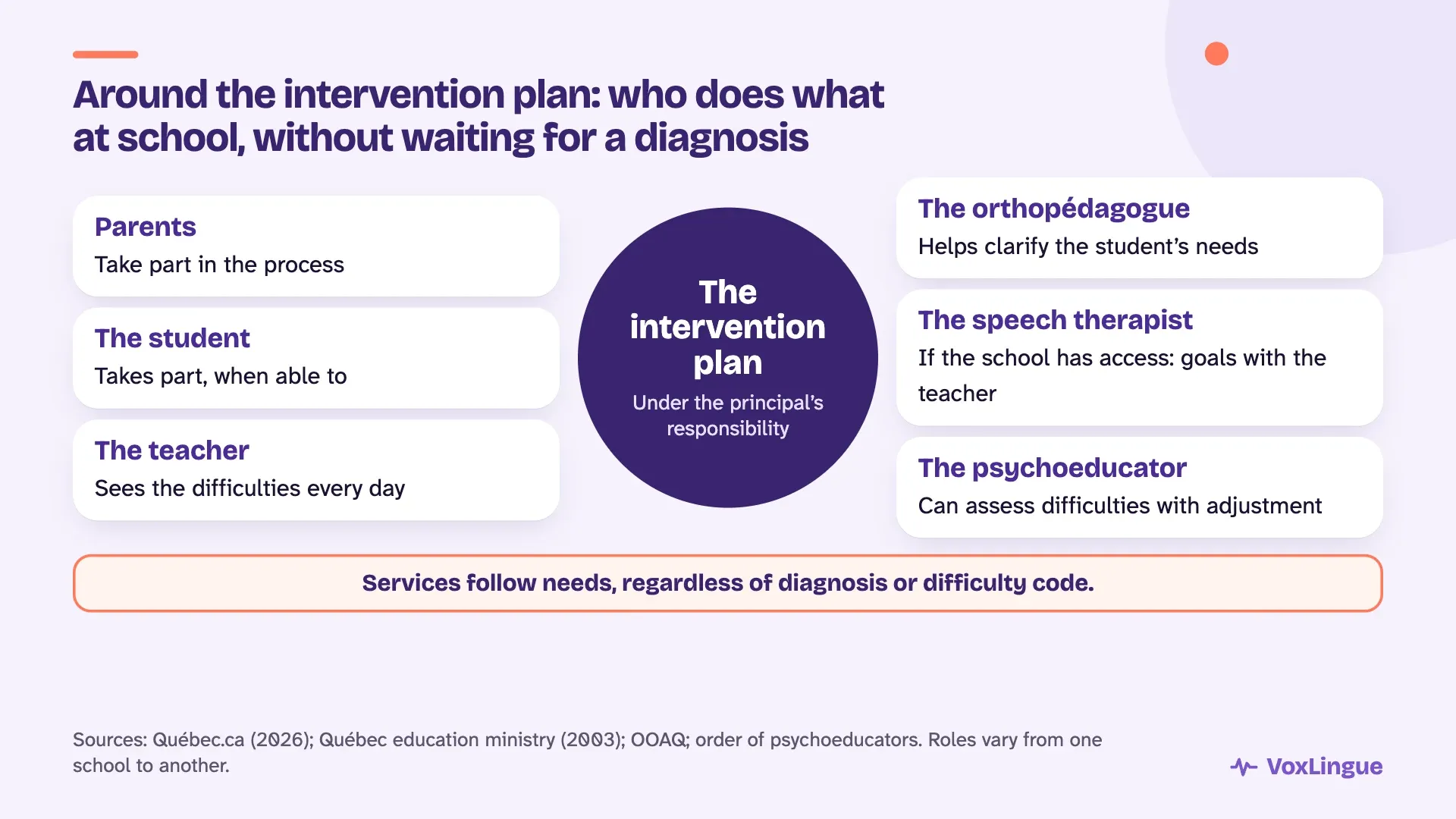
No. Québec.ca says services are organized around the student’s needs, regardless of diagnosis or difficulty code. Under the principal’s responsibility, the intervention plan (“plan d’intervention”) brings parents and staff together. The orthopédagogue, and the speech therapist if the school has access to one, can contribute to it.
This rule is on Québec.ca’s page on students with difficulties (in French). The order of psychologists agrees: a diagnosis isn’t essential to start an intervention, while an evaluation is still needed. A diagnosis can still be useful later on, and our article on the early signs of dyslexia explains why.
These professions work side by side at school. A ministry reference framework (in French; 2003) says the orthopédagogue, speech therapist, psychologist or psychoeducator can set individualized goals for some students with the teacher. It adds that the orthopédagogue can help clarify a student’s needs. The document is old, but it shows these roles were meant to work together.
Access isn’t the same everywhere. The OOAQ says (in French) that direct access to a speech therapist exists only through certain schools. To find out, ask the school, the school service centre or the English school board. If you already have a private report, you can give it to the school to inform the plan.
How do you check someone’s title and training?
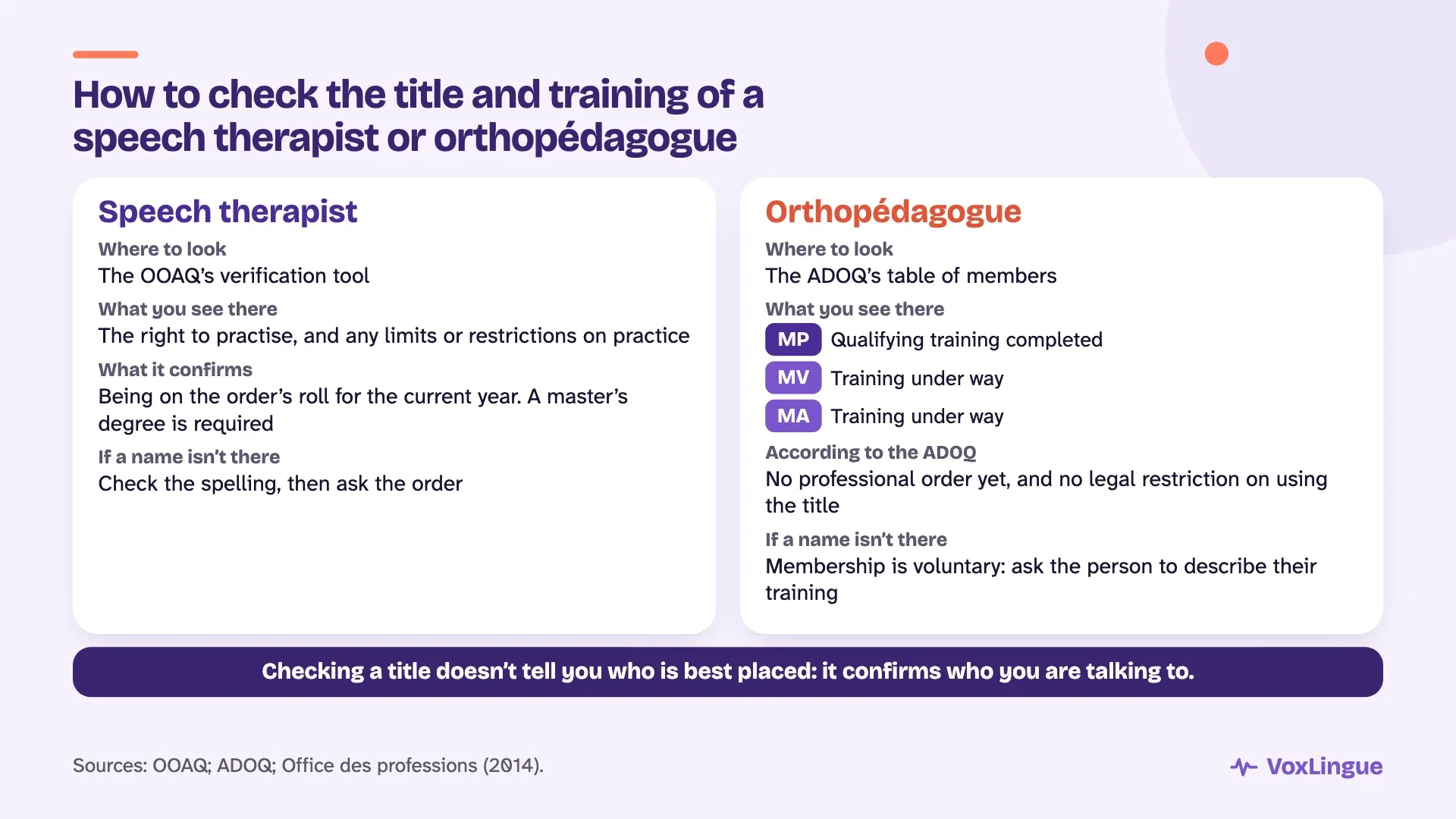
For a speech therapist, use the OOAQ’s tool, which confirms the right to practise and shows any restriction. For an orthopédagogue, ask about training and consult the ADOQ’s table of members, where the member number shows the status. According to the ADOQ, the profession isn’t yet overseen by a professional order.
To use the title of speech therapist in Québec, a person must be on the order’s roll for the current year, and a master’s degree is required (in French). The OOAQ’s verification tool (in French) lets you confirm this. Clicking on the name also shows any limits or restrictions on practice.
For an orthopédagogue, the situation is different. The ADOQ writes (in French) that the profession isn’t overseen by a professional order, and that there is no legal restriction on using the title. That says nothing about any one person’s competence. It means instead that the checking falls to you.
The ADOQ recommends that employers make sure the person has recognized university training in orthopédagogie and is a member in good standing. That is a fair yardstick for a parent too. The table of members (in French) shows status in real time. The start of the number (in French) tells you which: MP for completed qualifying training, MV or MA for training under way.
Don’t jump to conclusions if a name isn’t there. Membership is voluntary, as the Office des professions noted in 2014, and the private practice directory only shows members who chose to appear. Backgrounds also vary, because universities have not offered a specialized bachelor’s in orthopédagogie since 2003, according to the same report. Simply ask the person to describe their training.
Where does the professional order stand? The ADOQ’s 2026 annual report (in French) says the file is now under analysis by the Office des professions. That statement is the ADOQ’s own, and we have not read a position from the Office on this file. The ADOQ also has its own code of ethics, which applies to its members.
Where do you ask for help: public services, the school or private practice?
In the public system, speech therapy goes through your CISSS or CIUSSS. Agir tôt is for children under 7. At school, talk to the teacher or the principal. In private practice, the OOAQ and the ADOQ each have a directory. For speech therapy, our guide on costs explains insurance and receipts.
| Door | What for | How to reach it |
|---|---|---|
| CISSS or CIUSSS | Public speech therapy, free according to the OOAQ. Access varies by region | The OOAQ’s page (in French) sums up the routes |
| Agir tôt | Children under 7 and their families | Your CLSC, or your doctor |
| The school | Learning in class, the intervention plan | The teacher, the principal, the school service centre or English school board |
| Speech therapist in private practice | An assessment or follow-up | The OOAQ’s directory (in French) |
| Orthopédagogue in private practice | An assessment or learning support | The ADOQ’s directory (in French), in person or online |
This article doesn’t discuss prices. For speech therapy, our guide on what public services, insurance and tax cover walks through the steps. For orthopédagogie, the ADOQ reminds parents that coverage depends on your contract, so ask your insurer whether these services are included.
Wait times vary too. Our guide on the speech therapy waiting list in Québec explains how public and private services can be combined. Nothing stops you from talking to the school while you wait for another answer.
What about Ontario?
In Ontario, a diagnosis of dyslexia rests with psychologists. Speech-language pathologists there describe reading and writing difficulties, can conclude to a language disorder, and guide the family onward. At school, talk to the teacher and, if available, the special education teacher. “Orthopédagogue” isn’t a word you are likely to hear.
These rules come from Ontario’s college, CASLPO (2025), and the Ministry of Education’s guide (2026). The word is absent from that guide’s glossary. Support shouldn’t have to wait for a diagnosis, according to the Ontario Human Rights Commission (2022). See also telepractice in Ontario.
What should you write down before you call?
Write down what you notice, where it happens and since when, with one or two concrete examples. Add your child’s age, grade, languages and what the school has already tried. Bring any report cards and reports you have. These notes help the person answer you, or point you elsewhere.
| What you write down | Why it helps |
|---|---|
| The difficulty, with one or two examples | It shows more clearly whether this is about talking, understanding, reading, writing or calculating |
| Where and since when | Home, class, daycare: what repeats from one place to another helps point the way |
| Your child’s languages, and the language of school | Learning a second language and having a learning difficulty aren’t looked at in the same way |
| What the school has already tried | The person knows where you are starting from, and whether an intervention plan exists |
| What your child does well | It shows what already helps, not only what gets in the way |
| Report cards and reports | They save starting from scratch, and show what has already been assessed |
During the call, three questions are often enough:
- Do you often see this difficulty at my child’s age?
- What will your report contain: a diagnosis, a conclusion or a picture of the difficulties?
- If this isn’t your field, who would you send me to?
If you are getting ready for an appointment, our article on what to expect at a speech therapy assessment sets out the steps.
What to remember
Speech therapist or orthopédagogue: start from what you notice. Speech and spoken language often lead to a speech therapist. Learning in class often leads to the school and its orthopédagogue. The roles overlap in written language, and either professional can redirect you. You don’t need a diagnosis to ask for help at school.
Next step
Print the sheet “Before you call: what to note, and who to call for your child’s difficulty” and fill it in before your first call. If speech, language or written language is on your mind, you can request an assessment at our clinic in Marché Central, Montréal, or by telepractice. To read more about written language, see our page on reading and writing and our articles on the topic.
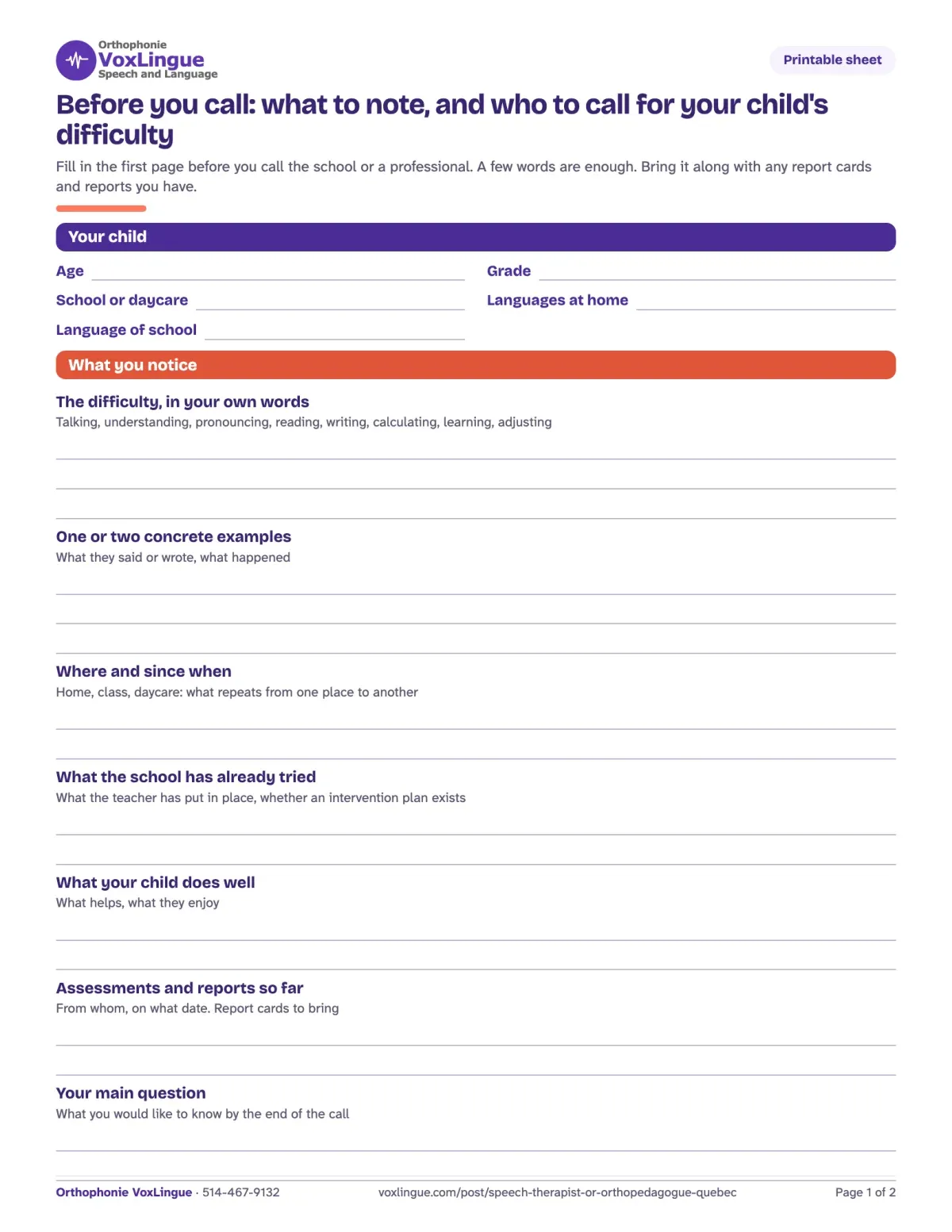
Printable sheet: Before you call: what to note, and who to call for your child’s difficulty (PDF, 2 pages).
Frequently asked questions
What is the English word for orthopédagogue?
There isn’t one exact match. Québec’s language office lists “resource teacher”, “learning assistance teacher” and “special education teacher”. Many parents search for “remedial teacher”, which isn’t on that list. The simplest approach is to ask your child’s school who supports students with learning difficulties.
My child struggles to read: who should I call first?
If your child is in school, often start with the teacher, then ask whether the orthopédagogue can see them. No diagnosis is needed. If you want a fuller assessment, or if speech or spoken language also worries you, a speech therapist is a good call. In private practice, an orthopédagogue can also assess reading.
Can an orthopédagogue diagnose dyslexia?
The OOAQ doesn’t name orthopédagogues among the professions sharing this diagnosis. The ADOQ says they contribute to it, within an interdisciplinary process. According to the Office des professions (2014), their evaluation aims to pin down difficulties, even when it is called “diagnostique”. For a diagnosis, see a speech therapist, psychologist, neuropsychologist or physician.
Who can diagnose dyslexia in Québec?
According to the OOAQ, speech therapists, psychologists, neuropsychologists and physicians share this activity. Since Bill 67, passed in November 2024, the law uses the word “diagnose” for speech therapists when it comes to language-related learning disorders. Our article on the early signs of dyslexia explains from when this becomes possible.
My child struggles with math: speech therapist or orthopédagogue?
Often start with the school, or an orthopédagogue: math is part of what she assesses, according to the ADOQ. A speech therapist becomes a good call if language seems involved, for example in understanding numbers or reasoning through a problem, or if dyscalculia is suspected. The OOAQ lists it among language-related disorders.
Can we see both at the same time?
Yes, and it can be useful, because their perspectives complement each other. One may work on language, the other on classroom strategies. Ask them to talk to each other, with your consent. At school, these roles meet around the intervention plan. In private practice, check what each one offers first, so nothing gets done twice.
Do we have to go through a doctor before calling?
Not for the CLSC: our guide to the wait explains that parents can contact it directly, with no medical referral. The OOAQ also has a public directory for reaching a speech therapist in private practice. Your insurance may require a doctor’s recommendation, though: our guide on costs explains what to ask.
My child is a preschooler: is it too early to call?
No. Agir tôt is for children under 7 and their families: contact your CLSC, or ask your doctor to refer you. A speech therapist can also see your child in private practice. Orthopédagogues work mainly in schools. Our guide to the wait explains the public route in more detail.
Is the title of orthopédagogue protected?
No, according to the ADOQ: since the profession has no professional order, there is no legal restriction on using the title. So ask about the person’s training, and check the ADOQ’s table of members. A number starting with MP shows completed qualifying training. Membership remains voluntary, so someone qualified may not be listed.
Is there a professional order for orthopédagogues?
Not to date, according to the ADOQ, which filed a request with the Office des professions in 2018 and an update in February 2025. Its 2026 annual report says the file is under analysis by the Office. Those are the ADOQ’s words. We have not read a position from the Office, and this may change.
Does my insurance reimburse orthopédagogie?
It depends on your contract, the ADOQ reminds parents: ask your insurer whether orthopédagogie services are included in your plan, because policies vary between insurers. According to the association, its members issue receipts for their services. For speech therapy, our guide on costs sets out the questions to ask your insurer.
My child has ADHD: who should we see first?
For the ADHD question itself, think of a physician or a psychologist. A speech therapist can’t make this diagnosis, according to the OOAQ, and orthopédagogues have no professional order. If your child also has trouble talking, reading or writing, a speech therapist or the school’s orthopédagogue can look at those difficulties on their own.