Signs to look for
- At 3, even family members often have trouble understanding your child
- Unfamiliar adults often struggle to understand your 4-year-old
- Your child leaves off the ends of many words or replaces many sounds with one, such as t for k ('tat' for 'cat')
- A lisp, or an unclear r, s or l, continues well past age 7
- Your child gets frustrated, gives up or avoids talking when people do not understand
- Other children or adults comment on or tease your child about their speech
- Your child has had frequent ear infections and their speech seems less clear than their peers'
What it is
A speech sound disorder means a child has more difficulty producing or using the sounds of their language than expected for their age. It is one of the most common reasons families contact a speech-language pathologist, and it usually responds well to the right kind of practice.
Speech sounds come in over several years. Early sounds such as p, b, m, n, t, d and w are usually in place by about age 3. Later sounds such as s, z, ch, j, l and r, along with clusters like “sp” or “tr”, often settle between ages 4 and 7. Mistakes along the way are normal. What we look at is whether your child’s speech is following the usual path and whether people can understand them.
Clinicians usually describe two kinds of difficulty, and many children show some of each.
Articulation
An articulation difficulty is about the movement itself. Your child has trouble placing the tongue, lips or jaw to produce a particular sound. A lisp on s or an r that sounds like w after age 7 are common examples. The error tends to happen on the same sound wherever it appears. When a lisp goes along with a tongue thrust, an open-mouth posture or mouth breathing, we also look at orofacial myofunctional patterns.
Phonology
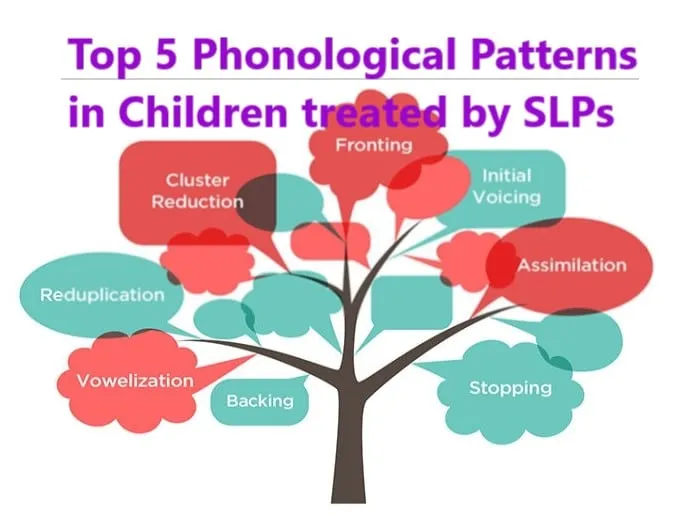
A phonological difficulty is about the sound system. Your child may be able to make a sound but does not yet use it in the right places. Instead, they follow simplifying patterns that affect many words, such as dropping final sounds (“ca” for “cat”), replacing back sounds with front ones (“tup” for “cup”) or shortening clusters (“poon” for “spoon”). These patterns are typical in toddlers, but when several persist past the expected age, a child can become hard to understand.
Who we see
We see toddlers, preschoolers and school-age children whose speech is harder to understand than expected, as well as older children and teens with a single sound, often r or s, that has not settled. Some families come because a daycare educator, teacher or doctor raised a concern. Others come because they notice that grandparents or friends often ask, “What did he say?”
How we assess it
Our speech-language pathologists start by listening to you. We ask about your child’s development, health, hearing, the languages spoken at home and what you have noticed. Then we observe and record your child’s speech in several ways:
- naming pictures that contain every sound in the language
- talking during play or about a book, so we hear connected speech
- checking whether your child can produce a sound when given a model or a cue
- looking at the structure and movement of the lips, tongue and palate
- listening for how well your child can hear differences between similar words
We analyze which sounds are affected, which patterns are present and how much they affect intelligibility, meaning how easily others understand your child. If hearing has not been checked recently, we may recommend a hearing assessment. You receive a clear explanation of the results and recommendations. Read more about our assessment process.
How therapy works at VoxLingue
Therapy is play-based for young children and built around your child’s interests. The approach depends on whether the difficulty is mainly articulatory, phonological or both.
For articulation goals
We teach your child how a sound is made, using mirrors, visual cues, touch cues and simple descriptions (“the snake sound keeps your tongue behind your teeth”). Practice then moves step by step from the sound alone to syllables, words, phrases, sentences and finally everyday conversation, until the new sound becomes automatic.
For phonological goals
We help your child discover that changing a sound changes the meaning of a word. A common activity uses pairs of words such as “key” and “tea”: if your child asks for the “tea” card, they get the tea card and quickly see why the difference matters. Depending on your child’s profile, our clinicians may use evidence-based approaches such as minimal pairs, multiple oppositions or a cycles approach.
Throughout therapy, we choose target words that matter in your child’s daily life and keep sessions short, active and fun, with many practice attempts. We also watch early literacy skills such as rhyming and hearing the first sound in a word, since these can be affected too.
Your role at home
Short, regular practice at home makes a real difference. After each session, you leave with a small activity and a clear idea of what to listen for. Some everyday habits help too:
- When your child makes an error, repeat the word back correctly in your reply instead of asking them to say it again.
- Give your full attention when your child is talking so they feel heard, even when the message is hard to understand.
- Read together and play with sounds through rhymes, songs and silly words.
- Praise the effort and the message, not only the correct sound.
Bilingual and multilingual families
Every language has its own set of sounds. English has the “th” sounds, French has nasal vowels and the front rounded vowel in “tu”, and Québec French has features such as the “ts” sound in “tu” that are part of the dialect and not errors. A bilingual child may also carry a sound from one language into the other. This is a normal language difference.
For an accurate picture, we look at your child’s speech in the languages they actually use. A true speech sound disorder shows up across all of them. Our team speaks many languages, and when a clinician who speaks your home language is not available, we work with you to understand how your language sounds. Your child does not need to drop a language to make progress.
In person or by telepractice
Speech sound therapy works in person at our Marché Central clinic in Montreal, or by telepractice anywhere in Quebec and Ontario. Online sessions use interactive games and allow your speech-language pathologist to coach you directly in your home, which often helps the new sounds carry over into daily life.
Getting started
You do not need a doctor’s referral. If you are wondering about your child’s speech, an assessment is a clear first step, and many families leave reassured or with a concrete plan.
Call our Marché Central clinic at 514-467-9132, or request an appointment through our contact form. Availability of specific clinicians and languages varies, and our team will match you with the right person.
Frequently asked questions
Will my child grow out of it?
Many sound errors are part of typical development and fade with time. Others, especially patterns that make a child hard to understand at 4 or later, tend to persist without support. An assessment tells you which situation you are in, so you are not left guessing.
What is the difference between articulation and phonology?
Articulation is about the movements needed to produce a specific sound, such as a lisp on s. Phonology is about how a child organizes sounds into a system, which can produce patterns that affect many sounds at once, such as replacing every k and g with t and d. Many children show a bit of both.
Does speaking two languages cause speech sound errors?
No. Research does not show that bilingualism causes speech sound disorders. Bilingual children may show some sounds from one language influencing the other, which is a normal difference. A true disorder shows up across all of a child's languages.
Should I correct my child when they say a word wrong?
Repeating the word back correctly in your own reply works better than asking your child to say it again. For example, if your child says 'tat', you can say 'Yes, a cat. A big cat.' Your speech-language pathologist will tell you when and how to add more direct practice.
How long does therapy take?
It depends on the number of sounds involved, the type of difficulty, how often practice happens at home and your child's age. Your speech-language pathologist will set specific goals with you and review progress regularly so the plan stays realistic.
Is a speech sound difficulty linked to reading?
It can be. Some children with phonological difficulties also find it harder to hear and play with sounds in words, a skill that supports early reading and spelling. We keep an eye on these early literacy skills as part of therapy.
Related areas of care
- Childhood apraxia of speechCareful assessment and frequent, movement-focused therapy for children who have difficulty planning and sequencing the movements of speech.
- Literacy: reading, spelling and the language underneathSupport for children and teens who find learning to read and spell difficult, built on the sound and language skills that literacy depends on.
- Orofacial myofunctional disorders (OMD)Assessment and therapy for how the tongue, lips and jaw rest and move during feeding, swallowing, chewing and breathing, from a baby's first feeds to adults with tongue thrust or mouth breathing, coordinated with your medical and dental team.
- Speech and language assessment for children, teens and adultsA careful look at speech, language, voice, fluency or swallowing to find out whether you or your child can benefit from speech-language therapy, and what would help most.