Signs to look for
- Your child has few spoken words for their age and is often frustrated when not understood
- Speech is very hard for others to understand, even after therapy
- Your child communicates mostly by leading you by the hand, pointing or crying
- Your child or family member can say some words but not enough to share needs, ideas or feelings
- Communication breaks down at daycare, school or work, even if it works at home
- An adult has lost speech after a stroke, brain injury or progressive condition
- Your child has a diagnosis known to affect speech, such as autism, apraxia, cerebral palsy or Down syndrome, and speech is limited
What it is
Augmentative and alternative communication, or AAC, means any way of communicating that adds to speech or stands in for it. “Augmentative” means it supports speech. “Alternative” means it can be used instead of speech when needed. We all use some AAC already: pointing, waving, writing a note or showing a photo on a phone.
AAC is usually grouped into three levels.
No-tech
Communication using the body: gestures, signs, facial expressions, pointing and body language.
Low-tech
Communication using simple materials that do not need power: picture cards, choice boards, communication books, alphabet boards and visual schedules.
High-tech
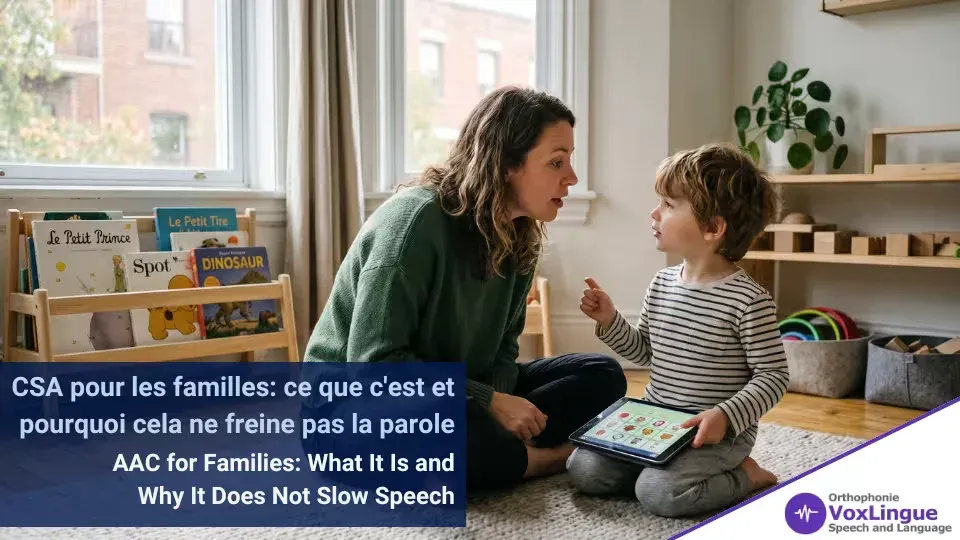
Speech-generating devices or tablet apps that speak a word or message aloud when the person selects a symbol, word or letter. Some can be accessed by touch, by a switch or with eye gaze.
Most people use a combination. A child might sign “more”, point to a picture of the park and use a tablet to tell a story, all in the same day. AAC is not a last resort and not a sign of giving up on speech. It gives a person a reliable way to be understood while speech continues to develop.
AAC and speech
The most common worry families share is that AAC will stop speech. Research over several decades does not support this. AAC does not reduce speech, and many children produce more spoken words after AAC is introduced. A child who can be understood is often calmer, more engaged and more willing to try spoken words.
Who we see
AAC can help anyone whose speech does not yet meet all their communication needs. We see children who are autistic, who have childhood apraxia of speech, cerebral palsy, Down syndrome or developmental language disorder, or who simply have very few words. We also see teens and adults, including people who have lost speech after a stroke or brain injury, or who have a progressive condition affecting speech.
How we assess it
An AAC assessment looks at how the person communicates now and what they need to communicate in daily life. Our speech-language pathologists:
- talk with you about how communication happens at home, school, work or in the community
- observe the person in play or conversation, noticing every way they already communicate
- look at understanding of language, vision, hearing and motor skills, which guide how a system is accessed
- try different options, such as signs, picture boards or a device, to see what works best
- consider the people who will use the system with the person every day
We often work with occupational therapists, educators and other professionals involved. We then recommend a starting system and plan how it will grow. Learn more about our assessment process.
How therapy works at VoxLingue
Our approach is neurodiversity-affirming. We respect each person’s way of communicating, presume competence and focus on helping them say what they want to say, not on making them communicate in only one way.
Modelling AAC
People learn to use AAC by seeing others use it, just as children learn speech by hearing it. This is called aided language modelling. During play, snack or a book, the clinician and family touch symbols on the system while speaking: “Let’s go out.” Over time, the person begins to use the system themselves.
A system that can grow
We favour systems with enough vocabulary to grow with the person, including core words such as “go”, “more”, “not”, “help” and “like”, which work across many situations. We add personal vocabulary such as names, favourite activities and foods.
Real communication
We practise AAC for real purposes: requesting, protesting, commenting, asking questions, telling jokes and sharing news. We avoid quizzing (“Show me the cat”), because communication is not a test.
Family and team training
AAC works best when everyone around the person uses it. We train parents, siblings, caregivers, educators and support staff to model, to wait and to respond to all communication attempts. We also help adapt the system for daycare, school or work.
Your role at home
You do not need to be an expert to start. A few habits make a big difference:
- Keep the AAC system within reach all day, not only during therapy.
- Model a few words during routines, even if you make mistakes.
- Pause and wait after you model, giving time to respond.
- Respond to every attempt, whether it is a word, a sign, a sound or a touch on the device.
- Never take the system away as a consequence. It is the person’s voice.
Bilingual and multilingual families
Using AAC does not mean giving up your family’s languages. Many AAC systems can be set up in more than one language, and families can model in the language they speak most naturally. A child may hear French at daycare, English at school and Arabic or Spanish at home, and their AAC can reflect that.
We plan vocabulary with you, including words that matter in your culture and family life, such as names for relatives, foods and celebrations. Our team speaks many languages. When a clinician who speaks your home language is not available, we help you set up and model the vocabulary in that language.
In person or by telepractice
AAC support is available in person at our Marché Central clinic in Montreal, or by telepractice anywhere in Quebec and Ontario. Telepractice is often very effective for AAC, because your speech-language pathologist can coach you in your own home, with the actual system, during the routines where communication happens. Many families combine both formats.
Getting started
You do not need a doctor’s referral. If you are wondering whether AAC could help your child or a family member, an assessment is a clear first step.
Call our Marché Central clinic at 514-467-9132, or request an appointment through our contact form. Availability of specific clinicians and languages varies, and our team will match you with the right person.
Frequently asked questions
Will AAC stop my child from talking?
No. This is the most common worry, and research does not support it. Studies consistently show that AAC does not reduce speech, and many children say more words after AAC is introduced. AAC lowers frustration and shows language in a clear, consistent way.
Is my child too young for AAC?
There is no minimum age and no list of skills a child must have first. Current guidance supports introducing AAC early rather than waiting for other approaches to fail.
What is the difference between no-tech, low-tech and high-tech AAC?
No-tech AAC uses the body: gestures, signs and facial expressions. Low-tech AAC uses simple materials such as picture cards, communication boards or books. High-tech AAC uses a tablet or dedicated device that speaks aloud when a symbol or word is selected. Many people use a mix.
Will AAC be permanent?
It depends. Some children use AAC for a while and move away from it as speech develops. Others use it throughout their lives. Both are good outcomes, because the goal is communication.
Can an AAC system include more than one language?
Yes. Many systems can be set up in more than one language, and families can model AAC in the languages they speak at home. We plan this with you.
Who pays for a device?
Funding depends on the province, the person's needs and the device. Some public programs in Quebec and Ontario help with equipment costs. We can explain the general steps and work with the other professionals involved.
Related areas of care
- Social communication, autism and neurodivergent profilesNeurodiversity-affirming support for how children, teens and adults use language with other people, built around connection, comfort and self-advocacy rather than fitting in.
- Childhood apraxia of speechCareful assessment and frequent, movement-focused therapy for children who have difficulty planning and sequencing the movements of speech.
- Aphasia and acquired communication disorders after stroke or brain injuryTherapy for adults whose language or communication has changed after a stroke, brain injury or other neurological event, with practical support for the people closest to them.
- Parent coaching and Hanen programsCoaching that helps parents and caregivers use proven strategies in daily routines, drawing on Hanen programs such as It Takes Two to Talk and More Than Words.