Paying for speech therapy in Québec: what public services, insurance and tax cover
Up to date as of November 2, 2026. General information: the rules change, and tax figures apply to the year shown.
Is speech therapy covered in Québec? The question rarely comes alone. You’ve heard the CLSC wait is long, private sessions are now on the table, and everything arrives at once: insurance, receipts, tax. You want to know what you will really end up paying, and what to keep.
This guide doesn’t give prices. It puts the payers in order: public services, your insurance, then tax credits. It suggests questions to ask your insurer before the first session. It also explains what a receipt says, whose name goes on it, and how to claim the costs afterward.
It is written first for parents in Québec, because the Québec rules need more explaining. Ontario families have their own section, and the federal rules in this guide apply to them too.
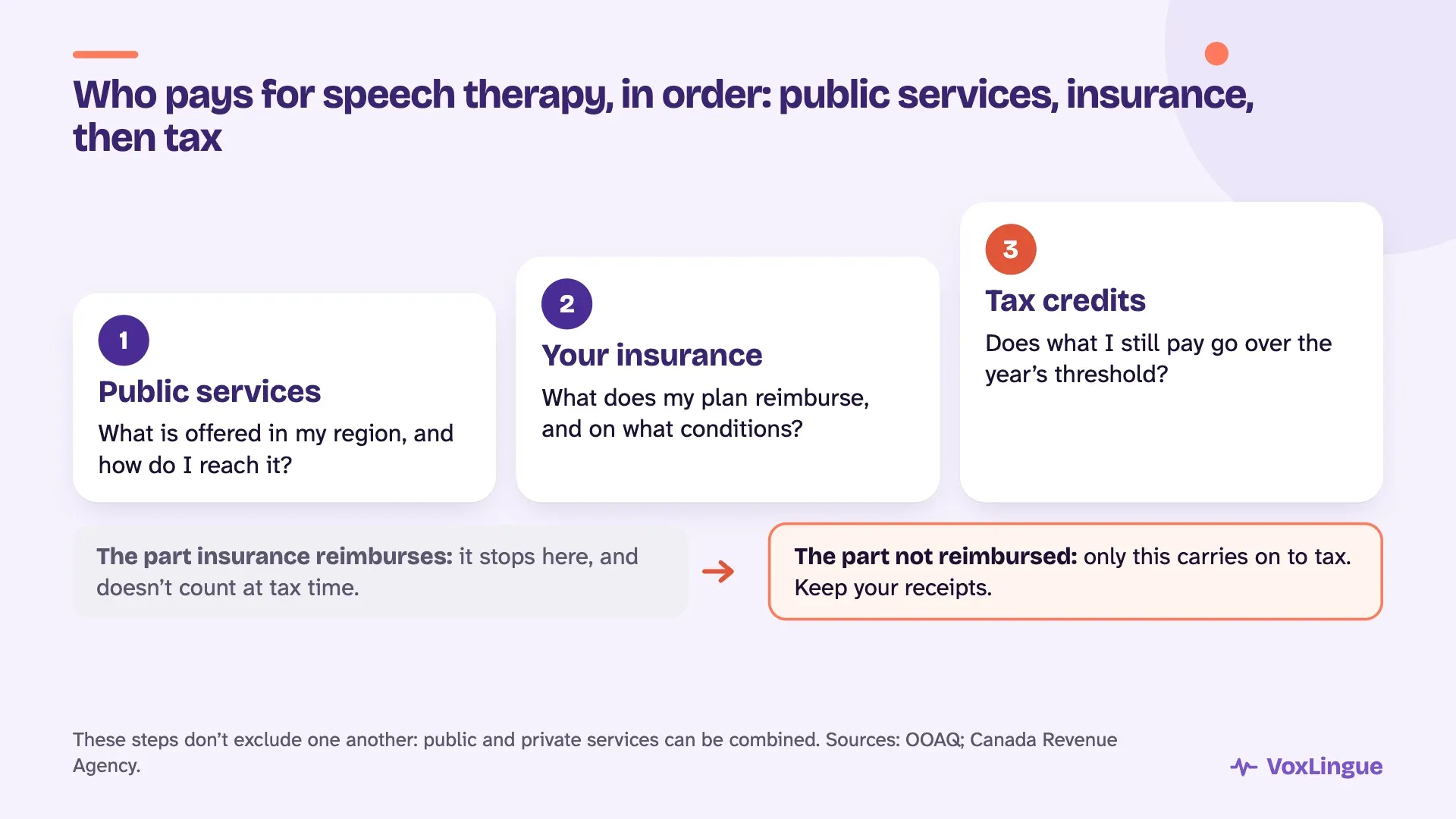
Who pays for what, and in what order?
Start with public services, which are free of charge but where access varies by region. For private sessions, then check what your insurance reimburses. What you still pay may count toward the medical expense tax credits, federally and in your province. Keep your receipts from the very start.
These three steps don’t exclude one another. Public and private services can be combined, as our waiting list guide explains; you’ll find it in the next section. The order is mainly there to help you ask the right questions at the right time.
One principle ties the three steps together: at tax time, only what isn’t reimbursed counts. The Canada Revenue Agency (CRA) excludes expenses a person is entitled to have reimbursed, in its folio on the medical expense tax credit (2025). That is why insurance comes before tax in this guide.
What do public services cover, and how do you reach them?
In the public system, speech therapy is free of charge, according to the Ordre des orthophonistes et audiologistes du Québec (OOAQ). Services and how to reach them vary by region: you go through the CISSS or CIUSSS, and some schools offer it directly. RAMQ doesn’t cover speech therapy in a private clinic.
The Order’s page on finding a speech-language pathologist (in French) sums up these routes. It also says that people with no family doctor can reach the Guichet d’accès à la première ligne (GAP) by calling 811, option 3.
The Agir tôt program is for children under 7 and their families. Its services are free and voluntary. Contact your CLSC, or ask your doctor to refer you. The Québec.ca page doesn’t present it as a speech therapy service, so ask what is planned for your child.
| Door | Who it’s for | How to reach it |
|---|---|---|
| CISSS or CIUSSS | Depends on the region and the service | Steps specific to your region |
| Agir tôt | Children under 7 and their families | Your CLSC, or your doctor |
| School | Some schools offer the service | Ask the school |
| GAP | People with no family doctor | 811, option 3 |
| Hospital | Depends on the service | The OOAQ (in French) suggests calling your regional hospital or CLSC |
The wait can be long. Our guide to the speech therapy waiting list in Québec explains what the published wait times mean, and how public and private services can be combined.
Does my insurance reimburse speech therapy?
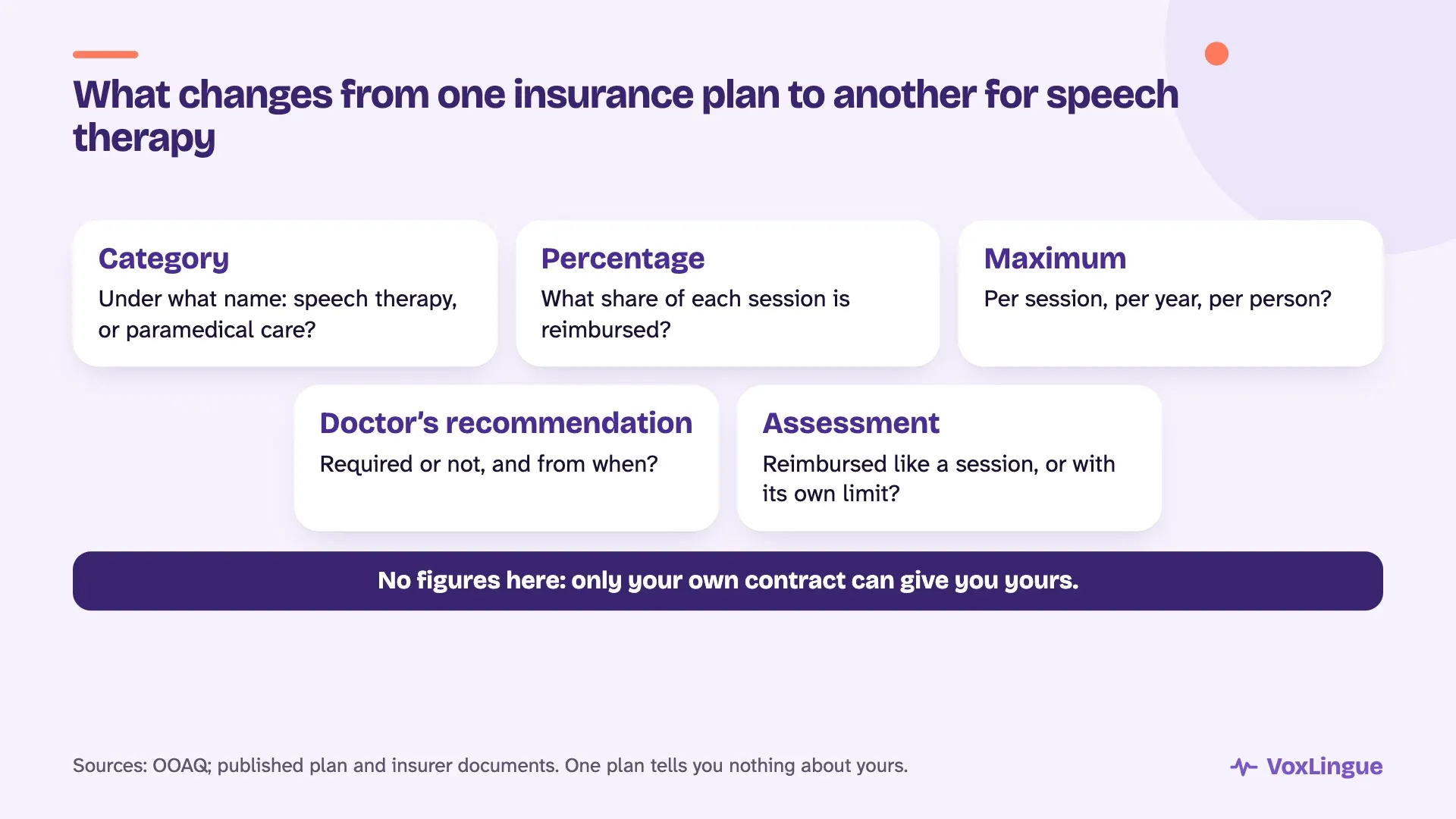
It depends on your plan: according to the OOAQ, each insurer decides what is eligible for reimbursement. Published plans show the differences: nothing on the basic tier, a limited number of treatments, a doctor’s recommendation. Check before the first session, not after the first receipt.
A dated example shows this. The brochure for one Québec civil service group plan (June 2026, in French) doesn’t cover speech therapy on the basic tier. The higher tiers do, for a limited number of treatments per calendar year, on the treating doctor’s recommendation. That is one plan among many, and yours may be very different.
The words change from one document to the next as well. Canada Life, for example, places speech-language pathologists under paramedical care on a page about its health insurance plans, with limits per visit and per practitioner. If “speech therapy” doesn’t appear in your booklet, look for that category, then ask.
The doctor’s recommendation also depends on the contract. A claim form from iA Financial Group warns that your policy may require one. An insurer can also limit reimbursement to the fees it considers reasonable and customary: according to an iA notice in effect since 2024, the plan member then pays the difference.
What should you ask your insurer?
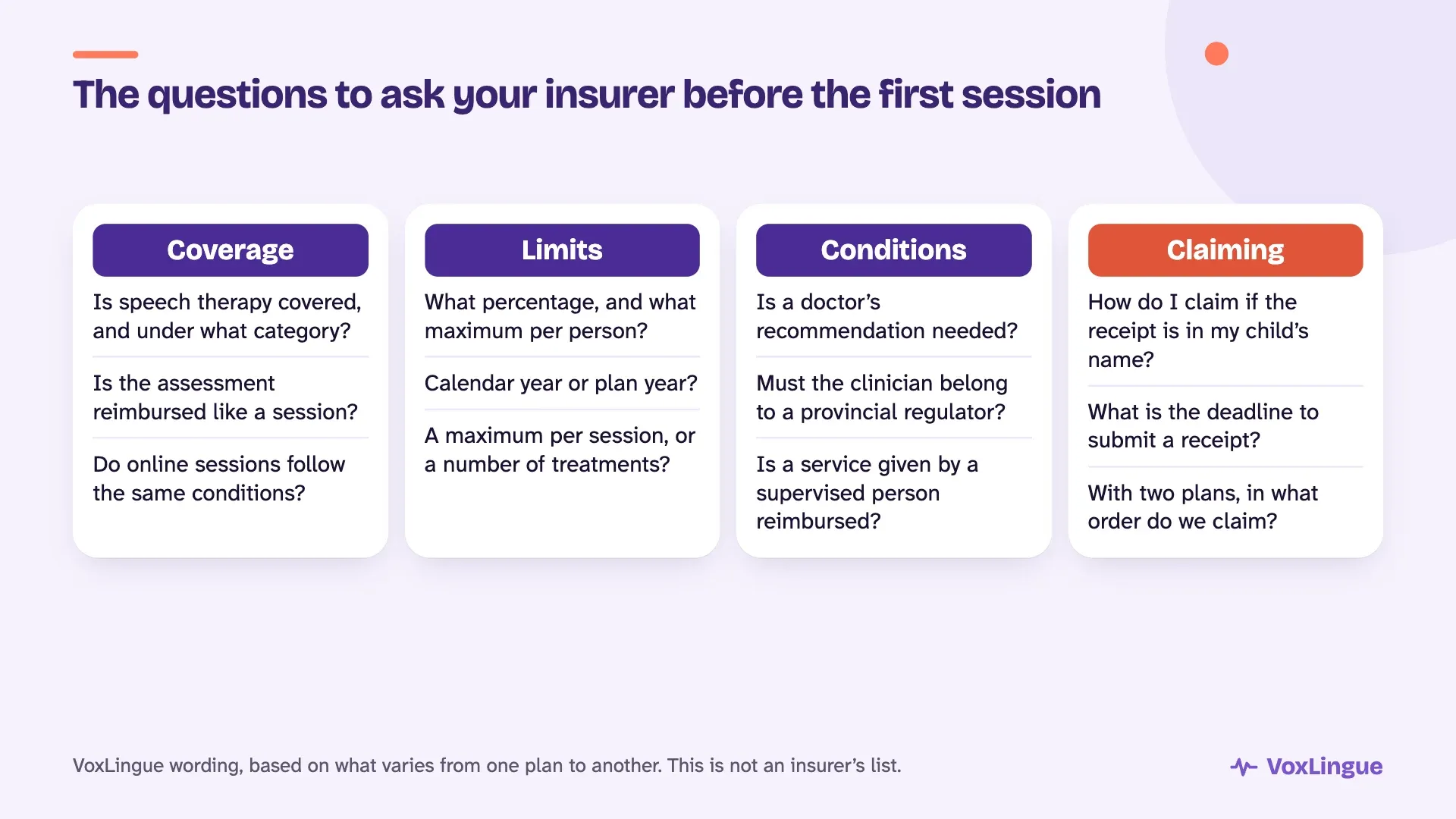
Call before you start, and write down the answer, the date and the person’s name. Ask whether speech therapy is covered, at what percentage, up to what maximum, and with or without a doctor’s recommendation. Also ask what applies to the assessment, to online sessions and to your child’s receipt.
Here are twelve questions, grouped by theme. This isn’t an insurer’s list: it’s our wording, based on what varies from one plan to another. Pick the ones that apply to your family.
- Coverage. Does my plan cover speech therapy, and under what category?
- Coverage. Is the assessment reimbursed like a session, and does it have its own limit?
- Coverage. Are online sessions reimbursed on the same conditions?
- Limits. What is the reimbursement percentage and the maximum per year, per person? Is it shared with audiology or other professions?
- Limits. Does the maximum follow the calendar year or the plan year?
- Limits. Is there a maximum per session, a number of treatments, or reasonable and customary fees?
- Conditions. Do I need a doctor’s recommendation or prescription? Before the first session?
- Conditions. Must the clinician belong to a provincial regulator, such as the OOAQ in Québec or CASLPO in Ontario? Is someone from another province accepted?
- Conditions. Is a service given by a supervised person, such as a language stimulation agent, reimbursed?
- Claiming. Must the receipt show the child’s name, and how do I claim if the parent is the plan member?
- Claiming. What is the deadline to submit a receipt?
- Claiming. If both parents have a plan, in what order do we claim?
Keep your notes with your insurance papers. If you have a group booklet, it may already answer some of these questions.
Why is the receipt in my child’s name?
Because the receipt names the person who received the service. If that is your child, their name goes on it, according to the Québec Order’s guidance to its members. That isn’t an obstacle: federally, the person who paid, or their spouse, claims the costs for their child.
This guidance comes from the OOAQ’s private practice FAQ (in French). For most sessions, the person receiving the service is your child. So the receipt says who was seen, not who paid.
There is another case. When a service is truly aimed at the parent, such as parent coaching, the receipt can be in the parent’s name, the Order says.
Would you have preferred a receipt in your own name? That’s a natural reaction when you’re the one paying. Your child’s name doesn’t stop you from claiming, and here is how.
Federally, the costs for your child under 18, or your spouse’s or partner’s child, go on line 33099. For an adult dependent child, it’s line 33199. According to the CRA folio, the right to claim follows the person who paid, not the name on the receipt.
In Québec, according to the Revenu Québec guide (the 2008 edition, the only one we were able to read), expenses must be paid by you or your spouse, for you, your spouse or a dependant. They must also be backed by receipts and not have been reimbursed. The credit is claimed on line 381: see Revenu Québec’s page on medical expenses.
On the insurance side, the question stays open. One insurer’s form that we read asks that the receipt show the claimant’s full name, without saying who that is. If you’re the plan member and the receipt is in your child’s name, ask your insurer how to submit the claim.
| Situation | Name on the receipt | Who can claim at tax time |
|---|---|---|
| You pay for sessions for your child under 18 | Your child | You or your spouse. Federal: line 33099. Québec: line 381, according to the Revenu Québec guide |
| A service is truly aimed at you, such as parent coaching | Yours | You or your spouse |
| Someone else pays, such as a grandparent | The person who received the service | Federally, the credit follows the person who paid or their spouse: look into it before paying |
What should a speech therapy receipt show?
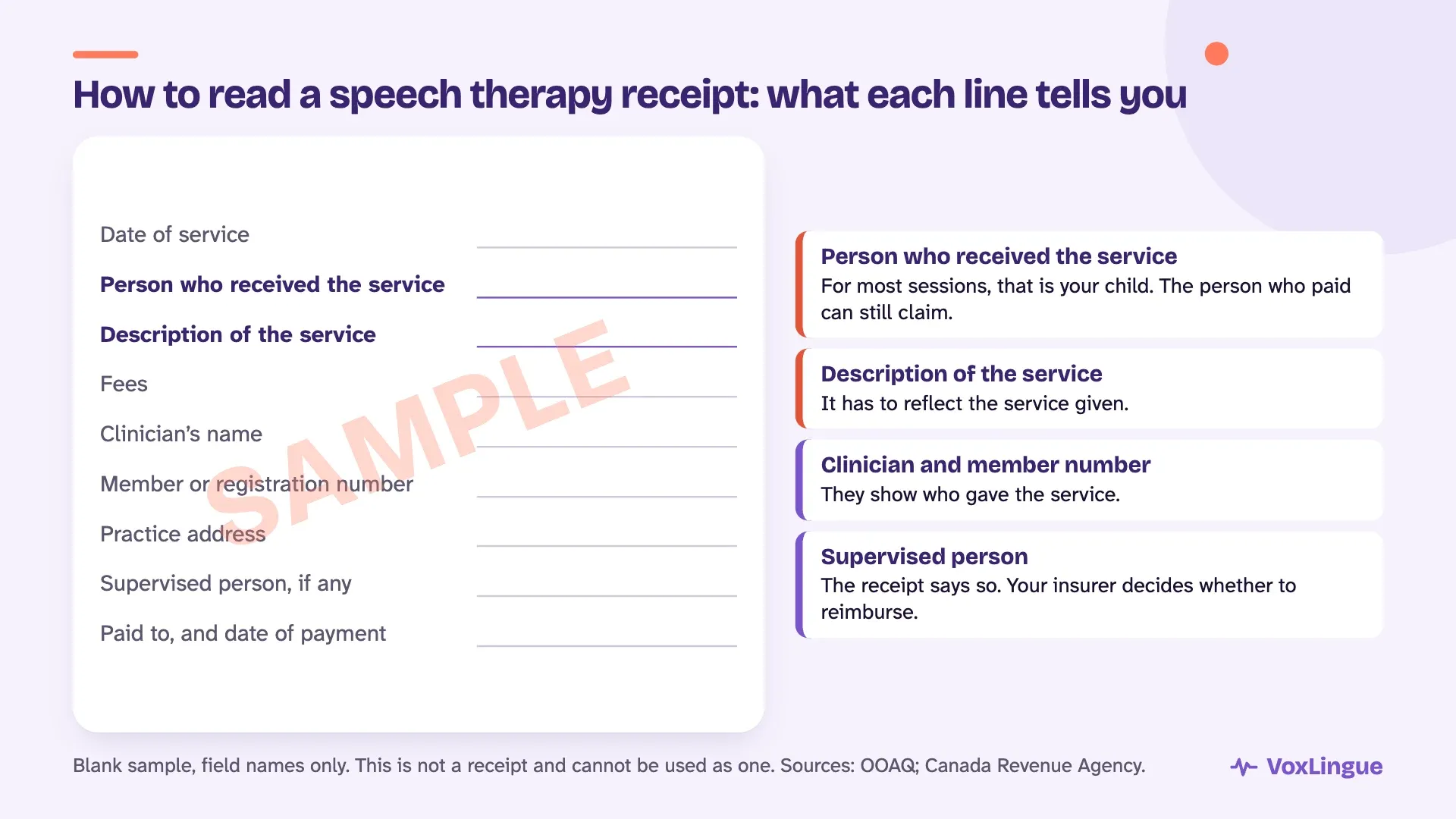
The Québec Order proposes a minimum to its members: the date, the person who received the service, its description, the fees, and the speech-language pathologist’s name, member number and practice address. If a supervised person gave the service, the receipt says so. A cashed cheque doesn’t replace a receipt.
This list appears in the OOAQ’s content on fees and receipts (in French). The CRA has its own markers, which apply across Canada: the receipt should show what the payment is for, its date, the patient and the professional. It must also show who the expense was paid to. It is the CRA that specifies a cancelled cheque isn’t enough.
A service may be given by a supervised person. According to the OOAQ, the speech-language pathologist can sign if the billing is accurate, and the description must stay faithful to the service. The insurer then decides whether to reimburse, which is why this question is on the list.
Someone else may also pay the fees, such as a grandparent. According to the Order, that gives them no special right to information about the child’s follow-up.
File your receipts through the year. Federally, you don’t send them with your return: you keep them in case the CRA asks. If you’re at the first-meeting stage, our article explains how a speech therapy assessment works.
What are the Québec and federal tax credits worth?
Both apply to the part of your medical expenses above a threshold. In Québec (2025), the credit is 20%, non-refundable, above 3% of family income. Federally (2025), the threshold is the lesser of 3% of net income or $2,834. Only what isn’t reimbursed counts. People who file in Ontario have a provincial credit as well.
The Québec Ministère des Finances sheet (2025 edition, in French) defines family income: your net income and your spouse’s. So the credit works out to about 20 cents per dollar above the threshold. Revenu Québec presents this credit on its medical expenses page.
| Québec | Federal | |
|---|---|---|
| Rate | 20%, non-refundable (2025 edition) | The lowest federal tax rate, according to the CRA: 14.5% for 2025, 14% from 2026 |
| Threshold | 3% of family income (2025 edition) | The lesser of 3% of net income or $2,834 (2025) |
| Income used | Your net income and your spouse’s | Line 33099: your net income (line 23600). Line 33199: the dependant’s |
| Period | 12 consecutive months ending in the year, according to the Revenu Québec guide (2008 edition) | Any 12-month period ending in the year (2025) |
| Line | 381 | 33099 for a child under 18; 33199 for another dependant |
Do speech-language pathologists count? The 2008 edition of the Revenu Québec guide names them among practitioners, as members of a Québec professional order. Federally, the CRA’s list recognizes speech-language pathologists in both Québec and Ontario.
Do you need a form? On the CRA page detailing the expenses, the entry on fees to a recognized practitioner mentions neither a prescription nor a certification. Don’t confuse it with the “Therapy” entry: that one is about salary and wages paid for therapy given to a person eligible for the disability tax credit.
You aren’t limited to the calendar year. Federally, the expenses can cover any 12-month period ending in the year, if they weren’t claimed the year before. The Revenu Québec guide (2008 edition) also describes a period of 12 consecutive months, which you choose, ending in the year.
Federally, either spouse can claim. The CRA advises comparing, since it is sometimes better for the person with the lower income to do so. For 2026, check the current federal threshold on the CRA page.
Three more points for Québec. According to the Research Chair in Taxation and Public Finance at Université de Sherbrooke (2025, in French), this credit has no ceiling. Revenu Québec also mentions a refundable credit on line 462, with age and income conditions. Finally, a separate credit (in French) covers travel and lodging when care isn’t available within 200 kilometres of home.
Does the 2026 change affect speech therapy?
No, according to the Québec budget. Since January 1, 2026, four groups no longer count as practitioners for the Québec credit: homeopaths, naturopaths, osteopaths and phytotherapists. Speech-language pathologists aren’t among them. If your family also sees one of these groups, check what still counts. This change concerns Québec’s credit only.
The 2025-2026 budget (in French) explains the change by the absence of a professional order for these groups. The Ministère des Finances repeats it in its sheet on medical expenses.
Can a language disorder qualify for help from Retraite Québec or the CRA?
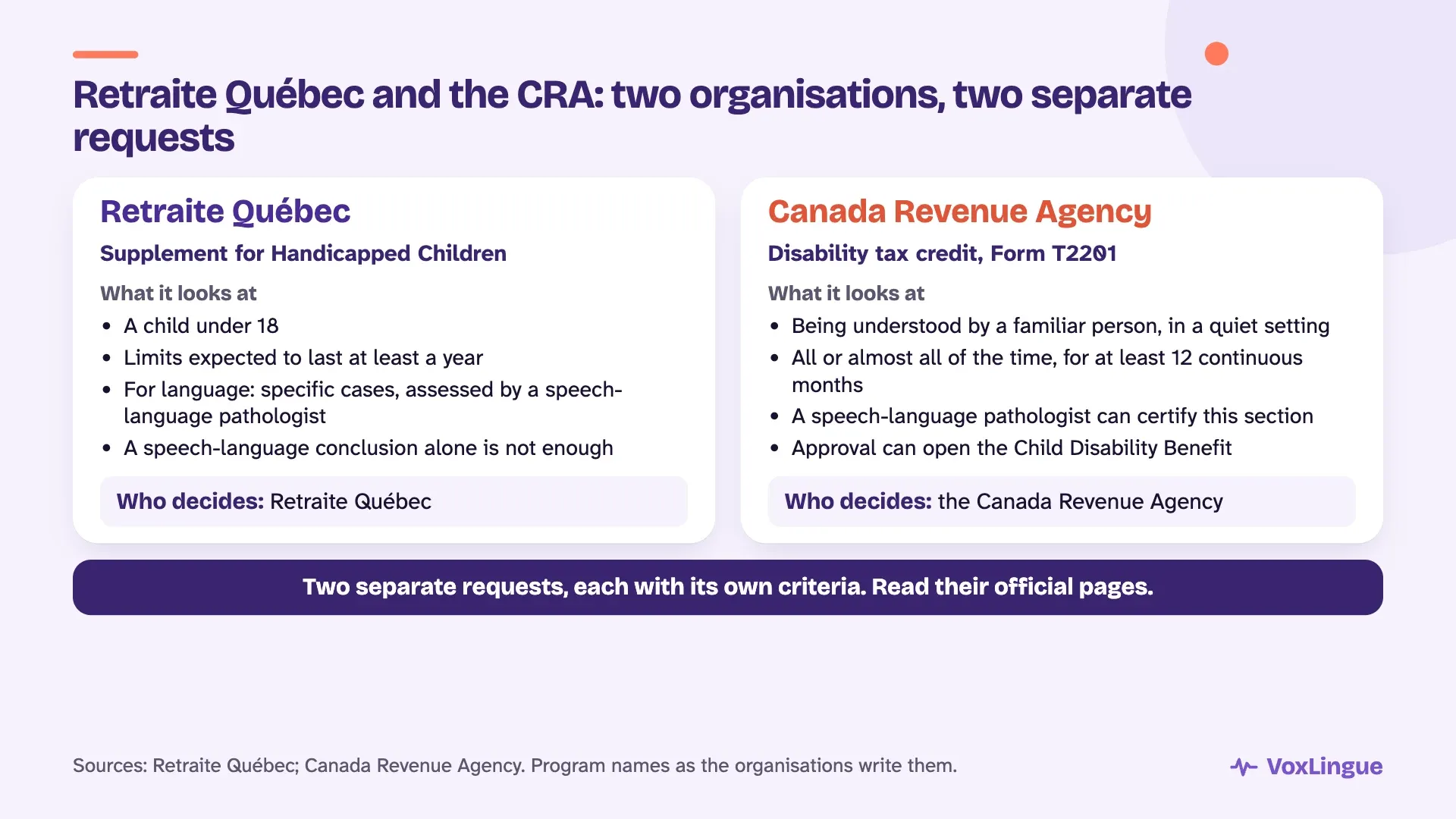
Sometimes, under precise criteria specific to each organisation. Retraite Québec states that a speech-language conclusion alone isn’t enough to make a child eligible. The CRA has its own test for speaking. These programs are for particular situations, so read their official pages before you apply.
The Supplement for Handicapped Children is for a child under 18, with limits expected to last at least a year. For language, Retraite Québec’s criteria (in French) describe specific cases, assessed by a speech-language pathologist. A separate rule applies to a child assessed only in a language they are learning. An evaluation can also be judged too brief or too old.
At the CRA, the speaking criterion means being unable to speak so as to be understood by a familiar person in a quiet setting, or taking three times as long. This must be the case all or almost all of the time, for at least 12 continuous months. A speech-language pathologist can certify this section of Form T2201. Approval can open the Child Disability Benefit. Only these organisations decide.
What if you have no private insurance?
Look first at public services, which are free of charge. A few specific resources also exist: university clinics with supervised students, funding from the Association des jeunes bègues du Québec, and Jordan’s Principle for First Nations children. Without insurance, tax credits are still possible.
| Resource | Who it’s for | What to check |
|---|---|---|
| Université de Montréal university clinic (in French) | Open to the public, no referral, in French. Students work there under close supervision | It charges fees: see those posted on its site |
| McGill University pediatric clinic | Young children. Free services, in English | Age, conditions and periods, winter and spring, are on its page |
| AJBQ funding program (in French) | Young people 17 and under who stutter, in Québec | It excludes the first evaluation and requires membership. Check that it is still open |
| Jordan’s Principle | First Nations children. Speech therapy is among the examples named | The steps are on the Indigenous Services Canada page |
If your child stutters, our article on stuttering and normal disfluency can help you see more clearly before you apply. Our guide on what you can do during the wait also covers what can be done at home.
Without insurance, what you pay yourself isn’t reimbursed. So keep your receipts from the start: these costs may count toward the tax credits explained above.
Do online sessions count for tax and insurance?
Federally, they can count if the person is authorized to practise where the service is rendered. According to the CRA, where that service is rendered remains a question of fact. For provincial credits and for your plan, ask Revenu Québec, the CRA or your insurer, and keep your receipts.
The CRA explains this in its folio (2025): a virtual service may be rendered where the practitioner is, where the patient is, or in both places. This article doesn’t settle these cases. If you’re considering speech therapy by telepractice, add the question to your call with your insurer.
What about Ontario?
OHIP has a limit outside hospitals: it doesn’t cover services from providers who are neither physicians nor prescribed practitioners. Public programs for children exist, with no doctor’s referral needed. For private sessions the logic stays the same: insurance, then federal and Ontario tax credits. Check the details with these programs.
The wording comes from Ontario’s page on what OHIP covers, which doesn’t name speech therapy. The program pages below don’t state a cost either, so ask them directly.
| Door | Who it’s for | Good to know |
|---|---|---|
| Preschool Speech and Language Program | Birth to school entry | No doctor’s referral needed |
| Children’s rehabilitation services | Up to 19, or 21 if in school | No formal referral required |
| Ontario Autism Program | Families in the program | Speech therapy is an eligible expense, from a registered and licensed professional |
| Ontario credit | People who file in Ontario | Line 58689, same 12 months as the federal credit |
Much of this guide applies in Ontario as written. The federal credit, lines 33099 and 33199, and the 12-month period are the same. The CRA’s list recognizes speech-language pathologists in Ontario. Your plan decides what it reimburses, so the twelve questions work just as well.
The OOAQ’s guidance on receipts is Québec’s. In Ontario, follow the CRA’s rules on receipts. See also telepractice in Ontario.
What do you do, and when, so nothing is missed?
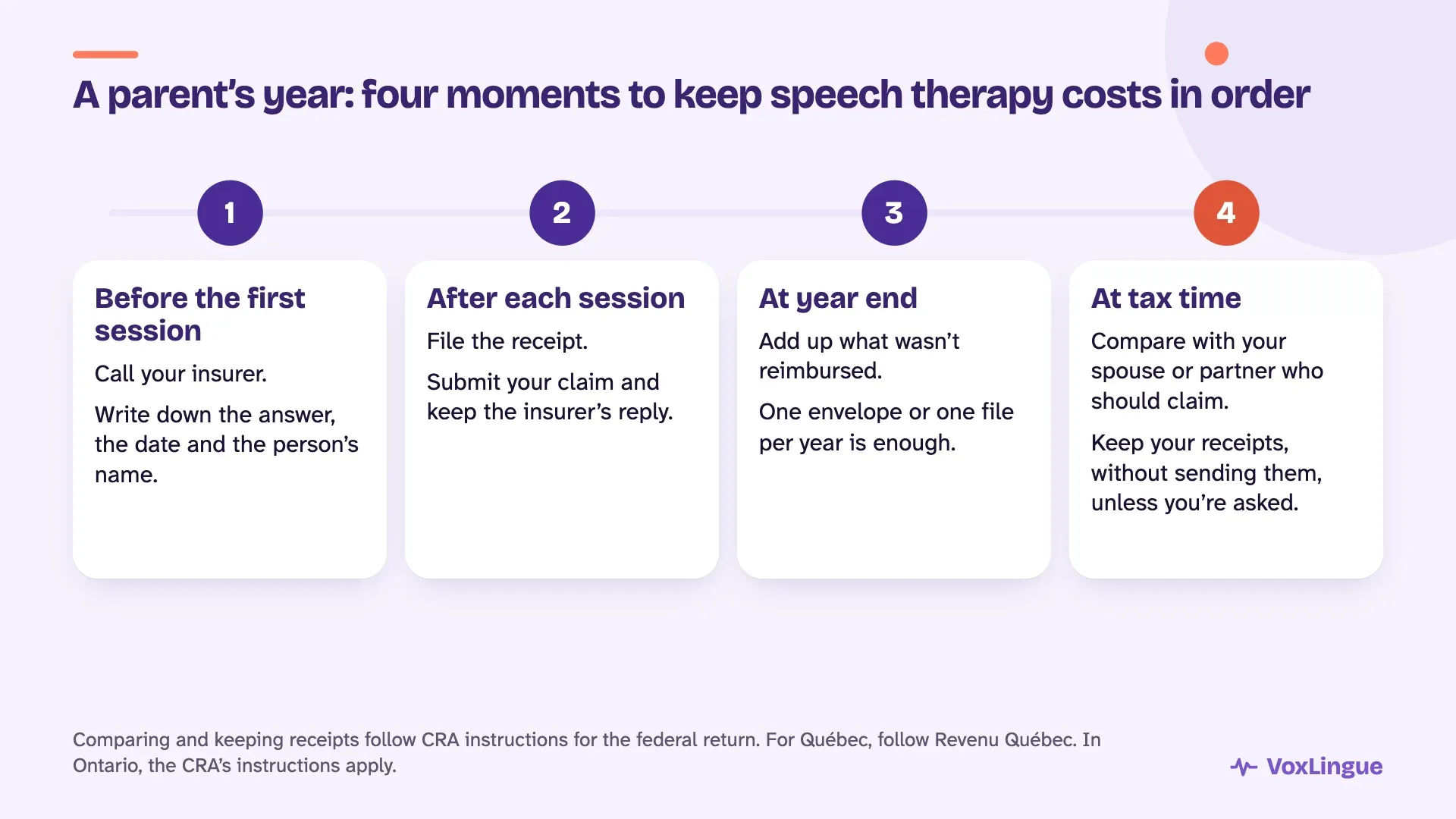
Before the first session, call your insurer. After each session, file the receipt and submit your claim. At year end, add up what wasn’t reimbursed. At tax time, compare with your spouse who should claim. Keep your receipts, without sending them, unless you’re asked to provide them.
A small file is enough: one envelope or folder per year, with the receipts and your notes from the call to your insurer. Add the insurer’s replies to your claims, so you know what was reimbursed.
Comparing spouses and keeping receipts follow the CRA’s instructions for the federal return, which also apply if you file in Ontario. For the Québec return, follow Revenu Québec’s.
Key takeaways
To pay for speech therapy in Québec, think in order. Public services come first, then your insurance, then tax credits on what isn’t reimbursed. Call your insurer before the first session. The receipt names the person who received the service, and the person who paid can still claim. Keep your receipts.
Next step
Print the sheet, “Before you claim: questions for your insurer and the receipt checklist”, and keep it with your insurance papers. If you’re thinking about a private assessment, you can request an assessment at our Marché Central clinic in Montréal, or by telepractice. To keep reading, see our articles on assessment. Your insurer can tell you what your plan reimburses.
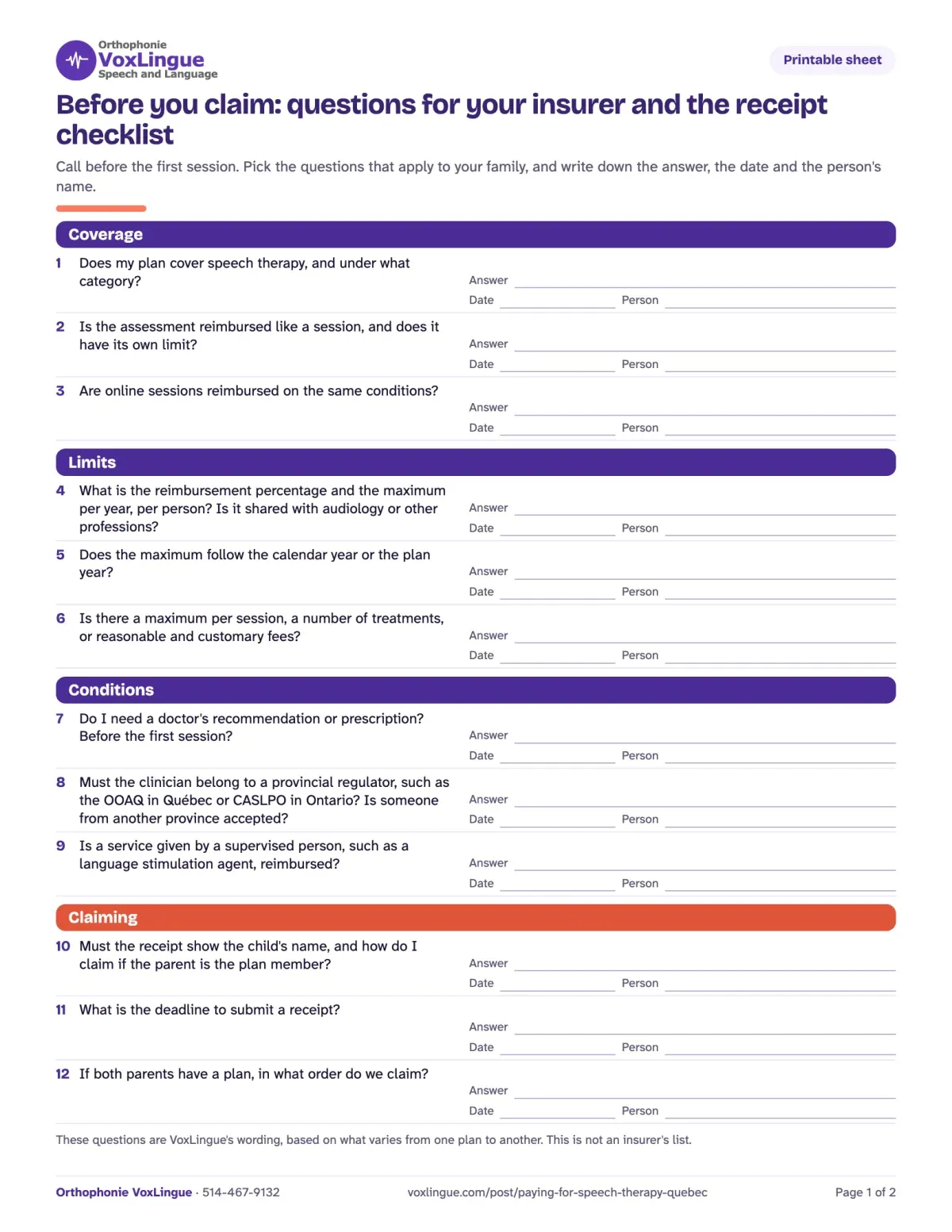
Printable sheet: Before you claim: questions for your insurer and the receipt checklist (PDF, 2 pages).
Frequently asked questions
Is speech therapy covered by RAMQ?
RAMQ doesn’t cover speech therapy in a private clinic. In the public system, speech therapy services are free of charge, according to the OOAQ, but access varies by region. In private practice, the fees are yours to pay: your insurance may reimburse part of them, and the rest may count toward tax credits.
Is speech therapy at the CLSC free?
Yes: according to the OOAQ, public sector speech therapy services are free of charge. Services and the steps to reach them vary by region, though, and the wait can be long. Our guide to the waiting list explains what the published wait times mean, and how to combine public and private services.
How much does a private speech-language pathologist cost?
According to the Ordre des orthophonistes et audiologistes du Québec, private hourly rates usually range from $100 to $200, and assessments are often billed separately (the Order’s page, read November 2, 2026). This is the Order’s market estimate for Québec, not a VoxLingue rate. Ask for an estimate before you start.
Does my insurance reimburse the assessment?
It depends on your plan. According to the OOAQ, each insurer decides what is eligible for reimbursement. Before you book, ask whether the assessment is reimbursed like a session and whether it has its own limit. That is the second question on our list. Write down the answer, the date and the person’s name.
Do I need a doctor’s recommendation to be reimbursed?
It depends on the contract. One published group plan requires the treating doctor’s recommendation for speech therapy, and a claim form from iA Financial Group warns that your policy may require one. Other contracts may say something else. Ask your insurer, and check whether the recommendation has to exist before the first session.
Can the receipt be in the parent’s name?
Yes, when the service is truly aimed at the parent, such as parent coaching, according to the OOAQ. For your child’s sessions, the Order’s guidance to its members is that the receipt names the child, since the child receives the service. That doesn’t stop you from claiming the costs at tax time.
Can I claim if the receipt is in my child’s name?
At tax time, yes. Federally, the right to claim follows the person who paid, or their spouse, not the name on the receipt. In Québec, the Revenu Québec guide (2008 edition) refers to expenses paid by you or your spouse for a dependant. For insurance, ask your insurer.
Can I deduct speech therapy on my taxes?
People often say deduction, but these are medical expense tax credits, federally and in your province. They apply to the part of your costs above a threshold, and only what isn’t reimbursed counts. The table above compares the Québec and federal rates, thresholds and return lines, and the Ontario section gives the Ontario line.
If insurance reimburses part, does the rest count at tax time?
Yes, the rest may count. The CRA excludes expenses a person is entitled to have reimbursed, and the Research Chair in Taxation and Public Finance at Université de Sherbrooke notes that only amounts not reimbursed count. The credit then applies to the part of your expenses above the year’s threshold.
Do I send my receipts with my return?
Federally, no: you keep them in case the CRA asks for them. For the Québec return, follow Revenu Québec’s instructions, since we weren’t able to read the current version. Either way, keep your receipts, filed by year, along with your insurer’s replies to your claims.
Can a grandparent pay for the sessions?
Yes. According to the OOAQ, someone else may pay the fees, without gaining any special right to information about the follow-up. Tax is different: federally, the credit follows the person who paid or their spouse. If that’s your situation, check with the CRA before anyone pays.
Is a speech therapy assessment enough for Retraite Québec?
Not on its own. Retraite Québec states that a speech-language conclusion alone isn’t enough to make a child eligible, and that an evaluation can be judged too brief or too old. Its eligibility page explains the requirements. Only the organisation decides, so read its page before you apply.