
Saint-Laurent · Chameran, Vieux-Saint-Laurent, Norgate, Bois-Franc and Place Benoît
Speech therapist in Saint-Laurent: assessing your child's language in all their languages, Arabic, Greek, Armenian or Spanish, before deciding what a concern raised in French at school or daycare means
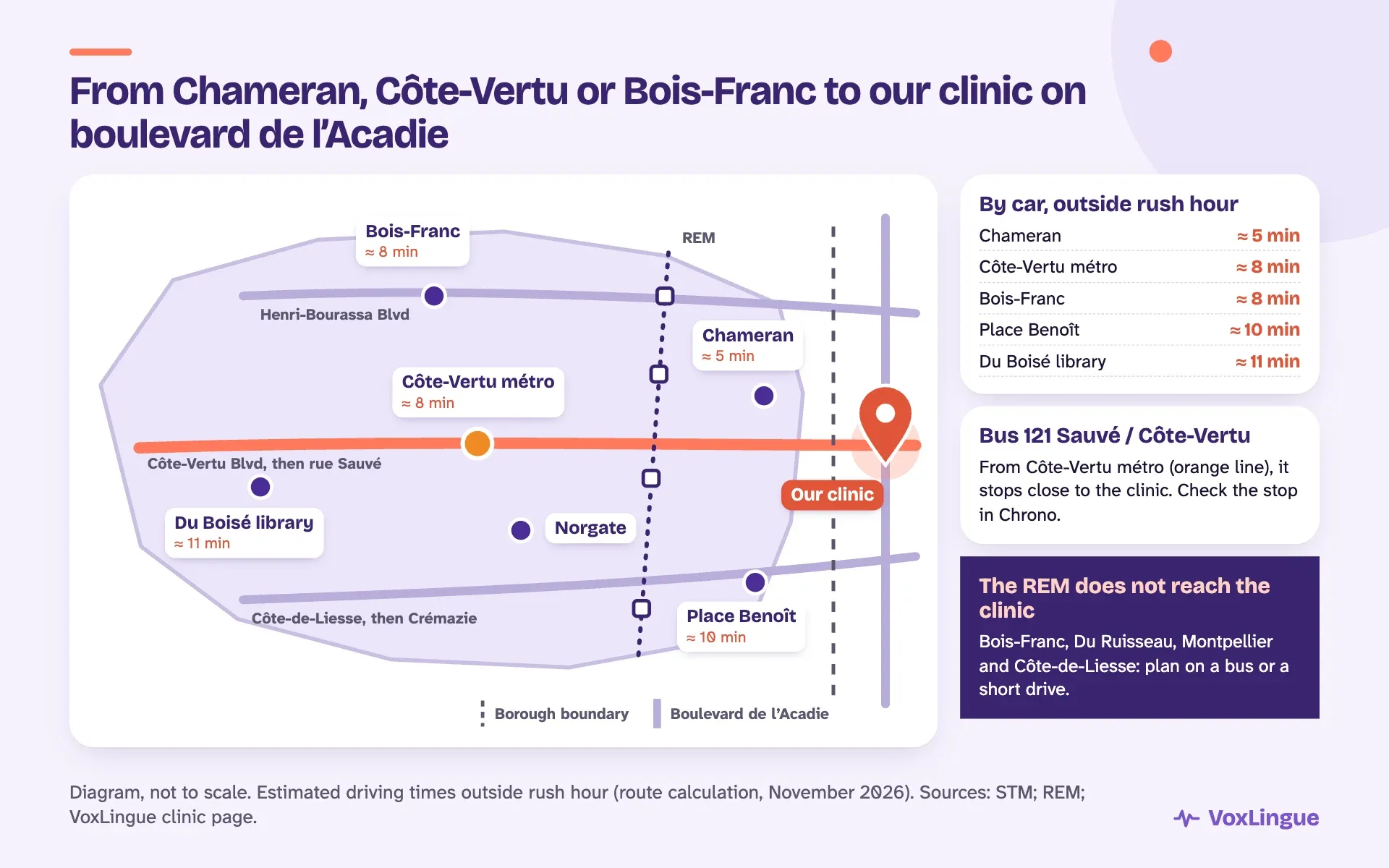
In the borough of Saint-Laurent, in Montréal, about one child in two speaks a language other than French or English at home. When daycare or school raises a concern about your child's French, our speech-language pathologist looks at all their languages before drawing a conclusion. Our Marché Central clinic is just across the borough's eastern edge, about 5 to 15 minutes by car depending on where you live.

Where can you find a speech therapist near Saint-Laurent who looks at all of your child’s languages?
Our clinic is just east of Saint-Laurent, at Marché Central. It is in the Plaza L’Acadie building, on the Ahuntsic-Cartierville side, right by the borough line. From Chameran, it takes about 5 minutes by car; from Côte-Vertu métro, about 8 minutes outside rush hour. Many residents still say “Ville Saint-Laurent”: this is the same area, not boulevard Saint-Laurent or the Bas-Saint-Laurent region.
You can come to the clinic or have sessions from home by secure video. The practical details are on one page: parking, entrance and clinic hours. For sessions at a distance, see online speech therapy sessions, which suit many goals as well as parent coaching.
Our speech-language pathologists work in English and French. Some also speak Arabic, Armenian, Greek or Spanish, all languages you hear in Saint-Laurent. Availability varies by language and schedule. Whether or not your clinician speaks your language, the assessment looks at all of your child’s languages. For details, see the languages spoken on our team.
Saint-Laurent: one child in two grows up with a language other than French or English at home
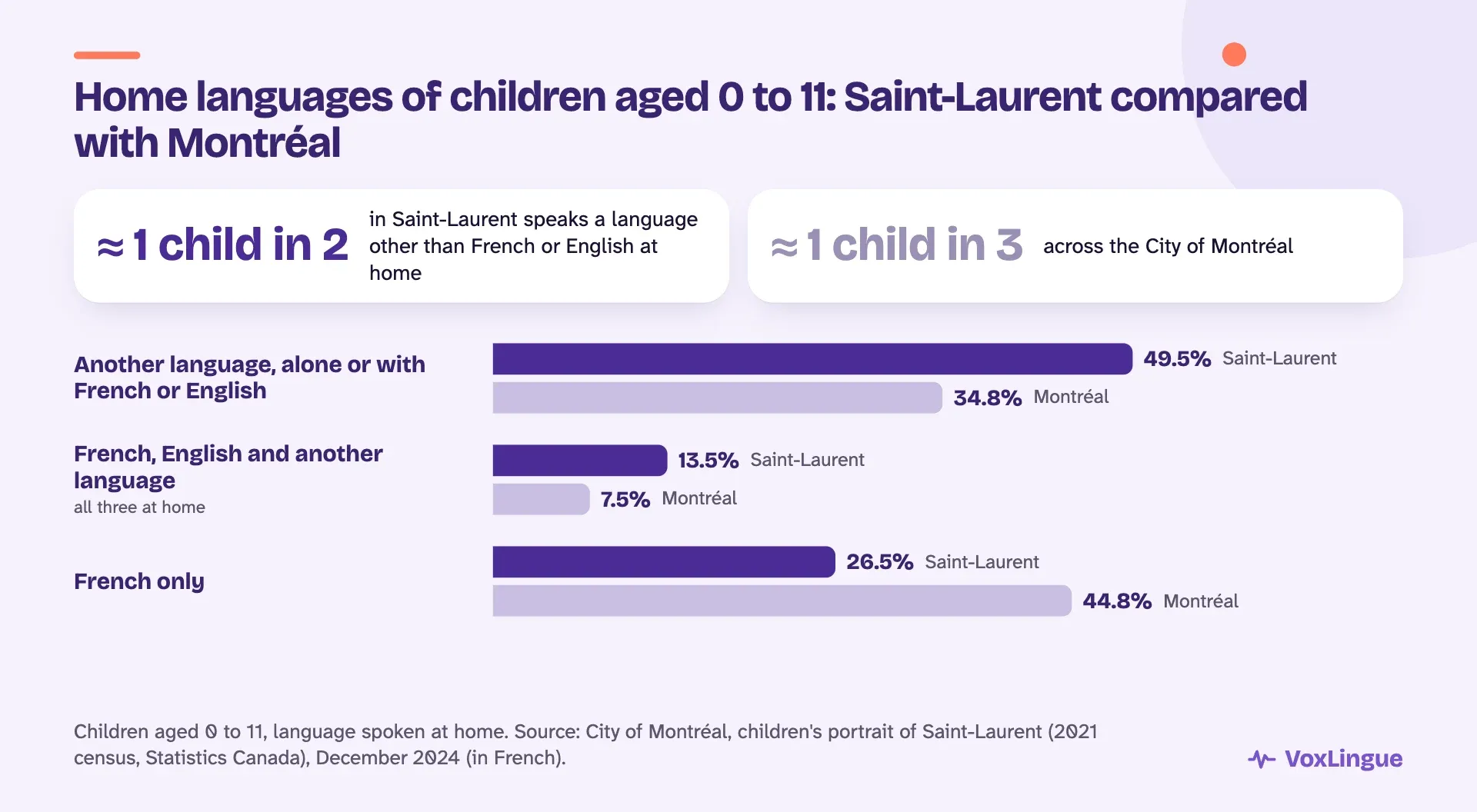
In Saint-Laurent, about half of children aged 0 to 11 speak another language at home. According to the City of Montréal’s portrait of children in the borough (in French), based on the 2021 census, 49.5% speak a language other than French or English, alone or with one of them. Across the city, the figure is 34.8%, or about one child in three.
Many of these children grow up with three languages. In 13.5% of Saint-Laurent children’s homes, French, English and another language are all spoken, nearly twice the Montréal figure (7.5%). By contrast, 26.5% speak only French at home, compared with 44.8% city-wide. The borough has 15,685 children aged 0 to 11, or 15.6% of its population, a larger share than the Montréal average (12.7%).
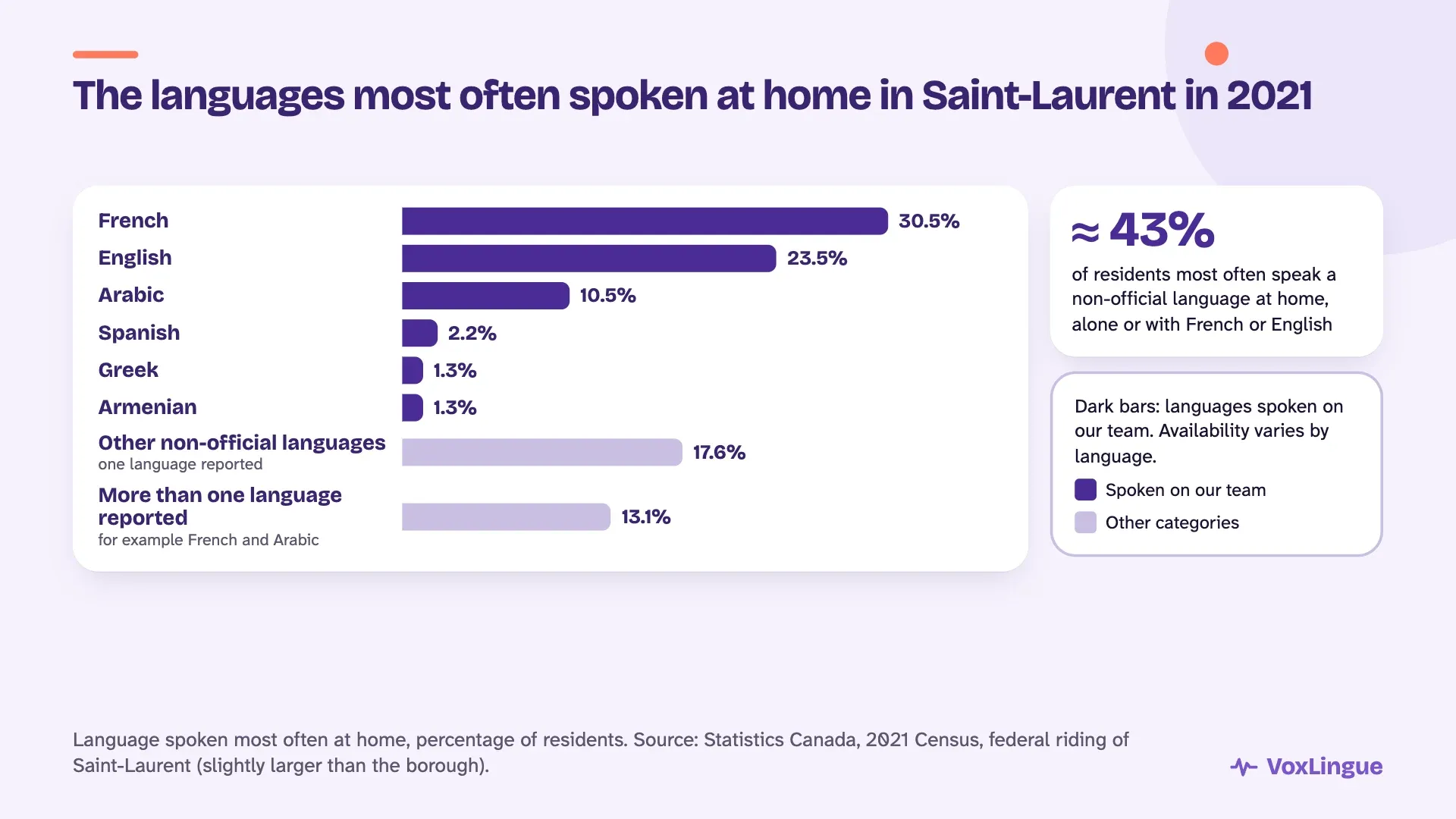
Arabic is the third language spoken at home, after French and English. In the federal riding of Saint-Laurent, which is slightly larger than the borough, about one resident in ten speaks Arabic most often at home (10.5%), according to Statistics Canada’s 2021 census. After Arabic, no other non-official language goes above 3%. Spanish, Greek and Armenian are among those heard most.
In all, about 43% of residents most often speak a non-official language at home, alone or with French or English. More than half of residents (57%) are immigrants or non-permanent residents, compared with 40.9% in Montréal. Their main countries of birth are Lebanon, Syria, China and Morocco.
These numbers describe diversity, not a problem. They do explain a common situation here: for many children, French arrives mainly at daycare or school, while their strongest language is the one spoken at home. That is often when the first concern comes up.
Daycare or school is worried about your child’s French: a language difficulty, or a language still being learned?
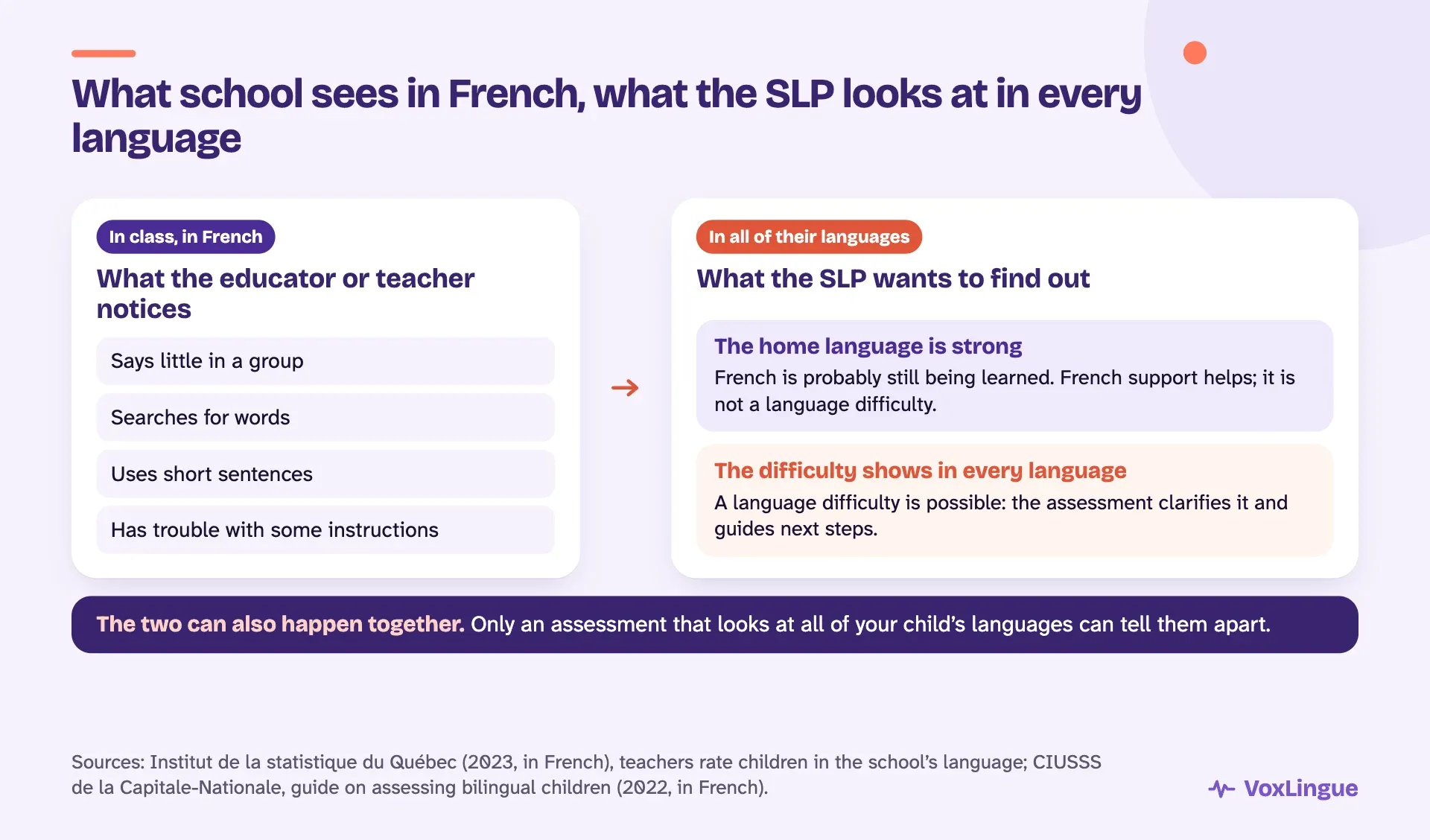
It can be either, and French alone cannot tell you which. A child learning French may say little in class, search for words or use short sentences. A language difficulty, on the other hand, also shows in the child’s strongest language. Only an assessment that looks at all of their languages can tell the two apart.
The educator or teacher sees your child in French, and that is expected: it is the language of the group. What they notice matters. They see whether your child follows instructions, plays with others and gets their message across. But they don’t hear your child speaking Arabic, Greek or Spanish with their grandmother. You do. Your description of how your child talks at home counts as much as theirs.
If the concern comes from daycare, read what we explain about when your child’s daycare educator is worried: what to ask and what to watch for at home. For school entry, see how to prepare the kindergarten language form and describe your child in their strongest language.
At kindergarten, a questionnaire filled out in the school’s language
Kindergarten teachers observe children in the school’s language. In Québec’s survey of child development in kindergarten, for example, teachers fill out a questionnaire for each student. According to the Institut de la statistique du Québec report (in French), they rate their students in the school’s language of instruction.
Yet 95.4% of children whose only mother tongue is neither French nor English attend a French-language school. For these children, the school mostly sees their French. Montréal’s public health department also points out that this questionnaire is not designed to screen or diagnose an individual child. It is meant to describe groups of children.
What you can ask the school team
A meeting with the school team is a good time to talk about all of your child’s languages. Whether your child attends an English Montreal School Board school, such as Gardenview or Cedarcrest, or a Centre de services scolaire Marguerite-Bourgeoys school, such as Henri-Beaulieu or Bois-Franc-Aquarelle, you can:
- describe your child’s language in their strongest language: their words, their sentences, how they tell a story;
- ask what your child understands and how they communicate with others, not only what they say in French;
- ask whether the school’s support services team can observe your child in class;
- share our report with the school, if you wish, with your consent.
The school team can refer a student to school speech therapy. They know how services work in your school.
How does a speech-language pathologist assess a child who speaks Arabic, Greek, Armenian or another language?
They look at each of your child’s languages, not only French. They ask you about your child’s history in each language, watch your child play, gather input from daycare or school and, where possible, give tasks in your child’s languages. Then they look at where the difficulty shows: in all of the languages, or only in French.
This is what a 2022 guide from the CIUSSS de la Capitale-Nationale recommends. According to this guide on assessing children in bilingual situations (in French), assessing only one language gives an incomplete picture of a child’s abilities. In one of their languages, a bilingual child may score lower than a monolingual child of the same age without having a language difficulty.
For each language that matters in the child’s life, the guide recommends varying methods and sources of information. Parents come first: you know when your child started each language, who they speak it with and how much. A case history questionnaire records this, language by language. The educator or teacher adds what they see in a group, and watching your child play shows how they communicate with you.
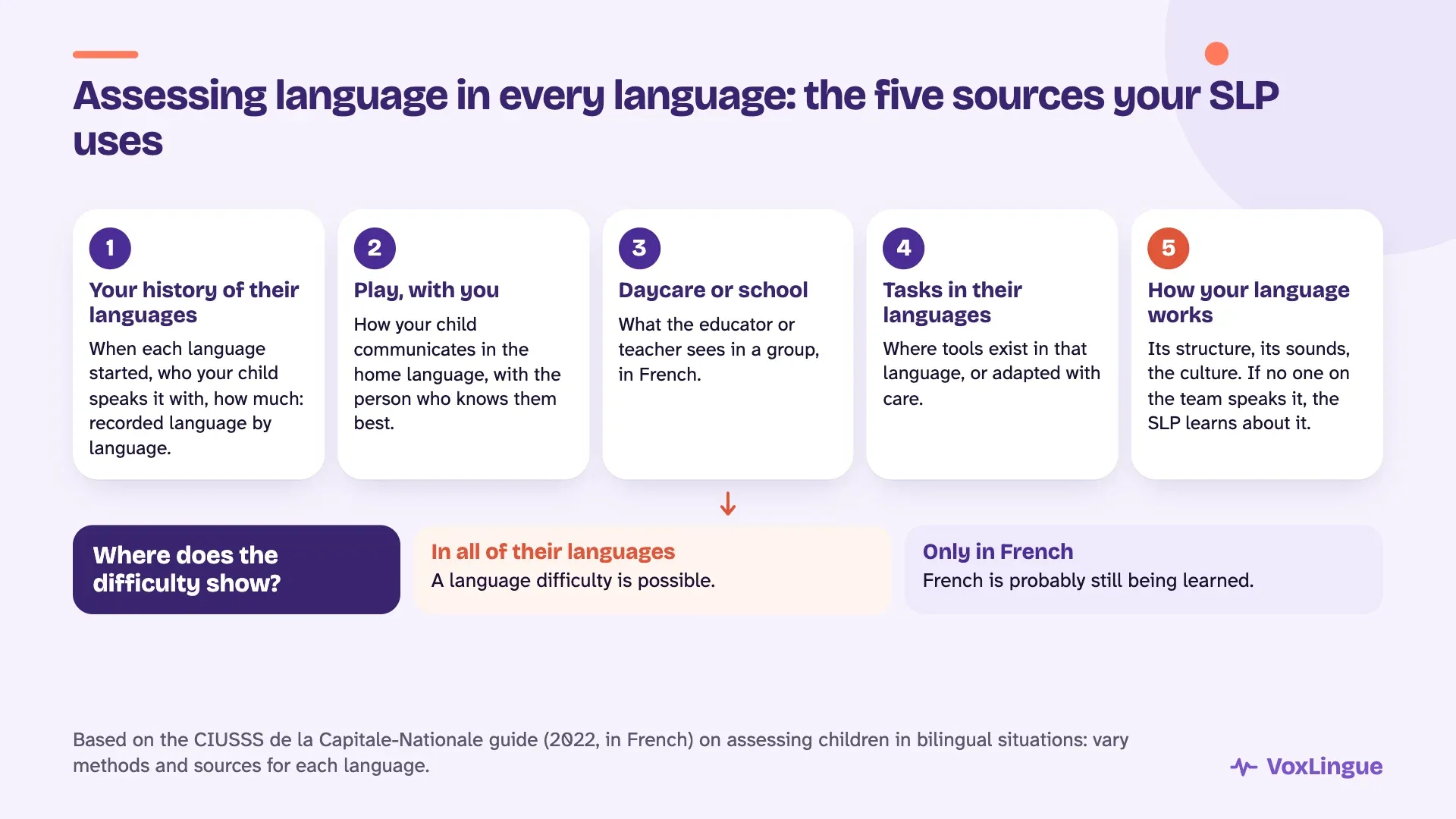
The conclusions take all of these sources into account. To see the steps with us, read about our speech-language assessment. To understand what separates a language still being learned from a disorder, see our post on telling a language difference from a language disorder.
When your clinician speaks your language
If your family speaks Arabic, Armenian, Greek or Spanish, some of our speech-language pathologists speak these languages too. The interview can then happen in your language, and your clinician can more easily recognize what is typical in that language. During therapy, they can also coach you in the language you use with your child every day. Availability varies, so ask when you book.
When no one on the team speaks your language
No one on our team speaks Mandarin, Cantonese, Vietnamese or Tamil, though all are widely spoken in Saint-Laurent. Your child can still be assessed in all of their languages. The CIUSSS de la Capitale-Nationale guide uses this very example, a child whose mother tongue is Cantonese: the speech-language pathologist does not need to speak that language.
The guide spells out what they do need to do. They learn about the structure of the language, take the cultural dimension into account and can work with an interpreter or someone who knows the language. The guide is candid: assessing a child in a language the clinician doesn’t speak takes more preparation and more time.
With us, your clinician learns how your language works and how your child uses it. They then coach you to support your child in the language you are most comfortable with. What you tell us about how your child talks at home carries even more weight here.
Should you stop speaking your language at home so your child learns French?
No. Learning more than one language does not cause a language disorder or make a difficulty worse. Québec’s order of speech-language pathologists and audiologists says so on its page about learning more than one language (in French). Yet the advice to drop the home language still circulates, often in good faith.
The order recommends speaking to your child in the language you know best, with frequent, rich conversations. It also suggests valuing each of your child’s languages, for example with books in each one. In Saint-Laurent, the Du Boisé library lends books in Arabic, Chinese and Spanish as well as French and English.
To track progress, add up your child’s words across all of their languages: our newsletter explains counting words in all of your child’s languages. And if your child switches languages in the middle of a sentence, that is common in bilingual children: see what it means for a child who mixes languages.
Recently arrived in Saint-Laurent with a young child: what is common, and when to get help
Saying little in French during the first months is common for a child who has just arrived. Their home language shows more clearly where they are. If it is not moving forward, if your child is losing words, or if you are worried, don’t wait until they speak French. An assessment that looks at all of their languages can happen now.
Many Saint-Laurent families are in this situation. According to the City of Montréal, 15.5% of the borough’s children aged 0 to 11 are immigrants, and 76.1% of them arrived between 2016 and 2021. In addition, 7.3% of children do not yet speak French or English, compared with 4.6% across the city. For age-by-age guideposts, see language milestones in bilingual children.
At school, the CSSMB has a set process for a child who does not speak French. According to its registration questions page (in French), you register online, then receive an appointment for a language evaluation for a welcome class (classe d’accueil). That appointment is used to place your child in the right class. It is not a speech-language assessment, and it does not look for a language difficulty.
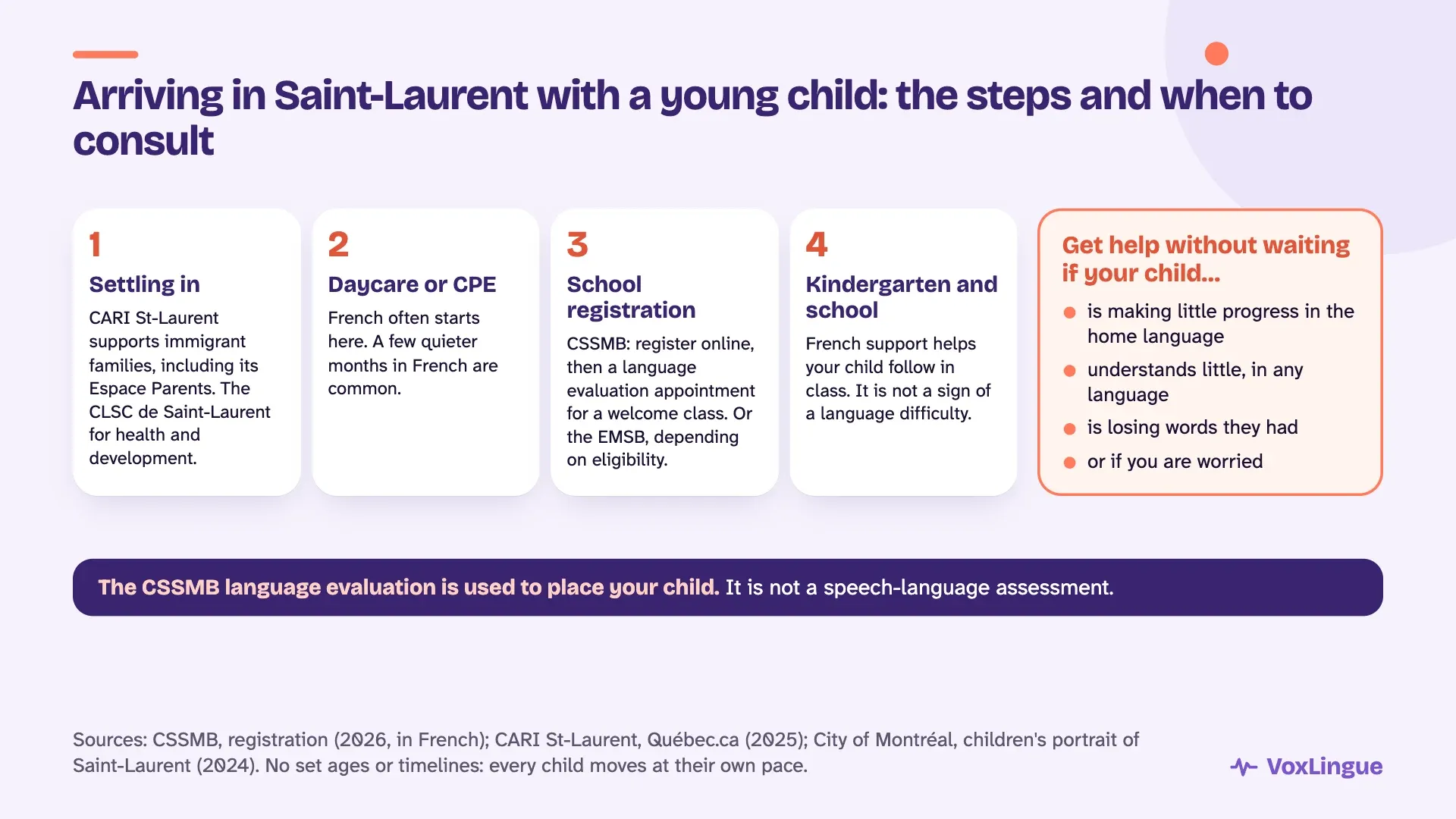
Getting French support at school does not mean your child has a language difficulty. To help you settle in, CARI St-Laurent supports immigrant families, including through its Espace Parents. The signs that call for an assessment are found in your child’s strongest language: they understand little, say little, lose words they used to have, or the educator notices the same thing in several areas.
CLSC, Agir tôt, school or private: where do you start in Saint-Laurent?
Start with the public network: contact the CLSC or ask the doctor. For a child under 7, the Agir tôt program is free. At school, talk to the school team. At the same time, if you can, a private assessment in all of your child’s languages helps you understand without waiting.
The CLSC de Saint-Laurent is on avenue Sainte-Croix; its details are in the cards below. The Agir tôt program is for children under 7, from birth to school entry, and their families. You can contact the CLSC yourself. A doctor or someone who knows your child can also refer them, with your permission.
On the same street, close to the CLSC, Au cœur de l’enfance, Saint-Laurent’s social pediatrics centre, supports families who need broader help. It offers language stimulation workshops among other services. For a school-age child, the EMSB or CSSMB school team remains the way into school services.
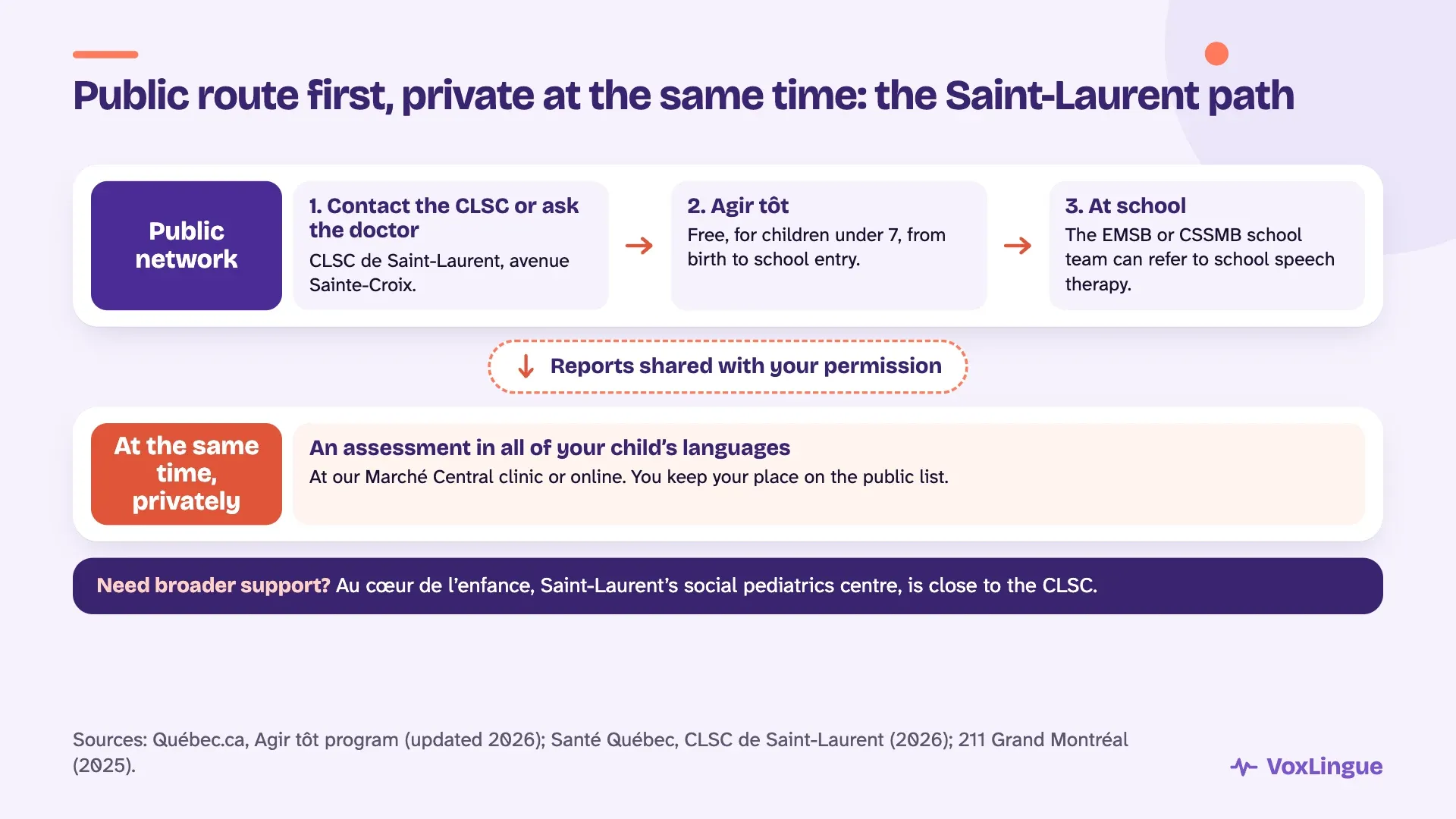
Public and private services are not either-or. You can keep your place on a public list while starting privately, and we share our reports with your permission. To plan ahead, read our guides to the public waiting list and what to do meanwhile and to what public services, insurance and tax cover.
Public and community services for Saint-Laurent families
Private and public services work well together. Many families keep their place on a public waiting list while starting with us, and we share reports with your permission.
CLSC de Saint-Laurent
1055 avenue Sainte-Croix, 514-748-6381. Part of Santé Québec, Nord-de-l'Île-de-Montréal. Open weekdays 7 a.m. to 8 p.m. If you have a concern about a child's development, ask at the CLSC front desk. Early stimulation and baby stimulation workshops by appointment.
Agir tôt program
Free, for children under 7, from birth to school entry, and their families. Contact the CLSC or ask the doctor; someone who knows your child can also refer them, with your permission.
Au cœur de l'enfance, Saint-Laurent social pediatrics centre
1159 avenue Sainte-Croix, close to the CLSC, 514-333-8989. Family support, social pediatric follow-up and language stimulation workshops (in French).
Du Boisé and Vieux-Saint-Laurent libraries
2727 boulevard Thimens and 1380 rue de l'Église. Story time (18 months to 5 years), baby story time (0 to 2) and occasional workshops on baby language. Du Boisé has books in Arabic, Chinese and Spanish as well as French and English.
Schools: EMSB and CSSMB
English schools of the EMSB, such as Gardenview or Cedarcrest, and French schools of the Centre de services scolaire Marguerite-Bourgeoys, such as Henri-Beaulieu or Bois-Franc-Aquarelle, can refer a student to school speech therapy. Talk to the school team. With your permission, we can share our reports with them.
CARI St-Laurent
774 boulevard Décarie, suite 300, 514-748-2007. Settlement and integration support for immigrant families, including its Espace Parents.
Information checked in November 2026. Contact each service to confirm current hours and how to apply.
How we can help
Common questions
Is there a speech therapist near Saint-Laurent?
Yes. Our Marché Central clinic, at 9580 boulevard de l'Acadie, is just east of the borough: about 5 minutes by car from Chameran and 8 from Côte-Vertu métro outside rush hour. Bus 121 links Côte-Vertu métro with the area around the clinic. We also offer online sessions by secure video.
My child speaks Arabic, Greek or Armenian at home. Can you assess them in their language?
Some of our speech-language pathologists speak Arabic, Armenian, Greek or Spanish, as well as French and English. Availability varies by language, so ask when you book. Either way, the assessment takes all of your child's languages into account, and your description of how they talk at home is part of it.
No one on your team speaks our language. Can you still assess our child?
Yes. A 2022 guide from the CIUSSS de la Capitale-Nationale notes that a speech-language pathologist does not need to speak the child's language, but must learn about it and take the culture into account. Your clinician will learn how your language works and how your child uses it. Keep using your language at home.
Do I need a referral?
No. You can contact us directly, without a doctor's referral, and we provide receipts for private insurance. If your child is under 7, start the public route at the same time: contact the CLSC or ask the doctor about the Agir tôt program, which is free.
Should we wait for the CLSC or start privately?
You can do both. Start with the public network: contact the CLSC or ask the doctor. Many families keep their place on a public waiting list while they start privately. With your permission, we share our reports with the CLSC or the school. You do not have to choose one or the other.
Does my child's school have a speech-language pathologist?
EMSB and CSSMB schools can refer a student to school speech therapy services. The way in is the school team: talk to the teacher or the principal first, who can explain how the school's support services work. With your permission, we can share our report with the school so it knows about all of your child's languages.
The CSSMB tested our child's French at registration. Was that a speech-language assessment?
No. For a child who does not speak French, the CSSMB gives an appointment for a language evaluation after online registration. It is used to place the child, for example in a welcome class. It does not look for a language difficulty. EMSB registration has its own steps, including eligibility for English schooling. If you are worried, a speech-language assessment in all of your child's languages answers that question.
Where can we find books in our language in Saint-Laurent?
The Du Boisé library on boulevard Thimens has books in Arabic, Chinese and Spanish as well as French and English. It also runs story time for children from 18 months to 5 years. Québec's order of speech-language pathologists and audiologists recommends valuing each of a child's languages, for example with books in each one.
Do you also see adults?
Yes. We also see adults for speech, language, stuttering, voice and swallowing, at the clinic or online. A sudden change in speech, language, voice or swallowing needs medical help first: call 911 or see a doctor right away, before booking a speech therapy appointment.
How long does it take a child to learn French at school?
It varies a lot from one child to the next, and no timeline fits everyone. Everyday French usually comes before the more abstract French of the classroom, which takes longer. In the meantime, your child's home language shows more clearly where they are. If that language is not moving forward either, or if you are worried, get an assessment.
Nearby areas
Let's talk about what you're noticing.
No referral needed. Call the clinic or send us a request, and we'll match you with the right clinician.