Online speech therapy for a toddler 18 months to 3 years old: how the speech-language pathologist coaches you during play, what research says, what still needs an in-person visit, and how to decide
Online speech therapy for toddlers often comes up in one of two ways. The speech-language pathologist suggests sessions by video, or the nearest clinic is an hour’s drive away. Your child is somewhere between 18 months and 3 years old, and one thought comes first: “They’ll never sit still in front of a screen.”
Many parents ask the same questions at this point. Does it really work at this age? Isn’t it just more screen time? And what am I supposed to do during the session?
This guide answers those questions from the parent’s side. It explains why the screen is mostly for you, what a session and an online assessment look like, what research shows and which children were studied, and what still needs a visit. It ends with how to decide, and with the rules and starting points in Québec and Ontario. The ages given are approximate: every child moves at their own pace.
Does online speech therapy work for toddlers 18 months to 3 years old?
Yes, for many families. At this age, online speech therapy is mostly about coaching the parent while they play with their child. In Québec, the public health institute recognises feedback to parents by videoconference, the provincial health-evidence institute recommends telepractice where it suits the child, and a public team in the Laurentides region works this way with children aged 1 to 5.
The professional term is “telepractice”. It is the word Québec’s Ordre des orthophonistes et audiologistes (OOAQ) uses for services delivered at a distance. Parents tend to say “online” or “virtual”. In this guide, all three mean the same thing: a live session with a speech-language pathologist (SLP) who can see you, hear you and answer you.
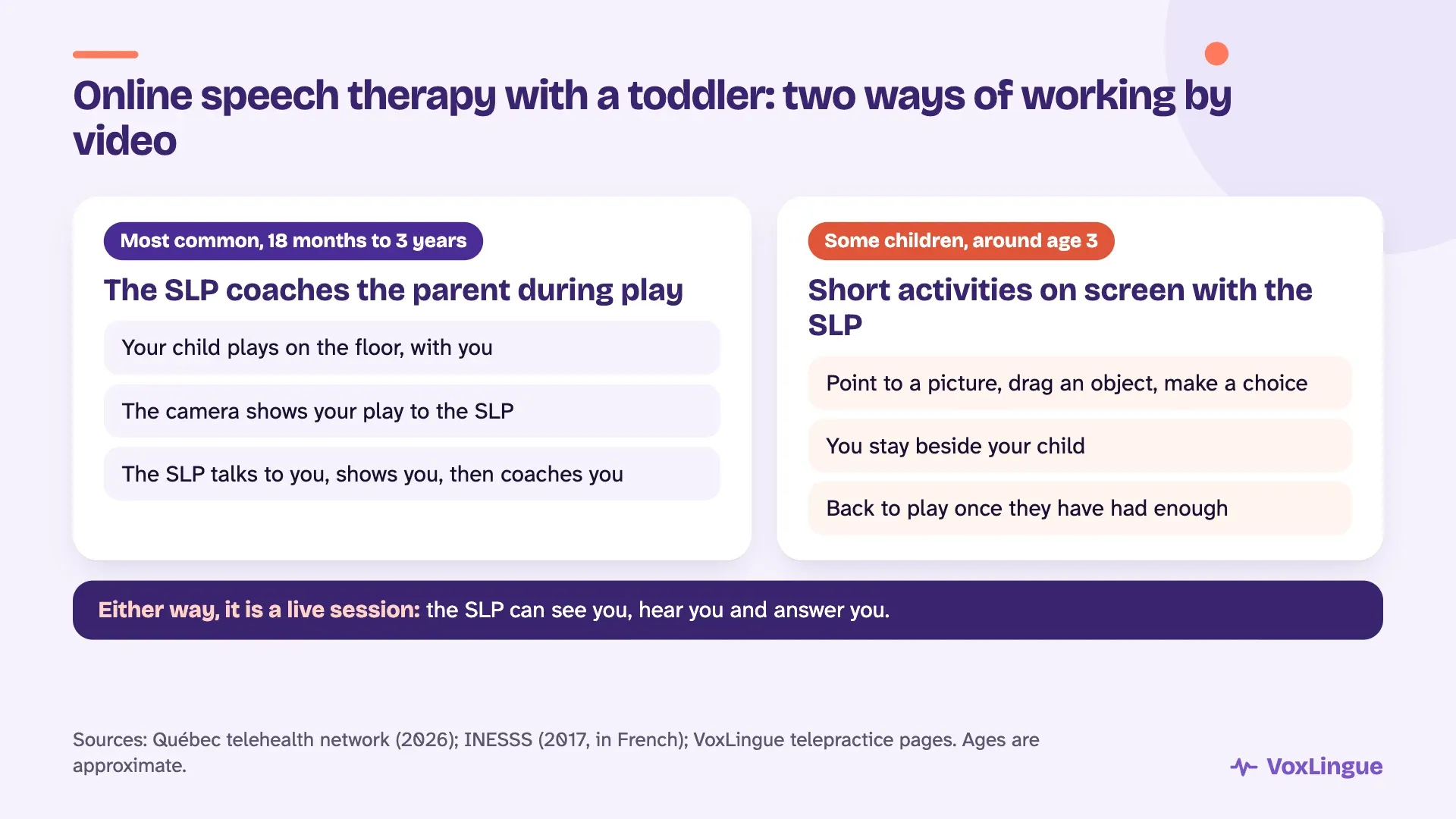
With a toddler, online speech therapy takes two forms. The most common one, from 18 months to 3 years, is parent coaching: you play with your child, and the SLP guides you. The other form is short activities that the child does on screen with the SLP. You see it more often around age 3, and only with some children.
The public system uses video with toddlers too. According to Québec’s telehealth network, SLPs at the CISSS des Laurentides have been working remotely for several years with children aged 1 to 5 and their parents (Télésanté Québec, 2026). All of their parent training is offered remotely. One regional program does not mean that every CISSS or CLSC offers the same thing.
In Ontario, CASLPO has had standards for virtual care since 2020, and it explains them to families in a short patient sheet.
Two Québec public bodies point the same way. The Institut national de santé publique du Québec (INSPQ) describes feedback given to a parent after an interaction that was observed or filmed. It notes that this feedback can be given in person, “but also by videoconference” (INSPQ, 2023, in French). The document covers promotion and prevention from birth to 6, not treatment.
The Institut national d’excellence en santé et en services sociaux (INESSS) recommends including telepractice “if relevant for the child” for children aged 2 to 9 with developmental language disorder (DLD) (2017, in French). According to INESSS, telepractice brings the intervention into the child’s everyday setting, “possibly in collaboration with a parent”.
Video also helps reach the other adults in your child’s life. An SLP can, for example, meet the educator by video, which makes talking with your child’s daycare educator easier without pulling them away from their group for long. For more on first words, see our articles on early language and late talkers.
Does my toddler need to look at the screen during online speech therapy?
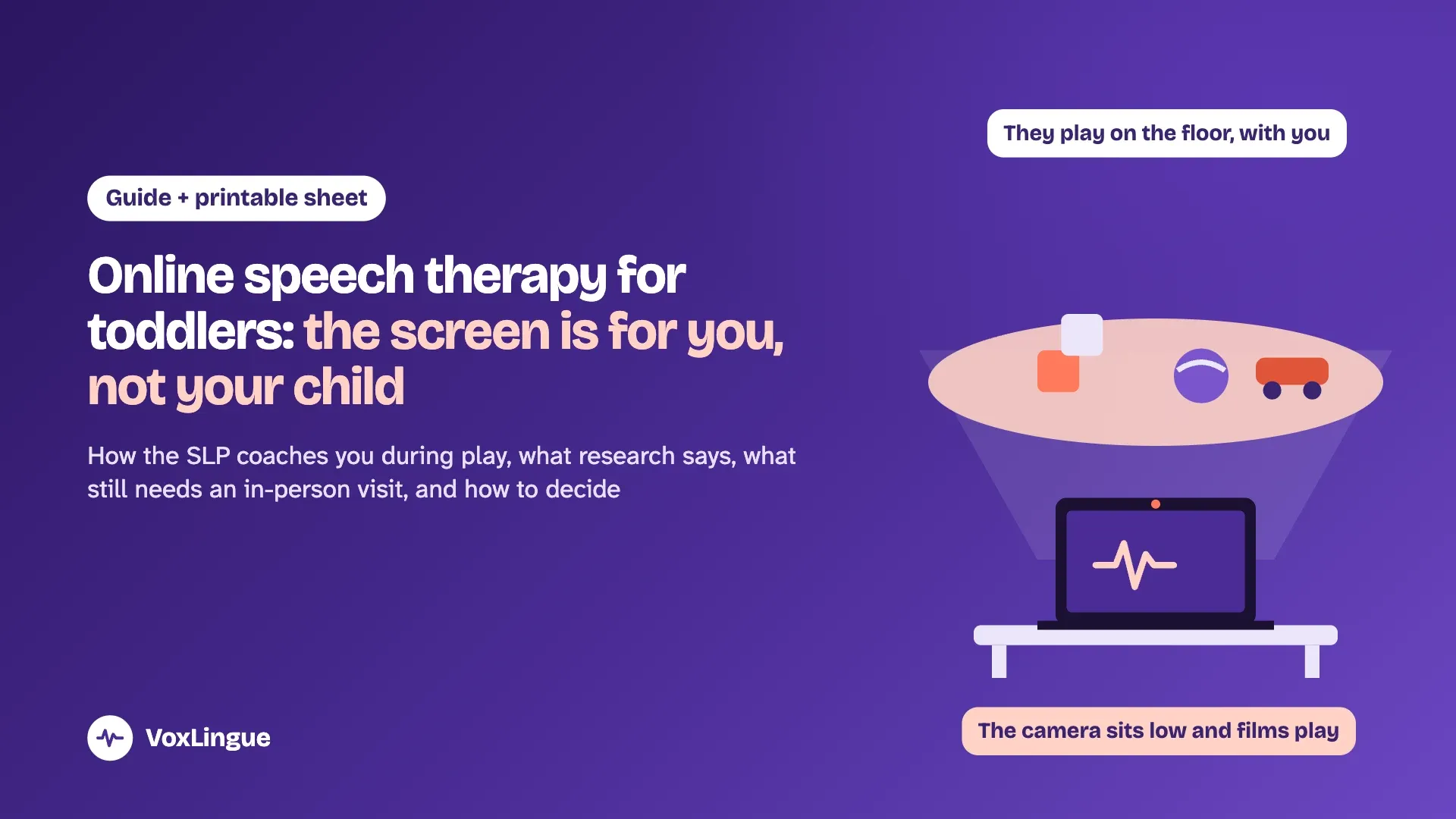
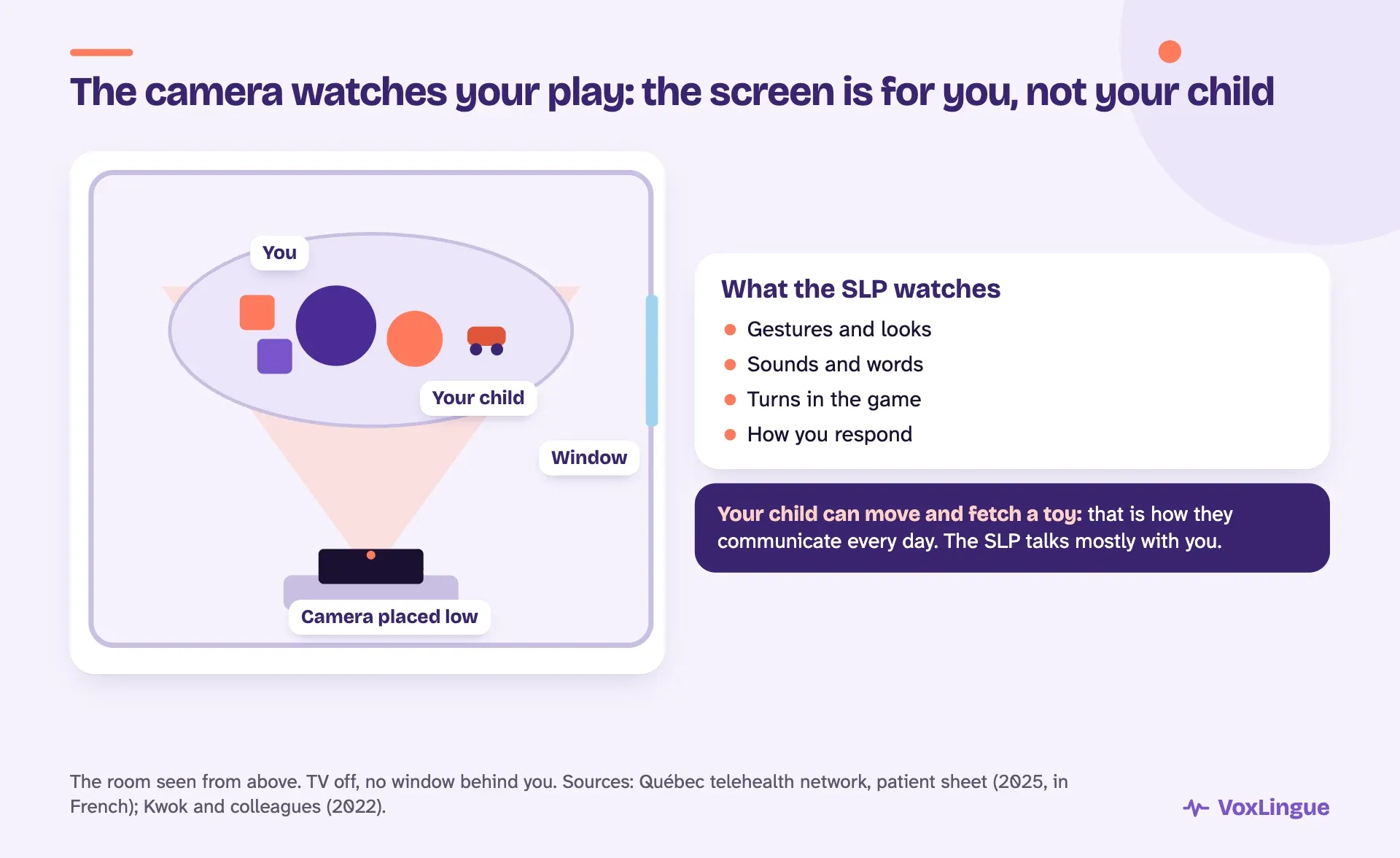
No, your toddler doesn’t need to look at the screen. The camera shows the SLP how you play together; the screen is for you. Your child can move around, play on the floor and go get a toy. That is exactly what the SLP wants to see, because it is how your child communicates every day.
It is often the first worry parents have, and it makes sense. You picture a two-year-old sitting at a computer, expected to answer someone on a screen. With parent coaching, that is not what happens. The person who watches the screen and talks with the SLP is you.
While you play, the SLP watches what your child does to communicate: gestures, looks, sounds, words, and how they take turns in the game. The SLP also watches how you respond. Then they talk to you, to suggest what to try next.
So does the SLP talk to your child or to you? The SLP may say hello to your child and cheer a new sound, but most of the conversation is with you. You are the one who will use the strategies all week, at bath time, at meals and on the floor.
A study in Ontario shows this role clearly. In a public preschool speech and language program, SLPs followed children aged 2 to 5 by video during the pandemic. Parents helped them make sense of their child’s words and actions (Kwok and colleagues, 2022). You know your child’s words better than anyone.
A coached session is not screen time
A session where the SLP coaches you is not screen time like any other. Your child is playing with you, a real person, at home. For our speech-language pathologists, a video call already isn’t screen time like any other, because the child is interacting with someone. In a coached session, that interaction happens mostly between you and your child.
The Canadian Paediatric Society advises no screen time before age 2, except video chatting with caring adults (2025). In Québec, the INSPQ’s Mieux vivre avec notre enfant guide adds that during a video call, an adult should help the exchange between the child and the person on screen (2026, in French). In a coached session, that adult is you, sitting on the floor with your child.
American studies with children aged 12 to 30 months explain why “live” matters. Toddlers learned words from a live video call, because the person responded to them, but not from a recorded video (Roseberry and colleagues, 2014; Myers and colleagues, 2017). That doesn’t mean all screens are equal: see what research says about screens and video calls.
Around age 3, some activities on screen
Some children closer to 3 also do short activities on screen with the SLP. They might point to a picture, drag an object, draw or make a choice. Even then, you stay beside your child to help. The SLP fits these moments to your child’s attention, and goes back to play with you once they have had enough.
What happens in an online speech therapy session with a toddler?
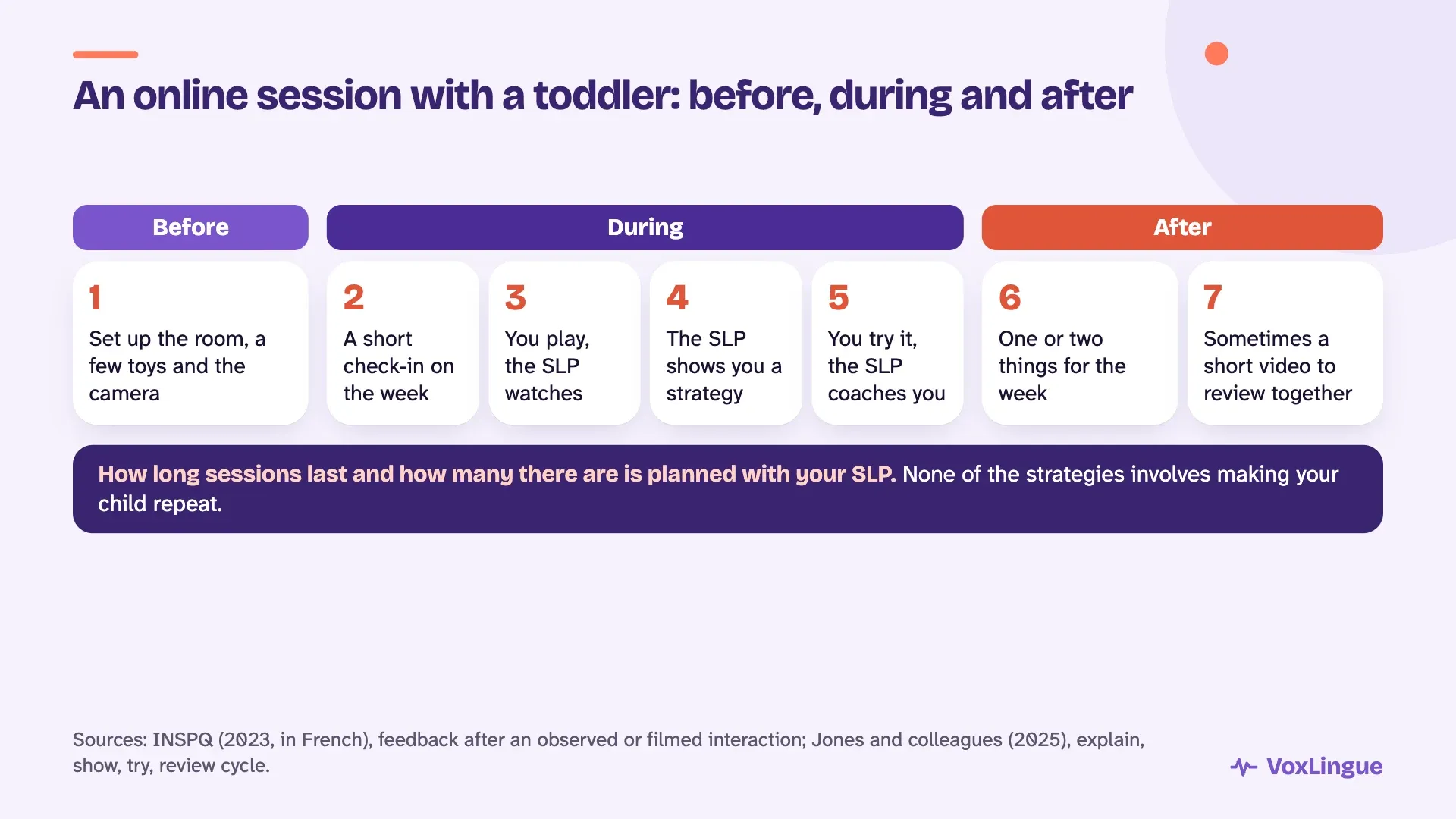
An online session with a toddler often follows the same thread. First, a short check-in on the week. Then you play while the SLP watches. The SLP shows you a strategy, you try it, and they guide you in the moment. You leave with one or two things to do during the week.
How long sessions last and how many there are varies from family to family: your SLP plans it with you (see what decides the number of sessions). What follows describes the session from the parent’s side, before, during and after.
Before the session: the room, the toys and the camera
A few minutes of preparation make the session easier for everyone. Here is what usually helps:
- a few toys your child loves, plus one or two the SLP asked for;
- a quiet room, with the TV off;
- a camera placed low enough to show your child’s face and hands, and yours, with no window behind you;
- a computer or tablet rather than a phone;
- a plan for siblings and pets, with another adult if possible.
Québec’s telehealth network also suggests keeping the TV off and not sitting with your back to a window (2025). In the Ontario study, phones often caused problems: small screens and weak sound. Siblings, pets and TV noise also affected how sessions went. Our printable sheet at the end of this guide has the same list.
During: you play, the SLP watches, shows, then coaches you
The session often starts with your news: what went well during the week, and what was harder. Then you play with your child as you usually would, for a few minutes. The SLP watches without stepping in.
Next, the SLP explains or demonstrates a strategy, such as waiting a little longer before you speak. You try it with your child. The SLP tells you in the moment what is working and what you might adjust. This cycle (explain, show, try, review) is also the one used in the video coaching trials described below.
You know your child better than anyone: what makes them laugh, what they ask for and how they ask. The SLP builds on what you know, and fits the strategies to your family, your routines and your culture. Progress can be subtle at first: one more look, a new sound, one more turn in the game.
A session that doesn’t go as planned is not a failure. If your child refuses a game or wanders off, the SLP watches how you respond and what brings your child back to you. Those moments are often where the SLP finds what to suggest.
Kimberly Martins, speech-language pathologist and founder of VoxLingue, sums it up simply: imitate what your child does, then build on it. All our clinicians draw on Hanen principles in parent coaching and early intervention. None of these strategies involves asking your child to repeat. They are explained in our article on the strategies your SLP will show you.
After: one or two things for the week, and sometimes a short video
You leave with one or two things to try, inside a routine you already have: bath time, meals, getting dressed. The idea is not to add exercises to your day, but to use moments you already share. There is no need to turn play into drills: if your child isn’t in the mood, try again later.
Sometimes the SLP asks you to film a short moment of play or a routine at home. You watch it together at the next session. This is the feedback on a filmed interaction that the INSPQ describes. Some meetings may also be with you alone, to take stock. Our page on parent coaching at VoxLingue describes the options.
From 18 to 24 months, then from 2 to 3 years: what changes
From 18 to 24 months, the work often centres on routines and play with you, in short stretches. Your child moves around a lot, and that is normal. Between 2 and 3, games often last a little longer, and some children do short activities on screen.
In the Ontario study, children tolerated video better as they got older. They were often more tired at the end of the day, after daycare. If that sounds like your child, mention it to the SLP when you choose session times. These are patterns, not rules: every child does things their own way, at every age.
Is online speech therapy effective for toddlers? What the research says
For coaching parents, studies find similar results by video and in person. But there are few of them, and they rarely involve toddlers. A Québec review of 31 studies concludes that telepractice is effective for training parents. For children, the effects vary, and no study can predict how your own child will respond.
Two questions hide behind “does it work?”. First: does being coached by video help, compared with no coaching? Second: does video give results as good as in-person therapy? Research answers each one a little differently.
Coached by video, compared with not being coached
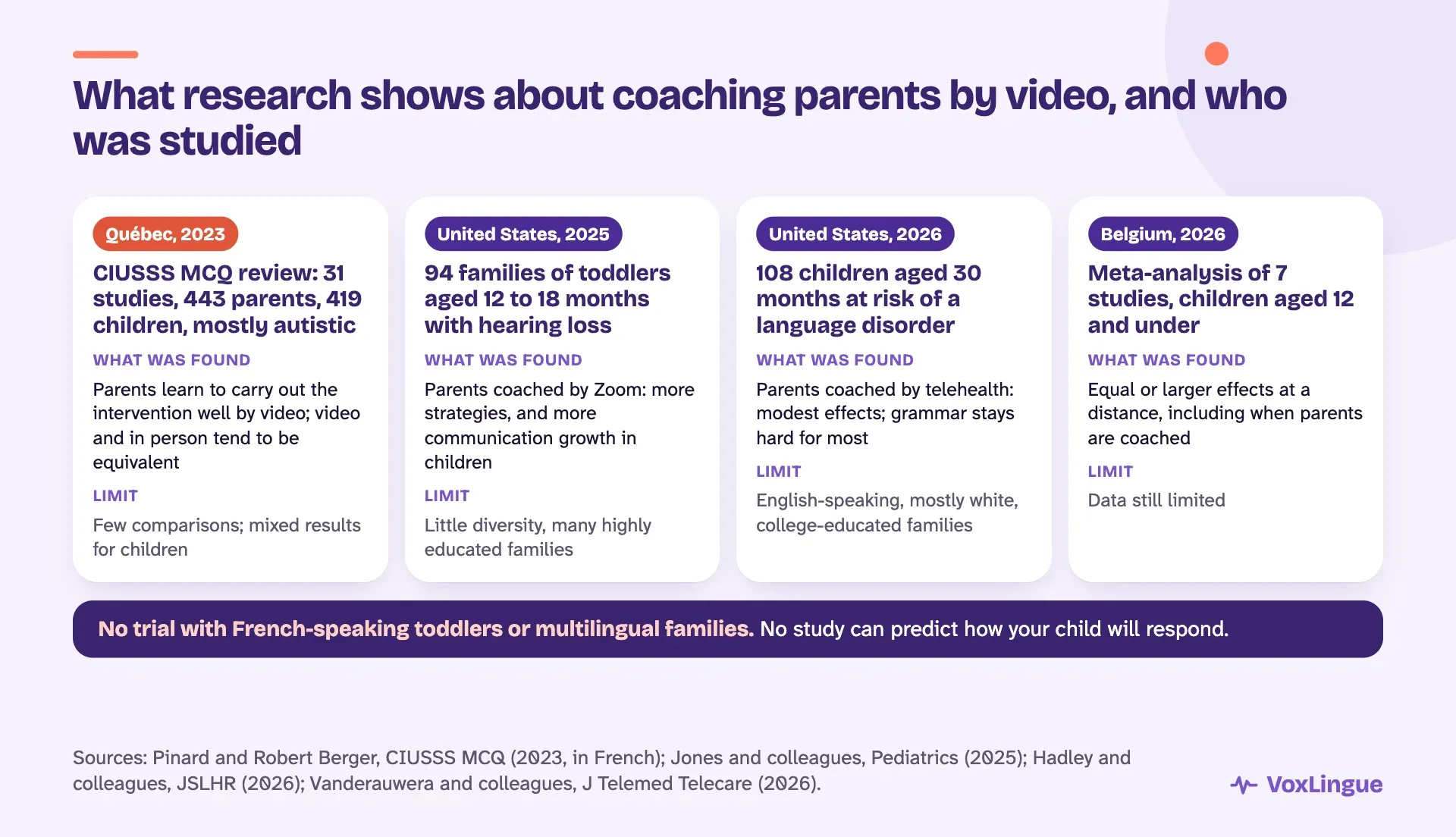
In Québec, a 2023 review by the CIUSSS de la Mauricie-et-du-Centre-du-Québec finds it “reasonable to conclude” that telepractice is effective for training parents to carry out an intervention with their child (in French). Three recent trials, all American, show what this looks like with young children.
In 2025, an American trial followed 94 families of toddlers aged 12 to 18 months with hearing loss. About half the families received weekly coaching by Zoom for 6 months. Coached parents used the strategies far more, and their children’s communication grew more than in the group receiving its usual services (Jones and colleagues, 2025).
In 2026, another American trial looked at 108 children aged 30 months at risk of developmental language disorder. Their parents were coached by telehealth. The effects were modest: a little more word understanding at 36 months, and a little more grammar at 42 months. For most children in both groups, grammar remained hard (Hadley and colleagues, 2026).
A 2024 American trial with 64 young autistic children adds a nuance. The version where a therapist coached parents by video helped the children’s language, through the parents’ use of the strategies. The self-directed version, without a therapist, did not (Ingersoll and colleagues, 2024). The coaching is the part that matters.
By video or in person: what the comparisons show
The same Québec review compared the two formats. It found that video and in-person coaching “tend to show equivalent effectiveness” for parents, with caution, because few studies make the comparison. Results for the children were mixed.
In 2017, INESSS kept three trials that compared video and in-person therapy (in French). Telepractice was as effective for assessment or treatment, with a moderate level of evidence. But those children were 4 to 12 years old: they were not toddlers.
Two recent international syntheses point the same way, with the same limits. A 2026 Belgian meta-analysis pooled 7 studies of children aged 12 and under. It found equal or larger effects with telepractice, including when parents were coached. Its authors still describe the data as limited (Vanderauwera and colleagues, 2026).
A 2025 review gathered 18 studies of children aged 5 to 37 months, mostly autistic children or children with cerebral palsy. Almost all coached parents by live video. Only 2 of these studies compared video with in-person services (Shin and colleagues, 2025).
Who was studied, and what research can’t promise
Before relying on a study, look at who took part. The table below sums up the main ones.
| Study | Where | Who | What was compared | What it shows | Limit |
|---|---|---|---|---|---|
| CIUSSS MCQ review, 2023 | Québec (31 studies, 28 of them American) | 443 parents and 419 children aged 1 year 4 months to 16, mostly autistic | Telepractice with parents, sometimes compared with in person | Parents learn to carry out the intervention well by video | Mixed results for children; few comparisons |
| INESSS, 2017 | Québec (3 trials kept) | Children aged 4 to 12 | Video and in person | As effective, moderate evidence | No toddlers |
| Jones and colleagues, 2025 | United States | 94 families of toddlers aged 12 to 18 months with hearing loss | Zoom coaching or usual services | More strategies from parents, more communication growth | Little diversity, many highly educated families |
| Hadley and colleagues, 2026 | United States | 108 children aged 30 months at risk of a language disorder | Parents coached by telehealth, compared with a control group | Modest effects | English-speaking, mostly white, college-educated families |
| Vanderauwera and colleagues, 2026 | Belgian meta-analysis (7 studies) | Children aged 12 and under | Telepractice and in person | Equal or larger effects at a distance | Limited data; direct work mostly with children 4 and older |
| Shin and colleagues, 2025 | International review (18 studies) | Children aged 5 to 37 months, mostly autism and cerebral palsy | Coaching parents by video | Nearly always live | Only 2 comparisons with in person |
These studies mostly involve children with hearing loss or autism, and English-speaking American families, often highly educated. In the Québec review, three quarters of the parents were mothers. No trial has looked at French-speaking toddlers, or at multilingual families like so many in Montréal.
In the Laurentides, SLPs report results comparable to in-person services, according to Télésanté Québec. That is a useful clinical impression, not a study. Above all, no study can tell in advance how your child will respond. That is why the SLP tracks progress with you and adjusts the plan.
Can a toddler have an online speech-language assessment?
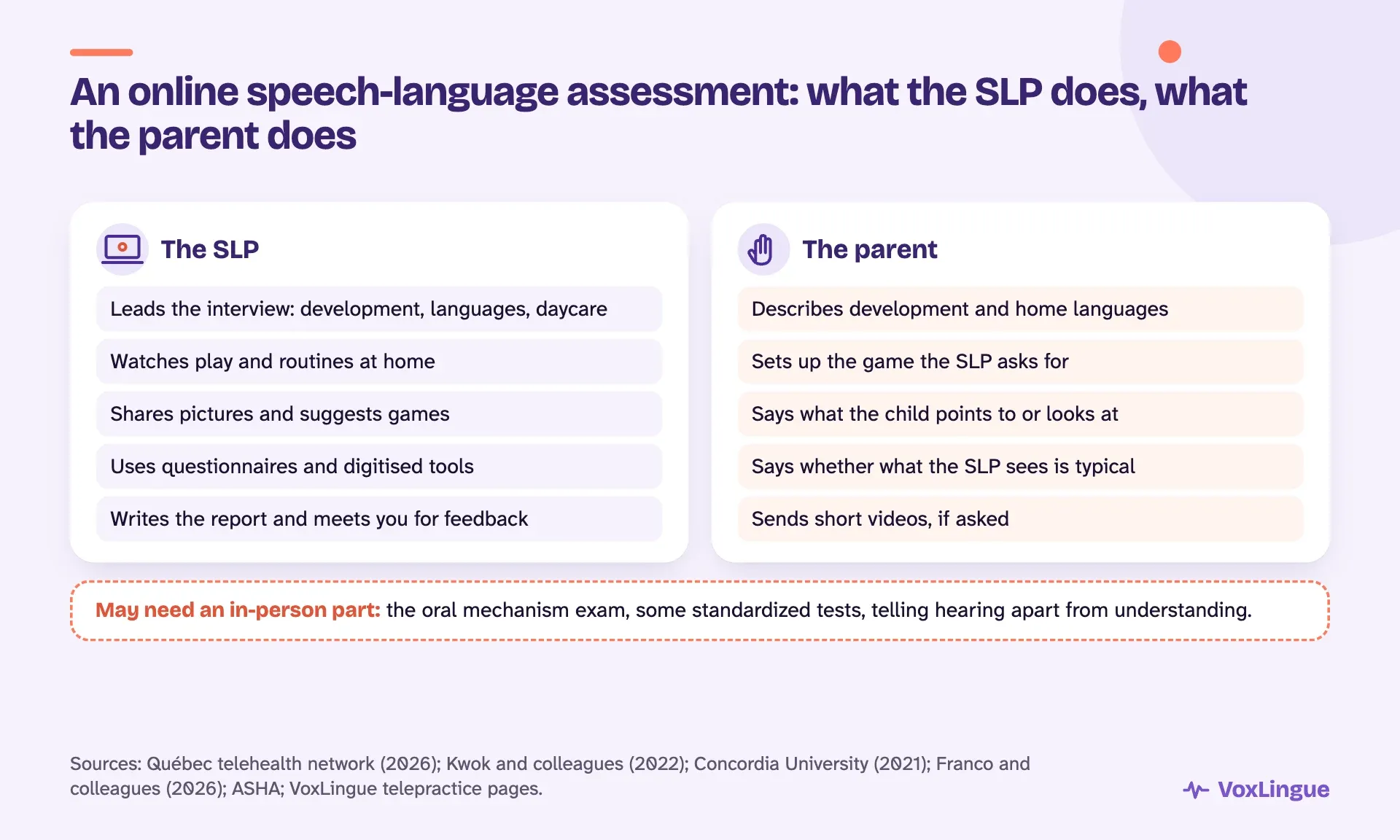
Yes, for the most part. An online assessment follows the same steps as at the clinic: an interview, observation of play, age-appropriate tools, a report and a feedback meeting. The parent becomes the SLP’s hands in the room. Some parts, like an oral mechanism exam or certain tests, may need a visit.
At VoxLingue, our assessment tools have been digitised for telepractice. If any part of the assessment would be more accurate in person, we will say so. For the full process, see the steps of a speech-language assessment.
What works well by video
The interview works very well at a distance: your child’s development, the languages spoken at home, daycare, and what worries you. The SLP can also watch play and routines in your child’s real setting, where they feel most at ease.
Questionnaires filled in by parents work just as well from home. For example, the MacArthur-Bates Communicative Development Inventories were adapted into Québec French at Concordia University, and Québec uses them on the Agir tôt platform (Concordia, 2021). The SLP may also ask for short videos, filmed at a time when your child talks more. With your consent, the SLP can also meet the educator by video to learn how your child communicates in a group.
Your role during the assessment
During an online assessment, you become the SLP’s hands. The SLP can share pictures on screen while you say what your child points to or looks at, as the Laurentides team does. You may be asked to bring out a specific toy or to offer your child two choices.
The SLP will ask whether what they see is typical. A tired or shy child may talk less than usual, and your view helps them interpret. In a 2026 study, parents coached by video gave a communication scale to 30 toddlers, younger siblings of autistic children, with high fidelity. Some parents still found it hard to keep their child engaged (Franco and colleagues, 2026).
To prepare, write down a few words or gestures your child often uses, and which languages they hear and from whom. Keep any reports you already have nearby, such as a hearing test. If you can, pick a time of day when your child is rested, and bring out two or three favourite toys.
What may need an in-person part
Some parts are harder by video. SLPs in a public program in Ontario named the oral mechanism exam, some standardized tests and assessing understanding. They also found it harder to tell hearing loss apart from difficulty understanding (Kwok and colleagues, 2022). The American Speech-Language-Hearing Association also notes that some assessment tools have not yet been validated for remote use (ASHA).
In those cases, part of the assessment can happen in person. We offer an assessment online or at our Marché Central clinic in Montréal. If you live far away, the SLP talks it through with you and explains what a visit would add.
What still needs an in-person visit or another professional?
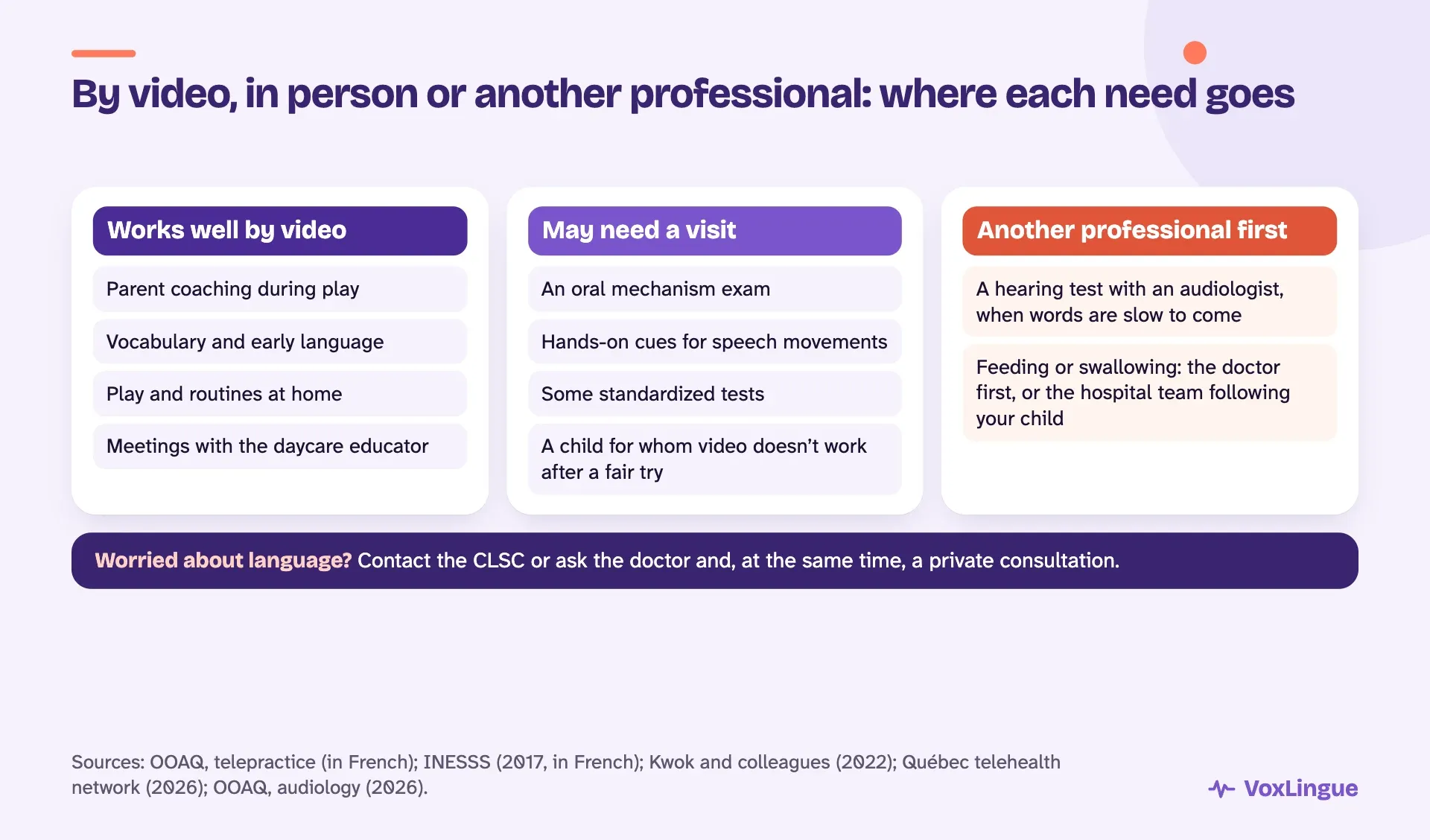
A lot works well by video, but not everything. Parent coaching, early language, play, routines and meetings with the daycare educator all work well on screen. An oral mechanism exam or hands-on cues may need a visit. Hearing and feeding go first to an audiologist and to the doctor.
| Works well by video | May need a visit | Another professional first |
|---|---|---|
| Parent coaching during play | An oral mechanism exam | A hearing test with an audiologist, when words are slow to come |
| Vocabulary and early language | Hands-on cues for speech movements | Feeding or swallowing: the doctor first, or the hospital team following your child |
| Watching play and routines at home | Some standardized tests | |
| Meetings with the daycare educator | A child for whom video doesn’t work after a fair try |
The OOAQ reminds SLPs that “some types of intervention do not lend themselves to remote services” (in French). INESSS also notes that telepractice is harder when the intervention needs physical contact, or when a child has attention or behaviour difficulties. According to Télésanté Québec, work on speech sounds may lend itself more to in-person sessions.
When words are slow to come, a hearing test helps rule out one cause. In private practice, an audiologist can see your child without a doctor’s referral; in the public system, some settings ask for one. Our article explains when to ask for a hearing test. For eating or swallowing, talk to the doctor first, and see who to see about feeding.
Mixing the two formats is common. In the Ontario study, all 16 SLPs recommended a hybrid model, online and in person. The 13 parents were split: 7 preferred hybrid, 3 in person and 3 online. There is no single right format. For a family far from Montréal, a mix can mean one in-person visit for the parts that need it, and coaching by video the rest of the time.
Online or in person: how do you choose for your family?
Decide with your SLP, based on your child, your home, your energy, your language and the distance. Video often suits parent coaching well, but it isn’t always the right option. You can choose in person, mix the two, or change your mind if video doesn’t work for your family after a fair try.
Your child. How do they react to a video call with Grandma? Do they hear and see well? The OOAQ asks SLPs to consider the person’s abilities: hearing, vision, dexterity, stamina, attention and behaviour. With a toddler, the parent’s availability matters just as much.
Your home. Do you have a quiet corner, a computer or tablet, a stable connection? Who looks after siblings during the session? In the Québec review, technology, managing the child’s behaviour during the session and managing the household were the main irritants for parents.
You. Telepractice asks a lot of you, during sessions and between them. In the Ontario study, some parents found that load heavy. Others value not having to travel: in the Québec review, parents often preferred telepractice.
Your language. Coaching happens in the language you use with your child, even if daycare is in French. Speak the language you are most comfortable in. If you speak English, Arabic or Spanish at home and daycare is in French, coaching in your home language is fine: your child learns language from the language you speak most naturally. Our article on families who speak more than one language explains why.
Distance and schedule. How long does it take to get to the clinic? Does your child still nap, or are they tired after daycare? Video saves the trip, but not the end-of-day fatigue.
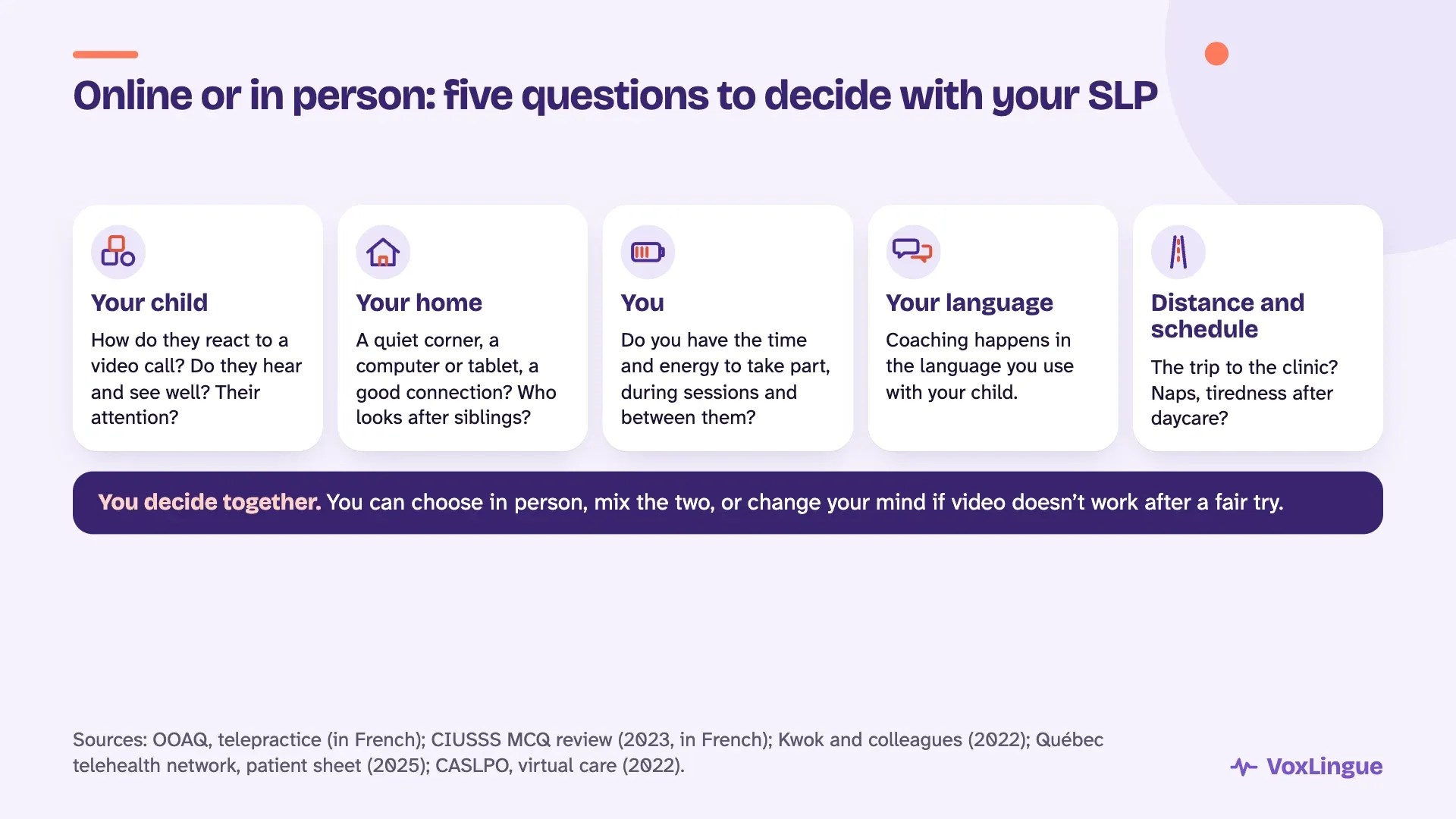
You decide together. In Ontario, CASLPO tells patients: “You will decide together if virtual care is right for you. It isn’t always the best choice” (CASLPO). In Québec, the telehealth network reminds patients that they can choose an in-person or remote appointment, and change their mind.
If video doesn’t work for your family after a fair try, you switch formats: in person, or a mix of both. Choosing in person from the start is also a good choice. What matters is that your child gets the help they need.
In Québec and Ontario: who can offer online speech therapy, and where do you start?
In Québec, contact the CLSC or ask the doctor first: Agir tôt is free. At the same time, if you can, a private consultation lets you start coaching at home while you wait. In Ontario, the Preschool Speech and Language program needs no referral. Your SLP must be registered in the province where your child lives: the OOAQ in Québec, CASLPO in Ontario.
In Québec, the Agir tôt program is free and voluntary, for children before they start school. Kimberly Martins advises two steps at the same time. Public first, to get your place on the waiting lists. At the same time, see a private speech-language pathologist to find out what is recommended now.
That private consultation can, for example, take the form of online parent coaching while you wait. Our guide explains the public waiting list and what to do meanwhile. Some public teams also work by video, like the one in the Laurentides, but not everywhere: ask your CLSC.
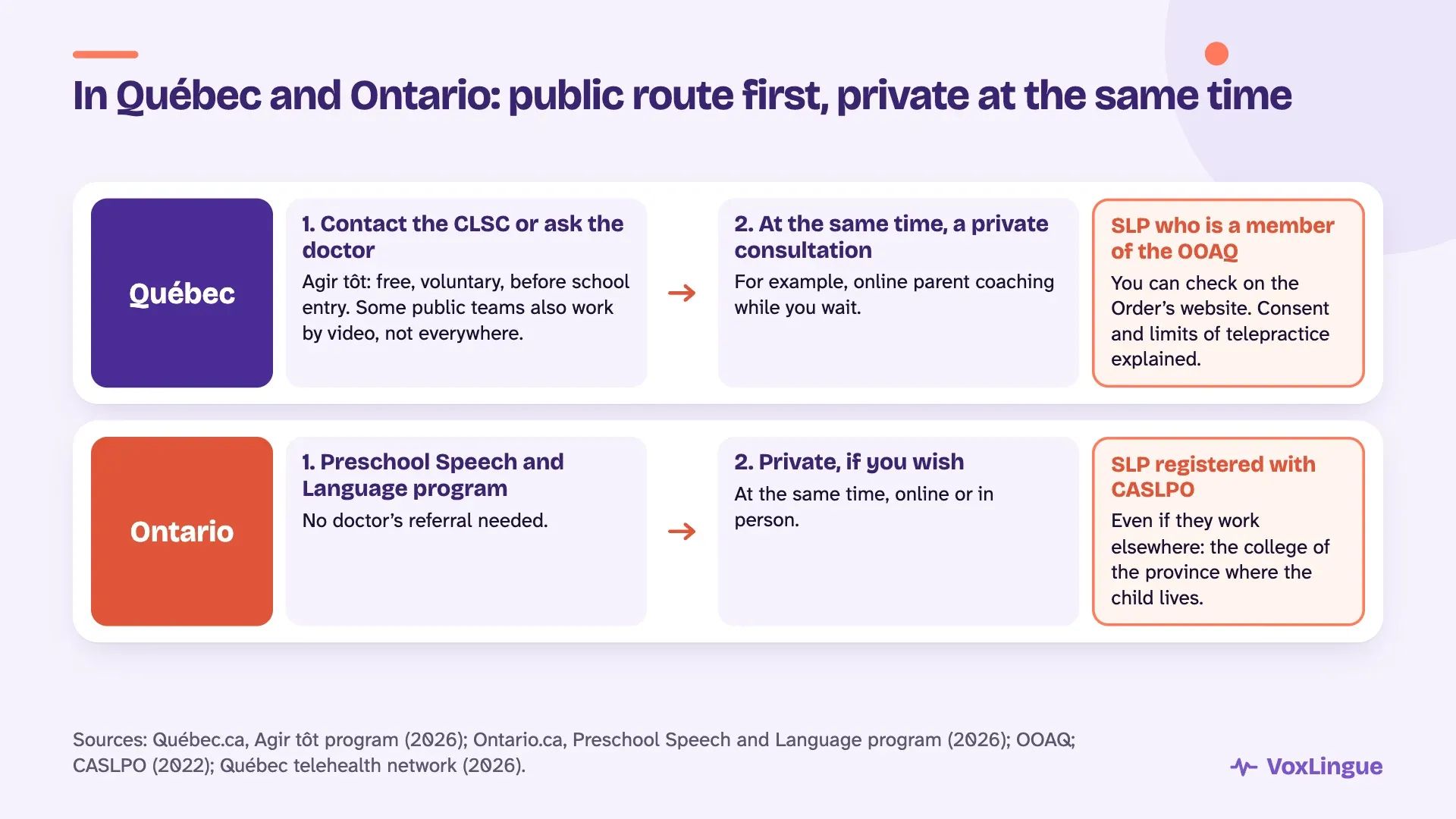
In Ontario, the Preschool Speech and Language program accepts children without a doctor’s referral, and families can also see a private SLP.
Whatever the province, the SLP must be registered with the regulatory body where your child lives, even if they work elsewhere. In Québec, that is the OOAQ, which offers an online search to check a member. In Ontario, it is the College of Audiologists and Speech-Language Pathologists of Ontario (CASLPO). If you live in Ontario near the Québec border, check that your SLP is registered with CASLPO, not only with the OOAQ.
Before you start, the SLP obtains your free and informed consent. As the OOAQ requires, they also explain the limits of telepractice and the risks to confidentiality.
Key takeaways
At this age, online speech therapy is mostly you, coached by the SLP while you play with your child.
- Your toddler doesn’t need to look at the screen: the camera shows your play, and the screen is for you.
- A session often follows the same thread: you play, the SLP watches and shows, you try, and you leave with one or two things for the week.
- Coaching parents by video helps, with results similar to in person, but studies with toddlers are few.
- An oral mechanism exam, hands-on cues and some tests may need a visit; hearing and feeding go first to an audiologist and the doctor.
- In Québec, contact the CLSC or ask the doctor first and, if you can, see a private SLP at the same time.
Next step
Our speech-language pathologists offer online speech therapy across Québec and Ontario. With toddlers, it is mostly parent coaching. See online speech therapy across Québec or online speech therapy across Ontario. An assessment can take place online or at our Marché Central clinic in Montréal.
Before your first session, print our sheet: how to set up the room, the toys and the camera, what you will do during the session, and four questions to ask your SLP.
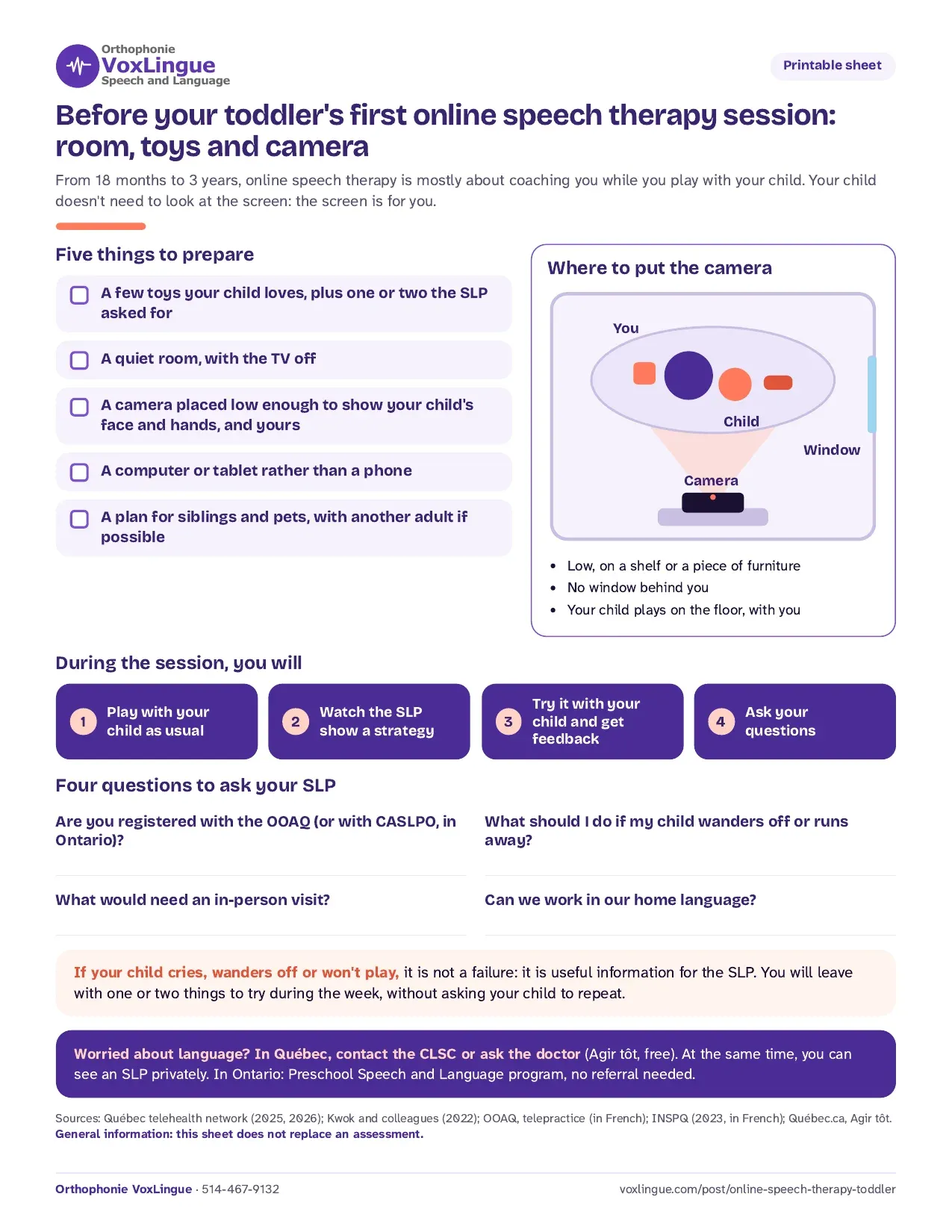
Printable: Before your toddler’s first online speech therapy session: room, toys and camera (PDF, 1 page).
Frequently asked questions
Can we mix online and in-person sessions?
Often, yes. For example, an in-person assessment at the clinic, then coaching online, or the other way around. We have one clinic, at Marché Central in Montréal, so the SLP talks it through with you based on your child’s needs and the distance. In the Ontario study, all 16 SLPs recommended a hybrid model.
Is a phone or an iPad enough?
A computer or tablet works better. A phone screen is small and its sound weaker, so you will see and hear the SLP less well. Place the device low, on a shelf or a piece of furniture, so the SLP can see your child playing on the floor. If you only have a phone, mention it to the SLP before the session.
What if my toddler cries, runs off or won’t play?
It happens, and it is useful information for the SLP. Follow your child, switch toys or take a break. What the SLP wants to see is your child as they are every day. Toddlers are also often more tired at the end of the day. If video doesn’t work after a fair try, you can change formats.
Can we do sessions with a sibling at home?
Yes, with a plan. Another adult can look after the older child or the baby, or set up a quiet activity in another room. If the SLP agrees, an older brother or sister can also join the game. In a Canadian study, having another adult present also helped with filming moments to review.
Do we need a hearing test before starting?
If your child has never had a hearing test and words are slow to come, ask for one: it helps rule out one cause. In private practice, an audiologist can see your child without a doctor’s referral; in the public system, some settings ask for one. The SLP will also tell you whether they recommend it before you start.
Can we start online while we wait for the CLSC?
Yes. First contact the CLSC or ask the doctor, to get your place in the public system. At the same time, if you can, a private consultation tells you what is recommended now. That may be online parent coaching while you wait. In our experience, seeing a private SLP does not cost you your place on the CLSC list: let the person handling your file know.
Can sessions be in our home language?
Coaching happens in the language you use with your child, even if daycare is in French. It is the language you play and talk in naturally. Our team speaks several languages, but availability varies by language, so ask when you book.