My child mixes French and English in the same sentence: is it confusion, should you correct it, and what Montréal research says about parents who mix too
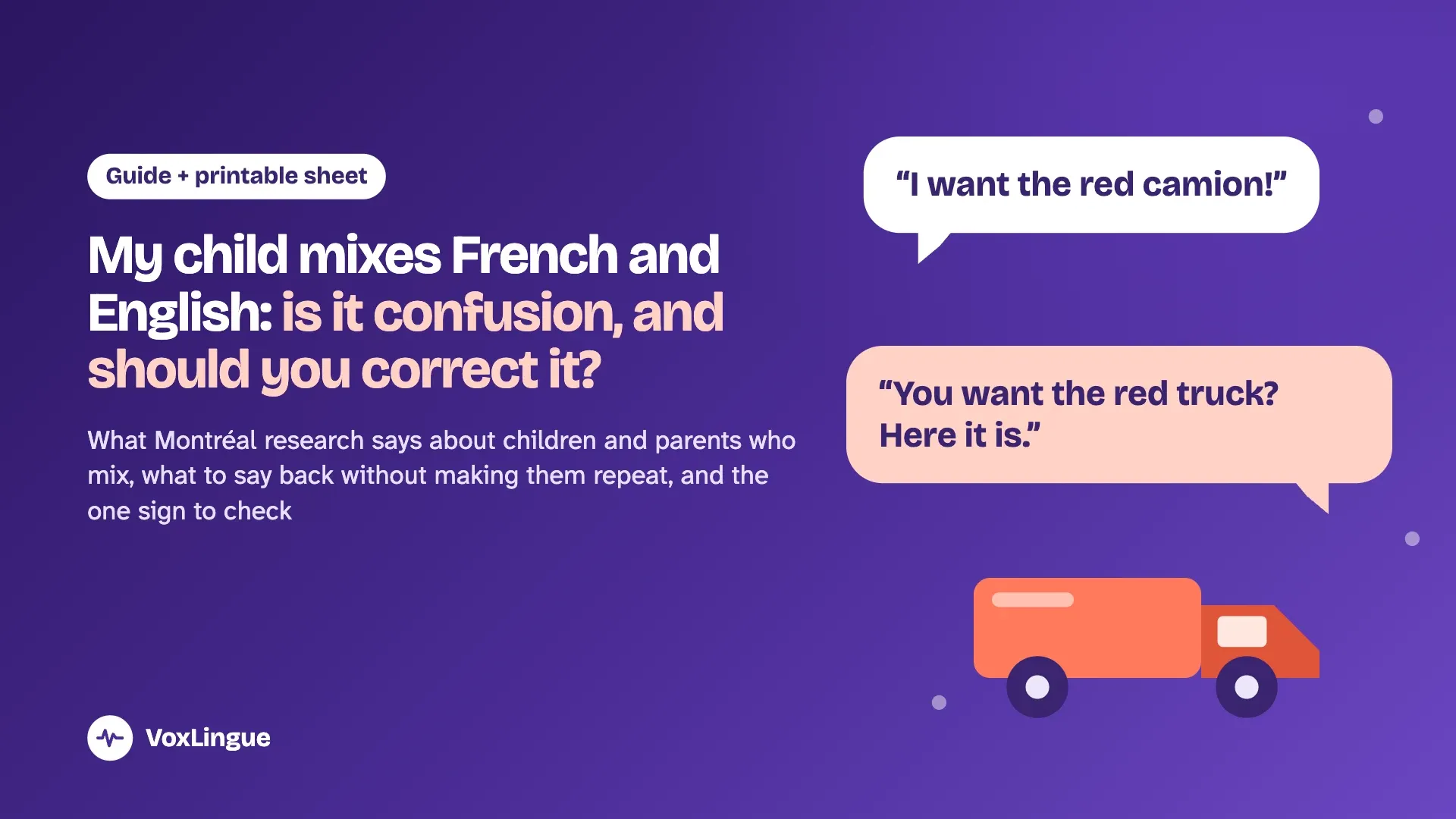
“I want the red camion.” Your child is mixing French and English in the same sentence, and you wonder whether that’s normal. Are they confused? Will their English or French suffer? Should you correct them every time?
In Montréal, this is an everyday scene. French at daycare, English at home, sometimes Spanish, Arabic or Creole with grandparents: many children grow up with several languages. And many parents switch between languages themselves without thinking about it.
This guide brings together what research done in Montréal, at McGill and Concordia, has found about a child mixing French and English, or any two languages. It explains why toddlers mix languages, what to do if you mix too, what to say back without making them repeat, and the one sign worth checking.
Child mixing French and English: is it normal?
Yes, mixing two languages in one sentence is part of bilingual development. Québec’s speech-language pathology order (OOAQ) lists the idea that children “get mixed up” between their languages as a myth. Bilingual adults mix too. What matters is what your child understands and says across all of their languages.
Mixing takes two forms. Your child may put words from both languages in one sentence: “I want the red camion.” They may also switch languages from one sentence to the next, or from one person to another. Researchers call this code-mixing or code-switching, and both forms are common (Byers-Heinlein and Lew-Williams, 2013).
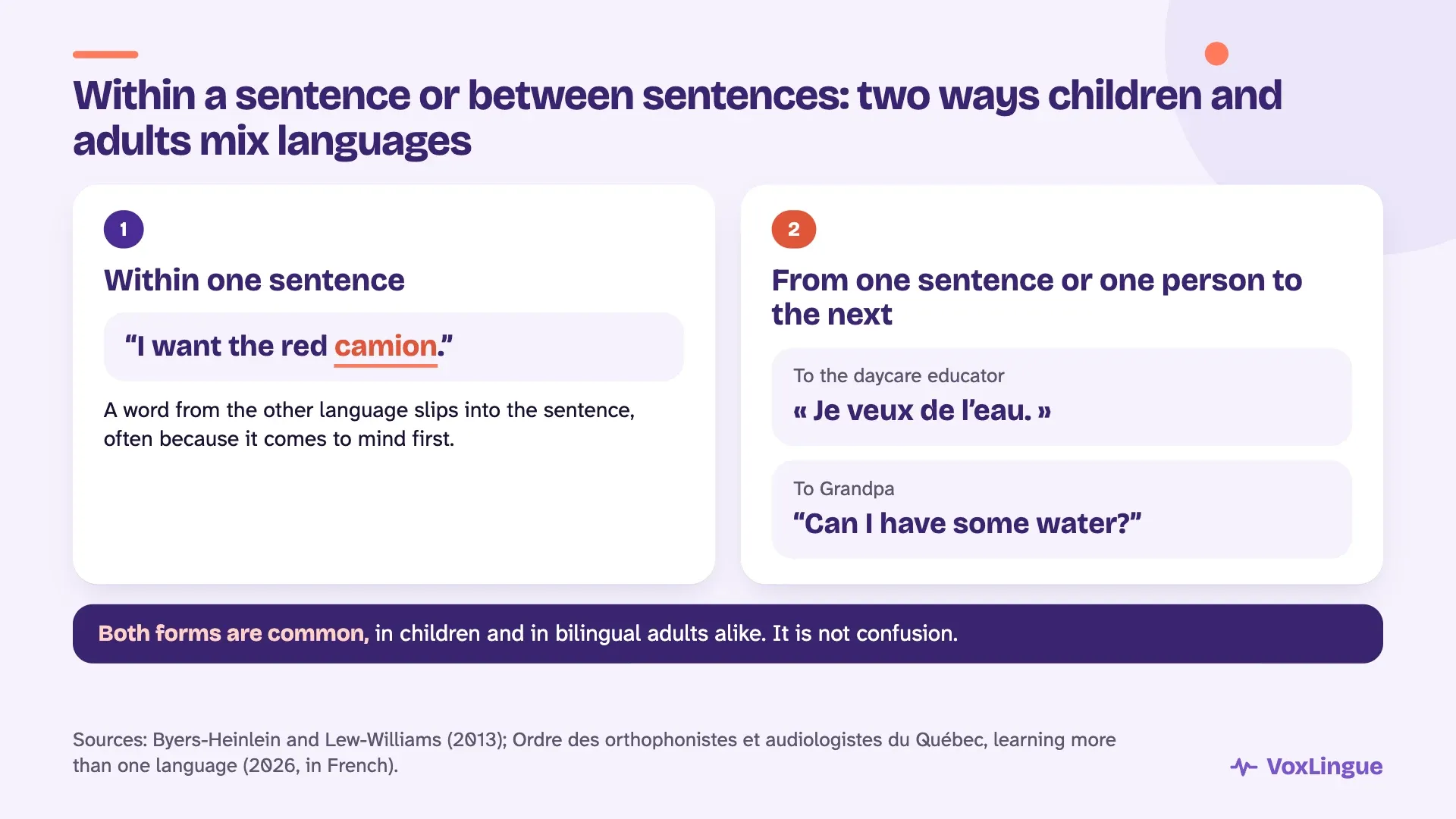
According to the OOAQ (in French, 2026), children tell the languages they hear apart very early, and a child who uses both languages in one sentence is not a cause for concern. The Montreal Children’s Hospital guide on bilingualism says the same: mixing will not confuse children, and adults do it too (2019).
Montréal is a city where people change languages all day long. In the 2021 census, 69.8% of people in Montréal could hold a conversation in two or more languages, the highest share of any large urban centre in Canada. Nearly one person in five was trilingual (Statistics Canada, 2022).
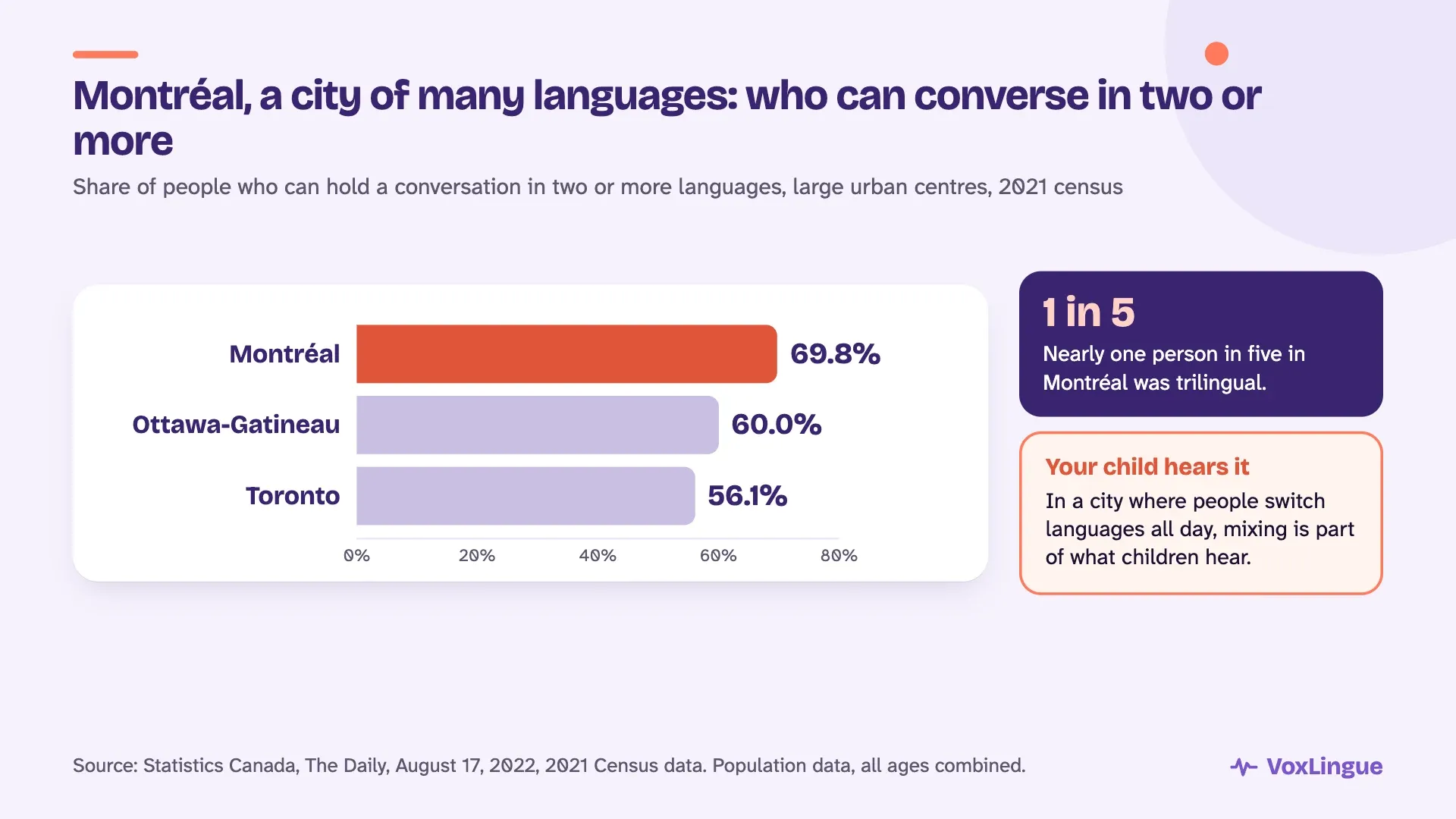
Your child is growing up in that reality. For more on raising children with several languages, see our articles for bilingual and multilingual families.
Is my bilingual child confused? What Montréal research shows
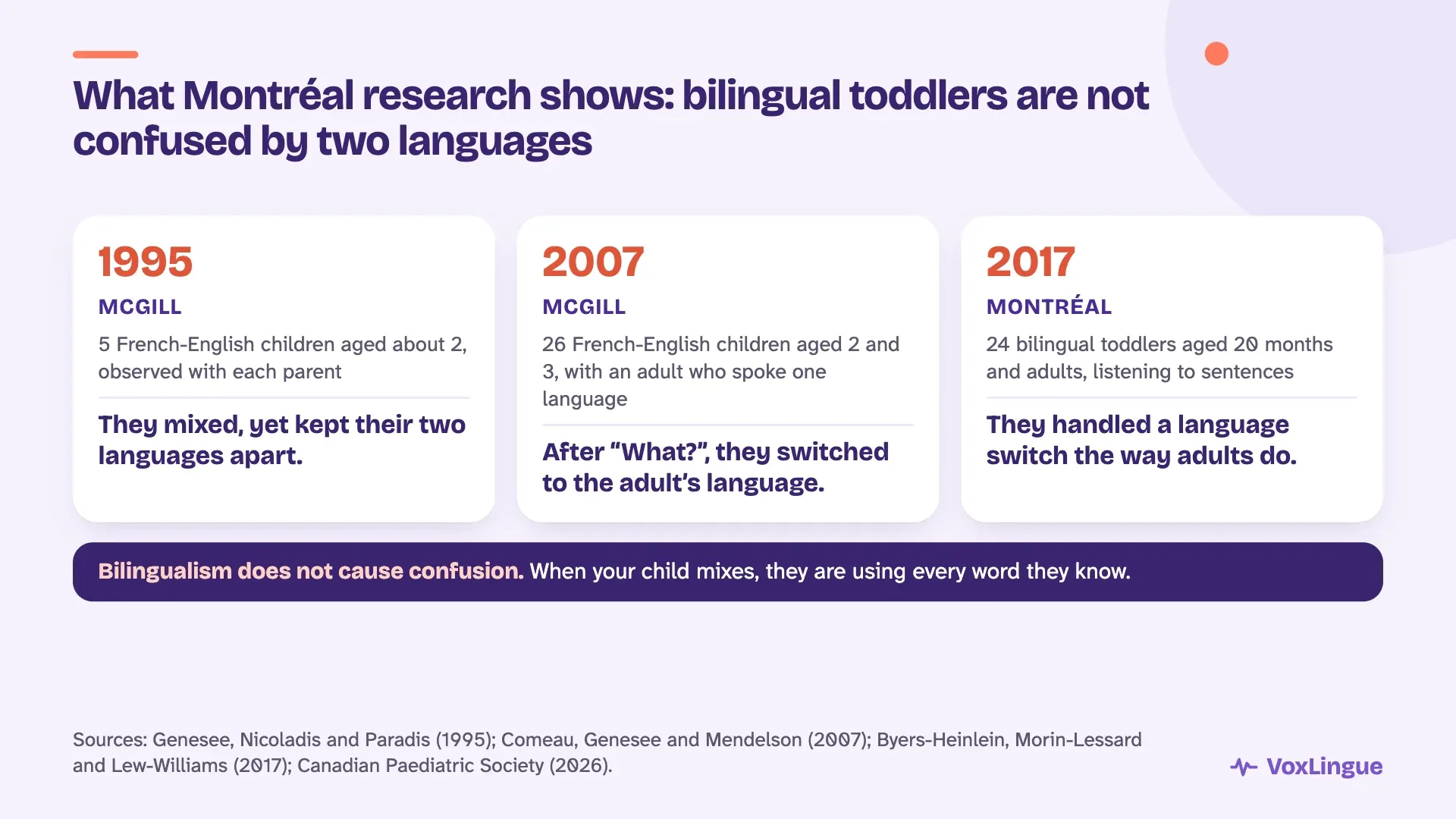
No, your child is not confused. Studies done at McGill since the 1990s show that bilingual toddlers keep their languages apart very early, even while mixing them. “Bilingualism does not trigger confusion,” as the Canadian Paediatric Society puts it (2026). When your child mixes, they are using every word they know.
As early as 1989, Fred Genesee of McGill University argued that bilingual children develop separate language systems from the start. In 1995, his team observed five French-English children aged about 2, with each of their parents. The children mixed, yet they clearly kept their two languages apart (Genesee, Nicoladis and Paradis, 1995).
In 2017, a Montréal study played sentences to 24 bilingual toddlers aged 20 months and to adults. Both groups were a little slower to recognize an object named in a sentence that switched languages (“Find the chien!”). The toddlers handled a language switch the way bilingual adults do (Byers-Heinlein, Morin-Lessard and Lew-Williams, 2017).
Mixes with you, speaks French at daycare: a sign of skill
Choosing a language to suit the listener is a skill, and it appears early. In a McGill study published in 2007, 26 French-English children aged 2 and 3 played with an adult who spoke only one language. When she said “What?”, the children switched to her language. They did not switch for other misunderstandings (Comeau, Genesee and Mendelson, 2007).
Even at two and a half, these children understood that their choice of language could cause the misunderstanding. That is the opposite of confusion.
So why do they mix more at home? With you, they know both languages work. With an educator who speaks French to them, they adjust. If daycare is the one raising a concern, see what to ask if daycare raises a concern.
Why does my child mix languages in the same sentence?
Most often, a word is missing or doesn’t come fast enough. So your child borrows it from the other language. Their stronger language, the words learned in each setting and the adults around them play a part too. Here are those four reasons, which often work together.
A word is missing. If they don’t know the word, or can’t find it quickly, they borrow it from the other language (Canadian Paediatric Society, 2026; Byers-Heinlein and Lew-Williams, 2013). “I want the camion” often means they know camion from daycare, and not truck yet.
The stronger language takes over. The language they hear most supplies words more easily. In the 1995 McGill study, the dominant language explained part of the mixing.
Each setting has its own words. A child may know feeling words in the home language and animal names in the daycare language. Their stronger language can also shift with the setting and the people around them (Naître et grandir, in French, 2021). When they tell you about daycare at home, French words naturally slip into English sentences.
They do what the adults around them do. Children often simply copy what they hear (Montreal Children’s Hospital, 2019). In a city where adults mix a lot, they learn that way of speaking too.
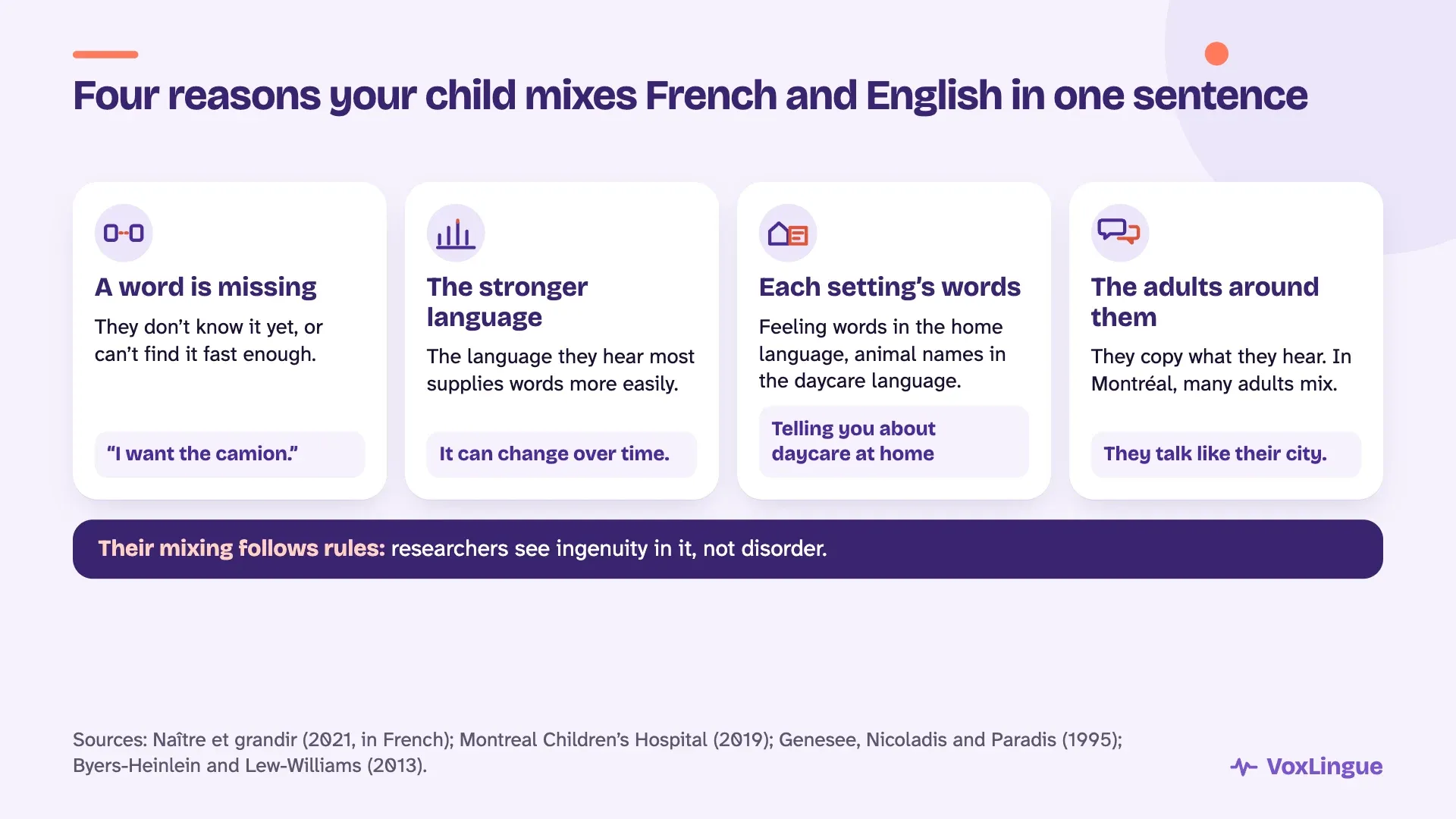
This isn’t disorder. Young children’s mixing follows rules close to the grammar of bilingual adults, and researchers see it as a sign of ingenuity (Byers-Heinlein and Lew-Williams, 2013, citing Paradis, Nicoladis and Genesee, 2000).
A bilingual child also often knows fewer words in each language than a child who speaks one, but as many or more when you add their languages together (OOAQ, 2026). That’s why it helps to start counting words across all their languages, mixed words included.
What if I mix French and English when I talk to my child too?
Mixing now and then does not hurt your child’s vocabulary. A Concordia study of 398 Montréal children found almost no link between parents’ mixing and vocabulary. Québec sources disagree, and our advice brings them together: when you can, give your child the whole sentence in one language, so they hear the complete model.
Québec sources don’t all say the same thing
Québec guides do not agree on whether parents should mix. This table shows what each one says, with its date.
| Source | Date | What it tells parents |
|---|---|---|
| Naître et grandir, guide on learning several languages (in French) | 2021 | Better not to mix languages in one sentence, so as not to harm the minority language. |
| CHU Sainte-Justine, page on developmental language disorder (in French) | 2026 | Better not to mix languages in one sentence when speaking to the child; “one parent, one language” is not necessary. |
| Montreal Children’s Hospital, guide on bilingualism | 2019 | Under “Don’t”: “be afraid to mix two languages when speaking to your child”. |
| Ordre des orthophonistes et audiologistes du Québec | 2026 | Says nothing about parents mixing. |
This advice was given in good faith. The Naître et grandir guide dates from 2021, before the 2025 Montréal study, which its own news section reported in January 2026.
From Vancouver in 2013 to Montréal in 2025: what the studies found
Three Concordia studies follow the question over twelve years. The first, in 2013, took place in Vancouver: about 90% of 181 parents mixed. Among 168 children aged 18 months and 2 years, more mixing went with a slightly smaller English vocabulary, a small effect that was probably temporary (Byers-Heinlein, 2013).
The second, in 2022, was a lab task. Three-year-olds had more trouble learning a new word heard right after a language switch in the middle of a sentence (Byers-Heinlein and colleagues, 2022). That is a lab task, not everyday vocabulary.
The third, in 2025, is the largest, and it was done in Montréal. It covers 398 children aged 7 to 34 months: 312 from French-English families and 86 from families who speak a heritage language with French or English. Parents’ mixing was almost unrelated to vocabulary (Paquette and Byers-Heinlein, 2025; see the Concordia news release).
In French-English families, there was no link in 10 of 12 analyses, and none in heritage-language families. One small exception held up to statistical checks: among older toddlers, more mixing went with slightly fewer words spoken in French.
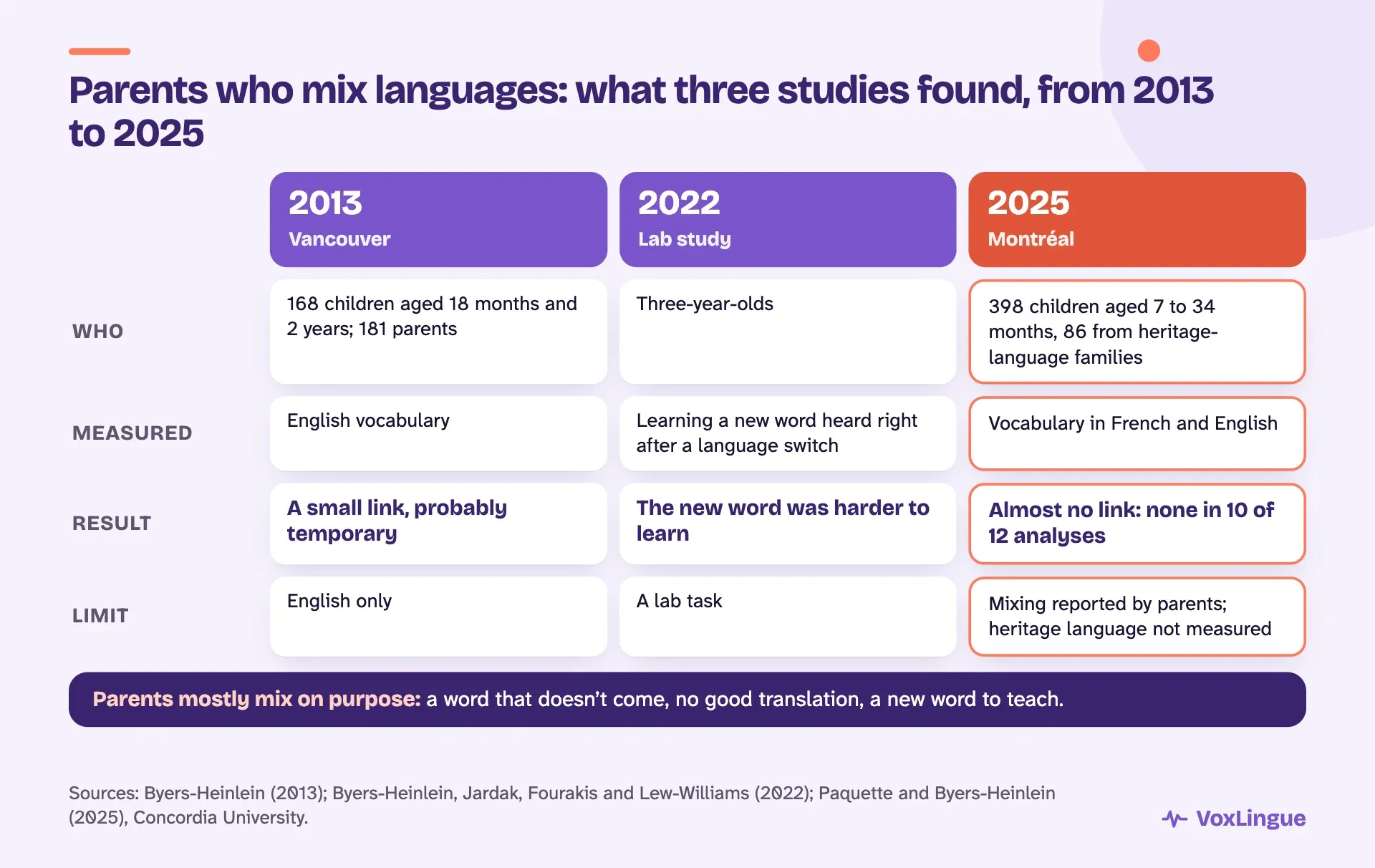
Parents mostly mixed on purpose, for example when a word didn’t come or to teach a new word. The study has limits: mixing was reported by parents, and vocabulary in the heritage language was not measured.
Our advice: mixing now and then is fine, and a whole sentence when you can
Mixing now and then is normal and doesn’t hurt vocabulary. When you can, give the whole sentence in one language. Kimberly Martins, speech-language pathologist and founder of VoxLingue, puts it this way: all bilingual speakers code-switch, and if it happens sometimes, that’s OK. Ideally, when speaking to your child, avoid mixing within the sentence, so they get the entire model of the language in that sentence.
This advice fits the research. A whole sentence lets your child hear the complete structure of a language, and a new word is learned more easily without a switch right before it (2022). Switching from one sentence to the next costs little: for the 20-month-olds in the 2017 study, the small extra effort almost disappeared.
In practice, instead of “Go get your souliers, we’re leaving”, say “Go get your shoes, we’re leaving.” Or, if French comes more naturally to you: « Va chercher tes souliers, on s’en va. » You can say one sentence in English and the next in French. What helps is that each sentence is complete in its own language.
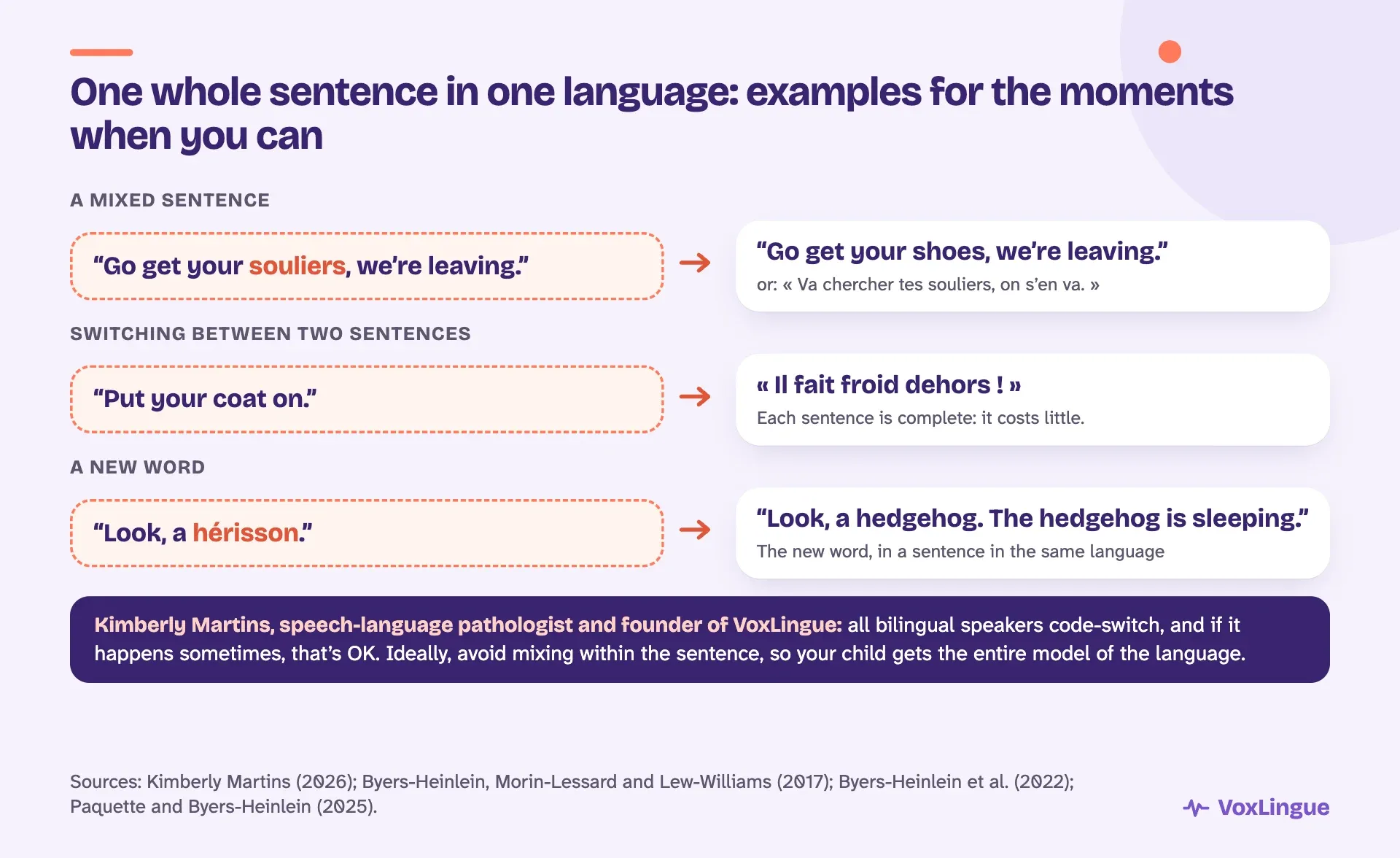
The goal is not to catch yourself on every word, or to switch to a language you’re less comfortable in. Kimberly Martins always advises parents to speak the language they’re most comfortable in, and to keep using more than one language if that’s what they speak.
Should I correct my child for mixing languages? What to say back instead
No, your child doesn’t need to be corrected. Answer what they asked for and say the word back in your language: “You want the red truck? Here it is.” They hear the word without pressure. Don’t ask them to repeat it: the conversation matters more than the word.
Correcting every mixed word comes from a good place, but it points out the error and interrupts the exchange. Québec’s public health institute (INSPQ) recommends recasting instead: say it correctly, without pointing out the error and without asking the child to repeat (in French, 2023).
With a child who mixes, that means three simple steps. First, answer what they mean. Then say the word in your language, naturally, as part of your answer. Then carry on with the conversation.
A few examples. They say “Look, a gros dog!”, and you answer “Oh yes, a big dog! It’s running fast.” In a Spanish-speaking family, they say “Mami, quiero more juice”, and their mother answers “¿Quieres más jugo? Aquí está.” Each time, the child gets what they wanted and hears the word in the language of the person speaking to them.
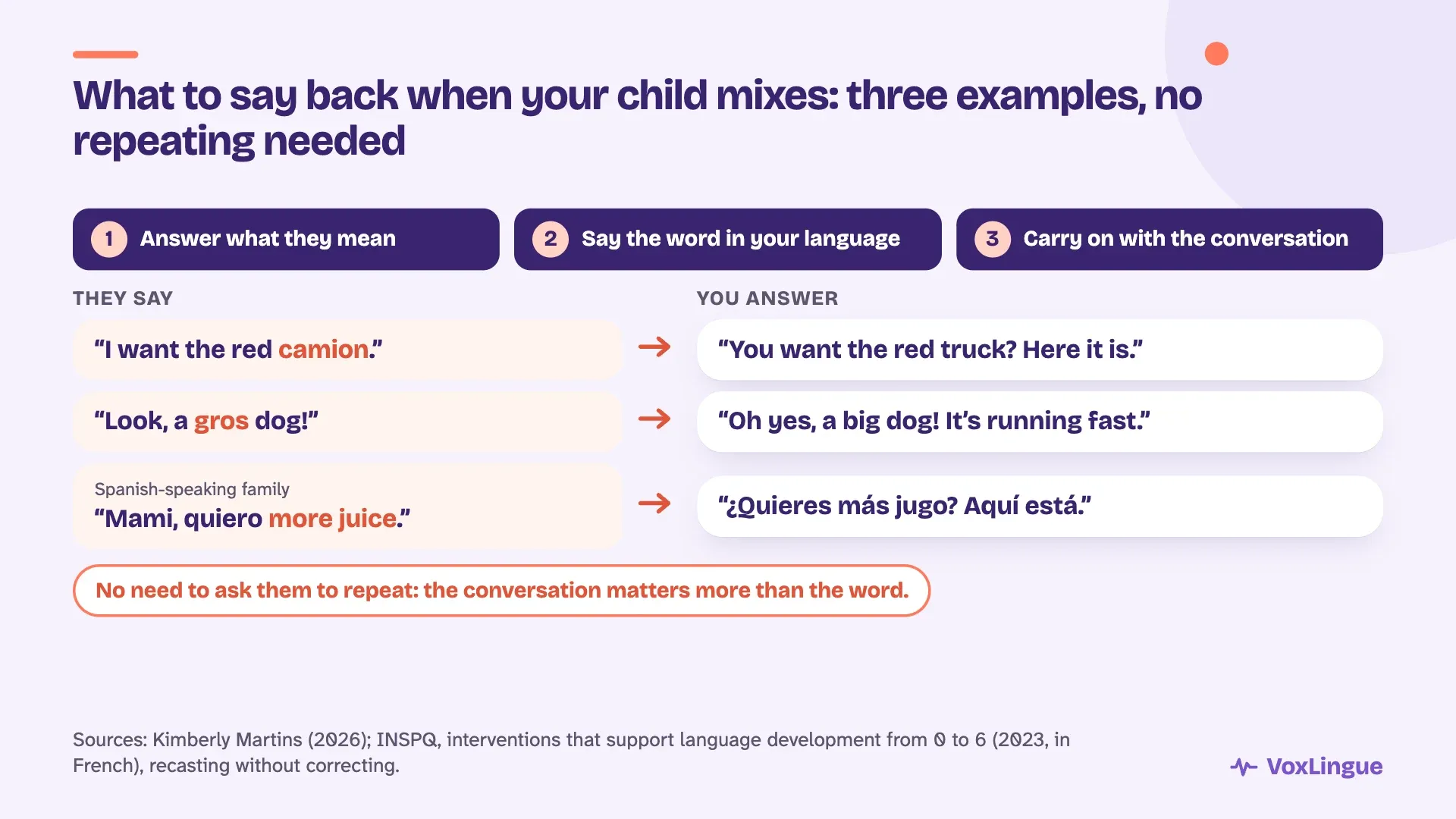
Making a child repeat a word can seem logical, but Kimberly Martins is clear: requiring them to repeat before they get something is a habit to drop right away. They have already told you what they want. Give it to them, saying the word.
If your child answers in a different language from yours, that’s OK. Kimberly Martins advises continuing in your language, and saying what they said in your language if you think they didn’t know how to say it. That way, you keep up their exposure to that language. Our guide has more ways to say it back without making them repeat.
Is mixing languages a sign of a language disorder?
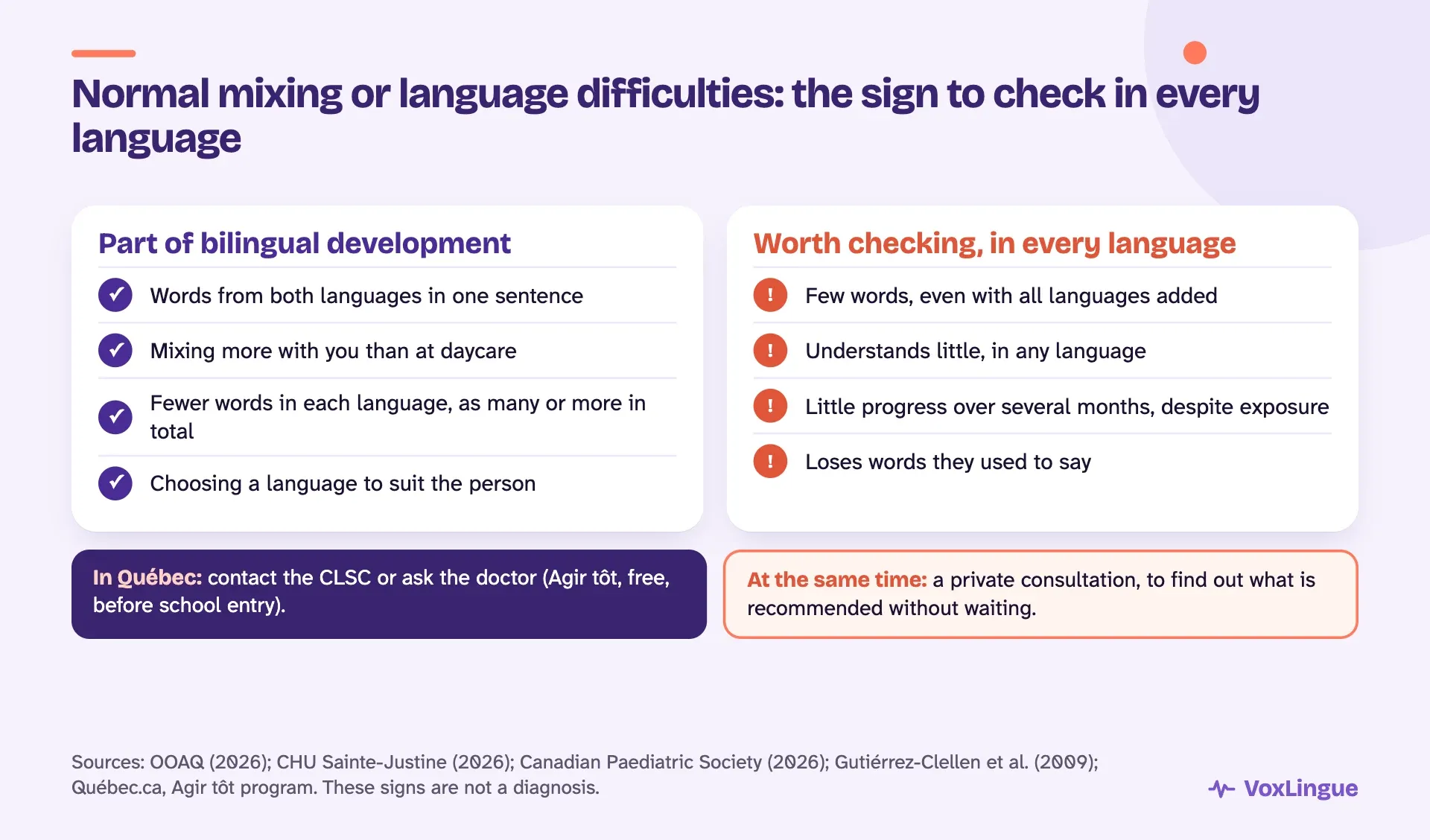
No, mixing in itself is not a sign of language difficulties. Children with a language disorder mix about as much as other children. What is worth checking is a child who has few words or understands little in all of their languages, or whose language changes little over several months.
In a US study of 58 school-age Spanish-English bilingual children, those with a language disorder switched languages about as often, and in the same ways, as the others (Gutiérrez-Clellen and colleagues, 2009). Code-switching was not a symptom.
A language disorder shows up in all of a child’s languages. According to CHU Sainte-Justine (in French), if the difficulties affect only one of the child’s languages, it is not a language disorder (2026). The Canadian Paediatric Society adds that we should never assume difficulties are caused by exposure to two languages (2026).
The sign to check: few words or little understanding in every language
Look at all of your child’s languages together, not at the mixing. Talk to a speech-language pathologist or your doctor if your child:
- has few words in all of their languages, even added together;
- understands little of what is said to them, in any language;
- makes little progress over several months, despite enough regular exposure to their languages;
- loses words they used to say.
These signs are not a diagnosis: before age 4, it is hard to tell whether a child has developmental language disorder (DLD), according to CHU Sainte-Justine. To go further, read our article on a language difference or a language disorder.
Who to talk to in Québec and Ontario
In Québec, start with the public system. Contact the CLSC or ask the doctor: the Agir tôt program offers free screening for children under 7, before they start school. At the same time, a private consultation lets you find out what is recommended without waiting. Our guide explains the public waiting list and what to do meanwhile.
An assessment should take all of a child’s languages into account. At VoxLingue, if the speech-language pathologist speaks the family’s language, she uses it. If not, she relies on questionnaires and an interview with you, and may coach you to act as interpreter during the session. In Ontario, the Preschool Speech and Language program sees children with no doctor’s referral, and we also offer telepractice for Ontario families.
Child mixing French and English: key takeaways
When your child mixes French and English, they’re not confused: they’re using every word they have.
- Mixing within a sentence is normal, and toddlers keep their languages apart very early.
- Your own mixing, now and then, doesn’t hurt their vocabulary. When you can, give them the whole sentence in one language.
- When they mix, answer what they asked for and say the word back in your language, without making them repeat.
- Speak the language you’re most comfortable in, and keep all your languages.
- The sign to check isn’t the mixing, but few words or little understanding in every language.
Next step
Have a question about your child’s language? Learn about an assessment that looks at every language your child uses and the languages we work in. Our speech-language pathologists see families at our clinic in Marché Central, Montréal, and by telepractice across Québec and Ontario.
To keep the examples handy, print our sheet: the three steps, examples to fill in for your own languages, and the sign to check.
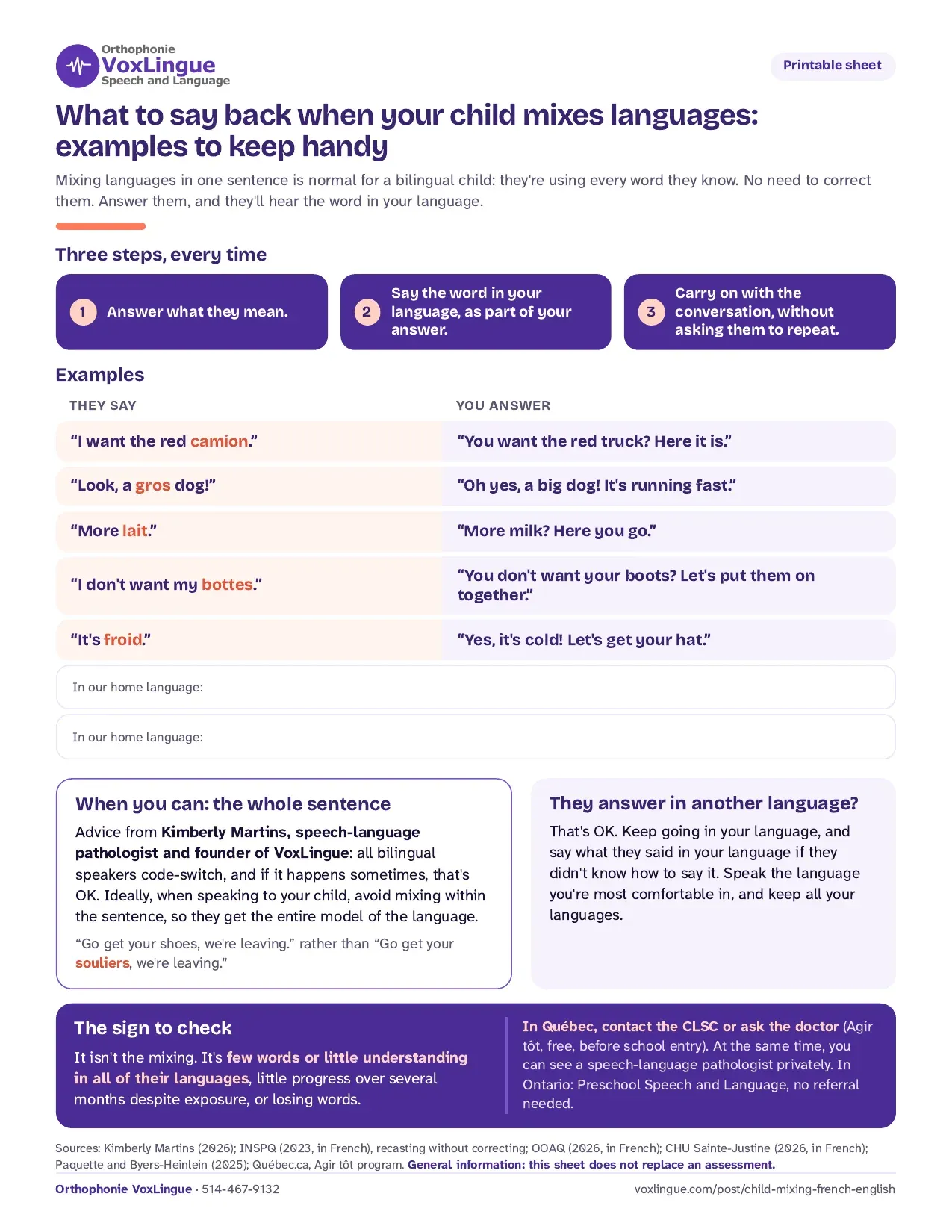
Printable handout: What to say back when your child mixes languages: examples to keep handy (PDF, 1 page).
Frequently asked questions
When do bilingual children stop mixing languages?
There is no fixed age, and bilingual adults mix all their lives. What grows with age is the ability to choose a language to suit the person they’re talking to. The McGill studies already show it in children aged 2 and 3.
Will mixing languages slow down their French or English?
No. According to Naître et grandir, mixing languages does not harm overall language development (in French, 2021). Their words in French, in English and in any other language add up.
Do we have to use “one parent, one language”?
It isn’t required, according to CHU Sainte-Justine. Even parents who follow it mix from time to time (Byers-Heinlein and Lew-Williams, 2013). What counts is regular, consistent exposure. To actively learn a language, a child needs to hear it about 30 to 40% of their waking hours, according to Kimberly Martins.
My child answers in English when I speak French: what should I do?
That’s OK. Keep going in your language, and say what they said in your language if you think they didn’t know how to say it. If they’re simply refusing, answer what they said, still in your language. As Kimberly Martins points out, by continuing to use it, you keep up their exposure to your language.
My child mixes Arabic, Spanish or Creole with French or English: is it the same thing?
Yes, in principle: the same reasons explain the mixing. In the 2025 Montréal study, families who spoke a heritage language mixed a little more, with no link to vocabulary in French or English. The same ways of answering work in every language.
Do mixed phrases count as real sentences?
Yes. “More lait” or “encore milk” is a real two-word combination: your child has put two ideas together (what counts as a two-word phrase). When you count their words and short phrases, count the mixed ones too.
Should we stop speaking our language so they mix less?
No. Kimberly Martins never advises reducing a language. In her view, the home language is the best model you can give your child.