Waiting for speech therapy in Québec: what happens on the list and what to do meanwhile
When your child is put on a speech therapy waiting list in Québec, the wait can last months, sometimes more than a year. For many parents, this is the hardest part: the worry is real, and it feels like there is nothing to do but wait for the phone to ring.
Families ask us the same questions again and again. How long will it take? Is Agir tôt the same as speech therapy? Should we start privately, and do we lose our place if we do? What can we do at home without turning into therapists?
This guide answers those questions. It walks through the public route in Québec step by step and explains what the published wait times actually measure. It will help you decide whether to wait or act now, and gives you a simple plan to make the waiting time count, at home, at daycare and with your child’s file.
How long is the speech therapy waiting list in Québec?
There is no single wait time. It depends on your region, your child’s age and the kind of service you are waiting for. The published numbers also measure different things: a first Agir tôt service can come within a few months, while individual speech therapy can take more than a year.
That is why parents hear numbers that seem to contradict each other. One article says 106 days, another says 410, a neighbour waited two years. They can all be right, because each one measures a different point on the route.
Four numbers, four different things
The wait for a first Agir tôt service was 106 days in early 2024. Children aged 5 and 6 waited an average of 410 days for speech therapy. In 2025, children still on a CLSC list had already waited 228 days on average. At the clinic, we often see families wait one to two years.
| The number | What it measures | Source |
|---|---|---|
| 106 days | Time to a first Agir tôt service of any kind, province-wide | Network data reported by Le Soleil, February 2024 |
| 410 days | Average wait for speech therapy for children aged 5 and 6, province-wide | Ministry of Health figures reported by Le Devoir, January 2025 (data from January 2024) |
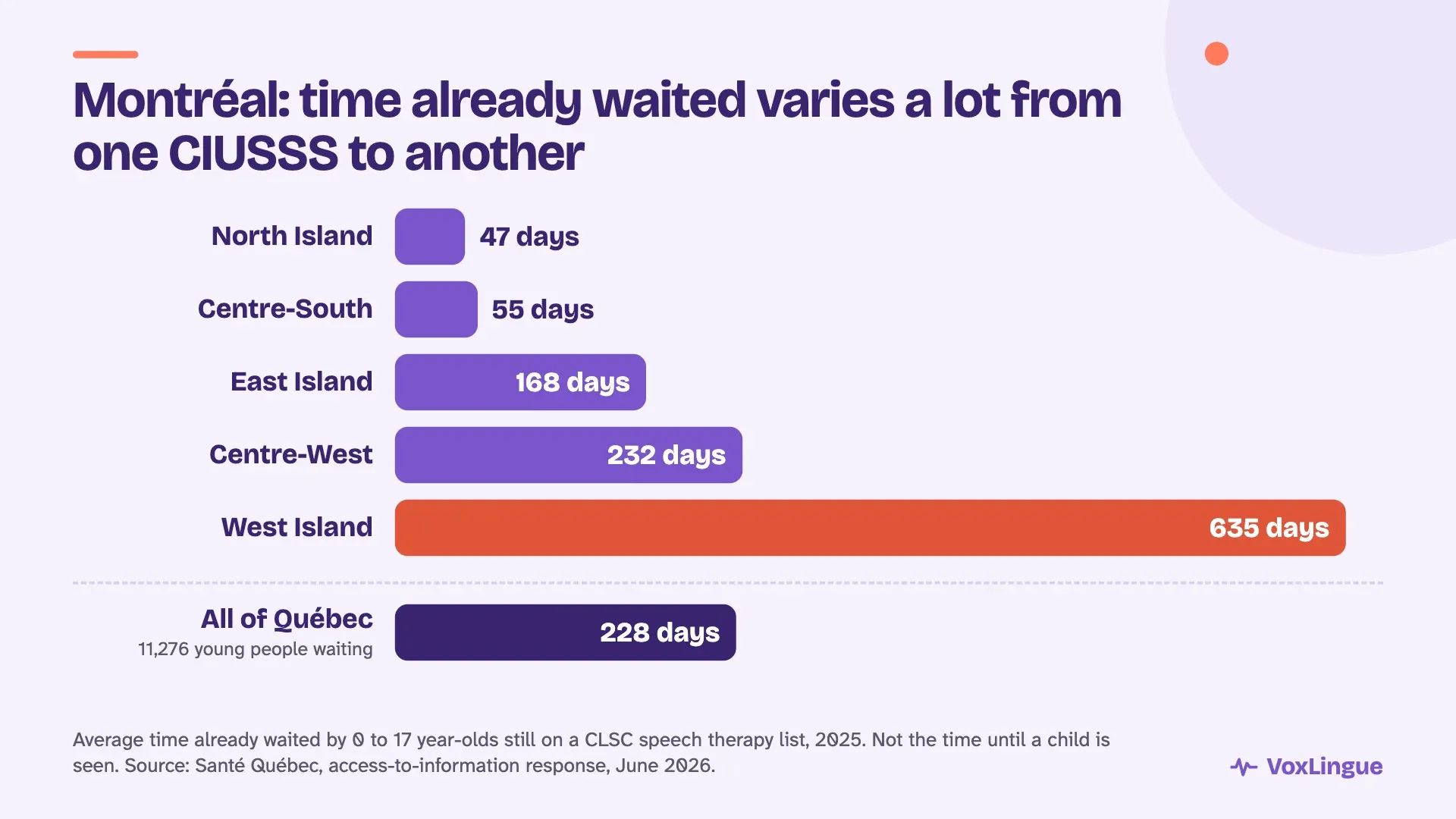
| 228 days | Average time already waited by the 11,276 young people aged 0 to 17 still on a CLSC speech therapy list | Santé Québec, access-to-information response, June 2026 (2025 data) |
| 1 to 2 years | What we often see before the CLSC calls for speech therapy services | Our clinical experience |
The third number is often misread. It does not tell you how long your child will wait to be seen. It tells you how long the children still on the list have already been waiting. Half of them had been waiting more than four months.
Montréal is not uniform either. According to the same Santé Québec data, the average time already waited in 2025 ranged from about 47 days in the north of the island to 635 days in the West Island. Depending on which CLSC covers your address, the experience can be very different.
Why does it take so long?
Screening now identifies more children, and requests have grown faster than the number of speech-language pathologists. According to the Ordre des orthophonistes et audiologistes du Québec (OOAQ), a reasonable wait for a child at risk would be one to three months.
The Ministry of Health says so itself: screening initiatives, including Agir tôt, have increased the number of children referred to speech therapy. Santé Québec also said in 2025 that Agir tôt funding had paid for close to 175 additional speech-language pathologists since 2019. Finding children earlier is good news, but resources have not kept pace.
Some regions are reorganizing to cut the wait. On the Côte-Nord, for example, offering parent workshops to everyone before individual speech therapy brought the wait for a first service down to 125 days, Radio-Canada reported in June 2026. People working in the public system do a lot with little: the wait is nobody’s personal failing.
How Agir tôt works, step by step
Agir tôt is a free, voluntary public program for children under 7. You can ask for it directly at your CLSC, or through 811, with no doctor’s referral and no diagnosis. Next come a needs assessment, online screening if useful, and then services matched to your child.
The program aims to spot early signs of developmental difficulty and steer children toward the right services before they start school. It is not only about speech: depending on the child’s needs, families may also see a special educator, an occupational therapist or a physiotherapist. The official Agir tôt page on Québec.ca describes its services.
The route often looks like this. At the 18-month vaccination, the nurse may fill out a short developmental questionnaire with you, called the ABCdaire. You can also make the request yourself, at any age before 7. A worker from the program then assesses your needs with you. They may suggest online screening questionnaires, then direct you to the program’s services.
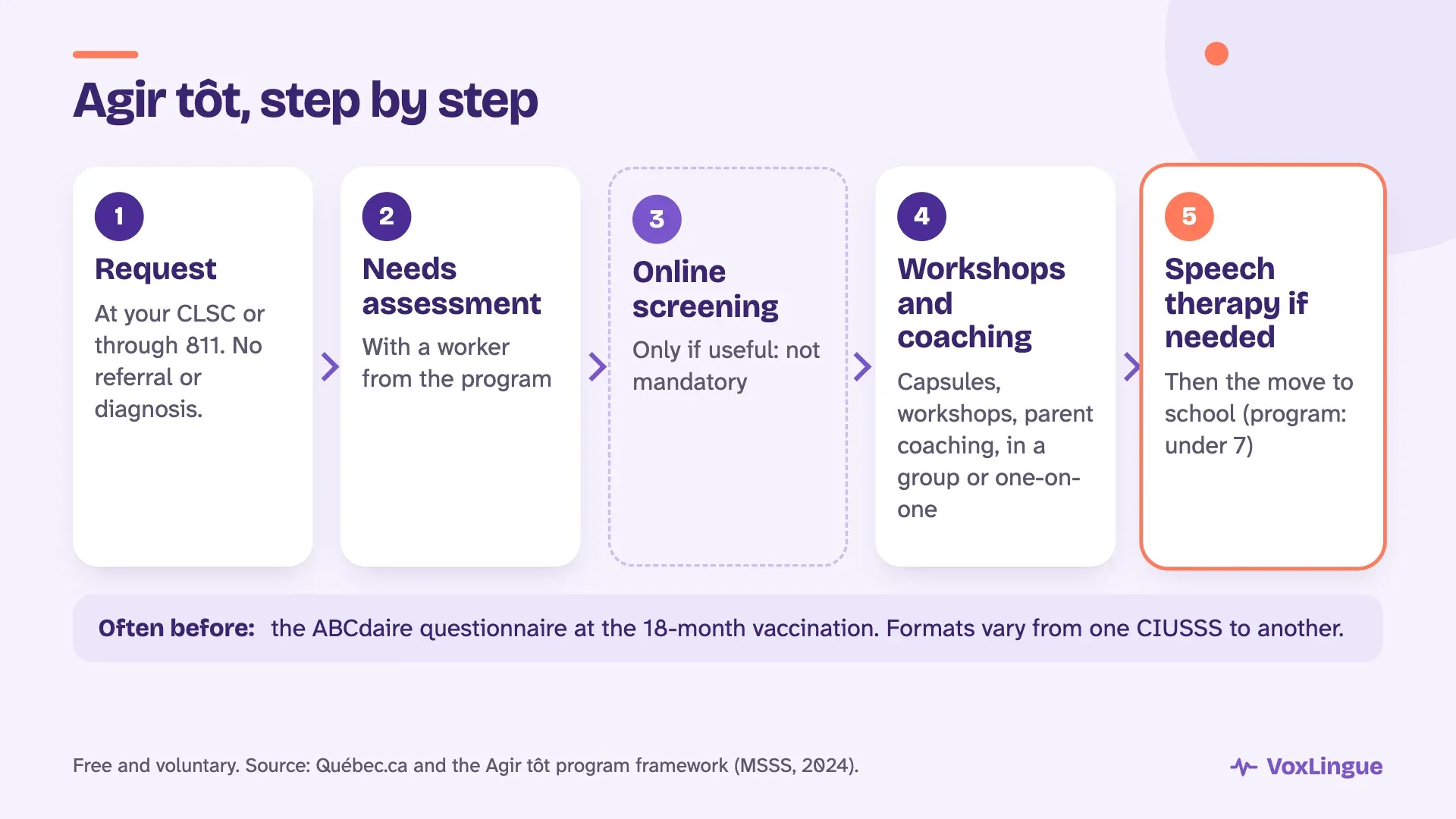
In Montréal, each CIUSSS (the regional health and social services network) has its own entry point for children’s services, and formats vary: workshops, individual sessions, simple advice. You can ask whether services are available in English. If a full speech and language assessment is offered along the way, our article on what to expect at a speech therapy assessment in Québec will help you prepare.
Do you need a doctor’s referral?
No. Parents can contact their CLSC directly. A doctor, a daycare educator or the school can also refer your child to Agir tôt, but only with your consent. No diagnosis is needed to receive services.
The program’s official framework is clear on this point: worried families can make a request without a medical referral. It also states that online screening is not a condition for getting services. It is one tool among others, and it is not needed in every situation.
A group workshop is not “nothing”
Many regions start with parent workshops, video capsules or group coaching before individual speech therapy. That is not a refusal of services: it is often the first step. Take part, ask your questions, and say so if the difficulties continue.
The program framework gives the example of video capsules followed by three to five group coaching sessions for parents. That is an example, not a rule: each health network organizes its services its own way. The format rests on a solid idea. When a speech-language pathologist trains and coaches parents, they become very effective at supporting language every day.
If your child is making little progress after the workshops, tell the worker clearly. Describe what you see, with examples. That information is what gets a child directed to a more intensive service.
What happens at age 7?
Agir tôt aims to support children through the start of school and the first years of elementary. If needs remain after age 7, the file can be transferred to another team. At school, services then depend on your school board or school service centre.
The program wants to avoid a child already being followed ending up without support during the move to kindergarten. If your child is 5 or 6 and still waiting, ask the person handling your file what is planned for the school year. The school section below explains what comes next.
Wait, or start privately? How to decide
Many children who talk late catch up, but nobody can predict which ones at age 2. An assessment tells you where your child stands. If therapy is recommended, a few coaching sessions give you strategies to use throughout the wait.
This is a personal decision. It depends on how worried you are, your budget and what you see at home. There is no wrong answer. But it helps to know what research says about “wait and see.”
What research says about “wait and see”
About half to two thirds of late talkers catch up with their peers. But 20 to 40% still have difficulties at age 4, and there is no way to know in advance which group your child will be in. Your worry matters: it turns out to be right about 80% of the time.
According to the American Speech-Language-Hearing Association (ASHA), 50 to 70% of late talkers catch up by the end of the preschool years or school age. The OOAQ adds that 20 to 40% still have language difficulties at 4, and about 20% at 7.
The problem is that we can’t tell which children those will be. In a large British study of more than 8,000 children, published in 2003, predicting a child’s outcome from their profile at age 2 was far too inaccurate to be useful in practice. The children whose difficulties persisted were not always the ones who were furthest behind at the start.
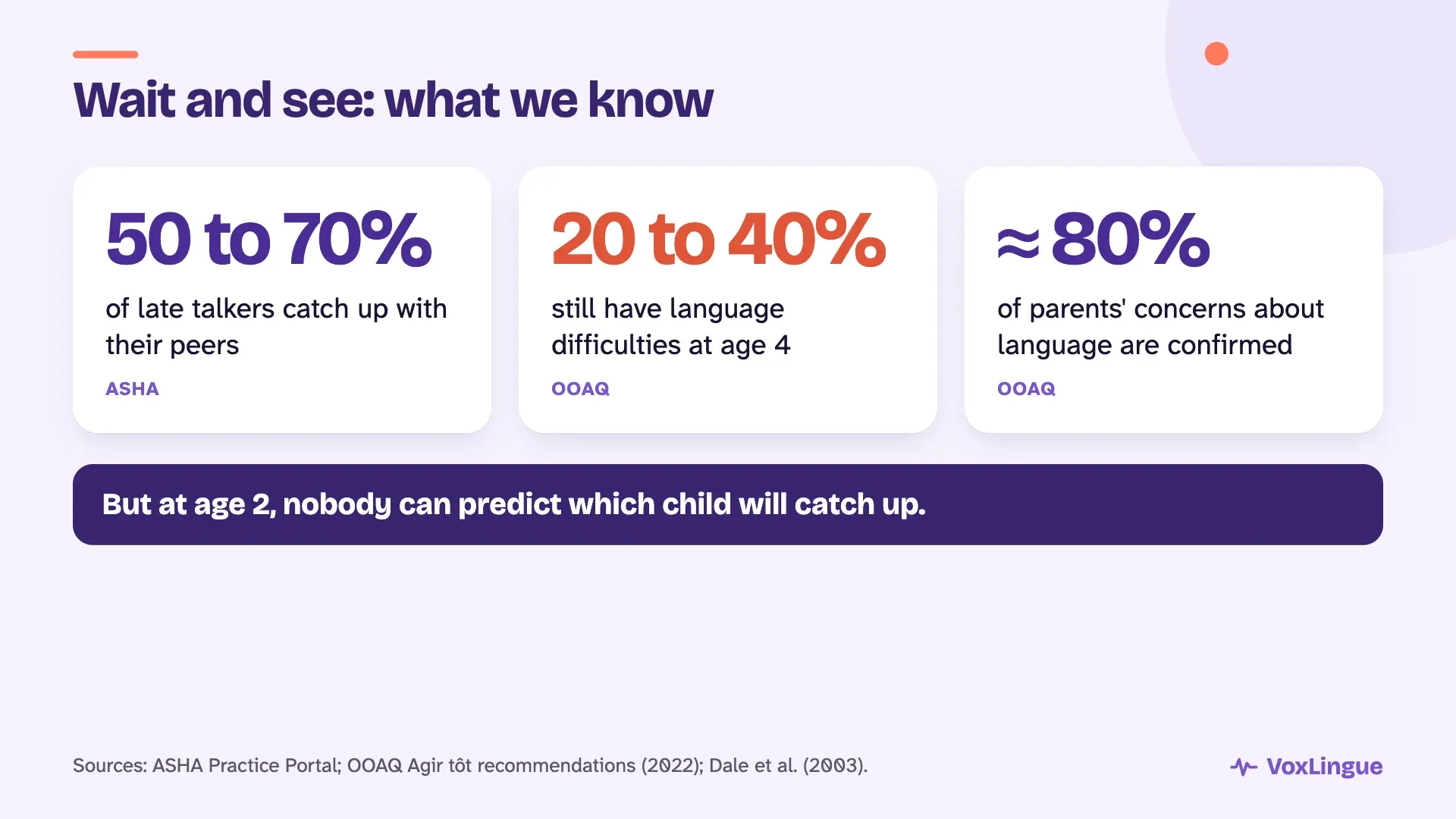
Your instinct, on the other hand, is a good guide. According to the OOAQ, parents’ concerns about language are confirmed about 80% of the time, and a Québec study found that only 3.6% of worried parents were wrong. If something worries you, it is worth raising.
Acting early can make a measurable difference. In a German trial published in 2009, 75% of 2-year-olds whose parents took a three-month program with professionals had typical expressive language at age 3. In the group that waited, it was 44%. The study was small, but it shows what waiting can cost.
That is why ASHA recommends that a late talker with no other concerns be monitored with language stimulation, not simply left to wait. In Québec, the OOAQ stresses that early intervention is essential when there are signs of difficulty. Naître et grandir puts it simply: you don’t need to wait until a certain age, or until your child talks, to see a speech-language pathologist.
One more point that relieves many parents: late talking is not the parents’ fault. An Australian study of 1,766 children found no link between late talking at age 2 and parenting practices, parents’ education or family income.
Signs that are worth not waiting for
Some signs deserve an assessment without waiting for the CLSC’s call: a child who seems not to understand, uses few gestures, has very few words or isn’t combining two words by around age 2. Have their hearing checked too.
| Age (approximate) | What is worth an assessment |
|---|---|
| Around 18 months | Fewer than about 15 words; few gestures to communicate (pointing, showing, waving bye-bye) |
| Around 2 years | Not yet combining two words, such as “more milk” or “daddy gone” |
| Around 2½ years | Not yet using short two- or three-word phrases |
| Any age | Seems not to understand what is said in simple situations; seems not to hear well; your worry doesn’t go away |
These ages are approximate. The 18-month and 2-year markers come from norms for French-speaking Québec children, cited by the OOAQ: by 24 months, 97% of children are already combining words. Difficulty understanding is the sign that most strongly predicts difficulties that last. For more on what is typical at each age, see our guide for parents of late talkers in Montréal.
For a child learning two languages, count all their words, in every language. Our guide to bilingual language milestones from 0 to 5 shows how.
What we recommend at the clinic
When a family comes to us while waiting for the CLSC, we start with an assessment. It helps us understand the child’s speech and language development, their strengths and their difficulties. Sometimes the assessment is reassuring: the child is progressing, and a few tips are enough for now.
If therapy is recommended, we suggest starting right away rather than waiting for the CLSC to call. In our experience, that call can take one to two years, and the public service then offers a limited number of sessions. That is a long time in a young child’s life.
You don’t need to commit for months. Even a few sessions give you support, coaching and strategies you can use every day at home. Research backs this up: according to a Cochrane review, parents trained by a speech-language pathologist achieved results similar to therapy delivered by the clinician.
If you’re unsure, a speech and language assessment gives you a clear picture, whether or not you then decide to wait for the public system.
Public and private at the same time: how does it work?
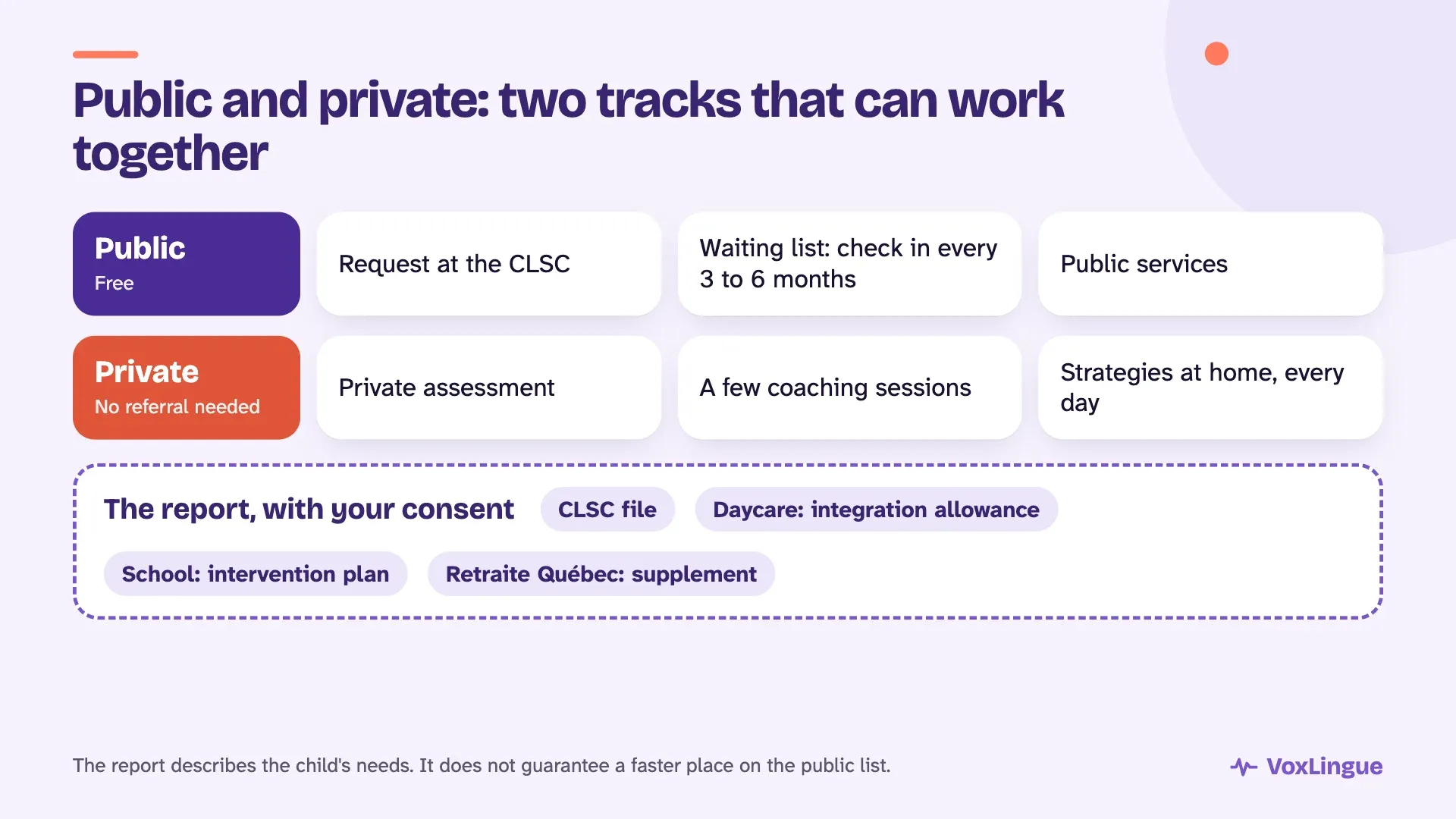
Public and private services can work together. A private assessment report describes your child’s needs and can update their CLSC file. Sometimes the public team then moves straight to intervention. Tell your CLSC, share the report if you choose to, and the professionals can coordinate.
In our experience, seeing a private speech-language pathologist does not cost you your place on the CLSC list. Let the person handling your file know, and ask how the private report can be used. Each health network has its own way of doing things.
Sharing the report is always your choice. Public intake forms actually invite referrers to attach relevant reports, with the parents’ permission. When public and private professionals talk to each other, each can work on different goals instead of repeating the same steps.
Private doesn’t have to mean driving across town every week. With young children, much of the work is coaching the parent, which suits speech therapy by telepractice anywhere in Québec.
What a private report can change
The report sets out your child’s needs and points toward the right services. It can update the CLSC file and support a request for daycare integration funding, an intervention plan at school or the supplement for handicapped children.
In practice, a speech-language pathologist’s report is one of the documents recognized for the daycare integration allowance in subsidized childcare. At school, it can support an individual intervention plan. For Retraite Québec’s supplement for handicapped children, a recent, complete assessment is part of what is required. The sections below explain each of these.
What it doesn’t guarantee
A private report does not guarantee a faster place on the public list. Each health network has its own rules and priorities. It sometimes saves a second assessment, but that is never automatic.
It doesn’t replace the decisions of the public system, the school or Retraite Québec either, which apply their own criteria. What the report brings is clear information, and that is often what a file is missing.
What can you do at home while you wait?
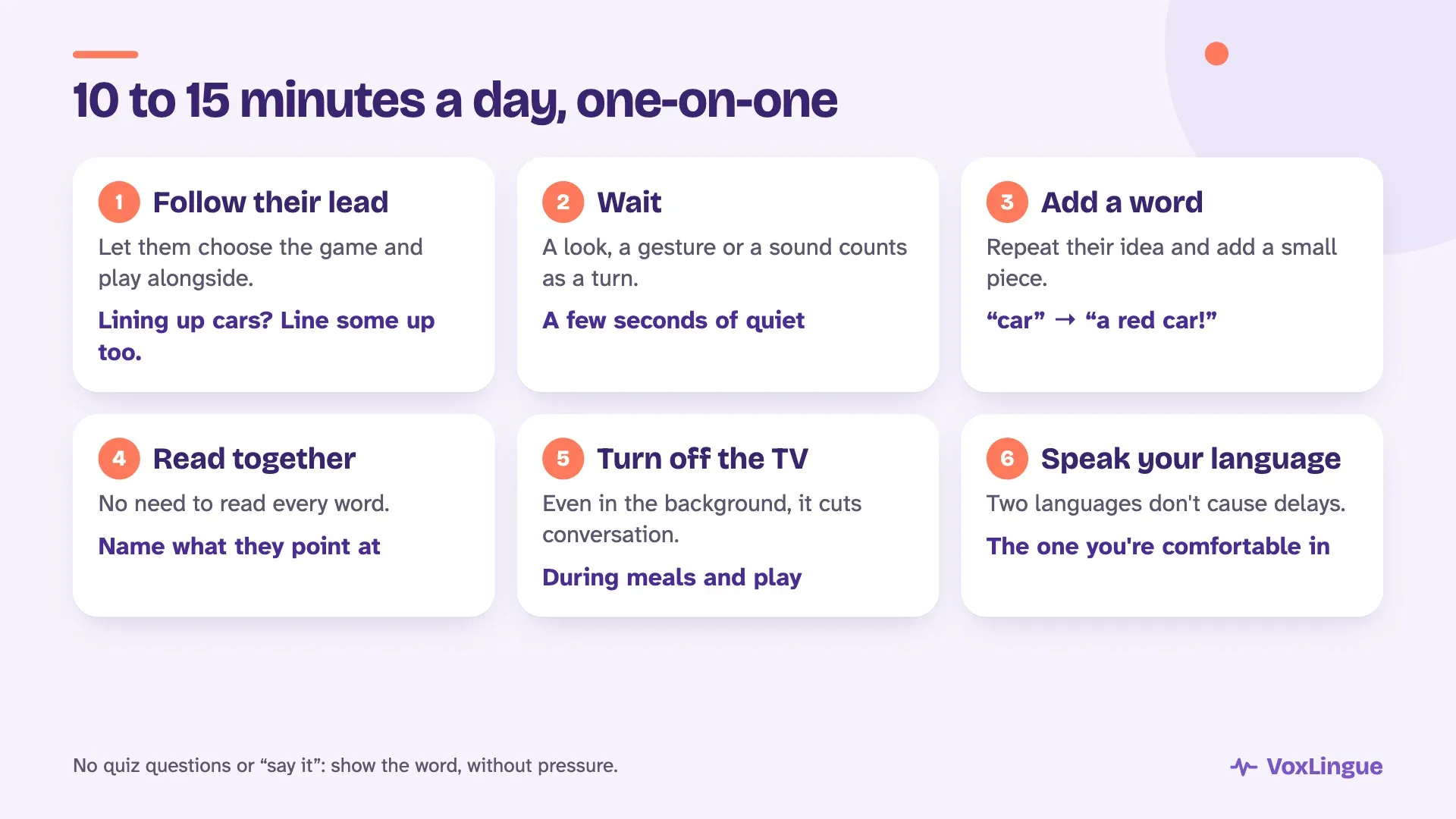
Ten to fifteen minutes of real one-on-one play every day does more than drills. Follow your child’s lead, respond to what they say by adding a word, read together, turn off background TV and keep speaking your own language.
Children learn best through play. You don’t need special materials, and you don’t need to become a therapist. What matters is a predictable moment, every day, when you are available to play, read a book or do an activity with your child. It is the quality of the back-and-forth, more than the number of words, that supports language.
Play: follow their lead
Pick a calm moment, get down to your child’s level and let them choose the game. If they line up cars, line up cars beside them. If they fill a bucket with sand, fill yours. By following what already interests them, you talk about exactly what has their attention.
Then wait. A look, a gesture or a sound is a way of taking a turn. Leave a few seconds of quiet before speaking for them: that pause is often when a child tries something.
Respond and add a word
When your child says something, repeat their idea and add a small piece. If they say “car,” you can answer “a red car!” If they say “fell,” try “the block fell down.” You show them the next step without correcting them or asking them to repeat.
Avoid quiz questions like “What’s this?” or “Say ‘ball.’” They add pressure and often end the exchange. Instead, comment on what you’re doing together, in short, clear sentences that are a little longer than theirs.
Speech-language pathologists use these techniques and teach them to parents. In late talkers, studies find that parents who repeat and build on their child’s words have children who talk more.
Read together, differently
Sharing a book supports language, especially when your child takes part. You don’t have to read every word on the page. Point to the pictures, name what your child points at, let them turn the pages and come back to the same book ten times.
Programs that teach parents to read this way improve children’s vocabulary, according to an analysis of 19 trials published in 2020, especially when reading happens often. A few minutes every day, at bedtime or after supper, does more than a long session once in a while.
Screens: start with background TV
A TV that is on in the room cuts down conversation between parent and child, even when nobody is watching it. That makes it the easiest change: turn it off during meals, play and routines.
The Canadian Paediatric Society recommends no screen time before age 2, except video chats with family, and about an hour a day or less between ages 2 and 5. If your child watches a show, watch it with them and talk about it. The Society’s advice on screen use and young children is clear and realistic.
Keep speaking your language
Learning two or more languages does not cause language difficulties and does not make them worse. You don’t need to drop your language, even if your child is talking late. Speak to them in the language you are most comfortable in: that is where your conversations are richest.
This matters in Montréal, where many families speak English, French and often a third language at home. A child who hears French at daycare and another language at home is not confused by it. Our article on identifying language disorders in bilingual children explains how professionals tell a difference from a disorder.
If you’d like support to use these strategies, parent coaching based on the Hanen approach is designed for exactly that. You learn the strategies while playing with your child, and the speech-language pathologist guides you in the moment.
It is the quality of the back-and-forth, more than the number of words, that supports language.
Daycare and CPE: allies during the wait
Talk to your child’s educator about what you notice. They can support your child in the group and share ideas with you. In subsidized daycare, a speech-language pathologist’s report, with no diagnosis required, can support a request for funding for extra help.
Educators see your child with other children, in a different setting. What they notice adds to what you see at home. Share the strategies you use with them, so your child hears the same approach in both places. When educators are trained in these strategies, small studies show they wait more for children to start the exchange, and the children talk more.
Some daycares also receive government support and have access to special educators. They can work with your child within the group to help them find their place.
The main funding tool is the integration allowance from Québec’s Ministère de la Famille (Allocation pour l’intégration en service de garde). It is paid to the subsidized daycare (a CPE, a subsidized daycare or a recognized home daycare), not to parents. It does not require a diagnosis, but it does require confirmation of the child’s needs by a recognized professional, and speech-language pathologists are on that list. The parent is the one who requests and authorizes the assessment.
An additional allowance exists for greater needs, but it is reserved for children eligible for the supplement for handicapped children. Either way, start by talking to the daycare director: the daycare makes the request.
Keeping track of your file on the waiting list
A file that is followed closely helps your child. Check in every three to six months, report any change, keep seeing your doctor, ask for a hearing test, and keep notes on what your child says and understands.
A call every three to six months is not pushy. Ask where the request stands, and tell the person handling your file about any change: a new concern, a change of daycare, a private report, a recommendation from the educator. That information can mean your child is seen sooner, or directed to a different kind of service.
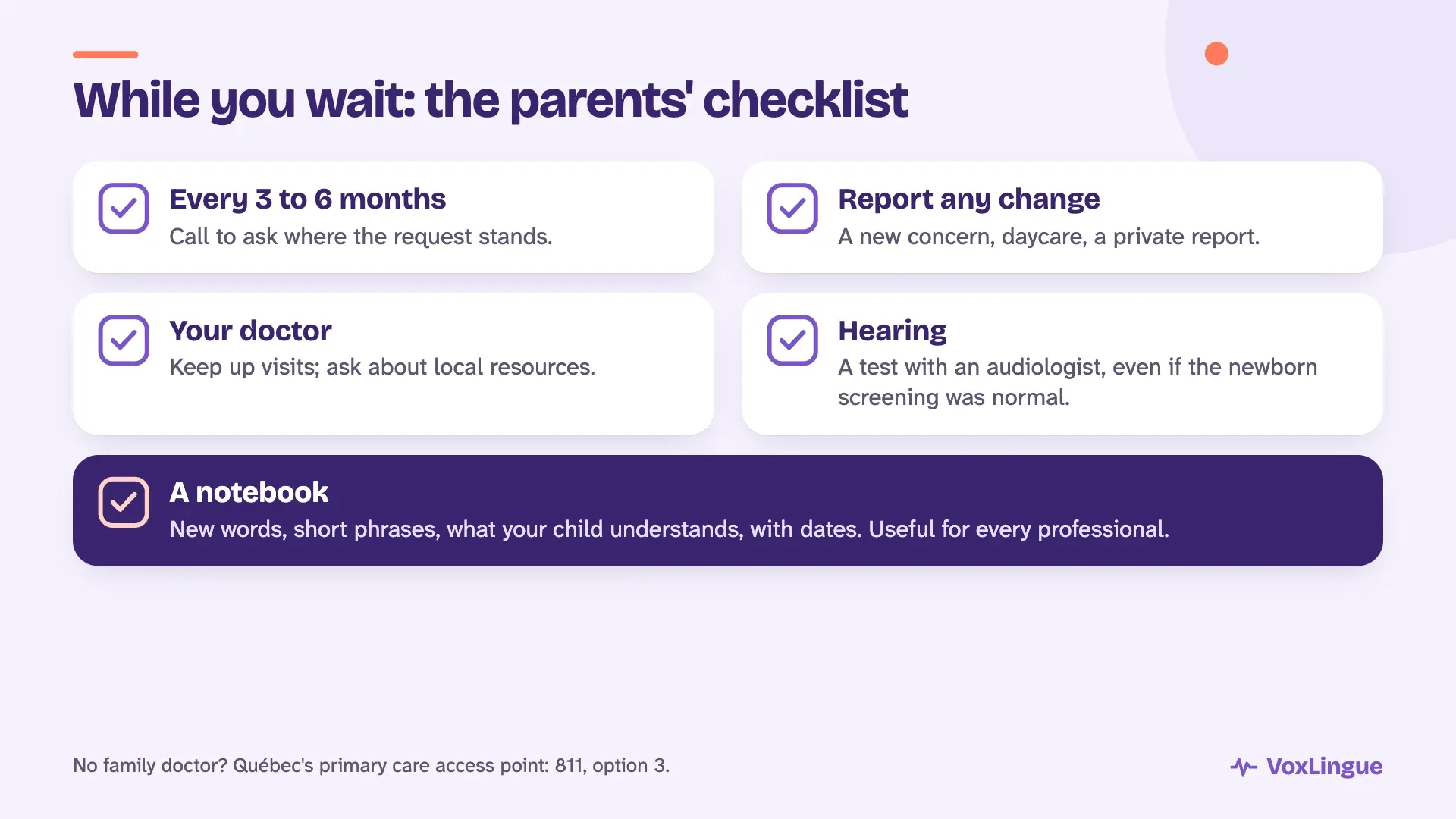
Keep up your visits with the doctor who follows your child, too. Talk about the wait, and ask whether they know of resources in your area, such as community organizations or foundations that help pay for private services. If you don’t have a family doctor, Québec’s Guichet d’accès à la première ligne (the access point for primary care) is reachable through 811, option 3, or online.
Hearing deserves special attention. When language is developing slowly, a hearing test by an audiologist is recommended, even if your child passed the newborn screening. It is a simple test that rules out one possible cause and guides what comes next.
Finally, keep a small notebook. Write down new words, short phrases and what your child understands, with dates and examples. These notes help every professional who meets your child, and they often show you progress that day-to-day life hides.
Financial help and free resources
Public services are free. For private care, many insurance plans reimburse speech therapy, and fees count for both the Québec and federal medical expense tax credits. A language disorder can also qualify for the supplement for handicapped children. And there are free resources too.
For private services, the OOAQ estimates that hourly rates usually range from $100 to $200, with assessments often billed separately. Before you start, check your insurance coverage and ask for an estimate.
| Support | Who it’s for | What to know |
|---|---|---|
| Private insurance | Families with group or individual coverage | Many insurers reimburse speech therapy under certain conditions. Call your insurer before you start. |
| Medical expense tax credit (Québec) | Any family paying for speech therapy | Fees paid to a speech-language pathologist who is a member of the Ordre count as medical expenses. Keep your receipts. |
| Medical expense tax credit (federal) | Any family paying for speech therapy | The Canada Revenue Agency lists speech-language pathologists as authorized medical practitioners in Québec. |
| Supplement for handicapped children (Retraite Québec) | Children whose language disorder significantly limits daily life for at least a year | $2,892 a year in 2026. A recent, complete assessment is required; a speech-language pathologist’s conclusion alone is not enough. |
| Disability tax credit (federal) | Children who have great difficulty being understood, nearly all the time | Strict criteria. A speech-language pathologist can certify the “speaking” category. |
| Association des jeunes bègues du Québec | Young people aged 17 and under who stutter | Up to $400 per request toward speech therapy, based on family income. |
| University clinics | Families looking for lower-cost services | Speech therapy students supervised by licensed clinicians, at Université de Montréal, Université Laval and UQTR. |
Retraite Québec explains the eligibility requirements for the supplement, which vary by age.
Several resources are free. Montréal’s CIUSSS networks offer capsules and toolkits for parents, such as the Agir tôt parent toolkit from the CIUSSS de l’Est-de-l’Île-de-Montréal, mostly in French. The Une naissance, un livre program gives a free reading kit to parents who sign up a baby under one at the public library. The OOAQ also has a directory to find a private speech-language pathologist.
What happens when my child starts school?
At school, speech therapy depends on the resources of your school board or school service centre. A report can support an individual intervention plan with accommodations. A diagnosis should not be a condition for getting help: it is the student’s needs that count.
Some schools have access to a speech-language pathologist, others very little. According to Québec’s association of speech-language pathologists and audiologists, resources thin out after the first years of elementary school, and a speech-language pathologist in high school is very rare. To find out what is offered, ask the school or your school board. English school boards follow the same Québec rules.
The intervention plan (plan d’intervention) is the main tool. It can include accommodations, which help the student without changing what is expected, such as extra time or instructions given both orally and in writing. It can also include modifications, which change the program’s expectations in a subject. Schools must make a plan for students recognized as having difficulties, and can make one for any student whose difficulties persist.
For some students, the school may ask for a code to be recognized. Code 34, for example, covers a severe language disorder confirmed by a speech-language pathologist. But Québec’s ombudsman, the Protecteur du citoyen, pointed out in 2022 that the idea that you need a diagnosis, then a code, to get services is a widespread misconception. Services should follow the student’s needs.
Frequently asked questions
Can we stay on the CLSC list if we see a private speech therapist?
In our experience, yes: starting privately does not cost you your place on the CLSC list. Let the person handling your file know, and ask how the private report can be used. The two can complement each other, each working on different goals.
Do we need a doctor’s referral for Agir tôt?
No. Parents can contact their CLSC directly, without a medical referral. A doctor, a daycare educator or the school can also refer a child to the program, always with the parents’ consent. No diagnosis is needed to receive services.
Is the online screening mandatory?
No. The online questionnaires are a tool the worker may suggest to understand your child’s needs better. The program’s official framework says they are not needed in every situation and are not a condition for receiving services.
Is private speech therapy covered by RAMQ?
Speech therapy in the public system, such as the CLSC, Agir tôt and school services, is free. Private fees are paid by the family or partly reimbursed by private insurance. They also count for the Québec and federal medical expense tax credits.
How much does a private speech therapist cost in Québec?
According to the Ordre des orthophonistes et audiologistes du Québec, private hourly rates usually range from $100 to $200, and assessments are often billed separately. Ask for a written estimate before you start, and check what your insurance covers.
Can we claim speech therapy fees on our taxes?
Yes. Fees paid to a speech-language pathologist count as medical expenses for both the Québec and the federal tax credits. Keep all your receipts. The expenses must be paid within a 12-month period and must not have been reimbursed by insurance.
Is it my fault my child is talking late?
No. A large Australian study found no link between late talking at age 2 and parenting practices, parents’ education or income. What you do now still matters: everyday conversation supports language, whatever caused the delay.
My child is bilingual. Should we speak only one language?
No. Learning two or more languages doesn’t cause language difficulties or make them worse. Keep speaking the language you are most comfortable in. Your child’s words count in every language they are learning, and our milestones guide explains how to count them.
My child has had lots of ear infections. Is that the cause?
Not necessarily. In otherwise healthy children, fluid in the ears has little or no link to later language, and ear tubes did not improve language in studies. But a child who is talking late should see an audiologist, even if they passed the newborn hearing screening.
What happens at age 7 if my child is still on the list?
Agir tôt aims to support children into school and the early elementary years. If needs remain after age 7, the file can be transferred to another team. At school, services depend on your school board’s resources. Ask early what is planned for the school year.
Does online speech therapy work with a young child?
With toddlers, much of the work is guiding the parent while they play with their child. Telepractice suits that well: the speech-language pathologist sees your interactions at home and suggests strategies on the spot. It is a useful option if you live far from a clinic or have a busy schedule.
Do we need a diagnosis to get help at daycare or school?
No. The daycare integration allowance is based on confirmed needs, not on a diagnosis. At school, the Protecteur du citoyen points out that services should follow the student’s needs rather than depend on a diagnosis or a code.
The bottom line
A speech therapy waiting list in Québec can be long, but the wait doesn’t have to be lost time. Understanding the public route helps you know where your child stands and what to ask. When you’re worried, an assessment tells you whether help is needed now.
Meanwhile, you remain your child’s best ally. A few minutes of play every day, a shared book, the TV turned off, a file followed up every three to six months: these are small steps, and they count.
To help you get organized, we’ve made a printable one-page plan, “Our waiting-list plan.” For more answers to families’ questions, see our articles on speech and language assessment.
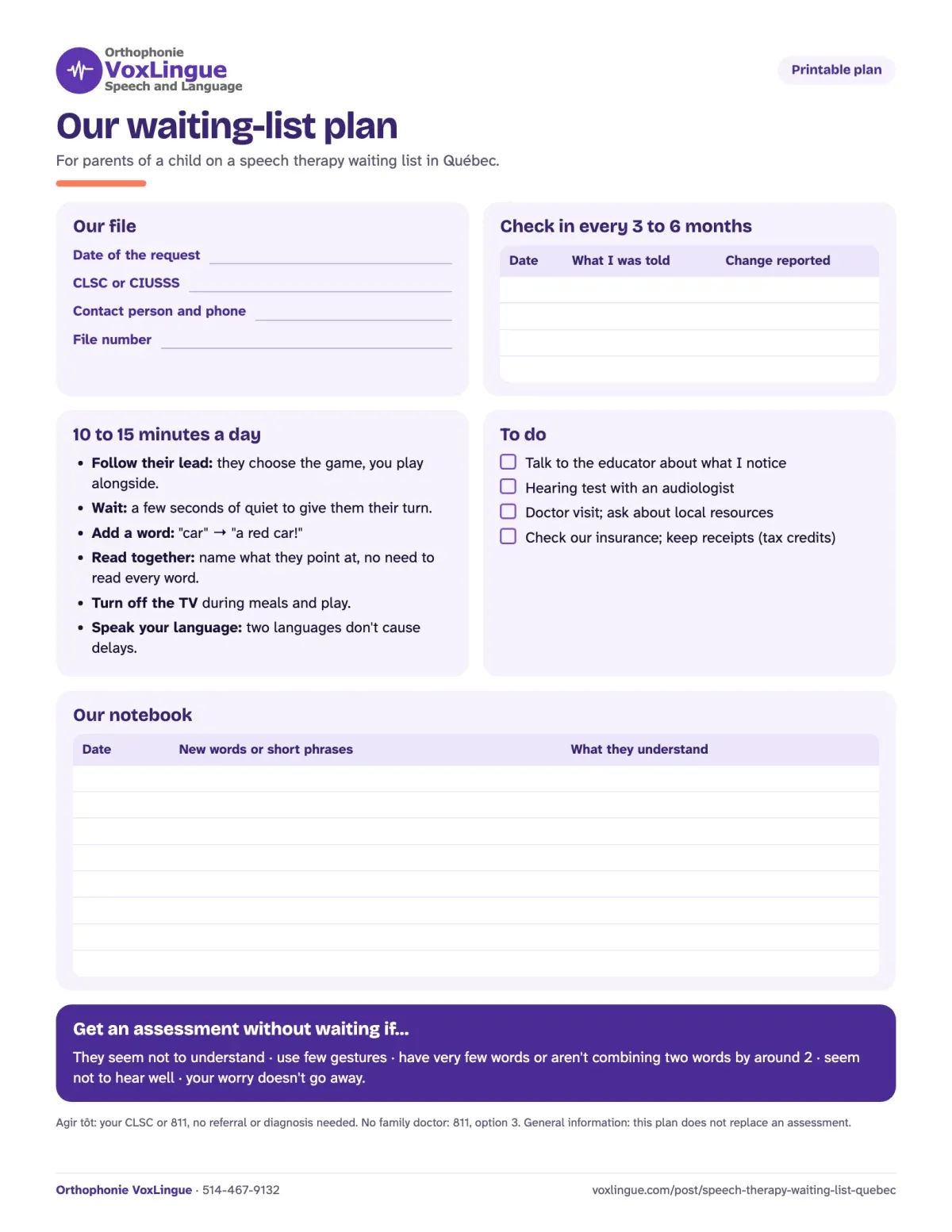
Printable plan: Our waiting-list plan (PDF, 1 page). Keep it on the fridge or in your child’s file.