Signs to look for
- Your preschooler has trouble with rhymes or with hearing the first sound in a word
- Your child finds it hard to learn letter names and the sounds they make
- In grade 1 or 2, sounding out simple words is slow and effortful, or your child guesses from the first letter
- Spelling mixes up or leaves out sounds, even in short words
- Your child can read the words but has trouble explaining what the text was about
- Your child avoids reading, or homework involving reading leads to frustration
- There is a family history of reading or spelling difficulties, or your child had early speech or language difficulties
What it is
Learning to read and write depends on spoken language. Before children can read a word, they need to hear the sounds in it. Before they can understand a story on the page, they need to understand the words and sentences when they hear them. When reading or spelling is hard, the difficulty often begins in these foundations.
Speech-language pathologists support literacy by working on three connected areas.
Phonological awareness
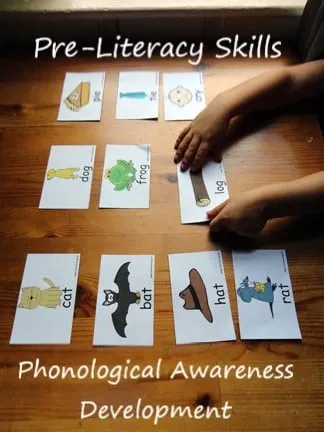
Phonological awareness is the ability to notice and play with sounds in spoken words: rhyming, clapping syllables, hearing the first or last sound, and blending or separating sounds (“c-a-t” makes “cat”). Research shows it is one of the strongest early predictors of reading success, and it can be taught.
Decoding and spelling
Decoding means linking letters to sounds and blending them to read a word. Spelling works in the other direction: hearing each sound and choosing the right letters. Children who find this hard may read slowly, guess from the first letter or spell words in ways that leave out sounds.
Language comprehension
Some children read the words accurately but do not understand what they read. Reading comprehension depends on vocabulary, grammar, background knowledge and the ability to follow a story or an explanation. Children with language difficulties are more likely to struggle here, even when decoding is strong.
Who we see
We see preschoolers who are building early literacy skills, school-age children who find reading or spelling hard, and teens whose reading comprehension or written expression is making school harder. Many children we see for literacy had earlier speech sound or language difficulties, since these are known risk factors. Others come after a teacher raises a concern or after a school assessment.
How we assess it
Our speech-language pathologists start with your child’s history: early speech and language development, family history of reading difficulties, school experience and the languages your child speaks and is learning to read in. Depending on your child’s age, the assessment may look at:
- phonological awareness, such as rhyming, syllables and sounds in words
- knowledge of letters and their sounds
- reading real words and made-up words, to see how your child decodes
- spelling, including which kinds of errors appear
- reading fluency and reading comprehension
- oral language: vocabulary, grammar and understanding of stories
You receive a clear description of your child’s strengths and needs, and recommendations for therapy, home and school. Whether a formal diagnosis such as dyslexia can be made, and by whom, depends on the province and your child’s profile. When another professional should be involved, we explain why. Learn more about our assessment process.
How therapy works at VoxLingue
Therapy is structured and explicit, which is what research supports for children who find reading hard, and it is built to be engaging.
Building sound skills
With younger children, we play with sounds through games: finding objects that start with the same sound, clapping syllables in family names, or moving tokens for each sound in a word. These skills are then linked to letters.
Connecting sounds and letters
We teach letter-sound links in a clear sequence and practise blending them into words, then reading short decodable texts. Spelling is taught alongside reading, so your child learns to hear each sound and write it.
Reading for meaning
Our literacy-based approach uses books to build vocabulary, understanding of story structure, inferencing and the ability to retell and discuss what was read. For older children and teens, we work on comprehension strategies, summarizing and planning written work.
Your role at home
Daily shared reading is one of the most helpful things you can do, in any language. A few habits make it more effective:
- Read together for a few minutes every day, choosing books your child enjoys.
- Talk about the story: ask what might happen next, or how a character feels.
- Play sound games in the car or at the table, such as “I spy something that starts with mmm”.
- Let your child see you read and write, from grocery lists to messages.
- Keep reading practice short and positive, and stop before frustration builds.
Bilingual and multilingual families
Many children in our communities learn to read in French at school while speaking English or another language at home, or the reverse. Research shows that core skills, such as phonological awareness and understanding stories, transfer across languages. A child who learns to hear sounds in Arabic or Spanish is building skills that also support reading in French or English.
Each language also has its own spelling system. French is fairly regular for reading but has many silent letters that make spelling harder. English has many irregular words. We take this into account and focus therapy on the language your child is learning to read in, while encouraging you to keep reading, telling stories and talking in your home language. Reading in one language does not take away from the other.
In person or by telepractice
Literacy therapy is available in person at our Marché Central clinic in Montreal, or by telepractice anywhere in Quebec and Ontario. Online sessions work well for literacy, with shared digital books, on-screen letter tiles and interactive games. For some school-age children, our group programs offer a chance to practise language and literacy skills with peers.
Getting started
You do not need a doctor’s referral. If reading or spelling is a struggle for your child, an assessment helps you understand why and what will help.
Call our Marché Central clinic at 514-467-9132, or request an appointment through our contact form. Availability of specific clinicians and languages varies, and our team will match you with the right person.
Frequently asked questions
Why would a speech-language pathologist work on reading?
Reading and writing are built on spoken language. Children need to hear and manipulate the sounds in words, link those sounds to letters, and understand vocabulary, sentences and stories. Speech-language pathologists are trained in all of these foundations, which is why literacy is part of our work.
What is phonological awareness?
Phonological awareness is the ability to notice and play with the sounds in spoken words: hearing rhymes, clapping syllables, finding the first sound in a word or blending sounds together. It is one of the strongest early foundations for learning to read and spell.
Can you diagnose dyslexia?
We assess reading, spelling and the language skills underneath them and explain what we find. Whether a formal diagnosis such as dyslexia can be made, and by which professional, depends on the province and on your child's profile. When another professional, such as a psychologist or neuropsychologist, should be involved, we tell you and can work alongside them.
Will learning to read in two languages confuse my child?
No. Many core reading skills, such as phonological awareness and understanding stories, carry over from one language to another. Each language has its own spelling rules to learn, and we take into account which language your child is learning to read in at school.
At what age should we look for help?
Earlier is helpful. Signs can appear in preschool, such as difficulty with rhymes or letter sounds. If your child is struggling to learn to read by the end of kindergarten or in grade 1, an assessment can clarify why and what will help.
Is this the same as tutoring?
No. Tutoring often focuses on homework and curriculum content. Our work targets the underlying sound and language skills that make reading and spelling possible, with goals based on a clinical assessment.
Related areas of care
- Language delays and language disordersSupport for children and teens who have difficulty understanding or using language, from late talkers to school-age developmental language disorder.
- Speech sound disorders: articulation and phonologySupport for children who are hard to understand or who mispronounce sounds past the typical age, in English, French and the other languages of your home.
- Speech and language assessment for children, teens and adultsA careful look at speech, language, voice, fluency or swallowing to find out whether you or your child can benefit from speech-language therapy, and what would help most.
- Speech therapy groups and day camps for childrenSmall group programs and day camps where children practise speech, language and social communication with peers, guided by speech-language pathologists.