Ready for kindergarten in Québec? Language skills that matter, and the school form explained
Kindergarten registration in Québec usually opens in January, and the school may hand you a form about your child’s language.
The registration package is on the kitchen table. Between the birth certificate and the proof of address, one page asks which languages your child speaks and whether they have ever seen a speech-language pathologist. It offers boxes marked “sometimes” and “often”. You pause. Will ticking a box label your child? Should they already be writing their name?
This guide is about kindergarten readiness in Québec, from the language side. Is your child ready for kindergarten in the ways that actually matter? We explain what the Québec program really expects at 4 and 5, and what it does not ask for on day one. We walk through the school’s language form, who reads it and what can happen next. We map the months from registration to October, and say when it makes sense to act before school starts.
A word on terms. In French-language schools, kindergarten is called maternelle: maternelle 4 ans (K4) and maternelle 5 ans (K5). Montréal’s English boards use “Kindergarten (K4-K5)”. We say “kindergarten” here and mean both.
This guide sits alongside our articles on speech and language assessment. One thing before we start: not knowing how to answer every question on the form is normal. You know your child better than anyone, and that knowledge is exactly what the school hopes to learn from you.
What should your child be able to do with language by the end of kindergarten?
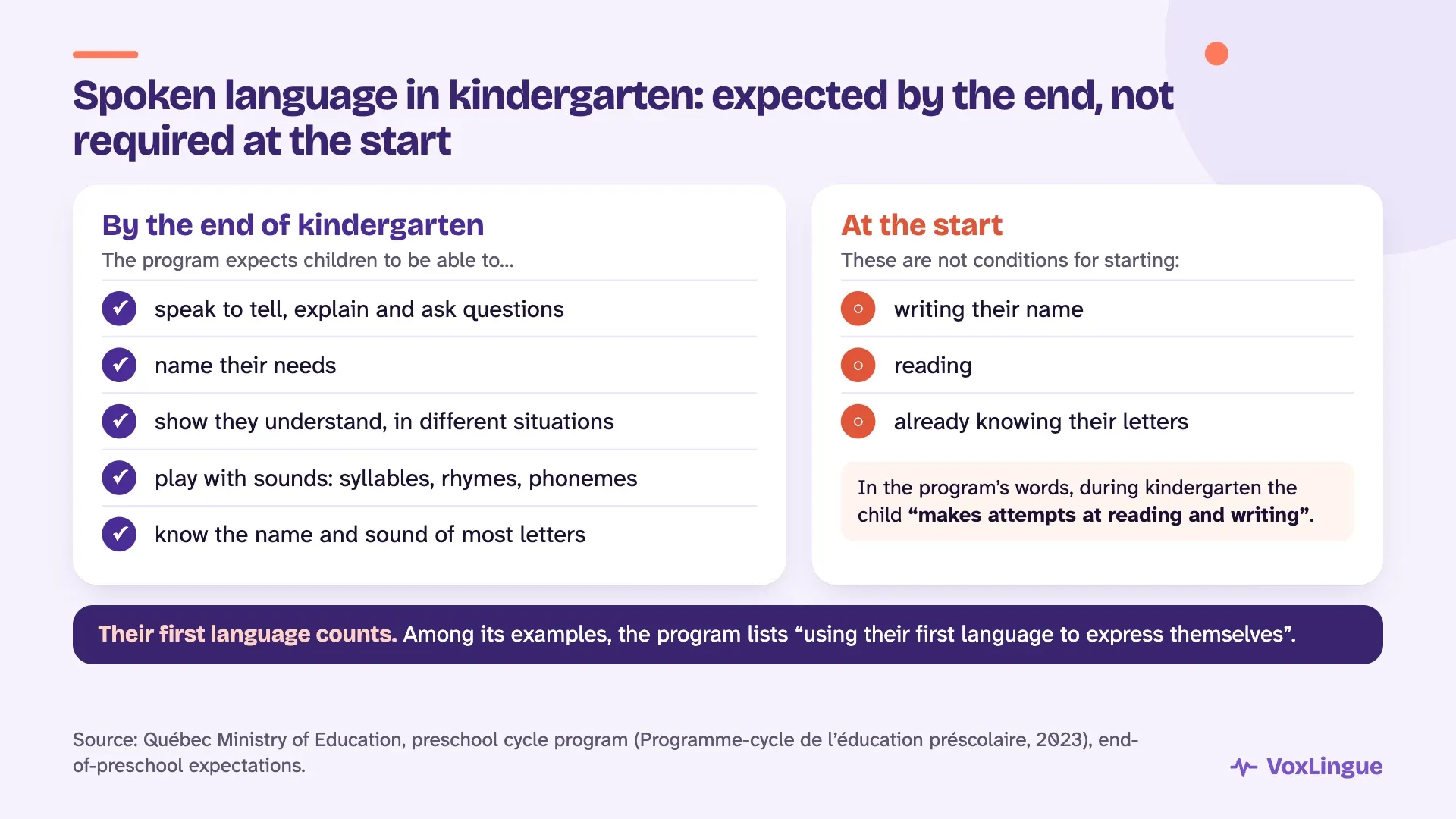
The Québec program sets its language goals for the end of kindergarten, not the first day. It describes a child who tells, explains, asks questions, names their needs, shows they understand, plays with sounds and knows most letters. Children learn these things at school. Nobody expects them on day one.
The reference document is the Programme-cycle de l’éducation préscolaire, the Québec preschool program (ministère de l’Éducation, 2nd edition, 2023). It treats K4 and K5 as one two-year cycle. Its expectations are written for the end of preschool education, which means the end of K5.
For language, the program expects a child who speaks “to tell, explain and ask, and to name their needs”. It also expects them to show they understand in different situations. These are action verbs, not lists of words to know. What counts is what a child does with language in everyday school life.
Two more skills prepare reading. The child develops phonological awareness: hearing syllables, rhymes and single sounds in words. They also learn the name and the sound of most letters of the alphabet. Again, this is where kindergarten ends, not where it starts.
Writing their name is not an entry requirement
Your child does not need to read or write their name to start kindergarten. The program describes a child who “makes attempts at reading and writing” during the cycle. It follows that writing is learned in class, not before. A parent Q&A from a Québec City school service centre, the CSS des Découvreurs, says the same (2026).
The program lists examples, “for guidance only”, of what children learn to do. They include rephrasing an instruction, showing they don’t understand, and retelling a story they heard in their own words. They also include “using their first language to express themselves”. For a child who speaks another language at home, that detail matters, and we come back to it below.
So a child who starts K4 has two years to reach these goals, and a child who starts K5 has one. In both cases, nobody expects them to have mastered these skills on the first morning.
Readiness also involves motor skills, independence and getting along in a group. This guide stays with language, which is our field.
Which language skills matter most in a kindergarten classroom at 4 and 5?
Five language skills carry a child through a kindergarten day. They are understanding and following instructions, telling and explaining, being understood, having words to learn with, and playing with sounds. Research links this broad oral language at 4 and 5 to later reading and to school success more generally.
The link between talking and learning is well documented. A large American study followed 1,137 children from age 3 to grade 3 (NICHD Early Child Care Research Network, 2005). Broad oral language, meaning grammar, vocabulary and meaning together, was a better foundation for early reading than vocabulary alone.
Other studies point the same way. In the United Kingdom, language skills at 3½ helped predict reading comprehension at 8½ (Hulme and colleagues, 2015). In England, narrative skills at 5 predicted reading comprehension at 10 and reading achievement at 14 (Babayiğit, Roulstone and Wren, 2021).
Québec research agrees. In a sample of French-speaking children, understanding spoken language in kindergarten was among the skills linked to grade 2 achievement, along with math and attention (Pagani and colleagues, 2010). Language is not an extra at school. It is how children learn everything else.
You will not find an age chart in this guide. Speech-Language & Audiology Canada notes that most published milestones come from monolingual English-speaking children (Speech-Language & Audiology Canada’s statement on milestones, 2024). Each child also develops at their own pace. For general descriptions, see ASHA’s 4 to 5 year communication milestones, keeping that caveat in mind.
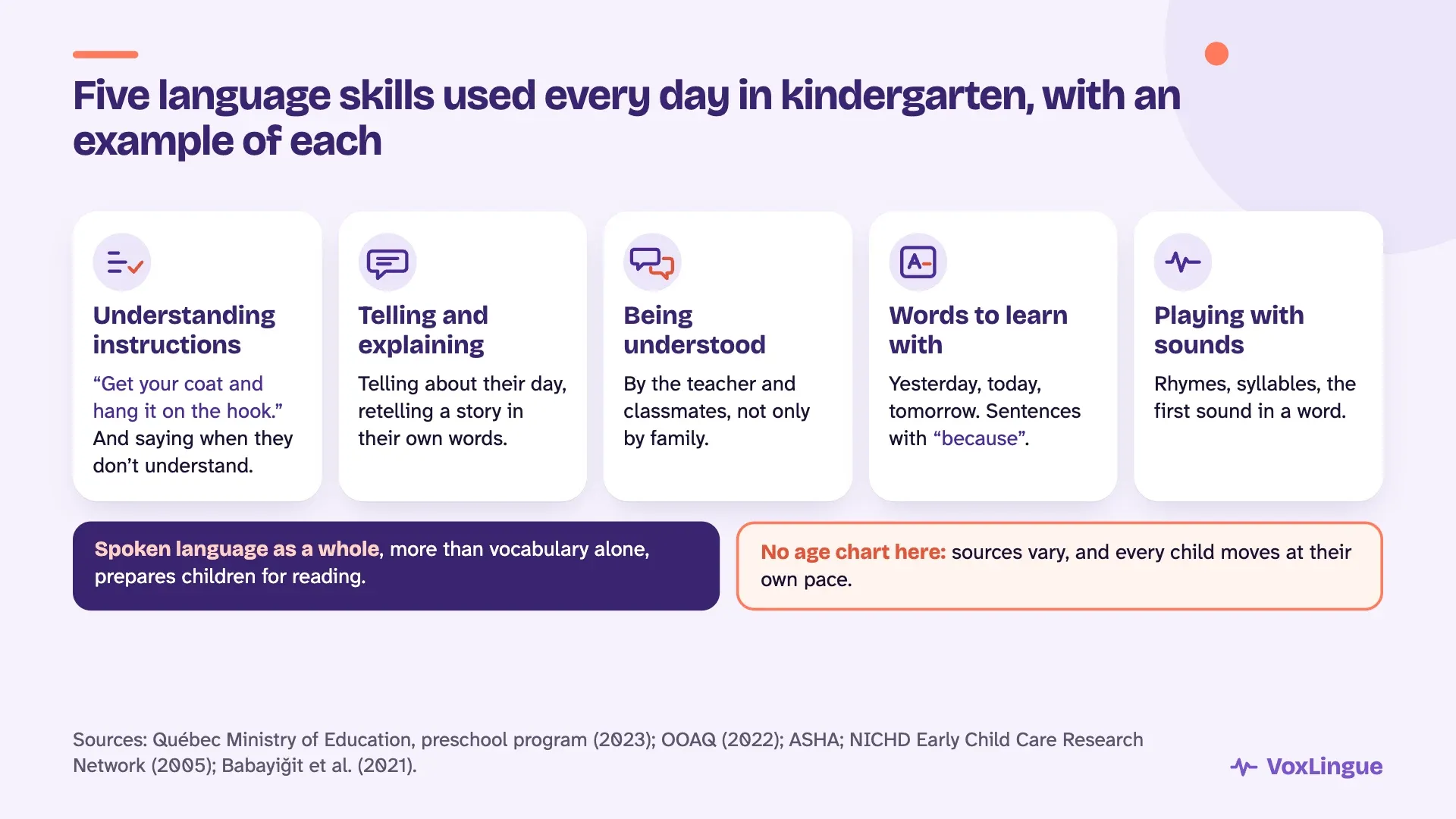
Understanding and following instructions
In a classroom, almost everything runs on instructions. “Get your coat and hang it on your hook” asks a child to understand two actions and do them in order. A routine instruction is easy to follow by watching the group. A new instruction shows more clearly what the child actually understands.
The American Speech-Language-Hearing Association (ASHA) and Québec’s order of speech-language pathologists (OOAQ, 2022) describe children of 4 to 5 who can follow an instruction about something out of sight. The Québec program also values saying when you don’t understand. A child who asks “What?” or “Can you say it again?” is using a skill school wants to grow.
Telling and explaining
Telling a story means putting events in order with words. Your child tells you what happened at the park, retells the bedtime story or explains why their friend was crying. The Québec program lists describing an event and retelling a story among its examples.
This skill carries a lot of weight later on. In the English study above, storytelling at 5 predicted reading comprehension years later (Babayiğit and colleagues, 2021). At this age, children also begin to invent their own stories (OOAQ, 2022). Our article on how storytelling skills develop explains the steps.
Being understood
At school, your child talks to adults and children who don’t know them yet. Parents often understand more than others, because they know the context. That is why school forms ask whether the child is understood by people who are not familiar with them.
Some sounds take longer. Naître et grandir, a Québec parenting resource, notes that certain sounds and consonant clusters can still be hard at 4 and 5 (2026). In English, clusters are the pairs of consonants in words like “spoon”, “train” or “flower”. To know what to watch for, read our article on when only you understand your child.
Words to learn with
School brings new words every day: seasons, shapes, the steps of a craft. Time words matter too. The OOAQ and ASHA describe children of 4 to 5 who understand “yesterday”, “today” and “tomorrow” and who use “because” to explain (2022).
Vocabulary on its own is not the whole picture. What prepares reading best is language as a whole: building sentences, linking ideas, following an explanation (NICHD, 2005). A child who knows dozens of dinosaur names but cannot tell you about their day still has language to grow.
Playing with sounds
Playing with sounds means hearing that “cat” and “hat” rhyme. It means clapping the syllables in their name, or finding a word that starts like “Mommy”. This is called phonological awareness. Along with letter knowledge, it is among the skills that predict later reading (National Early Literacy Panel, 2008).
These games are taught in kindergarten; they are not required at entry. Our guide to phonological awareness milestones describes them in detail. If reading is already on your mind, see also early signs of dyslexia in kindergarten.
K4 or K5 in Québec: what changes for language?
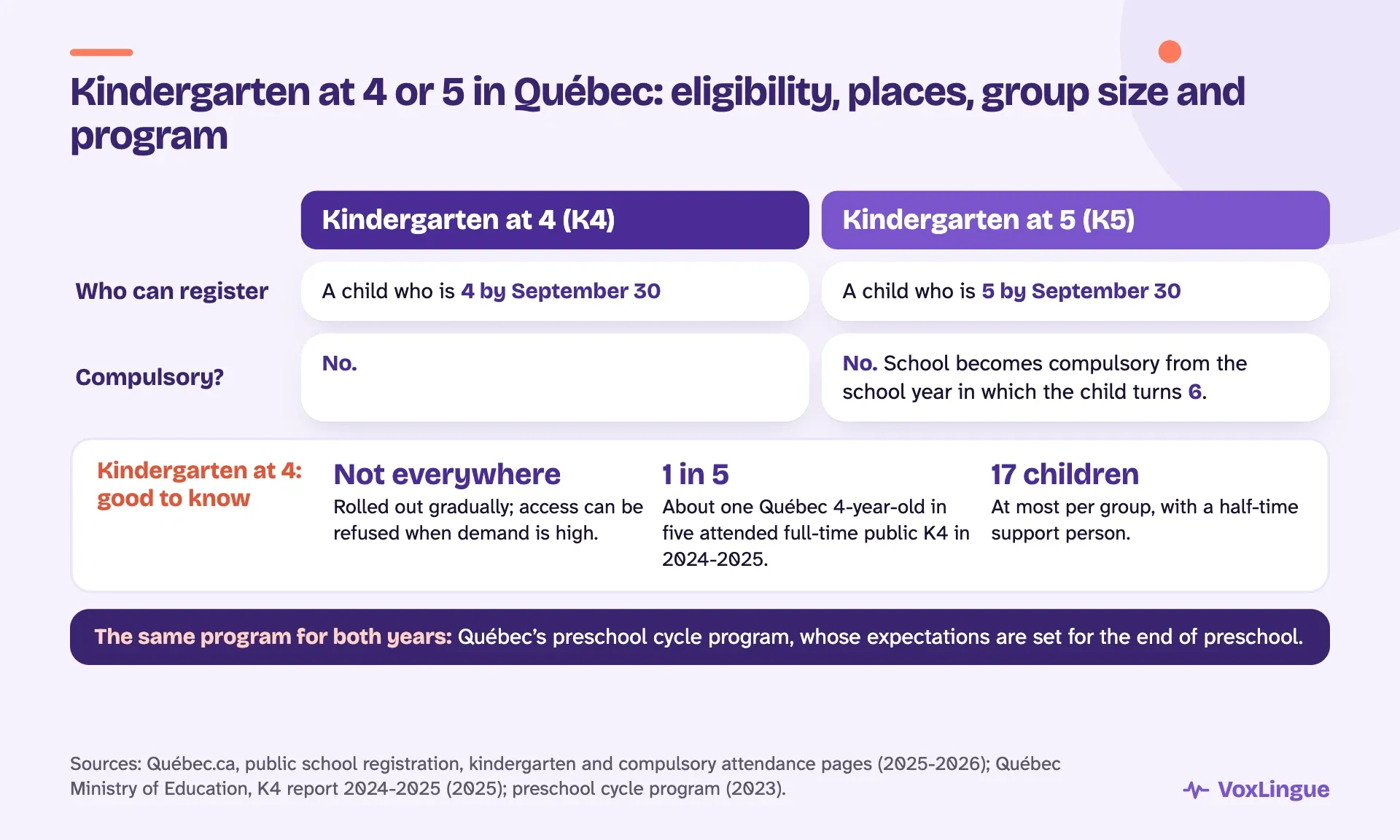
K4 is optional in Québec and is offered only in some schools. In 2024-2025, about one Québec 4-year-old in five attended full-time public K4 (ministère de l’Éducation, 2025). K5 follows the same program. For a child with language difficulties, the choice depends on the child, the family and the class on offer.
Eligibility depends on your child’s age on September 30. Your child can start K4 if they are 4 by that date, and K5 if they are 5 (Québec.ca, 2025). The date applies to the school year in question.
K4 is being rolled out gradually. It is not compulsory, and access can be refused when applications exceed the places available (Québec.ca, 2026). School service centres can also set extra admission criteria. In 2024-2025, the public network had 1,691 K4 classes, which reached 20.8% of Québec 4-year-olds (ministère de l’Éducation, 2025).
K4 groups have at most 17 children, with a half-time support person, according to Québec.ca’s kindergarten page (2026). The same two-year program covers both years.
School attendance becomes compulsory “from the beginning of the school year in which the child turns 6” (Québec.ca, 2026). K5 is therefore not part of that obligation, even though it is the usual way into school.
The English boards follow the same age rules. At the Lester B. Pearson School Board, K4 is taught mainly in English, and French immersion programs begin in K5. If you are weighing K4, ask your board or school service centre which schools offer it.
For a child with language difficulties, there is no single right answer. A few questions can help. Is K4 offered at your neighbourhood school? Is your child already followed at the CLSC (your local community health centre) or privately, and what does their therapist think? At registration, you can mention the difficulties and ask what support the school can offer.
When is kindergarten registration in Montréal, and what are the steps?
Most Montréal school boards and school service centres register in January or February for the following September. Québec.ca says registration generally runs from January to March. Check your board’s dates in early January. At registration, mention any concern about language and bring professional reports if you have them.
Registration dates for 2027-2028
For 2027-2028, only the LBPSB has published its dates: January 11 to 29, 2027.
The other Montréal boards and school service centres had not yet published theirs at the time of writing. Québec.ca’s general rule is that kindergarten registration generally takes place between January and March, and each school service centre sets its own dates (2025).
The table gives last year’s window as a guide. Check your school service centre’s or board’s site in early January. This article will be updated then.
| Board or school service centre | Registration for 2027-2028 | Guide: the 2026-2027 window |
|---|---|---|
| Centre de services scolaire de Montréal (CSSDM, French) | Not yet published: check the CSSDM site | January 7 to 27, 2026 (K4 and K5) |
| CSS Marguerite-Bourgeoys (CSSMB, French) | Not yet published: check the CSSMB site | K4 applications January 26 to February 27, 2026, on the Inscris-TOI platform |
| CSS de la Pointe-de-l’Île (CSSPI, French) | Not yet published: check the CSSPI site | “In January or February”, at the neighbourhood school (CSSPI leaflet, 2022) |
| English Montreal School Board (EMSB) | Not yet published: check the EMSB site | K4-K5 Registration Week, February 2 to 6, 2026; virtual queue opened January 26, 2026 |
| Lester B. Pearson School Board (LBPSB) | January 11 to 29, 2027 | Not needed: 2027 dates published |
From November to October, month by month
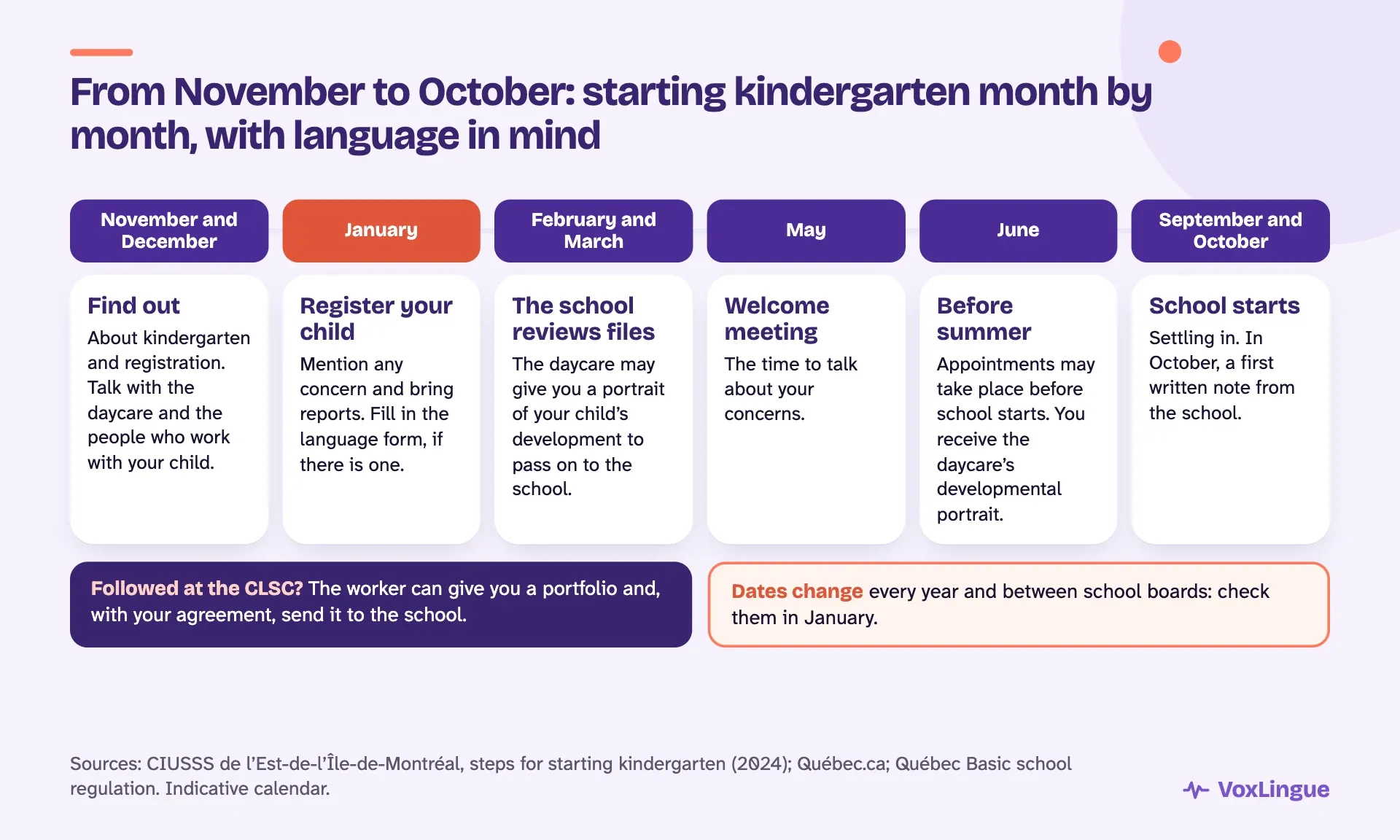
Starting kindergarten takes almost a year of small steps. The CIUSSS de l’Est-de-l’Île-de-Montréal, the regional health authority for the east of the island, offers parents a simple calendar (2024). It lists the CSSDM, the CSSPI and the EMSB, and it fits language concerns well.
In November and December, find out about kindergarten and talk with the daycare and anyone who works with your child. In January, you register. If your child is followed at the CLSC, their worker can give you a portfolio and, with your agreement, send it to the school.
In February and March, the school reviews student files. The daycare educator can give you a portrait of your child’s development to pass on to the school. According to a CSSPI document (2022), for a child with special needs, a review committee meets from March and a placement recommendation follows from April.
In May, according to this calendar, the school holds a welcome meeting, and the CIUSSS suggests you share your concerns there. In June, some appointments can happen before summer. In September and October, your child settles into class and the team gets to know them.
What to say and what to bring
Registration is your first chance to talk about language. The CSSDM reminds parents that at registration “it is important to mention the child’s particular needs”. The CSSPI asks for copies of any professional assessment reports (2022).
The documents usually requested are simple (Québec.ca, 2025; CSSDM; EMSB):
- your child’s birth certificate;
- proof of address;
- any speech-language assessment or progress reports, from the CLSC or a private clinic;
- for a public English school, a Certificate of Eligibility for instruction in English.
If your child does not speak French yet and you register at a French school, some school service centres assess their French to choose a class. We cover this in the section on children learning French.
The school’s language form: what is it for, and what does it ask?
Many schools give parents a short questionnaire about language at registration. It helps the school speech-language pathologist spot children who may need support early. It asks which languages your child speaks, whether they have had speech therapy, and what you notice. It is not a test and does not give a diagnosis.
There is no single Québec form. Each school service centre, and sometimes each school, has its own. We read four public documents in different formats, published between 2021 and 2026. Ask your school which version it uses, if any. English boards may use their own forms as well.
The most detailed one is the CSS des Découvreurs’ speech-language screening form for kindergarten registration, 2026-2027, from the Québec City area. Another, on screening for language difficulties, comes from the CSS des Patriotes on Montréal’s South Shore (2021-2022). Some Montréal schools hand out a general questionnaire instead, “Tell us about your child”, adapted by a speech-language pathologist and a preschool teacher.
Why the school asks these questions
The goal is to offer help earlier. The CSS des Patriotes form is meant to identify children “who may need speech-language services”. It says your participation could let your child receive services earlier in the school year (2021).
Parents often see what the school has not seen yet. An American study screened kindergarten children for language impairment. Only 29% of the parents of children with a language impairment had been told before that their child had a speech or language problem (Tomblin and colleagues, 1997). The form is a way to bring your observations into the school from the start.
What the form asks, section by section
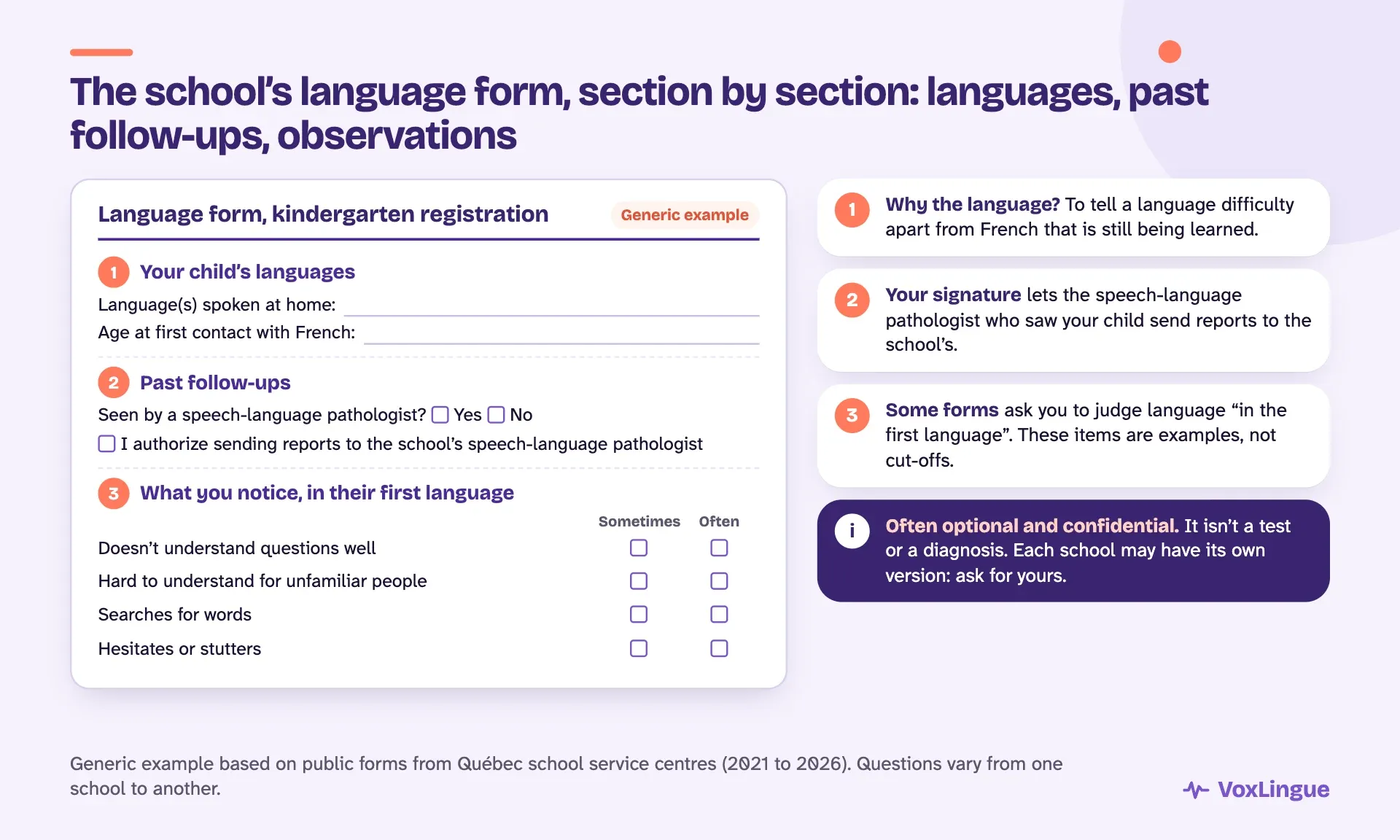
A typical form has three parts. The first is about languages. It asks for the child’s first language, the languages spoken at home, and how old the child was at their first contact with French (CSS des Découvreurs, 2026). These questions help the speech-language pathologist know whether your child is still learning French.
The second part covers past services. Has your child had a speech-language assessment or therapy? Do they still have language difficulties? By signing the consent section, you allow the speech-language pathologist who saw your child to send their reports to the school’s speech-language pathologist.
The school speech-language pathologist may then file a copy in the student’s confidential support file. That file is reserved for the staff who work with the child (CSS des Découvreurs, 2026).
The third part gathers your observations. Each line is ticked “sometimes” or “often”. The form asks you to judge your child’s language “in their first language”. Here are examples of what schools ask, drawn from the CSS des Découvreurs form. They are not thresholds. Your child:
- does not understand questions well;
- cannot follow a simple instruction outside the routine, such as fetching a fork;
- is hard to understand for people who don’t know them;
- searches for words, or has trouble learning new words;
- hesitates or stutters when speaking.
Other forms use yes-or-no questions. The CSS des Patriotes form asks whether the child talks enough for their age, meaning whether they converse, tell, explain and ask questions. It asks whether you and other adults understand them, and whether they use complete sentences. It ends with a direct question: do you think your child has a language problem?
“Sometimes” or “often”: how to answer
There is no right answer to aim for. The form describes your child as they are in an ordinary week, not on their best or worst day. If you are unsure about a line, watch for a few days before filling in the page.
When there is room, a concrete example can help the speech-language pathologist. “He says ‘tat’ for ‘cat’” tells them more than a ticked box alone. If your child speaks another language, think of the language they know best. If a question is unclear, you can note it in the margin or ask the school.
Should you fill it in if you’re not sure?
The decision is yours. The CSS des Patriotes states plainly that the process is “not mandatory” (2021). In that example, the answers stay confidential within the speech-language service. The CSS des Découvreurs form is for parents whose child has already had services, or who have questions about their child’s language (2026).
Sharing information can help the school plan. The speech-language pathologist knows earlier which children to watch, and your child may receive services from the start of the year. Not filling it in does not stop the school from talking with you later, in class or at the first report card.
The form does not, on its own, place a child in a special class. According to a CSSPI document (2022), placement for a child with special needs follows a review of the file by a committee.
Who reads the form, and what happens next?
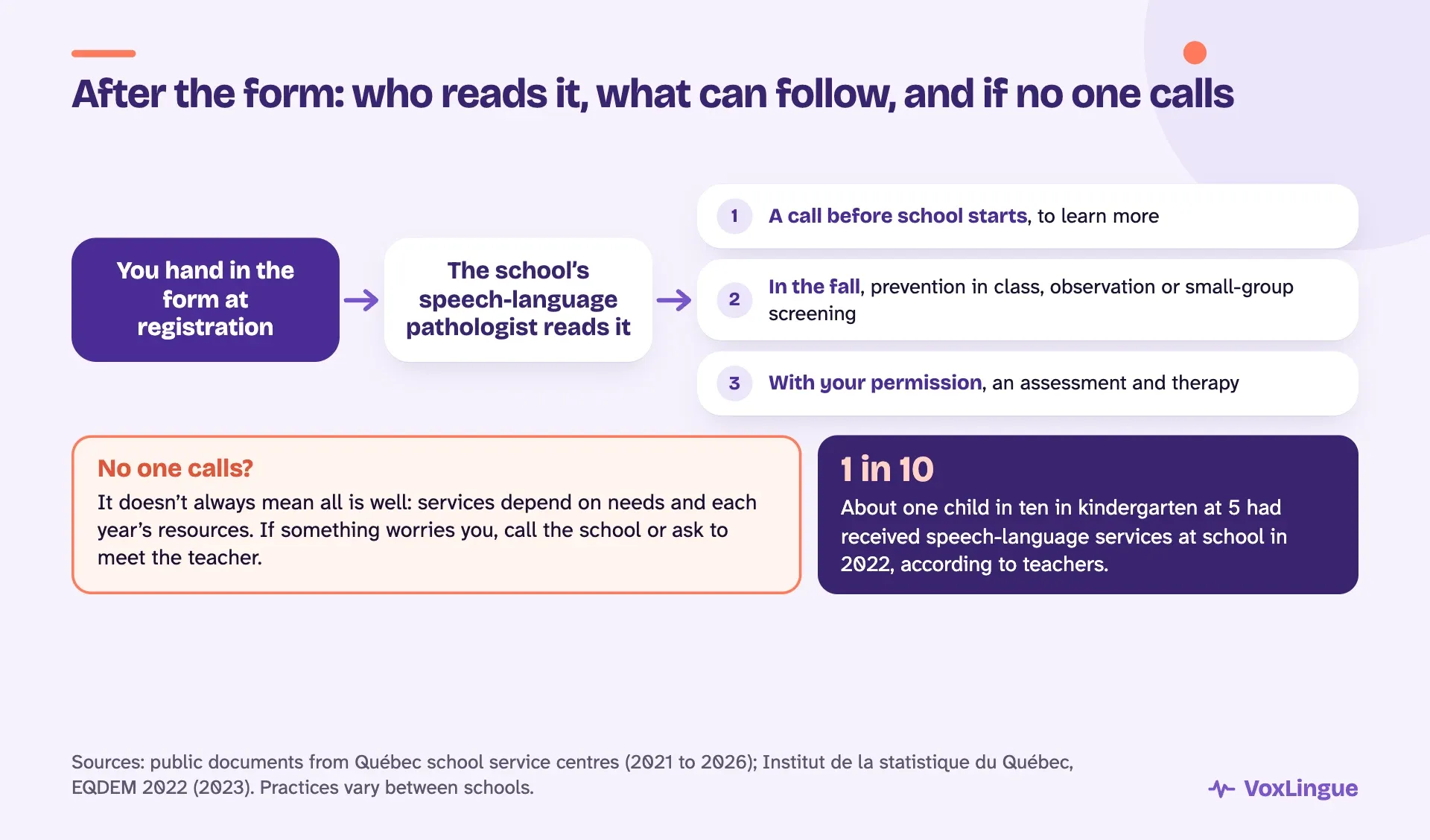
The form usually goes to the school’s speech-language pathologist. They may call you before September, observe your child in class in the fall, or suggest an assessment with your permission. Services depend on needs and on each year’s resources. So no call does not always mean everything is fine.
At the CSS des Découvreurs, the office passes the original form to the school speech-language pathologist. The form warns that the speech-language service may contact you before the next school year begins (2026). At the CSS des Patriotes, a professional may call you and, if needed, suggest further screening (2021).
At school, the speech-language pathologist wears several hats. A 2026-2027 information sheet from École de l’Harmonie, in the CSS des Premières-Seigneuries near Québec City, describes them. They run language workshops in class, especially in preschool and grade 1. They observe children and screen small groups when the team asks.
With parents’ permission, they assess, provide therapy and take part in the intervention plan. At that school, therapy is offered first to preschool and grade 1 students. Arrangements are set each year according to available resources and priorities. These are examples; each board organizes services its own way.
For a sense of scale: in 2022, about one K5 child in ten (11.1%) had received speech-language services at school. This figure comes from Québec’s kindergarten development survey (Institut de la statistique du Québec, 2023). Teachers reported it, regardless of how often the services took place.
If you hear nothing and still have questions, call the school in the spring or in September and ask to speak with the speech-language pathologist. In Québec schools, you may also hear about the orthopédagogue, a specialist in learning difficulties. Our article on the school speech-language pathologist and the orthopédagogue explains who does what.
Which documents can follow your child to school, and with whose consent?
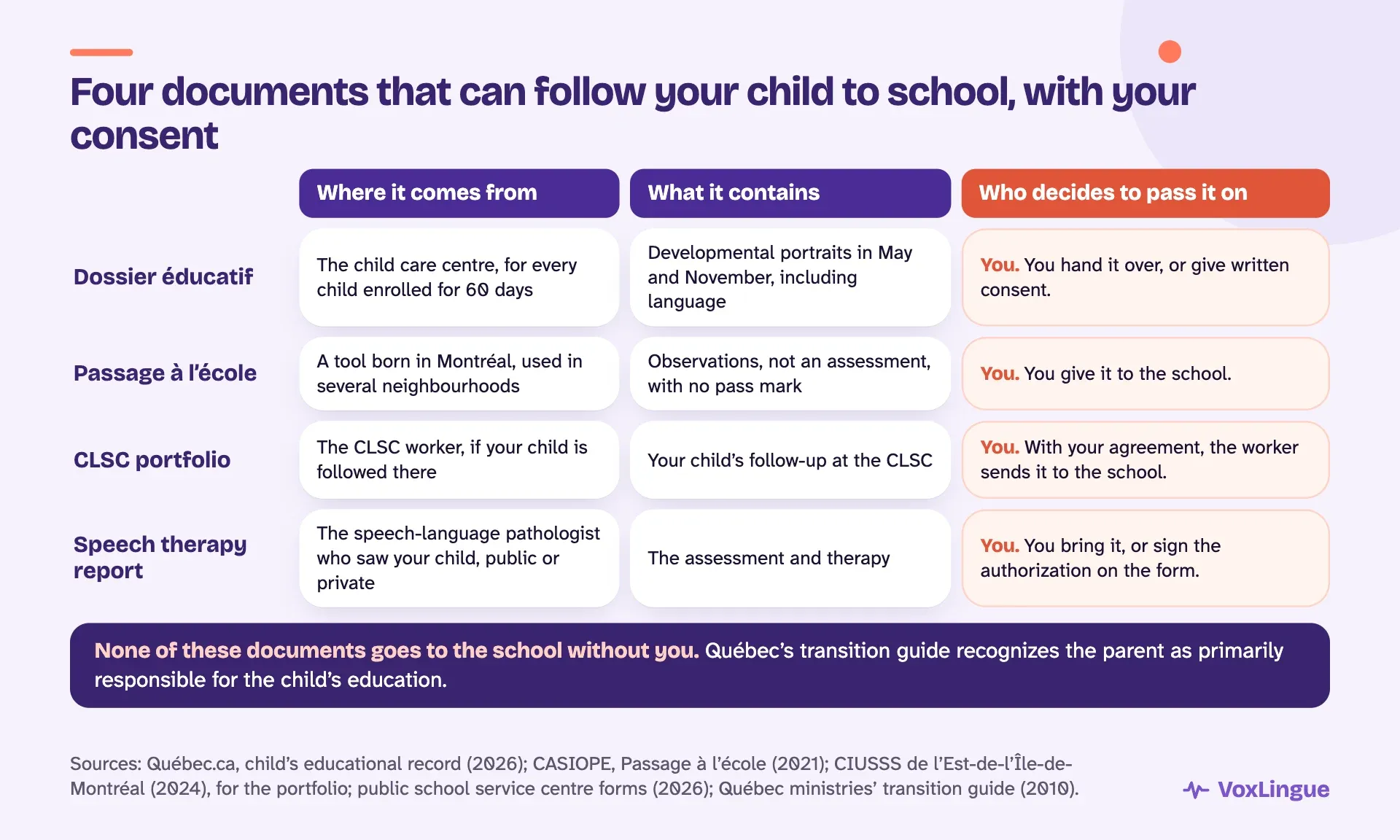
Several documents can help the teacher get to know your child. They include the daycare’s developmental portrait, the Passage à l’école tool used in several Montréal neighbourhoods, a CLSC portfolio and any speech-language report. None goes to the school without you: you hand it over yourself, or you give your consent.
The first is the dossier éducatif, the daycare’s educational file. It is mandatory for every child in a licensed educational childcare service after 60 days. The educator writes a developmental portrait in May and November. Parents receive it by June 15 and December 15. The portrait covers four areas, including language.
The rule for sharing it is clear. According to Québec.ca, transfer to the school is done “by the parent or with the parent’s written consent” (2026). If the educator has already raised a concern, read our article on when daycare raises a concern about language.
The second is Passage à l’école, a transition tool. It was born in Montréal, in Ville-Émard and Côte-Saint-Paul, and has been used in several neighbourhoods since 2008 (CASIOPE, 2021 version). It is meant as a way to share observations, “not an assessment tool”. Its items have no pass mark. The parent carries it to the school.
The third is the CLSC portfolio. In the east of Montréal, if your child is followed at the CLSC, their worker can give you a portfolio. With your agreement, they can also send it to the school (CIUSSS de l’Est-de-l’Île-de-Montréal, 2024). Ask your CLSC whether it does the same in your area.
The last is a report from a speech-language pathologist, public or private. You can hand it in at registration, or sign the form’s consent section so the speech-language pathologist sends it. Either way, it is your choice.
The Québec government’s guide to a first school transition recognizes the parent as primarily responsible for the child’s education (2010). It also asks schools to involve everyone who knows the child. You are at the centre of the move to school, not on the sidelines.
Your child is learning French: how should you fill in the form, and what should you tell the school?
If your child speaks another language at home, describe how they talk in that language. That is what tells the school whether there is a language difficulty or simply French still being learned. Learning French takes time. A language difficulty, by contrast, shows up in every language a child speaks.
“Being multilingual is not a communication disorder,” as ASHA on multilingual children puts it. The signs of a disorder show up across all of a child’s languages. That is why some forms ask you to judge language “in the first language”. A child who tells stories well in Arabic or Spanish, but not yet in French, is learning a language.
The Québec program agrees. Among its examples, it lists using the first language to express oneself (2023). It also asks the school team to pay attention to the child’s mother tongue and to link it with the language of instruction.
Montréal research points the same way. In 5-year-olds learning French and English, vocabulary in each language tracked how much time the child spent in that language (Thordardottir, 2011). Learning the school language takes several years, and the pace varies from child to child (Paradis and Jia, 2017).
On the form, answer for the language your child knows best. Give the age of their first contact with French, even roughly. Tell the teacher which languages your child hears, with whom, and what is usual for them at home. For background, see our guide to bilingual language milestones.
What Québec data show, and their limits
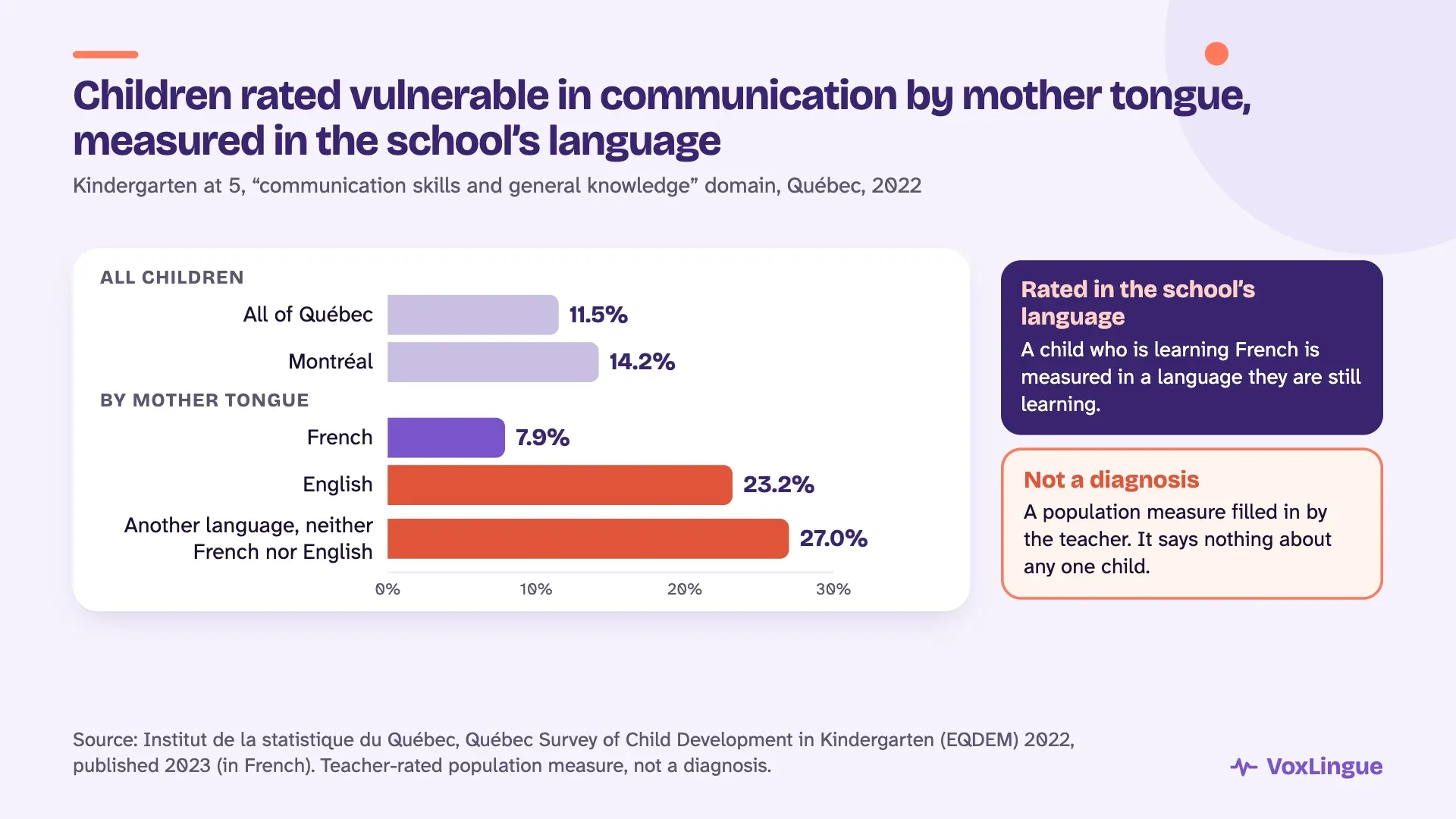
Québec’s kindergarten development survey gives a population picture. In 2022, 11.5% of K5 children were “vulnerable” in communication skills and general knowledge. The figure reached 14.2% in Montréal (Institut de la statistique du Québec, 2023).
The gaps by mother tongue are large. The figure was 7.9% for children whose mother tongue is French. It was 23.2% for children whose mother tongue is English, and 27.0% for children whose only mother tongue is neither French nor English.
These numbers need care. Teachers complete the survey in the language of the school. A child learning French is therefore measured in a language they are still learning. The survey states that it provides no individual measure. “Vulnerable” is not a diagnosis; it is a population-level measure.
According to the same survey, 95.4% of children whose only mother tongue is neither French nor English attend French-language schools. You can read Québec’s 2022 kindergarten development survey (in French) in full.
Welcome classes and French-language support
Some school service centres assess the French of new students. At the CSSDM, a service assesses the child’s French to place them in a regular class or a French-language support class. Parents book an appointment with the welcome service.
Québec’s 2026-2027 budget rules for school service centres provide for K5 in regular, welcome and French-support classes. Arrangements vary by school service centre and context (Québec.ca, 2024). Ask your school how it welcomes children who are learning French.
English-speaking families: French school or English school
The same rule applies when English is the home language. If your child goes to a French school, describe their language in English on the form. Tell the teacher what is usual for your child at home, and how much French they have heard so far.
If you are considering an English public school, one rule applies: you need a Certificate of Eligibility (EMSB; LBPSB, 2026). As noted above, LBPSB immersion programs begin in K5. The choice of school network is yours. If you are worried about a child who speaks two languages, read how speech-language pathologists go about identifying language disorders in bilingual children.
When should you see a speech-language pathologist before September instead of waiting for school?
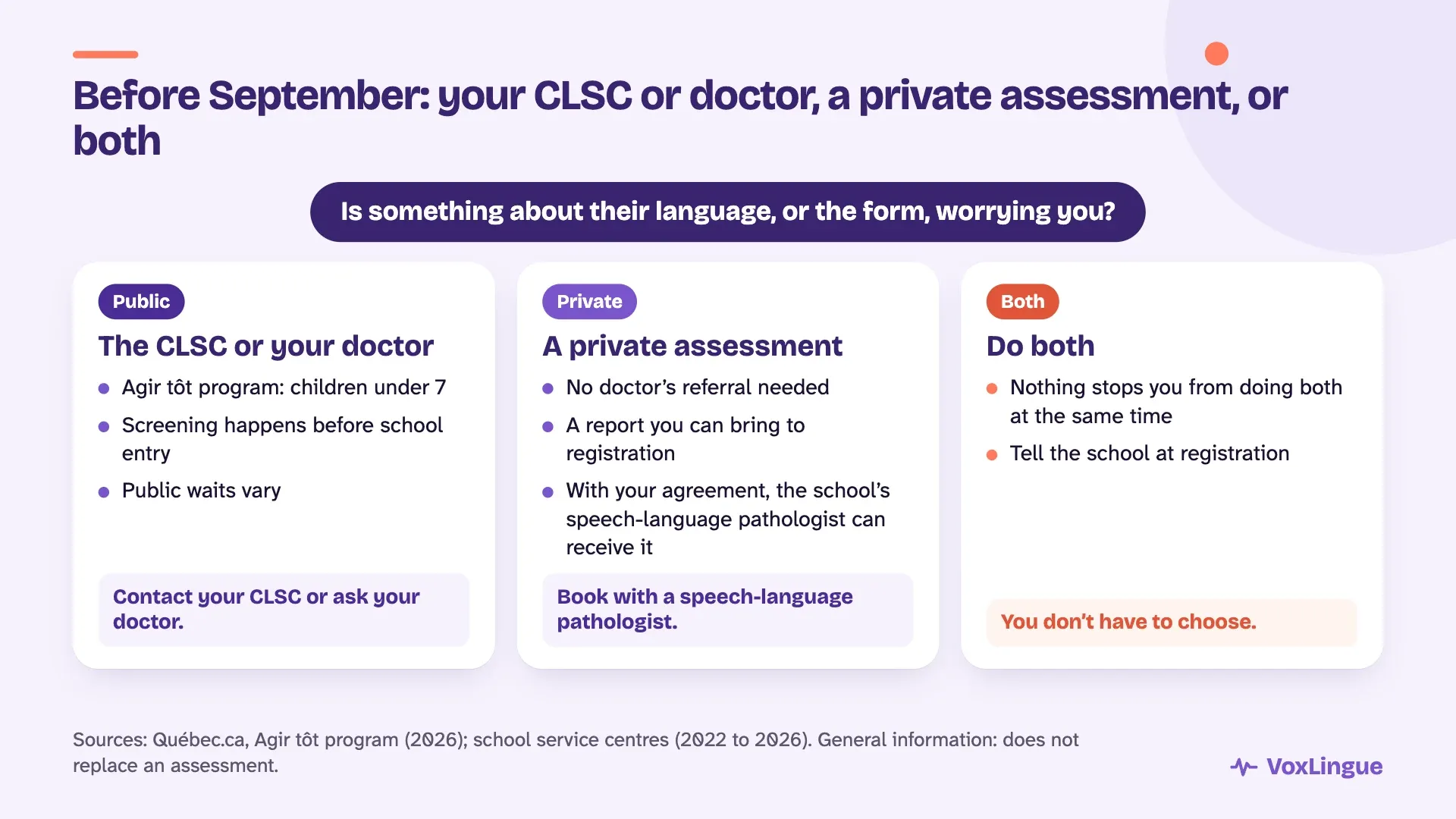
See someone before September if your child’s language already worries you. The signs to watch are the ones school forms ask about: your child is hard to understand outside the family, misunderstands questions or instructions, or rarely uses complete sentences. Contact your CLSC or ask your doctor, or book a private assessment.
School forms are a good starting point, because they come from school speech-language services. Based on the CSS des Découvreurs form (2026) and the CSS des Patriotes form (2021), these signs are worth raising without waiting, if they come up often:
- people who don’t know your child well have trouble understanding them;
- they misunderstand questions, or cannot follow a simple instruction outside the routine;
- they use few complete sentences, or their sentences are often jumbled;
- they often search for words, or have trouble remembering new ones;
- they often hesitate or stutter when speaking;
- in a bilingual child, the same difficulties also show up in the first language.
Your own concern counts too. The CSS des Découvreurs form is meant precisely for parents who have questions about their child’s language. One sign on one day does not mean much. A pattern that lasts is worth talking about. To tell the difference between a slow start and something more lasting, read late talker or DLD.
These difficulties are not rare. At school entry, about one child in ten has a language disorder, according to Speech-Language & Audiology Canada (2024), citing an English study (Norbury and colleagues, 2016).
Three routes, which you can combine
The first route is public. The Agir tôt program, Québec’s early screening program, serves children under 7. Its screening takes place between birth and school entry (Québec.ca, 2026). To access it, contact your CLSC or ask your doctor. Because it covers the years before school, it makes sense to ask now.
The second route is private. A private speech-language assessment is possible without a referral. The third route is both: you keep your place on the public list while you consult privately. Waits vary by region; our article on speech therapy waiting lists in Québec explains how to find your way.
An assessment gives you a picture of your child’s language. If you choose, its report can then follow your child to school, with your consent.
What can you do at home before school starts?
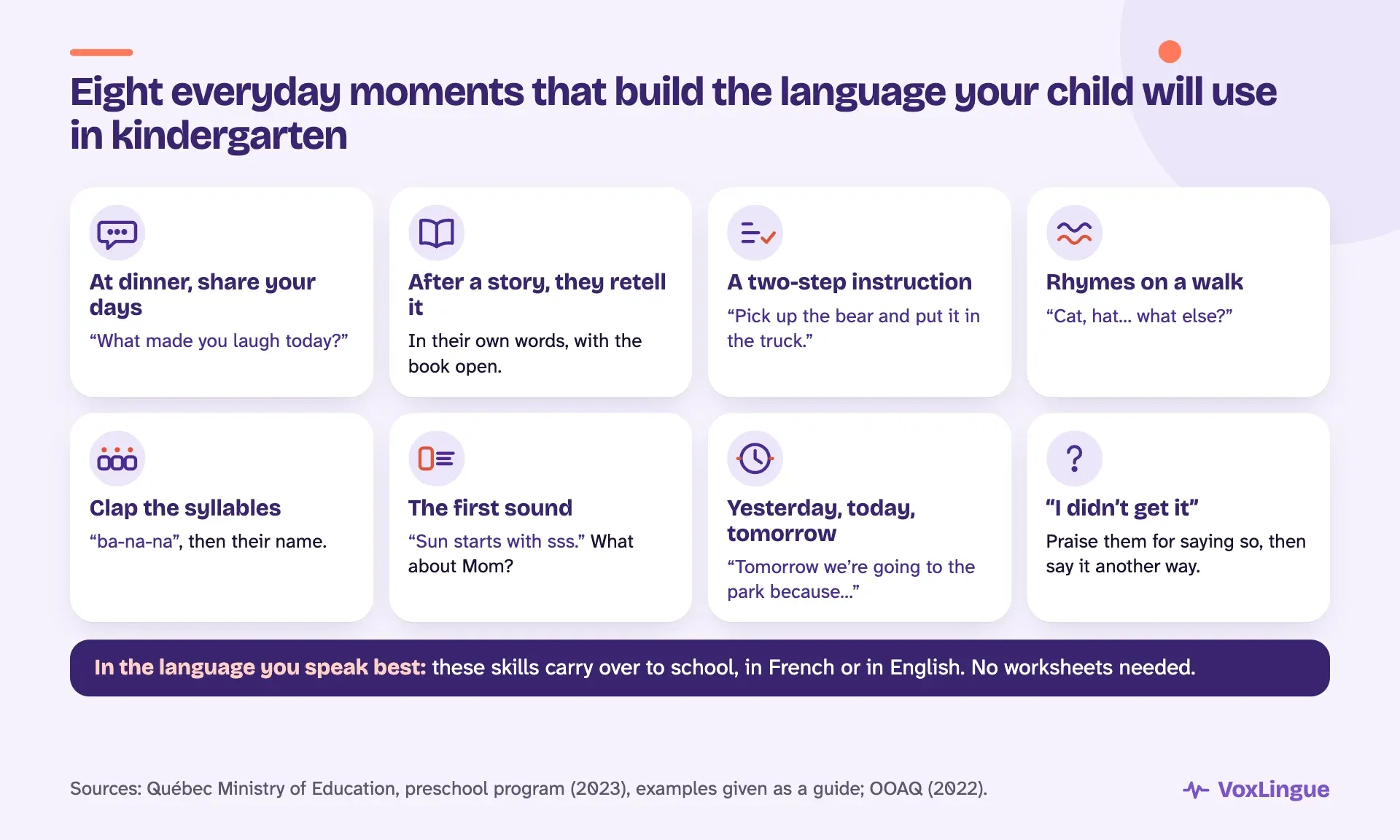
You don’t need workbooks. Talk about the day, read stories and let your child retell them, give two-step instructions during play, and play with rhymes and first sounds. Keep speaking the language you speak best at home. It feeds the same storytelling and understanding skills your child will use in French or English at school.
These ideas come from the Québec program’s examples and from the OOAQ’s descriptions. They fit into moments you already share:
- at supper, ask what happened at daycare, then “And then what?”;
- after a story, let your child tell it back in their own words as you turn the pages;
- during play, give two-step instructions: “Take the red truck and put it in the garage”;
- in the car, play rhyming games: “hat, cat, bat… what else?”;
- at the grocery store, look for something that starts with the same sound as their name;
- at bedtime, talk about yesterday and tomorrow: “Tomorrow we’re going to Grandma’s.”
Let your child tell you when they don’t understand. If you answer “What?” or “I don’t get it” calmly, you strengthen a skill the program wants to build.
For the home language, remember that the program lists using the first language as an example of learning. A story told in Spanish, Arabic or Tagalog also builds storytelling and vocabulary.
What happens after school starts in September?
After September, the school becomes your first point of contact. You receive a first written communication by October 15 and a first report card by November 20. If something worries you, ask to meet the teacher. In Québec, an intervention plan does not require a diagnosis.
These dates come from Québec’s Basic school regulation (Régime pédagogique). It also requires at least a monthly communication with parents when the school is concerned about a child’s development or learning. Agir tôt, for its part, covers the years before school entry.
If your child needs help, the school can open an intervention plan (plan d’intervention), regardless of diagnosis (Québec.ca, 2026). You can ask for a meeting at any time of year.
Do you live in Ontario?
In Ontario, Kindergarten is a free two-year program for 4- and 5-year-olds. Before school, the Preschool Speech and Language Program serves children from birth, without a doctor’s referral. Once school starts, Ontario schools screen early reading from Year 2 of Kindergarten, under Policy/Program Memorandum 168.
School is compulsory from September of the year a child turns 6, and Ontario’s Preschool Speech and Language Program serves children until they start school (ontario.ca, 2026). Check your school board’s registration dates.
Ready for kindergarten: key takeaways
Being ready for kindergarten, on the language side, does not mean reading or writing their name. The Québec program sets its goals for the end of kindergarten. What matters at the start is a child who understands, tells, makes themselves understood and enjoys playing with words.
The school’s language form is not a test. It is there to help earlier, and filling it in is your choice. Documents from the daycare, the CLSC or a speech-language pathologist follow your child only with your consent. And if something worries you, you don’t have to wait until September.
Next step
If a line on the form gives you pause, an assessment before September can help you see more clearly. It can also give the school useful information from the first day. To learn how it works, read our page on a speech and language assessment. Our speech-language pathologists see families at our clinic in Marché Central, Montréal, and by telepractice across Québec and Ontario.
Before you fill in the form, print our handout. It helps you watch your child for two weeks, note examples and prepare your questions for the school.
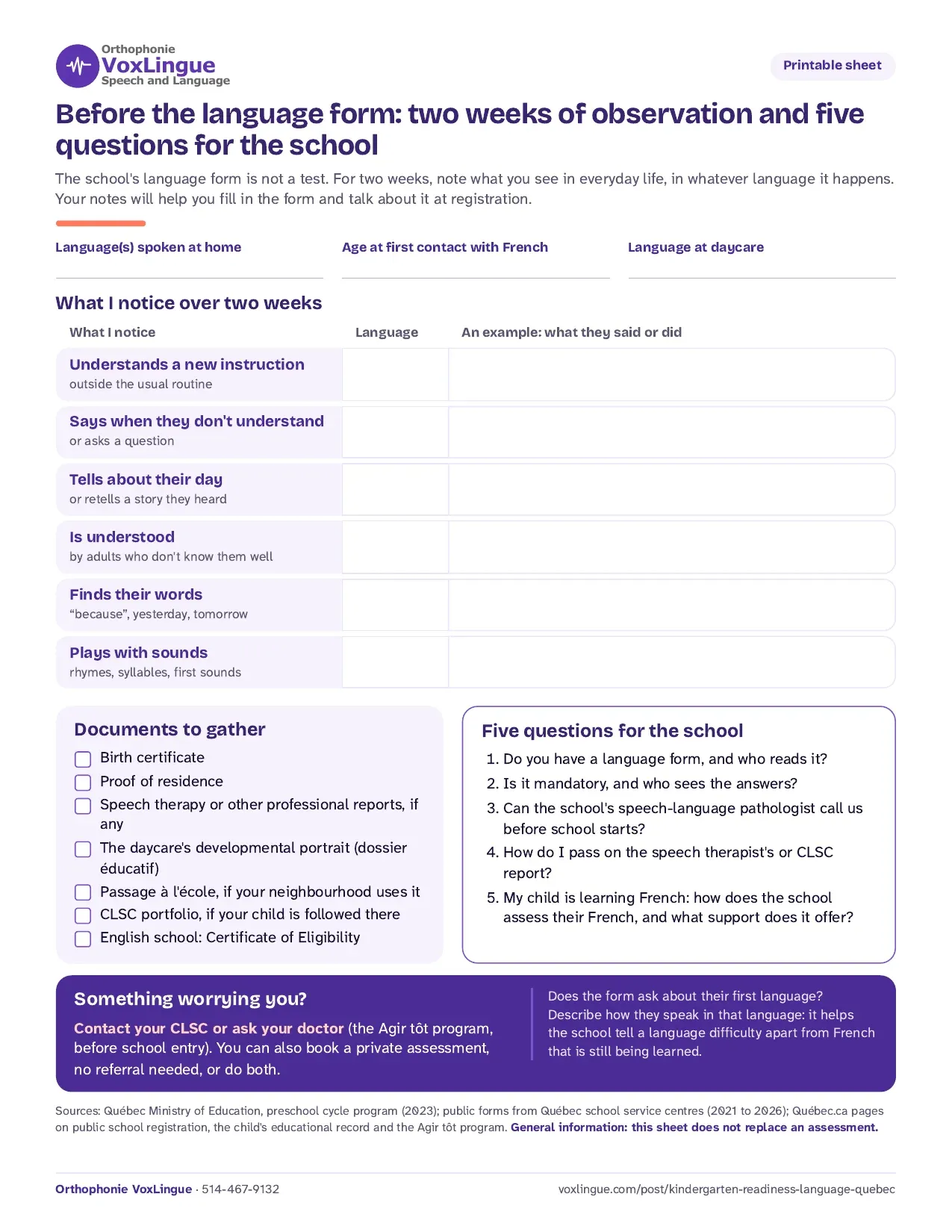
Printable handout: Before the language form: two weeks of observation and five questions for the school (PDF, 1 page).
Frequently asked questions
Does my child need to write their name before kindergarten?
No. The Québec program sets its goals for the end of kindergarten, and writing is learned during the cycle, where the child “makes attempts at reading and writing”. If your child already enjoys letters, that is fine. If not, the class will get there.
Is the school’s language form mandatory?
In the public examples we read, no. The CSS des Patriotes states the process is “not mandatory”, but that it can lead to services earlier. Practices vary between boards and school service centres. Ask your school how it uses its form.
If I tick “often”, will my child be labelled or put in a special class?
The form is there to find children who may need services, not to sort them. In one public example, answers stay confidential within the speech-language service. A special placement is decided after a committee reviews the file, according to a CSSPI document (2022).
Should I give my child’s private speech therapy report to the school?
It is your choice. You can hand it in at registration, or sign the form’s consent section so the speech-language pathologist sends it. A report helps the school speech-language pathologist get to know your child. It goes into a confidential file for the staff who work with them.
Is it normal for a 5-year-old to still mispronounce some sounds?
It can be. Naître et grandir notes that some sounds and consonant clusters can still be hard at 4 and 5 (2026). What matters most is whether people outside the family understand your child. Most published sound norms come from English-speaking children, so a speech-language pathologist can tell you whether your child’s errors are expected.
My child speaks another language at home. Should I say their French is weak?
Simply describe where they are. Give their first language, the languages spoken at home and the age of their first contact with French. For the observations, describe their language in the language they know best. Beginning French is not a language difficulty.
Is K5 compulsory in Québec?
No. According to Québec.ca (2026), school attendance is compulsory from the beginning of the school year in which the child turns 6. K5 is therefore not part of that obligation, even though it is the usual way into school.
Can we still use Agir tôt if our child starts kindergarten in September?
Yes, as long as your child has not started school. Agir tôt screening takes place between birth and school entry, for children under 7 (Québec.ca, 2026). Contact your CLSC or ask your doctor now. After school starts, the school becomes the door.
Can the school speech-language pathologist assess my child without my consent?
No. In the school documents we read, individual assessment and therapy happen with the parents’ permission. The speech-language pathologist may still observe the class or run prevention workshops for all children.