Aphasia after a stroke: how to talk with your relative and what comes next
Updated November 4, 2026. General information: only an assessment can pin down your relative’s needs.
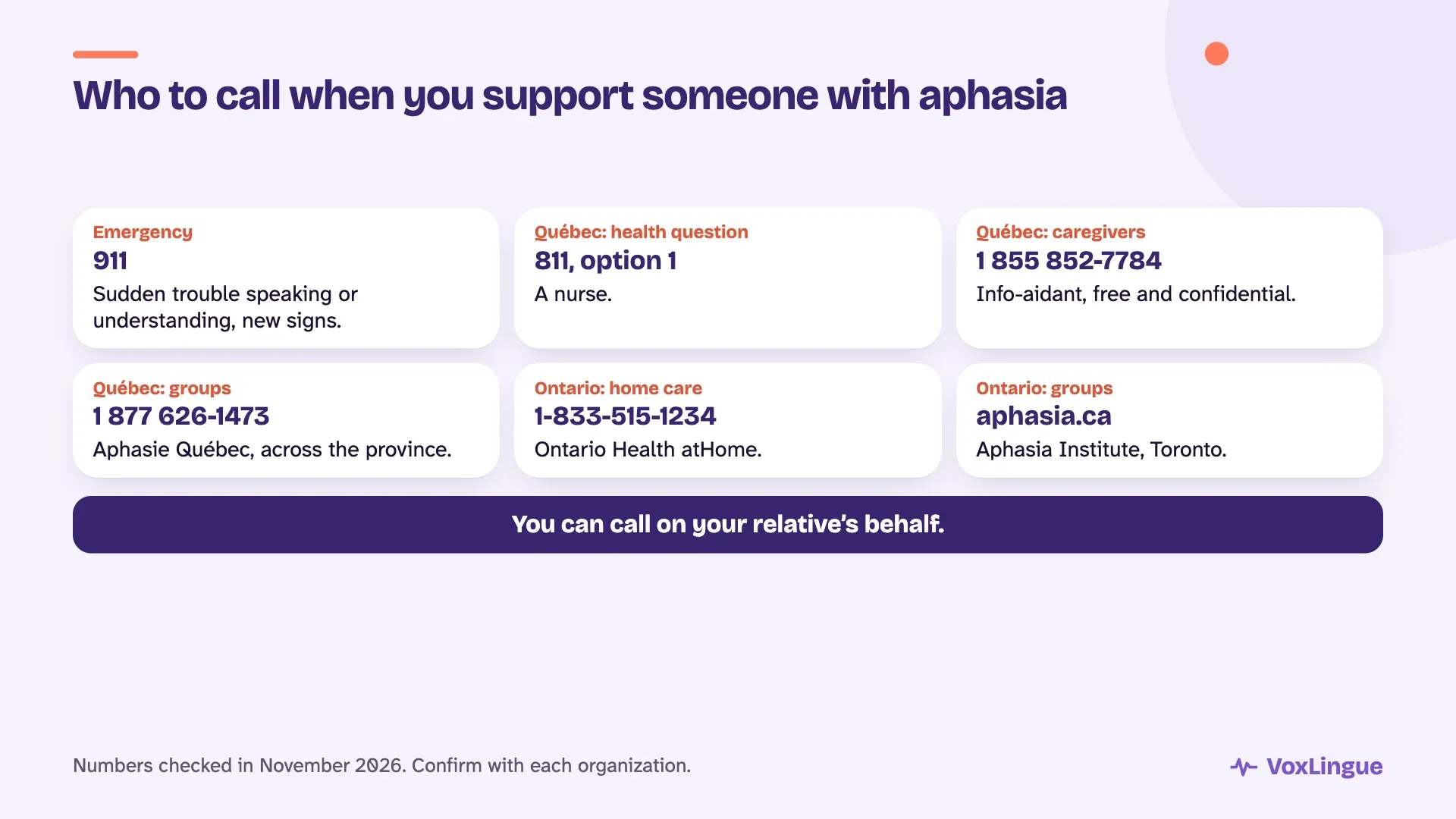
Sudden trouble speaking or understanding is an emergency: call 911. Heart & Stroke’s FAST signs include a drooping face, trouble raising both arms, and speech problems. Don’t drive to the hospital. Do the same if new signs appear in someone who already has aphasia.
Aphasia after a stroke can change a conversation overnight. Your spouse searches for words. Your mother says “yes” when that isn’t what she means. You no longer know what she understands, or how to talk to her without treating her like a child.
This guide is written for you, the spouse, son or daughter. It explains what changes, how to talk together, what can improve, and where to turn in Québec and Ontario after the hospital.
It rests on a simple idea: the way you talk is part of the help, and it can be learned.
In the first months, families often ask Kimberly Martins, speech therapist and founder of VoxLingue, whether the person will be back to how they were and how long it will take. They ask whether the person will stay this way forever, what could happen with another stroke, and how to help and talk so the person understands.
What is aphasia, and what isn’t it?
Aphasia is a language disorder. Damage to the brain, most often from a stroke, changes how a person speaks, understands, reads or writes. Often the person knows what they want to say, but the words don’t follow.
About one in three people have aphasia after a stroke (Brady et al., Cochrane, 2016). Québec’s aphasia association, the AQPA (in French), puts it simply: a person with aphasia is intelligent and knows what they want to say. Yet people with aphasia are often wrongly treated as less competent (StrokEngine, 2018).
You can’t see this disorder, as L’Appui (in French) points out: it shows when the person speaks or writes.
The CHUM’s patient sheet (2019, in French) describes two families. In non-fluent aphasia, speech is mainly affected. The person says few words, or only “yes” and “no” at first, and may say a word slightly wrong. In fluent aphasia, understanding is mainly affected. Sentences are complete, but don’t always make sense or connect with the conversation.
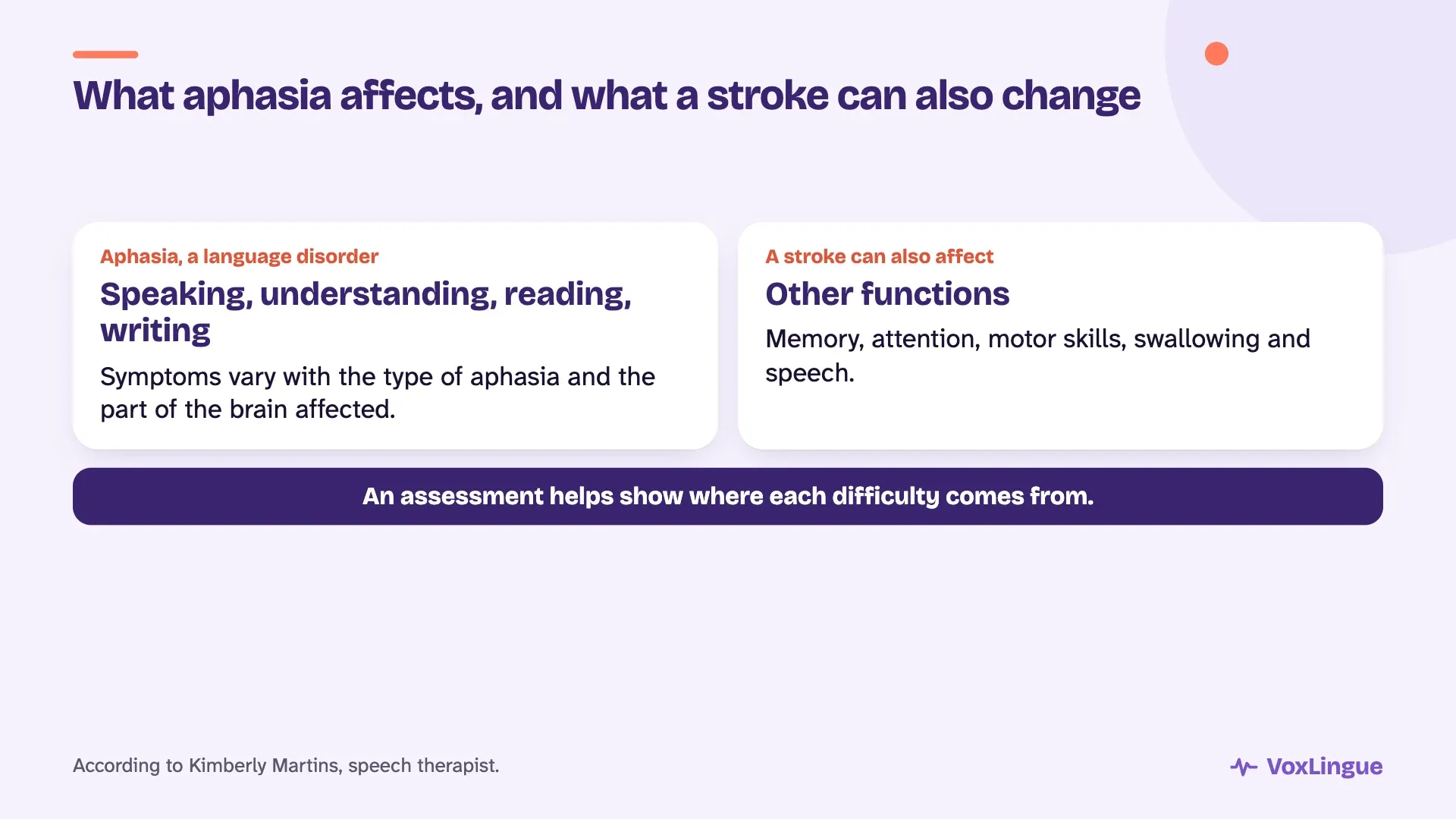
There are different types of aphasia depending on the part of the brain affected, Kimberly Martins explains, and each has different symptoms in understanding, expression, reading and writing. A stroke can also affect other functions: memory, attention, motor skills, swallowing and speech.
Why does my relative seem confused, or say one word for another?
Searching for words or saying one word for another is part of aphasia. It can look like confusion without being confusion. A stroke can also change attention, memory or energy, though. An assessment helps show where each difficulty comes from.
Trouble speaking or understanding is among the signs of a stroke, and it can look like sudden confusion. So when your relative answers off topic, you may think they’re confused, when sometimes the right word just doesn’t come.
This still needs nuance. In a Dutch study, difficulties with abilities other than language, such as visual memory, were common in people with aphasia, at three months and at one year (El Hachioui et al., 2014). Saying that “everything else is intact” would be too simple.
Dysarthria, for its part, affects the muscles of speech and isn’t aphasia. You don’t have to sort this out yourself: note what you observe.
Aphasia sometimes comes with trouble swallowing (L’Appui). If you notice it, tell the doctor, and see our page on dysphagia. If someone is choking and can’t breathe, cough or speak, call 911.
How do you talk with someone who has aphasia?
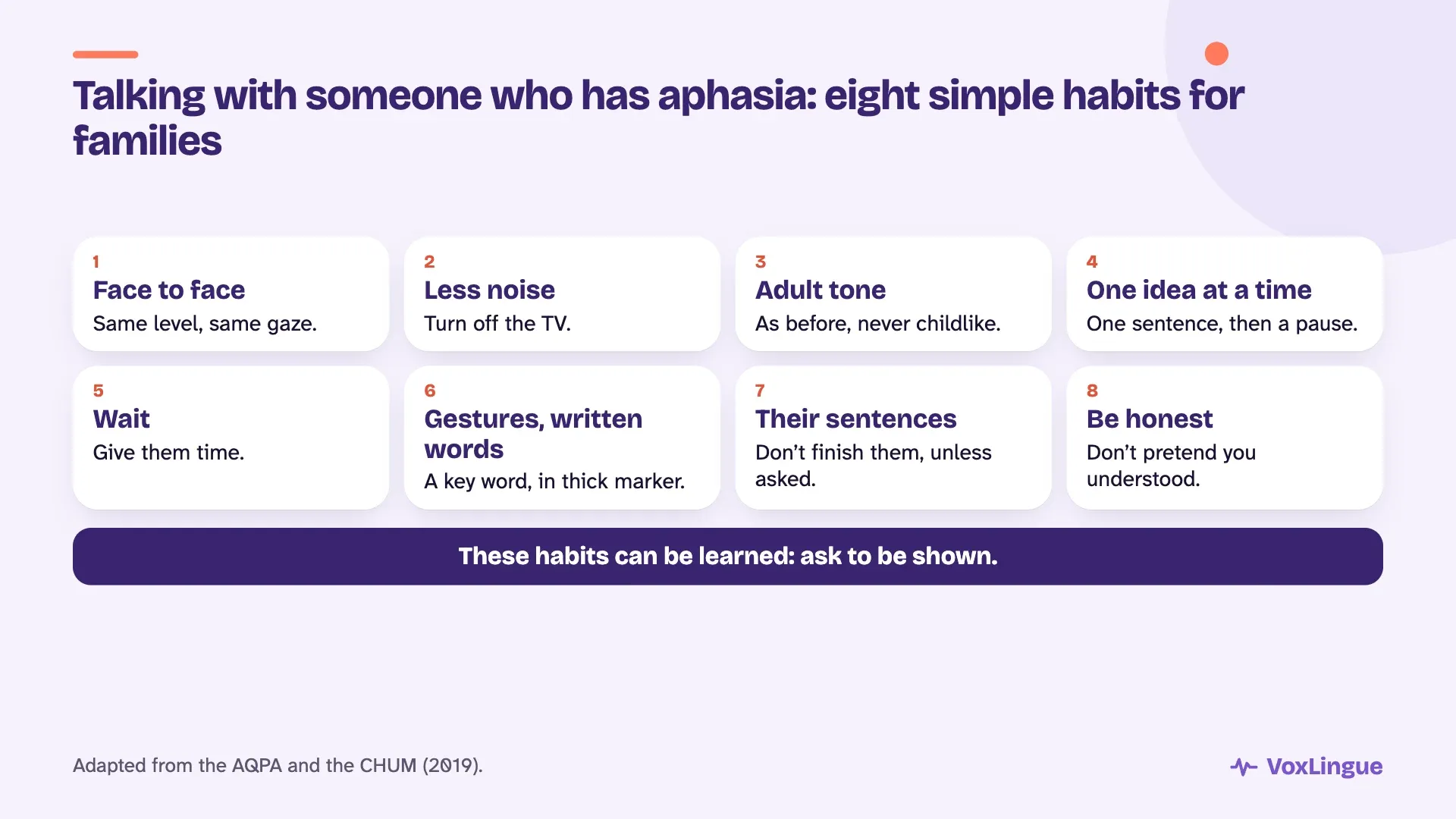
Sit facing them, turn off the TV and keep an adult tone. Say one idea at a time, then wait. Add gestures and write key words. Don’t finish their sentences unless they ask you to, and don’t pretend you understood.
These habits come from the AQPA’s advice and the CHUM sheet. The hardest part is keeping them up when you’re rushed or worried.
Take the morning. Instead of saying all at once, “I’ll help you get up, shower and get dressed, then we’ll go have breakfast,” try one sentence at a time, with a pause after each. “First, a shower.” “Next, you get dressed.” “After that, breakfast.” This example is adapted from a StrokEngine sheet (2018).
Write things down too. A key word on a sheet, in separate letters and thick black marker, can help the person follow (StrokEngine, 2018). Keep your head level with theirs, and don’t answer for them (CHUM, 2019).
What can you do when you no longer understand each other?
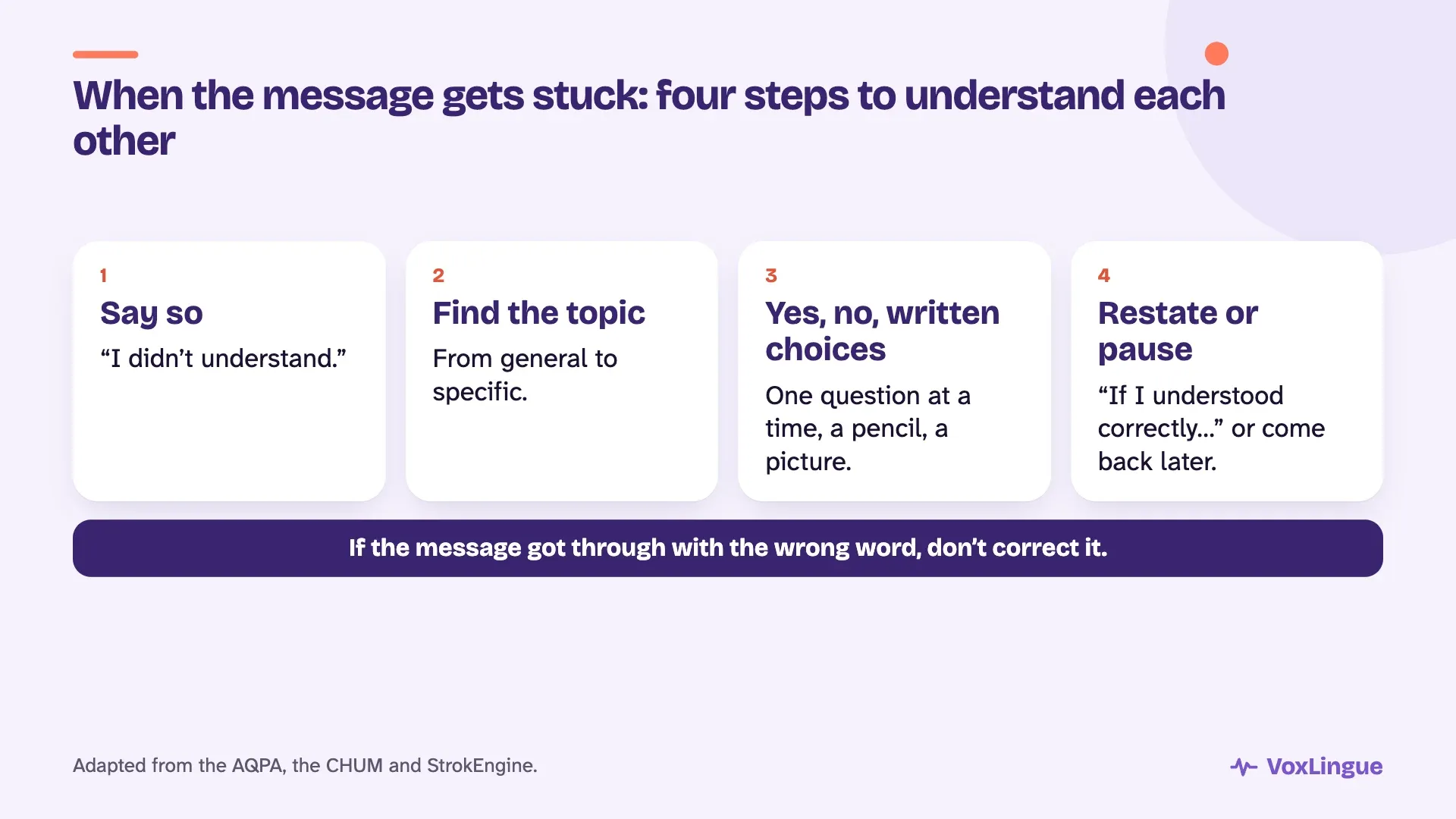
Simply say you didn’t understand. First look for the general topic, then ask yes-or-no questions. Offer written choices, a pencil or a picture. Restate to check: “If I understood correctly…”. If the exchange gets tiring, come back to it later.
Here’s an example, adapted from StrokEngine (2018). “Are you talking about the family?” Yes. “About our daughter?” Yes. “Are you wondering if she’s coming today?” You go from general to specific.
If you’re stuck, switch to writing. Note two or three possible answers and let your relative circle one, or hand them the pencil (AQPA). And if the message got through, but with the wrong word? Don’t correct it, the AQPA advises: the exchange worked.
Some people need more permanent support, like an app or a communication book. Canadian guidance treats these as an option to consider. Our article on AAC and speech, written mainly for parents, explains why these tools don’t replace speech.
Can someone show us how to do this?
Yes, and you can ask. Canadian guidance calls for offering relatives training in supported conversation. It isn’t always offered from the start. Bring it up with the team’s speech therapist, or contact an aphasia association in your region.
The Canadian Stroke Best Practice Recommendations say this training “should” be offered to communication partners of people with aphasia, as a strong recommendation. They also call for involving the family, with education and training.
Supported conversation was developed at the Aphasia Institute, a community centre in Toronto. In a controlled trial with forty volunteers, the competence of people with aphasia came through thanks to the skill of the trained partner (Kagan et al., 2001). These were volunteers, not relatives. One review reports positive changes, especially in chronic aphasia (Simmons-Mackie et al., 2016).
A Université de Montréal team interviewed eight speech therapists in rehabilitation: training for relatives remained rare, and depended on certain conditions (Hallé, Le Dorze and Mingant, 2014). The study is small and several years old. It isn’t a reproach, but a reason to ask: “Can you show us how to talk with them?”
In Montréal, the AQPA says it offers communication support (in French), in groups and through occasional sessions with the person and their relative together. It notes it’s restructuring its services for relatives, so call first at 514-277-5678.
Kimberly Martins encourages families to advocate for their needs and their relative’s from the hospital on. Ask for access to speech therapy, to learn strategies that support communication and interaction as the person progresses.
Will my relative talk again?
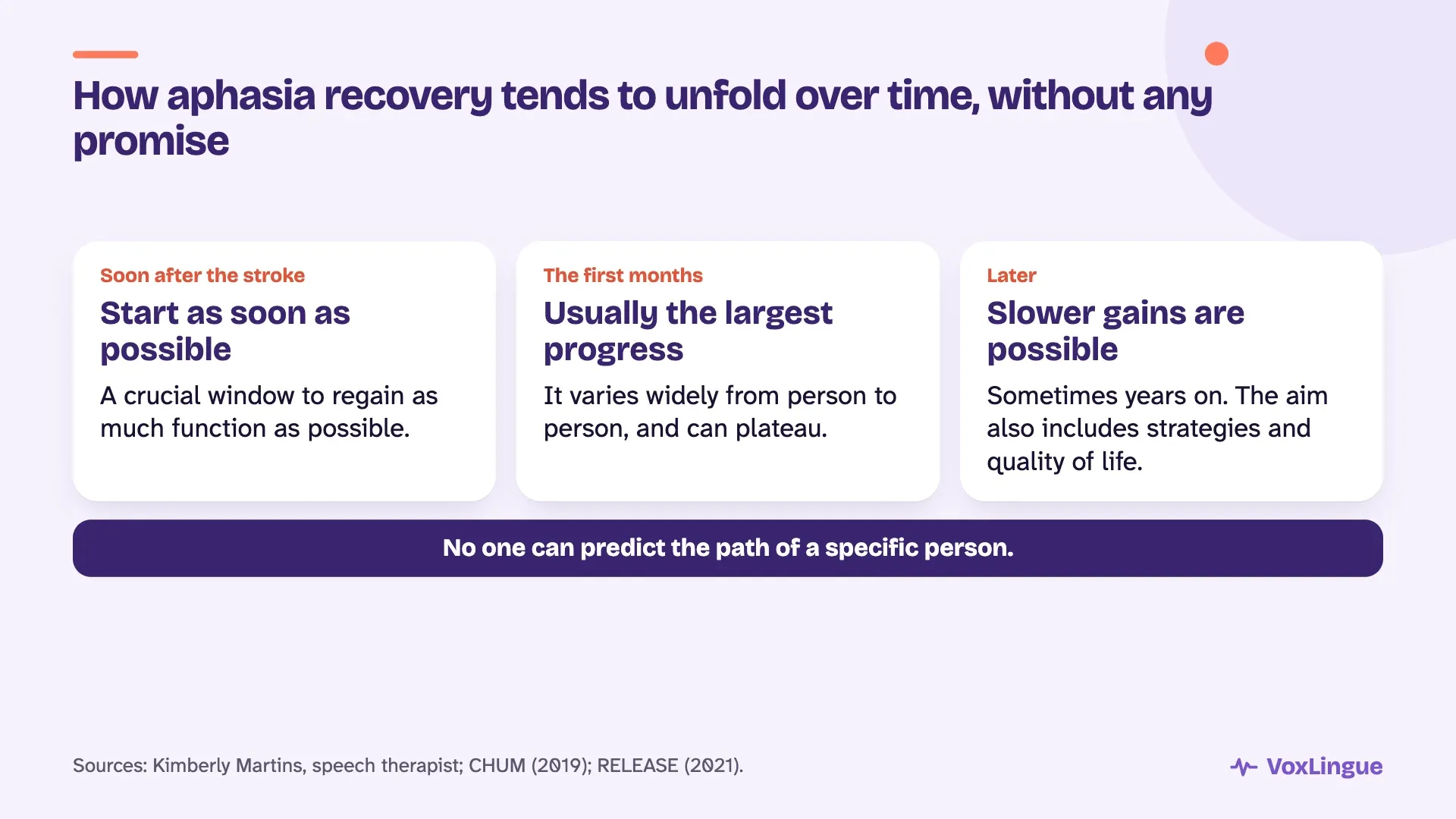
No one can predict this for a specific person. Progress is generally greatest in the first months. It can continue after that, more slowly, sometimes years after the stroke. Some people regain nearly all their ability to communicate, others only a small part.
The CHUM sheet (2019) says it plainly: recovery varies widely from person to person. Some aphasia also often remains after the first months (NIDCD, United States).
The international RELEASE collaboration (2021) saw the largest gains soon after the stroke, then smaller gains after six months. They were seen even beyond two years and in people over 75. These averages come from study participants: they promise nothing to any one person.
The Cochrane review concludes that speech therapy helps, compared with no therapy (Brady et al., 2016). Its limit: gains weren’t clear at later follow-up, based on smaller numbers of people.
A German trial looked at adults aged 70 or younger, six months or more after the stroke. Intensive therapy, in routine care conditions, improved everyday communication compared with deferred therapy, right after three weeks (Breitenstein et al., 2017).
Therapy can also be tiring or frustrating (StrokEngine, 2018): tell the speech therapist. A plateau doesn’t mean everything is over, and it doesn’t mean progress is assured.
Depending on the severity of the stroke, Kimberly Martins explains, the aim is to get back as close as possible to earlier abilities, or to improve what can be improved. Strategies are also put in place to compensate for what was lost, with a focus on quality of life.
Why start speech therapy quickly?
Start as soon as possible after the stroke. According to Kimberly Martins, there’s a crucial window to try to regain as much function as possible, before progress plateaus. Canadian guidance also calls for rapid access to intensive therapy, based on the person’s needs and goals.
Session frequency can differ between public and private services. Ask what’s planned for your relative.
What happens after the hospital in Québec and Ontario?
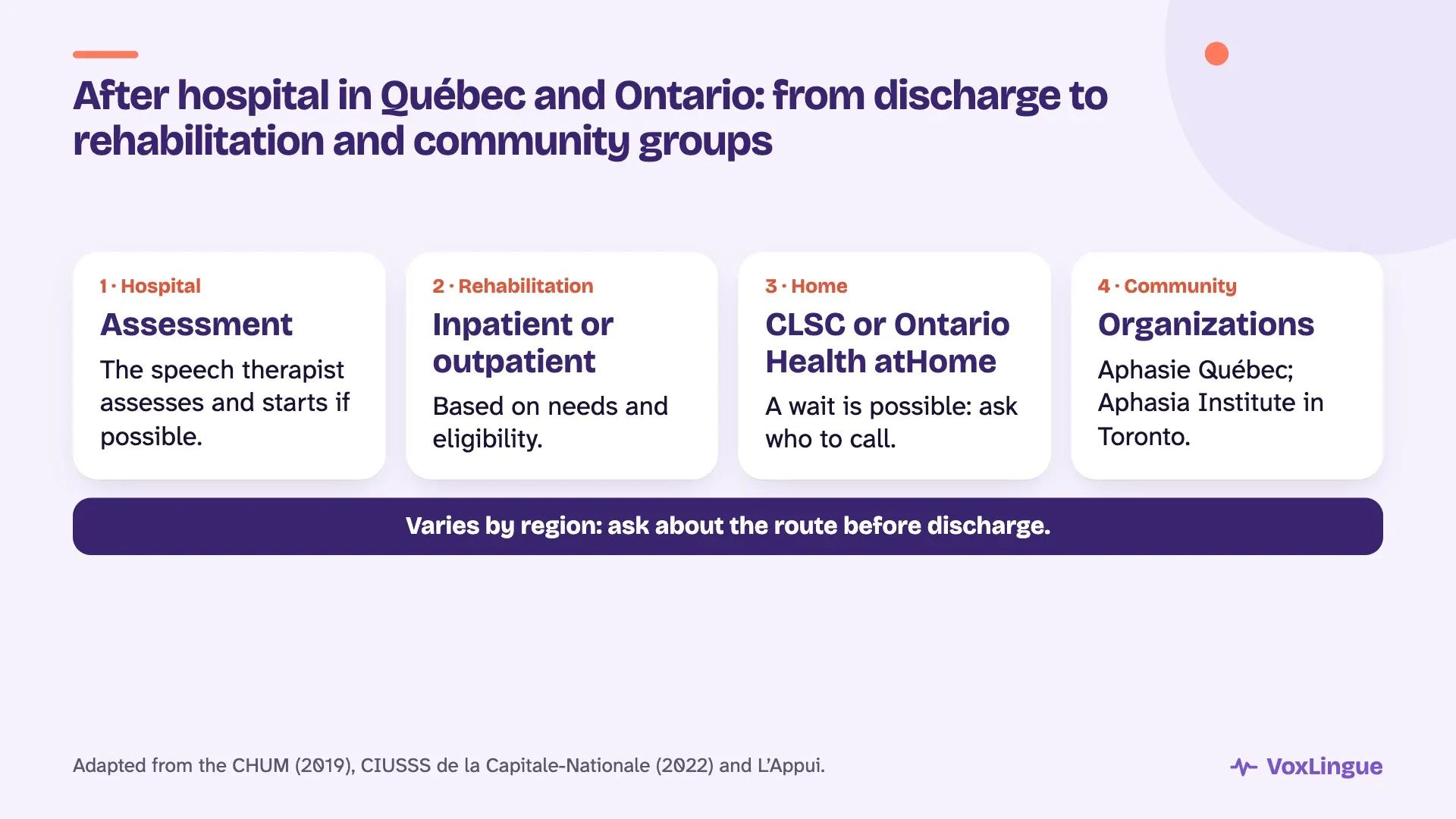
The hospital speech therapist assesses communication and starts the work if possible. Depending on needs, the person may then go to rehabilitation, as an inpatient or outpatient, then receive home services. In Québec these come through the CLSC, in Ontario through Ontario Health atHome (1-833-515-1234). A wait is possible. The route varies by region, so ask before discharge.
A Capitale-Nationale leaflet (2022, in French) shows these stages for its region. L’Appui also recommends referring the person to support organizations.
In Montréal, professionals request specialized rehabilitation through a regional access desk, and not everyone qualifies. Returning home with services may then be the route offered (document for professionals, CCSMTL, 2024). A master’s thesis from UQO also reports waits between stages (Limoges, 2026).
Before discharge, ask the team these questions:
- Who follows up on speech therapy after discharge, and when?
- Can you show us how to talk with them?
- Does swallowing need to be checked?
- Who do we call if the wait gets longer?
Keep a copy of the reports for the next service. Between stages, in Québec, 811, option 1, connects you with a nurse for a health question.
For groups in Québec, start with Aphasie Québec (1 877 626-1473), which says it brings together fourteen associations in twelve regions. In Montréal, the AQPA takes requests at 514-277-5678.
Who pays, in Québec and Ontario?
In Québec, the public network goes through the health insurance card. RAMQ doesn’t cover speech therapy in a private clinic, though some group insurance plans reimburse part of it. In Ontario, the government pays for home care if the person is eligible. Outside hospital, OHIP generally doesn’t cover these services.
| Type of service | Québec | Ontario | Who usually pays | How to reach it |
|---|---|---|---|---|
| Hospital and rehabilitation | Public network | Hospital or local program | Québec: public network, with the health insurance card. Ontario: ask the team | Through the care team |
| Home care | CLSC | Ontario Health atHome | Québec: public network. Ontario: the government, if the person is eligible | CLSC; in Ontario, 1-833-515-1234 |
| Private speech therapy | Private clinic, no medical referral | Private clinic | You or your insurance. Neither RAMQ nor, in general, OHIP | Directly with the clinic |
| Community organizations | Aphasie Québec and its associations | Aphasia Institute, Aphasia Centre of Ottawa | Depends on the organization: ask | On their website or by phone |
These are general guides. Rules and services change, so confirm with each organization.
In Québec, a CCSMTL document (2024) states that the health insurance card spares the user the costs of rehabilitation.
In Ontario, the government funds home care if the person is eligible. The health coverage page excludes care given outside hospital by professionals who aren’t doctors, with exceptions. It doesn’t name speech therapy, so ask.
The Aphasia Institute in Toronto offers direct services and a weekly family group after one of its programs. The Aphasia Centre of Ottawa offers virtual support in Eastern Ontario. Elsewhere in Ontario, see Heart & Stroke’s directory, and check each entry.
How do you keep going as a caregiver?
Fatigue, sadness and anger are common among relatives. You don’t have to stay positive all the time. Talk about it, keep some time for yourself and ask for help. In Québec, Info-aidant, 811 option 2 and aphasia associations all offer support.
A Université de Montréal study of twelve relatives in the three months after discharge describes a tendency: you focus on the affected person and forget your own needs (Hallé and Le Dorze, 2014). Roles at home change too.
L’Appui (in French) notes that relatives are often asked to keep a positive attitude, which can bring guilt and stress.
Watch your relative’s mood as well. Across pooled studies, about three in ten people with aphasia had depression after the stroke (Vogel-Eyny et al., 2025). It’s harder to spot without words (van Dijk et al., 2016). Tell the medical team what you see. Return to work is also less common with aphasia (Burfein et al., 2025).
Info-aidant is free and confidential, at 1 855 852-7784, Monday to Friday from 8 a.m. to 6 p.m. In Québec, 811, option 2, connects you with a psychosocial professional.
Two languages at home: which one to work on?
There’s no single rule. Both languages can be affected equally or differently, and the language learned first often comes out stronger, especially if the other was learned later. The choice is made with the speech therapist, based on who the person needs to talk to and the moments that matter.
In an analysis of 130 cases, people who had learned their second language before age 7 did comparably well in both (Kuzmina et al., 2019). Your relative may also understand one language and not the other (StrokEngine, 2018).
In an analysis of seventeen studies, with thirty-nine people in all, practice helped mainly the words practised, and very little the other language (Lee and Faroqi-Shah, 2024). A Université de Montréal team adds that this transfer depends on several factors, including the type of word and how similar the languages are (Ansaldo and Saidi, 2014).
Note who your relative wants to talk to, and in which language: this list helps with the choice.
Kimberly Martins relies on what the family and relatives say: the choice is the dominant language, the one used most before the stroke. If the assessment shows the person communicates in more than one language, the work can aim for skills that carry across, alternating languages in therapy.
Does telepractice work for aphasia?
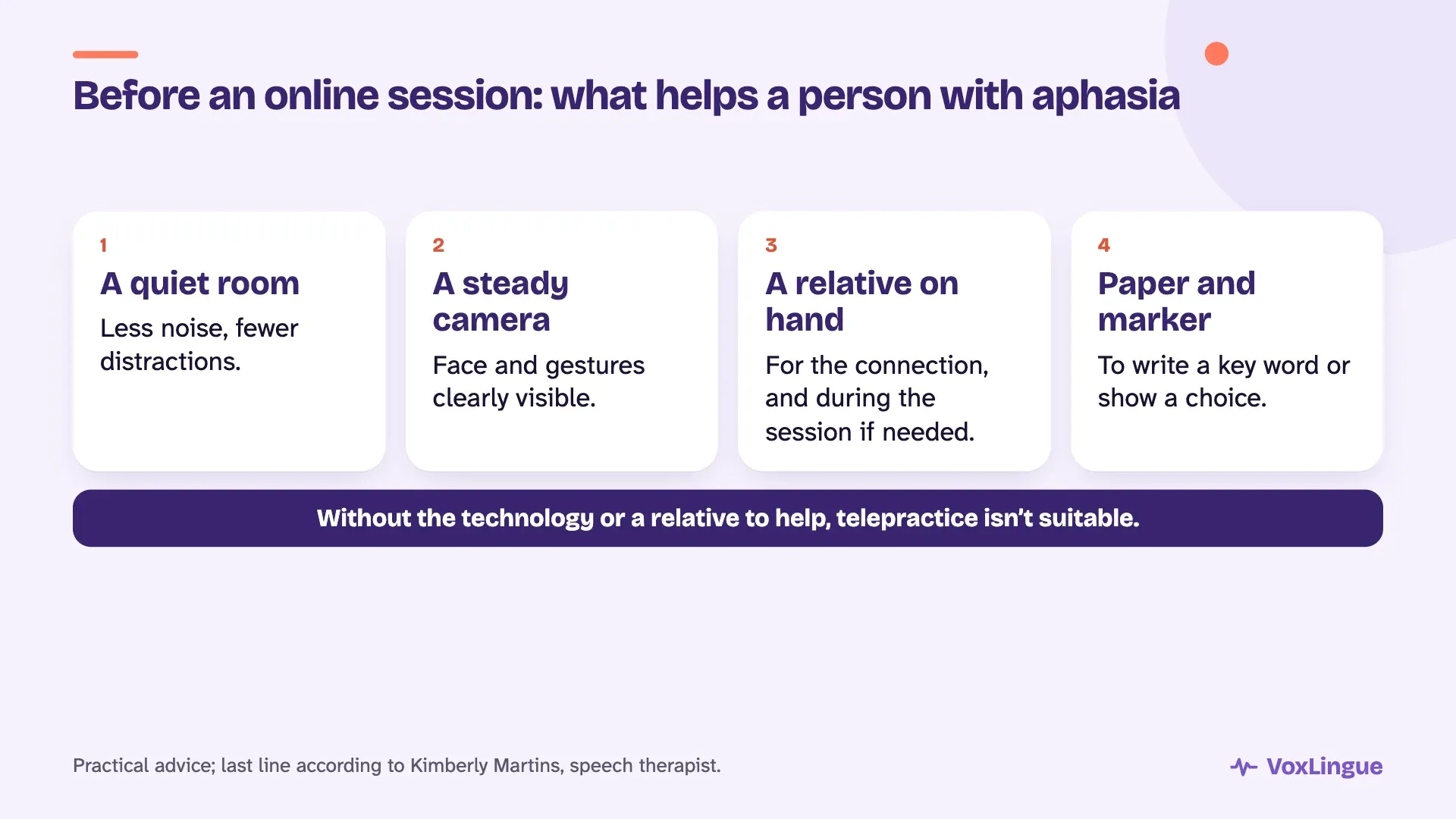
It can, but the evidence remains limited. Small studies suggest results comparable to in-person therapy, with low-quality evidence. Communicating can also be harder on a screen. A relative’s help with the technology and the speech therapist’s opinion guide the choice.
An analysis of five studies, with 132 people in all, finds the evidence still insufficient to guide clinical decisions (Cacciante et al., 2021). Canadian guidance on virtual rehabilitation (2022) suggests considering it for aphasia, while warning that some people may find it harder to communicate during a virtual visit.
Our page on telepractice explains how it works in Québec and Ontario.
According to Kimberly Martins, telepractice isn’t suitable if limitations prevent the person from using the technology and no relative can help during the session.
When should you ask for help, and from whom?
Sudden trouble speaking or understanding is an emergency: call 911. Outside emergencies, consult if conversations are increasingly avoided, if progress seems stuck or if new goals come up. A private assessment doesn’t require a medical referral.
You don’t need to wait for your relative to ask: you can call for them. New goals are a good reason to take stock again, even after therapy has ended.
To find a speech therapist in Québec, see the Ordre des orthophonistes et audiologistes du Québec (OOAQ). Our guide to speech therapy assessment in Québec compares public and private routes, and our assessment page explains what’s looked at.
What to remember
Aphasia changes how a person speaks, understands, reads or writes. A stroke can also affect other functions. The way you talk helps, and it can be learned: ask to be shown. Progress varies and no one can promise it. Before discharge, ask who follows up.
Next step
Print the fridge sheet and bring it to your next meeting with the team. If you’re looking for more, see our page on aphasia and acquired disorders or our articles for adults. Our speech therapists see adults at our clinic in Marché Central, Montréal, and through telepractice across Québec and Ontario.
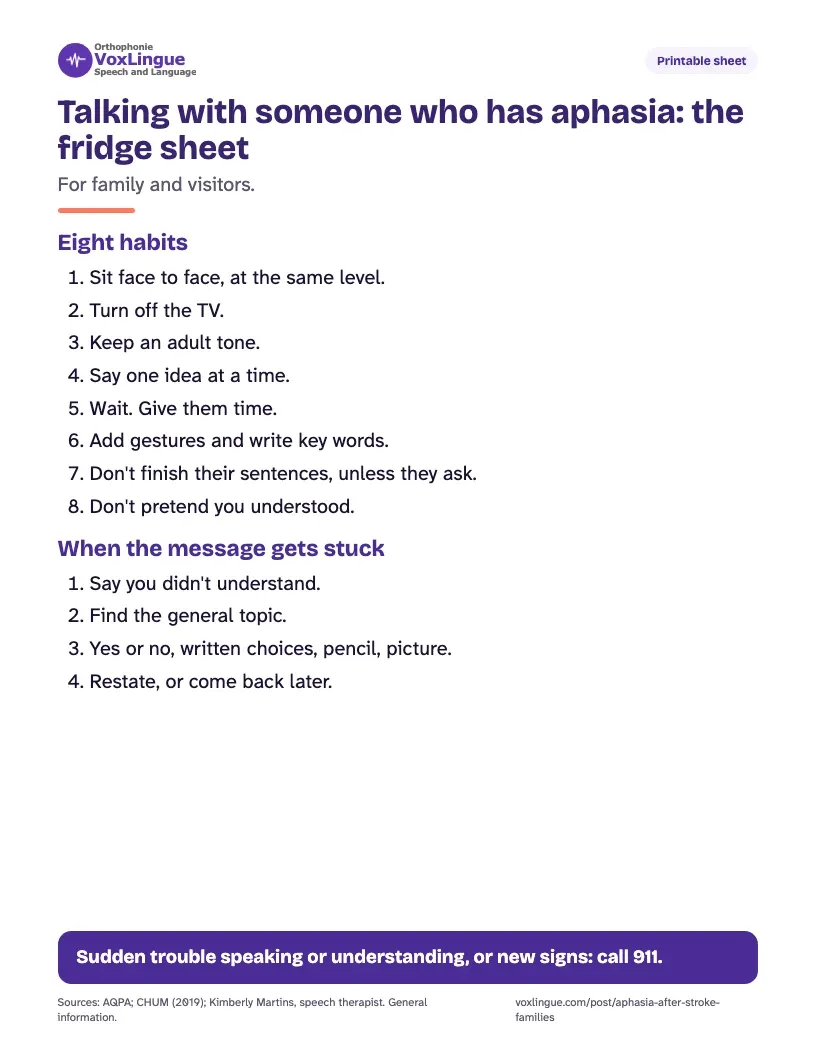
Printable sheet: Talking with someone who has aphasia: the fridge sheet (PDF, 2 pages).
Frequently asked questions
How long does aphasia last?
It varies widely. According to the CHUM sheet, progress is greatest and fastest in the first months, and it can still come months and years later. No one can give a duration for a specific person, and some aphasia often remains.
Is aphasia a form of dementia?
No. After a stroke, aphasia appears suddenly and comes from damage to the brain. Dementia sets in and progresses over time. There’s also primary progressive aphasia, which sets in gradually: that’s a different condition. If you’re still unsure, talk to the doctor.
Can someone make progress years after a stroke?
It’s possible, but not assured. Smaller gains have been seen beyond two years, and Kimberly Martins points out that progress can plateau. Depending on the person, the aim then becomes what can still improve, strategies to compensate, and quality of life.
Should I correct their mistakes?
If the message got through, no. The AQPA is clear: the exchange worked, even with the wrong word. If you didn’t understand, simply say so, then look for the general topic together.
Should I finish their sentences?
Not on your own initiative. Give them time, and fill in only if they ask you to. People have their own preferences: the simplest thing is to ask, at a calm moment, what helps.
Does my relative understand what’s said in front of them?
It depends on the type of aphasia and the moment, and you can’t know for sure. Assume they can understand. Talk with them rather than about them, and include them in decisions that concern them.
What exercises can we do at home?
Ask the speech therapist, who chooses them based on your relative’s goals. Try not to turn into a teacher: useful everyday conversations count too. If exercises become a source of tension, tell the speech therapist.
Can a relative call on the person’s behalf?
Yes. You can call to ask questions or request an assessment, and a private assessment doesn’t require a medical referral. The person with aphasia stays at the centre of decisions, so include them as much as you can.
What if there’s another stroke?
New signs are an emergency: call 911, even if the person already has aphasia. Families often worry about this. Ask the medical team what can lower the risk in your relative’s case, and keep the FAST signs in plain view at home.
Is private speech therapy covered?
RAMQ doesn’t cover speech therapy in a private clinic and, in Ontario, OHIP generally doesn’t either. Some group insurance plans reimburse part of it, so check your policy and ask what your insurer requires.
Where can we find a group near us?
In Québec, start with Aphasie Québec at 1 877 626-1473, which can direct you by region. In Montréal, the AQPA takes requests at 514-277-5678. In Ontario, see the Aphasia Institute, the Aphasia Centre of Ottawa or Heart & Stroke’s directory.
Can my relative go back to work?
No one can say in advance. Return to work is less common after a stroke with aphasia than without it, and little is known yet about what helps most. If it’s a goal, tell the team from the start.
Aphasia, dysarthria, apraxia: what’s the difference?
Aphasia affects language: finding words, understanding, reading and writing. Dysarthria affects the muscles of speech. Apraxia of speech affects planning the movements for speaking. They can occur together, and an assessment helps tell them apart. See our page on aphasia and acquired disorders.