Montréal clinic · Telepractice across Quebec and Ontario

Speech therapy in Montréal, and online across Quebec and Ontario

Our speech-language pathologists assess and treat speech, language, fluency, voice and swallowing needs, from toddlers to older adults. Visit our clinic at Marché Central in Montreal, or meet us online by telepractice from anywhere in Quebec or Ontario.

  • Founded in 2018
  • 7 languages spoken by our clinicians

Clinical care that starts with how your family communicates

Orthophonie VoxLingue Speech and Language is a private speech-language pathology clinic founded in 2018 by Kimberly Martins, M.A. CCC-SLP. We work with children, teens and adults in person at our Montreal clinic and by telepractice anywhere in Quebec and Ontario. You can contact us directly. No physician referral is needed.

Many of the families we see speak more than one language at home. Our clinicians are trained to tell a typical bilingual pattern apart from a true speech or language difficulty, and they build therapy around your goals, your routines and the languages your family uses every day. Parents and caregivers take part in every step, so practice continues at home between sessions.

  • OOAQ Ordre des orthophonistes et audiologistes du Québec
  • CASLPO College of Audiologists and Speech-Language Pathologists of Ontario
  • ASHA American Speech-Language-Hearing Association (CCC-SLP)
  • Hanen It Takes Two to Talk, More Than Words, Learning Language and Loving It

Video

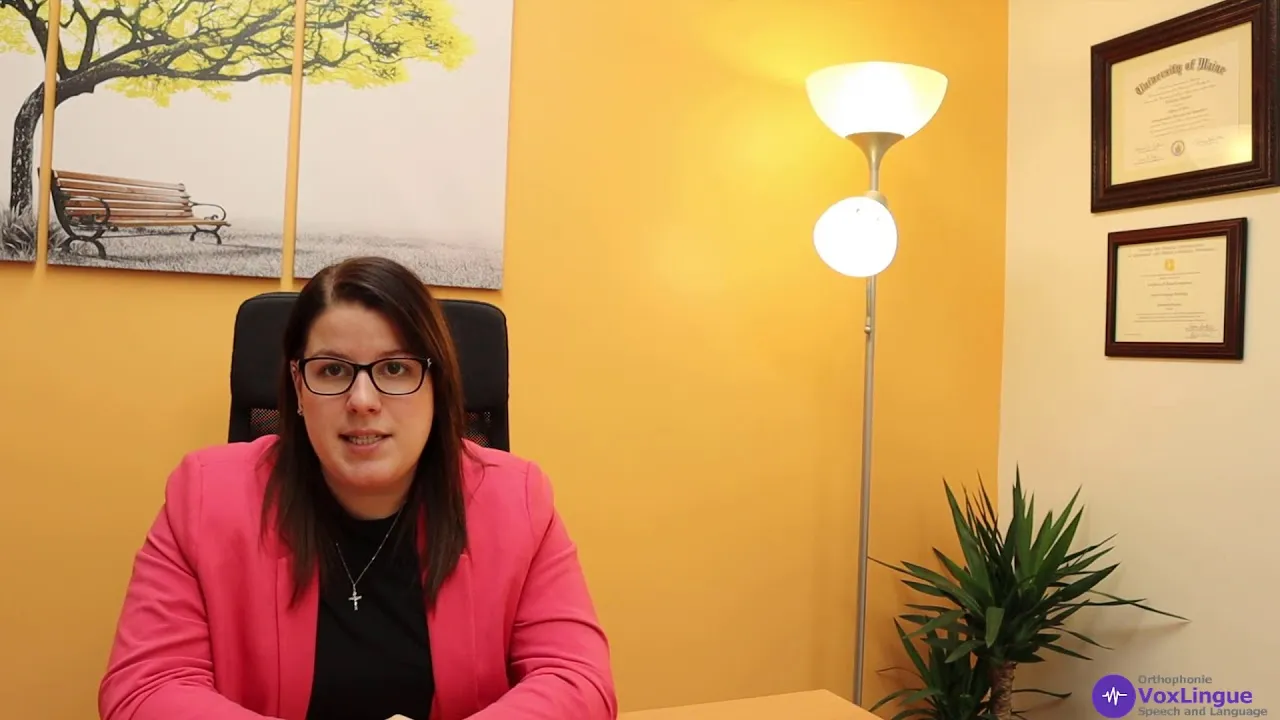
Get to know VoxLingue

A short introduction to our clinic, our approach and how we work with families who speak more than one language.

Request an appointment

Our services

Most clients begin with an assessment. From there, we plan individual treatment, add a group program when peers can help, and offer telepractice whenever meeting online suits you better.

All services →

What we help with

Our team covers the full range of speech-language pathology, from first words and speech sounds to stuttering, voice, swallowing and communication after a stroke or brain injury. Choose an area to see how we assess it, what therapy looks like and how you can help at home.

Show areas for

All areas we treat →

Who we see

Children

Most of our caseload is children, from toddlers who are slow to talk to school-age children whose language affects reading and learning. Sessions are play-based and built around what motivates your child. We share strategies with you after each visit so the work carries into daily life.

  • Late talkers and slow vocabulary growth
  • Speech that is hard to understand
  • Language and literacy difficulties at school
Speech therapy for children →

Teens

Teenagers often come to us for language, literacy, stuttering or social communication goals that affect school and friendships. We treat them as active partners and set goals that matter to them, from class presentations to conversations with peers.

  • Developmental language disorder (DLD)
  • Stuttering
  • Reading, writing and social communication

Adults

Adults see us for acquired difficulties after a stroke or brain injury, for voice and fluency concerns, for swallowing, and for accent modification. Therapy focuses on the conversations and tasks that matter in your work and home life.

  • Aphasia after a stroke or brain injury
  • Voice and swallowing difficulties
  • Stuttering and accent modification
Speech therapy for adults →

Families and caregivers

Parents and caregivers are part of the team, not observers in the waiting room. Through coaching and Hanen programs, we show you how to build communication into meals, play and bedtime, in the languages you speak at home.

  • Parent coaching
  • Hanen programs for early language
  • Home strategies after every session

A language difference is not a language disorder

Children who learn two or more languages may mix words, take longer to say certain sounds or know some words in only one language. These are often typical parts of bilingual development. When a clinician reads them as a disorder, a child may receive therapy they do not need. When a real difficulty is put down to bilingualism, a child may wait too long for help.

Our clinicians look at all of your child's languages, ask about how and when each one is used, and interpret test results with bilingual development in mind. We will never ask you to stop speaking your home language. Research suggests that a strong home language supports learning a second one.

Find a clinician who speaks your languages

  • English
  • Français
  • Español
  • Português
  • العربية
  • Ελληνικά
  • Հայերեն

How it works

  1. Step 1: Contact us

    Call our Marché Central clinic, or request an appointment through our contact form. Tell us briefly what you have noticed and which languages your family uses.

  2. Step 2: Intake

    Our team gathers background information and matches you with a clinician whose areas of practice, languages and schedule fit your needs. Availability varies, and we will tell you clearly what we can offer.

  3. Step 3: Assessment

    Your clinician combines an interview, play-based or conversational tasks and standardized tests. You receive a written report and a meeting to go over the results together.

  4. Step 4: Your plan

    We agree on specific goals, how often to meet and whether sessions happen in person, by telepractice or in a group. You know what we are working on and why.

  5. Step 5: Therapy and home strategies

    Regular sessions target your goals step by step. After each one, you leave with a few concrete strategies to use at home, at daycare or at work.

  6. Step 6: Review

    We check progress against your goals and adjust the plan as needed. When goals are met, we plan how to maintain the gains or connect you with other services.

One clinic in Montreal, telepractice across two provinces

We see clients in person at our Marché Central clinic in Montreal, open Monday to Saturday, 8:00 to 19:00. Families anywhere else in Quebec, and across Ontario, work with us by telepractice.

Québec · Ahuntsic-Cartierville, Montréal

VoxLingue Marché Central

Our Montreal clinic is at 9580 boulevard de l'Acadie in the Marché Central area of Ahuntsic-Cartierville. Families come from across central and north Montreal, and many drive in from Laval thanks to quick access to Autoroute 15 and local transit. Families from the South Shore visit us as well.

Address
9580 boulevard de l'Acadie, suite 209-211
Montréal, QC H4N 1L8
Hours
Monday to Saturday, 08:00–19:00

Families come from

Parking, transit and directionsAll areas we serve

Anywhere in Quebec · All of Ontario

Telepractice

Telepractice brings our assessment and therapy to you anywhere in Quebec or Ontario, with the same clinical standards as an in-person visit. Your clinician is registered in your province (OOAQ in Quebec, CASLPO in Ontario). All you need is a computer or tablet and a stable internet connection.

Registered with

  • OOAQ (Québec)
  • CASLPO (Ontario)

How we approach therapy

Evidence-based

We choose methods supported by current research, such as the Lidcombe Program for young children who stutter and Hanen programs for early language. We measure progress against clear goals and adjust when something is not working.

Family partnership

You know your child or your own communication better than anyone. We explain what we are doing and why, coach you during sessions and give you strategies that fit your routines.

Multilingual by design

Our clinicians speak seven languages: English, French, Spanish, Portuguese, Arabic, Greek and Armenian. Bilingualism is an asset in our practice, and we plan therapy around the languages your family uses every day.

Whole person and neurodiversity-affirming

We respect each person's way of communicating, including through AAC. Goals focus on connection, participation and independence, not on making someone appear typical.

Practical ideas in your inbox

Our newsletter shares everyday strategies to support communication at home, in English and French. No clinical advice, just ideas you can try this week.

Ready to talk about your concerns?

Call our Marché Central clinic in Montreal at 514-467-9132, or request an appointment through our contact form. No physician referral is needed, and we will help you find the right first step.