Toddler stopped saying words they used to say: normal word changes or speech regression, what to note, and when to get a check right away
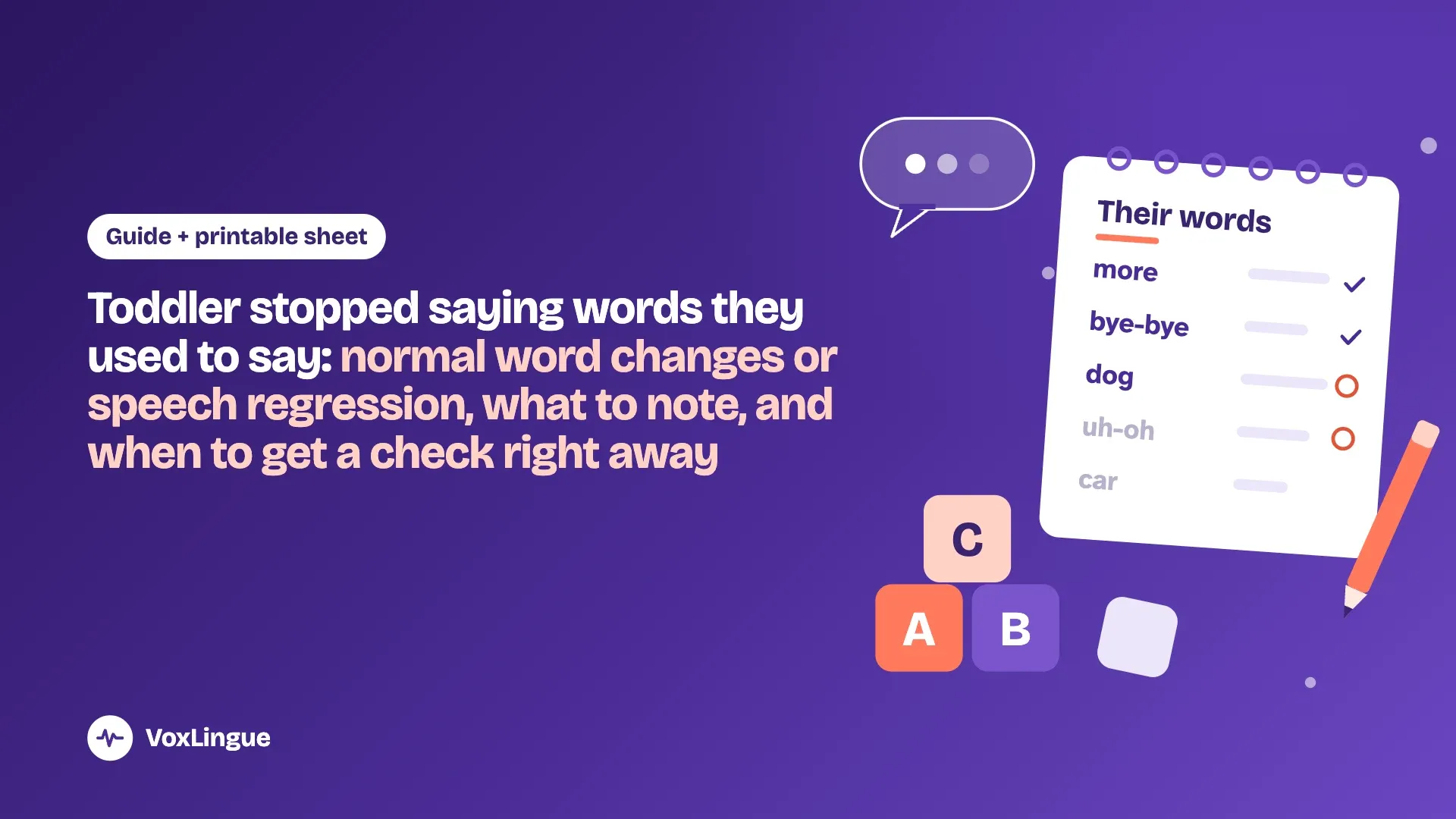
They used to say “more”, “uh-oh” and “bye-bye”. For a few weeks now, you haven’t heard them. You wonder whether something is wrong.
When a toddler stopped saying words they used to say, the same sentence can hide two very different situations. Often, a toddler’s words simply change. Sometimes it is a real loss. And a loss of words or skills is a reason to get a check right away, not to watch and wait for months.
This guide helps you tell the two apart, without making a diagnosis: what normally changes, what a real loss looks like, what to write down and who to call this week, in Québec or Ontario. It builds on our articles on early language and late talkers.
Toddler stopped saying words: normal change or real loss?
Not necessarily a loss. Toddlers’ words change all the time: a baby word gives way to an adult word, a word comes out differently, or new words arrive more slowly for a while. A real loss is several words disappearing, or words fading together with gestures, eye contact or play. Then you get a check without waiting.
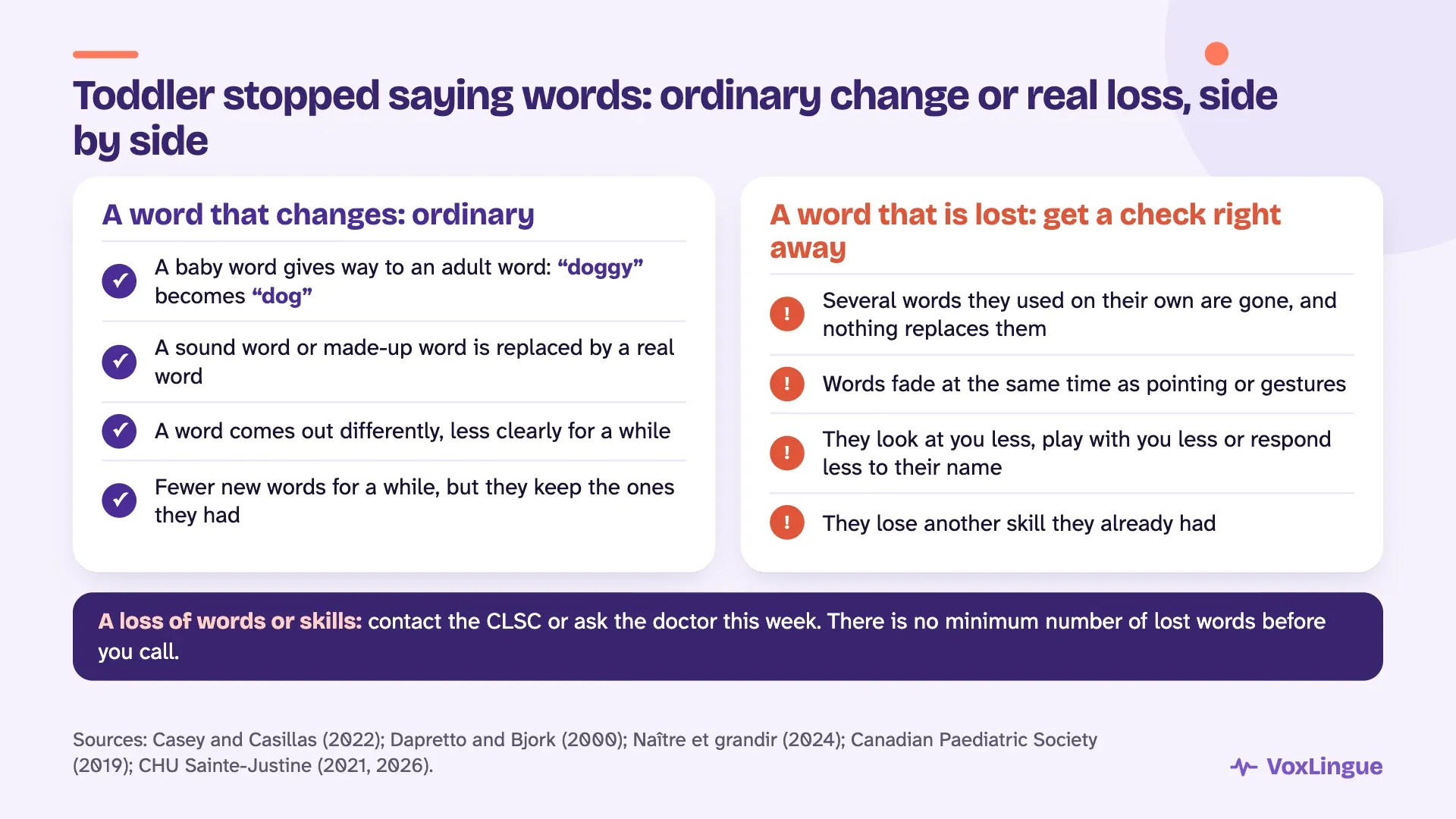
The table helps you describe what you are seeing.
| A word that changes (ordinary) | A word that is lost (get a check right away) |
|---|---|
| A baby word gives way to an adult word: “doggy” becomes “dog” | Several words they used on their own are gone, and nothing replaces them |
| A sound word or made-up word is replaced by a real word | Words fade at the same time as pointing or gestures |
| A word comes out differently, less clearly for a while | They look at you less, play with you less or respond less to their name |
| Fewer new words for a while, but they keep the ones they had | They lose another skill they already had |
What normally changes in a toddler’s words
A baby word replaced by an adult word is not a lost word: “doggy” becomes “dog”, “nana” becomes “banana”. In a large study of English-speaking children, the switch happened on average around 2½ years, and children kept the baby forms for talking to younger children (Casey and Casillas, 2022).
Sound words and made-up words, like “woof” for every animal, also tend to give way to real words once vocabulary speeds up (Dapretto and Bjork, 2000). A word can also come out less clearly for a while when a child is learning many words at once: it is still there.
Finally, a pause in new words is not a loss. Naître et grandir (in French) notes that it is common for a toddler not to add new words every day, and that vocabulary often speeds up after about 50 words (2024). During a pause, the child keeps the words they had.
What a real loss of words looks like
A real loss means several words they used on their own, with meaning and regularly, are no longer said. It also means words fading together with pointing, gestures, eye contact, shared play or response to their name.
Canadian guidance treats any loss of skills as a warning sign. The Canadian Paediatric Society position statement on early detection of autism lists developmental regression at any age: a loss of social behaviours, or of words and gestures, compared with earlier. On any such sign, it recommends an evaluation and an immediate referral to early intervention, without waiting (2019).
Québec clinical sources say the same. CHU Sainte-Justine’s milestone sheets end every age with the same warning sign, the loss of a skill the child already had (2021, in French). Regroupement Langage Québec lists “regression or stagnation” of language among the signs of a language disorder between 2 and 3 (2019, in French).
Kimberly Martins, speech-language pathologist and founder of VoxLingue, treats losing words or skills as a reason to ask without waiting. It is not a diagnosis, but a signal to have things checked this week.
Your toddler stopped saying “mama” or “dada”? If those words are gone and nothing has replaced them, or if they also look at you and point less, contact the CLSC or ask the doctor right away.
How can you tell if a word was really there?
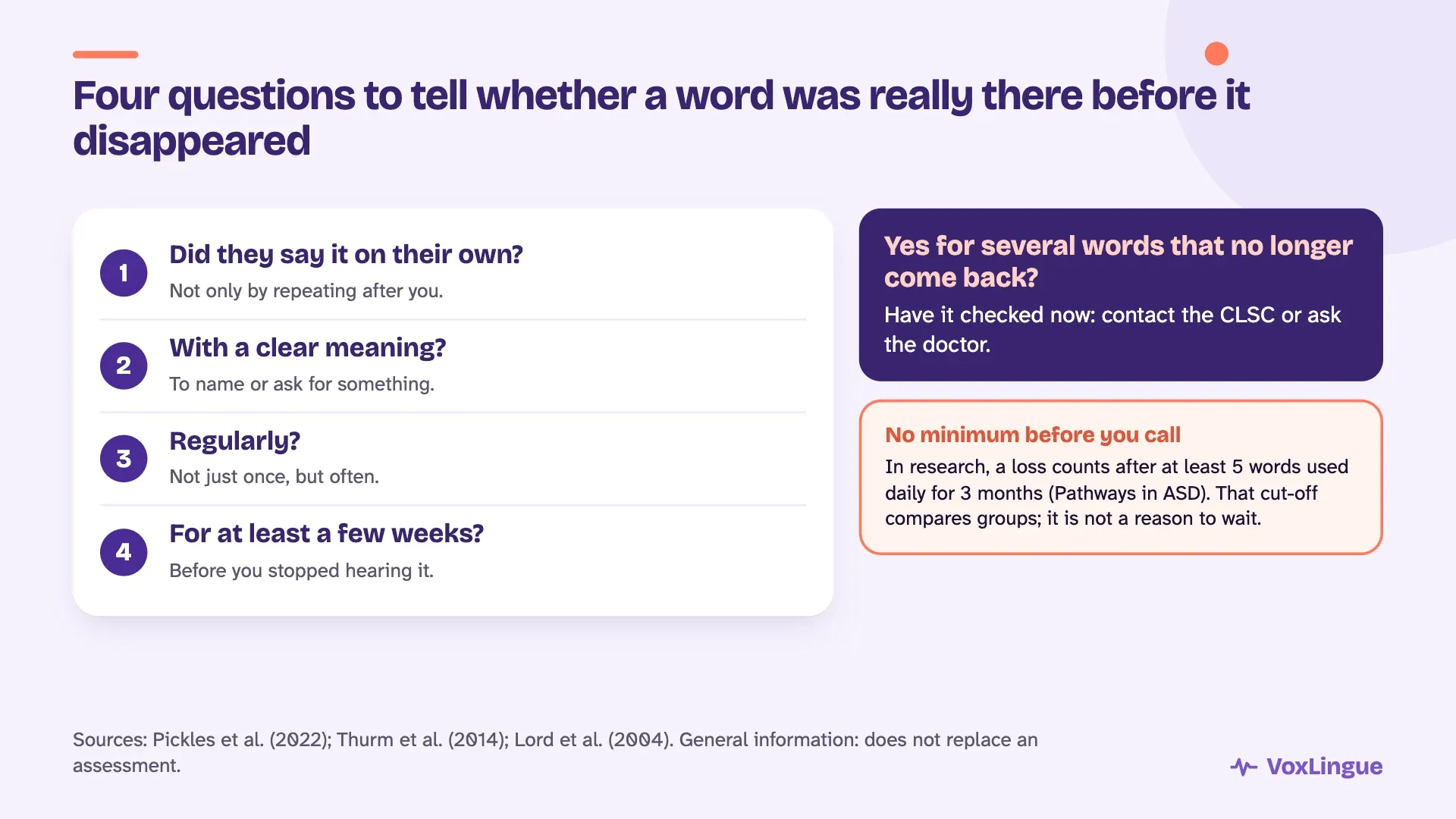
Four questions help. Did they say it on their own, not only by repeating after you? With a clear meaning? Regularly? For at least a few weeks? If the answer is yes for several words that no longer come back, have it checked now.
Research uses a stricter definition. The Canadian Pathways in ASD study counted a loss only after a child had used at least five words daily for at least three months (Pickles et al., 2022). That cut-off is for comparing groups of children, not for deciding whether to call.
There is no minimum number of lost words before you ask. None of the Québec or Canadian sources we read suggests waiting a set time when words are lost.
Beyond words: which other skills should you watch?
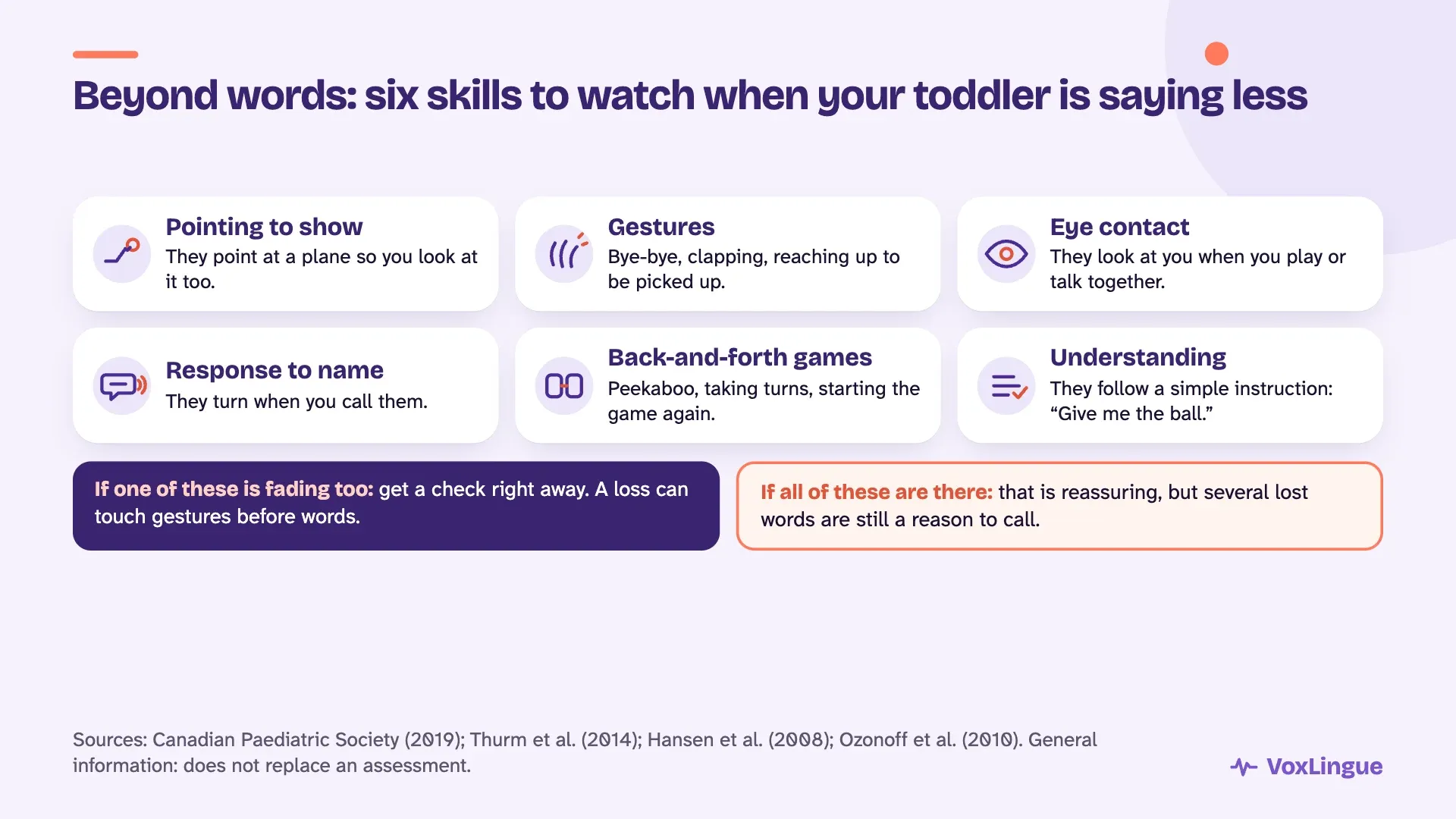
Look at gestures, eye contact, response to their name, back-and-forth games and understanding. Do they point to show you something? Do they still wave bye-bye or clap? Do they play peekaboo? Do they follow simple instructions? If all of this is there, that is reassuring information. If one of these skills is fading too, get a check without waiting.
A loss does not always start with words. In an American study, the skills most often lost by young autistic children were eye contact, first words, response to name, peekaboo and babbling (Thurm et al., 2014). A loss can also touch gestures before words (Hansen et al., 2008).
On the other hand, several lost words are still a reason to call, even if everything else seems fine. A loss is not always clear-cut either: for many children, interest in other people fades gradually (Ozonoff et al., 2010). If you feel your toddler is doing less than before, trust that feeling and talk to someone.
Our article on what professionals look at beyond words describes these signs in detail.
Can hearing, a big change or two languages play a part?
Yes, each can mean fewer words. Lower hearing, a big change in the family or a shift from one language to another each has a recognisable picture. None of them should take away pointing, play, or several words in every language. If that happens, have it checked without waiting.
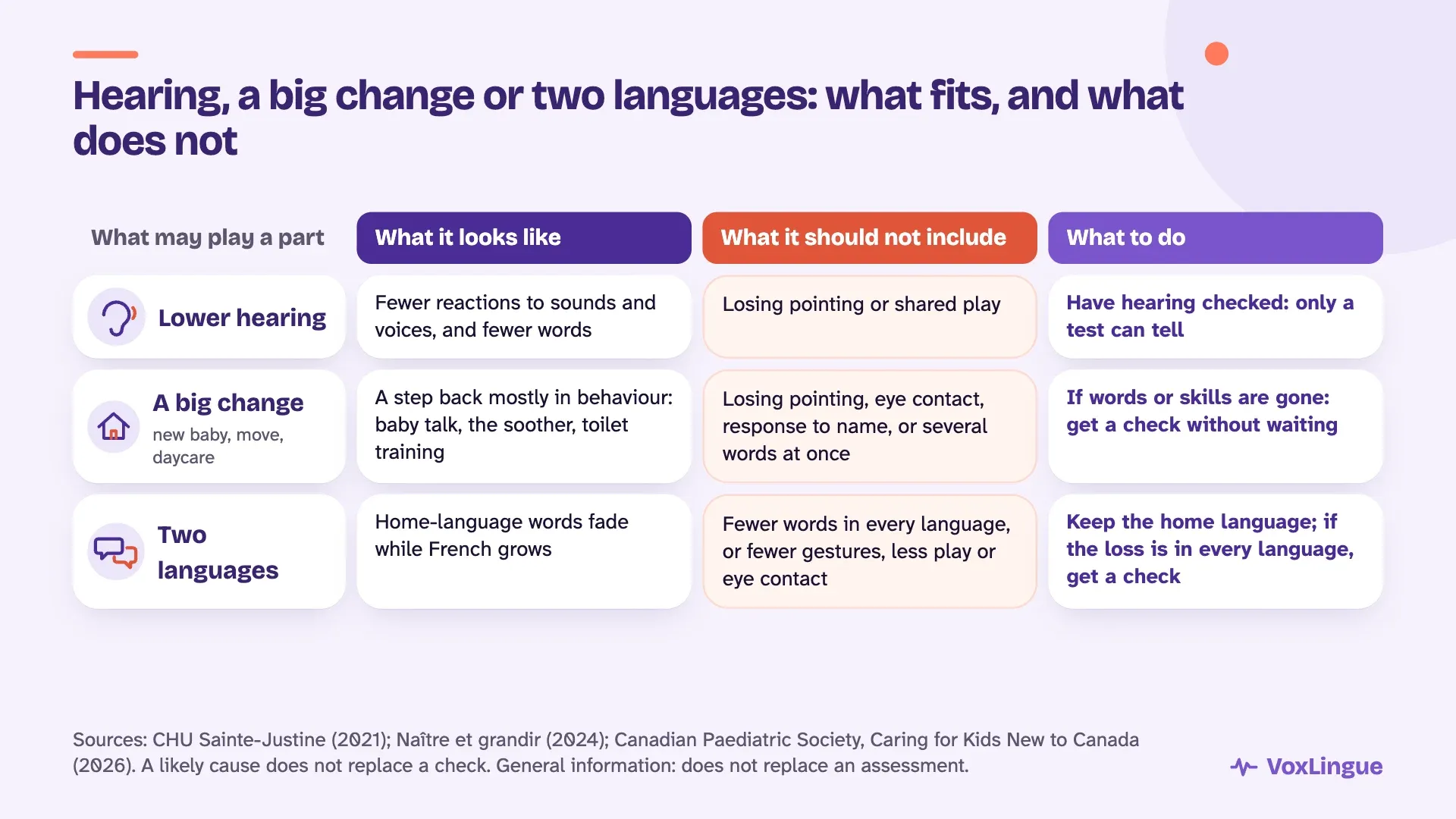
Even if you think you know the cause, a loss of words needs a check. The table sums up the three situations.
| What may play a part | What it looks like | What it should not include | What to do |
|---|---|---|---|
| Lower hearing | Fewer reactions to sounds and voices, and fewer words | Losing pointing or shared play | Have hearing checked: only a test can tell |
| A big change (new baby, move, daycare) | A step back mostly in behaviour: baby talk, the soother, toilet training | Losing pointing, eye contact, response to name, or several words at once | If words or skills are gone, get a check without waiting |
| Two languages | Home-language words fade while French grows | Fewer words in every language, or fewer gestures, less play or eye contact | Keep the home language; if the loss is in every language, get a check |
Hearing: the first thing to have checked
Lower hearing can mean fewer words, and only a hearing test can confirm it. In CHU Sainte-Justine’s milestone sheets, a single hearing-related sign is enough to refer a child to audiology (2021, in French).
Fluid behind the eardrum, for example after an ear infection, lowers hearing, on average slightly and often temporarily. Our article on ear infections, fluid and language explains the link.
If your child has never had a hearing test, our team always recommends one. In Québec, a private audiologist sees you without a referral. And if pointing or shared play are fading too, get a speech-language check at the same time.
A new baby, a move, daycare: when a big change shakes things up
A big change can bring a step back, mostly in behaviour. Naître et grandir (in French) explains that any event that asks a child to adapt can bring a regression: baby talk, asking for the soother again, more toilet accidents (2024). That guidance is about behaviour in 3 to 5 year olds, not about words.
A big change should not take away pointing, eye contact, response to their name, or several words at once. If it does, don’t wait for your toddler to “adjust”: contact the CLSC or ask the doctor.
A child who talks at home but stays silent at daycare is a different question, sometimes linked to selective mutism: they still have their words. Our article on understanding selective mutism covers it.
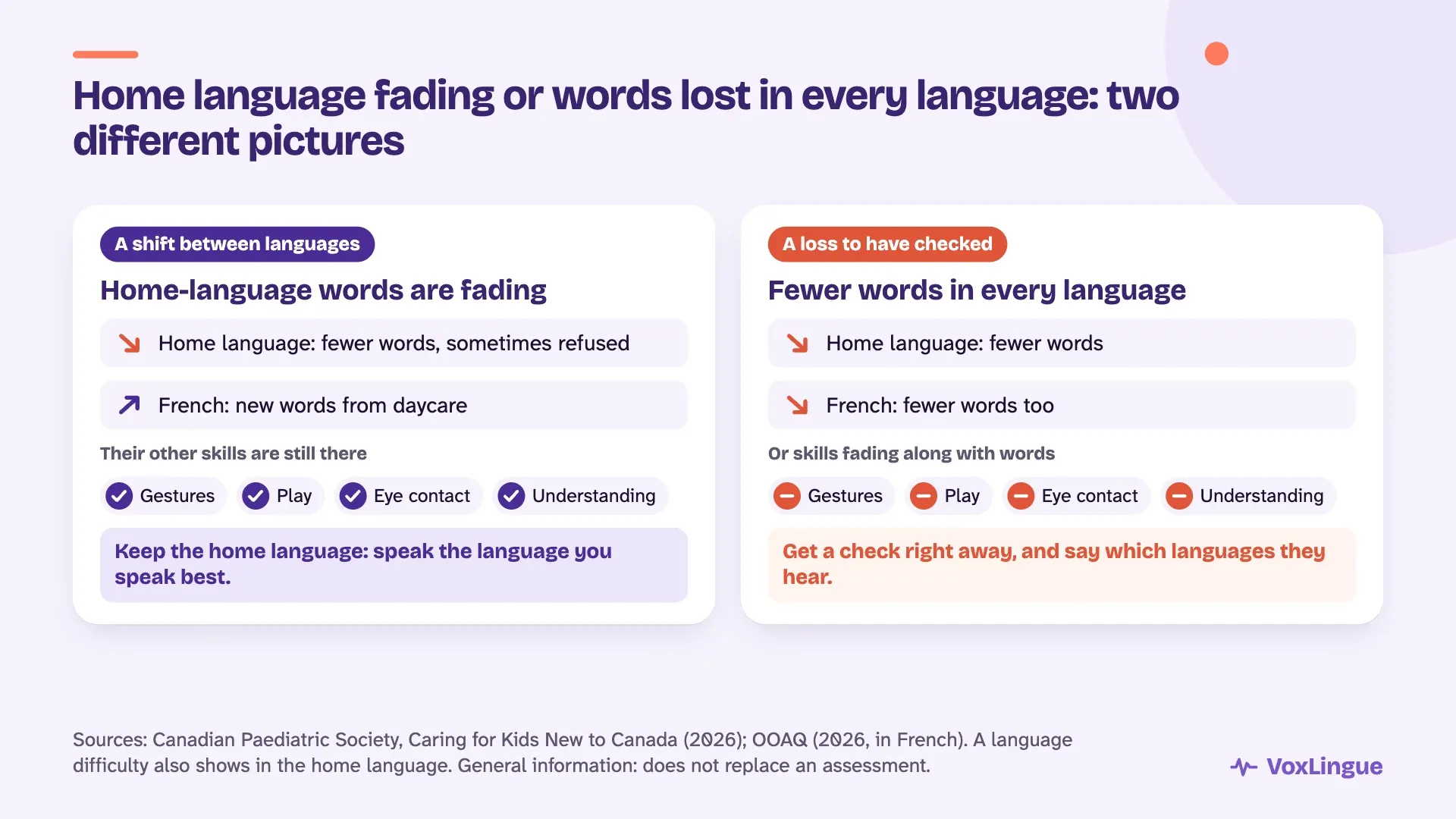
Bilingual toddler: is the home language fading, or are words lost in every language?
When French takes up more room, some home-language words can fade. A toddler who hears English at home may start saying « chien » instead of “dog” after a few months at a French daycare.
The Canadian Paediatric Society’s Caring for Kids New to Canada site explains that a child may stop using the first language in the new setting. At home, the first language should keep growing. As the second language takes over, children may lose skills in their first language (2026).
Mixing languages in one sentence is normal too: see why bilingual children mix French and English. The picture is different if your toddler says fewer words in every language, or if words fade along with gestures, play or eye contact. A language difficulty also shows in the home language. Then get a check without waiting, and tell the speech-language pathologist which languages your child hears.
Keep the home language: speak to your child in the language you speak best. For guidance, see language milestones for bilingual children.
Does losing words mean autism? What research says
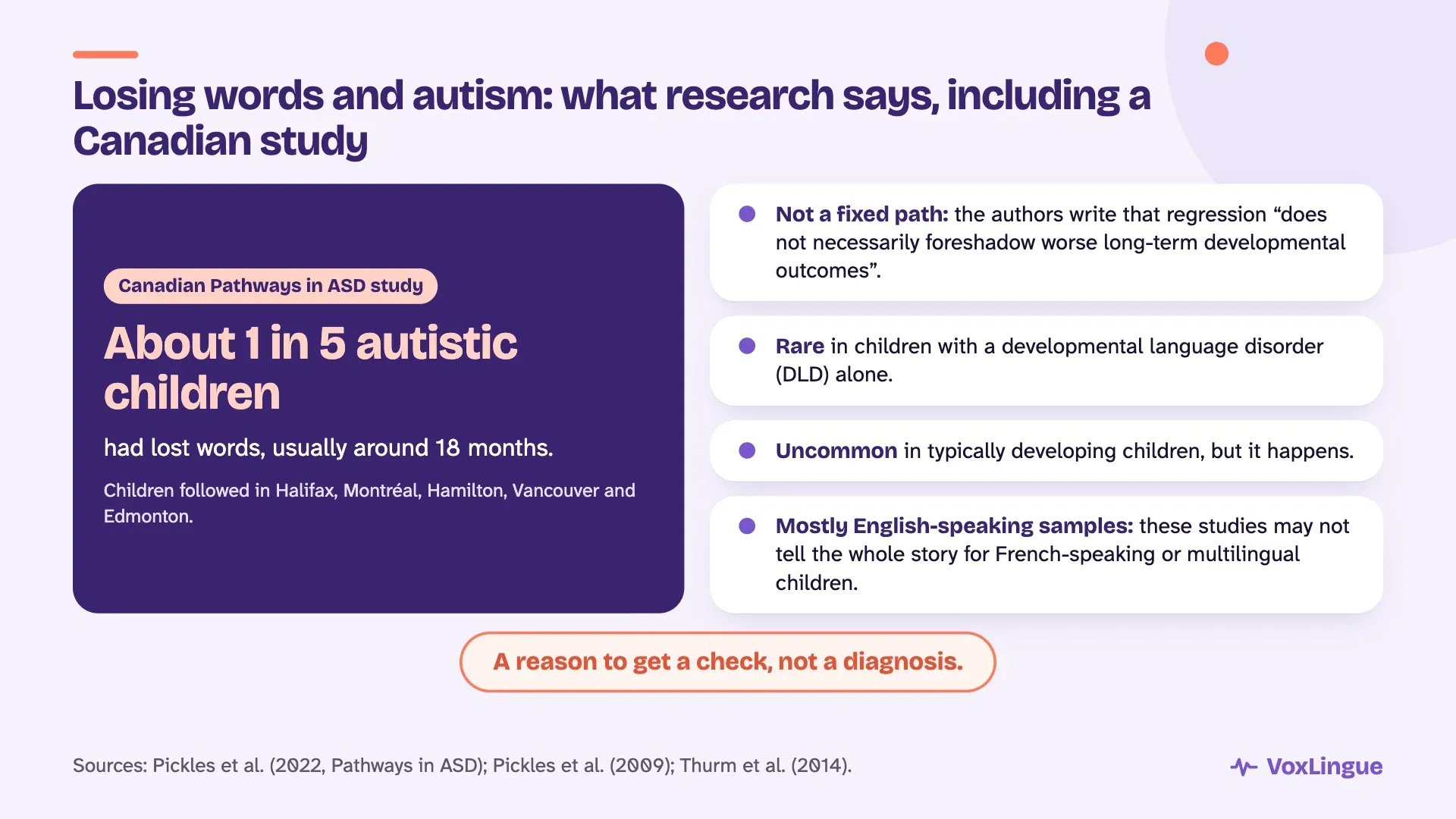
Not always. In studies, losing words is mostly linked with autism, but not only, and not in every autistic child. In a large Canadian study that included Montréal, about 1 in 5 autistic children had lost words, usually around 18 months. It is a reason to get a check, not a diagnosis.
That study, Pathways in ASD, followed autistic children in Halifax, Montréal, Hamilton, Vancouver and Edmonton (Pickles et al., 2022). Those who had lost words had walked and said their first words earlier. They reached phrase speech at about the same age as the others.
The authors write that regression “does not necessarily foreshadow worse long-term developmental outcomes”. These children still had larger communication delays during follow-up, largely explained by differences that were there from the start.
In a British study, language loss was rare in children who had a developmental language disorder (DLD) alone (Pickles et al., 2009). In typically developing children, it is uncommon in studies, but it happens (Thurm et al., 2014). Most of this research comes from English-speaking children, so it may not tell the whole story for French-speaking or multilingual children.
Losing words is a reason to have things checked, not a label: there are several possible causes, and the doctor also looks at medical ones. See also our article on late talkers and developmental language disorder.
What to write down when your toddler stops saying words: the two-week notes sheet
Write down the words they no longer say and what they still do. Note when you last heard each word, and in which language. Add what changed around them and a few short videos. You take these notes while you call: they are not a reason to wait.
Our printable sheet gives you room for:
- the words they no longer say, when you last heard them, in which language, and whether they said them on their own or only by repeating;
- their other skills, day by day: pointing, gestures, eye contact, response to name, play, understanding;
- what changed around them: illness, ear infections, sleep, a move, a new baby, daycare;
- the short videos you took, with their dates.
Videos help professionals a lot, because they only see your child for a short time. Film bath time, a meal, play in the living room.
Avoid asking your child to repeat their old words to check. Quizzing puts on pressure and doesn’t show what they do day to day. Note what they say on their own instead. Our article on simple ways to help your toddler talk every day explains what to do instead.
Start the sheet the day you call, and bring it to the appointment.
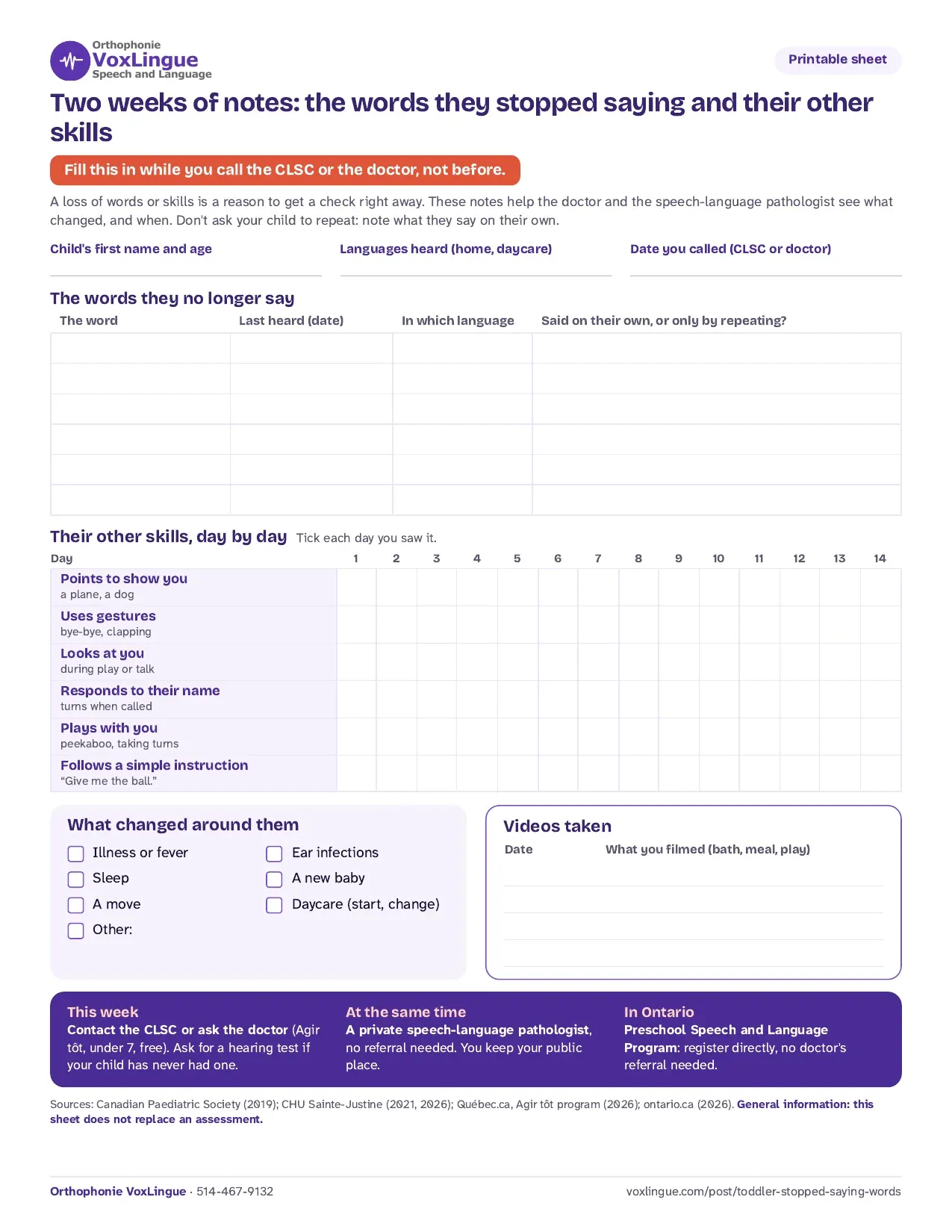
Printable sheet: Two weeks of notes: the words they stopped saying and their other skills (PDF, 1 page).
Who should you call, and should you wait before getting a check?
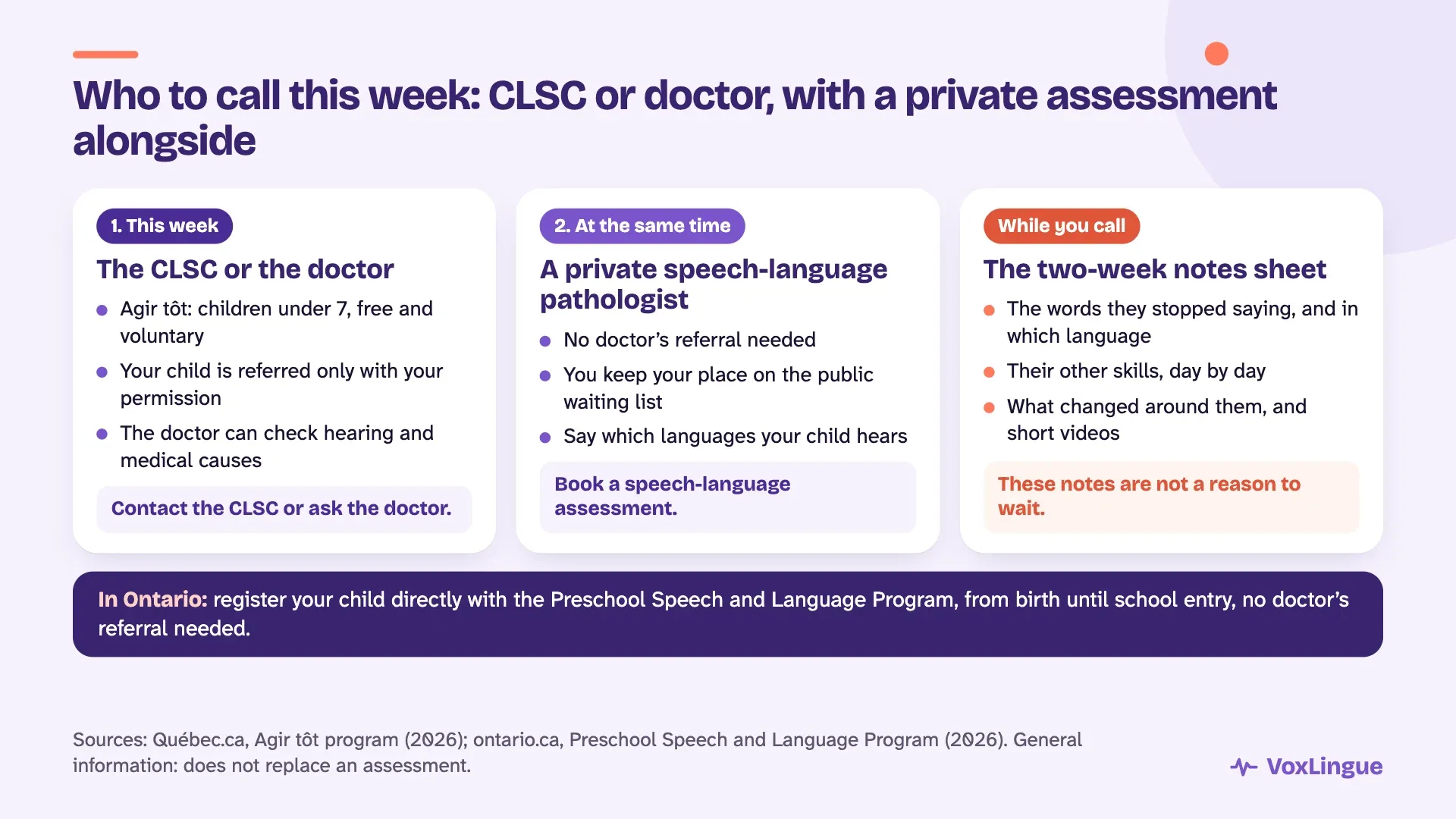
No, you don’t need to wait. This week, contact the CLSC or ask the doctor: your child can be referred to Agir tôt, and the doctor can have their hearing checked. At the same time, you can book a private speech-language consultation. In Ontario, register your child directly with preschool speech services.
In Québec: contact the CLSC or ask the doctor
The public route is called Agir tôt. According to the Agir tôt program page on Québec.ca, it serves children under 7 and their families. Its services are free and voluntary (2026).
To get in, contact the CLSC or ask the doctor. A professional can refer your child to the program only with your permission. For non-urgent health questions, Info-Santé 811 can also guide you.
The doctor can check hearing and look at medical causes. Wait times vary by region: our article on the public waiting list and what to do meanwhile helps you find your way.
At the same time: a private speech-language consultation
Get your place on the public list first, and see someone privately at the same time if you can. That is what Kimberly Martins, speech-language pathologist and founder of VoxLingue, recommends. You keep your place on the waiting list, and you get advice without waiting your turn.
You don’t need a referral to see a private speech-language pathologist. Bring your notes and videos, and say which languages your child hears at home and at daycare.
In Ontario: self-referral to preschool services
In Ontario, the Preschool Speech and Language Program serves children from birth until they start school. You don’t need a doctor’s referral: you can register your child as soon as you have a concern (2026).
For private advice at the same time, telepractice for Ontario families lets you consult from home.
What to remember
Your toddler stopped saying words they used to say? First ask whether the words are changing or being lost.
- A word that changes is not a lost word: a baby word replaced or a word said differently is ordinary.
- A real loss is several words gone, or words fading together with gestures, eye contact or play.
- A loss of words or skills is a reason to get a check this week, not to wait.
- Have hearing checked, and keep the home language.
- Take notes while you call: the two-week sheet is not a waiting period.
Next step
If what you see looks like a real loss, contact the CLSC or ask the doctor this week. At the same time, you can book an assessment with a private speech-language pathologist, no referral needed. Our speech-language pathologists see families at our Marché Central clinic in Montréal and by telepractice across Québec and Ontario.
Printable sheet, to fill in while you call: Two weeks of notes: the words they stopped saying and their other skills (PDF, 1 page).
Frequently asked questions
Will the words come back?
No one can predict it: it depends on the cause. If a baby word was replaced, nothing was lost. If it is a real loss, an assessment helps you understand what is happening and what to do. In the Canadian Pathways study, losing words did not necessarily mean a worse outcome.
My toddler says fewer new words since they started walking: is it related?
Some parents notice fewer new words for a while. Yet on average, an American study linked the start of walking with more words understood and said, not fewer (Walle and Campos, 2014). A pause is not a loss. If your toddler stopped saying words they used to say, get a check without waiting.
Should I ask my child to repeat old words to check?
No. Quizzing and “say it” put on pressure and don’t show what your child does day to day. Write down the words they say on their own, in ordinary moments, and film a few short clips: that is what helps professionals.
Can ear infections cause speech regression?
An ear infection can leave fluid behind the eardrum, which lowers hearing, on average slightly and often temporarily. A child who hears less well may react less and say fewer words. Have hearing checked, and also get a check if words or other skills have disappeared.
Do I need a referral to see a private speech-language pathologist or audiologist?
No. In Québec, a private speech-language pathologist or audiologist sees you without a referral. In the public system, the hearing test is free, but some facilities ask for a referral. The simplest route: get your place in the public system through the CLSC or the doctor, and see someone privately at the same time.
My toddler talks less since the new baby arrived: how long should I wait?
Baby talk or asking for the soother again is a common step back. But if your toddler has lost words, pointing, eye contact or response to their name, don’t wait for them to adjust. None of the Québec or Canadian sources we read suggests a waiting period when words are lost.