Language milestones from 0 to 5 for bilingual children (complete guide and printable chart)
Your child hears Spanish at home, French at daycare and some English with their cousins. Then you come across a milestone chart that says “50 words by age 2.” You count their English words, you get to 20, and the worry sets in.
This guide is written for that moment. It walks you through the language milestones for bilingual children from birth to age 5, and the right way to count a bilingual child’s words. You will also see what is normal when a child grows up with two or more languages, and which signs are worth discussing with a speech-language pathologist.
Along the way, you will find practical ideas to support each of your child’s languages, the steps to follow in Quebec, and a printable chart.
One thing first: the milestone charts you find online were not designed for bilingual children. That is not a reason to ignore them. It is a reason to read them differently, and that is what this guide is about.
Do bilingual children talk later?
No. Quebec’s professional order of speech-language pathologists and audiologists (OOAQ, 2026) says children exposed to two languages from birth say their first words around age 1. They combine words between 18 and 24 months, like other children. Around age 5, they speak at a level comparable to children who speak only one language.
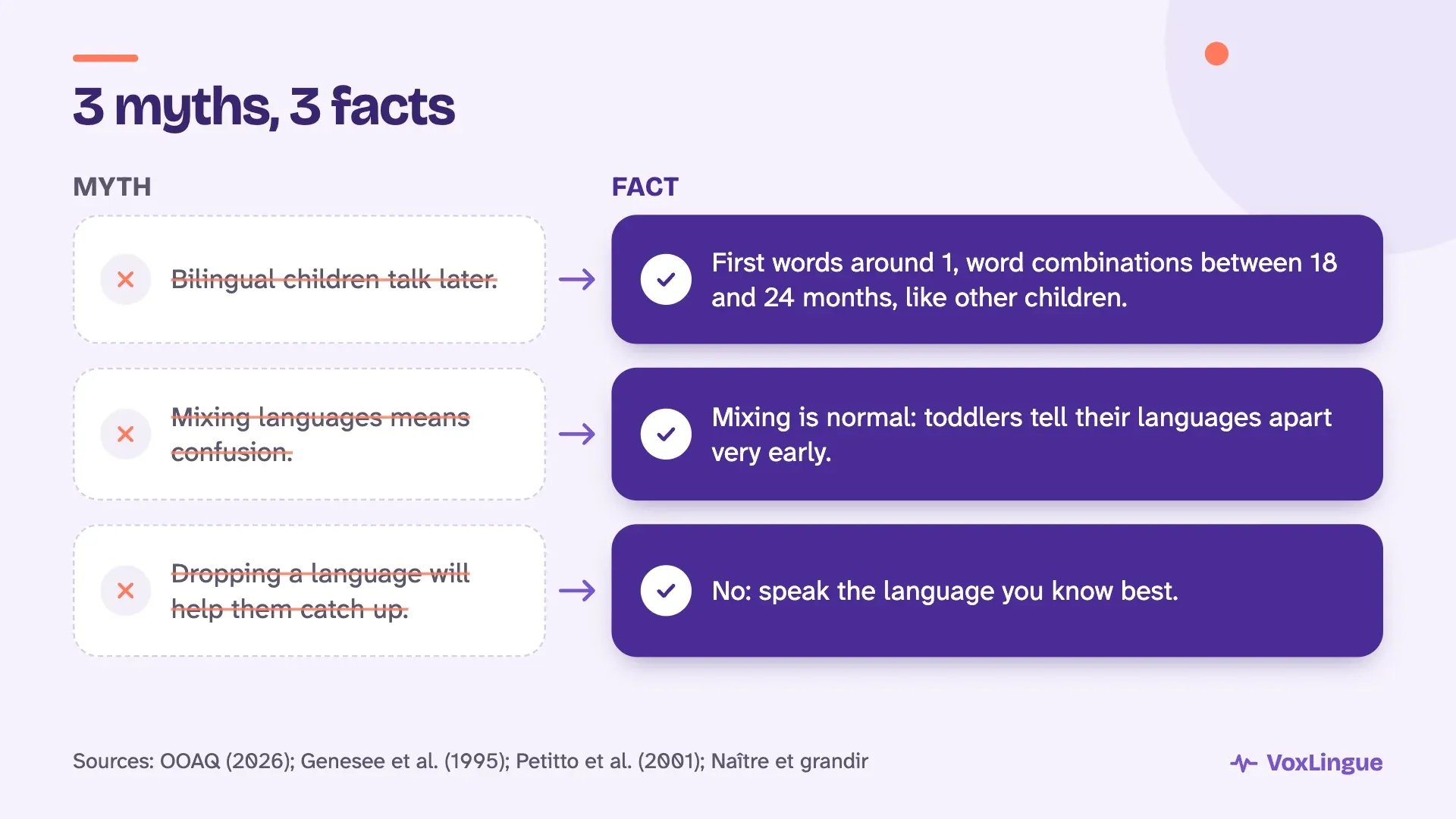
Recent research points the same way. A study published in 2025 compared 302 bilingual and 302 monolingual children (Muszyńska et al., Journal of Child Language). It found the same ages for babbling, the first word, the fiftieth word and the first word combinations. Learning two languages does not cause a language disorder, and it does not make a child’s existing difficulties worse.
So where does the idea that bilingual children talk late come from? Mostly from the way words are counted. In any one of their languages, a bilingual child often knows fewer words than a child who speaks only that language. A large study carried out in Montréal showed this again in 2024 (Byers-Heinlein et al.). If you count only their English words, or only their French words, you underestimate them.
We often hear this myth in two opposite forms. The first is “bilingual kids talk late, so we can wait.” The second is “pick one language so they can catch up.” Both can do harm. The first delays a consultation that could help. The second takes a family language away from the child without helping the other one.
Two ways to become bilingual: from birth or later
Specialists distinguish two paths. Simultaneous bilingualism means a child hears two languages regularly before about age 3. Sequential bilingualism means a second language arrives later, often at daycare or school. The age-3 line is a convention, not a sharp boundary (ASHA Practice Portal; CIUSSS de la Capitale-Nationale, 2022).
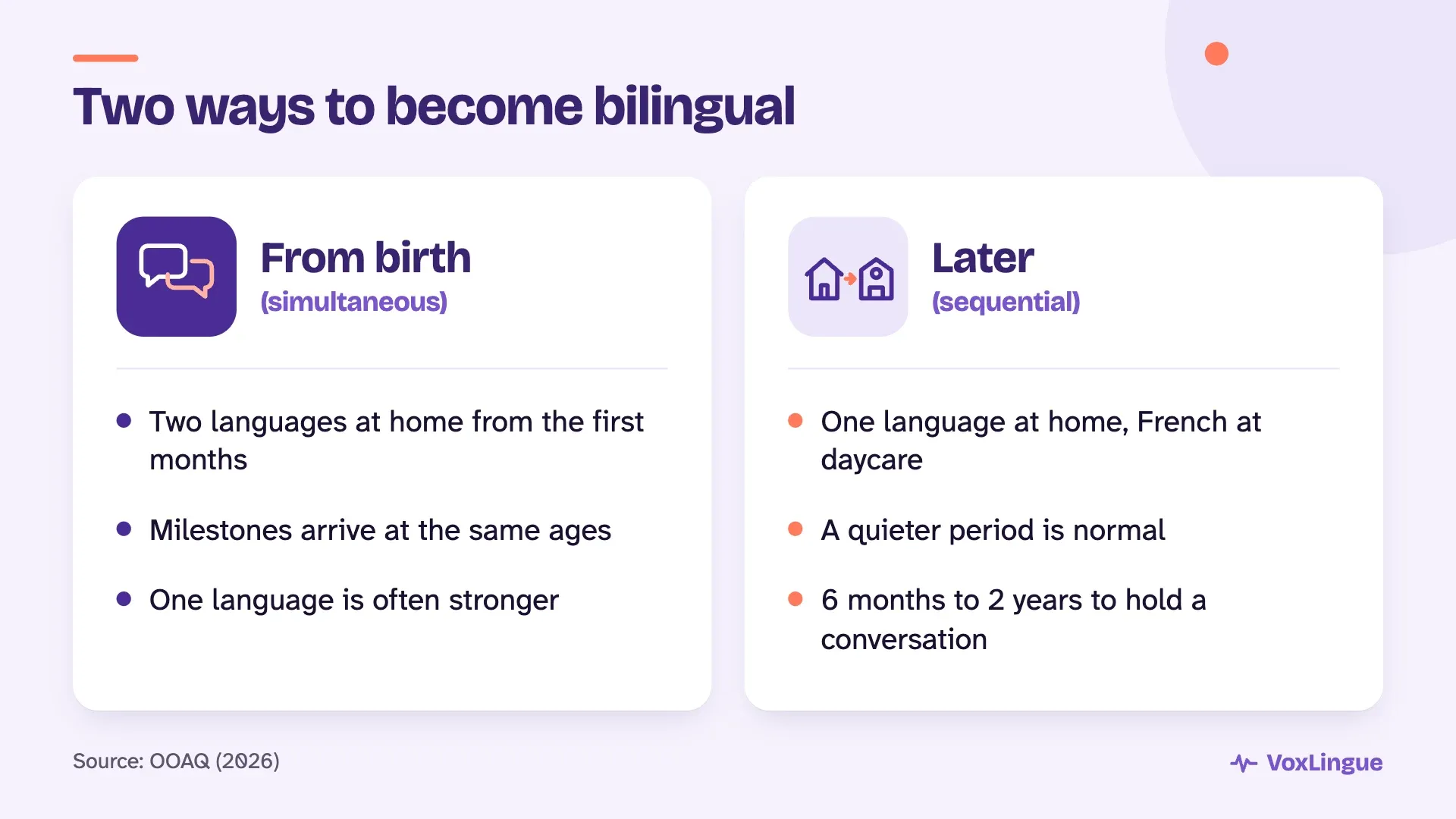
In simultaneous bilingualism, both languages develop at the same time. The big milestones arrive at the same ages as for other children. One language is often stronger than the other, usually the one the child hears most. That balance can shift as the child’s daily life changes.
In sequential bilingualism, the child already has a first language when they meet a new one. They often go through a quieter period in the new language. Then they start with single words and set phrases, like “my turn” or “all done,” before they can hold a conversation. This is the path of many Montréal toddlers who speak another language at home and discover French at daycare.
In Montréal, this is a very common situation. On the Island of Montréal in 2021, just under half of residents mostly spoke French at home, and about 24% mostly spoke English. Nearly 19% mostly spoke a language other than French or English, and about 9% spoke more than one language most often (OQLF, 2022).
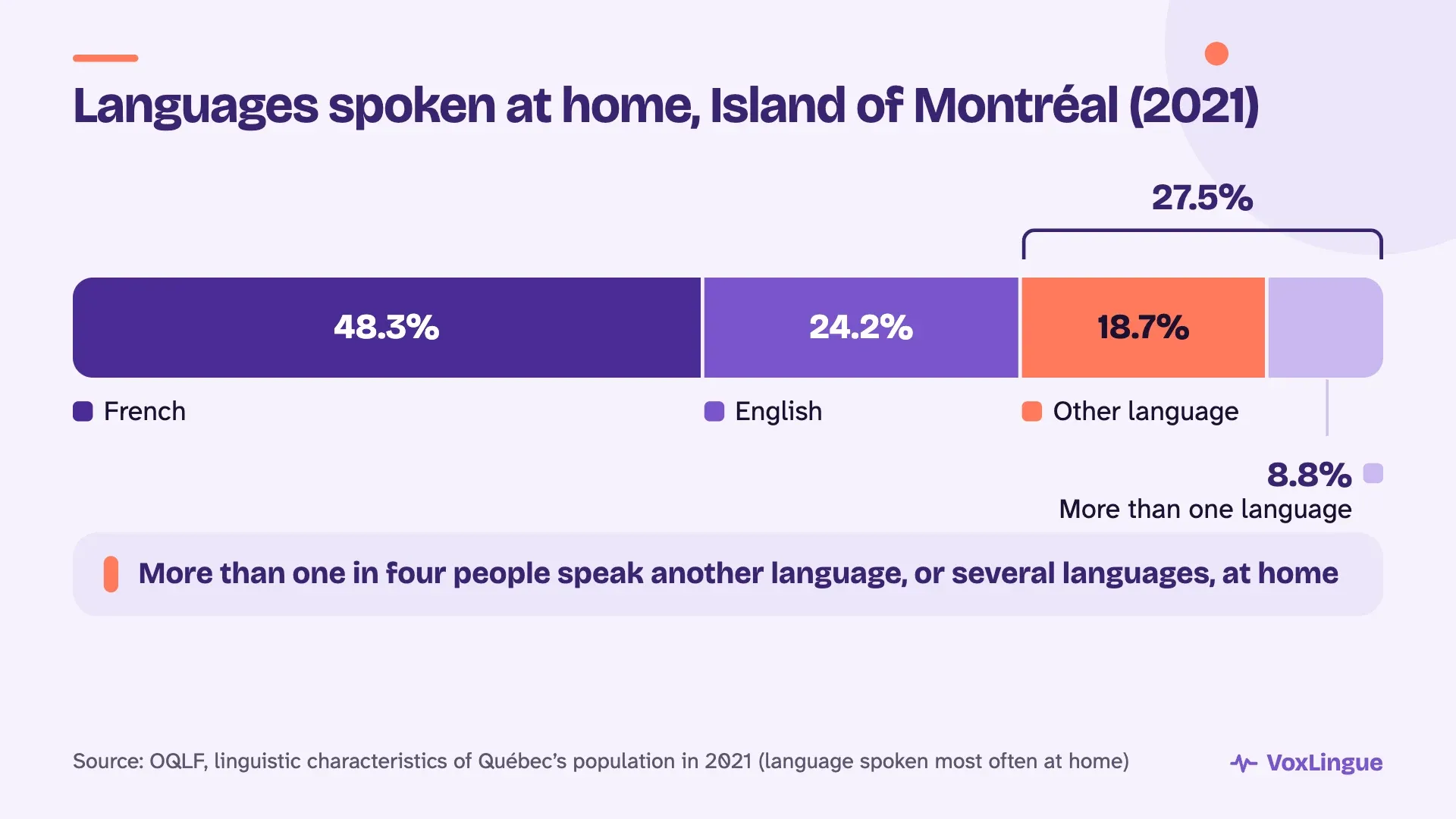
Both paths are normal ways to become bilingual. Knowing which one describes your child helps you read their milestones. A child who has heard French and English since birth is compared one way. A child who started French at daycare at age 2 is compared another way, as you will see below.
How do you read language milestones for bilingual children?
Three rules are enough. Add up the words in all of your child’s languages. Check that at least one of their languages is on track for their age. And look at what they understand and how they use gestures, not only at the words they say. These rules turn a general chart into a useful one.
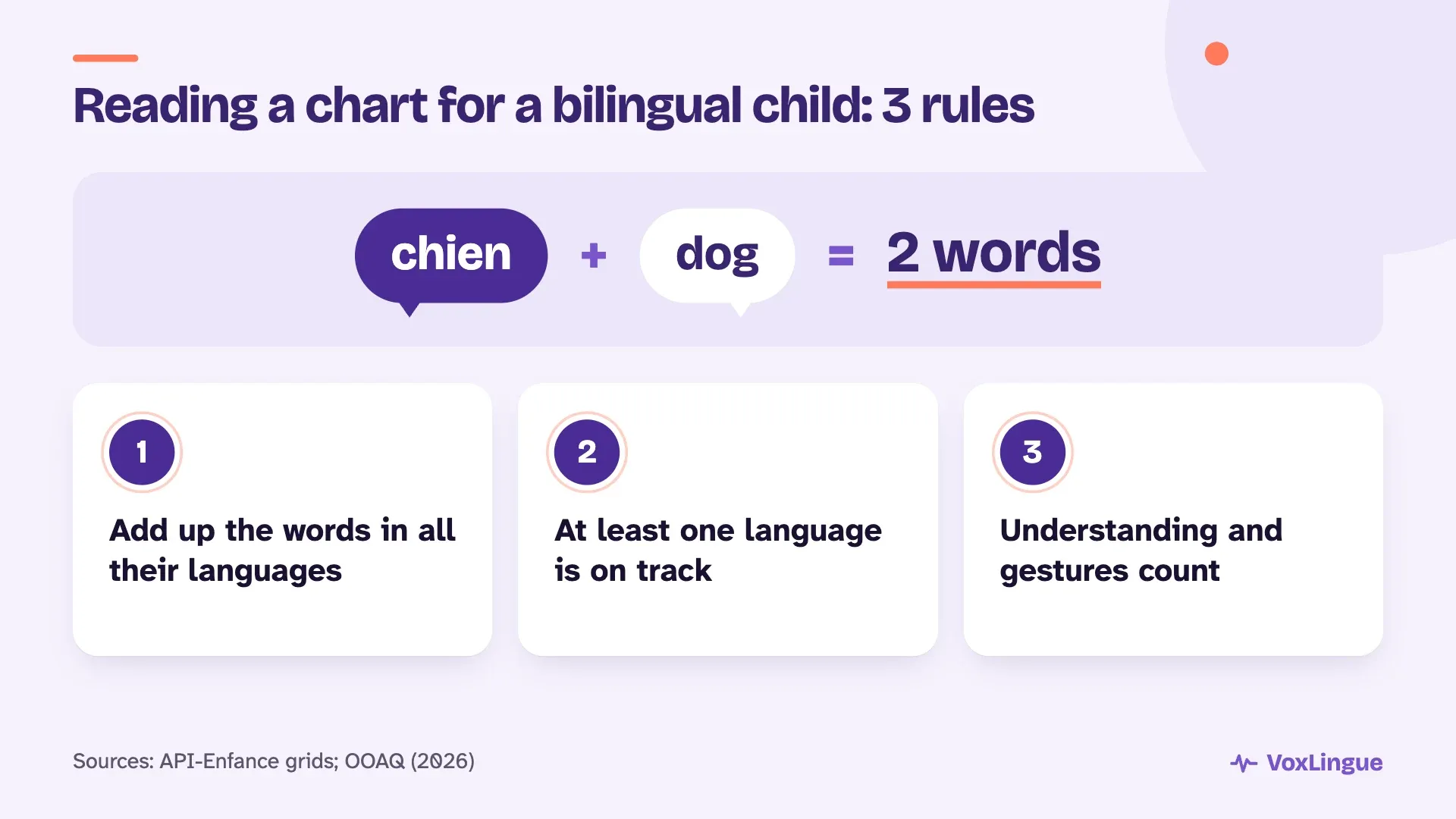
Rule 1: add up the words in all their languages. If your child says chien at daycare and dog with their dad, that counts as two words. The language development grids used in Quebec say this explicitly for bilingual children: count words in every language the child uses (API-Enfance, CIUSSS de la Capitale-Nationale). Counted this way, bilingual toddlers’ vocabularies are comparable to those of monolingual toddlers (Pearson, Fernández and Oller, 1993).
Many parents count only one language, usually the one the daycare or the doctor asks about. We often see this: once the words in every language are added up, the picture changes, and many parents feel reassured. A child who seemed “behind” in French may in fact have a rich vocabulary across Spanish, French and English.
Rule 2: check that at least one language is on track. A bilingual child often has a stronger language. What matters is that this language is progressing as expected for their age. A weaker language, especially one learned later, such as French at daycare, is not in itself a sign of delay.
Rule 3: count understanding and gestures too. A child who understands what you say, points, shows you things and uses gestures to communicate is sending very positive signals. That is true even if they still say only a few words.
A practical tip: for two weeks, write down every word your child says, in any language, and who they said it to. A notebook or a note on your phone works well. This list is the best basis for reading a milestone chart, and it is very helpful if you consult. The printable chart at the end of this guide includes a space for it.
Bilingual language milestones, age by age
The ages below are approximate, since every child moves at their own pace. For a bilingual child, read them with the three rules: words in all languages added up, at least one language on track, understanding and gestures included. Each period covers what is usually seen, what differs for a bilingual child, and simple ways to help.
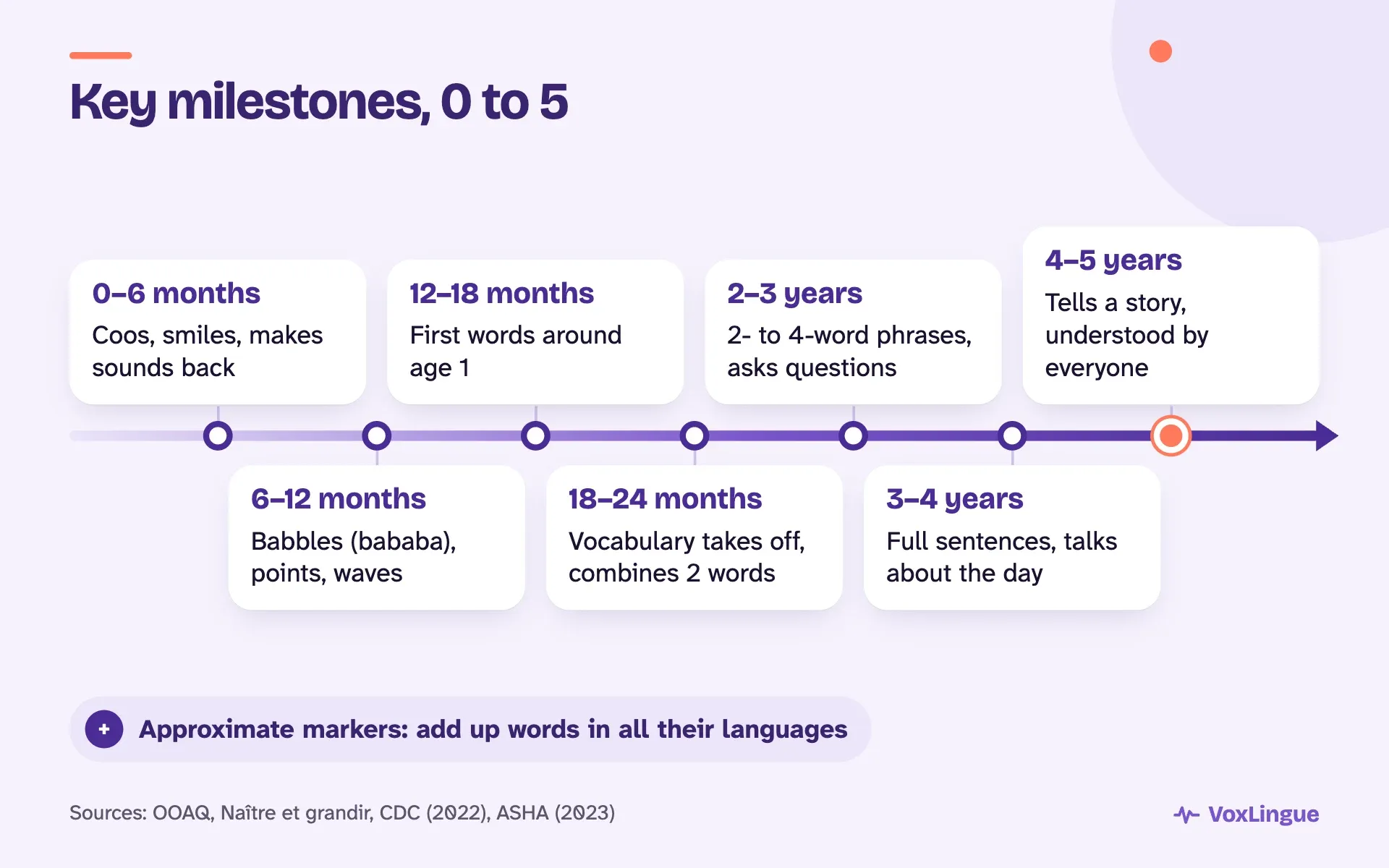
| Age | What they understand | What they say | For a bilingual child |
|---|---|---|---|
| 0 to 6 months | Reacts to sounds and voices; calms down when spoken to | Coos around 3 to 6 months, smiles, makes sounds back | Same timing; babies already tell their languages apart |
| 6 to 12 months | Responds to their name; understands “no” and a few familiar words | Babbles (“bababa”) around 6 to 9 months; points and waves bye-bye around 9 to 12 months | Babbling and gestures are not delayed by two languages |
| 12 to 18 months | Follows simple directions, at first with gestures | First words around 12 months; at least about 15 words by 18 months, often many more | Add up the words in all their languages; first words may come mostly in one language |
| 18 to 24 months | Follows simple directions without gestures; points to body parts | Vocabulary speeds up; about 50 words or more and two-word combinations around age 2 | Mixed phrases (“more lait”) count |
| 2 to 3 years | Follows two-step directions; understands where, who and what | 2- to 3-word phrases, then 3 to 4 words around age 3; asks questions | One language is often stronger: compare that one to their age |
| 3 to 4 years | Follows longer directions; understands why and when | Full sentences, talks about their day; understood most of the time | Errors that come from the other language are expected |
| 4 to 5 years | Understands explanations and time words | Long sentences with “because,” tells a story; understood by strangers | Around 5, a level comparable to monolingual children in a well-supported language |
Sources: OOAQ, Naître et grandir (a Quebec parenting resource), CDC (2022), ASHA (2023). These markers come mostly from studies of children who speak one language, English (CDC, ASHA) or French (the Quebec grids).
From 0 to 6 months: conversation starts before words
From the first weeks, your baby reacts to voices and calms down when you talk to them. Between 3 and 6 months, they coo, smile and make sounds back at you. By about 6 months, most babies already take turns making sounds with an adult: they make a sound, you answer, and they go again (CDC, 2022).
The bilingual side. The timeline is the same for a baby who hears two languages. Very young babies notice the sounds and the rhythm of each of their languages early on. Hearing two languages does not confuse them.
How to help. Copy your baby’s sounds, then give them time to answer: that is already a conversation (Naître et grandir, 2024). Talk face to face, with a sing-song voice and real words rather than “baby talk.” Read and sing from birth, in your own language, even if your baby does not understand yet (Canadian Paediatric Society, 2021).
From 6 to 12 months: babbling, gestures and first “dialogues”
Around 6 to 9 months, babies babble by repeating syllables (“bababa,” “mamama”). They respond to their name, look when you call them and lift their arms to be picked up. Around 9 to 12 months, they point, wave bye-bye, and understand “no” and a few familiar words.
They also start to follow your gaze and look at what you show them. This is called joint attention, and it is an important foundation for language. When you and your baby look at the same thing and share the moment, words have something to attach to.
The mouth is learning at mealtimes too: between 6 and 12 months, babies move from purées to lumps and start drinking from an open cup. Our guide to baby feeding milestones from 0 to 12 months explains each step.
The bilingual side. Babbling and gestures are not delayed by bilingualism (Germain et al., 2022). A baby who is not babbling by around 12 months is worth discussing with a professional, however many languages they hear.
How to help. Turn their babbling into words: “ma-ma-ma” becomes “Yes, that’s Mama!” Name what your baby looks at or points to, and answer with words when they point to ask for something. Play peekaboo and pat-a-cake. These little routine games teach waiting, taking turns and the fun of communicating.
From 12 to 18 months: first words
First words usually appear around 12 months. They are often incomplete (“ba” for “ball”), and one word can mean several things. At this age, it is common not to hear new words every day. By 18 months, a child says at least about 15 words, often many more, and points to show you something interesting (CDC, 2022).
The bilingual side. Add up the words in all their languages. First words may appear mostly in one language, the one the child hears most, and that is normal. A child who understands both languages well without saying much in one of them yet is on a good path.
How to help. Repeat what your child says and add a word: they say “ball,” you answer “Yes, a big ball!” Put words to what they are trying to communicate, without asking them to repeat. Observe, wait and listen before you speak. Following a child’s lead is linked to stronger language skills (The Hanen Centre, 2022).
From 18 to 24 months: the vocabulary burst
Between 18 and 24 months, vocabulary often takes off all at once. The child follows simple directions without gestures, points to parts of their body and starts combining two words (“more milk,” “Daddy gone”). Around age 2, you can expect about 50 words or more, all languages added up, and those first combinations.
Sounds like “r” and “th” are still hard at this age, and long words are often simplified. That is part of typical development and not a concern on its own at 2.
The bilingual side. Mixed combinations count: “more lait” is a real two-word phrase. Mixing languages at this age shows that your child is using every word they know to be understood. It is a sign of resourcefulness, not confusion.
How to help. Make their phrases one word longer. Have lots of back-and-forth exchanges: research suggests these conversational turns matter more than the number of words a child hears (Romeo et al., 2018). Read together often. Shared book reading has a measurable effect on language, especially when it happens regularly (Dowdall et al., 2020).
From 2 to 3 years: short sentences and questions
Your child makes 2- or 3-word sentences, then 3- or 4-word sentences around age 3. They ask questions, follow two-step directions, and understand where, who and what. Around two and a half, they start to pretend, for example by feeding a doll with a block (CDC, 2022).
Their speech becomes easier to understand for people who do not know them well, without being perfect yet. In a large study of English-speaking children in the United States, the typical child was understood about half the time by unfamiliar adults around two and a half to three. Every child should reach at least that level by age 4 (Hustad et al., 2021).
The bilingual side. One language is often clearly stronger at this age. That is the language to compare to the age markers. Your child may also use the grammar of one language in the other, such as a French word order in an English sentence. These cross-language influences are expected.
How to help. Ask simple questions about books: who, what, where? Tell them about your day and ask about theirs. When they say a word incorrectly, give back the correct model without asking them to repeat: “Yes, it’s a spoon.” Use opposites and concept words, like big and little, in and out.
From 3 to 4 years: telling about their day
Your child makes full sentences, even if they sometimes leave out small words. They tell you what happened during their day, follow longer directions and understand questions with why and when. They pretend to be someone else in play and begin to use “because,” “if” and “when.” They are understood most of the time, even by people who do not know them well.
The bilingual side. Between 3 and 5, being six months to a year behind in one language can be expected if the other language is developing well (Hoff and Ribot, 2017, a study of Spanish-English children in the United States). A child who started French late may still search for French words while telling a wonderful story in Spanish.
How to help. Ask open questions that start with why, how or when. Speak in full sentences and explain new words. Pretend-play with your child, and while reading together, ask them what they think will happen next.
From 4 to 5 years: telling a story
Your child makes long sentences with “because,” tells a story with at least two events, and keeps a conversation going over several exchanges. They use time words like yesterday and tomorrow, play with rhymes, and are understood by strangers (CDC, 2022). Some complex sounds and clusters like “tr” or “fl” may still need time.
The bilingual side. Around age 5, a child exposed to both languages since birth speaks at a level comparable to monolingual children in a well-supported language (OOAQ, 2026). For a child who started French at age 3 or 4, school French will take more time, and that is normal.
How to help. Play with rhymes and syllables, which prepares children for reading (see our article on pre-literacy skills and phonological awareness). Make up stories together, sort objects into categories, and ask questions about the stories you read.
Understanding and gestures come before words
For every child, and even more for a bilingual child, what they understand goes far beyond what they say. A child may understand many words in both languages while saying only a few in each. That is why professionals always look at understanding and gestures, not only at the number of words a child produces.
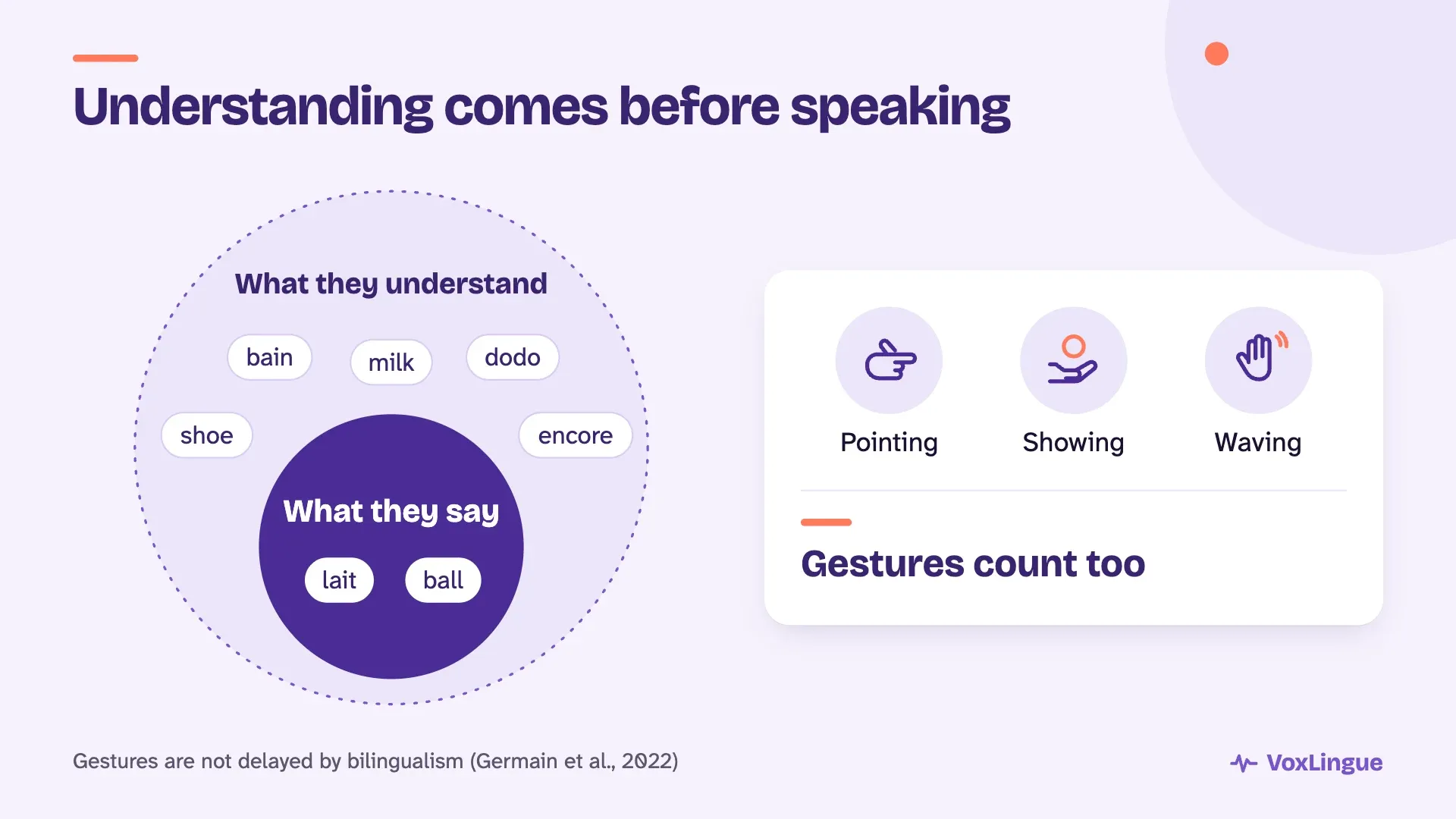
Gestures are very good indicators: pointing to ask or to show, waving bye-bye, nodding or shaking the head, holding out an object to share it. They are not delayed by bilingualism (Germain et al., 2022). A child who understands everyday directions in the language they hear most, and who communicates a lot with gestures, is sending reassuring signals, even if they still say little.
You can observe this at home without any test. Does your child bring you a toy to show it? Do they look at you and then at what you are pointing to? Do they follow “get your shoes” without a gesture? Each “yes” tells you something about their language, whatever the language.
On the other hand, some children understand little in all their languages, use few gestures, or rarely try to share their attention with you. In that case, talk to a speech-language pathologist without waiting to see whether the words will come.
Why don’t milestone charts all say the same thing?
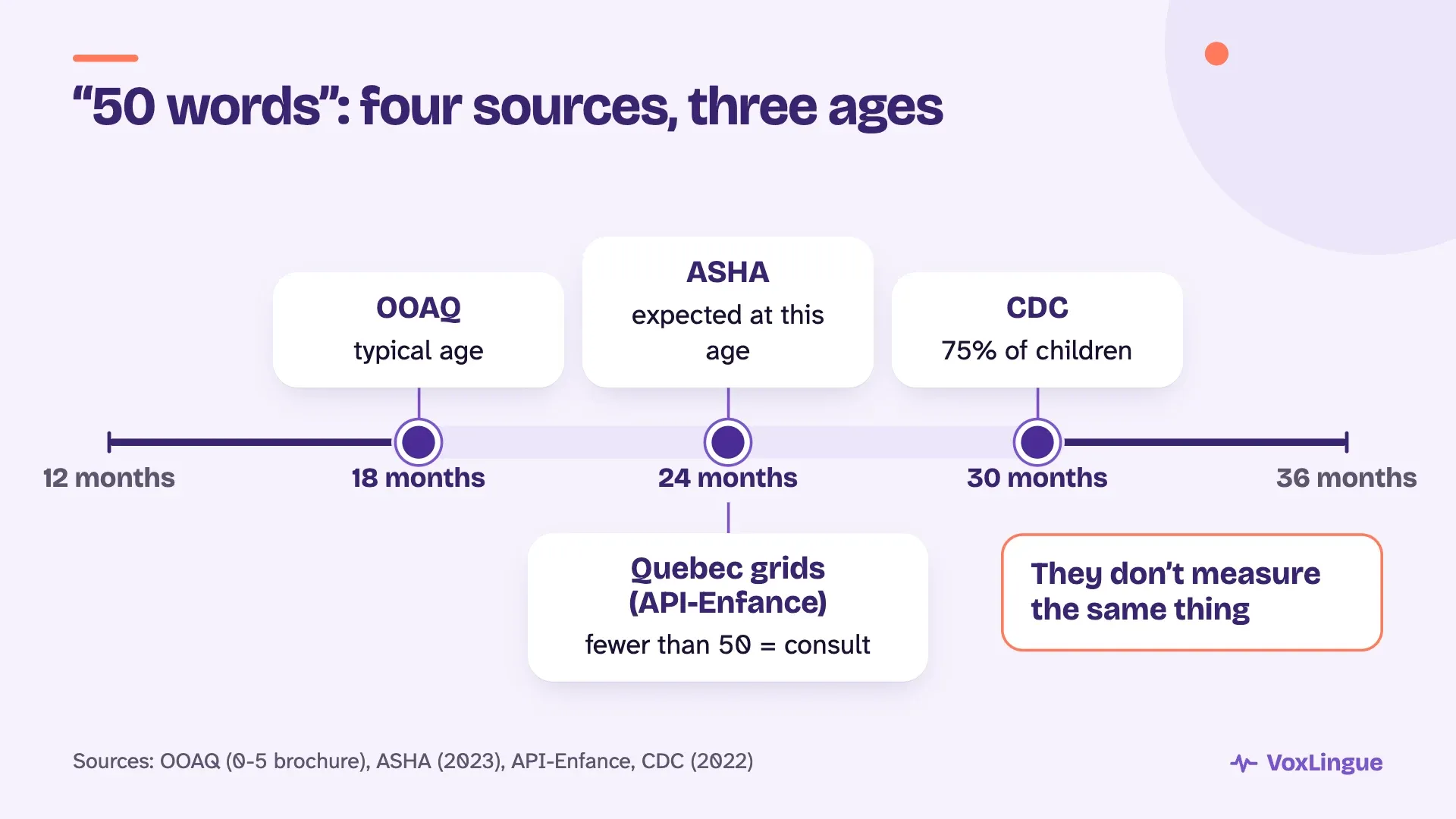
Because they do not measure the same thing. Some give the average age at which children reach a milestone. Others give the age by which most children have reached it, and others a threshold at which a consultation is recommended. The same “50 words” can therefore appear at 18 months, at age 2 or at 30 months.
| Source | “About 50 words” | Type of marker |
|---|---|---|
| OOAQ (0 to 5 brochure) | Around 18 months | Typical age |
| ASHA (2023) | At least 50 words by age 2 | What is expected at that age |
| CDC (2022) | About 50 words by 30 months | What most children (75% or more) do |
| Quebec grids (API-Enfance) | Fewer than 50 words around age 2 | Threshold to consult |
In 2022, the CDC and the American Academy of Pediatrics revised their milestones to list what most children, at least 75%, can do by a given age (Zubler et al., 2022). That choice places some milestones later than on other charts. It is useful for spotting children who need help, but it does not describe the typical child.
None of these charts was built for bilingual children. ASHA’s milestones are designed for children who speak English in the United States, and ASHA does not translate them for that reason. The Quebec grids were designed for children who speak only French. They all remain useful, as long as you read them with the three rules in this guide.
So use a chart as a guide, not a verdict. When in doubt, the whole picture matters: understanding, gestures, the stronger language and progress over the months.
What is normal for a bilingual child, and what deserves attention?
Several things that worry parents are actually typical of bilingual development. Others deserve a conversation, however many languages a child hears. The difference often comes down to one simple question: does the difficulty show up in only one language, or in all of them? That question guides the rest of this section.
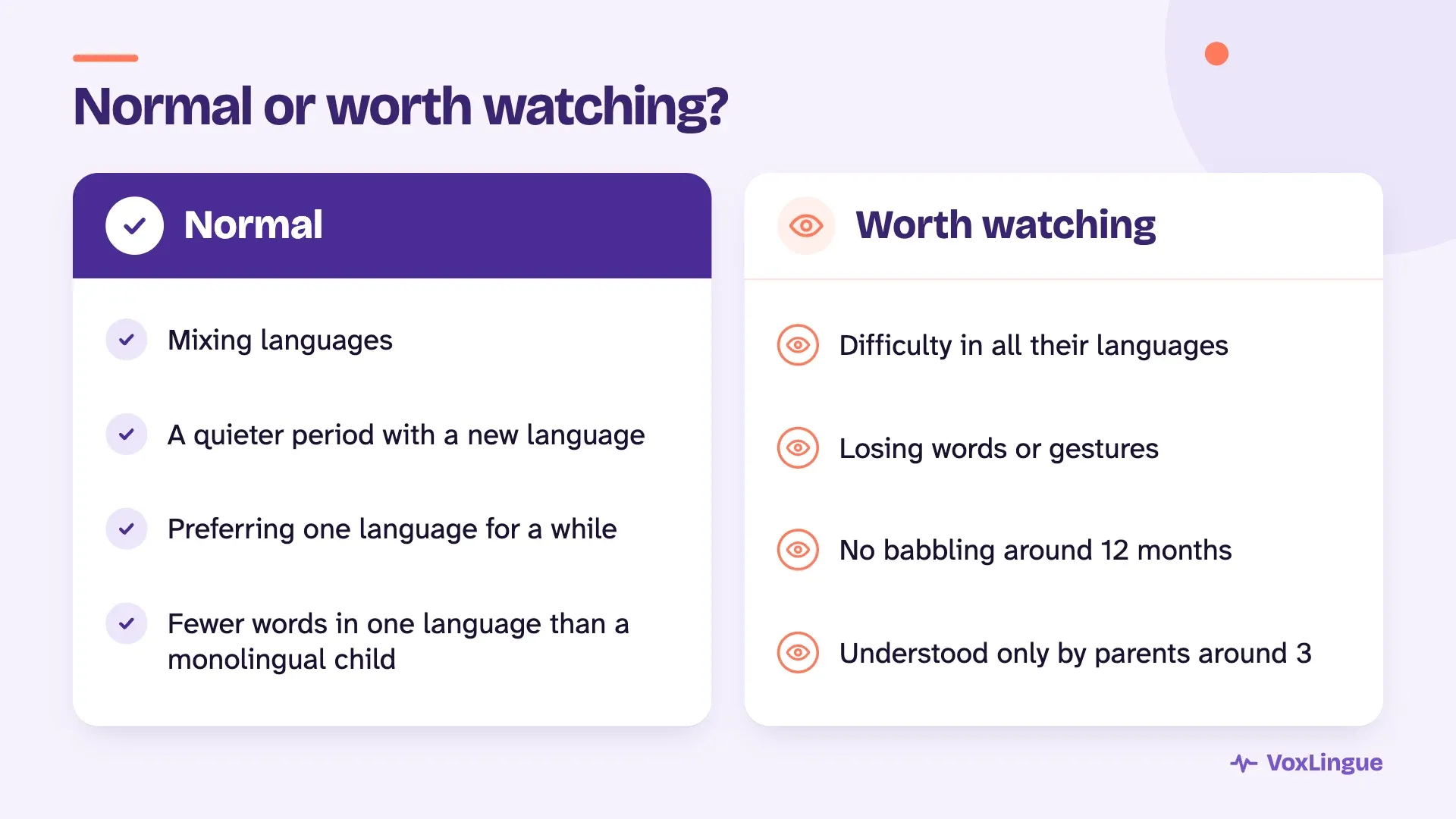
Mixing languages (“more milk,” “more lait”) is normal. Research carried out in Montréal shows that bilingual toddlers tell their languages apart very early, even when they mix them (Genesee et al., 1995; Petitto et al., 2001).
A quieter period is common during the first months of a new language, for example when a child starts daycare in French. It often lasts 3 to 6 months (Canadian Paediatric Society, 2026).
Preferring one language for a while is common. The stronger language can also change over time and with the setting, for example when a child spends more hours at daycare than at home.
Having fewer words in one language than a monolingual child is expected, as long as their languages together are on track for their age.
What deserves attention, on the other hand: difficulties in all their languages, the loss of words or gestures they used to have, no babbling around 12 months, or a 3-year-old understood only by their parents. We come back to these signs below.
French at daycare, another language at home: what should you expect?
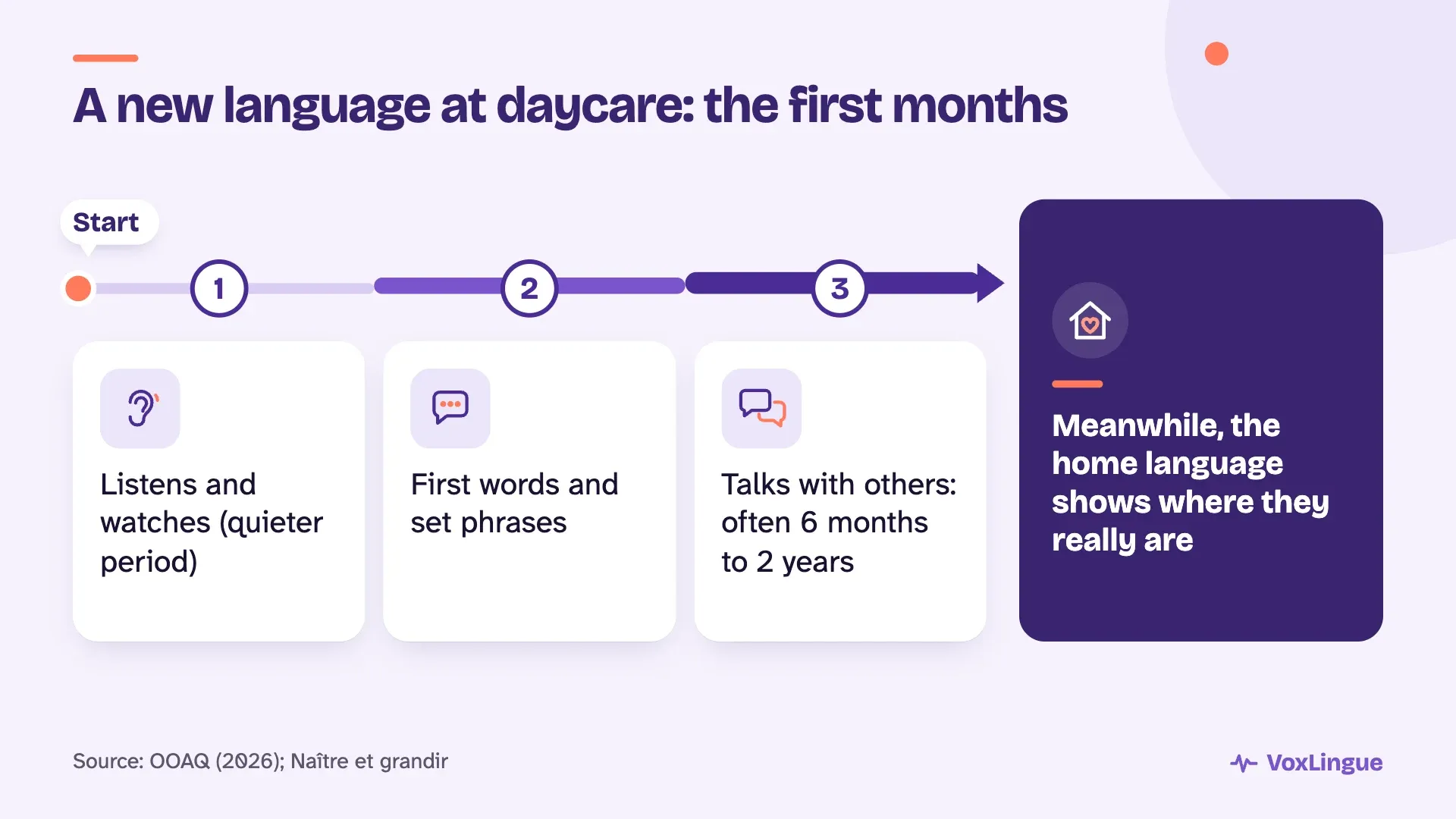
This is the reality for many Quebec families, and it usually goes well. A child who meets French at daycare often says little in French for the first few months. It often takes 6 months to 2 years to hold a conversation in a new language (OOAQ, 2026). In the meantime, the home language shows where your child really is.
Daycare in Quebec is a shared experience for most families. About 72% of children under 5 attended childcare in 2021 (Institut de la statistique du Québec, via the Observatoire des tout-petits). Many of these settings, including CPEs (Quebec’s subsidized early childhood centres), operate in French. So for many children who speak English, Spanish or another language at home, daycare is where French begins.
We often see children who are almost silent at daycare in their first months while talking a lot at home. In that case, home language is the best guide to their development. If the educator is concerned, ask what your child understands and how they communicate with other children, not only what they say in French.
It helps to separate two different skills. Chatting in French in the playground comes within a few months to two years. Mastering French like a monolingual child can take 5 to 7 years (Canadian Paediatric Society, Kids New to Canada). A 4-year-old who is “still searching for words” in French after a year of daycare is not, for that reason alone, delayed.
Starting kindergarten in French. If your child enters a French-language school without speaking much French yet, the school can offer French welcome and support services. These are given in a welcome class (classe d’accueil) or in a regular class, from preschool on (Quebec Ministry of Education, reference framework, 2014). This support is normal and does not mean your child has a language difficulty. Once again, what matters most is their home language.
In trilingual families, common in Montréal, a toddler may know fewer French and English words than a bilingual child, with big differences from one child to the next (Côté et al., 2022). The same rules apply: add up the words in all their languages, and look at the stronger language.
How can you support language in several languages every day?
Bilingual children progress through plenty of good interaction in each language. That means both the amount and the quality of exchanges count. There is no single method to follow. Speak the language you know best, widen the circle of people who talk with your child, read, sing and chat, and keep screens in their place.
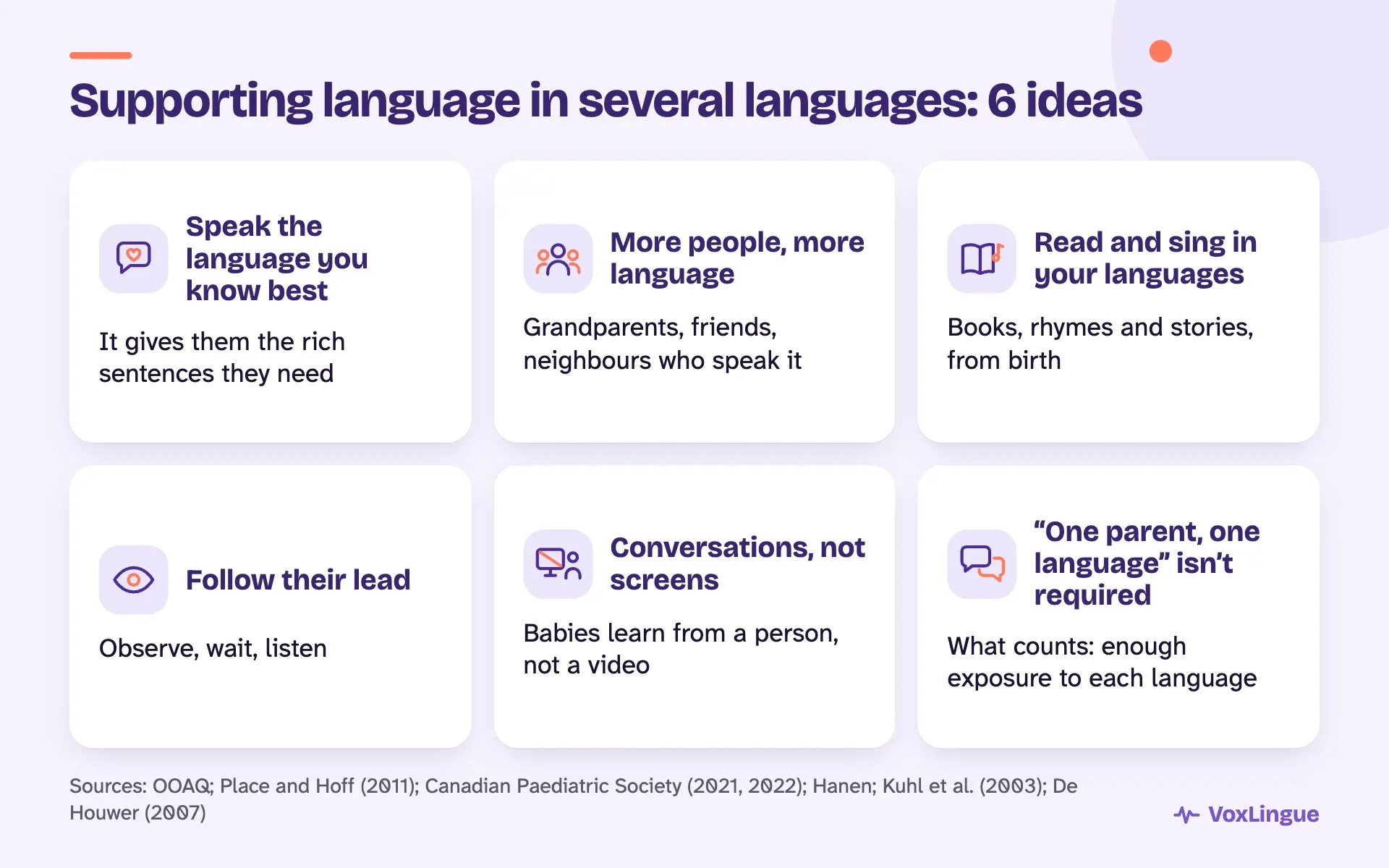
Speak the language you know best. This is what the OOAQ and Naître et grandir recommend. In a language you know well, you offer rich sentences, explanations, stories and jokes. Research confirms it: language from people who are comfortable in that language is richer, and that richness is what helps the child progress (Hoff, Core and Shanks, 2020).
If your French or your English feels shaky, nothing requires you to speak it at home. Daycare and school will take care of it. Your child gains far more from a warm, detailed conversation in Spanish than from a hesitant one in a language you are still learning.
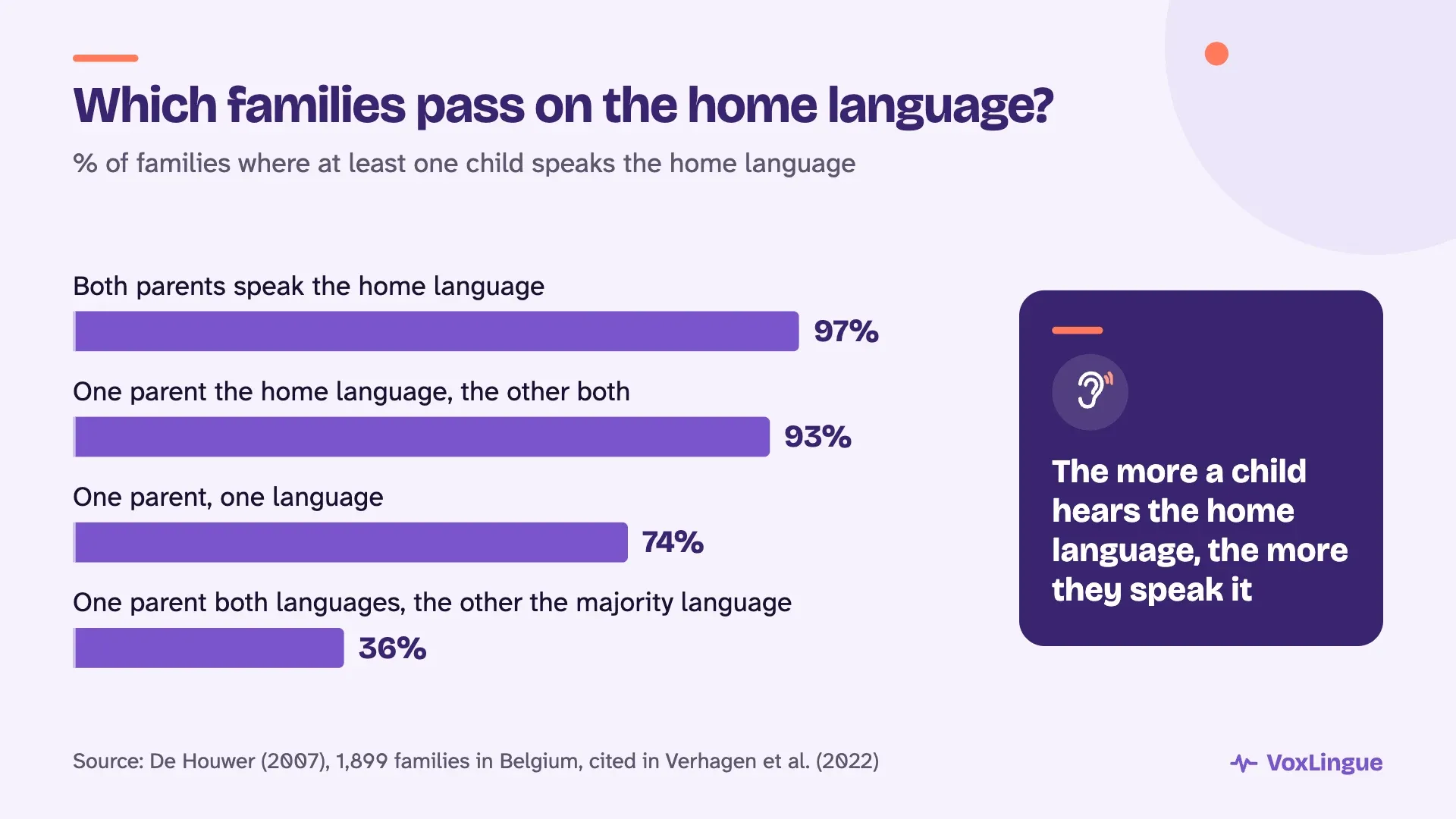
“One parent, one language” is not required. In this approach, each parent speaks their own language to the child. It can work, but it is neither necessary nor sufficient (De Houwer, 2007). In a large study of 1,899 families, the home language was most often passed on when both parents spoke it at home. What matters is that the child hears enough of each language (Byers-Heinlein and Lew-Williams, 2013).
Widen the circle of people who speak the home language. Hearing a language from several different people helps a child develop it (Place and Hoff, 2011). Grandparents, aunts and uncles, family friends, neighbours and video calls with relatives abroad all count. Where possible, a daycare or activities in the home language also give a solid foundation (Naître et grandir, 2021).
Read and sing in your languages. Read books, sing nursery rhymes and tell stories in your language, from birth. Skills learned in one language, such as understanding a story, transfer to the other (Canadian Paediatric Society, 2021). Public libraries often offer books and story times in several languages.
Mixing your languages when you talk to your child is normal. Many bilingual parents do it, for example when a word does not come to them right away. An older study found a small link with vocabulary. A 2025 study of 398 Montréal children found almost no link (Paquette and Byers-Heinlein, 2025). There is no need to police yourself: speak naturally.
Conversation rather than screens. The Canadian Paediatric Society does not recommend screen time before age 2, except video calls with family. From 2 to 5, it suggests about one hour a day or less (Caring for Kids). Babies learn the sounds of a language from a live person, not from a video (Kuhl et al., 2003).
A Toronto study also found that each extra 30 minutes a day of handheld device use at 18 months was associated with more parent-reported delays in expressive language (van den Heuvel et al., 2019). Cartoons in your home language can add to your conversations, but they cannot replace them.
Never stop speaking your language. Even when a child has a language disorder, they should not be limited to one language (Canadian Paediatric Society, 2026). Cutting back the home language does not improve the school language, and the child loses a language of their family. A recent study of school-age children with language difficulties points the same way (Lin and Paradis, 2026).
Which signs should you watch for, whatever the language?
Some signs are not explained by bilingualism. They are worth discussing with a professional without waiting, however many languages your child hears. The most important ones are a difficulty that shows up in all of your child’s languages, and the loss of skills they already had. Here is the list to keep in mind.
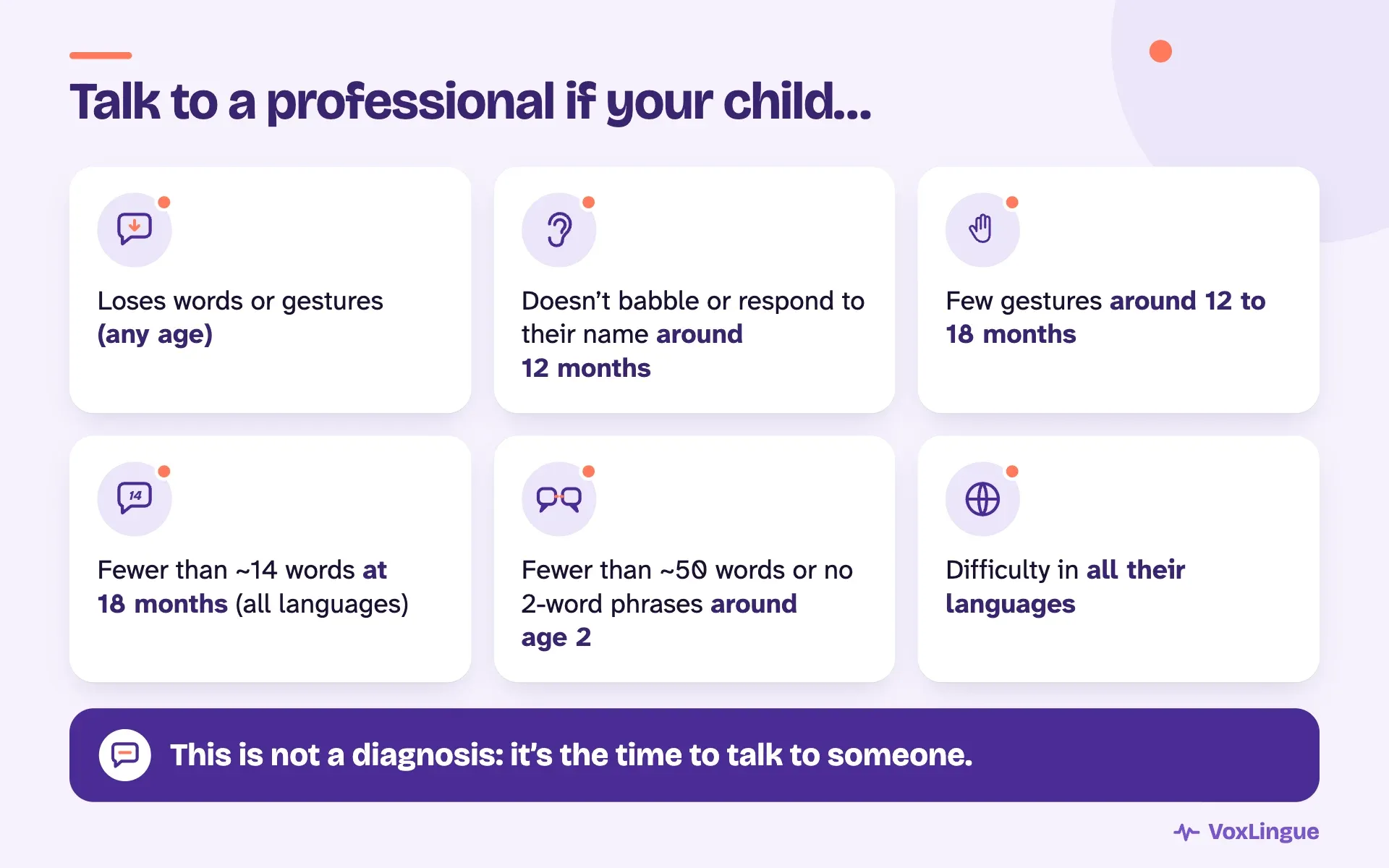
Talk to a speech-language pathologist or your doctor if your child:
- loses words, gestures or babbling they used to have, at any age;
- is not babbling (“bababa”) around 12 months, or does not respond to their name (have their hearing checked too);
- uses few or no gestures, such as pointing or waving, around 12 to 18 months;
- says fewer than about 14 words around 18 months, or fewer than about 50 words around age 2, all languages added up, or is not combining two words around age 2;
- is understood only by their parents around age 3;
- has difficulty in all their languages, not only in the newest one.
These signs are not a diagnosis. They mean a professional look will help you understand what is going on. A difficulty that also shows in the home language is not just a matter of learning French (Quebec Ministry of Education, 2014). A true language disorder shows up across all of a child’s languages, even if it looks a little different in each.
To learn more, read our article on telling bilingualism apart from a language disorder and our page on language delays and disorders. If your child is not yet talking much, our guide to late talkers in Montréal goes further.
What can you do if you’re worried in Quebec?
Start by writing down what you observe, in all of your child’s languages, then talk to someone. In Quebec, you can go through the public system, see a speech-language pathologist in private practice, or do both at the same time. You do not need a doctor’s referral to consult privately. Each route has its own strengths.
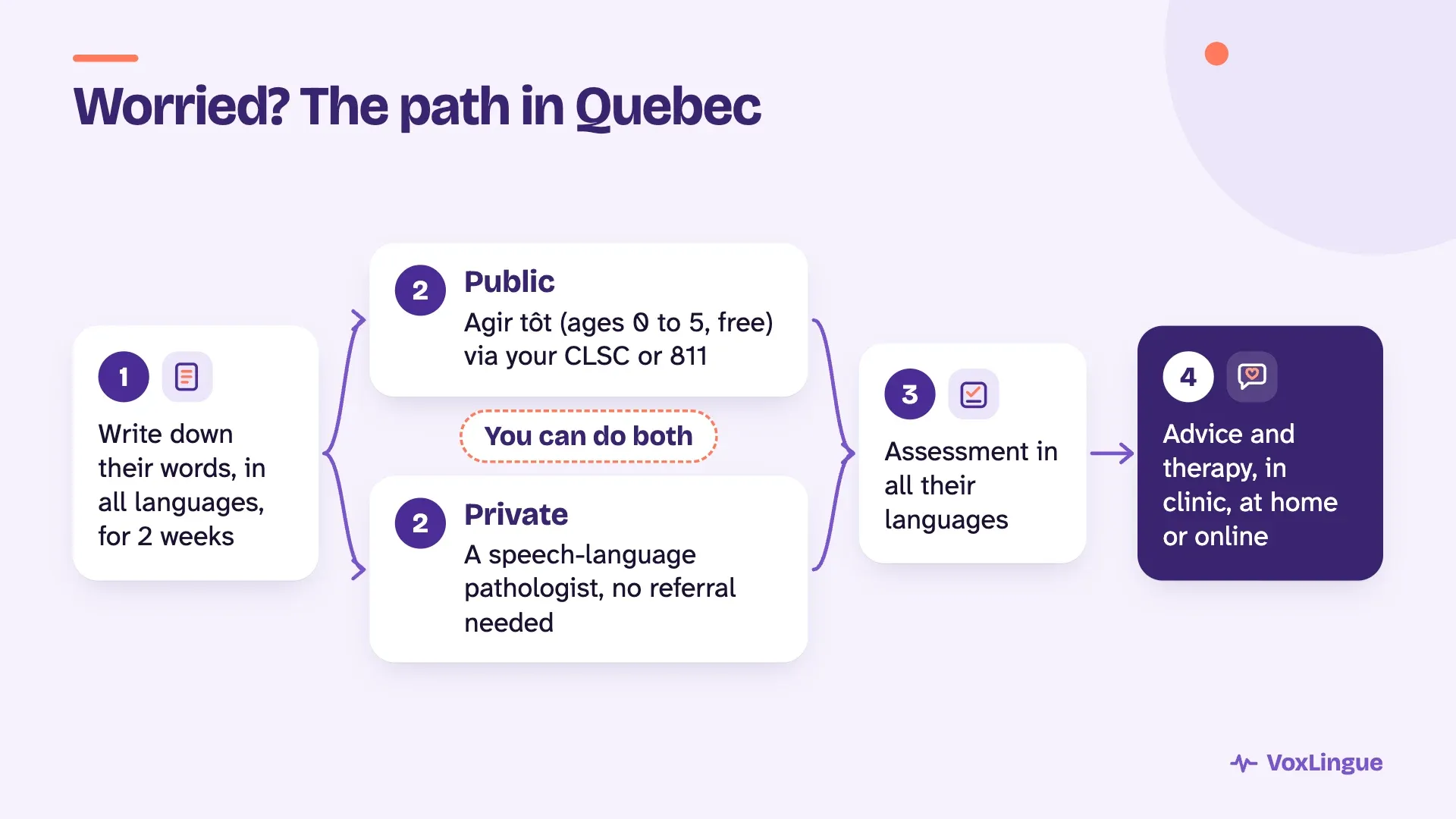
The public system. Quebec’s Agir tôt program offers free screening and services to young children until they start school. The name means “act early.” To request a screening, contact your CLSC or call Info-Social 811, option 2. A CLSC is your local community health and social services centre, part of the public network.
The CLSC nurse also often raises child development at the 18-month vaccination visit. That appointment is a good moment to mention any concern about language, in any of your child’s languages. Services are free and voluntary.
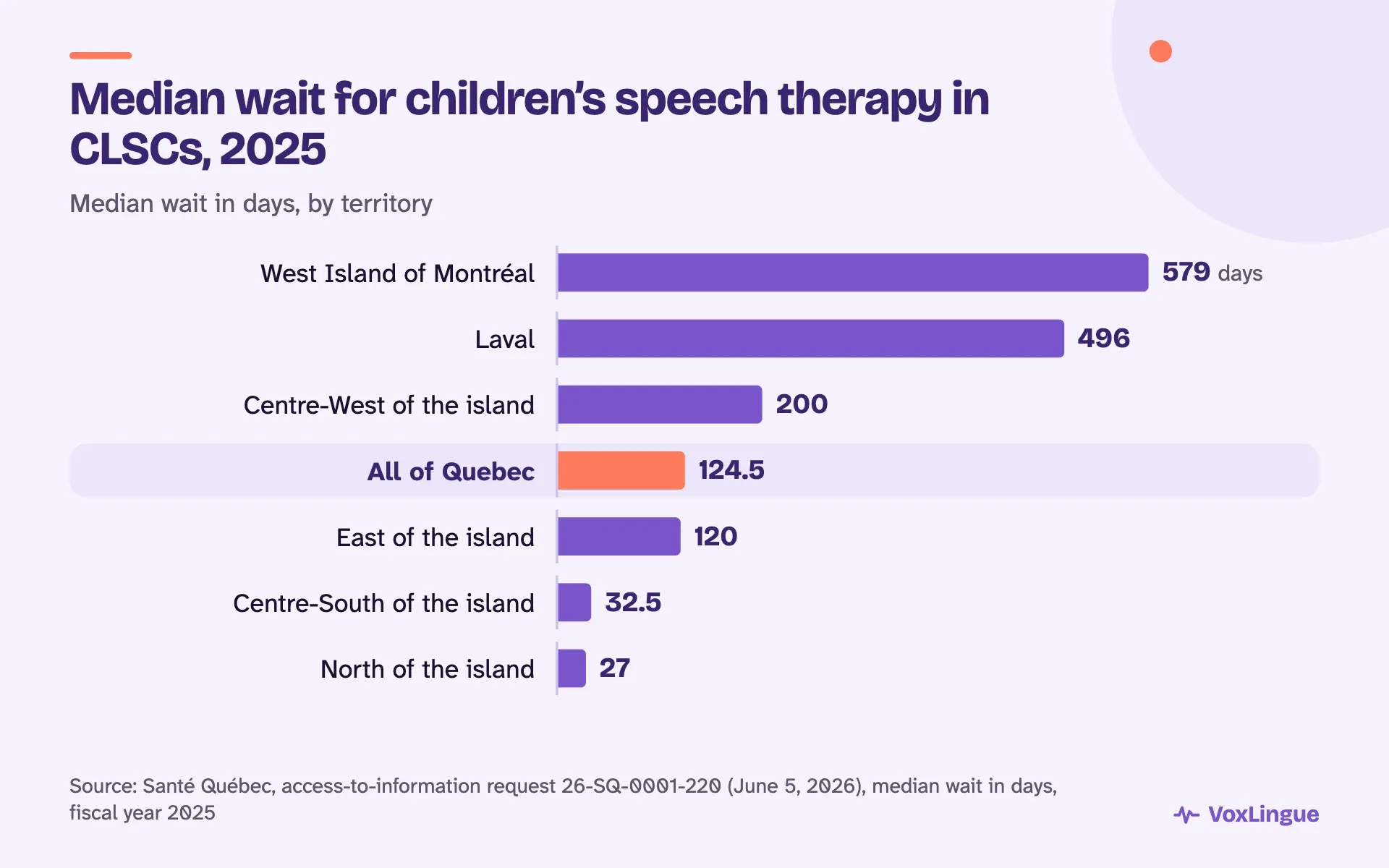
Public wait times vary a lot from one region to another. According to Santé Québec data published in June 2026, the median wait for children’s speech therapy in CLSCs was about 125 days across Quebec in 2025. It ranged from 27 days in the north of the Island of Montréal to nearly 500 days in Laval and more than 570 in the West Island. Our guide to the speech therapy waiting list in Québec explains these numbers and what to do while you wait.
Private practice. A speech-language pathologist in private practice can assess your child without a medical referral. Many families keep their place on the public waiting list while consulting privately. With your consent, the private report can be shared with the public system. Group insurance plans often cover part of the cost.
At home and online. Depending on your situation, therapy can take place at the clinic, at home or online, anywhere in Quebec (telepractice in Quebec). For toddlers, coaching parents is often at the heart of therapy, as in Hanen parent coaching programs. Parents learn simple ways to build language into daily routines.
While you wait for an appointment, keep talking, reading and playing in your strongest language. It is never wasted time.
How is a bilingual child assessed?
A good assessment looks at the child in all of their languages. It begins with a detailed interview about the child’s language history, uses tests with caution, and observes how the child learns. Test norms built on monolingual children are not used to diagnose a bilingual child (CIUSSS de la Capitale-Nationale, 2022; ASHA Practice Portal).
Your child’s language history. The speech-language pathologist asks who speaks which language to your child, since when, where and for how long. She also asks about the age of their first words and first phrases. This is one of the most useful clues for telling a language difference from a disorder (Paradis et al., 2010).
All their languages. The speech-language pathologist observes your child in each of their languages, with your help or an interpreter’s if she does not speak the home language. At VoxLingue, several of our speech-language pathologists speak languages other than French and English (see speech therapy in your family’s languages).
Tests, used with caution. Standardized tests can describe a child’s skills. But their norms, designed for monolingual children, do not allow a conclusion that a disorder is present. Bilingual 5-year-olds with no difficulty at all often score somewhat below monolingual norms (Thordardottir, as summarized by the CIUSSS de la Capitale-Nationale, 2022).
Watching how your child learns. Dynamic assessment means teaching the child something new, then observing how easily they learn it. A child who learns quickly mostly needs more exposure to the language. A child who has real difficulty learning may need help.
To see how an appointment works in practice, from the first call to the report, read what to expect at a speech therapy assessment in Quebec or visit our assessment page.
Frequently asked questions
These are the questions parents of bilingual toddlers ask most often. Each answer is short and stands on its own, so you can come back to the one that matters to you. For anything specific to your child, a speech-language pathologist can look at the whole picture with you.
How many words should a bilingual 2-year-old say? Around age 2, expect about 50 words or more, all languages added up, and two-word combinations. If your child says fewer or is not combining words yet, a consultation will help you understand where they are, especially if the difficulty shows in all their languages.
Do you count words in both languages? Yes. Add up the words in all of your child’s languages, even when they mean the same thing, like chien and dog. This is the rule used in the language development grids in Quebec.
Is it normal for my child to mix French and English? Yes. It is typical of bilingual development. Toddlers tell their languages apart very early, even when they mix them in a sentence. They are simply using every word they know.
Should we stop speaking our language at home? No. Speak the language you know best. Dropping one language does not help the other, and it takes a family language away from your child, even if they have a language disorder.
Do we have to use “one parent, one language”? No. This approach can work, but it is neither necessary nor sufficient. What matters is that your child hears enough of each language, from people who are comfortable in it.
How long does the silent period last? When a child meets a new language, for example at daycare, they often speak little in that language for 3 to 6 months. They listen and understand before they speak. Their home language shows where they really are.
Can cartoons in our language replace conversation? No. Babies learn the sounds of a language from a person, not from a video. Screens are not recommended before age 2, except video calls with family. From 2 to 5, watch together and talk about what you see.
Should grandparents speak their language to my child? Yes. Hearing a language from several people helps a child develop it. Grandparents are often the best allies of the home language.
Does my child need to be assessed in both languages? Yes. An assessment in only one language gives an incomplete picture. The speech-language pathologist observes all their languages, with your help or an interpreter’s if needed.
My child is starting kindergarten in French without speaking French. What will happen? The school can offer French welcome and support services, in a welcome class or in a regular class, from preschool on. This is normal and is not a sign of a disorder. What matters is their home language.
The printable chart
To keep these markers close at hand, print our one-page chart. It summarizes the milestones from 0 to 5, the three rules for a bilingual child, the signs to watch for, and a space to log your child’s words for two weeks, in all their languages.
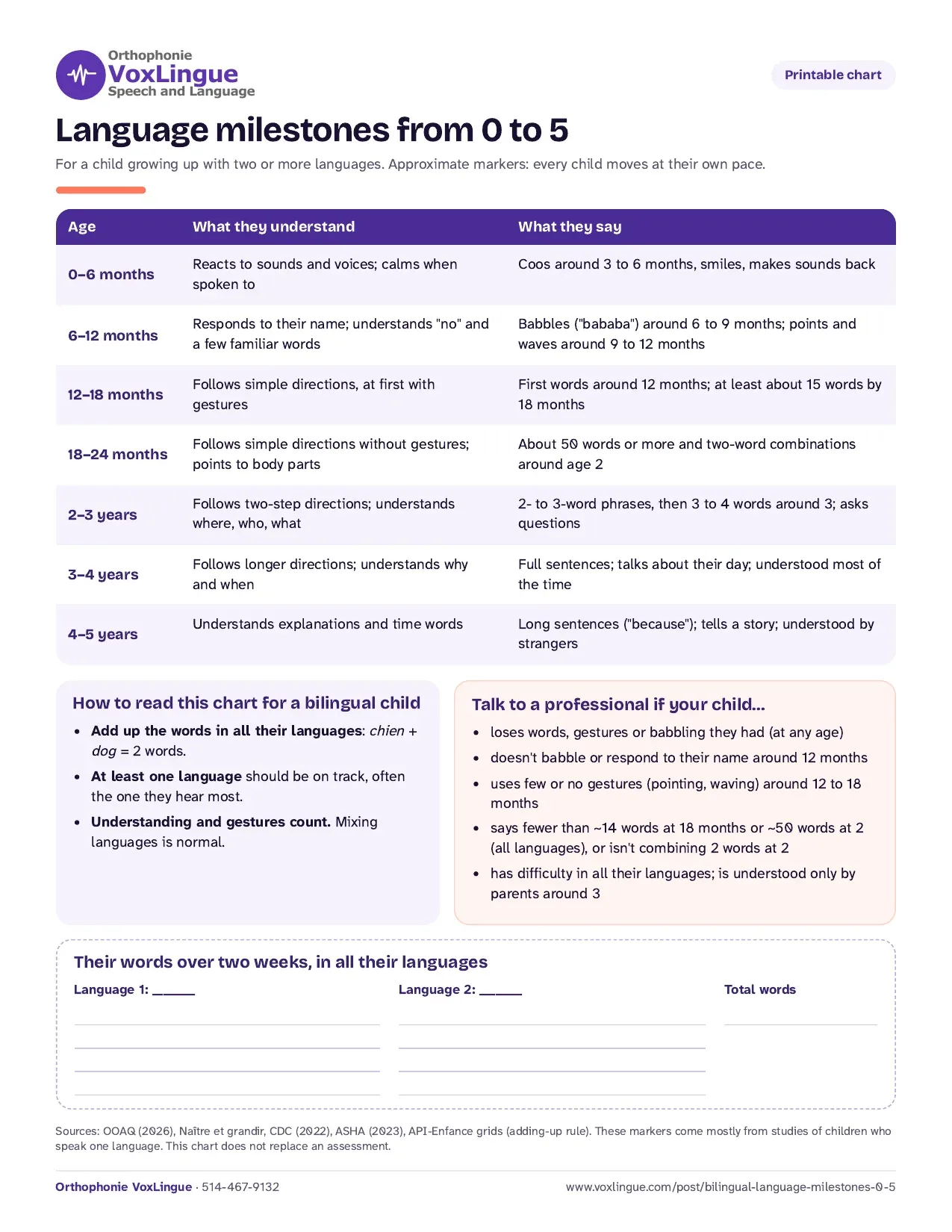
Printable chart: Language milestones from 0 to 5, bilingual child (PDF, 1 page). Put it on the fridge or bring it to your appointment.
Growing up with several languages is a gift. When you read bilingual language milestones, look at all of your child’s languages rather than a single number. Write down their words, support the language you speak best, and consult if a sign worries you. You will find more in our early language and late talkers section, including our article on early communication from birth to 3, and on our page for children.