Your child's daycare portrait is coming: how to read what the educator writes about language
Right now, in recognized daycares across Québec (CPEs, daycares with a permit, recognized home daycares), educators are writing the first progress portrait of the year. You’ll get it by December 15. The second one comes in May.
For many parents, it’s the first written account of their child’s development by someone outside the family. The language part is usually the one you read twice. Sometimes it’s reassuring. Sometimes one sentence worries you, or the educator asks to talk before the portrait even arrives.
Here’s how to read that part and what to do if the educator is concerned, especially if your child hears a language other than French at home.
What to know
It’s required by regulation
Since 2021, Québec’s childcare regulation has required recognized daycares to keep an educational file for every child. The progress portrait (portrait périodique) is the heart of it. Here’s what the rules say (Ministère de la Famille, in French):
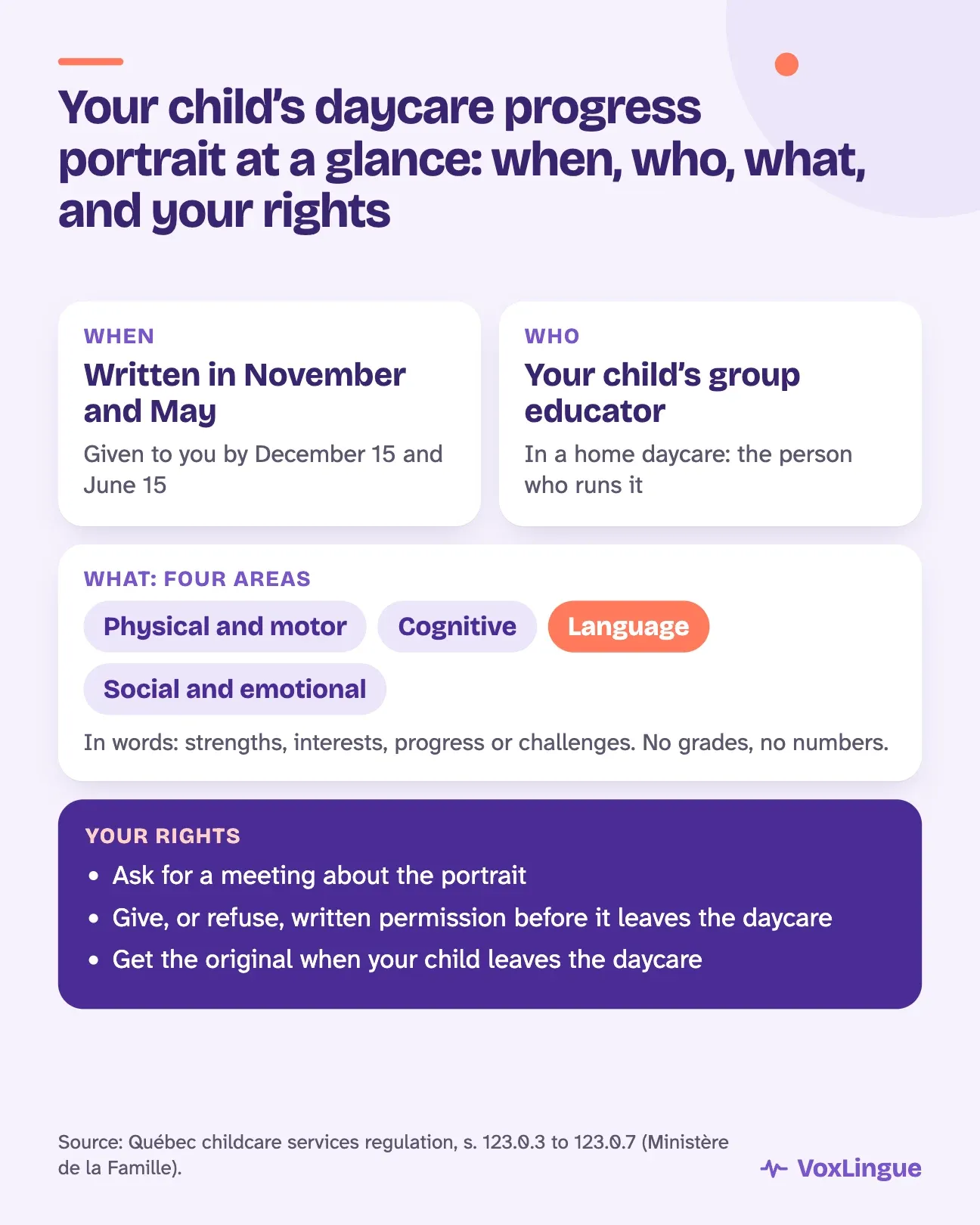
- When: it’s written in November and May, and given to you by December 15 and June 15.
- Who: your child’s group educator writes and signs it. In a home daycare, it’s the person who runs it.
- What: where your child is in four areas of development: physical and motor, cognitive, language, and social and emotional. It’s usually written as comments on your child’s strengths, interests, progress or challenges.
- Your right: if you ask, the daycare has to make itself available to meet with you about the portrait.
There are no grades and no numbers comparing your child with others. It’s a description in words.
The regulation also gives the portrait a screening role. The portraits are meant to help spot a child who makes little or no progress in an area, despite the educator’s efforts. So a comment about language is never there by accident. It’s an invitation to talk with the educator.
Reading the language part: look for examples
“Expresses himself well” or “needs to work on her language” tell you very little. A useful observation describes a situation.
The ministry gives educators exactly that model in its observation guide (Précisions sur l’utilisation de l’outil de surveillance, in French). Its example: during the morning routine instructions, the educator notices that the child needs her to repeat them, walk him through them, or watch the other children to follow along. That’s the level of detail to look for.
If the portrait stays vague, ask: “Can you give me a recent example?”
As you read, look for three things:
- Understanding: does your child follow routine instructions without having them repeated or pointed out?
- Being understood: do adults and other children understand what your child says?
- Interacting: does your child ask for things, comment, play with others?
An observation is never a diagnosis. The same guide asks educators to avoid diagnostic terms such as language disorder, autism or ADHD. Only an assessment by a professional can conclude that. If one of those words comes up in a conversation, treat it as a question to check.
What the educator sees that you don’t
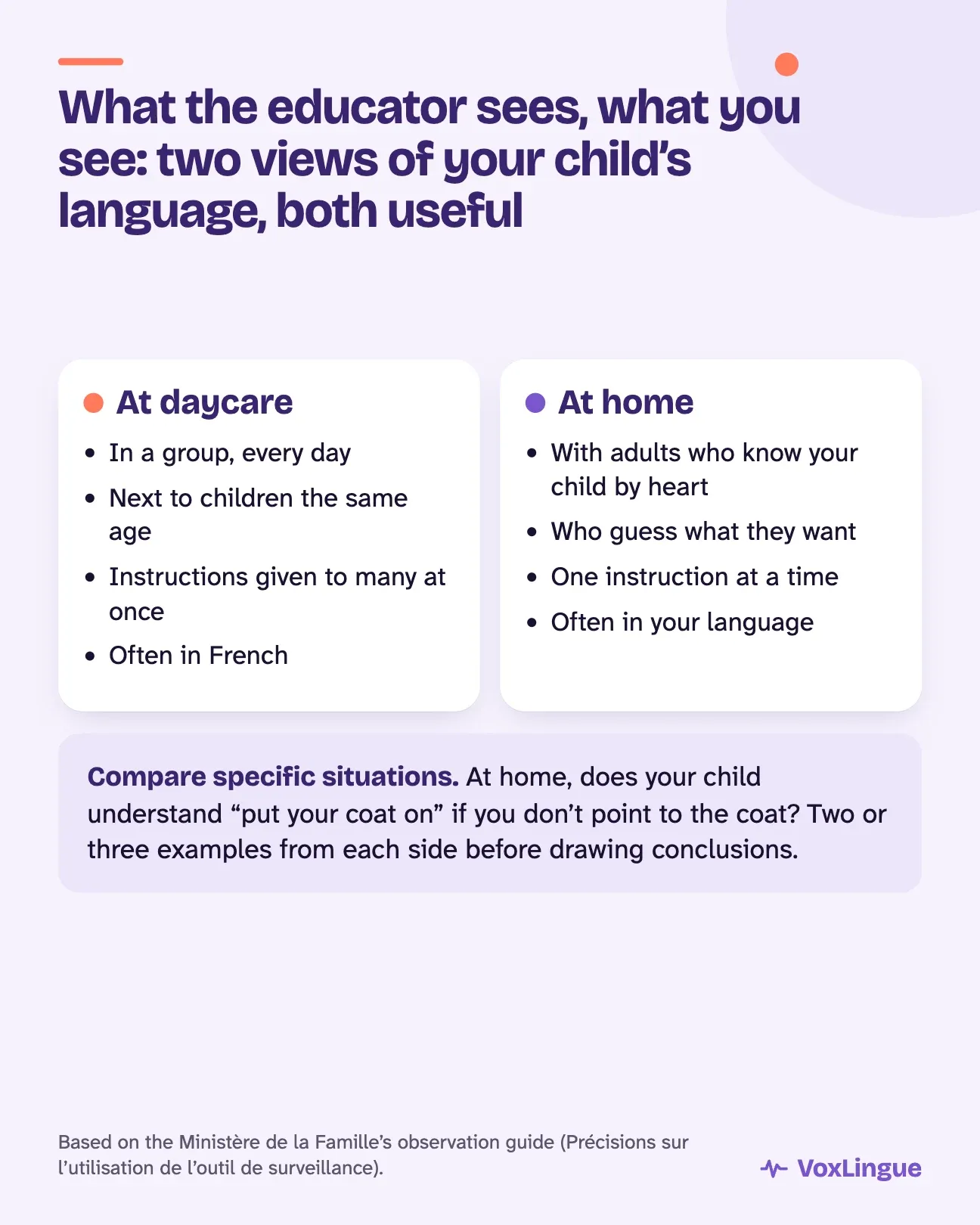
The educator sees your child every day, in a group, next to children the same age. At home, you see your child with adults who know them by heart, guess what they want and speak their language. Both views can be true at once.
That’s why the guide asks the educator to start the meeting by asking how you see your child. She’s also asked to fill in a section on your own concerns with you. Your view is part of the observation.
Don’t recognize your child in what she describes? Say so, then compare specific situations. At home, does your daughter understand “put your coat on” if you don’t point to the coat? Gather two or three examples from each side before drawing conclusions.
The gap often has an explanation. Daycare asks a lot more independence of a child: a routine, instructions given to the whole group, asking for things on their own. If at home everything is anticipated for them, or the days are less structured, their difficulties may not show. Our speech-language pathologists look for exactly what changes from one setting to the other.
French at daycare, another language at home
In Montréal, this is the reality for a large share of families: French at daycare, another language at home: English, Arabic, Spanish, Portuguese, Tagalog. If your child goes to an English daycare and hears another language at home, the same logic applies.
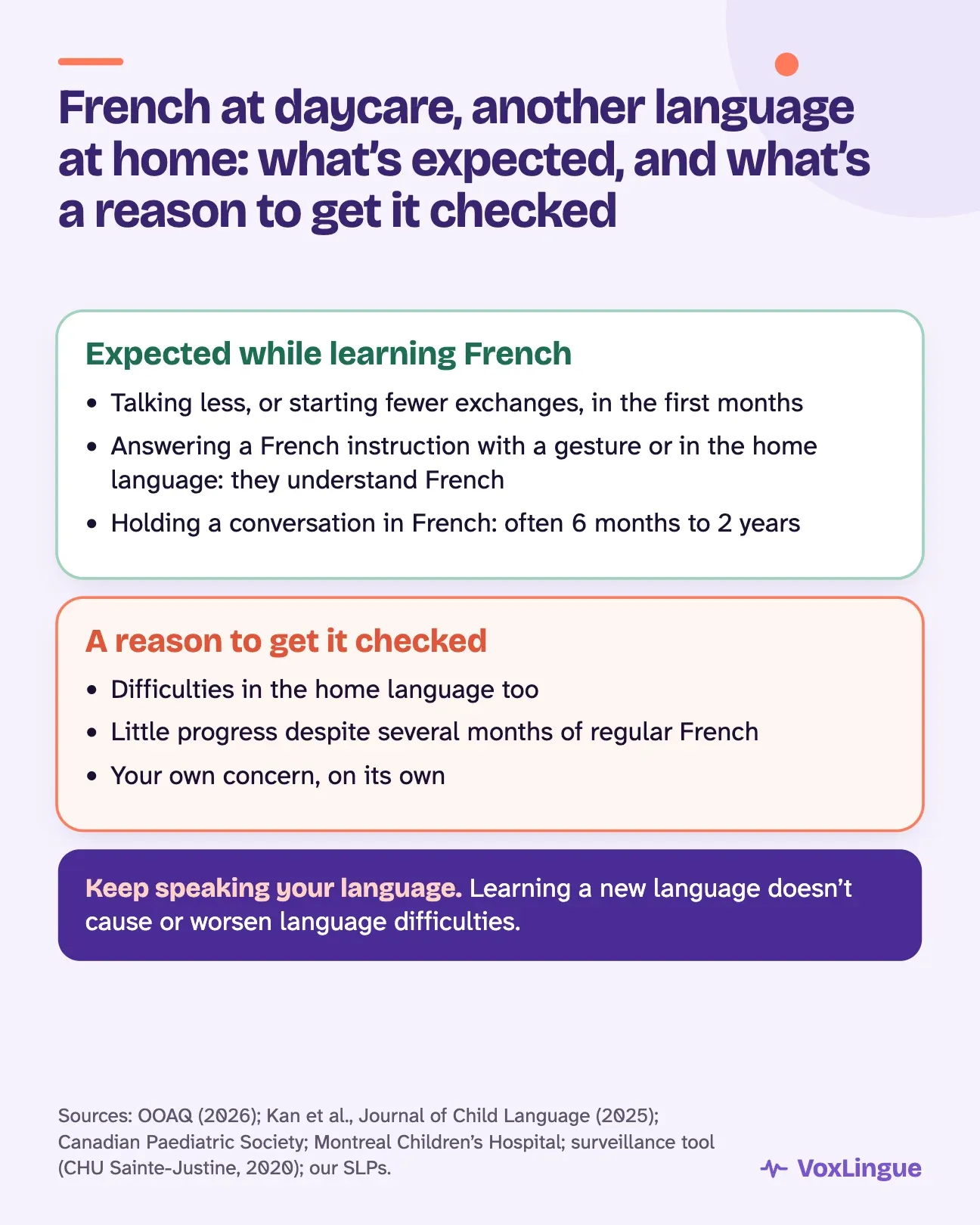
A child learning a new language often talks less, or starts fewer exchanges, in the first months. According to Québec’s Ordre des orthophonistes et audiologistes (in French), it often takes 6 months to 2 years to hold a conversation in a new language. Using it well at school takes more like 5 to 7 years.
Understanding French comes before speaking it. A useful marker: if your child answers a French question or instruction appropriately, with a gesture or in your language, they understand French. A 2025 review of 40 studies points the same way (Kan and colleagues, Journal of Child Language): children learning a language often communicate with gestures and their home language.
So when we assess a child who is learning French, we look at every setting and every language. We listen to your history, ask about home, and talk with the educator. Only then do we draw a conclusion. It may be a language difficulty or something different. Sometimes the child simply needs more time in French.
So how do you tell this apart from a language difficulty? Look at the home language. When a child learns a second language after the first, a real difficulty also shows up in the first language (Canadian Paediatric Society). In your language, with you, does your son understand what you ask? Does the family understand him? Are his sentences getting longer over the months? If so, his French probably mostly needs time. If the home language worries you too, bring it up.
And please don’t stop speaking your language with your child. The speech-language pathology department at the Montreal Children’s Hospital is clear: one language at home and another at daycare is a normal way to become bilingual. Each adult should speak the language they know best, and learning a new language doesn’t cause or worsen language difficulties.
If the educator is concerned: next steps
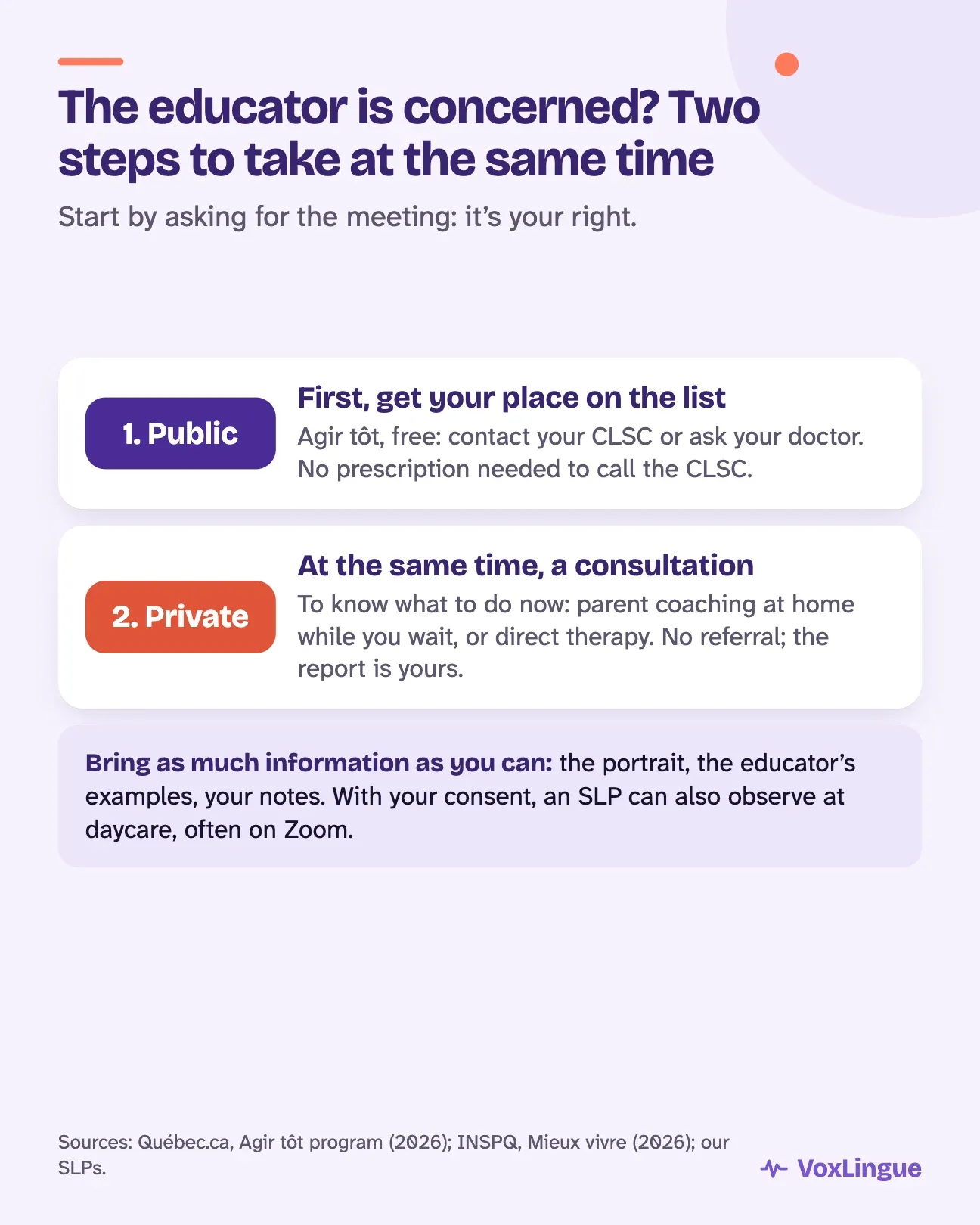
First, ask for the meeting. It’s your right, and the ministry’s guide even plans a second meeting if you need time to think. Bring your questions: since when? In which situations? Only in French, or also when your child hears your language? What has she already tried in the group?
Then take two steps, at the same time:
- Public first, to get your place on the waiting list. The Agir tôt program is free and voluntary: contact your CLSC or ask your doctor. You don’t need a prescription to call the CLSC. With your agreement, the daycare can also make the connection, and its staff can take part in assessing your child’s needs.
- At the same time, a private consultation, to find out what to do now. Depending on your child’s needs, that may be language stimulation at home through parent coaching while you wait, or direct therapy. No doctor’s referral needed. The report belongs to you: you decide whether to share it with the daycare. And in our experience, seeing someone privately doesn’t cost you your place on the CLSC list.
Bring as much information as you can to these appointments: the portrait, the educator’s examples, your own notes. What the daycare has seen is very useful.
Our speech-language pathologists can also observe your child at daycare and meet with the educator. Sometimes that’s in person, and most often it’s on Zoom, always with your consent. In the group, what they most often suggest to educators: check that the child has understood, offer one-on-one or pair exchanges if the group is too much, and back up words with gestures and pictures.
In Ontario, the Preschool Speech and Language Program serves children from birth to school entry, and you don’t need a doctor’s referral.
When not to wait
You don’t need the daycare to be worried before you consult, and you don’t need it to agree with you. In the developmental surveillance tool provided to Québec daycares (CHU Sainte-Justine, 2020), a parent’s concern is, on its own, a reason to screen.
Also consult if your child’s language changes little despite several months of regular exposure to French (OOAQ), or if the home language is a concern too.
One more sign, even if things seem fine at home: your child is having a very hard time fitting into the group, protests going to daycare, or their behaviour is very difficult. Once the settling-in period is over, usually after about 3 months, consult without waiting.
Kimberly put it this way on our blog. “Please, if you have concerns, if your child is not talking by 2 years old, reach out to someone and advocate for an early developmental assessment.”
Our full guide, Daycare is worried about your child’s speech or language, goes further. It has questions to ask the educator and a printable sheet to note her examples. It also explains how to tell learning French apart from selective mutism and from language difficulties.
Try this week
The clear box · 12 months to 3 years
Kimberly wrote her favourite trick down on our blog years ago. “My favorite trick and strategy to use with children developing language from birth to 3 is to put everything in ziplocks and sealed transparent boxes.” Your child can see what they want, but they need you to get it. That gives them a real reason to communicate.
At snack time, put a few crackers in a clear container with the lid on, right in front of your child. Give it a little shake:
“Oh! Crackers!”
Then wait, without saying anything. Give your child 10 to 20 seconds, and don’t guess the request for them.
Everything counts as a request: a look at you, reaching for the box, a sound, a word. Answer by adding one word to what your child gave you. If he pushes the box and says “cra!”, say: “Crackers! You want crackers. Open!” Give one or two at a time, so there’s a reason to ask again.
If there’s no response, give it anyway and name it: “Crackers!” You’re showing that an exchange means taking turns, and that you’re leaving them theirs. One rule to keep: never make your child repeat a word before giving them what they want. Kimberly is clear that this is the habit to stop right away.
It works with a closed bottle of bubbles, too, or a toy car in a zip bag.
What to watch for: how does your child ask? With their eyes, a point, a sound, one word, two words? Write it down in one line. That’s exactly the question to ask the educator: “How does she ask for things at daycare?” If the two answers match, you already have a truer picture.
More ideas for bath time, the grocery store and the car, stage by stage, are in our guide How to help your toddler talk.
In Québec
The educational file: who gets to see it?
The portrait is part of the educational file the daycare keeps for your child. The regulation protects that file closely:
- Before sending it to anyone outside the daycare (a school, another daycare, a doctor, a speech-language pathologist), the daycare needs your written permission. The same goes for making a copy.
- The only exceptions: a change of group within the same daycare, and a ministry inspection.
- When your child leaves the daycare, you get the original. The daycare keeps a copy for one year, then destroys it.
When your child starts kindergarten, the daycare may encourage you to give the file to the school, or send it itself with your written permission. The portrait helps the teacher get to know your child from September. The decision is yours, and you can take time to think about it.
Worth reading
“Bilingualism/Multilingualism”, Montreal Children’s Hospital: the hospital’s summary of the research on children who grow up with more than one language. A good document to bring to a meeting with the educator.
“The Agir tôt program”, Québec.ca: the official English page. It explains who the program is for, how to start, and what happens after you call the CLSC.
From VoxLingue
School is coming fast. In several Québec school service centres and boards, kindergarten registration opens in January, sometimes with a language questionnaire. Our new guide, Ready for kindergarten in Québec?, explains that form and the language skills to watch at 4 and 5. It comes with the printable sheet Before the language form: two weeks of observation and five questions for the school.
Your question: have you ever received a progress portrait from daycare? What helped, or left you puzzled? Reply to this email in one line. Your answers help us plan the next issues.
This newsletter is for information and does not replace an assessment. Lire en français