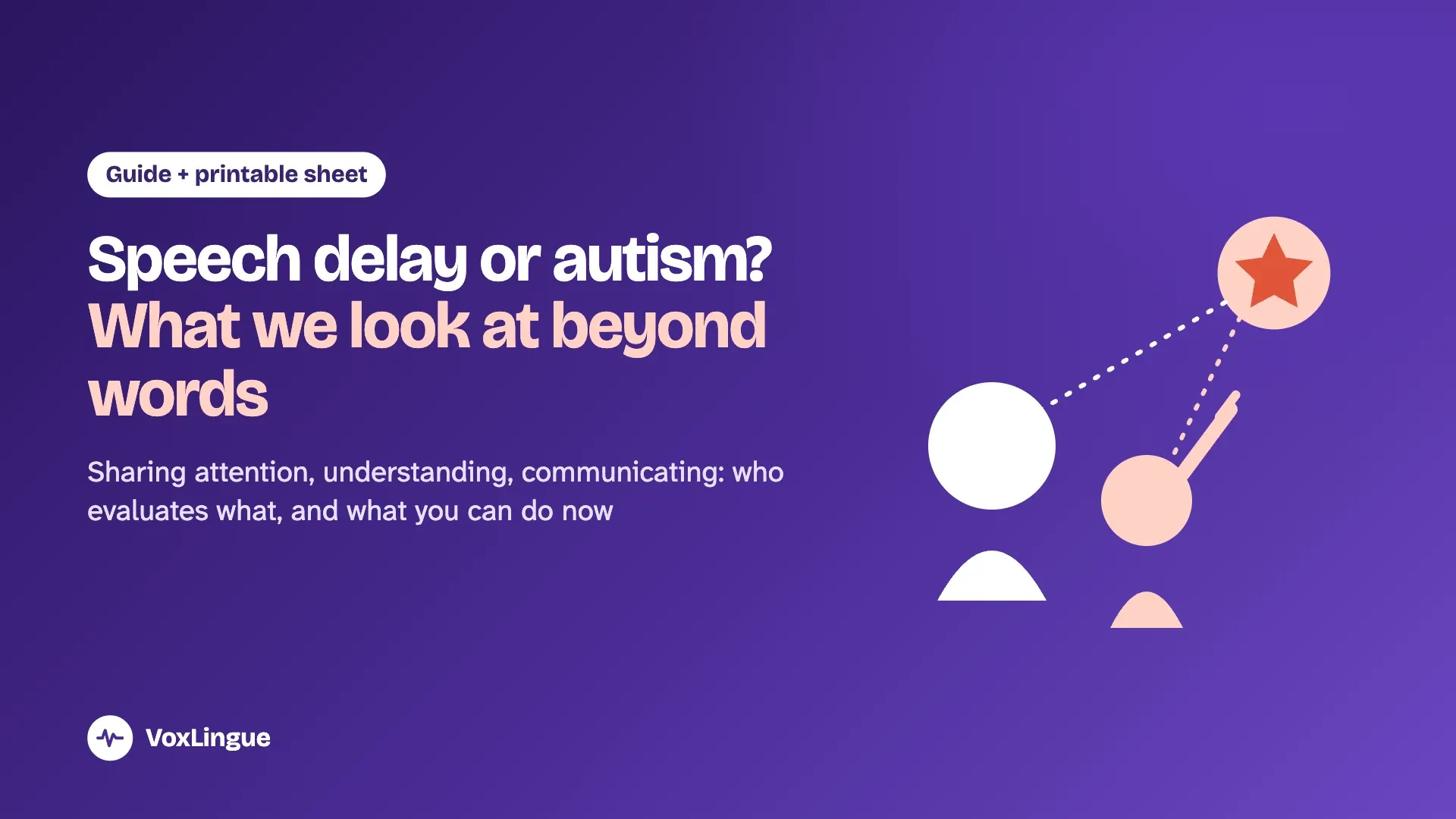
Speech delay or autism? What professionals look at beyond words
Your child is 2 and still says only a few words. Your doctor may have told you to wait. Or a daycare educator, a relative or your doctor was the first to mention autism, and you’re wondering if they’re right. And one evening you searched online, only to find lists of signs that worried you more than they helped.
You are not alone in asking: speech delay or autism? A child who talks little is often the first thing parents worry about, whether the child turns out to be a late talker, autistic, both, or neither. That is exactly what makes the question hard: around age 2, the number of words alone can’t tell you which it is.
This guide explains what professionals look at beyond a speech delay, why the answer is often “both” or “not yet”, who evaluates what in Québec and Ontario, and what you can do this week.
It doesn’t replace an assessment. And a speech-language pathologist (SLP) doesn’t diagnose autism: we assess communication, and that assessment helps the team that makes the diagnosis. For more on first words and late talkers, our early language and late talkers section is a good companion to this guide.
Speech delay or autism: why is it so hard to tell apart around age 2?
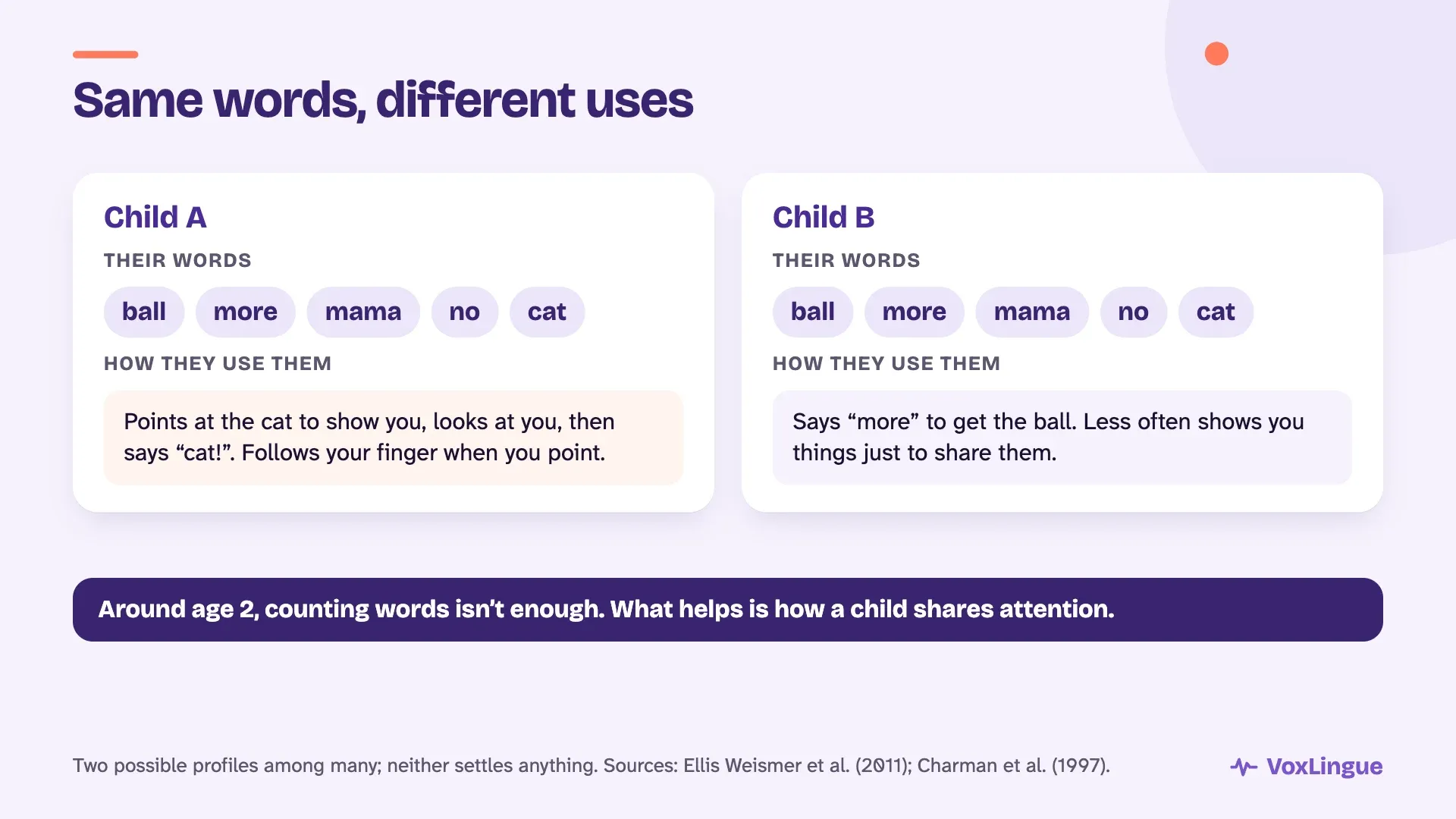
Because at that age, the number of words can look the same. Autistic toddlers and late talkers often have very similar vocabularies, and talking little is the first worry in both cases. What usually differs is how a child communicates with other people. No single sign is enough to tell.
Research shows this clearly. When researchers compared the words that autistic toddlers and late talkers of the same age say and understand, the vocabularies looked very much alike (Ellis Weismer and colleagues, 2011). Counting words, on its own, doesn’t tell you what is going on.
The starting point is often the same, too. For many autistic children, language is the first thing that worries their parents (De Giacomo and Fombonne, 1998). But it is also the first worry for parents of children with other developmental delays (Kozlowski and colleagues, 2011). A child who talks little can be on many different paths.
Québec’s professional guidelines say so openly. The Collège des médecins du Québec and the Ordre des psychologues du Québec write that a speech-language assessment can be requested early, given how hard it is to tell a language disorder from autism at first (2012). They add that no single behaviour, on its own, confirms autism. It is the whole picture that counts.
If your child mostly has few words, but understands, points and plays with you, our guide to late talkers explains when to worry and what to do.
Beyond words: what do professionals look at?
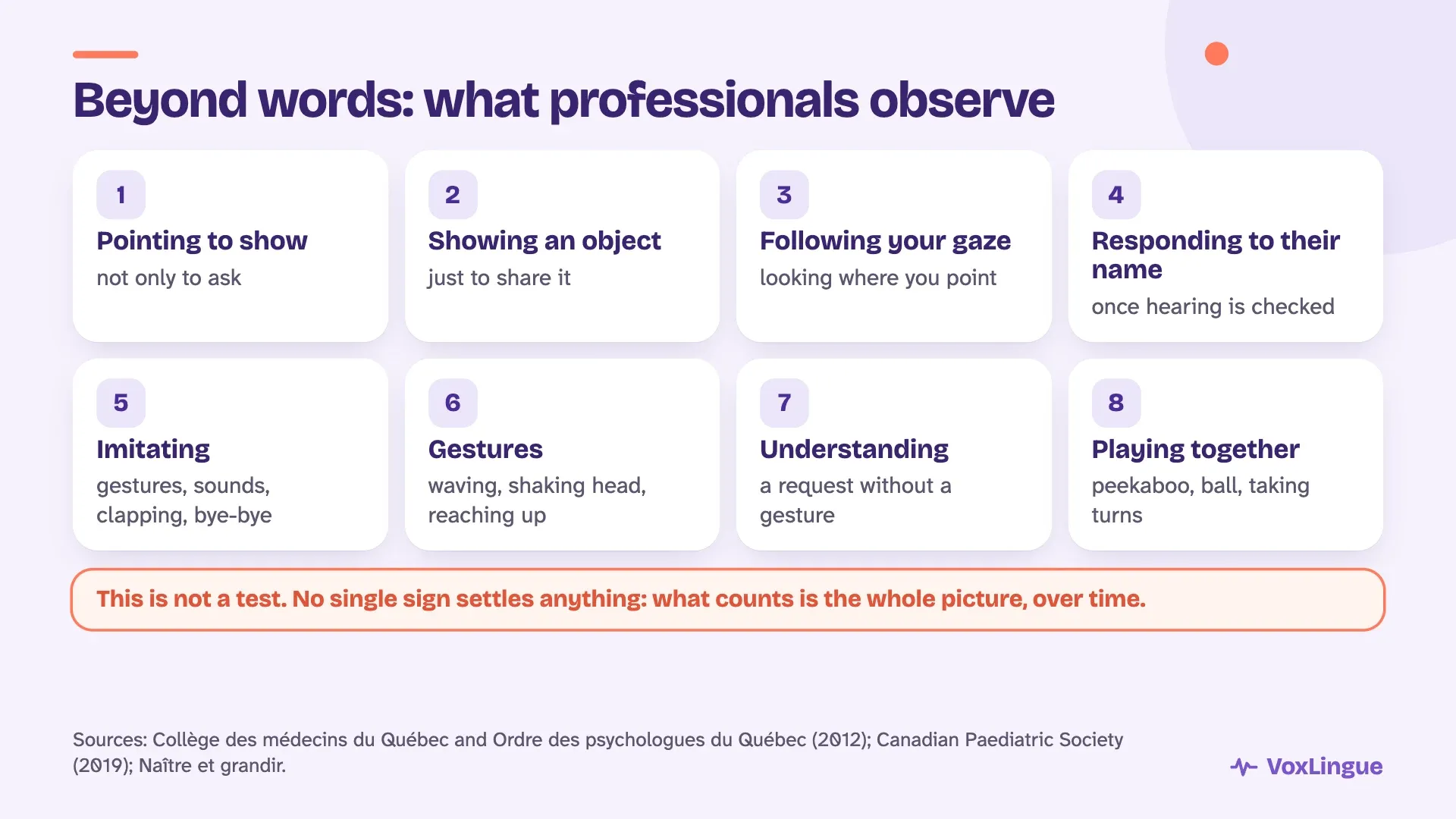
They look at how your child shares attention and communicates without words. Do they point to show you something, not only to ask? Do they follow your gaze? Respond to their name? Copy your gestures? Understand a simple request without a gesture? These skills often say more than the number of words.
Babies communicate long before their first words. Between about 12 and 18 months, most children point to ask and then to show, hold up objects, wave bye-bye and look where an adult is looking. Professionals call this joint attention: two people looking at the same thing, and both knowing they are looking at it together.
Late talkers usually have these skills. They say few words, but they point, show, copy and understand a lot. In autistic toddlers, what is more often different is the way they share attention, imitate and look at others (Charman and colleagues, 1997). And toddlers who understand well and use many gestures are more likely to catch up on words.
The table below shows what professionals look at and why. It is not a test. It helps you notice things you can bring up with your doctor or a speech-language pathologist.
| What you might notice | Why professionals look at it | Good to know |
|---|---|---|
| They point to show you something (a plane, a dog), not only to ask | Pointing to share means they want you to look at the same thing | Pointing to get a cookie and pointing to show you a dog are different messages |
| They bring or hold up an object just to show it to you | It is another way of sharing an interest without words | Some children lead you by the hand to what they want instead |
| They look where you point or where you are looking | Following an adult’s attention helps link words to things | Try in a quiet room, with something they like |
| They often turn when you call their name | Responding to their name is one of the signs doctors look at | An inconsistent response can come from hearing: have it checked first. Many autistic children respond to their name too |
| They copy your gestures and sounds (clapping, bye-bye, animal noises) | Imitation opens the door to new words | They may copy more easily during a game they love |
| They use gestures to communicate: waving, shaking their head, reaching up to be picked up | Lots of gestures with few words is generally encouraging | Gestures don’t hold speech back: they prepare for it |
| They understand a short request without a gesture (“go get your shoes”) | Good understanding is one of the best signs for what comes next | In a bilingual family, check in each language |
| They enjoy back-and-forth games with you (peekaboo, rolling a ball) | These games show a wish to interact and take turns | Shared enjoyment matters more than how long the game lasts |
| They use words to ask, but also to greet, comment or get your attention | How a child uses words says as much as how many they have | Repeating phrases they’ve heard (echolalia) is one way of learning language, in some autistic children and in others |
No line in this table settles anything. A child can do almost everything in it and still need an assessment. Another may not do some of it yet and develop without any difficulty. What counts is the whole picture, seen over time by professionals. The Canadian Paediatric Society puts it plainly: no single sign rules autism in or out (2019).
In a first meeting, the speech-language pathologist also watches your child in action: how they interact with you during play, then with the SLP, a stranger to them. The SLP looks at how they handle toys and explore a new place. Sometimes the SLP puts a favourite toy in sight but out of reach, to see how your child goes about getting it.
To see where your child stands against typical milestones, our guide to language milestones from 0 to 5 gives age ranges, including for children learning more than one language.
What about eye contact?
Eye contact can’t confirm or rule out autism. Many autistic children look their parents in the eye, especially during moments they enjoy. And some people who aren’t autistic avoid eye contact, as many people who stutter do. “He looks me in the eye, so it can’t be autism” is the belief our speech-language pathologists correct most often.
What about pretend play?
Pretending to drink from an empty cup or to feed a doll develops gradually between 18 months and 3 years. At around 20 months, this kind of play is often still missing in late talkers and in autistic toddlers alike (Charman and colleagues, 1997). At that age, its absence doesn’t mean much on its own. Professionals look at it later, along with everything else.
Speech delay or autism… or both?
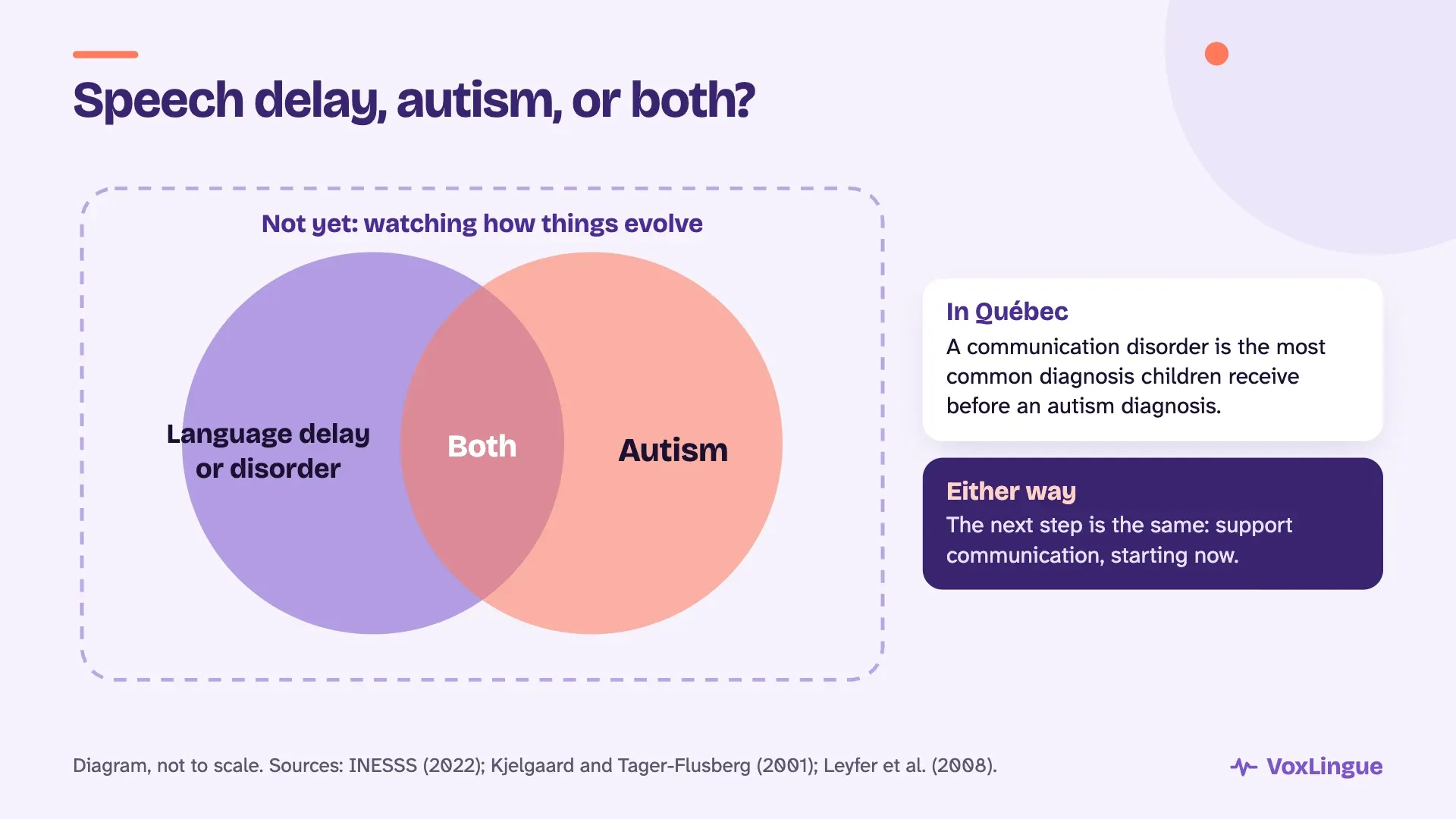
Often, it isn’t one or the other. An autistic child can also have a language disorder, and some children with a language disorder have differences in social communication. In Québec, a communication disorder is actually the most common diagnosis children receive before an autism diagnosis. “We don’t know yet” is an honest answer.
The two overlap more than people expect. Studies show that many autistic children also have a language disorder that looks like the one seen in non-autistic children (Kjelgaard and Tager-Flusberg, 2001). In the other direction, some children with developmental language disorder show differences in social communication (Leyfer and colleagues, 2008).
Québec data point the same way. Québec’s health technology agency, INESSS, looked at children who had received an autism diagnosis. Communication disorders were the diagnosis they had most often received before (2022). In other words, many autistic children were first seen for their language.
When autism is confirmed, the speech-language pathologist’s findings don’t become wrong. They become more precise, and the child’s communication needs stay the same. Our page on language delays and language disorders explains what an SLP assesses.
Why “not yet” is a real answer
Between 18 months and 3 years, development changes quickly. Some questions need time and several observations before a professional can answer them. “Not yet” doesn’t mean no one is listening to you. It means watching how things evolve before drawing conclusions.
In a session, a speech-language pathologist sees only a glimpse of your child’s life. You know your child better than anyone: if you’re worried, that deserves to be taken seriously. And speech therapy looks much the same with or without a broader developmental assessment. It starts from your child’s needs and adjusts along the way.
But “not yet” doesn’t mean “wait and do nothing”. The goal of an assessment is neither to avoid a label nor to get one. It is to understand how your child communicates and what helps. Whatever the answer, the next step is the same: support their communication, starting now.
They used to say words and stopped: when should you see a doctor quickly?
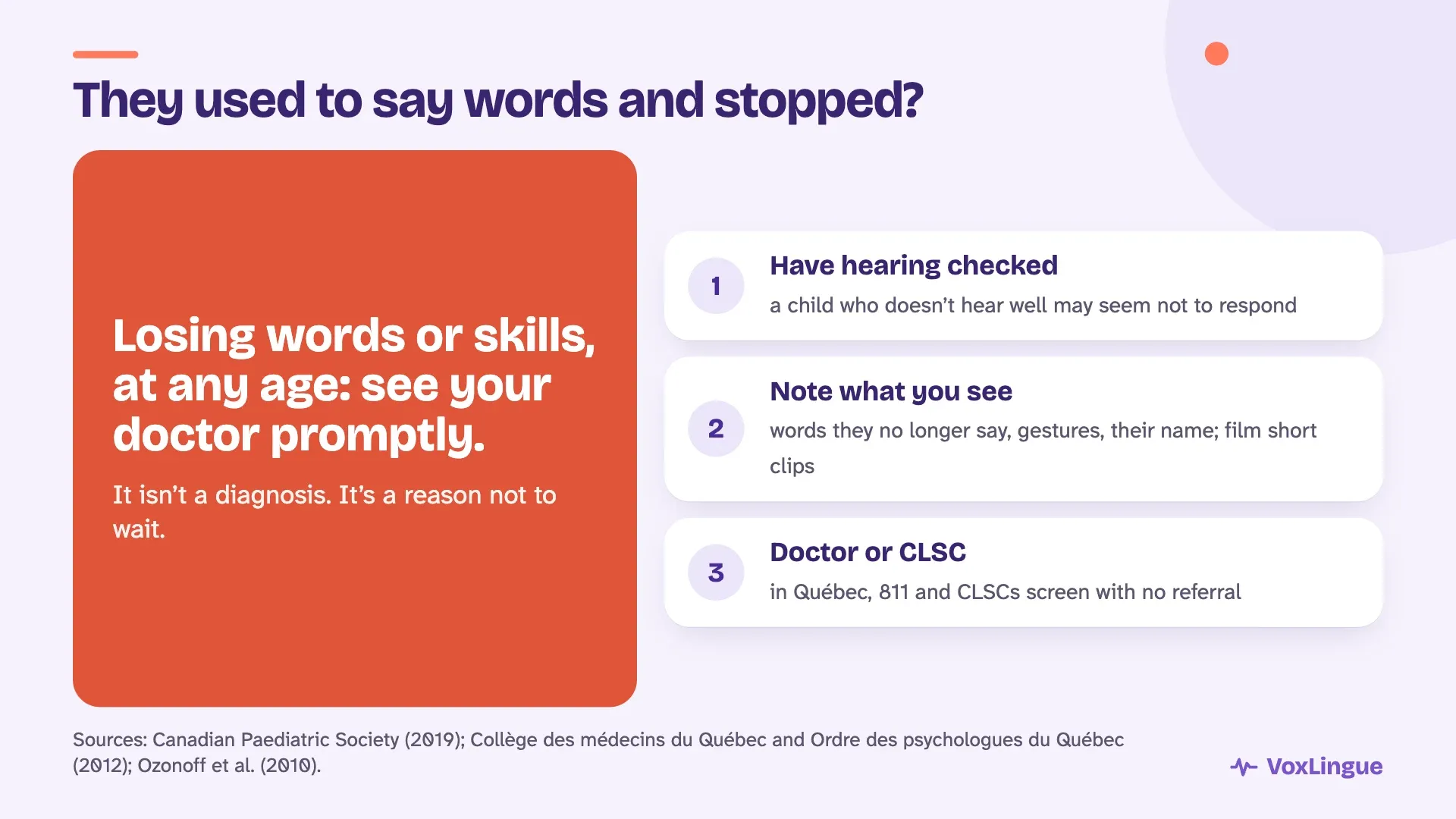
Losing words or social skills, at any age, is a reason to see a doctor promptly. It isn’t a diagnosis. It is a reason not to wait. A loss of skills can have several causes, and your doctor is the right person to start looking into them.
A loss of skills might look like a child who used to say “mama”, “more” or “bye-bye” and hasn’t said them for a few weeks. Or a child who used to point, wave or play peekaboo and no longer does. Every clinical guideline we reviewed, in Québec and elsewhere, treats this as a reason to consult without waiting.
It isn’t always that clear. In many children, differences appear gradually, and parents don’t notice a clear “loss” (Ozonoff and colleagues, 2010). If you feel your child is doing less than before, trust that feeling and bring it up.
Other signs are also worth an appointment. The Canadian Paediatric Society and Québec’s medical and psychology guidelines list, among others:
| Around what age (approximate) | Worth raising with your doctor |
|---|---|
| Around 12 months | Few or no gestures (pointing, waving); little response to their name |
| Around 16 to 18 months | No words; doesn’t point to show |
| Around 24 months | Few or no two-word phrases (“more milk”, “daddy gone”) |
| At any age | Loss of words or social skills |
These guideposts help you decide when to consult, not what to conclude. They come mostly from studies of English-speaking children. For a child learning two languages, count words in all their languages together. And in every case, have their hearing checked: a child who doesn’t hear well may seem not to respond to their name.
Who evaluates what in Québec and Ontario?
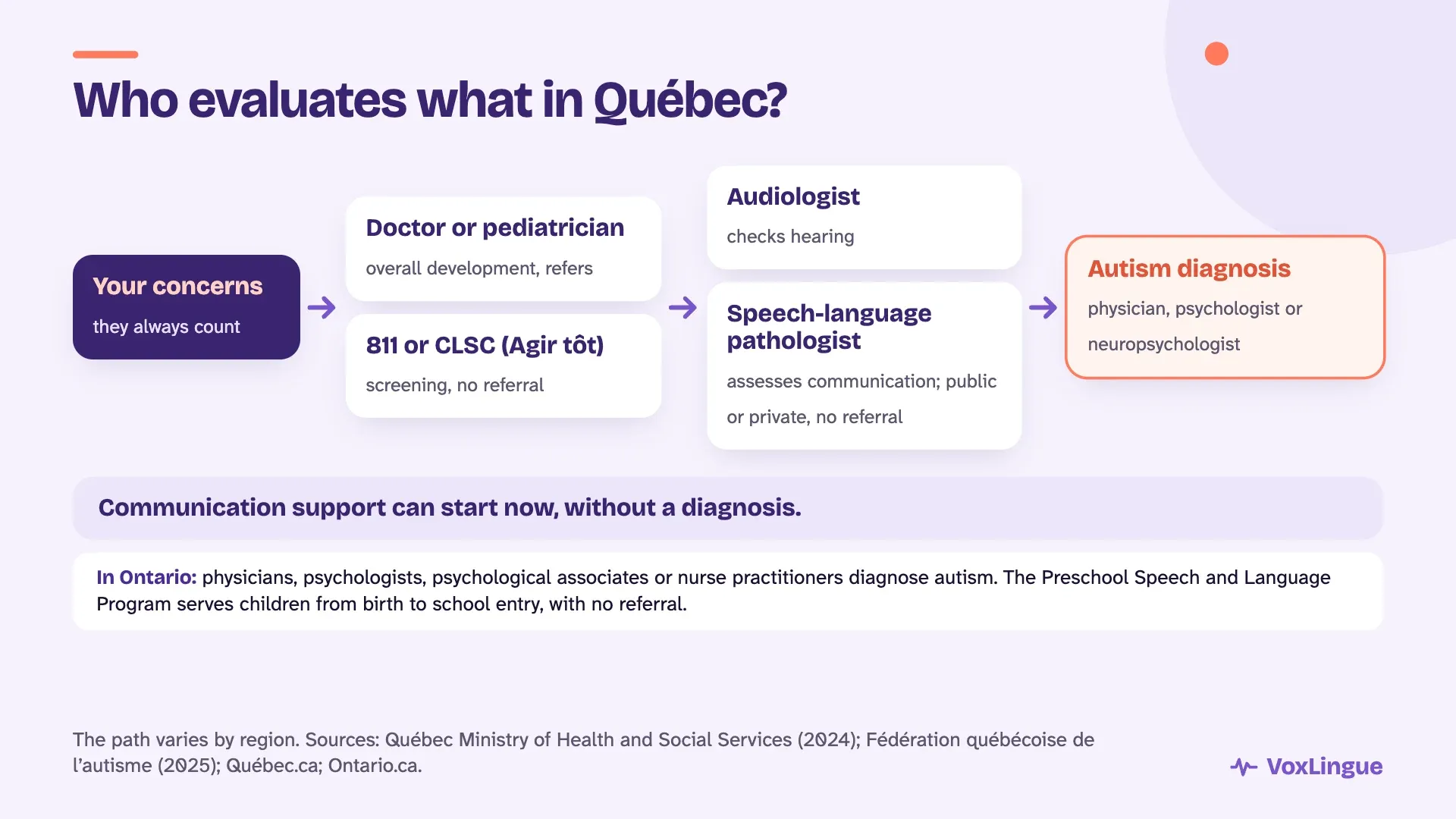
In Québec, a family doctor or pediatrician looks at overall development and refers. The CLSC screens for developmental delays, with no referral needed. A speech-language pathologist assesses communication. Autism is diagnosed by a physician, psychologist or neuropsychologist. These assessments complement each other: none replaces the others.
The path varies by region, but it often starts in the same place. You can raise your concerns with your family doctor or pediatrician, who looks at overall development, arranges a hearing test and refers you to the right services. You can also call 811 or your local CLSC directly: developmental screening is offered from birth to school entry, with no medical referral needed.
Québec’s Agir tôt program, run through CLSCs, is for children under 7 and their families. It is free and voluntary. The screening identifies developmental delays and directs children to the CLSC team, which brings together several professionals. The screening itself doesn’t diagnose. In some regions, including part of Montréal, going through the CLSC is actually a required step before a public diagnostic assessment.
A speech-language pathologist assesses understanding, expression, speech and the social use of language, in each of the child’s languages. The SLP can conclude that a child has a language delay or a language disorder, but doesn’t diagnose autism. The SLP’s report does help the team that does, and points the child toward the right services.
If the SLP’s observations suggest that a broader developmental assessment would help, the SLP explains why: language may be only one part of a child’s difficulties. A child who struggles to regulate, emotionally or physically, also has a harder time taking in and processing language. You can see an SLP in the public system or privately, with no referral. Our page on speech and language assessment explains how it works.
An autism diagnosis, for its part, is reserved for physicians (mostly pediatricians and child psychiatrists), psychologists and neuropsychologists, and specialized mental-health nurse practitioners (Québec Ministry of Health and Social Services, 2024).
Because this diagnosis needs a full developmental evaluation, family doctors usually refer to a team of several professionals. Wait times vary by region and can be long. Some families, often with private insurance, choose a private evaluation with a psychologist or neuropsychologist. Either way, nothing requires you to wait until the end of this process to help your child.
| Who | What they do | How to reach them |
|---|---|---|
| Family doctor or pediatrician | Looks at overall development, arranges a hearing test, refers | Your usual appointment |
| CLSC (Agir tôt) | Screens for developmental delays, refers to services | 811 or your CLSC, no referral needed |
| Speech-language pathologist | Assesses communication, concludes on language, works with the child and parents | Public or private, no referral needed |
| Audiologist | Checks hearing | Often through your doctor or CLSC |
| Physician, psychologist or neuropsychologist | Diagnoses autism | Public (through the CLSC or your doctor) or private |
In Ontario
In Ontario, autism can be diagnosed by a physician, a psychologist, a psychological associate or a nurse practitioner. The province also has five regional diagnostic hubs, but a diagnosis from one of them isn’t required to access the Ontario Autism Program (Ontario.ca).
For communication, Ontario’s Preschool Speech and Language Program serves children from birth until they start school. You don’t need a doctor’s referral. The Ontario Autism Program also offers early-years programs for parents of young children. As in Québec, you can see a private speech-language pathologist without a referral or a diagnosis.
Canada doesn’t do it the American way
Much of what you read online comes from the United States. There, pediatricians give every child an autism screening questionnaire at 18 and 24 months, and families are pointed to state “Early Intervention” programs and insurance coverage. None of that applies here. The Canadian Paediatric Society considers the evidence insufficient to recommend routine screening. Instead, it recommends watching every child’s development at every visit and acting as soon as a concern comes up (2019).
Online questionnaires such as the M-CHAT are screening tools. They don’t diagnose. A “high risk” result often means a child would benefit from a developmental assessment, not necessarily that they are autistic. If you filled one in and it worries you, bring it to your doctor.
Do you have to wait for a diagnosis to start speech therapy?
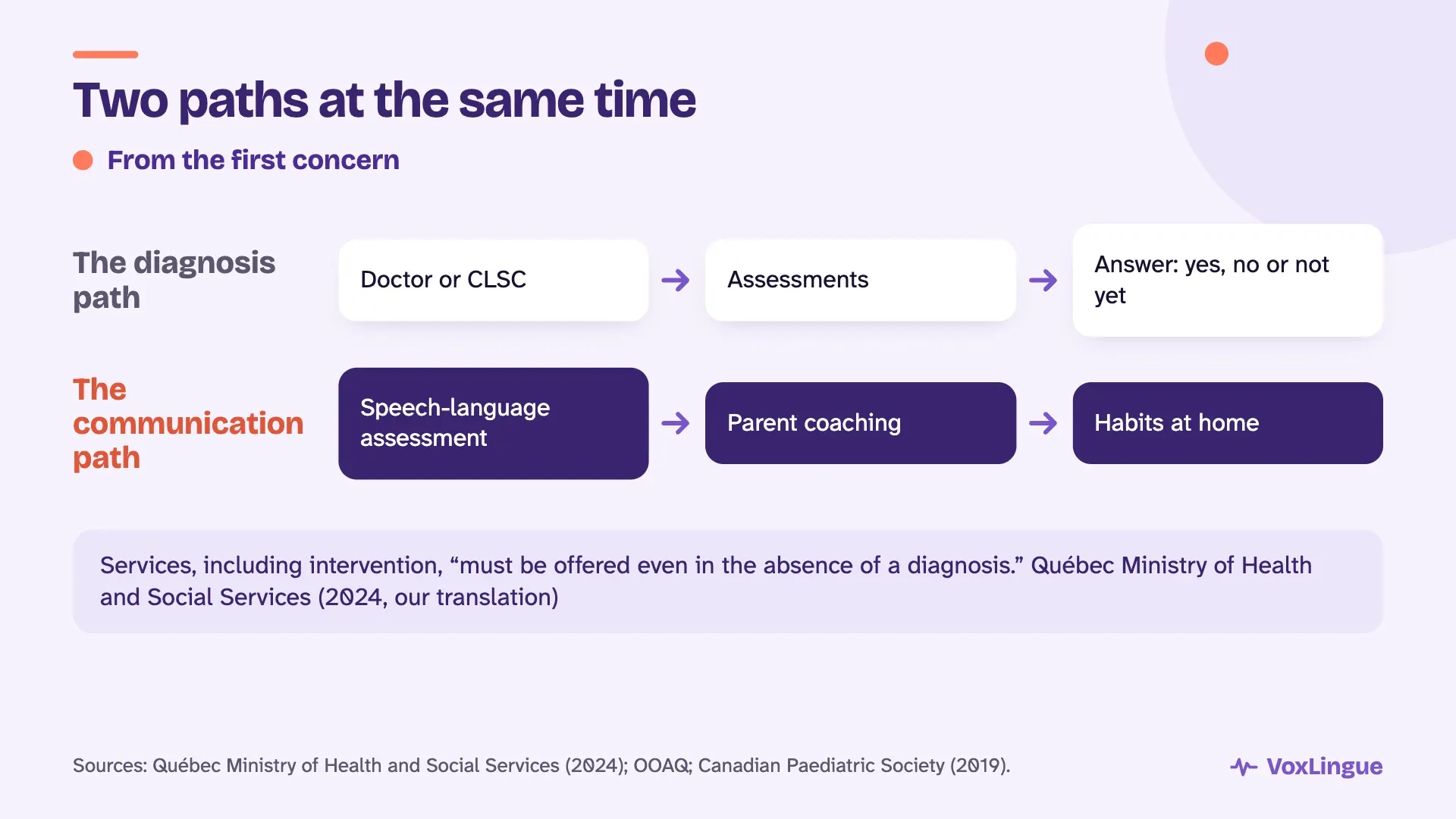
No. Québec’s Ministry of Health and Social Services states that services, including intervention, must be offered even without a diagnosis. Québec’s order of speech-language pathologists and audiologists (OOAQ) says speech therapy can begin as soon as autism is suspected. Supporting communication doesn’t require a label.
The policy is clear. According to the Ministry, services “must be offered even in the absence of a diagnosis in order to meet the needs of the child and family” (2024, our translation). And according to the OOAQ, it is possible to begin speech therapy “as soon as autism is suspected” (our translation).
The Canadian Paediatric Society agrees. It recommends that children at risk be referred “immediately” to early intervention services while they wait for a diagnostic assessment (2019). In practice, some public services still depend on a diagnosis. But the principle is settled: your child’s needs come before the label.
“Wait and see” isn’t recommended either. Québec’s guidelines describe it as harmful when professionals only reassure worried parents or advise them to wait (2012). Many late talkers do catch up. But at 2, no one can predict which ones will (Dale and colleagues, 2003).
What speech therapy looks like with a toddler
With a 2-year-old, speech therapy happens through play, and through you. The SLP watches how your child communicates, then shows you simple ways to enrich your everyday exchanges: at bath time, at meals, while playing. The goal is for your child to be able to ask, share and be understood.
Parent coaching programs are a good example. The Hanen program It Takes Two to Talk is for parents of children with a language delay. Hanen’s More Than Words program is for parents of autistic children or children who need support with social communication. Studies show that early parent coaching helps toddlers’ communication, even before any diagnosis (Whitehouse and colleagues, 2021).
Speech therapy doesn’t “prevent” autism, and no one can promise a result. It helps your child communicate in their own way, and helps you understand them. Our approach is neurodiversity-affirming: the goal is comfortable, effective communication, not making a child seem more “typical”. Our page on social communication and autism describes this approach.
Bilingual child: are two languages to blame?
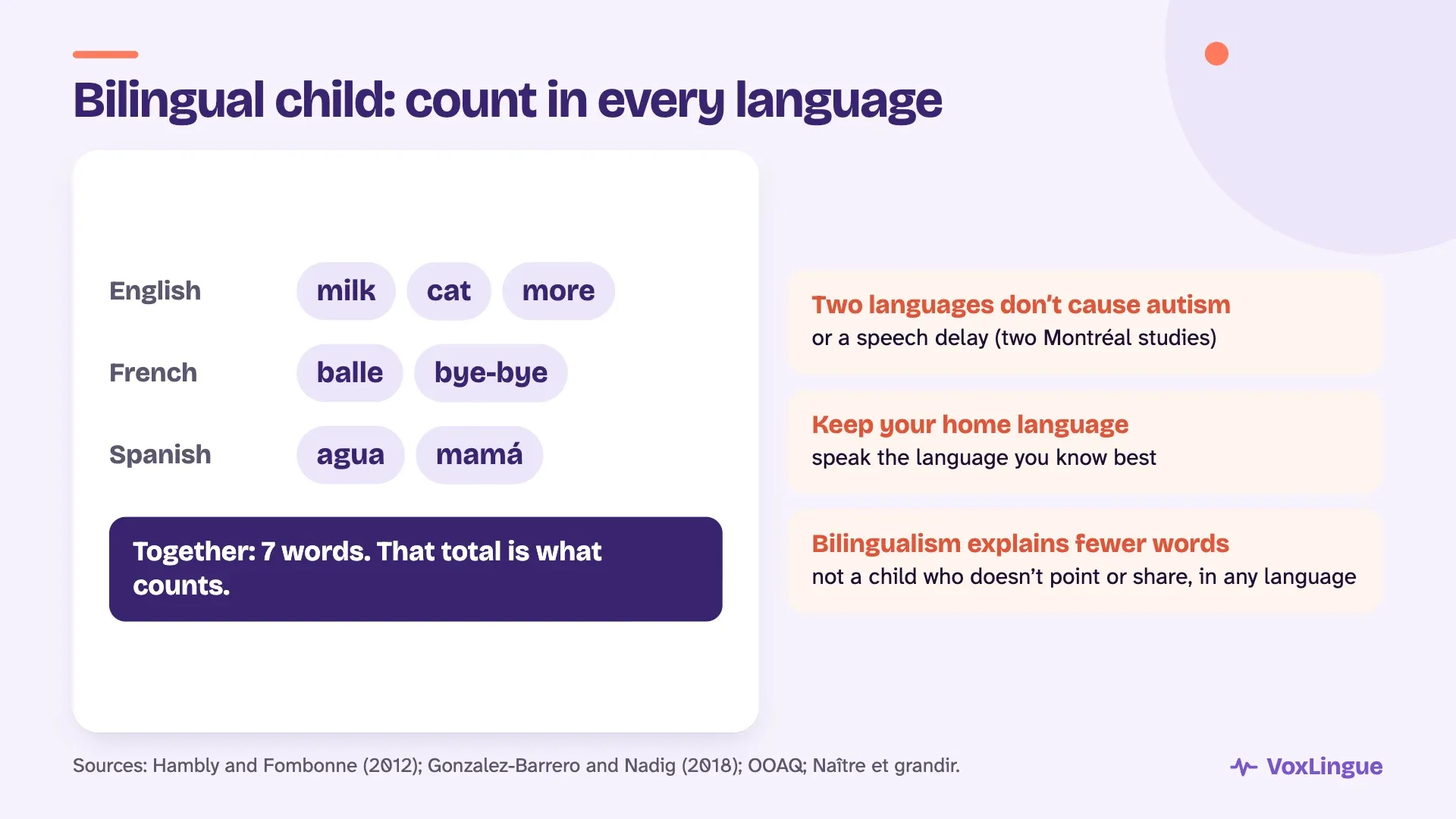
No. Learning two or more languages doesn’t cause autism or a speech delay, and it doesn’t hold back an autistic child’s language. Two studies done in Montréal show this. For a fair picture, count words across all of your child’s languages, and keep speaking your home language.
In one Montréal study, autistic children exposed to two languages had no more language delay than autistic children who heard only one (Hambly and Fombonne, 2012). Another showed that, for autistic children and others alike, the amount of language a child hears is what predicts their vocabulary (Gonzalez-Barrero and Nadig, 2018).
Yet “too many languages confuse him” is a belief our speech-language pathologists often correct. Bilingualism can explain fewer words in one language. It doesn’t explain a child who, in every language, doesn’t point, share or respond.
When a child is diagnosed autistic, one question comes up often: should we keep raising them in two languages? The studies above point to yes. Many autistic children also have a preferred language. Some refuse the home language, find English easier, or refuse French at school. This is common, and a speech-language pathologist can guide you.
A child who starts daycare in a new language may also say very little for a short while, or drop the home language. That is not the same as losing skills, and an SLP can help you tell the difference. Our article on identifying language disorders in bilingual children explains how bilingual children can be assessed fairly.
Above all, don’t stop speaking your language. Speech-language professionals recommend using the language you know best, for richer and more frequent conversations. That is true for every child, autistic or not.
While you wait: what can you do this week?
Book an appointment with your doctor or call your CLSC, and ask for a hearing test. Note what you see for a week, and film two or three short everyday moments. Ask the daycare what they notice. And start a few simple habits now that help every toddler communicate.
Parents’ observations are valuable. Note, for example, whether your child points to show, responds to their name, which gestures they use, what they understand and which words they say, in each of their languages. Note any word they’ve stopped saying. Short videos help professionals a lot, since they only see your child for a short time. Daycare educators can also share what they see in a group.
At home, a few habits help every toddler, whatever the answer turns out to be:
- follow their interests and play with them face to face, at their level;
- name what they are looking at or holding (“a truck! a big truck!”);
- wait a few seconds before helping, to give them a chance to communicate;
- add gestures to your words, and repeat their words back with a little more added.
Above all, keep playing and talking with your child, and give them chances to be with other children and other adults. Every parent’s concern is valid. If you feel dismissed and still worried, you can also contact a speech-language pathologist, occupational therapist, psychologist or neuropsychologist directly to see if an assessment is warranted.
Look after yourself too. Regional autism associations welcome families with or without a diagnosis. The Hanen Centre explains why pointing matters and how to encourage it at home. Our guide to waiting for speech therapy in Québec suggests other ways to use this time.
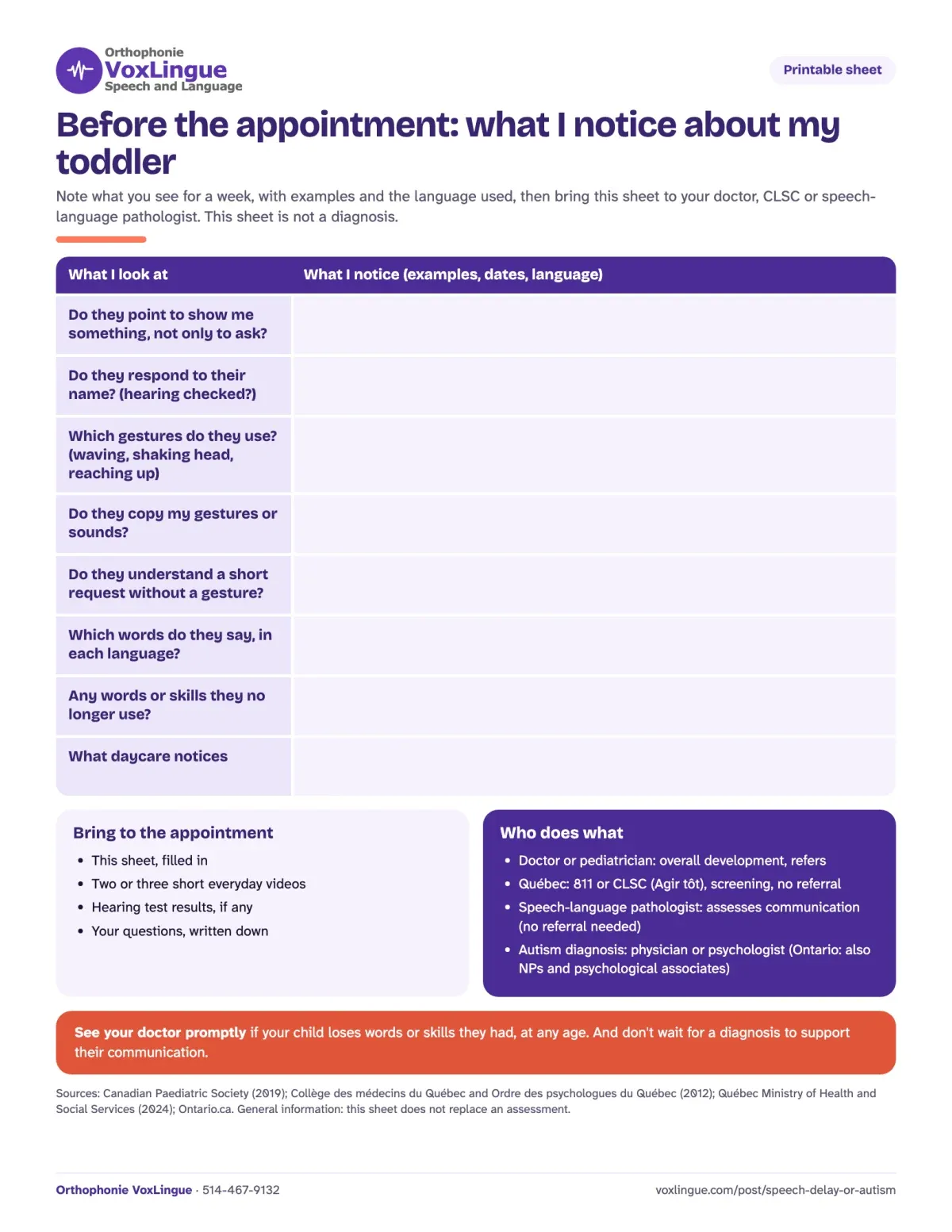
Printable sheet: Before the appointment: what I notice about my toddler (PDF, 1 page).
Next step
When you’re asking “speech delay or autism?”, the number of words tells only part of the story. What really helps is how your child shares attention, understands and communicates with you, observed over time by professionals. No single sign settles the question, and the answer is sometimes “both” or “not yet”.
You don’t need a final answer to start helping your child communicate.
If a question is on your mind, talk to your doctor or CLSC, and have your child’s hearing checked. You can also have your child’s communication assessed by a speech-language pathologist, with no diagnosis and no referral. To see how we work with toddlers and their parents, visit our page on social communication and autism.
Frequently asked questions
Can a child with good eye contact be autistic?
Yes. Many autistic children look their loved ones in the eye, especially during moments they enjoy. Eye contact alone can’t confirm or rule out autism. Professionals look at the whole picture: shared attention, gestures, understanding, imitation and how a child uses words.
Is “Einstein syndrome” real?
It isn’t a recognized diagnosis: the term doesn’t appear in official medical classifications. It describes children who talk late and then catch up. Those children exist, but no one can know in advance whether a particular toddler is one of them. That is why waiting isn’t recommended.
Do boys talk later than girls?
Boys are somewhat more common among late talkers (Zubrick and colleagues, 2007). But being a boy doesn’t explain a real delay, and it isn’t a reason to wait. A boy who says few words at 2 deserves the same attention as a girl in the same situation.
Can a speech-language pathologist diagnose autism?
Not in Québec or Ontario. An SLP assesses communication and can conclude that a child has a language delay or disorder. Autism is diagnosed by a physician or psychologist (and, in Ontario, also by a nurse practitioner or psychological associate). The SLP’s report helps the team that makes the diagnosis.
Do you need a diagnosis to get speech therapy?
No. Québec’s Ministry of Health and Social Services states that services must be offered even without a diagnosis. The OOAQ says speech therapy can begin as soon as autism is suspected. In Québec and Ontario, you can see a private speech-language pathologist with no referral.
Can a speech delay “turn into” autism?
No. A speech delay doesn’t turn into autism. But a child first seen for their language may later be diagnosed autistic, because the two can occur together and some signs become clearer over time. In Québec, this is a common path.
“He understands everything but doesn’t talk”: is that reassuring?
Good understanding is an encouraging sign. Check it without gestures, though: a child can follow a familiar routine without understanding every word. And still consult if words aren’t coming. A speech-language pathologist can confirm what your child understands and help them express themselves.
My child repeats lines from shows: is that autism?
Not necessarily. Repeating phrases they’ve heard, called echolalia, is one way children learn language. It happens in some autistic children and in others. Our article on gestalt language processing explains what those phrases can mean.
At what age do babies point?
Usually between about 12 and 18 months. They point first to ask for something, then to show you something interesting. If your child isn’t pointing by 16 to 18 months, mention it to your doctor, especially if they use few other gestures.
Are online autism questionnaires reliable?
They are screening tools, not diagnoses. A “high risk” result often means a developmental assessment would be useful, not necessarily that the child is autistic. If a questionnaire worries you, bring it to your doctor. In Canada, doctors follow each child’s development at every visit instead.
How long is the wait for an autism assessment in Québec?
It varies a lot by region, and it can be long. Some families choose a private evaluation to move faster. Either way, you don’t need to wait for a diagnosis to start supporting your child’s communication, at home and with a speech-language pathologist.
Should we drop one of our languages?
No. Learning several languages doesn’t cause autism and doesn’t hold back an autistic child’s language. Speak to your child in the language you know best. Rich, frequent conversations help more than a language you speak less naturally.