How to help your toddler talk: everyday strategies from gestures to first sentences
Your toddler points at the cereal box and yells until you work out what they want. They say “no”, “more” and a handful of other words. They seem to understand a lot, but the words are slow to come. So you start searching for how to help your toddler talk, without turning every moment into a lesson.
You do not need special toys or extra time. Children learn to talk through everyday back-and-forth with the adults who care for them, according to Québec’s public health institute (INSPQ, 2023). Breakfast, bath time, getting dressed and the drive to daycare are already good moments for it.
This guide starts by helping you see where your child is right now: mostly gestures and sounds, single words, two-word combinations or short sentences. For each stage, it suggests what to do and what to say. It then shows how to build these strategies into your routines, and which well-meant habits can slow talking down.
It also covers what to do when your family speaks more than one language, when home strategies are not enough, and where to turn in Québec and Ontario. Ages here are approximate, because every child has their own pace. For more on these early years, browse our early language articles.
How does a toddler learn to talk, and what is your role?
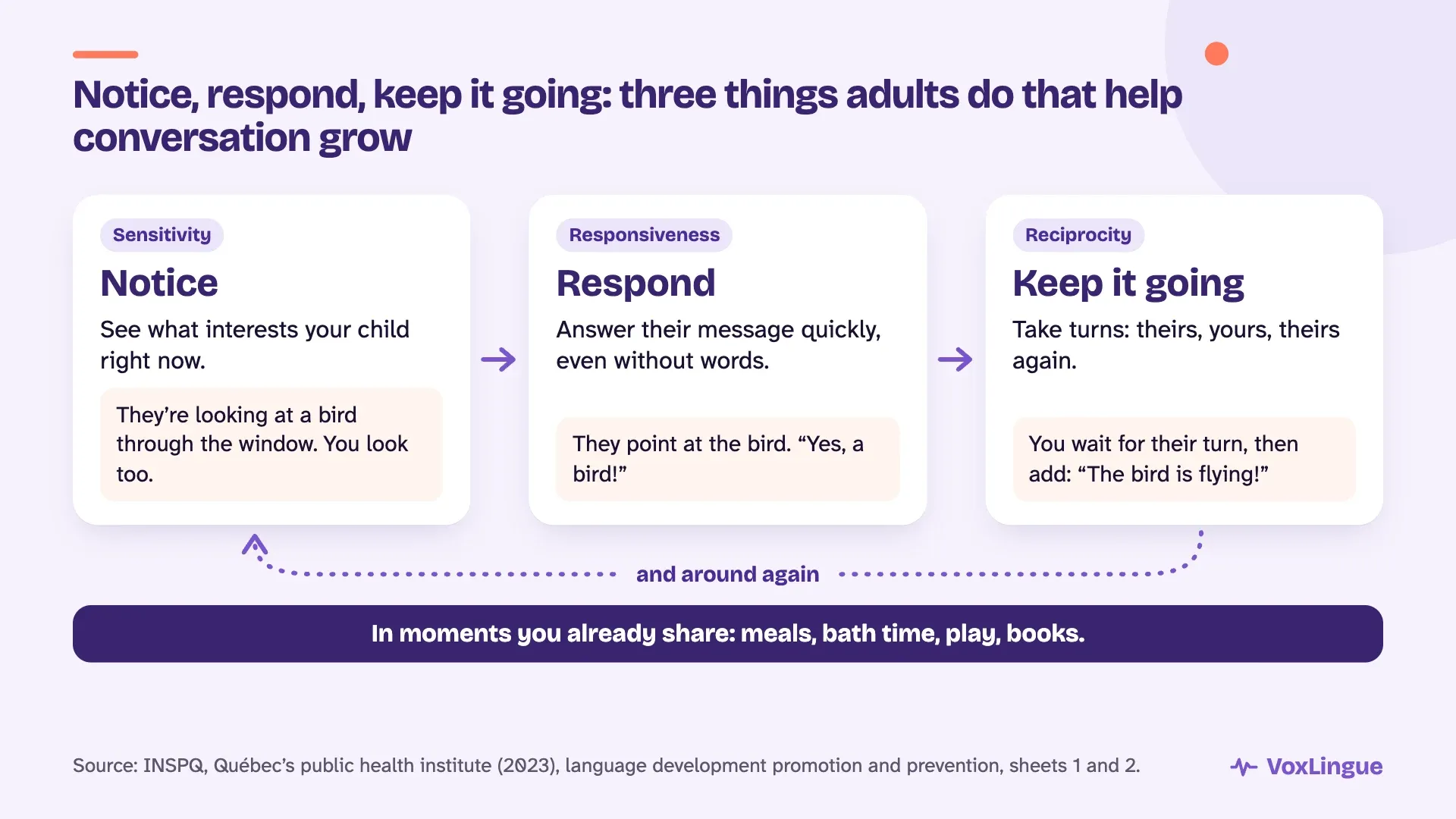
Toddlers learn to talk through everyday exchanges with the adults they know. What helps most is noticing what interests them, responding quickly and keeping the turns going, during moments you already share. Parents can learn these strategies, and children benefit, without drills or special materials.
In 2023, Québec’s Institut national de santé publique (INSPQ) published a set of evidence summaries on supporting language from birth to age 6. They describe three qualities in the adult that support these exchanges: sensitivity, responsiveness and reciprocity (INSPQ, 2023).
Sensitivity means noticing what interests your child: what they look at, what they point to, the sound they make. Responsiveness means answering it quickly, with a word, a gesture or a smile. Reciprocity means keeping the exchange going: they make a sound, you answer, they try again. A conversation takes shape, even without words.
These three qualities often fit into a few seconds. At supper, your child bangs on the high chair tray and looks at you. You bang back and say “Boom!”, and they do it again. They had a turn, you answered, and a word was added to the moment.
This role does not mean talking much more. It means talking with your child and leaving room for them. You already do a good part of this, often without thinking about it. Our newsletter explains why interaction comes before words.
What research says about parent strategies
Research supports this role for parents, with real but modest results. In 2011, a review of 18 studies looked at children aged 18 months to 5 years who had language difficulties. When parents were taught strategies to use in daily life, children’s understanding and talking improved (Roberts and Kaiser, 2011).
A more recent review pooled 25 randomised trials (Heidlage and colleagues, 2020). It found modest gains in the words children said, especially when strategies were used during play and routines, or while reading together. The effect on understanding was small.
A trial in Nashville with 97 toddlers aged 2 to 3½, all with language difficulties, adds another nuance (Roberts and Kaiser, 2015, in Pediatrics). Parents learned every strategy they were taught. Their children understood more and used more different words. Their overall scores for expressive language, however, did not differ from the comparison group.
So these strategies help, but they are not magic. Most of these studies come from English-speaking families, often in the United States, and results may differ for children learning French or several languages. Québec institutions such as the INSPQ (2023) and the Montreal Children’s Hospital (2022) still recommend the same approach to every family.
Which everyday strategies really help a toddler talk?
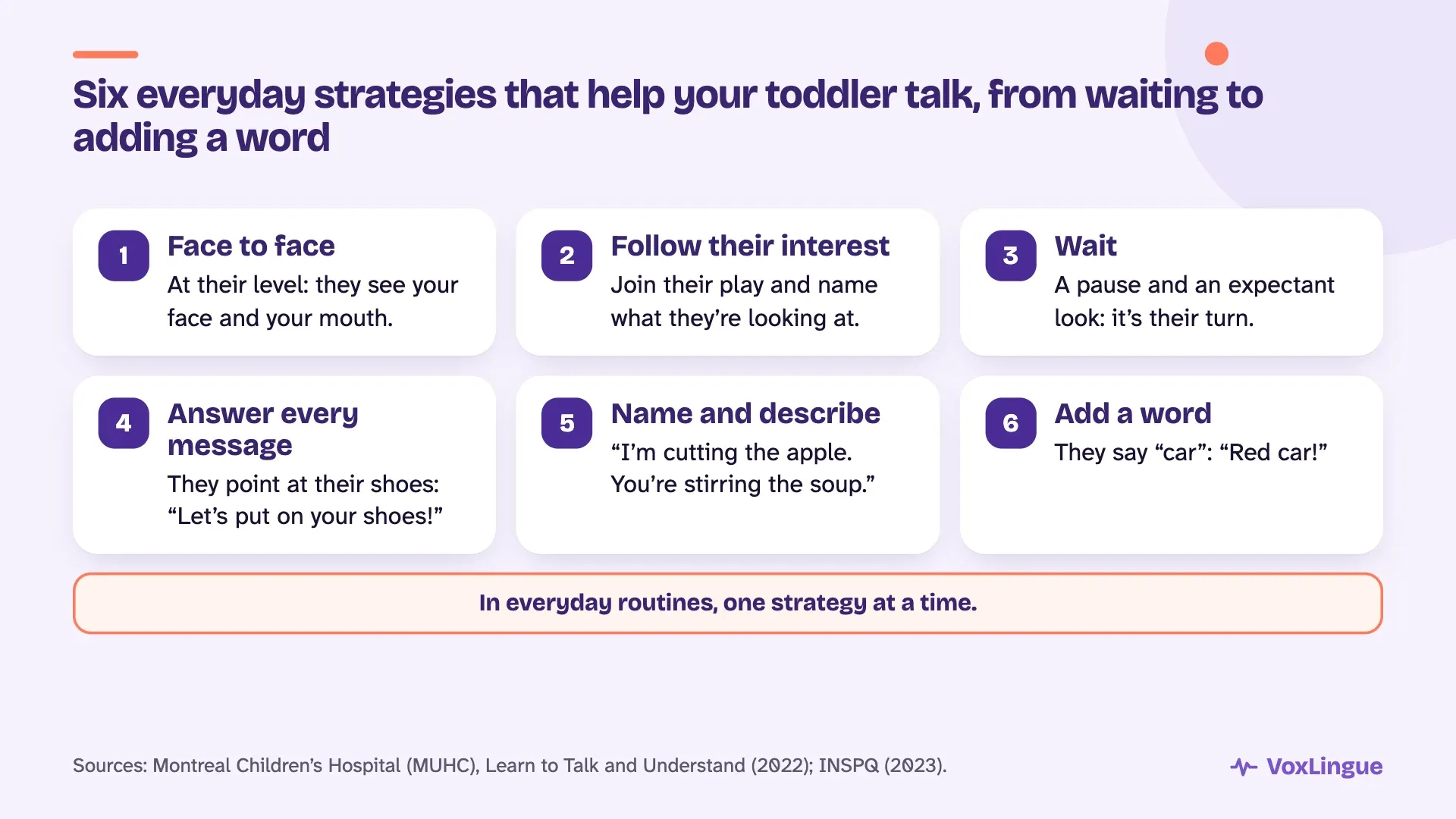
Six simple strategies do most of the work to encourage a toddler to talk. Get face to face, follow what interests your child, wait, respond to every message, even without words, describe what you are doing, and add a word or two to what they say. Build them into moments you already share, one strategy at a time.
These strategies come from the Speech-Language Pathology Department of the Montreal Children’s Hospital, in its leaflet “Learn to Talk and Understand: 11 ways to help your young child develop language” (2022). They match the INSPQ’s summaries (2023).
They follow the order of an exchange: be there, notice, wait, respond, describe, then add. A seventh, more delicate one is setting up reasons for your child to ask. You do not need to do everything at once. Pick one, and add another when the first one feels natural.
Get face to face, at your child’s level
Being face to face lets your child see your face. The Montreal Children’s Hospital suggests getting down to your child’s level, so they can see your face and your mouth as you talk (2022). They can follow your expressions and the shape of your lips.
In practice, that means sitting on the floor to play, sitting in front of the high chair rather than beside it, or leaning over the edge of the tub. You also see better what they are looking at, which is often where the exchange begins.
Follow what interests your child
Join in with whatever already holds your child’s attention. If they are lining up cars, line one up next to theirs. If they are watching a bird at the window, watch it too and name it: “A bird!” The word arrives at the moment their attention is already there.
The INSPQ calls this the adult’s sensitivity (2023). A parent article explains why children who lead get the language they need.
Copying your child’s sounds and words is another way to follow. According to the Montreal Children’s Hospital, it catches their attention and encourages them to copy you in turn (2022). If they say “ba ba”, say “ba ba” back, then wait to see what they do.
Wait: the pause that leaves room for your child
Waiting gives your child time to take a turn. After you speak, stop. Look at them expectantly, count slowly in your head, and give them time to respond.
That silence is where they try something: a look, a gesture, a sound or a word. The Montreal Children’s Hospital points out that a gesture or a sound already counts as a request (2022). The pause is not a test. It is a space you leave open for your child.
Respond to every message, even without words
Every look, gesture or sound your child makes can be a message. The Montreal Children’s Hospital recommends interpreting these messages and saying them back in your own words (2022). If your child points to their shoes by the door, say: “Let’s put on your shoes!” You give them the words that match what they meant.
Responding this way also shows them that communicating works: they made a gesture, and you understood. That can make them want to try again.
Name and describe what you are doing together
Talking about what you are doing gives your child the words for the moment. The Montreal Children’s Hospital suggests talking about what you do and see at meals, at bath time, while reading and while playing (2022). The INSPQ describes two ways to do this: describing your own actions, and describing your child’s (2023).
For your actions: “I’m cutting the banana. I’m putting the banana in the bowl.” For theirs: “You’re stirring. Stirring fast!” Keep sentences short, and use the same words from one day to the next.
Add a word or two, and say it back correctly
When your child says a word, add one or two. If they say “car”, you might say “red car” or “car goes”. The Montreal Children’s Hospital (2022) and the guidance from the Communication Health Support Association, powered by ASHA (2026), both describe this: build on what your child says.
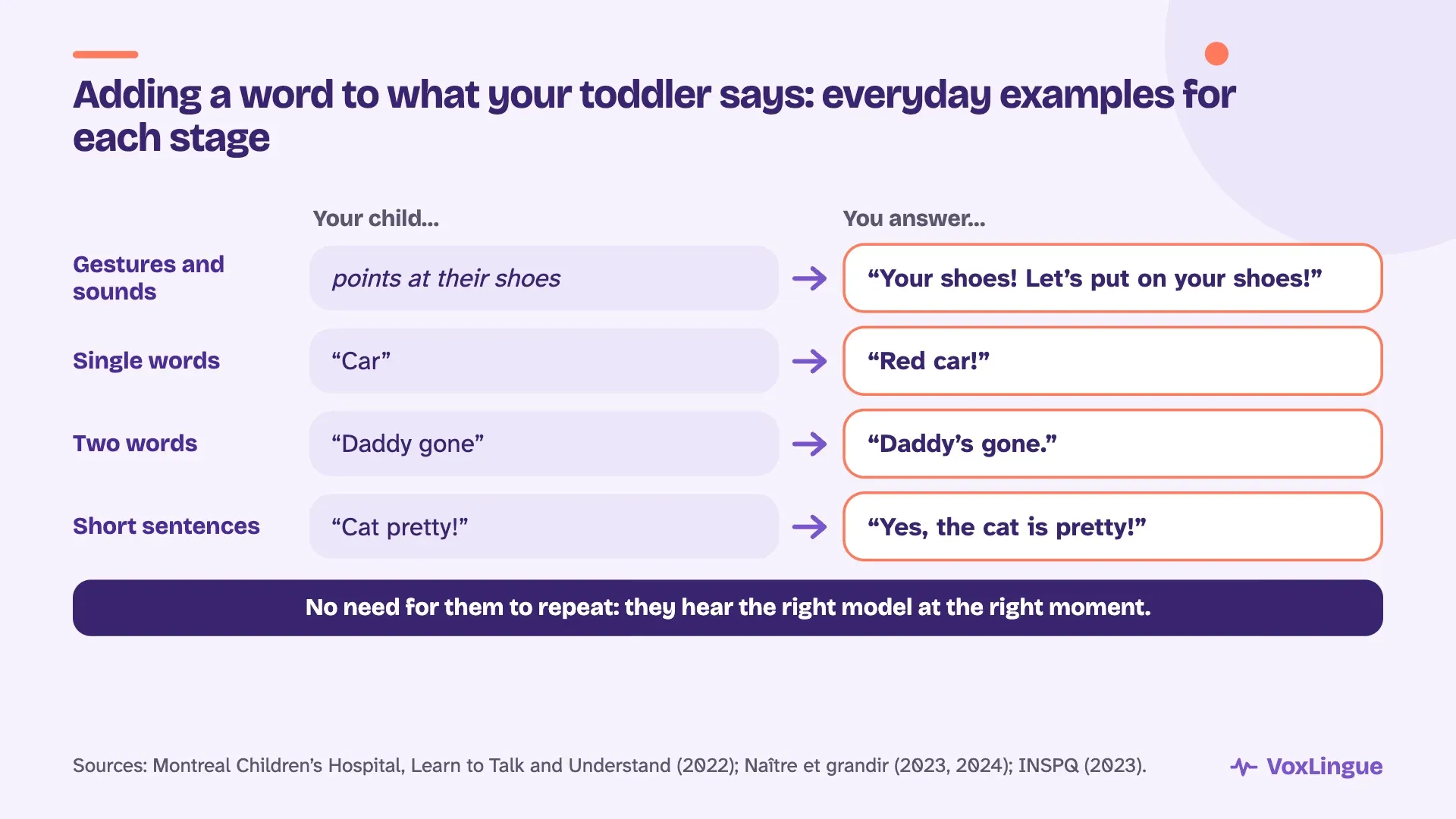
Do the same when your child makes a mistake. The INSPQ recommends recasting rather than correcting (2023). If they say “Daddy gone”, you answer “Yes, Daddy’s gone.” You say it correctly, without pointing out the error and without asking them to repeat it. They hear the right model, and the exchange stays pleasant.
Set up reasons to ask, without frustration
Small set-ups give your child a reason to communicate. The Montreal Children’s Hospital suggests several (2022). Put a favourite toy in sight but out of reach. Give a puzzle with one piece missing. Close the bubble jar after a few bubbles. Offer two choices.
Then wait. If your child points, reaches or makes a sound, that is a request: give them what they want and name it. “Bubbles! You want bubbles.” You do not have to insist on a word before handing it over.
Watch their mood. If your child gets upset or gives up, give them what they want right away, and name it. It should stay a game, never a check on what they can say.
Where is your toddler now, and what helps at each stage?
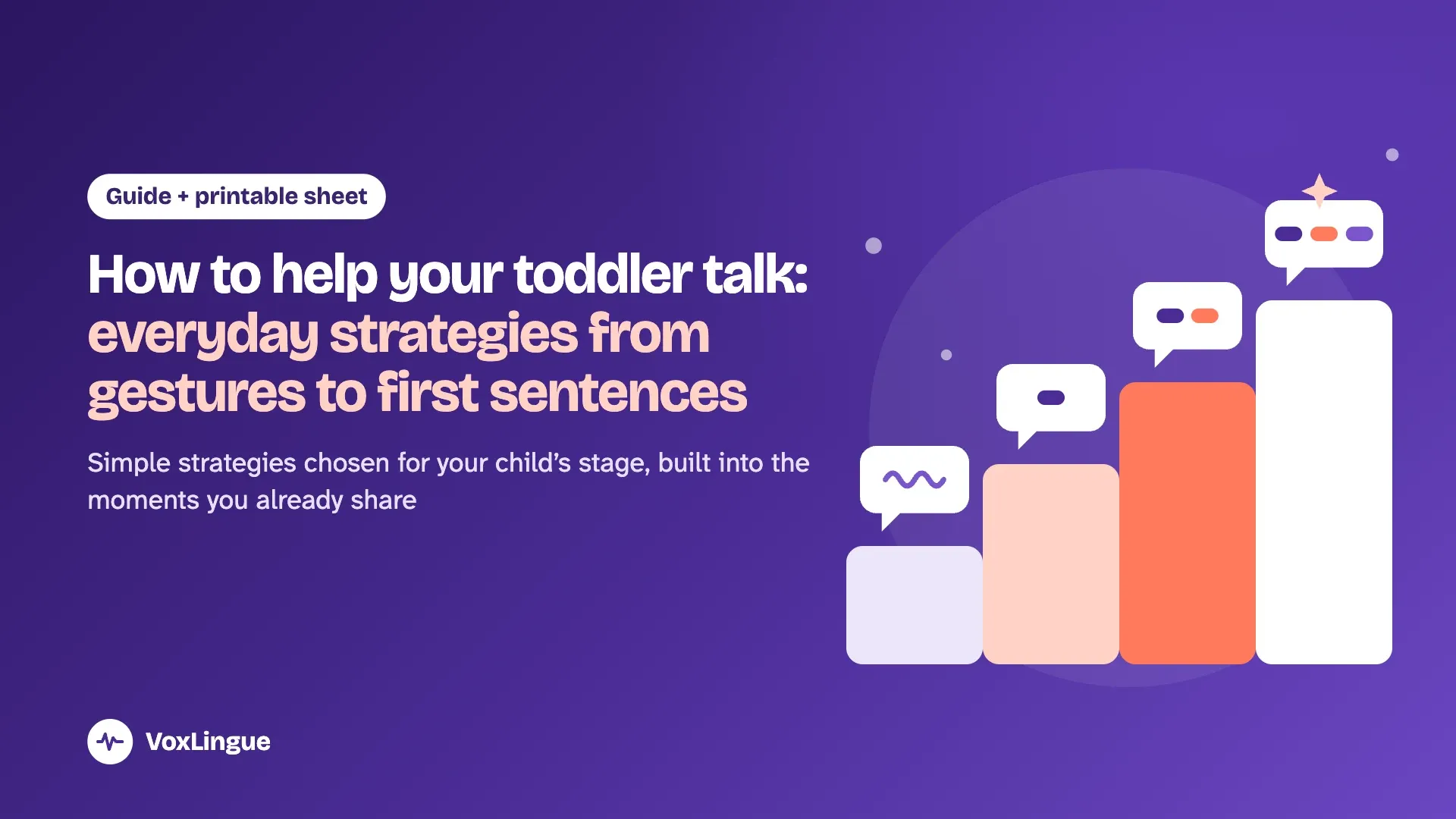
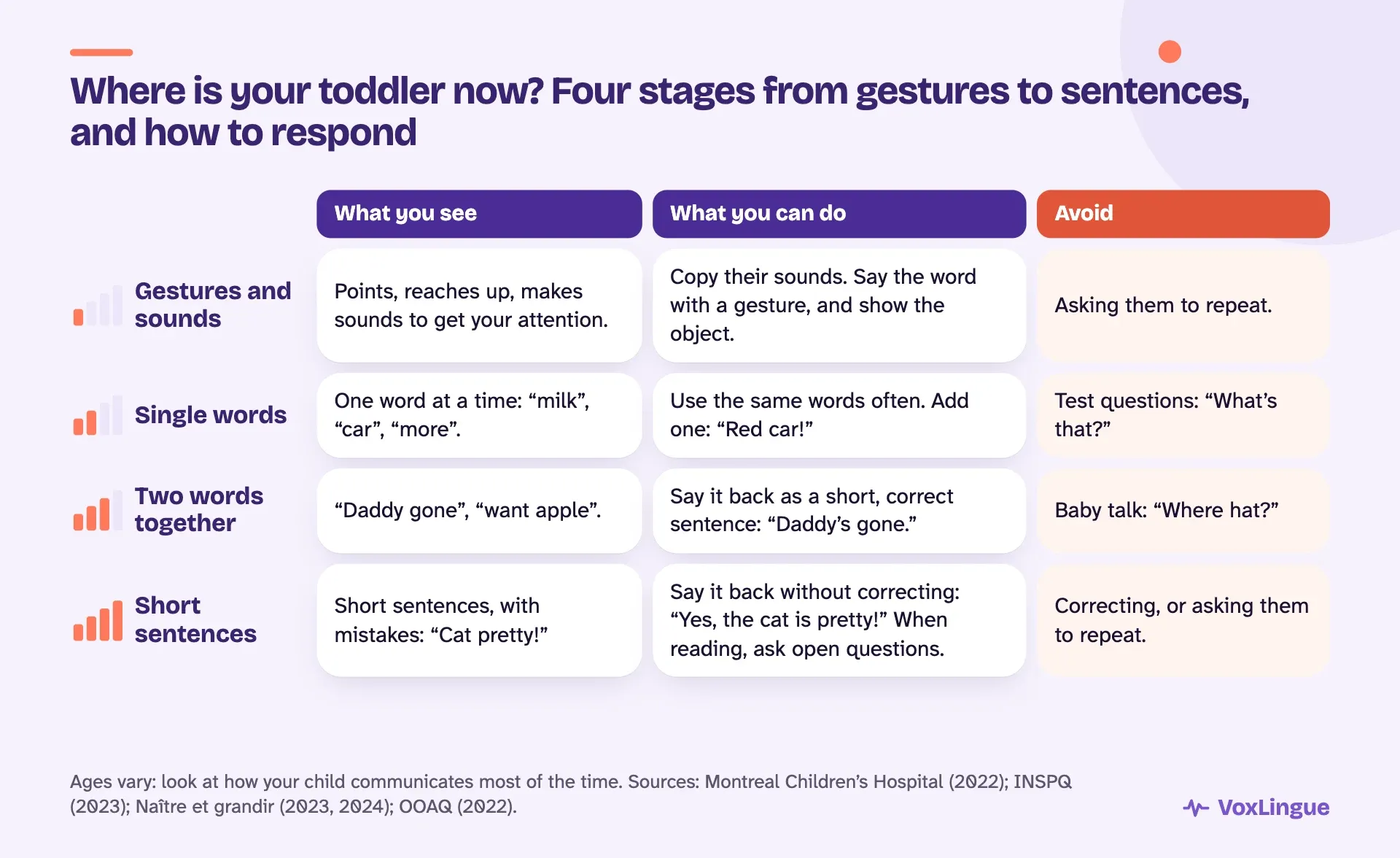
Look at how your child communicates most of the time, not only at their age. If they mostly use gestures, answer with a word. If they say single words, answer with two. If they combine two words, answer with a short sentence. Your answer sits just a little above theirs, so the next step is always within reach.
Naître et grandir, Québec’s parenting resource reviewed by speech-language pathologists, describes the usual order (2023, 2024). First words often appear between 12 and 16 months. Vocabulary speeds up after about fifty words, then word combinations follow. Speech usually becomes clearer around age 3.
These markers are approximate, and many norms come from English-speaking children; they may differ for children learning French or several languages. For age-by-age markers, see language milestones from birth to 5. The Communication Health Support Association’s tips by age, powered by ASHA, also group strategies by age band. Here, the idea is simpler: start from what your child does today.
Mostly gestures and sounds
At this stage, gestures and sounds are already communication. Your child points at what they want, reaches up, shakes their head or yells to get your attention. They may say few words, or none yet, but they have plenty to say.
Add gestures to your words, such as pointing, shaking your head for “no” or waving bye-bye. Show the object as you name it (Montreal Children’s Hospital, 2022).
When your child points and screams, put words to the request instead of waiting for them to say it. “You want water. Water!” Naming what they show you, as they show it, gives them the word that goes with what they meant.
Does baby sign language delay speech?
No, based on what we know today. Naître et grandir explains that baby signs do not appear to harm language development, but they do not seem to speed it up either (2022). If you use signs, always say the word along with the sign, never instead of it. The sign travels with the spoken word.
Signs are a kind of gesture, like pointing or waving, and the Montreal Children’s Hospital recommends adding gestures to your words (2022). If you use them, what matters is that your child hears the word every time.
Toddler first words, one at a time
A toddler’s first words usually arrive one at a time. Your child says “no”, “more” or the name of someone they love. Each word is something to build on.
Name what they look at or touch, as they do it. Use the same words in several situations: “more” at breakfast, “more” in the bath, “more” on the swing. They hear the same word in different moments, always tied to what they are living.
Add a word to what they say, without asking them to repeat. If they say “car”, say “red car” or “car goes”. Your additions show them what the next step sounds like. In a multilingual family, count their words across all of their languages together.
Starting to put two words together
Around age 2, most children start using two-word phrases. Your toddler says “daddy gone”, “want apple” or “give ball”. Québec’s professional order of speech-language pathologists and audiologists (OOAQ) uses these kinds of examples: at 24 months, almost all children combine two words (2022).
At this stage, build their phrase into a short, correct sentence. If they say “daddy gone”, answer “Daddy’s gone” (Montreal Children’s Hospital, 2022). If they say “want apple”, answer “You want an apple.” You add the small words that are missing, without asking them to say it again.
Keep your sentences short and grammatical (Montreal Children’s Hospital, 2022). The goal is not for your child to repeat you. It is for them to hear, again and again, a slightly fuller version of what they meant.
Short sentences
When your child starts using short sentences, mistakes come with them. They may leave out small words or put words in an unusual order. Keep saying it back correctly, the way the INSPQ recommends (2023).
At this stage, open questions become useful. Québec’s government guidance suggests asking open questions to encourage your child to take part (Québec.ca, 2026). Give them time to answer, then add a word to what they say.
Around age 3, speech usually becomes clearer (Naître et grandir, 2024). If other people still find your child hard to understand, our article on speech intelligibility by age explains what to watch for and when to ask.
How can you help your toddler talk during daily routines?
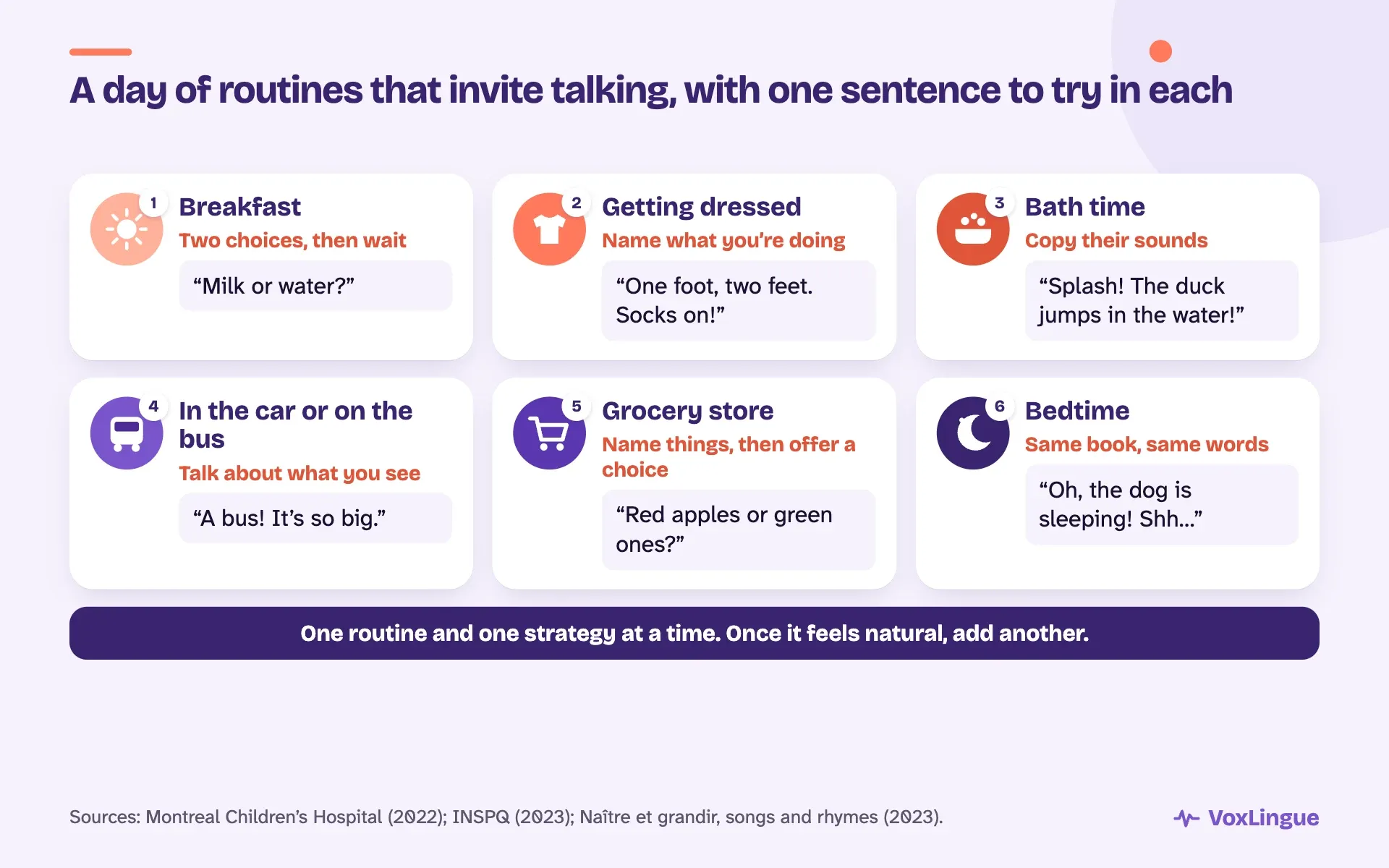
Routines work well for language because they come back every day with the same words. Choose one routine, such as breakfast or bath time, and one strategy. When it feels natural, add another. You do not need extra time: you are using moments that already exist.
The 2020 review by Heidlage and colleagues found gains in the words children said, especially when strategies were used during play and routines. The Montreal Children’s Hospital also names mealtimes, bath time, reading and play (2022). Because these moments repeat, your child hears and tries the same words many times.
Below, each routine has one strategy and one sentence to try. Adapt them to your family’s words and your language.
Breakfast and mealtimes
Meals are full of choices and natural requests. Before serving, hold up two options and wait: “Cereal or toast?” If your child points, name the choice. When they finish, wait before offering more. A look, a gesture or a “more” is a request, and you answer by naming it: “More milk!”
The same words come back at lunch and supper, always at the moment they make sense.
Getting dressed and diaper changes
Getting dressed follows the same steps every time, and those steps have words. Describe what you are doing as you do it: “Arm in the sleeve. Hat on your head.” In winter, the snowsuit, boots, mittens and toque add words that come back every morning.
During diaper changes, name body parts: “Your feet. Your tummy.” Words like “up” and “down” fit in naturally too. Keep the same phrases from one day to the next.
Bath time
Bath time is full of actions and sounds to name. Pour water and say “Pour!” Drop a toy in: “Splash!” Then wait: your child may want to do it again and make the sound with you.
Copy their splashing and sounds, as the Montreal Children’s Hospital suggests (2022). Describe what they do as well: “You’re washing your arm. Scrub, scrub!”
In the car, the stroller, the bus or the métro
Getting around is a good time to comment on what you both see. In the stroller, on the bus or in the métro, name what catches your child’s eye: “A truck! A big truck.” Try not to turn it into a quiz full of “What’s that?”
In the car, where you cannot see their face, songs work well. Pause before the last word of a song they know, and let them fill it in with a sound or a word. The walk to daycare drop-off can follow the same pattern every morning.
At the grocery store
The grocery store is full of concrete words. Name what goes into the cart. Offer two choices: “Apples or bananas?” Give your child a small job, such as putting apples in the bag, and describe it: “You put the apple in. Another apple!” They hear useful words while they handle the objects.
Bedtime
Bedtime runs on rituals, and rituals repeat the same words. Read the same book several nights in a row if your child asks for it. Sing the same song. Then name one or two things from the day: “Today we saw a dog. The dog barked!”
Books, songs, toys and screens: what really helps?
What helps is the back-and-forth with you around the object, more than the object itself. Books, songs and simple toys create turns. Share a book without necessarily reading the words, sing the same songs often, choose toys that need an adult to play, and turn the TV off when nobody is watching it.
Reading to toddlers without reading the words
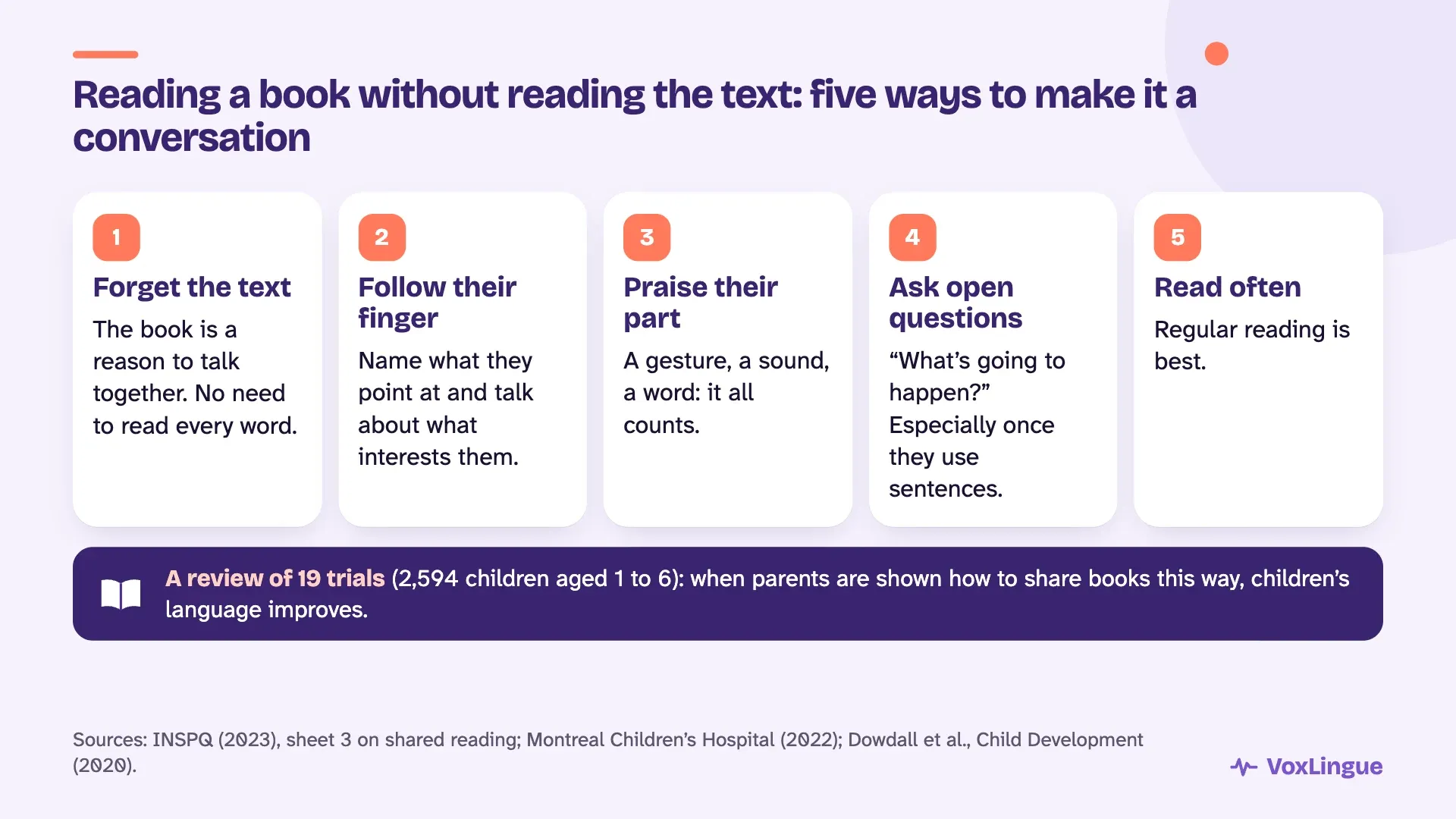
With a toddler, a book is mostly a reason to talk together. The INSPQ describes shared reading: you do not have to read the text word for word (2023). You follow what your child points at, name things, praise their participation and, with an older child, ask open questions. Reading regularly is ideal.
The Montreal Children’s Hospital also suggests telling the story in your own words (2022). Let your child turn the pages, even if they skip some. If they linger on a picture, stay there with them.
Research backs this way of reading. A review of 19 trials with 2,594 children aged 1 to 6 found that teaching parents to share books this way improved children’s language (Dowdall and colleagues, 2020). The effect was larger when parents received enough coaching.
Songs and nursery rhymes
Songs and nursery rhymes repeat the same words and play with rhyme. According to Naître et grandir, this helps children become familiar with the sounds of their language and learn new words (2023).
Sing the same ones often. Then pause before the last word and wait for your child to fill it in, with a sound, a gesture or a word. The songs from your own childhood, in your own language, work just as well.
Which toys help speech?
A good toy for talking is one that needs you. A ball you roll back and forth, blocks you stack and knock down, a little car that goes and comes back: every turn is a chance for a word. No particular brand is needed.
Electronic toys that talk or sing can take the place of your voice. In a 2016 study of 26 families with babies aged 10 to 16 months, parents said fewer words with electronic toys. There were also fewer back-and-forth exchanges than with traditional toys or books (Sosa, 2016).
What about screens?
Screens deserve a separate note, especially a TV left on in the background. Even when nobody is watching, it reduces the back-and-forth between children and adults, and the Canadian Paediatric Society advises turning it off (2025). Our article sums up what research says about screens.
Which well-meant habits can slow toddler talk?
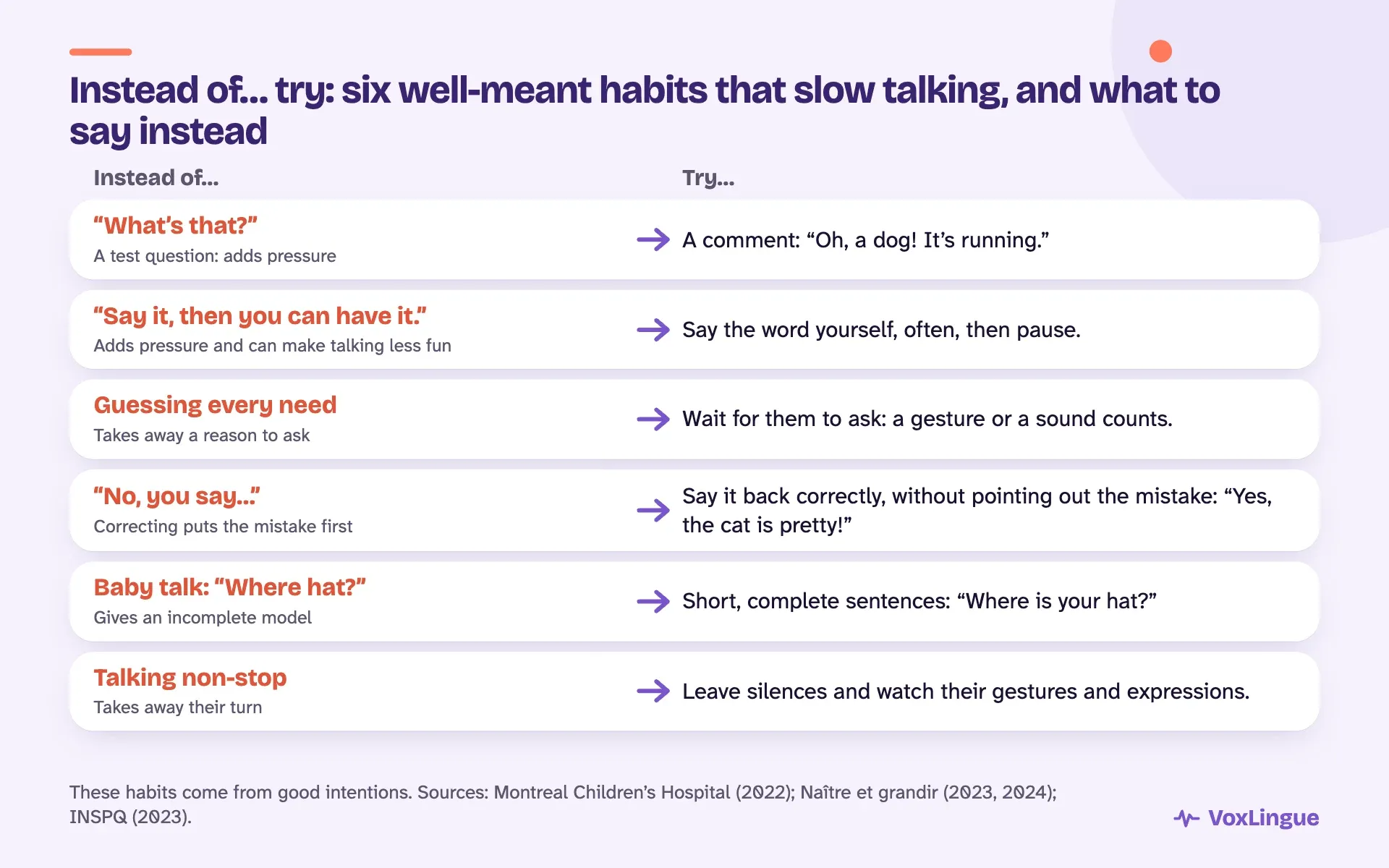
Some well-meant habits can slow a toddler’s talking. Asking them to name things, saying “say it” before handing something over, guessing every need, finishing their words or correcting them: these come from good intentions. They can still take away your child’s turn or add pressure. Each one has a simple alternative.
If you recognise yourself here, you have done nothing wrong: these habits come from wanting to help. The table offers another way for each one, based on guidance from the Montreal Children’s Hospital (2022), Naître et grandir (2023, 2024) and the INSPQ (2023).
| Instead of… | Why it can slow talking | Try… |
|---|---|---|
| Asking “What’s that?” when you know the answer | The exchange becomes a test | Comment: “A dog! He’s running.” |
| Saying “Say ‘milk’” before giving it | It adds pressure and can make talking less appealing | Say “Milk,” pause, accept a gesture |
| Handing things over before your child asks | They have no reason to communicate | Wait a few seconds, looking expectant |
| Finishing their words for them | It takes away their turn | Wait, then say the whole word back |
| Correcting: “No, that’s not how you say it” | The mistake is highlighted | Say it back correctly: “Yes, Daddy’s gone.” |
| Baby talk: “Where hat?” | The model is incomplete | A short, correct sentence: “Where’s your hat?” |
| Talking non-stop | There is no room left to answer | Leave silences and watch their gestures |
When a child cannot make themselves understood, frustration can build on both sides. Our article on behaviour explains what happens when the frustration of not being understood boils over.
Quizzing and “say it”: should I make my toddler repeat words?
Making a toddler repeat words seems logical, but Québec guidance advises against it. The Montreal Children’s Hospital recommends not forcing your child to repeat: it can put pressure on them and make them less eager to talk (2022). Naître et grandir gives the same advice (2023, 2024).
Quiz questions are close cousins of “say it”. “What’s that?” or “What does the cow say?”: you already know the answer, and the exchange turns into a small test.
Instead, use the word often, in moments where it means something, then pause in case your child wants to try it. If they do not say it, the exchange still goes on: they heard the word one more time, with no pressure.
Guessing every need, finishing their words
When you guess everything, your child has fewer reasons to communicate. Naître et grandir advises not anticipating every need and waiting for your child to ask (2024).
Leave the need open for a few seconds, with an expectant look. Then respond, even if all they did was gesture. Do the same when they are searching for a word: wait before finishing it, then say the whole word back.
Correcting, baby talk, or talking non-stop
These three habits change the model your child hears. Correcting directly highlights the mistake. Instead, say the word or the sentence back correctly, without asking for a repeat (Naître et grandir, 2023; INSPQ, 2023).
Baby talk oversimplifies. The Montreal Children’s Hospital recommends short, grammatical sentences: “Where’s your hat?” rather than “Where hat?” (2022). Naître et grandir also advises against baby talk (2024).
Talking non-stop, finally, leaves no room. Naître et grandir suggests avoiding non-stop talk and watching your child’s gestures and expressions instead (2023). Leave silences: they are invitations for your child to take a turn.
Questions: which ones help, and which get in the way?
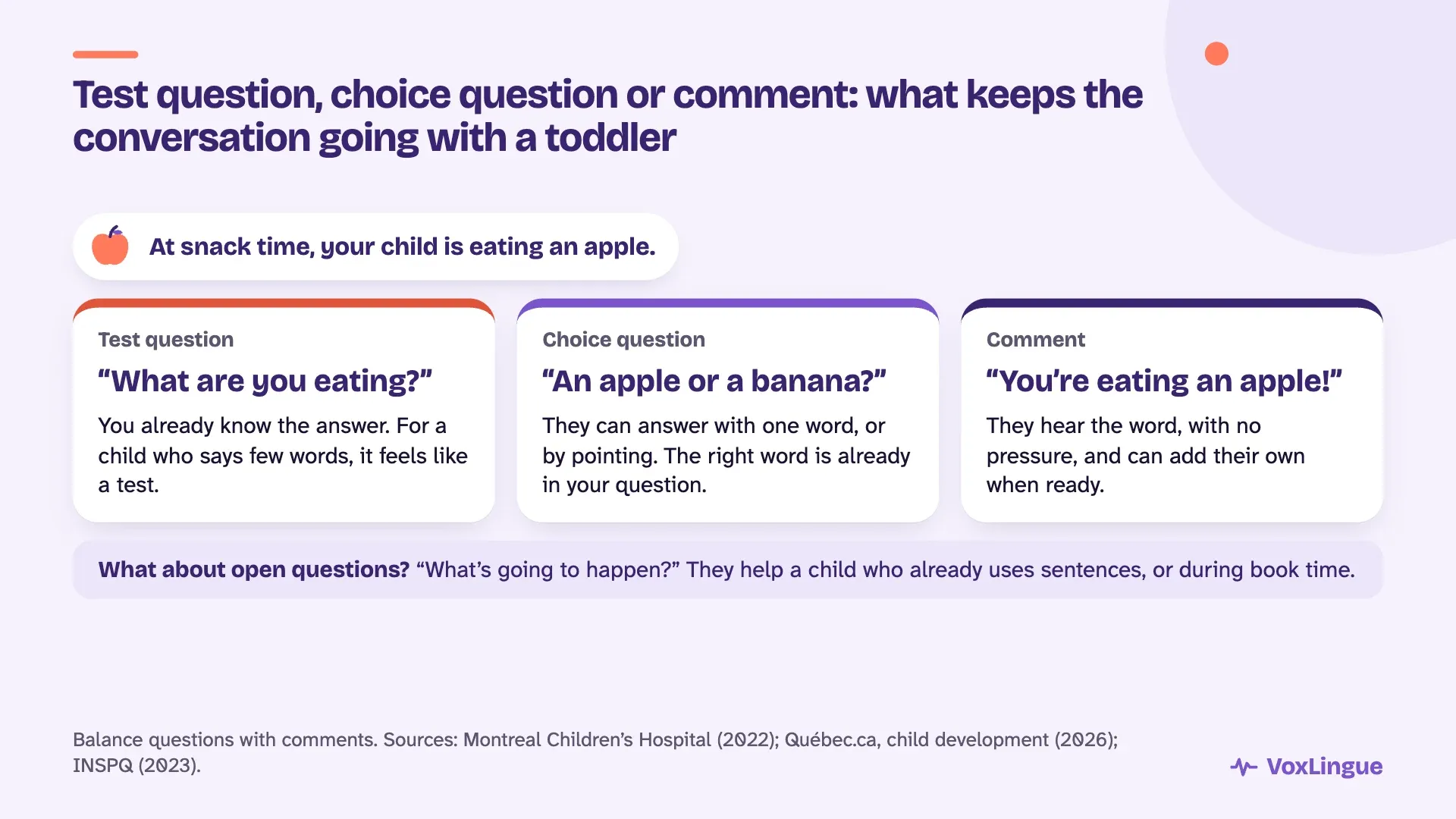
Questions are not the problem; questions you already know the answer to can be. Turn some of them into comments, offer two choices to a child who says few words, and save open questions for a child who already uses sentences, or for book time. So no, you do not need to stop asking your toddler questions.
Québec’s government guidance suggests asking open questions (Québec.ca, 2026), while the Montreal Children’s Hospital recommends balancing questions with comments (2022). These two pieces of advice do not contradict each other: they target different kinds of questions and different stages.
Take snack time. “What are you eating?” is a quiz question: you already know. The Montreal Children’s Hospital suggests turning it into a comment: “You’re eating an apple!” (2022). A choice question such as “Apple or banana?” gives a child who says few words the word they need to answer.
Open questions such as “What’s happening?” ask your child to build an answer. They suit a child who already uses short sentences, and book time, where the INSPQ recommends them (2023).
Several languages at home: which language should you use for these strategies?
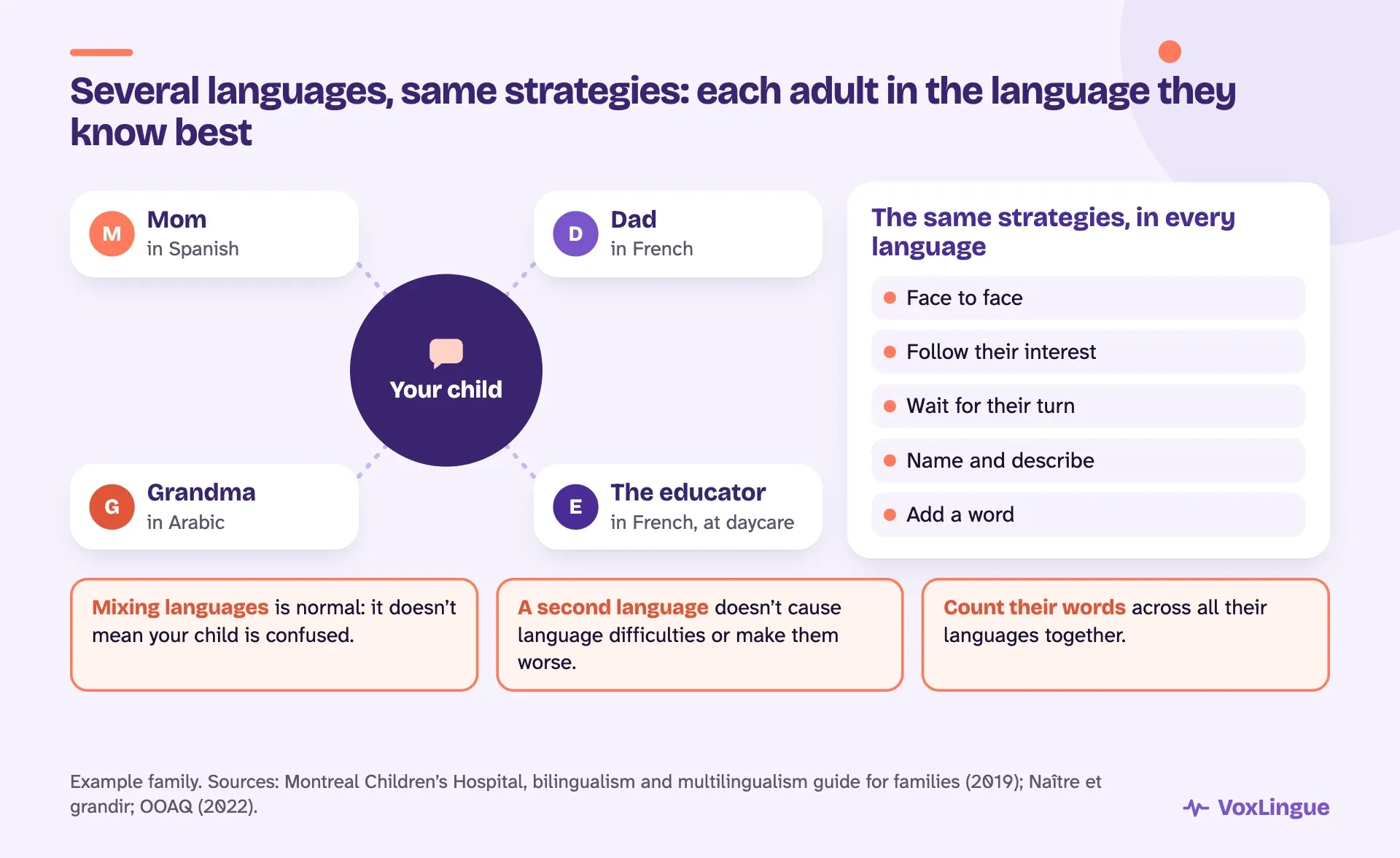
Use these strategies in the language you know best. Each adult can speak their own language, and the strategies work in all of them. Mixing languages is normal, and learning a second language does not cause language difficulties or make them worse. Count your child’s words across all of their languages together.
The Montreal Children’s Hospital’s guide for bilingual and multilingual families advises reading, talking and singing in the language or languages you know best (2019). Each family member can use the language they prefer: a mother Spanish, a father English, a grandmother Arabic.
The Communication Health Support Association, powered by ASHA, makes the same point: its tips help children learn words “in all the languages that you might use at home” (2026). Commenting, waiting and adding a word all come more easily in a language where you have the right words, a natural tone and the songs of your own childhood. You do not need to switch to English or French to help your child talk.
Mixing languages is normal. A child who uses a word from each language in the same sentence is not confused, according to the same Montreal Children’s Hospital guide (2019). Learning another language does not cause language difficulties or make them worse. That holds even for a child with a language disorder, an autistic child, or a child with an intellectual disability (Montreal Children’s Hospital, 2019).
In Montréal, many children hear French at daycare and English or another language at home. In that case, daycare already provides French. At home, keep your own language strong, with the same strategies: face to face, waiting, commenting, adding a word.
To get a fair picture of your child’s vocabulary, count their words across all of their languages together, as Naître et grandir and the OOAQ recommend. A bilingual child knows some words in one language and other words in the other.
If you are wondering whether what you notice comes from the languages or from something else, our article explains the difference between a language difference and a language disorder. A speech-language pathologist assesses a child in all the languages they hear. You can also see the languages our clinicians speak.
When are strategies to help your toddler talk not enough?
These strategies help, but they do not replace an assessment when certain signs are there. In Québec, contact your CLSC or talk to your doctor if your child says very few words around 18 months, is not combining two words around age 2, seems to understand little, or does not point. Do the same if you are worried.
Strategies and getting advice go together: you do not have to prove first that the strategies are not working. If one of the markers below fits your child, keep using the strategies and ask for help at the same time.
Our article will your child’s difficulties pass? explains what is known about how language difficulties evolve in toddlers.
Signs that it is time to talk to someone now
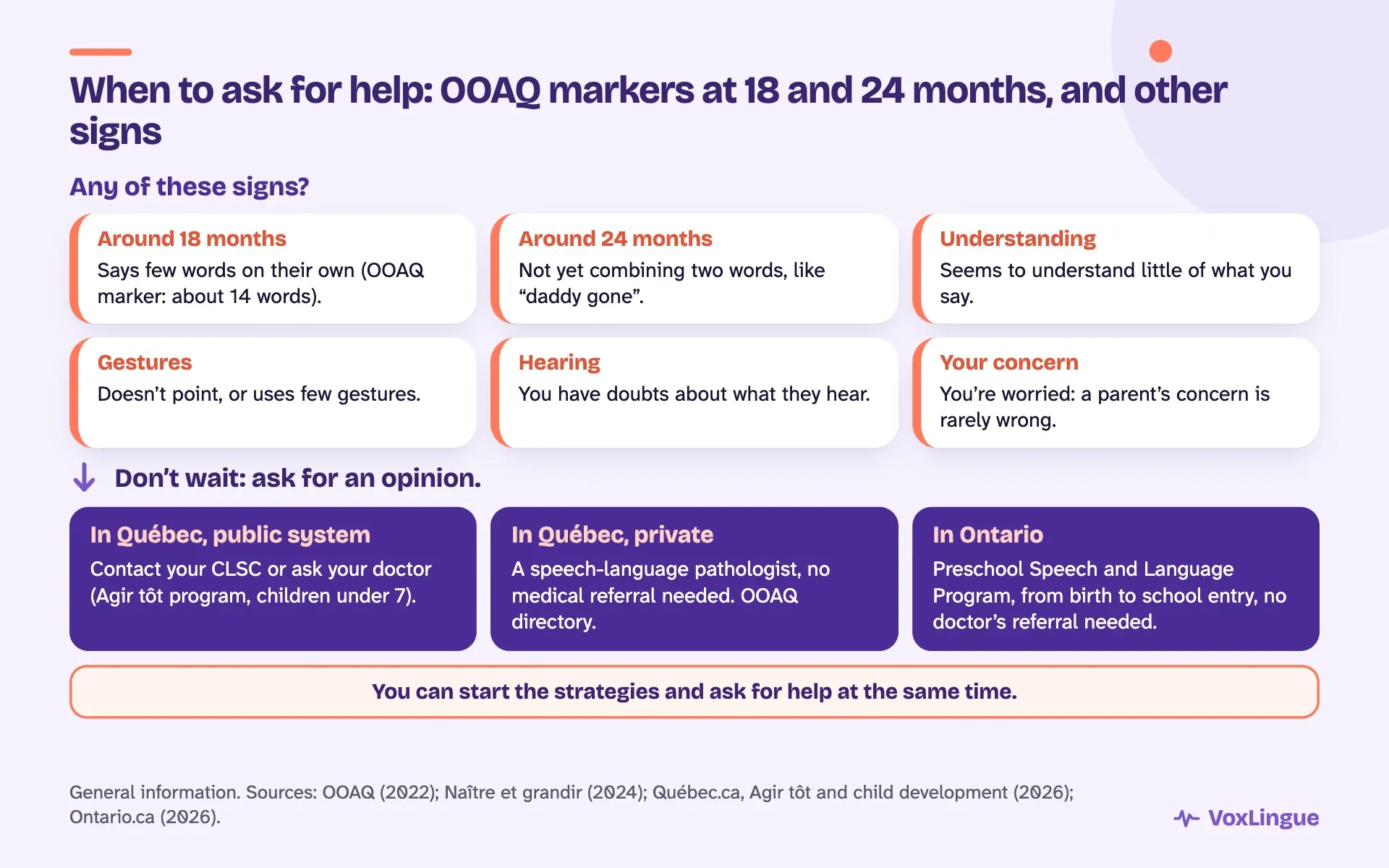
A few simple markers mean it is worth asking now. In 2022, the OOAQ published recommendations for the 18-month check-up in Québec’s Agir tôt program. Talk to your CLSC, your doctor or a speech-language pathologist if your child:
- around 18 months, says few words on their own (the OOAQ uses about 14 spontaneous words at that age as a marker);
- around 24 months, is not yet combining two words, such as “daddy gone” or “want apple” (OOAQ, 2022);
- seems to have trouble understanding what you say (Naître et grandir, 2024);
- does not use gestures such as pointing (Naître et grandir, 2024);
- leaves you with doubts about their hearing (Québec.ca, 2026);
- worries you, even without a specific sign.
Your concern counts. According to the OOAQ, a parent’s worry is rarely wrong (2022). Understanding is also the best indicator of longer-term difficulties, but it is hard for a parent to judge at home (OOAQ, 2022).
If your child does not point or seems to understand little, a hearing assessment can also be done (Naître et grandir, 2024). For a child who hears several languages, count their words across all of them before comparing with these markers.
In Québec: the CLSC, your doctor or a private speech-language pathologist
In Québec, the public entry point is the Agir tôt (“act early”) program. It is for children under 7. You can contact your local community health centre (CLSC) directly, and a doctor or another professional can also refer your child with your consent (The Agir tôt program, Québec.ca, 2026).
The 18-month vaccination visit, where the ABCdaire tool is used, is another chance to raise your concerns. Agir tôt services can include support for parents (Québec.ca, 2026).
You do not need a doctor’s referral to see a speech-language pathologist privately, and the OOAQ’s directory lists members (Naître et grandir, 2024). You can take both routes at the same time. If a public waiting list worries you, read what happens on the public waiting list.
In Ontario: preschool speech and language services, no referral needed
In Ontario, a public program serves children from birth to school entry. The Preschool Speech and Language Program does not require a doctor’s referral, and its options include parent education workshops (Ontario.ca, 2026). Our clinicians also work with Ontario families through speech therapy by telepractice in Ontario.
What is parent coaching in speech therapy?
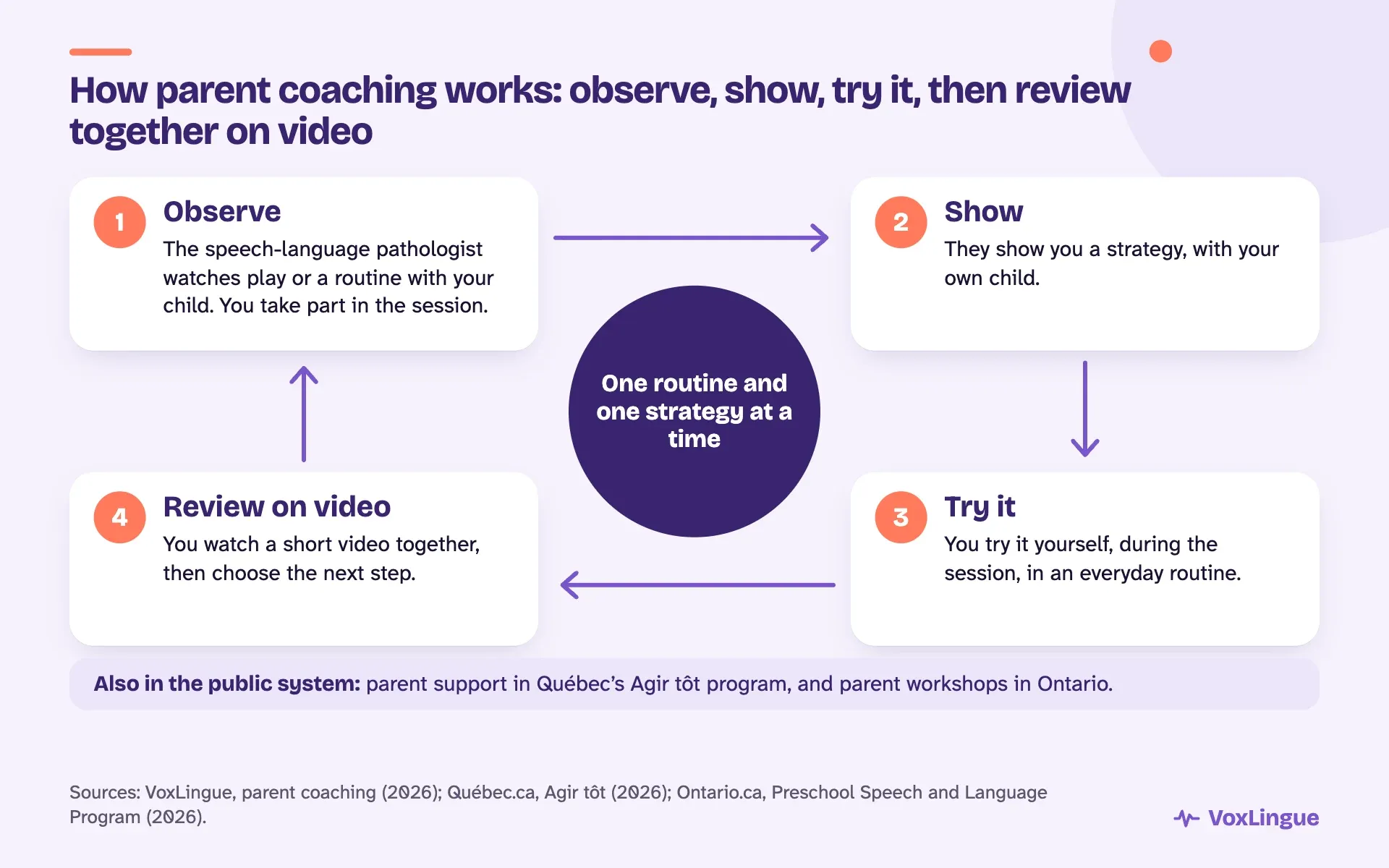
Parent coaching means a speech-language pathologist helps you use these strategies with your own child. They show you a strategy, you try it, then you look back at a short video together and choose the next step. It is offered privately and, in some forms, in public services: through Agir tôt in Québec and workshops in Ontario.
Your child spends far more time with you than with any clinician. That is the idea behind the studies described above, in which parents were taught strategies to use in daily life (Roberts and Kaiser, 2011).
The Hanen Centre, a Canadian not-for-profit organization, created It Takes Two to Talk®, known in French as « Parler, un jeu à deux », and More Than Words® for parents of young autistic children.
It Takes Two to Talk® is for parents of toddlers who say few words, and it has been studied since the 1990s. In a 1996 trial with 25 toddlers who said few words, children used more words and combined more words after their mothers’ training (Girolametto and colleagues, 1996).
For autistic children, the 2020 review by Heidlage and colleagues found smaller effects. A speech-language pathologist can then suggest an approach that fits the way your child communicates.
At VoxLingue, you take part in the session. Your clinician demonstrates a strategy with your child and explains why it helps. They support you as you try it, and you leave with one or two clear things to practise that week.
Some sessions are mainly for you. You review short videos of you and your child at home together, talk about what went well and plan the next step. Video lets you see responses from your child that are easy to miss in the moment. It is not a test of your parenting.
Coaching takes place at our clinic in Marché Central, Montréal, or by telepractice anywhere in Québec and Ontario. Our page on parent coaching at VoxLingue describes the formats available.
In public services, Agir tôt’s parent support and Ontario’s parent workshops follow a similar logic (Québec.ca, 2026; Ontario.ca, 2026). None of these approaches promises that a child will start talking by a certain date. They give you tools to support your child day to day.
What This Means for Families
Helping your toddler talk happens mostly in moments you already live. Five ideas sum up this guide:
- Start from what your child does today: gestures, single words, two words or short sentences. Answer just a little above.
- Get face to face, follow what interests them, wait, respond to every message and add a word.
- Choose one routine and one strategy at a time, such as breakfast or bath time.
- Swap quiz questions and “say it” for comments, choices and pauses.
- Speak your strongest language, and contact your CLSC, your doctor or Ontario’s preschool program if a marker worries you.
You do not have to do any of this perfectly. Every exchange where your child had a turn is a step forward.
Next Step
Our fridge sheet keeps these ideas within reach. It sums up one strategy per routine, the habits to avoid and the signs that mean it is time to call. If you would like a speech-language pathologist to coach you with your child, or if a marker worries you, you can request a speech-language assessment, at our Montréal clinic or by telepractice.
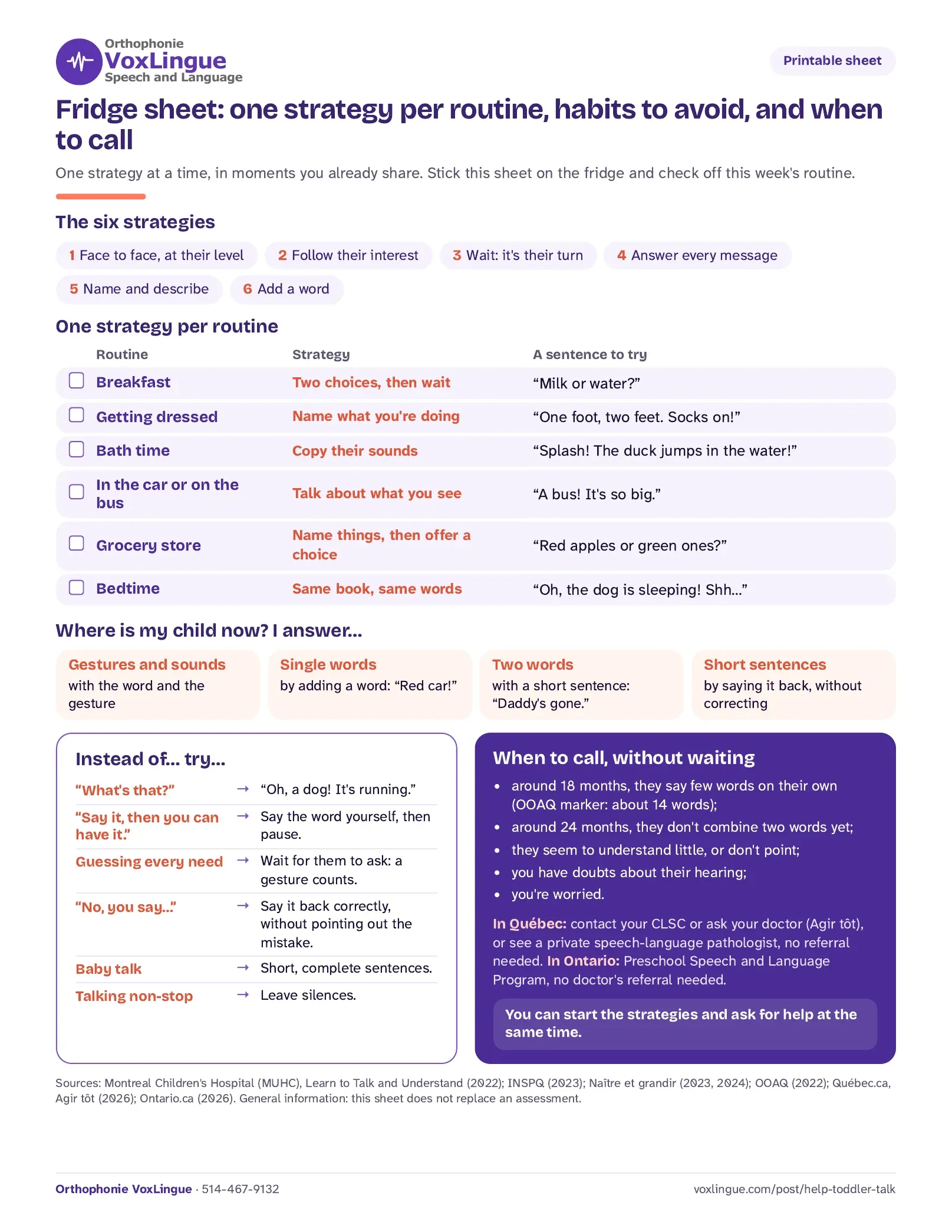
Printable sheet: Fridge sheet: one strategy per routine, habits to avoid, and when to call (PDF, 1 page).
Frequently Asked Questions
My older child keeps talking for the little one: what can I do?
Older brothers and sisters often want to help. Explain simply that the little one needs time to find their words. Invite them to wait with you, then to offer two choices instead of answering for their sibling. Older children can use the same strategies as adults, in their own way and through play.
My toddler understands everything but won’t talk: should I worry?
Understanding well is a good sign, but not a reason to wait. According to the OOAQ, understanding is the best indicator of longer-term difficulties, and it is hard for a parent to judge (2022). If your child says few words around 18 months or is not combining two words around age 2, contact your CLSC or talk to your doctor.
How much time a day should I spend on language?
The Québec sources cited here do not set a length of time. These strategies do not need a separate session: they fit into meals, bath time, getting dressed and outings. The 2020 review by Heidlage and colleagues found gains when strategies were used during play and routines. Start with one routine and one strategy.
Am I talking too much, or not enough?
What matters most is the room you leave for your child. Naître et grandir suggests avoiding non-stop talk and watching your child’s gestures and expressions (2023). Talk about what you are doing and what interests them, in short sentences, then pause. Those silences are where your child takes a turn.
Can grandparents, a nanny or daycare educators use these strategies?
Yes. Any adult who spends time with your child can use them. Each person can do so in the language they prefer, as the Montreal Children’s Hospital advises (2019). The more people around your child who wait, comment and add a word, the more chances your child has to practise.
Do electronic toys that talk help toddlers talk?
Not really, according to a small study. With electronic toys, parents of babies aged 10 to 16 months said fewer words, and there were fewer exchanges than with traditional toys or books (Sosa, 2016). The study, from the United States, involved 26 families. A simple toy that needs you leaves more room for conversation.
Do I need a referral to see a speech-language pathologist?
No. Privately, no doctor’s referral is needed, and the OOAQ directory lists speech-language pathologists in Québec (Naître et grandir, 2024). In the public system in Québec, you can contact your CLSC directly through Agir tôt. In Ontario, the Preschool Speech and Language Program does not require a doctor’s referral (Ontario.ca, 2026).
My toddler isn’t interested in books: what can I do?
With a toddler, a book is first of all a reason to talk together. You do not have to read the text (INSPQ, 2023). Let your child choose the book, turn the pages and point at just one picture if they want. Stay with what interests them, even if you never finish. Songs and nursery rhymes offer the same repeated words.