Late talker or developmental language disorder: will your child's difficulties pass?
Up to date as of November 3, 2026. General information: only an assessment can say what your child needs.
Your child is 2, or 3, and talks little. People tell you to wait, that every child has their own pace, and you have a doubt. When a child aged 3 to 5 isn’t speaking yet, parents often ask Kimberly Martins, speech therapist and founder of VoxLingue, when their child will start speaking, or whether they ever will. In families with several languages, they ask if all those languages are confusing the child.
She tells them right away that nothing they did caused these difficulties, and that it isn’t their fault.
The answer to their question is less simple than yes or no. Many children will no longer have difficulties, others will continue to, and no one can say in advance which. This guide explains what Québec’s order of speech therapists and audiologists (OOAQ) says, how a developmental language disorder (DLD) comes to be concluded, and what you can do this month.
Why don’t clinicians say “language delay” anymore?
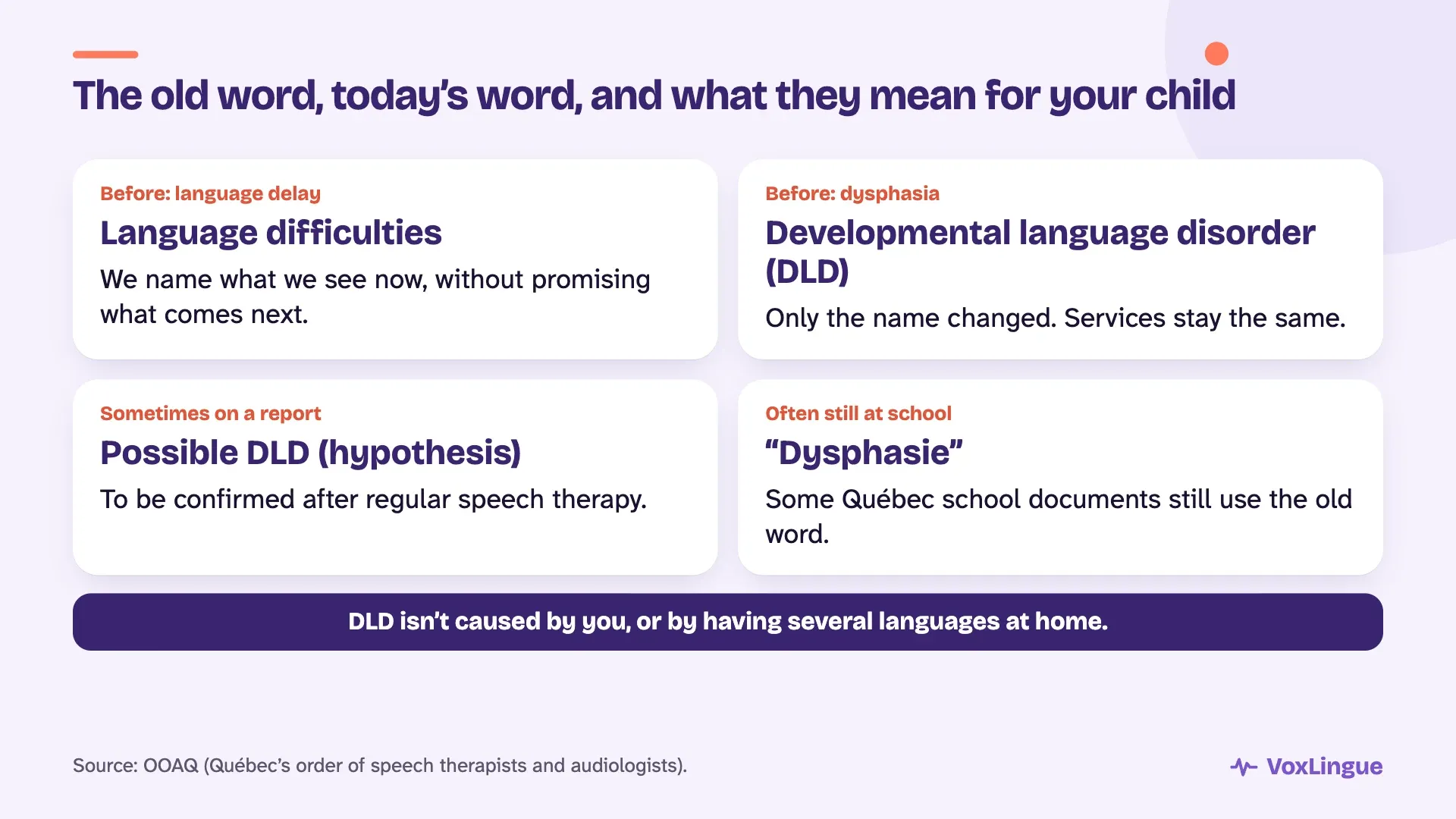
In Québec, clinicians now say “language difficulties” rather than “language delay”. “Delay” suggests a child will end up at the same point, only later, and that can’t be known in advance. In French, DLD (TDL) has replaced the word “dysphasie”. Only the name changed.
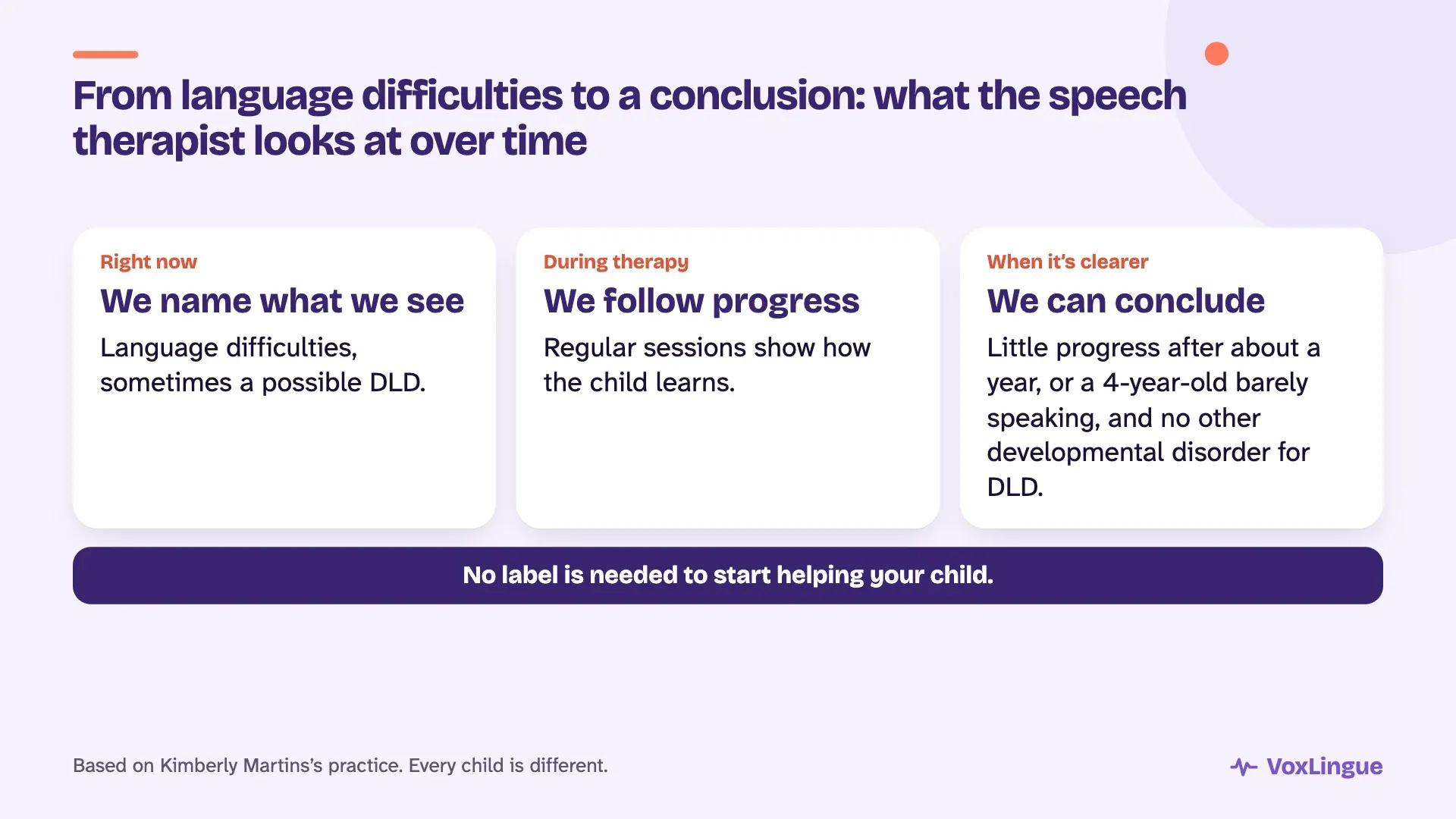
So Kimberly Martins names what she sees at the time: language difficulties. She explains which ones she sees, checks whether that matches what the parents notice, and describes how to stimulate the child’s language. Sometimes she speaks of a possible DLD, to be confirmed after regular speech therapy. That way, parents aren’t given false expectations.
The OOAQ adopted the term in 2017. Someone who had a conclusion of dysphasie keeps the same services. You may still see the old word, since some school documents use it.
DLD affects about seven children in a hundred (OOAQ). It is developmental: it doesn’t come from the child’s environment, from how you talk to your child, or from hearing several languages (OOAQ). As Kimberly Martins explains, the child’s brain processes information differently, and the task is to learn how to help that child learn language with the brain they have.
Will the difficulties pass?
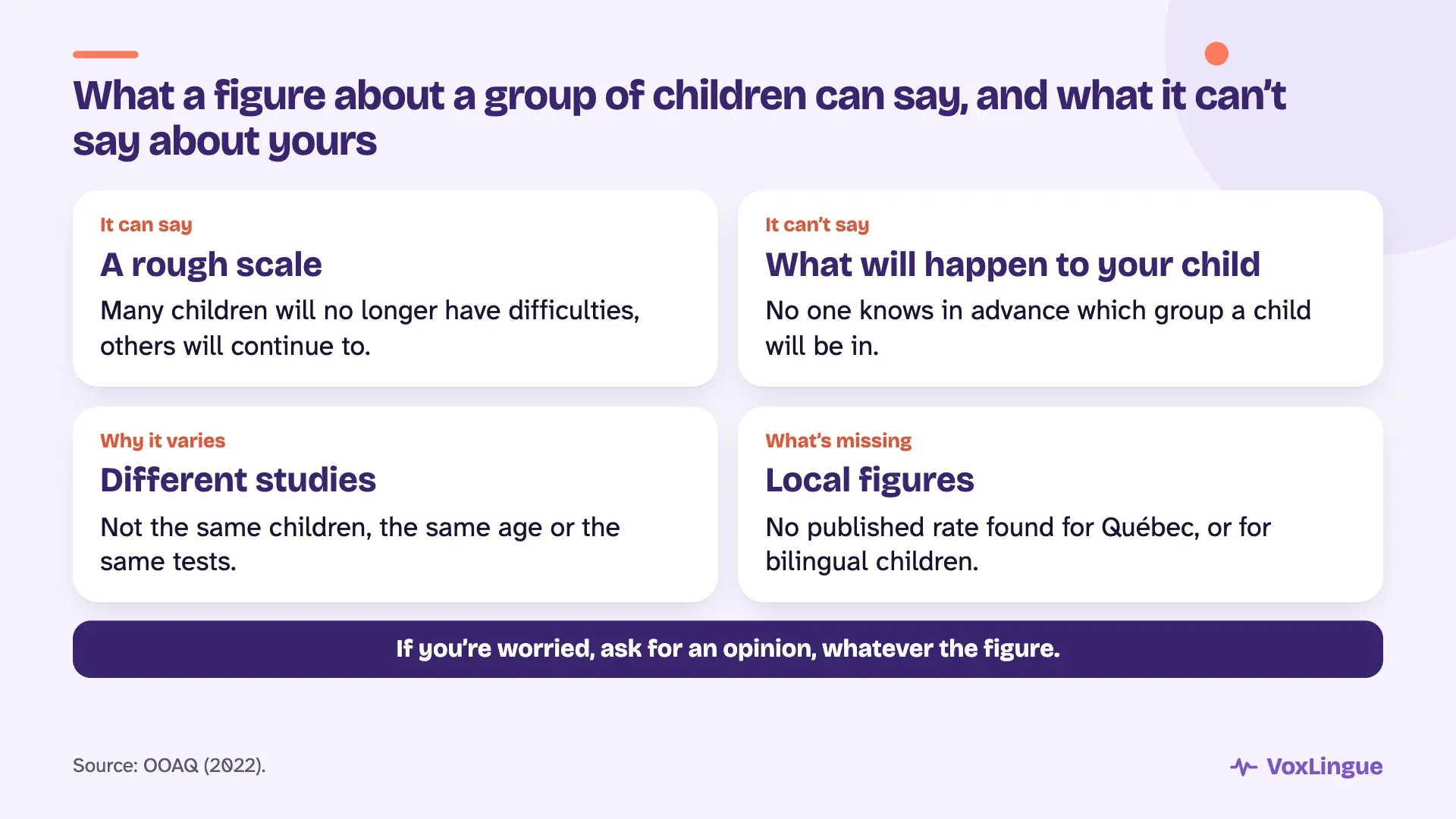
For many children, yes, but not for all. According to the OOAQ, two to four in ten children who talk little at 2 continue to have difficulties at 4, and about two in ten at 7. These figures give a rough scale. They predict nothing for your child.
In other words, most no longer have difficulties at 4, and the OOAQ notes this is often without help. If you read other figures elsewhere, it’s because studies don’t follow the same children, at the same age, with the same tests. We found no published rate specific to Québec children or to bilingual children.
What deserves a closer look?
Kimberly Martins is more concerned when a child interacts little with others, when their play skills are behind, when they express few needs, with or without words, and when there is a family history. In Québec, not combining two words at 2 also deserves attention.
- Interaction: they rarely try to exchange or share a moment with you.
- Play: their play skills seem behind for their age.
- Communication: they use few gestures, sounds or words to say what they want.
- Family: a relative has had language difficulties.
These signs guide your eye; they are not a test.
In Québec, almost all French-speaking children combine two words at 24 months (OOAQ, 2022). At 18 months, fewer than fourteen words is a warning sign (OOAQ, 2022; Naître et grandir, 2024). And a child with no risk factors can still have DLD (Naître et grandir, 2025).
Your worry counts too. According to the OOAQ, a worried parent is rarely wrong, even if not being worried doesn’t prove all is well (2022).
At what age can DLD be concluded?
There is no single age. It depends on the child’s age, their difficulties and their progress in therapy. Kimberly Martins concludes DLD, for example, when a child has made little progress after about a year of regular sessions, and no other developmental disorder, such as autism, is present.
A 4-year-old who is barely speaking is a different case: she is comfortable concluding a language disorder at that point. And if a child is autistic, it isn’t called DLD, but a language disorder in the context of autism. Our article on speech difficulties and autism explains what professionals look at.
You may read other ages, because sources aren’t answering the same question. CHU Sainte-Justine writes that before 4, it is hard to conclude. Naître et grandir says 4 or 5 (2025). In Montérégie, the service access point accepts a DLD conclusion from 30 months: that’s a rule for access to services. Québec’s school code 34 requires severe difficulties that persist past 5.
What matters for you: not being able to name the problem at 2 or 3 doesn’t mean there’s nothing to do at that age. A speech therapist doesn’t need a label to see where your child is and advise you.
The difficulties are gone: is everything settled?
That is very good news. In a Québec twin study, children whose language difficulties had gone by the preschool years did as well as other children in language and at school in elementary grades. They did have a little more behaviour difficulty in kindergarten, and with peers in grade 1 (Matte-Landry et al., 2020).
Children whose difficulties persisted kept having them throughout elementary school: in language, at school and socially. This small group shows why follow-up is worthwhile when difficulties last. Written language can be affected too: our article on the early signs of dyslexia explains what to watch for from kindergarten.
Wait or act?
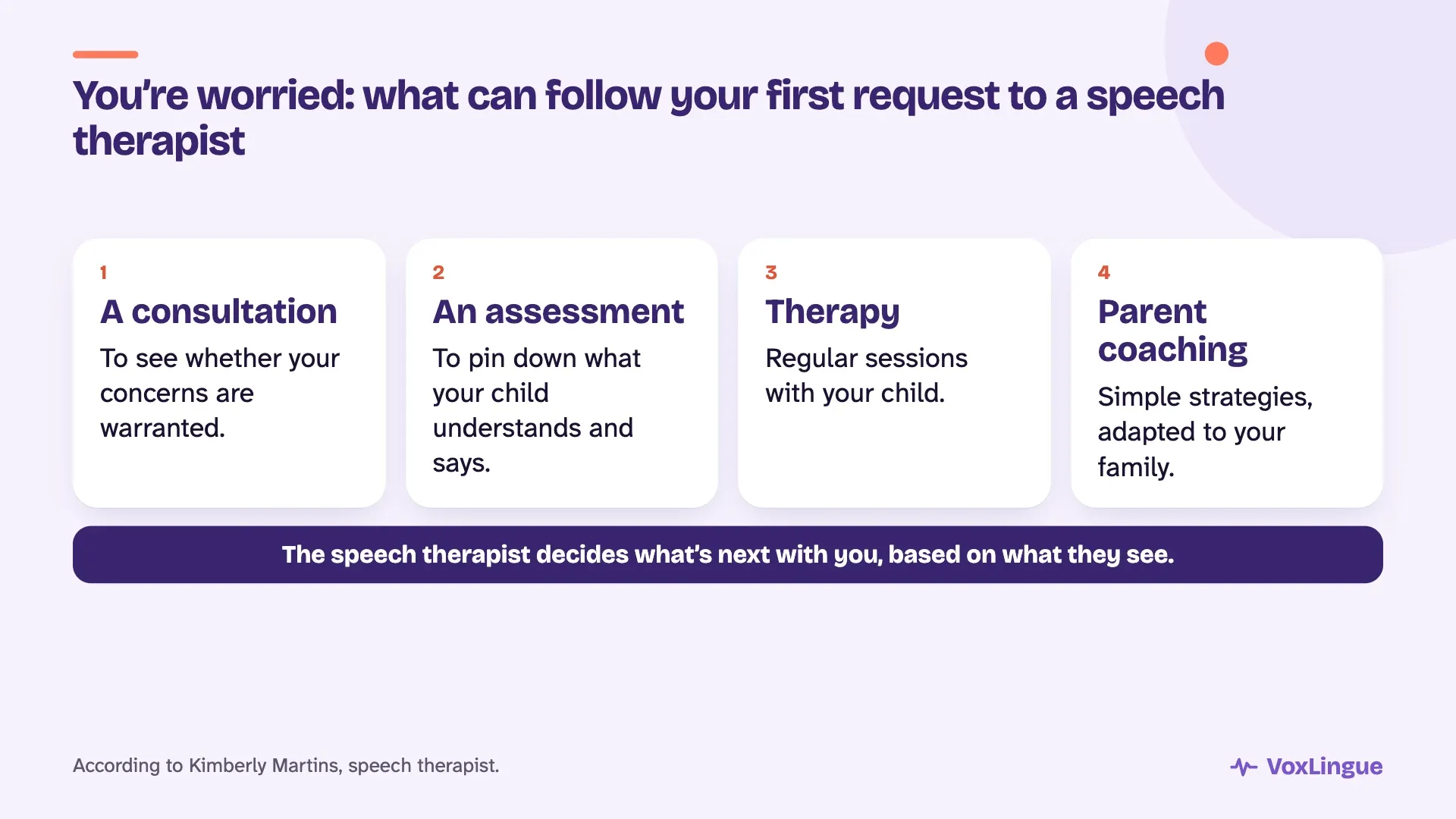
If you’re worried, consult: parents know their child better than anyone. The speech therapist then decides what’s next with you, based on what they see: a consultation, an assessment, therapy or parent coaching. So consulting doesn’t commit you to long-term follow-up.
The OOAQ confirms the benefits of early intervention, while cautioning against intervening with children who wouldn’t have needed it (2022). That’s the value of a professional opinion rather than a general rule.
What parent coaching can do. Kimberly Martins considers it very useful, since parents spend the most time with their child and can have the biggest impact. But you need to understand the strategies and know how to use them day to day. They should also be simple and not take too much time. Otherwise, it’s easy to feel overwhelmed.
It adapts to each family. Not everyone plays the same way, and not everyone feels they should play with their child. The speech therapist takes your values and culture into account.
Progress can be subtle. After a month, a child may not be speaking more, yet stay in an exchange with you for five minutes, when they lasted one minute the month before. That is real progress, even if it’s easy to miss.
What you hear, and what we know
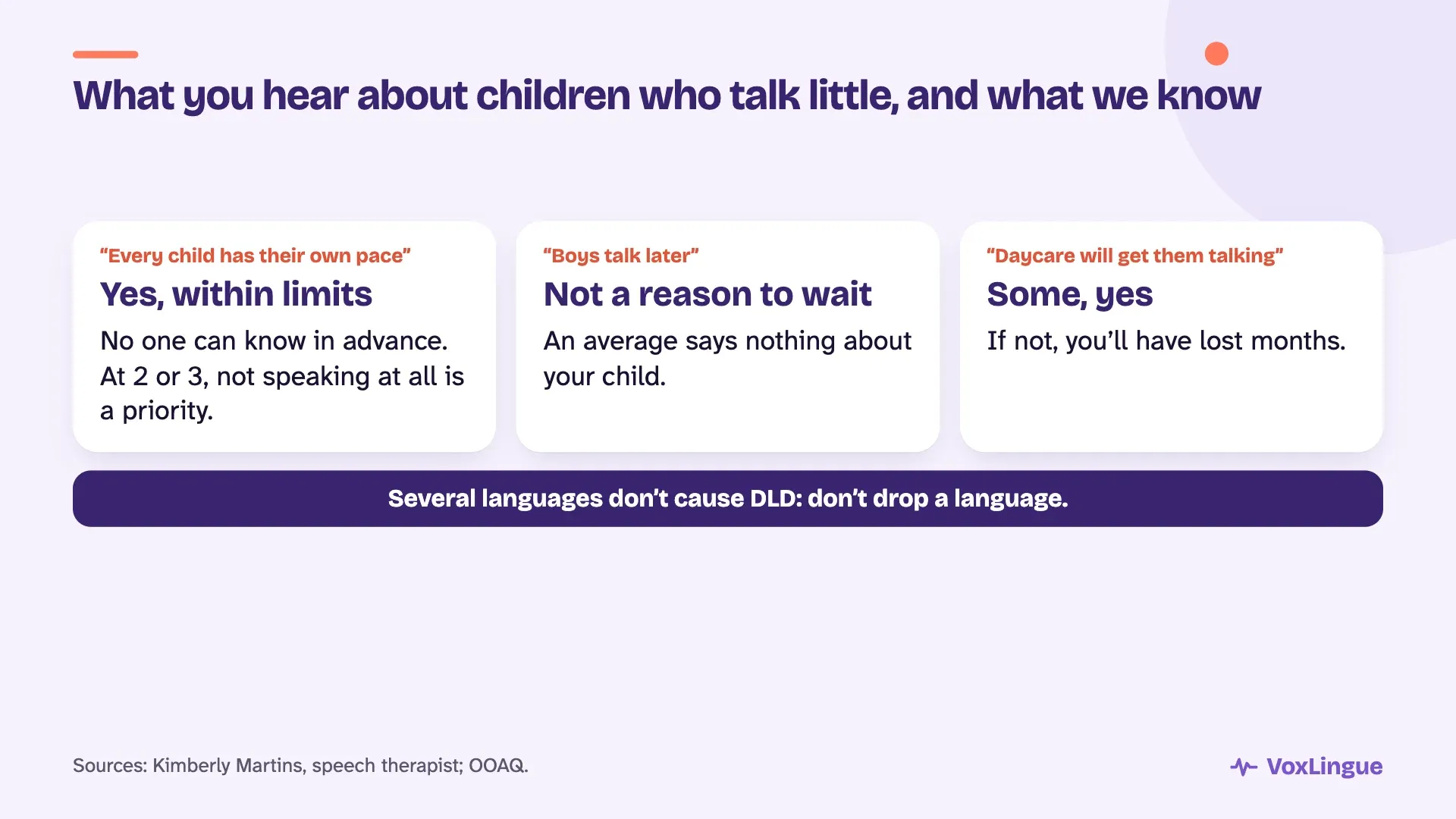
“Every child has their own pace” is true, within limits. But no one can know in advance whether a child will get there alone. For Kimberly Martins, a 2- or 3-year-old who isn’t speaking at all is a high priority: she wouldn’t wait and see.
“Boys talk later.” Many people still believe it. Even if it were true on average, it would say nothing about your child, and it isn’t a reason to wait.
“Daycare will get them talking.” Some children do start. But if yours doesn’t, you’ll have lost months.
“They hear too many languages.” Multilingualism doesn’t cause DLD, and you shouldn’t drop a language (OOAQ).
Bilingual child: second language or DLD?
First look at how long and how much your child hears each language. DLD can’t be concluded from a second language: the home language has to be assessed. A quiet period in a new language is normal. But if your child struggles in their home language, don’t wait.
So a child who has heard French for a few months at daycare may be quiet in French while speaking well at home. If they have difficulties in the language they have heard since birth, the short time in French changes nothing: Kimberly Martins then assesses that language, without assessing French at that point.
A Québec guide notes that norms set for one language aren’t enough to conclude a disorder in a bilingual child (CIUSSS de la Capitale-Nationale, 2022). Our article on language disorders in bilingual children goes further.
What to do right now
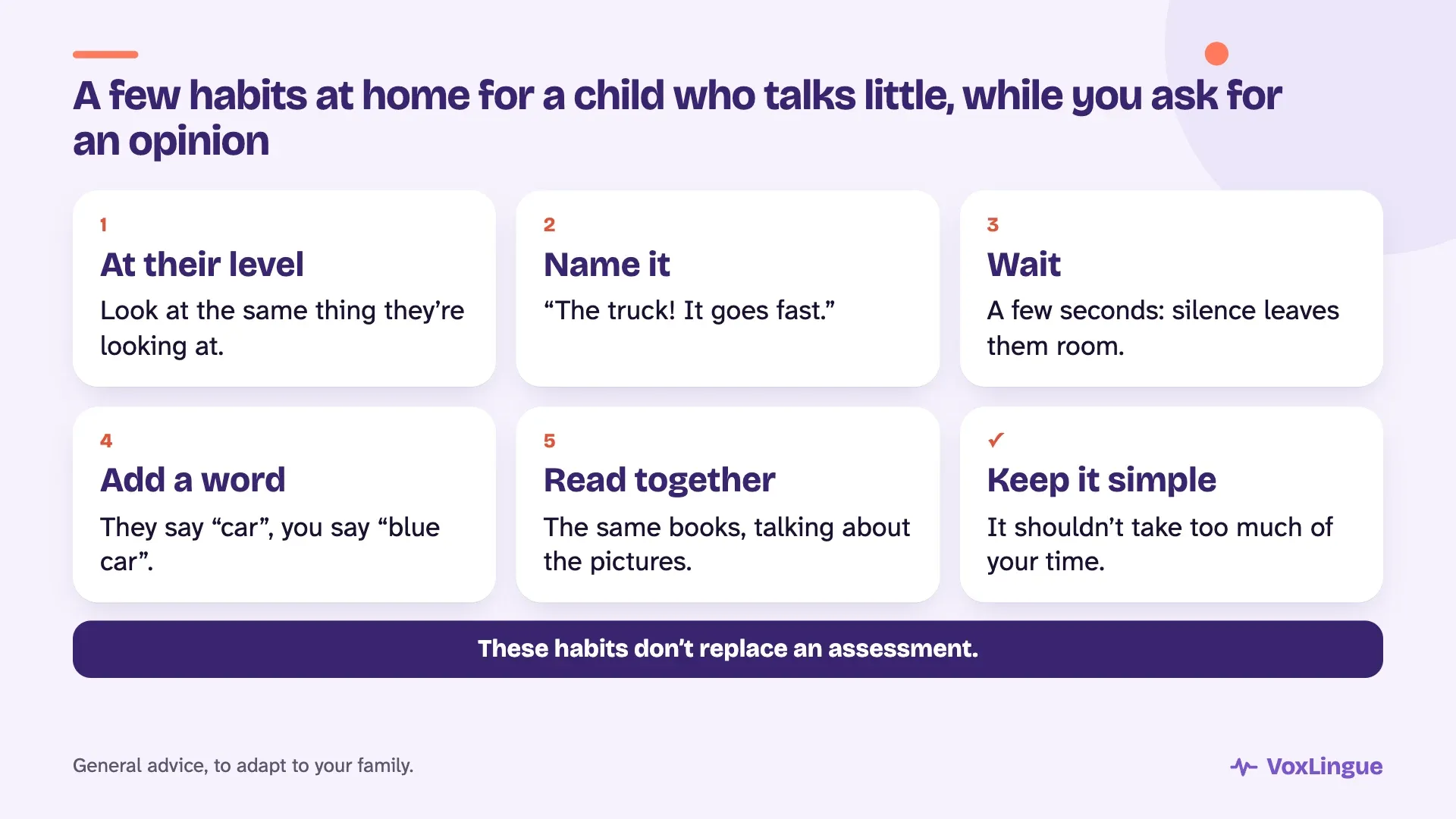
You can take three steps at the same time: talk to your family doctor, sign your child up for public services, and ask a private speech therapist for a consultation, to find out whether your concerns are warranted and what to do next. At home, a few simple habits help in any case.
- Get down to their level and look at the same thing they’re looking at.
- Name what interests them, in short sentences: “The truck! It goes fast.”
- Wait a few seconds after you speak. Silence leaves them room.
- Add a word to what they say. If they say “car”, say “blue car”.
- Read together, the same books, often, talking about the pictures.
These habits don’t replace an assessment, and you have nothing to blame yourself for if you weren’t already doing them. While you wait for an appointment, our article on waiting for speech therapy in Québec has more ideas.
When to consult, and where, in Québec and Ontario
Consult if your 2- or 3-year-old isn’t speaking at all, doesn’t combine two words at 2, interacts or communicates little, loses words, or simply if you’re worried. There’s no need to wait for daycare or school. Your worry is reason enough.
Talk to a speech therapist if your child:
- at 18 months, says fewer than fourteen words;
- at 2, doesn’t combine two words;
- at 2 or 3, isn’t speaking at all;
- interacts little, or plays little for their age;
- uses few gestures, sounds or words to say what they want;
- loses words or gestures they used to use.
In Québec, the public system goes through the free Agir tôt program: contact your CLSC, or ask your doctor to refer you. A screening comes first, then the team directs your child to the right service. In private practice, you can see a speech therapist without a referral.
In Ontario, the Preschool Speech and Language Program is free, from birth until school entry, and parents can sign their child up themselves.
During a speech therapy assessment, the speech therapist looks at what your child understands and says, and checks that hearing has been tested. If follow-up would help, our page on language disorders explains how we work.
The takeaway
Many children who talk little will no longer have difficulties later, but not all, and no one can say which at 2. If you’re worried, that isn’t a reason to wait: it’s a reason to ask for an opinion.
Next step
Print our sheet “Before the appointment: what to note about your child’s language” and note what you observe before the appointment. Our speech therapists see families at our clinic in Montréal, and by telepractice across Québec and Ontario. To learn more, explore our early language and late talkers section.
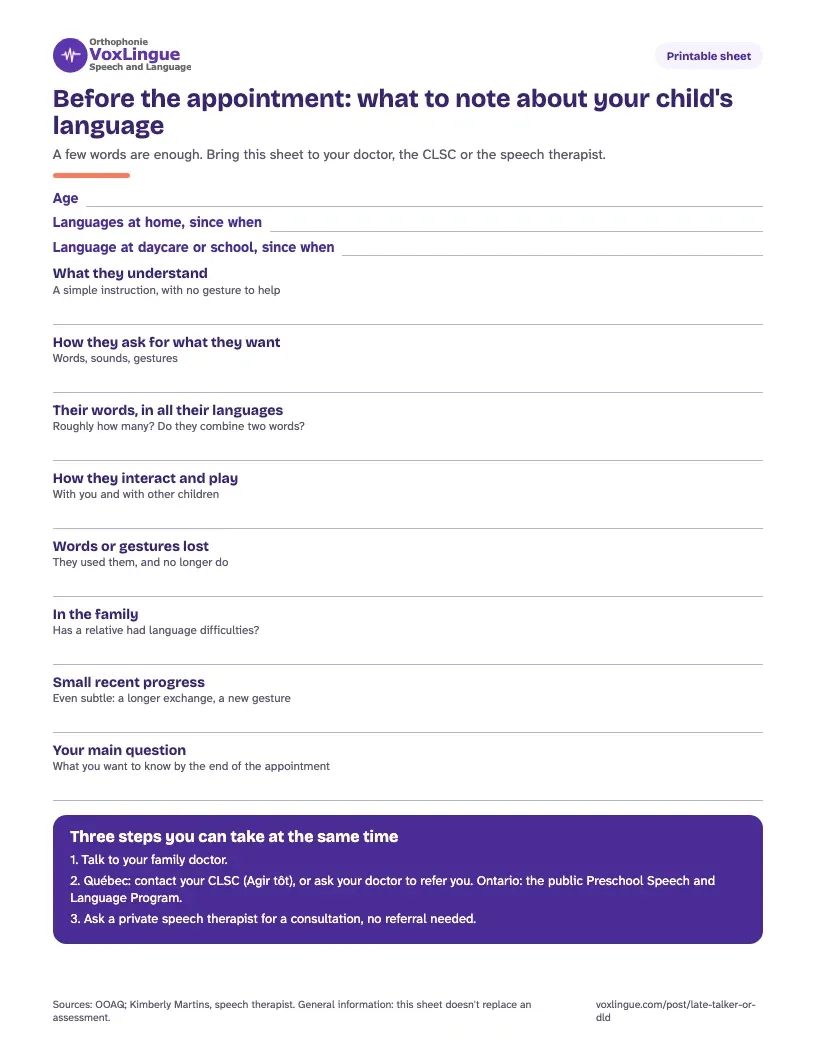
Printable sheet: Before the appointment: what to note about your child’s language (PDF, 1 page).
Frequently asked questions
At what age should I worry?
There’s no need to wait for a set age. In Québec, fewer than fourteen words at 18 months and no two-word combinations at 2 deserve attention. A child of 2 or 3 who isn’t speaking at all is a priority. And if you’re worried, that alone is reason enough to ask.
Is it my fault?
No. DLD is developmental. It doesn’t come from your child’s environment or from how you talk to them, and nothing you did caused it.
Is DLD the same as dysphasie?
Yes. In Québec, DLD (TDL) replaced the word “dysphasie”. Only the name changed, and services stay the same.
Does DLD go away?
Developmental doesn’t mean a child grows out of it. The difficulties last, but they change, and the child keeps progressing with the right support.
Do boys talk later?
Many people believe so. Even if it were true on average, it wouldn’t tell you anything about your child, and it isn’t a reason to wait.
Should we wait for daycare or school?
No. Some children start talking at daycare, but if yours doesn’t, you’ll have lost months. You can ask for an opinion now.
Should we drop a language?
No. Several languages don’t cause DLD, and the OOAQ advises against dropping one. A speech therapist looks first at the language your child has heard since birth.
Do we need a referral?
In private practice, no. For public services in Québec, contact your CLSC or ask your doctor to refer you. In Ontario, parents can sign up for the preschool program themselves.