Ear infections and speech delay: what fluid in the ear really changes
“Nine ear infections this winter.” Since daycare started, your child has gone from one earache to the next: short nights, antibiotics, missed workdays. And now another question sits on top of the others. If your child isn’t saying much, or isn’t very clear, can ear infections cause a speech delay?
You are far from alone in asking. In Québec, nearly one toddler in two had at least one ear infection in the year before 17 months (Institut de la statistique du Québec, 2025).
Kimberly Martins, speech-language pathologist and founder of VoxLingue, often hears the question on the very first call. Some parents have already had their child’s hearing checked and now want a language assessment. Others wonder whether ear infections are why their child can’t say certain sounds.
Online, the answers contradict each other. Some pages say ear infections delay speech; others say there is no link at all. The truth sits in between, and it is mostly reassuring.
This guide explains what fluid behind the eardrum really changes for your child’s hearing, what research shows about ear infections and language, what to do while the fluid is there, and when to consult without waiting.
Ear infection or fluid behind the eardrum: what’s the difference?
An acute ear infection hurts and often comes with a fever. Afterwards, fluid can stay behind the eardrum for weeks, without pain. This is called otitis media with effusion, or “glue ear”. It is mostly this quiet fluid that lowers hearing. Nearly all children have it at least once before starting school.
The acute infection, the one that wakes everyone at night, is hard to miss. Your child pulls at an ear, cries, runs a fever, and you see the doctor. That part belongs to your doctor, and the Canadian Paediatric Society’s Caring for Kids page on ear infections explains it well.
The fluid is different: it often goes unnoticed. It sits in the middle ear with no active infection and no pain (American Academy of Otolaryngology, 2016). It can follow an acute infection, but it sometimes appears without one anyone noticed. Many parents never know their child had it.
It is very common. About nine children in ten have fluid in the ear at least once before school. More than half have it in their first year, and more than six in ten by age 2 (American Academy of Otolaryngology, 2016).
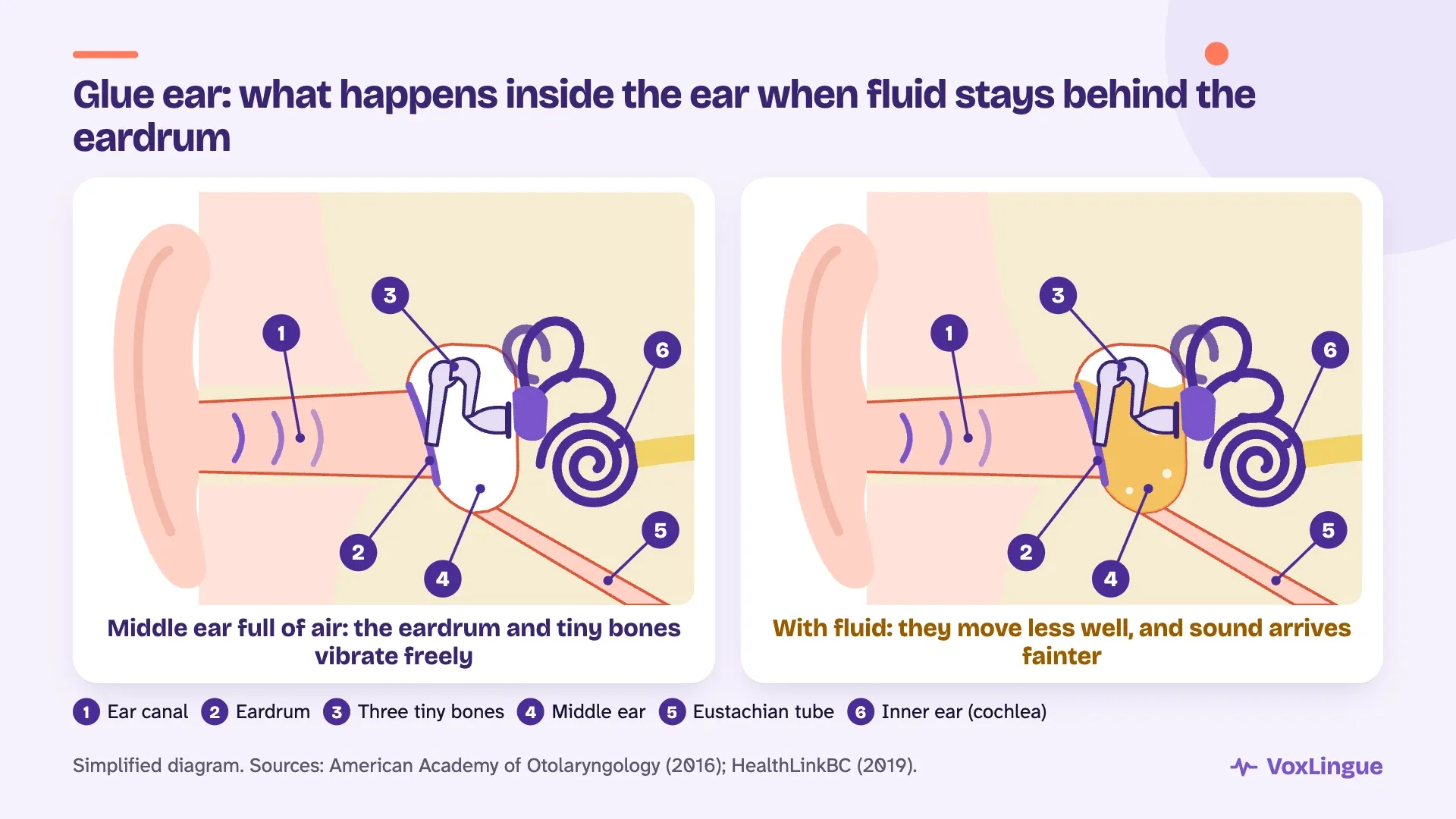
Why does fluid change hearing? Normally, the middle ear is full of air. The eardrum and three tiny bones vibrate freely and pass sound along. When fluid replaces the air, they move less well, and sound reaches the inner ear more faintly. The good news: in young children, most hearing loss is temporary (HealthLinkBC, 2019).
How long does ear fluid last?
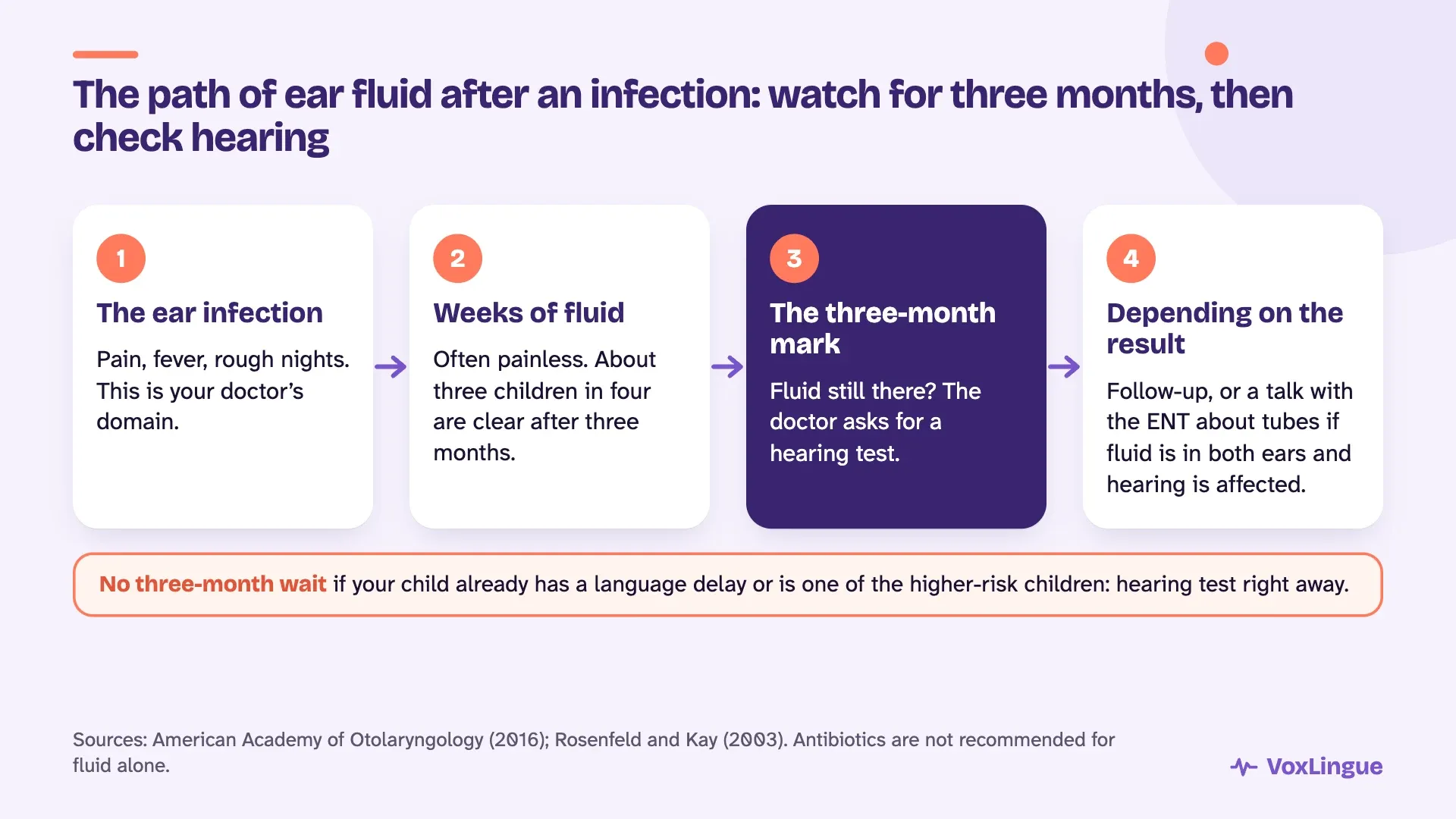
After an ear infection, about three children in four are clear of fluid three months later. When fluid settles in, it clears much more slowly, and about one child in three has repeat episodes. Doctors usually watch for three months, then ask for a hearing test if the fluid is still there.
In most cases, the fluid goes away on its own (Rosenfeld and Kay, 2003). But once it has been there a long time, it clears much more slowly: about one child in three is clear after a year. And about one child in three has more episodes, often in the cold months and the daycare years (American Academy of Otolaryngology, 2016).
The three-month mark comes from medical guidelines. For a healthy child, the doctor watches and waits. If the fluid is still there after three months, a hearing test comes next (American Academy of Otolaryngology, 2016). For some children, there is no wait: see the section on children to watch more closely, below.
Ear tubes are mainly considered when fluid has been in both ears for three months or more and hearing is affected. That is a medical decision, made with an ear, nose and throat specialist (ENT).
A word on medicines. Antibiotics, steroids, antihistamines and decongestants are not recommended for fluid alone (American Academy of Otolaryngology, 2016). They still have a role in other situations, such as an acute infection: your doctor will guide you.
What does a child with fluid in the ears hear?
Think of listening with your fingers in your ears. Soft sounds, word endings and speech in noise suffer most. The drop is usually mild, sometimes moderate, and it changes from week to week: one day your child hears well, the next day much less.
On average, fluid causes the equivalent of a mild hearing loss. But children vary a lot: some hear almost normally, others have a moderate loss (American Academy of Otolaryngology, 2016). And speech in background noise is hit hardest (Cai and McPherson, 2017).
That is why the drop is easy to miss. Your child still hears loud voices, music, and their name when you are close. What gets lost are soft sounds, words said from across the room, and conversation in a noisy space, like a daycare room at lunchtime.
It also shifts over time. The fluid comes and goes from week to week. One day your child seems to follow everything; the next, they seem distracted. It isn’t stubbornness: some days, they really do hear less.
What it means for a child learning English
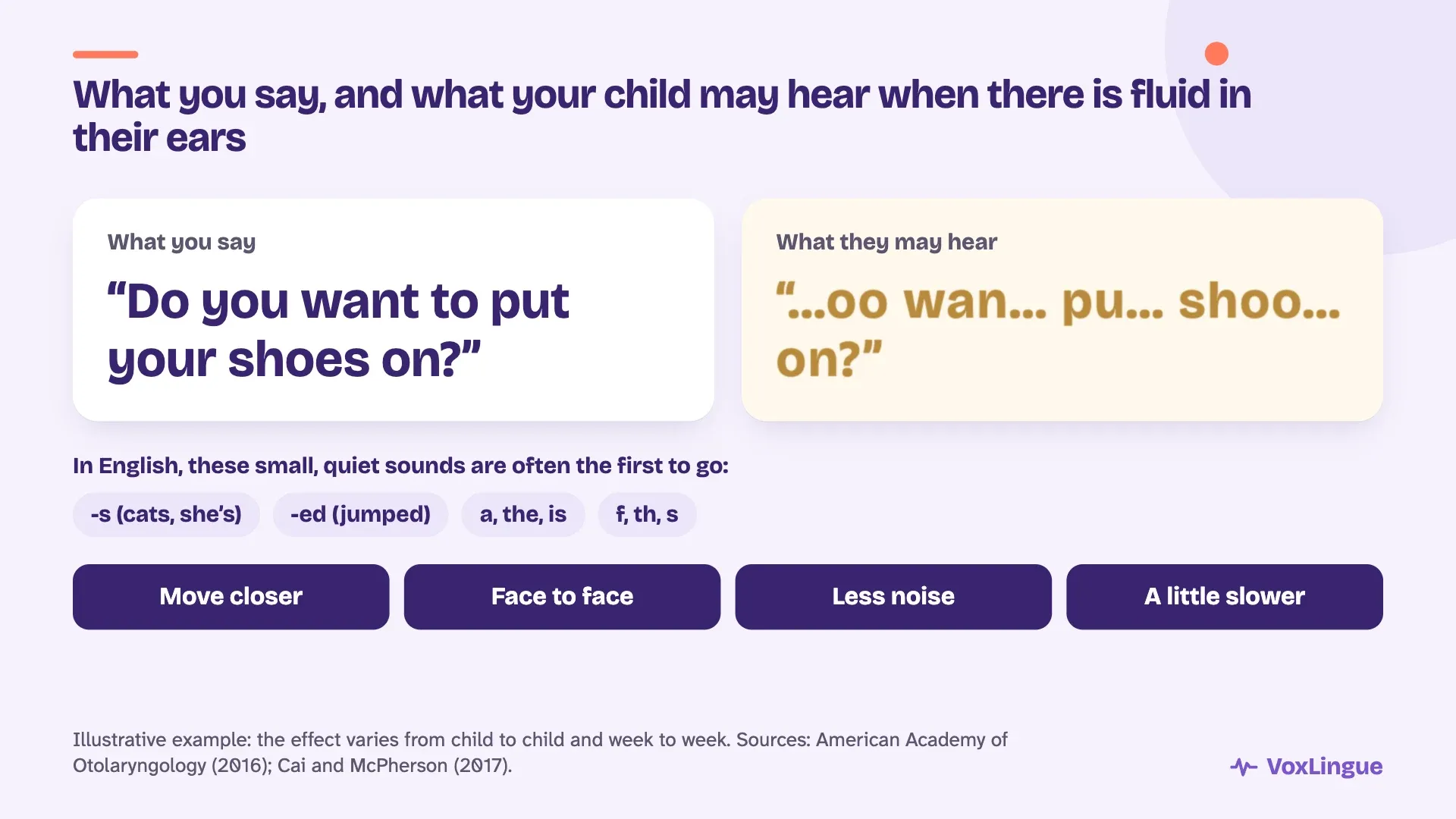
In English, a lot of grammar rides on small, quiet sounds. The “s” in “cats” and “she’s”, the “ed” in “jumped”, little words like “a”, “the” and “is”, and soft sounds like “f”, “th” and “s”: these are often the first to go when the ear is blocked.
Picture the sentence “Do you want to put your shoes on?” With fluid in the ears, your child might catch only pieces, something like “…oo wan… pu… shoo… on?”. They fill in the rest from context, but they hear fewer clear models to learn from.
When these episodes last, your child may seem less clear, or slower to put sentences together. To see what to expect at each age, read our article on speech intelligibility by age.
Do ear infections cause speech delay?
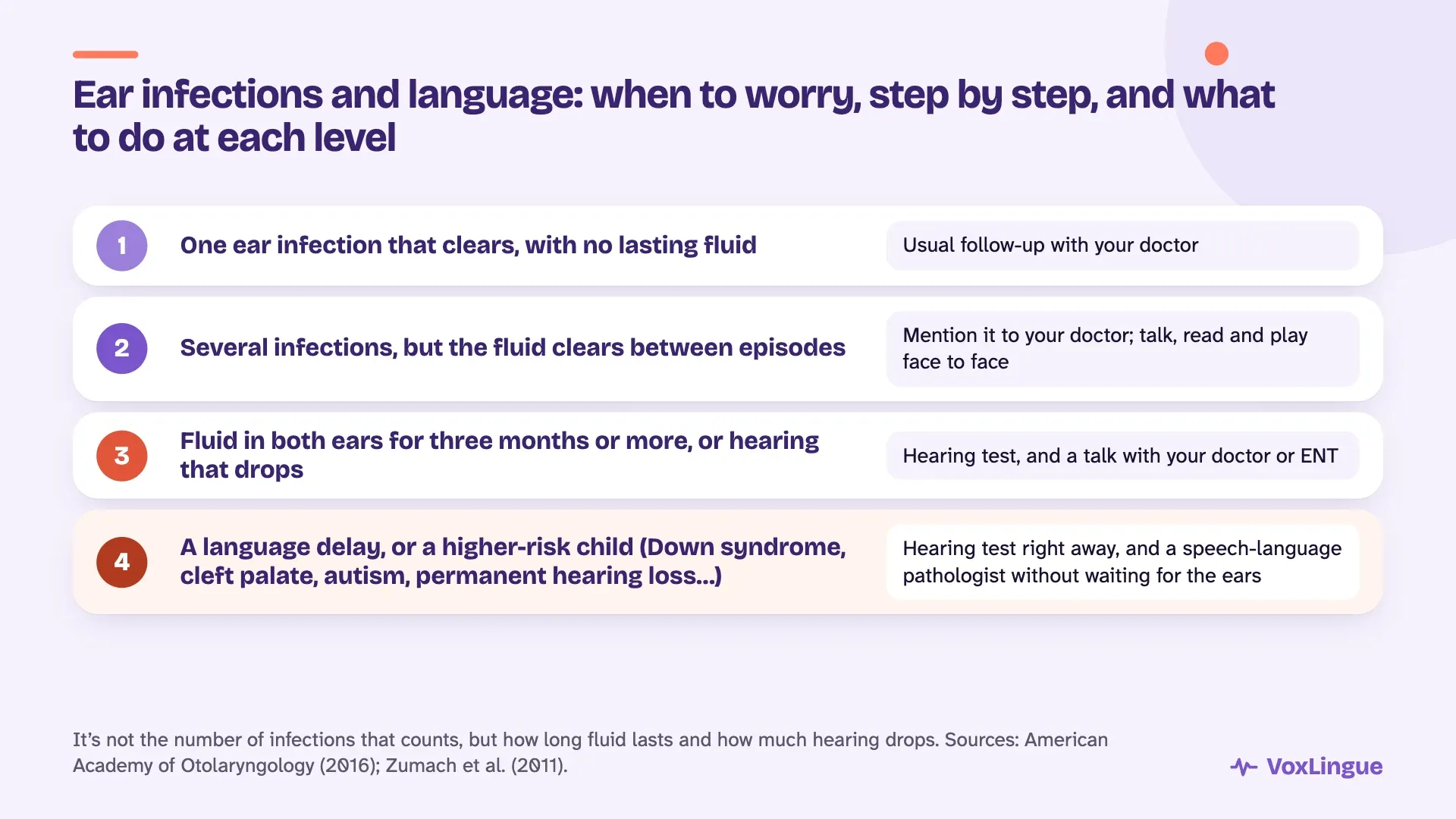
Not on their own. But fluid that lowers hearing often and for a long time puts a child at risk for speech and language difficulties. What matters is not the number of infections, but how long fluid stays and how much it lowers hearing. In most healthy children, the gap is small and temporary.
This is the question parents ask most, and the short answer is reassuring. One large analysis pooled fourteen studies that followed children for several years (Roberts et al., 2004). In healthy children, ear fluid had little or no link with their later language or speech.
“Little” is not “none”. In some of those studies, children who often had fluid understood and spoke slightly less well as preschoolers. The gap was small. And most studies did not account for other factors, such as home environment, that could partly explain it.
Kimberly Martins sees the same thing in clinic. Anything that lowers hearing regularly and over a long time can affect speech and language, because the child gets poorer feedback from what they hear and say. There is never a single cause. But a child who often has fluid, with a hearing loss, is at risk.
It’s not the number of ear infections that counts
Parents count ear infections, and that makes sense: each one is hard on the whole family. But for language, the real question is a different one: how long did your child hear less well?
An infection that clears quickly leaves little mark on hearing. On the other hand, a child can have a single infection and keep fluid for months without anyone noticing. Dutch researchers put it this way: it is not the ear infection itself, but how much hearing drops, that is linked to later difficulties (Zumach et al., 2011).
A small American study points the same way (Shriberg et al., 2000). Among children who heard almost normally between 12 and 18 months, about two in a hundred had a speech delay at age 3. Among those who heard less well, it was about one in three.
Why most children catch up
In studies that followed children into school, the gaps faded over time. In the Netherlands, the link between hearing loss and language seen around age 2 was gone by age 7 (Zumach et al., 2010). In the United States, children who had a lot of fluid before age 2 had caught up with their peers by second grade (Roberts et al., 2002).
The same studies show something encouraging. The home environment was more strongly linked to children’s language than fluid or hearing was (Roberts et al., 2002). In England, children most affected by fluid had slightly lower verbal scores at age 4, mostly when there was little stimulation at home. By age 8, the gap had nearly closed (Hall et al., 2014).
In other words, you have real influence. Talking, reading and playing with your child matter even more during the stretches when they hear less well. The section “While the fluid is there”, below, gives concrete ways to do it.
It is just as important to say what these studies don’t show. They involved healthy children, mostly English or Dutch speakers, and none was done in Québec or in French. They also say little about children who already have a delay or a health condition. We cover them in the section on children to watch more closely.
What the research shows
| Study | What it did | What it found | What it means for you |
|---|---|---|---|
| Roberts et al., 2004 | Analysis of fourteen studies that followed children | Little or no link between ear fluid and later language | Ear infections don’t doom your child’s language |
| Paradise et al., 2001 to 2007 | Over four hundred children with persistent fluid: early tubes or waiting | No difference in language, speech or learning at 3, 4, 6 and 9 to 11 | Tubes are a medical decision, not a language treatment |
| Cochrane reviews, 2010 and 2023 | Pooled trials of ear tubes | Better hearing, mostly in the first six months; no clear effect on language | Tubes help hearing for a while; language needs support too |
| Zumach et al., 2010; Roberts et al., 2002 | Children followed from infancy into school | Early gaps were gone by age 7 or second grade | Most children catch up |
| Hall et al., 2014 | Over a thousand English children followed to age 8 | Fluid mattered more when there was little stimulation at home | What you do at home counts |
Will ear tubes help my child talk?
Ear tubes are a medical decision, made with the ENT. They restore hearing quickly, especially in the first months. But in a large trial, getting tubes early instead of waiting did not improve language, at age 3 or at 9 to 11. Tubes give back hearing; they don’t teach the words a child missed.
Ear tubes are tiny vents placed in the eardrum during a short procedure called a myringotomy. They let air into the middle ear so the fluid can drain. It is not a speech-language pathologist’s role to recommend them or not: that decision belongs to the doctor and the family.
What research can tell us is their effect on language. In a large American trial, over four hundred children with persistent fluid got tubes either promptly, or later if the fluid stayed. At ages 3, 4 and 6, and again between 9 and 11, their language, speech and learning were similar (Paradise et al., 2001 to 2007).
Even among children with fluid in both ears almost all the time, or with the biggest hearing loss, early tubes made no difference at age 3 (Paradise et al., 2003). Cochrane reviews agree: tubes improve hearing, mostly in the first six months, with no clear effect on language (Browning et al., 2010; MacKeith et al., 2023).
One important limit: these trials involved healthy children. None studied children who already had a language delay. For them, we simply don’t know, and that is one more reason not to wait before consulting.
Tubes give back hearing; they don’t teach the words a child missed.
What to expect after tubes
Online, some parents say their child started talking almost overnight. Others saw no clear change. Both happen. Tubes restore hearing, but on their own they don’t make up for the words a child didn’t hear for months.
When a child had a hearing loss from fluid, Kimberly Martins expects them to hear better within months of getting tubes. The speech-language pathologist then follows how speech and language develop, and gives parents strategies to boost that development.
If language doesn’t move in the months after tubes, talk to a speech-language pathologist. The problem may not have been only in the ears.
Children to watch more closely
Some children have more to lose when they hear less well. These are children who already have a language delay, a permanent hearing loss, Down syndrome, a cleft palate, autism, a developmental delay or a significant vision problem. For them, there is no three-month wait: hearing test right away.
Why these children? Because they have less margin. A child who already finds words hard to learn, or who relies on hearing to make up for poor vision, loses more when the ear blocks up (American Academy of Otolaryngology, 2016).
Some also get fluid far more often. In children with a cleft palate, fluid is almost always present. In children with Down syndrome or a cleft palate, six to nearly nine in ten have it (American Academy of Otolaryngology, 2016).
For these children, the guidelines are clear: don’t watch and wait for long. A hearing test as soon as fluid is found, and closer follow-up with the doctor. Remember that the big tube trials didn’t include them, so their reassuring results can’t simply be applied.
If your child is one of them, it is not a judgment on what you do. It just means each episode of fluid counts for more, and it is better to check early.
How can I tell if my child hears well?
Some signs can tip you off. Your child turns up the TV, doesn’t answer when called from another room, or often says “what?”. But only a hearing test can tell. In Québec, a private audiologist sees you without a referral; in the public system it’s free, sometimes with a referral.
Other possible signs: your child seems distracted, “in their own world”, a bit clumsy, or sleeps poorly (NHS, 2023; American Academy of Otolaryngology, 2016). No single sign is enough. But if several keep coming back, especially after an ear infection, a hearing test is a good idea.
Parents often tell our team their child doesn’t always respond unless they speak very loudly. The child seems distracted, or often asks people to repeat. But some children with fluid behave exactly like everyone else: you can’t always tell.
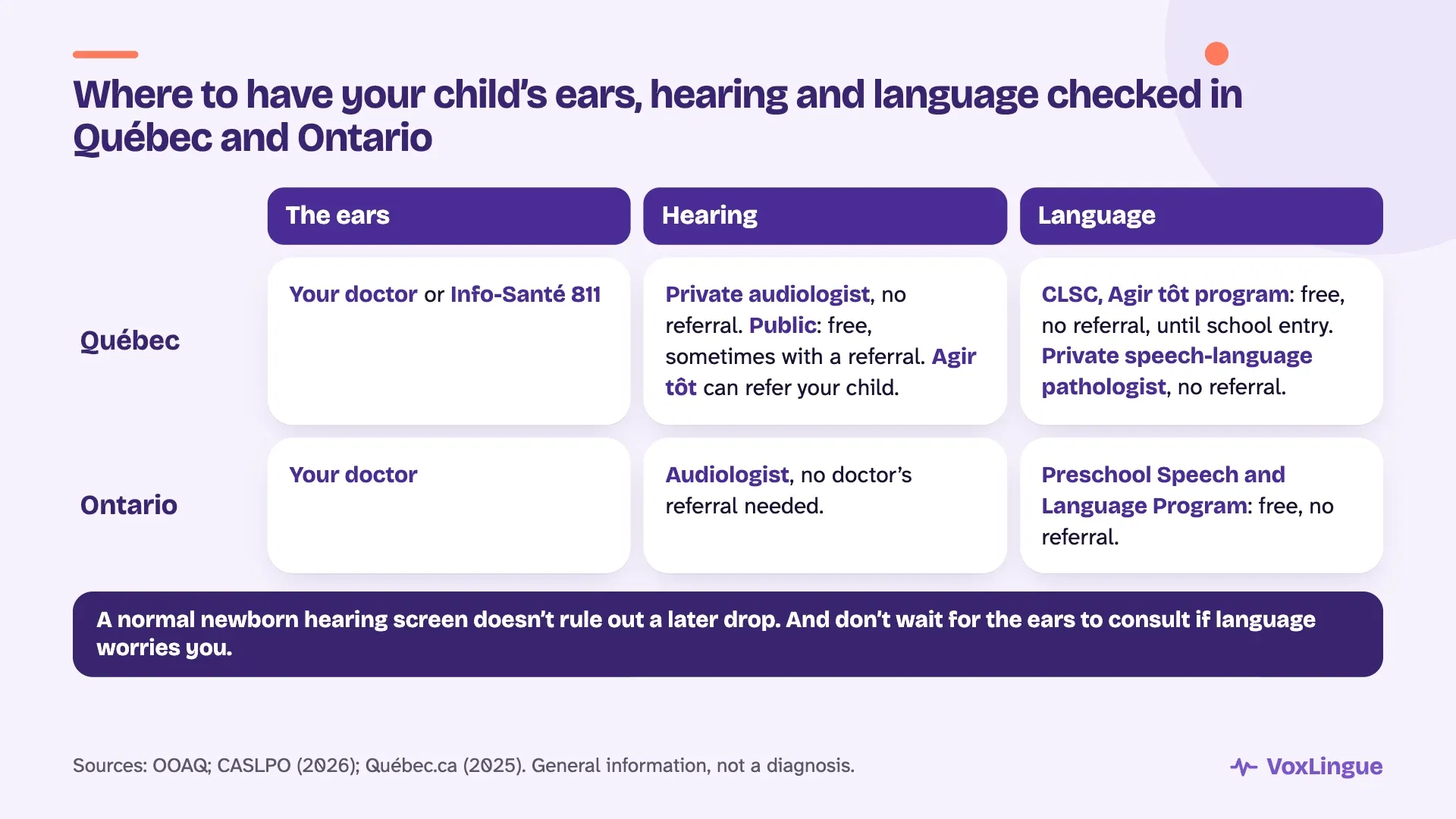
A normal newborn hearing screen is reassuring, but it doesn’t rule out a later drop in hearing (Québec.ca, 2025). Fluid can settle in at any age.
In Québec, start with your doctor or Info-Santé 811 for the ears. For hearing, a private audiologist doesn’t need a doctor’s referral. Public testing is free, but some sites ask for a referral, and the Agir tôt program can also refer your child to an audiologist (OOAQ). Since November 2024, Québec audiologists can identify fluid during their evaluation; treatment stays medical (OOAQ, 2025).
In Ontario, you can see an audiologist without a doctor’s referral, and repeated ear infections and a speech delay are both good reasons to go. The College of Audiologists and Speech-Language Pathologists of Ontario explains when to see an audiologist (CASLPO, 2026).
If your child has never had a hearing test, our team always recommends one. To go through the public system, ask your doctor for a referral. At some private clinics, the test may be covered by RAMQ with a doctor’s referral, or partly reimbursed by private insurance: ask the clinic. If there is no concern and no sign, the speech-language pathologist can start helping your child while they wait for the test.
What a hearing test looks like for a toddler
It doesn’t hurt, and it mostly looks like a game. From about 6 months, the audiologist teaches your child to turn toward a sound; each right answer lights up a toy. From about 2 to 4 years, the test becomes a game: dropping a block in a bucket each time they hear a sound (HealthLinkBC, 2019).
Tympanometry and a hearing test are not the same
Tympanometry measures how the eardrum moves, and it detects fluid (HealthLinkBC, 2019). On its own, it doesn’t tell how well your child hears. So a child can have fluid and still pass a hearing test the same day. If their language worries you, that result shouldn’t stop you from consulting.
Bilingual children: should we drop a language?
No. No study shows that speaking two languages makes the effect of ear infections worse. However, in noise, a child listening in their second language loses more words. Calm, face-to-face talk in each of their languages matters even more during episodes of fluid.
In Montréal, many toddlers live in two or three languages. When ear infections pile up, some parents wonder whether to simplify and keep just one. Research doesn’t point that way. Learning two languages doesn’t cause language delay (Canadian Paediatric Society, 2026), and no study shows that bilingualism makes the effects of fluid worse.
There is one useful nuance. In a noisy classroom, students listening in their second language lost more words than their classmates, even with normal hearing (Nelson et al., 2005). It wasn’t a study about ear infections, but it helps show where the hard listening moments are.
For many families, daycare is the noisiest place of the day, and often the place of the second language. Home then becomes where your child hears their language clearly, up close, without noise. Keep speaking the language that comes naturally to you. According to Kimberly Martins, a child learning two or three languages doesn’t need anything different during a long episode of fluid. The same habits help, in each of their languages.
If an assessment is needed, the speech-language pathologist looks at all of your child’s languages. That is essential to tell a simple difference from a true language disorder.
While the fluid is there: what to do at home and at daycare
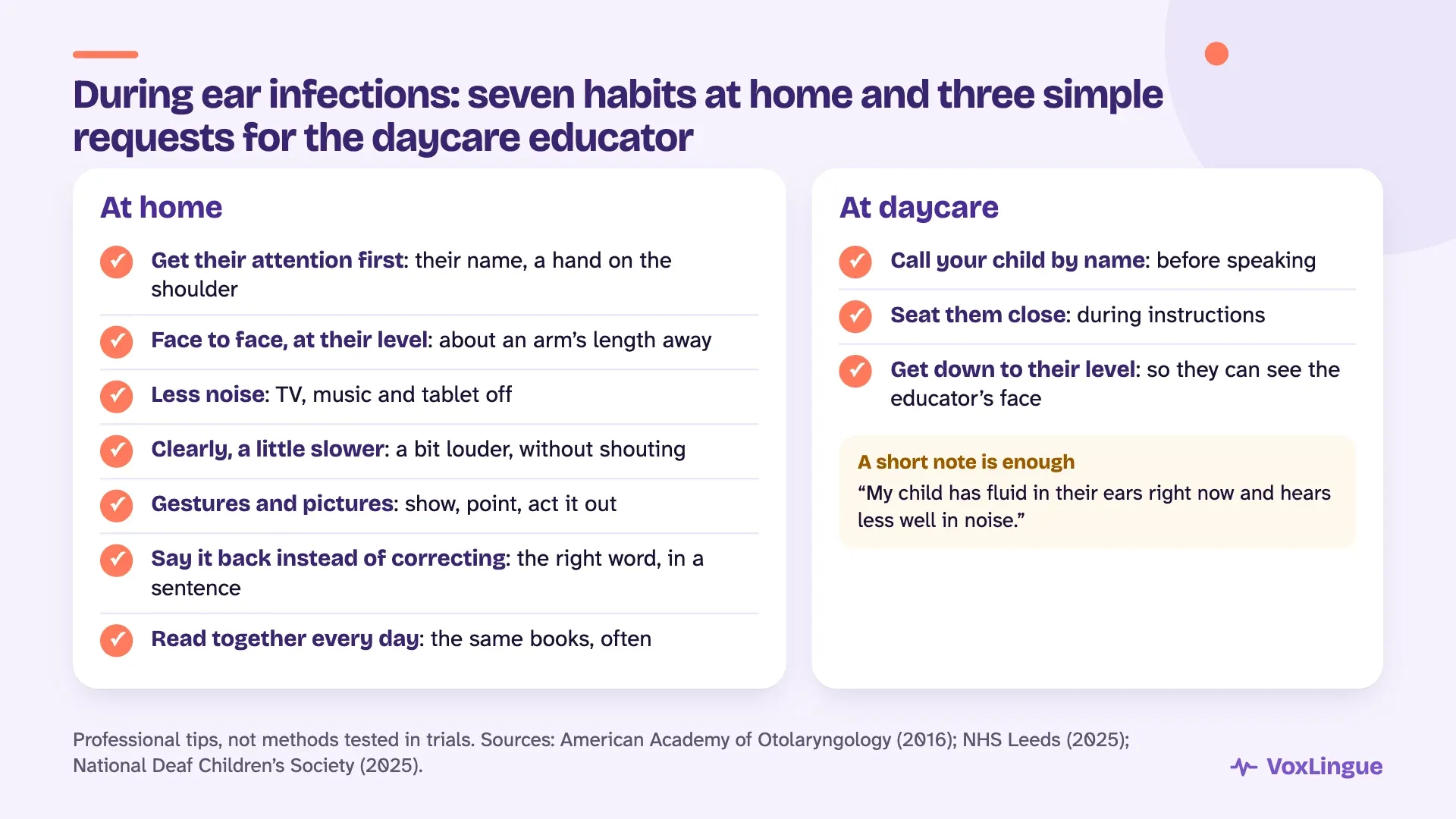
Get your child’s attention before you speak, and face them up close. Turn off the TV and music, and speak clearly and a little slower. Move closer rather than shouting. Use gestures and pictures, read together, and tell the daycare educator. These are professional tips, not methods tested in trials.
Parents ask this often online: “What do we do in the meantime?” Here is what guidelines and speech and hearing teams recommend (American Academy of Otolaryngology, 2016; NHS Leeds, 2025; National Deaf Children’s Society, 2025):
- Get their attention first. Say their name or touch their shoulder, then speak.
- Face to face, at their level. Stay close, about an arm’s length, so they can see your face.
- Less noise. Turn off the TV, music and tablet when you talk with them.
- Clearly, a little slower. Speak a bit louder, without shouting.
- Gestures and pictures. Show the object, point, act it out.
- Say it back instead of correcting. If they say a word wrong, say it back correctly in a sentence, without asking them to repeat.
- Read together every day. The same books, often: they hear the same words up close, again and again.
At daycare, a few simple habits from the educator go a long way. Ask them to call your child by name before speaking, seat your child near them during instructions, and get down to their level. A short note is often enough: “My child has fluid in their ears right now and hears less well in noise.”
These tips come from professionals’ experience. They haven’t been tested as such in trials, but they are simple, risk-free, and good for every child’s language.
If Kimberly Martins had to pick a few, these would be them. Lean on gestures and pictures. Speak face to face, a little slower, and a little louder if you’re soft-spoken: your child also sees your mouth. Cut background noise. And follow your doctor’s advice about the fluid, whether or not tubes are planned.
When to see a speech-language pathologist without waiting for the ears
Don’t wait for the ears to be sorted out before consulting if language worries you. Consult if your child already has a delay, loses words, isn’t meeting the milestones for their age, or if you have doubts. The speech-language pathologist will check that hearing was tested and look at language in all their languages.
Ear infections should never become the reason to wait. Fluid can explain part of the difficulty, but not necessarily all of it. And if your child needs help with language, the earlier it starts, the better.
Talk to a speech-language pathologist if:
- around 12 months, your child uses few or no gestures, like pointing or waving bye-bye;
- around 18 months, they say no words;
- around 2 years, they aren’t combining two words yet, like “more milk”;
- around 3 years, you yourself often have trouble understanding them;
- at any age, they lose words or gestures they used to use;
- they are one of the higher-risk children described above.
For detailed milestones, see our guide to late talkers.
In Québec, CLSCs offer free speech-language services without a referral through the Agir tôt program, from birth until school entry. Waits can be long: our article on the speech therapy waiting list in Québec explains what to do in the meantime. In private practice, you can see a speech-language pathologist directly, without a referral. In Ontario, the Preschool Speech and Language Program is free and needs no referral.
During a speech-language assessment, the speech-language pathologist will ask whether hearing has been checked and refer you to an audiologist if needed. They will look at what your child understands and says, in each of their languages.
Kimberly Martins’s advice is simple: if anything about their speech or language worries you, consult. The speech-language pathologist will tell you whether the concern is warranted and what to do next. And if you’re advised to wait, at least you’ll have peace of mind. If follow-up is recommended, see our page on language disorders.
What to remember
Repeated ear infections are hard on the whole family, but they rarely hold back language for good. What matters is hearing: how long the fluid stays, and how much it lowers what your child hears. Most children catch up, and what you do at home weighs heavily.
During episodes of fluid, move closer, talk face to face and cut the noise. Get hearing checked if the fluid lasts or if you have doubts. And if a speech delay worries you, don’t wait for the ears to be sorted out.
Next step
Keep the handout “During ear infections: how to help my child hear and talk, at home and at daycare” close by, and give a copy to the daycare educator. If your child’s language worries you, our speech-language pathologists can assess it at our Montréal clinic or by telepractice anywhere in Québec and Ontario. To learn more, explore our Early language and late talkers section.
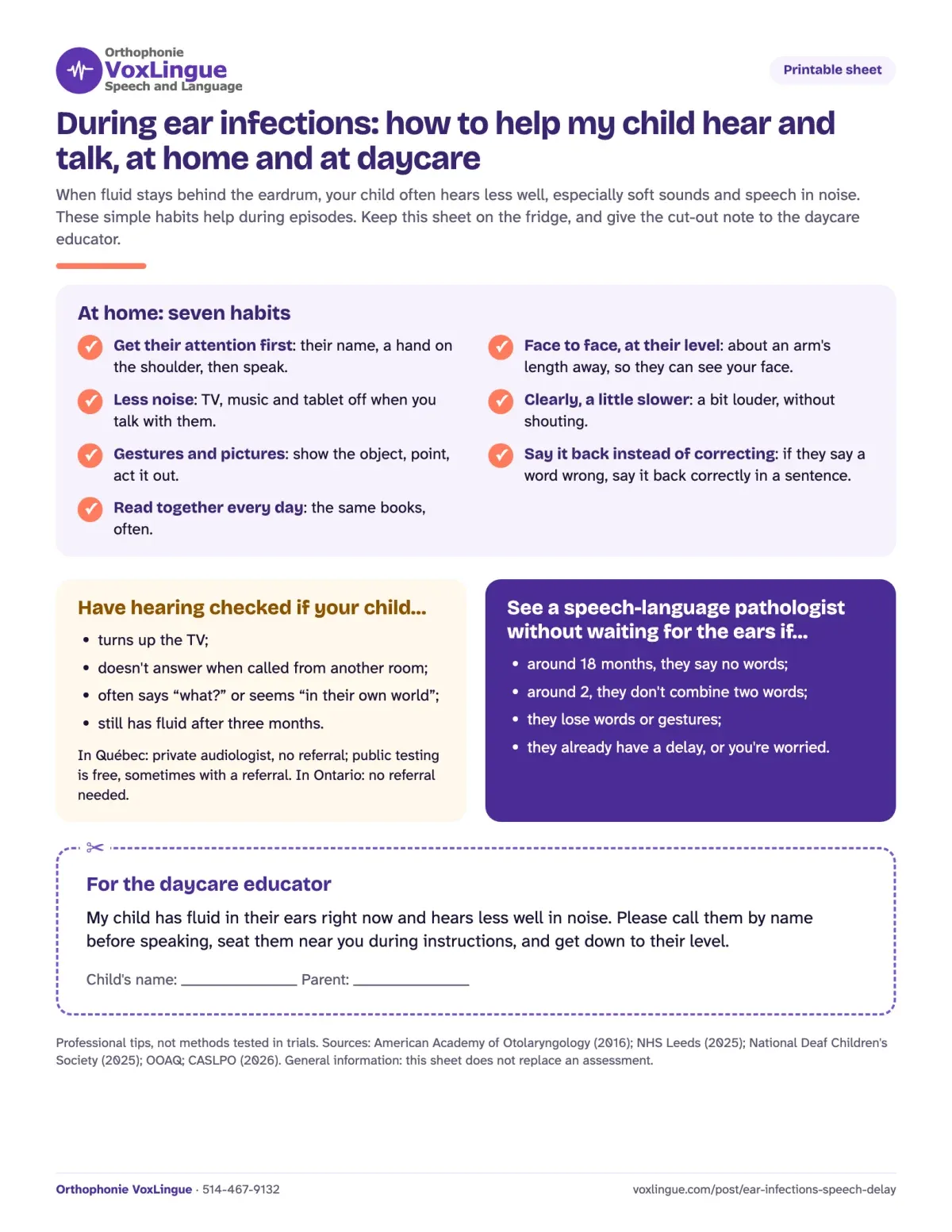
Printable handout: During ear infections: how to help my child hear and talk, at home and at daycare (PDF).
Frequently asked questions
How many ear infections are too many?
There is no magic number. Your doctor decides when to refer to an ENT, based on how often infections happen and how long the fluid lasts. For language, what matters is not the number of infections, but how long your child heard less well (Zumach et al., 2011).
Can fluid in one ear affect language?
Much less. When only one ear has fluid, the other keeps hearing normally. Research on language, and decisions about tubes, focus mostly on fluid in both ears (American Academy of Otolaryngology, 2016). If your child keeps having fluid on the same side, still mention it to your doctor.
My child has fluid but passed a hearing test: can it still matter?
Yes, it can. Hearing can change from week to week with fluid, and a test shows only one day (American Academy of Otolaryngology, 2016). If your child’s language worries you, see a speech-language pathologist even if the test was normal.
How long after tubes will we see a difference?
Hearing usually improves quickly, mostly in the first six months (MacKeith et al., 2023). Language takes longer: your child still has to learn the words they heard poorly. Not every child responds the same way. If nothing changes after a few months, see a speech-language pathologist.
Do I need a referral to see an audiologist?
In Québec, not for a private audiologist. Public testing is free, but some sites ask for a doctor’s referral, and the Agir tôt program can also refer your child (OOAQ). In Ontario, you don’t need a referral to see an audiologist either (CASLPO, 2026).
Do antibiotics clear ear fluid?
No, not for fluid alone. Guidelines don’t recommend antibiotics, steroids, antihistamines or decongestants for otitis media with effusion (American Academy of Otolaryngology, 2016). Antibiotics still have a role in other cases, like some acute infections. Your doctor will tell you what suits your child.
Can ear infections be prevented?
You can lower the risk. Avoid second-hand smoke, breastfeed if that works for you, limit the pacifier after the first year, and keep vaccines up to date. Daycare also raises the risk (Canadian Paediatric Society, 2022). Your doctor remains your best guide.
Do pacifiers cause ear infections?
They raise the risk a little. In a Finnish trial, limiting pacifiers in children under 18 months cut ear infections by nearly a third (Niemelä et al., 2000). Your doctor or speech-language pathologist can help you wean off gently.
My child had lots of ear infections and isn’t clear: is it related?
Not on their own. An analysis of fourteen studies found little or no link between ear fluid and later speech clarity (Roberts et al., 2004). Lower hearing can play a role during episodes. A speech-language assessment, along with a hearing test, helps sort it out.
Do ear infections cause learning problems later?
Not according to the large trials. In an American study that followed over four hundred children with persistent fluid to ages 9 to 11, their language, speech and learning were similar, whether or not they got early tubes (Paradise et al., 2007).
Can ear infections cause auditory processing disorder?
The question is still being studied, and the results don’t allow a firm answer. If your child passes a hearing test but seems to struggle to understand in noise or to follow instructions, an audiology and speech-language assessment can help clarify things.
Should I tell my child’s daycare?
Yes. A few simple habits from the educator help a lot: calling your child by name before speaking, seating them close during instructions, and getting down to their level. These are the same tips as at home (American Academy of Otolaryngology, 2016). The printable handout above sums them up.