How many speech therapy sessions does a late-talking toddler or preschooler need: what decides how often and how long, blocks or ongoing therapy, and why your role matters more than the count
Your 2- or 3-year-old talks very little, and a speech-language pathologist has just recommended therapy. Or the assessment is coming up, and you are already wondering how many speech therapy sessions it will take. Many parents ask the same questions: “How many sessions will it take?”, “Is once a week enough?”, “When will it end?”
This guide won’t give you a number, because no number holds for every child. Instead, it explains what decides how often and how long therapy lasts, using public documents from Québec and Ontario and the research. You’ll see why some therapy comes in blocks with breaks, how public and private services fit together, and how therapy ends.
Above all, you’ll see why your role matters more than the number of sessions. Not because everything rests on you, but because your child spends their days with you, and sessions largely serve to equip you for those moments.
At the end, you’ll find a list of questions to ask about your child’s plan, with a printable version. For more, see our articles on toddlers who talk late and our guide to what a late talker is.
How many speech therapy sessions does a child who talks late need?
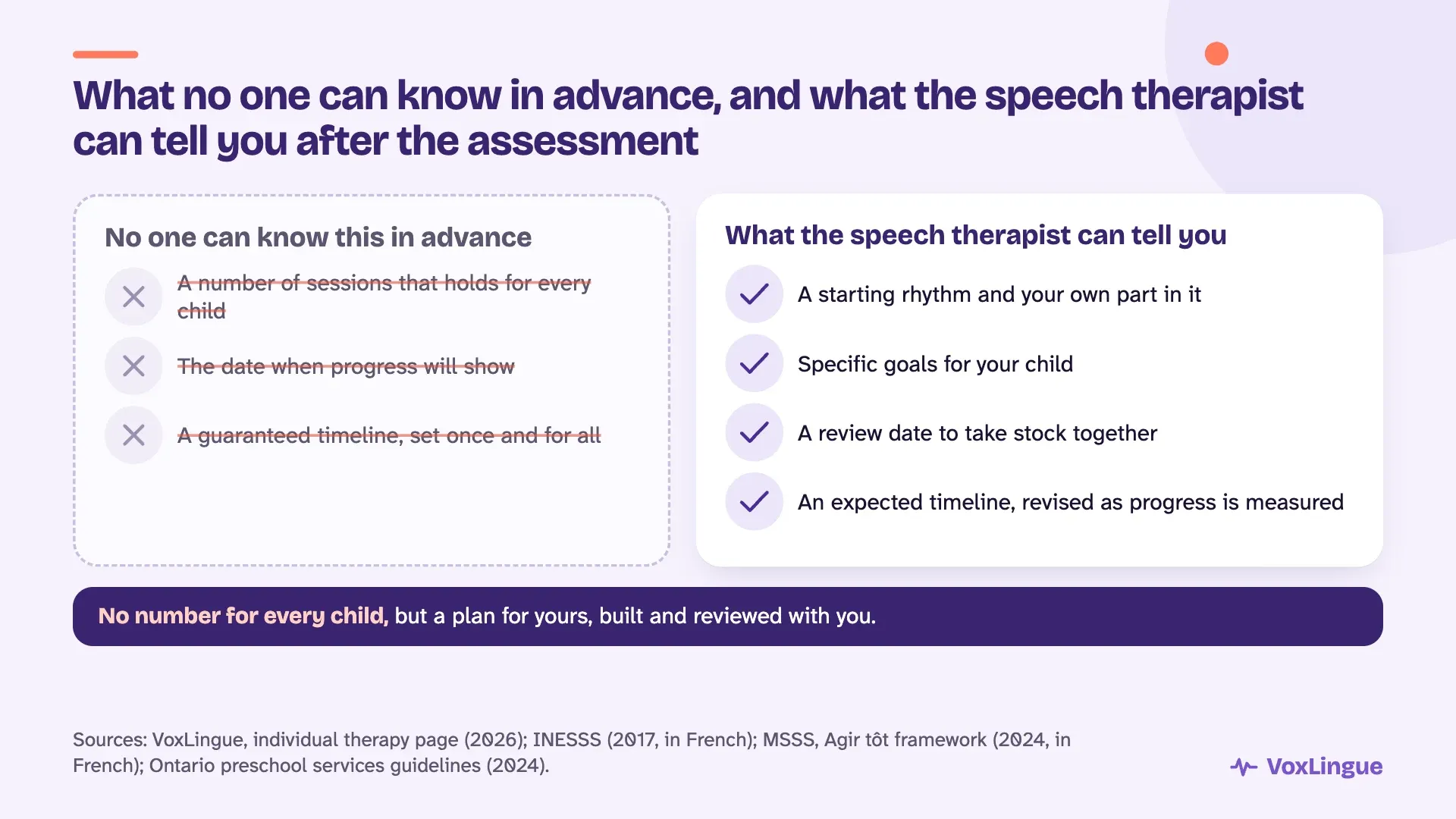
No one can give a number of sessions that holds for every child. No public source in Québec or Ontario sets one. After the assessment, the speech therapist suggests a rhythm, a review date and an expected timeline for your child, then adjusts them as your child progresses.
You may read that a late-talking toddler needs a set number of sessions or months. That figure doesn’t come from Québec sources. Québec’s health and social services evaluation institute (INESSS) describes what makes therapy vary, without setting a number. The Agir tôt program provides support that adjusts to each child’s response. In Ontario, the preschool services guidelines ask families and clinicians to decide the intensity together.
This isn’t a way of dodging the question. Two children of the same age, with the same number of words, can have very different needs. One understands well and communicates a lot with gestures; the other understands less and seeks out interaction less often. Their plans won’t be the same.
What the speech therapist can tell you after the assessment
No single number doesn’t mean the speech therapist can tell you nothing. At VoxLingue, as our page on individual therapy explains, how often and how long depends on the type of difficulty, its severity, the child’s age and goals, and how much practice happens between sessions. Your clinician will recommend a frequency and discuss an expected timeline with you, then review it as progress is measured.
In practice, at the end of the assessment, you can leave with a starting rhythm, an idea of your own part in the sessions, specific goals and a time to take stock. The expected timeline is a working hypothesis, not a promise. It changes if your child progresses faster, more slowly or differently than expected.
Not every assessment leads to therapy. Sometimes the right recommendation is home strategies and a check-in a few months later. So consulting doesn’t commit you to long-term follow-up: the speech therapist decides what comes next with you. To see what you’ll learn before any plan, read about what a speech and language assessment tells you and how an assessment and its recommendations work.
Dose, frequency, duration: what’s behind the number of sessions?
The “number” of sessions actually mixes several settings. There is the dose, meaning the time really spent on a goal during a session, the frequency, and the total duration of therapy. Together, they make up the intensity. More intensity generally helps, but only up to a point that no one has clearly defined yet.
These terms come from a 2017 report by INESSS on children aged 2 to 9 with developmental language disorder (DLD). The report is written for public health managers, but its definitions also help parents understand a plan.
The dose is what INESSS calls “the active ingredient”: the number of minutes spent specifically on one language skill during a session. The frequency is the number of sessions per period, such as every week or every two weeks. The duration is the total period over which therapy continues. Cumulative intensity is what these settings add up to together.
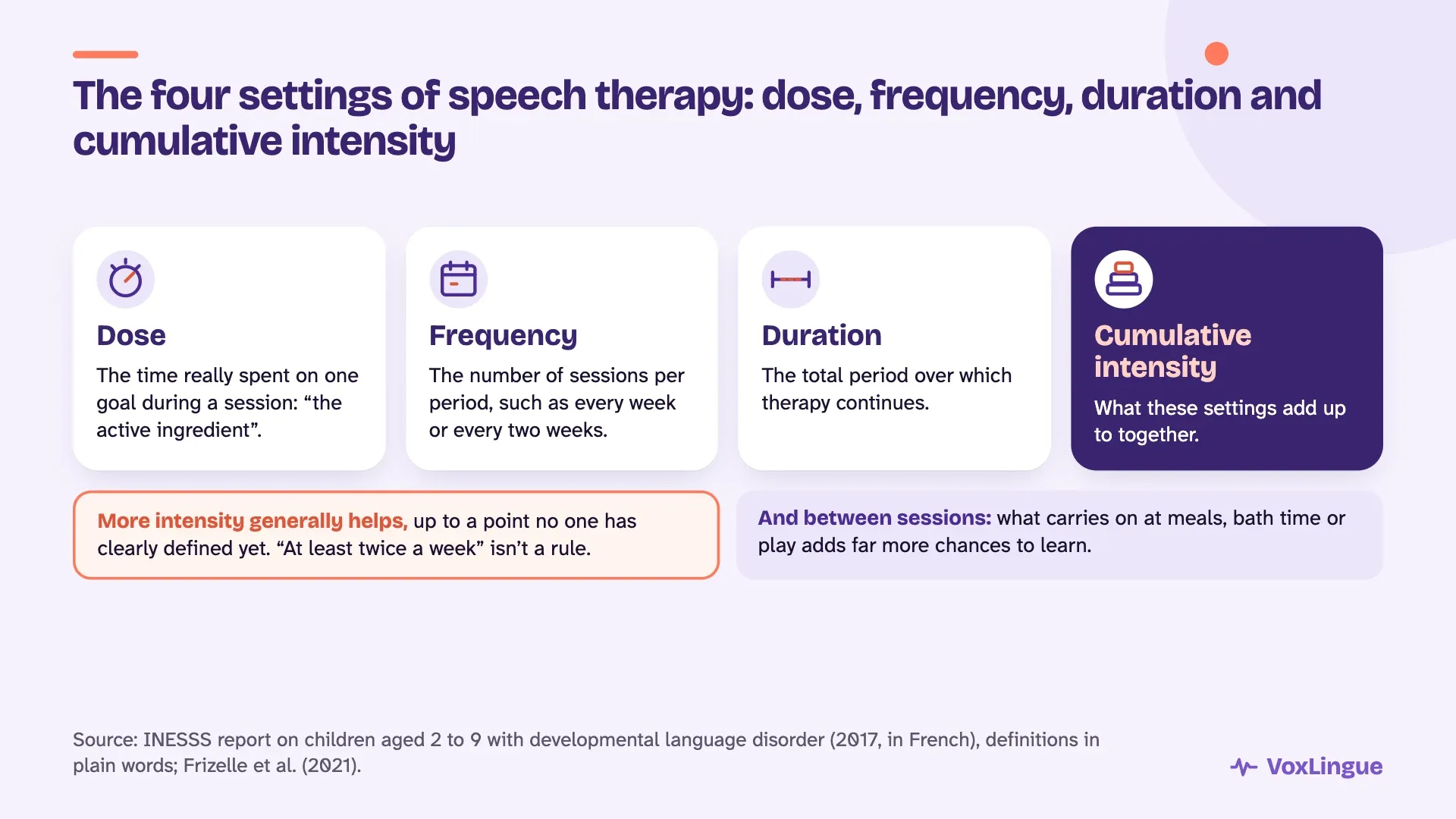
These definitions show why “one hour a week” says little on its own. Within an hour, what counts is the real opportunities your child has to hear, understand and try what is being targeted. A well-filled session gives many of those opportunities. And what carries on at home, at meals, bath time or play, adds far more.
According to the INESSS report (in French), more intense intervention generally gives better results. But beyond a certain point, adding more brings little, and that point is not well defined. An international review from 2021 on children with DLD reached the same conclusion: gains shrink as more is added, and research on dosage is still in its infancy (Frizelle et al., 2021).
Studies that compare ways of spreading out sessions often find similar results. One study followed 24 late-talking toddlers in Arizona, mostly English-only. Two ways of spacing out the chances to hear new words gave similar results, over 16 sessions in this study (Alt et al., 2020). Both groups learned words.
This guide is about language: words, understanding, sentences and back-and-forth. Speech-sound practice at home and childhood apraxia of speech follow their own practice plans, with different questions about rhythm.
Is one session a week enough? Is twice a week better?
You may read that toddlers need “at least two sessions a week”. That isn’t a rule. No Québec or Ontario source requires it. For children with DLD who receive specialised services, INESSS recommends a high-dose intervention, once a week or every two weeks.
That recommendation targets a specific group: children with an established language disorder, seen at the specialised level. Many toddlers who talk late are not in that situation. Still, it shows one thing: even for the greatest needs, Québec’s reference point is not “twice a week”.
INESSS adds that frequency should depend not on the clinician’s caseload but on the child’s ability to benefit from the stimulation. It also notes that travelling to many short sessions can be hard on families. In Ontario, the guidelines ask families and clinicians to decide the intensity together, based on the research and on child and family factors.
Research points the same way. In a US study of 233 school-age children, frequent short sessions, or less frequent but richer ones, gave better results than the other two combinations. More treatment time did not necessarily mean better results in this study (Schmitt et al., 2017). INESSS rates this evidence as moderate, and these children were older than the toddlers this guide is about.
So the right question isn’t only “how many times a week?” It is also: what happens during each session, and what carries on between sessions? If you’re torn between two rhythms, ask the speech therapist what each would bring your child, and what each would ask of you.
If weekly trips are hard for your family, say so at the start. The plan can take it into account: sessions spaced further apart, some sessions online, or sessions mainly for you, with practice built into your days.
What decides how long your child will need speech therapy?
How long depends mostly on your child, their goals and how they respond. The speech therapist looks at understanding, words and gestures, age at the start, any other difficulties and progress at each review. How regular the sessions are, and what happens between them, also matter. No one can predict it with certainty at the start.
Understanding carries a lot of weight. A 2017 meta-analysis pooled 20 groups of children, 2,134 late-talking toddlers followed in several countries. What best helped predict how their talking developed was their understanding and the number of words they already said (Fisher, 2017). The American Speech-Language-Hearing Association (ASHA) also lists understanding and vocabulary size among the best predictors. In Québec, the Agir tôt framework asks services to adjust support continuously, based on the child’s response.
The speech therapist will also ask whether other family members had language difficulties. That information is part of the picture. In the 2017 meta-analysis, family history did not, on its own, predict how children’s language developed.
The table below sums up what the speech therapist looks at. It contains no timelines: these factors combine differently in every child.
| What she looks at | Why it matters | Where it comes from |
|---|---|---|
| Understanding | Along with the number of words, it best helps predict how language develops | 2017 meta-analysis (2,134 children); ASHA |
| Words and gestures | They show how your child already communicates, even with few words | The assessment |
| Play and interaction | Back-and-forth is the base that words build on | The assessment and parent coaching |
| Age at the start of therapy | It was linked to progress in a 2023 Australian study | Zulkifli et al., 2023 |
| Other developmental difficulties | They can change the goals and the services needed | The assessment; ASHA |
| The goals chosen | Some goals move faster than others | The plan, built with you |
| Response at each review | The plan adjusts to what your child makes of the intervention | Agir tôt (2024); our individual therapy page |
| Regular sessions | Regular sessions give learning continuity | The plan, built with you |
| Practice between sessions | A few minutes built into the day often does more than one long session on its own | Our individual therapy page |
| Family history | You’ll be asked about it, but on its own it did not predict outcomes | 2017 meta-analysis |
How the speech therapist measures progress
At VoxLingue, the clinician tracks each goal through observation, data collected in sessions and, when useful, re-testing. She shares what she sees with you and adjusts goals as skills develop.
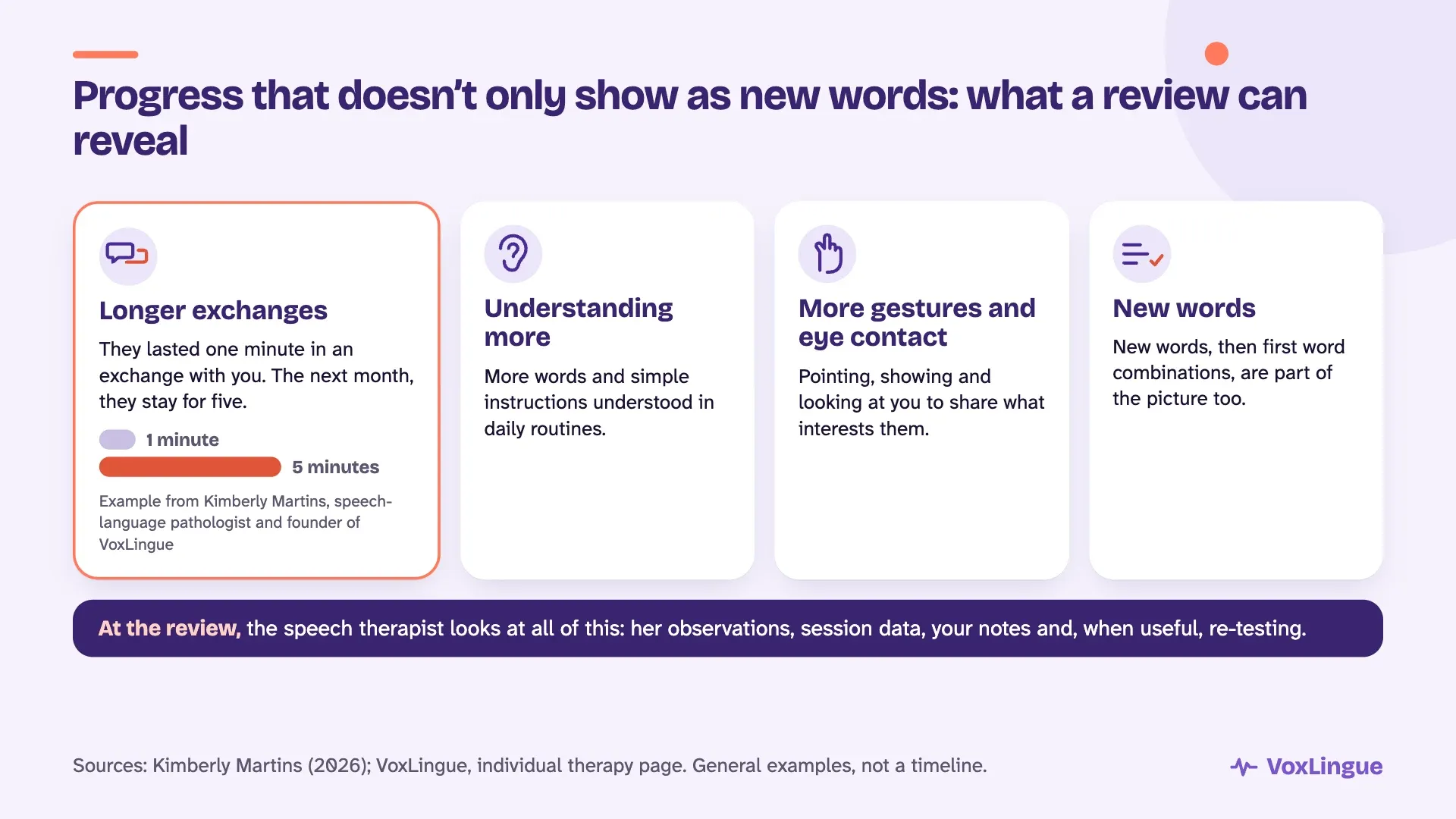
Progress can be subtle. Kimberly Martins, speech-language pathologist and founder of VoxLingue, gives this example: after a month, a child may not be speaking more, yet stay in an exchange with you for five minutes, when they lasted one minute the month before. That is real progress, even if it’s easy to miss.
And when progress stays slim? Kimberly Martins concludes DLD, for example, when a child has made little progress after about a year of regular sessions, and no other developmental disorder is present. That isn’t a timeline for your child. It is the kind of moment when the plan is rethought: other goals, another format, a new assessment. To learn more, read late talker or DLD: what can be known, and when.
Why does your role matter more than the number of sessions?
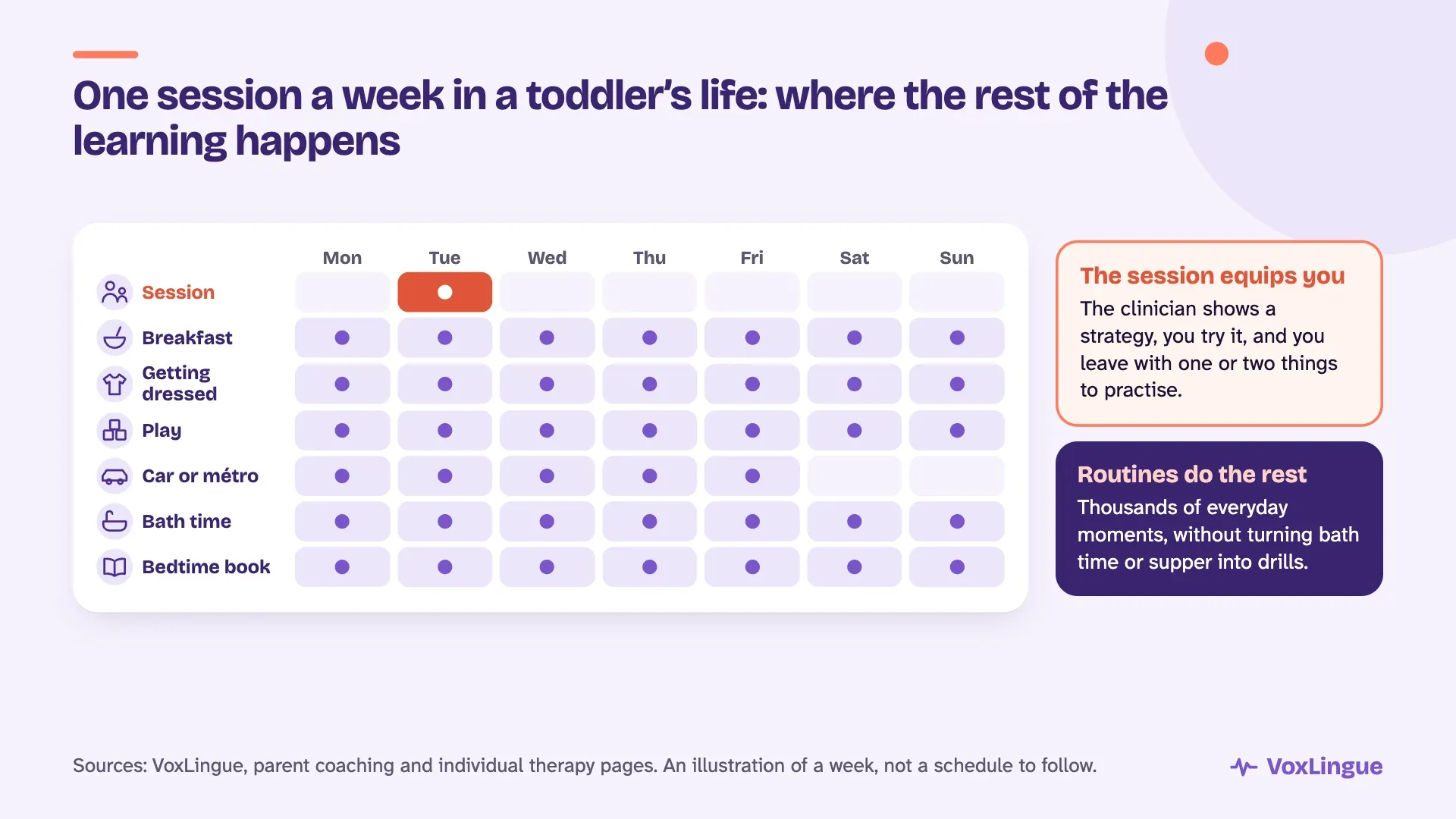
Your child spends far more time with you than with the speech therapist. In a study of 273 toddlers, the number of sessions did not predict progress, but parents’ responsiveness at the start did. Sessions still matter, largely because they equip you for the moments you already share.
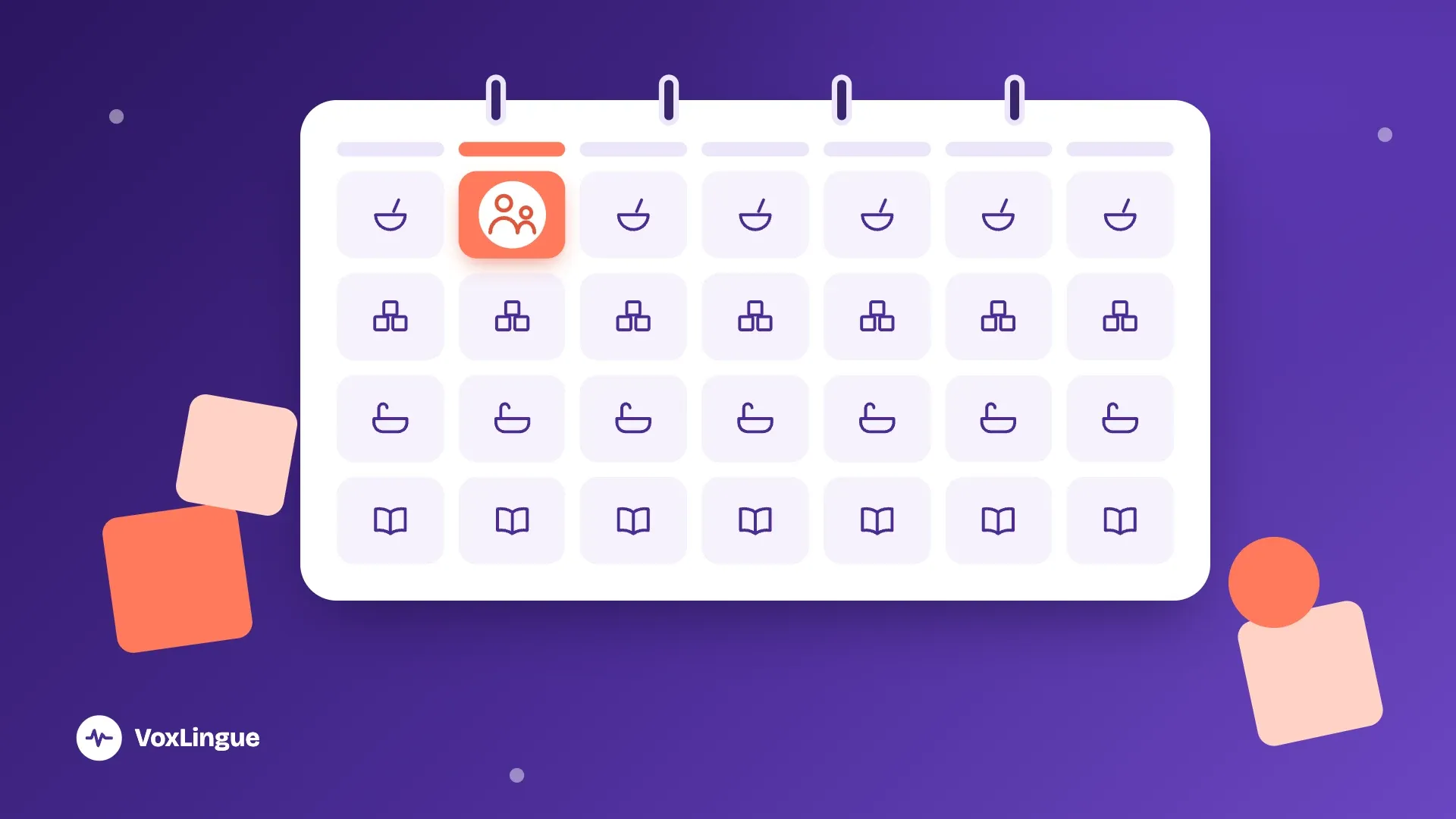
A weekly session with a speech-language pathologist matters, but it is a small part of a child’s week. Children learn to communicate through thousands of everyday moments: breakfast, getting dressed, bath time, play, books, the drive or the métro, supper.
Kimberly Martins considers parent coaching very useful, since parents spend the most time with their child and can have the biggest impact. She adds a condition: you need to understand the strategies and know how to use them day to day. They should also be simple and not take too much time. Otherwise, it’s easy to feel overwhelmed. Our newsletter explains why interaction comes before words.
What research found about the number of sessions
The study of 273 toddlers took place in Sydney, Australia, with a multicultural clinical caseload. The children were about two and a half on average. Their parents attended It Takes Two to Talk, a Hanen Centre program that teaches parents strategies to support language in daily life.
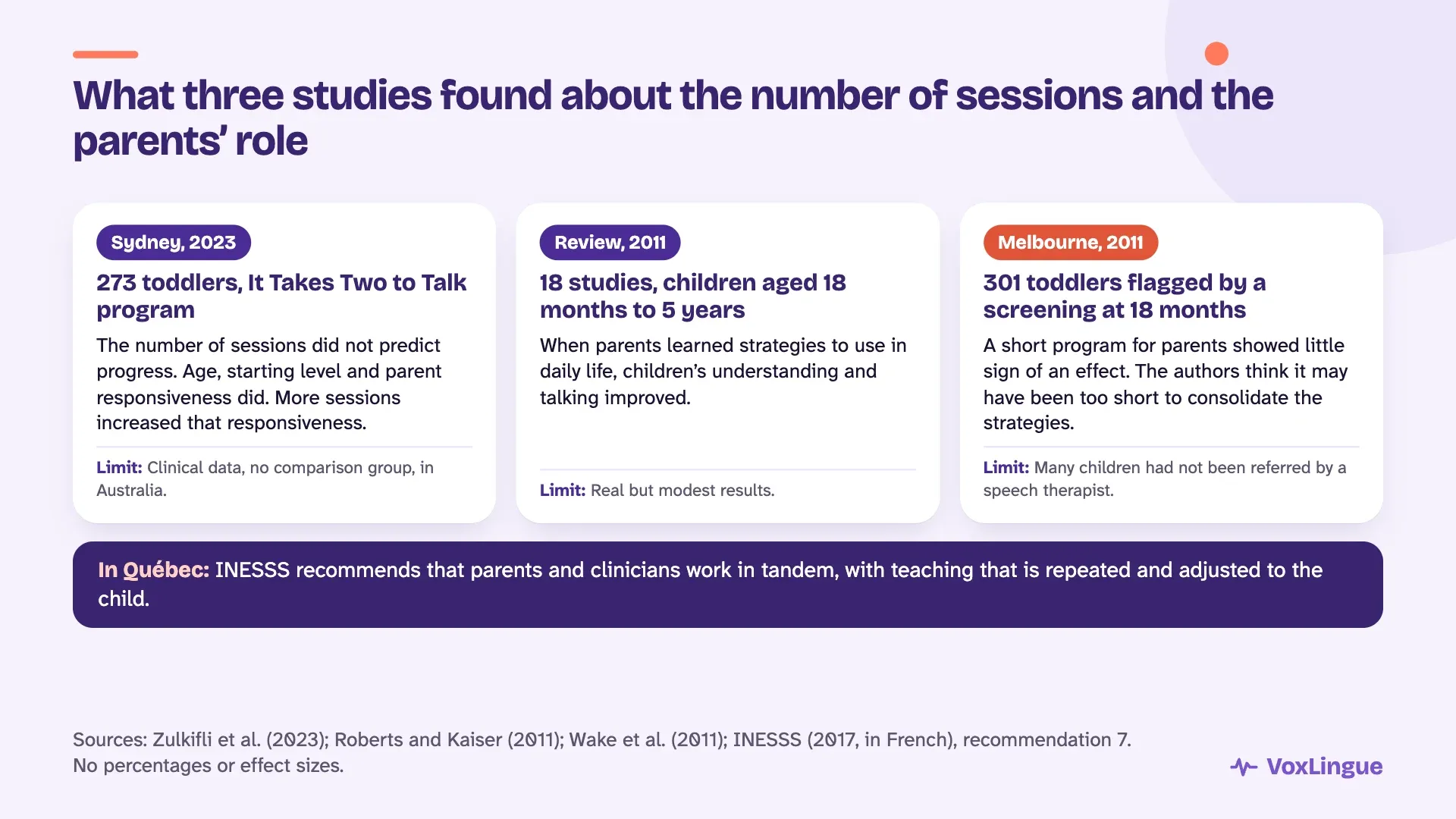
The number of sessions attended did not predict children’s language progress. What did predict it was age, starting level and the parent’s responsiveness at the beginning of the program. But more sessions did increase parents’ responsiveness (Zulkifli et al., 2023).
This study has limits. It relies on clinical data, without a comparison group. It took place in Australia. And speaking only English at home was also linked to parents’ responsiveness, so the results might differ for families who speak several languages.
Other work points the same way. In 2011, a review of 18 studies looked at children aged 18 months to 5 years who had language difficulties. When parents were taught strategies to use in daily life, children’s understanding and talking improved (Roberts and Kaiser, 2011).
According to a Cochrane review (2003) of children with speech or language difficulties, parents trained by a speech-language pathologist achieved results similar to therapy delivered by the clinician. Group and individual sessions did not differ either.
Québec sources say the same thing in their own words. INESSS recommends that clinicians and parents work in tandem. The speech therapist teaches strategies that fit into daily life. That teaching is repeated and adjusted to the child’s needs, their progress and what the parent can do. The 2026 summary of the Agir tôt program (in French) also relies on coaching parents, in partnership.
At VoxLingue, you take part in the session. Your clinician demonstrates a strategy with your child and explains why it helps. They support you as you try it, and you leave with one or two clear things to practise. Some sessions are mainly for you, with short videos of you and your child at home. Some members of our team have Hanen training, and all our clinicians draw on Hanen principles.
This guide doesn’t teach the strategies themselves. You’ll find them in everyday strategies, step by step, and the possible formats on our page on parent coaching at VoxLingue.
What this doesn’t mean
It doesn’t mean sessions are useless. In the Australian study, more sessions increased parents’ responsiveness, and that is what mattered for the children.
Nor does it mean your child’s language difficulties come from you. Or that you need to become a therapist at home. The goal is to use a few strategies in the moments you already live, without turning bath time or supper into drills. These strategies should be simple and fit your family, your routines and your languages. It’s not about making your child repeat words.
Too little can be too little
The reverse is also true: a program that is too short may not be enough. In Melbourne, Australia, 301 toddlers flagged by a screening at 18 months were invited to a group program for parents: six weekly sessions in this study. The trial found little sign of an effect at ages 2 and 3 (Wake et al., 2011).
The authors think six weeks may not have been enough for parents to consolidate the strategies. They note that longer programs had given better results in more carefully selected late-talking children. Many children in the trial had not been referred by a speech-language pathologist.
A 2004 meta-analysis had already noted that therapy lasting more than eight weeks, in the studies it analysed, might be a factor in good results (Law, Garrett and Nye, 2004). INESSS points out that those trials date from before 2000. So the message isn’t “as many sessions as possible”. It is: enough time to learn the strategies, try them and build them into your days.
Speech therapy in blocks or ongoing: why plan breaks?
Some therapy is ongoing; some comes in blocks followed by a break. Ongoing therapy continues with regular reviews. In blocks, a series of sessions is followed by a review and a planned break. A break isn’t a failure: it gives time to use the strategies in daily life. Then you decide together whether to resume, adjust or stop.
Working in blocks isn’t new in Québec. In 2017, INESSS described interventions offered in blocks in several public health networks, most often with one session a week. Most of these networks also had limits on the number of sessions, the length of therapy and the number of service episodes. These data are dated, and each region organises things its own way.
A 2013 Québec review by the CSSS de la Vieille-Capitale (in French) noted that the evidence doesn’t allow an ideal frequency to be set. In its view, blocks make services easier to access under three conditions: enough sessions in each block, a review after the break, and the flexibility for the speech therapist to stop at the right time.
In Ontario, the preschool services guidelines describe a consolidation period that usually follows an active intervention. During that time, the child and parent keep building the strategies into everyday activities, on the same goals. A re-assessment may follow if the family has further concerns. If the break goes on for a long time, a check-in with the family is strongly encouraged. To monitor progress, re-assessment takes place at least every six months.
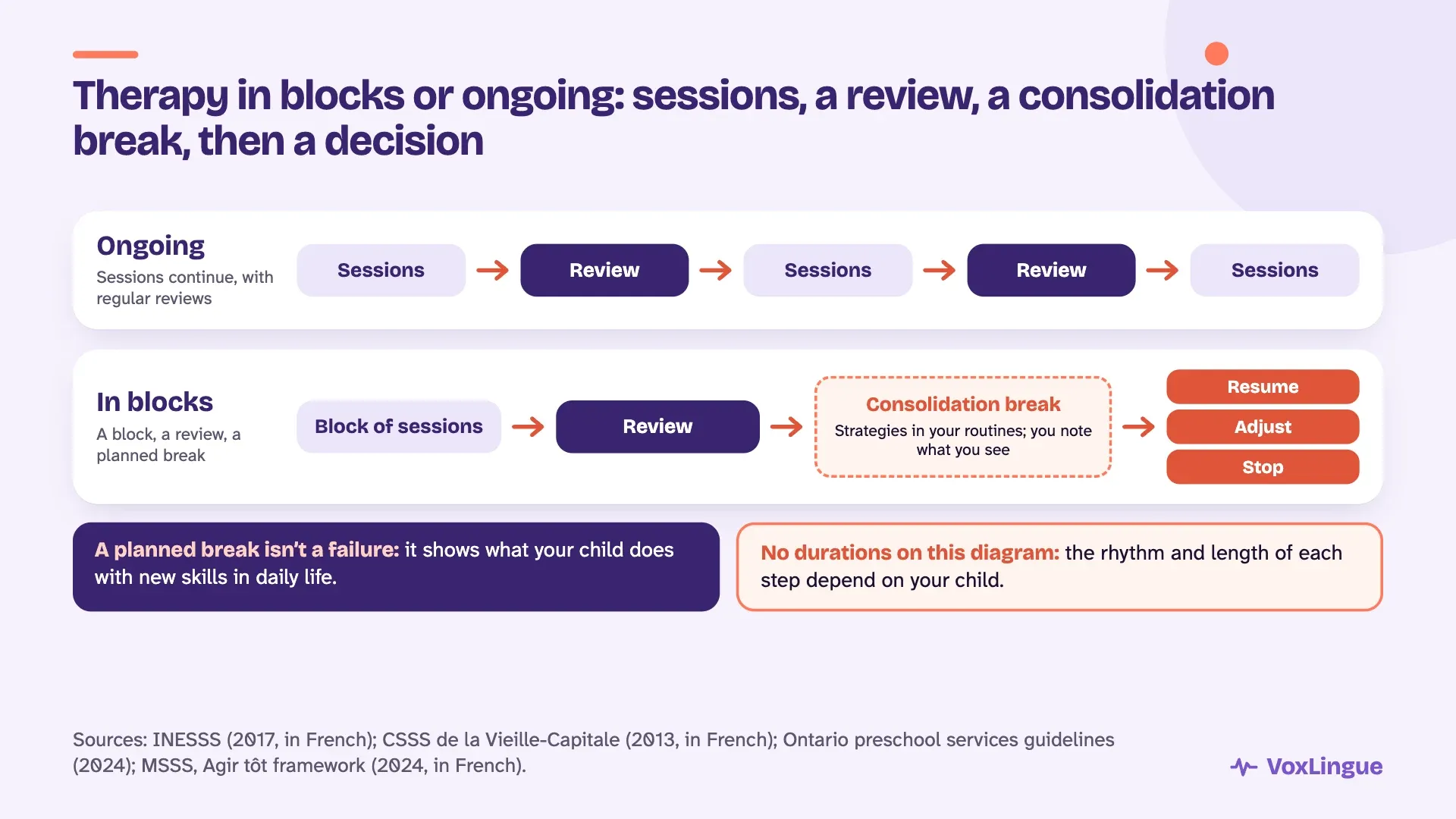
Québec’s Agir tôt framework points the same way: the intensity of support adjusts continuously to the child’s response, and moving back and forth between levels of service is possible. A plan can become more intense, lighter, or pause for a while.
You may hear that a break means “it didn’t work”. That is rarely the case. A planned break shows what your child does with new skills outside sessions, and what you do with the strategies. What you notice during the break then helps decide what comes next. Simply ask, from the start, what the break is for and when the review will be.
At the review, the speech therapist compares what your child does now with where they started, using her observations, session data and what you have noticed at home. You then decide together what comes next: resume, change the rhythm or the goals, or stop.
What to do during a break
During a break, the idea is to keep the thread going, without turning your days into sessions:
- keep one or two strategies in your routines, the ones that work best at home;
- note what you see: new words, longer exchanges, more gestures, what your child understands;
- contact the speech therapist if something changes or worries you, without waiting for the planned date;
- avoid drills, and don’t ask your child to repeat.
Your notes, even a few lines on your phone, make the review more useful. They show what the clinician can’t see in a session: your child in real life.
CLSC, Agir tôt, Ontario, private: what’s on offer, and how do services fit together?
In Québec, Agir tôt scales support to each child’s needs. It can mean online capsules and parent groups, or more individual therapy when the child’s response calls for it. In Ontario, preschool services offer workshops, groups, consultation or a home program. You can also start privately at the same time.
Agir tôt is Québec’s free early-development program, offered through the CLSCs, the local community health centres of each public health network (CISSS or CIUSSS).
Its support isn’t a ladder you climb one rung at a time. According to the 2026 summary of its framework (in French), a child doesn’t have to “climb” the levels one by one, and levels can be combined. When difficulties can resolve with little support, the program also offers brief interventions, such as advice or active monitoring.
The framework gives the example of a group: online capsules, then a few group coaching meetings for parents, and then, depending on the child’s response, more individual intervention or an assessment. It is an example, not a rule. In the Laurentides region, the path presented to parents in 2025 includes a first meeting, trying strategies, an assessment, a parent group and follow-up of progress. Parent coaching is described there as an essential element.
How many sessions does the CLSC give? It varies by region and changes over time. Ask the person handling your file. Our guide to the waiting list and the Agir tôt steps explains the path in detail.
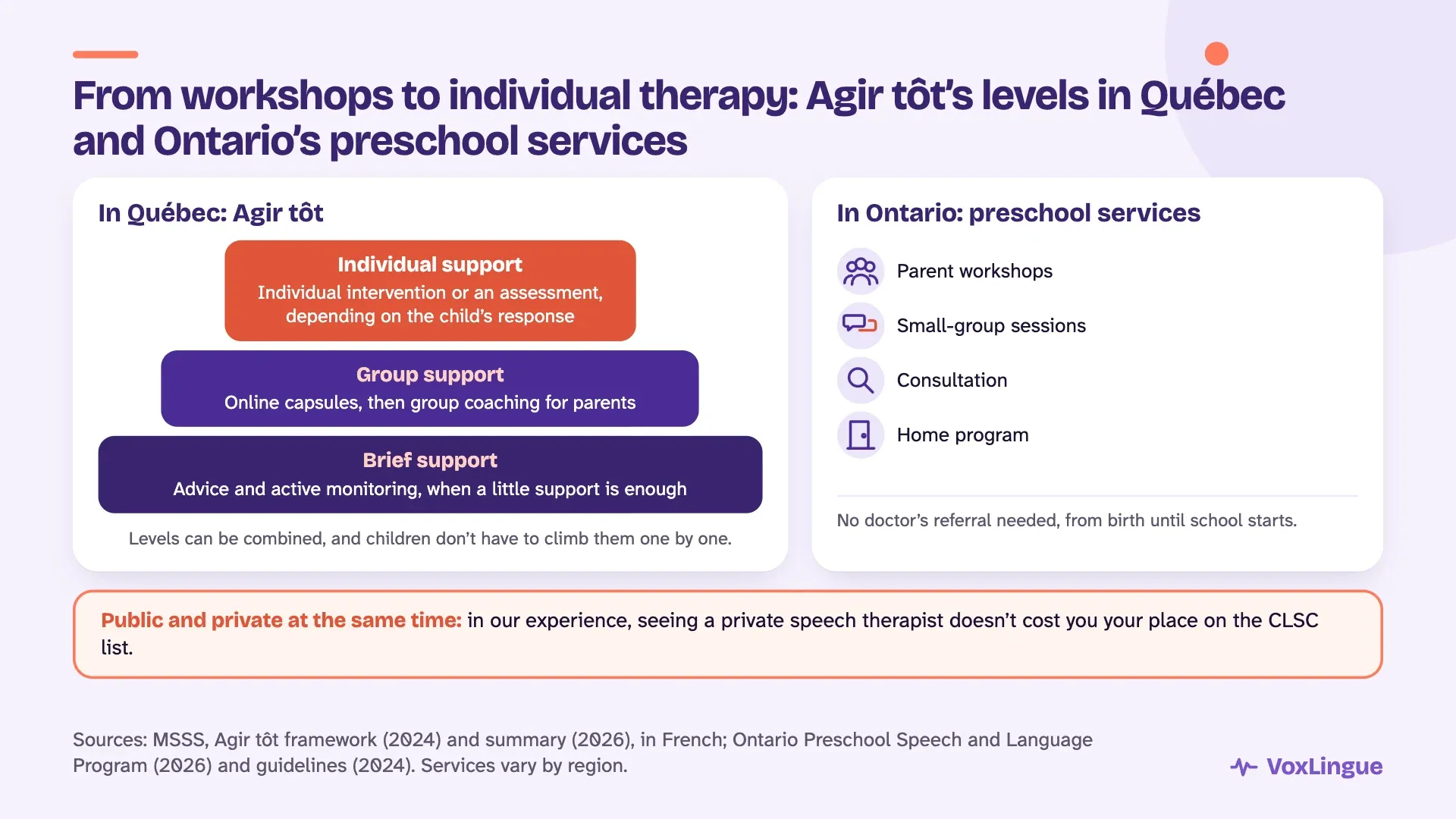
In Ontario, the Preschool Speech and Language Program serves children from birth until they start school. You don’t need a doctor’s referral to sign up. Approaches include parent workshops, small groups, consultation and a home program. The guidelines add that the program’s services continue until school start, when children who still need help move to school-based services.
Sessions can also take place online, through telepractice, anywhere in Québec and Ontario. For insurance, receipts and other ways to pay, see our guide to paying for speech therapy in Québec.
Starting privately while waiting for the CLSC, then coordinating
If therapy is recommended, we suggest starting right away rather than waiting for the CLSC. In our experience, that call can take one to two years, and the public service then offers a limited number of sessions. That is a long time in a young child’s life.
You don’t need to commit for months. Even a few sessions give you support, coaching and strategies you can use every day at home.
In our experience, seeing a private speech-language pathologist does not cost you your place on the CLSC list. Sharing the assessment report is always your choice. When public and private professionals talk to each other, each can work on different goals instead of repeating the same steps.
When CLSC or Agir tôt services begin, talk it over with your private speech therapist. Depending on what each service is working on, you can continue, space sessions out or take a break. What matters is that you and your child don’t get the same thing twice, or advice that conflicts.
How does speech therapy end?
Therapy ends when goals are met, or when a review shows something else is needed. The ending can take the form of a maintenance period, a group, a check-in a few months later or discharge. You can come back if new needs appear.
At VoxLingue, when goals are met, we plan for maintenance, a transition to group programs, or discharge. Our groups often complement or follow individual therapy: they give your child a chance to use their skills with other children.
Public services work in a similar way. In Agir tôt, services are reviewed regularly, and each review can lead to continuing, revising the plan, redirecting the child, requesting a diagnostic assessment or closing the file. In Ontario, when needs and goals are met, families are supported to transition out of services. A child can re-enter services after discharge, for example if the family notices new concerns.
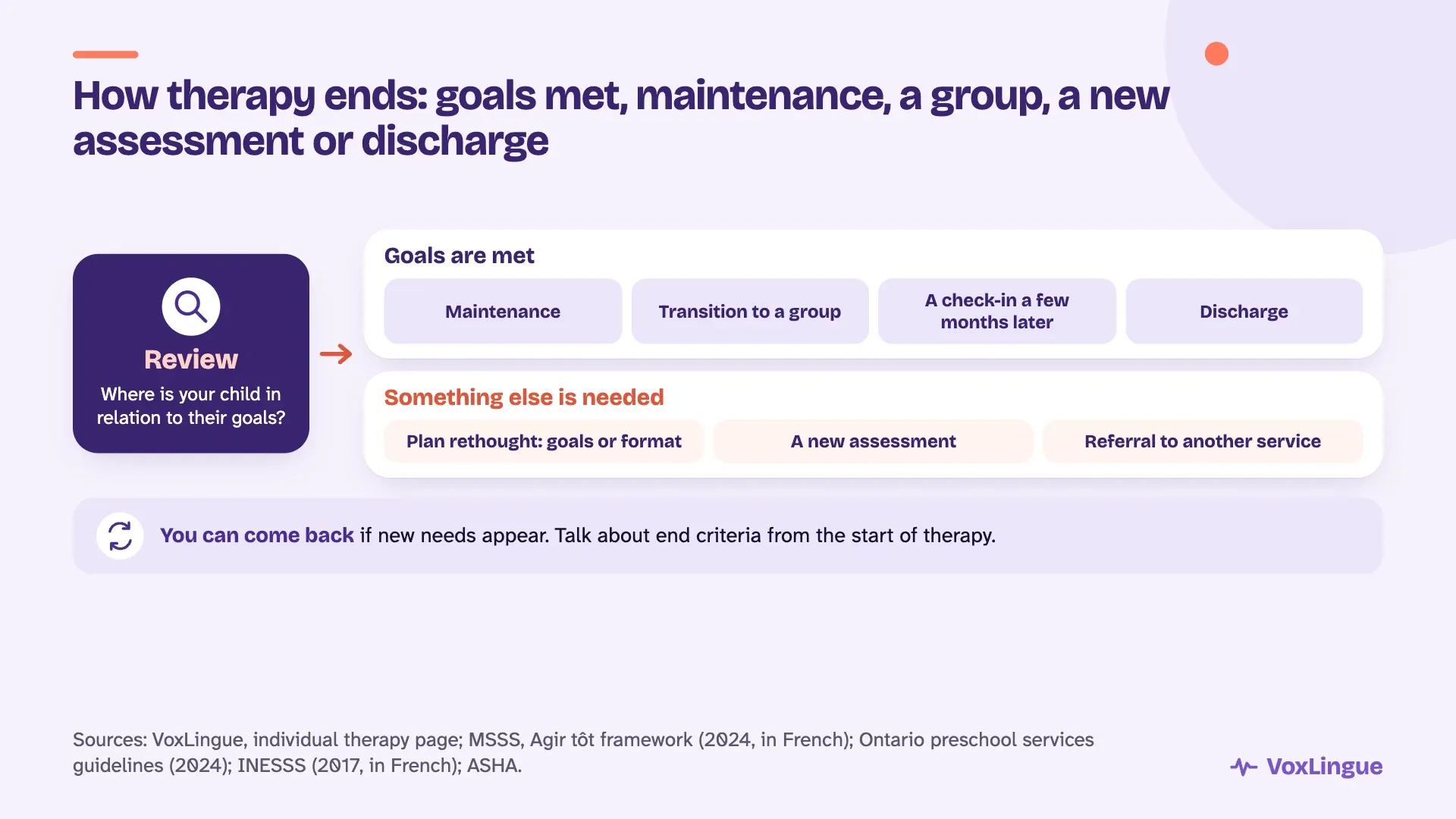
The American Speech-Language-Hearing Association says services should be planned with the end in mind, from the start. According to ASHA, therapy ends when it is no longer needed, no longer effective or no longer matches the goals, through a decision shared with the family.
INESSS notes that some clinicians find it hard to end therapy, precisely because these are children who are still developing. Hence the value of talking about end criteria at the start: how will we know therapy can stop?
And if progress stays slim, ending isn’t the only option. The plan is rethought, as described above: other goals, another format or a new assessment.
What questions should you ask about your child’s speech therapy plan?
Ask how often, with whom and to practise what. Also ask when the next review will be, what would change the plan and how you’ll know therapy can end. These answers are worth more than a number given in advance.
Parents are right to ask. According to INESSS, parents want to be kept informed throughout therapy, not only after the assessment, and to know what the decisions are based on.
You don’t need to ask everything on the first day. Some answers will come after a few sessions, once the speech therapist knows your child better. But knowing when the review will be, and what you’ll look at, helps you follow the plan rather than count sessions.
Here are the questions to keep handy, for instance at the end of the assessment:
- How often will we meet, and how long is each session? Who takes part?
- What should I practise, in which routines, and for how long each day?
- Will therapy be in blocks or ongoing? If there is a break, what should we do during it?
- When is the next review, and what will we look at together?
- What would change the plan: more often, less often, another format?
- How will we know therapy can end?
- How do we coordinate with the CLSC or Agir tôt, if those services begin?
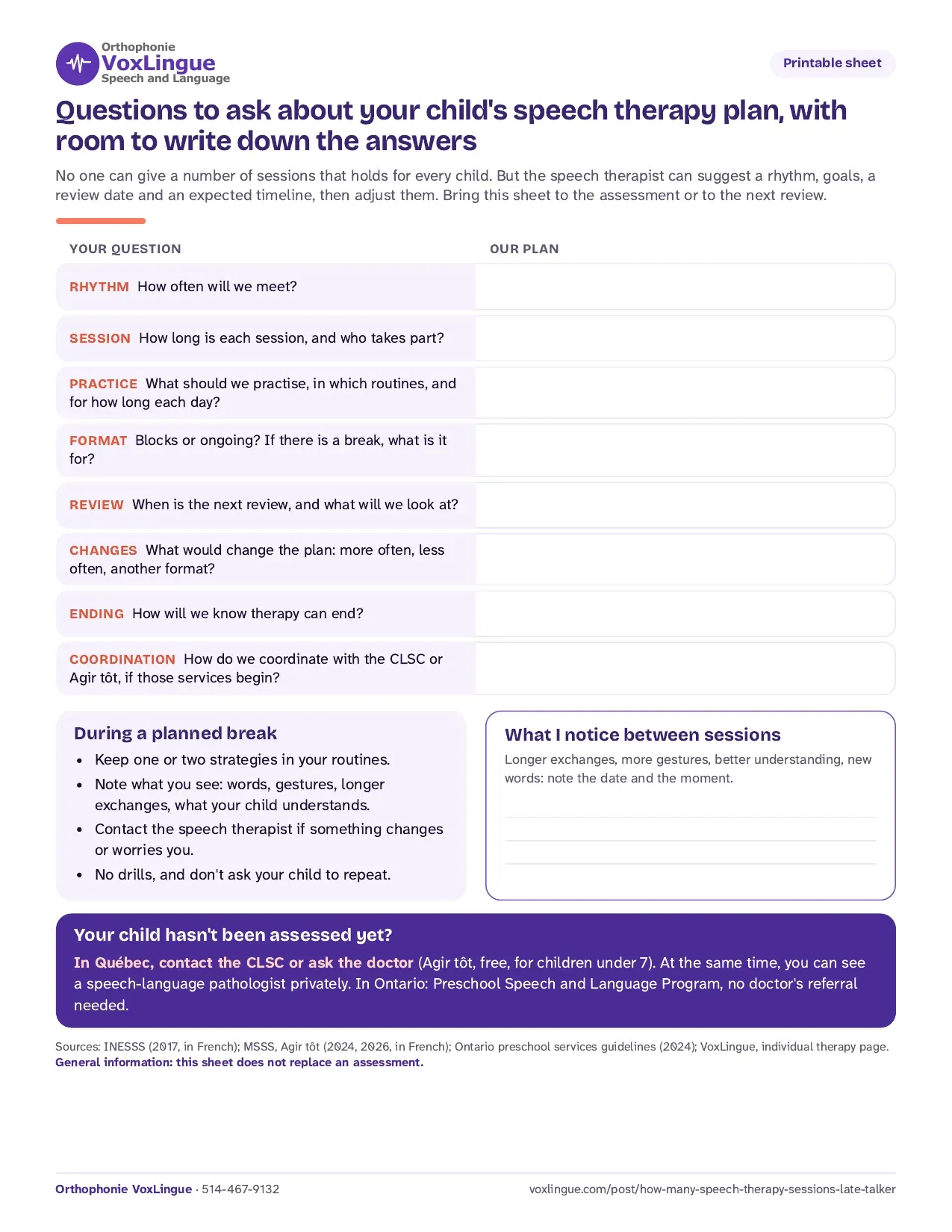
Our printable sheet lists these questions, with room to write down the answers: Questions to ask about your child’s speech therapy plan, with room to write down the answers (PDF, 1 page).
When should you consult, and where do you start in Québec and Ontario?
If your child hasn’t been assessed yet, contact the CLSC or ask the doctor. See a private speech therapist at the same time if you can. In Ontario, the Preschool Speech and Language Program doesn’t require a doctor’s referral. Your concern is reason enough to consult.
Consult if your 2- or 3-year-old doesn’t talk at all, isn’t putting two words together at 2, interacts or communicates little, loses words they used to say, or simply if you’re worried. There’s no need to wait for daycare or school.
In Québec, the Agir tôt program is free for children under 7 who haven’t started school yet. In Montréal, the Montreal Children’s Hospital asks that children aged 0 to 5 first go through screening at the CIUSSS for their area. Privately, choose a speech-language pathologist who is a member of Québec’s order of speech therapists and audiologists (OOAQ).
In Ontario, you can sign your child up yourself with the Preschool Speech and Language Program in your area, as soon as you have a concern about their talking or understanding. Our speech-language pathologists also see Ontario families through telepractice in Ontario, including while you wait for local services.
Key takeaways
The number of speech therapy sessions matters less than what they help you do with your child.
- No one can give a number of sessions that holds for every child. After the assessment, the speech therapist suggests a rhythm, a review and an expected timeline, then adjusts them.
- “At least twice a week” isn’t a rule. The rhythm follows the child and their goals.
- In a study of 273 toddlers, the number of sessions did not predict progress; parents’ responsiveness did. Sessions largely serve to equip you.
- A planned break isn’t a failure. It gives time to use the strategies, before a review.
- Ask your questions about the plan from the start, including how therapy will end.
Next step
A speech and language assessment ends with a clear plan you can question: rhythm, goals, reviews and your own part in it. Our speech-language pathologists see families at our Marché Central clinic in Montréal, and by telepractice across Québec and Ontario. Bring the question sheet to your first appointment.
Frequently asked questions
How many sessions does the CLSC offer?
It varies by region and changes over time. In 2017, INESSS found that most public health networks set limits on the number of sessions, the length of therapy and the number of service episodes. Today, Agir tôt often starts with online capsules or parent groups, then adjusts support to the child’s response. Ask the person handling your file what is planned in your region.
How soon will I see progress?
No one can promise a date. Early progress is often subtle: an exchange that lasts longer, more gestures, better understanding, before new words. Note what you see between sessions. The review is there to look at that progress together, and to adjust the plan if it’s slow to come.
Do I stay in the room during the session?
Often yes, or for part of the session. Parents who see strategies in action can use them at home, where most practice happens. Your clinician will suggest the format that suits your child’s age and goals. Some sessions may even be mainly for you.
Does online therapy count the same?
Yes, according to the evidence available. INESSS reports that three trials, with small groups of children, found telepractice as effective as in-person sessions, with moderate evidence. With a toddler, much of the work is coaching the parent, which suits video well. The speech therapist then sees your child at home, with your routines and toys. For what a session looks like, see online speech therapy for toddlers.
My child is bilingual: which language is therapy in?
In a multilingual setting, INESSS recommends bilingual intervention rather than intervention in one language only. Otherwise, therapy happens in the stronger language, with interpreters if needed. We will never ask you to stop speaking your language. If your child switches between languages, see when your child mixes French and English.
Will my child need a new assessment to continue or stop?
Not always a full assessment. Progress is followed through observation, session data and, when useful, re-testing. In Ontario, the guidelines call for re-assessment at least every six months. Ask your speech therapist when the next one will be, and what they’ll look at.
My child is making little progress after several months: should we stop?
Not necessarily. Talk it over with the speech therapist: the goals, the format or the rhythm can change, and a new assessment may help. If other difficulties are suspected, other professionals can get involved. When progress stays slim despite regular sessions, the plan is rethought. It isn’t simply extended, or stopped without explanation.
Can we see a private speech therapist and the CLSC at the same time?
Yes. In our experience, seeing a private speech-language pathologist doesn’t cost you your place on the CLSC list. Let the person handling your file know. You choose whether to share the report. When the two teams talk, each can work on different goals, and your child doesn’t go through the same steps twice.