Daycare is worried about your child's speech or language: what it means, what next
At pickup, the educator asks if you have a minute. She has noticed that your child doesn’t talk much, or doesn’t always seem to follow instructions. She would like someone to take a closer look.
When daycare is concerned about your child’s speech or language, it can stir up several feelings at once. Surprise, worry, sometimes the urge to defend your child, especially if everything seems fine at home. These reactions are normal. They say nothing about your parenting, or about the quality of the daycare.
This guide turns that concern into a plan. It explains what the educator observes and writes down, what to ask her to get concrete examples, and how to read her concern when your child speaks English or another language at home and French at daycare. It also sets out your options in Québec, your rights over your child’s file, and how to work with the educator afterwards.
It is written for parents whose children attend a CPE (a centre de la petite enfance), a private garderie or a home daycare, and for educators who want to pass it on. The Québec documents behind it are mostly in French, so we name them and translate the key points. For the wider picture, our articles on speech and language assessment are gathered in one place.
What does it mean when daycare is concerned about your child’s speech?
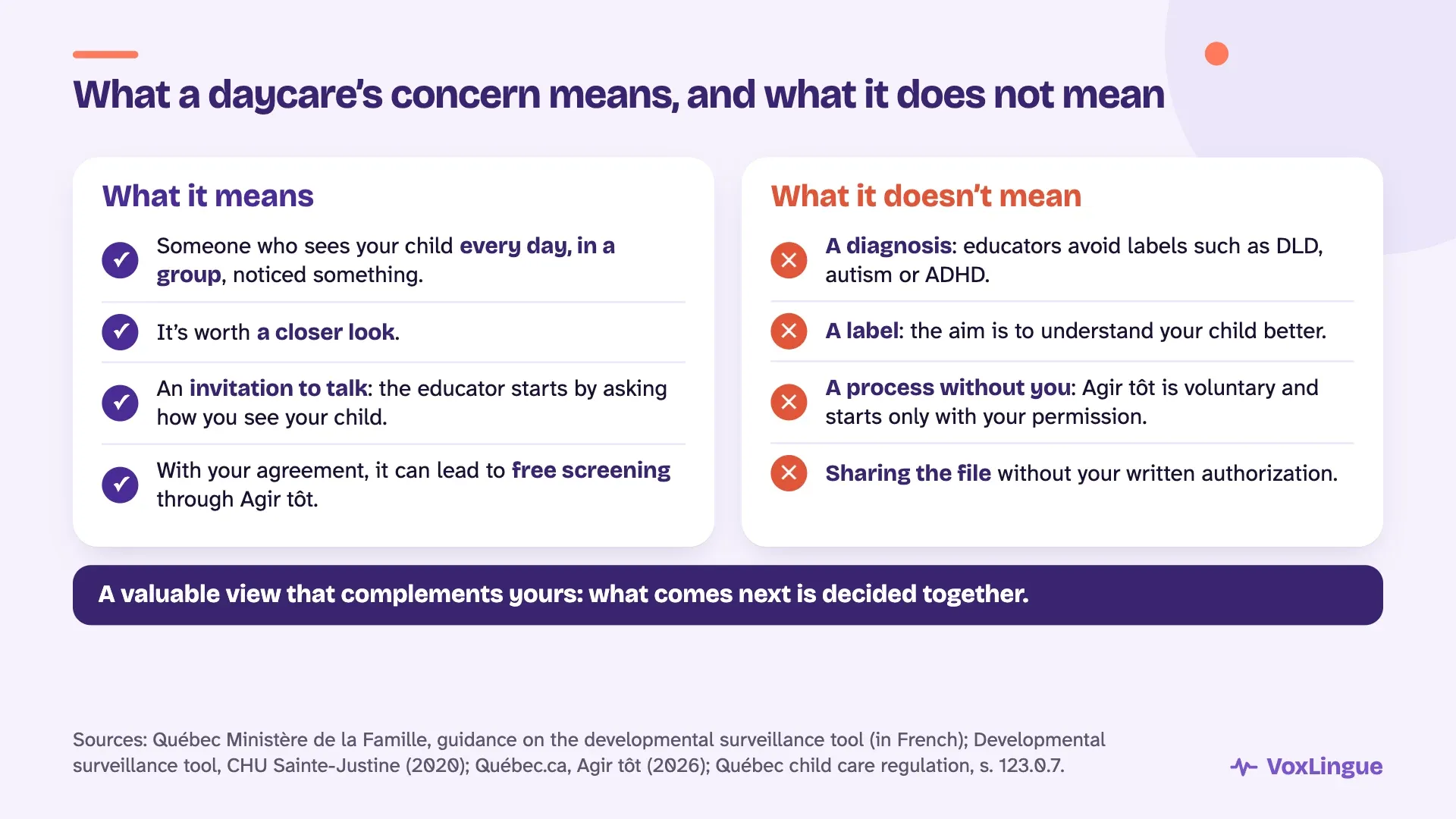
It means someone who sees your child every day has noticed something. She sees your child among other children the same age, which is a useful view. It is an observation, not a diagnosis: Québec educators are asked not to use labels such as DLD or autism. The next step is to understand what she saw, then decide together.
The educator sees your child in a setting you rarely see: in a group, every day, with children of the same age. The developmental surveillance guide written at CHU Sainte-Justine for Québec’s ministère de la Famille makes this point. Educators spend time with children daily (Cousineau and colleagues, 2020). Without meaning to, they compare how each child understands, asks, plays and tells.
She also sees your child at moments that are demanding for language: following an instruction given to the whole group, waiting a turn, making himself understood by a friend. These situations happen less at home, where adults often guess what a child means before he says it. Siblings and grandparents become expert interpreters.
Her observation has limits too, and the ministry names them clearly. Its guidance on the surveillance tool asks educators to avoid diagnostic terms such as DLD, autism or ADHD. Those words are reserved for after a thorough assessment by a health professional (ministère de la Famille, Précisions sur l’utilisation de l’outil de surveillance du développement de l’enfant, in French).
The purpose of a concern is to take a closer look, not to put a label on your child. The surveillance guide says so almost word for word (Cousineau and colleagues, 2020). An educator’s observation opens a conversation. It does not close one.
It is easy to think that the educator is exaggerating, that it will sort itself out by kindergarten, or that it is only about French. Each of these thoughts may hold some truth. None of them replaces concrete examples, and that is the best place to start. If the word “disorder” worries you, our article late talker or DLD: what tells them apart explains the difference in plain terms.
Above all, remember this: the educator and you are on the same side. She knows your child in a group, and you know him across his whole life. Together you hold a fuller picture than either of you does alone.
What the educator records: the development report and the observation checklist
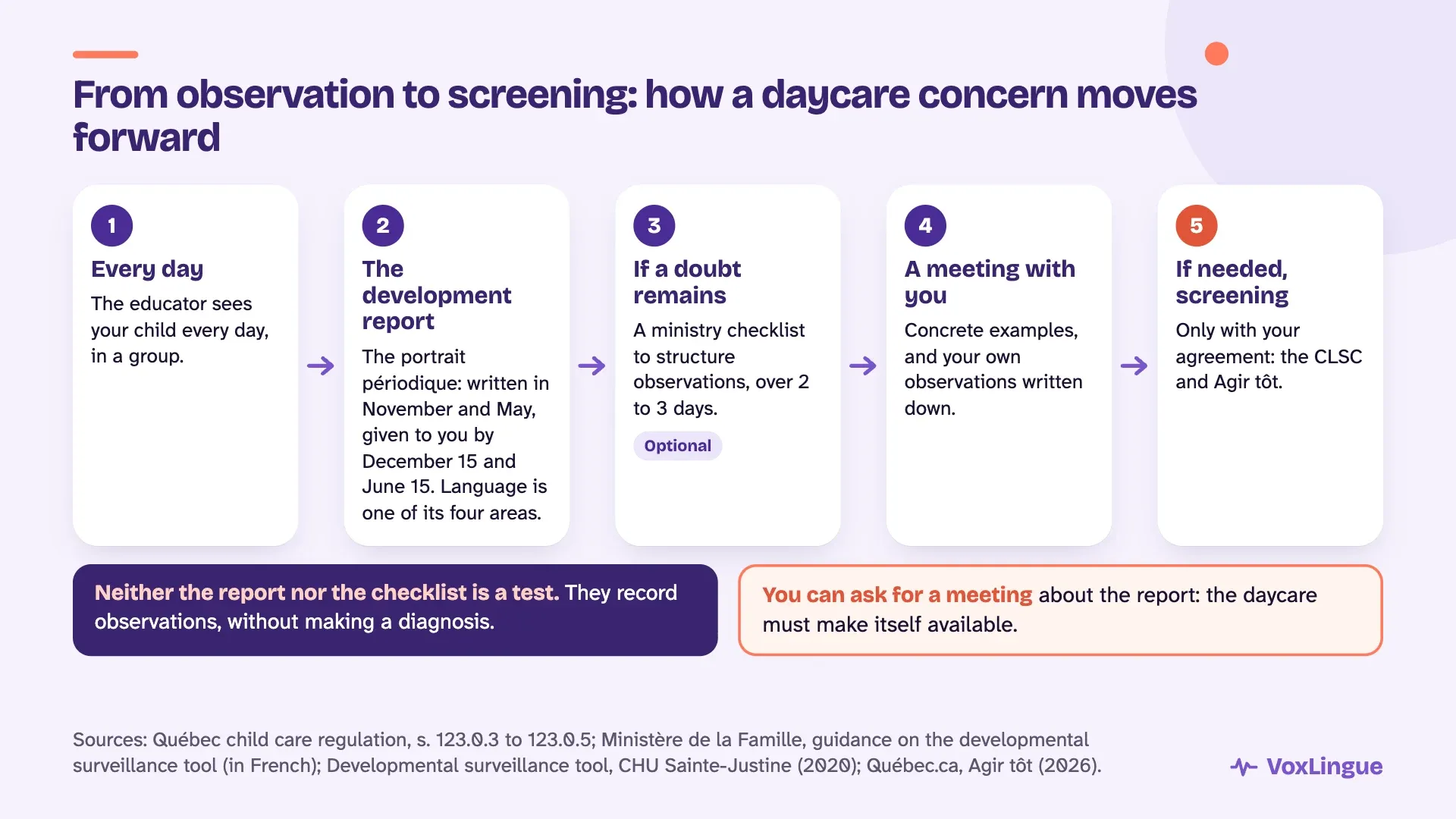
Every recognized daycare in Québec keeps an educational file for each child. The educator writes a portrait of your child’s development in November and May, which you receive by December 15 and June 15. Some daycares also use an optional ministry checklist when a doubt arises. Neither one is a test; the checklist can lead to screening.
These documents come from the educational program that every Québec daycare applies, called Accueillir la petite enfance. Language is one of its four developmental domains. According to Québec.ca (2026), the educational file aims, among other things, to support early detection of difficulties in line with Agir tôt, the province’s early screening program. Watching language is part of an educator’s normal job.
The development report (portrait périodique): what it contains and your rights
The portrait périodique describes where your child is in four domains. They are physical and motor, cognitive, language, and social and emotional development. It is a qualitative description, written in words, with no marks or scores. Your child’s educator writes it or, in a home daycare, the person who runs it (Educational Childcare Regulation, sections 123.0.3 and 123.0.4).
The educational file becomes mandatory for each child after 60 days. It holds very little: identification details, the portraits and, where relevant, documents about particular support. That might be a report from a public health-network professional or an integration plan (sections 123.0.1 and 123.0.3).
The regulation also explains the spirit of these portraits. Taken together, they should help spot a difficulty when, despite the educator’s efforts, a child makes little or no progress in a domain. A single portrait is a snapshot. Several portraits show a path over time.
You have the right to talk about it. If you ask for a meeting about the portrait, the daycare must make itself available within a reasonable time (section 123.0.5; ministère de la Famille, FAQ, 2023). Québec.ca explains the child’s educational file and its calendar (in French).
If French is not your strongest language, it is fine to ask for the meeting in English or to bring someone with you. Ask the educator to walk you through the language section and to give you examples behind each sentence.
The ministry’s developmental checklist: what it is for
The ministry also offers an optional tool: a developmental surveillance checklist. It covers children from 12 to 60 months. An educator may use it when a doubt arises, when difficulties persist despite her educational efforts, or simply to structure her observations. She then observes the child over two or three days (ministère de la Famille, Précisions, in French).
This checklist does not diagnose. It can lead to a recommendation for screening, a closer look by the public health network. The guide recommends screening in three situations (Cousineau and colleagues, 2020). The child has not yet reached two or more milestones expected for his age, shows a warning sign, or his parents are worried.
Your own concerns therefore count as much as the educator’s observations. The checklist includes a section for parents’ concerns, based on a parent questionnaire (PEDS, developed by Glascoe). The ministry asks the educator to fill it in with you. Its wording also matches the Agir tôt screening platform, which makes the step to the CLSC smoother.
One detail matters a great deal in Montréal. The checklist’s language milestones come from French-speaking children. The guide says a bilingual child should still reach them in one language or the other. If a milestone seems missed because of language, the educator is asked to use words in the language the child understands, or to check with you.
That means you can help directly. Tell the educator which words your child knows in English or in your home language, and ask whether the checklist was scored with them in mind. You can also ask whether the daycare used the checklist at all, and what it noted.
What should you ask the educator about your child’s speech?
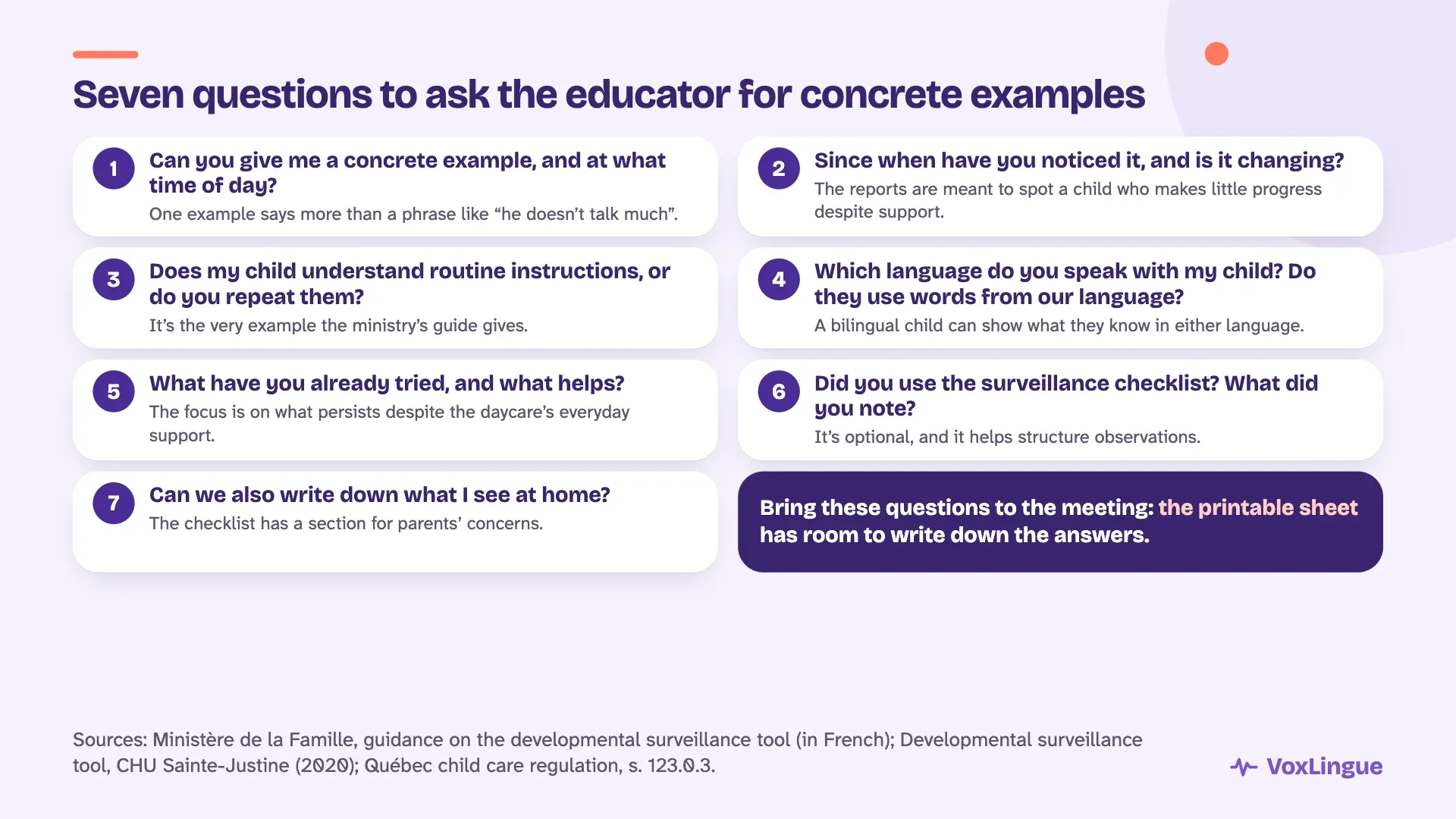
Ask for concrete examples. What does your child do when given an instruction? Who understands him when he talks? How does he play and ask for things, in which language, and since when? Ask what she has already tried. Examples like these help you, your doctor and a speech-language pathologist talk about the same child.
A sentence like “he doesn’t talk much” can mean many things. Your child may use few words, or many words that are hard to understand. He may not understand instructions, or understand them and not follow them. He may talk to adults but not to other children. Each version points in a different direction.
The ministry asks educators to work this way. Its guidance on meeting parents suggests they start by asking how you see your child. They should then give concrete examples, fill in the parents’ concerns section with you, and offer a second meeting if you would like more time (ministère de la Famille, Précisions, in French).
The document even gives a model of a useful observation. Translated, it reads: “When I give the instructions for the morning routine, I notice that your child needs me to repeat them…”. A sentence like that can be checked, compared with home and followed over time. That is the kind of example your questions are looking for.
Here are seven questions in that spirit, with what each one helps you understand.
| Question to ask the educator | Why it helps |
|---|---|
| Can you give me a recent example? | A specific moment says more than a general impression. |
| Since when have you noticed this? | A new difficulty and a long-standing one are read differently. |
| How does he follow routine instructions, like « mets ton manteau » (put your coat on)? Do you need to repeat or show him? | Understanding shows in everyday actions, even in a child who talks little. |
| Do other adults and children understand him when he talks? | Being understood by people who know him less well is a useful marker. |
| How does he ask for what he wants, and how does he play with others? | Gestures, eye contact and play show how he communicates, even with few words. |
| Which language does he use? Does he use words from home? | A child learning French may communicate in his home language or with gestures. |
| What have you tried, and what helps him? | What works at daycare can work at home too, and the other way round. |
Ask these questions with curiosity, not as a cross-examination. The educator has nothing to prove: she is sharing what she sees so your child gets the right support. If she cannot answer everything, that is normal. You can agree to watch for a few days and talk again.
Write down her answers: they will be useful at the CLSC, at the doctor’s office or at an assessment. The printable sheet at the end of this article lists the seven questions, with space for her examples, the language used and since when.
Tell her what you know as well. Your child may have started daycare recently, moved house, welcomed a new baby, or hear mostly English or another language at home. That information helps her read what she sees. The conversation goes both ways.
“He talks at home but not at daycare”: when you don’t see the same child
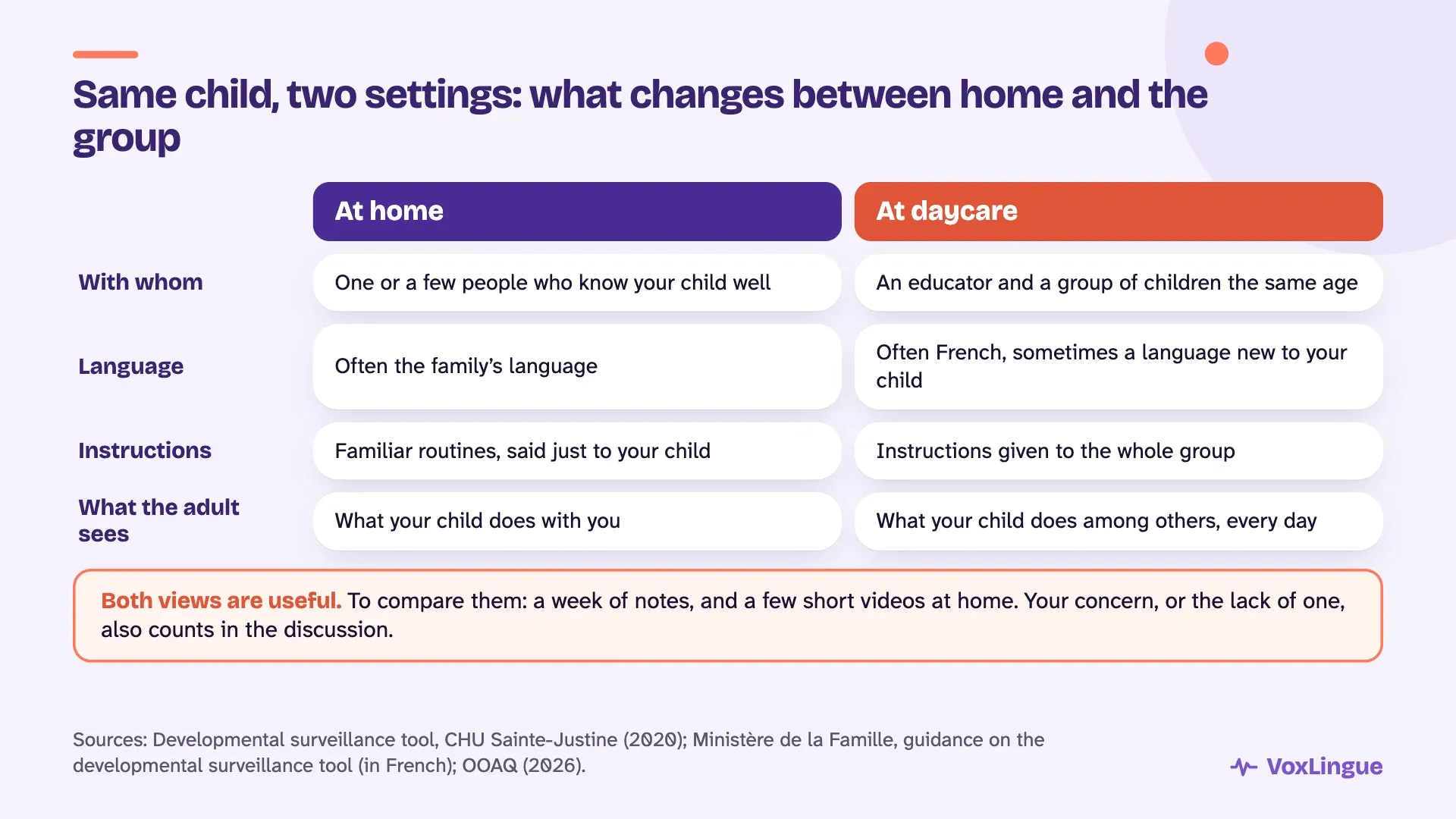
It is common for a child to communicate differently at home and in a group. At home, you know his words and routines. At daycare, he has to follow group instructions, often in French, among noisy friends. Both views are useful. Compare them with a week of notes and a few short videos.
At home, everything helps your child be understood. You know his made-up words, you can tell what he wants from his tone and gestures, and routines repeat. Often he doesn’t even need to speak: the glass of milk arrives before he asks for it.
At daycare, the conditions change. An instruction goes to the whole group at once, in a noisy room, often in a language he is still learning. Friends don’t decode his words. He has to wait his turn, insist, try again. These are exactly the moments when difficulty understanding or expressing himself can show.
So both pictures can be true at once. You are not wrong to find him chatty at dinner, and the educator is not wrong to find him quiet in the group. The useful question is not who is right. It is what changes from one setting to the other.
Your view is built into the process. The ministry asks the educator to start by asking how you see your child. The surveillance guide even treats a parent’s worry as a reason for screening on its own (Cousineau and colleagues, 2020). What you see at home is not a counterweight to her observation. It is the other half of the information.
To compare, one week of observation is a good start. Each day, note two or three moments: what he understood without help, what he said, to whom and in which language. Film one or two short everyday scenes, at breakfast, bath time or during play. Ask the educator to note two or three examples from the group on her side.
These notes are not about proving anyone right. They show whether your child understands better with gestures, talks mostly in his home language or avoids certain situations. One caution: some signs call for an assessment without waiting, even if things look fine at home. They are listed further down.
Your child is learning French at daycare: a new language, anxiety or language difficulties?
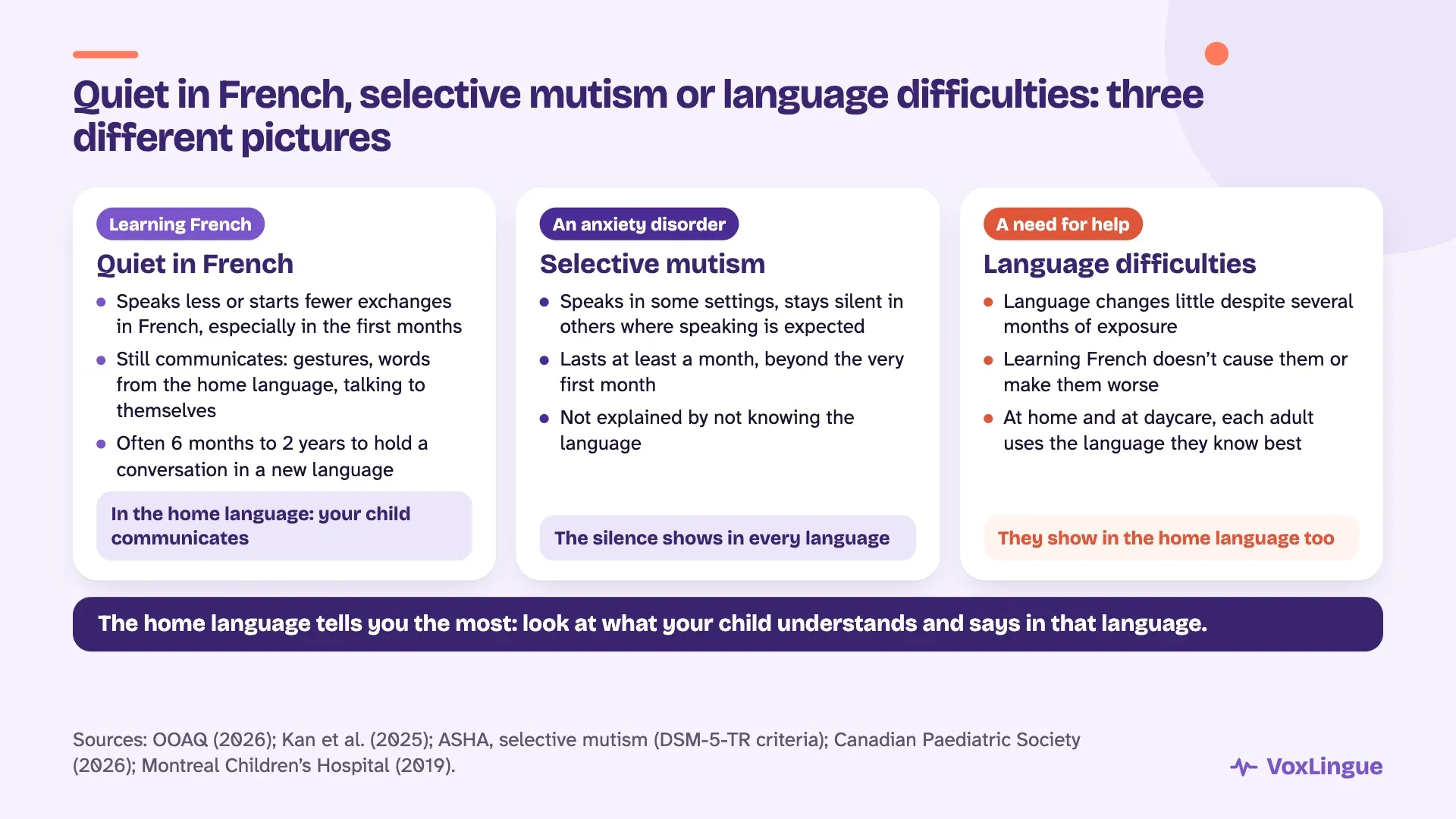
Your child’s home language is your best clue. A child learning French often says little in French in the first months, but still communicates with gestures and his home language. Selective mutism is an anxiety-based silence in some places, in every language. Language difficulties show in the home language too, whether that is English or another language.
In Montréal, many children hear English, Arabic, Spanish or another language at home and French at daycare. When the educator raises a concern, the question comes quickly: is it just French, or something else? Three situations look alike from a distance but are quite different up close.
First, a reassuring Québec study about daycare itself. It looked at more than 70,000 kindergarten children. Those whose first language was neither French nor English were less often vulnerable at school entry if they had attended child care (Collet and colleagues, JAMA Pediatrics, 2025).
One caveat before going further. Much of the research on these questions comes from the United States, about children learning English. The broad lines apply to French, but timelines can vary from one child and one setting to another.
| Quiet in French | Selective mutism | Language difficulties | |
|---|---|---|---|
| Where you notice it | Mostly in French, in the group | In some places, such as daycare, while he talks elsewhere | In all his settings |
| In the home language | He understands and expresses himself as he usually does | He talks freely with family, but stays silent where he is anxious, even in his home language | The difficulties show there too |
| How he communicates at daycare | Gestures, looks, home-language words, talking to himself in play | He may freeze or avoid speaking, even when he understands | He has trouble understanding or being understood, whatever the language |
| Over time | He understands more and more, then talks more | The silence lasts more than a month and goes beyond settling in | Language changes little despite several months of exposure to French |
Quiet in French is not the same as not communicating
In the first months of a new language, a child often speaks less. Québec’s Ordre des orthophonistes et audiologistes describes it this way: the child talks less or starts fewer exchanges (OOAQ, 2026). It often takes 6 months to 2 years to hold a conversation in a new language, and 5 to 7 years to master it for school.
You may have heard of a “silent period”. A 2025 scoping review of 40 studies adds nuance to that idea (Kan and colleagues, 2025). Its length varies enormously, from a few days to more than a year. An earlier review of 12 studies even found the evidence for a silent stage shared by all children very limited.
Above all, these children are not really silent. They communicate with gestures and eye contact, talk to themselves while playing, and use their home language (Kan and colleagues, 2025). Quiet in French is not the same as not communicating. A good question for the educator: how does he make himself understood when he isn’t speaking French?
What the educator can watch for is growing understanding. The child follows the routine by watching the others, brings the right object, laughs at the right moment during story time, then repeats a few words like « encore » or « à moi ». For age markers, see our guide to language milestones for bilingual children. You can also read the scoping review by Kan and colleagues on the silent period, which is open access.
Selective mutism or shy? An anxiety-based silence, in every language
Selective mutism is an anxiety disorder with specific clinical criteria, not a lack of vocabulary. Those criteria are what set it apart from ordinary shyness. The child talks in some settings, often at home, and stays silent where speaking is expected, such as daycare. According to the American Speech-Language-Hearing Association, it usually begins between ages 3 and 6 and is often noticed at school entry (ASHA).
The clinical criteria set two clear limits. The silence lasts at least a month and is not limited to the first month at school or daycare. And it is not explained by not knowing the language: in a bilingual child, it must show in all of his languages, as the ASHA guidance on selective mutism explains.
Selective mutism seems somewhat more common in children from immigrant or language-minority families. Yet these children risk both errors: their quiet in French is mistaken for mutism, or a real mutism is missed because everyone assumes it is the language (ASHA; Kan and colleagues, 2025).
A simple marker helps. A child learning French will often chat freely with you or a sibling in your home language, even at the daycare door. A child with selective mutism may freeze in front of the educator, whatever the language. For more, read understanding selective mutism.
Language difficulties show in the home language too
A language difficulty is not specific to French. In a child who learned a second language after the first, it also shows in the first language, says the Canadian Paediatric Society in its guidance on language acquisition in newcomer children (2026). That is why a speech-language pathologist always asks about the home language.
So ask yourself how he manages in your language. Does he understand what you ask without gestures? Do his sentences sound like those of children his age in your family or community? The OOAQ (2026) recommends consulting when language changes little despite sustained exposure over several months.
Share this with the educator too. Tell her what he understands and says at home, and give her a few key words in your language. In an English-speaking home, that may be “water”, “bathroom” or “more”; in a Spanish-speaking one, « agua » or « baño ». The ministry’s checklist expects exactly this: using words in the language the child understands.
Finally, keep your language. According to the Montreal Children’s Hospital speech-language pathology department, one language at home and another at daycare is a normal way to become bilingual (2019). Parents and educators should use the language they speak best. Learning a new language does not cause language difficulties and does not make them worse.
The same department adds that this holds even for children who already have language difficulties. For more on how professionals tell the two apart, see our article on a language difference or a disorder in bilingual children.
What are your options now? The CLSC or your doctor, a private assessment, or both
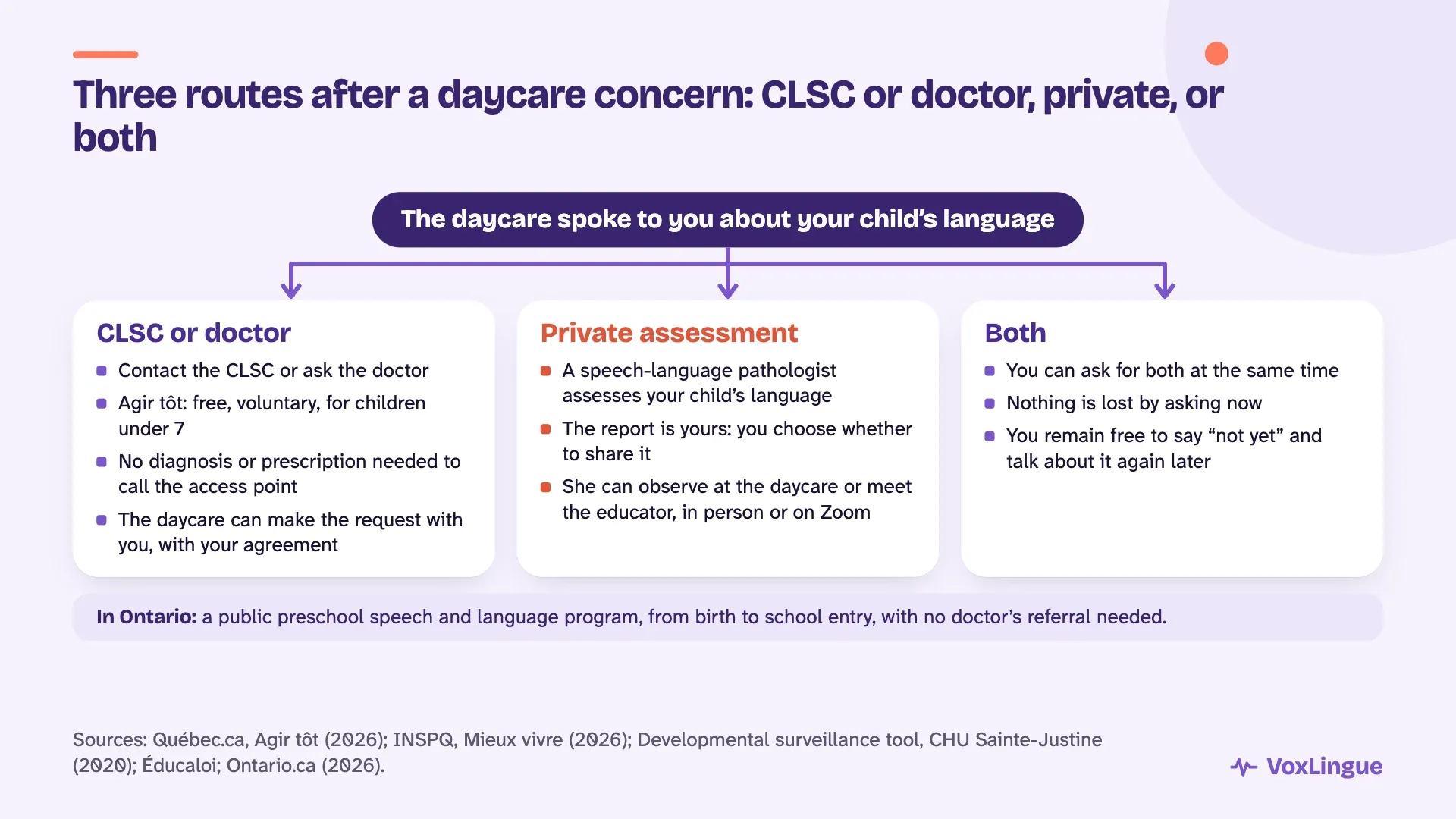
Several routes are open to you, and they can be combined. You can contact your CLSC or ask your doctor to reach Agir tôt, a free program that does not require a diagnosis. You can also request a private speech and language assessment, or do both. The daycare can contact the CLSC for your child, but only with your agreement.
Asking now commits you to nothing: Agir tôt is voluntary, and an assessment only starts if you consent. In Ontario the system is different; it is covered at the end of this section.
The CLSC and Agir tôt, starting from the daycare’s concern
Agir tôt is Québec’s public early screening program for young children. It is free and voluntary. To start, contact your CLSC (local community health centre) or ask your doctor. A doctor or another professional can refer your child, but only with your permission (Québec.ca, 2026).
You don’t need a doctor’s note. According to Québec’s public health institute (INSPQ, 2026), you can call your CLSC’s access desk at any time, with no medical opinion or prescription. Québec.ca describes the Agir tôt program and how to access it in English.
The daycare can also help. The surveillance guide says the daycare may, with your agreement, act as a facilitator and refer your child to the CLSC (Cousineau and colleagues, 2020). You can also go yourself and bring the checklist. Daycare staff who know your child may then take part in assessing his needs.
For the call, gather the latest portrait périodique, the checklist if one was completed, the educator’s examples and your week of notes. Say which languages your child hears and speaks, and how long he has been at daycare. You can pass these documents on yourself. If you prefer to speak English, say so when you call.
A private speech and language assessment
An assessment answers a specific question. Does your child have language difficulties, which ones, and what can help? The speech-language pathologist asks about his history and each of his languages. She observes his play, his understanding and how he expresses himself. She then explains what she found, and whether support is needed.
The assessment can take the daycare’s view into account. It may include an observation at daycare or a conversation with the educator, with your consent. The report belongs to you, and you decide who receives it. Our article on what happens at a speech therapy assessment walks through the steps, and you can request an assessment whenever you are ready.
Both at once, and the wait
Several steps can run at the same time. You can make the CLSC request and see a private clinician while you wait. Let the person handling your file at the CLSC know, and ask how a private report can be used: each establishment has its own way of working. Our guide to the public waiting list and what to do meanwhile covers this in detail.
In Ontario: preschool speech and language self-referral
In Ontario, the route is different. The Preschool Speech and Language Program serves children from birth until they start school. You do not need a doctor’s referral; parents can contact their local program directly, as the Ontario government’s program page explains (2026).
Ontario’s rules on how child care centres share information are not covered here. Ask your child care centre how it shares information about your child before anything leaves it. Families in Ontario can also work with us online: see telepractice for Ontario families.
Your rights: your consent, your child’s file and what can be shared
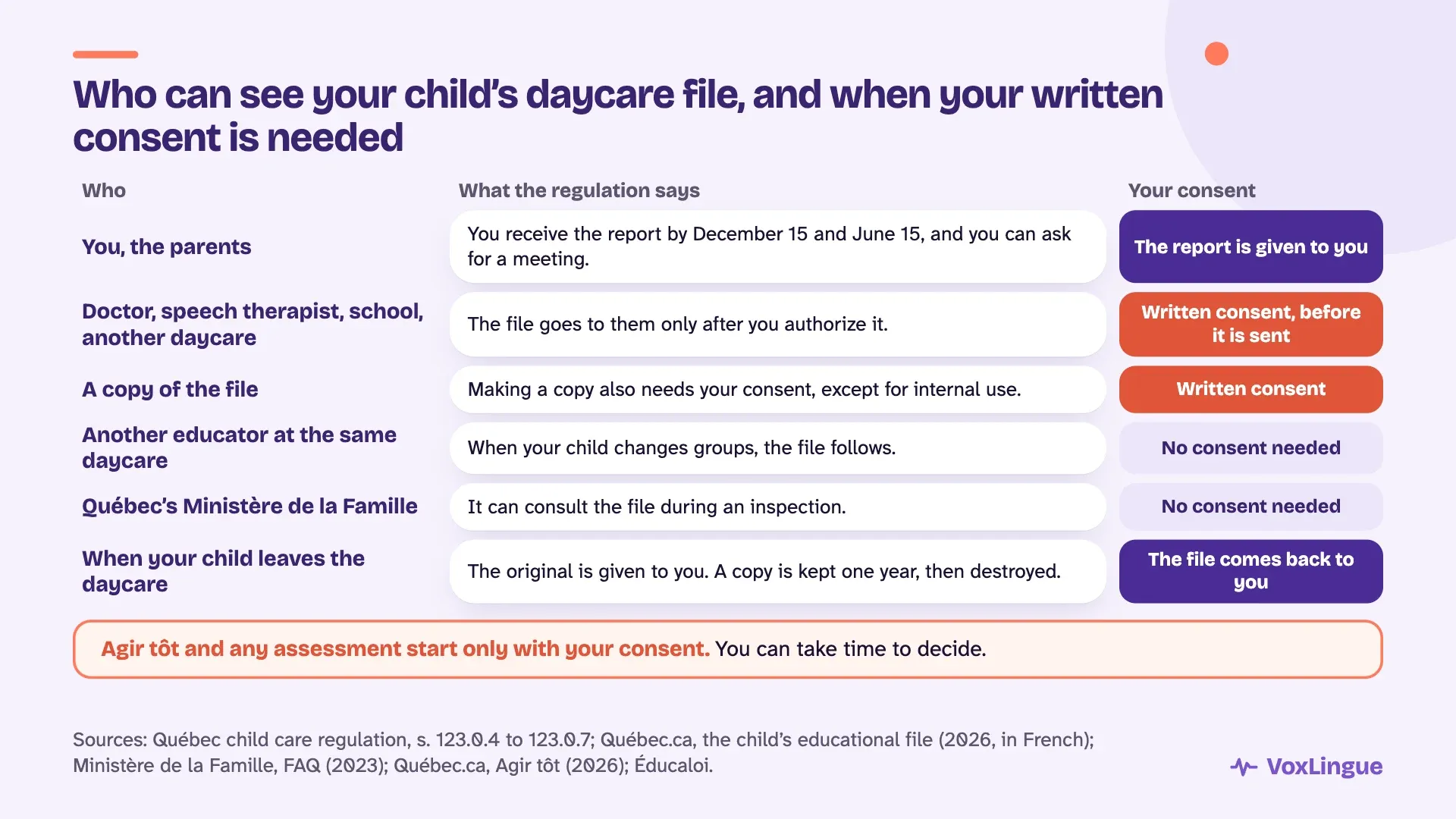
Your child’s file does not leave a Québec daycare without your written consent. That applies to a doctor, a speech-language pathologist, the CLSC or the school. Agir tôt and any assessment start only with your consent. You can ask for a meeting, take time to think, or say “not now” and come back to it later.
The rule is in the regulation. Before passing the educational file to a third party, the daycare must have the parent’s written authorization (Educational Childcare Regulation, section 123.0.7). Québec.ca (2026) adds that the file is passed on by the parent or with the parent’s written agreement, and that this applies to every transfer.
There are only two exceptions: your child moving to another group with the same provider, and a ministry inspection. Copying the file for anyone else also requires your written authorization. When your child leaves the daycare, you receive the original file. The daycare keeps a copy for one year, then destroys it (sections 123.0.4 and 123.0.6).
| Situation | Is your consent needed? |
|---|---|
| Your child changes groups with the same provider | No |
| Inspection by the ministère de la Famille | No |
| Sending the file to a doctor, a speech-language pathologist or the CLSC | Yes, in writing |
| Sending the file to the school or another daycare | Yes, in writing |
| A copy of the file for someone outside the daycare | Yes, in writing |
| The daycare contacting the CLSC or Agir tôt about your child | Yes |
These rules apply to recognized Québec daycares: CPEs, garderies and recognized home daycares. If the daycare sets up an intervention plan (plan d’intervention), it is built with you. Your authorization is also needed before information goes to other professionals (Naître et grandir, 2021, in French).
For care, the principle is simple. For a child under 14 in Québec, parents consent to care, in the child’s interest. No assessment or service starts without your consent. Éducaloi explains medical decisions for children under 14 in plain language.
Taking time is part of your rights too. The ministry expects educators to offer a second meeting if you need it (ministère de la Famille, Précisions, in French), and the CLSC access desk stays open at all times.
If you are unsure, just say so to the educator. For example: “I need to think about it. Could you keep noting what you see, and we’ll talk again in a month?” A sentence like that keeps the conversation open and lets everyone do their part.
In the meantime: what to do this week, at home and with daycare
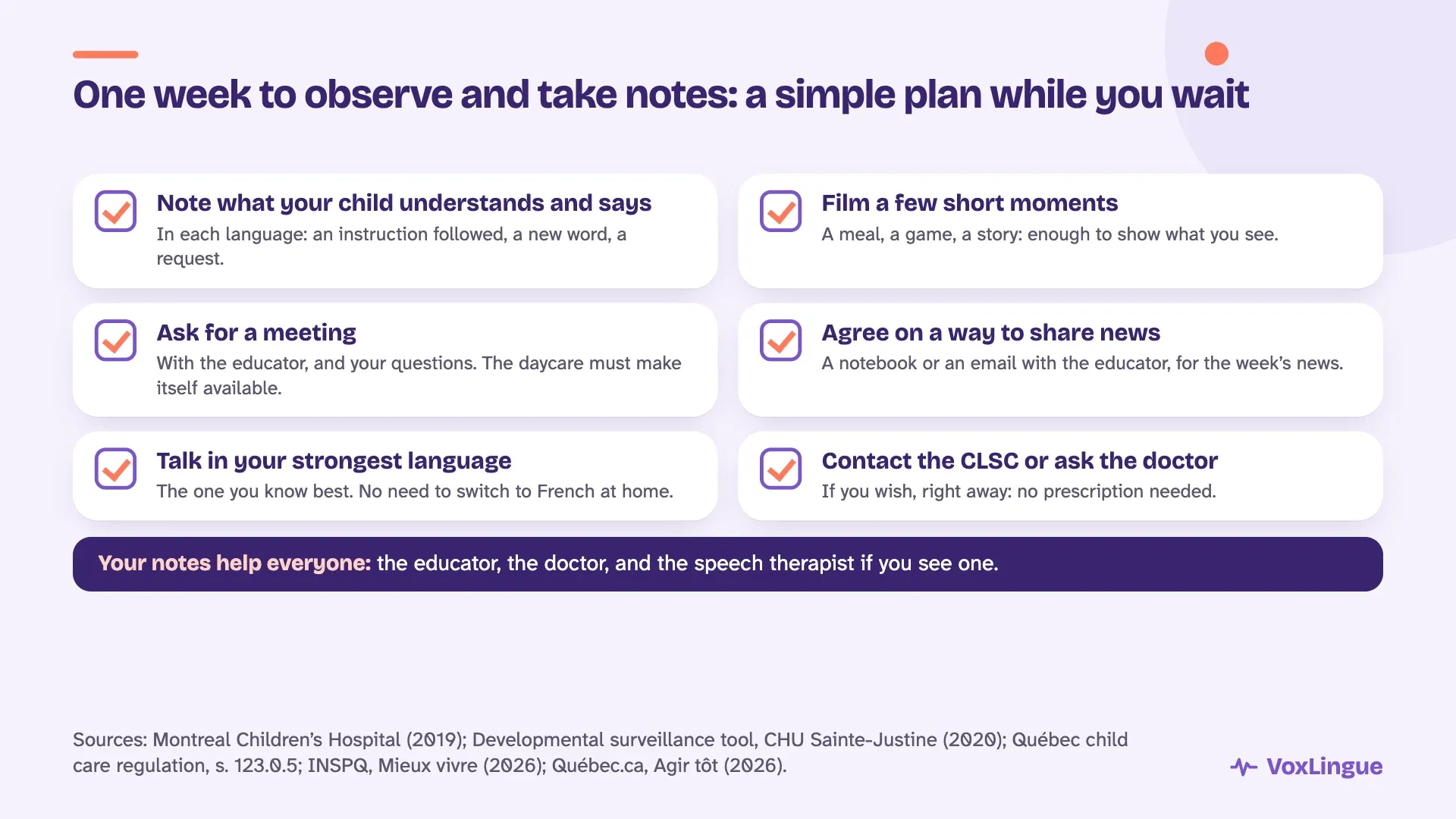
Start this week with a few simple steps. Ask your doctor whether your child’s hearing should be checked. Note what your child understands and says in each of his languages. Agree with the educator on one easy way to share news. And keep talking with your child in the language you speak best.
You don’t need to wait for the CLSC to act. Here is a realistic plan for the coming weeks:
- ask your doctor whether a hearing check makes sense, a usual step when language is in question;
- keep a notebook for one week: what he understood, what he said, to whom and in which language;
- film one or two short everyday scenes, at dinner or during play;
- choose a way to stay in touch with the educator, such as a notebook in his bag or a quick word at Friday pickup;
- give her a short list of important words in your home language;
- talk, read and sing with your child in your strongest language.
Keep these moments enjoyable. During routines and play, give your child time to respond, follow what interests him, and name what he is looking at. Repeat what he says and add a word: if he says “car”, you might answer “yes, the red car”. These small adjustments fit into everyday life.
What to avoid matters too. There is no need to drill lists of words or turn dinner into a lesson. Don’t switch your home language to French: the Montreal Children’s Hospital speech-language pathology department recommends using the language you speak best (2019). And don’t wait for kindergarten “to see” if your questions persist.
If you speak English at home and your child attends a French daycare, you may feel you cannot help with the French. You don’t need to. Your role is to keep his home language rich, through stories, songs and talking about your day. The daycare brings the French.
After the assessment: can a speech therapist work with the daycare?
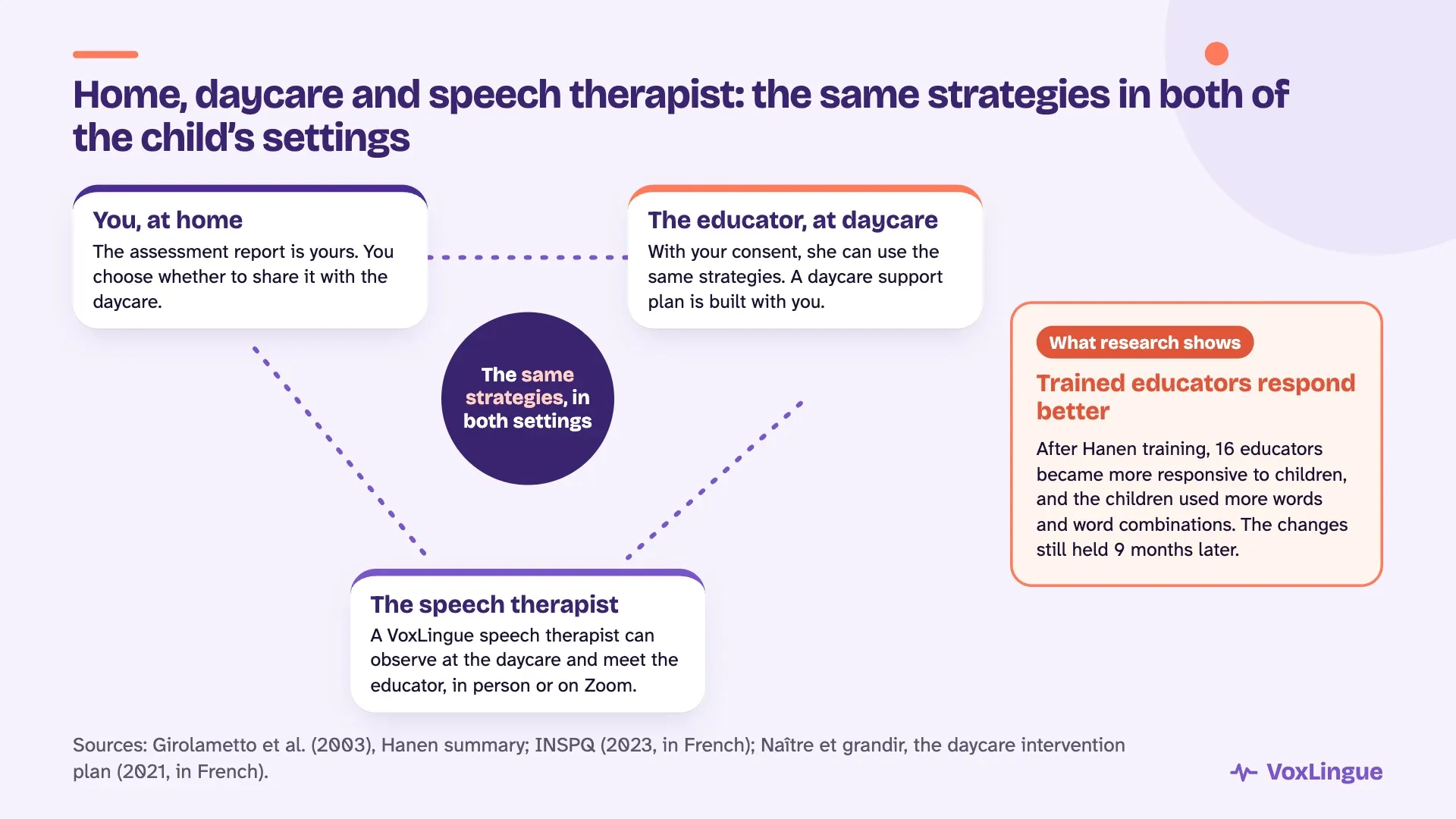
Yes, and the report is yours to share or not. If you share it, the educator can use the same strategies as you. A speech-language pathologist can also observe your child at daycare or meet the educator, often by video. Your child then finds the same kind of support at home and in the group.
You can share the full report, a summary or just the recommendations. You decide what is passed on, and to whom.
At VoxLingue, our speech-language pathologists observe children at daycare and meet educators, in person or, most often, on Zoom. A short video meeting means the educator does not have to leave her group for long. These conversations help fit the strategies to the real rhythm of the daycare day.
Several strategies that help in a group are simple. Waiting a few seconds before answering for the child. Pairing an instruction with a gesture or a picture. Repeating what he says and adding a word. These are known as responsive strategies, at the heart of Hanen programs for parents and for educators.
Research supports this work with educators. In a Canadian study, 16 educators were randomly assigned by child care centre (Girolametto and colleagues, 2003). Those trained in the Hanen program Learning Language and Loving It became more responsive. Children in their groups produced more utterances and more word combinations, and the changes held 9 months later.
You can read the Hanen Centre’s summary of that study. The INSPQ (2023) also lists training and feedback for educators among the documented ways to support language in child care. For parents, our page on parent coaching and Hanen programs describes how these strategies are learned at home.
If your child needs more support at daycare, an intervention plan can be set up with you. Our guide to the public waiting list also explains Québec’s integration allowance for daycares and the role of a special educator.
And the move to kindergarten?
The move to school can be prepared with the daycare too. According to Québec.ca (2026), the daycare may encourage you to give the educational file to the school, send it itself with your written authorization, or use an adapted model. Ask the daycare how it prepares the transition. Our guide to getting your child’s language ready for kindergarten explains what comes next.
When to consult without waiting
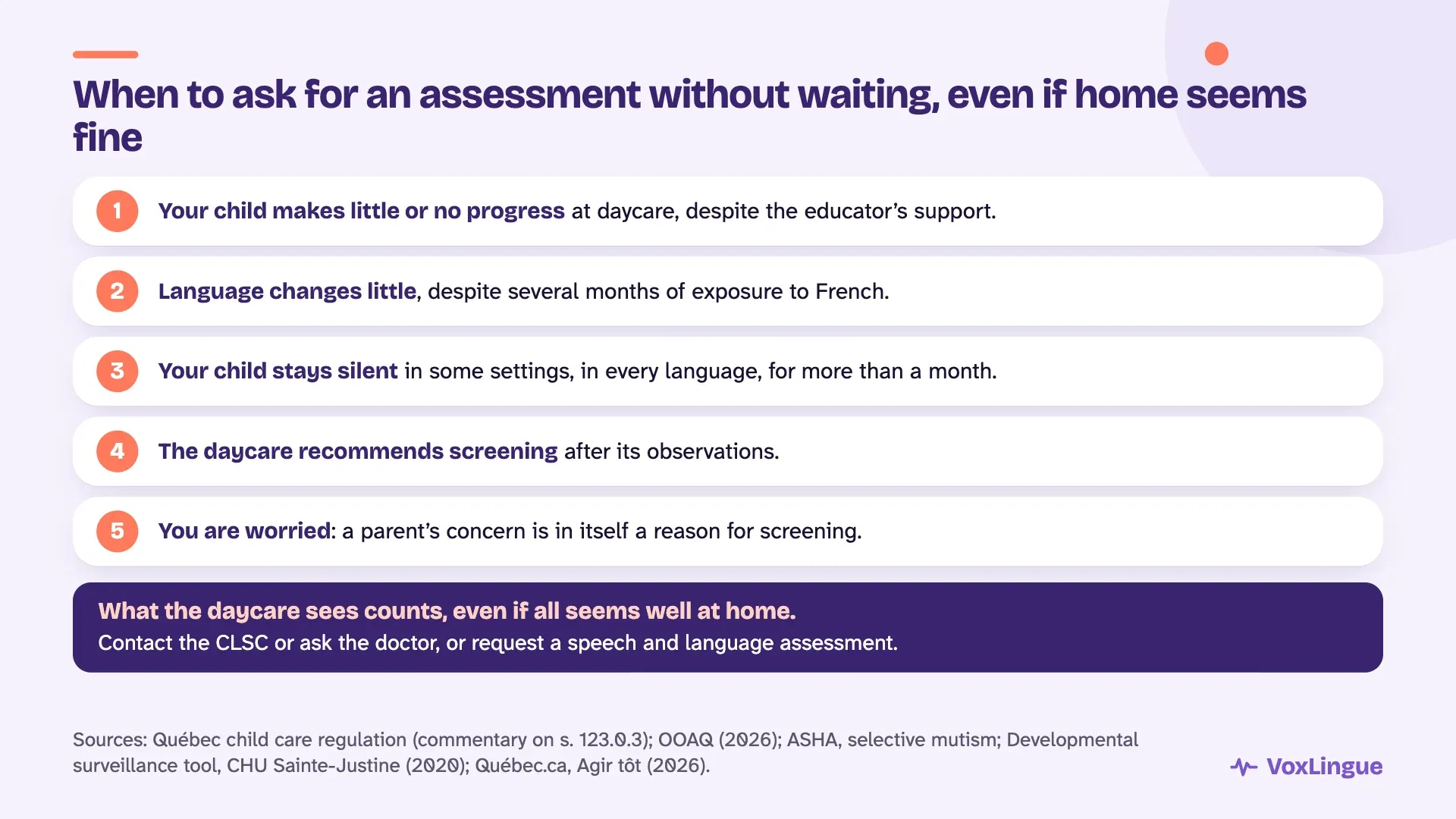
Some signs call for an assessment without waiting, even if home seems fine. That is the case if your child understands little in any of his languages, is hard to understand, has lost words or skills, or has made little progress over several months. Your own worry is also a good enough reason.
In these situations, contact your CLSC or ask your doctor, and consider a private assessment at the same time:
- he understands little of simple routine instructions, in your language as in French;
- people who don’t know him well find him hard to understand;
- he has lost words or skills he used to have;
- his language changes little despite several months of steady exposure to French (OOAQ, 2026);
- you have doubts about his hearing;
- you are worried, even if you cannot say exactly why.
The last point is not a small one. The ministry’s surveillance guide makes a parent’s worry a reason for screening on its own (Cousineau and colleagues, 2020).
If your questions also involve play, eye contact or how your child connects with others, our article on what professionals look at beyond words can help you prepare for the appointment.
Key takeaways
When daycare is concerned about your child’s speech or language, a few ideas help you keep your bearings:
- the educator’s observation is valuable information, not a diagnosis, and its purpose is a closer look;
- concrete examples, in French and in your home language, are worth more than a general impression;
- for a child learning French, the home language is the most useful clue;
- you can contact your CLSC or ask your doctor, request a private assessment, or do both;
- your child’s file does not leave a Québec daycare without your written consent, and nothing starts without your agreement.
Next step
Print the sheet below and bring it to your next conversation with the educator. It will help you note her examples and plan what comes next. If you would like an assessment, our speech-language pathologists can observe your child at daycare or meet the educator, at our Montréal clinic or by telepractice anywhere in Québec and Ontario.
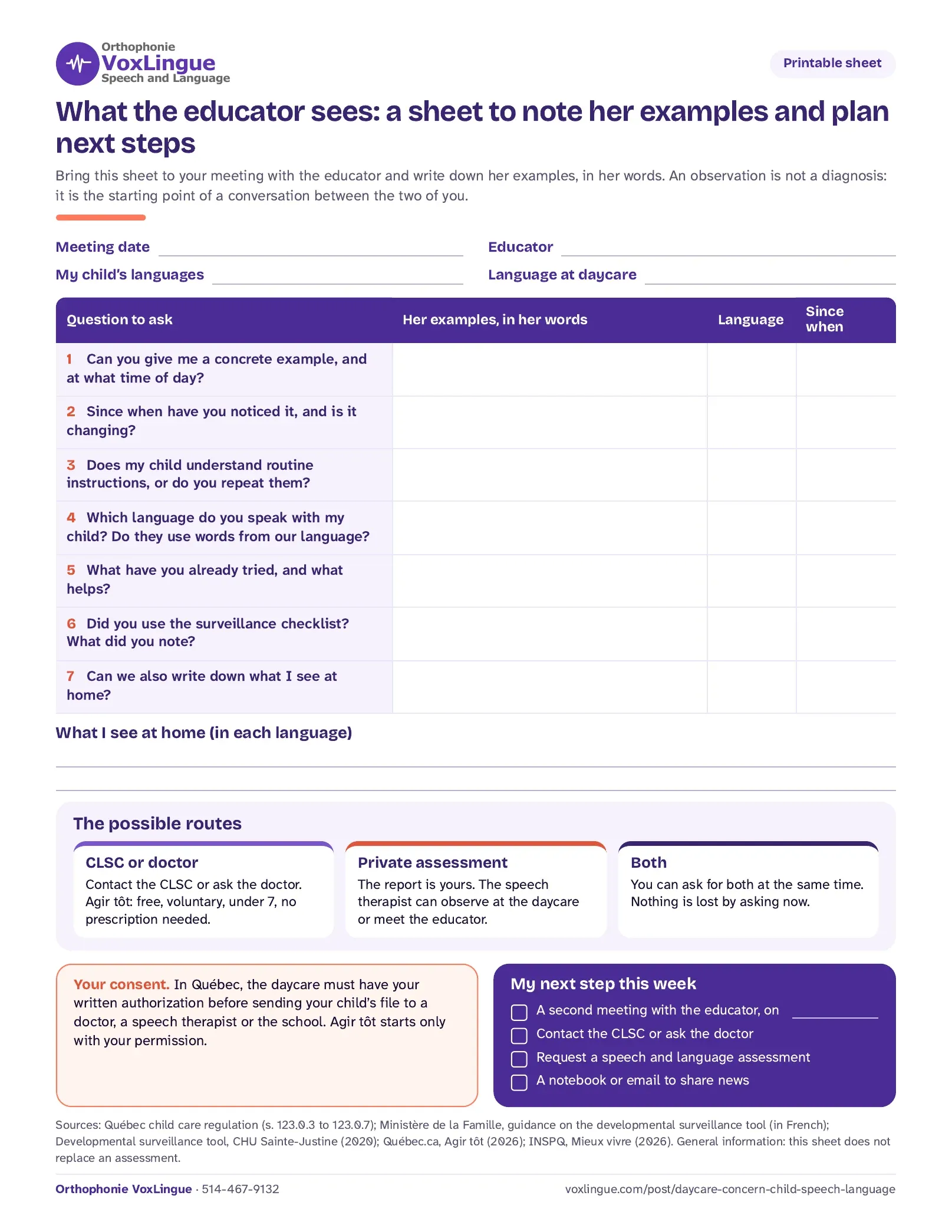
Printable sheet: What the educator sees: a sheet to note her examples and plan next steps (PDF, 1 page).
Frequently asked questions
Can a daycare educator diagnose a speech delay or a language disorder?
No. Québec’s ministère de la Famille asks educators to avoid diagnostic terms such as DLD, autism or ADHD. Those words come only after a thorough assessment by a professional, such as a speech-language pathologist. The educator can describe what she observes and suggest screening. That is already a lot: her examples will help whoever sees your child next.
Can I refuse what the daycare suggests?
Yes. Agir tôt is voluntary, and no assessment or service starts without your consent. You can ask for time, a second meeting, or more examples before deciding. Saying “not now” closes no doors: according to the INSPQ (2026), you can call your CLSC’s access desk at any time, whenever you are ready.
Can the daycare refer my child to the CLSC without me?
No. The surveillance guide says the daycare may refer your child to the CLSC only with your agreement (Cousineau and colleagues, 2020). For Agir tôt, a professional can refer your child only with your permission (Québec.ca, 2026). With your agreement, daycare staff who know your child can then take part in assessing his needs.
Do I need a doctor’s referral for Agir tôt?
No. You can call your CLSC’s access desk yourself, with no medical opinion or prescription (INSPQ, 2026). You can also ask your doctor, who can refer your child with your permission. Both routes lead to the same program. Choose whichever is simpler for your family. In Ontario, the Preschool Speech and Language Program also accepts parents directly.
Will the daycare’s portrait follow my child to school?
Only if you want it to. The daycare must have your written authorization before passing the educational file to the school (section 123.0.7). It may also encourage you to hand it over yourself. When your child leaves the daycare, you receive the original file, and the copy it keeps is destroyed after one year.
Should we speak French at home to help?
It isn’t necessary. The Montreal Children’s Hospital speech-language pathology department (2019) recommends that each adult use the language they speak best. One language at home and French at daycare is a normal way to become bilingual. Learning French does not cause language difficulties and does not make them worse.
Can a speech therapist observe my child at daycare?
Yes, with your consent and the daycare’s agreement. An observation shows your child in his group, where the educator noticed something. At VoxLingue, our speech-language pathologists observe children at daycare and meet educators, in person or, most often, on Zoom. These conversations help everyone agree on shared strategies.
My child is in a home daycare: is it the same?
Yes, if the home daycare is recognized by a coordinating office (bureau coordonnateur). The educational file rules apply to recognized daycares, and the person who runs the home daycare writes the portrait. In a non-recognized home daycare, ask how observations are recorded and who they are shared with. The CLSC remains open to you either way.
What if the educator and I don’t see the same child?
That is common, and both views can be right. Your child does not face the same situations at home and in a group. Note what you see for a week, ask for her examples, and compare. If the doubt remains, an assessment can take both settings into account, by listening to you and observing your child.