Does screen time cause speech delay? What the research really says
Your toddler still says only a few words, and one question keeps coming back: is it because of screens? It is often one of the first things parents ask a speech-language pathologist. The next question follows quickly: do we have to remove everything, or can we keep a little to get dinner made?
Screens are part of family life. The headlines, meanwhile, contradict each other: some call screens a “plague”, others promise apps that teach toddlers to talk. In Québec, the order of speech-language pathologists and audiologists (OOAQ) reminds parents that real-time human interaction is essential for language, and that screen use is a shared responsibility (2025).
This guide sorts it out, without judgment. It explains whether screen time causes speech delay according to research, what matters more than the number of minutes, what to do in real life, and when to consult, whatever your screen habits. For general milestones, our section on early language and late talkers is a good companion to this guide.
Does screen time really cause speech delay?
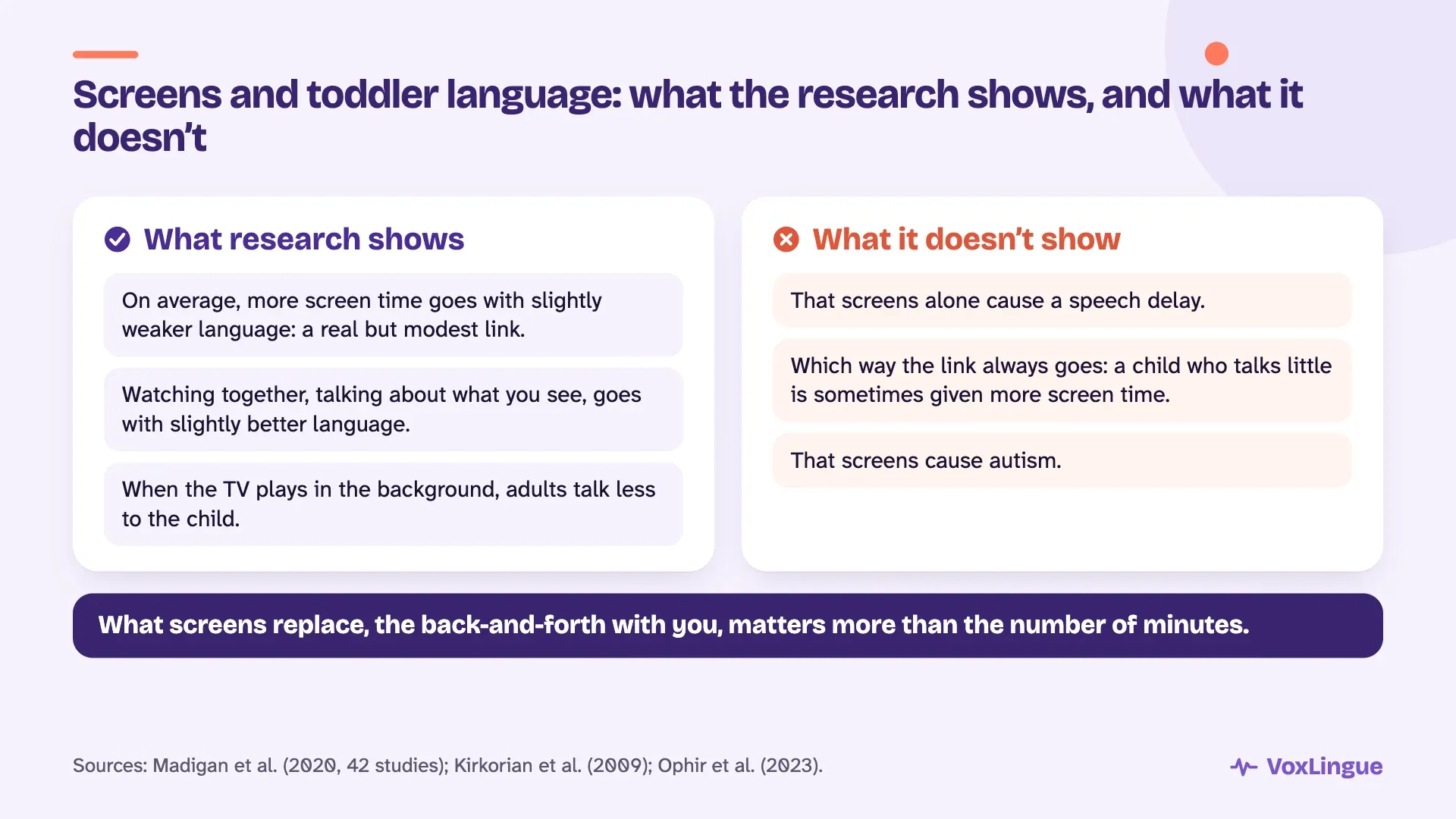
Research shows a real but modest link, and mostly associations. On average, more screen time goes with slightly weaker language, while watching together goes with slightly better language. No study proves that screens, on their own, cause a speech delay.
Pooled research gives the best overall view. In 2020, a Canadian team combined forty-two studies involving nearly nineteen thousand children (Madigan and colleagues). More screen time went with slightly weaker language. In contrast, watching with an adult and choosing educational shows went with slightly better language. In both cases, the links were small.
The next question is which way the link runs. In Calgary, a study followed about two and a half thousand children (Madigan and colleagues, 2019). More screen time at ages 2 and 3 came before slightly lower scores on a developmental questionnaire, one or two years later. The reverse was not observed. That questionnaire measures overall development, not only language.
In Québec, the Québec Longitudinal Study of Child Development points the same way. More TV at 29 months was linked to weaker receptive vocabulary (the words a child understands) at kindergarten entry (Pagani and colleagues, 2013).
In Japan, a large study found that the more screen time children had at age 1, the more often they had communication delays at age 2 (Takahashi and colleagues, 2023). The gap was largest above four hours a day.
These studies share one limit, though. None of them randomly assigned children to more or less screen time. A child who already talks little, or an exhausted family, may also turn to screens more often.
Kimberly Martins, speech-language pathologist and founder of VoxLingue, sums up what the research allows us to say. In her words, screens are not a cause of any disorder. But they can make underlying difficulties worse, because they take time out of the day. That is time the child could have spent interacting with others, or just playing alone and building their play skills.
So the real question becomes: what is the screen replacing?
What screens replace: back-and-forth conversation
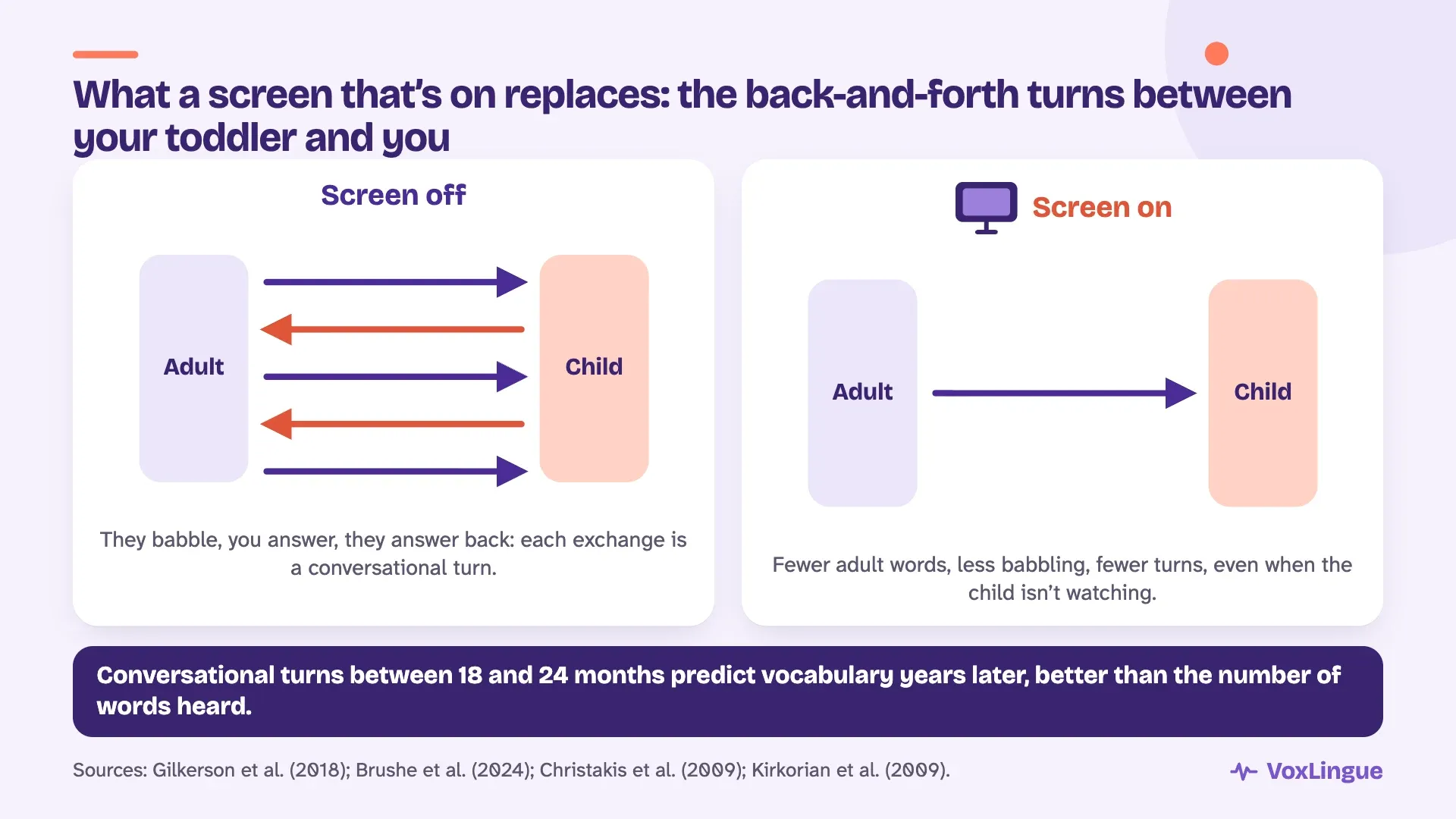
Language grows through back-and-forth exchanges with people. When a screen is on, adults talk less and children vocalize less. And conversational turns between 18 and 24 months predict language years later. Background TV and our own phones count too, even when the child isn’t watching.
A conversational turn is a small round trip: your child makes a sound, you answer, and they answer back. An American study recorded full days with toddlers, then saw the children again about ten years later (Gilkerson and colleagues, 2018). Conversational turns between 18 and 24 months predicted their vocabulary, better than the number of words they heard.
Other recordings show what happens when a screen is on. In Australia, toddlers wore a small recorder for whole days, from 12 to 36 months (Brushe and colleagues, 2024). Each extra minute of screen time went with fewer adult words, fewer child sounds and fewer conversational turns. The gap was largest at age 3.
Background TV
A TV left on in the background counts, even when your child isn’t watching it. “But they’re not even watching it” is a sentence our speech-language pathologists hear often. They explain that the TV is still a distraction in the room, for the child and for the parent.
Studies point the same way. In a lab experiment, parents talked less to their toddler, and less richly, when an adult show was playing in the background (Kirkorian and colleagues, 2009). In another study, each hour of audible TV went with several hundred fewer adult words heard by the child (Christakis and colleagues, 2009).
In the 2020 pooled research, background TV showed one of the clearest links with weaker language, though across only five studies. It is also common in Québec. According to the Institut de la statistique du Québec (2025), about one toddler in four at 2 and a half lives in a family where the TV is often or always on, even when no one is watching.
What about our own phones?
Our own screens matter too. In a small study, mothers taught their 2-year-old two new words (Reed and colleagues, 2017). When a phone call interrupted the teaching, the child didn’t learn the word, even though they had heard it just as often. The OOAQ calls this technoference: a screen that interrupts, even briefly, the exchange between parent and child.
No guilt here: everyone checks their phone. The idea is to protect a few face-to-face moments each day, like bath time or the bedtime story.
Not all screen time is the same
A video call where grandma answers has nothing in common with a show watched alone or a TV left on all day. What helps is a screen that brings people together and gets them talking. What gets in the way is a screen that takes the place of conversation, with no one talking about it.
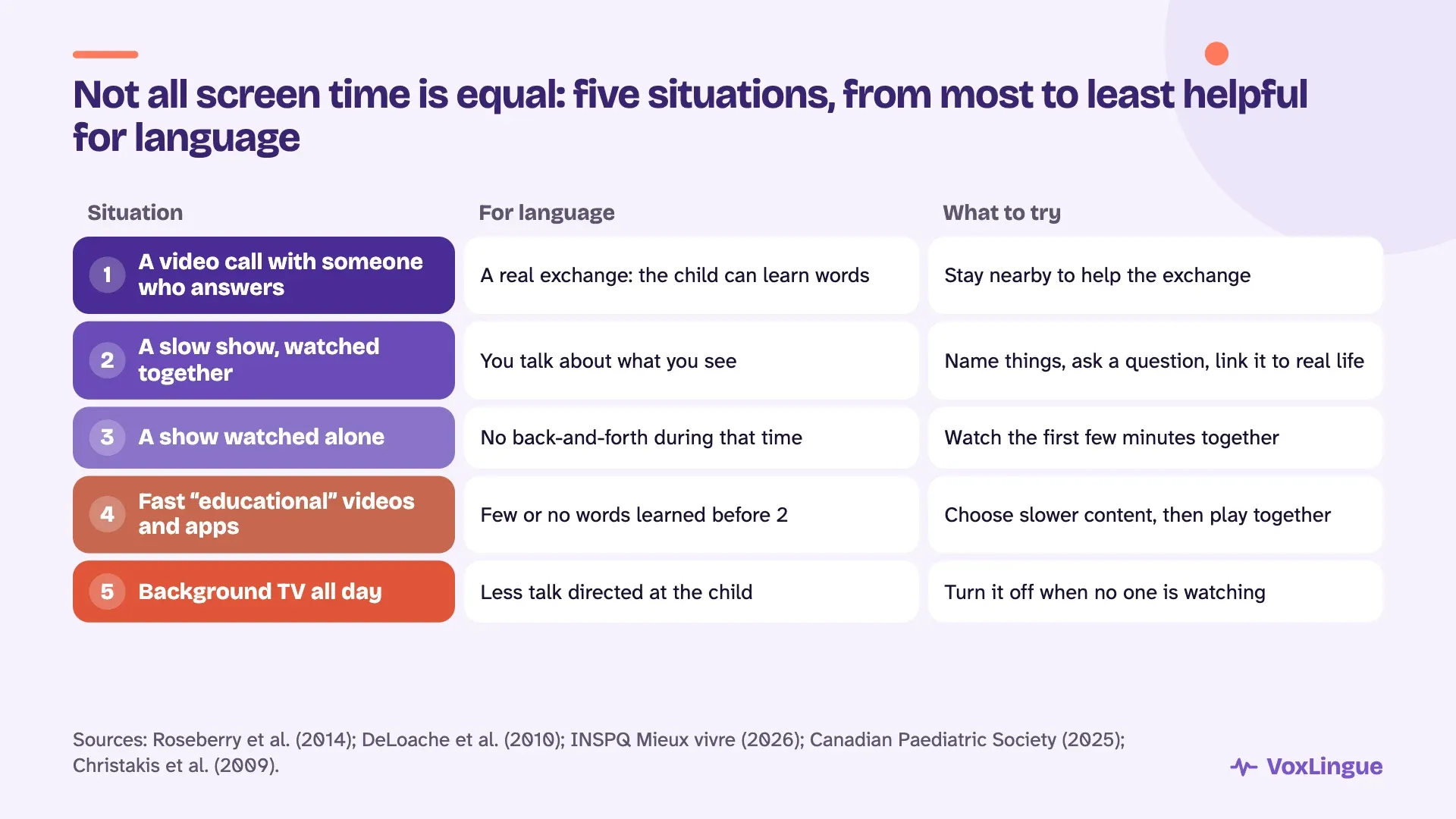
The table below ranks common situations, from the most helpful to the least helpful for language.
| Situation | What happens for language | What to try |
|---|---|---|
| A video call with a loved one who answers | A real exchange: a child can learn words, because the person responds to them | Stay next to your child to help them follow the conversation |
| A slow-paced show, watched together | The parent names what you see and asks questions: the show becomes a conversation | Name things, ask a question, connect it to real life |
| A show watched alone | No back-and-forth during that time | Watch the first few minutes together, then talk about it afterwards |
| Fast “educational” videos and apps | Little or no word learning before age 2 | Choose slower content, then play together afterwards |
| Background TV all day | Less talk directed at the child, even if they aren’t watching | Turn it off when no one is watching |
“Educational” apps and videos
The word “educational” on an app or video doesn’t guarantee that a child learns. In one study, babies aged 12 to 18 months watched a vocabulary DVD several times a week for a month (DeLoache and colleagues, 2010). They learned no more words than a group that hadn’t seen it. They learned the most when their parents taught them the same words in everyday life.
In Québec, the INSPQ’s parenting guide From Tiny Tot to Toddler (2026) states that apps and videos labelled “educational”, despite their name, don’t help children under 2 develop. After age 2, the Canadian Paediatric Society advises choosing educational, age-appropriate programs and watching them with your child. The two pieces of advice fit together: they target different ages.
Do video calls count?
For our speech-language pathologists, a video call isn’t screen time like any other. Your child is interacting with a real person, through a screen, much like a phone call. The Canadian Paediatric Society makes video calls the exception to its guidance for children under 2.
Research explains why. Toddlers learned new words from a live video call, but not from a recorded video of the same person (Roseberry and colleagues, 2014; Myers and colleagues, 2017). The difference: the person on screen responds to them. In Québec, about one child in six at 17 months uses a screen every day to talk with family (ISQ, 2024).
To make the call a real exchange, the From Tiny Tot to Toddler guide advises that an adult help the child during the conversation. You can repeat what grandma says, show the object she is talking about, or invite your child to wave bye-bye.
When the screen is their only interest
Our speech-language pathologists always start from a child’s interests. But when the tablet is the only thing a child wants, things get tricky. They then help parents start from that interest and turn it into a moment of connection, rather than passive viewing.
In practice, you can watch a short clip together and pause to name what you see. You can sing their favourite song with them, then sing it again without the screen, with the actions. Or bring their favourite character into play, with real toys.
How much screen time is recommended by age?
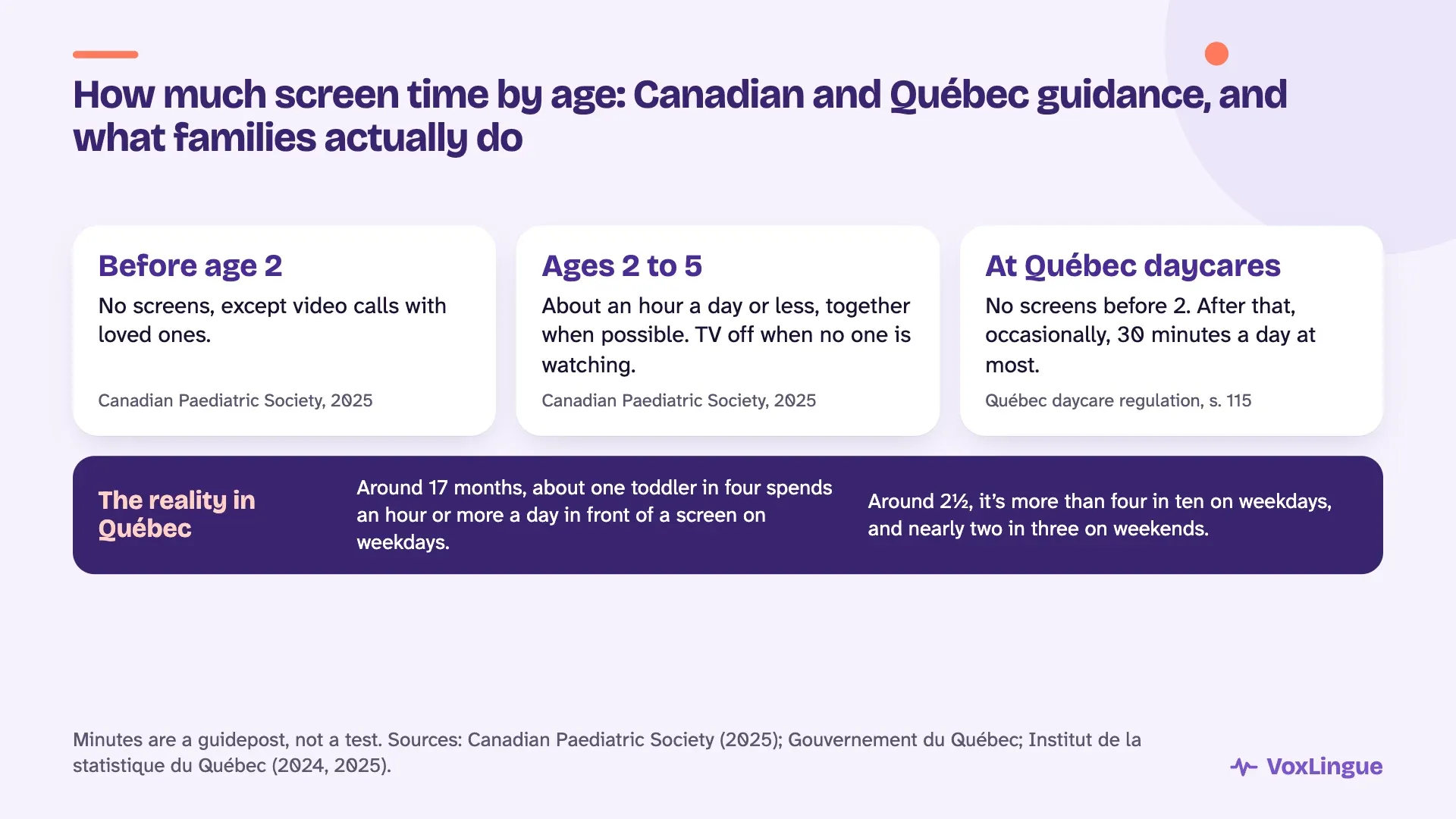
In Canada, the Canadian Paediatric Society advises against screens before age 2, except video calls with loved ones. From 2 to 5, it recommends about an hour a day or less, watched together when possible, with background TV turned off. Québec’s daycare rule points the same way.
The Canadian Paediatric Society updated its parent advice on screen use and young children in March 2025. For children under 2, screen use is not recommended, except video chatting with caring adults, such as extended family. For children 2 to 5, it recommends limiting routine or sedentary screen use to about an hour or less per day. The Québec government makes the same recommendations, and the CPS guidance applies across Canada, Ontario included.
Many web pages still quote a Canadian Paediatric Society position statement published in 2017. It has been retired from the society’s website: the 2025 handout, with similar limits, is the current reference.
And at daycare?
In Québec, the rule for daycares is written into regulation. Section 115 of the Regulation respecting educational childcare services bans screens for children under 2. After age 2, a screen is allowed only if it is part of the educational program, used occasionally, and for no more than 30 minutes in a single day.
What Québec families actually do
Many families go beyond these benchmarks. According to the Institut de la statistique du Québec, around 17 months, about one toddler in four spends an hour or more a day in front of a screen on weekdays (2024). It is about one in three on weekends. Around 2 and a half, it is more than four in ten on weekdays, and nearly two thirds on weekends (2025).
These numbers aren’t here to judge: they show you are far from alone. Minutes remain a benchmark, not a test. What happens during and around the screen matters more: who watches with your child, what they watch, and what the screen replaces.
Bilingual families: can a child learn a language from videos?
Videos don’t replace people for learning a language. Babies learned the sounds of a new language from a person in the room, but not from the same person on video. Keep speaking your language at home, and think of video calls with family abroad as real conversations.
An American study showed this clearly (Kuhl and colleagues, 2003). Nine-month-old babies heard Mandarin during about a dozen short sessions. Those who heard it from a person in the room learned to tell apart sounds of that language. Those who saw the same person on video, or heard them on audio, showed no measurable effect. It is a single study, about sounds rather than words.
In bilingual toddlers, how they watch seems to matter more than how long. A Canadian study compared toddlers who were English-only, French-only and bilingual in English and French (Hudon and colleagues, 2013). The amount of TV wasn’t linked to vocabulary. But adult TV, background TV, watching alone and an early start went with weaker vocabulary, especially in English for bilingual children.
We found no study showing that videos in the home language are enough for a toddler to learn that language. According to our speech-language pathologists, a video still has value if the parent watches it with the child and turns it into a moment of exchange.
Above all, keep speaking your language at home: your child learns it by hearing you speak it. Video calls with grandparents abroad are precious. They are real conversations, with someone who answers.
5 p.m., dinner and the tablet: realistic solutions
You don’t need zero screens to help your child talk. Small changes count: turn off background TV, watch the first few minutes together, choose slower shows and plan a screen-free activity for the hardest moments. And if you need a break, that isn’t a failure.
Dinner time is often the hardest moment of the day. Everyone is tired, the meal has to get made, and the tablet solves the problem in two seconds. Many parents do this: in Québec, about one in five say they often use a screen to keep their child busy while they do something else (ISQ, 2024).
Kimberly Martins, speech-language pathologist and founder of VoxLingue, starts by looking at the family’s day. She then suggests things the child can do while the parent cooks. She watches whether the child manages to play alone, or prefers to sit near the parent in the high chair, with an activity or a book. “Of course it all depends on the child’s age and their needs,” she says.
A few ideas for that moment:
- a basket of toys kept for dinner time, brought out only at that hour;
- containers, wooden spoons and foods to touch, in the high chair next to you;
- a board book or lift-the-flap book within reach, instead of a screen;
- music or audio stories, which leave room for conversation;
- a small “big kid” job: washing vegetables, tossing the salad, setting out napkins.
Meanwhile, talk about what you’re doing. “I’m cutting the carrot. Crunch! Another carrot.” These little sentences count, even when your child doesn’t answer with words yet.
And if, some evenings, you need a break, that isn’t a failure. Kimberly never shames parents for it. Instead, she explains which kinds of content to choose. On the TV, or on a tablet with parental controls, the parent stays in control of what the child sees. That is different from a child left alone to scroll through YouTube.
When you watch a show together, name what you see and ask a question: “Where’s the dog? He’s running!” Parent coaching programs, such as the Hanen program It Takes Two to Talk, show parents how to build more of these exchanges into everyday life.
When you change your habits: what to expect
When a family cuts back on screens, interaction often increases. Kimberly sees it: there is more interaction between the child and their parents, and more chances for the child to try to communicate.
The first few days can be hard, though. A child who loses something they enjoy may have more tantrums. That’s normal. Stay calm near them, name what they’re feeling and offer the new activity. Specialists call this co-regulation: your calm helps them find theirs. Over time, things usually get better.
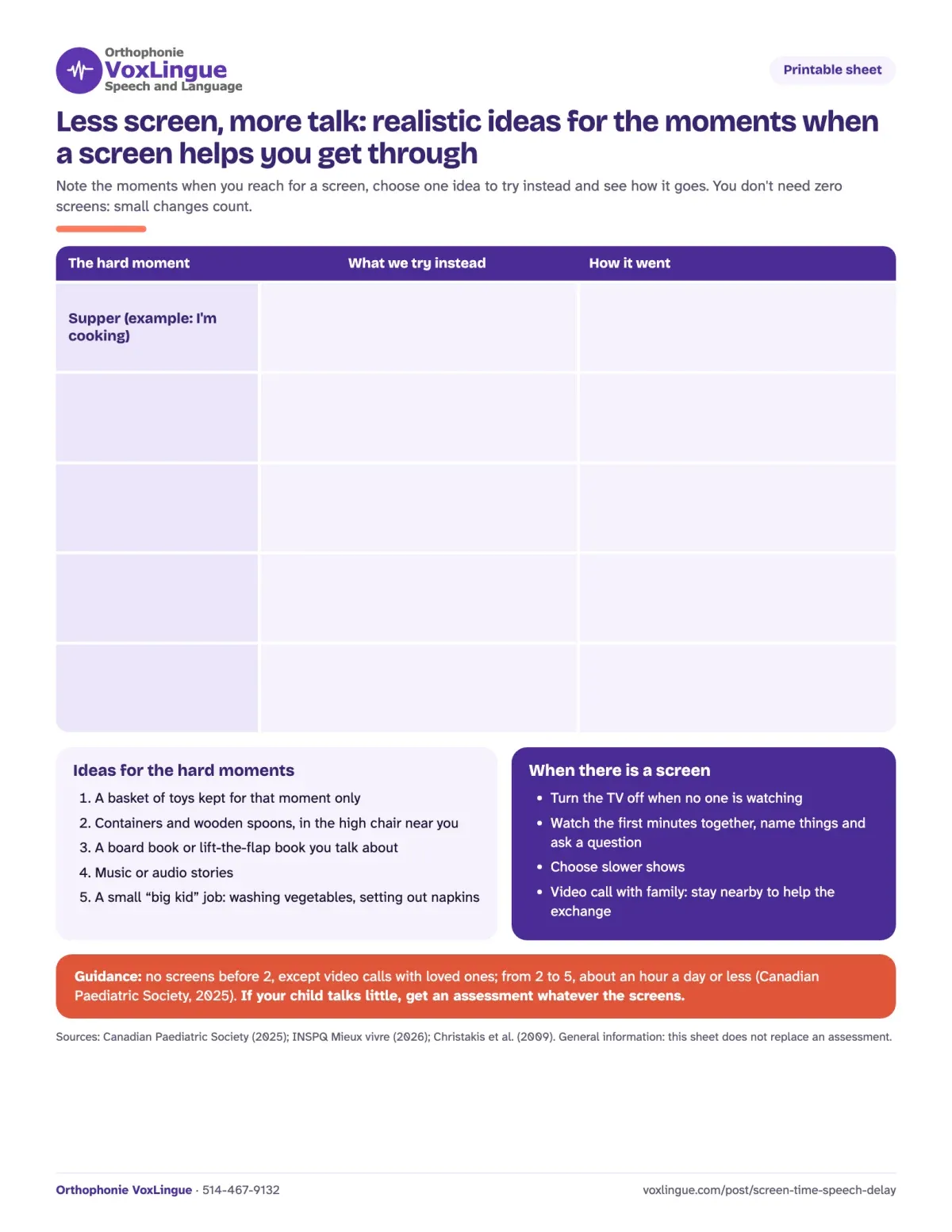
Printable sheet: Less screen, more talk: realistic ideas for the moments when a screen helps you get through (PDF, 1 page).
Can screens cause autism?
No, research doesn’t show that screens cause autism. A 2023 review concluded that the link isn’t sufficiently supported. Some children in whom signs of autism were later noticed were already spending more time in front of screens. If autism worries you, look at communication beyond words.
That review pooled forty-six studies and more than half a million participants (Ophir and colleagues, 2023). Once publication bias was corrected, the link between screens and autism was no longer significant.
The authors don’t rule out the reverse explanation: autistic children may turn to screens more to avoid social situations that are harder for them. A small study points that way. Children in whom signs of autism or ADHD were later noted already had more screen time at 18 months (Hill and colleagues, 2024). The link may run both ways.
You may come across the term “virtual autism” online. It isn’t a recognized diagnosis, and no controlled study supports it. As our speech-language pathologists remind parents, screens are not the cause of a disorder.
If autism is on your mind, our article Speech delay or autism? explains what professionals look at beyond words: pointing, shared attention and imitation.
My child talks little: should we cut screens or get an assessment?
Both can happen at the same time, but don’t wait for a “screen detox” to fix everything. Cutting back on screens improves your child’s environment; it is neither a test nor a treatment. If your child talks little for their age, doesn’t point or share, or has lost words, consult.
During an assessment, our speech-language pathologists always ask about screen habits. They want to understand a typical day for your child, to tailor their recommendations and guide you through the next steps. Screens are part of the picture, but they never explain it on their own.
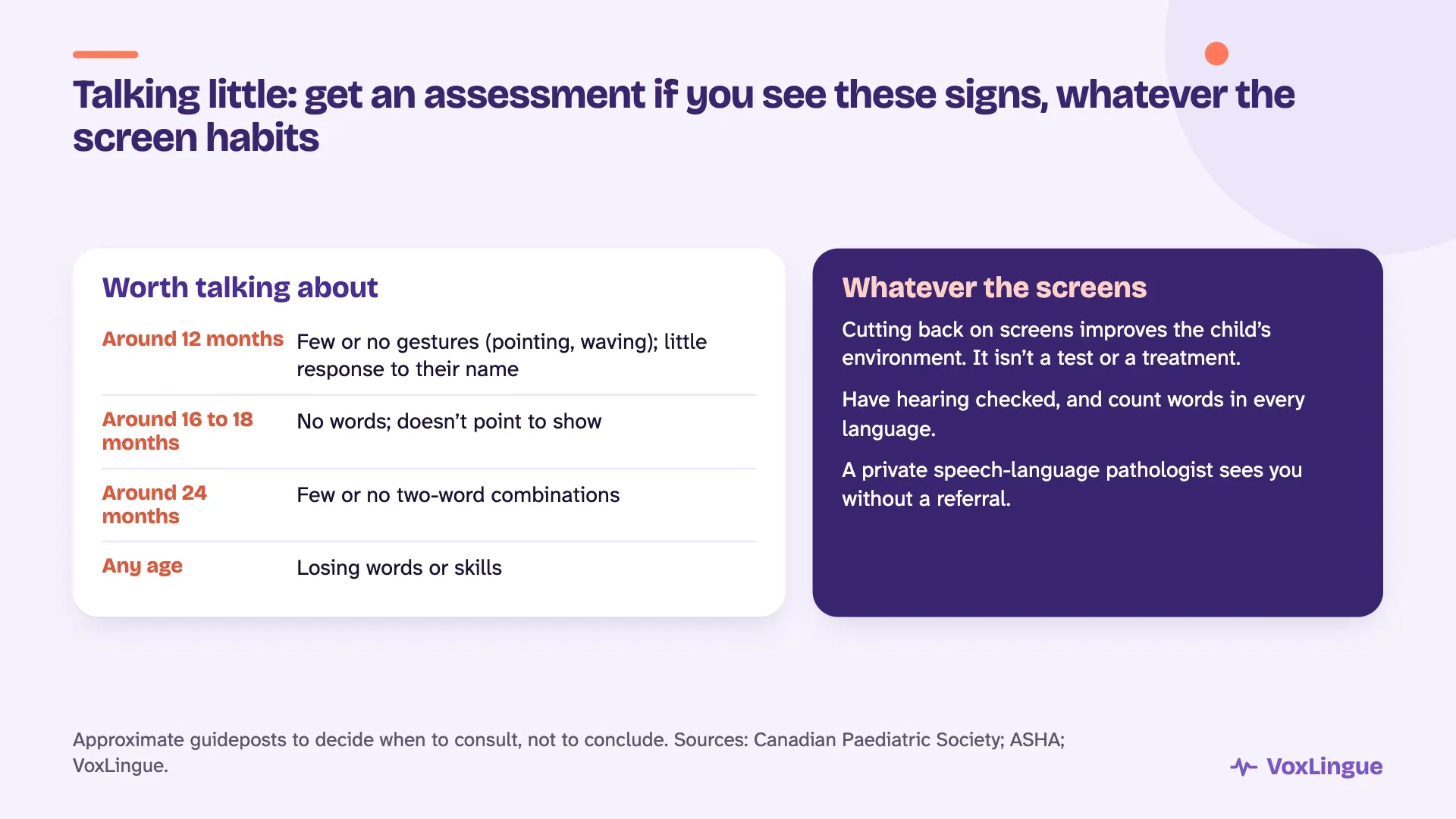
Some signs are worth raising with your doctor or a speech-language pathologist, whatever the screen habits:
| Around what age (approximate) | Worth talking about |
|---|---|
| Around 12 months | Few or no gestures (pointing, waving); little response to their name |
| Around 16 to 18 months | No words; doesn’t point to show you things |
| Around 24 months | Few or no two-word combinations (“more milk”, “daddy gone”) |
| At any age | A loss of words or skills |
These signs help you decide when to consult, not to reach a conclusion. They come mostly from studies of English-speaking children. For a bilingual child, count words across all of their languages. And have their hearing checked: a child who doesn’t hear well can seem distracted or uninterested in talking.
In Québec, you can raise your concerns with your doctor or your CLSC. In Ontario, the Preschool Speech and Language Program serves children from birth until they start school, with no doctor’s referral needed. In both provinces, you can also see a private speech-language pathologist without a referral.
Our page on language delays and disorders explains what a speech-language pathologist assesses, and our page on speech and language assessment describes how it works.
What about a communication tablet?
A communication tablet isn’t screen time. In augmentative and alternative communication (AAC), the tablet is how the child communicates: it is their voice. It should never be taken away, even when you cut back on other screens. AAC doesn’t delay speech: it gives a child a way to be understood while their words develop.
Key takeaways
Screens don’t, on their own, cause a speech delay: the link exists, but it is modest. What gets a child talking isn’t the absence of screens: it’s their exchanges with you. You don’t need to aim for perfection. Turning off background TV, watching together and planning an activity for the hard moments already make a difference.
What gets a child talking isn’t the absence of screens: it’s their exchanges with you.
Next step
Print the “Less screen, more talk” sheet and pick just one moment of the day to change this week. If your child talks little for their age, don’t wait to see what a screen break does: a speech and language assessment can clarify things. Our speech-language pathologists see families in Montréal and online, in English and French.
This article is general information. It doesn’t replace an assessment by a professional.
Frequently asked questions
If I stop screens, will my child start talking?
Cutting back on screens often increases conversation at home, and that’s a good thing. But it isn’t a treatment, and no one can predict the effect on a particular child. If your child talks little for their age, consult without waiting to see what a screen break does. You can do both at the same time.
Do video calls count as screen time?
Not like other screens. During a video call, your child interacts with a real person who responds to them, much like a phone call. The Canadian Paediatric Society makes video calls the exception to its guidance for children under 2. Stay close to your child during the call to help them follow the conversation.
Are nursery rhyme videos on YouTube okay?
They are more useful when you sing along with your child. Do the actions together, pause the video to repeat a verse, then sing the same rhyme without the screen, in the bath or in the car. Avoid autoplay from one video to the next. Before age 2, the Canadian Paediatric Society doesn’t recommend screens, except video calls.
Watching together or handing over the tablet to keep them busy: what’s the difference?
A big one. In pooled research, watching with an adult went with slightly better language, while more screen time went with slightly weaker language. When you watch together, you name things, ask questions and connect what you see to real life. The screen then becomes a starting point for conversation.
My child repeats lines from their shows: is that a problem?
Not necessarily. Repeating phrases they’ve heard, called echolalia, is one way some children learn language, autistic or not. If your child mostly speaks in ready-made phrases and rarely uses their own words, talk to a speech-language pathologist.
Are screens allowed at daycare?
In Québec, the regulation on educational childcare services bans screens for children under 2. After age 2, a screen is allowed only if it is part of the educational program, used occasionally, and for no more than 30 minutes in a single day. Wherever you live, you can ask your child care provider how they handle screens.
What about the American (AAP) guidance?
Much of what you read online comes from the United States, and American guidance has changed over the years, so older numbers still circulate. For families in Canada, including Québec and Ontario, the reference is the Canadian Paediatric Society’s March 2025 guidance: no screens before 2 except video calls with loved ones, and about an hour a day or less from 2 to 5.
Do educational apps help toddlers talk?
Not before age 2. Québec’s From Tiny Tot to Toddler guide states that apps and videos labelled “educational”, despite their name, don’t help children under 2 develop. In one study, babies learned no more words from a vocabulary DVD. They learned the most from their parents, in everyday life.
Can my child learn French from videos?
Not from videos alone. A child learns a language from the people who speak it with them, in exchanges where someone answers. For French, daycare, friends, activities and books read aloud give your child real conversations. And at home, keep speaking the language you know best.
Is it my fault that my child talks little?
No. No study shows that screens, on their own, cause a speech delay, and children talk little for many reasons. Screens are part of life in almost every family. What matters is what you do from today: more back-and-forth conversation, and an assessment if you’re worried.
Is a communication tablet screen time?
No. A tablet used for augmentative and alternative communication (AAC) is how your child communicates: it is their voice. It is never taken away, even when you cut back on other screens. It doesn’t delay speech. It gives your child a way to be understood while their words develop.
At what age can a child start using screens?
According to the Canadian Paediatric Society, screens are not recommended before age 2, except video calls with loved ones. From 2 to 5, it recommends about an hour a day or less, ideally watched together. The same society notes there is no evidence that starting early helps: toddlers learn mostly from people.