Baby feeding milestones, 0 to 12 months: how your baby's mouth learns to eat

Baby feeding milestones are easy to find online, but they rarely explain what is actually happening in your baby’s mouth. Then comes the first gag on a slightly thicker spoonful, and the parent holding their breath. And the question that keeps coming back: am I moving too fast, or not fast enough?
Eating is learned. Like walking, it happens in steps, over several months. Your baby’s mouth moves from sucking to munching, then to chewing, and each step calls for a different texture and a different way of drinking.
This guide follows those steps from birth to 12 months. You will see what your baby’s mouth is doing at each age, which textures and cups fit that stage, what is normal, such as gagging and mess, and which signs are worth a professional opinion.
The guidance comes from Health Canada and the Canadian Paediatric Society, with Québec’s family guide, Mieux vivre avec notre enfant. Many popular pages on this topic are American and sometimes say different things; we explain why.
What does your baby’s mouth do before solids?
From birth, your baby coordinates three demanding actions: sucking, swallowing and breathing. Between about 4 and 6 months, hands and toys go to the mouth, the mouth opens as a spoon comes near, and the tongue starts moving food back to swallow. This exploring prepares for solids without making them urgent.
Sucking, swallowing and breathing
At birth, babies already turn toward the breast or bottle, open the mouth, latch, suck and swallow. These are the first items on the feeding milestones of the American Speech-Language-Hearing Association (ASHA). It looks simple. In fact, sucking, swallowing and breathing have to take turns, in a rhythm your baby fine-tunes feed after feed.
The lips, tongue, jaw and cheeks work together during every feed. They are the same parts your baby will later use to chew, and then to talk. They do not make the same movements for each job, but they start learning to coordinate in the very first weeks.
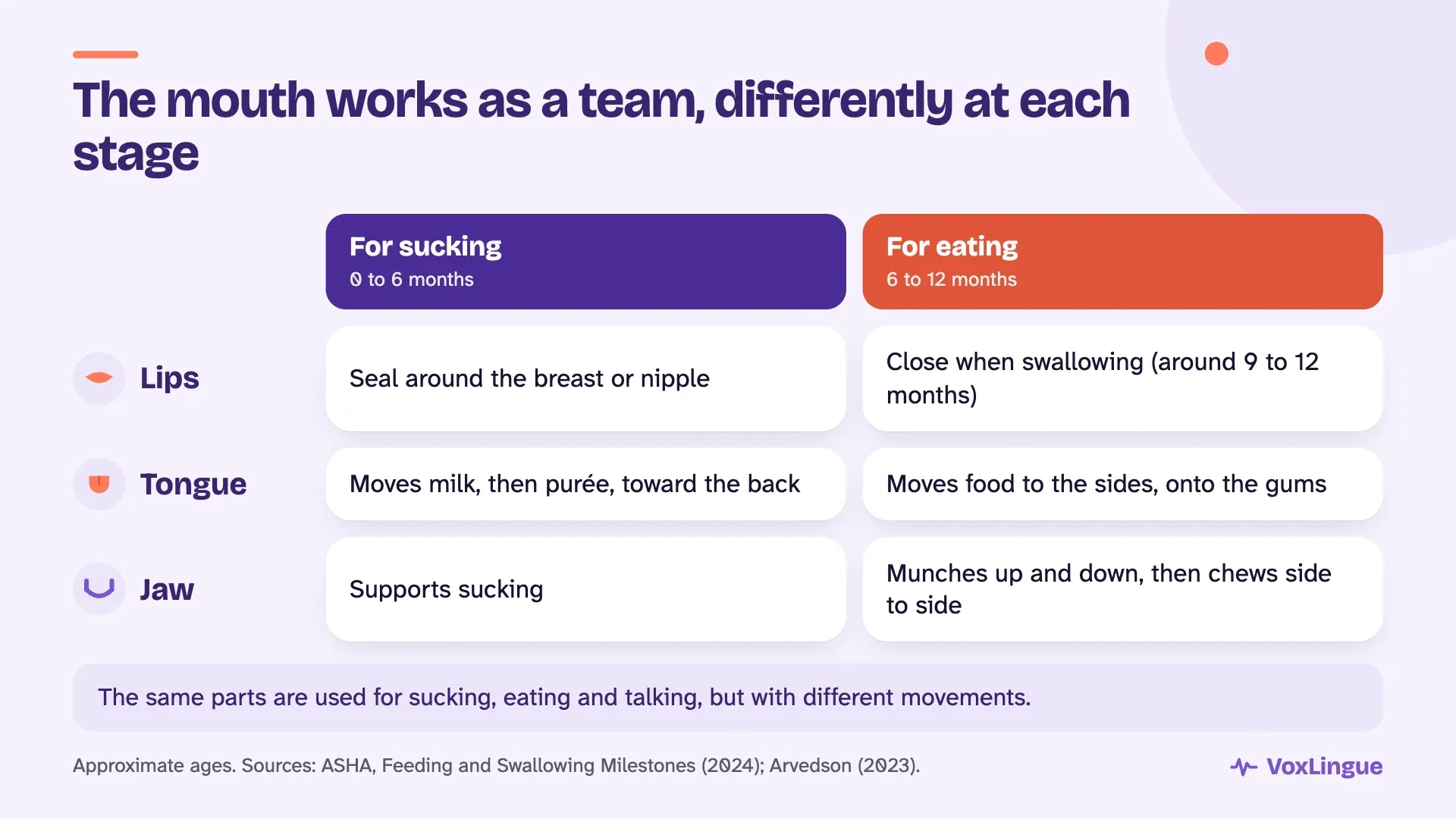
While they learn that rhythm, babies may cough or gag a little on milk. That is common. Joan Arvedson, an American researcher who specializes in children’s feeding, points out that babies also gag on liquids while they learn the rhythm of sucking (2023). If coughing happens at nearly every feed, mention it to your doctor.
Sucking is also soothing, with a pacifier or a thumb. When those habits last a long time, they can affect tongue position and breathing. We cover this in our article on childhood oral habits and their effects.
Hands to mouth: getting ready
Between about 4 and 6 months, babies bring their hands, fists and toys to the mouth. They pat the breast or bottle, and they open the mouth as a spoon comes near. The tongue also starts pushing food toward the back of the mouth to swallow it.
These actions do not mean solids should start sooner. They are exploration: the mouth is discovering shapes, textures and temperatures, at its own pace. There is nothing to train here. Clean toys that suit your baby’s age are enough.
What about tongue-tie?
Tongue-tie, or ankyloglossia, worries many parents. A 2017 Cochrane review found it in about 4 to 11% of newborns. A 2023 review notes that there is no agreed definition, and that most babies who have one have no symptoms. If breastfeeding is hard, your doctor and a lactation consultant are the first people to see.
How do you know your baby is ready for solids?
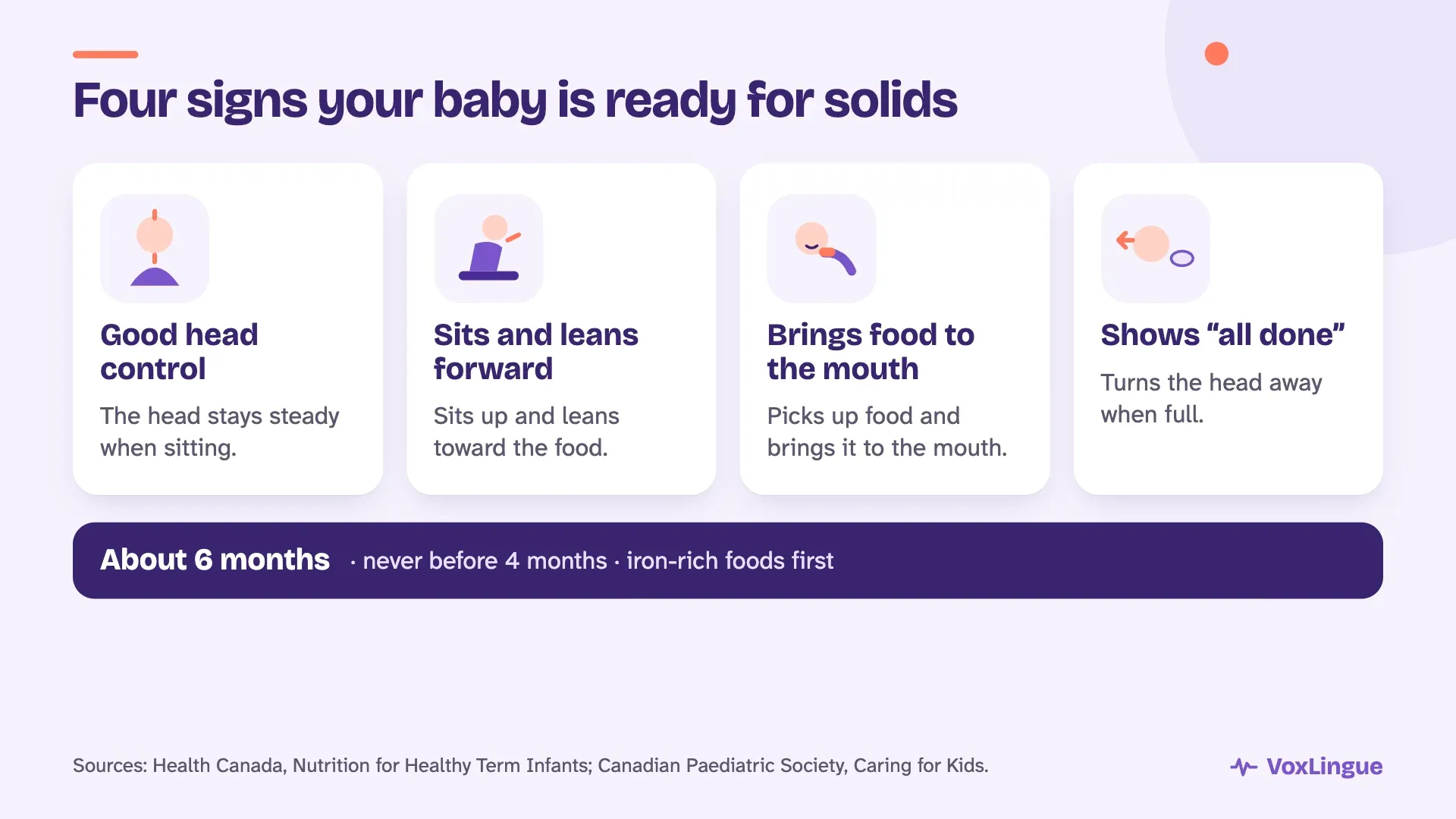
In Canada, most babies are ready for solid foods at about 6 months, never before 4 months. The signs: good head control, sitting up and leaning forward, bringing food to the mouth, and turning the head away when full. First foods should be rich in iron.
Health Canada describes four signs of readiness. Your baby has better head control. They can sit up and lean forward. They show they are full by turning their head away. And they pick up food and try to bring it to their mouth. These signs usually show up together, around 6 months.
The Canadian Paediatric Society adds that most babies are ready at about 6 months, and that waiting much longer increases the risk of low iron. Its parent page on feeding your baby in the first year walks through the main steps. In Québec, Mieux vivre avec notre enfant gives the same window: around 6 months, never before 4.
First foods are rich in iron: meat, fish, egg, tofu, beans and lentils, or iron-fortified infant cereal. For amounts and frequency, your doctor or a dietitian is the right person to ask. This guide is about how your baby eats, not the menu.
If your baby was born prematurely, talk with their doctor about timing. For self-feeding, Mieux vivre recommends going by corrected age, meaning the age your baby would be if born at term.
Why “about 6 months” and not “from 4 months”?
Many sites say to start “between 4 and 6 months”, or “when your baby has doubled their birth weight”. That guidance comes from the American Academy of Pediatrics. In Canada, the recommendation is about 6 months, once the readiness signs are there. We come back to these differences below.
Baby feeding milestones: what does the mouth learn, month by month?
The mouth moves from sucking to munching, when the jaw goes up and down. Next, the tongue learns to move food to the sides, and your baby begins to bite and chew. Each step calls for a texture and a cup. The ages are approximate ranges, and most published milestones come from American sources.
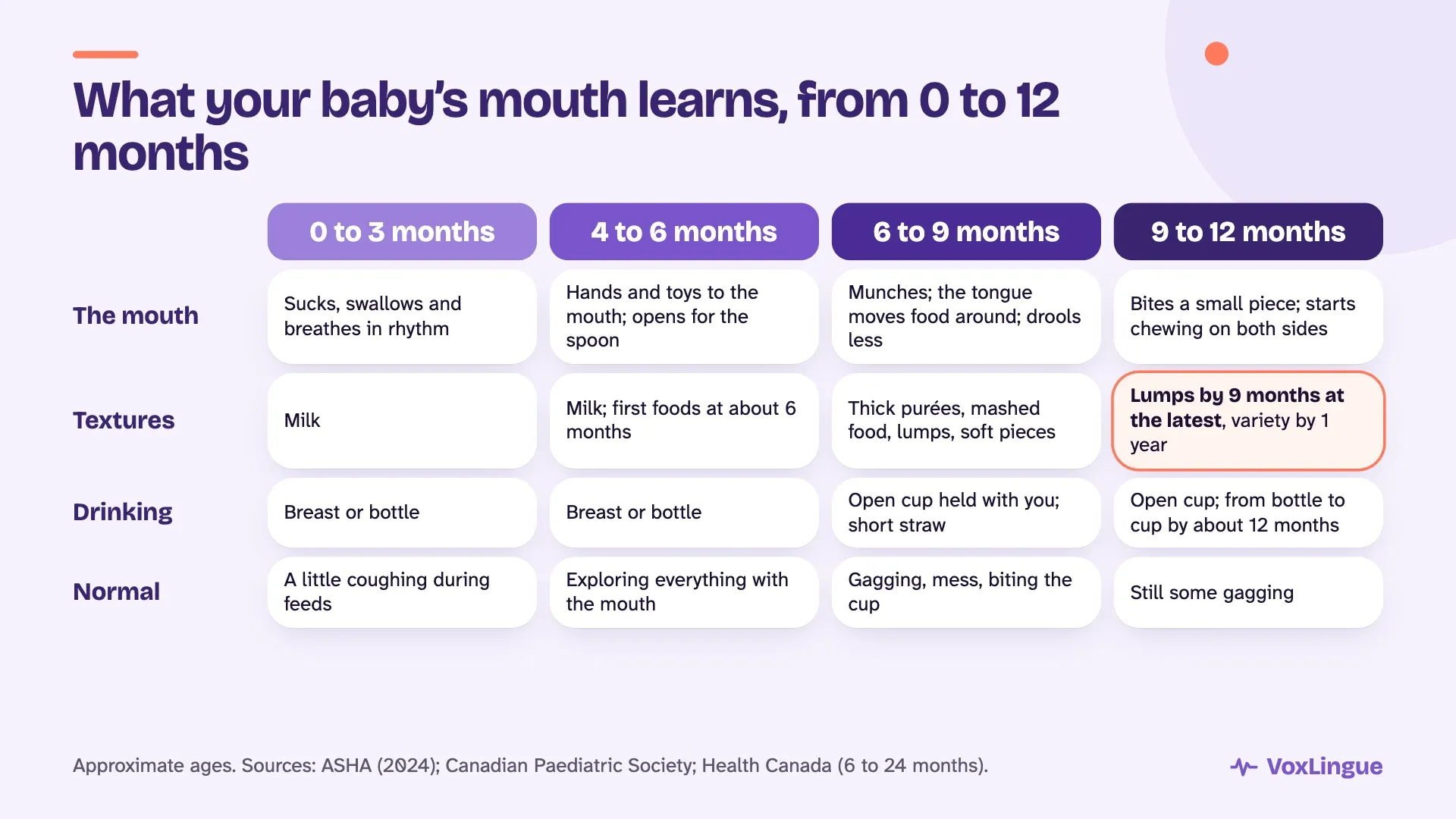
The table below sums up these baby feeding milestones. It brings together ASHA’s milestones, the Canadian Paediatric Society’s table and Health Canada’s guidance on textures and cups. You will find more articles on the mouth, swallowing and early habits in our oral habits topic hub.
| Age (approximate) | What the mouth does | Textures | For drinking | What is normal |
|---|---|---|---|---|
| 0 to 3 months | Sucks, swallows and breathes in rhythm | Breast milk or formula | Breast or bottle | A little coughing during feeds |
| 4 to 6 months | Brings hands and toys to the mouth, opens for the spoon | Milk; first foods at about 6 months | Breast or bottle | Exploring everything with the mouth |
| 6 to 9 months | Munches (jaw up and down), moves food with the tongue, drools less, picks up food with the fingers | Thick purées, mashed food, lumps, soft pieces | Open cup held with you; short straw | Gagging, mess, biting the rim of the cup |
| 9 to 12 months | Bites off a small piece, starts chewing on both sides, closes the lips when swallowing | Lumps by 9 months at the latest, then a variety of textures by about 1 year | Open cup; from bottle to cup by about 12 months | Still some gagging |
The ages are ranges. Most published milestones come from American sources, and they do not always agree. The Canadian Paediatric Society places the start of side-to-side chewing at 6 to 9 months; ASHA places it at 9 to 12 months. Every baby moves at their own pace, sometimes a little earlier, sometimes a little later.
Chewing without teeth
Your baby does not need teeth to learn to chew. Québec’s Mieux vivre avec notre enfant makes the point clearly: the gums can already chew soft food. Babies start by munching, the jaw moving up and down as if biting the air.
Little by little, the tongue learns to push food to the sides of the mouth, onto the back gums. Joan Arvedson describes this learning in three moves: food is placed on the side, munched up and down, then shifted from side to side by the tongue. That is how rotary chewing settles in toward the end of the first year.
Why milestones differ from one source to another
Sources divide the year differently and do not always describe the same actions. That is why a milestone is never a deadline. What matters is that your baby keeps moving from one step to the next. ASHA puts it simply: every child develops in their own way, even within the same family.
When should babies move from purées to lumpy food?
Health Canada recommends offering lumpy textures no later than 9 months. By about 1 year, your baby eats a variety of textures. Finger foods can start at 6 months. Moving forward matters: in a large UK study, babies who first had lumps after 9 months had more feeding difficulties later.
That 9-month marker comes from Health Canada’s feeding recommendations for 6 to 24 months, written with the Canadian Paediatric Society and Dietitians of Canada. Québec’s popular parenting site Naître et grandir puts it another way: do not stay more than about a month at each step, and treat 6 to 9 months as a particularly important window. The message is the same: keep moving forward, without rushing.
Why not wait? A British study followed 7,821 children born in 1991 and 1992 (Coulthard, Harris and Emmett, 2009). Those who first had lumpy food after 9 months ate fewer fruits and vegetables at age 7 and had more difficulties at mealtimes. This is an association, not proof of cause: a baby who already refuses textures may also become a more selective eater.
The texture ladder
Textures follow one another like the rungs of a ladder. You start with a smooth purée, then a thicker one, then food mashed with a fork, then food with small lumps. Next come soft pieces your baby picks up with their fingers, and finally family foods, adapted to their age.
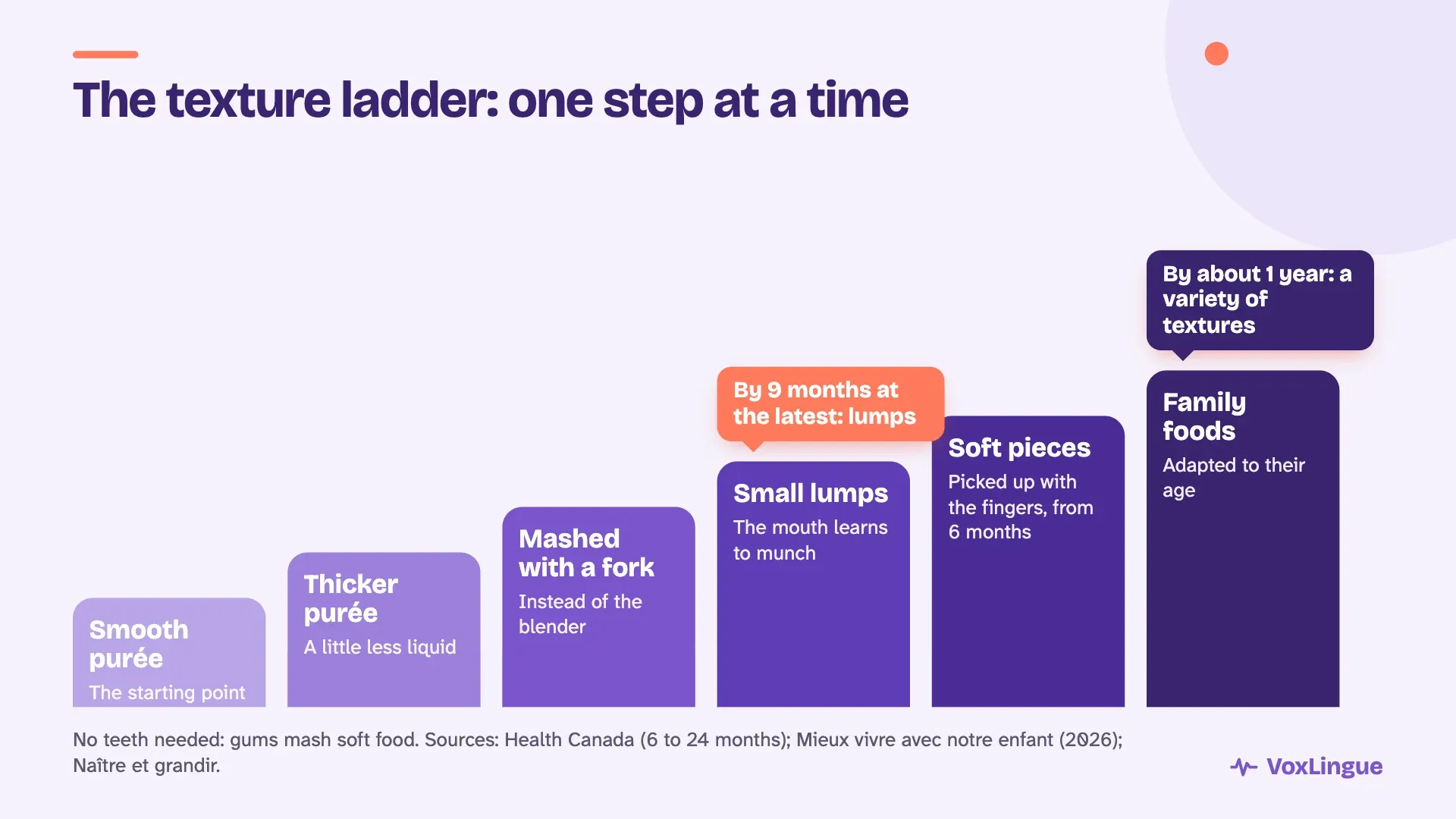
Your baby does not need teeth for any of these steps. A piece soft enough to squash easily is within reach: well-cooked sweet potato, a strip of omelette, a piece of ripe banana, shredded chicken, soft-cooked pasta, or mashed lentils from the family dal.
Finger foods can be part of the very first meals, from 6 months. Your baby touches them, squashes them and brings them to the mouth. Very little gets swallowed at first, and that is normal: your baby is learning. There will be a lot of mess too, which is part of discovering food.
Purées and pieces at the same meal?
On this question, Québec’s two main family guides do not agree. Mieux vivre avec notre enfant (2026) suggests not offering both textures at the same meal, because the mouth does not make the same movements for a purée and a piece. Naître et grandir (2024) says alternating them is not dangerous.
Both approaches are reasonable. If your baby seems overwhelmed when purée and pieces arrive at the same meal, offering them at different meals is a simple option.
My 9-month-old only eats smooth purées
First, no panic, and no pressure. A pressured meal often makes refusal stronger. Health Canada recommends following your baby’s hunger and fullness cues: the goal is to move forward one small step at a time, at your baby’s pace.
A few ideas, to try over several days:
- thicken the usual purée a little, or mash it with a fork instead of the blender;
- put a very soft piece on the tray so your baby can touch and taste it, with no expectations from you;
- eat together, so your baby sees you chew and shares the moment;
- bring back a refused food another day, in another form.
If pieces trigger gagging or vomiting at nearly every try, or if nothing changes despite your efforts, talk to your baby’s doctor. ASHA says it plainly: do not wait to get help if your child is having trouble eating solid foods. There is no need to wait for a toddler milestone if mealtimes are hard now.
Is it gagging or choking? How to tell the difference
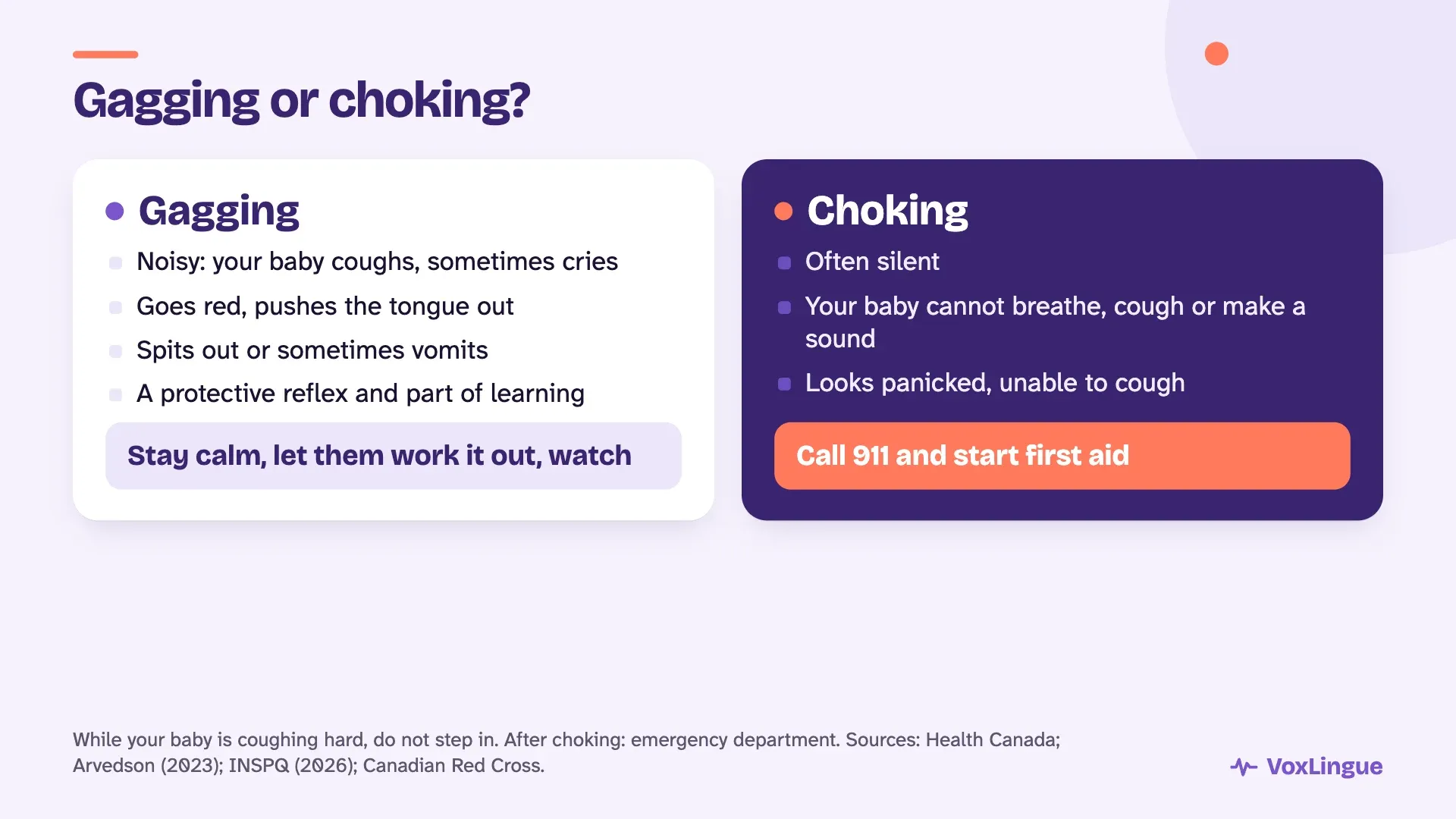
Gagging is noisy: your baby coughs, goes red, pushes the tongue out, spits out or sometimes vomits. It is a protective reflex and part of learning. Choking is often silent: your baby cannot cry, cough or breathe. That is an emergency: call 911.
Gagging frightens parents, but it is part of learning to eat. Health Canada describes it as a natural reflex that helps older babies avoid choking. Québec’s Mieux vivre guide says the same: gagging is normal when babies discover new textures.
| Gagging | Choking | |
|---|---|---|
| What you hear | Noise, coughing, sometimes crying | Little or no sound |
| Breathing | Your baby breathes and coughs | Your baby cannot breathe, cough or make a sound |
| What you see | Red face, tongue out, spitting out or vomiting | Looks panicked, unable to cough |
| What you do | Stay calm, let your baby work it out, watch | Call 911 and start first aid |
Why babies gag
Gagging often happens when a piece lands in the middle of the tongue, especially if it is small and round, Joan Arvedson explains. Your baby is learning how big a mouthful is and where food needs to go. Gagging happens with spoon-feeding and with finger foods, and even with liquids.
Gagging can look dramatic, with coughing, the tongue pushing out or vomiting. The most helpful thing is to stay calm, let your baby handle it and watch. Your calm helps them get back to the meal. Gagging is not a reason to stop offering textures.
Preparing food to lower the risk
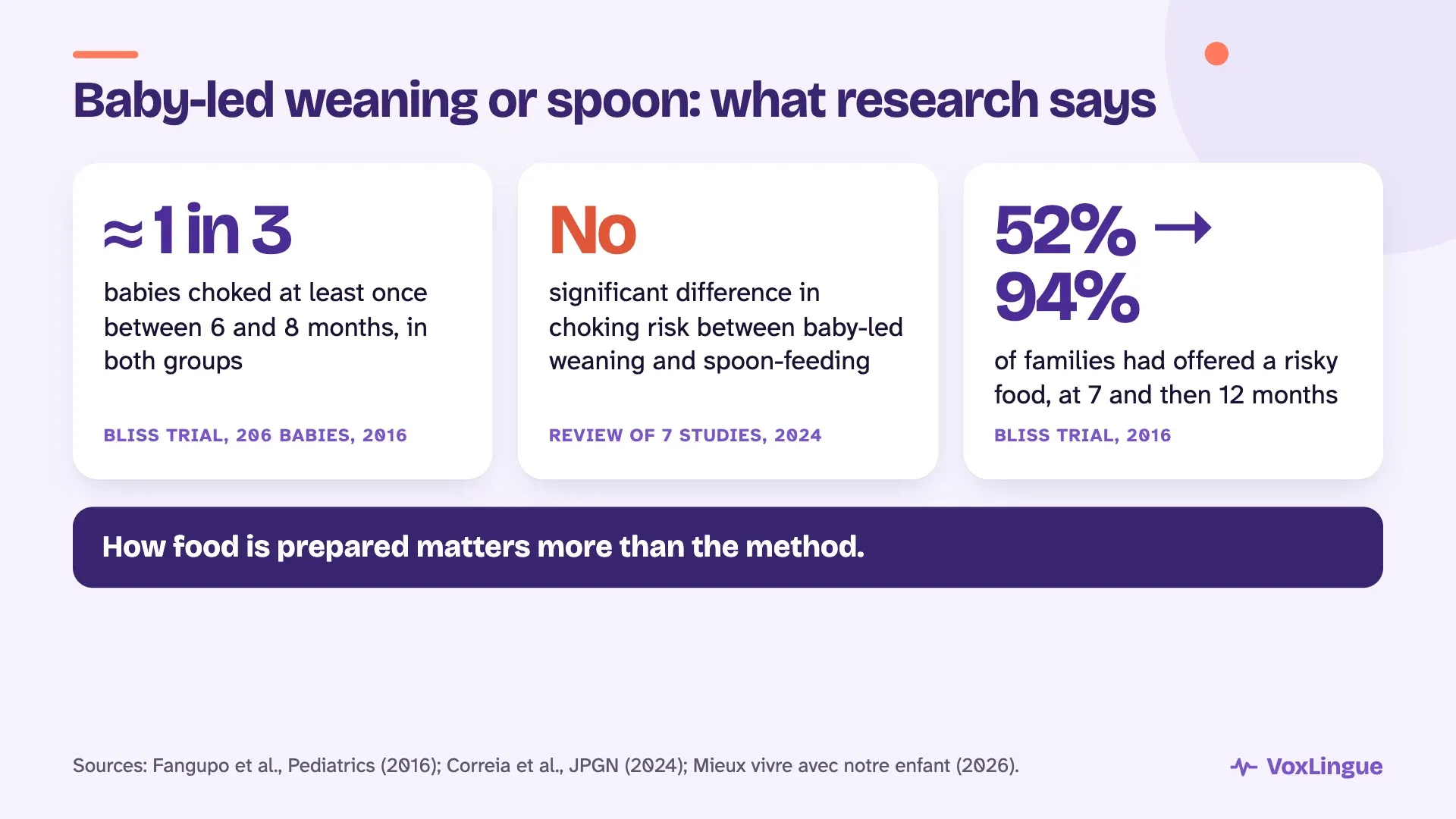
Food preparation is the best prevention. The BLISS trial was run in New Zealand with 206 babies (Fangupo and colleagues, 2016). Whatever the feeding method, most families had offered at least one risky food: 52% at 7 months and 94% at 12 months.
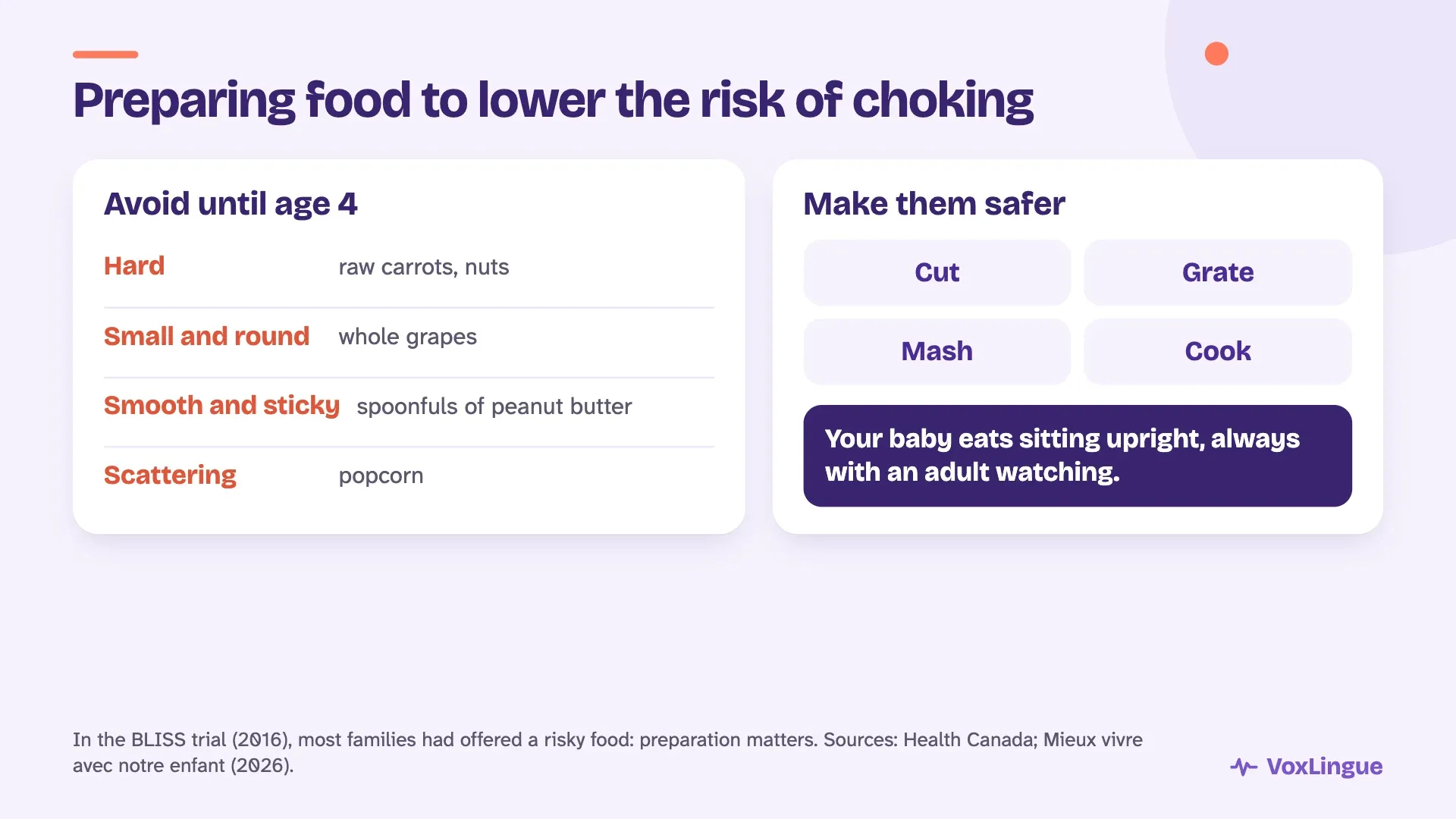
Health Canada and Mieux vivre advise avoiding hard, small and round, or smooth and sticky foods until age 4: whole grapes, nuts, popcorn, raw carrots, spoonfuls of peanut butter. Cut, grate, mash or cook these foods to make them safer. Your baby eats sitting upright, and always with an adult watching.
If your baby chokes
Québec’s public health guidance gives a simple rule: do not step in while your child is coughing hard, because they are trying to clear it on their own. If your baby cannot breathe, cough or make a sound, or if their breathing worries you, call 911. After a choking episode, have your baby seen in the emergency department.
We do not describe first aid here, because it is best learned hands-on. The Canadian Red Cross explains what to do when a child or baby is choking, and a first aid course is the best preparation. Many municipalities and community centres offer one.
Baby-led weaning or spoon-feeding: which should you choose?
Both approaches can work. Studies find no more choking with baby-led weaning than with spoon-feeding, as long as food is prepared safely. Babies who feed themselves gag more at first, then less. Many families mix the two, and that is fine.
Baby-led weaning means offering, from the start, foods your baby picks up and eats on their own. Spoon-feeding usually starts with purées. Both can support your baby’s mouth skills, as long as textures keep moving forward.
In the BLISS trial, about a third of babies choked at least once between 6 and 8 months, in both groups. Babies following baby-led weaning gagged more at 6 months, then less than the others at 8 months.
In 2024, a review of seven studies (Correia and colleagues) found no significant difference in choking risk between baby-led weaning and spoon-feeding. According to the authors, a baby’s familiarity with each texture and safe food preparation matter more. Québec’s Mieux vivre guide agrees: babies who feed themselves do not choke more, but they may gag more.
Many families do both: a purée on the spoon and a few soft pieces to pick up. Whatever the method, three things matter. Textures move forward. Your baby eats seated and supervised. Food is prepared safely.
Open cup, straw cup or sippy cup?
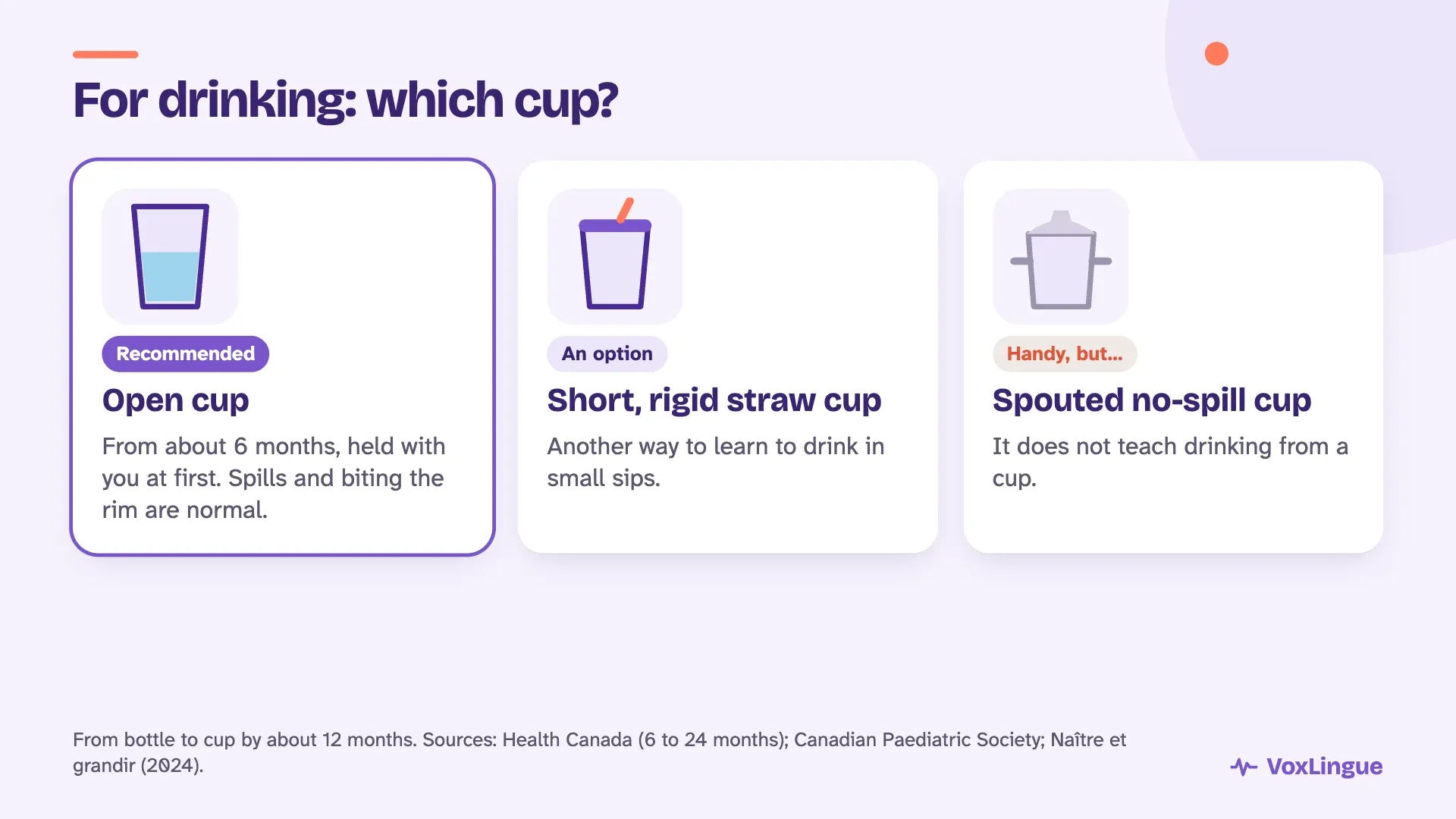
Health Canada favours an open cup from about 6 months, held with your help at first. A cup with a short, rigid straw is another option. Spouted no-spill cups do not teach your baby to drink from a cup. Spills and little bites on the rim are normal.
Health Canada recommends offering water in an open cup, with help at first, and moving from the bottle to a cup by about 12 months. The Canadian Paediatric Society suggests starting the open cup for water once solids begin.
Spouted no-spill cups are convenient, but Health Canada notes that they do not support mature drinking skills. Naître et grandir, in a text reviewed by an occupational therapist, adds that spouted cups do not get children used to drinking from a cup. A cup with a short, rigid straw is a useful option.
Learning to drink from a cup, step by step
A small cup with a little water in the bottom, held together with you, lets your baby take small sips at their own pace. At first, very little goes down, and that is normal. Offering the cup at meals, while your baby is seated, turns it into a routine.
Between 6 and 9 months, babies often bite the rim of the cup or the straw, and some liquid spills out of the mouth. A little coughing now and then, at first, is also common. If your baby coughs at nearly every sip, or their voice sounds wet after drinking, mention it to your doctor.
For how much water to offer, follow Health Canada’s guidance or your doctor’s advice.
Why do baby feeding guidelines differ online?
Many popular pages are American. They still mention starting at 4 months, often put fruits and vegetables first and suggest sippy cups. In Canada, the guidance is about 6 months, iron-rich foods first, lumps by 9 months at the latest, and an open cup.
When you search online, many of the most visible pages come from the United States, including large commercial feeding sites. Their advice often follows the American Academy of Pediatrics and ASHA, which differ from Canadian guidance on a few points.
| Topic | What you often read on American sites | The guidance in Canada |
|---|---|---|
| Starting solids | Between 4 and 6 months, or when birth weight has doubled | About 6 months, never before 4 months |
| First foods | Cereal, then fruits and vegetables, one at a time | Iron-rich foods first |
| Chewing | No food that requires chewing at first | Soft pieces from 6 months, lumps by 9 months at the latest |
| Cups | Sippy, open or straw cup; sippy cup at 9 to 12 months | Open cup with help; sippy cups do not teach drinking |
| Non-urgent advice | Call your pediatrician | Info-Santé 811 in Québec, Health811 in Ontario, or your doctor |
These sites are not wrong for their own readers: they follow different recommendations. In Canada, Health Canada and the Canadian Paediatric Society are the reference points, and Mieux vivre avec notre enfant in Québec. If two sources disagree, your doctor can help you sort it out.
Does eating prepare babies to talk?
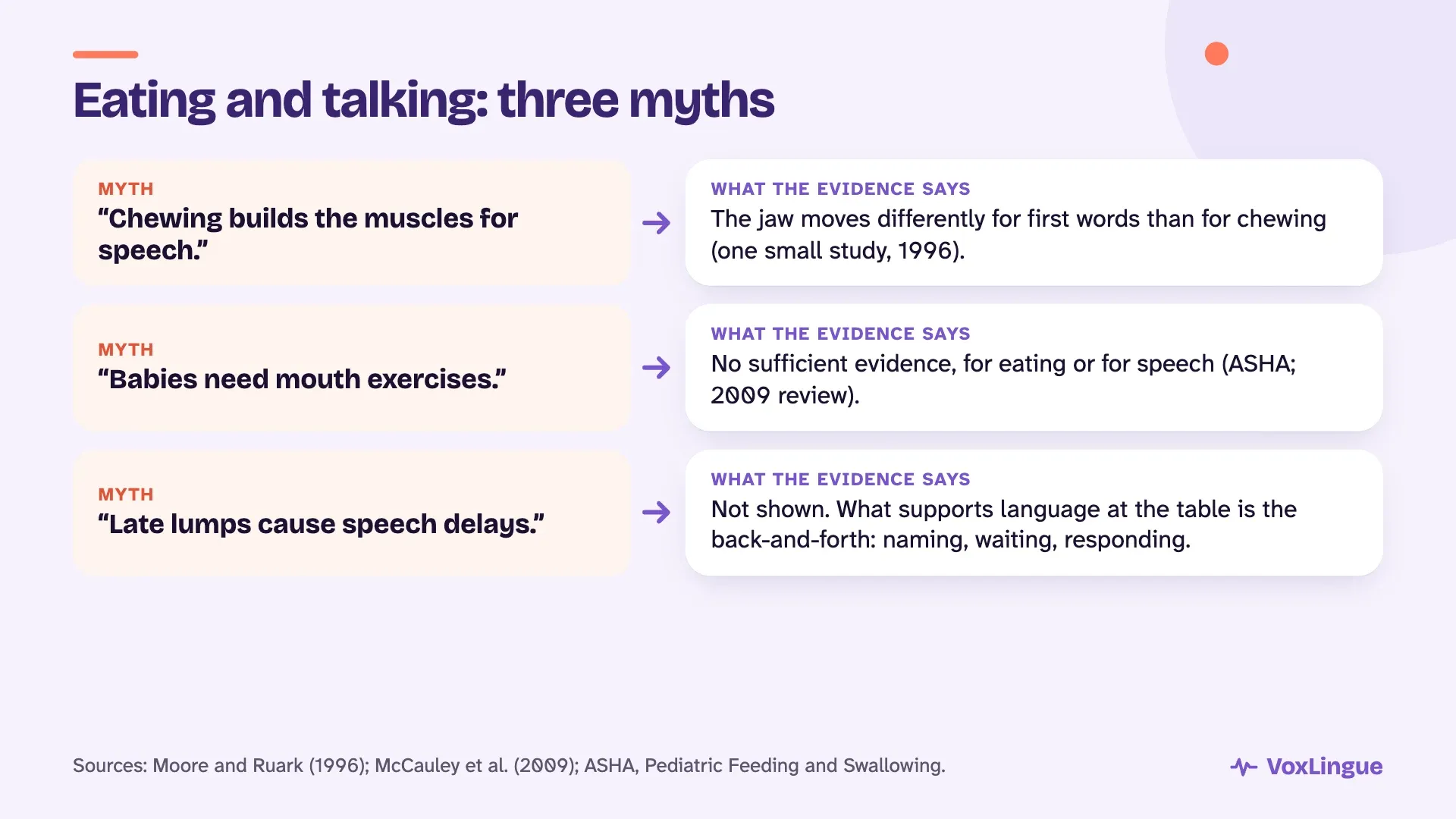
The mouth uses the same parts to eat and to talk, but not the same movements. One small study found that the jaw moves differently for first words than for chewing. Oral motor exercises have not been shown to help. What links meals and language is the conversation around the table.
The “speech muscles” myth
You will often read that chewing “builds” the muscles for speech, or that late lumps cause speech delays. The evidence does not point that way. In 1996, Moore and Ruark measured jaw muscle activity in seven toddlers aged 15 months. The coordination was not the same for saying words as for chewing or sucking.
The study is small, but it challenges the idea that speech grows out of chewing. The two skills develop side by side, each with its own movements.
The same goes for exercises: blowing through straws, “tongue workouts”, vibrating tools. ASHA notes the lack of high-quality evidence for oral motor exercises in feeding. A 2009 review found insufficient evidence for any effect on speech (McCauley and colleagues). For a baby who is developing well, there is nothing to train: eating, playing and babbling are enough.
If you are wondering how your baby’s language is coming along, our guide to language milestones from 0 to 5 for bilingual children describes what to look for at each age.
Mealtimes are for talking
The most useful link between meals and language is conversation. At the table, your baby looks, points, reaches and makes sounds to say “more” or “all done”. You name what they are eating, wait for their response and repeat it back with one more word. These exchanges matter more than the texture on the plate.
The language spoken at the table does not matter. In families who speak more than one language, each person can use the one that comes naturally. It is the back-and-forth that supports language, as our newsletter on why interaction comes before words explains.
What this means for your family’s meals
Eating is learned, like walking: one step at a time, with practice, mess and a lot of patience. Your job is not to become a therapist. It is to offer the right opportunities at the right time, and let your baby do the rest.
In practice, use these baby feeding milestones as a guide, not a deadline. Move through textures one small step at a time, aiming for lumps by about 9 months at the latest. Sit with your baby and eat together when you can: they learn by watching you. Let them touch, squash and get messy. It is not waste; it is discovery.
During gagging, stay calm and watch. Follow your baby’s hunger and fullness cues, without pushing for the last spoonful. And offer water in a small open cup as soon as solids begin.
Eating is learned, like walking: one step at a time, with practice, mess and a lot of patience.
When should you ask for help with your baby’s feeding, and who should you see?
A professional opinion is useful when meals are often difficult. Talk to your doctor if feeding often brings coughing, breathing changes or a wet-sounding voice, or if weight gain worries you. A speech-language pathologist assesses eating and drinking skills, working with your doctor, a dietitian, an occupational therapist and a lactation consultant.
Most first-year feeding difficulties pass. Some signs, though, are worth raising without waiting. Québec’s Ordre des orthophonistes et audiologistes (OOAQ) notes that feeding difficulties can happen in babies who are developing well. They are more common, however, after a premature birth, with a medical condition or with a developmental delay.
Signs to mention to your doctor
These signs are not a diagnosis. They simply suggest that an opinion would help:
- coughing or gagging at most meals;
- difficult or noisy breathing during feeds or meals;
- a wet or gurgly voice after eating or drinking, or liquid coming out of the nose;
- very long meals, crying, or a baby who arches or stiffens at mealtimes;
- frequent vomiting, or weight gain that worries you;
- trouble breastfeeding or bottle-feeding, or pieces still refused at around 9 to 10 months.
Who does what?
If your baby is choking or struggling to breathe, call 911. For a non-urgent question, Info-Santé 811 in Québec and Health811 in Ontario connect you with a nurse, day or night. Your baby’s doctor or nurse practitioner remains the first stop: they check growth, look for a medical cause and can refer you on.
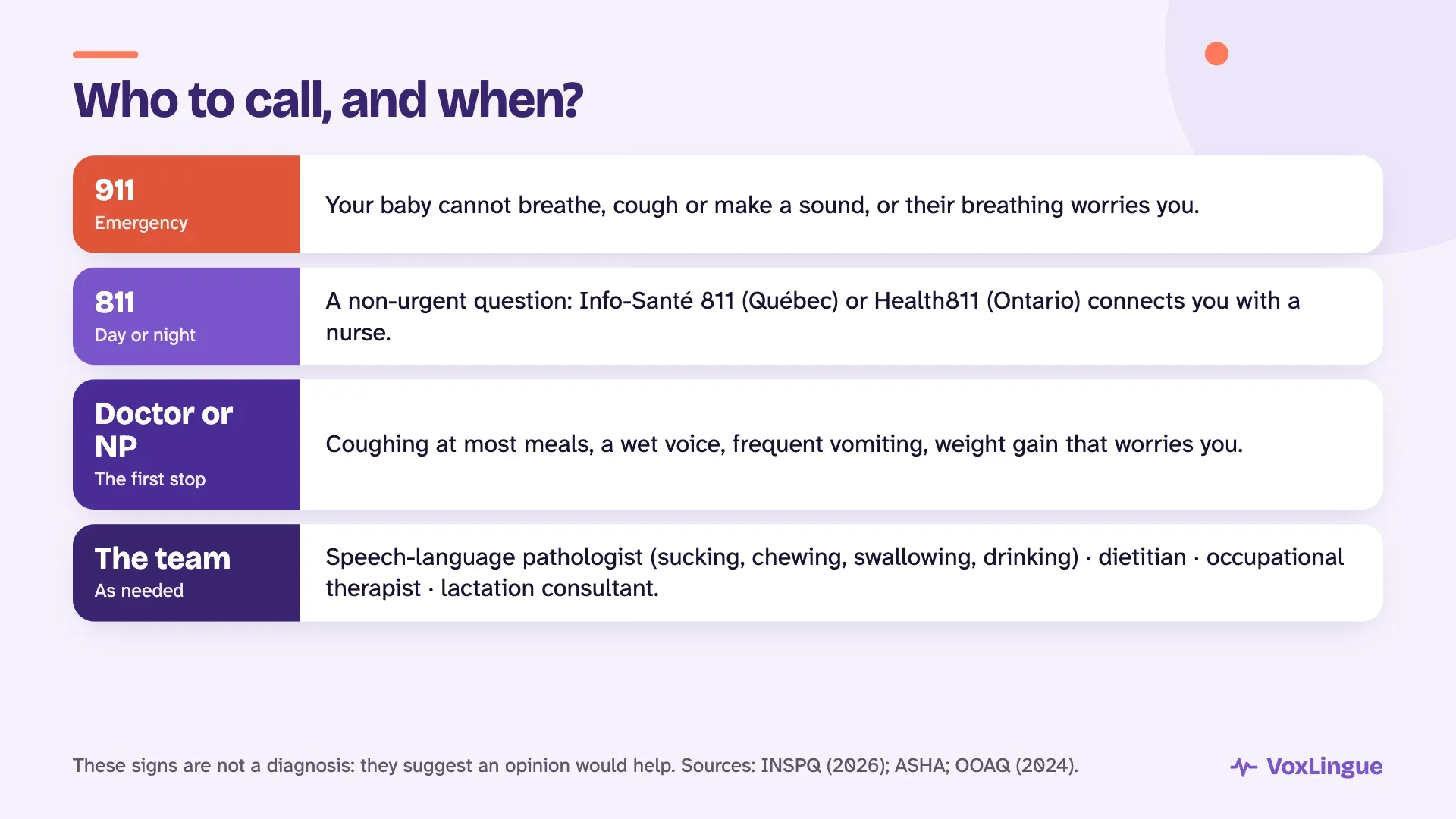
Around the doctor, each professional has a role. A lactation consultant supports breastfeeding. A dietitian looks at amounts, iron and growth. An occupational therapist can help with seating and self-feeding. A speech-language pathologist assesses and supports the skills for sucking, chewing, swallowing and drinking, and the move from one texture to the next.
In Québec, if your baby has been referred to public services and placed on a list, our article on the speech therapy waiting list in Québec explains how follow-up works and what to do meanwhile. In Ontario, the free Preschool Speech and Language Program serves children from birth to school entry; whether it covers infant feeding depends on your region. Families in Ontario can also see us through online speech therapy in Ontario.
What does a feeding assessment look like?
The speech-language pathologist starts with your questions and your baby’s history: birth, health, feeds and meals. They then watch a meal or a feed, ideally with your usual foods, bottle or cup. They look at posture, mouth movements, swallowing and breathing.
You leave with explanations and practical ideas for meals. If another professional should see your baby, the speech-language pathologist tells you and can coordinate with them. ASHA’s page on feeding and swallowing milestones from birth to 1 year is a useful companion if you want to compare notes before an appointment.
What if your baby was born prematurely?
Babies born early often follow their own timeline. Their progress is compared with their corrected age, and the team following your baby remains the best source of advice. The signs above apply to them too, so do not hesitate to raise them.
Next step
To keep these milestones handy, download our printable guide.
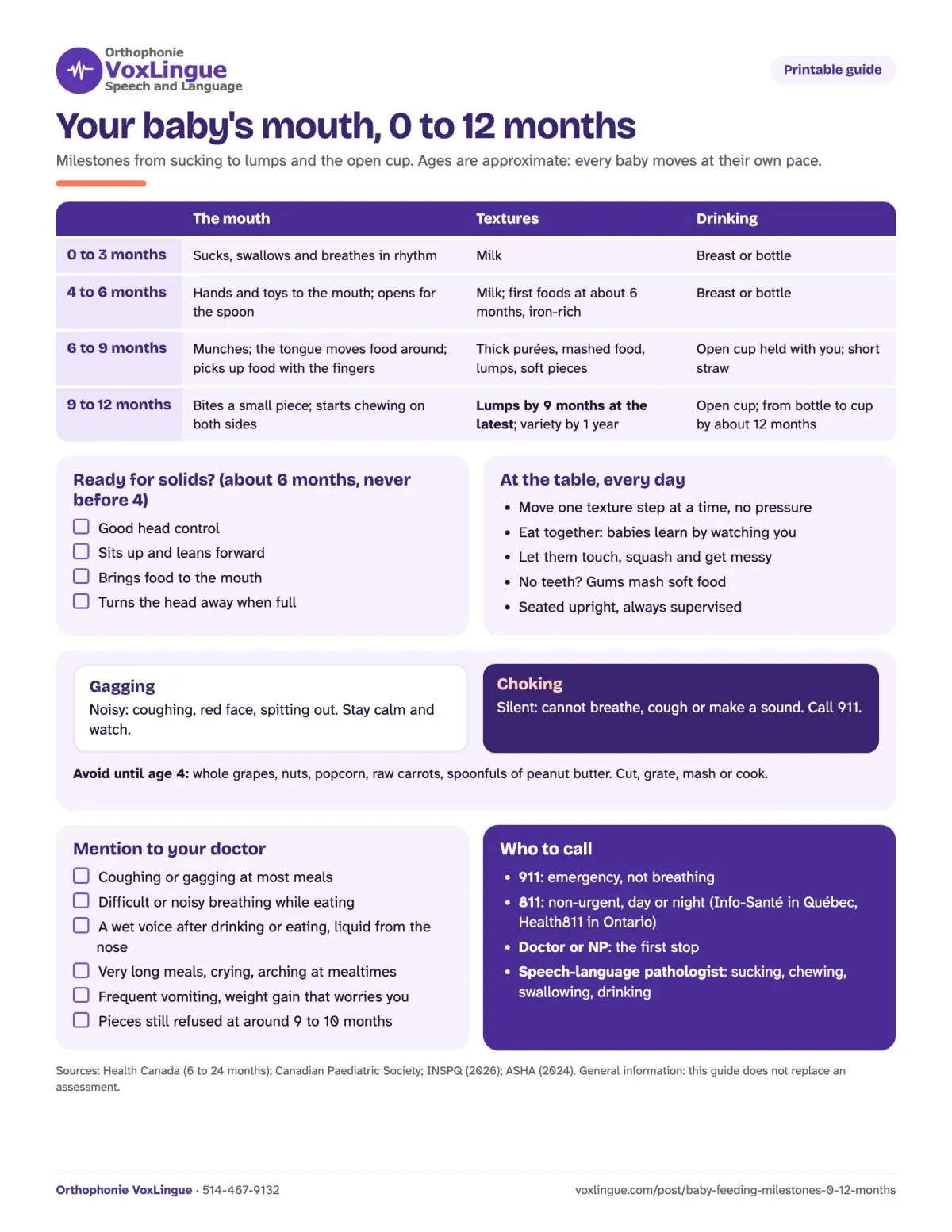
Printable guide: Your baby’s mouth, 0 to 12 months (PDF, 1 page). Stick it on the fridge or keep it with your baby’s health records.
If something about your baby’s feeding worries you, our page on swallowing and feeding therapy explains how we support children, at our Marché Central clinic in Montréal or by telepractice across Québec and Ontario.
Frequently asked questions
Is it normal for my baby to gag on every spoonful?
Often, yes, especially in the first weeks of a new texture. Gagging is a reflex that protects your baby and helps them learn how big a mouthful should be. It usually eases as they get used to the texture. If gagging happens at nearly every meal and does not ease, or comes with frequent vomiting, talk to your doctor.
Can babies eat finger foods without teeth?
Yes. The gums can already mash soft food, and there is no need to wait for teeth. Offer pieces soft enough to squash easily, such as well-cooked sweet potato or a piece of ripe banana. Teeth will help with chewing later, but they are not needed to start.
When do babies learn to chew?
Babies start by munching, moving the jaw up and down, at around 6 to 9 months. True chewing, where food moves from side to side, begins somewhere between 6 and 12 months depending on the source. The ages are ranges: what matters is that your baby keeps moving forward from one step to the next.
My baby swallows food whole: what should I do?
Offer soft pieces long enough for your baby to hold and bite, rather than small cubes that drop into the middle of the tongue. Eat together so your baby can watch you chew. Stay close and give them time. If nothing changes, or your baby often coughs while eating, talk to your doctor or a speech-language pathologist.
My baby vomits after gagging: is that serious?
A strong gag can lead to vomiting, and this happens to many babies while they learn new textures. If it is occasional and your baby gets back to the meal easily, it is usually not a concern. Frequent vomiting, weight gain that worries you or meals that have become a struggle are worth raising with your doctor.
Can my 6-month-old have water, and in what?
Yes. Once solids begin, at about 6 months, your baby can have a little water in a small open cup, held with you. Health Canada favours the open cup over sippy cups, which do not teach drinking from a cup. For amounts, follow Health Canada’s guidance or your doctor’s advice.
My baby coughs when drinking from a cup: is that normal?
A little, at first. Drinking from a cup means controlling a sip, and that takes practice. Spills, biting the rim and an occasional cough are common between 6 and 9 months. Coughing at nearly every sip, or a wet-sounding voice after drinking, is a sign to mention to your doctor.
Does baby-led weaning increase the risk of choking?
The available studies find no more choking with baby-led weaning than with spoon-feeding, as long as food is prepared safely. A 2024 review of seven studies reached that conclusion. Babies following baby-led weaning gag more at first, then less. Either way, your baby eats seated and supervised.
Should I do mouth exercises with my baby?
No. There is no good evidence that mouth exercises help babies eat or talk. For a baby who is developing well, eating a range of textures, playing with toys and babbling with you are enough. If you have a specific concern, a speech-language pathologist can assess the situation and advise you.
My baby was premature: which age should I use?
Usually your baby’s corrected age, meaning the age they would be if born at term. Québec’s Mieux vivre guide recommends it for self-feeding in particular. For when to start solids, talk with your baby’s doctor or the team following them, who know their history and growth.
What is a pediatric feeding disorder?
It is difficulty eating or drinking that does not match a child’s age and is linked to medical, nutritional, feeding-skill or psychosocial factors. An expert group proposed this definition in 2019 (Goday and colleagues). Only a professional can make this diagnosis, after an assessment.
Can a speech-language pathologist see a baby for feeding?
Yes. In Québec, the professional order (OOAQ) includes feeding and swallowing in the speech-language pathologist’s role, for children and adults. The speech-language pathologist assesses the skills for sucking, chewing, swallowing and drinking, and often works with your doctor, a dietitian, an occupational therapist and a lactation consultant. Your doctor can also refer you.