Speech sound practice at home for a child aged 3 to 7 in speech therapy: how many tries and minutes a day, five-minute routines, and what to say without frustrating your child
Your child’s speech therapist sent home a sheet of “sh” words and asked for speech sound practice at home. The questions come quickly. How many minutes? How many times? And what do you say when the word still comes out wrong?
You may also have heard two pieces of advice that seem to clash. One says never make your child repeat. The other says have them say the sound many times. Both are right, each at its own moment. In everyday conversation, you don’t ask for repeats. During the short practice your speech-language pathologist (SLP) sets, repeated tries are the whole point.
This guide explains those two moments, then what research actually uses as a number of tries and what those numbers mean in your home. It offers a five-minute routine, words to say after each try and signs that it’s time to stop. It also gives examples of sounds children often work on, in English and in Québec French, and what doesn’t help.
One thing never changes: the plan belongs to your SLP. They choose the sound, the level and how much practice. This guide helps you carry out that plan, never replace it.
Should you make your child repeat? Two moments, two rules
Both pieces of advice are right, each at its own moment. In conversation, don’t ask your child to repeat: say the word back correctly. During the short practice your SLP sets, your child says the sound many times, in a game. Those repeated tries are part of the treatment, not a correction.
Parent pages often give opposite advice because they never separate these two moments. Some say never ask for a repeat. Others suggest saying “that’s not quite it, try again” during homework. Side by side, each moment has its own rule.
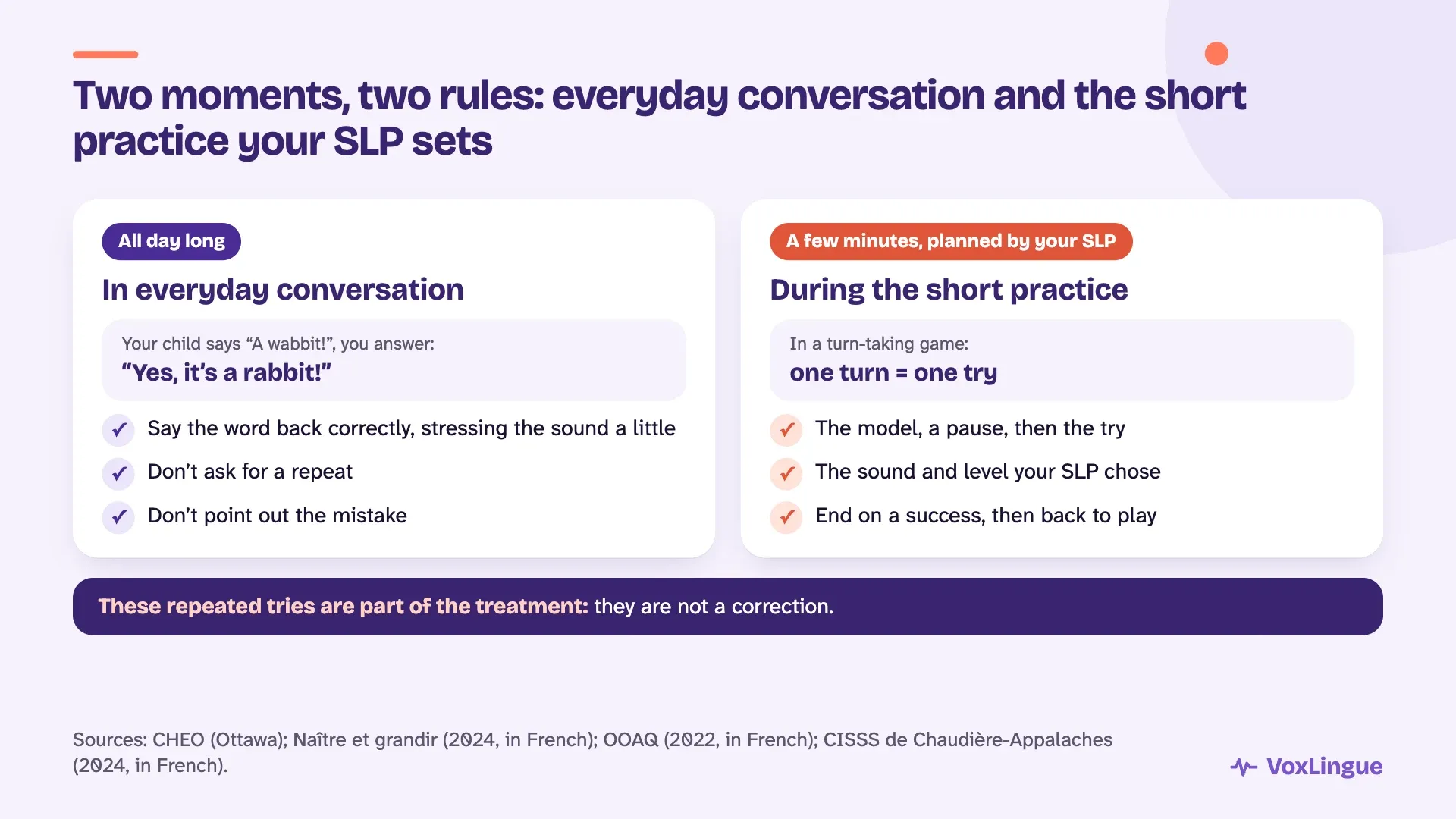
| In everyday conversation | During the short practice | |
|---|---|---|
| Who decides | No one: it’s daily life | Your SLP chooses the sound, the level and how much |
| When | Any time of day | One chosen moment, a few minutes, as your SLP sets |
| What you do | Say the word back correctly: “Yes, it’s a rabbit!” | Give the model, leave a pause, and each turn of the game earns one try |
| What you avoid | Asking for a repeat, pointing out the mistake | Going on until tears, practising a sound your SLP hasn’t started |
| How it ends | The conversation goes on | On a success, then back to play |
In conversation: say the word back, don’t ask for a repeat
When your child says “wabbit” for “rabbit”, say the word back correctly and stress the tricky sound a little: “Yes, it’s a rabbit!” Don’t point out the mistake. CHEO, the children’s hospital in Ottawa, puts it plainly: “Avoid asking your child to repeat after you”. Its example is a child who says “want tootie!” and a parent who answers “You want a cookie?”
Québec sources say the same. Naître et grandir explains that asking for a repeat cuts the conversation short, can make a child less keen to talk, and makes some children angry (2024, in French). The Ordre des orthophonistes et audiologistes du Québec (OOAQ) describes the same model parent, who doesn’t make the child repeat (2022, in French). If your child says the word again on their own and gets it, praise them. If not, praise the effort: “Good try!”
For Kimberly Martins, speech-language pathologist and founder of VoxLingue, requiring a child to repeat before you give them something is the habit to drop right away. Our guide on how to model, wait, then give shows how. Our article on speech clarity also explains why it’s better to say the word back instead of asking for a repeat.
During practice: many tries, inside a game
Practice is a different moment. It’s a short time your SLP has planned, with a sound your child can already make with some help. Here, repeated tries are the goal: a sound settles in by being produced often, at a level where your child succeeds.
The level matters. CHEO notes that repeated attempts can encourage practice of mistakes. That happens when a child tries a sound they can’t yet make, with no model. It’s why your SLP chooses the sound and the level, and why practice always starts with your model.
Even inside the game, the try comes from the game, not from a request. Give the model, leave a pause, then offer two choices or a sentence to finish. Each turn of the game earns one try. You stop on a success, and the conversation goes back to its usual rules.
Getting the word without asking for it: five tips from Québec speech therapists
SLPs at the CISSS de Chaudière-Appalaches, a Québec public health agency, suggest five ways to get a child to say a word without asking them to repeat (parent workshop for 4- and 5-year-olds, 2024, in French). They work in conversation and during practice. That’s what makes them a bridge between the two moments.
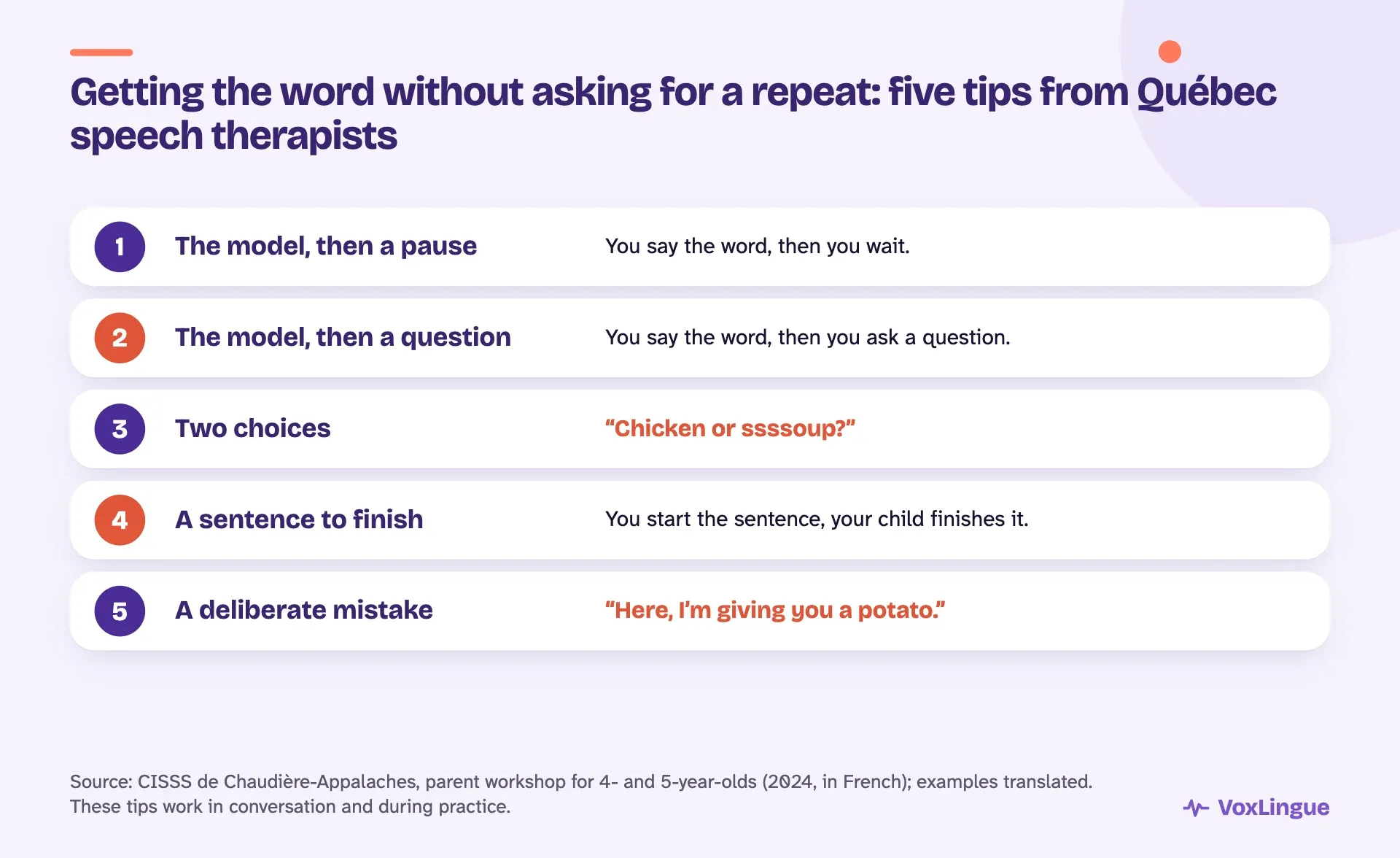
The first tip: say the word, then pause. The second: say the word, then ask a question. The third: offer two choices, such as “chicken or ssssoup?”, adapted from their French example.
The fourth: start a sentence and let your child finish it. The last: make a deliberate mistake, such as “Here, I’m giving you a potato” (their French example), so your child wants to say the right word. Each time, your child hears the model just before speaking, and no one asks them to say it again.
Why does the speech therapist give speech sound practice for home?
Because a sound settles in with many tries, often more than one weekly session can hold. Parents trained by the SLP can deliver this practice well. A Montréal study also found it helps most when it goes in the same direction as the therapy.
Start with the number of tries. A review of 199 studies published from 1979 to 2016 found that research therapy was most often given two to three times a week. Individual sessions lasted 30 to 60 minutes, with about 100 productions of the sound per session. In the same paper, 288 SLPs in Australia described less intensive practice than the research (Sugden and colleagues, 2018).
In Québec, research looked at the other half of the picture: what the family does. A Montréal trial led by McGill University, with the Montreal Children’s Hospital, followed 65 French-speaking 4-year-olds for 12 weeks (Rvachew and Brosseau-Lapré, 2015). Each child received individual therapy, a home program and a small group on sound awareness.
The home programs were of two kinds: articulation practice or shared reading. The most useful finding for parents is simple. The home program helped most when it matched the kind of individual therapy the child received. In other words, the practice that works is the one your SLP planned for your child, not a workbook found elsewhere.
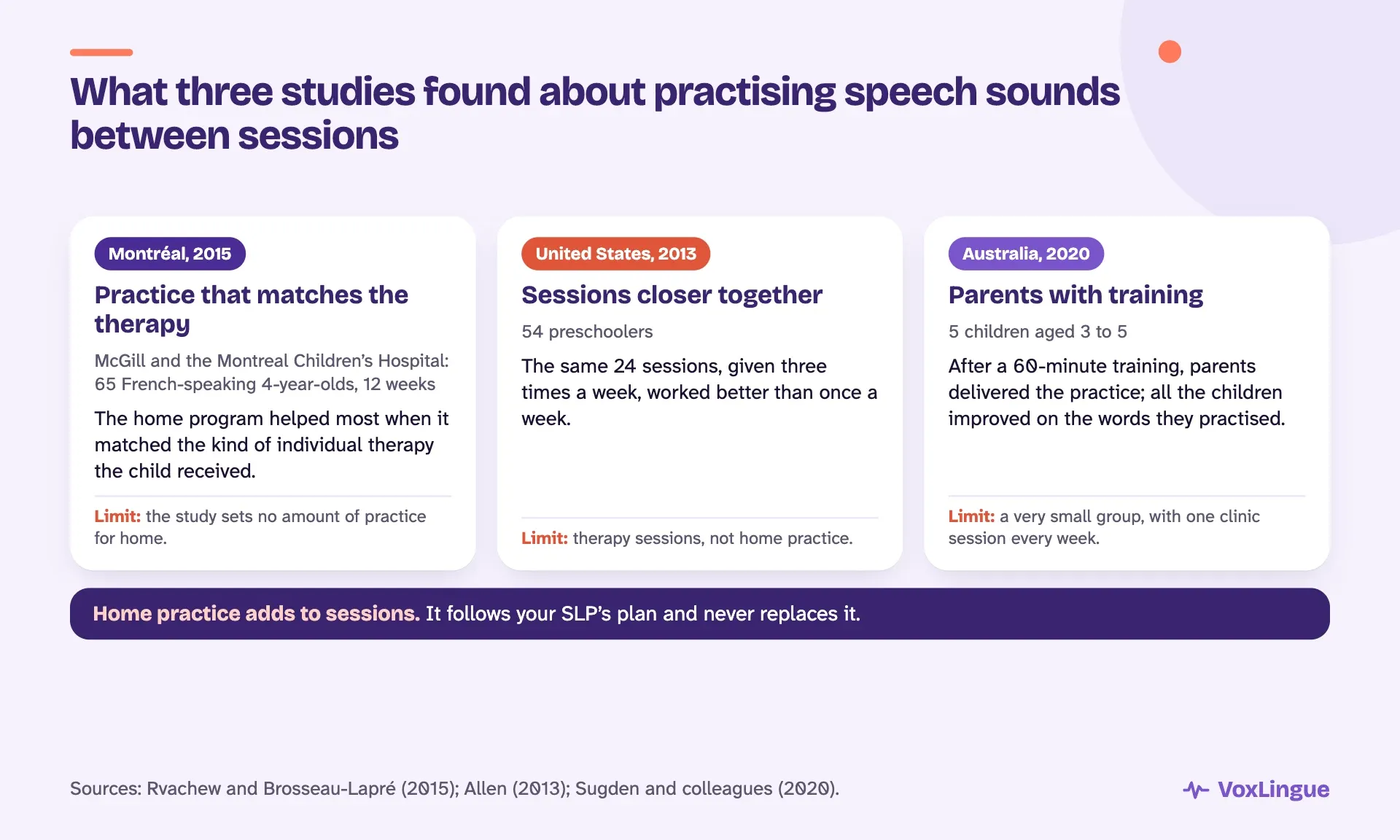
Can parents really deliver this practice? A small Australian study followed 5 children aged 3 to 5 (Sugden and colleagues, 2020). Parents had a 60-minute training, then did two practices a week at home, on top of one clinic session a week. All the children improved on the words they practised, and 3 of 5 improved a lot on other words.
These studies have limits. What parents did at home is often poorly described: in a 2016 review, only 61 of 176 papers involved parents (Sugden and colleagues). A recent study with nine parents in the United Kingdom adds a useful point: practice works better when parents understand not only what to do but why, with clear roles (Pritchard and colleagues, 2026).
Above all, remember this: home practice adds to sessions, it never replaces them. It follows your SLP’s plan. For more on how your child’s speech develops, see our articles on speech sounds.
How many tries and minutes a day? What research actually uses
In studies, children made about 50 to 100 tries per session, with an SLP. These are not targets for home. At home, aim for a few minutes, most days, as your SLP sets.
The numbers you see online come almost entirely from research sessions run by SLPs. The table gathers them, with what each one means for you.
| Study | Who was studied | What the study used | What it means for you |
|---|---|---|---|
| Sugden and colleagues, 2018 | 199 studies from 1979 to 2016, and 288 SLPs in Australia | 2 to 3 sessions a week, 30 to 60 minutes, about 100 productions per session | Session figures with an SLP, higher than what the surveyed SLPs offered |
| Thao and Lee, 2022 | A review of five studies of in-person therapy | 50 to 100 productions per session, about 30 minutes, twice a week | Many tries fit into a short time |
| Thao and Lee, 2022 | Studies of online therapy | 75 to 100 productions, 20 to 40 minutes, twice a week, based on few studies | Online, the number of tries aimed for is similar |
| Williams, 2012, as reported in the 2022 review | A review paper on intensity | At least 50 tries per session, and at least 70 for severe difficulties | A guide for sessions, not for home |
| Allen, 2013 | 54 preschoolers in the United States | 24 sessions, three times a week or once a week | Regularity matters (see below) |
These numbers have real limits. A 2016 review kept only 7 of 580 studies as strong enough to compare intensities. Higher intensity seemed favourable, with no precise dose (Kaipa and Peterson). Most of this research was done with English-speaking children. A survey of 106 Québec SLPs notes that few studies involve French-speaking children (Montembeault and colleagues, 2022, in French). The Montréal trial above is one of them.
So there is no single proven “dose”. Research numbers describe what happened in a session, with an SLP. They explain why practice matters, but they don’t say how many tries your child should do at home.
At home: a few minutes, most days, as your SLP sets
The guide to remember is simple: a few minutes, most days, as your SLP sets. Your SLP decides the amount, because they know the sound, the level and your child.
Before you leave a session, write down four things: the sound, the level (sound alone, syllable, word or sentence), about how many tries, and which days. If anything is unclear, ask your SLP to show you during the session.
You may see “100 tries a day” on app websites. We found no source for that number, and it matches none of the studies cited here. A missed day isn’t a failure either: regularity is measured over the week, not one day.
Short and regular beats long and rare
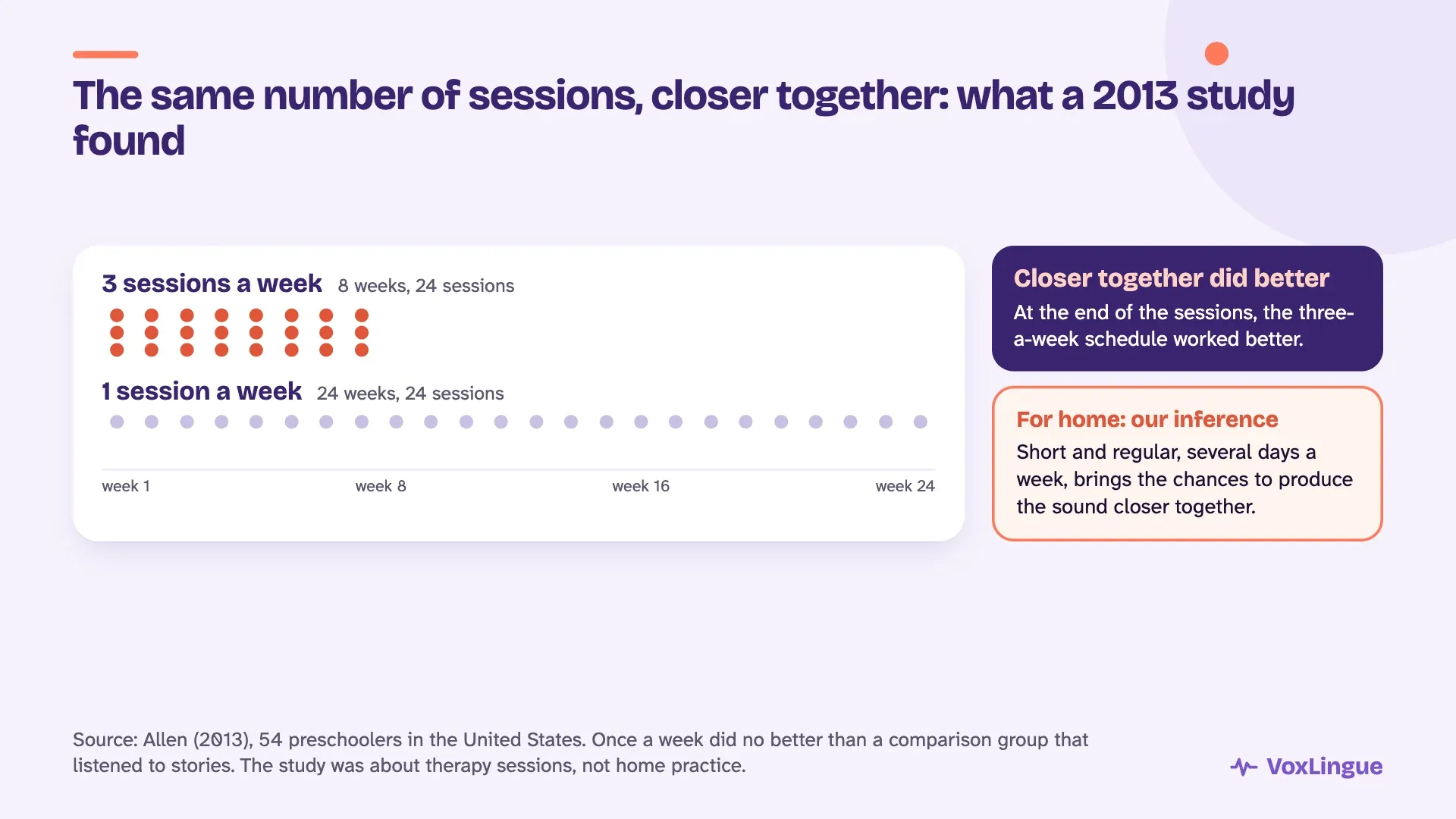
When sessions happen matters as much as how many there are. In Allen’s study of 54 preschoolers in the United States, the same number of sessions (24) was given two ways. Three sessions a week for 8 weeks worked better, at the end of the sessions, than one a week for 24 weeks.
Once a week did no better than a comparison group that listened to stories (Allen, 2013). For home, we draw one idea from this, and no more: short practice several days a week brings the chances to produce the sound closer together. Allen studied therapy sessions, not home practice.
Other studies point the same way. Ten-minute sessions, four times a week for 8 weeks, improved the English “r” in 13 English-speaking children aged 7 to 9 (Herbst and colleagues, 2025). The progress showed in syllables, not yet in words they hadn’t practised.
In 2 children with childhood apraxia of speech, more than 100 productions in 15 minutes led to faster progress than 30 to 40 (Edeal and Gildersleeve-Neumann, 2011). These studies are small and often involve older children. The Québec survey cited above is a reminder that little of this work involves French-speaking children. They still show one useful thing: many tries fit into a few minutes, when they are well organised.
A five-minute routine: what speech sound practice at home looks like
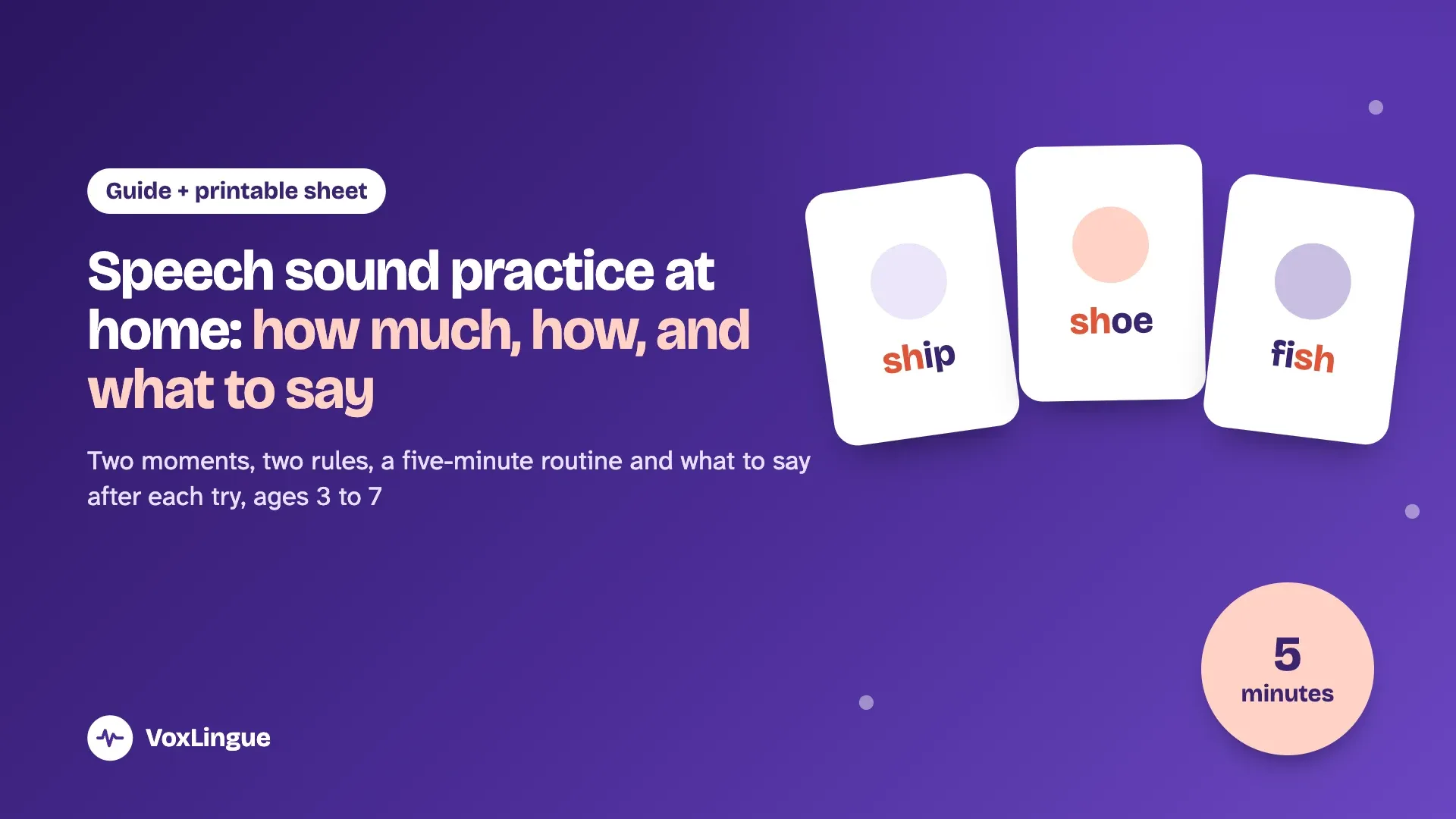
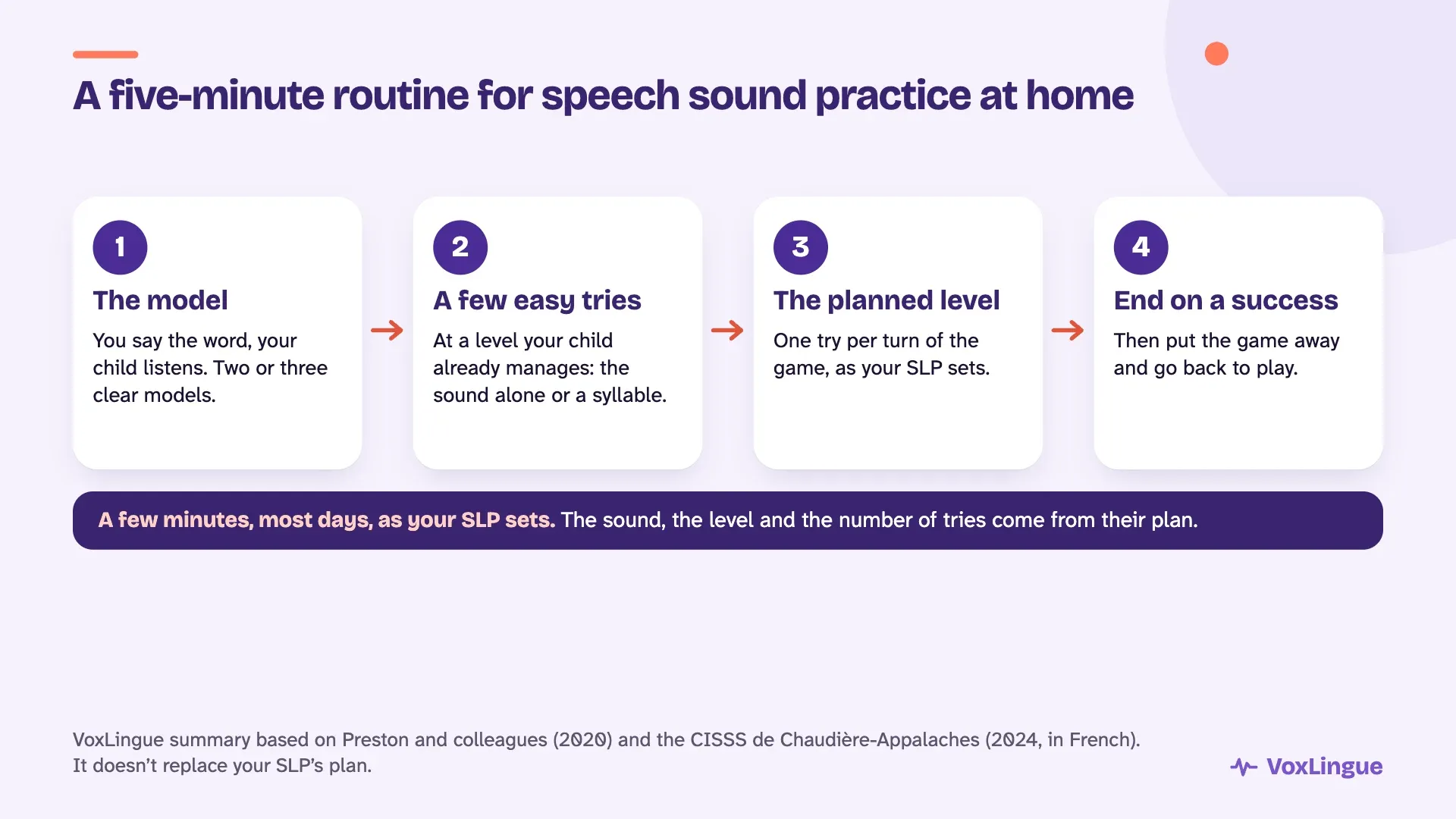
Five minutes is enough for a good number of tries when each turn of a game earns one. Start with the model and a few easy tries, work at the level your SLP set, then stop on a success, before your child gets tired of it.
Here is one way to organise those minutes. Adjust it with your SLP: their plan decides the sound, the level and the number of tries.
- You say the word, and your child listens. Two or three clear models are enough, without asking them to say it back.
- A few easy tries, at a level your child already manages, such as the sound alone or a syllable. Practice starts on a success.
- Tries at the level your SLP set, one try per turn of the game. This is the heart of the five minutes.
- Stop on a success, then go back to play or move on to something else.
The level changes over time. SLPs usually move a child from the sound alone to syllables, then words, short sentences and finally conversation. You move up when it has become easy, and back down when it’s too hard. Your SLP will tell you when to change.
A turn-taking game suits this routine well. Take a card game or a simple board game, and add pictures of words with the sound. For “sh”, that might be a ship, a shoe, a sheep or a fish. On their turn, your child names the picture they draw, then plays. On your turn, you name yours: they hear the model once more.
The game does the work. Your child plays to win, not to be tested, and every turn earns a try. A study of 2 children with childhood apraxia of speech showed that more than 100 productions can fit into 15 minutes (Edeal and Gildersleeve-Neumann, 2011). At home, the number stays the one your SLP planned.
Keep the routine predictable: same time, same game, same ending. Your child knows what to expect, and the five minutes become a habit rather than a negotiation.
Fitting the five minutes into your day: bath, car, snack, bedtime story
The five minutes don’t need a table and a worksheet. They fit into moments that come back every day. For language, Kimberly Martins suggests starting with bath time or the bedtime routine, and the same idea works here: a moment that already exists, one activity.
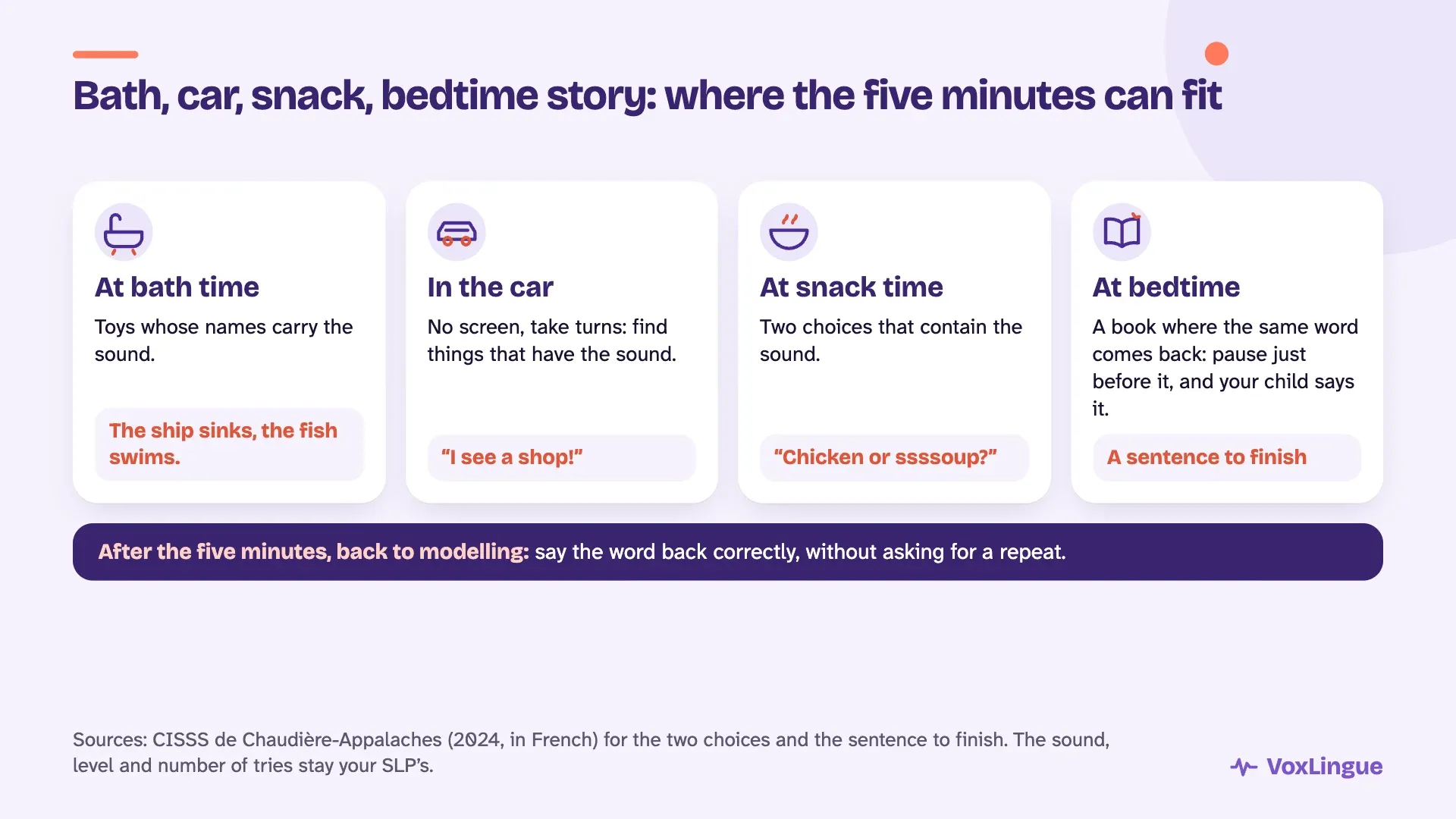
At bath time, choose toys whose names carry the sound. The ship sinks, the fish swims: your child names the toy they dunk, and you name yours. In the car, with no screen, take turns finding things that have the sound.
At snack time, offer two choices that contain the sound, as the CISSS de Chaudière-Appalaches SLPs suggest: “chicken or ssssoup?” At bedtime, choose a book where the same word comes back often. Pause just before that word, and let your child say it.
After those few minutes, conversation goes back to its usual rules. You say the word back correctly when they still say it differently, without asking them to say it again.
What to say after a try: right, almost right, not yet
When a try is right, say exactly what worked. When it’s almost right, name what was good and give the model again. When it’s not there yet, give the model again, go back to an easier level and praise the effort. Your SLP will tell you what to say for your child’s sound.
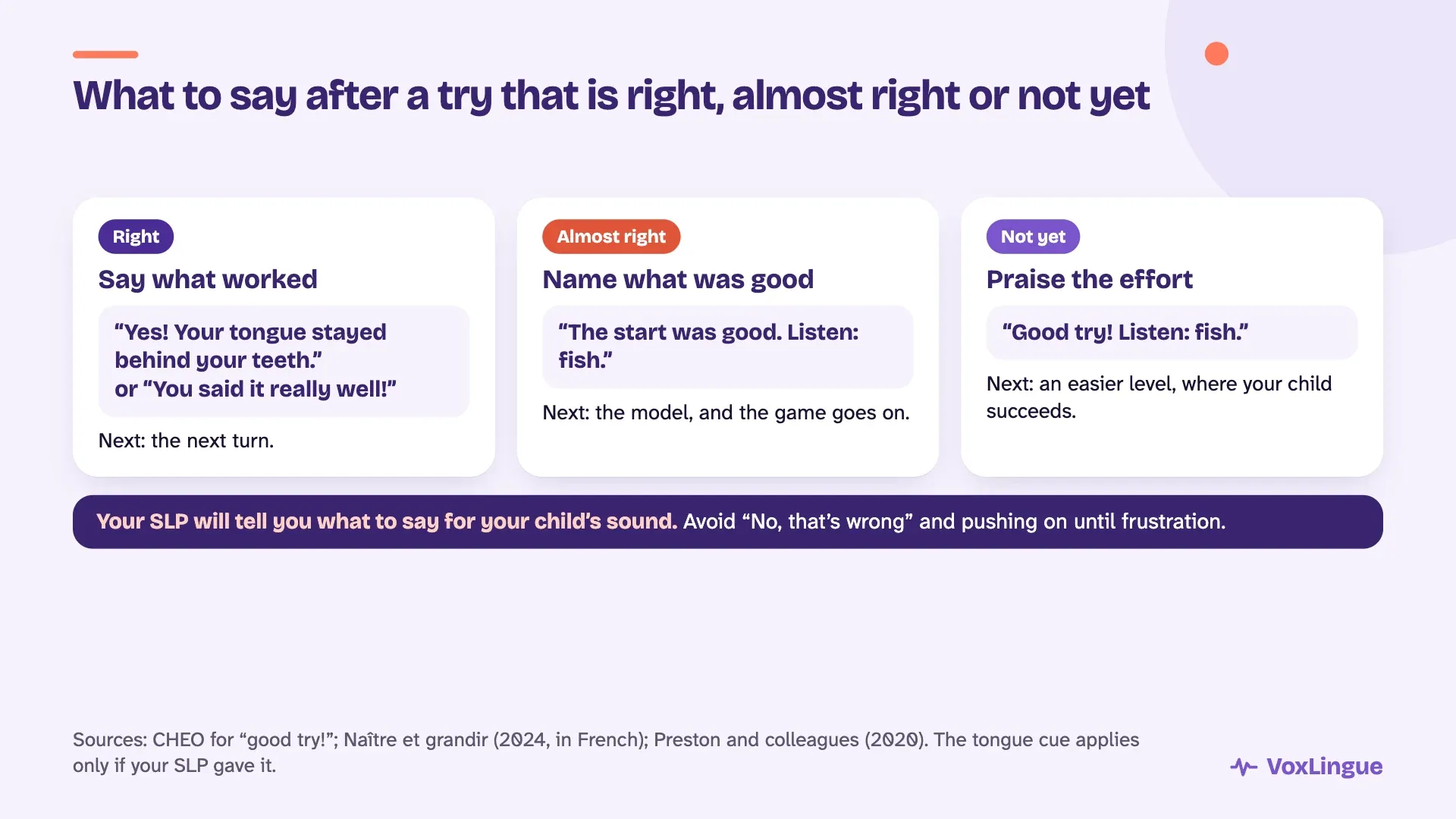
| Right | Almost right | Not yet | |
|---|---|---|---|
| What you say | “Yes! Your tongue stayed behind your teeth.” (if that’s the cue your SLP gave) or “You said it really well!” | “The start was good. Listen: fish.” | “Good try! Listen: fish.” |
| What you do next | Move on to the next turn | Give the model again, and the game goes on | Go back to an easier level, where your child succeeds |
| What you avoid | A vague “good job”, always the same | “No, that’s wrong.” | Pushing on the same word until frustration |
“Good try!” is CHEO’s phrase, and Naître et grandir suggests the French equivalents of “You said it really well!” and “You’re trying hard!” (2024, in French). They show the spirit of each column: name the success, or recognise the effort without pointing out the mistake.
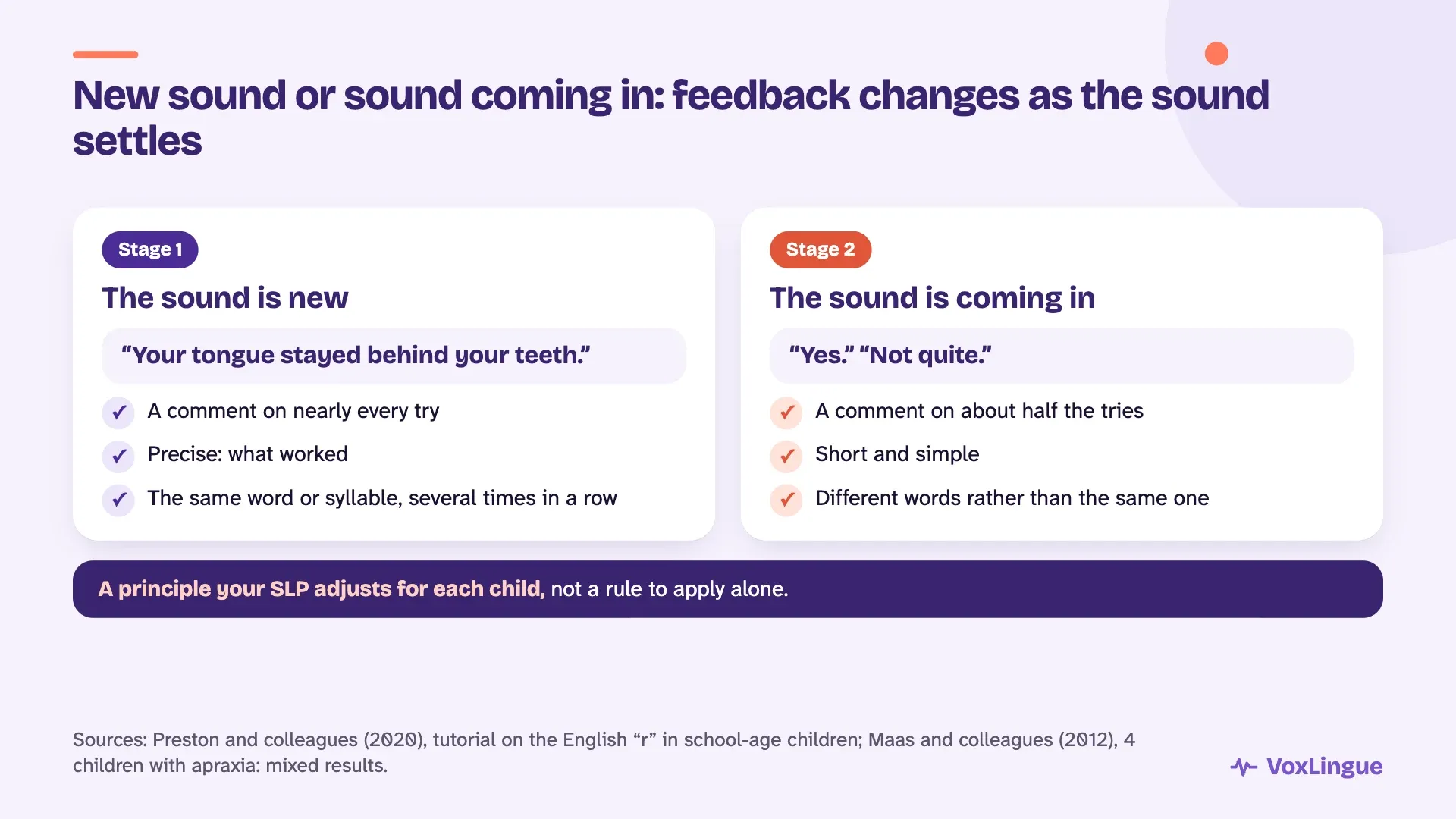
How you give feedback also changes over time. SLPs adapt their comments to where the sound is. A tutorial on the English “r” in school-age children describes the shift: precise, frequent comments at first, then fewer and simpler ones (Preston and colleagues, 2020). It’s a principle your SLP adjusts, not a rule to apply alone.
When the sound is new: say exactly what worked
Early on, your child needs to know what they did right. A general “good job” encourages, but it doesn’t tell them what to do again. A precise comment, like the cue your SLP taught you (“your tongue stayed behind your teeth”, for example), gives them something to do again on the next turn.
At this stage, SLPs often practise the same word or syllable several times in a row. They comment on almost every try and highlight the successes. At home, follow the cue your SLP gave you, in their own words if you can.
When the sound is coming in: less feedback, a simple “yes”
When the sound starts to come, comments become less frequent and simpler. Preston and colleagues describe going from a comment on nearly every try to one on about half of them. The words change too: a simple “yes” or “not quite” is enough. Words are then mixed instead of repeating the same one.
This principle comes mostly from research on learning movements outside speech. Results in children vary. In 4 children with childhood apraxia of speech, less feedback helped 2, more feedback helped 1, and 1 child did not progress (Maas and colleagues, 2012). That’s why your SLP adjusts this for each child.
After practice: say it back, don’t correct
Once the game is over, conversation rules come back. If your child still says “wed” for “red” at supper, simply say the word back: “Yes, your cup is red.” Practice was earlier.
Sometimes your child will use the new sound on their own, in an everyday word. Praise it once, simply, and carry on with the conversation. Don’t ask them to say it again so you can hear it: that moment belongs to them.
When to stop for the day, and what to do if your child refuses speech homework
Stop as soon as frustration rises, before tears, and end on a successful try. If your child often refuses, make it shorter, let them pick the game and talk to your SLP. Practice has to stay pleasant to work.
A few signs tell you it’s time to stop for today:
- your child gets angry, sighs, hides or says they “can’t”;
- they refuse to play or change the game to skip their turn;
- they are tired or hungry, or the day has been long;
- several missed tries come in a row, even with your model;
- the game has stopped being fun, for them or for you.
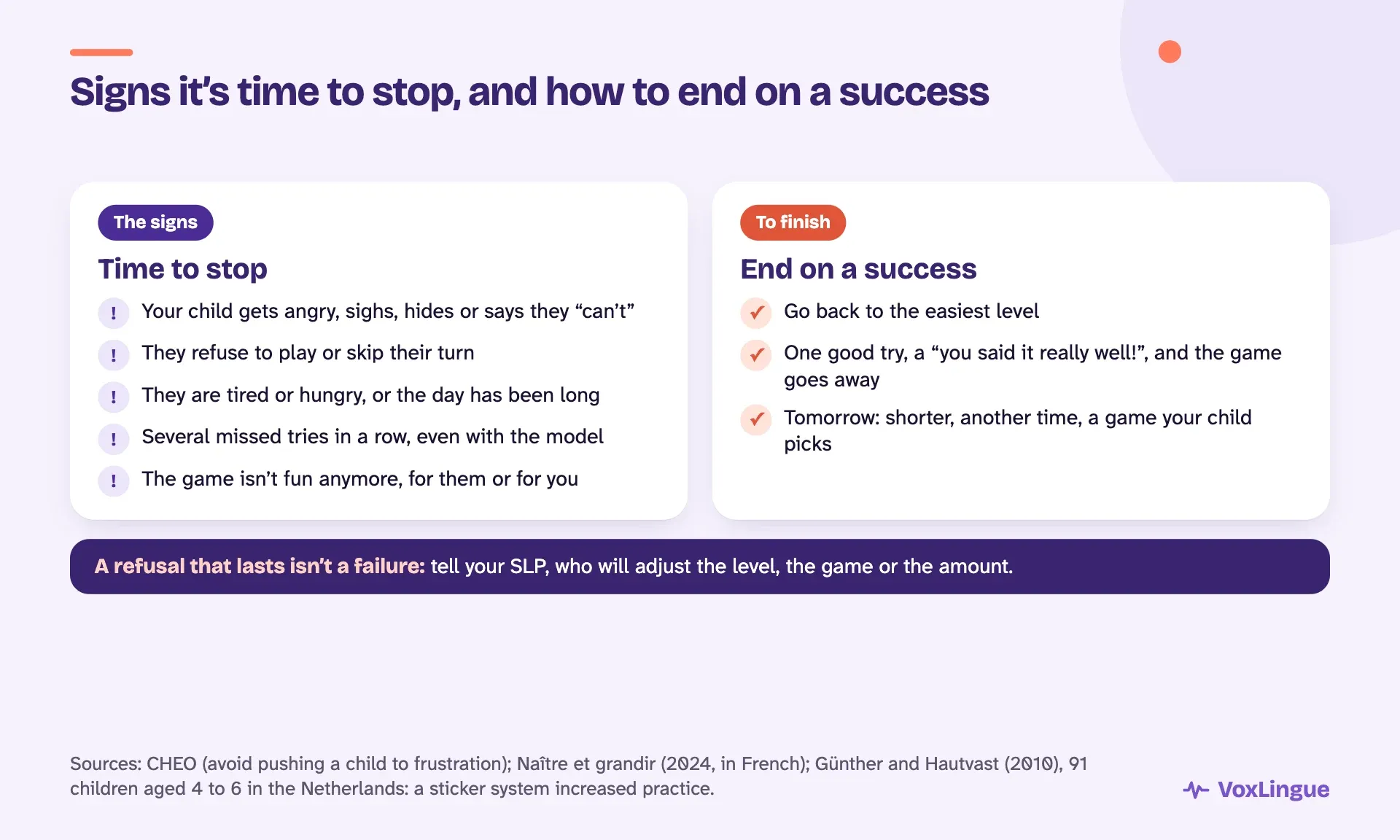
To end on a good note, go back to the easiest level, where your child succeeds every time. One good try, a “you said it really well!”, and the game goes away. If the moment doesn’t work, try another one tomorrow: after the bath rather than before supper, for example.
CHEO advises parents to avoid pushing a child to frustration. Naître et grandir adds that some children get angry when asked to repeat (2024, in French). Practice already takes effort, so it needs to stay short, predictable and pleasant. Forcing a child to keep going mostly teaches them that practice is unpleasant.
If your child often refuses, cut practice down to a few tries, and let them choose the game or the moment. A small reward system can also help. In the Netherlands, a study of 91 children aged 4 to 6 found that a simple sticker system increased the number of practice sessions done at home (Günther and Hautvast, 2010).
Tell your SLP as well. A refusal that lasts isn’t a failure on your part. It’s useful information that helps them adjust the level, the game or the amount.
Which sounds are often practised? Examples in English and Québec French
Sounds like “s”, “sh” and “r” and groups of consonants are often worked on. These are examples, not a timetable: your SLP chooses the sound, the level and when to start.
In English, a child might say “wed” for “red” or “poon” for “spoon”, examples from our guide to sound development, or “tootie” for “cookie”, CHEO’s example. A lisp is when “s” and “z” sound a bit like “th”. CHEO shows how to model a tricky sound in everyday talk, stressing it a little: “The robot is red.”
Many Montréal children practise in French at daycare or school. For those families, the SLPs of the CISSS de Chaudière-Appalaches give common examples in Québec French (2024, in French). “Ch” and “j” are often replaced: « sa » for chat (cat), « zaune » for jaune (yellow), « rouze » for rouge (red).
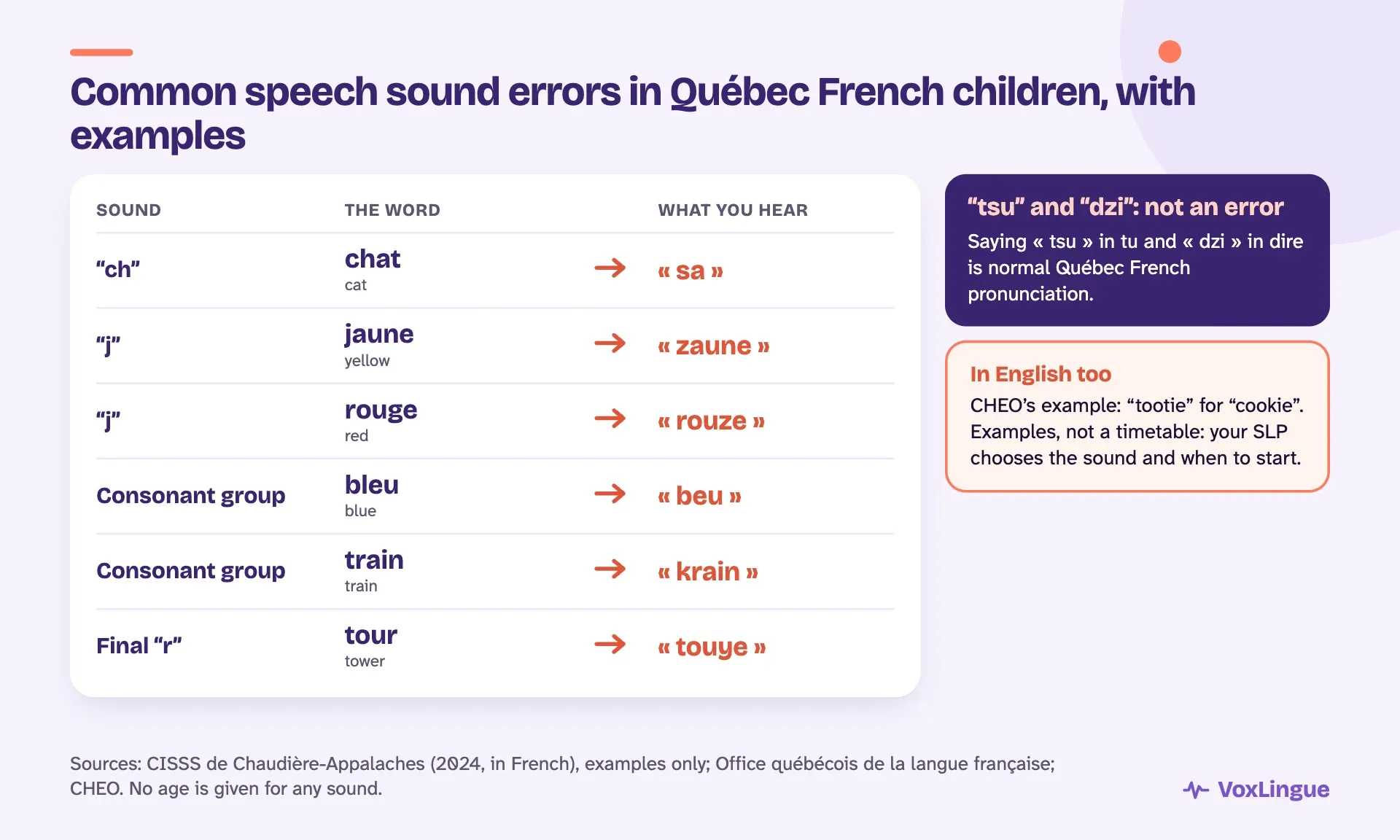
Groups of consonants get simplified or changed: « beu » for bleu (blue), « krain » for train. A final “r” can turn into another sound, as in « touye » for tour (tower). The same SLPs suggest asking about it if a child changes sounds other than these.
Some sounds are normal in Québec French and need no practice. When a child says « tsu » in tu or « dzi » in dire, they sound like the adults around them. The Office québécois de la langue française calls this pronunciation normal and usual for Québec speakers.
If your child makes several errors that follow the same pattern, our article on phonological patterns and games to work on them explains what’s going on. For the order sounds usually come in, see our guide. This article gives no age for each sound, on purpose: what matters here is the sound your SLP chose for your child.
What doesn’t help: blowing, tongue exercises and long sessions
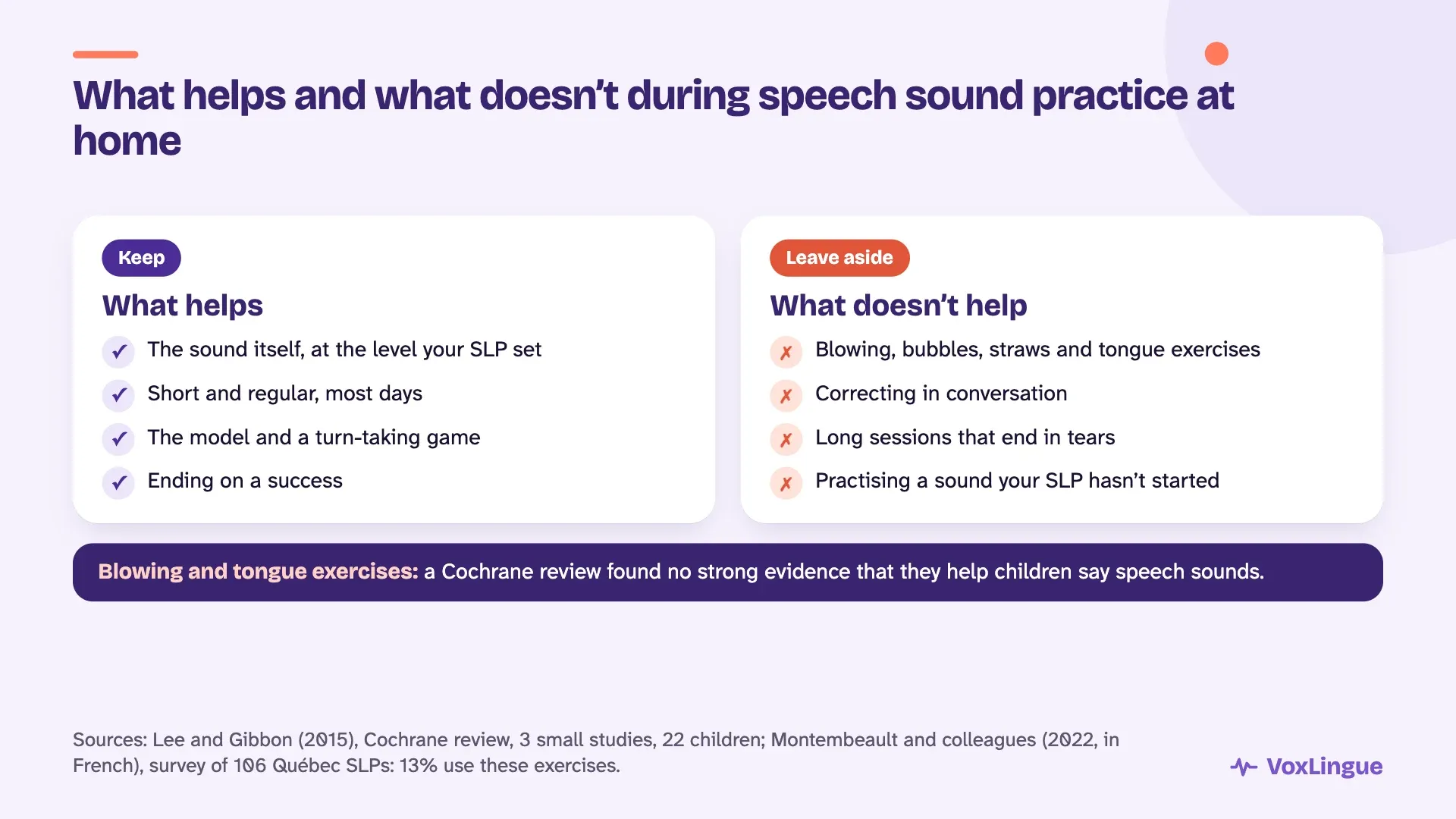
There is no strong evidence that blowing, bubbles or tongue exercises help children say speech sounds. Correcting in conversation, going on until tears or practising a sound too early don’t help either.
Blowing, lip and tongue exercises. Blowing through a straw, blowing bubbles, whistling or moving the tongue in front of a mirror are common exercises. A Cochrane review found 3 small studies, with 22 children in total. There is no strong evidence that these exercises help children say speech sounds, alone or added to therapy (Lee and Gibbon, 2015).
In Québec, a survey of 106 SLPs found that 95% knew these exercises, but only 13% used them. The study classes them among approaches with “proven ineffectiveness” (Montembeault and colleagues, 2022, in French).
Correcting in conversation. Pointing out the mistake at supper or asking for a repeat cuts the exchange short, as we saw above. The five minutes of practice are enough; for the rest of the day, you are a model.
Long sessions that end in tears. Twenty extra minutes don’t fix a practice that went badly. A session that ends badly makes the next one harder. Short and regular beats long and painful.
Practising a sound before your SLP has started it. In some approaches, a child first learns to hear the difference between two sounds, before producing them. Our article on phonological patterns makes the same point: don’t practise too early. Wait until your SLP tells you to start.
Childhood apraxia of speech: a specific plan
For childhood apraxia of speech, your SLP sets a very specific practice plan. Apraxia affects the planning of speech movements, and practice works differently than for other sound difficulties. This guide therefore gives no routine for apraxia.
Our guide to childhood apraxia of speech explains why therapy sessions hold the structured practice, while daily life holds the connection with your child. To learn more, see speech therapy for apraxia.
Two languages, school, online sessions: what changes for practice
In a bilingual family, practise the sound in the language your SLP chose. The rest of the time, speak the language you are most comfortable in. At school or online, the routine stays the same: just ask that everyone works on the same sound.
Sounds differ from one language to another. The French “r” and the English “r”, for example, are made differently. So your SLP chooses the language of practice along with the sound. During the five minutes, stay in that language.
For everything else, keep every language your family speaks. Your child needs a rich model, in the language you know best.
At school age, the school’s SLP may also send practice home. Ask that home and school work on the same sound, at the same level. In Ontario, CHEO’s school services ask families to support the care plan so that strategies and practice are consistent across home and school. In Québec, our article on who does what at school helps sort out the SLP and the orthopedagogue.
If sessions happen online, the home routine is the same. Thao and Lee’s review (2022) found that online therapy studies aimed for a number of tries similar to in-person sessions, based on few studies. To see how online sessions work, read about speech therapy by telepractice, and for toddlers, online speech therapy from 18 months to 3 years.
When to ask your SLP to adjust the plan
Talk to your SLP if practice is always missed or always too easy. Do so too if your child is unhappy with it or nothing changes after several weeks. Ask them to show you the model in a session: a plan that adjusts is normal.
These situations are worth raising:
- tries are almost always missed, even at the easiest level;
- it’s always too easy, and your child is bored;
- your child dislikes practice, or has refused it for weeks;
- nothing seems to change after several weeks of regular practice;
- you aren’t sure what model to give or what to say after a try.
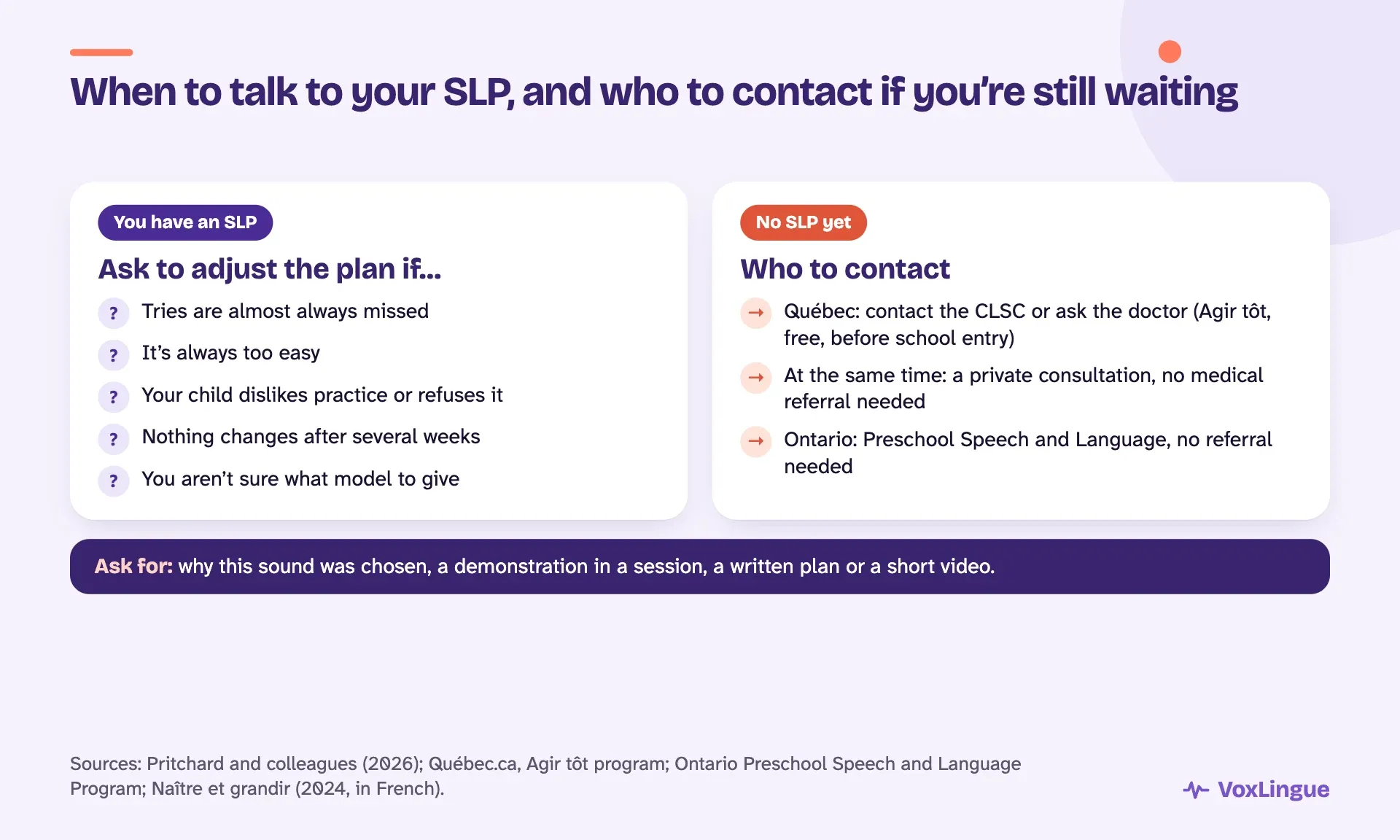
You can also ask for what would help you. Ask why this sound and this level were chosen. Ask for a demonstration during the session, a written plan or a short video of the game. In a study with nine parents in the United Kingdom, understanding the why and having clear roles helped practice (Pritchard and colleagues, 2026).
Follow-up on homework varies a lot from one SLP to another, according to a survey of SLPs in the United States (Tambyraja, 2020). So it’s normal to ask questions. Another study, with 15 SLPs in the United Kingdom, found that they aim for practice done as planned, and adapt it to each family (Pritchard and colleagues, 2026).
No SLP yet? Who to contact in Québec and Ontario
In Québec, start with the public network. Contact the CLSC or ask the doctor: the Agir tôt program offers free screening to children under 7, before they start school. At the same time, a private consultation, with no medical referral needed, tells you what is recommended without waiting. Naître et grandir also suggests a hearing check with an audiologist (2024, in French).
In Ontario, the Preschool Speech and Language program accepts children without a doctor’s referral. After school entry, services go through the school board. VoxLingue also offers telepractice for Ontario families.
While you wait, be a model in conversation and use the CISSS de Chaudière-Appalaches tips to get words without asking for them. Avoid drilling a sound before an SLP has seen your child. Our guide explains what you can do on the waiting list.
Key takeaways
Speech sound practice at home is a short moment, planned by your SLP, different from conversation.
- In conversation, don’t ask for a repeat: say the word back correctly.
- During the short practice, your child says the sound many times, in a game, at the level your SLP chose.
- The 50 to 100 tries in studies describe sessions with an SLP. At home, it’s a few minutes, most days, as your SLP sets.
- After each try, name what worked, give the model again, and end on a success, before tears.
- Blowing and tongue exercises have no strong evidence behind them; the time is better spent on the sound itself.
Next step
To learn more about therapy, see speech therapy for speech sounds. Our SLPs see families at our clinic in Marché Central, Montréal, and by telepractice across Québec and Ontario.
To keep the routine handy, print our sheet: a box to write down your SLP’s plan, the four steps, what to say after each try and the signs to stop.
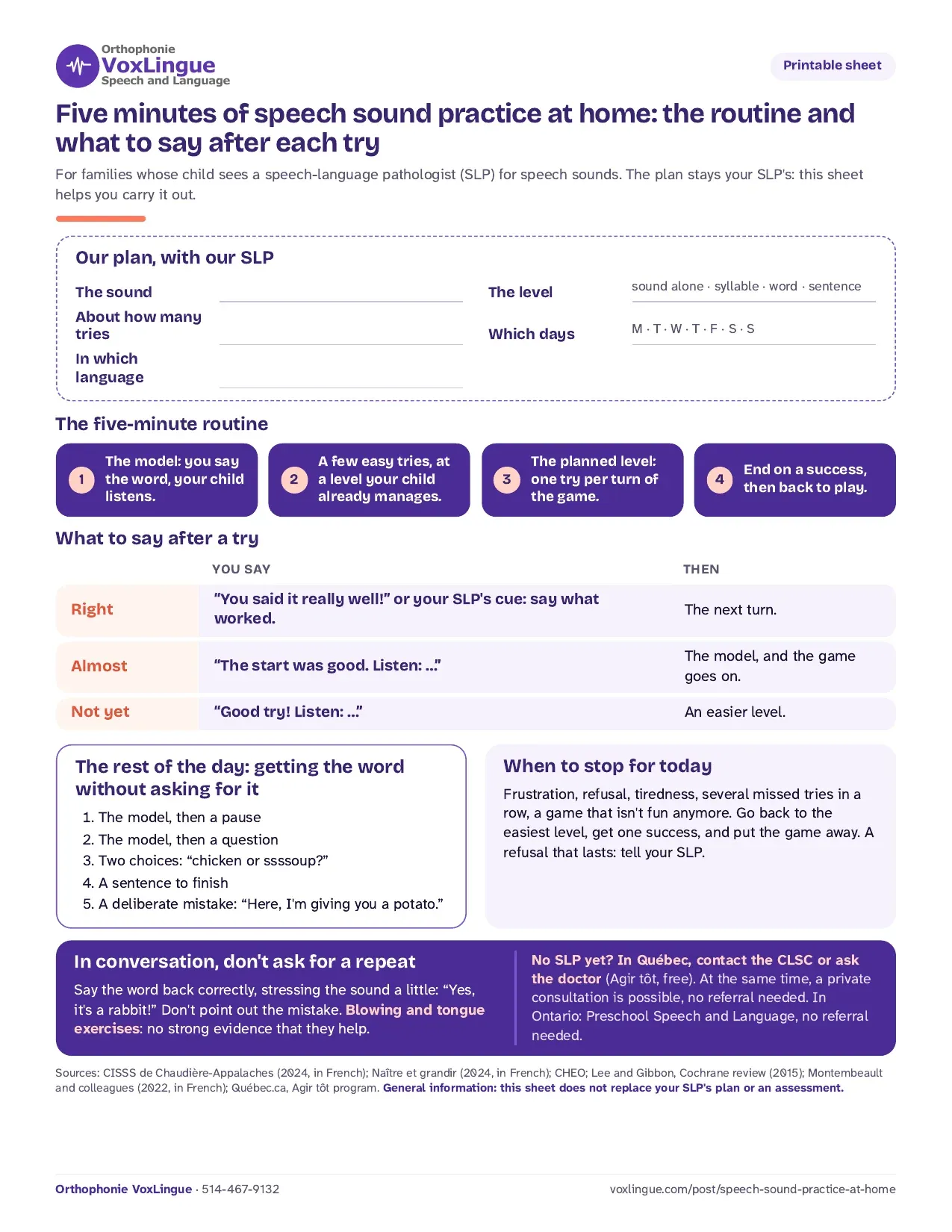
Printable sheet: Five minutes of speech sound practice at home: the routine and what to say after each try (PDF, 1 page).
Frequently asked questions
Does my child need to do speech homework every day?
Most days, as your SLP sets. Research suggests that short, regular practice works better than a long session now and then. A missed day is fine: regularity counts over the week. If your schedule doesn’t allow it, tell your SLP, who will adjust the plan.
How many repetitions should we do each time?
The number your SLP planned for your child. In studies, children made about 50 to 100 tries per session, with an SLP. Those are research figures, not a target for home. The “100 a day” figure you see online comes from no study we could find.
Is five minutes a day enough?
Five minutes is enough for plenty of tries when each turn of a game earns one. It’s not a promise of results: every child progresses at their own pace. Ask your SLP whether practice should be longer, shorter or more frequent for your child.
My child cries or gets angry during speech homework: what should I do?
Stop for today. Go back to the easiest level, get one good try and put the game away. Tomorrow, try something shorter, at another time, with a game your child picks. If tears come back often, tell your SLP: it’s useful information for adjusting the plan.
Should I correct my child when they say a word wrong?
No. In conversation, say the word back correctly, stressing the sound a little: “Yes, it’s a rabbit!” Don’t point out the mistake or ask them to repeat. Our article on how clear your child’s speech should be explains why.
Do oral motor exercises like blowing and tongue exercises help speech?
There is no strong evidence that they do. A Cochrane review found only 3 small studies, with 22 children, and no strong evidence of an effect on speech sounds (2015). In Québec, most SLPs surveyed in 2022 don’t use them. Practice time is better spent on the sound itself.
My child has a lisp: can we practise at home?
Yes, but only what your SLP has planned. Naître et grandir notes that a lisp often resolves well with an SLP’s help (in French). Your SLP chooses when to start, which cue to give and the level. Until then, simply say words back correctly in conversation, without asking for a repeat.
My child speaks French and says “tsu” and “dzi”: should we practise that?
No. Saying « tsu » in tu and « dzi » in dire is normal Québec French pronunciation, according to the Office québécois de la langue française. Your child sounds like the adults around them. There is nothing to correct or practise.
Can home practice replace therapy sessions?
No. It adds to sessions and follows your SLP’s plan, which sets the sound, the level and the amount. Studies that involved parents always kept sessions with an SLP. There is no guaranteed timeline: review progress with your SLP at each check-in. For what decides how often and how long therapy runs, see how many speech therapy sessions.
What can we do while we wait for speech therapy?
Be a model in conversation and use the tips for getting words without asking for them. Avoid drilling sounds before an SLP has seen your child. Contact the CLSC or ask the doctor, and consider a private consultation at the same time.