My 2-year-old has lots of words but isn't putting two words together yet: what counts as a phrase, when to consult, and how to help at home
Your 2-year-old has lots of words but isn’t putting two words together yet.
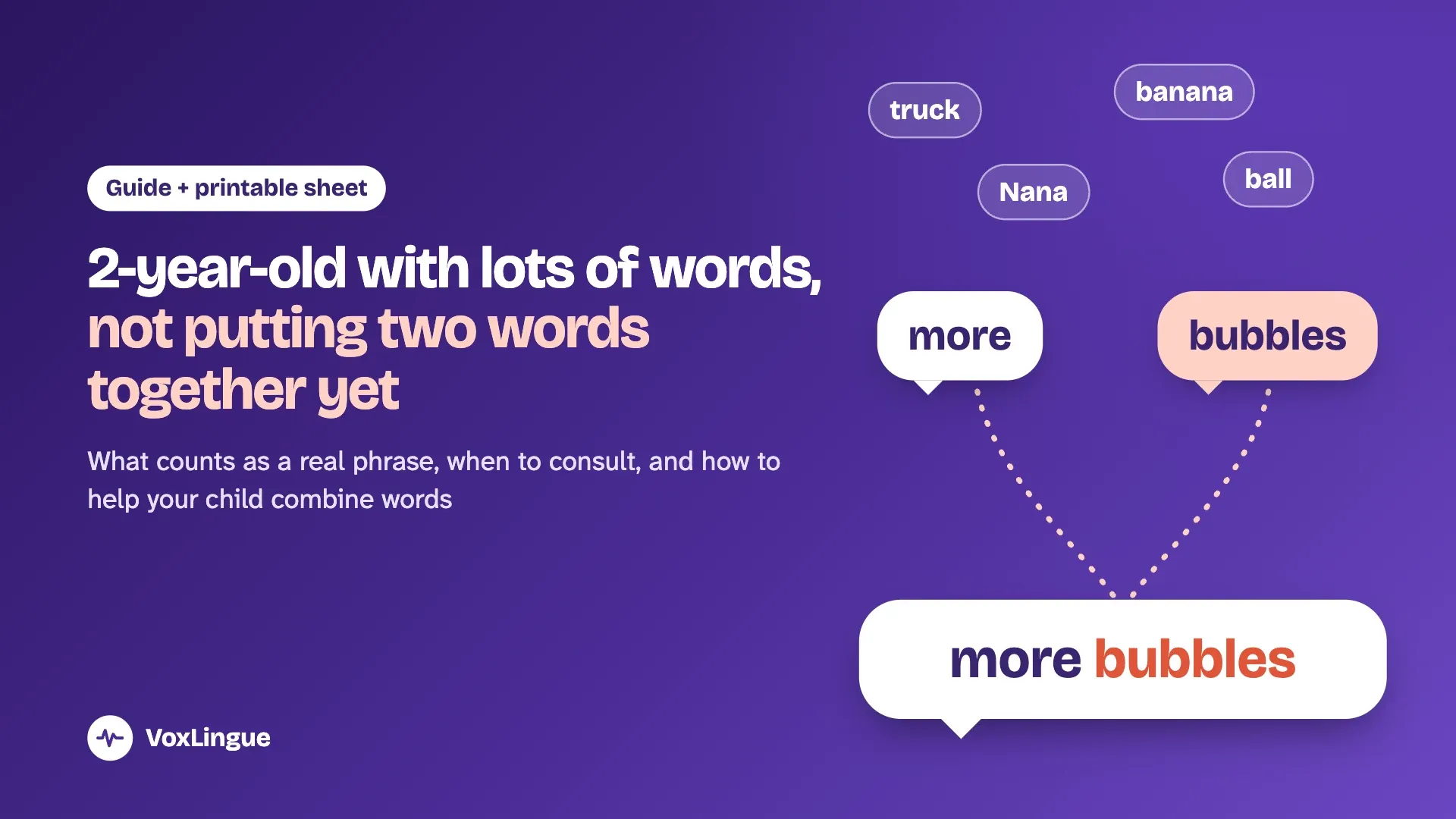
“Truck”, “banana”, “Nana”, “ball”, “more”… They name what they see and what they want, one word at a time, never two together. Is that normal, or should you worry?
Lots of words is good news. Putting two words together is a separate step, though, and it’s the one Québec’s reference points look at around 24 months.
This guide explains what counts as a real two-word phrase, why some vocabularies combine later, what else to look at, when to consult, and how to build the bridge at home. It’s part of our articles on early language and late talkers.
My 2-year-old has lots of words but isn’t putting two words together: is that normal?
Most children start putting two words together between about 18 and 24 months. These first phrases usually come once vocabulary has grown quite a bit, so lots of words is a good foundation. In Québec, the reference point is combining two words at 24 months: if your child isn’t there yet, take a closer look and talk to someone.
Québec sources describe the same sequence. Between 18 and 24 months, children start grouping words into two-word phrases (Naître et grandir, 2024, in French). The Ordre des orthophonistes et audiologistes du Québec (OOAQ) says the same.
Vocabulary comes first. Children often need to be using about 50 words before their vocabulary starts growing faster (Naître et grandir, 2024). Around age 2, expect 50 words or more, often many more, with all languages counted together. Sources give different numbers: our guide to language milestones from 0 to 5, and why sources give different word counts explains why.
The “vocabulary explosion” doesn’t happen to every child: in one study of 38 children, only a few showed a true sudden spurt (Ganger and Brent, 2004). And the 24-month reference point is about putting two words together, not about how many words.
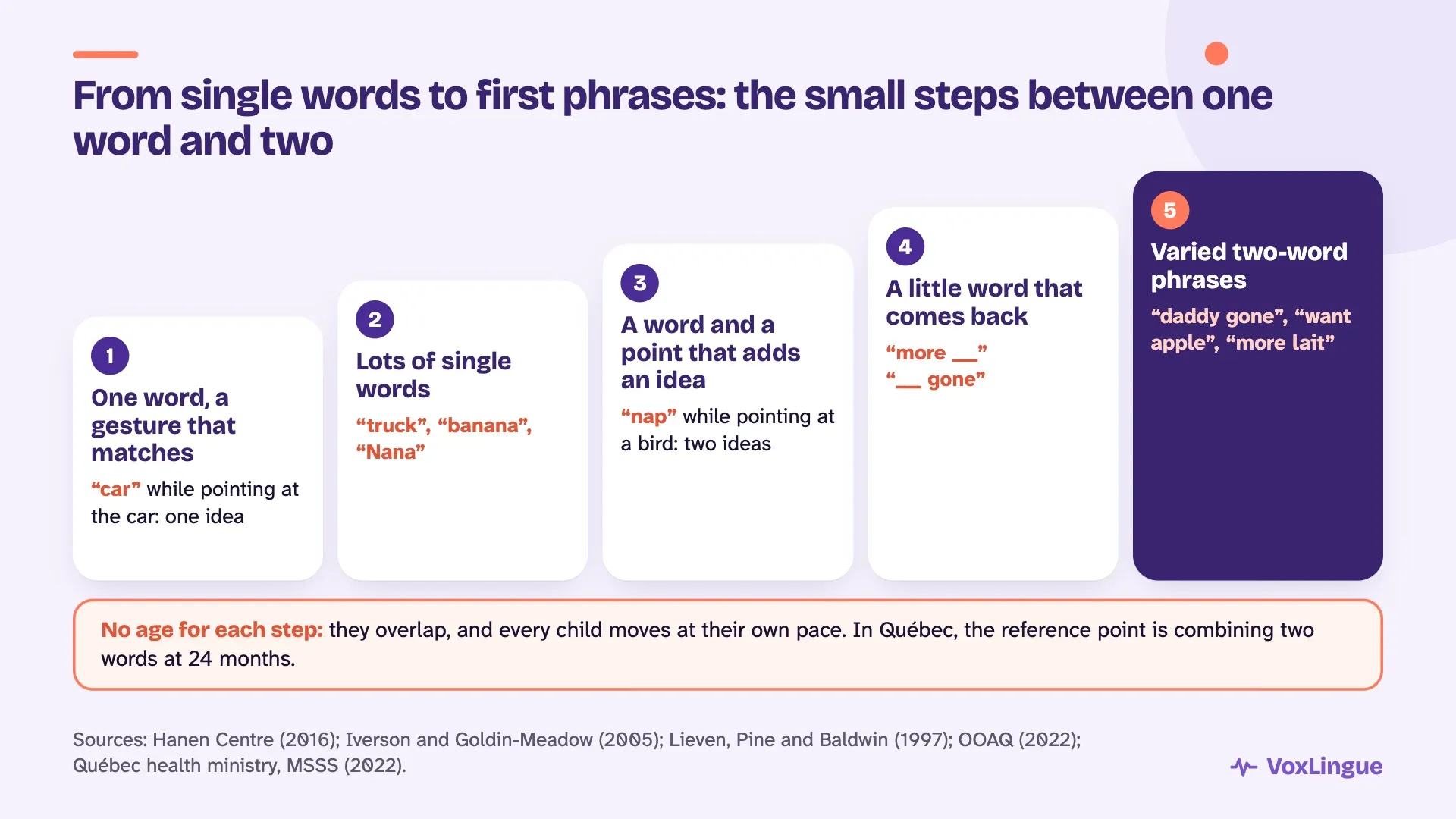
What counts as a real two-word phrase?
A real two-word phrase joins two ideas that your child put together on their own. “More bubbles” and “daddy gone” are good examples. Chunks learned as one piece, like “what’s that”, don’t show combining yet. One simple test helps tell them apart: can your child swap one of the two words?
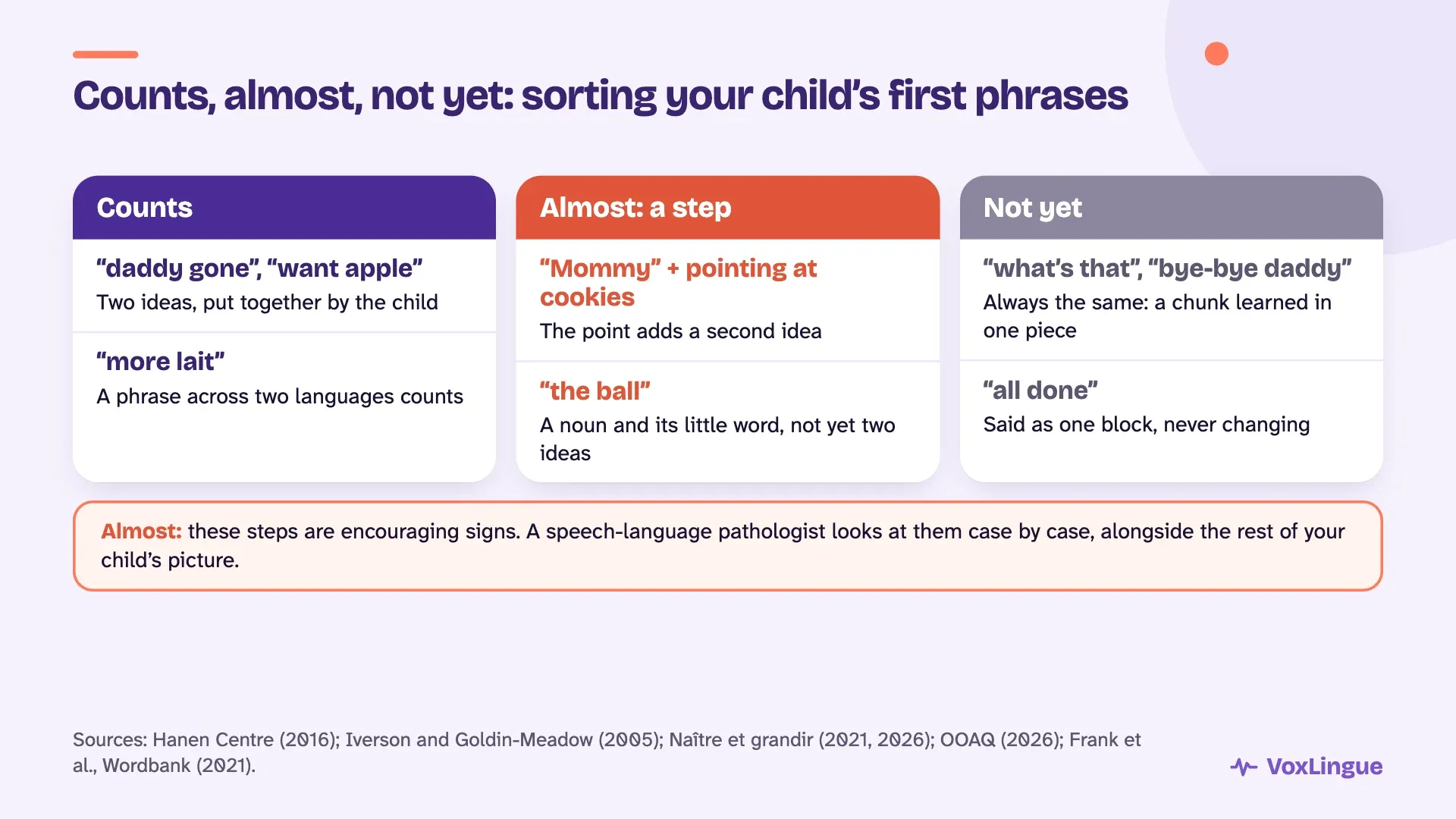
The Hanen Centre describes a true combination as two separate ideas (2016). The table sums up what counts, what is close, and what doesn’t count yet.
| What your child says | Where it fits | Why |
|---|---|---|
| “daddy gone”, “want apple”, “more bubbles” | Counts | Two ideas, put together by the child; one word can change |
| “more lait”, “encore milk” | Counts | A phrase across two languages is still a two-word phrase |
| “Mommy” while pointing at the cookies | A step toward phrases | The point adds a second idea |
| “the ball” | A step toward phrases | A noun with its little word, not yet two ideas |
| “what’s that”, “bye-bye daddy”, always the same | Not yet | A chunk learned in one piece that never changes |
The swap test: can your child change one of the two words?
If your child can swap one of the two words, they are really combining. If they say “more milk” at breakfast, then “more bubbles” at the park, they’ve worked out that “more” can attach to other words. The same goes for “daddy gone” turning into “kitty gone” or “truck gone”.
In 11 children followed from age 1 to 3, many first phrases were built around a few familiar words that kept the same slot, like “more ” or “ gone”. Most others were frozen phrases learned in one piece (Lieven, Pine and Baldwin, 1997). Hanen’s article on combining words together explains the difference for parents.
Jot down every combination you hear for a week on a sheet on the fridge. A phrase that always comes out the same way is probably a chunk.
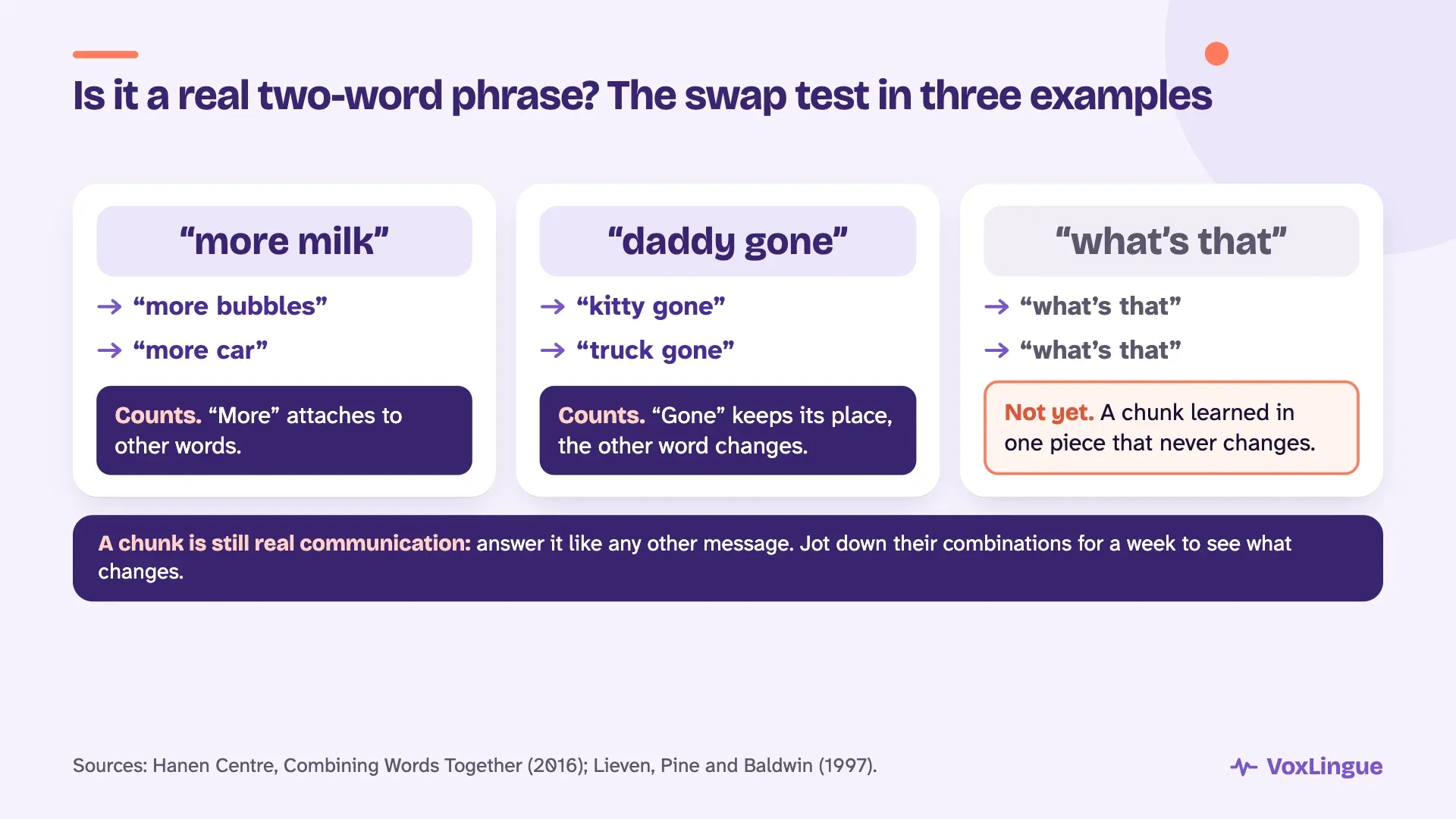
“What’s that”, “all done”, “bye-bye daddy”: memorised chunks
Chunks learned in one piece don’t show combining yet. “What’s that”, “all done” or “bye-bye daddy” sound like two or three words. Often, though, your child learned them as one unit. Hanen gives “thank you” and “night night” as examples: the child can’t yet pull the parts apart to reuse them, so they don’t say “thank Mom” (2016).
So does “all done” count as two words? If it only ever comes out as one block, it probably works like a single word for now.
Chunks are still real communication: your child uses them to get your attention, ask or say goodbye. Answer them like any other message: “It’s an owl! A big owl.”
“The ball”, a word and a point: steps toward phrases
“The ball” and a word paired with a pointing gesture are steps toward phrases. In English, “the ball” raises a small version of the same question: a noun with its little word, not yet two ideas.
In French, little words like « le » or « la » come gradually, with more and more of them between 2 and 2½ (Naître et grandir, 2026). In a large international database, Québec French-speaking parents reported their child “combining” with very few words; the authors think the questionnaire item may have been misread (Frank et al., 2021).
Pointing plays a similar role. Saying “nap” while pointing at a bird expresses two ideas: the bird, and what it’s doing. In a small study, the children who made these word-and-point combinations first were also the first to put two words together (Iverson and Goldin-Meadow, 2005).
Both are encouraging signs worth noting. A speech-language pathologist looks at them case by case, alongside the rest of your child’s picture.
Mixed-language phrases count
A phrase that mixes two languages, like “encore milk”, counts as a two-word phrase. Our article on a child who mixes French and English explains why that’s normal. The OOAQ notes that using two languages in the same sentence is usually not a cause for concern (2026, in French). Bilingual children start combining words at the same ages as other children, between 18 and 24 months (OOAQ, 2026).
Look at your child’s phrases in each language, and at the ones that mix both (Naître et grandir, 2021). Don’t compare phrase length across languages: in Montréal, French-speaking toddlers produced longer utterances than English-speaking peers, with fewer different words (Thordardottir, 2005).
Why doesn’t a toddler with lots of words put them together yet?
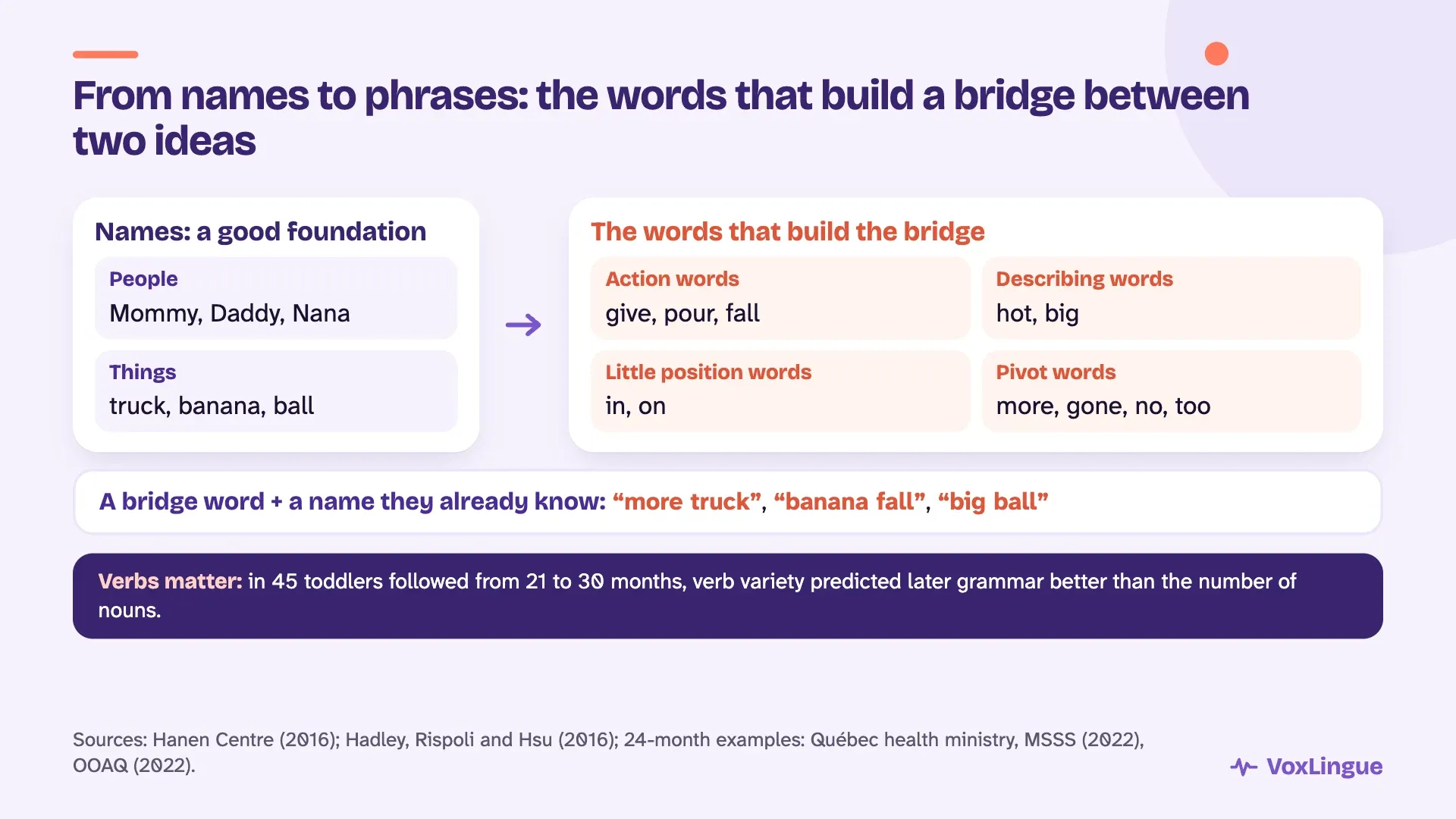
Phrases depend on vocabulary size, and also on the kind of words. A vocabulary made mostly of names, like “truck” or “banana”, offers few ways to link two ideas. Action words and a few little words like “more” or “gone” act as the bridge.
In a database covering 12 languages, early grammar closely tracks vocabulary size (Frank et al., 2021). Children who combine words often already have well over 50 words.
Lots of nouns, few action words
Action words seem to matter more than the number of nouns. In 45 toddlers followed from 21 to 30 months, the variety of verbs they used predicted later grammar better than the number of nouns they knew (Hadley, Rispoli and Hsu, 2016). Verbs like “give”, “fall” or “eat” naturally link two ideas: who does what.
A child with mostly nouns hasn’t done anything wrong: they’re missing the words that connect them. Write down your child’s last 20 new words, then sort them into people, things, actions, describing words and little words. If almost everything lands in “people” and “things”, you know what to add.
The little words that build the bridge
Some little words help a child link ideas. Hanen lists action words (“give”, “pour”, “go”), describing words (“hot”, “big”) and little position words (“in”, “on”). Each one can attach to a name your child already knows (2016).
Pivot words, like “more”, “gone” or “no”, stay in place while the other word changes. Québec’s own 24-month examples are built on them. The Québec health ministry uses « fini dodo » (all done sleeping) and « veux lait » (want milk); the OOAQ and the daycare milestone grid use « papa parti » (daddy gone).
What else should I look at besides phrases at 2?
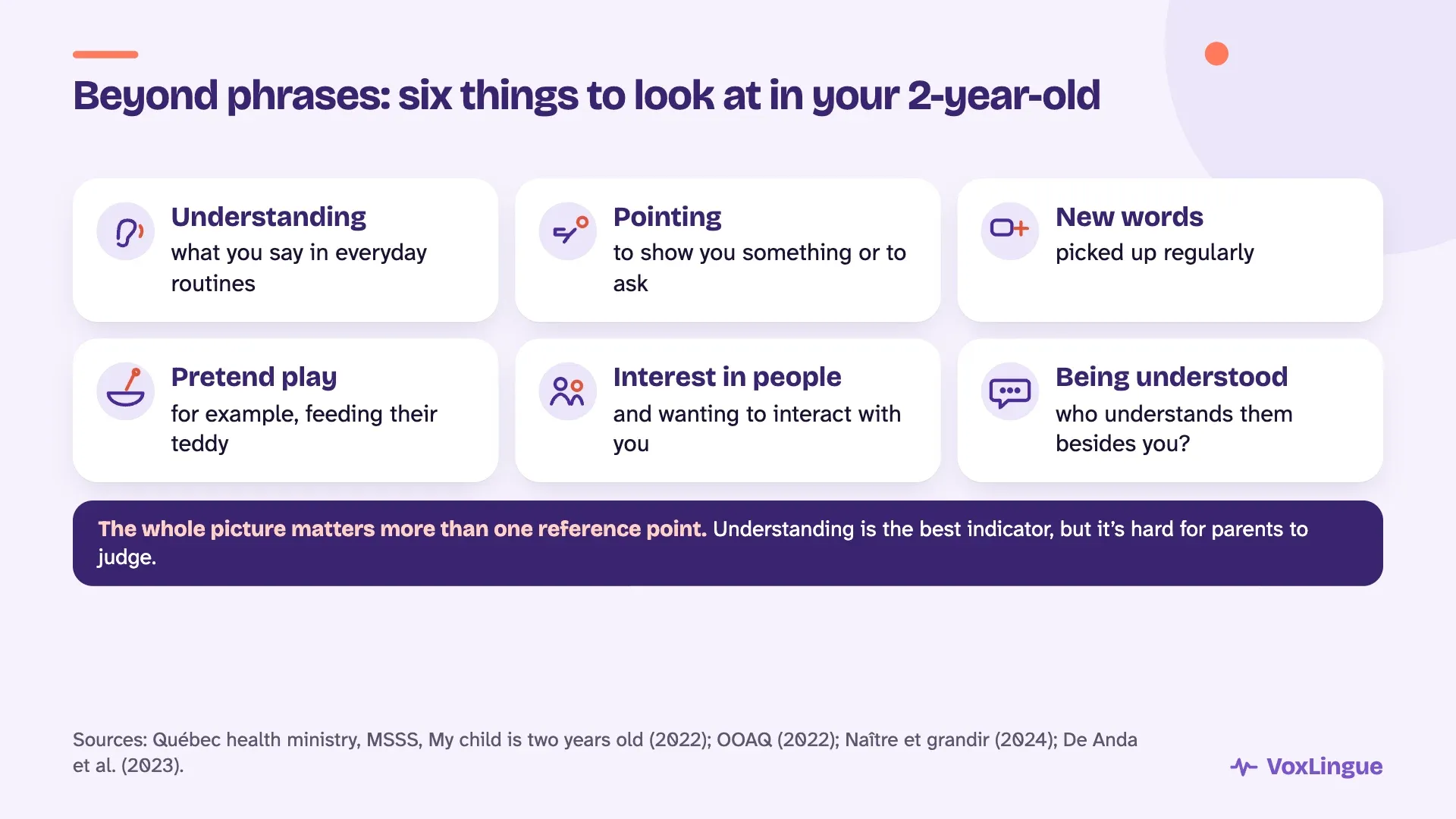
Phrases are only one piece of your child’s picture. Also look at whether they understand what you say, point and use gestures, learn new words, play pretend and want to interact with you. The whole picture matters more than any single reference point.
In a study of 52 bilingual toddlers, the timing of first combinations alone didn’t pick out the children who had language difficulties (De Anda et al., 2023). Alongside phrases, watch for:
- understanding: do they follow what you say in everyday routines?
- gestures: do they point to show you something or to ask?
- new words: are they picking up new ones regularly?
- play: do they pretend, for example feeding their teddy?
- people: are they interested in others, and do they seek you out to interact?
- being understood: who understands them besides you? See how much others should understand at each age.
Pretend play and interest in people are part of what the Québec health ministry describes at age 2 (2022). Understanding is the best indicator of lasting difficulties, but it’s hard for parents to judge (OOAQ, 2022). Our newsletter explains why understanding and talking are different skills.
If your toddler seems to understand everything but won’t put words together, look at the rest of the picture.
No two-word phrases at 2: when to consult, and who to contact?
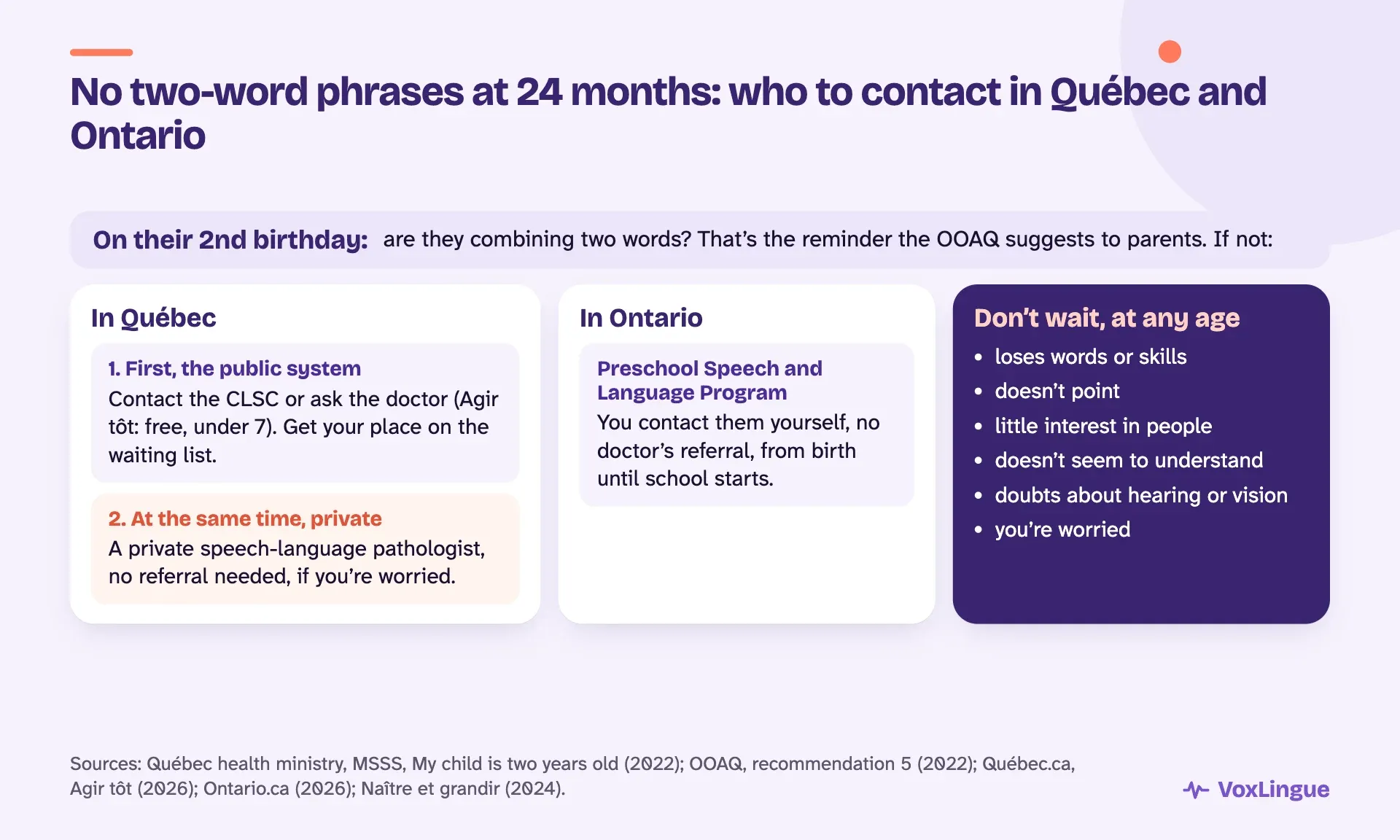
In Québec, if there’s no two-word phrase at 24 months, contact the CLSC or ask the doctor. That’s the reference point of the Québec health ministry (MSSS) and the OOAQ. Don’t wait for 24 months if you’re worried. A private consultation can happen at the same time.
This reference point is about combining words, not counting them. NHS Scotland’s guidance for the 27 to 30 month review says it plainly: children who have over 50 words but have never linked two words together are also a concern. You don’t need to wait for a set age to consult a speech-language pathologist (Naître et grandir, 2024).
In Québec: the 24-month reference point and Agir tôt
The MSSS handout for parents of 2-year-olds names this reference point clearly. It asks you to contact your doctor, nurse practitioner or CLSC if your child is not yet making two-word sentences at 24 months, or if you’re concerned (My child is two years old, 2022).
The OOAQ even suggests a phone reminder on your child’s 2nd birthday: are they combining two words? If not, contact the CLSC (2022). The daycare 24-month grid includes it too; read when daycare raises a language concern.
Agir tôt is free and serves children under 7. You contact your CLSC directly, and a doctor can also refer your child with your consent (Québec.ca, 2026). Sign up in the public system first to get your place on the waiting list. If you’re worried, see a private speech-language pathologist at the same time, no referral needed.
Read what happens on the public waiting list, or book a speech and language assessment.
In Ontario: preschool speech and language, no referral needed
In Ontario, you can contact the Preschool Speech and Language Program yourself. It serves children from birth until they start school, and you don’t need a doctor’s referral (Ontario.ca, 2026).
In Ottawa, the local program, First Words, expects a child at 24 months to consistently combine two or more words in short phrases, like “daddy hat” or “truck go down”. Our speech-language pathologists also work with Ontario families by telepractice.
When not to wait
Some signs mean it’s worth consulting right away, whatever your child’s phrases. Contact the CLSC or ask the doctor without waiting if your child:
- loses words or skills they used to have;
- doesn’t point to show or ask;
- shows little interest in other people;
- doesn’t seem to understand what you say;
- leaves you with doubts about their hearing or vision;
- worries you, even without a specific sign.
These signs come from the MSSS (2022) and Naître et grandir (2024). For what we know about how difficulties evolve, read late talker or DLD: what we know about how difficulties evolve.
How can I help my 2-year-old put two words together?
Answer each single word with a short phrase that adds just one word. Use a few pivot words like “more”, “gone”, “no” and “too” often, offer choices, then wait. Don’t ask your child to repeat: say the word, pause, then give, even if they said nothing.
Parents can learn these strategies. In a trial with 97 toddlers, trained parents greatly increased how often they expanded what their child said. Their children understood more and used more different words, with no difference on the overall expressive test (Roberts and Kaiser, 2015). The effects are real but modest.
For routines, books and play, see everyday strategies for routines, books and play. Here we focus on one step only: the bridge from one word to two.
Add one word, just one
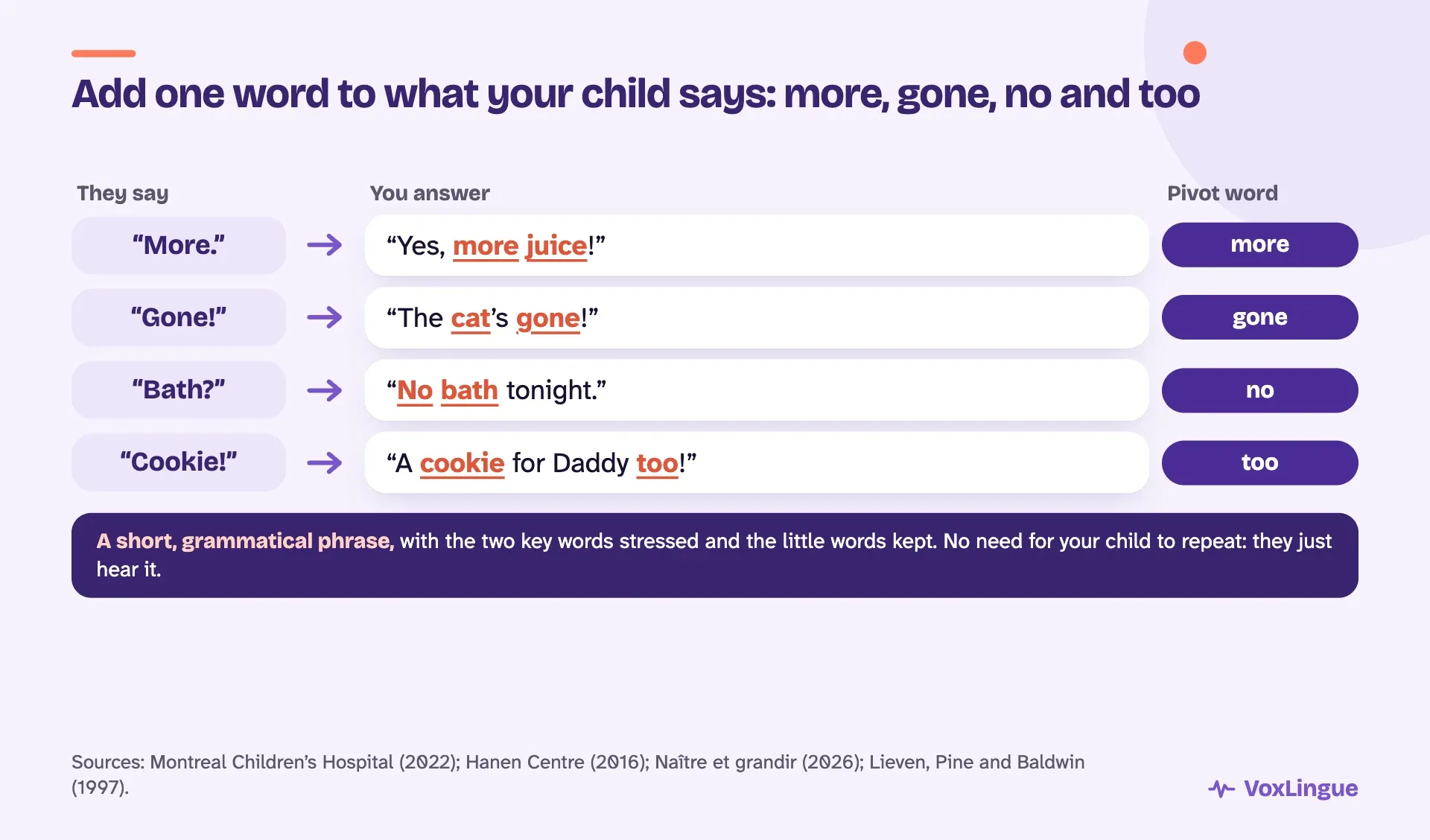
When your child says one word, answer with a short phrase that adds one more. If they say “more”, answer “Yes, more juice!” You show them how to stretch what they say without asking them for anything.
Keep your phrases short and grammatical, not baby talk (Montreal Children’s Hospital, 2022). Stress the two key words, “more” and “juice”, without dropping the little words. Repeating and expanding what a child says is supported by limited but positive evidence (Cleave et al., 2015).
Pivot words: “more”, “gone”, “no”, “too”
A pivot word is a little word you attach to lots of names. “More” works at breakfast, in the bath and at the park: more juice, more water, more pushes. Your child hears the same little word with different names.
Pick three pivot words for the week: “more”, “gone”, “no”, “too”, “all done” or “want”. With “gone”, say “The cat’s gone!” when it leaves the room. With “no”, “No bath tonight.” With “too”, “A cookie for Daddy too!” No need for your child to repeat them.
Action words, not only names
Describe what your child is doing, while they’re doing it: “You’re jumping! You’re pouring!” Describing their actions helps them learn verbs, which will help them build phrases (Naître et grandir, 2026).
Link actions to the things they already name. If they say “car”, answer “The car goes!” as it rolls.
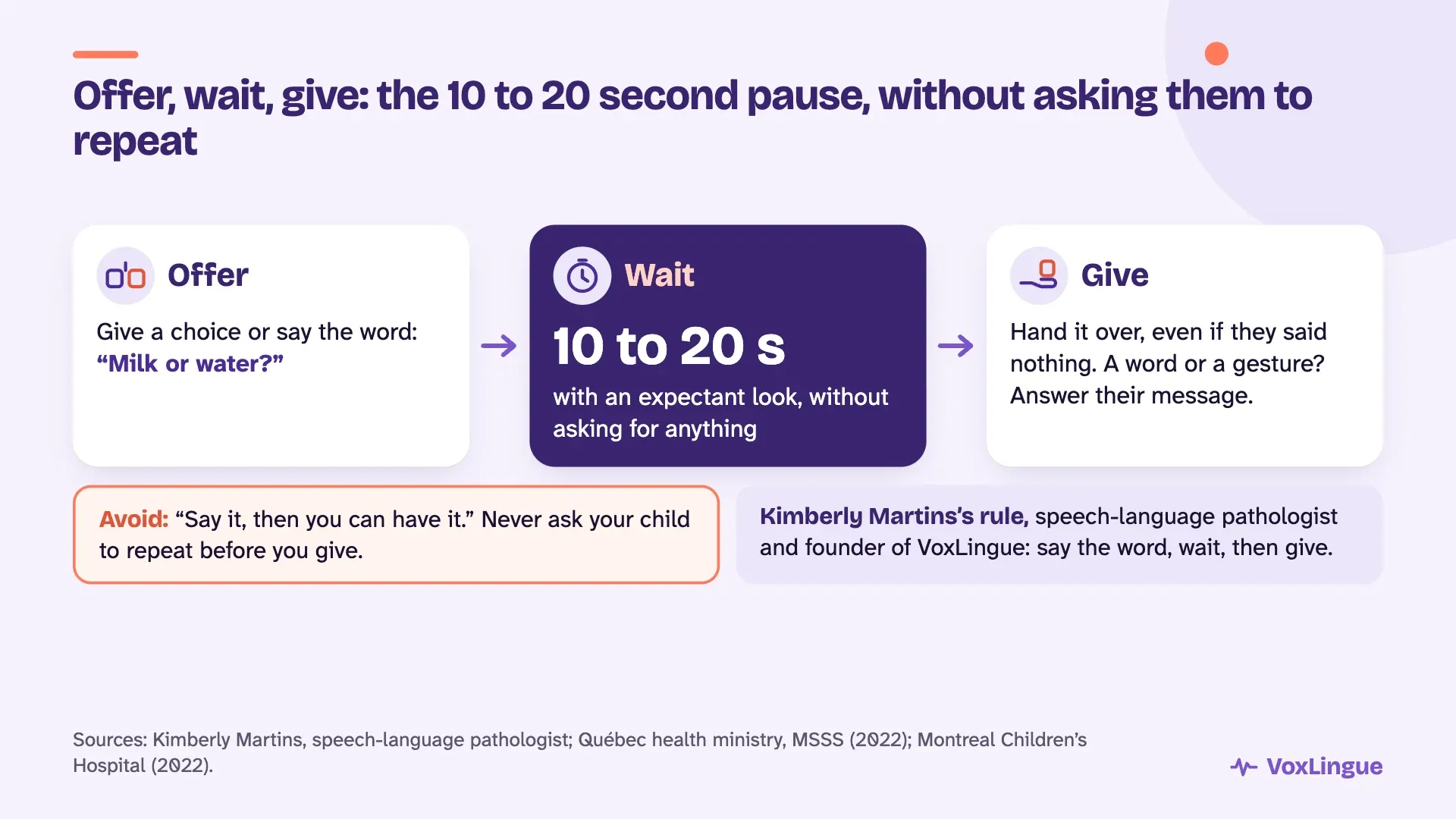
Choices and a pause, without “say it”
Offer choices, then give your child time to answer. “The red shirt or the blue one?” The MSSS recommends giving children the chance to make choices (2022).
Don’t ask your child to repeat before you give them what they want. For Kimberly Martins, speech-language pathologist and founder of VoxLingue, that habit has to stop right away. Say the word yourself, wait 10 to 20 seconds, then give it, even if they said nothing.
Test questions like “What’s that?” also turn the moment into a quiz. Swap them for a comment: “Oh, a dog! It’s running.”
Key takeaways
If your 2-year-old isn’t putting two words together yet, keep these points in mind:
- Lots of words is a good foundation; putting two words together is a separate step.
- A real two-word phrase joins two ideas: if your child can swap one of the words, they’re combining.
- Action words and pivot words, like “more” or “gone”, build the bridge to phrases.
- In Québec, with no two-word phrases at 24 months, contact the CLSC or ask the doctor, and see a private speech-language pathologist at the same time if you’re worried. In Ontario, you can refer your child yourself.
- At home, add one word, offer choices, wait, then give, without asking your child to repeat.
Next step
For coaching with these strategies, learn about parent coaching inspired by Hanen programs. If the 24-month reference point has passed without two-word phrases, an assessment can tell you where things stand. Our speech-language pathologists see families at our Marché Central clinic in Montréal, and by telepractice across Québec and Ontario.
Our fridge sheet keeps the essentials at hand.
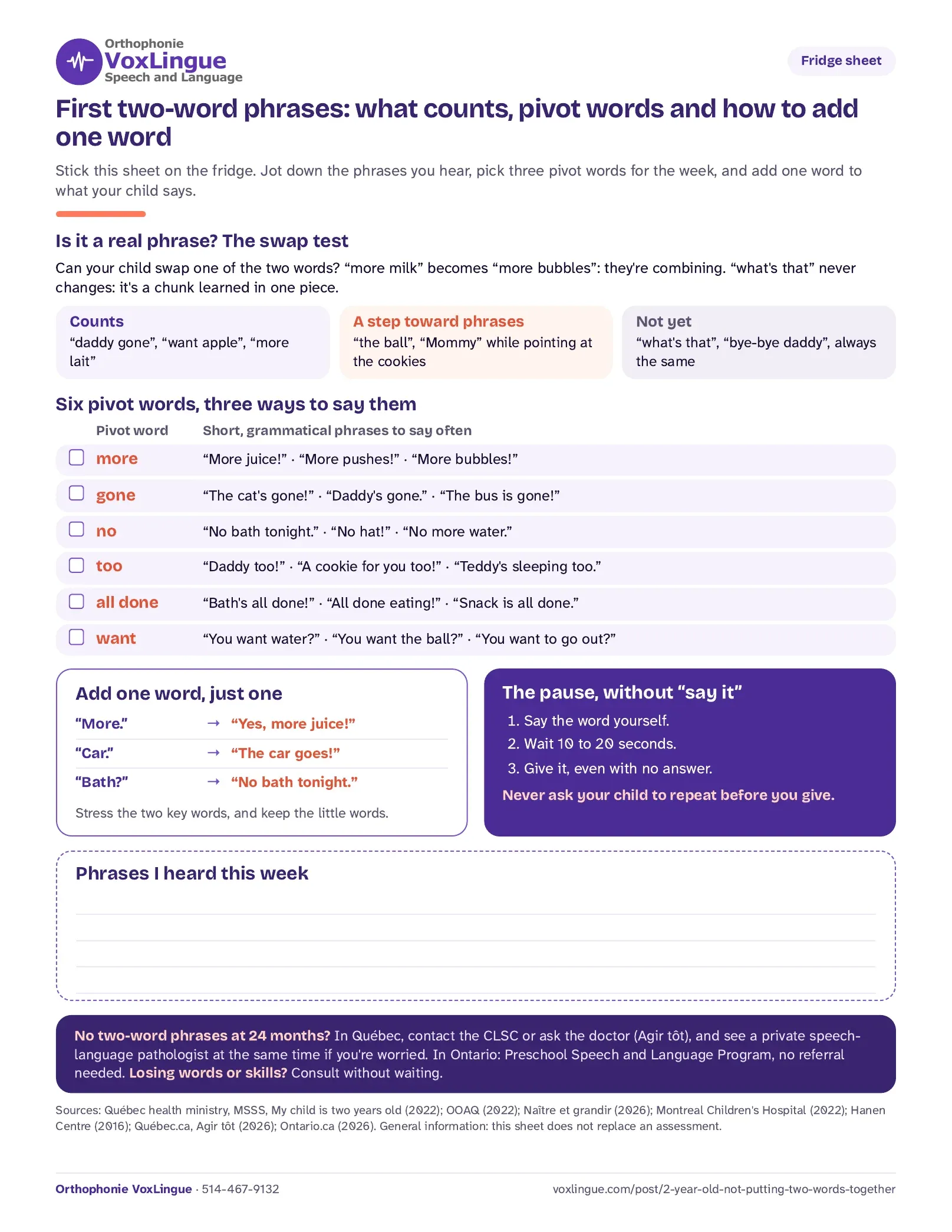
Printable handout: First two-word phrases: what counts, pivot words and how to add one word (PDF, 1 page).
Frequently asked questions
How many words does a child need before two-word phrases?
There’s no magic number. Around age 2, expect 50 words or more, often many more, with all languages counted. Children who combine words often have well over 50 (Frank et al., 2021). The kind of words matters too.
Is it a late talker if my child has 50 words?
Possibly. The 24-month reference point in Québec is about two-word phrases, not only about the number of words (OOAQ, 2022). A child can have a good vocabulary and not combine yet. Our guide for parents of late talkers in Montréal explains the term and what to do.
My bilingual child only makes phrases in one language. Is that a problem?
Not necessarily. Look at their phrases across both languages together, including ones that mix them (Naître et grandir, 2021). A two-word phrase in French counts just as much as one in English.
My child is 30 months and still uses single words. What now?
Contact the CLSC or ask the doctor now. Around 2½, Naître et grandir lists no short phrases of 2 or 3 words as a sign of language difficulties (2024). Get your place on the public list and, if you wish, see a private speech-language pathologist at the same time.
Will two-word phrases come on their own?
No one can predict that for a particular child, so strategies at home and a consultation go together. Our article on late talkers and DLD sums up what we know about how difficulties evolve.
Do I need a referral to see a speech-language pathologist?
Not privately. In the public system, Agir tôt goes through your CLSC, and a doctor can also refer your child with your consent (Québec.ca, 2026). In Ontario, the Preschool Speech and Language Program accepts referrals from parents. Both routes can run at the same time.