I don't talk to my baby or toddler much: what the newest research on adult talk, back-and-forth and the 30 million word gap says, and what quiet parents can do instead of nonstop narration
You don’t talk to your baby or toddler much, and you wonder whether that could hold back their language. Bath time sometimes goes by in silence. The stroller ride happens without a word. You feel a little silly describing what you’re doing to a baby who can’t answer yet. Then a page online tells you about “30 million words”.
Many parents wonder whether they talk enough. Some are quiet by nature. Others are exhausted by the end of the day. Others speak to their baby in English or French when their own language is Arabic, Spanish or Creole, and the words come less easily.
This guide is for parents of children aged 0 to 3. It explains where the 30 million word figure came from, what large recent studies found and what they can’t say, including a Québec twin study. It then offers five simple moves for quiet parents, and the signs that mean it’s worth getting a check, whatever the amount of talk at home. For more, see our articles on early language.
I don’t talk to my baby much: can it hurt their language?
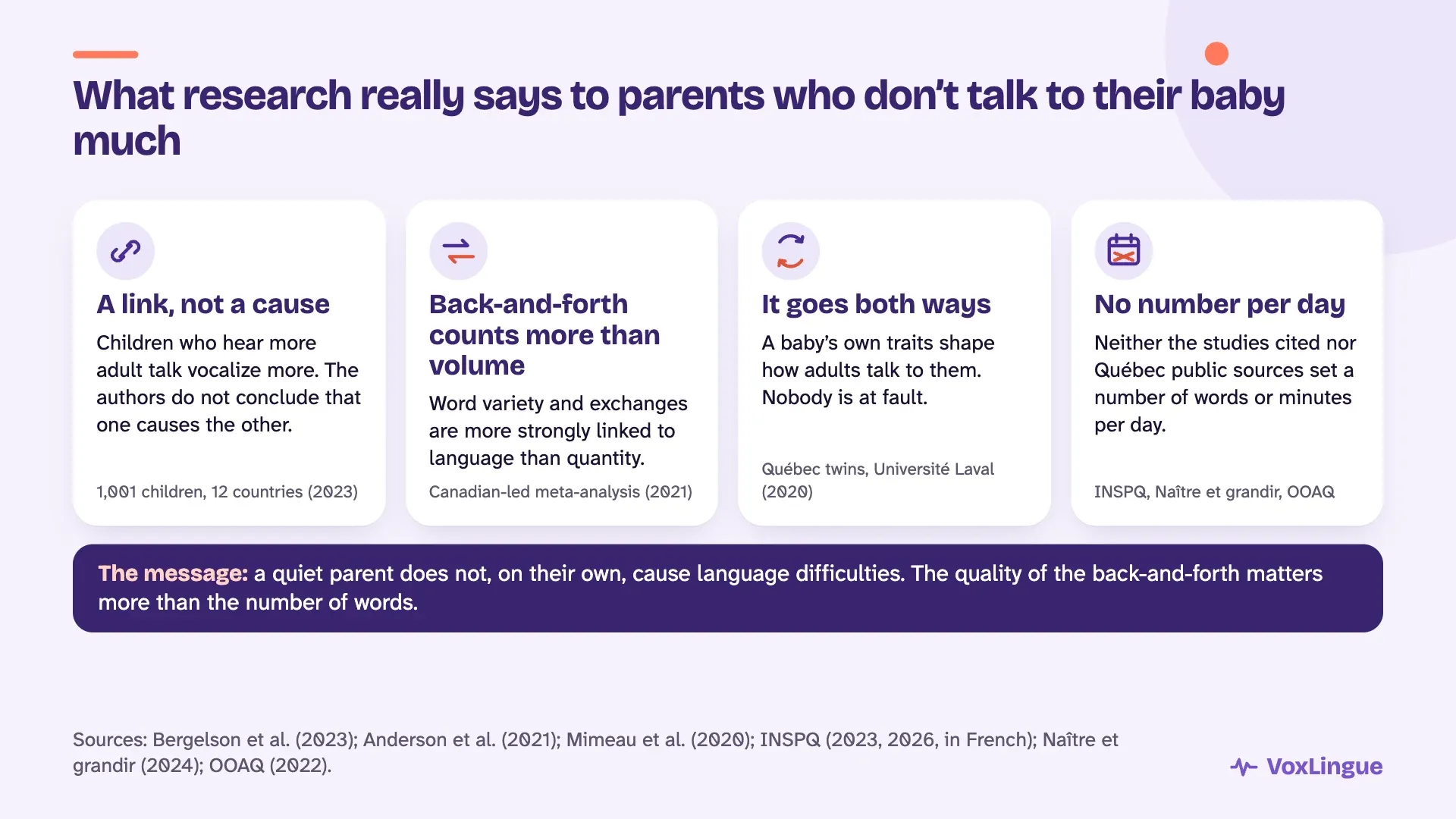
Talking less doesn’t decide your child’s language on its own. Large recent studies find a link between adult talk and children’s talk, but a link is not a cause. A Québec study also shows that the influence runs both ways. What matters most is the back-and-forth: answering, waiting, talking about what interests your child.
The worry has a source. Naître et grandir, a Québec parenting resource, says that the more words your baby hears, the more they will be able to understand and then say (in French, 2024). The same page adds that by taking turns, babies learn the basics of conversation. Both ideas are true, and recent research helps put them in order. Four findings stand out.
First, a link is not a cause. In 2023, an international team recorded 1,001 children in 12 countries: those who heard more adult talk vocalized more. The authors themselves write that this does not show a cause (Bergelson and colleagues, 2023).
Second, the back-and-forth counts more than the volume. A Canadian-led meta-analysis found that the variety of words and the richness of sentences are more strongly linked to children’s language than the number of words (Anderson and colleagues, 2021). Québec’s public health institute, the INSPQ, describes quality interaction as following the child, answering them and taking turns (in French, 2023).
Third, it goes both ways. A Université Laval study of 189 mothers of twins found that a baby’s own traits shape how adults talk to them (Mimeau and colleagues, 2020). A calm baby sometimes draws less talk, and nobody is at fault.
Finally, no study sets a number of words per day. None of the Québec or Ontario public sources we consulted gives one either.
Fatigue and worry make anyone talk less, and that’s human. In an American study of mostly higher-income parents, those asked to think about money worries talked less to their 3-year-old during play. The researchers call the results preliminary (Ellwood-Lowe and colleagues, 2022). A quieter evening does not change a child’s language.
The message fits in two sentences. The quality of the back-and-forth matters more than the number of words. And a quiet parent does not, on their own, cause language difficulties.
Where did the 30 million word gap come from, and what is it worth?
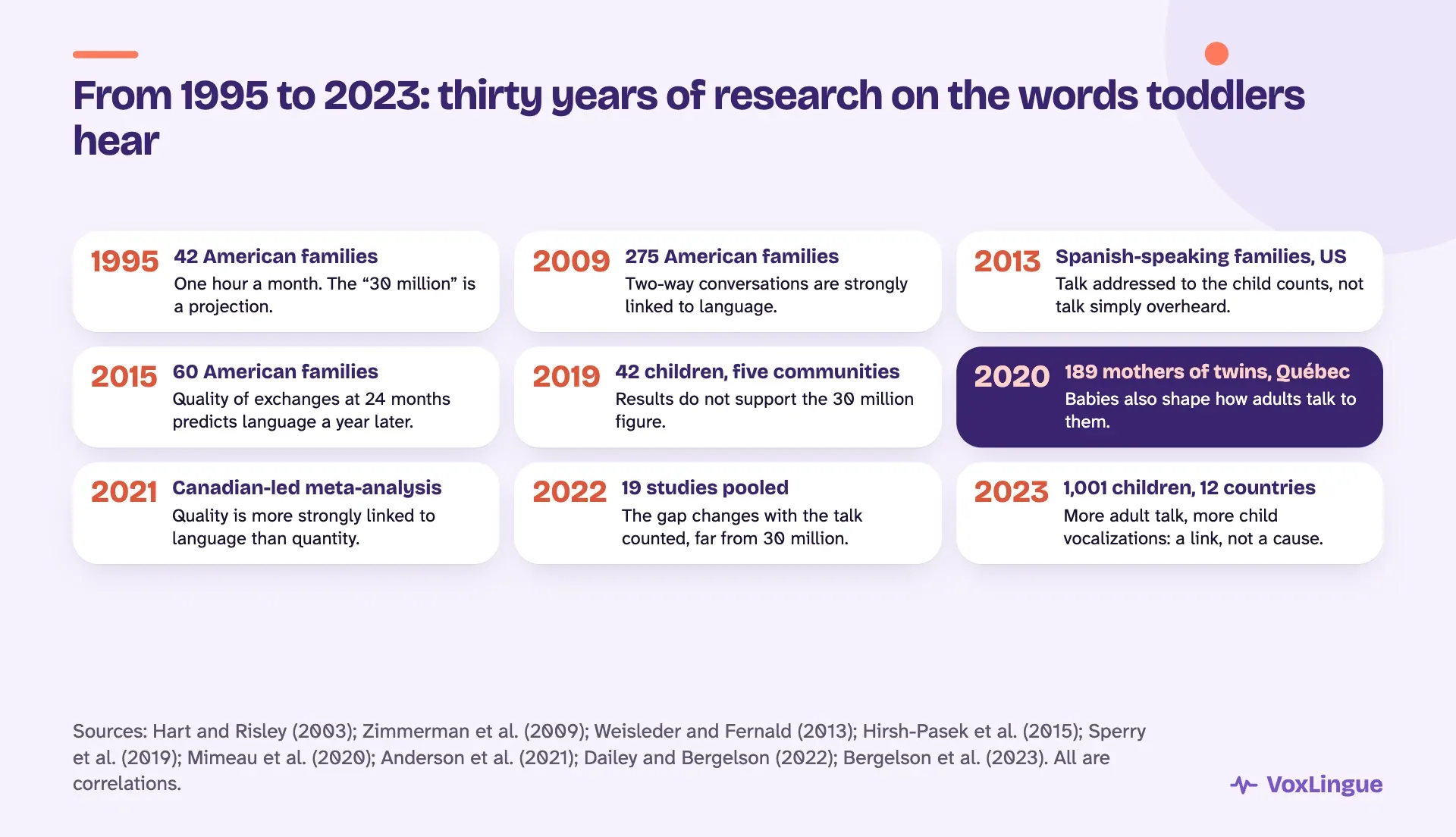
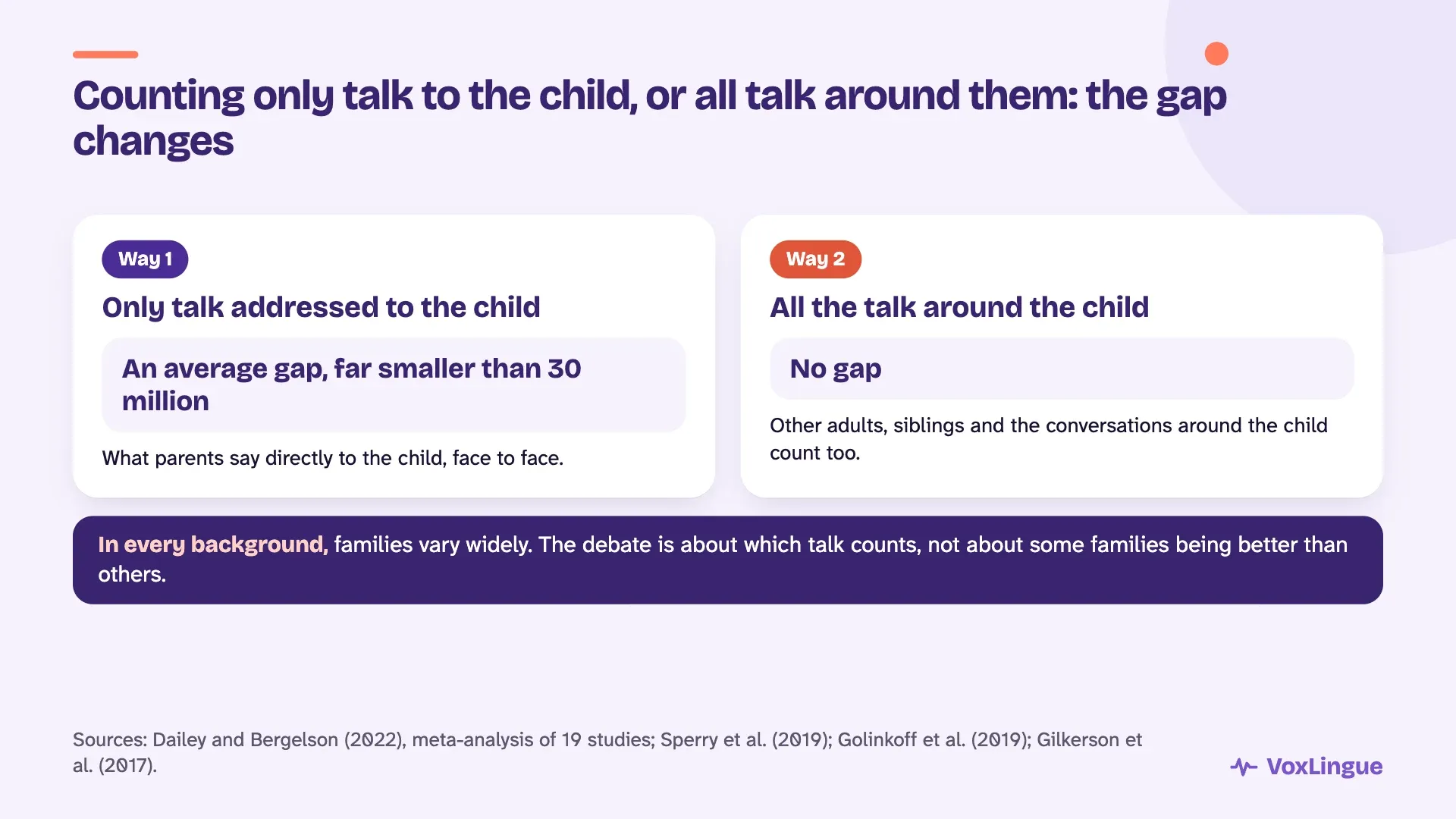
The figure comes from a 1995 American study of 42 families. The 30 million words were never counted: they are a projection up to age 4. Later studies find much smaller gaps, and those gaps change with what researchers decide to count.
It helps to say exactly what the myth is. It isn’t the idea that children hear more or less talk from one family to another: differences exist, and researchers still debate them. The myth is the size of the number, and the idea that it applies to every family as a measure of each home. Thirty million words is not a measured gap, and it is not a verdict on yours.
Why did the number travel so far? A big round number is easy to remember and repeat, and it has been repeated very often. In 2019, researchers still described it as an often-cited claim facing growing controversy (Sperry and colleagues, 2019). Others defended the importance of the question (Golinkoff and colleagues, 2019).
A study of 42 families, one hour a month
Two American researchers, Betty Hart and Todd Risley, followed 42 families at home. Once a month, they recorded one hour of everyday life, from age 7 to 9 months until age 3. They then counted the words parents addressed to their child during those hours (Hart and Risley, 2003, a summary of their 1995 book).
The 30 million came from a calculation. The researchers took the number of words heard per hour and multiplied it by about 100 waking hours a week, or 5,200 hours a year. They then extended the calculation to age 4. Nobody counted 30 million words in a home.
The families had been grouped by parents’ occupation and income, and the study reported differences between those groups. The authors’ 2003 summary was titled “The Early Catastrophe”. The number became a powerful image, then a slogan, far beyond what 42 families observed one hour a month could show.
What later studies found: it depends on what you count
Later studies find much smaller gaps, and they vary with the talk that gets counted. In 2019, a team re-examined what 42 children aged 18 to 48 months heard in five American communities. Its results did not support the 30 million claim, and differences within each group were large (Sperry and colleagues, 2019).
That team raised a point of method. Counting only the mother leaves out other adults, siblings and the conversations happening around the child. Other researchers replied that the key ingredient is still quality talk addressed to the child, more than talk the child simply overhears (Golinkoff and colleagues, 2019).
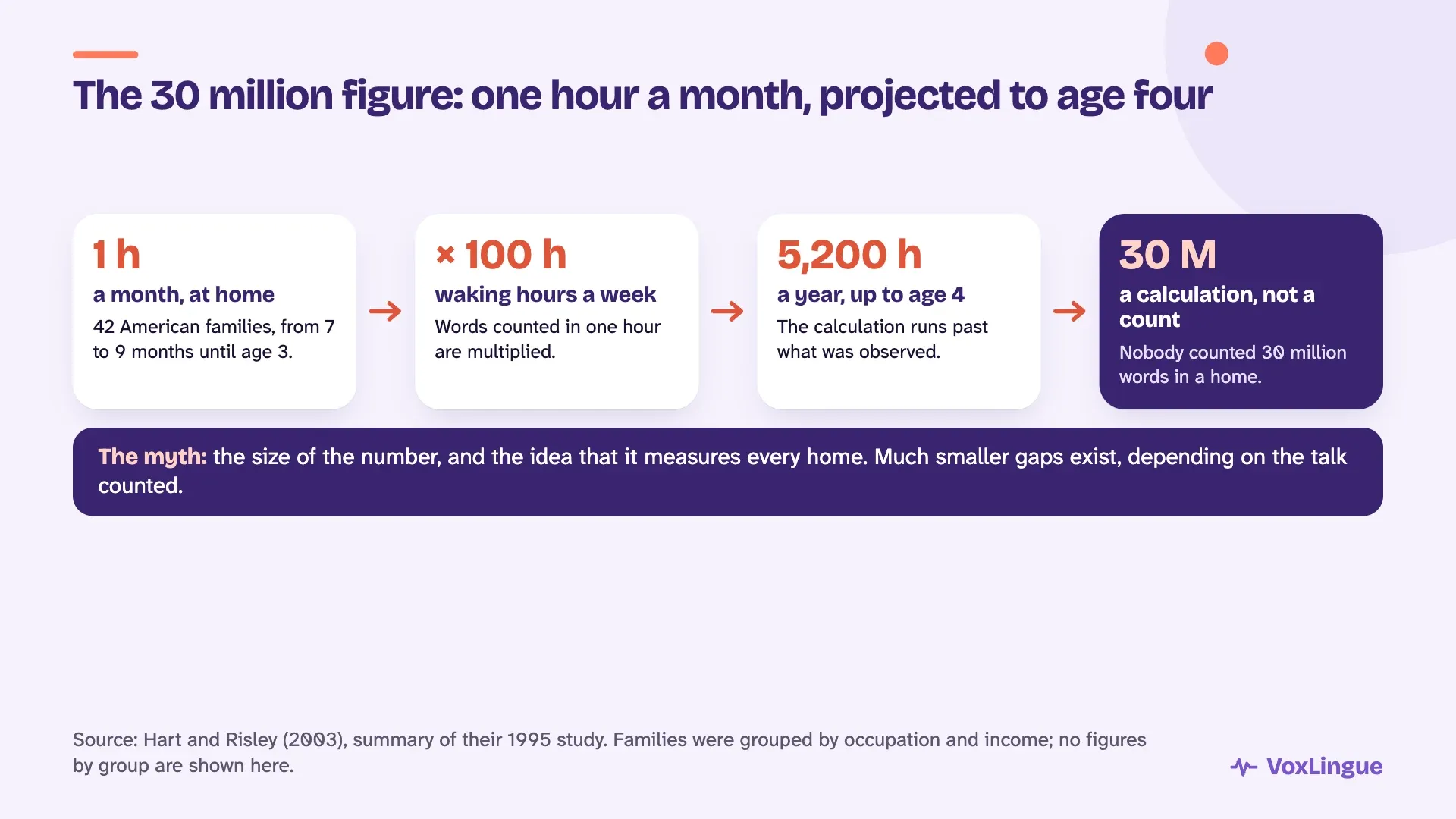
In 2022, a meta-analysis pooled 19 studies. When only talk addressed to the child is counted, an average gap appears between socioeconomic backgrounds. When all the talk around the child is counted, the gap disappears. Either way, it is nowhere near 30 million (Dailey and Bergelson, 2022). The authors also criticize reading families through a “deficit” lens.
Large American recordings, more than 3,000 full days, had already shown wide variation between families from the same background (Gilkerson and colleagues, 2017). So the debate is about which talk counts, not about some families being better than others.
In Québec, public sources don’t use the number. Naître et grandir talks about taking turns, and the INSPQ describes the quality of interactions with the child rather than a word count (in French, 2023).
What did the study of 1,001 children in 12 countries find?
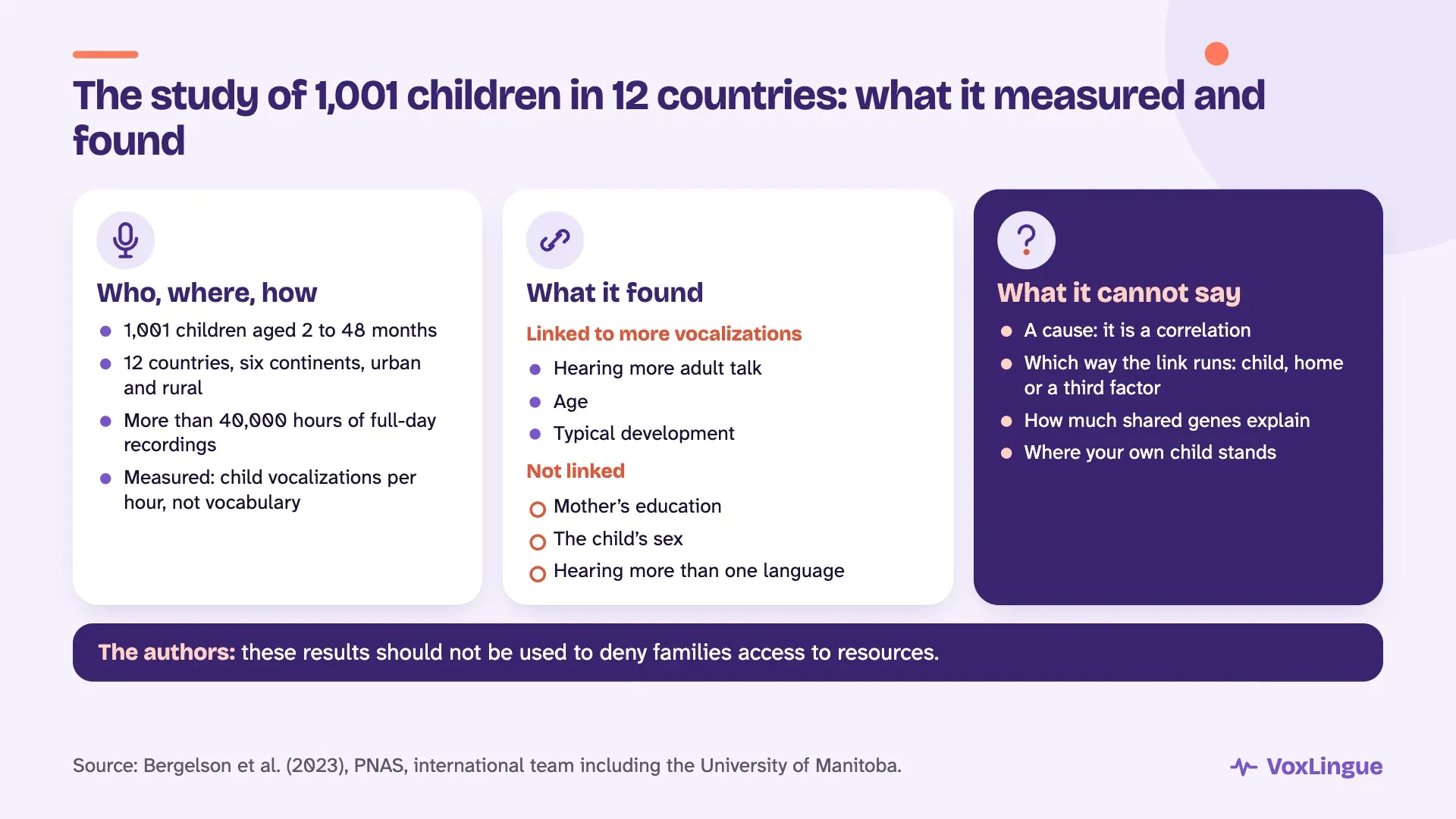
In 2023, researchers analyzed more than 40,000 hours of recordings of 1,001 children. The children, aged 2 to 48 months, lived in 12 countries. Those who heard more adult talk vocalized more. Their mother’s education was not linked to how much they vocalized. The authors make clear that this does not show a cause.
The study was published in PNAS by an international team that included a researcher from the University of Manitoba (Bergelson and colleagues, 2023). Families lived on six continents: in cities, in communities that live by hunting, gathering and farming, and among farmers who grow their own food. Children wore a small recorder for full days, more than 2,500 days in all.
What the study measured is specific. It counted the child’s vocalizations per hour: babbling, syllables and words. It also counted the talk of adults close to the child. It did not measure the child’s vocabulary or what they understood.
Three factors went with more vocalizations: hearing more adult talk, being older, and typical development. Three others were not linked: the mother’s education, the child’s sex, and hearing more than one language. That last point is reassuring for multilingual Montréal families.
What the study cannot say matters just as much. The authors offer three possible explanations. A child who vocalizes more may draw more talk. A home with more talk may get the child vocalizing. Or a third factor may be at work, such as the genes parents and children share. Their data cannot rule out any of these.
In this study, children’s age and development did not predict how much adults talked. So on its own, it does not show that children influence their parents. The Québec twin study, below, sheds light on that.
The authors add an important sentence: their results should not be used to deny families access to resources. A correlation measured across 1,001 children says nothing about your child in particular. To know where your child stands, their own markers are what count, such as those from Québec’s order of speech-language pathologists and audiologists (OOAQ), listed below.
Does the quality of back-and-forth matter more than the number of words?
Most of the time, yes, but quantity plays a part too. A Canadian-led meta-analysis found that the variety of words and the richness of sentences are more strongly linked to children’s language than the number of words. Two-way conversations count as well. Both play a role, but the back-and-forth counts more.
The meta-analysis was led by researchers in Calgary, Toronto and York (Anderson and colleagues, 2021). It pooled dozens of studies. Quality and quantity were both linked to children’s language, quality more strongly. The link did not differ by families’ socioeconomic background.
Other studies point the same way, with their limits. In 60 low-income American families, the quality of exchanges at 24 months predicted language a year later far better than the number of words the mother said. Researchers looked at shared attention, routines and smooth, connected exchanges (Hirsh-Pasek and colleagues, 2015).
A team then repeated the analysis in other groups. The same result held in a high-income group, but not in a middle-income group. The authors conclude that it may not be universal (Masek and colleagues, 2021). Quality matters, but it doesn’t erase quantity.
In 275 American families with children aged 2 to 48 months, two-way conversations were strongly linked to language. Part of the effect of adult words went through those conversations (Zimmerman and colleagues, 2009). In Spanish-speaking families in the United States, talk addressed to the child went with a larger vocabulary at 24 months, but talk simply overheard did not (Weisleder and Fernald, 2013).
A brain imaging study of 36 children aged 4 to 6 points the same way. Those who had more back-and-forth with adults showed more activity in a language-related brain area, regardless of background and of the number of words (Romeo and colleagues, 2018).
In Québec, the INSPQ describes quality interaction through three behaviours. Sensitivity means noticing what interests the child. Responsiveness means reacting quickly, in step with what they do or say. Reciprocity means keeping the turns going, each in turn (in French, 2023).
| What is measured | An example | What studies found | Its limit |
|---|---|---|---|
| Quantity: the number of adult words | Words counted over an hour or a day | Linked to children’s language, less strongly than quality (Anderson, 2021) | Doesn’t say whether the words were addressed to the child |
| Quality: variety of words, sentences, shared attention | Talking about the truck they’re looking at, with a new word | More strongly linked to language (Anderson, 2021; Hirsh-Pasek, 2015) | Not found in every group (Masek, 2021) |
| Conversational turns: the back-and-forth | They say “ba”, you answer “ba!”, they say it again | Linked to vocabulary years later (Gilkerson, 2018) | Recorders estimate turns less accurately than words (Cristia, 2021) |
What is a conversational turn?
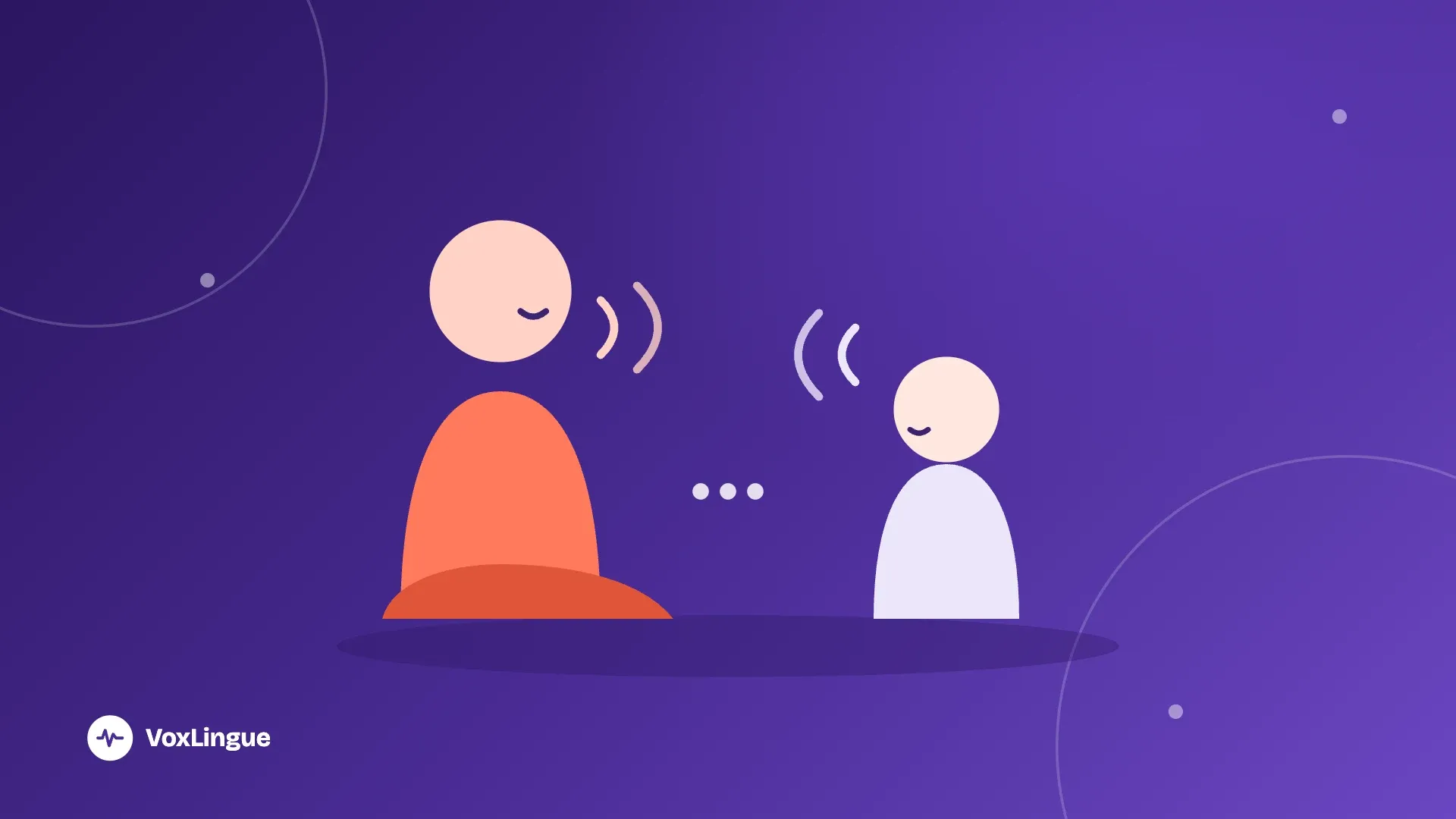
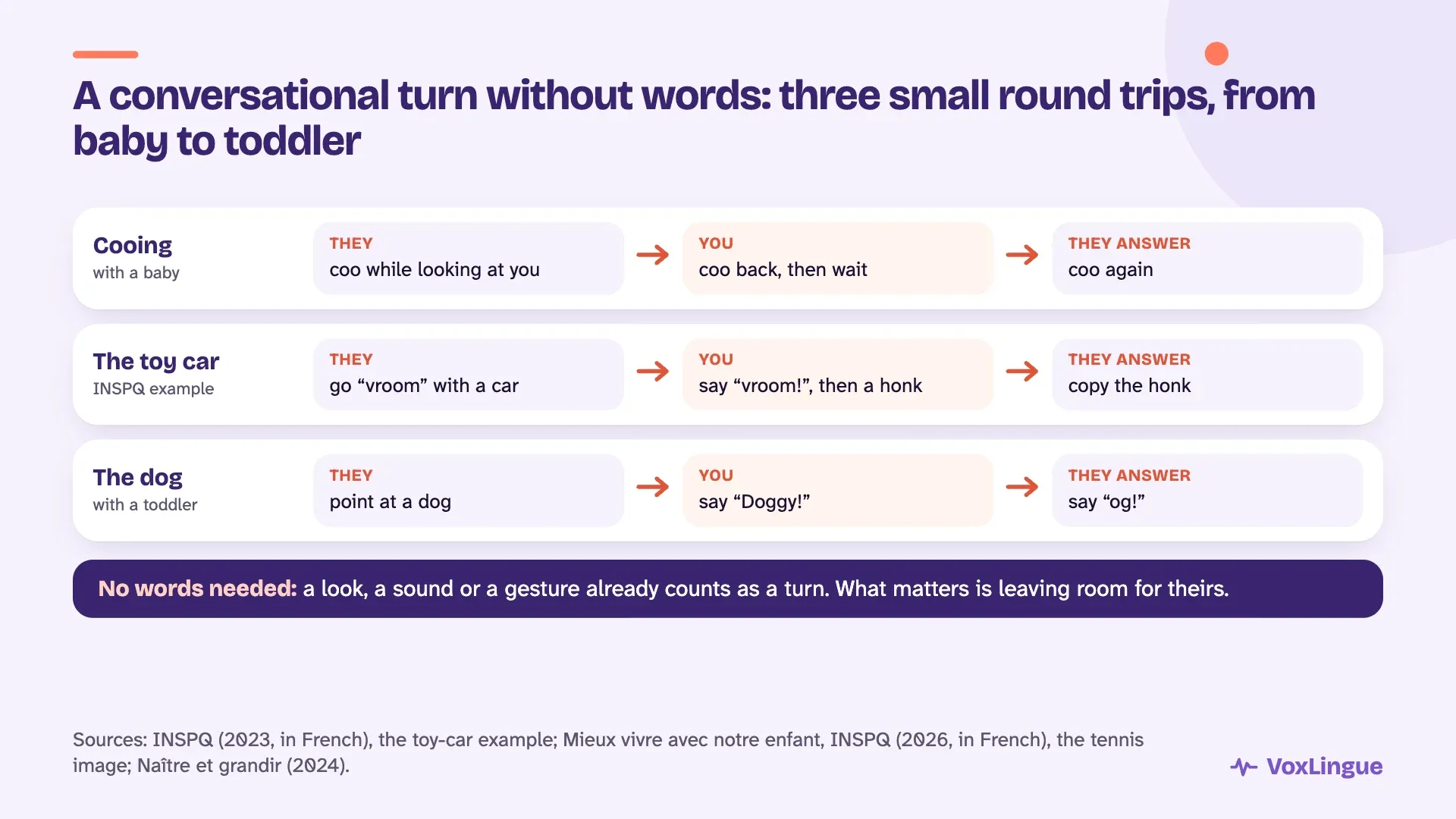
A conversational turn is a small round trip: your child makes a sound, you answer, and they answer back. No words are needed. A look, a smile, a sound or a gesture already counts as a turn.
The INSPQ’s parenting guide, Mieux vivre avec notre enfant, compares communication to a game of tennis where each player sends the ball back in turn. Your child needs room in the exchange (in French, 2026). The INSPQ gives an example without words: the child goes “vroom” with a toy car, the adult makes car noises too, then a honk, which the child copies (2023).
Turns change with age, but the idea stays the same. Your baby coos, you coo back, and they coo again. Later, they roll a car and say “vroom”, you answer “vroom!” and they add a sound. Later still, they point at a dog, you say “Doggy!” and they answer “og!”. To see why interaction comes before words, read our newsletter, and for more, see how to leave room for your child’s turn, routine by routine.
Why research focuses on 18 to 24 months
An American study recorded full days with toddlers, then saw the children again about ten years later (Gilkerson and colleagues, 2018). Conversational turns between 18 and 24 months predicted their vocabulary, better than the number of words they heard.
That result explains why this period gets so much attention. But devices that count words estimate adult words and child sounds fairly well, and conversational turns much less well (Cristia and colleagues, 2021). These numbers serve research. They are not targets to reach at home.
In Québec, this period also matches two OOAQ markers for the 18-month visit in the Agir tôt program. They are about 14 spontaneous words around 18 months, and two-word combinations around 24 months (2022). These are not deadlines. They are markers for knowing when to ask, whatever your child’s age between 0 and 3.
Your baby shapes how you talk too: what a Québec twin study found
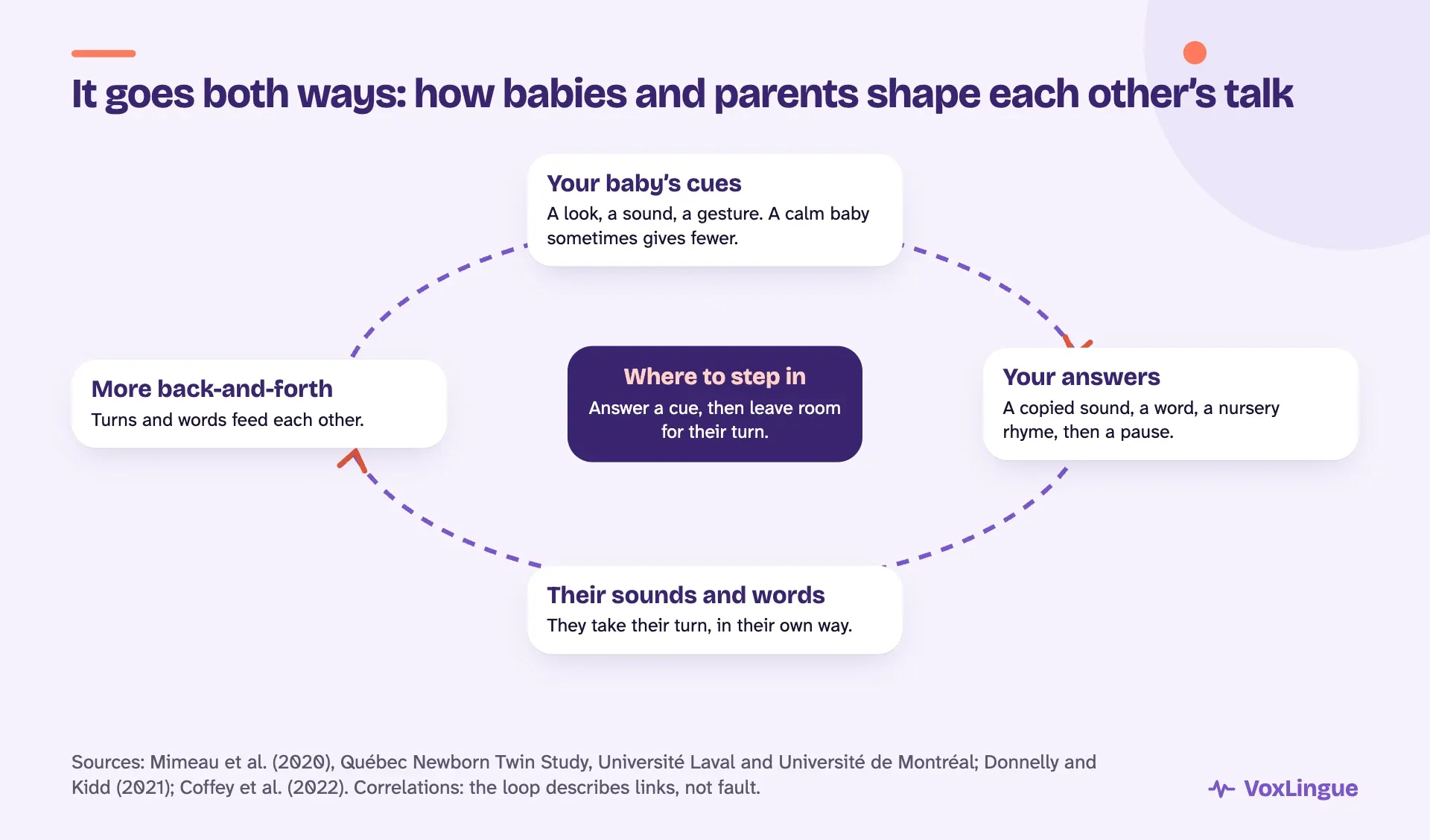
Yes, it goes both ways. A Université Laval study of 189 mothers of twins born in the Montréal area found that a baby’s own traits shape how adults talk to them. A calm baby sometimes draws less talk. That isn’t a verdict: it’s a loop you can step into.
The data come from the Québec Newborn Twin Study, run by Université Laval and Université de Montréal with twins born between 1995 and 1998. Researchers filmed 189 French-speaking mothers at 5 months with each of their twins. They then measured the children’s language in French at 18 months, 2½ years and 5 years (Mimeau and colleagues, 2020).
Three ways of talking predicted different ages. The amount the mother talked at 5 months predicted language at 5 years. Her sensitivity, meaning talking about what the baby was looking at, predicted language at 2½ and 5 years. Repeating part of her own sentence predicted language at 18 months.
Twins make it possible to compare two babies with the same mother. The mother’s sensitivity and repetitions were partly linked to the baby’s genes. In other words, a baby’s traits shape how adults talk to them. The authors suggest letting parents know. They also state their limit: a correlational design cannot confirm the direction of the links.
Other studies support this loop. In 122 children learning English, followed from 9 to 24 months, conversational turns and vocabulary fed each other, even after accounting for the number of words heard (Donnelly and Kidd, 2021). A child with more words later took more turns, and more turns went with more words.
Parents’ talk still matters, and not only because of genes. In 46 internationally adopted children, vocabulary grew with how the adoptive mother talked, with no shared genes (Coffey and colleagues, 2022). The honest answer is both. Your baby shapes your exchanges, and your exchanges help your baby.
Stepping into the loop takes few words. In an American randomized trial of 71 families with 6-month-old babies, coaching parents at 6, 10 and 14 months increased the sing-song voice addressed to the baby and turn-taking. Those changes went with better language at 18 months (Ferjan Ramírez and colleagues, 2020). That is the idea behind parent coaching in speech therapy.
What research does not say to quiet parents
Research does not say that a quiet parent causes language difficulties. It gives no number of words per day, doesn’t measure parents’ personality and doesn’t rank families. The OOAQ is clear: developmental language disorder is not caused by a lack of stimulation.
Many parents wonder whether they talk enough. None of the studies cited here shows that a quiet parent, on their own, causes language difficulties. The table below sums up what the studies say, and what people sometimes make them say.
| What research says | What it does not say |
|---|---|
| Adult talk and children’s talk are linked (Bergelson, 2023) | That talking less causes language difficulties |
| The quality of exchanges is more strongly linked to language than quantity (Anderson, 2021) | That quantity doesn’t matter at all |
| Babies also shape how adults talk to them (Mimeau, 2020) | That it’s the baby’s fault, or yours |
| Conversational turns are linked to vocabulary later on (Gilkerson, 2018) | How many words, minutes or turns a child needs each day |
| Families from the same background vary widely (Dailey and Bergelson, 2022) | That some families talk “better” than others |
None of the studies cited sets a quota. Research recorders count conversational turns poorly, and none of the Québec or Ontario public sources we consulted sets a number of words or minutes per day.
None of the studies cited here measured parents’ personality either. None compares “introverted” and “talkative” parents. What researchers measure is recorded talk, not temperament.
The studies don’t rank families. The authors of the 2022 meta-analysis criticize the “deficit” lens, and those of the 1,001-child study ask that their findings not be used to deny families resources.
Finally, the OOAQ is clear. Developmental language disorder (DLD) is not caused by a lack of stimulation, by the home environment or by learning several languages. It is a neurological disorder present from birth, more common when other family members have had difficulties (in French, 2021). To learn more, see how to tell short-term language difficulties from DLD.
Quiet parent: five moves that matter more than narrating everything
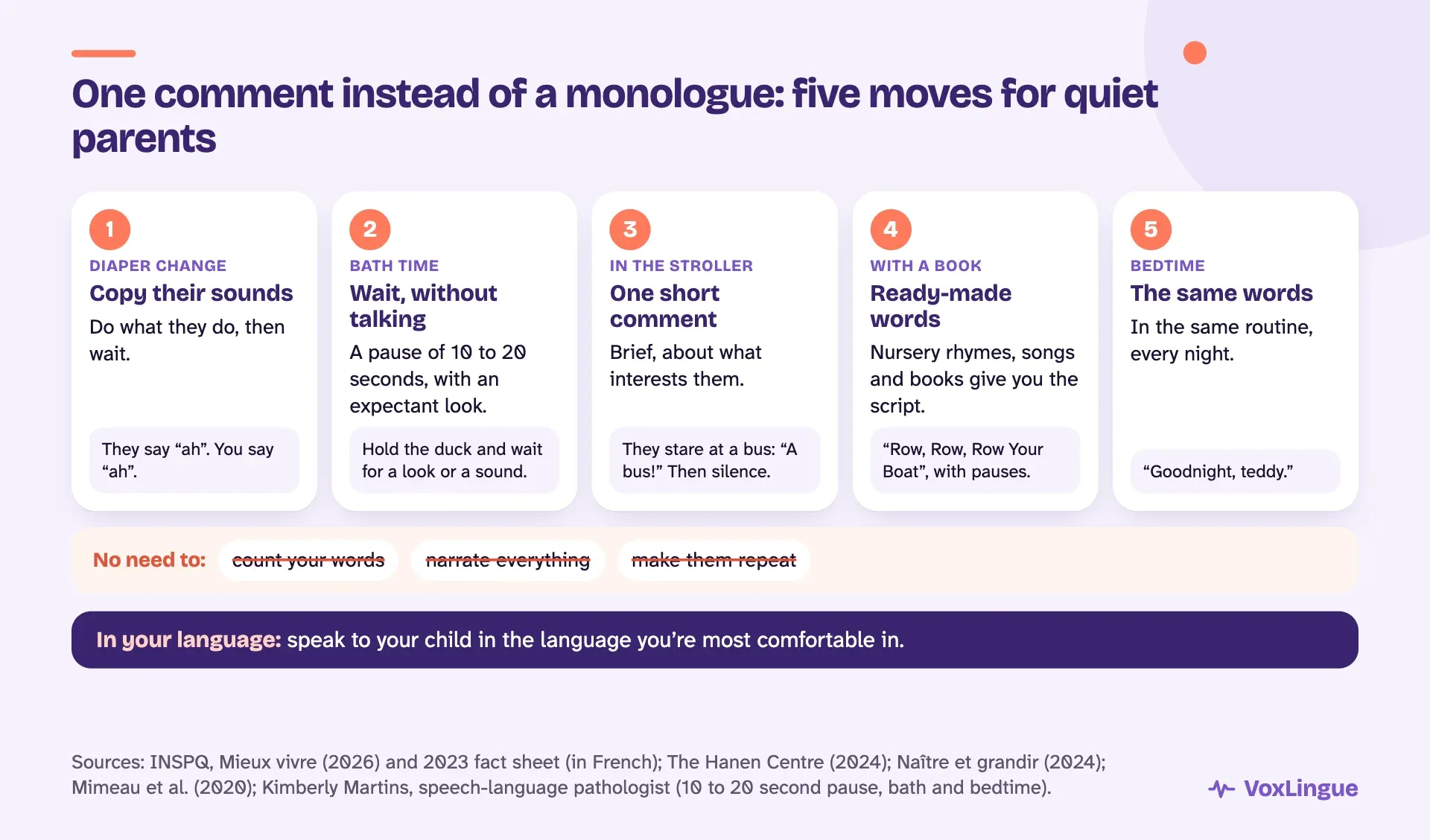
You don’t have to narrate all day. Copy their sounds, wait, add one short comment, use nursery rhymes and books as ready-made words, and say the same words in the same routines. These moves take few words and leave room for your child’s turn.
Copy their sounds and gestures. Mieux vivre avec notre enfant says it simply: imitate their noises, sounds and words (in French, 2026). During a diaper change, your baby says “ah”: you say “ah” back, then wait. Kimberly Martins, speech-language pathologist and founder of VoxLingue, sums it up in our language guide: imitate what your child does, then build on it.
Wait, without talking. For The Hanen Centre, waiting is the most important part of its “Observe, Wait, Listen” strategy: while you wait, you stop talking (2024). Kimberly Martins recommends a pause of 10 to 20 seconds, with an expectant look. For a quiet parent, this is a strength: silence becomes an invitation to take a turn.
One short comment, about what interests them. In the stroller, your toddler stares at a bus. Say “A bus!”, then leave a silence. Mieux vivre suggests talking about what holds their attention without bombarding them with information (in French, 2026). For the INSPQ, describing is only one strategy among several, alongside naming, adding a word, expanding and rephrasing (in French, 2023).
Ready-made words: nursery rhymes, songs and books. If the words don’t come, borrow them. Naître et grandir suggests reading books to your baby and singing nursery rhymes, with a higher-pitched voice, clear words and exaggerated intonation (in French, 2024). “Row, Row, Row Your Boat” or a bedtime book gives you the script. All you need to add are pauses.
The same words in the same routines. At bath time, say “Water on your toes” every night. At bedtime, “Goodnight, teddy”. In the Québec twin study, repeating part of one’s own sentence went with better language at 18 months (Mimeau and colleagues, 2020). According to Kimberly Martins, bath time and the bedtime routine work especially well to start.
One-on-one moments count too. In 26 babies aged 11 and 14 months, the sing-song voice used one-on-one went with more words at 24 months (Ramírez-Esparza and colleagues, 2014). A few minutes face to face, in the bath or on the play mat, are good chances for these exchanges.
You don’t need to count your words, narrate all day or make your child repeat. Mieux vivre notes there is no point asking a child to repeat (in French, 2026). For Kimberly Martins, requiring a child to repeat is the most important habit to drop. For more strategies, from bath time to bedtime, see our guide.
Talking less because English or French isn’t your language?
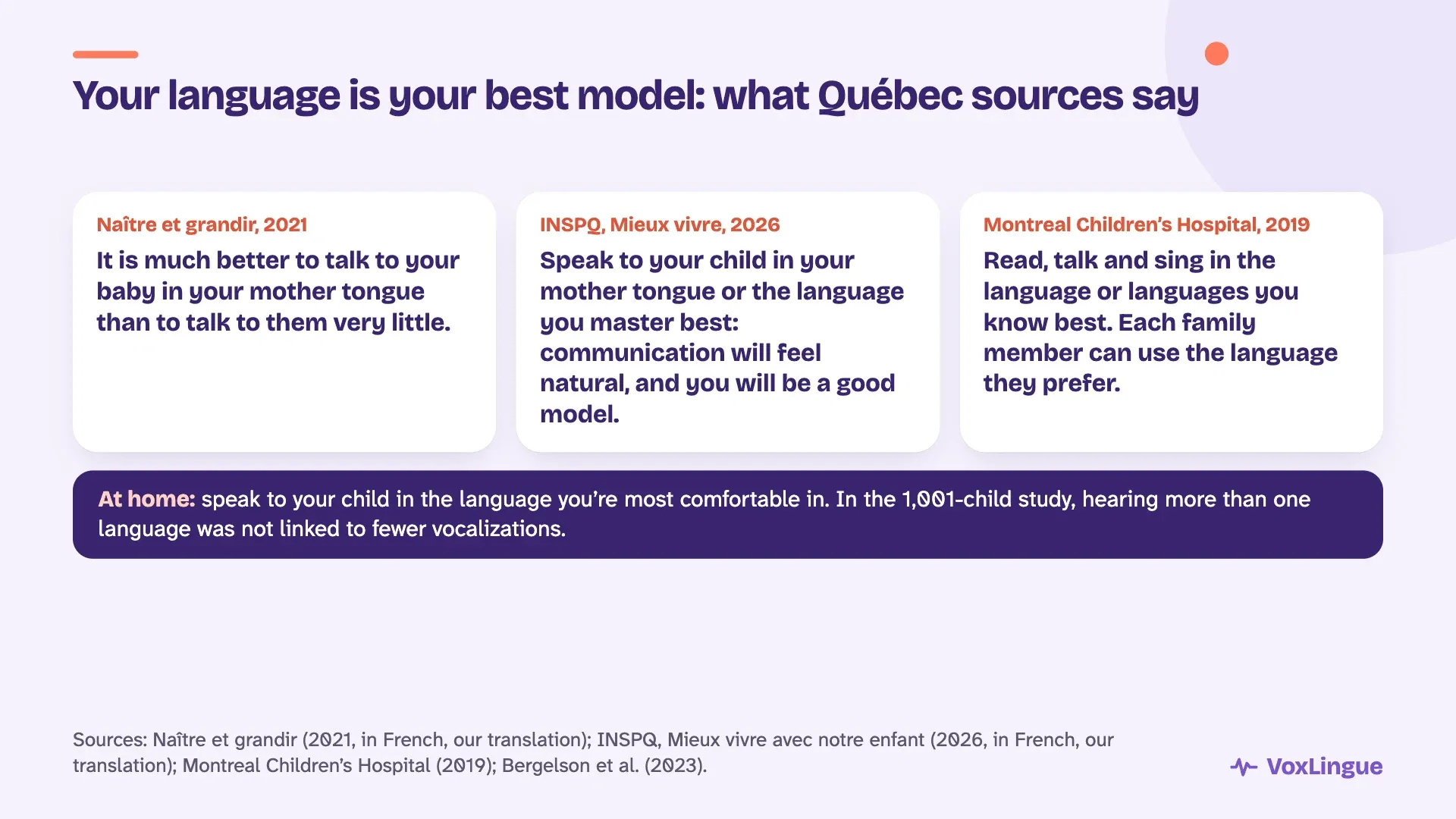
Speak to your child in the language you’re most comfortable in. Naître et grandir says it plainly: it is much better to talk to your baby in your mother tongue than to talk to them very little. The INSPQ adds that you will be a good model that way. In your own language, words, rhymes and back-and-forth come more easily.
In Montréal, this happens often. A parent whose language is Arabic, Spanish, Vietnamese or Creole speaks to their baby in English or French, hoping to help with school later. But the sentences come slowly, the rhymes are missing, and the parent ends up going quiet. The baby then hears less back-and-forth, in any language.
Québec sources all point the same way. According to Naître et grandir, immigrant parents will probably tend to talk more with their toddler in their own language, and you are a better model in the language you master best (in French, 2021). The Montreal Children’s Hospital guide on bilingualism suggests reading, talking and singing in the language or languages you know best. Each family member can use the language they prefer (2019).
The INSPQ’s Mieux vivre guide puts it in writing: it is preferable to speak to your child in your mother tongue or in the language you master best. Communication will then feel natural, and you will give a good model (in French, 2026). The same goes for an English-speaking parent in Québec: you don’t need to switch to French at home.
International research doesn’t contradict this advice. In the study of 1,001 children, hearing more than one language was not linked to how much children vocalized (Bergelson and colleagues, 2023). In 29 Spanish-English bilingual toddlers aged 25 months in the United States, the amount of exposure predicted each language. English from native speakers and from several people also counted (Place and Hoff, 2011).
French or English also has its place, at daycare, at school and with adults who speak it with ease. At home, speak to your child in the language you’re most comfortable in. If your child then mixes languages, see why mixing French and English is normal. And to follow their progress, remember to start counting words across all their languages.
When to get a check, whatever the amount of talk at home
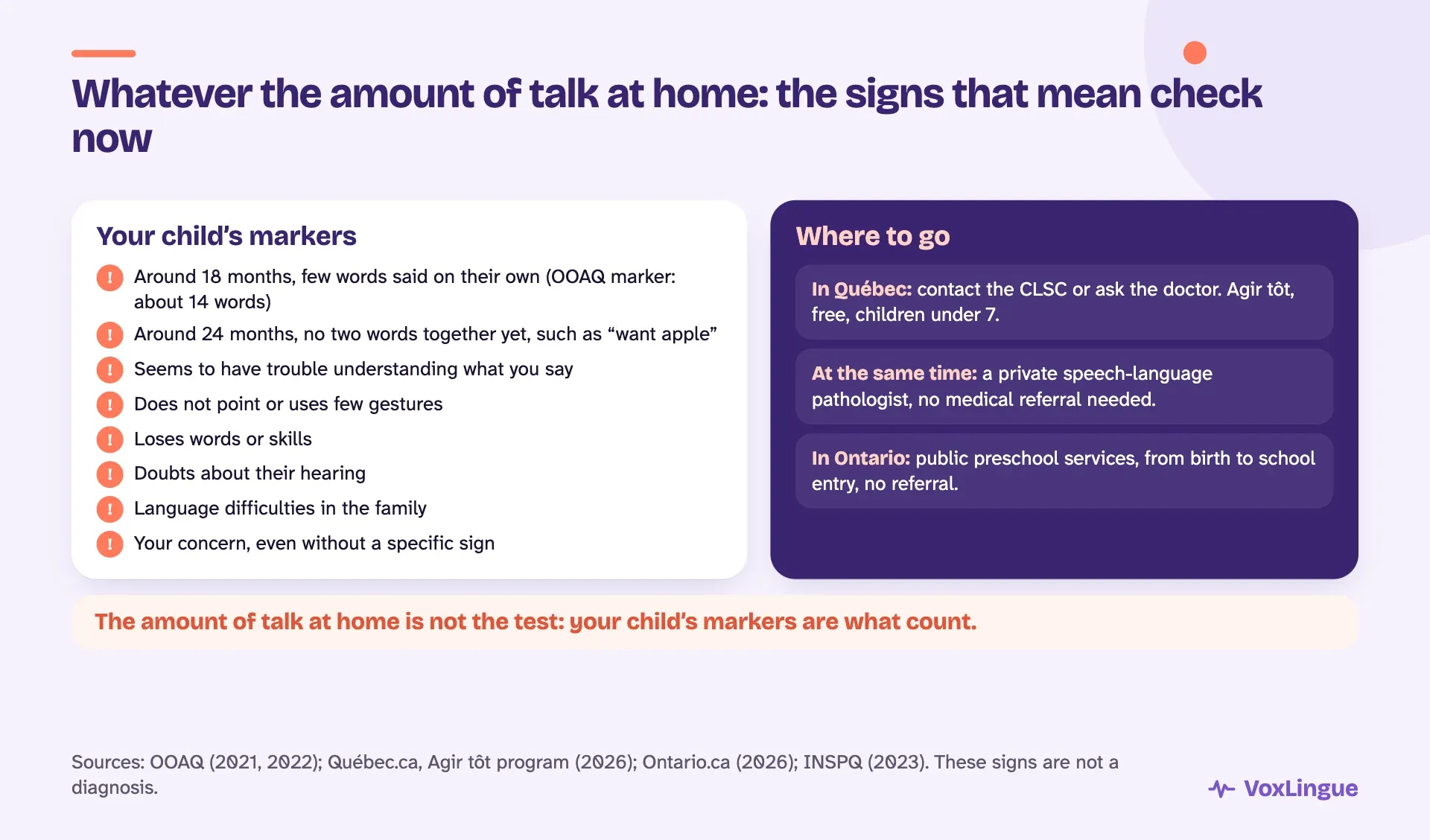
Some signs mean it’s worth asking, whatever the amount of talk at home. Few words around 18 months, no two-word combinations yet around 24 months, understanding that worries you, losing words, or simply your own concern. Contact the CLSC or ask the doctor, and see a private speech-language pathologist at the same time if you can.
The amount of talk at home is not the test. A quiet parent can have a child who talks a lot, and a very chatty parent can have a child with language difficulties. What counts are your child’s own markers.
The signs that mean it’s worth asking now
In 2022, the OOAQ published recommendations for the 18-month visit in Québec’s Agir tôt program. Contact the CLSC or ask the doctor if your child:
- around 18 months, says few words on their own (the OOAQ uses about 14 spontaneous words at that age as a marker);
- around 24 months, is not yet combining two words, such as “daddy gone” or “want apple” (OOAQ, 2022);
- seems to have trouble understanding what you say;
- does not point or uses few gestures;
- loses words or skills they already had;
- leaves you with doubts about their hearing;
- has family members who have had language difficulties;
- worries you, even without a specific sign.
Parents know their child: if they are worried, they should get a check. According to the OOAQ, a parent’s worry is rarely wrong (2022). If single words are there but short phrases are slow to come, see when two-word phrases are slow to come. For a toddler who stopped saying words, don’t wait.
For a child who hears several languages, count their words across all their languages before comparing with these markers. These signs are not a diagnosis: they only tell you when to ask.
In Québec and Ontario: who to talk to
In Québec, contact the CLSC or ask the doctor. The public entry point is the Agir tôt program, free for children under 7. A doctor or another professional can also refer your child, with your consent. The 18-month vaccination visit is another chance to raise your concerns (Québec.ca, 2026).
At the same time, you can see a speech-language pathologist privately, with no medical referral. Both routes can run in parallel. A speech and language assessment shows where your child stands and what is recommended. If the wait worries you, read about the public waiting list and what to do meanwhile.
In Ontario, the public Preschool Speech and Language Program serves children from birth to school entry. You don’t need a doctor’s referral, and the options include parent workshops (Ontario.ca, 2026). Our clinicians also offer telepractice for Ontario families.
Key takeaways
- I don’t talk to my baby much: is that bad? Not in itself. A quiet parent does not, on their own, cause language difficulties.
- The 30 million word figure is a projection from 42 families. Later studies find much smaller gaps, depending on the talk counted.
- The quality of the back-and-forth matters more than the number of words, even though quantity plays a part too.
- It goes both ways: your baby shapes your exchanges, and you can step into the loop with few words, in the language you’re most comfortable in.
- Your child’s own markers, not the amount of talk at home, tell you when to get a check.
Next step
Would you like help with the back-and-forth with your toddler? Learn about parent coaching inspired by the Hanen programs. A speech-language pathologist shows you a move, you try it with your child, and you choose the next step together. Our clinicians see families at our Marché Central clinic in Montréal, and by telepractice across Québec and Ontario.
To keep the five moves handy, print our sheet: one example per routine, what you don’t need to do, and the signs that mean it’s worth asking.
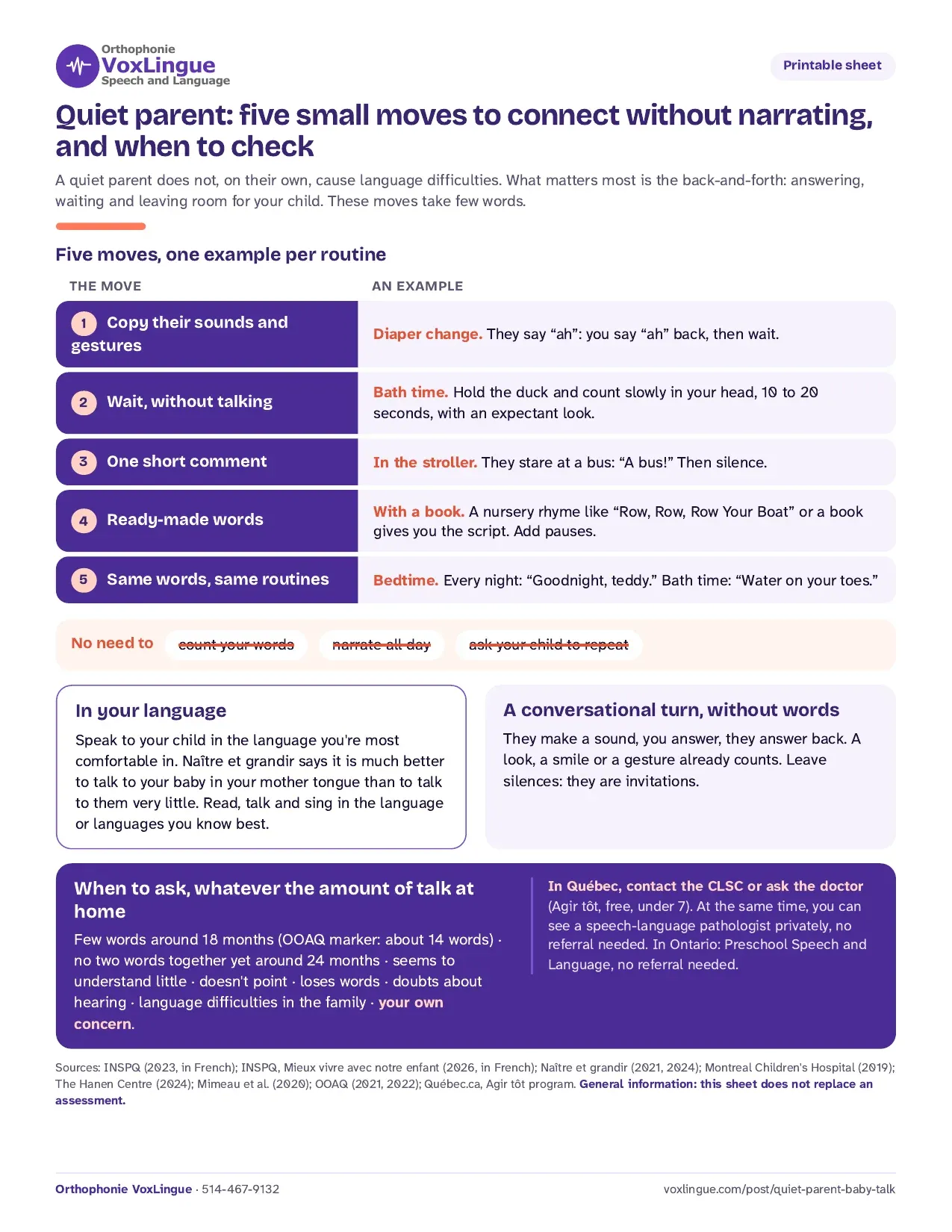
Printable sheet: Quiet parent: five small moves to connect without narrating, and when to check (PDF, 1 page).
Frequently asked questions
How many words should my baby hear each day?
There is no number. None of the Québec or Ontario public sources we consulted sets words or minutes per day. Conversational turns counted by recorders are research estimates, not a score to reach at home. What helps is back-and-forth woven into daily routines. Our guide also answers the question of how much time to spend on it each day.
Do I need to narrate everything I do?
No. For the INSPQ, describing what you do is one strategy among several, alongside naming, adding a word, expanding and rephrasing (in French, 2023). Mieux vivre suggests talking about what holds your child’s attention without bombarding them with information. One short comment followed by a pause leaves more room for their turn than a long monologue.
I feel silly talking to a baby who can’t answer yet: does it help?
Yes, and your baby already answers in their own way: with a look, a sound or a movement. Naître et grandir suggests giving them time to answer: by taking turns, they learn the basics of conversation (in French, 2024). A sing-song voice is normal: in an American study, it went with more turn-taking (Ferjan Ramírez and colleagues, 2020). If words don’t come, a nursery rhyme or a book gives you the script.
My partner, the grandparents or the daycare educator talk more than I do: does that count?
Yes. What matters most is talk addressed to the child (Weisleder and Fernald, 2013), and it can come from every adult who cares for them. In bilingual toddlers, talk from several people also counted (Place and Hoff, 2011). Your own moments with your child still matter, even quiet ones: a look, a nursery rhyme, a pause that leaves room for their turn.
Does talk on TV or around them count?
Less than talk addressed to them. In one study, talk the child simply overheard was not linked to vocabulary, while talk addressed to the child was (Weisleder and Fernald, 2013). Researchers still debate how to count the talk around a child. For screens, see what research says about screens and toddler talk.
My baby is calm and so am I: is that a problem?
Not in itself. The Québec twin study shows that babies shape how adults talk to them: a calm baby sometimes draws less talk. Step into the loop through your baby’s cues: a look, a sound, a gesture. Then watch your child’s own markers rather than the amount of talk at home.
Is the 30 million word gap real?
Not as stated. The number is a projection from 42 American families observed one hour a month. Later studies find a much smaller gap in talk addressed to children, and no gap when all the talk around them is counted (Dailey and Bergelson, 2022). The number is not a measure of your home.
Is it my fault my child talks little?
No. None of the studies cited here shows that a quiet parent, on their own, causes language difficulties. According to the OOAQ, developmental language disorder is not caused by a lack of stimulation (in French, 2021). If your child’s language worries you, get a check: telling short-term language difficulties from DLD can help you see more clearly.