
Is it the screens? What research really says about screens and toddler talk
“Is it because of the screens?”
When a toddler isn’t saying much, that’s often the first question parents ask our speech-language pathologists. The second one comes right after: do we have to take everything away, or can we keep a bit of TV so supper gets made?
Both questions deserve a real answer, without a lecture. Research has moved a lot in the past ten years, and it says something more useful than “screens are bad.” Mostly, it shows what a screen replaces in a child’s day. That’s where you have the most power, even without aiming for zero screens.
What to know
A real link, but a modest one
The short answer first: no, research doesn’t show that screens on their own cause a language delay.
It does show a link. In 2020, a Canadian team pooled forty-two studies covering nearly nineteen thousand children (Madigan and colleagues, JAMA Pediatrics). On average, more screen time went with slightly weaker language. Watching with an adult went with slightly better language. Both effects were weak.
A Calgary study followed about two and a half thousand children to see which way the link runs (Madigan and colleagues, 2019). More screen time at 2 and 3 came before slightly lower scores on a developmental questionnaire a year or two later. The reverse wasn’t found.
Still, none of these studies randomly assigned children to “lots” or “few” screens. A child who already talks little sometimes drifts toward the tablet. So does an exhausted family.
Kimberly Martins, our founding speech-language pathologist, puts it this way: “Screens are not a cause of any disorder, but they can make underlying difficulties worse.” The reason is time. Screen time is time your child could have spent interacting with someone, or playing alone and inventing.
What screens replace: back-and-forth talk
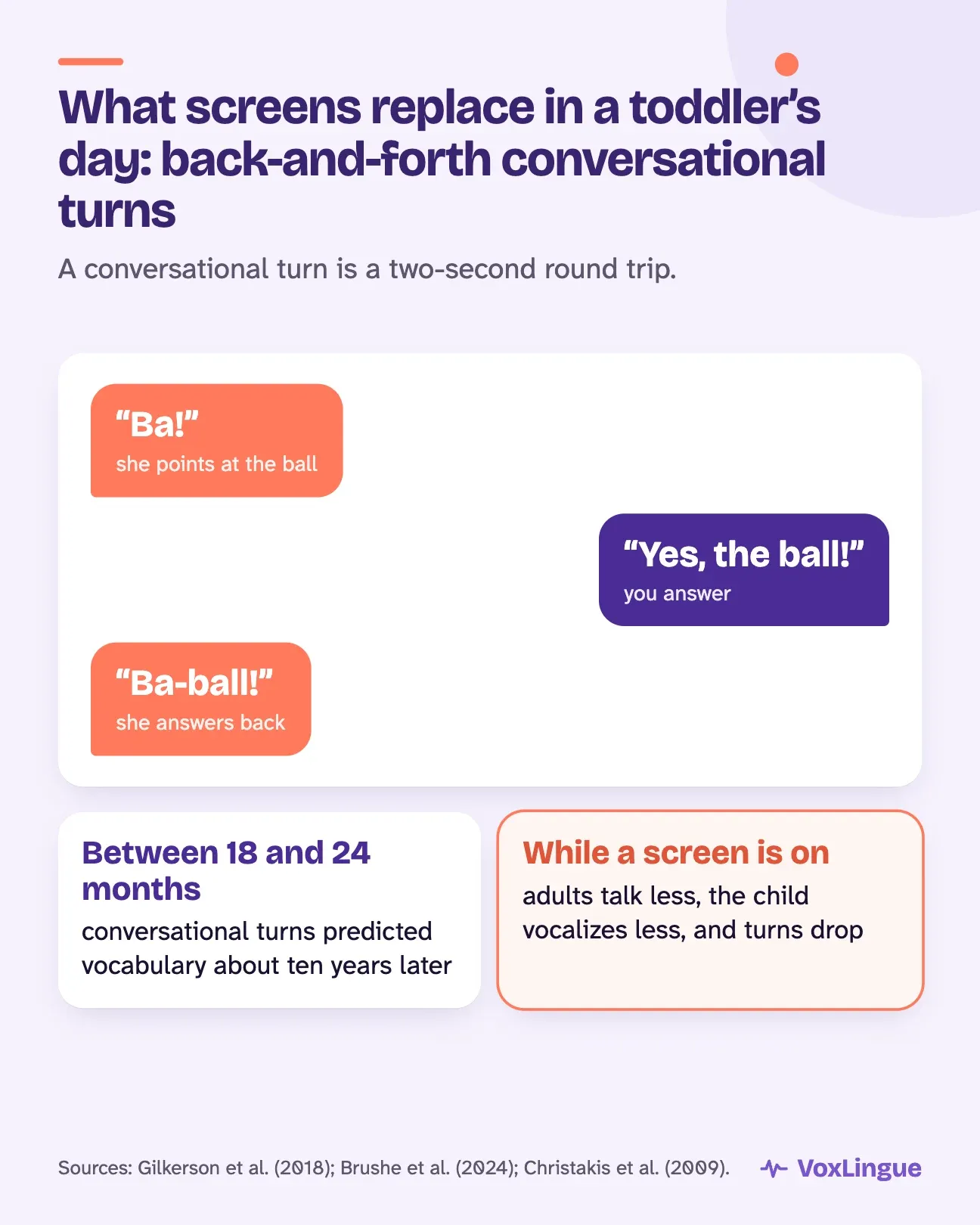
A conversational turn is one round trip. Your 20-month-old says “ba!” and points at the ball, you say “Yes, the ball!”, and she answers back. It takes two seconds, and it counts for a lot.
A US study recorded whole days at home with toddlers, then saw the same children about ten years later (Gilkerson and colleagues, 2018). Conversational turns between 18 and 24 months predicted their vocabulary, better than the total number of words they heard.
Screens eat into exactly those turns. In Australia, children aged 12 to 36 months wore a recorder for full days (Brushe and colleagues, 2024). Each extra minute of screen time went with fewer adult words and fewer sounds from the child. Turns dropped too. The gap was biggest at age 3.
“He’s not even watching it”
Our speech-language pathologists hear this a lot about the TV that’s on in the background. Their answer: it’s still a distraction in the room, for the child and for the parent.
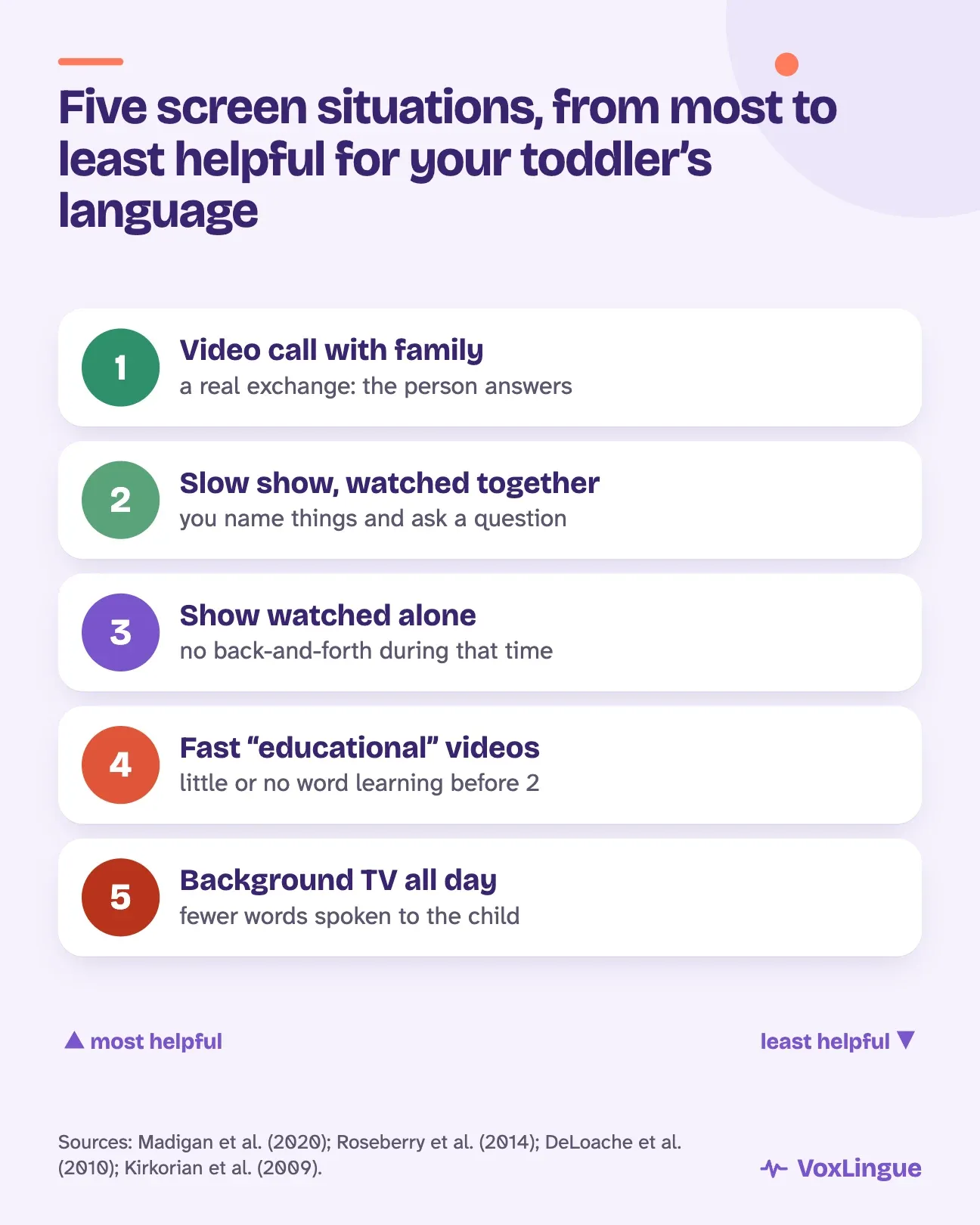
The studies agree. In a lab, parents spoke less to their toddlers, and less well, when an adult show played behind them (Kirkorian and colleagues, 2009). In another study, every hour of audible TV went with several hundred fewer adult words reaching the child (Christakis and colleagues, 2009).
In Québec, it’s common. According to the Institut de la statistique du Québec (2025, in French), about one in four children aged two and a half lives with a TV that’s often or always on. Even when nobody’s watching.
What about our own phones? In a small study, mothers taught their 2-year-olds two new words (Reed and colleagues, 2017). When a phone call interrupted the teaching, the child didn’t learn the word, even after hearing it just as often.
Nobody lives without a phone. The aim is to protect a few face-to-face stretches each day: bath time, breakfast, the bedtime story.
Not all screens are equal
A video call with a grandparent who answers back has nothing in common with videos autoplaying on YouTube.
Our speech-language pathologists don’t count video calls as screen time like the rest: your child is talking with a real person through a screen, the way they would on the phone. Research backs this up. Two-year-olds learned new words over a live video chat, but not from a recorded video of the same person (Roseberry and colleagues, 2014). The difference? The person on screen responded to them.
In Québec, about one 17-month-old in six uses a screen every day to talk with family (ISQ, 2024, in French). For many Montréal families, it’s the main link with grandparents in Manila or Kingston. Sit next to your child during the call: repeat what Grandpa says, and show the thing he’s talking about.
The official guidance, and real life
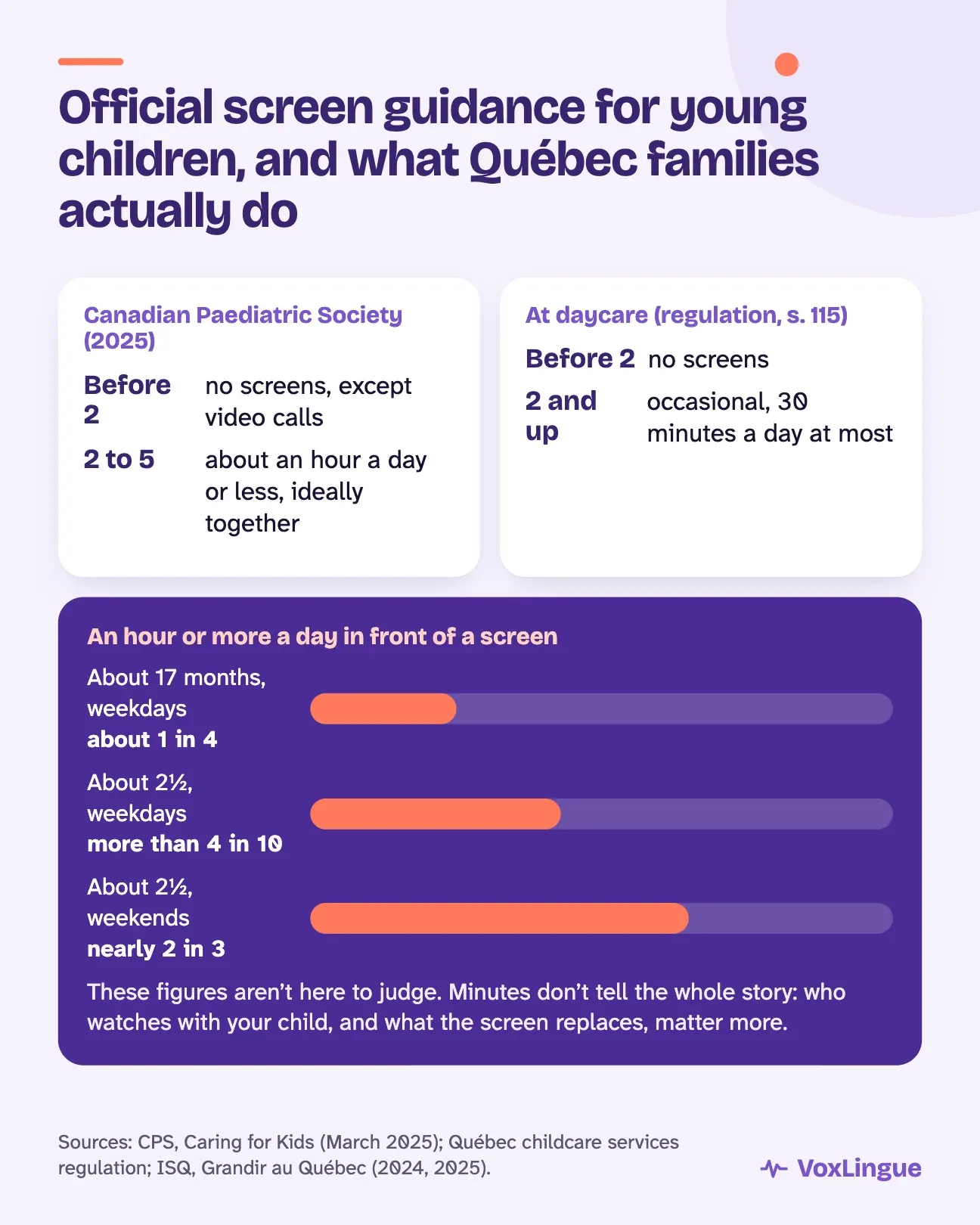
The Canadian Paediatric Society updated its advice in March 2025. Before age 2, it doesn’t recommend screens, except video chatting with family. From 2 to 5, it suggests about an hour a day or less. Ideally you watch together, and the TV goes off when no one’s watching.
At daycare in Québec, the rule is written into regulation. Section 115 of the childcare services regulation bans screens before age 2. After 2, a screen is allowed only as part of the educational program, occasionally, for no more than 30 minutes in a day. You can ask your daycare how they apply it.
At home, many families go past these limits. Around 17 months, about one Québec toddler in four spends an hour or more a day in front of a screen on weekdays. Around two and a half, it’s more than four in ten on weekdays, and nearly two thirds on weekends (ISQ, 2024 and 2025). Those figures aren’t here to judge anyone. They show you’re far from alone, and that minutes don’t tell the whole story. Who’s watching with your child? What are they watching? And above all, what is the screen replacing?
Bilingual families: the home language comes through you
Parents often ask us whether cartoons in the home language can keep it alive. Unfortunately, no study shows that videos alone can teach a toddler a language.
A well-known experiment shows why (Kuhl and colleagues, 2003). American 9-month-olds heard Mandarin over about a dozen short sessions. The babies who heard it from a person in the room learned to tell apart sounds of that language. Those who watched the same person on video showed no measurable effect.
In English-French bilingual toddlers in Canada, the amount of TV wasn’t what mattered; how it was watched was (Hudon and colleagues, 2013). Adult TV, background TV and watching alone went with lower vocabulary.
Speak your language with your child. Sing it, tell stories in it. A video in that language still has value if you watch it together and talk about it afterwards.
What about autism?
This one comes up a lot online. A 2023 review of forty-six studies concluded that the link between screens and autism isn’t well supported (Ophir and colleagues). Some autistic children may simply be more drawn to screens. “Virtual autism” isn’t a recognized diagnosis.
If autism is on your mind, look at communication beyond words. Does your child point to show you something? Look at you to share what they see?
Talking little: cut screens or get an assessment?
You can do both at once. But don’t wait for a “screen break” to fix things: cutting back improves your child’s environment, but it’s neither a test nor a treatment.
In an assessment, our speech-language pathologists always ask about screen habits. They want to understand your child’s typical day, so the advice fits your real life. Screens are part of the picture. They never explain it on their own.
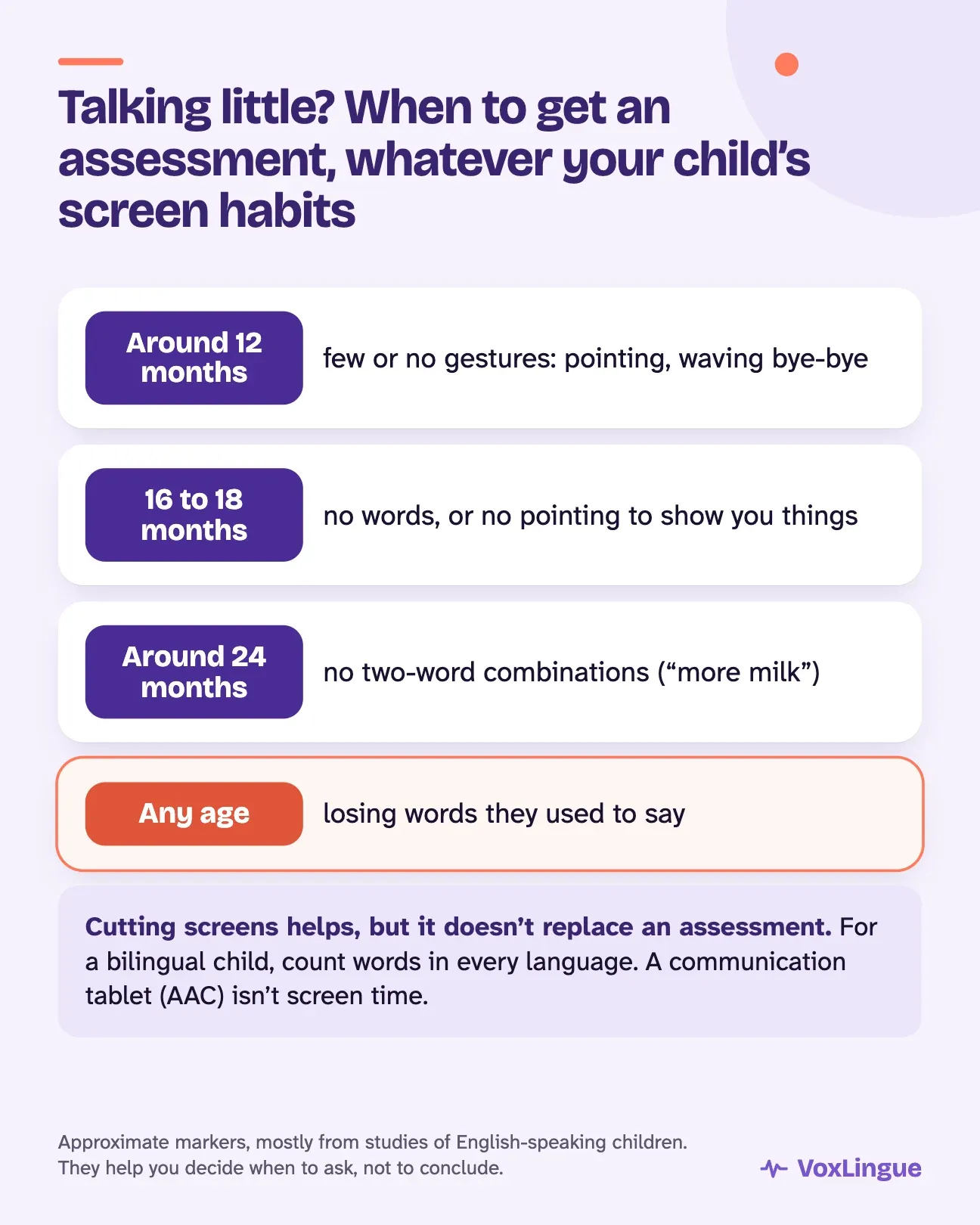
Talk to your doctor or a speech-language pathologist if:
- around 12 months, your child uses few or no gestures (pointing, waving bye-bye);
- around 16 to 18 months, says no words or doesn’t point to show you things;
- around 24 months, isn’t combining two words (“more milk”, “daddy gone”);
- at any age, loses words they used to say.
For a bilingual child, count words in every language. And a communication tablet (AAC) isn’t screen time: it’s your child’s voice, and it’s never taken away.
Try this week
The first five minutes together · 18 months to 5 years
About one Québec parent in five says they often use a screen to keep their child busy while they do something else (ISQ, 2024). If that’s you, keep the show. Just change how it starts and how it ends.
At the start: sit with your child for the first five minutes. Pick a slow show rather than a string of fast clips. Pause when something happens, and name it:
“Oh! The dog’s running. Where’s he going?”
Then wait.
Count to five in your head. An 18-month-old might point or say “there!”. A 3-year-old might say “He’s getting the ball.” Repeat what they said and add a word: “Yes, the red ball!”
At the end: turn it off, and keep the story going without the screen. Bring out a stuffed dog and a ball: “The dog’s running… where’s the ball?” That’s where the conversation really becomes your child’s.
What to watch for: does your child respond to your pauses? A gesture counts, and so does a sound. Do they bring the character back into play later on their own? If there’s no response to the pauses at all, write it down: that’s useful for your doctor or a speech-language pathologist.
For the first few days, expect some protest when the screen goes off. Stay close, name the feeling (“You’re mad, you wanted more dog”) and offer the toy. It usually gets easier within days.
Myth or fact
“Educational apps teach babies words.”
It’s easy to see why people believe it. The app is colourful, it names things, it cheers when your baby taps. And it says “educational” right on it.
One study put it to the test (DeLoache and colleagues, 2010). Babies aged 12 to 18 months watched a vocabulary DVD several times a week for a month. They learned no more words than a group that never saw it. The babies who learned the most? Those whose parents taught them the same words during the day, no screen involved.
Québec’s public-health guide for parents (INSPQ, Mieux vivre avec notre enfant, 2026) is clear: despite the name, so-called educational apps and videos don’t help children under 2 develop. After 2, the Canadian Paediatric Society suggests age-appropriate educational shows, watched together.
Verdict: a myth, before age 2. Words are learned from someone who answers back.
Worth reading
“Screen use and young children”, Canadian Paediatric Society: the official handout for parents, updated in March 2025. Plenty of websites still quote the 2017 statement, which the Society has since withdrawn. This is the current one, with practical advice by age.
From VoxLingue
Our full guide, Does screen time cause speech delay?, goes further: nursery-rhyme videos, echolalia, communication tablets, and what happens when a family changes its habits. It includes the printable sheet Less screen, more talk, with ideas for the supper rush.
Your question: when in the day does a screen help you get through the most? Reply to this email in one line. Your answers will help us plan a future issue.
This newsletter is for information and does not replace an assessment. Lire en français