French or English school for a child with language difficulties in Montréal: what changes from kindergarten to Grade 1, what research on immersion shows, and what the English-eligibility rules really allow

Your child is in kindergarten in Montréal, and the teacher mentions that Grade 1 will bring more French, or reading and writing in French. If your child has language difficulties, the question of French or English school suddenly feels urgent. Will they follow? Is immersion too much? Could they go to English school instead?
Kimberly Martins, speech-language pathologist and founder of VoxLingue, hears versions of this question often. In our guide to getting ready for kindergarten in Québec, she wrote that when French is the worry, parents ask her whether their child will be OK in a French school.
This guide puts three things side by side: how much French each Montréal program gives in Grade 1, what Canadian research on immersion shows and leaves open, and what Québec’s English-eligibility rules actually say. It ends with questions to ask the school, a word on the home language, and whom to talk to.
It gives information, not legal advice. Nothing shows that a change of school is needed on its own; that decision belongs to your family, with the school team and your speech-language pathologist.
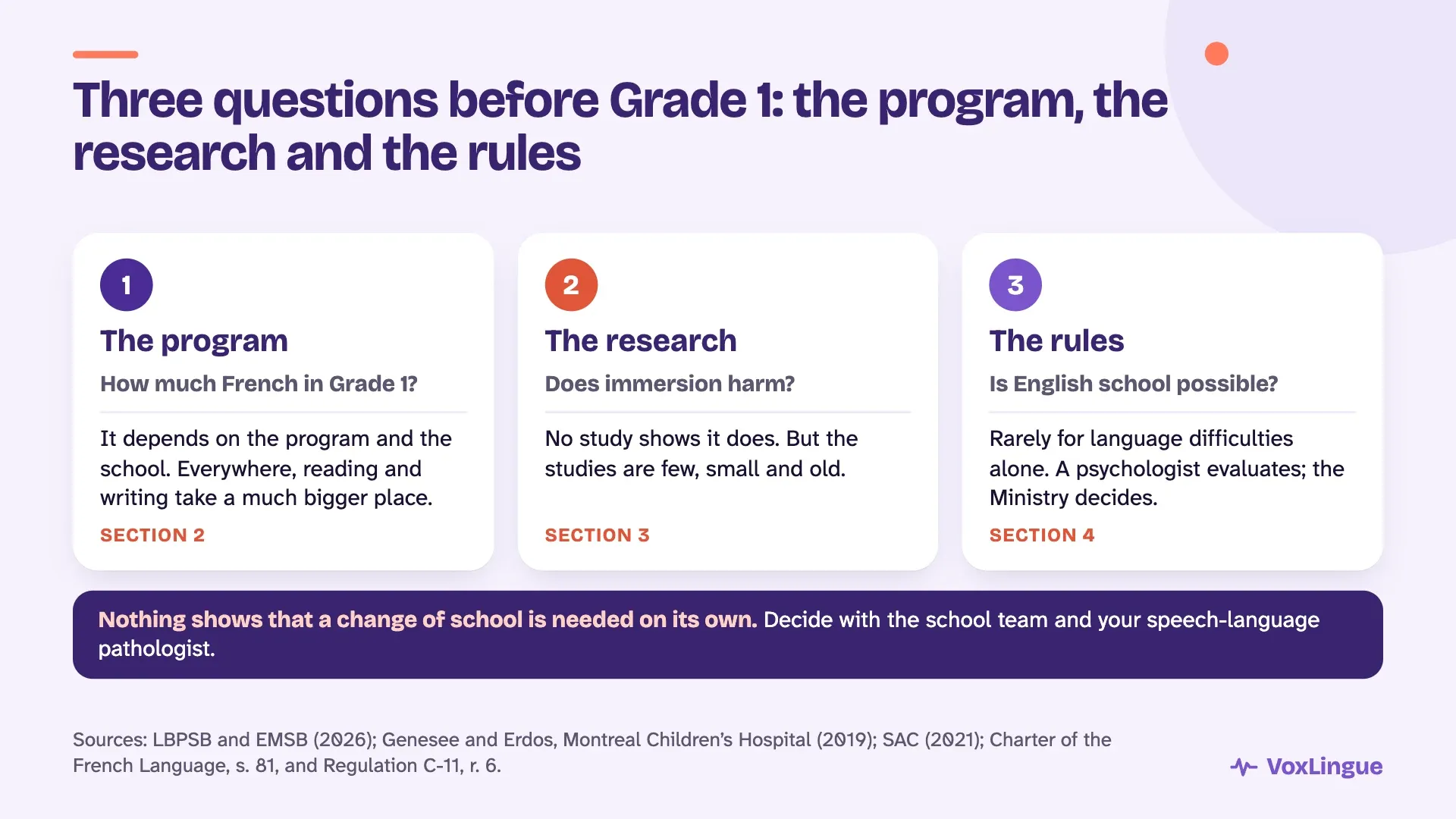
Is French school or French immersion a problem for a child with language difficulties?
No study shows that French school or immersion causes or worsens a language difficulty. The research is small and old, though, so it cannot say which program suits your child. Nothing shows that a change of school is needed on its own: decide with the school team and your speech-language pathologist. A real difficulty shows in every language.
The question is still fair: in Grade 1, a child who already finds language hard starts reading, sometimes in a language they are still learning.
McGill researchers answered the core worry in a question-and-answer guide for the Montreal Children’s Hospital. Learning an additional language will not make these students’ difficulties worse, they write. And a real language disorder will be evident in both languages (Genesee and Erdos, 2019).
So the program alone rarely explains a child’s difficulty. If finding words or building sentences is hard in your home language too, the difficulty will likely follow your child into French. If only French seems hard, they may simply be learning it.
Kimberly Martins made a related point about the choice of kindergarten at age 4. For a child with language difficulties, there is no right or wrong answer: it depends on each child and family. The aim is for your child to be where they will have the support they need.
For other questions about raising a child in more than one language, see our articles for bilingual and multilingual families.
What changes between kindergarten and Grade 1 in Montréal’s English, bilingual, immersion and French programs?
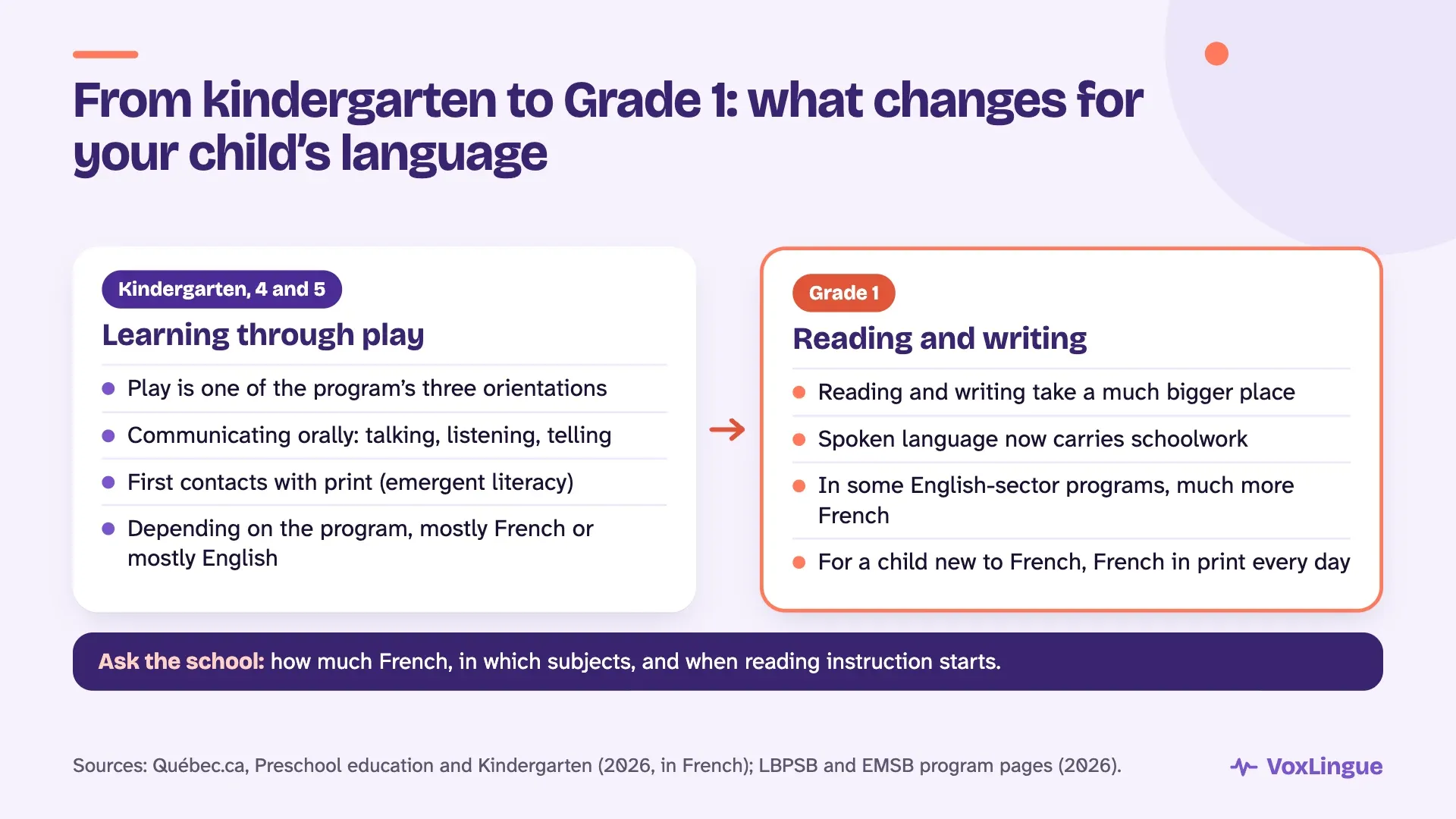
It depends on the program and the school. In some English-sector schools, kindergarten is mostly in English and French grows in Grade 1; in immersion, French starts in kindergarten. In every program, Grade 1 is when reading and writing take a much bigger place. Ask your school how much French your child will have, subject by subject, each year.
How much French each English-sector program gives, by grade
Each English board describes its French programs in its own way. The Lester B. Pearson School Board (LBPSB) describes them by subject and grade; the English Montreal School Board (EMSB) gives a share of teaching time. The table keeps each board’s own words.
| Program | Kindergarten to Grade 2 | Grades 3 to 6 | Source (read November 2026) |
|---|---|---|---|
| LBPSB Bilingual | About half the week in English, half in French; English language arts and math in English; science, geography and history in French | Same split to Grade 6 | LBPSB, About our Programs |
| LBPSB French Immersion | All core subjects in French | English language arts and math in English from Grade 3, then about half and half | LBPSB, About our Programs |
| LBPSB Français Plus | French | French to Grade 4; English arrives in Grade 5 | LBPSB, About our Programs |
| EMSB English Core | 68% English, 32% French (board-wide figure) | Same board-wide figure | EMSB, French programs |
| EMSB Bilingual | 50% English, 50% French | Same | EMSB, French programs |
| EMSB French Immersion | 85% of teaching in French in the early grades | The bilingual model (50/50) from Grade 3 | EMSB, French programs; Edward Murphy school page |
These are program facts from the boards, not data about children. The EMSB immersion split comes from one school’s page, and splits can differ from one school to another. Ask yours for its split, grade by grade and subject by subject.
The LBPSB’s 2023-2024 program offering also describes its kindergarten for 4-year-olds as taught mostly in English. So for some families, Grade 1 is the year French grows a lot. For others, French has been there since kindergarten, and Grade 1 adds reading and writing in French.
In French school: from play-based kindergarten to reading and writing in French
In French school, kindergarten follows Québec’s preschool program, at age 4 and at age 5. Play is one of its three main orientations. Language there means communicating orally and in writing, including the first contacts with print that the program calls emergent literacy.
In Grade 1, reading and writing take a much bigger place. For a child who speaks English or another language at home, this is often the first year they meet French in print every day.
For children who are new to French, Québec’s school funding rules for 2026-2027 include welcome and French-support classes from kindergarten at age 5. How this help is organised varies from one school to the next.
How long does a new language take? A 2016 Canadian review found that children learning English as a second language often take more than three years to reach the level of children who speak only English, and children with a language disorder longer still (Paradis, 2016). French learners are likely similar, but this was not tested.
A slower pace in a new language is part of learning it, not a sign of failing. To tell whether weaker French comes from recent exposure or from a language disorder, see how to tell learning French from a language disorder.
Why Grade 1 reading leans on spoken language, in any language
Reading builds on spoken language: the sounds of words, what they mean, and how sentences fit together. In a Canadian study of 108 children in French immersion, sound skills measured in English in kindergarten predicted difficulty reading French words in Grade 3. Children who struggled tended to struggle in both languages (MacKay, Chen and Deacon, 2023).
In other words, a child’s language base carries across languages. Signs to watch for, and what helps in immersion, are covered in our article on early signs of reading difficulties from kindergarten to Grade 2.
What does research say about French immersion for children with language difficulties?
Canadian studies since 1978 found no harm, but they are few, small and old. Children with language difficulties in immersion did as well in their first language as similar children taught in English, and they learned French. None of the studies compared programs or starting ages. Speech-Language & Audiology Canada says not to steer these children out of immersion by default.
The main studies were done in Montréal by researcher Margaret Bruck. Children with language difficulties followed in French immersion in kindergarten and Grade 1 had, after two years, language and thinking skills similar to those of comparable children taught in their first language (Bruck, 1982). They also learned French, though less than classmates without language difficulties.
An earlier Grade 3 study pointed the same way, and Bruck recommended including these children in immersion, with support services. In her later work, students in difficulty who switched to an English program did no better at school than those who stayed. Transfer studies had no comparison group of children who stayed with support, so they cannot show that switching helps (as reported by Genesee, 2007).
Reviews since then call this evidence thin. In 2007, McGill researcher Fred Genesee found only one set of studies on immersion and language impairment, and called the evidence scant and methodologically weak. Whether learning through a second language puts these children at extra risk, he wrote, remains an open question.
A 2016 review led by Canadian researchers found only one study, unpublished, that had compared children with developmental disorders in different school language programs (Kay-Raining Bird, Genesee and Verhoeven, 2016). A 2003 Montréal study is also often cited, but almost all of its eight bilingual children went to school in one language, so it does not test immersion.
| Study | Place and year | Children | What was found | Main limit |
|---|---|---|---|---|
| Bruck (as reported by Genesee, 2007) | Montréal, 1978 | Grade 3, immersion | Did like similar students in the English program, with better French | Older definitions; number of children not reported |
| Bruck | Montréal, 1982 | Kindergarten and Grade 1, immersion | After two years, like similar children taught in their first language; learned French | Number of children not reported |
| Bruck (as reported by Genesee, 2007) | Montréal, 1985 | Grades 2 to 4, students in difficulty | Those who switched out did no better at school | No comparison group who stayed with support |
| Paradis, Crago, Genesee and Rice | Montréal, 2003 | 8 bilingual 7-year-olds with a language disorder | Did as well as children with the same disorder who spoke one language, on verb tense | Not an immersion study |
| Genesee (review) | Canada, 2007 | Review of the studies | Only one set of studies; evidence scant | The question stays open |
| Kay-Raining Bird, Genesee and Verhoeven (review) | Canadian-led, 2016 | Children with developmental disorders | Only one unpublished study compared school programs | Little research on school programs |
| Genesee and Erdos (guide for parents) | Montréal, 2019 | Summary of the research | No study compared immersion types or starting ages | A summary, not a new study |
The McGill researchers’ guide for the Montreal Children’s Hospital says it plainly. No study has compared types of immersion programs for students at risk, and none says at what age to start. Studies of children with a developmental language disorder, Down syndrome or autism show that they can become bilingual. But those studies looked at languages learned at home, not at school programs.
Our own search for newer studies, from 2010 to 2026, found none comparing children with a language disorder in immersion and in English programs. Newer Canadian work looks at reading, intervention or assessment.
Canada’s national association of speech-language pathologists and audiologists draws a careful conclusion. In its 2021 position statement, Speech-Language & Audiology Canada (SAC) says children with language disorders should not be systematically counselled out of immersion programs. They should have access to special-education support and to the second language, without having to choose one or the other (SAC, 2021).
SAC also reports, citing a 2021 review, that immersion students with language disorders reach the same academic results as similar students in English programs, with better French (Genesee and Lindholm-Leary, 2021).
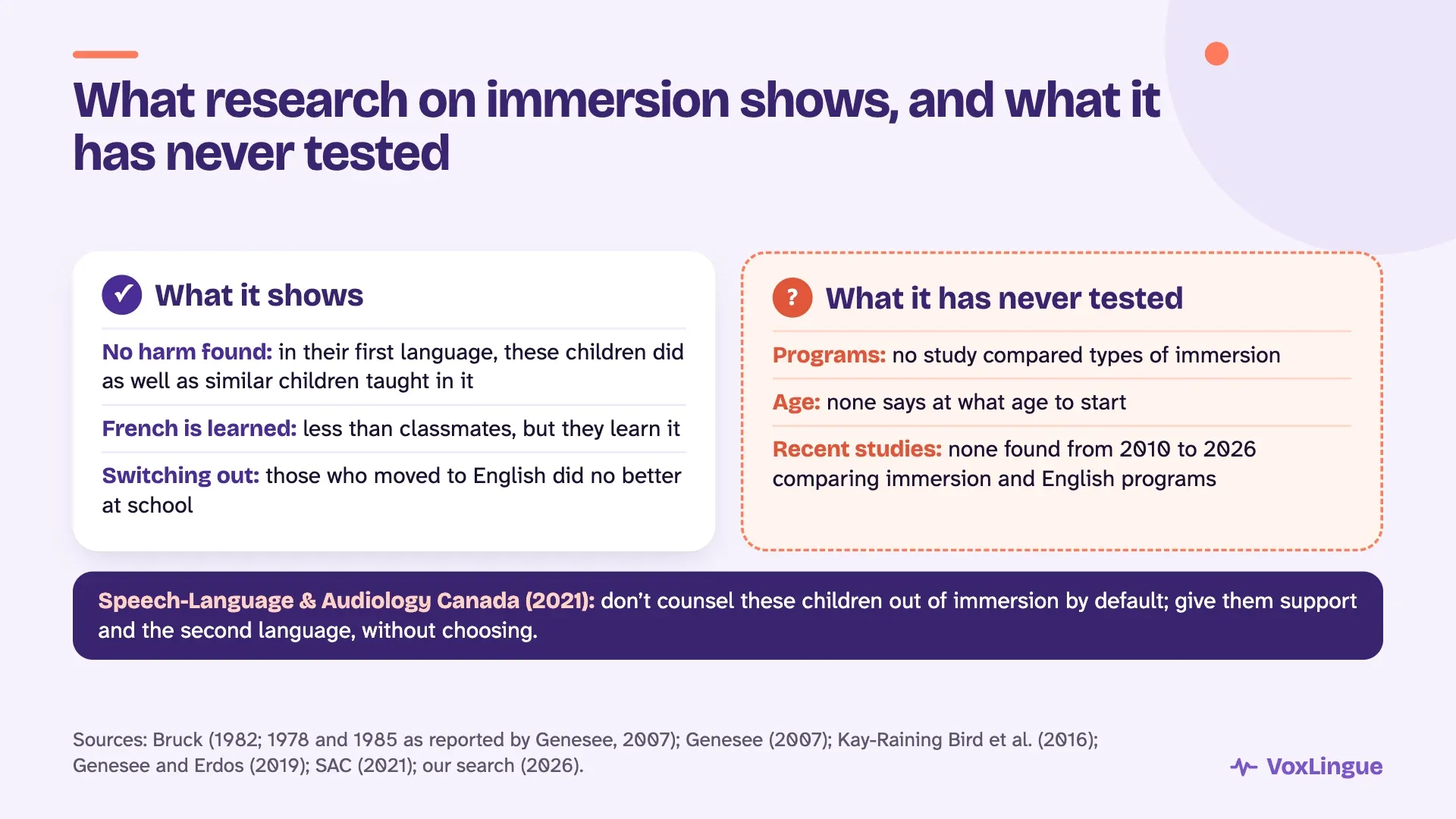
So research has not found that French immersion harms children with language difficulties, and it has never tested which program or starting age suits them. The decision rests on your child, the help available and the people who know them, not on a general rule.
Can a language difficulty get my child into English school in Québec?
Rarely, and not on its own. Section 81 of the Charter of the French Language allows English schooling for serious learning difficulties. But its regulation describes three precise situations, requires an evaluation by a psychologist the school board designates, and the Ministry decides. In Kimberly Martins’s experience, English eligibility is often refused.
This is information with official links, not legal advice: only the Ministry decides a child’s file.
Who is usually eligible for English public school
In Québec, instruction from kindergarten to the end of secondary school is in French, with exceptions (Charter of the French Language, section 72).
The usual routes, as Québec.ca lists them, are for a child living in Québec whose mother or father is a Canadian citizen. They rest on English schooling in Canada: the child’s, a brother’s or sister’s, or a parent’s. The full conditions are on Québec.ca’s page on eligibility for instruction in English. The school board sends the request, and the Ministry decides in writing.
English boards ask for the resulting certificate of eligibility at registration. If your child is already eligible, the question is only which program: see the table above.
The exemption for serious learning difficulties, in plain words
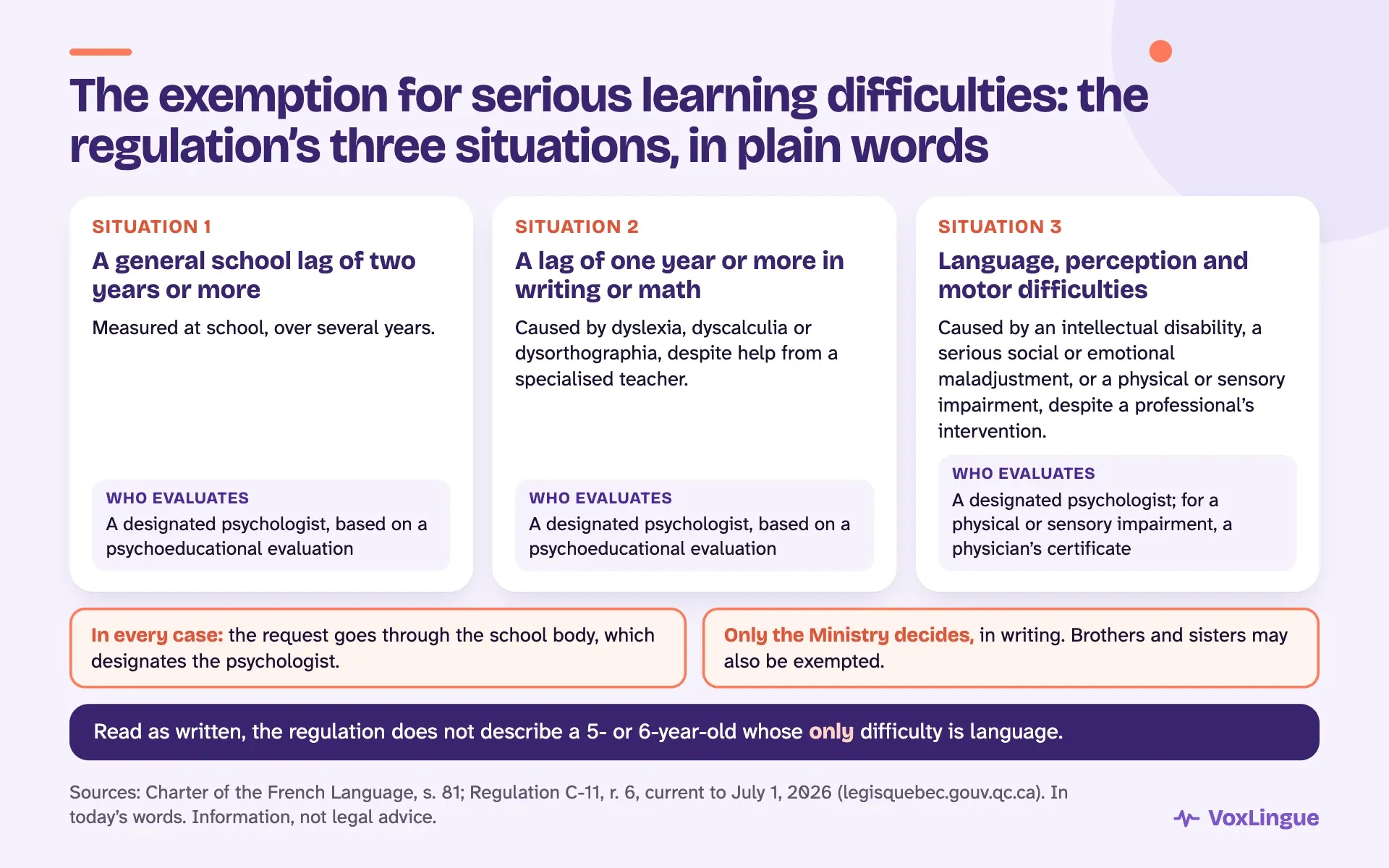
Under section 81, children with serious learning difficulties may, at a parent’s request, receive instruction in English if this is required to help them learn. Their brothers and sisters may also be exempted (Charter of the French Language, section 81). Bill 96, adopted in 2022, did not change this section.
What counts as a serious learning difficulty is set by a 1993 regulation, still in force (Regulation C-11, r. 6, current to July 1, 2026). At the time of the request, the child must be in one of three situations, given here in today’s words.
The first is a general school lag of two years or more. The second is a lag of one year or more in writing or in math, caused by dyslexia, dyscalculia or dysorthographia, that persists despite help from a specialised teacher. The third is language, perception and motor difficulties caused by an intellectual disability, a serious social or emotional maladjustment, or a physical or sensory impairment, that persist despite a professional’s intervention.
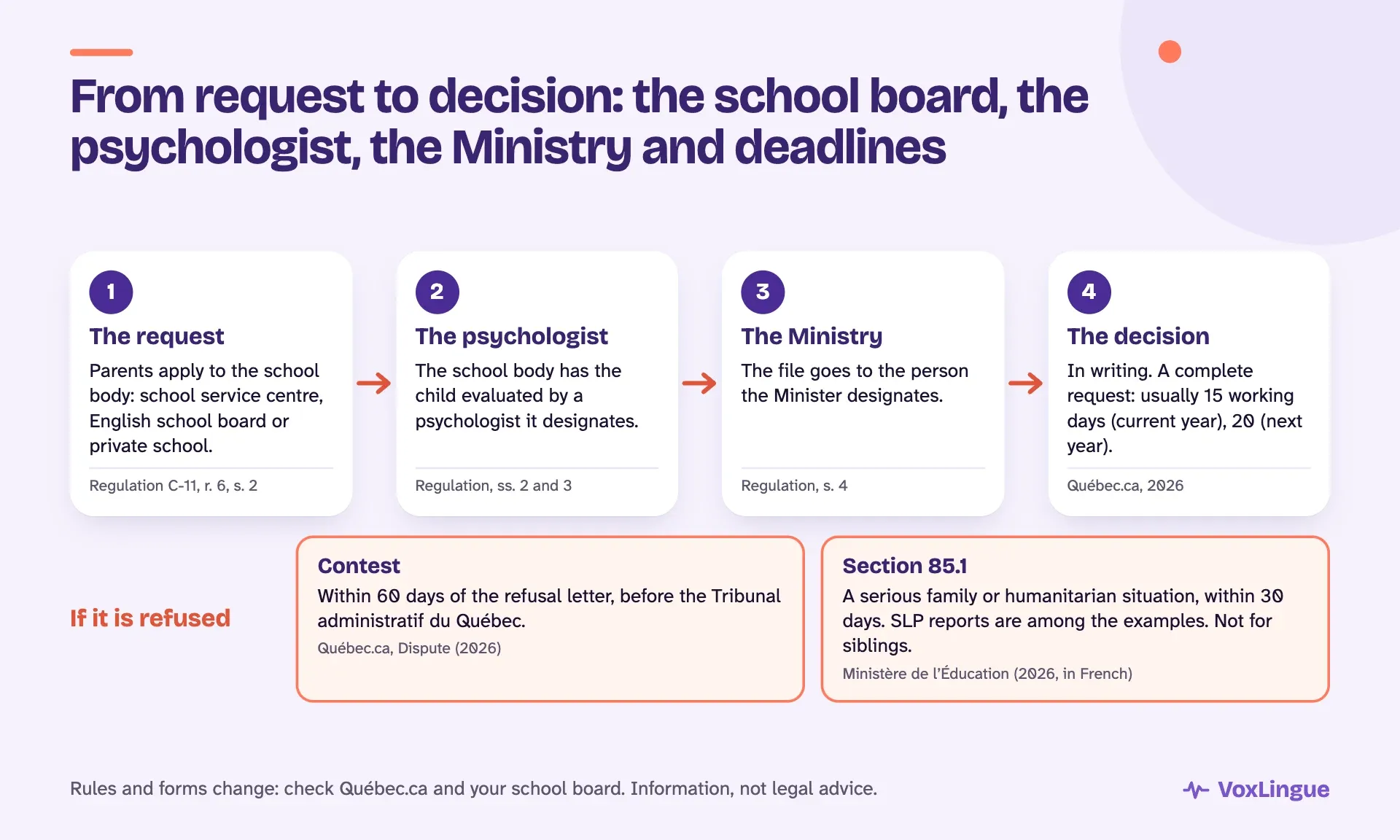
The request goes through the school body (school service centre, English school board or private school), which has the child evaluated by a psychologist it designates. For the first two situations, the psychologist relies on a psychoeducational evaluation by a pedagogical consultant the school body designates. For a physical or sensory impairment, a physician’s certificate is needed.
The school body then sends the file to the person the Minister designates, who decides in writing. If the request is accepted, the family receives a declaration of eligibility.
What a speech-language report can and cannot do
Read as written, the regulation does not describe a 5- or 6-year-old whose only difficulty is language. The first two situations need a school lag measured in years. The third needs a specific cause, such as an intellectual disability or a sensory impairment. Only the Ministry decides each file, so ask the school board before you build one.
Under special exceptions, the EMSB’s eligibility page asks for a diagnostic report by a licensed professional that confirms the difficulty and recommends English instruction. It also asks for the original report cards and individualized education plans (IEPs) of the past two years, and support letters, for example from therapists working in English (EMSB, Eligibility).
A child entering Grade 1 rarely has two years of report cards and IEPs yet. At the LBPSB, families applying for this reason are asked to contact the Admissions team for guidance.
For children with severe language disorders, some parents ask Kimberly Martins for a letter to obtain English eligibility. In her experience, English eligibility is often refused.
So a speech-language report can be one document in a file, and it helps the school plan support. It does not replace the evaluation by the psychologist the school body designates, and on its own it rarely fits what the regulation asks for.
Timelines, refusals and the other route after a refusal
Complete requests usually take 15 working days for the current school year, and 20 for the next one, according to Québec.ca. If eligibility is refused, you have 60 days after receiving the refusal letter to contest it before the Tribunal administratif du Québec (Québec.ca, disputing a decision on eligibility).
After a refusal, another route exists for a serious family or humanitarian situation (section 85.1). The request must be made within 30 days of the refusal letter. Among the examples of supporting documents, the Ministry lists reports from a speech-language pathologist.
The Ministry also says that preferring English, or finding it easier, is not a reason, and that this route does not extend to brothers and sisters (Ministère de l’Éducation, 2026, in French). Rules and forms change, so check Québec.ca and your school board before you apply.
What help can a French school or an English board give a child with language difficulties?
Both networks plan help around your child’s needs. French schools call the plan a plan d’intervention; English boards call it an IEP (individualized education plan). It is the same tool. Speech-language services vary from school to school. The EMSB also has a Language Class from Grade 1 for severe language disorders. Neither network is the right answer for every child.
In Québec’s French schools, help is organised according to the student’s needs, regardless of a diagnosis or a difficulty code. A plan d’intervention needs no diagnosis. The principal sets it up with the parents, the school staff and the student.
Kimberly Martins sees the same variety in school speech-language services. Some school speech-language pathologists assess and treat directly. Others support specialised classes or coach the school team, and some do all of these. Difficulty codes and the steps of a plan d’intervention in French schools will have their own guide on this blog.
In the English boards, the IEP plays the same role. At the EMSB, resource teachers support students with learning difficulties in both French and English, in class or in small groups, and these students have an IEP.
The EMSB also has a Language Class for students in Grades 1 to 6 with severe language disorders. It is a small class within a regular school, with a speech-language pathologist consulting every week. It is considered only after several attempts in a regular class have not worked, and it is decided at a meeting with the parents.
The school speech-language pathologist and the remedial teacher (orthopédagogue) have different roles: see what the school SLP and the remedial teacher each do.
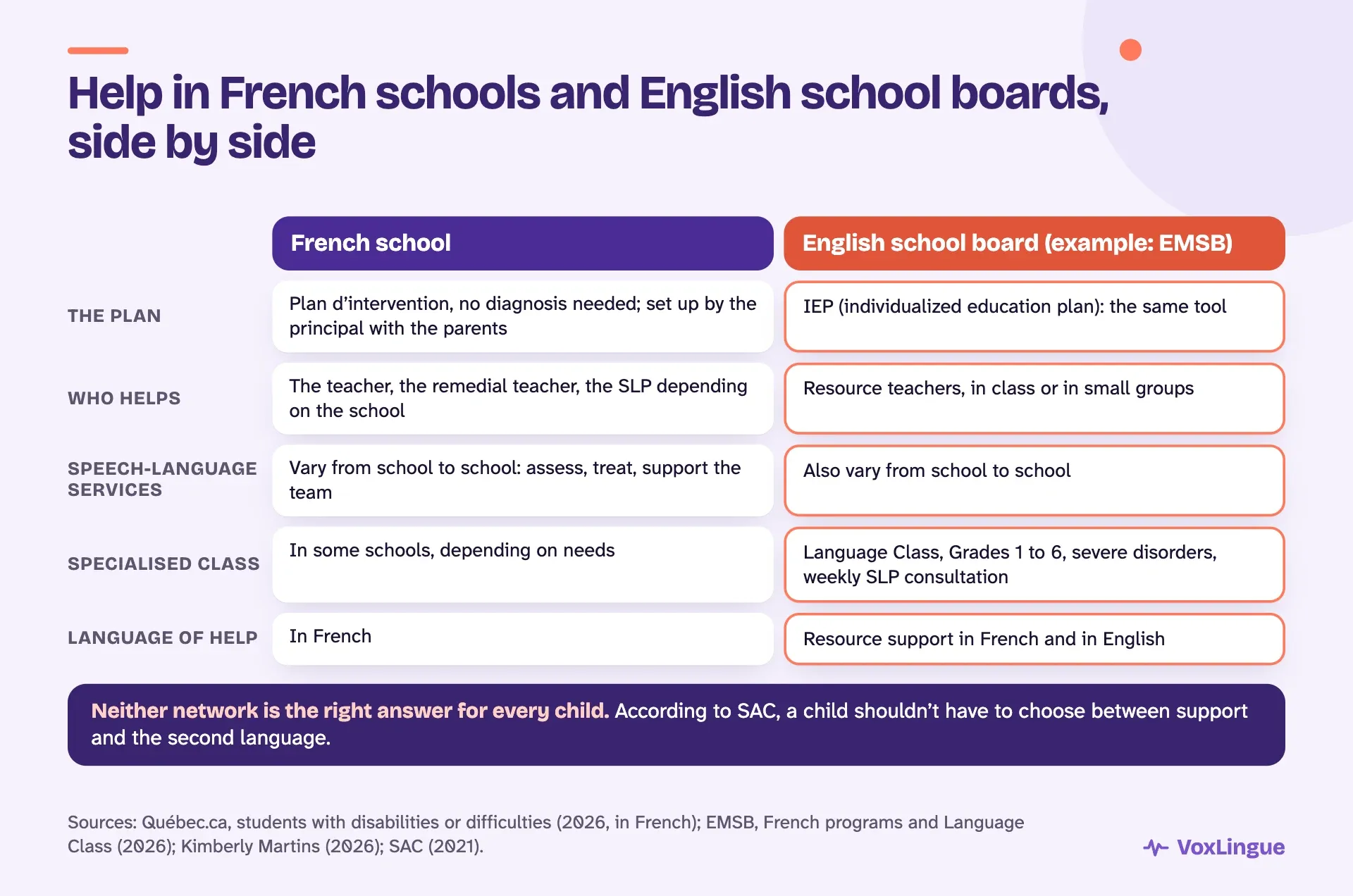
Whatever the network, SAC’s position applies: a child should not have to choose between special-education support and the second language. The useful question is less “which network?” than “what help will my child get, and in which language?”
What should you ask the school before Grade 1?
Ask precise questions, and bring your child’s reports. Ask how much French your child will have in Grade 1, who the school speech-language pathologist is, what help exists in class, and how progress will be shared. The first report card, due by November 20, is a natural moment to meet the teacher and ask again.
Here are eight questions to ask before the end of kindergarten, or in the first weeks of Grade 1.
- How much French will my child have in Grade 1, and in which subjects?
- When does reading start, and in which language?
- Who is the school speech-language pathologist, and how is access decided?
- What help exists in class, and in which language is it given?
- Will there be an IEP or a plan d’intervention, and when do we meet?
- How, and how often, will you tell us about our child’s progress?
- What happens if the fall of Grade 1 is hard?
- Who should receive our speech-language reports?
If your child has already seen a speech-language pathologist, bring all their reports for the school speech-language pathologist, Kimberly Martins advises. If your child is on a waiting list, let the school know that too.
Québec’s school rules also set a rhythm you can count on. Parents receive a first written communication by October 15 and a first report card by November 20. When the school is concerned about a student, it must contact the parents at least once a month.
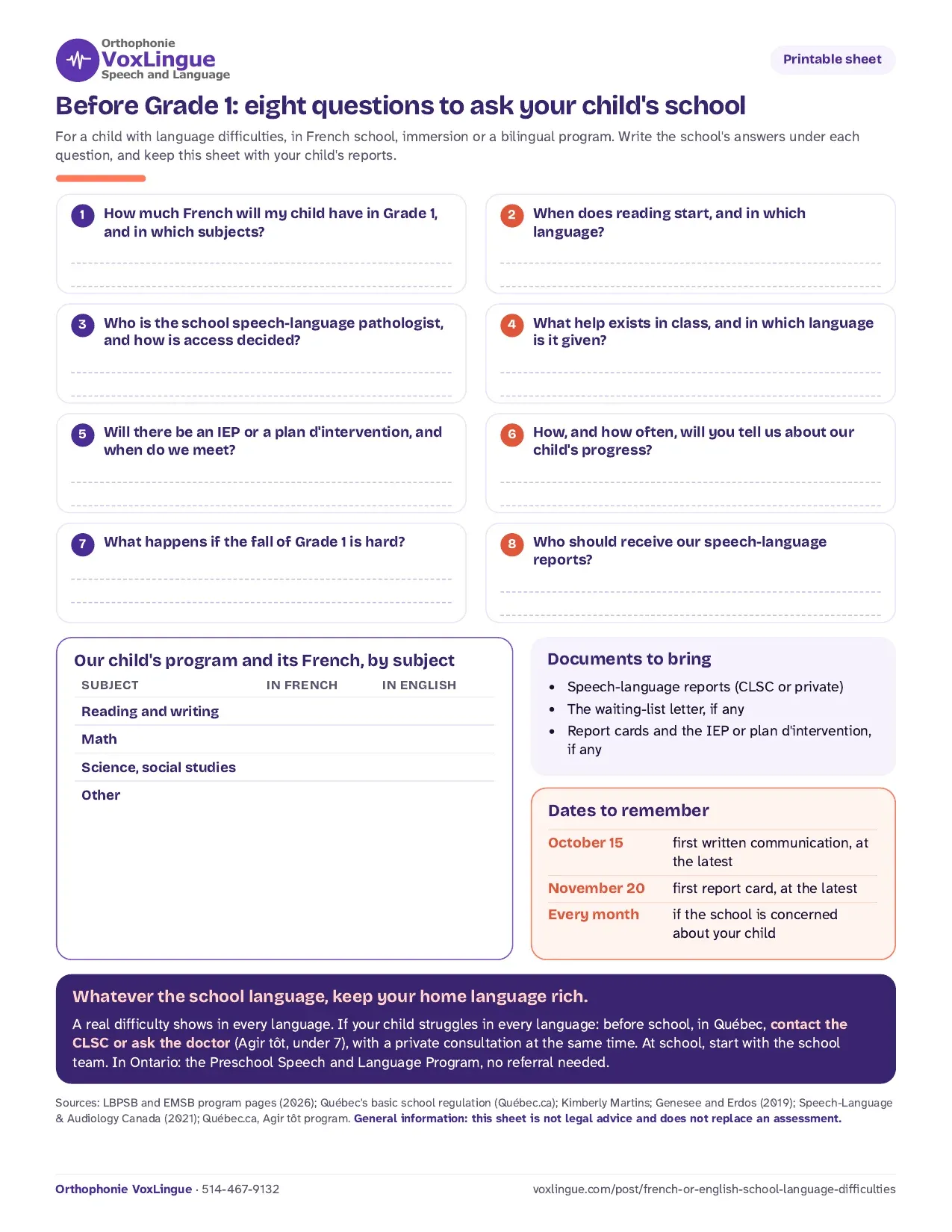
Printable sheet: Before Grade 1: eight questions to ask your child’s school (PDF, 1 page), with room for the school’s answers.
At home, there is no need for French drills, and no need to ask your child to repeat or answer to practise. Talk about their day, read together, and leave French teaching to the school.
Should you keep speaking your home language if your child goes to school in French?
Yes. Keep the home language rich, whatever the school language. A real language difficulty shows in every language, and cutting back the home language does not make French stronger. Canadian speech-language pathologists and paediatricians say the same, and Kimberly Martins wrote it plainly: the number of languages does not interfere.
The McGill guide for the Montreal Children’s Hospital makes two points that matter here. A real language disorder will be evident in both languages. And parents help most by offering rich and varied experiences in the language spoken at home (Genesee and Erdos, 2019).
SAC adds the reason. A strong first language helps a child learn a second one, especially the language of school. Cutting back the home language can also harm communication within the family (SAC, 2021).
The Canadian Paediatric Society agrees: even when a child has a language disorder, they should not be limited to one language. A 2026 Canadian study of 48 children aged about 8 points the same way (Lin and Paradis, 2026). Children with language difficulties lost more of their home language, and less home language did not go with a stronger school language.
Our article on bilingual milestones explains why you should never stop speaking your language, even when a child talks late.
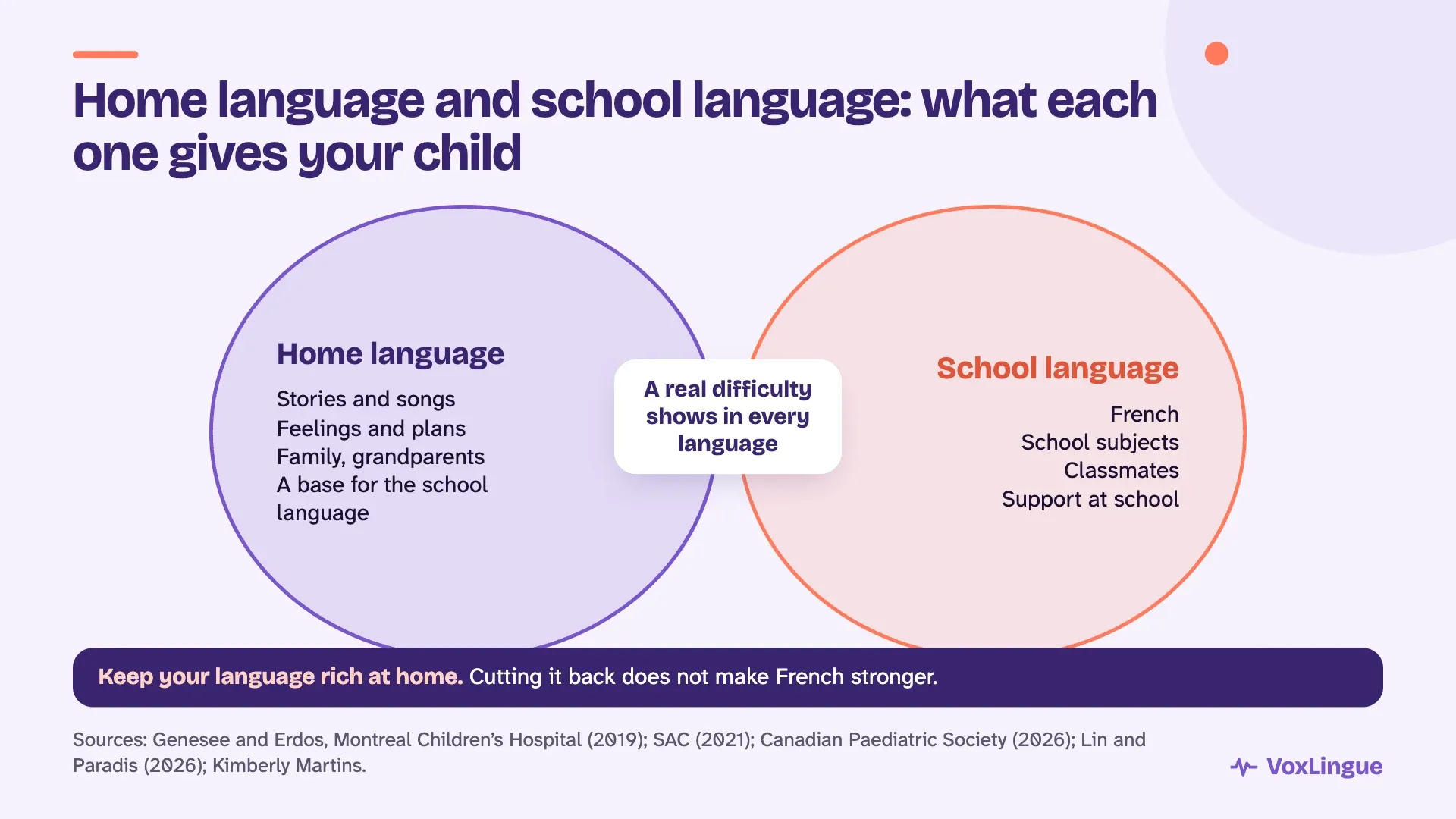
In practice, talk, read and tell stories in the language you know well, and leave French to the school. What your child learns at school builds on what you give at home.
When should you talk to someone, and who, in Québec and Ontario?
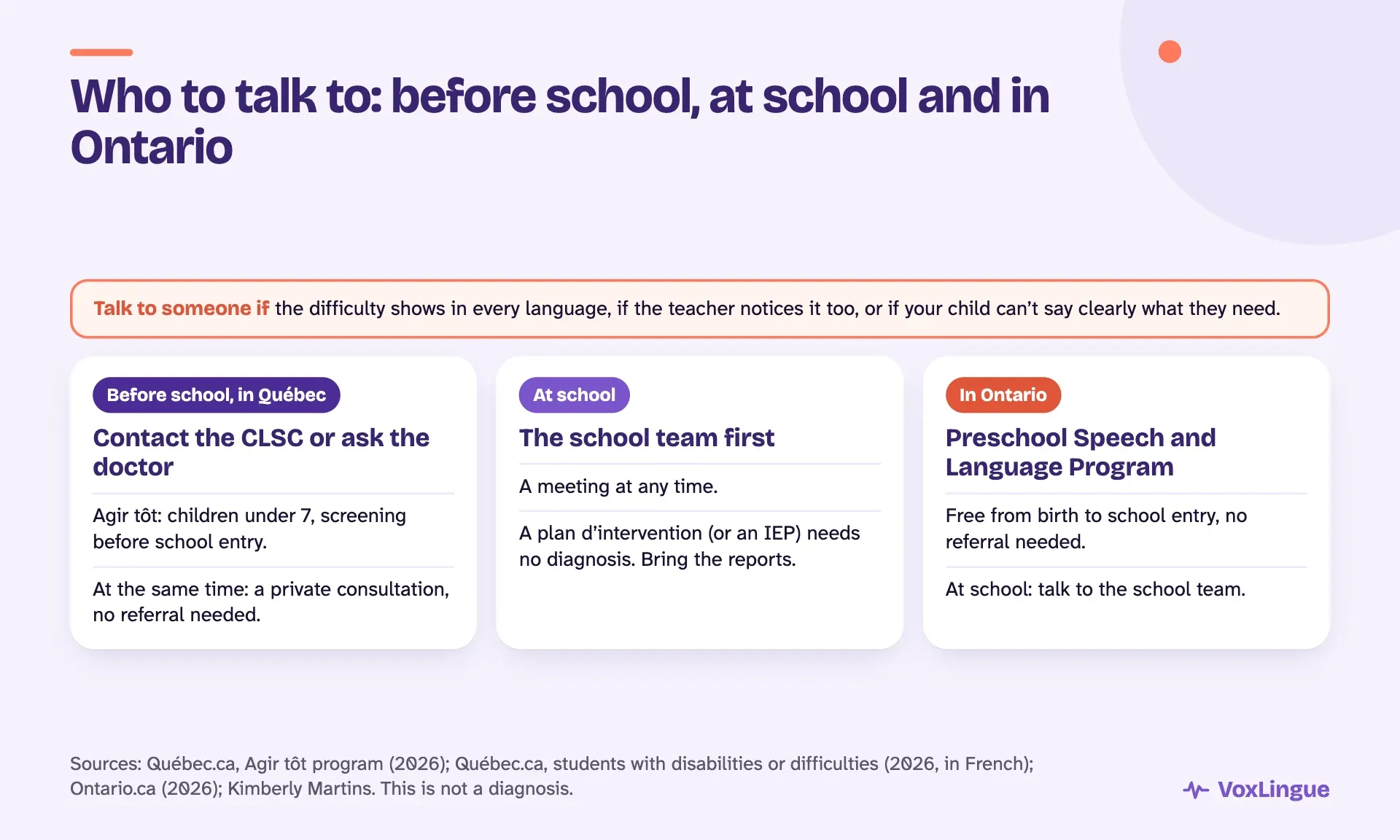
Talk to someone if the difficulty shows in every language your child uses. The same goes if the teacher notices it too, or if your child can’t say clearly what they need. Before school, contact the CLSC or ask the doctor, with a private consultation at the same time. Once your child is at school, start with the school team.
These signs point to something more than learning French:
- Talking and understanding are hard in every language your child uses, not only in French.
- The teacher notices the same things you do.
- Your child can’t say clearly what they want, what they need or what happened.
- They have trouble following what is said to them in your home language.
Our article on late talkers explains whether your child’s language difficulties are likely to pass.
Before school, in Québec, contact the CLSC or ask the doctor. The Agir tôt program is for children under 7, and its screening takes place between birth and school entry. At the same time, you can see a private speech-language pathologist, no referral needed. Kimberly Martins recommends doing both at once.
Our article on what to do while you wait for public services explains the waits and how to find your way.
Once your child is at school, the school team is the first door. You can ask for a meeting at any time, and a plan d’intervention needs no diagnosis. A private assessment can add an outside view of each of your child’s languages.
Our newsletter explains how speech-language pathologists assess language in bilingual children.
In Ontario
Before school, Ontario’s Preschool Speech and Language Program is free from birth to school entry, with no referral needed.
In its 2022 Right to Read inquiry, the Ontario Human Rights Commission found that some students with reading difficulties were discouraged from enrolling in French immersion, or encouraged to leave it, instead of receiving accommodations. It wrote that all students can learn French with the right support. We also offer online speech therapy for Ontario families.
Key takeaways
French or English school is a decision to make with information, not fear.
- Grade 1 brings reading and writing in every program, and more French in some. Ask your school for its split, subject by subject.
- No study shows that French school or immersion harms a child with language difficulties, but the research is thin and never compared programs or ages.
- Section 81 rarely fits a language difficulty on its own: a psychologist designated by the school body evaluates, and the Ministry decides.
- Ask the school eight precise questions before Grade 1, and bring your child’s reports.
- Keep the home language rich. A real difficulty shows in every language.
Next step
Would you like a clear picture before Grade 1? See a language assessment in every language your child uses, and our support for children with language difficulties. Our speech-language pathologists see families at our clinic in Marché Central, Montréal, and online across Québec and Ontario.
To prepare your meeting with the school, print our sheet: Before Grade 1: eight questions to ask your child’s school (PDF, 1 page).
Frequently asked questions
Is French immersion too hard for a child who talks late?
Research does not show that immersion harms these children. A child with language difficulties often learns a second language more slowly, and needs support in it. No study says which program or starting age suits them. Look at the help the school offers, and decide with the school team and your speech-language pathologist.
Should we take our child out of French school or French immersion?
Nothing shows that it’s necessary. In the Montréal studies, children in difficulty who switched to English did no better at school than those who stayed, and the transfer studies had no comparison group. It’s an important decision, to make with the school team and the professionals who know your child.
Will a letter from a speech-language pathologist get my child into English school?
Rarely on its own. The regulation requires an evaluation by a psychologist the school body designates, and describes three precise situations. In Kimberly Martins’s experience, English eligibility is often refused. A speech-language report can be one document in a file. It is also among the examples of documents for the section 85.1 route after a refusal.
If one child is exempted, can the brothers and sisters go to English school too?
Under section 81, yes: brothers and sisters may also be exempted. The request includes a copy of the exempted child’s declaration of eligibility and the sibling’s birth certificate. The separate section 85.1 route, for a serious family or humanitarian situation, does not extend to brothers and sisters.
Is a bilingual program easier than immersion for a child with language difficulties?
No study has compared program types for these children, so no one can say. What may matter more is the help available in class, and in which language it is given. The eight questions above help you compare what each school offers.
Should we speak French at home if our child goes to school in French?
Speak the language you know well, and keep it rich. Stories, songs and everyday talk in your language build the base that French will rest on. French at school is the school’s job. Our article on why you should never stop speaking your language explains why.
Our child is autistic and has language difficulties: does any of this change?
Studies show that autistic children can become bilingual, but they looked at languages learned at home, not at school programs. Each eligibility request is decided case by case by the Ministry. The same questions to the school apply. See also what professionals look at beyond words when autism is a question.