Early signs of dyslexia from kindergarten to grade 2, and why not to wait
The first report card comes home in November. For some parents, it confirms a worry that started in kindergarten. The letters don’t stick, the sounds get mixed up, and bedtime reading ends in tears.
Kimberly Martins, a speech-language pathologist and the founder of VoxLingue, often hears the same worries. The child has trouble reading or writing. They reverse letters or write them the wrong way. The teacher says they aren’t reading at grade level. Some parents also notice trouble saying longer words.
You’re not alone. Dyslexia affects about seven children in a hundred in primary school: two or three in every class (Yang et al., 2022). Yet parents are still often told to wait until a child is two years behind before anything happens.
This guide covers the early signs of dyslexia to watch for, from pre-kindergarten to grade 2. It explains why help doesn’t have to wait for a diagnosis, and who does what in Québec and in Ontario. It also answers a question we hear often in Montréal: when a child is learning to read in French, is it the second language or dyslexia? And it suggests what you can do right now.
What is dyslexia, exactly?
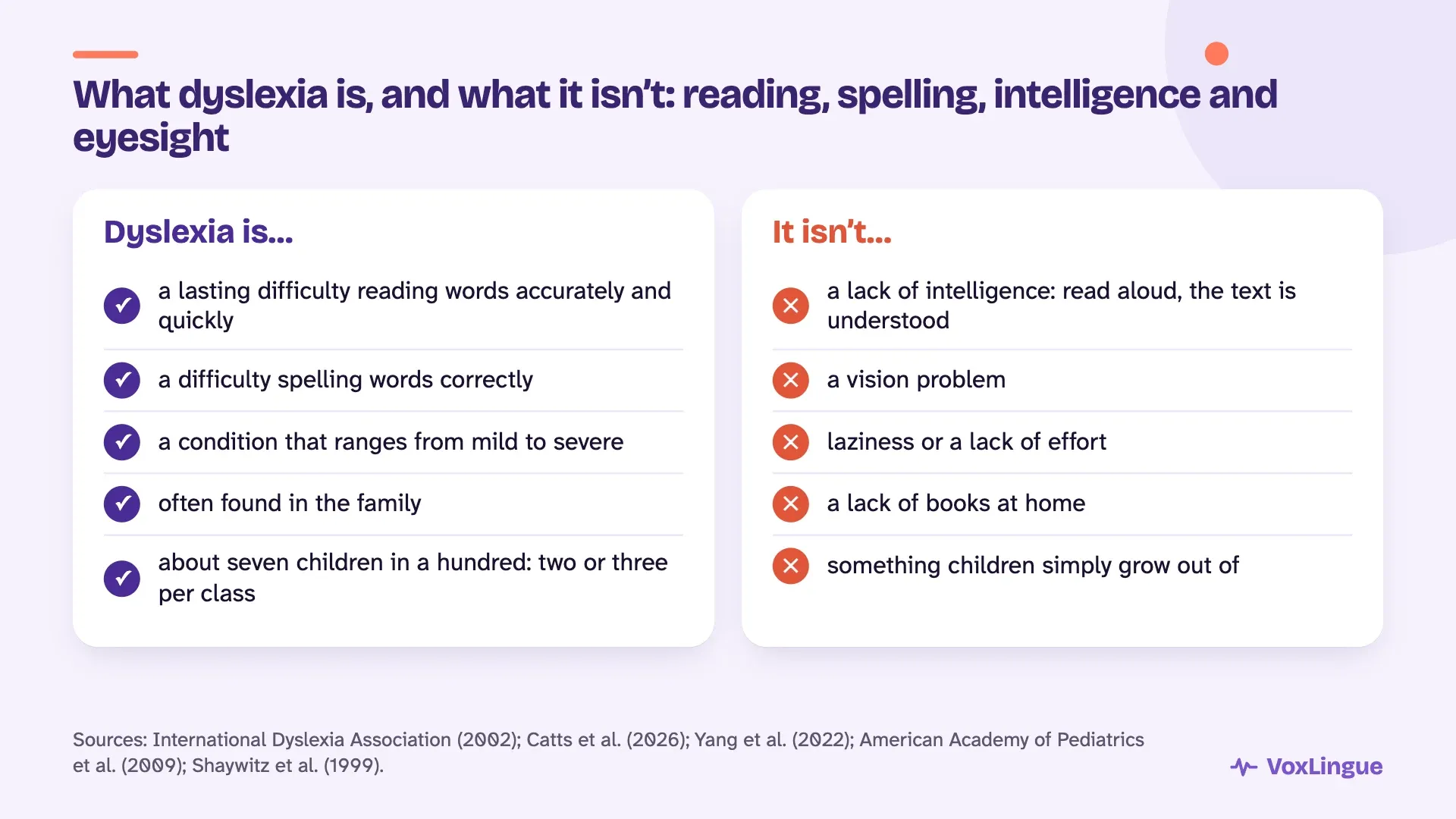
Dyslexia is a lasting difficulty reading words accurately and quickly, and spelling them. It ranges from mild to severe. It has nothing to do with intelligence or eyesight: read the text aloud, and the child understands it. It affects about seven children in a hundred, so most classes have two or three.
The International Dyslexia Association describes it as a specific learning disability rooted in how the brain processes the sounds of language (International Dyslexia Association, 2002). Reading is effortful, full of errors and slower than expected for the child’s age and schooling. Spelling is usually hard too. In Québec schools, you may hear “dyslexie-dysorthographie”: dysorthographie is the spelling side.
The 2025 revision of the international definition stresses two points. Dyslexia sits on a continuum, from mild to severe. And it persists even when teaching works well for other children (Catts et al., 2026). A child with dyslexia is not a child who isn’t trying, or who doesn’t have enough books at home.
It is more common than many parents expect. A large review of studies puts it at about seven children in a hundred in primary school (Yang et al., 2022). Boys are identified about twice as often in those studies, but girls are more often missed (Yang et al., 2022; Quinn and Wagner, 2015). A quiet girl who reads slowly deserves the same attention as a restless boy.
Dyslexia exists in every language. English spelling is one of the least regular of all, and French is far more regular, though less so than Italian or Spanish (Seymour et al., 2003). Yet dyslexia affects about as many children in regular spelling systems as in irregular ones (Yang et al., 2022).
Why the first signs show up in speech before reading
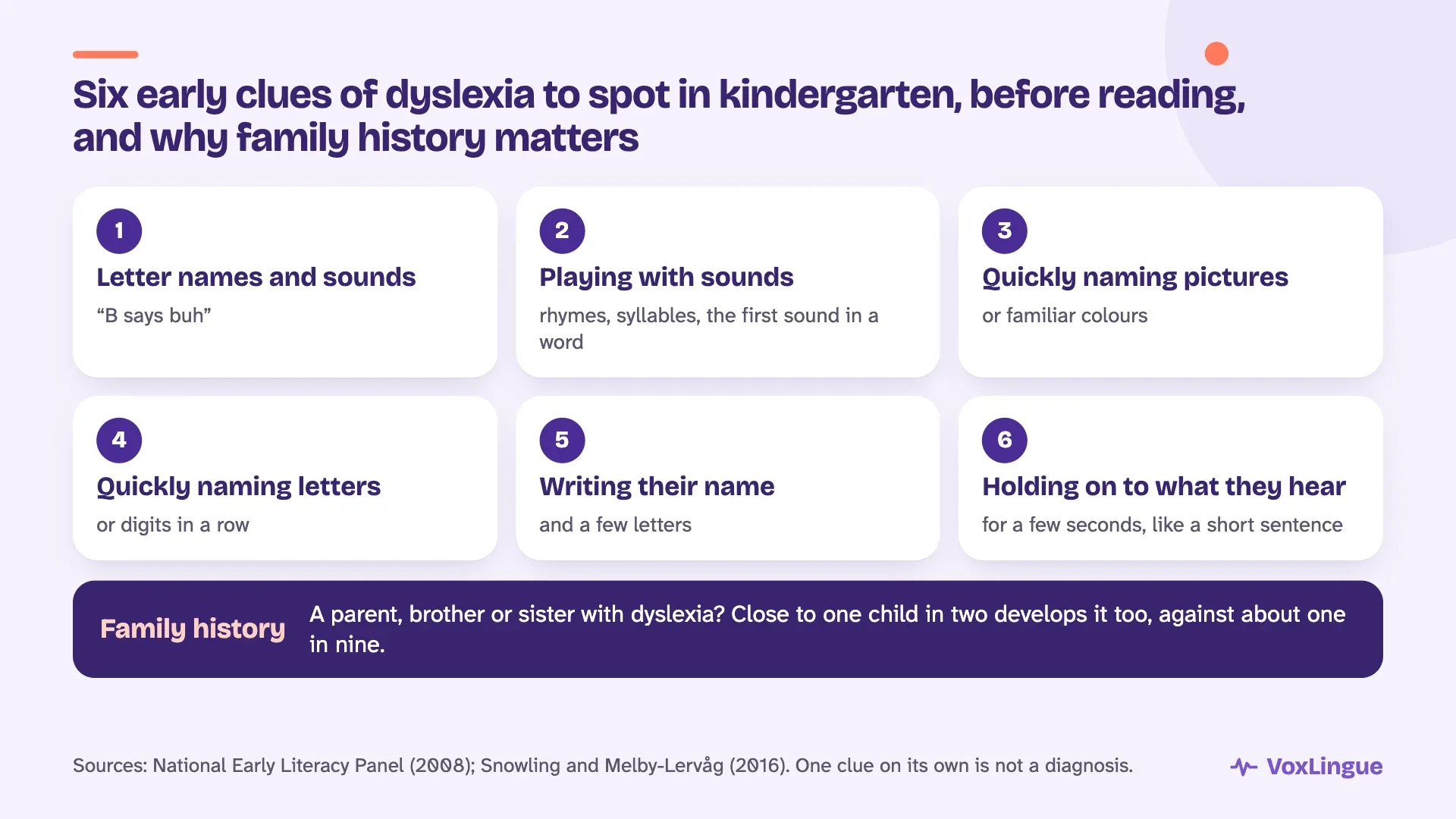
Dyslexia starts in how the brain handles the sounds of words. So before a child reads, the clues are spoken ones: playing with sounds, learning letter names and sounds, and naming familiar things quickly. Family history matters too: close to one child in two develops dyslexia when a parent has it.
A large American review looked for the kindergarten skills that best predict reading later (National Early Literacy Panel, 2008). Six stood out:
- knowing letter names and letter sounds;
- playing with the sounds in words, such as finding a rhyme or the first sound;
- quickly naming familiar pictures, colours or objects;
- quickly naming letters or digits in a row;
- writing one’s name and letters;
- holding on to what was just heard for a few seconds.
Spoken language counts too, mostly for understanding what is read later on (National Early Literacy Panel, 2008). Vocabulary and sentences matter less for sounding out words than for making sense of them.
Playing with sounds is called phonological awareness. It grows in steps, from syllables to rhymes to single sounds. Our article on phonological awareness and pre-literacy skills describes those steps age by age.
Family history is a strong clue. When a parent, brother or sister has dyslexia, close to one child in two develops it too, against about one in nine in comparison groups (Snowling and Melby-Lervåg, 2016). Genes explain about half the differences between children; the environment counts as well (Gialluisi et al., 2021).
Children with a family history often started talking a little later. Even before school, they find sounds, letters and quick naming harder (Snowling and Melby-Lervåg, 2016). If you had trouble learning to read yourself, tell the teacher and the speech-language pathologist. It is useful information, not a confession.
Did your child have trouble pronouncing sounds? That is mostly reassuring. A speech sound disorder on its own has little effect on reading. The risk rises when there is also a language disorder or a family history (Hayiou-Thomas et al., 2017).
Signs of dyslexia, year by year, from pre-K to grade 2
At each grade, compare your child with what is being taught at that point. By the end of kindergarten, Québec’s Ministry of Education expects most children to know the names and sounds of most letters. One sign on its own means little. What matters is a cluster of signs that lasts despite good teaching.
Québec has one program for maternelle 4 ans (pre-K) and maternelle 5 ans (kindergarten). By the end, the child picks out syllables, rhymes and single sounds, and knows the name and sound of most letters, upper and lower case (Ministère de l’Éducation, 2023). In Ontario, the same skills are screened in Year 2 of Kindergarten. Either way, it is a simple benchmark to check with the teacher.
In her practice, Kimberly Martins usually notices the same things first. The child has trouble identifying or naming letters or sounds, and breaking words into sounds and blending them back together. They struggle to pronounce long words and may reverse syllables. They seem to forget what they just learned. Some also have trouble identifying and naming numbers.
| Grade | What school works on | Signs to watch | What to do |
|---|---|---|---|
| Pre-K (maternelle 4 ans, Ontario Year 1) | Nursery rhymes, rhyming, clapping syllables; letters in their own name | Shows no interest in sound games; struggles to learn rhymes and songs; started talking late | Play sound games at home; mention it to the teacher |
| Kindergarten (maternelle 5 ans, Ontario Year 2) | Rhymes, syllables, first sounds; names and sounds of most letters | Knows few letters by the end of the year; can’t find the first sound in a word; struggles to pronounce long words; finds writing their name hard | Ask where they stand; consult if there’s a family history |
| Grade 1 | Linking letters and sounds; sounding out simple words | Doesn’t connect letters with their sounds; quickly forgets what they just learned; reads very slowly, word by word | Ask at the first report card what support is in place |
| Grade 2 | Reading faster; spelling words correctly | Slow, halting reading; spelling that doesn’t follow the sounds; tires quickly or avoids reading | Ask for a school support plan; consider an assessment |
In pre-K, watch how your child plays with sounds. Most four-year-olds love rhymes and silly words. A child who turns away from them, can’t hold on to songs or started talking late is worth watching, calmly. Nobody expects them to read yet.
In kindergarten, letters take centre stage. By June, most children can name most letters and give their sounds. A child who knows very few, despite classroom activities, is below the benchmark. That is a good moment to talk to the teacher, especially if dyslexia runs in the family.
In grade 1, children learn to sound out words. At first, everyone reads slowly. The signal is a child who still doesn’t link letters and sounds after a few months of teaching. They may also recite words from memory without really reading, or wear themselves out on every word.
In grade 2, reading is expected to flow more. A child with dyslexia still reads slowly and haltingly, and their spelling doesn’t follow the sounds of the word. They may avoid reading, tire quickly or say they’re “bad at it”. Read the text to them, though, and they understand it well.
Is mixing up b and d a sign of dyslexia?
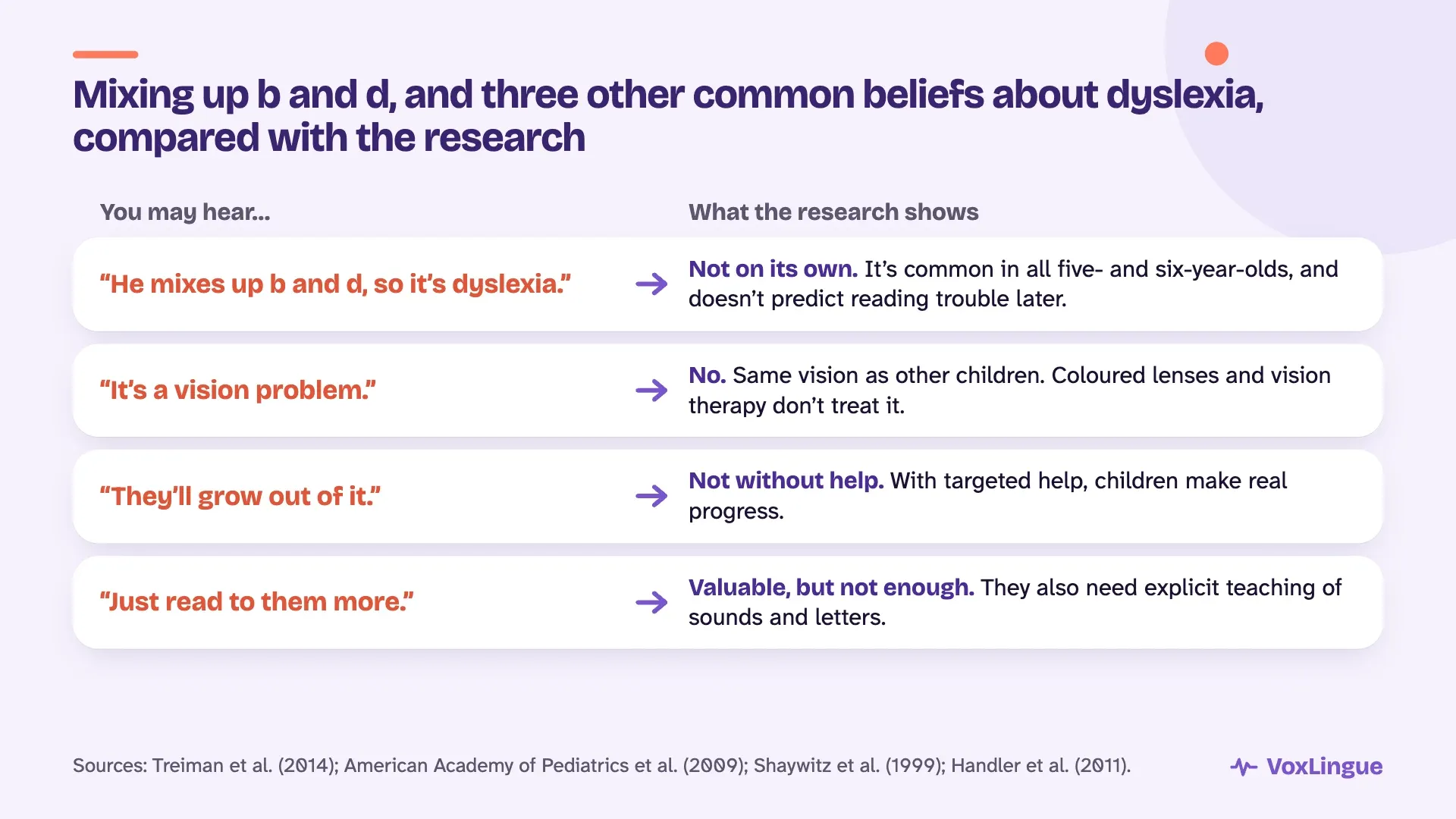
Not on its own. Most five- and six-year-olds reverse letters, and in one study, the children who later struggled to read didn’t reverse more than the others. Reversals fade with practice: children end up learning the correct way, Kimberly Martins points out. The more telling signs are elsewhere: sounds, letters and very slow reading.
This is probably the most widespread idea about dyslexia. An American study followed a hundred and thirty five- and six-year-olds: reversals were common in all of them, and didn’t predict reading trouble later (Treiman et al., 2014). Writing their name backwards at 5 is ordinary. That doesn’t mean reversals never matter: if they come with the other signs, mention them.
“It’s a vision problem.” No. Children with dyslexia have the same vision as other children. Eye exercises, vision therapy and coloured lenses don’t treat dyslexia (American Academy of Pediatrics et al., 2009). An eye exam is still a good idea to rule out a vision problem, but it doesn’t replace a reading assessment.
“They’ll grow out of it.” Not without help. Children with dyslexia don’t simply catch up as they get older (Shaywitz et al., 1999). With targeted help, they make real progress. That is why the early grades matter so much.
“Just read to them more.” Reading stories to your child is valuable: they learn words, discover books and enjoy the time together. But it doesn’t teach them to decode. For that, they need explicit teaching of sounds and letters (Handler et al., 2011). Keep the stories, and add that teaching.
“French is just too hard for them.” If your child is learning French as a second language, it’s a fair question. It has its own section below.
Why not wait two years
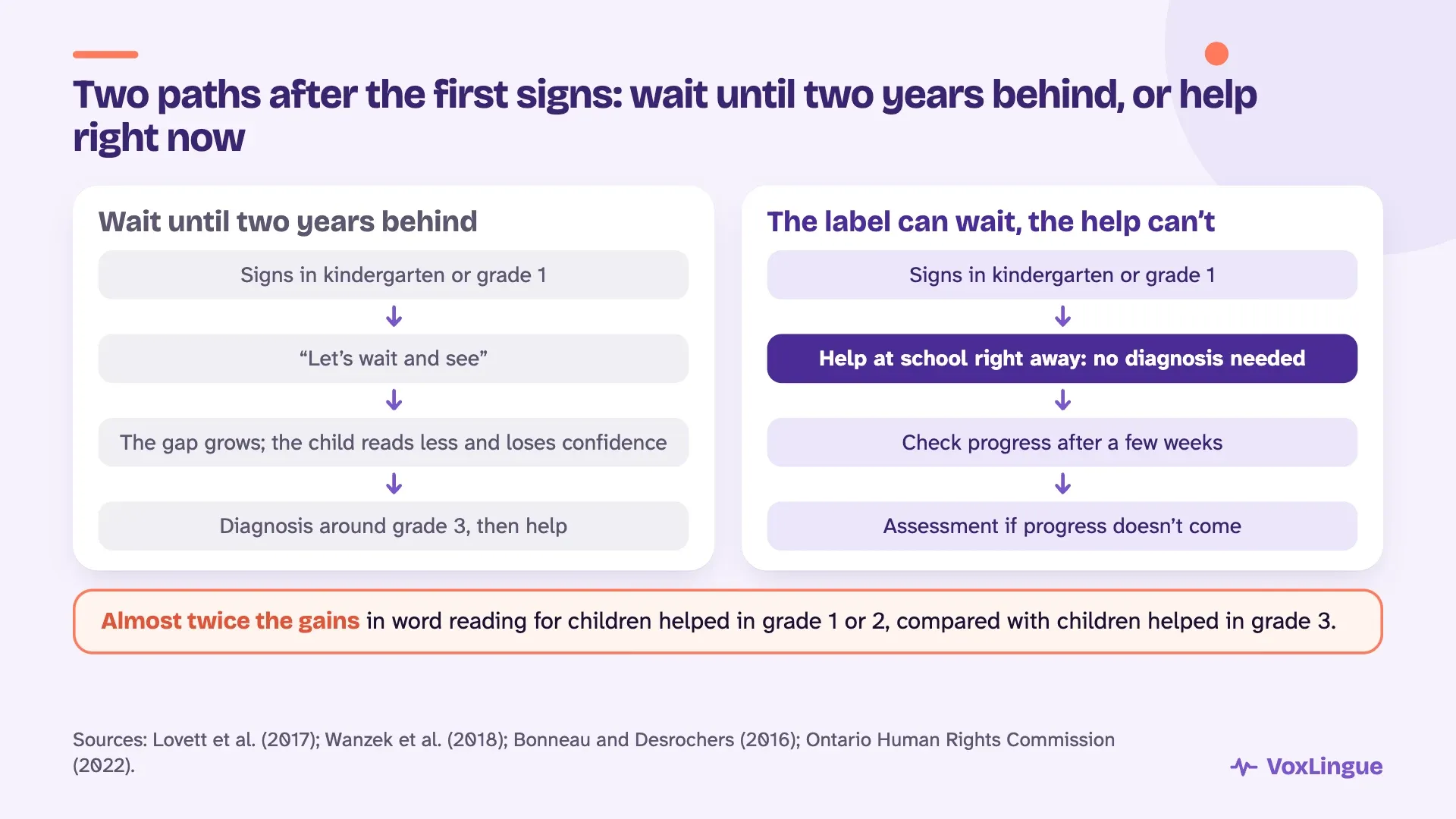
Some school documents say dyslexia isn’t identified before two years of primary school. That’s true of the diagnosis, not of help. Children helped in grade 1 or 2 made almost twice the reading gains of children helped in grade 3. The label can wait. The help can’t.
Parents often hear that a child must be two years behind in reading before anyone talks about dyslexia. The rule comes from a good place: not labelling a child who is simply learning at their own pace. But it is about the diagnosis. It doesn’t say help should wait.
And time matters. A North American study followed struggling readers who received the same help at different ages (Lovett et al., 2017). Those who got it in grade 1 or 2 made almost twice the gains in word reading of those helped in grade 3. The grade 3 children improved too: it’s never too late. But earlier is easier.
Other research points the same way. An analysis of twenty-five studies found that intensive help from kindergarten to grade 3 improves reading in struggling children (Wanzek et al., 2018).
In Ontario, the Human Rights Commission’s Right to Read inquiry found that “wait and see” doesn’t work. Intervention is most effective in kindergarten and grade 1, and no later than grade 2 (Ontario Human Rights Commission, 2022). In Québec, researchers and schools have called for an end to “waiting for failure before intervening”, and for screening from kindergarten (Bonneau and Desrochers, 2016).
Kimberly Martins is clear on this: a diagnosis of dyslexia or dysorthographia can only be made around grade 3, once the basics of reading and writing have been taught. But difficulty with phonological awareness in kindergarten or grade 1 already warrants a consultation, and extra support if needed, instead of waiting all that time.
The label can wait. The help can’t.
Not waiting doesn’t mean panicking. It means talking to the teacher early, asking what support is in place at school, and checking again after a few weeks. If progress doesn’t come, an assessment helps you understand why. And in both provinces, school help shouldn’t wait for a diagnosis.
Dyslexia or a language disorder: what’s the difference?
Dyslexia affects reading and spelling words. A developmental language disorder (DLD) affects understanding and using spoken language. They are two distinct conditions, but they often go together. A child who has both finds it hardest to understand what they read. A speech-language pathologist looks at both.
A child with dyslexia stumbles over written words. Read the text to them, and they understand it. A child with DLD struggles with vocabulary, sentences and understanding, in speech as well as in print. They may sound out a text correctly without really getting its meaning.
The two often overlap. Among children with dyslexia seen in clinics, about half also have weak spoken language, and the reverse is true too (McArthur et al., 2000). In the general population, the overlap is smaller: about one child in five to one in three (Adlof and Hogan, 2018). The review by Adlof and Hogan explains both conditions clearly.
Why does it matter? A child with both has the hardest time understanding what they read. Their help should target their real needs, spoken and written, whatever the label (Snowling et al., 2020). That’s where a speech-language pathologist helps: they assess spoken and written language together.
Bilingual child in French school: second language or dyslexia?
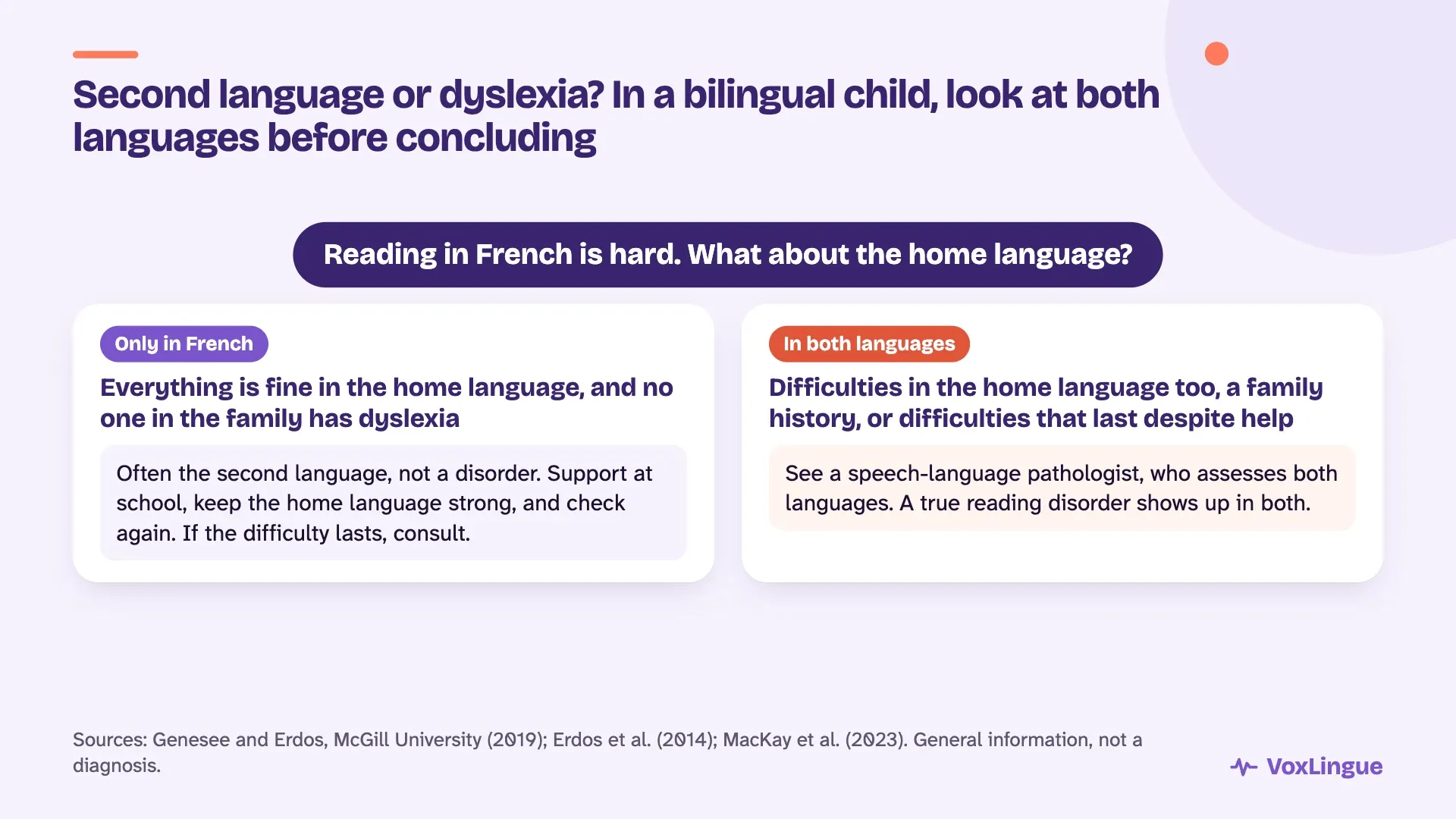
A true reading disorder shows up in both languages. If a child struggles to read only in French, while everything is fine in their home language, that isn’t a disorder. According to McGill researchers, dyslexia shouldn’t stop a child from learning to read in two languages.
In Montréal, many children learn to read in French when it isn’t the language spoken at home. Some go to French school; others are in French immersion, here or in Ontario. When reading is hard, parents naturally wonder whether it’s the language or something else.
Fred Genesee of McGill University and speech-language pathologist Caroline Erdos addressed this in a parent and teacher FAQ on immersion (Genesee and Erdos, 2019). Their rule of thumb: if a child has a language or reading disorder, it will be evident in both languages. It’s the same rule as in our article on language disorders in bilingual children.
They are also candid that no study answers the dyslexia-in-immersion question directly. Their reading of the evidence: dyslexia shouldn’t stop a child from learning to read and write in two languages (Genesee and Erdos, 2019). Québec data on children who speak other languages at home are thin, but Canadian immersion studies offer useful markers.
Tests done in the home language, as early as kindergarten, already help spot the risk of reading trouble in French (Erdos et al., 2014). And an immersion student who struggles to read words in French often struggles in English too. The French difficulty tends to last: it isn’t “just the second language” (MacKay et al., 2023).
Keep the home language strong. Talking, reading and telling stories in it helps the second language too (Genesee and Erdos, 2019). You don’t need to switch to French at home to help your child read in French.
In Québec, the Charter of the French Language provides an exception: a child with serious learning difficulties may, at a parent’s request, be exempted from French schooling (section 81). In Ontario, the Human Rights Commission found that children with reading difficulties are sometimes steered out of French immersion, and recommended that screening and help apply equally in French programs (2022). Either way, it’s a weighty decision to make with the school team and the professionals who know your child.
To tell the two apart, Kimberly Martins looks at whether errors differ from one language to the other, and whether the child carries patterns across languages. The pronunciation of some sounds may also be slightly affected. Overall, if French is their school language, a child with no language or learning disorder should read and write like everyone else by about grade 3, bilingual or not.
Who does what in Québec and Ontario?
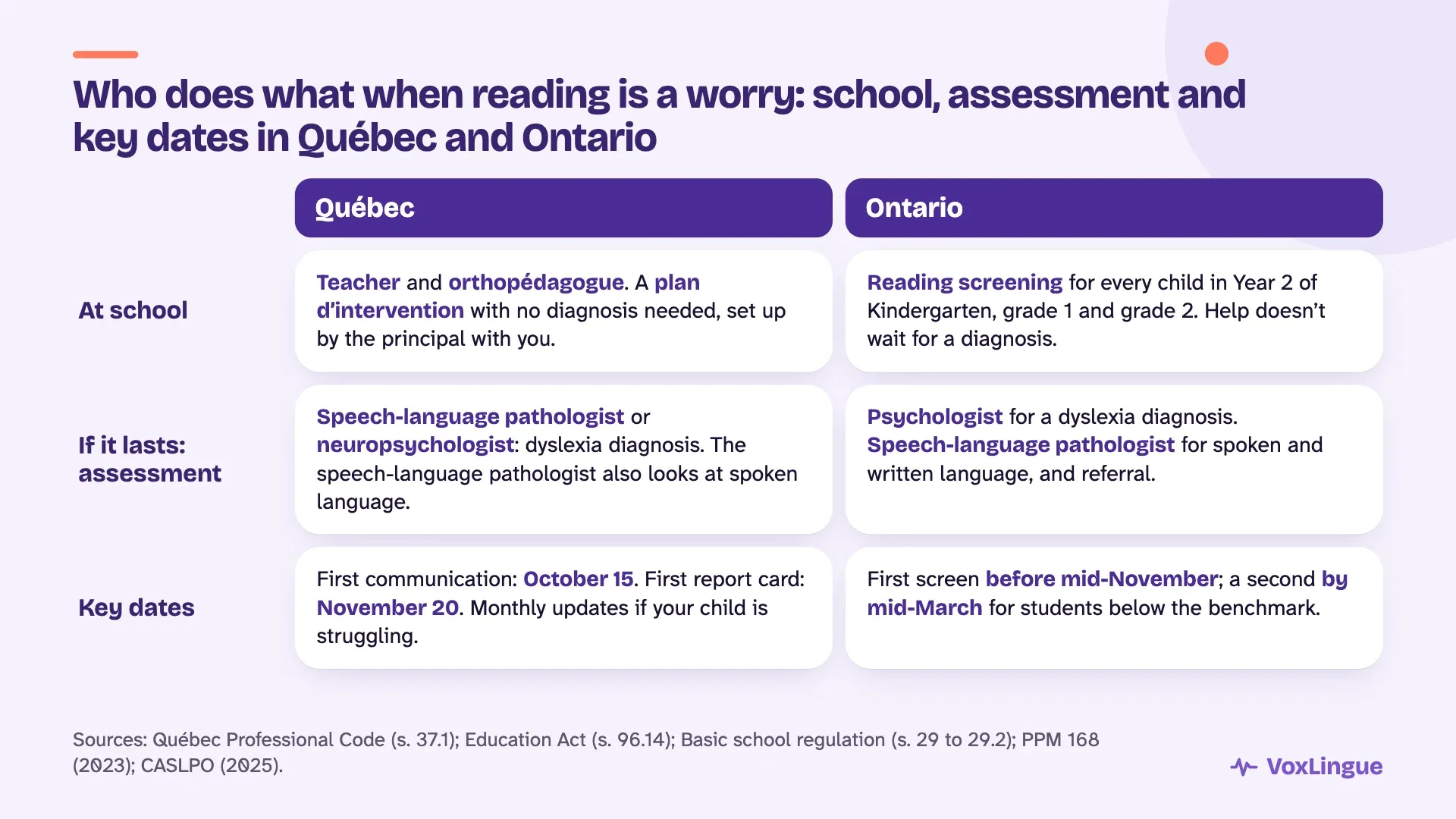
At school, the teacher and the resource or special education teacher help first, and school support doesn’t require a diagnosis. In Québec, speech-language pathologists and neuropsychologists can diagnose dyslexia. Ontario schools screen reading from Year 2 of Kindergarten to grade 2.
At school, in Québec. The teacher is usually the first to see the difficulties. The orthopédagogue, a learning-difficulties specialist, assesses reading and writing at school and works with the child alone or in a small group. They don’t diagnose, and they often already work with struggling students, as prevention. When a student has learning difficulties, the principal sets up an individual education plan (plan d’intervention) with the parents and staff (Education Act, s. 96.14).
That plan doesn’t require a diagnosis. The Québec government states that services are based on the student’s assessed needs, “regardless of diagnosis”. So you can ask for one as soon as difficulties persist.
A diagnosis is still useful. According to Kimberly Martins, it helps the school better understand which accommodations and modifications the child needs, and assign the proper code. Later on, in college, a student without a diagnosis gets no support or accommodations.
Diagnosis, in Québec. The Professional Code allows speech-language pathologists to “diagnose language disorders and learning disorders linked to language” (s. 37.1). According to Kimberly Martins, both the speech-language pathologist and the neuropsychologist can diagnose a language-based learning disorder: dyslexia or dysorthographia.
They don’t look at quite the same things. The speech-language pathologist also examines spoken language: does the child have a spoken language disorder affecting written language, a written language disorder only, or both? The neuropsychologist looks more closely at attention, working memory, executive function and IQ, to rule out other causes.
Often, the neuropsychologist does the first assessment, then sends the child to the speech-language pathologist for intervention. The speech-language pathologist sometimes needs to assess language in more depth to build the support plan. Our article on what happens in a speech therapy assessment in Québec walks through the steps.
In Ontario. Since 2023, schools must screen the reading of every student in Year 2 of Kindergarten, grade 1 and grade 2. The first screen happens before mid-November, with a second by mid-March for students below the benchmark (Policy/Program Memorandum 168, 2023). Help shouldn’t wait for a diagnosis (Ontario Human Rights Commission, 2022).
In Ontario, a dyslexia diagnosis comes from a psychologist. Speech-language pathologists there describe reading and spelling difficulties, may identify a language disorder, and refer the family on (College of Audiologists and Speech-Language Pathologists of Ontario, 2025). Our team also supports Ontario families through telepractice.
The first report card: what to ask the teacher
In Québec, the school sends a first written communication by October 15, then the first report card by November 20 (Basic school regulation, s. 29 and 29.1). When a student is struggling, the school must update parents at least once a month (s. 29.2). That includes a kindergarten child who may not be ready for grade 1. In Ontario, ask for the results of the fall reading screen.
The report card is a good moment to talk. Here are a few questions to ask:
- How is my child doing with letter names and letter sounds?
- What is already in place in class to help?
- Can the resource teacher or orthopédagogue see them?
- When will we check in again together?
- Would a support plan help?
What you can do at home, starting now
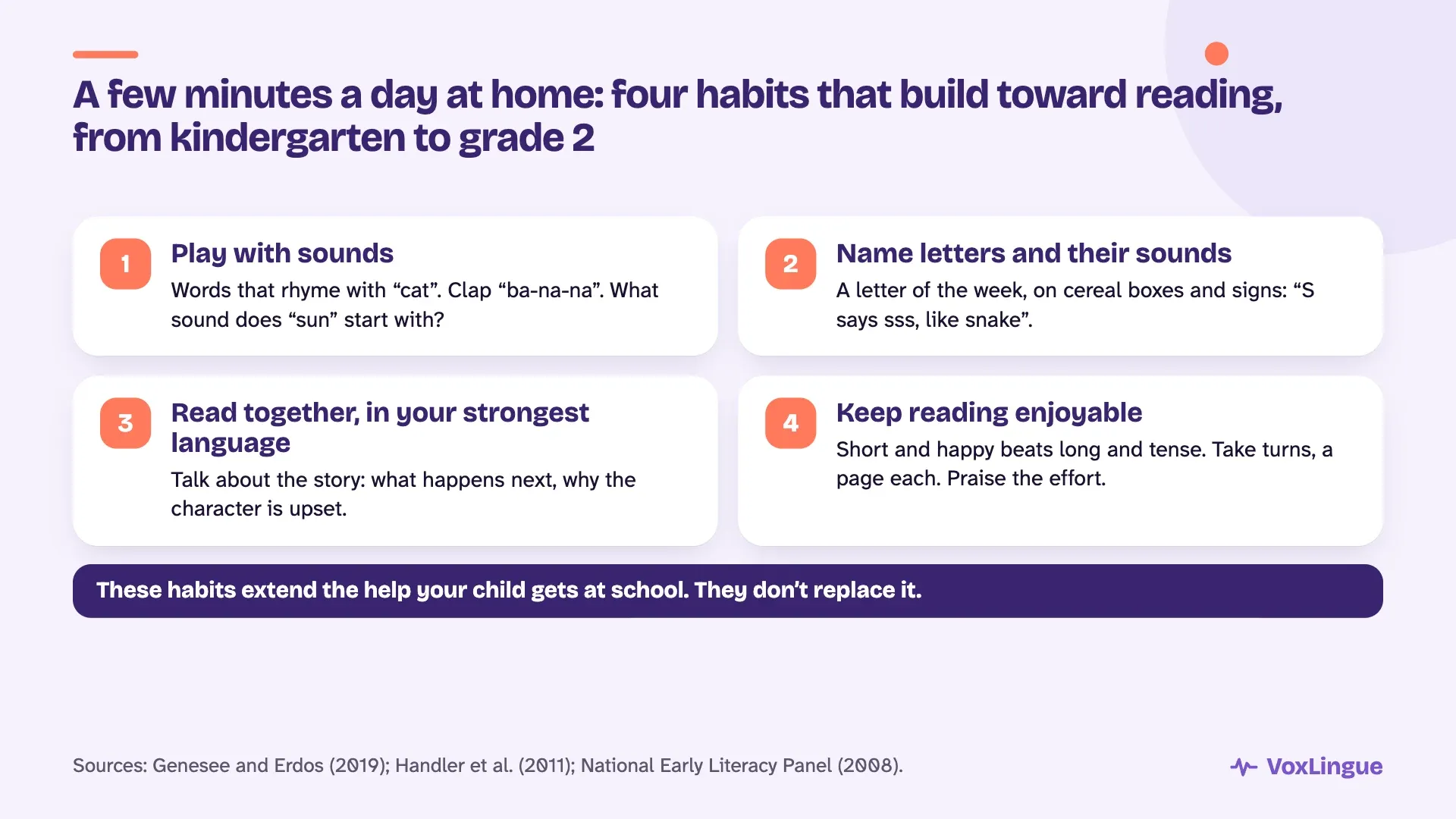
Play with sounds and rhymes, name letters and their sounds, and read together every day in the language you speak best. Talk about the stories, and keep reading enjoyable. These habits help every child. They don’t replace help at school, but they extend it.
A few minutes a day is enough. Consistency matters more than length. In the car, at dinner, at the grocery store: there’s no shortage of chances.
Play with sounds. Find words that rhyme with “cat”. Clap the syllables in “ba-na-na”. Ask what sound “sun” starts with. These games work directly on phonological awareness.
Name letters and their sounds. Pick a letter of the week. Spot it on cereal boxes and street signs, and say its sound: “S says sss, like snake”. In grade 1, have your child read short words they can sound out.
Read together every day, in your strongest language. Reading in the home language helps the second language too (Genesee and Erdos, 2019). Talk about the story: what will happen next, why the character is upset. That builds vocabulary and understanding.
Keep reading enjoyable. A short, happy read beats a long, tense session. If your child is struggling, take turns, a page each. Praise the effort more than you correct the mistakes.
Kimberly Martins puts reading first. Read together as much as you can, with a variety of books. Start with the title, and point to the words as you say them. Sing nursery rhymes and children’s songs: they’re great for rhyming. Bring written words into crafts. Ask your child to retell the story, and ask them questions about it. Listening comprehension is a precursor to reading comprehension.
Explicit teaching of sounds and letters is what helps at-risk children most (Handler et al., 2011). At home, you build on it. Our printable sheet sums up the signs by grade and the questions to ask the teacher.
When to see a speech-language pathologist without waiting
Consult when several signs last despite teaching, when a parent, brother or sister has dyslexia, when your child has already had a language delay, or simply when you’re worried. An early assessment isn’t about putting a label on a child. It explains what’s getting in the way and points to the right help.
You don’t have to wait for a school diagnosis or for two years of delay. See a speech-language pathologist if your child:
- by the end of kindergarten, knows few letters or can’t play with sounds, despite classroom activities;
- halfway through grade 1, still has trouble identifying or naming letters or sounds;
- from age 4 or 5, has trouble pronouncing certain words or mixes up parts of long words;
- has trouble recalling information, answering questions, following instructions or doing steps in the right order;
- in grade 2, still reads very slowly, with great effort, and avoids reading;
- has a parent, brother or sister with dyslexia, and already shows some of these signs;
- has had a language delay or disorder, or still has trouble understanding or putting sentences together.
For Kimberly Martins, the signs at 4 or 5 and halfway through grade 1 are reasons not to wait for the school.
If your child is learning to read in French but speaks another language at home, tell the speech-language pathologist. They will take both languages into account.
To learn more about how we help, see our page on literacy support for reading and writing. You can also read about how a speech-language assessment works at VoxLingue.
Key takeaways
A dyslexia diagnosis often comes only after two years of school, but the first signs show up well before that, in kindergarten. You hear them first: sounds, rhymes, letter names and letter sounds. One sign on its own means little; a cluster of signs that lasts is worth talking about.
The label can wait. The help can’t. In Québec and in Ontario, the school can help your child without a diagnosis, and a speech-language pathologist can tell you what’s getting in the way. At home, a few minutes of sound games and shared reading each day make a real difference.
Next step
Print our sheet, “Signs of dyslexia by grade, and questions to ask your child’s teacher”, and bring it to your next meeting with the teacher. If your child’s reading worries you, our speech-language pathologists can assess them at our Montréal clinic or by telepractice anywhere in Québec and Ontario. To go further, explore our Literacy and storytelling articles.
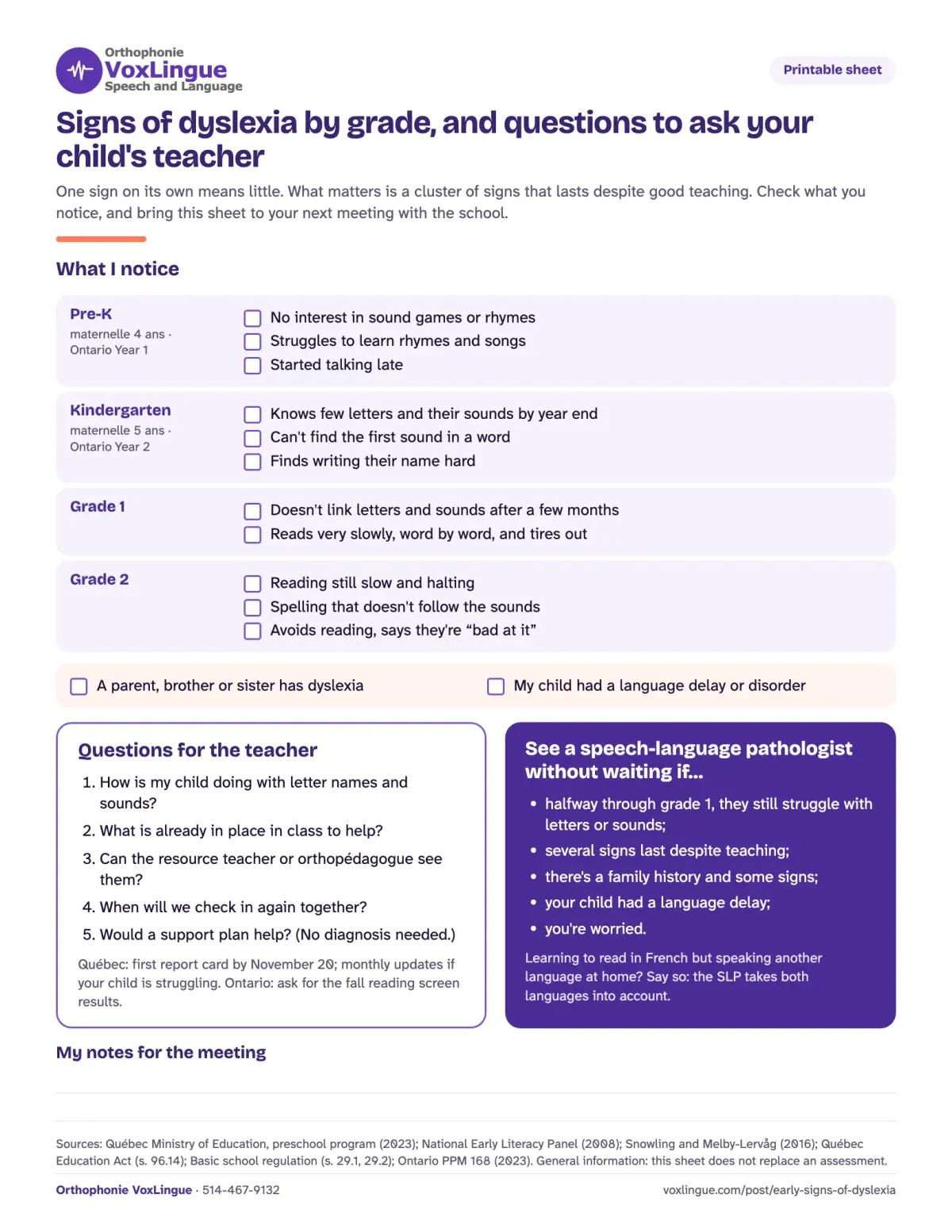
Printable sheet: Signs of dyslexia by grade, and questions to ask your child’s teacher (PDF).
Frequently asked questions
At what age can dyslexia be diagnosed?
A diagnosis is often made around grade 2 or 3, once a child has had time to learn to read. But the signs show up much earlier, from kindergarten, and help doesn’t have to wait. In Québec and Ontario, schools can put support in place without a diagnosis.
My 5-year-old writes their name backwards. Should I worry?
Not for that reason alone. At 5 and 6, most children reverse letters, and reversals don’t predict reading trouble (Treiman et al., 2014). Look instead at whether your child knows their letters and letter sounds, and enjoys rhyming games. If those are hard too, talk to the teacher.
Do we need a diagnosis to get help at school?
No. In Québec, the principal sets up a plan d’intervention with the parents for a student with learning difficulties, based on needs (Education Act, s. 96.14). In Ontario, the Human Rights Commission says assessments should never be required for help. You can ask as soon as difficulties persist.
Can a speech-language pathologist diagnose dyslexia?
It depends on the province. In Québec, yes: the Professional Code allows speech-language pathologists to diagnose learning disorders linked to language (s. 37.1), and neuropsychologists can make this diagnosis too. In Ontario, a dyslexia diagnosis comes from a psychologist; speech-language pathologists describe the difficulties and refer.
Is dyslexia hereditary?
Largely, yes. When a parent, brother or sister has dyslexia, close to one child in two develops it too, against about one in nine otherwise (Snowling and Melby-Lervåg, 2016). Genes explain about half the differences between children. The environment, including teaching, matters too.
My child had a speech sound disorder. Are they at risk of dyslexia?
Not much, if that’s their only difficulty. A speech sound disorder on its own has little effect on reading. The risk rises when there’s also a language disorder or a family history (Hayiou-Thomas et al., 2017). In that case, keep a close eye on letters and sounds in kindergarten.
Do coloured lenses or glasses help with dyslexia?
No. Dyslexia isn’t a vision problem. Coloured lenses, vision therapy and eye exercises don’t treat it (American Academy of Pediatrics et al., 2009). An eye exam is still useful to rule out a vision problem, but effective help works on sounds and letters.
Should we take our child out of French school or French immersion?
Nothing shows that it’s necessary. According to McGill researchers, dyslexia shouldn’t stop a child from learning to read in two languages (Genesee and Erdos, 2019). It’s an important decision, best made with the school team and the professionals who know your child.
Can dyslexia be cured?
Dyslexia is lifelong, but it doesn’t stop a child from learning. With targeted help, children learn to read and make real progress, especially when help starts early (Lovett et al., 2017). Accommodations, such as extra time on tests, then help them show what they know.
Is reading stories to my child enough?
It’s valuable, but not enough to learn to read. Stories build vocabulary, understanding and a love of books. To decode, a child needs explicit teaching of sounds and letters (Handler et al., 2011). Keep the bedtime stories, and add a few minutes of sound and letter games. If reading stays hard despite both, talk to the teacher.
What is an orthopédagogue?
In Québec schools, an orthopédagogue is a specialist in learning difficulties. They assess a student’s reading and writing and work with them alone or in a small group. They don’t diagnose. They work with the teacher, the parents and, when needed, the speech-language pathologist or neuropsychologist. In Ontario, the closest role is the special education teacher.
What is Ontario’s early reading screening?
Since 2023, Ontario schools must screen the reading of every student in Year 2 of Kindergarten, grade 1 and grade 2. The screen looks at letters, sounds and reading words. The first happens before mid-November, with a second by mid-March for students below the benchmark (Policy/Program Memorandum 168, 2023).