My 3-year-old doesn't answer questions, repeats them back or answers off topic after daycare: what it says about understanding, and how to ask so they can answer
End of the day. You zip up their coat and ask, “What did you do at daycare?” Your 3-year-old doesn’t answer questions, or not the way you hoped. They go quiet. They repeat your question back, word for word. Or they tell you, very seriously, “The truck is red.”
Kimberly Martins, speech-language pathologist and founder of VoxLingue, often hears this from parents of toddlers: “He doesn’t answer me when I ask him questions.” Two worries usually sit behind it. Won’t they answer, or can’t they? And is this normal at their age?
This guide explains why the daycare question is one of the hardest a 3-year-old gets, and what each kind of answer tells you. You’ll see the order in which children come to understand questions, and where the line sits between what’s expected and what’s worth talking to someone about.
You’ll also find three steps to help your child understand a question without pressure, five ways to ask about their day, and what to know if your child is bilingual.
My 3-year-old doesn’t answer questions after daycare: is it normal?
Often, yes. “What did you do at daycare?” is one of the hardest questions a 3-year-old gets. It asks about moments that are over, somewhere else, with nothing in front of them, and it comes when they’re tired. To that question, going quiet, repeating it or talking about something else is expected around 3.
Québec and Montréal sources point the same way. The CISSS de Chaudière-Appalaches and the Montreal Children’s Hospital place questions about past moments later than questions about what’s right there. Four reasons explain why this one asks so much of a 3-year-old.
It’s about what isn’t there. At the daycare door, nothing from their day is in sight: not their friends, not the toys, not the sandbox. A US study of 40 children aged 3 to 6 found that they answered less well when the question was about objects, people or events not in the immediate setting (Parnell, Patterson and Harding, 1984).
It’s about the past. According to the speech-language pathologists at the CISSS de Chaudière-Appalaches, before 3, communication is mostly about the here and now. Between 3 and 4, it gradually moves beyond the present, and children start talking about past events. The Montreal Children’s Hospital lists understanding questions about the past, such as “How did you hurt yourself?”, among its 4-year markers.
It asks for a whole day in one question. As Naître et grandir puts it, around 3, a child can talk more clearly about a few moments of their day, often leaving out details and the order. A question this broad asks them to choose, out of dozens of moments, which one to tell.
It comes when they’re most tired. Naître et grandir notes that pickup isn’t necessarily the best time to ask about their day: dinner, bath time or bedtime often work better.
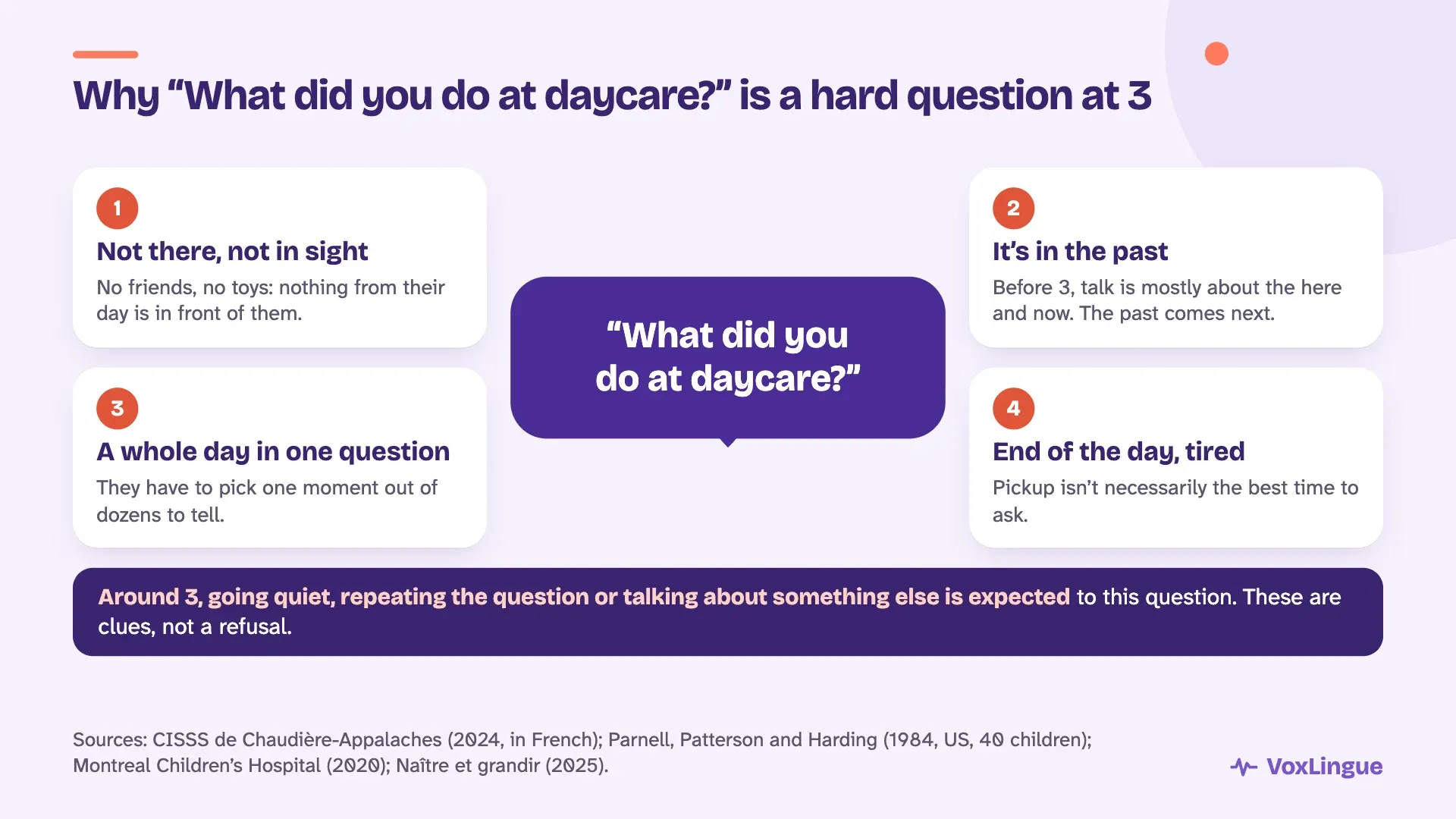
So their silence, the echoed question or the off-topic answer are clues, not a refusal. The next section explains what each of those answers tells you. For more on first words and early understanding, see our guides to early language.
Silence, an echoed question, an off-topic answer or “yes” to everything: what each answer tells you
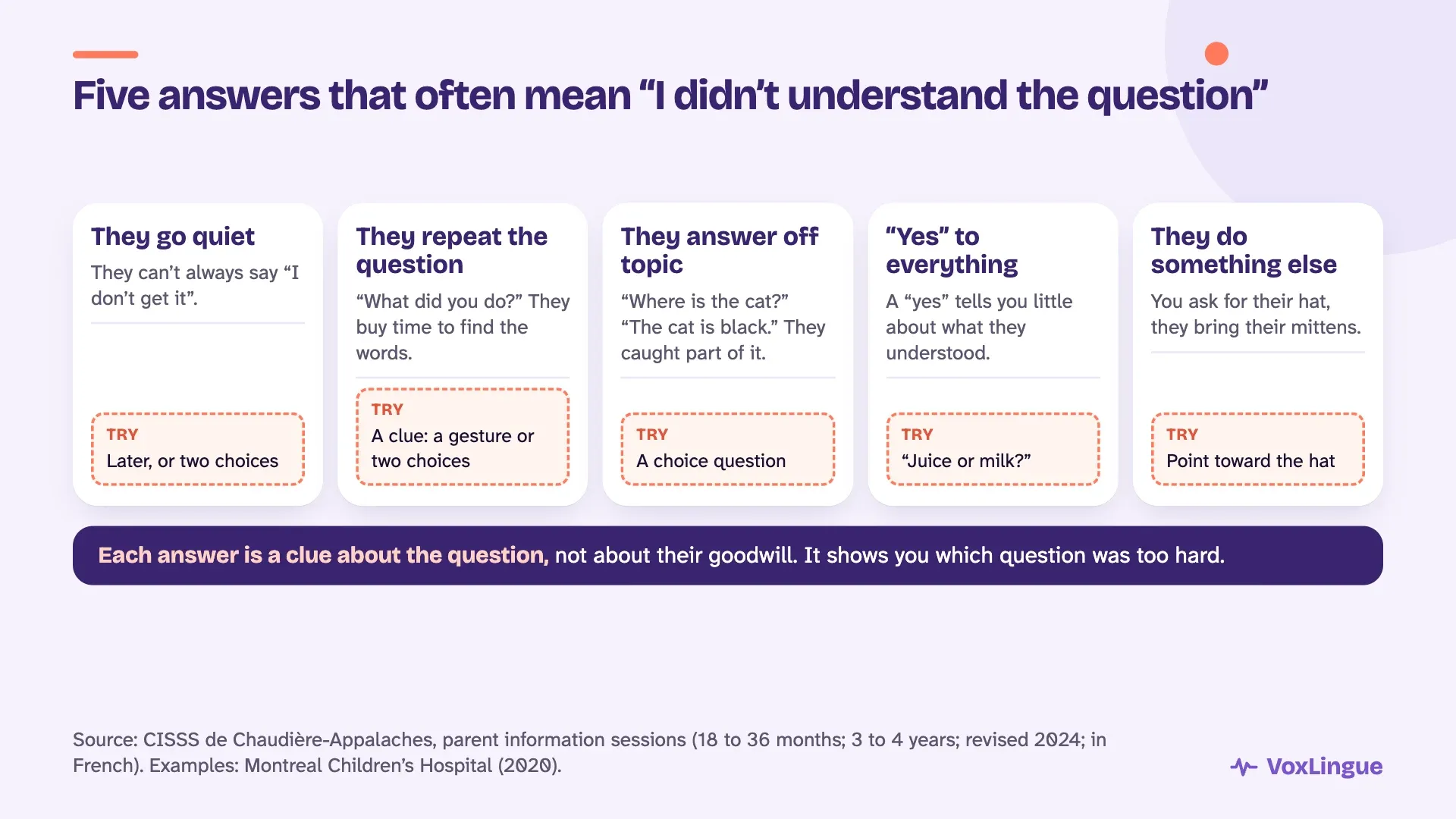
Each answer is a clue about the question, not about your child’s goodwill. The speech-language pathologists at the CISSS de Chaudière-Appalaches describe it: a child who didn’t understand a question goes quiet, repeats it, answers off topic or says “yes”. These answers show you which question was too hard.
Kimberly Martins writes in one of her articles that a child needs to understand what the question is asking of them before they can answer it. An answer that doesn’t fit the question is often about understanding, not behaviour.
The CISSS adds a fifth sign to its list: the child does the wrong thing. You ask where their hat is, and they bring you their mittens. They caught part of the sentence, not all of it.
They say nothing: they didn’t understand, or they’re tired
Silence often means they didn’t understand, or they need some quiet. A 3-year-old can’t always say “I don’t get it”. They don’t even always notice that they didn’t understand.
In a US study of children aged 2½ to 4½, the 3-year-olds noticed some comprehension problems, but not all of them. By 4, children noticed them all (Revelle, Wellman and Karabenick, 1985).
Silence can also come from tiredness, or from wanting a quiet moment after the day. Try this: ask again later, or offer two choices.
They repeat the question instead of answering
Repeating the question instead of answering it is called immediate echolalia. According to a 2022 review of the research, repeating what they hear is common through about the first three years, then drops off naturally. No study gives a figure for how many children do it (McFayden and colleagues, 2022).
A US study followed a single child for two years. To answer questions, he first used gestures, then repeated words from the adult’s question, then added words of his own (Clark and Lindsey, 2015). Repeating can be a way to buy time while finding the words.
Around 3, repeating a hard question is a common step. If your child repeats most simple questions, the ones about what’s right there, take a closer look: the section on signs below will guide you. Our article on echolalia as a way of learning language goes further.
They answer off topic
An off-topic answer often shows that they caught part of the question, not all of it. In the 1984 US study, children gave the right kind of answer, such as a place for “where”, well before they gave the right answer.
The Montreal Children’s Hospital gives a telling example. Asked “Where is the cat?”, the child answers “The cat is black.” They understood the question was about the cat, but not what was being asked about it. Around 3, this happens. Around 4, if it happens often, the hospital lists it as a reason to consult.
Sometimes the answer sounds like a line from a show or a book. It may be a phrase learned by heart. If almost all of their answers are like that, a speech-language pathologist looks at the whole picture of their communication. It isn’t necessarily autism: see when to wonder about autism. Try this: a choice question, which shows them what kind of answer fits.
They say “yes” to everything
A “yes” to everything tells you little about what they understood. A Canadian study from Queen’s University, with children aged 2 to 5, found that 2-year-olds tended to say “yes” to yes-or-no questions, even ones they couldn’t understand. Around 3, this tendency starts to change (Fritzley and Lee, 2003).
A later study of 200 children found the same tendency in the youngest (Fritzley, Lindsay and Lee, 2013). A choice question, like “Juice or milk?”, tells you more: they have to pick, and you see what they understood.
Which questions do children understand first, and which come later?
Children first understand questions about what’s right there, then questions that ask them to imagine. First yes-or-no questions and choices, then where, who and what, then how many and who with, then why, how and when, and last, questions about what they can’t see. Every child moves at their own pace.
This is the order described by the speech-language pathologists at the CISSS de Chaudière-Appalaches in their parent session on language at 3 to 4 (in French). It comes from Québec French clinical practice and mostly English-language studies. In French, everyday questions are often built differently, but the order of the steps is the same.
Yes-or-no questions come first: “Are you hungry?” Then choice questions: “Juice or milk?” Next come where, who, what and what’s he doing: “Where’s your hat?”, “What’s the dog doing?” Then how many, who with and what with: “Who did you play outside with?”, with the daycare photo in hand.
Higher up the ladder are why, how and when: “Why is the dog barking?” Last come questions about what they can’t see: guessing what will happen next in a story, or telling what happened somewhere else. “What did you do at daycare?” is one of these.
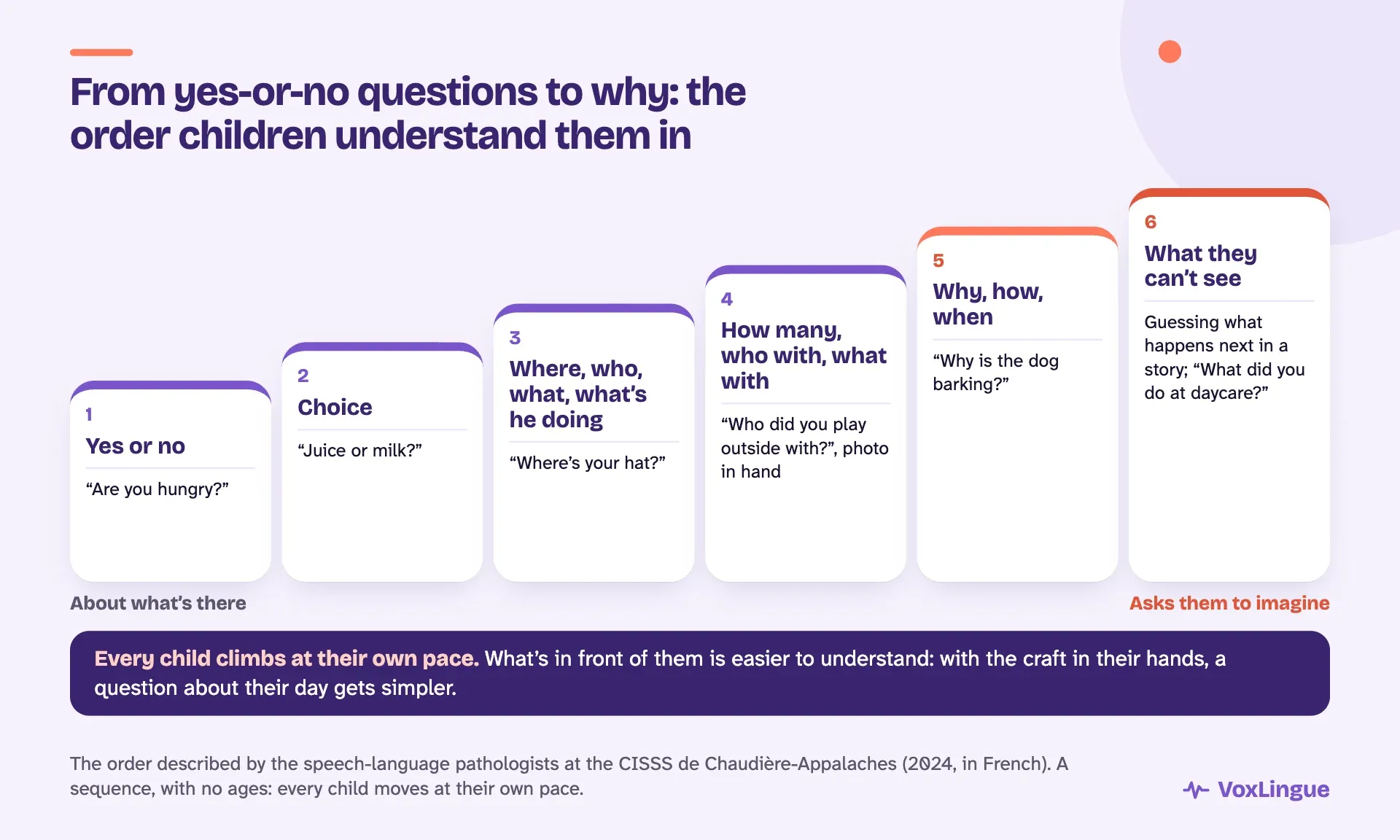
The question word isn’t everything. What also matters is whether the thing is right there, in front of them. The CISSS lists “Who helped you make the craft?” among the simple questions. With the craft in their hands, a question about their day becomes easier: it’s about something they can see. That’s the key to the ways of asking further down.
Questions that ask a child to imagine keep developing for a long time. A study from Université Laval and Université de Montréal looked at 121 French-speaking Québec children aged 3 to 6. Questions about the “why” in a story and about how a character feels were still hard at 3. Answers kept improving up to kindergarten (Filiatrault-Veilleux and colleagues, 2016).
A word of honesty: this order comes mostly from clinical practice. The English studies on the order of questions are old and small, and we found no Québec French study on it. That’s why the ladder gives no ages.
Kimberly Martins advises adapting the complexity of a question to your child’s age and language abilities. To see where your child is, look at language milestones in one language or more.
Is it a sign of a language difficulty? The same answer means something different depending on the question
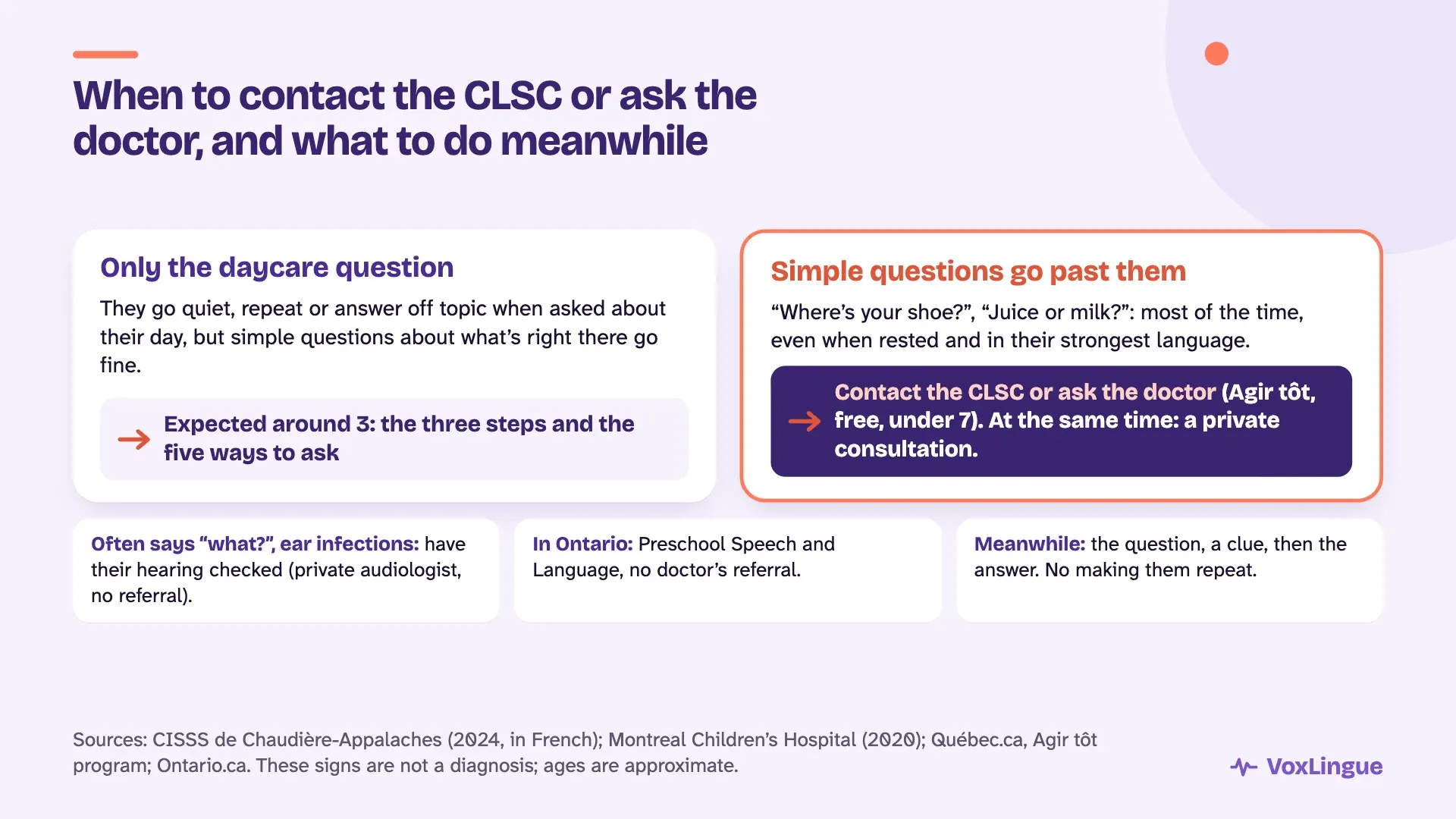
It depends on the question. To the question about their day, these answers are expected around 3. To simple questions about what’s right there, like “Where’s your shoe?” or “Juice or milk?”, if it happens most of the time, contact the CLSC or ask the doctor.
This line comes from Québec sources. Among the signs worth talking about, the CISSS de Chaudière-Appalaches names not understanding simple questions: no answer, a wrong answer or a repeated question. Around 2½ to 3, it counts choices, and where, who, what and what’s he doing, among the simple questions.
The Montreal Children’s Hospital draws the same line in its page on language development and when to consult. Around 3, not understanding simple questions such as “who” or “where” is a reason to consult. Around 4, repeating the question instead of answering, or often making off-topic remarks, is one too. These ages are approximate: markers, not deadlines.
Two conditions matter before you draw any conclusion. Watch when they’re rested, not at pickup. And watch in their strongest language, if they have more than one. This table sums up the difference.
| Their answer | To “What did you do at daycare?”, around 3 | To “Where’s your shoe?” or “Juice or milk?”, most of the time |
|---|---|---|
| They go quiet | Expected: the question is about what isn’t there | A reason to talk to someone |
| They repeat the question | Expected: buying time, or the question is too big | A reason to talk to someone |
| They answer off topic | Expected: they caught part of the question | A reason to talk to someone |
| They say “yes” | Little information: try a choice question | A reason to talk to someone, especially if they say “yes” even to a choice question |
If simple questions often go past them, that isn’t a diagnosis. It’s a reason to ask a speech-language pathologist’s opinion. To understand the difference between language difficulties and developmental language disorder, see our guide.
Three steps to help your child understand a question, without making them answer or repeat
Ask the question once, with no help. If they don’t answer, give a clue: a gesture or two choices. If they still don’t answer, say the question again and give the answer yourself. That’s all: they hear the question and its answer together, with no pressure.
This method comes from the speech-language pathologists at the CISSS de Chaudière-Appalaches (in French). Here’s how it goes in the kitchen, while getting dinner ready.
Step 1: you ask the question, with no clue. “Who’s going to wash the carrots?” You wait about 5 seconds, the time the CISSS suggests leaving after a question.
Step 2: if they don’t answer, you give a clue. “Who’s going to wash the carrots? Daddy or you?” You touch Daddy’s shoulder, then theirs. You wait about 5 seconds again.
Step 3: if they still don’t answer, you say the question again and give the answer. “Who’s going to wash the carrots? Daddy!” You point to Daddy, Daddy picks up the carrots, and dinner carries on.
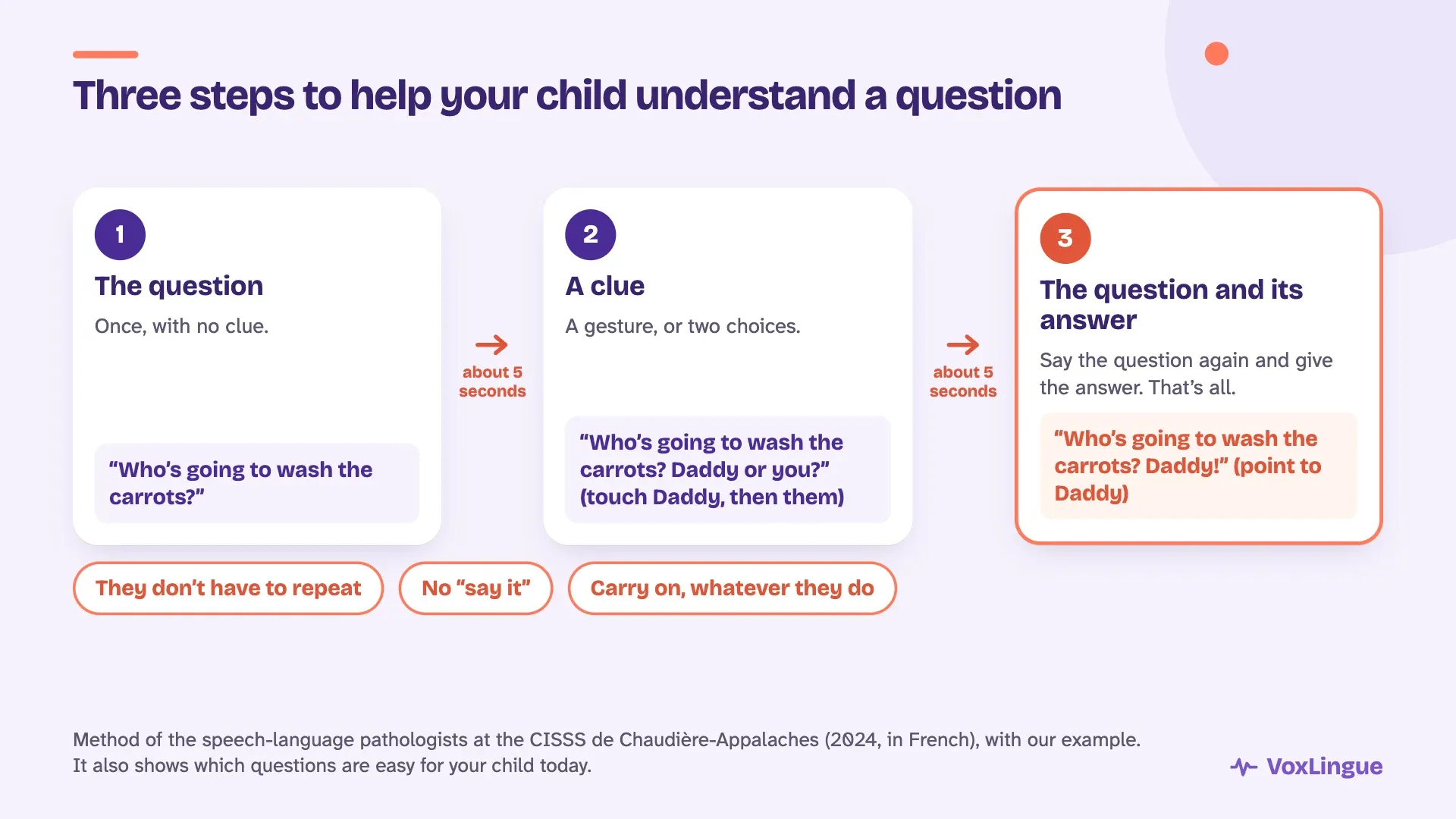
Step 3 stops there. You don’t ask them to say “Daddy”, and you don’t ask the question again to check. If you feel like asking again, do it once, lightly, and carry on whatever they do. If they say “Daddy” on their own, great.
Kimberly Martins makes the point in her guide to asking questions, waiting and expanding: it is important to always give your child all the required information first, then ask. Step 3 works the same way: they get the information they were missing, attached to the question. Next time, they will already have heard the two together.
These steps have another benefit. They show you which questions are easy for your child today. If they answer at step 1, the question was within reach. If they need the clue, it was just above. If they need the answer, it was too big for that moment.
Won’t or can’t?
The three steps help you tell. The CISSS de Chaudière-Appalaches explains that they show whether a child didn’t understand or didn’t want to answer. And if they didn’t understand, the steps help them understand better.
Two more clues can help. Do they answer the same question better when they’re rested, in the morning or on the weekend? If so, tiredness is playing a part. Do they react to a statement when they ignore a question? They don’t answer “Do you want a banana?”, but they go get it when you say “The banana’s on the counter.” Feeling quizzed can weigh on some children.
The CISSS also reminds parents that our questions shouldn’t be used to test a child. Either way, don’t let it become a battle of wills. A child who doesn’t want to answer doesn’t need a second question, but a calmer moment or a statement instead.
How to ask a 3-year-old about their day at daycare so they can actually answer
Ask later, start from what’s there, and make it smaller. A craft in their backpack, a photo from the educator, a choice question or a specific question gives them something to hold on to. A real question, to find out rather than to check, and a few seconds to answer.
The CISSS de Chaudière-Appalaches talks about exactly this moment, coming home from daycare. Its speech-language pathologists advise that our questions shouldn’t test what the child knows, but get real information and keep the conversation going. You don’t know what they did today: that’s already a real question.
Questions still help. In a US study of 41 fathers and their 2-year-olds, the fathers’ “who, what, where” questions were linked to the children’s vocabulary and reasoning later on (Rowe, Leech and Cabrera, 2017). It’s a link, not proof of cause, but there’s no reason to stop asking questions.
Here are five ways to ask a 3-year-old about their day:
- Later. At dinner, bath time or bedtime, rather than at the daycare door, as Naître et grandir suggests.
- From what’s there. The craft in their backpack, or a photo sent by the educator: “Oh, a bird! Who helped you make it?”
- As a choice. “Did you play outside or stay inside?” Naître et grandir also suggests choice questions.
- Specific and short. “Who made you laugh today?” rather than “What did you do?” A US study found that long questions are harder for children with language difficulties (Deevy and Leonard, 2004).
- A comment, then wait. “You’ve got paint on your sleeve!” Then wait about 5 seconds. A comment invites them to talk without asking for an answer.
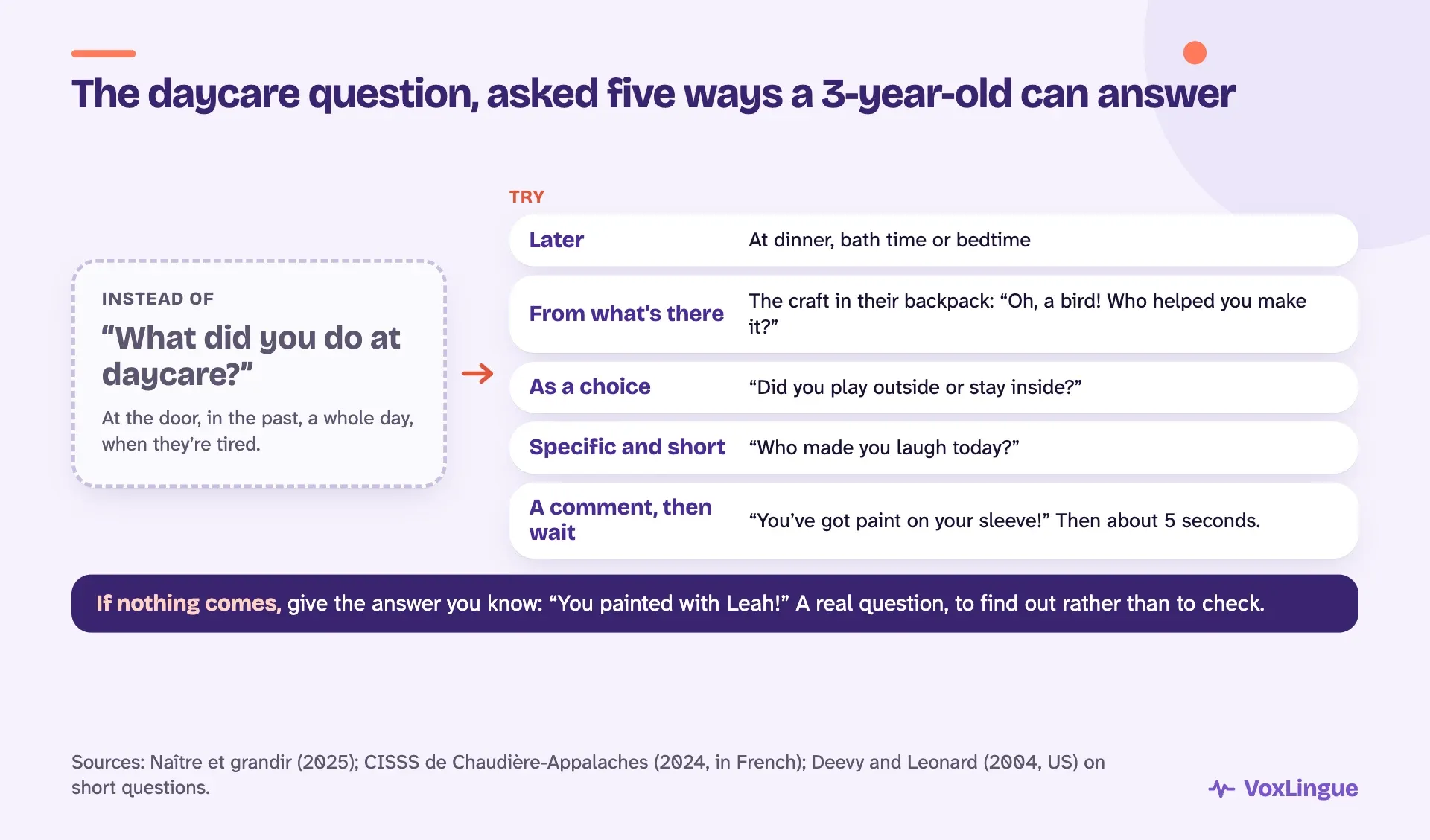
If nothing comes, give the answer you know, as in step 3. The photo shows friends around a painting table? “You painted with Leah!” They hear the words for their day without having to find them alone.
Questions you already know the answer to are a different matter. Our article on test questions, choice questions or comments explains how to spot them and what to say instead.
Later on, the same question changes. Around 5 to 7, it becomes a question about telling a story: recounting the school day, in order, with details. When a 5 to 7-year-old won’t tell you about their school day, other ideas apply.
Bilingual toddler: they answer in the other language, mix languages or repeat the question
Answering in the other language isn’t a sign they don’t understand. Bilingual toddlers often pick their stronger language, and they know how to switch when an adult asks them to. To judge their understanding, look at simple questions in their strongest language.
A Canadian study looked at 26 French-English bilingual children aged 2 and 3. When the adult spoke only one of the two languages, the children switched to match, even after a plain “What?” (Comeau, Genesee and Mendelson, 2007). Choosing a language to suit the person is a skill, not a lack of understanding.
You ask in English, “What do you want for snack?” and they answer, “Pomme!” They understood the question. They answered with the word they knew best, or the one they hear at daycare. They may also mix both languages in one answer, or repeat your question while they look for the words.
Two rules help you judge their understanding. Look at simple questions about what’s right there, in their strongest language. And count both languages: what they understand in one adds to what they understand in the other. A language difficulty shows up in all of a child’s languages, not just one.
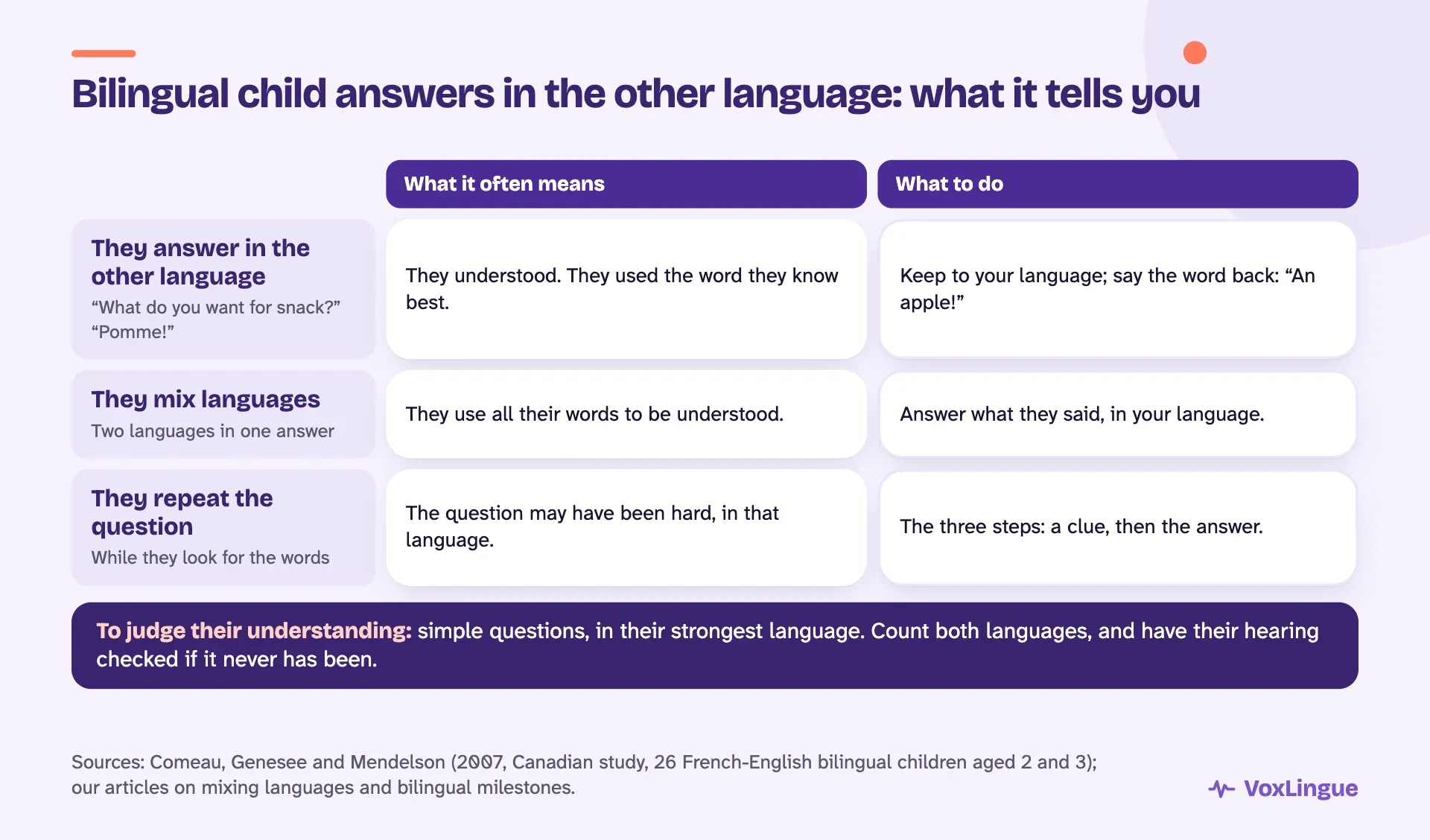
Keep speaking your language with them, even if they answer in the other one. As Kimberly Martins points out, by continuing to use it, you keep up their exposure to your language. Our article on when your child mixes French and English has more ideas.
If their hearing has never been checked, have it checked too. A child who doesn’t hear well can seem not to understand, in either language.
Simple questions going over their head: when to contact the CLSC or ask the doctor, in Québec and Ontario
Talk to someone if simple questions about what’s right there go past them most of the time. In Québec, contact the CLSC or ask the doctor, and at the same time book a private consultation if you can. Have their hearing checked too if it never has been.
Talk to someone if your child:
- doesn’t understand most simple questions about what’s right there, even when rested and in their strongest language;
- has trouble following a simple instruction without a gesture, like “Go get your boots”;
- says few words or uses very short sentences for their age;
- often says “what?”, doesn’t answer when called from another room, or has had many ear infections: think first of having their hearing checked;
- almost always answers with lines from shows, or shows little interest in back-and-forth exchanges;
- around 4, still often repeats the question or answers off topic.
These signs draw mainly on the CISSS de Chaudière-Appalaches and the Montreal Children’s Hospital. The ages are approximate. None of these signs is a diagnosis: they’re reasons to ask for an opinion.
In Québec, start with the public network. Contact the CLSC or ask the doctor: the Agir tôt program offers free screening for children under 7. At the same time, a private consultation lets you get an opinion without waiting.
A speech-language pathologist looks at how your child understands instructions and questions, in all their languages. If the educator raised the concern, see when the educator is worried about their language.
In Ontario, the Preschool Speech and Language Program sees children without a doctor’s referral. We also offer online sessions for Ontario families.
Sometimes simple questions go fine, but conversations at home often turn into questions and answers that go nowhere. That’s exactly what our Hanen-based parent coaching is for: ways of talking together in your everyday moments.
What to remember about 3-year-olds and questions
When your 3-year-old doesn’t answer questions, look at the question first.
- “What did you do at daycare?” is about what isn’t there, in the past, when they’re tired. At 3, going quiet, repeating it or answering off topic is expected.
- Silence, an echoed question, an off-topic answer and “yes” to everything are clues about understanding, not a refusal.
- Children first understand questions about what’s right there, then questions that ask them to imagine.
- To help: the question, then a clue, then the answer. They don’t have to repeat it.
- If simple questions go past them most of the time, contact the CLSC or ask the doctor, and see someone privately at the same time if you can.
Next step: from questions and answers to real conversations
Would you like to turn questions and answers into real conversations? Learn about our Hanen-based parent coaching. If simple questions go past your child, see an assessment that looks at understanding in every language. Our speech-language pathologists see families at our clinic in Marché Central, Montréal, and by telepractice across Québec and Ontario.
To keep the order of questions, the three steps and the five ways to ask in view, print our sheet and put it on the fridge.
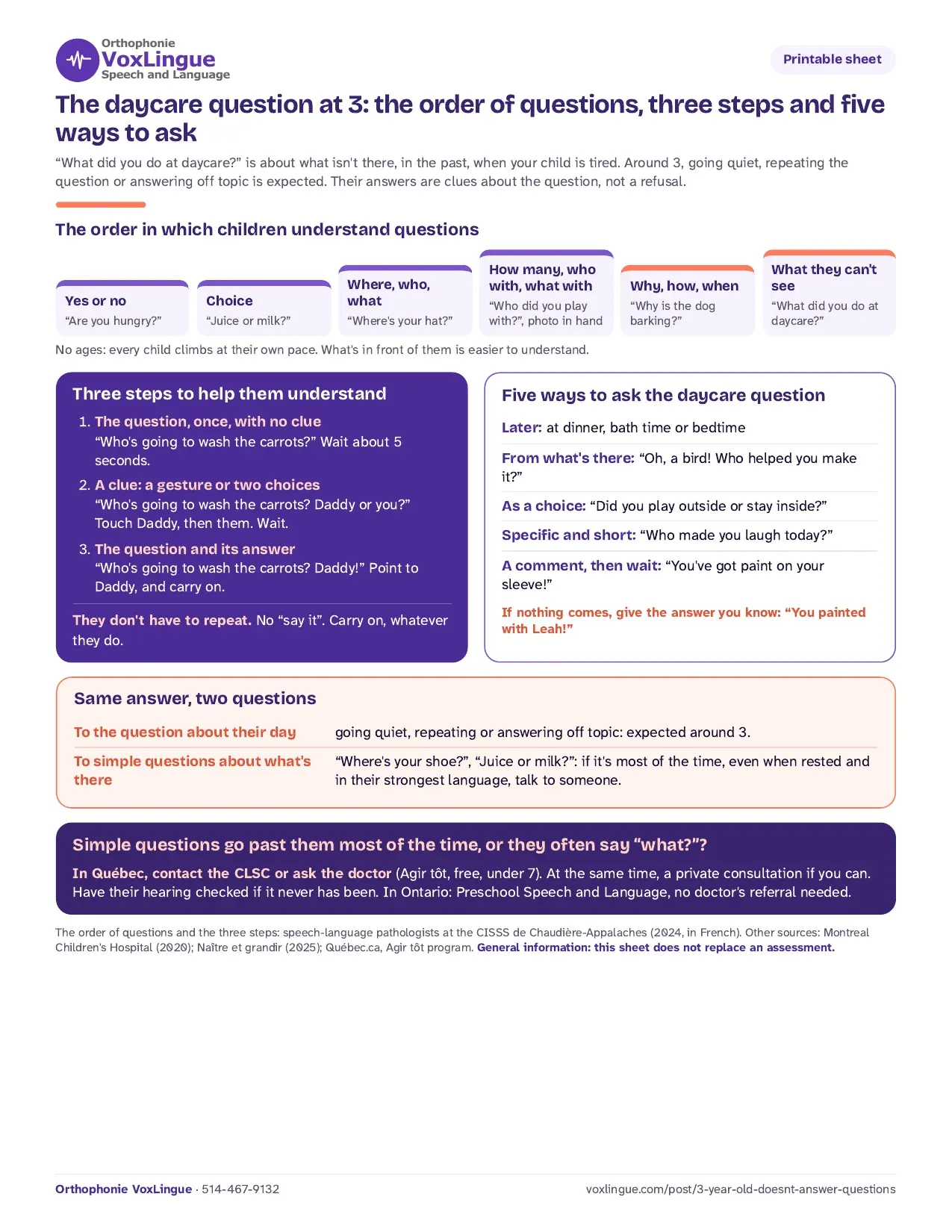
Printable sheet: The daycare question at 3: the order of questions, three steps and five ways to ask (PDF, 1 page).
Frequently asked questions from parents of 3-year-olds
When do children understand “why” questions?
There’s no fixed age. “Why” questions come later in the order, after choice questions and where, who and what. They ask a child to explain a cause, often something they can’t see. A Québec study shows that “why” questions about a story keep developing up to kindergarten. Start with “why” questions about what’s right in front of them.
Should I stop asking my toddler questions?
No. Real questions, the ones you don’t know the answer to, keep the conversation going. In a US study, they were linked to children’s vocabulary later on. Choose the step your child can reach, keep questions short, and mix in comments. To see which questions help, read about test questions, choice questions or comments.
They say “what?” all the time: could it be their hearing?
Yes, it’s worth checking. Especially if they don’t answer when called from another room, or have had many ear infections. In Québec, a private audiologist can see you without a referral. Our article on ear infections and language explains what to watch for.
They answer with lines from their shows: is it autism?
Not necessarily. Repeating phrases they’ve heard is one way of learning language, in some autistic children and in others. If almost all of their answers are learned phrases, or they show little interest in back-and-forth, a speech-language pathologist looks at the whole picture. See when to wonder about autism.
They answer the educator but not me: why?
At daycare, many questions are about what’s right there, during the routine: “Where are your boots?” At pickup, you often ask about their day, just when they’re tired. Compare the same kind of question, at a calm moment. If they talk at home but stay silent everywhere else, see a child who talks at home but not elsewhere.
Should I ask them to say the right answer?
No. Give the answer, then carry on with what you were doing. If they say the word on their own, great. Asking them to repeat adds pressure without helping them understand the question. What helps is hearing the question and its answer together, often, as in step 3.
What about when they start school: will they tell me about their day?
Telling about their day develops gradually, between about 3 and 7. At 3, they talk about a few moments, often without details. Around 5 to 7, the question changes: when a 5 to 7-year-old won’t tell you about their school day, it’s mostly about telling a story.