My child won't tell me anything about their school day: why 'nothing' is often normal at 5 to 7, the questions that help them tell, and when it points to a language difficulty

It’s 4:30, and you’re picking your child up from the school daycare. Your child won’t tell you anything about their school day, however you ask. “How was school?” “Good.” “What did you do?” “Nothing.” Then, at bedtime, out comes a whole story: a friend, recess, and a ball stuck on the school roof.
A team of school speech-language pathologists in Québec (the Centre de services scolaire des Navigateurs, in French) describes this well. Many parents are disappointed when their child says they don’t remember what they did, or gives very few details. That “nothing” is familiar to a lot of families.
This guide explains why a 5 to 7-year-old says “nothing”, what research says about it, and how telling grows from kindergarten to Grade 2. You’ll find a routine to try tonight, specific questions to ask, what changes for a bilingual child, the signs worth checking, and what to ask the teacher at the November meeting.
My child won’t tell me about their school day: should I worry at 5 to 7?
Usually not. At 5 to 7, “nothing” on its own is generally not a sign of a language difficulty. The school day is long, the question is broad, and it comes at the wrong moment. What matters more is how your child tells things when they want to, at supper or at bedtime.
Canadian and Québec sources treat this “nothing” as an ordinary situation. The Navigateurs school speech-language pathologists and Naître et grandir offer ways to help a child tell their day, not warning signs. SickKids, the Toronto children’s hospital, mostly explains how much work the question asks of a child.
So look at how your child tells things when they start the story themselves: in the bath, at supper, at bedtime, or about a book you read together. Can they say what happened in a way you understand?
Kimberly Martins, speech-language pathologist and founder of VoxLingue, made this a marker in our article on starting kindergarten: your child should be able to say clearly what happened, and be understood when they say it. If your child tells you things in the evening, even a little out of order, the 4:30 “nothing” is mostly about the question and the timing.
For more on this, see our articles on storytelling, reading and writing.
Why they say “nothing”: a routine day, a question that’s too big, the wrong moment
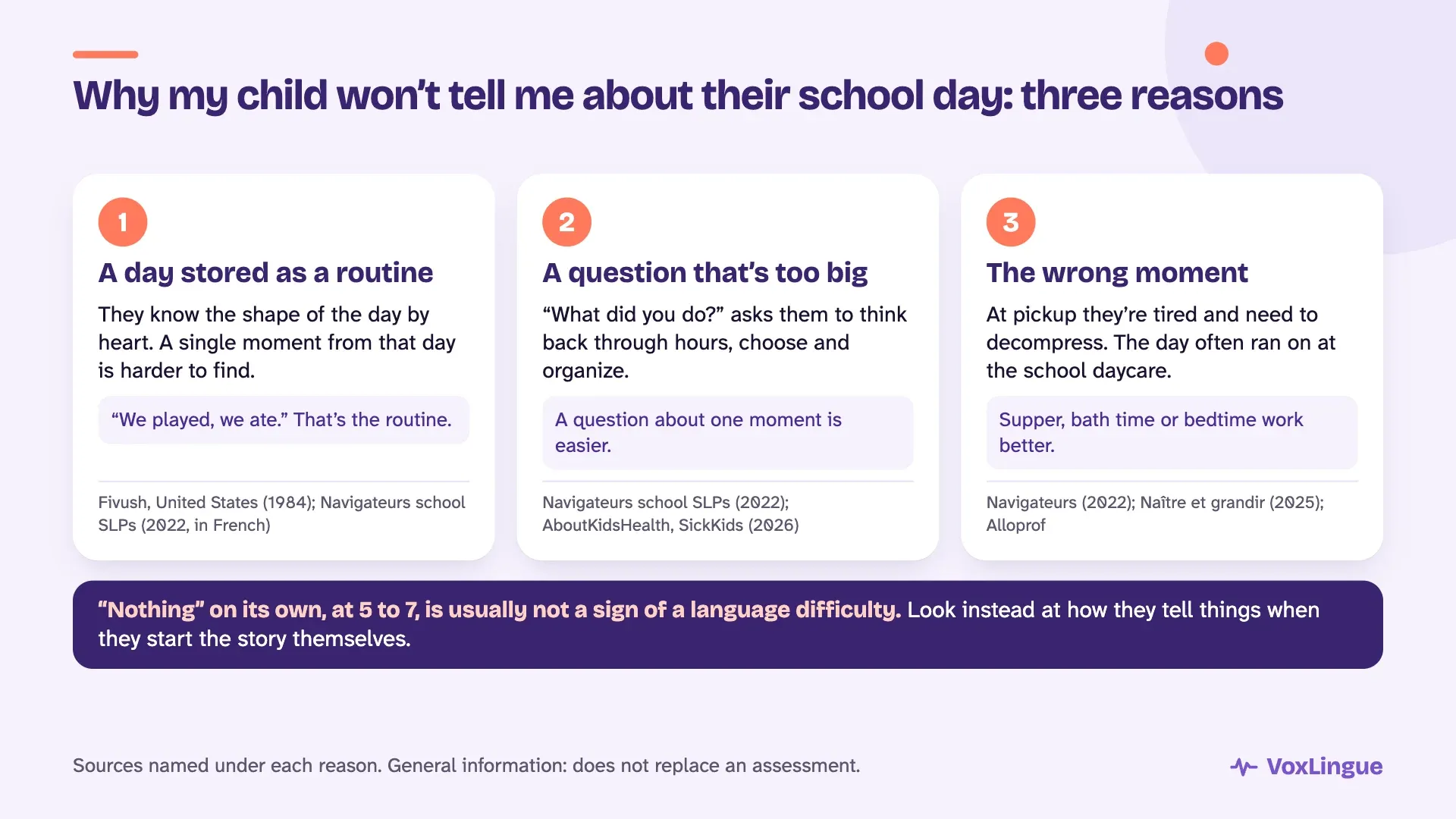
Three things combine. A school day is stored in memory as a routine, so a single moment is hard to find. We ask the child to tell instead of letting them start. And the question comes at pickup, when they’re tired and need to decompress.
A school day is stored as a routine
Kindergartners learn the shape of their school day very quickly. An American researcher, Robyn Fivush, interviewed kindergarten children four times during their first three months of school (1984). From the second day, they described the routine in a general, well-organized way. But at all four interviews, they had trouble recalling specific moments from the day before.
In other words, “we played, we ate, we went outside” is the routine. Your child knows it by heart, and it looks much the same every day. “Leah fell off the slide” is a moment, and your child has to go and find it. When the question covers the whole day, that moment often stays hidden behind the routine.
In Québec, the Navigateurs school speech-language pathologists describe the same thing from the parent’s side: the child says they don’t remember. AboutKidsHealth, from SickKids, explains that answering “How was your day?” means thinking back through hours of experiences, deciding what was important and organizing those thoughts. That’s a lot at 5 or 6.
Telling when asked, or telling on their own
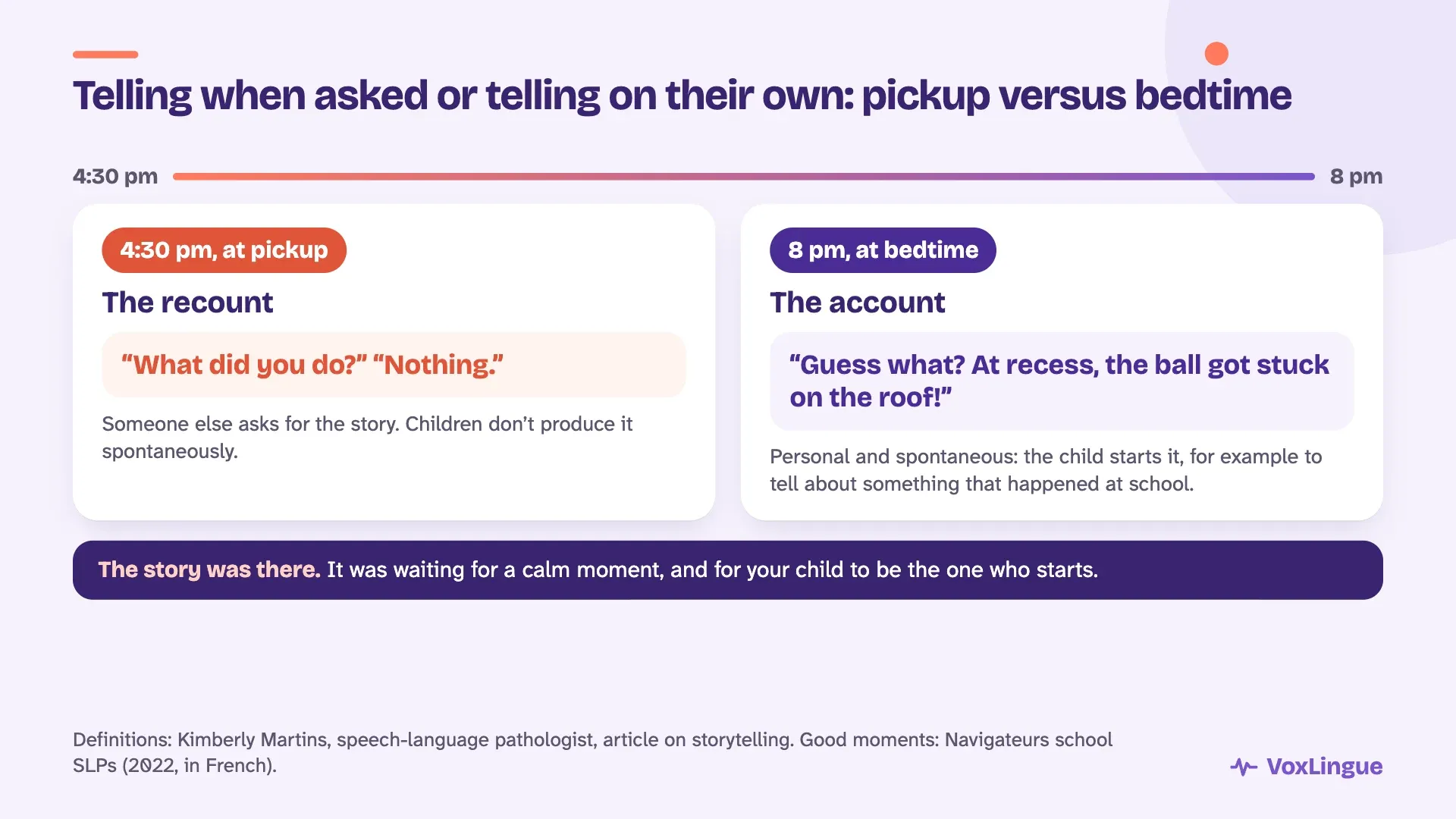
Kimberly Martins describes two kinds of telling in her article on storytelling. In her words, “Recounts are narratives prompted from the child by others. They are not spontaneously produced by children.” Accounts, on the other hand, “are narratives that are usually personal and spontaneously produced”, such as relating an experience that happened at school.
At pickup, we ask for a recount. At bedtime, your child is calm, you’re available, and they often start the story themselves. This difference helps explain why the same child says “nothing” at 4:30 and tells you a whole story at 8. The story was there. It was waiting for a calm moment, and for your child to be the one who starts.
Kimberly’s guide to narrative language and how storytelling develops explains the kinds of telling and the steps in more detail. The Navigateurs team also names bath time and bedtime among the good moments to talk about the day.
Pickup isn’t the best time to ask
When you ask matters as much as what you ask. The Navigateurs school speech-language pathologists advise against questioning your child right after school, in the late afternoon, or while they’re playing a video game. They suggest a calm moment without distractions instead: a meal, bath time, bedtime.
Naître et grandir’s page on helping your child tell you about their day adds that the best time isn’t necessarily when you pick your child up, because they may be tired. Alloprof Parents suggests letting your child decompress a little after the school day. AboutKidsHealth notes that many children need time to transition, and suggests waiting until everyone has had a chance to reset.
For many children in Québec, the day carries on at the school daycare (the service de garde) until late afternoon. By the time you ask, your child has already had a long day.
Finally, every child has their own personality. Some children, like some adults, just don’t enjoy telling about their day. Naître et grandir recommends respecting that and not bombarding them with questions.
How storytelling about the school day grows, from kindergarten to Grade 2
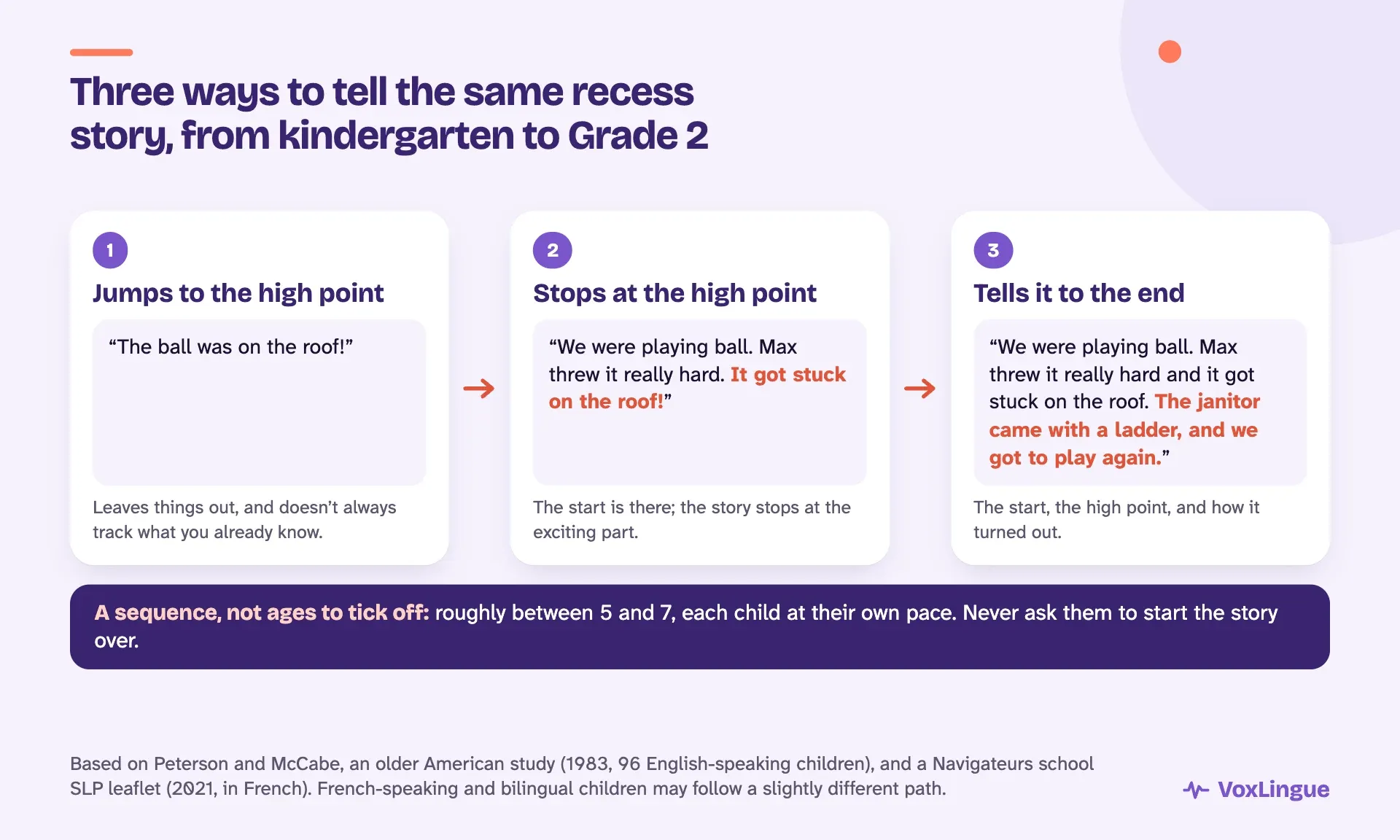
Telling about the day starts around 3 or 4. Between 5 and 7, what grows is order, the details a listener needs, and the ending. At 5, a child often jumps to the most exciting part and stops there. Around 6 or 7, they also tell how it ended.
Our article on language milestones from birth to 5, in every language describes the start: by about 3 to 4, most children already tell what happened in their day. Naître et grandir adds that between 5 and 8, children link events together and use the right words for time.
A leaflet by a Navigateurs school speech-language pathologist (in French) describes the 5-year-old. When they tell about something that happened, they leave information out: they often jump straight into the heart of it and don’t always take into account what the listener knows. You hear “And then the ball was on the roof!” without knowing which ball, or which roof.
A classic American study described what comes next. Carole Peterson and Allyssa McCabe listened to 96 children aged 3½ to 9½ tell about their own experiences, in a small Ohio town (1983). Around 5, stories often stopped at the high point: the ball on the roof, and that’s it. This was still common at 6. From about 6, the most common kind of story also told how things turned out.
This study is old and looked at one group of English-speaking children. French-speaking and bilingual children may follow a slightly different path, and every child moves at their own pace. Think of these steps as a sequence, not as ages to tick off.
Speech-language pathologists call this kind of story a personal narrative: telling something you lived through. The feelings and thoughts of the people in the story come later; Kimberly Martins places that step around age 8.
At a younger age, around 3, the question about the day is often one of the hardest a child can be asked. For a 3-year-old who doesn’t answer questions, what to look at is different.
Why this matters for school, reading and writing
Telling is part of what school expects. By the end of kindergarten, Québec’s Ministère de l’Éducation programme (in French) expects children to express themselves to tell, explain and ask questions. Its examples include describing an event and retelling a story they heard in their own words. Québec’s new primary French programme puts oral communication first; it becomes mandatory in the 2027-2028 school year.
This skill also carries forward. In England, a large study of 716 children found that storytelling at 5 predicted reading comprehension at 10 and reading at 14 (Babayiğit and colleagues, 2021). Our article on what kindergarten expects of your child’s language covers this in more depth. If reading is your worry, see early signs of dyslexia from kindergarten to Grade 2.
I’ll go first: telling your own day before asking about theirs
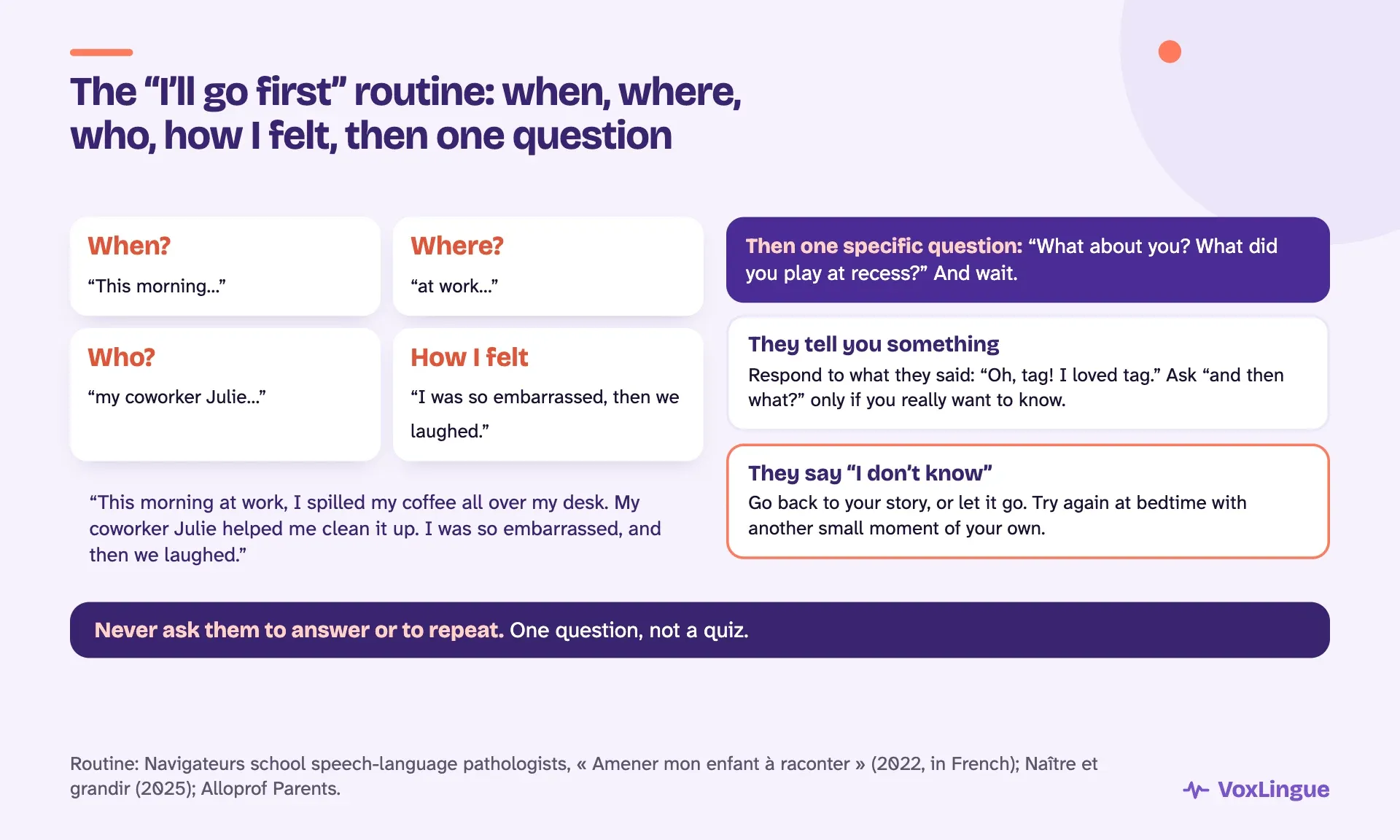
Start by telling a small moment from your own day: when, where, who with, and how you felt. Then ask one specific question, and wait. If your child tells you something, show interest in what they say. If they say nothing, that’s fine: never ask them to answer or to repeat.
This routine comes from the Navigateurs school speech-language pathologists, in a handout for parents called « Amener mon enfant à raconter » (2022, in French). By going first, you give your child a model to help them tell their own story. They suggest naming four things: the moment (when?), the place (where?), the people (who?) and how you felt. A pleasant moment or a less pleasant one both work.
Naître et grandir and Alloprof Parents give the same advice: talk about your own day before your child does, to offer a model. Our article on language milestones already suggested it for younger children.
Then, no pressure. The Navigateurs leaflet is clear: never ask the child to repeat, never force the child to talk. It’s not a test. It’s a conversation where you speak first.
An example, from supper to bedtime
At supper, you start: “This morning at work, I spilled my coffee all over my desk. My coworker Julie helped me clean it up. I was so embarrassed, and then we laughed.” Then one question: “What about you? What did you play at recess?”
There are two ways it can go. If your child tells you something, respond to what they said rather than how they said it: “Oh, tag! I loved tag.” You can add the word they were looking for, or ask “and then what?” because you really want to know, never to check.
If they say “I don’t know”, go back to your story, or let it go. You’ll try again at bedtime, with another small moment of your own. That evening, they may not tell you anything. What counts is the habit: you tell often, without expecting anything back, and night after night, they hear how a moment gets told.
What research says about parents who tell
Research on parents who talk through memories with their children mostly involves younger children. In New Zealand, Elaine Reese and Rhiannon Newcombe trained mothers to revisit shared memories in rich detail when their children were 1½ to 2½ (2007). Their children later told richer memories, at 2½ (115 children) and at 3½ (100 children).
In the United States, among 33 low-income families of 4-year-olds, this way of talking about memories improved the quality of children’s stories more than interactive book reading did (Reese and colleagues, 2010). The effect held for bilingual children too.
A meta-analysis of 38 studies, covering 2,492 parent-child pairs with children aged 2½ to 5, points the same way. The more detail mothers add when talking about the past, the better children’s memory and language (Waters and colleagues, 2019). That’s a link, not proof of cause.
The limit matters. These studies involve children younger than yours, mostly mothers, and often small groups. We found no trial with children aged 5 to 7. So the “I’ll go first” routine is the school speech-language pathologists’ advice, consistent with this research, not a method proven at this age. The table sums up the eight studies cited in this guide.
| Study | Children | What was measured | What was found | Main limit |
|---|---|---|---|---|
| Fivush, United States, 1984 | Kindergartners, interviewed 4 times over 3 months | What they told about their school day | The routine was told well from day 2; specific moments of the day before stayed hard | Old; number of children not stated |
| Peterson and McCabe, United States (Ohio), 1983 | 96 children aged 3½ to 9½ | The shape of their stories about their own experiences | Around 5, stories often stopped at the high point; from about 6, they often went on to the ending | Old; one group of English-speaking children |
| Reese and Newcombe, New Zealand, 2007 | 115 children at 2½, 100 at 3½ | Their memories, after mothers were trained | Richer memories in children of trained mothers | Younger children; mothers only |
| Reese and colleagues, United States, 2010 | 33 low-income families of 4-year-olds | The quality of their stories | Talking about memories helped more than book reading, for bilingual children too | Small group; younger children |
| Waters and colleagues, meta-analysis, 2019 | 38 studies, 2,492 parent-child pairs, aged 2½ to 5 | How mothers talk about the past | More detail went with better memory and language | A link, not a cause; mostly mothers |
| McCabe and colleagues, American team, 2008 | 27 children aged 7 to 9 with a language disorder | A story about something that happened to them, and a story made up from a wordless picture book | The two were only weakly related | Older children; small group |
| Gabaj and colleagues, Croatia, 2025 | 50 ten-year-olds with DLD and 50 classmates of the same age | Their stories about their own experiences | Simpler sentences, more errors and fewer links in children with DLD | Older than your child |
| Huang and colleagues, United States, 2022 | 95 Spanish-English bilingual students in Grades 1 and 3 | Storytelling in both languages, and reading | Storytelling in both languages helped English reading | Spanish and English, not French |
What to ask your child after school instead of “What did you do today?”
Ask open but specific questions: about one moment, like recess, lunch or gym. Avoid questions that are too vague, and questions that can be answered with yes or no. One question at a time is enough, and if they don’t answer, let it go.
Open, but specific
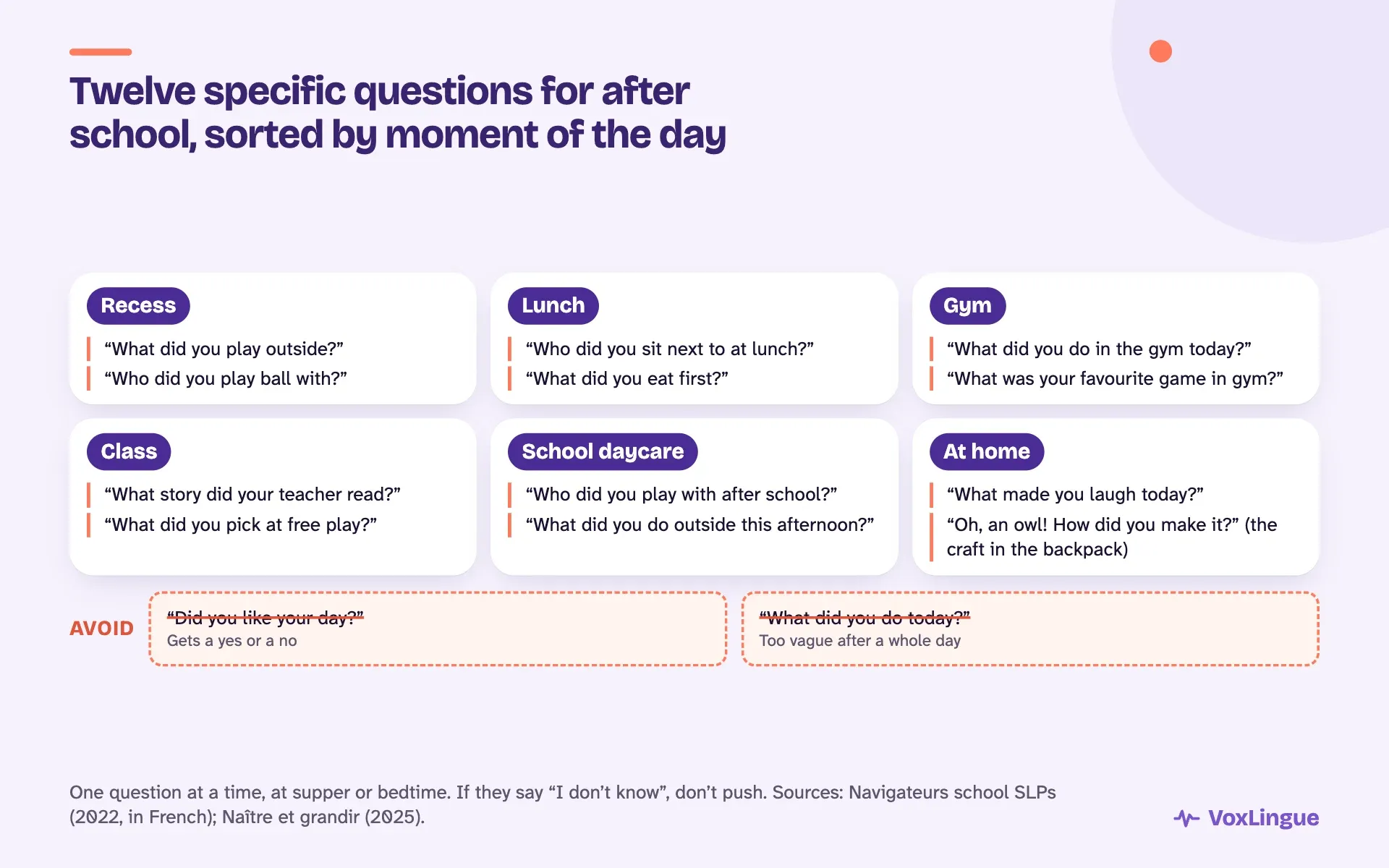
The Navigateurs school speech-language pathologists show the difference with three examples. “Did you like your day?” gets a yes or a no. “What did you do today?” is too vague after a whole day. “What did you play at recess?” is still open, but it points to a single moment. Your child can answer it without searching through the whole day.
If an open question is still hard, offer a choice: “Did you play ball or on the climbing structure?” Naître et grandir gives another example of a specific question: “Who did you play ball with?” Here are six questions, one for each moment of the school day:
- Recess: “What did you play outside?”
- Lunch: “Who did you sit next to at lunch?”
- Gym: “What did you do in the gym today?”
- Class: “What story did your teacher read?”
- School daycare: “Who did you play with after school?”
- On the way home: “What made you laugh today?”
Pick one, not six. The printable card has twelve, sorted by moment of the day.
Start from what you already know about their day
A question built on something you know is easier to answer. The Navigateurs team suggests starting from the schedule the teacher sends home: “You had gym today. What did you do in the gym?” A photo or a video from the school can do the same job. So can the craft sticking out of the backpack: “Oh, an owl! How did you make it?”
They also suggest themes that open the door: the funniest moment of your day, or what you enjoyed most. A theme swaps the whole day for one moment to find.
When they say “I don’t know”
When your child says “I don’t know”, don’t push. Don’t ask the question again, and don’t ask a second one right away. Go back to your own story, or move on and try again at supper or bedtime.
The Navigateurs leaflet puts it simply: bombarding a child with questions could take away their wish to talk. One question, not a quiz. And never “say it properly” or “say it again”: your child learns mostly by hearing you tell.
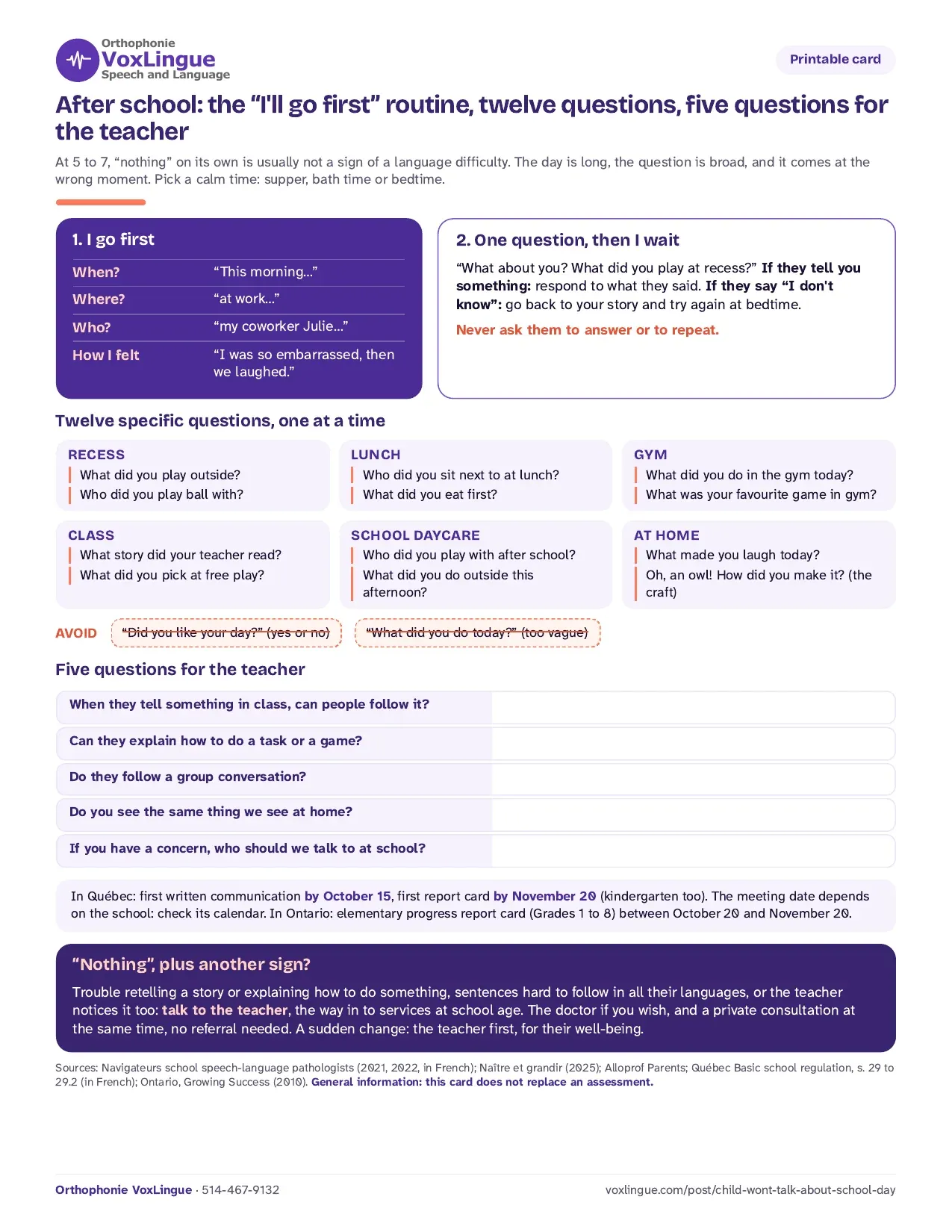
Printable card: After school: the “I’ll go first” routine, twelve questions, five questions for the teacher (PDF, 1 page).
My child tells me about school in a different language from home: what should I know?
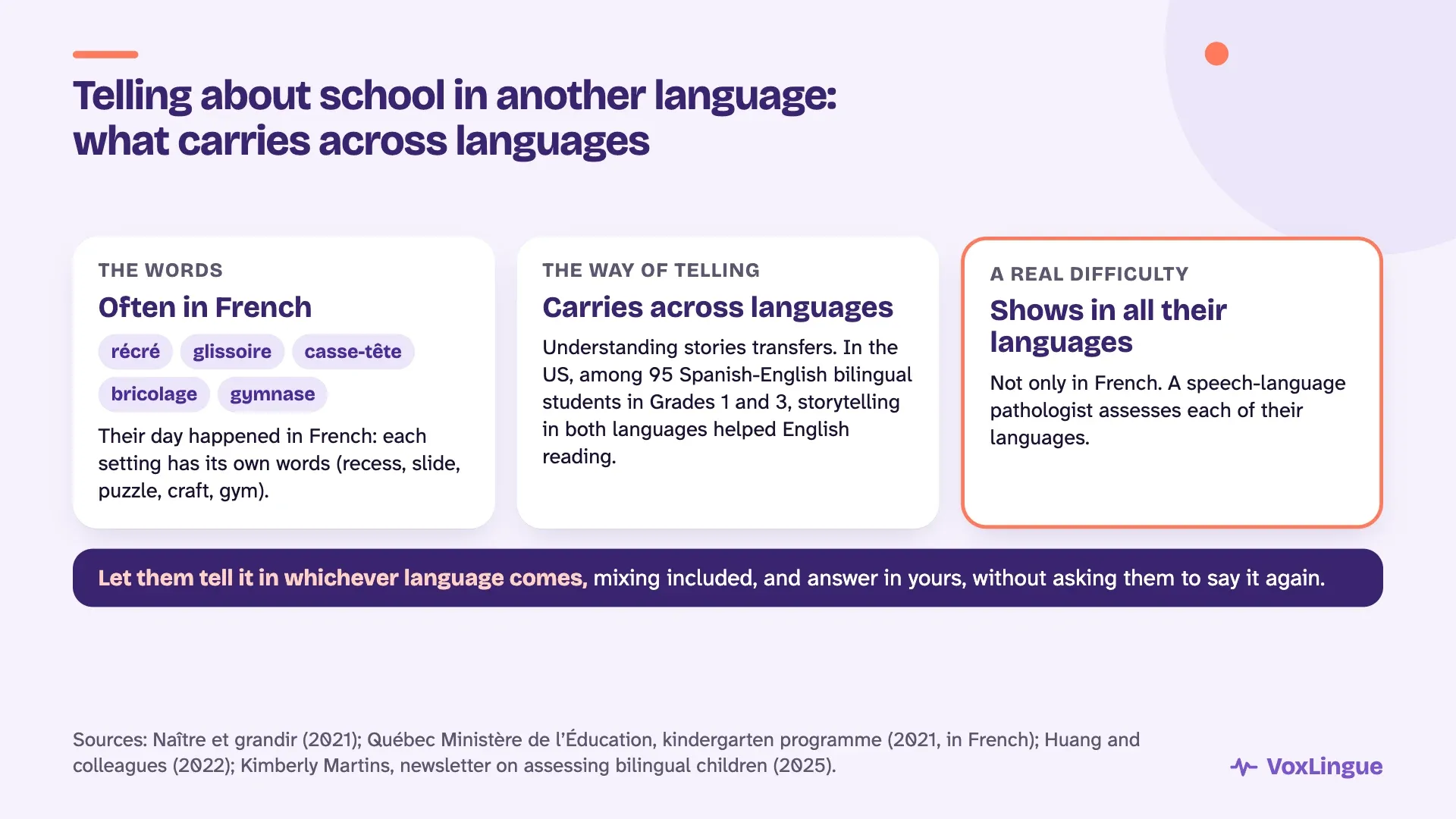
The words for their school day are often in French, because that’s where they lived it. Let your child tell it in whichever language comes, mixing included. The way of telling a story carries across languages. A real difficulty shows up in all of a child’s languages, not only in French.
Each setting has its own words. If you speak English, Spanish, Arabic or another language at home and your child goes to school in French, recess, lunch and gym all happened in French. Your child may know « glissoire » (slide), « casse-tête » (puzzle) and « bricolage » (craft) only in French. Our article on why bilingual children mix their languages explains this in detail.
So let them tell it in the language that comes, and answer in yours. Québec’s kindergarten programme even lists using one’s first language to express oneself among the things children learn. You can say their French word back in your language, without asking them to say it again.
The way of telling, though, carries across languages. Our pages on literacy note that basic skills, such as understanding stories, transfer from one language to another. In the United States, among 95 Spanish-English bilingual students in Grades 1 and 3, storytelling in both languages contributed to reading in English (Huang and colleagues, 2022).
To know whether a difficulty is hiding behind the “nothing”, you have to look at all of their languages. Kimberly Martins said it in her newsletter: ask for a language evaluation that includes both spoken languages. Read Kimberly’s newsletter on assessing language in bilingual children for why.
When “nothing” is more than tiredness: signs worth checking
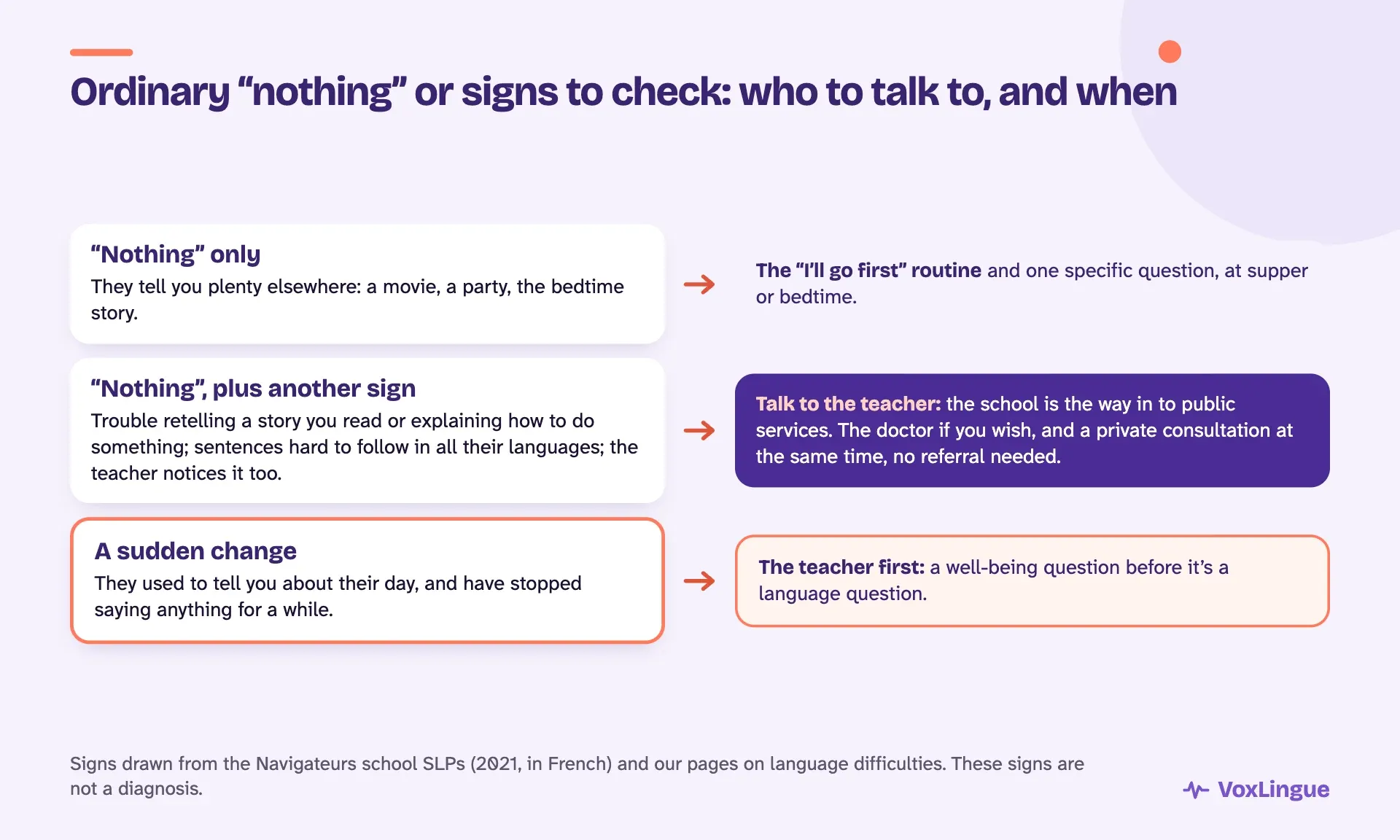
Look at what comes with the “nothing”. Do they also struggle to retell a story you read together, or to explain how to do something? Are their sentences hard to follow in all of their languages? Does the teacher notice the same thing? Then talk about it. A sudden change is a conversation for the teacher first.
A child who won’t tell you about school but tells you all about a movie, a party or the bedtime story is mostly dealing with a question that’s too big and a bad moment. A check becomes useful when the difficulty also shows up elsewhere. These signs come from school speech-language pathologists and from our own pages on language difficulties:
- They also struggle to retell a story you read together, or to explain how to do something, like the rules of a game.
- Their sentences are very short or hard to follow, they often change topic, and this is true in all of their languages.
- The teacher notices the same thing in class.
- They used to tell you about their day, and have stopped saying anything for a while. In that case, talk to the teacher first: it’s a well-being question before it’s a language question.
The Navigateurs leaflet treats signs like these as a reason to pay closer attention. Our page on our support for language difficulties names the same sign: trouble telling a story in order or explaining what happened at school.
Two studies help explain why a speech-language pathologist looks at more than one kind of telling. An American team compared, in 27 children aged 7 to 9 with a language disorder, a story about something that happened to them and a story made up from a wordless picture book (McCabe and colleagues, 2008). The two were only weakly related: a child can do well at one and not the other.
In Croatia, 50 ten-year-olds with developmental language disorder told their own experiences with simpler sentences, more errors and fewer links than 50 classmates of the same age (Gabaj and colleagues, 2025). These children are older than yours. For more on what developmental language disorder (DLD) is, see our article on the topic.
One more point: a child who talks at home but not at all at school is a different question. Our article on a child who speaks at home but not at school explains selective mutism.
The November report card and the teacher meeting: how they tell and explain in class
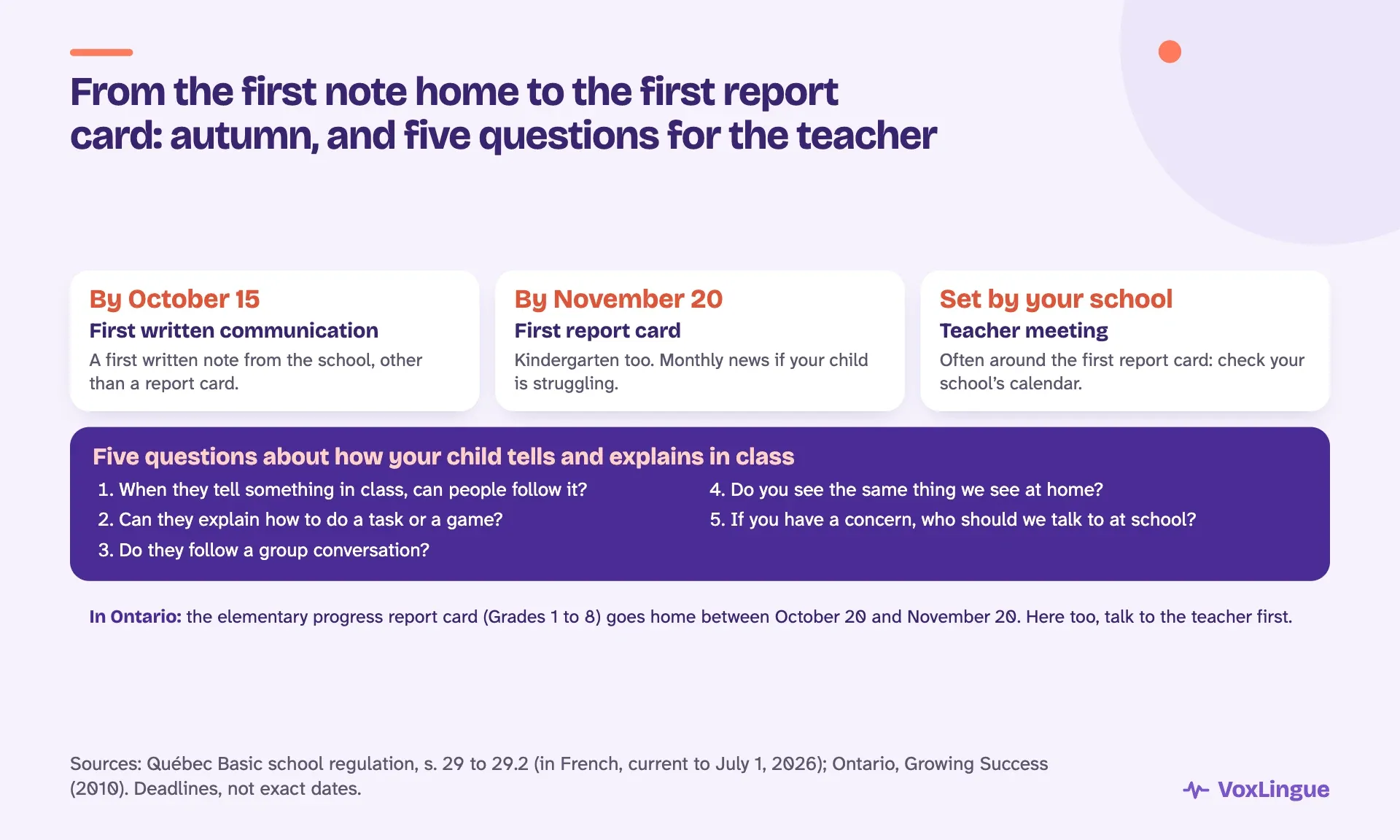
In Québec, the first report card comes out no later than November 20. Many schools invite parents to a meeting around then. It’s a good time to ask the teacher how your child tells things and explains in class. At school age, the school is the way in to public services.
Québec’s Basic school regulation (the Régime pédagogique, in French) sets deadlines, not exact dates. The school sends a first written communication no later than October 15, then the first report card no later than November 20. This also applies to kindergarten. When a student is struggling, the school gives news at least once a month. The meeting date varies from school to school: check your school’s calendar.
At the meeting, five questions help you learn how your child tells and explains in class:
- When they tell something in class, can people follow it?
- Can they explain how to do a task or a game?
- Do they follow a group conversation?
- Do you see the same thing we see at home?
- If you have a concern, who should we talk to at school?
Talk to the teacher first: they can bring in the school’s professionals, such as the speech-language pathologist or the orthopédagogue (a Québec learning specialist). An intervention plan (plan d’intervention) doesn’t require a diagnosis. You can also ask the doctor, and book a private consultation at the same time, no referral needed. To see who does what, read about the difference between a speech therapist and an orthopedagogue in Québec.
In Ontario, the elementary progress report card for Grades 1 to 8 goes home between October 20 and November 20, according to the province’s Growing Success assessment policy. School boards have speech-language pathologists. Here too, talk to the teacher first. If you live in Ontario, see also online sessions for Ontario families.
The short version: “nothing” after school
- Your child won’t tell you about their school day? At 5 to 7, “nothing” on its own is usually not a sign of a language difficulty.
- A school day is stored as a routine: one moment is easier to find than a whole day.
- Tell a moment from your own day first (when, where, who with, how you felt), then ask one specific question.
- Never ask your child to answer or to repeat. If they say “I don’t know”, try again at bedtime.
- If the “nothing” comes with other signs, talk to the teacher, at the November report card meeting or sooner.
Where to go from here: the printable card, the teacher and, if needed, an assessment
To keep the routine in view, print our card: After school: the “I’ll go first” routine, twelve questions, five questions for the teacher (PDF, 1 page). It fits on one page, with the five questions for the teacher.
If the signs go beyond “nothing”, our support for language difficulties also works on storytelling, using children’s books. Our speech-language pathologists offer a speech and language assessment in each of your child’s languages, at our clinic in Marché Central, Montréal, or by telepractice anywhere in Québec and Ontario.
Parents’ questions about a 5 to 7-year-old who won’t talk about school
My child says they can’t remember their day: is it a memory problem?
Usually not. A school day is stored as a routine, and a single moment is hard to find when the question covers the whole day. An American study of kindergartners saw this from their first months of school. A question about one moment, like recess, helps your child find it. Bedtime, when your child starts the story, is often a better time.
Is it the same at 3?
No. Around 3, the question about the day is often one of the hardest a child can be asked. Between 5 and 7, children can already tell, and the question becomes one of storytelling: the order of events, the details a listener needs, the ending. For a 3-year-old who doesn’t answer questions, what to look at is different.
Should I keep asking until they answer?
No. One question is enough. If they don’t answer, don’t repeat the question, and don’t ask them to say anything again. School speech-language pathologists put it plainly: forcing a child to talk or bombarding them with questions can take away their wish to talk. Tell a moment from your own day instead, and try again at bedtime.
My child used to talk about school and stopped: what should I do?
A sudden change in a child who used to tell you things is a conversation for the teacher first. It’s a well-being question before it’s a language question: how are things going in class, at recess, at the school daycare? If other signs come with it, such as sentences that are hard to follow in all of their languages, talk to a professional too.
My child retells books well but not their day: is that normal?
These are two different kinds of telling. An American team saw it in 27 children aged 7 to 9 with a language disorder: telling something that happened and telling a made-up story were only weakly related. A child can do well at one and not the other. That’s why, when you consult, the speech-language pathologist looks at both.
What does a speech-language pathologist look at?
They assess your child’s understanding and expression, in each of their languages. They may ask your child to tell a story or retell one they heard, to see how they organize their ideas. With your permission, they can also gather information from the school, so the whole picture is clear.