Only you understand your child? How much others should understand at each age
“I understand them just fine.” Yet at daycare, the educator asks you to translate. Grandma smiles and nods without catching a word. And your child is starting to get upset when people don’t understand them.
A child who is hard for others to understand, but not for their parents: this is very common. Many parents describe it the same way. At home, everything is fine; it’s elsewhere that people don’t understand.
It still raises a real question: is this normal for their age? The guideposts you find online don’t always help. The most widely shared chart, which says a child should be understood by everyone around age 4, sets the bar too early according to recent research.
This guide explains why you understand your child better than others do, what someone who doesn’t know them should understand at each age, how to help at home and when to see a speech-language pathologist. For the order in which sounds appear, see also our guide to when each speech sound usually comes in.
What is speech intelligibility?
Speech intelligibility is how much of what your child says a listener can understand. It depends on the sounds your child has mastered, but also on who is listening, the context and how fast your child talks. A child can make several sound errors and still be fairly well understood.
So intelligibility is measured from the listener’s side, not with a list of sounds said right or wrong. The same child can be very clear to their dad and hard to follow for the neighbour.
It also isn’t the same thing as saying every sound correctly. A 3-year-old who says “poon” while reaching for a spoon at dinner gets the message across easily. The same word, said to an aunt over the phone, can stay a mystery.
So speech-language pathologists ask: does the message get through, and to whom? A person who doesn’t know the child is the toughest test, and the guidepost for deciding when to consult.
Why you understand your child, and others don’t
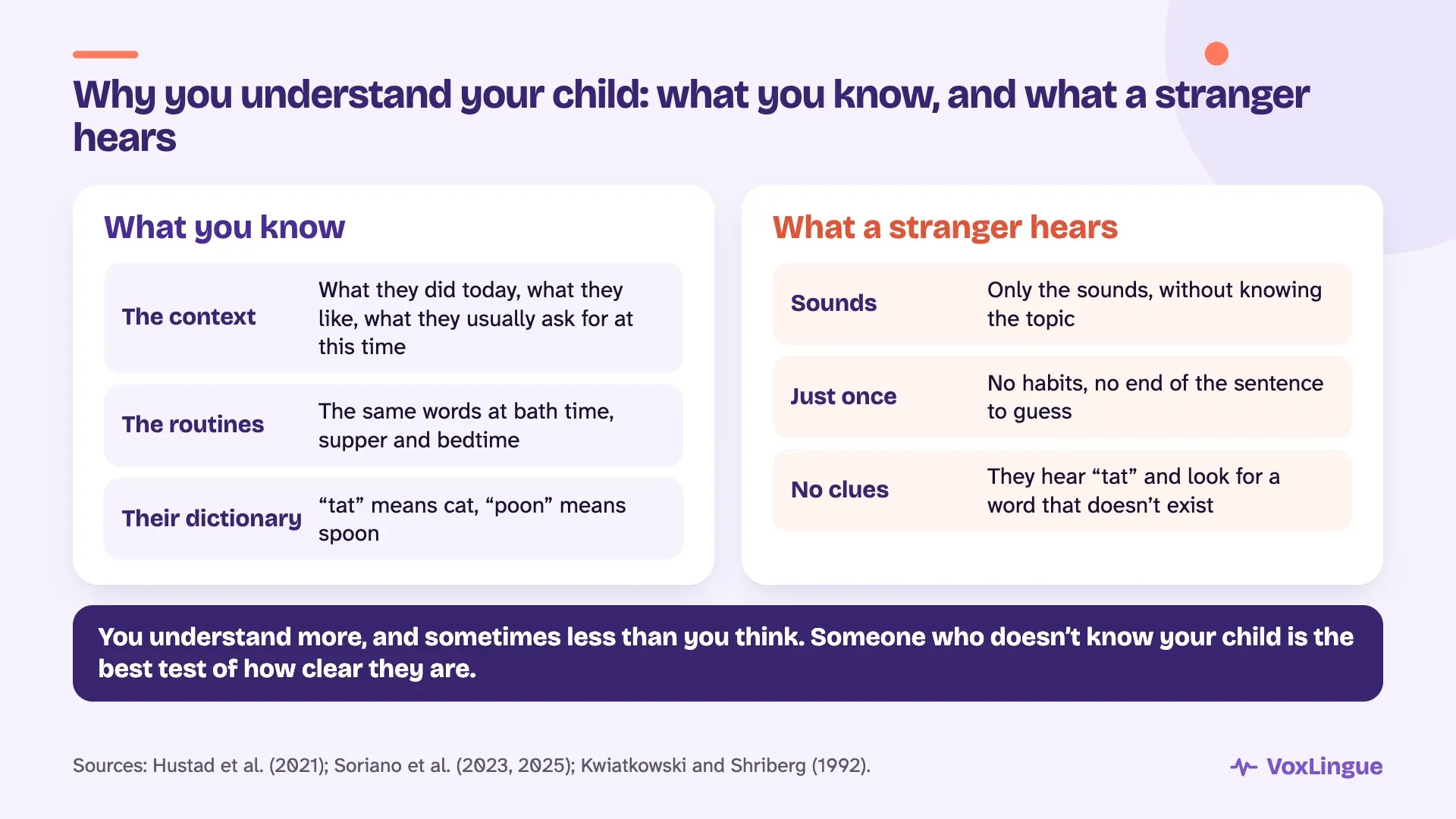
You know the context, the routines and the words your child uses, and you have learned their way of saying things without even trying: to you, “tat” means cat. Someone who doesn’t know them hears only sounds, once, with no clues. So you understand more, and sometimes less than you think.
You understand your child because you have clues that others don’t. It isn’t your imagination: it’s a real listening skill, built day after day.
The first clue is context. You know what they did at daycare, what they like and what they usually ask for at this time of day. When they say “poon” at the supper table, you don’t even need to listen to the sounds: you know they want a spoon.
The second clue is routines. The same words come back at bath time, at dinner and at bedtime. You have heard them hundreds of times, almost in the same order. Often, you guess the end of a sentence before your child finishes it.
The secret parent dictionary
The third clue is the quietest. Without realizing it, you have learned your child’s own ways of simplifying words. You know that “tat” means cat, that “wabbit” means rabbit and that “poon” means spoon. Your brain translates automatically. Someone who doesn’t know your child hears “tat” and searches for a word that isn’t there.
Many parents also finish their child’s sentences, or answer before the child is done, without thinking about it. It’s a well-meant reflex, and it partly explains why a sentence works at home and less so elsewhere.
Research confirms this gap. In the largest study on the topic, adults listened to children they didn’t know, once and with no context at all. The researchers point out that their results are a floor: in real life, knowing the child, the topic or the situation helps people understand more (Hustad and colleagues, 2021).
Parents see the difference themselves. Asked who understands their child, they give themselves the highest rating and strangers the lowest, at every age from 2 and a half to almost 10 (Soriano and colleagues, 2023). Most say strangers “always” understand their child only around age 6.
There is a flip side. Because you fill in the gaps without thinking, you sometimes believe you understood when your child meant something else. In a study of children with a speech delay, parents thought they understood about four words in five. In fact, they understood about three in four (Kwiatkowski and Shriberg, 1992).
In other words, your impression and what a stranger really understands are two different things, only loosely linked (Soriano and colleagues, 2025). That’s why the view of a daycare educator or a grandparent is valuable. It doesn’t replace yours: it completes it.
One word or a long sentence?
You might think a single word is always easier to understand. It isn’t that simple. In a short sentence, the other words give clues, and strangers often understand better than with a word on its own (Hustad and colleagues, 2021). But when your child talks fast, in long sentences, the sounds run together and clarity drops (Mahr and colleagues, 2025).
So if your child gets harder to follow when they get excited or tell a long story, that’s expected. For a fair picture, listen to them in an ordinary conversation, not only when they name pictures.
How much should others understand at each age?
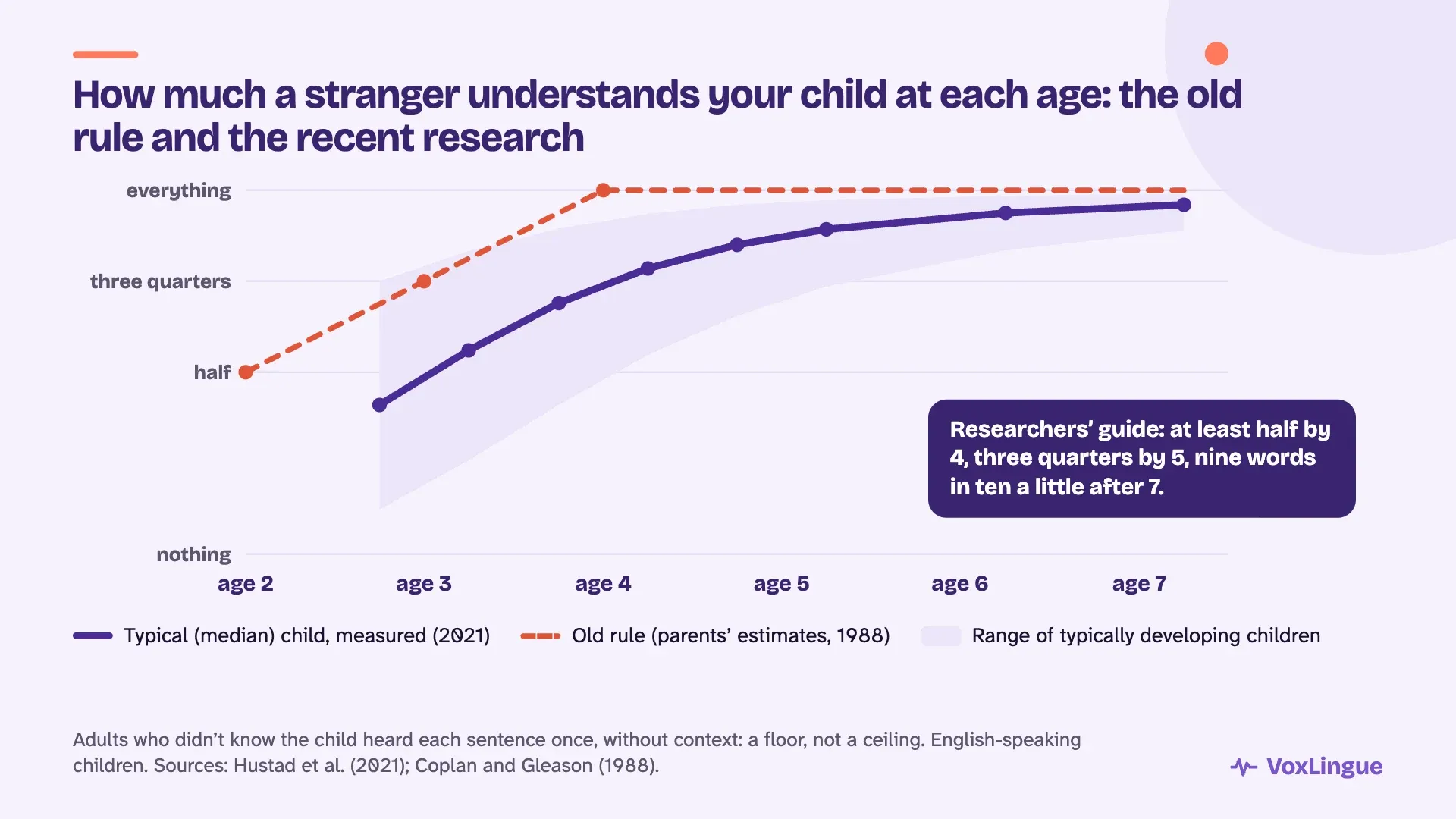
According to the largest recent study, strangers understand about half of a child’s sentences a little before age 3, three quarters around 4 and nine words in ten around 5. Children vary a lot. The researchers’ guidepost: at least half by age 4, and at least three quarters by 5.
In this study, more than a thousand adults listened to 538 children aged 2 and a half to almost 10, all developing typically. Each adult heard each sentence only once, then wrote down what they understood (Hustad and colleagues, 2021). The table sums up the results. It is not a test: it gives an order of magnitude.
| Child’s age | What a stranger understands, “average” child | What is still within the typical range |
|---|---|---|
| 2 and a half to 3 | A little less than half | From about one word in ten to three quarters |
| 3 to 3 and a half | A little more than half | From about a quarter to four words in five |
| 4 to 4 and a half | About four words in five | From a little over half to more than nine words in ten |
| 5 to 5 and a half | About nine words in ten | From about three quarters to almost everything |
| 7 to 7 and a half | Almost everything | From nine words in ten to almost everything |
Source: Hustad and colleagues (2021), English-speaking children in the United States, sentences heard once and with no context.
Children vary a lot: at 3, a stranger may understand a quarter of what one child says and four words in five from another, and both are developing typically. Clarity also keeps improving until about age 9 in many children.
From this, the researchers draw a threshold rather than an average: at least half by age 4, at least three quarters by 5, and about nine words in ten a little after 7. That threshold is what matters when deciding whether to consult.
One caution: these figures come from English-speaking children in one American region. No such curves exist yet for children in Québec, whether they speak French, English or both. Some sounds also come in late: r and th in English, and ch, j and s in Québec French, which some children master after age 4 and a half (MacLeod and colleagues, 2011).
Our article on the common patterns children use to simplify words, like “tat” for “cat” explains these steps.
Where does the old “50%, 75%, 100%” rule come from?
This rule, repeated on many websites, says a child is understood half the time at 2, three quarters of the time at 3 and completely at 4. It comes from a 1988 study (Coplan and Gleason). That study didn’t measure what strangers understood: it asked parents to estimate it. The “quarter rule”, which turns a child’s age into a percentage, is a memory aid, not a measurement.
Measured directly, each step comes about a year later (Hustad and colleagues, 2021). With the old rule, a parent may worry too early about a 3-year-old. They may also feel falsely reassured at 4 or 5, by comparing their child with the wrong guidepost.
Who understands your child? A simple check at home
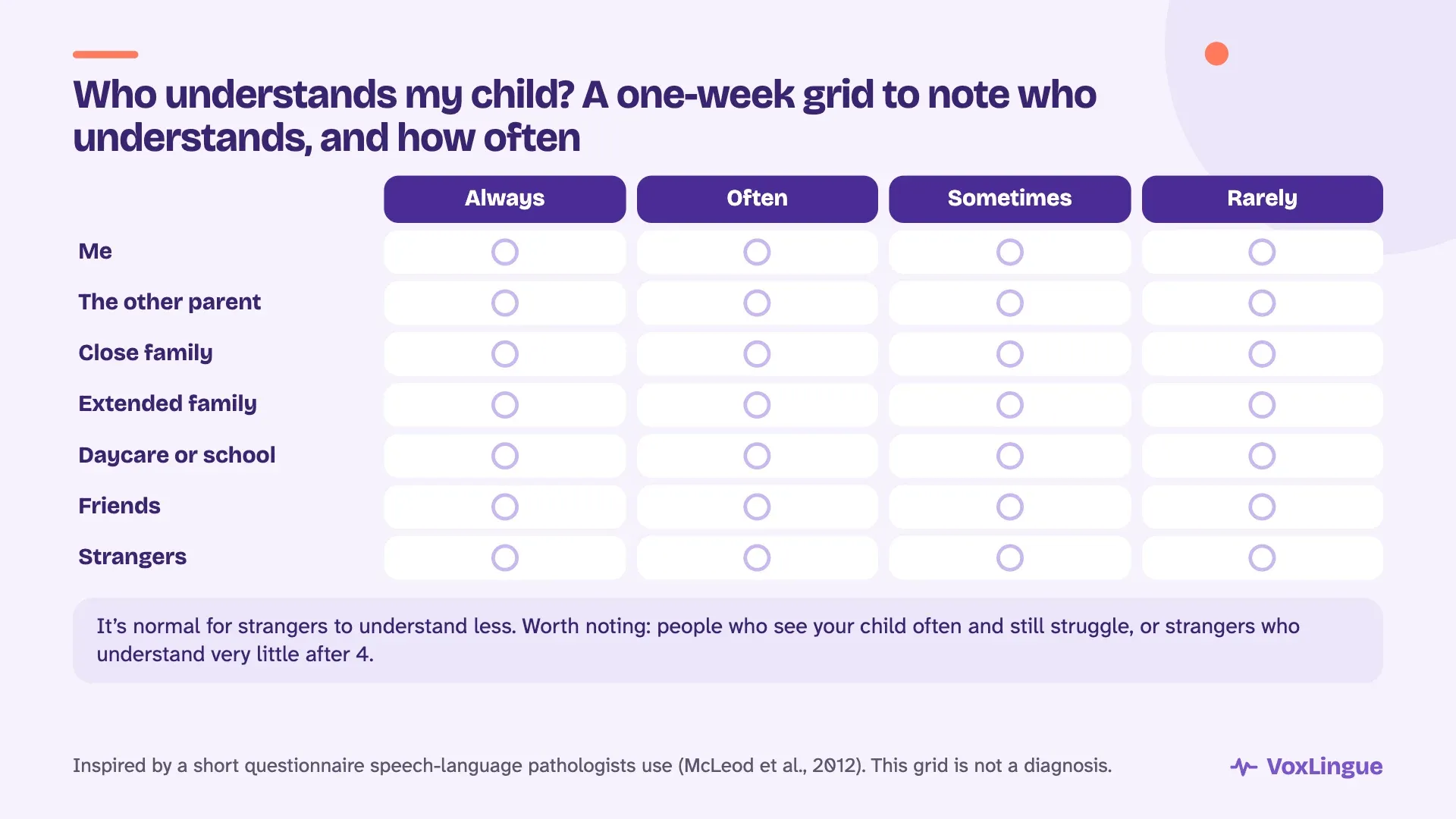
Ask yourself who understands your child: you, close family, extended family, daycare, friends, strangers. Speech-language pathologists use a similar questionnaire. It’s normal for strangers to understand less. What deserves attention: people who see your child often and still struggle, or strangers who understand very little after age 4.
The idea comes from a short questionnaire for parents that speech-language pathologists use (McLeod and colleagues, 2012). For seven listeners, from parents to strangers, you note whether that person understands your child always, often, sometimes, rarely or never.
You can do the same for a week. Note how each person who talks with your child reacts: do they understand the first time, ask your child to repeat, or turn to you? Also ask the daycare educator: “Do you understand them most of the time?” They hear your child every day without you.
Expect a slope: you understand the most, then family, then daycare, then strangers. This slope shows up at every age, in children developing typically (Soriano and colleagues, 2023). Bring your notes if you ask for an assessment: the overall picture helps the speech-language pathologist.
Bilingual children: understood in one language, not the other?
Speaking two languages doesn’t make a child less clear over time. Their errors can differ from one language to the other, though, and each language has its own late sounds. A listener who learned a language later in life may also find a young child’s unclear speech harder to understand.
Studies are limited, but a review of sixty-six studies found no clear sign that bilingual children become clear more slowly; their errors are rather different and more varied (Hambly and colleagues, 2013). In a large Australian study, parents of bilingual children didn’t report them as less well understood (McLeod and colleagues, 2015).
In Montréal, and in many Ontario communities, who is listening matters a lot. A child may speak French at daycare, English or another language at home, and see grandparents who learned English or French as adults. A listener who learned a language later understands unclear child speech less well (Lagerberg and colleagues, 2019).
So a child may seem clearer in one language than in the other. The speech-language pathologist looks at all of the child’s languages: according to the ASHA Practice Portal on speech sound disorders, a pattern that comes from another language the child uses is not a disorder. Our guide to bilingual language milestones gives guideposts by age.
Above all, keep speaking your language at home. According to the Canadian Paediatric Society, learning two languages doesn’t cause a delay, and doesn’t make an existing delay worse (2026).
How to help your child be understood at home
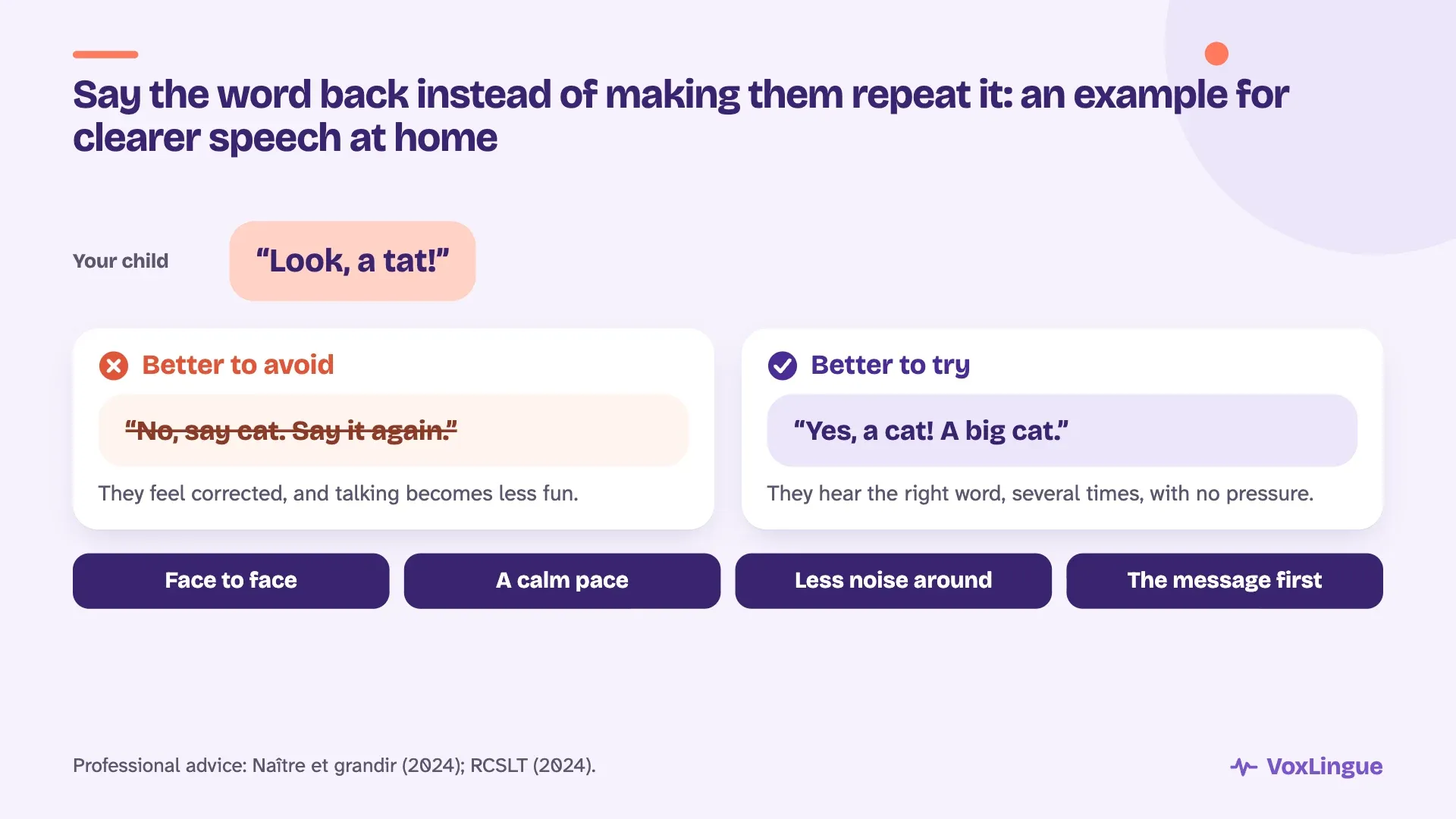
Say the word back correctly instead of asking your child to repeat it. Talk face to face, at a calm pace, in moments without background noise. Read books full of the tricky sound. And respond first to what your child is telling you: the message matters, not the pronunciation.
The most important tip: say it back, don’t make them repeat. Québec’s Naître et grandir (2024) and the UK’s Royal College of Speech and Language Therapists (2024) agree on this. If your child says “Look, a tat!”, answer “Yes, a cat! A big cat.” Stress the sound a little, without asking them to say it again.
Speech-language pathologists often recommend a few simple habits, with no special materials:
- talk face to face, at their level, so they can see your mouth;
- slow your own pace a little, without asking them to slow down;
- save real conversations for calm moments, without TV or background music;
- read books and sing songs full of the sound they find hard: a “sound bath”, inspired by a speech therapy technique (ASHA);
- respond to the message first (“Oh yes, you want to play outside!”) and praise their effort, not their pronunciation.
A few traps are worth avoiding. Making your child repeat a word until it’s perfect turns the conversation into a drill. Copying their errors for fun can hurt them. Naître et grandir also advises against pointing out that they said a word wrong (2024). Your role isn’t to be their therapist: it’s to stay a partner who makes them want to talk.
When you don’t understand: what to say
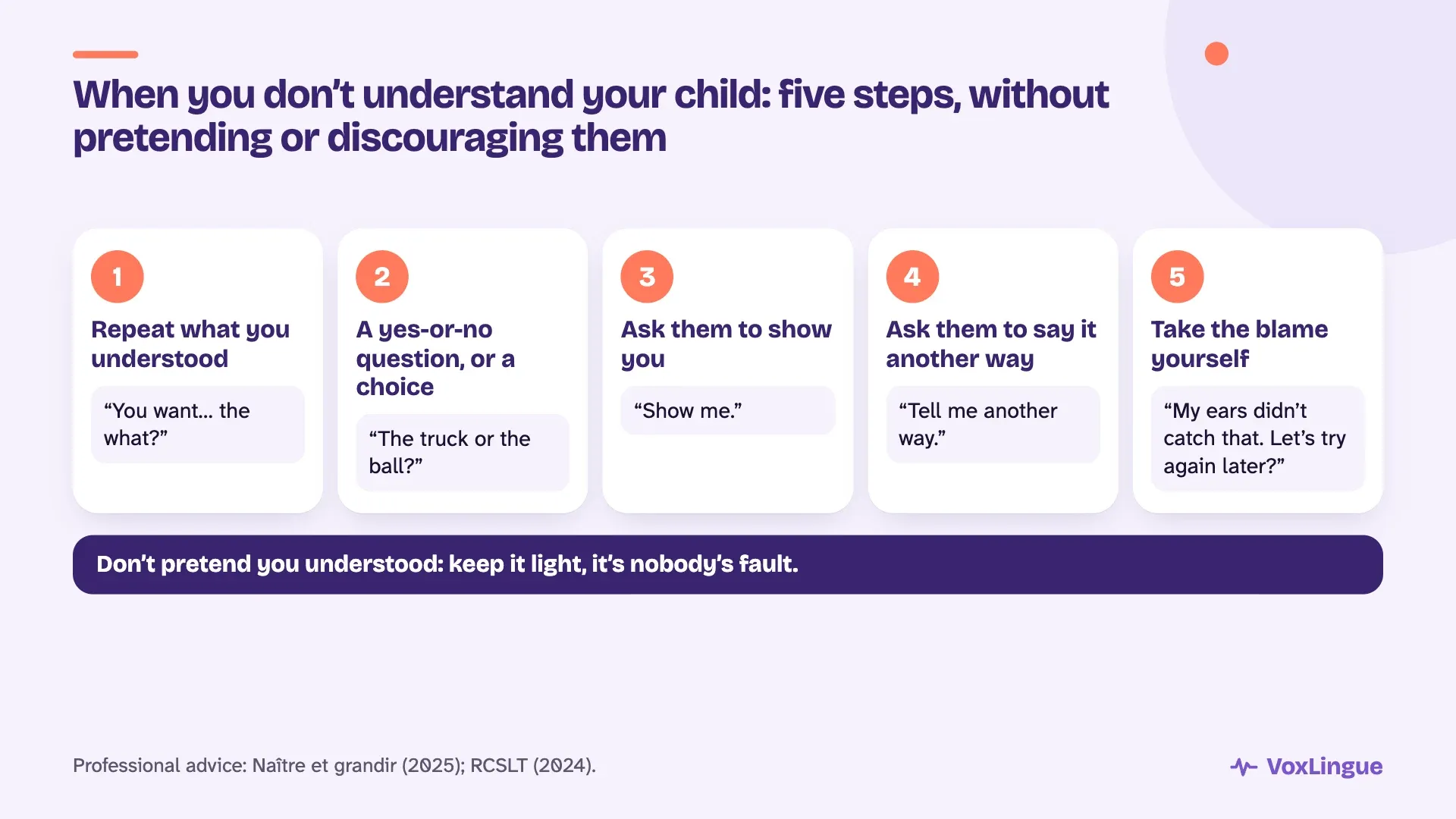
Don’t pretend you understood. Repeat the part you caught, ask a question they can answer with yes or no, or ask them to show you. If that doesn’t work, tell them kindly that you’ll try again later. Keep the tone light: it’s nobody’s fault.
Pretending is tempting, especially when you’re in a hurry. But according to Naître et grandir, if you pretend to understand, your child could lose confidence in you. Its parent sheet on understanding what your child says suggests simple strategies instead (2025).
Here is one way to go about it, in order, when the message isn’t getting through:
- Repeat what you understood: “You want… the what?”
- Ask a question they can answer with yes or no, or offer a choice: “The truck or the ball?”
- Ask them to show you: “Show me.”
- Invite them to say it another way: “Tell me another way.”
- If nothing works, take the blame yourself: “My ears didn’t catch that. Let’s try again later?”
The first two steps come from that Naître et grandir sheet; the idea of offering a choice comes from the Royal College of Speech and Language Therapists (2024). Keep a calm tone and encourage your child’s efforts.
Many parents see an older brother or sister translate for the younger one. That can help in a pinch. Still, let your child try first, then thank the translator.
Share your tips with the daycare educator and the grandparents, too: your child’s own words, like “poon” for spoon, and their routines. They will understand your child better.
When to consult, and where?
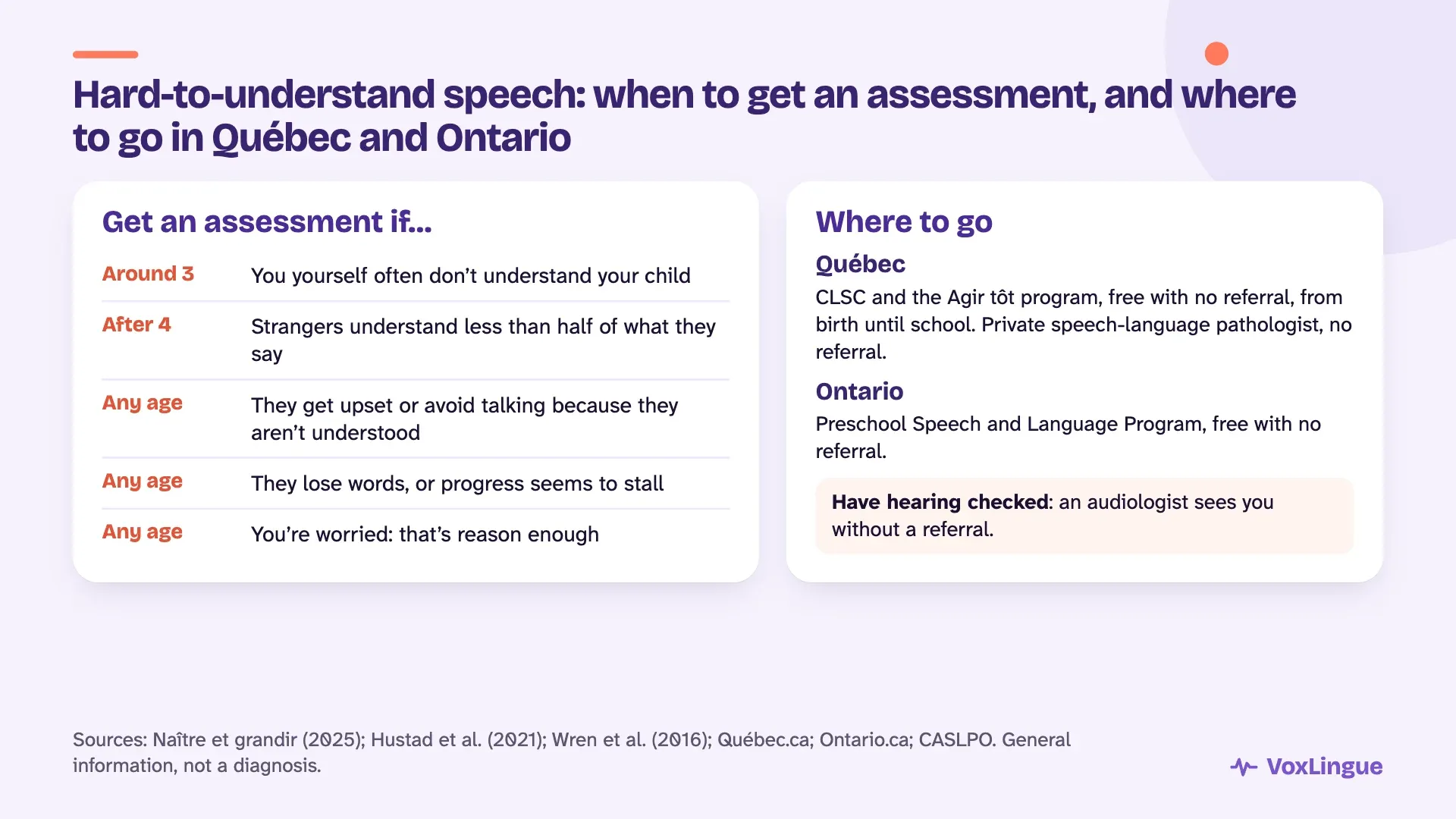
Consult if, around age 3, you often don’t understand your child, if strangers understand very little after 4, or if your child gets upset or avoids talking because people don’t understand. Consult whenever you’re worried, too. Have their hearing checked. In Québec and Ontario, you don’t need a referral.
Being hard for strangers to understand around age 3 is one of the early signs most linked to speech difficulties that persist into school (Wren and colleagues, 2016). It isn’t a diagnosis, but it’s a good reason to ask a speech-language pathologist’s opinion.
Here are the signs that call for an assessment, whatever the charts say:
| Around what age | What you notice |
|---|---|
| Around 3 | You yourself regularly don’t understand them (Naître et grandir, 2025) |
| After 4 | Strangers understand less than half of what they say (Hustad and colleagues, 2021) |
| At any age | They get upset, give up or avoid talking because people don’t understand them |
| At any age | They say very few words for their age, or they lose words they used to say |
| At any age | Their progress seems to have stalled, or others make fun of the way they talk |
Québec’s order of speech-language pathologists and audiologists (OOAQ) also lists, among the reasons to consult, a child who has tantrums when they aren’t understood. When in doubt, it’s better to ask early than late.
Have their hearing checked, too. Unclear speech is a good reason to see an audiologist, and you don’t need a referral. In Ontario, CASLPO lists unclear speech among the reasons to see an audiologist. Repeated ear infections alone don’t seem to cause a speech disorder: what matters is how well your child hears (Roberts and colleagues, 2004).
In Québec, several doors are open. Your CLSC can guide you, and the free Agir tôt program is for children from birth until they start school, with no referral needed. You can also go directly to a private speech-language pathologist or audiologist, with no doctor’s referral.
In Ontario, the Preschool Speech and Language Program is free and accepts families without a doctor’s referral, from birth until a child starts school. You can also see a private speech-language pathologist without a referral.
A speech-language assessment tells you whether your child’s errors are expected for their age, and what would help. If follow-up is useful, it often takes the form of speech sound therapy, with activities to do at home.
What to remember
You understand your child because you know them, and that is a strength, not a mistake. You have learned their words, their routines and their way of saying things. But the best test of how clearly your child speaks is a person who doesn’t know them at all.
Recent guideposts are more generous than the old chart: a stranger understands about half of a child’s sentences a little before age 3, and three quarters around 4. At home, say words back instead of making your child repeat them, and never pretend you understood. If you have doubts, an assessment will give you a clear answer.
Next step
This week, note who understands your child, using the printable sheet “Who understands my child? A one-week check, and what to say when you don’t understand”. If it worries you, our speech-language pathologists can assess your child at our Montréal clinic or by telepractice across Québec and Ontario. To learn more, explore our articles on speech sounds.
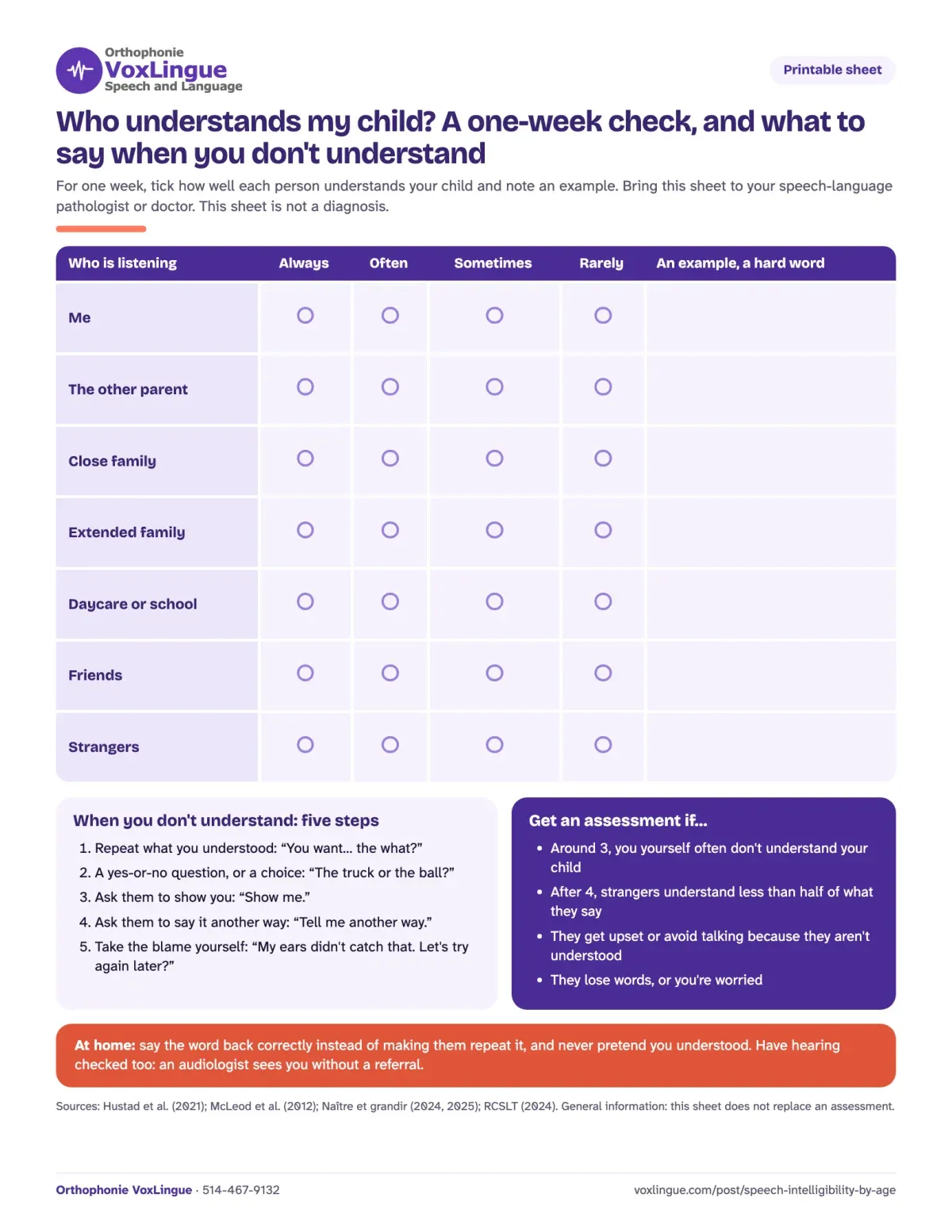
Printable sheet: Who understands my child? A one-week check, and what to say when you don’t understand (PDF).
Frequently asked questions
My 3-year-old is hard to understand: is that normal?
For strangers, often yes. At 3, a stranger understands on average a little more than half of what a child says, and children vary a lot (Hustad and colleagues, 2021). But if you yourself regularly don’t understand your child at this age, talk to a speech-language pathologist or your doctor.
At what age should a child be understood by everyone?
Around 5, a stranger understands on average about nine words in ten. Clarity then keeps improving, until about age 9 in many children (Hustad and colleagues, 2021). Most parents say strangers “always” understand their child only around age 6 (Soriano and colleagues, 2023).
Should I make my child repeat a word they said wrong?
No. Say the word back correctly instead, in a natural sentence, stressing the tricky sound a little: “Yes, a cat!” Asking them to repeat turns the exchange into a drill and can discourage them. Naître et grandir and the Royal College of Speech and Language Therapists give the same advice (2024).
Should I pretend to understand?
No. Say what you understood, ask a question they can answer with yes or no, or ask them to show you. If nothing works, offer to try again later. According to Naître et grandir, a child who senses you’re pretending could lose confidence (2025).
Their sister translates for them: is that a problem?
Not necessarily. A brother or sister who translates can help, and often does it out of kindness. Still, let your child try first, with the strategies above. If they always rely on someone else to speak for them, they get fewer chances to make themselves understood. Thank the translator, then give the floor back to the younger child.
They’re clear in single words but not in sentences: why?
Long sentences said fast are harder to follow, because the sounds run together (Mahr and colleagues, 2025). Short sentences, on the other hand, often help the listener, because the other words give clues (Hustad and colleagues, 2021). If people mostly lose your child when they get excited, that’s expected.
They talk fast and no one can follow: what can I do?
Slow your own pace, without asking them to slow down: you model a calmer rhythm. Long sentences said fast are harder to understand (Mahr and colleagues, 2025). Keep your own sentences short when your child is searching for words, and give them time to finish. If they’re very hard to understand even when calm, ask a speech-language pathologist.
Can ear infections make speech less clear?
On their own, they don’t seem to. An analysis of fourteen studies found no link, or a very weak one, between ear infections and children’s later speech (Roberts and colleagues, 2004). What matters is hearing: have it checked by an audiologist if your child’s speech is unclear.
Does speaking two languages make my child harder to understand?
Not over time. Bilingual children don’t become clear more slowly, but their errors can differ from one language to the other (Hambly and colleagues, 2013). Your child may seem clearer in one language than in the other. Keep speaking your language with them: two languages don’t cause a delay.
My child has an accent, or sounds like our family: is that a speech error?
No. According to ASHA, we all speak with an accent and use one or more dialects, and someone can have a noticeable accent and still be understood. A child who sounds like the adults around them, in English, French or a home language, is simply copying them. A speech-language pathologist looks for a disorder only in patterns that don’t match the languages and dialects your child hears.
Do I need a referral to see a speech-language pathologist?
No. In Québec, you can see a private speech-language pathologist or audiologist without a doctor’s referral. The Agir tôt program, offered through CLSCs, is free and doesn’t require a referral either. In Ontario, the Preschool Speech and Language Program also accepts families without a referral.
Will my child grow out of it?
Many errors fade with age, and clarity improves until about age 9. But no one can predict in advance which child will catch up on their own. Being hard for strangers to understand around age 3 deserves a professional opinion (Wren and colleagues, 2016). At 4, about three children in a hundred have a speech sound disorder (Eadie and colleagues, 2015).