
Montréal-Nord · CLSC de Montréal-Nord · Pointe-de-l'Île and English Montreal schools
Speech therapy in Montréal-Nord: you don't have to choose between the CLSC and a private clinic, how to start both at the same time for your child's speech and language
In the CLSC de Montréal-Nord territory, young children make up a larger share of the population than anywhere else in Montréal. If your child's speech or language worries you, you don't have to choose between the CLSC and a private clinic. You can contact the CLSC's early stimulation service and book with us at the same time, at our Marché Central clinic or online.
Montréal-Nord has many young children: what does that mean for your family?
Young children make up a larger share of Montréal-Nord than of the rest of the island. In the CLSC de Montréal-Nord territory, 6.8% of residents are children under 5, compared with 4.9% across Montréal. Many families are wondering about a young child’s language at the same time, and the CLSC itself runs an early stimulation service.
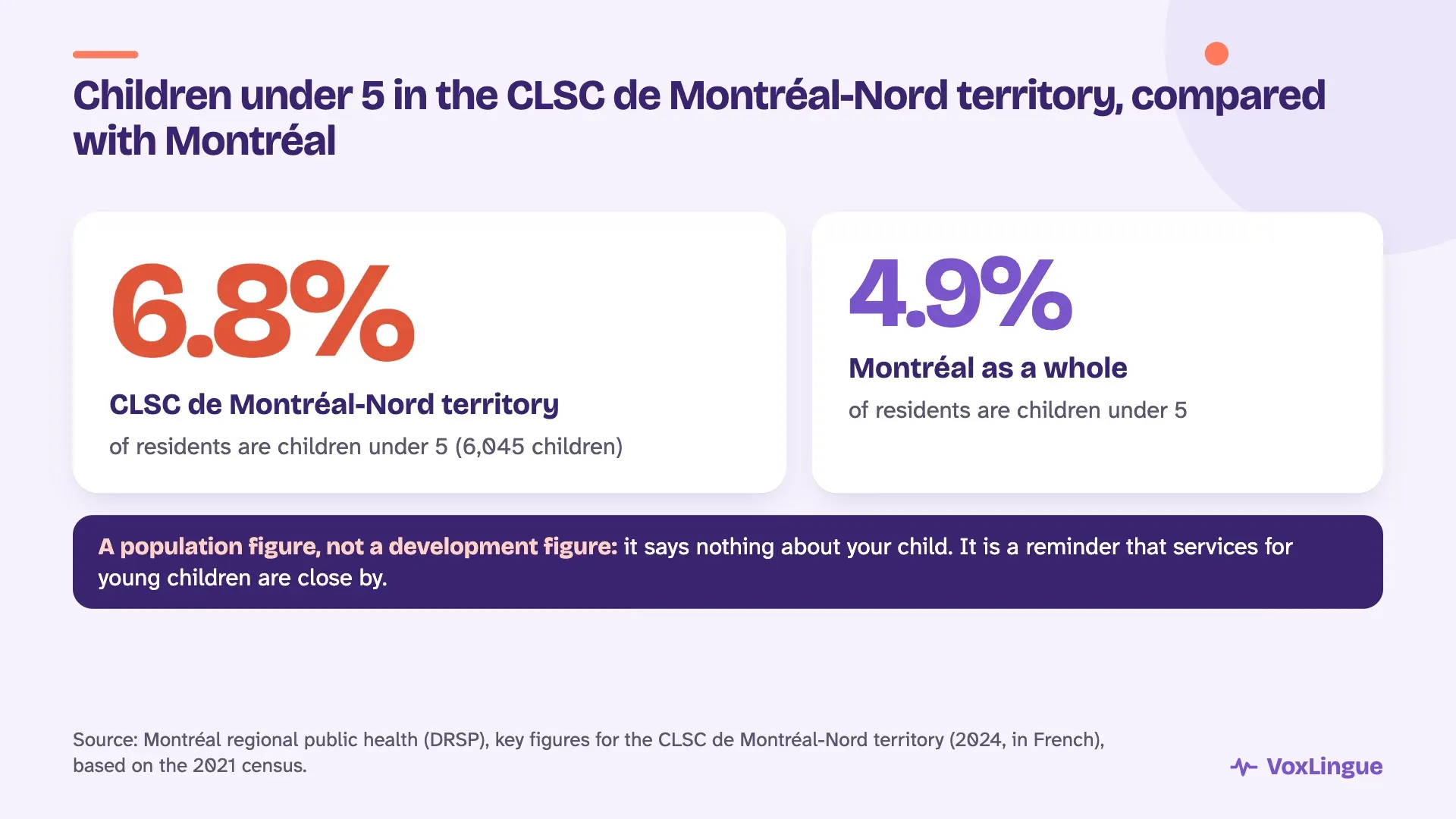
The figure comes from the key figures for the CLSC de Montréal-Nord territory (in French) published by Montréal’s regional public health department, based on the 2021 census. It is the highest share of any CLSC territory in Montréal. It says nothing about any one child’s development. It simply means that services for young families are close at hand in Montreal North, and that asking questions early is normal.
When parents are worried, they often think they have to choose: wait for the CLSC or pay for a private clinic. In Montréal-Nord, as everywhere in Québec, both routes can move forward together. The CLSC de Montréal-Nord offers free early stimulation through Agir tôt. A private speech-language pathologist can see you without a referral, at our Marché Central clinic or online. Schools, family organisations and local libraries fill in the rest.
This page follows the order of the steps: the CLSC and private care, then school, home languages, getting to us and a first week. For a wider view, see our guides to starting speech therapy in Montréal.
Can we apply to the CLSC de Montréal-Nord and start privately at the same time?
Yes, and many families do. You can contact the CLSC de Montréal-Nord’s early stimulation service and see a private speech-language pathologist in the same week. The CLSC is free and you keep your place on its list. A private clinic needs no referral. With your permission, we send our report to the CLSC team.
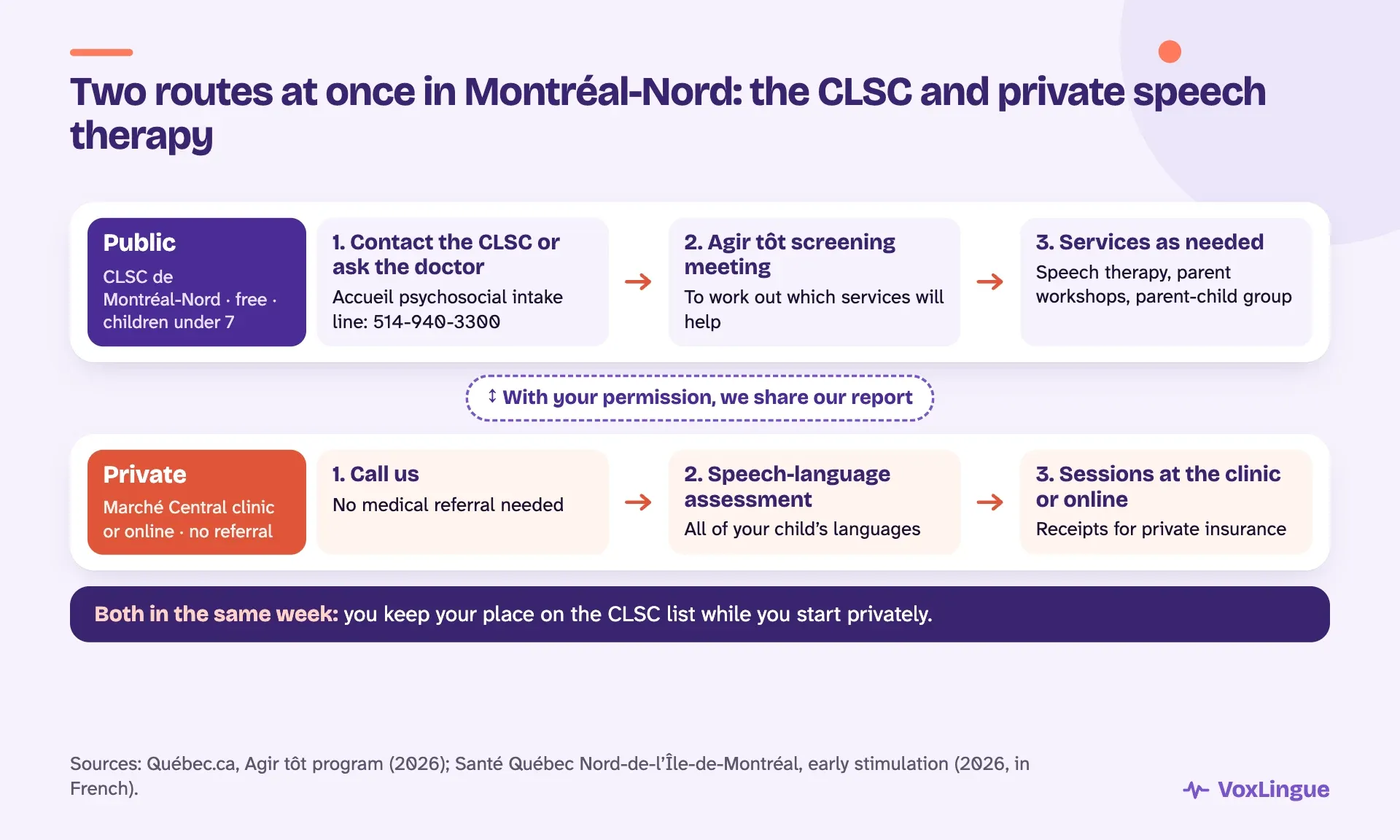
The two routes do different jobs. The CLSC opens the door to a public team that can bring several professionals together around your child. A private clinic gives you an appointment you book yourself, a detailed assessment and regular sessions. Neither one requires you to give up the other.
Early stimulation (Agir tôt) at the CLSC de Montréal-Nord: who it is for and how to ask
Agir tôt is Québec’s free and voluntary program for children under 7 and their families, from birth until school entry. According to Québec.ca, it aims to spot signs of developmental difficulties early and refer children to the right services quickly. To get started, contact the CLSC or ask the doctor.
At the CLSC de Montréal-Nord, the program takes the form of the early stimulation service of Santé Québec Nord-de-l’Île-de-Montréal (in French). It is for young children who show signs of developmental difficulties, for example in language. It includes a screening meeting, parent workshops and a parent-child group. Depending on needs, a child may also receive speech therapy, special education, occupational therapy, physiotherapy or psychoeducation.
To apply, talk to your doctor, a CLSC nurse or another health professional. You can also call the Accueil psychosocial, the CLSC’s intake line, at 514-940-3300, or go to the CLSC de Montréal-Nord at 11441 boulevard Lacordaire. The CLSC also offers stimulation workshops for babies 0 to 6 months, by appointment. Services are mainly in French.
Private care: no referral, while you keep your place
A private speech-language pathologist needs no medical referral: you can call us directly. An assessment can start while your child stays registered with the CLSC. It describes how your child understands, expresses themselves and communicates, and ends with recommendations. To see how it works, read the steps of a speech-language assessment or see a speech-language assessment at VoxLingue.
Our speech-language pathologists are members of the Ordre des orthophonistes et audiologistes du Québec. We provide receipts for private insurance, and our article on paying for private speech therapy: insurance and receipts covers reimbursement. If your child is already on a list, see what happens on the waiting list and what to do in the meantime.
What the two teams share, with your consent
With your permission, we can send our report to the CLSC or the school. Each team then decides on next steps under its own criteria. A private report does not replace a public team’s own assessment, but it gives them a recent description of your child.
You remain the link between the teams. Keep a copy of every report, note the dates of meetings and tell each team who else sees your child. That small file saves you from telling the whole story again at every appointment.
The kindergarten teacher is worried about your child’s French: who do you talk to at school in Montréal-Nord?
Start with your child’s school team. In Montréal-Nord, the French schools belong to the Centre de services scolaire de la Pointe-de-l’Île, and the English elementary school, Gerald McShane, to the English Montreal School Board. Ask what the teacher has noticed, tell them which languages your child hears at home and ask how the school’s speech-language pathologist can observe your child.
Gerald McShane, on boulevard Maurice-Duplessis, takes children eligible for English instruction from Pre-K 4 to Grade 6. If your child is there, ask the school team about its student support and speech-language services. The Pointe-de-l’Île service centre serves Montréal-Nord, Anjou, Montréal-Est, Pointe-aux-Trembles, Rivière-des-Prairies and Saint-Léonard. In both networks, access to school speech therapy goes through the school team, under its criteria.
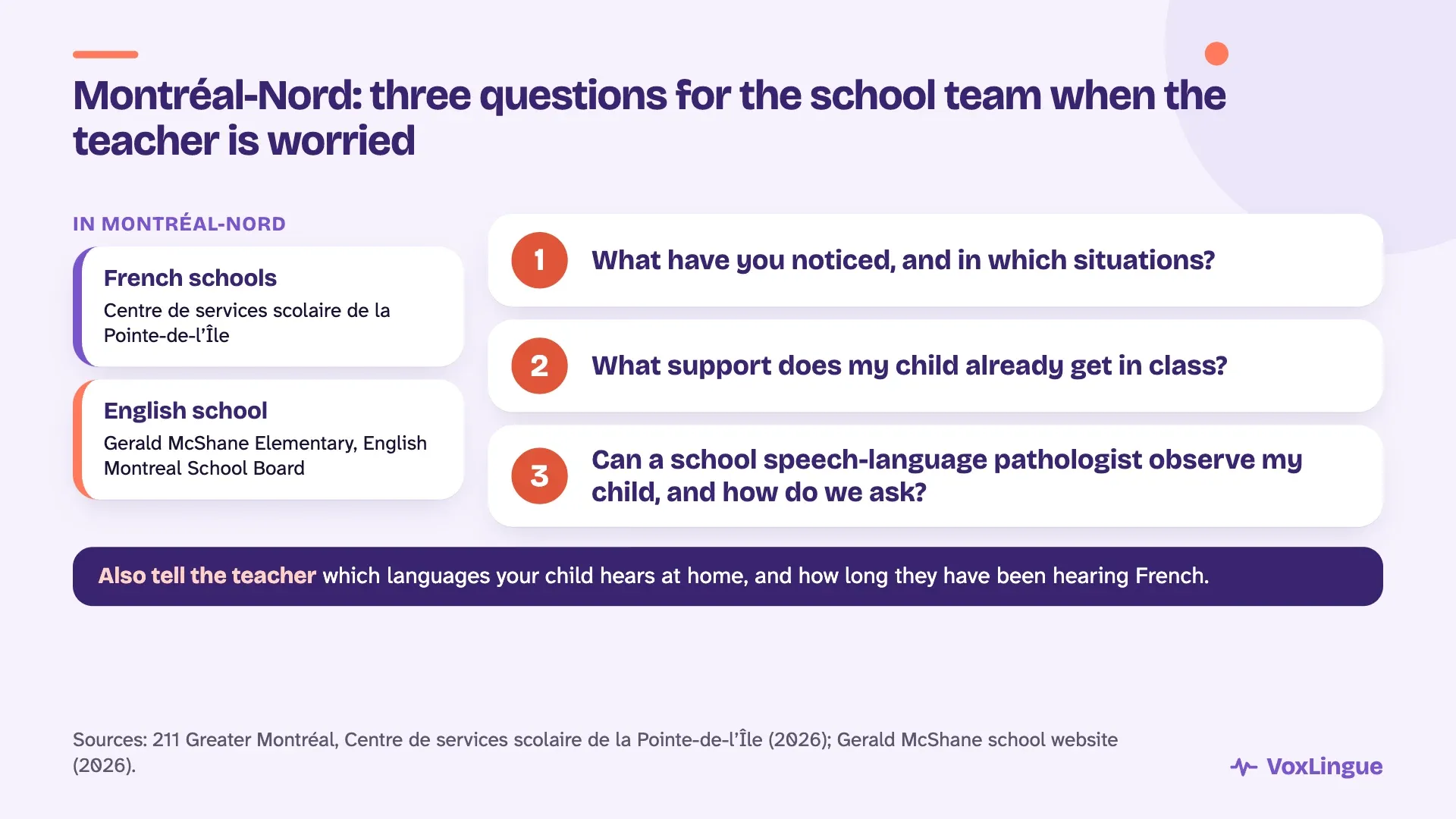
A meeting with the teacher takes only a few minutes to prepare. Three questions are often enough to start:
- What have you noticed, and in which situations?
- What support does my child already get in class?
- Can a school speech-language pathologist observe my child, and how do we ask?
Also tell the teacher which languages your child hears at home, and how long they have been hearing French. A child who has just started learning French may need time. A child who struggles in every language would benefit from an assessment. Only a look at all of their languages can tell the two apart, as the next section explains.
If your child is not in school yet, the first sign often comes from daycare. Our article on what to do when the daycare educator is worried suggests questions to ask. For the year before school starts, see language and kindergarten readiness. Until school entry, Agir tôt remains open to your child through the CLSC.
Your child hears another language at home: how does a speech-language pathologist assess all of their languages?
A speech-language pathologist looks at all of your child’s languages before drawing a conclusion. In Montréal-Nord, nearly one person in four speaks mainly a language other than French or English at home, and one in ten speaks more than one. Learning several languages does not cause language difficulties. What matters is how your child communicates in each one.
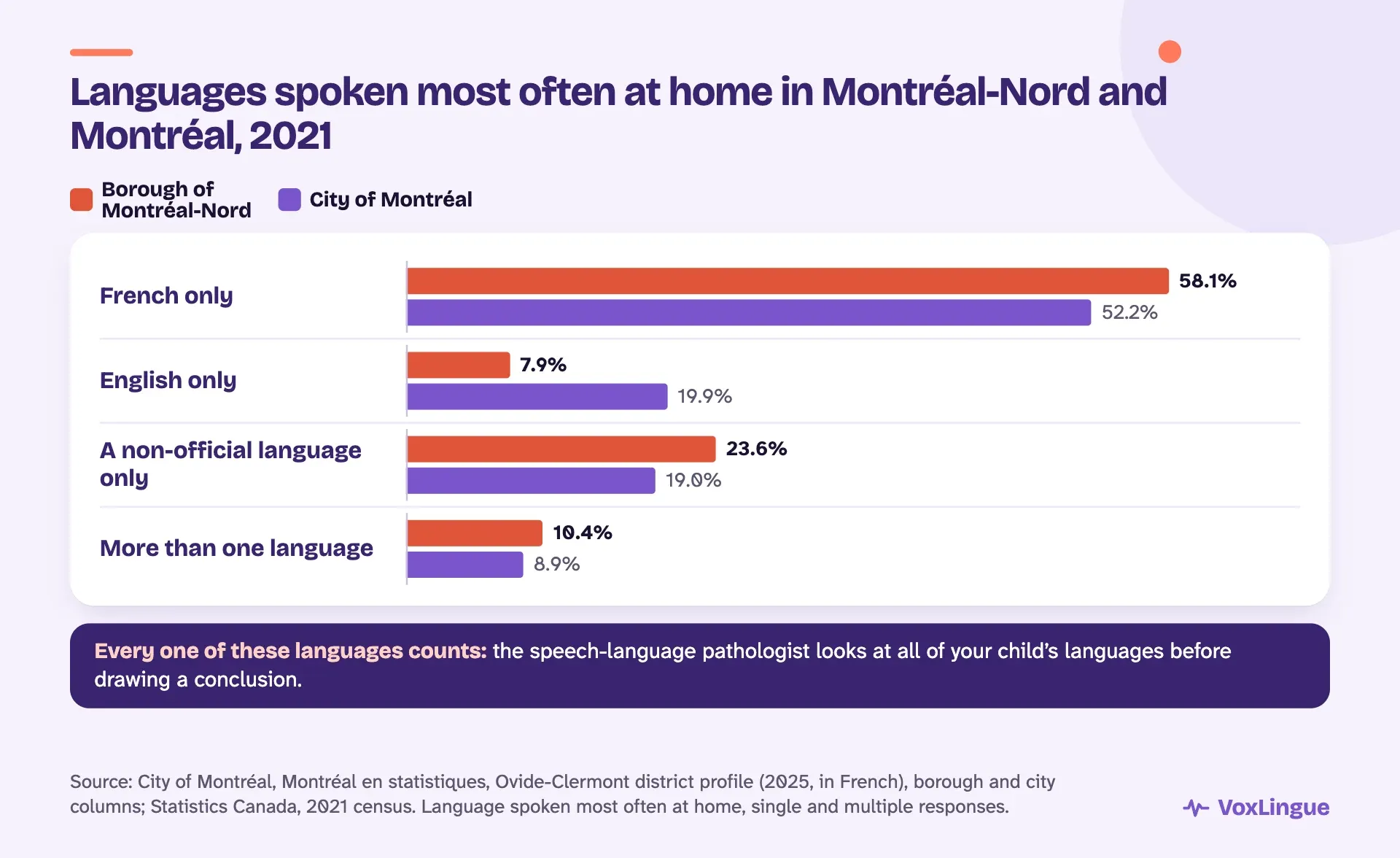
According to the City of Montréal district profile (in French, 2021 census), 58.1% of residents of the borough speak only French at home, 7.9% only English, 23.6% only a non-official language and 10.4% more than one language. The most common non-official languages are Haitian Creole (6.1%, six times the Montréal share), Spanish (5.4%), Arabic (4.3%) and Italian (2.6%).
In a child learning several languages, some patterns are often typical. They may mix two languages in one sentence. They may know a word in one language and not in the other. Their French may sound younger than a classmate’s who speaks only French. None of this is enough to conclude that there is a language difficulty.
That is why a speech-language pathologist does not compare your child with the norms of a single language. A guide from the CIUSSS de la Capitale-Nationale (in French, 2022) notes that those norms are not enough to conclude that a bilingual child has a disorder. We ask which languages your child hears, from whom and how much. We will never ask you to stop speaking your language at home.
Our speech-language pathologists work in English and French, and some also speak Spanish, Arabic, Greek, Portuguese or Armenian. Availability varies by language: ask when you call. None of our speech-language pathologists speaks Haitian Creole. We look at all of your child’s languages with your help and, when needed, an interpreter.
To go further, read identifying language disorders in bilingual children, bilingual language milestones from birth to 5 and speech therapy in your family’s languages.
From Montréal-Nord: come to the clinic or work online?
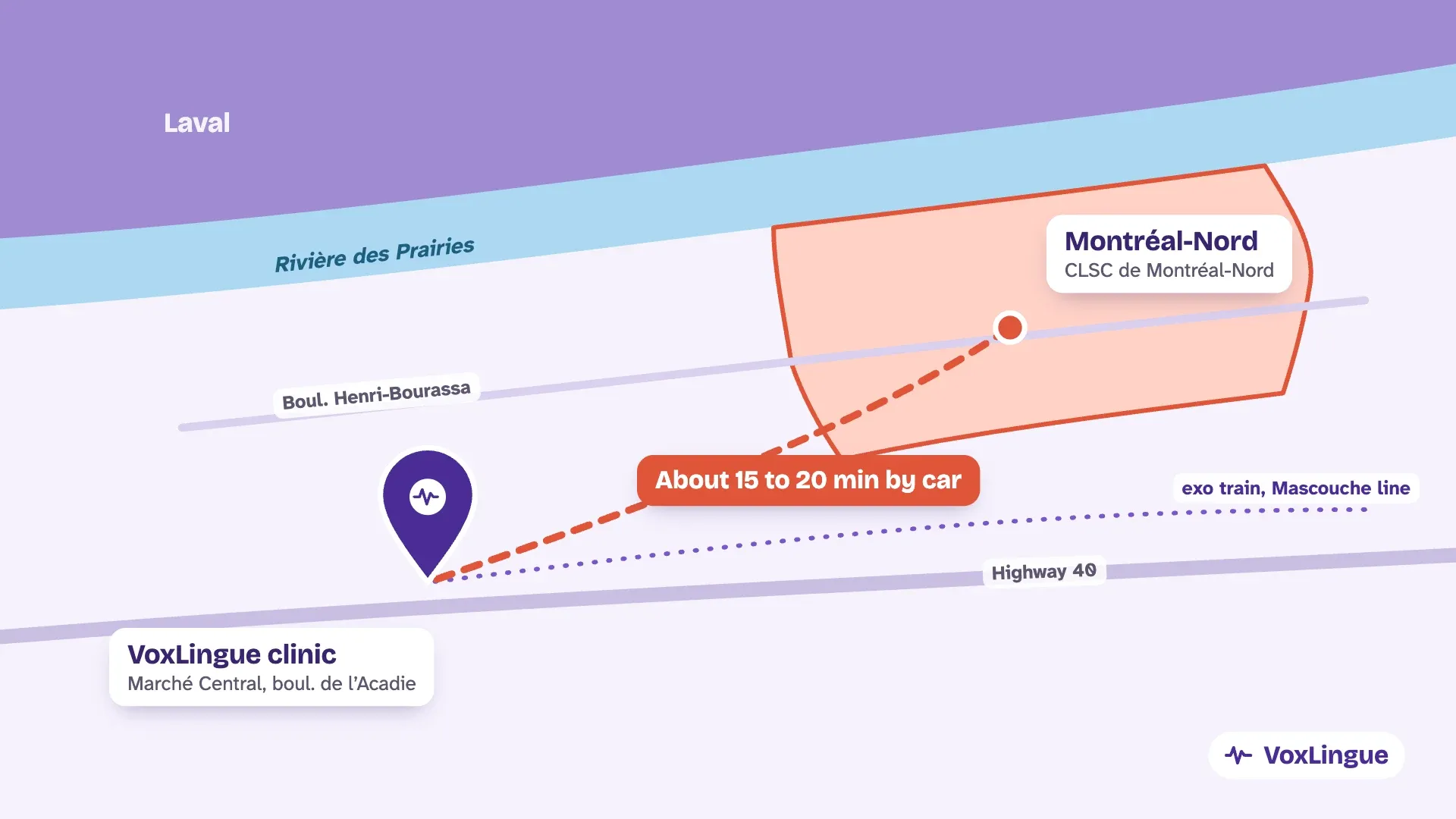
Choose based on your child and your week. Our Marché Central clinic is about 15 to 20 minutes away by car outside rush hour, or by exo train to Ahuntsic station, directly across the street. Online sessions save the trip, for example for parent coaching with a toddler or a session after school.
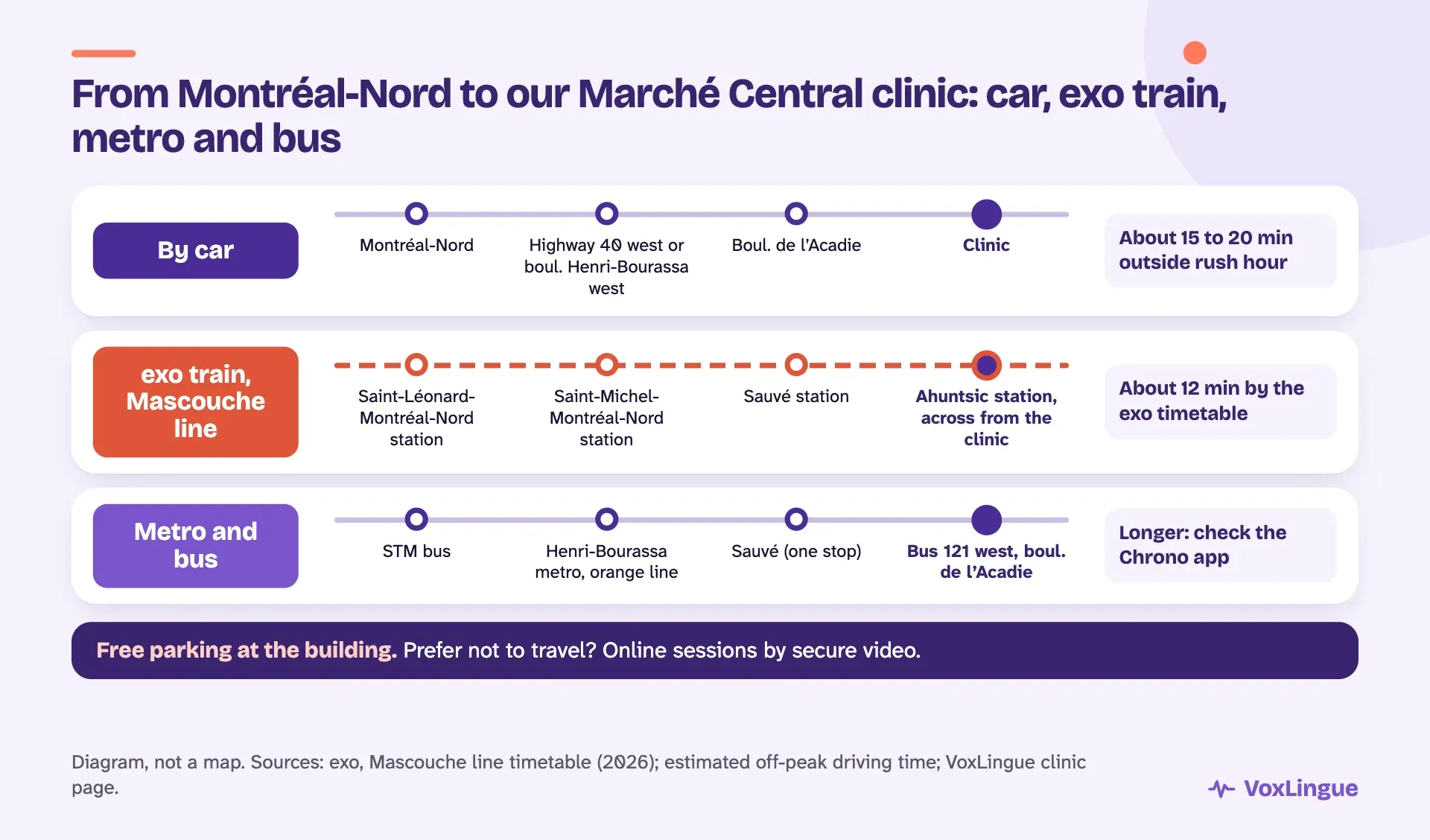
The clinic suits a child who needs hands-on work, and some parts of an assessment. It is easy to reach for families near Highway 40 or the Saint-Léonard-Montréal-Nord and Saint-Michel-Montréal-Nord train stations. According to the exo timetable, the train takes about 12 minutes from Saint-Léonard-Montréal-Nord to Ahuntsic. Parking, the entrance and hours are on our Montréal clinic page.
By metro and bus, the trip is longer than by car and depends on where you start: check it in the Chrono app. Online sessions by secure video suit many goals. With a toddler, the speech-language pathologist mostly coaches the parent during play: see online speech therapy with a toddler and online speech therapy across Québec. You can also mix clinic and online sessions.
Where do you start this week if your child’s language worries you?
Make two calls in the same week. The first to the CLSC de Montréal-Nord, or your doctor, for early stimulation. The second to a private speech-language pathologist, if you can. If your child is in school, talk to the school team too. In the meantime, keep talking, reading and playing with your child in your own language.
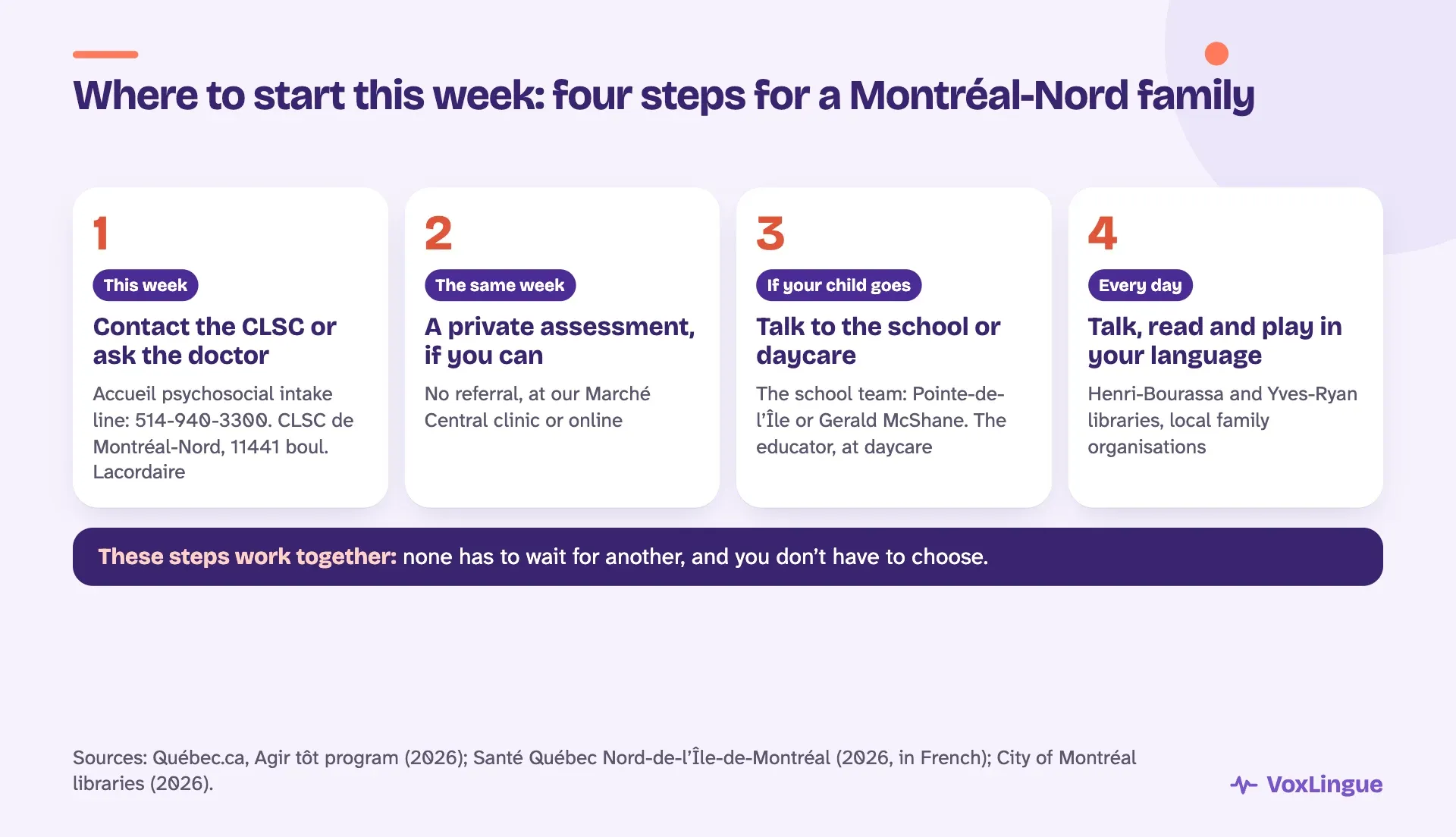
Here are those steps in order, with local resources:
- Contact the CLSC or ask the doctor: the Accueil psychosocial intake line answers at 514-940-3300.
- In the same week, if you can, call for a private assessment; our number is at the bottom of this page.
- If your child is in school or daycare, talk to the teacher or the educator.
- Meanwhile, talk, read and play with your child in your family’s language; the local libraries and family organisations listed below offer activities for young children.
These steps do not ask you to choose. They work together, and none has to wait for another. If you are looking for a speech therapist in Montréal-Nord, you can start this week, through the public system and privately at once.
What about an adult or an older relative in Montréal-Nord?
Yes, we also see adults. A sudden change in speech, language, voice or swallowing goes to the doctor first, or to 911 if there are signs of a stroke. After a stroke or an illness, speech therapy can take place at our clinic or online, with family involved when it helps.
For a health question that is not urgent, Info-Santé answers at 811. To learn more, see speech therapy for adults and our article on aphasia after a stroke, for families.
Public and community services for Montréal-Nord families
Private and public services work well together. Many families keep their place on a public waiting list while starting with us, and we share reports with your permission.
CLSC de Montréal-Nord
11441 boulevard Lacordaire, 514-384-2000, option 4. Part of Santé Québec Nord-de-l'Île-de-Montréal Universitaire. The CLSC offers early stimulation (Agir tôt), with speech therapy as needed: ask your doctor or call the Accueil psychosocial (intake line) at 514-940-3300. Page in French.
Agir tôt program
Québec's free, voluntary program for children under 7 and their families. Contact the CLSC or ask the doctor. A professional can also refer your child to the program with your consent.
French schools: Centre de services scolaire de la Pointe-de-l'Île
The CSSPI serves Montréal-Nord, Anjou, Montréal-Est, Pointe-aux-Trembles, Rivière-des-Prairies and Saint-Léonard. If the teacher is worried about your child's language, talk to the school team. With your permission, we can share our report with them.
English schools: Gerald McShane Elementary (EMSB)
6111 boulevard Maurice-Duplessis, 514-321-1100. The English Montreal School Board's elementary school in Montréal-Nord, from Pre-K 4 to Grade 6, for children eligible for English instruction. Ask the school team about its speech-language services.
Entre Parents de Montréal-Nord
A family centre active in Montréal-Nord since 1985, with activities for children 0 to 5 and for parents. 4828 boulevard Gouin Est, 514-329-1233. Site in French.
Fondation de la Visite
Since 1988, parent visitors have supported families at home when they welcome a newborn during a difficult time. 11832 avenue Bellevois, 514-329-2800. Site in French.
Centre de pédiatrie sociale de Montréal-Nord
Free support for children 0 to 17 and their families, parent-child workshops, and movement workshops for 4 and 5 year olds starting school. Services in French, Haitian Creole and Arabic. 6336 rue Chartrand, 514-303-3351.
Henri-Bourassa and Yves-Ryan libraries
5400 boulevard Henri-Bourassa Est and 4740 rue de Charleroi. Children's books, the Une naissance un livre program for babies, and activities for young children: check the library calendar.
Information checked in November 2026. Contact each service to confirm hours and how to apply. These organisations are independent of VoxLingue.
How we can help
Common questions
Is there a speech therapist in Montreal North?
In the public system, the CLSC de Montréal-Nord's early stimulation service includes speech therapy as needed, for children under 7. Privately, our Marché Central clinic is about 15 to 20 minutes away by car, or by exo train to Ahuntsic station. We also offer online sessions.
How do I get speech therapy through the CLSC de Montréal-Nord?
Contact the CLSC or ask the doctor. The Accueil psychosocial intake line answers at 514-940-3300. A nurse or another professional can also refer your child to Agir tôt with your consent. A screening meeting then sets out which services would help, including speech therapy.
Can we keep our place at the CLSC and start privately?
Yes. You keep your place on the CLSC list while you start privately. With your permission, we send our report to the CLSC or the school, and each team then decides on next steps under its own criteria. Keep a copy of every report so you can show it to the other team.
Do I need a doctor's referral for a private speech therapist?
No. You can call us directly. Our speech-language pathologists are members of the Ordre des orthophonistes et audiologistes du Québec, and we provide receipts for private insurance. For coverage questions, see our article on paying for private speech therapy.
My child speaks Haitian Creole at home. Can you assess them?
Yes. None of our speech-language pathologists speaks Haitian Creole. We look at all of your child's languages with your help and, when needed, an interpreter, before drawing any conclusion. Keep speaking your language with your child: it is your family's language.
Do you offer sessions in Spanish or Arabic?
Some of our speech-language pathologists speak Spanish or Arabic, as well as English and French. Availability varies by language: ask when you call. Whatever language the sessions are in, we take into account how your child uses each of their languages.
Does my child's school have a speech therapist?
Gerald McShane and the other English Montreal School Board schools, like the Pointe-de-l'Île French schools, can refer students to school speech-language services under their own criteria. Talk to the school team. With your permission, we can share our report with them.
How long is the wait at the CLSC de Montréal-Nord?
We found no published waiting time for Montréal-Nord, and the wait depends on your child's age and needs. The CLSC can tell you when you call. Our article on the speech therapy waiting list explains what you can do in the meantime.
Nearby areas
Let's talk about what you're noticing.
No referral needed. Call the clinic or send us a request, and we'll match you with the right clinician.