Meltdowns and challenging behaviour: could it be language?
“He melts down over everything.” “She hits when we say no.” “Daycare tells me he can’t keep up with the group.” Many parents come to a speech-language pathologist with words like these. They feel discouraged and can’t work out why their child reacts this way. Many already have a hunch: “He does it because he can’t tell us what he wants.”
Meltdowns are part of growing up. But when a child struggles to understand what’s asked, lacks the words to say what they want, or can’t make themselves understood, frustration often comes out as behaviour. Québec’s professional order of speech-language pathologists (OOAQ) even lists tantrums when a child isn’t understood among its reasons to see a speech-language pathologist.
This guide is for parents of children aged 2 to 10. It explains how to tell whether language is part of the picture, what to watch for, what to try at home and how a speech-language pathologist (SLP) can help. It is about communication. Behaviour and emotions belong to other professionals, and we explain who they are below. For younger children, our articles on early language and late talkers are a good companion.
Are meltdowns normal?
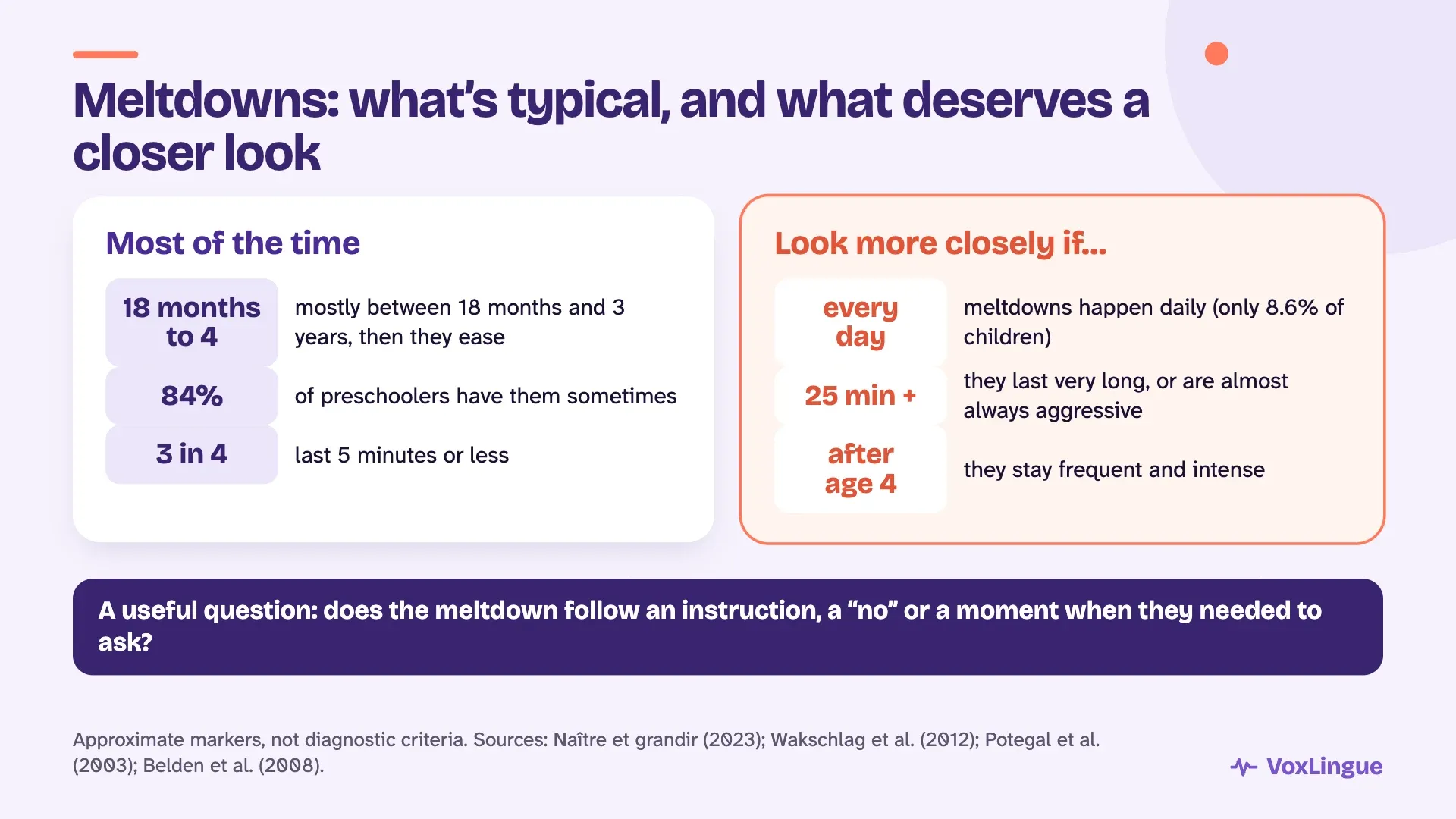
Yes, most of the time. Tantrums are common from about 18 months to 3 years, and they usually ease around 3 or 4, as children learn to use words instead. Nearly all preschoolers have them sometimes, but fewer than 1 in 10 has one every day. What matters is the overall pattern.
Québec’s parenting reference, Naître et grandir, places tantrums mainly between 18 and 36 months. Among the triggers, it names the moments when a child doesn’t have the words to express themselves, and it notes that tantrums decrease as children can say more with words.
The research says the same. In a US study of 1,490 preschoolers, about 84% had tantrums sometimes, but only 8.6% had them daily (Wakschlag and colleagues, 2012). Most tantrums are short: in another study, 3 out of 4 lasted 5 minutes or less (Potegal and colleagues, 2003).
What deserves a closer look
One meltdown tells you little. Patterns tell you more: how often, how long, how intense, and in which situations. One question is especially useful here: are words part of the problem? Does the meltdown follow an instruction your child may not have understood, or a moment when they needed to ask for something and couldn’t?
Telling yourself “it’s normal at this age” or “let’s wait until 4” doesn’t answer the most important question: why? Kimberly Martins, speech-language pathologist and founder of VoxLingue, insists on this. Even when a meltdown is typical for the age, you can look for what sets it off and act. You can help your child notice what is happening, and give them another way to ask or to refuse.
How are language and behaviour connected?
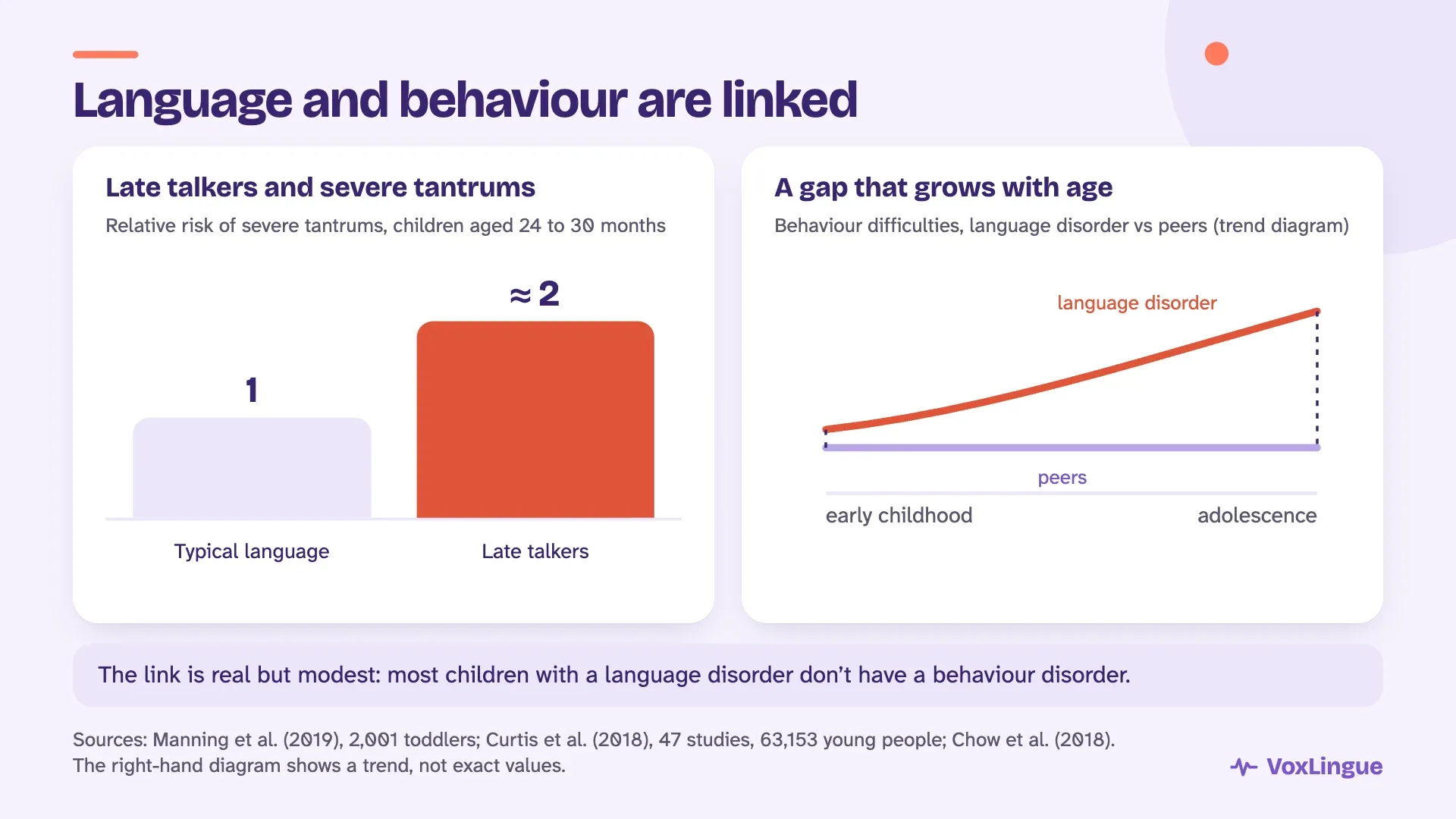
Words are tools for asking, refusing, waiting and calming down. A child with fewer of them gets frustrated faster. Research backs this up: toddlers who say fewer words have more intense tantrums, and children with a language disorder have more behaviour difficulties on average. The link is real, but it doesn’t apply to every child.
Think about everything a 3-year-old has to handle with words. Saying “that’s mine”, asking for help, explaining they’re hungry, understanding “we’re leaving in five minutes”. Without the words, what’s left are gestures, yelling and sometimes hitting. It isn’t manipulation. Often it’s the only tool they have.
What the studies show
In a large study of 2,001 toddlers aged 12 to 38 months, the fewer words a child said, the more frequent and intense their tantrums were. Late talkers aged 24 to 30 months were nearly twice as likely to have severe tantrums (Manning and colleagues, 2019). The study relied on parent reports at a single point in time.
Another team followed 120 children from 18 months to 4 years. Children with stronger language, or language that grew faster, showed less anger at age 4. Part of the reason: they were better at asking for help or distracting themselves while waiting (Roben and colleagues, 2013).
The gap shows up later too. A meta-analysis of 47 studies covering 63,153 children and teens found that young people with language disorders have more behaviour difficulties on average, and the gap widens with age (Curtis and colleagues, 2018). Another review found they are about twice as likely to have significant emotional or behaviour difficulties later on (Yew and O’Kearney, 2013).
Still, keep these numbers in perspective. Across the whole population, the link between language and behaviour is modest (Chow and colleagues, 2018). Most children with a language disorder don’t have a behaviour disorder. And most tantrums aren’t about language.
Language first, behaviour later?
Studies that follow children for years suggest language difficulties come before behaviour difficulties more often than the reverse (Petersen and colleagues, 2013). They don’t prove that one causes the other. Temperament, attention, sleep and family stress play a part too. But they are a good reason to look at language early rather than wait.
How can you tell if language is part of it?
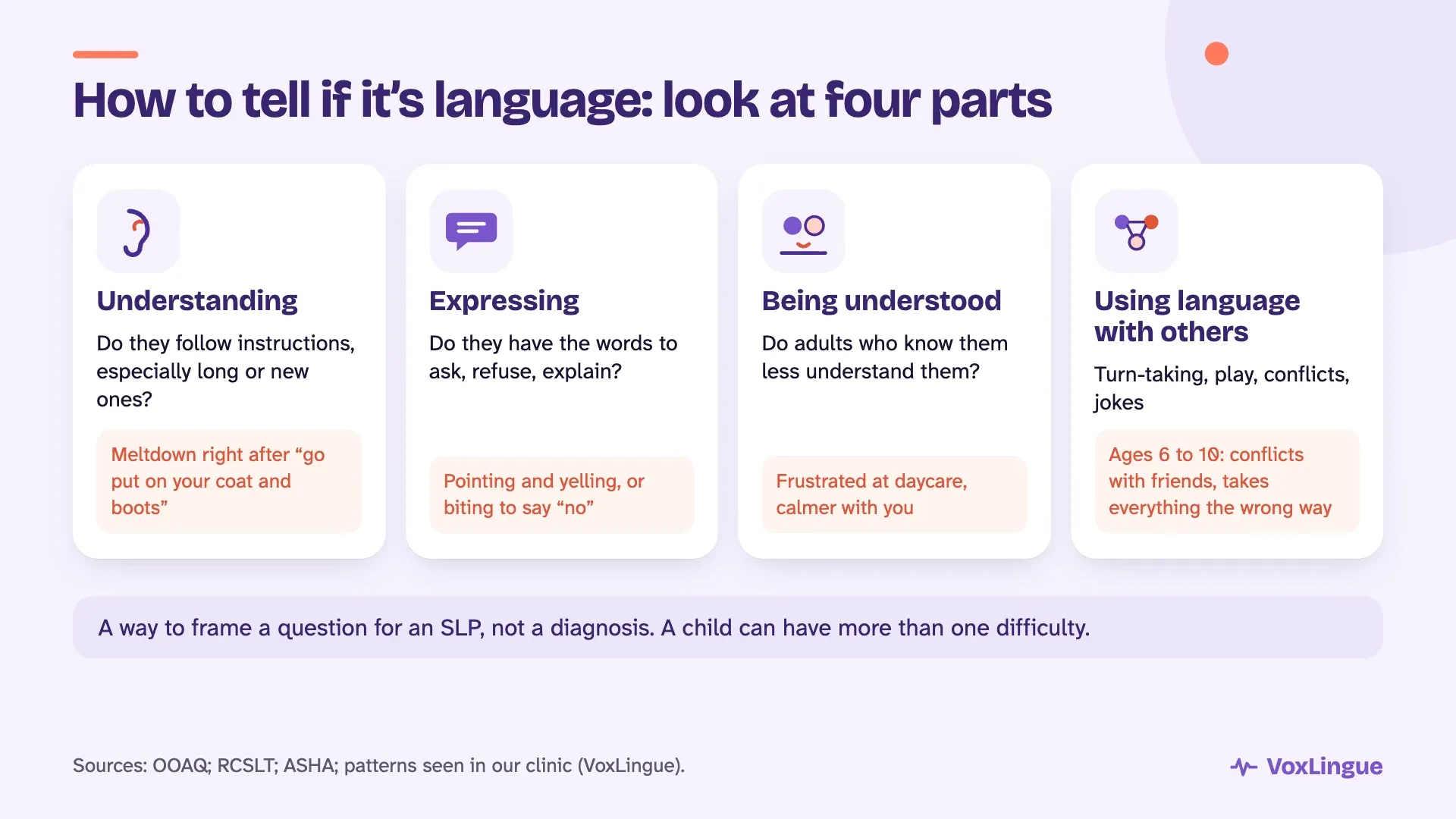
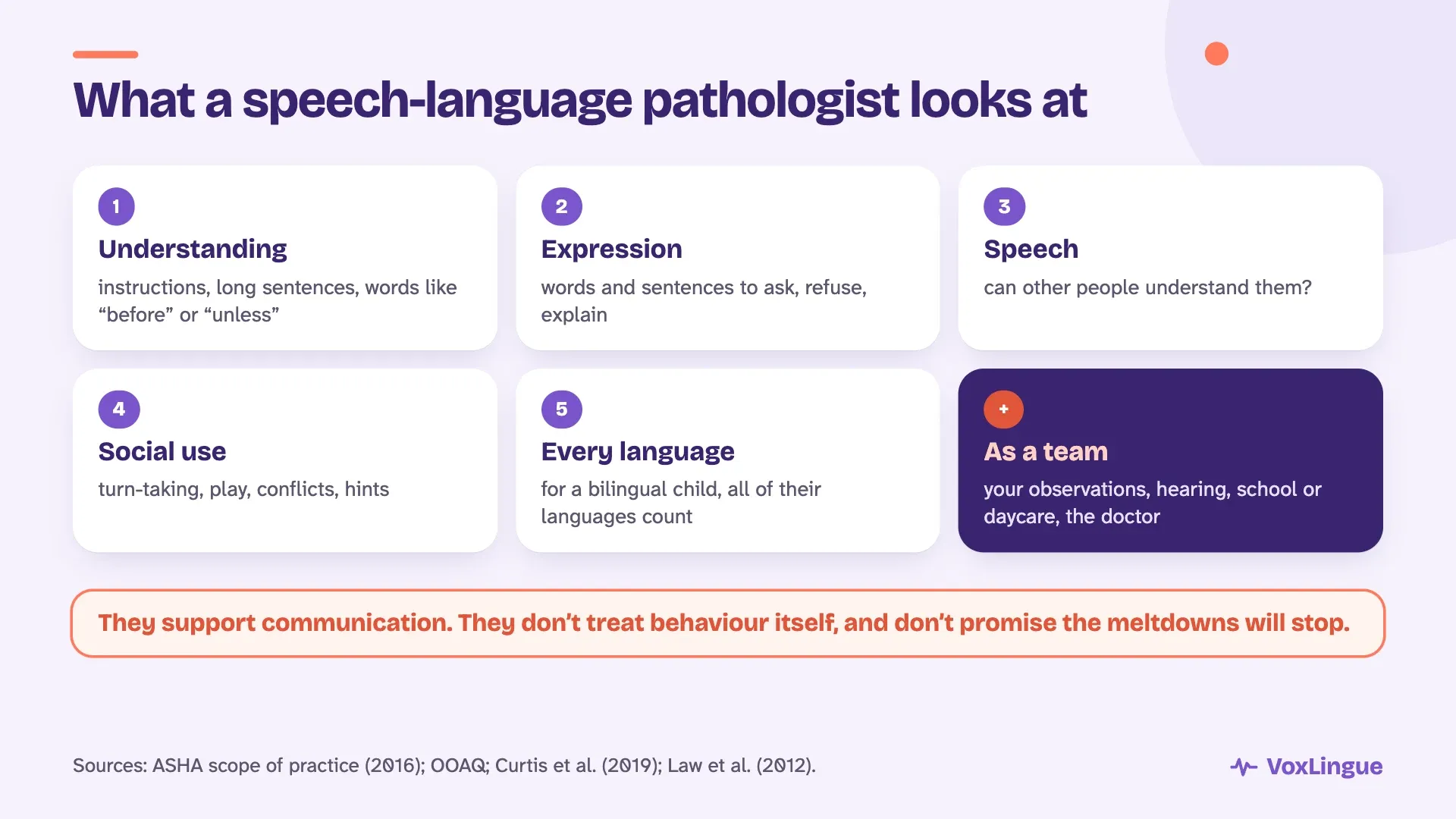
Look at four parts of communication. Understanding: does the meltdown follow an instruction or a change they may not have understood? Expressing: do they have the words to ask, refuse or explain? Being understood: do other people understand them? Using language with others: taking turns, playing, sorting out conflicts.
Communication is more than talking. A child can have plenty of words and still struggle with long sentences. They can understand well but lack the words for what they want. They can talk but be hard to understand for adults who don’t know them. Or they can speak well yet find it hard to join a game or settle a conflict with words.
In each case, frustration can come out as behaviour. Parents often describe the same situations. Very long meltdowns, hard transitions (getting ready for daycare, stopping play to come and eat), a big reaction to the word “no”. Or a child who bites or hits when they don’t get what they want. The table below can help you see what may be behind it.
| What you see | What may come from language | What may also point elsewhere |
|---|---|---|
| A meltdown right after an instruction or a change of activity | They may not have understood the instruction, or what comes next | It happens even when the instruction is short, familiar and shown with a gesture or picture |
| “He doesn’t listen”, you have to repeat everything | Long sentences or words like “before”, “after”, “unless” are hard to understand | They understand well when you check, but find it hard to pay attention anywhere |
| Pointing and yelling to get something | Few words or sentences to ask with | They ask easily when calm |
| Grabbing things without asking | Asking is hard or doesn’t work well for them | They do it even when they know how to ask |
| Biting or hitting to refuse or protest | They can’t yet say “no”, “stop” or “that’s mine” | Aggression in almost every meltdown, even with the words available |
| Quick to lose patience with adults they know less well | New people understand them less well than you do | The frustration is the same with everyone, you included |
| Ages 6 to 10: conflicts with friends, takes everything the wrong way, misses jokes | Social use of language and non-literal language (idioms, hints) are hard | Conflicts also happen in games without talking |
| Ages 6 to 10: pushback mostly at homework, reading or long explanations | Very verbal tasks take more effort | The pushback is the same in every activity |
This table doesn’t diagnose anything. It helps you form a question an SLP can check. The two right-hand columns aren’t mutually exclusive: a child can have a language difficulty and another difficulty at the same time.
Some signs concern overall development rather than language alone: delayed motor skills, great difficulty calming down, repetitive behaviours or very narrow interests. In those situations, an SLP will recommend seeing your family doctor, who can refer for a broader developmental assessment. We come back to this in the section on who does what.
Why it’s sometimes calmer at home
Parents know their child better than anyone. They guess what the child wants before it’s asked, understand words that come out unclear and read their gestures. At home, a child needs fewer words to be understood.
At daycare or school, it’s different. Educators, teachers and other children can’t guess as well. The child has to ask, explain and follow group instructions. That’s often where impatience and frustration show up. If your child is calm with you but struggling elsewhere, language deserves a closer look.
The reverse happens too. Some children hold it together all day and fall apart when they get home, where they feel safe. Either way, noting where and with whom meltdowns happen gives you valuable clues. The section on observing, below, shows you how.
“He doesn’t listen”: could it be understanding?
Difficulties with understanding are the ones people notice least. A child who doesn’t follow a long instruction can look distracted, defiant or “in their own world”. At school, developmental language disorder (DLD) affects about 7% of children, roughly two in every class, and it often goes unnoticed.
A child who struggles to understand often develops ways to cope. They watch the others and copy them. They follow the group, a step behind. These strategies hide the difficulty well enough that it can be missed for a long time.
At daycare and at home
At daycare or school, a child who doesn’t understand often looks around to copy the others. They have trouble following the group, want to leave circle time to do something else, or stand still and stare, unsure what to do. They may look distracted or dreamy. At home, parents feel the child doesn’t listen and find themselves repeating everything. Parent and child both end up feeling overwhelmed.
Professional bodies say the same. In the UK, the Royal College of Speech and Language Therapists notes in its factsheet on social, emotional and mental health that many children “communicate through behaviour”. A child who hasn’t understood an instruction can look “defiant” when they simply don’t know what to do.
A difficulty that often stays invisible
The OOAQ describes DLD as little known and hard to see. It affects about 7% of the population and is five times more common than autism. A large English study of children aged 4 to 5 found the same order of magnitude, about two children in a class of 30 (Norbury and colleagues, 2016). In a US study, only 29% of parents of children with DLD had ever been told their child had a language difficulty (Tomblin and colleagues, 1997).
The OOAQ also notes that DLD is often associated with difficulty controlling emotions. Our article on identifying language disorders in bilingual children explains how DLD is recognized when a child speaks more than one language.
At school, ages 6 to 10
At school age, difficulties with understanding hide behind comments like “he doesn’t listen in class”. Multi-step instructions, spoken explanations and homework all demand a lot of language. A child who struggles to understand may tune out, fidget or refuse, and the behaviour is what people see first.
Studies in child psychiatry clinics show how often this happens. Among children referred only for behaviour or emotional concerns, 34% to 40% had a language difficulty nobody had suspected (Cohen and colleagues, 1993 and 1998). These difficulties were often subtler, which is why they had been missed.
If your child is being seen for behaviour, ask whether their language, and especially their understanding, has been assessed. This doesn’t question the other professionals’ work. It’s information that can help them, especially when the support offered relies heavily on talking.
How can you observe before you consult?
Before drawing conclusions, observe for a week or two. Note what happened just before each meltdown, how long it lasted, how it ended, where, when and with whom. Then book an appointment with your family doctor, and get your child’s hearing tested if it has never been checked.
Your observations are valuable. They help the SLP, the doctor or any other professional understand what’s going on, far better than a general memory. For each meltdown, note:
- What happened: the type of behaviour (crying, yelling, hitting, refusing).
- Just before: an instruction, a “no”, a transition, a noise, a wait.
- How long it lasted, and how it ended.
- Your child’s emotions before and after.
- Where and when: at home, at daycare, in the morning, before dinner.
- With whom: is it more frequent with one parent than the other, or with certain people?
- Your best guess: why do you think it happened?
After a few days, patterns often appear. Do meltdowns mostly follow instructions, changes of activity or moments when your child needs to ask for something? If so, language is worth exploring.
Ask yourself two more questions. Has there been a big change recently, such as a new baby, a move or a new daycare? A change can explain new reactions, and your child will need time and security to adjust. And is your child developing as expected in every area: motor skills, relationships with others, emotions and language?
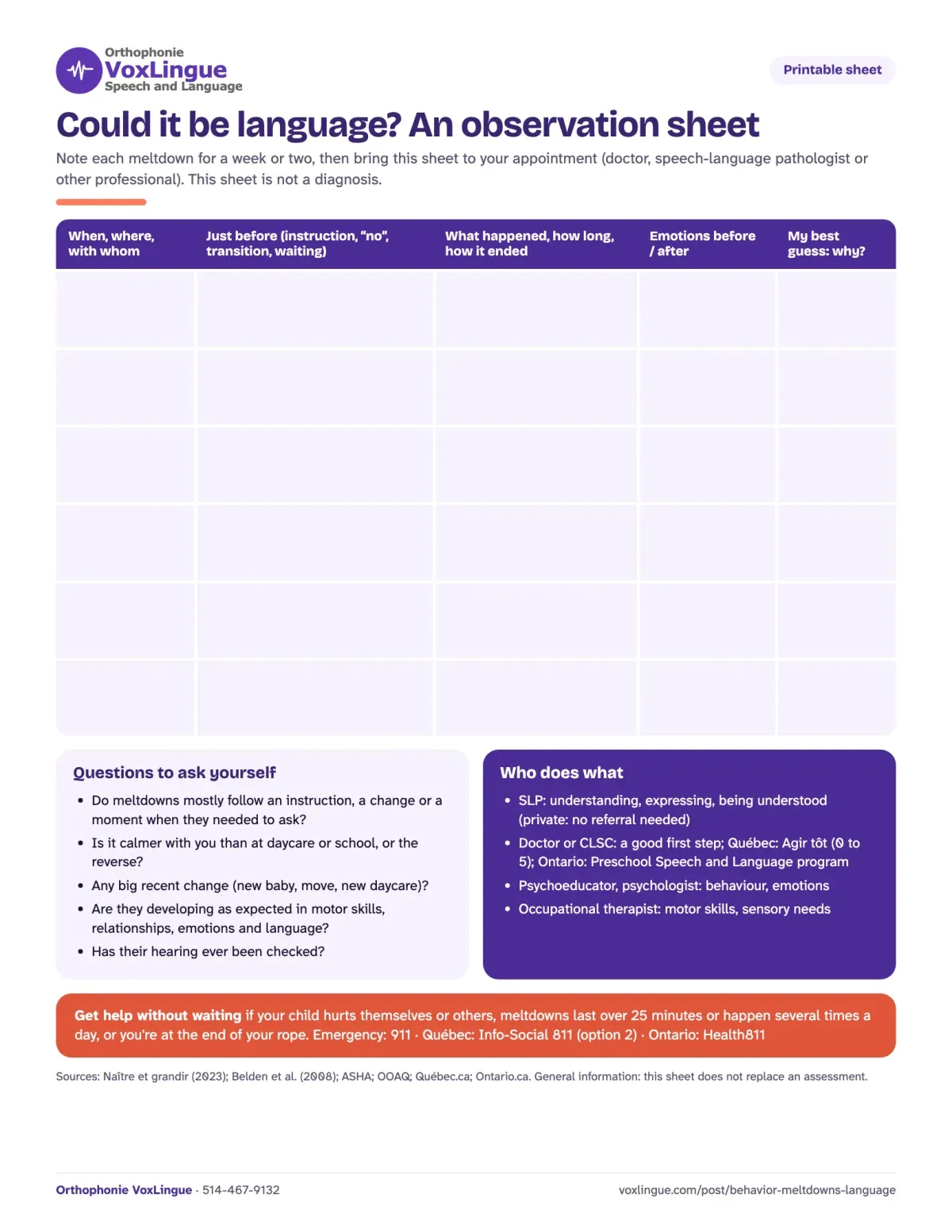
Printable: Could it be language? An observation sheet (PDF, 1 page). Note each meltdown for a week or two, then bring the sheet to your appointment.
Why check hearing
A child who doesn’t hear well can seem not to listen. Repeated ear infections or fluid behind the eardrum can reduce hearing on and off, with no visible sign. Before concluding there’s a behaviour or language problem, a hearing test is always a good idea if one has never been done.
The American Speech-Language-Hearing Association (ASHA) recommends screening hearing in children whose language is late, to rule out hearing loss. Ask your family doctor or, in Québec, your CLSC to refer you to an audiologist.
What can you do at home to support communication?
Take some of the load off words. Use pictures and gestures in daily routines so your child knows what’s coming and what’s expected. Speak in short sentences, one instruction at a time, at their level. Announce changes. Give them words to ask and to refuse, then wait for their answer.
These are strategies speech-language pathologists often recommend to families. They support communication. They don’t claim to make meltdowns disappear, and they don’t replace another professional’s help when behaviour calls for it.
Show, don’t just tell
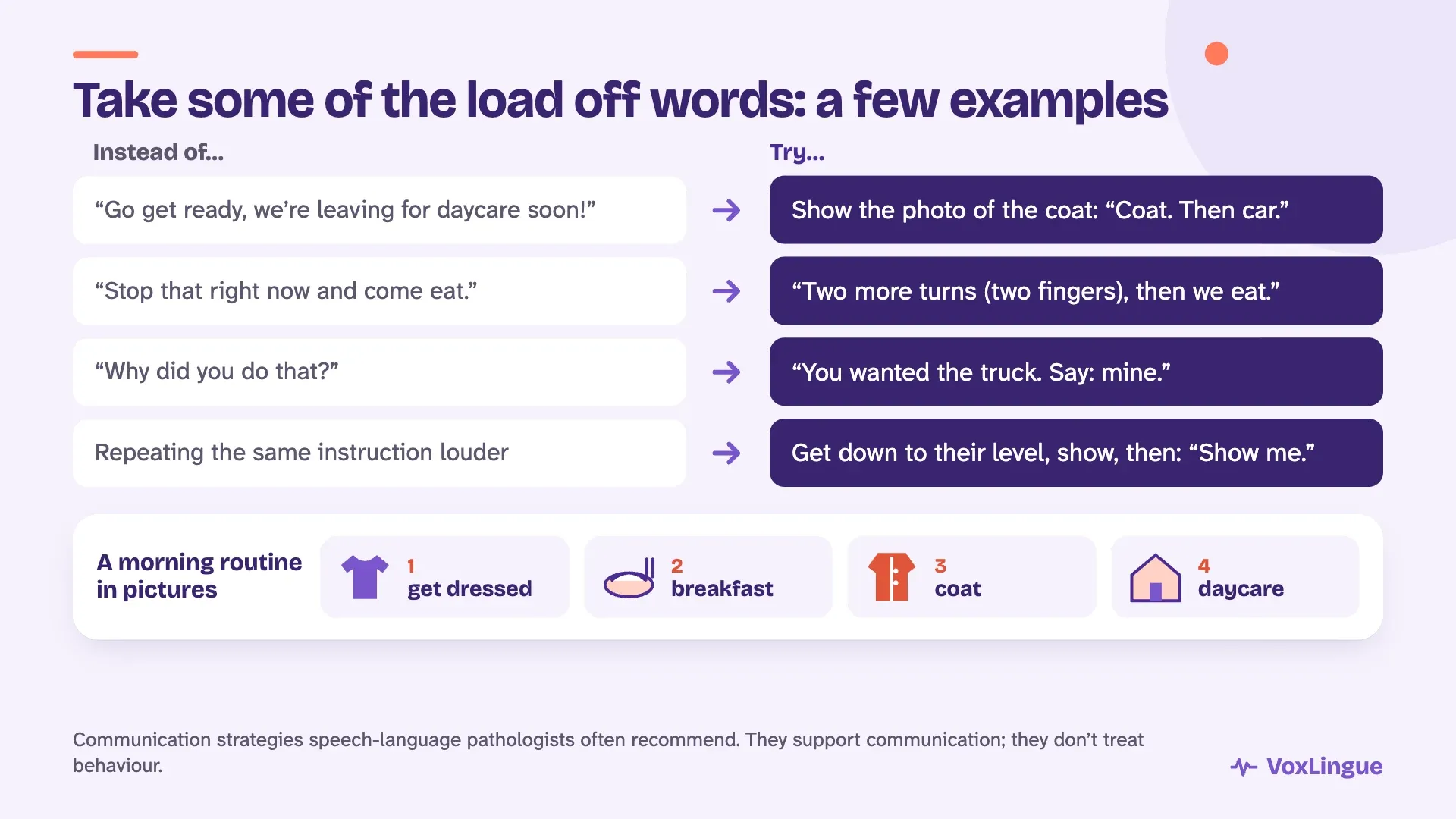
Pictures and gestures take part of the load off spoken words. A morning routine in pictures (get dressed, breakfast, coat, daycare) lets your child know what comes next without having to understand everything by ear. You can simply photograph the real steps of your routine and stick them on the fridge.
For transitions, announce the change and show it. “Two more turns, then we eat,” holding up two fingers. Then show the plate or a photo of the meal. “First… then…” helps a lot: “First shoes, then the park.” Your child knows what’s expected and what comes after.
Keep it simple, and check
Get down to your child’s level and wait until they’re looking or listening before you speak. Give one instruction at a time, in short sentences. Avoid abstract words like “before”, “after” or “unless” when they’re upset or tired. Then check they’ve understood: “Show me what you’re going to do.”
Give them words for what they want and what they refuse. “You can say: no thank you.” “Say: mine.” “You can say: help me.” Naming what they feel is part of language too: “You’re angry, you wanted to keep playing.” After a question, wait a few seconds in silence. Many children need that time to find their words.
| Instead of… | Try… |
|---|---|
| “Go get ready, we’re leaving for daycare soon!” | Show the photo of the coat: “Coat. Then car.” |
| “Stop that right now and come eat before it gets cold.” | “Two more turns (two fingers), then we eat.” |
| “Why did you do that?” | “You wanted the truck. Say: mine.” |
| “Clean up your room.” | “First blocks in the box.” (pointing to the box) |
| Repeating the same instruction louder | Get down to their level, show, then ask: “Show me.” |
What isn’t speech therapy
Helping a child calm down during a meltdown, by staying calm yourself and staying with them (often called co-regulation), matters a great deal. But it isn’t the SLP’s role. Your doctor, a psychoeducator or a psychologist can guide you there. The SLP helps you lighten the load on words and gives your child ways to say what they want.
In a bilingual family
According to the OOAQ, DLD is caused neither by a lack of stimulation nor by learning more than one language. A bilingual child with DLD has difficulties in all of their languages. Keep speaking the language you’re most comfortable in. An assessment will take all of your child’s languages into account. Our guide to bilingual language milestones from 0 to 5 gives age-by-age markers.
How can a speech-language pathologist help?
A speech-language pathologist assesses understanding, expression, speech and the social use of language, in each of the child’s languages. They check whether a language difficulty is contributing to the meltdowns. Then they work with the child, coach the parents and can give daycare or school practical tools. They don’t treat the behaviour itself.
The assessment
An SLP assessment starts with your observations. The sheet you’ve filled in and your concerns shape the questions. The SLP then watches your child play and talk, and uses tasks suited to their age. They look at what your child understands, what they say, how they say it and how they communicate with others. For a bilingual child, each language counts.
At the end, the SLP explains what they saw. Is a language difficulty contributing to the meltdowns? If so, which one? If not, who should you turn to? Either way, you leave with concrete next steps.
Therapy
If a language difficulty is involved, therapy targets communication. Learning to ask, to refuse, to explain, to understand longer instructions. Words for feelings can become vocabulary goals too. Parents play a big part: interventions guided by an SLP and carried out by parents improve young children’s understanding and expression (Roberts and Kaiser, 2011).
The SLP can also make visual supports with you that fit your routine, and give the educator or teacher ideas to make group instructions easier to follow. If the family would rather wait and see first, a few sessions can be a starting point. If little changes, other services are explored alongside.
What speech therapy can, and can’t, promise
The evidence is encouraging but still limited. In a randomized study of 97 children with language delays, a parent-led language intervention was followed, a year later, by fewer behaviour difficulties reported by parents (Curtis and colleagues, 2019). A review of 19 studies points the same way, but most were of modest quality (Law and colleagues, 2012).
So we don’t promise that speech therapy will stop meltdowns. It can reduce an important source of frustration and make other professionals’ help more accessible. Talking-based therapies are harder to benefit from for a child who struggles to understand (Cohen and colleagues, 2000). To learn more, see our page on language disorders.
SLP, psychoeducator, psychologist: who does what?
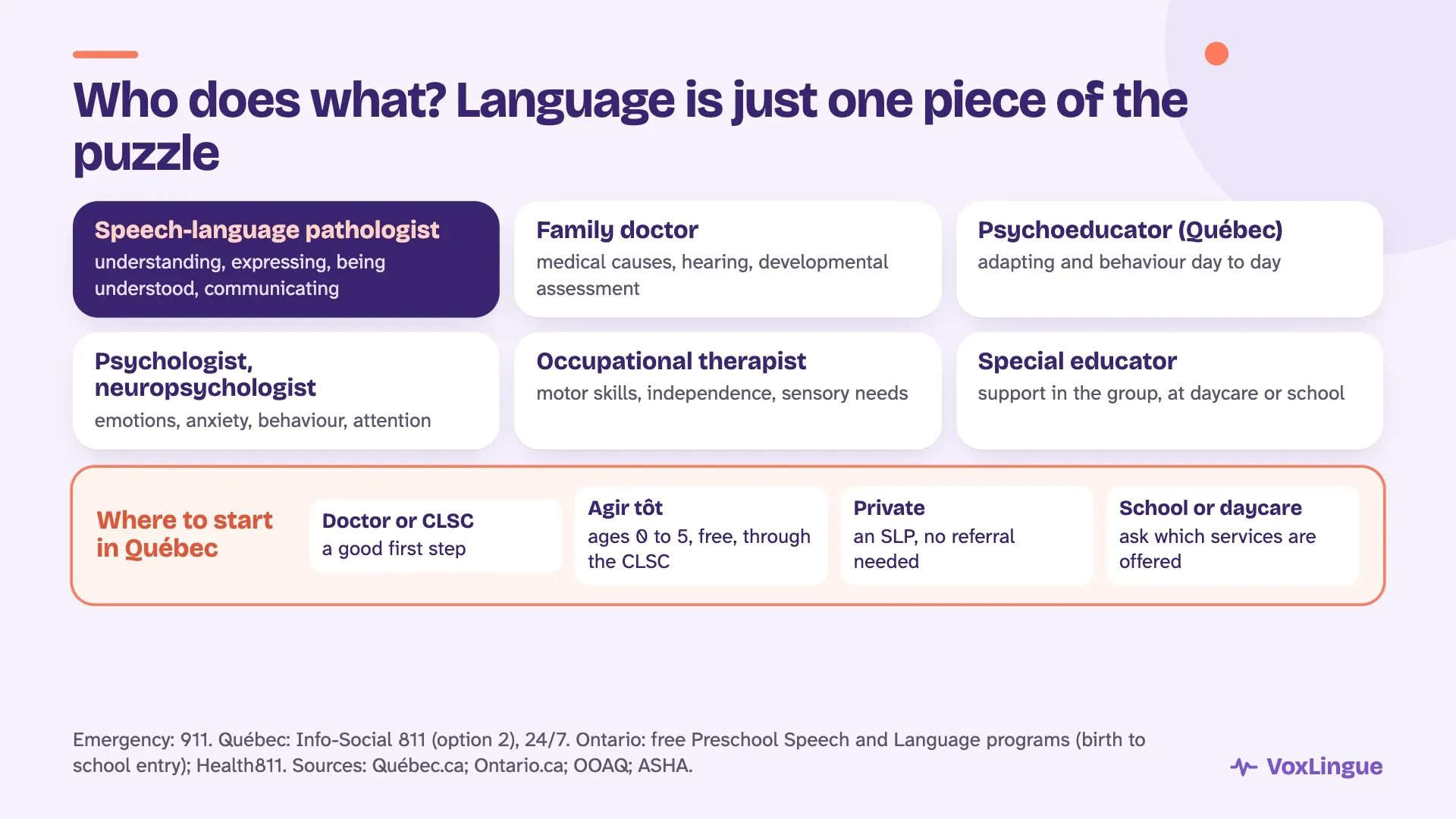
The SLP works on communication. A psychoeducator (a Québec profession) helps the child adapt and supports behaviour day to day. A psychologist assesses and treats emotional and behaviour difficulties. The doctor rules out medical causes and refers. Several often work together, because language is just one piece of the puzzle.
Challenging behaviour rarely has a single cause. Language can be part of it, and so can attention, sensory needs, sleep, anxiety or a change in the family. That’s why a child sometimes needs more than one kind of help. “Language is just one piece of the puzzle,” says Kimberly Martins.
| Professional | Their role with your child | When to think of them |
|---|---|---|
| Speech-language pathologist | Understanding, expressing, being understood, communicating with others | You suspect language plays a part in the meltdowns |
| Family doctor or paediatrician | Ruling out medical causes, arranging a hearing test, referring for a developmental assessment | Always a good first step, especially if several areas worry you |
| Psychoeducator (Québec) or behaviour specialist | Adapting and behaviour day to day, at home, at daycare or at school | Meltdowns are frequent or intense, or you feel overwhelmed |
| Psychologist or neuropsychologist | Emotions, anxiety, behaviour, attention and overall functioning | Difficulties affect several areas or persist despite help |
| Occupational therapist | Motor skills, independence and sensory processing | Clothes, noises or textures set off meltdowns; motor skills are behind |
| Special educator (daycare, school) | Supporting the child within the group | Daycare or school is struggling to support them |
When an SLP refers elsewhere
When an SLP notices signs that affect overall development, they recommend seeing the family doctor. Delayed motor skills, great difficulty calming down, repetitive behaviours or very narrow interests are examples. The doctor can refer the child for a developmental assessment in the public system. Families can also go private to avoid the wait.
If other areas are affected, the SLP may also suggest an occupational therapist, a neuropsychologist or a psychoeducator. SLPs don’t diagnose ADHD, anxiety, behaviour disorders or autism. Those assessments belong to a physician, psychologist or neuropsychologist.
Where to start in Québec and Ontario
In Québec, your family doctor or CLSC is a good starting point. For children aged 0 to 5, the public Agir tôt program screens for signs of developmental difficulties and points families to the right services. It’s free, and you can call your CLSC any time you’re worried about your child’s development.
You can see a private SLP without a doctor’s referral. At school, ask the teacher which services are available. Worried about public wait times? Our article on the speech therapy waiting list in Québec explains your options.
In Ontario, each region runs a free Preschool Speech and Language program for children from birth to school entry, and in many regions parents can call directly, without a doctor’s referral. School boards have SLPs for school-age children. As in Québec, you can see a private SLP without a referral.
When to get help without waiting
Some situations call for a doctor, a CLSC or a psychologist quickly. These markers come from research on tantrums in preschoolers and from Naître et grandir. They aren’t diagnostic criteria (Belden and colleagues, 2008). Get help if:
- your child hurts themselves during meltdowns, or often hurts others;
- meltdowns last a very long time (more than 25 minutes on average) or happen several times a day, several days in a row;
- your child almost never manages to calm down, even with your help;
- meltdowns stay frequent and intense after age 4, or appear suddenly;
- you feel overwhelmed or exhausted.
If your child or someone else is in immediate danger, call 911. In Québec, Info-Social 811 (option 2) connects you with a psychosocial professional, free, confidentially and 24 hours a day. In Ontario, Health811 connects you with a registered nurse 24 hours a day, including for mental health concerns.
And you, the parents?
Living with frequent meltdowns is exhausting. Feeling helpless or at the end of your rope is normal. Taking care of yourself helps your child too. Depending on your situation, an SLP may suggest support for you: a family therapist, counselling or respite services. Asking for help isn’t a sign of failure. It’s a way to keep the energy your child needs.
Key takeaways
Look at language before judging behaviour. Before concluding your child is “just acting out”, ask yourself whether they understand what’s asked, have the words to answer and are understood by others. Often, the answer changes how you see the meltdowns.
Meltdowns and language are linked, but language doesn’t explain everything. Observe, take notes, get hearing checked and talk to your doctor. Take some of the load off words with pictures and gestures. And if language seems to be involved, an SLP can assess it and give you tools, working as a team with the other professionals who support your child.
Next step
Print the observation sheet and note meltdowns for a week or two. If your child’s language, understanding or ability to be understood worries you, a speech-language assessment can help clarify things. Our SLPs see families in Montréal and online, in English and French.
This article is general information. It doesn’t replace an assessment by a professional.
Frequently Asked Questions
Can a speech delay cause behaviour problems?
It can contribute. Toddlers who say fewer words have, on average, more frequent and intense tantrums: late talkers at 2 are nearly twice as likely to have severe ones (Manning and colleagues, 2019). But language is never the only explanation. Temperament, sleep, attention and family circumstances matter too. Our guide to late talkers explains when to act.
Will the meltdowns stop once they talk better?
Often they ease as words come in. Children whose language grows tend to show less anger by age 4 (Roben and colleagues, 2013). Nothing is guaranteed, though. If meltdowns stay frequent and intense after 4, talk to your doctor.
Is it my fault?
No. Meltdowns are part of development, and the OOAQ is clear that a language disorder isn’t caused by a lack of stimulation. The communication strategies you put in place can help, but they don’t mean you did anything wrong before.
Should we wait until age 4?
No. If your child’s language worries you, you can consult at any age. Waiting doesn’t tell you why the meltdowns happen. An assessment shows whether a language difficulty plays a part, and lets you start helping sooner if it does.
SLP or psychoeducator: who should we see first?
If language worries you, start with the SLP. If it’s mostly behaviour, emotions or your own exhaustion, a psychoeducator or your doctor is a good starting point. Often both are useful, and each can refer you to the other.
My child understands everything but says little: is it language?
Possibly. A lack of words alone can cause a lot of frustration: they know what they want but can’t say it. The SLP will check understanding too. Parents often overestimate it, because children lean on routines and gestures to guess what’s meant.
Can bilingualism cause meltdowns?
No, bilingualism doesn’t cause a language disorder. A child learning two languages may sometimes search for words, especially when starting daycare or school in the language they know less well. If the difficulties show up in all of their languages, an assessment is a good idea.
Can speech therapy fix behaviour problems?
It supports communication, which can reduce an important source of frustration. One randomized study found fewer behaviour difficulties after a parent-led language intervention (Curtis and colleagues, 2019). But speech therapy doesn’t treat behaviour itself, and we don’t promise the meltdowns will stop.
What if it’s ADHD?
DLD and ADHD can occur in the same child. Only a physician, psychologist or neuropsychologist can diagnose ADHD. Our article on ADHD and language explains how attention shapes communication.
My child was asked to leave daycare: what now?
It’s a hard situation, and many families go through it. Ask for a meeting to understand what’s happening and in which situations. Book an appointment with your family doctor and have your child’s language assessed. A special educator or a psychoeducator can also help your child settle into their next setting.