What toys help a toddler who talks little: talking toys, AI plush toys or simple toys, what studies show, what to give at Christmas from 18 months to 3, and when to consult
December is coming, and the family wants to know what to get your toddler. You may be looking for toys that help speech development, because at 2, your child still says only a few words. The grandparents, meanwhile, have spotted a toy that sings and a plush toy that answers questions.
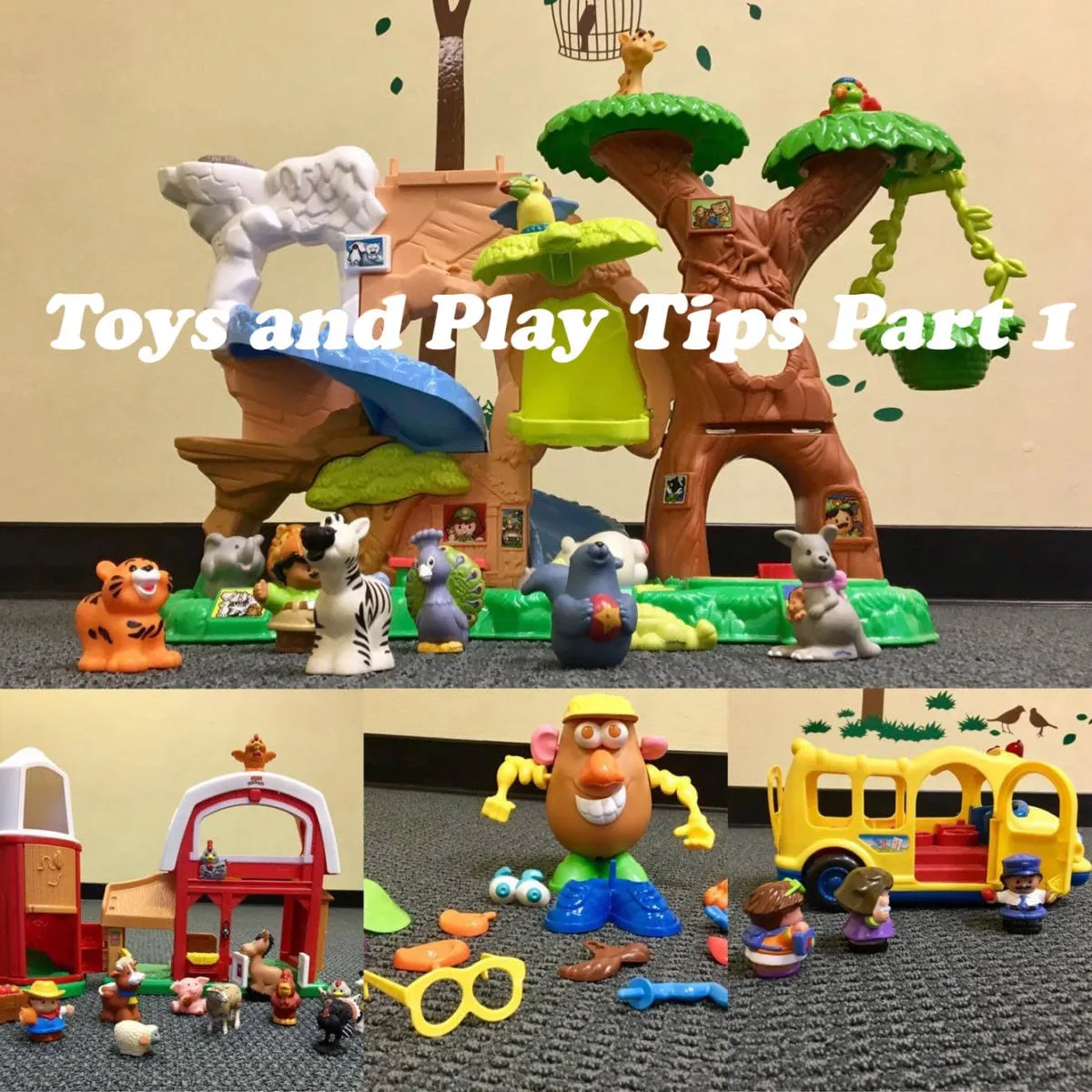
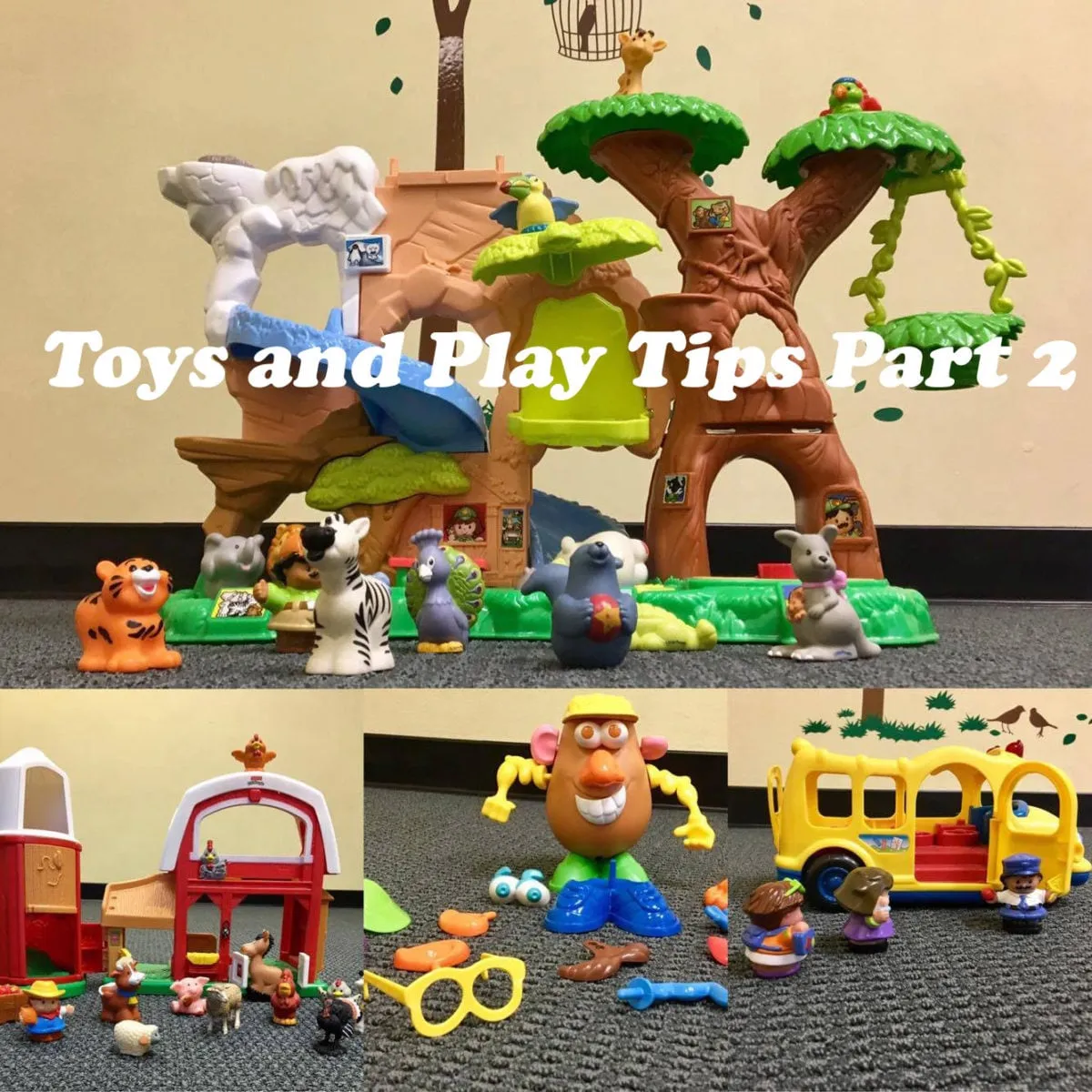
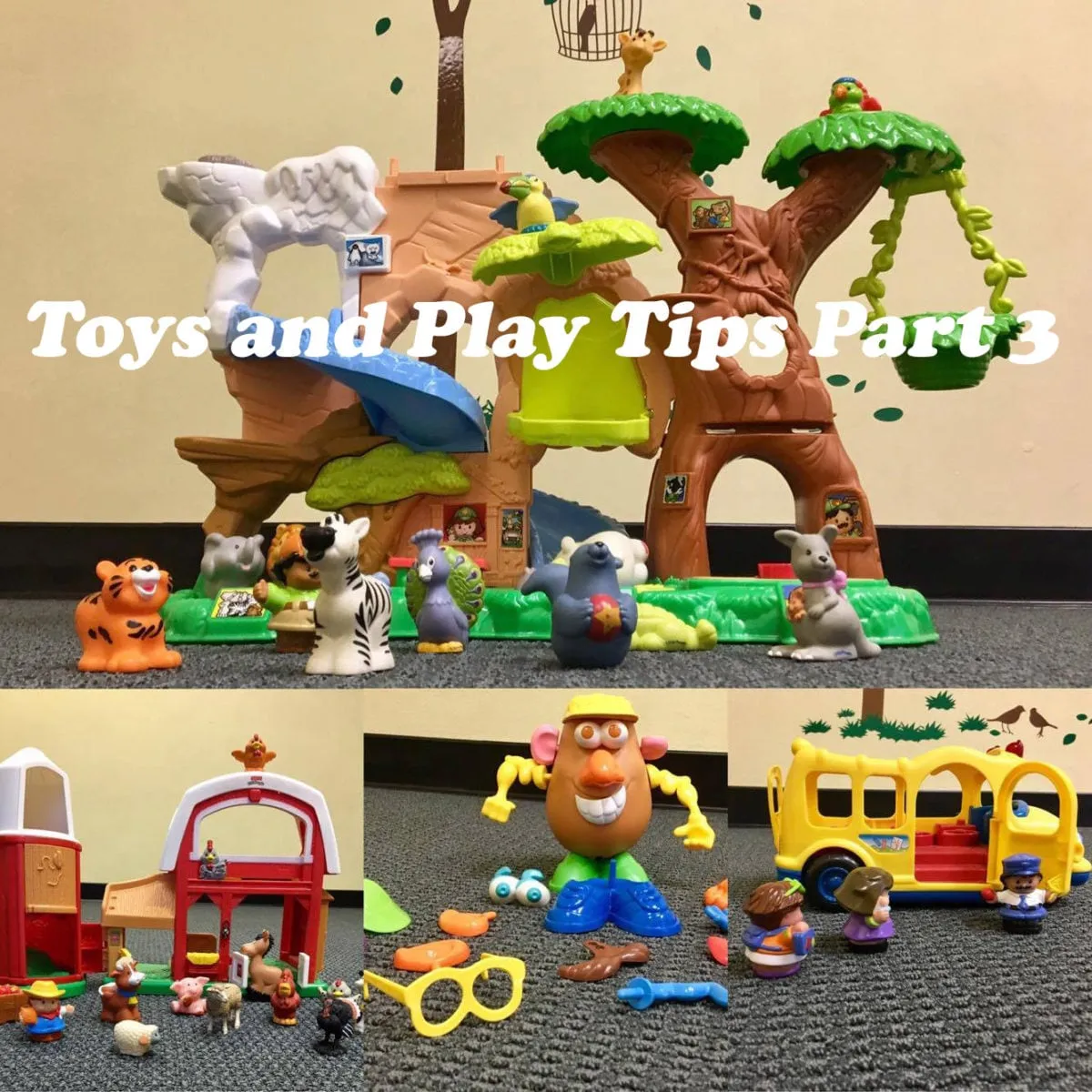
Kimberly Martins, speech-language pathologist and founder of VoxLingue, put it simply in her series on toys and play: the best way to help children develop and grow is to play with them. This guide starts from that idea, then looks at what the research says.
You’ll find what studies have seen with talking toys, what noise changes for a toddler, and what we know in 2026 about AI plush toys. Then comes what to give at each age, how to give it, a printable list for the grandparents, and when to contact the CLSC. For more, see our articles on early language and late talkers.
Can a toy help a toddler who talks little?
No toy teaches a child to talk. A toy helps when it gives an adult and a child something to do together: rolling, stacking, pretending, looking at a book. For a toddler who talks little, the best gift is a simple toy, and a person who sits down to play with it.
A Québec speech-language pathologist made the same point in Naître et grandir back in 2014 (in French). A child playing alone with an electronic toy that recites the alphabet doesn’t learn how words are used. Her conclusion: a lovely gift to give a child is time spent playing with them. She adds that a toy matched to the child’s level is more likely to hit the mark.
Québec’s public health institute (INSPQ) says the same thing (in French). Toys aren’t needed for play: pots, spoons, bowls and boxes often do the job. Many so-called “educational” toys are expensive and don’t support development any better than everyday objects (2026).
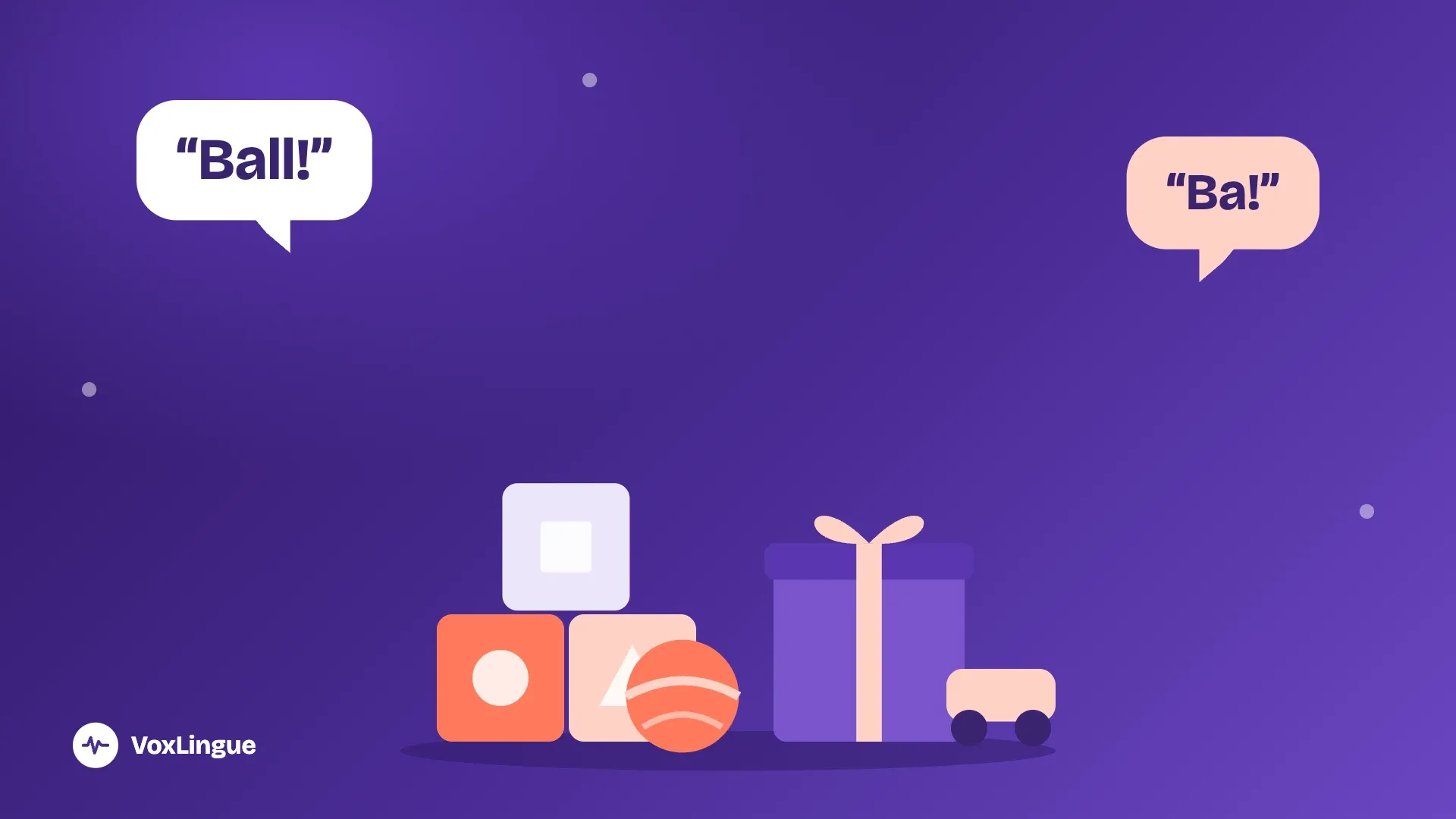
What makes the difference is the turn. You roll the ball and say “Ball!” You wait. Your child looks at you, reaches out, makes a sound or says part of a word. You answer, and you roll it again. Each back-and-forth is a small conversation, even without words.
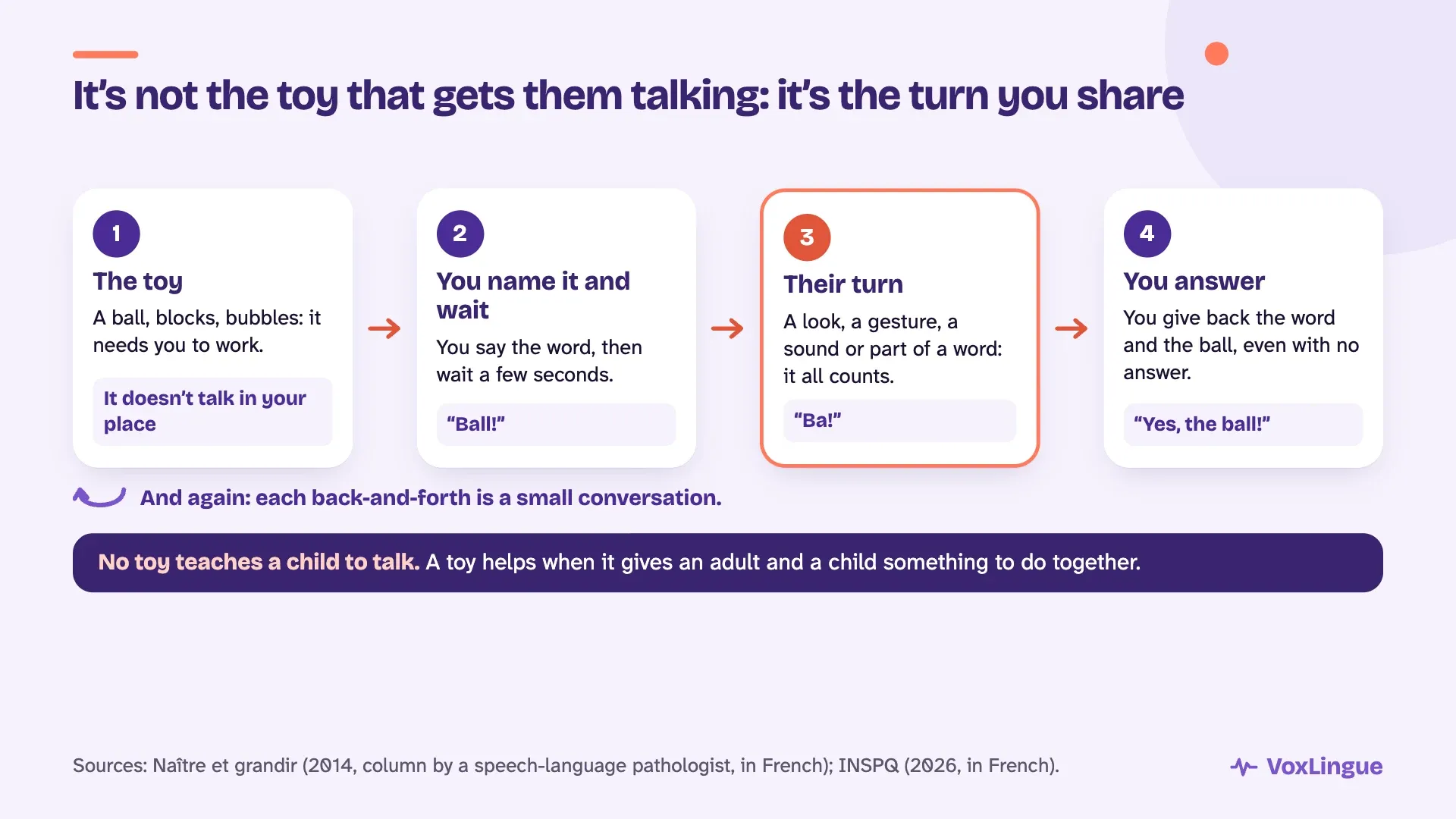
A toy that needs you creates these turns naturally. A toy that talks, sings or lights up on its own can take them in your place. For everyday moves, see simple ways to help your toddler talk, no special toys needed.
Toys that talk, sing or light up: what studies have seen in toddlers
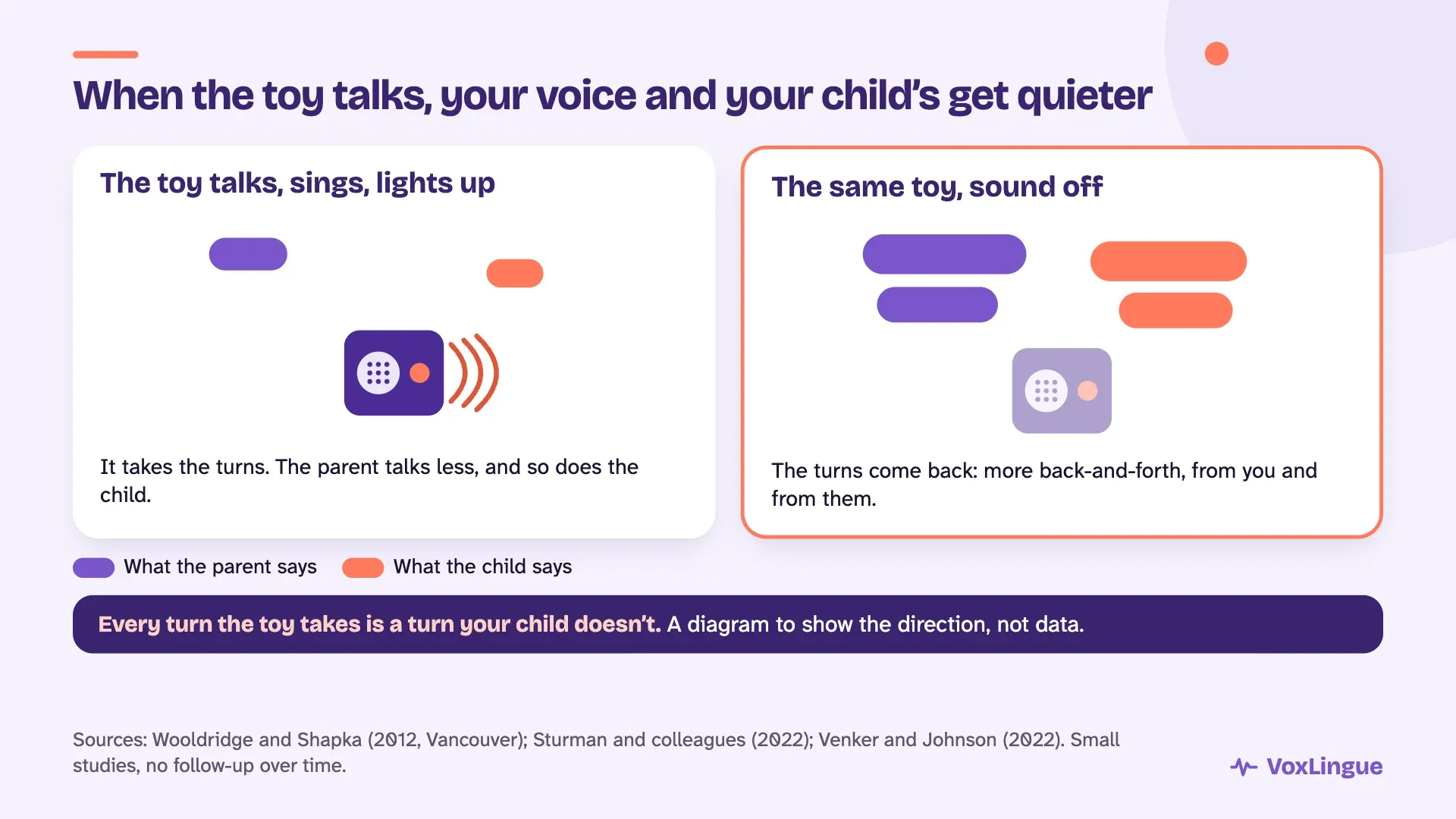
Studies on electronic toys are small, but they all point the same way. When the toy talks or sings, parents talk less and respond less, and there are fewer exchanges. In the only one of these studies that counted the children’s words, the children said fewer too. None shows that such a toy causes language difficulties.
What changes for the parent
With an electronic toy, parents talk less and respond less to their child. In Vancouver, a University of British Columbia team filmed 25 mothers and their toddlers, about 20 months old on average, at home. With electronic toys, mothers responded less to their child and did less “teaching”. Their warmth didn’t change (Wooldridge and Shapka, 2012).
In the United States, parents played for about 7 minutes with their toddler and a shape sorter, either electronic or traditional. With the electronic version, they used less varied language, even after counting the words the toy said itself (Zosh and colleagues, 2015). A 2016 US study of 26 families with babies aged 10 to 16 months saw the same thing (Sosa, 2016); our guide above summarises it.
In 2022, a US team had 28 families of children aged 2 to 5 play with the same toys, once with their sounds and lights and once without. With the sounds on, parents said fewer sentences and fewer different words, and there was more silence (Sturman and colleagues, 2022).
What changes for the child
In the only one of these studies that counted their words, children talked less too. With electronic toys, the children from the same 28 families said fewer sentences and used fewer different words, autistic or not (Venker and Johnson, 2022). The team writes that children seem to take a back seat to the toy.
The study has limits: a small group with little diversity, two 10-minute lab sessions, no follow-up over time. For a toddler who talks little, the idea still matters: every turn the toy takes is a turn your child doesn’t. See also what research says about back-and-forth between parent and child.
Noise makes speech harder to understand
A toy’s noise can also make speech harder to understand. Three audiologists at CHU Sainte-Justine, the Montréal mother-and-child hospital, say it plainly in a leaflet (in French): sound toys, like other sources of noise, can keep a child from understanding speech well (2019).
A child understands better in a calm setting, the leaflet reminds parents. For a toddler learning first words, your voice shouldn’t have to compete with a song playing on a loop.
These studies are small (25 to 28 families where the number is known) and short (7 to 15 minutes per toy). None follows children for months, and none shows that a talking toy causes language difficulties. But they all point the same way, as this table sums up.
| Study | Families and ages | Length and setting | What was measured | With the electronic toy | Main limit |
|---|---|---|---|---|---|
| Vancouver, Canada, 2012 | 25 mothers, toddlers about 20 months old | 10 to 15 minutes per toy set, at home | Mother’s responsiveness and teaching | Less responsive, less teaching; same warmth | Small group, highly educated mothers |
| United States, 2015 | Parents and toddlers (number not stated here) | About 7 minutes | Parent’s language with a shape sorter | Fewer shape words, less varied language | One toy only |
| United States, 2016 | 26 families, babies 10 to 16 months | At home | Parent’s words, exchanges | Fewer words, fewer exchanges | Small group |
| United States, 2022 (parents) | 28 families, children 2 to 5 | Two 10-minute sessions, in a lab | Parent’s sentences and different words | Fewer sentences, fewer different words, more silence | Small group, little diversity |
| United States, 2022 (children) | The same 28 families | The same sessions | Child’s sentences and different words | Fewer sentences, fewer different words | Small group, little diversity |
A toy that makes noise at home: turn the sound off or play with it together
A toy that makes sounds doesn’t have to go. Turn the sound off, take out the battery or play with it together: you do the talking, and the toy becomes a reason to talk. The studies and the Sainte-Justine audiologists mostly point away from toys that talk, ask questions or narrate the play for the child.
Kimberly Martins picked a musical toy herself in her toys series: a ball popper that plays music. She noted that it can be a little noisy, so be mindful of how long your child plays with it. Elsewhere, she advises being mindful of how loud sound toys are.
So the sound itself isn’t the problem. The problem is when the toy does all the work. Naître et grandir, Québec’s parenting resource, puts it simply (in French): when pressing the button to make noise becomes the point of the game, children use their imagination less. Before buying a sound toy, ask whether the sound really adds anything.
Often, a truck, a stuffed animal or a doll that makes no noise is just as much fun. If the sound toy is already at home, try it out: if you have to raise your voice to talk over it, it’s too loud. Health Canada puts it this way: if it sounds uncomfortable to you, it may be too loud for your child. The INSPQ also suggests trying toys in the store.
The Sainte-Justine audiologists suggest taking the battery out or covering the speaker with tape, and keeping these toys for short periods. Toys that talk, ask questions or narrate the play take the most turns: those can stay at the store.
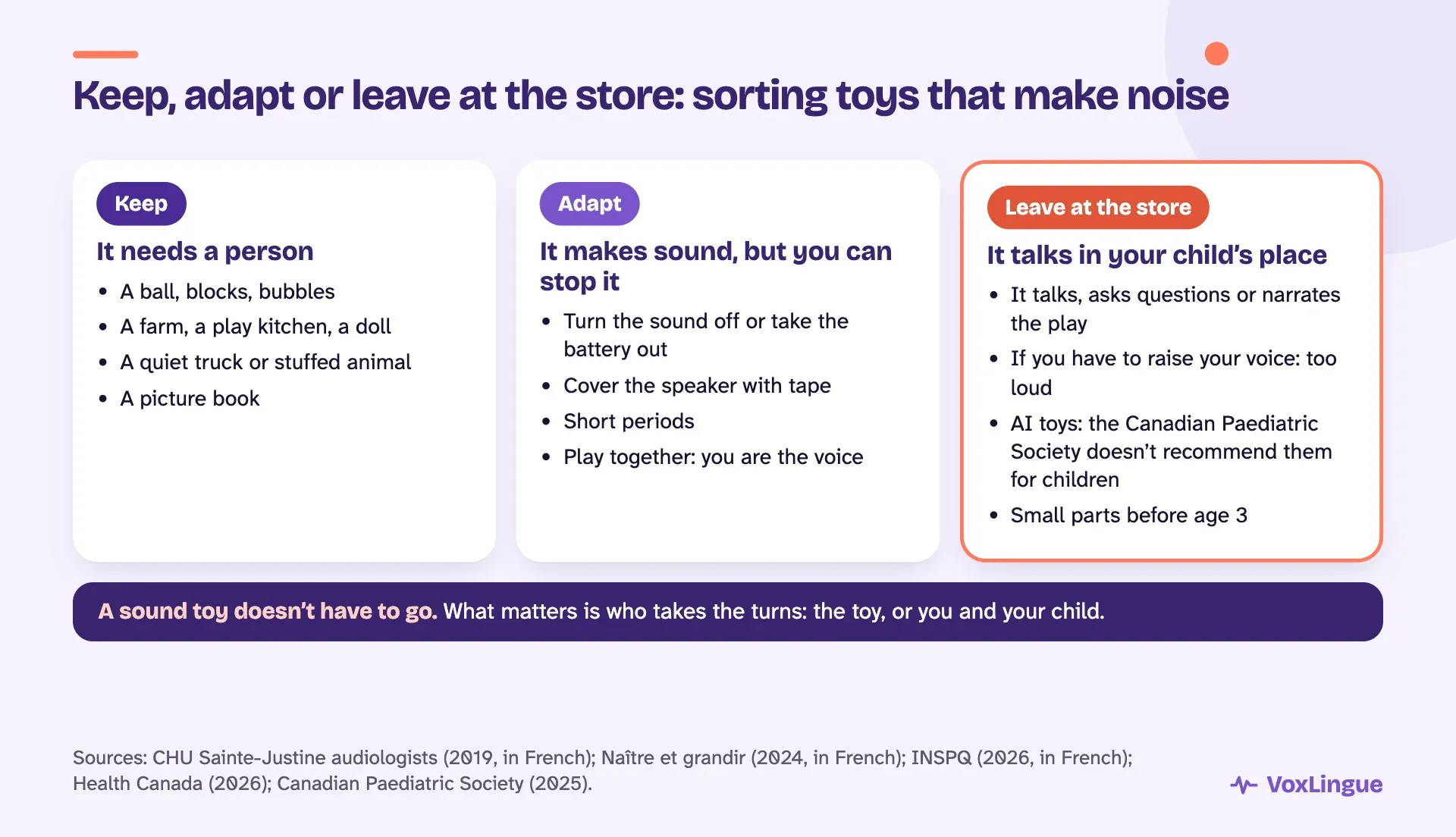
With a button toy, become the toy’s voice. Your child presses the cow button, the sound is off, and you wait a moment. Then you say: “Moo! The cow.” The toy no longer talks for your child: it gives you both a reason to talk.
AI plush toy or chatbot toy: should you give one to a toddler?
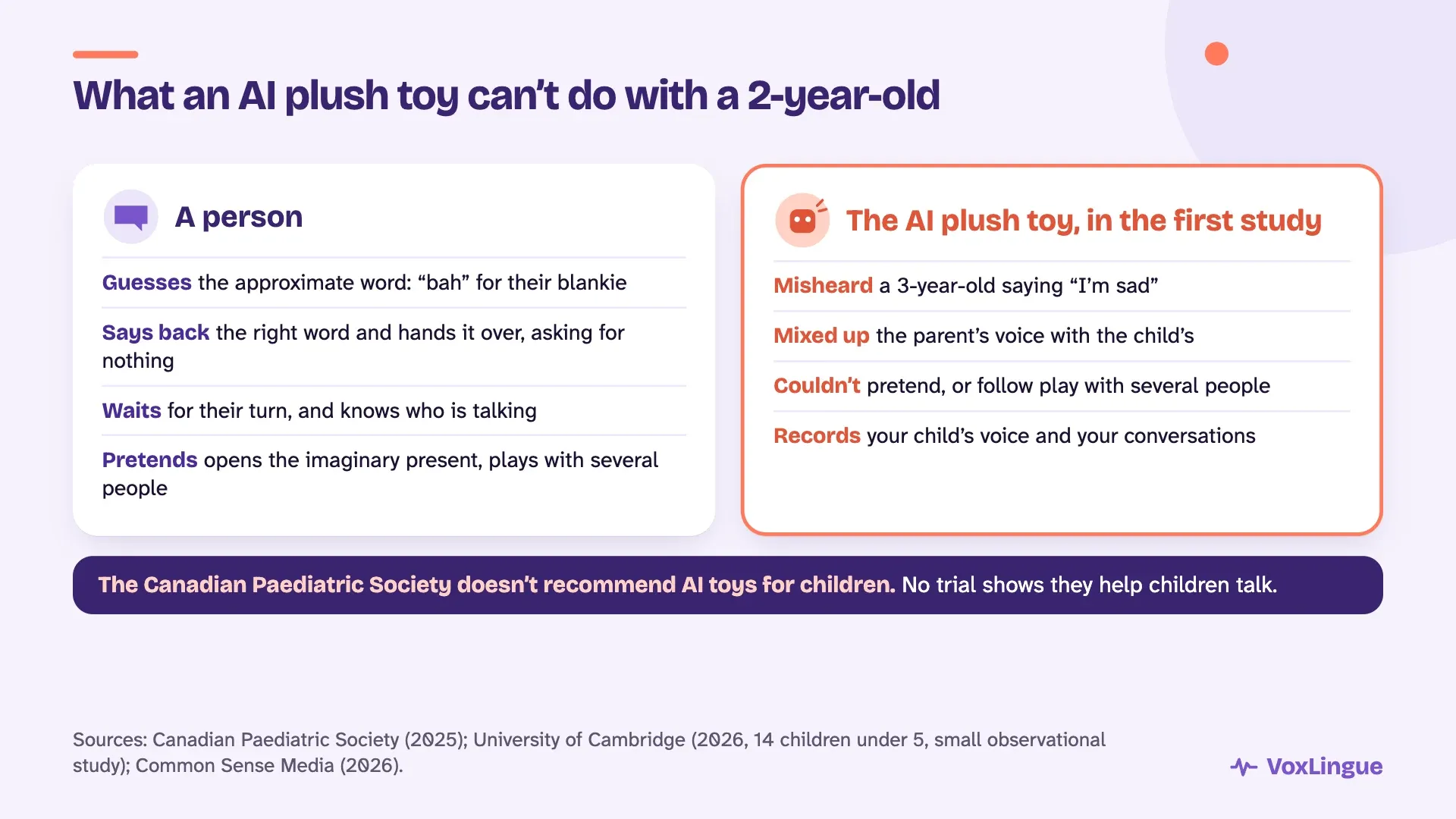
The Canadian Paediatric Society doesn’t recommend AI toys for children. No trial shows they help children talk. The first study saw an AI plush toy misunderstand young children and mix up their voices. To learn to talk, a toddler needs a person who understands them and answers.
What these toys are in 2026
They are plush toys, dolls or small robots connected to artificial intelligence. According to the Canadian Paediatric Society, they are often marketed as trusted friends who listen to children and respond to them “like humans” (Are AI toys safe for young children?, 2025).
Its conclusion is clear: child health and development experts don’t recommend AI toys for children. The best toys, it says, encourage activity, imaginative play or motor skills. The page is filed under “Under age 5”. Common Sense Media, a US organisation that rates children’s products, also says no AI toys for children 5 and under (2026).
The American Psychological Association’s magazine describes them as toys designed to hold conversations, remember details and keep the child engaged as long as possible (2026). Some work on a subscription.
What the first study saw
There is still no trial of these toys’ effect on young children. A 2026 review, still a preprint, found only 7 studies on generative AI toys for children 5 and under. They offered little to no evidence on development, learning or privacy (Goodacre and colleagues, 2026).
The first observational study comes from the University of Cambridge in the United Kingdom. The team filmed 14 children under 5 playing with an AI plush toy for the first time. A 3-year-old told it “I’m sad”: the toy misheard and changed the subject. It also mixed up the parent’s voice with the child’s (University of Cambridge, 2026).
The plush toy struggled to pretend: it wouldn’t open an imaginary present, and it struggled when several people played together. The children, though, hugged it and said they loved it. It’s a small observational study, not a trial, but it fits the Canadian Paediatric Society’s caution.
Why a toddler’s speech throws them off
A toddler still says words approximately, and a machine understands them poorly. Roberta Golinkoff, a US researcher who studies young children’s language, is skeptical that AI toys can help. Their speech is hard to decode, she explains, even for sophisticated speech-recognition systems (2026).
A parent, though, guesses. Your child points at the bed and says “bah”. You realise they want their blankie, you say “Your blankie!” and you hand it over. They hear the right word at the exact moment they want it, without being asked for anything.
Roberta Golinkoff and her colleague Kathy Hirsh-Pasek put it this way: children learn to talk through thousands of back-and-forth exchanges between two people, not on their own.
Your family’s voices and your data
These toys record your child’s voice and your family’s conversations. In a Common Sense Media survey, more than 8 in 10 parents said they were concerned about the personal information collected on their child (2026). In a test by the same organisation, 2 of the 3 toys assessed had data breaches.
They are also designed to create attachment. Before buying one, read where the recordings go. If one is already at home, keep it in a shared room, play with it together and talk about what it says.
What about kids’ tablets?
A kids’ tablet is still a screen, even when it’s shaped like a toy. The same goes for video toys and “learning” screens. For guidance, see what research really says about screens. One exception: a communication tablet, used in speech therapy to help a child express themselves, is not screen time.
What to give at Christmas to help a toddler talk, from 18 months to 3
Give a simple toy, one that needs an adult to work. A ball, blocks, a play kitchen, a farm, bubbles or a book all work well. Choose it for what interests your child and how they play, not the age on the box. One or two gifts are plenty, especially if someone sits down to play.
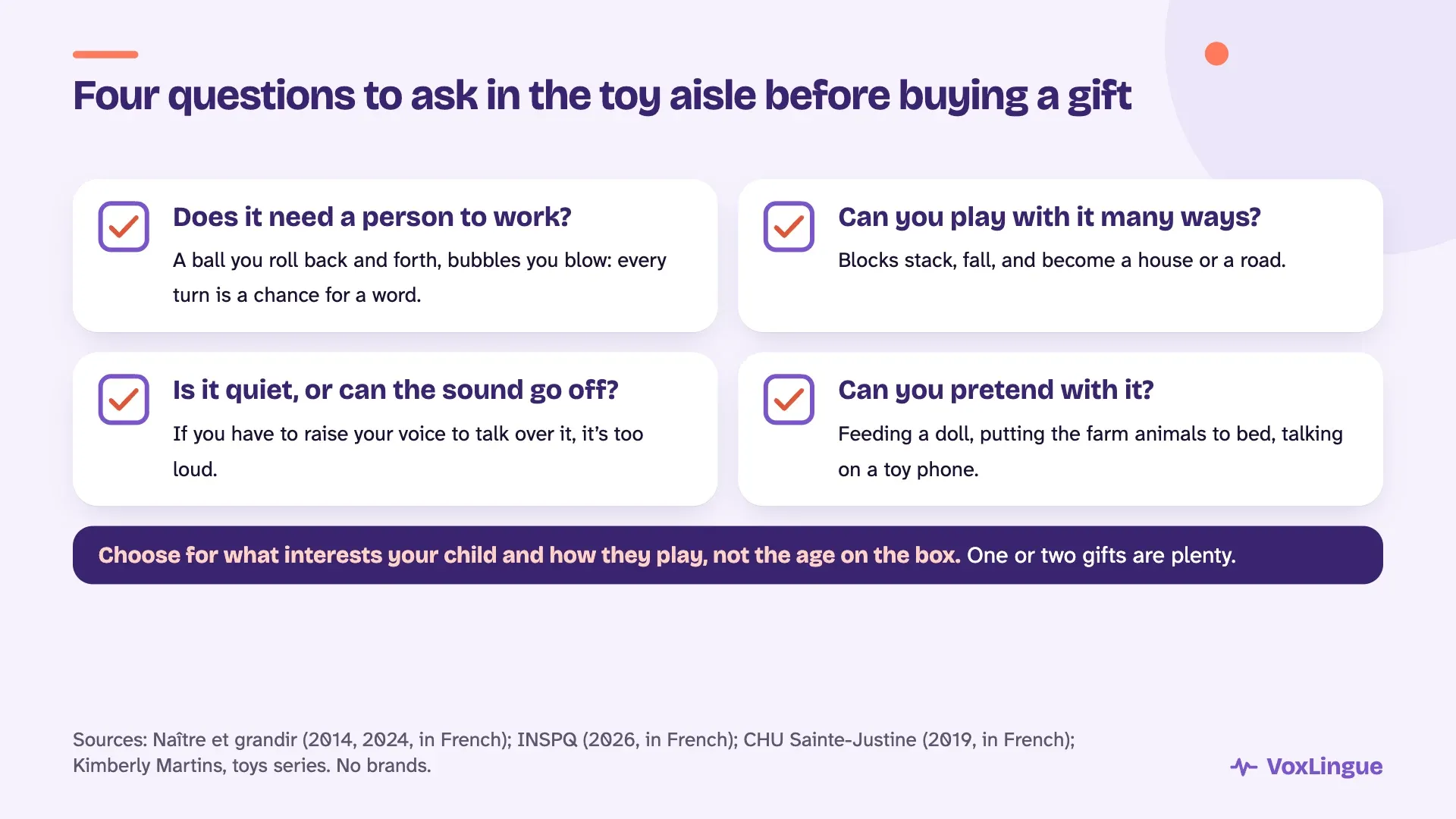
Bubbles, a ball, blocks you stack and knock down, a little car that goes and comes back: every turn is a chance for a word. In her series, Kimberly Martins wrote that bubbles are a must for any kiddo. These toys don’t talk, and that is exactly what leaves room for your voice and your child’s. In the toy aisle, four questions help you sort.
By age: the toy types Kimberly Martins published
Kimberly Martins published a list of toy types by age band. It comes from Kimberly’s guide to play development from birth to 3, and here it is, without brands:
- 12 to 18 months: blocks, balls, picture books, nesting and sorting toys, simple puzzles, push and pull toys, modelling clay, and crayons.
- 18 to 24 months: a play kitchen or picnic set, a shopping cart, dolls, smaller blocks, toy instruments, thick wooden puzzles, a train set, and a ball.
- 2 to 3 years: dress-up clothes, a doll house, small household objects for pretend play, building sets, toys with keys and doors. Add first board and memory games, story books, art supplies and sports toys.
These bands are about toys, not about what your child should be able to do. A toddler who talks little often enjoys toys from the band before. That’s fine: choose for what your child does and enjoys, not the box.
On safety, no small parts before age 3: if a piece fits through a toilet-paper roll, it’s too small. Be careful with button batteries, and check recalls (Toy safety tips, Health Canada).
Pretend play, a safe bet
Pretend play and language go together. A meta-analysis by Australian researchers pooled 35 studies and 6,848 children. It found a modest but robust link between pretend play and language (Quinn, Donnelly and Kidd, 2018). It’s a link, not proof that one causes the other.
The Naître et grandir speech-language pathologist calls pretend play a safe bet (in French). Another Naître et grandir article notes that dolls and imitation games help develop language and social skills.
At 2, pretending means feeding a doll, talking on a toy phone or putting the farm animals to bed. Kimberly Martins suggested a farm set and a baby doll set for exactly this. Every action calls for a word: “Baby’s hungry.” “Hello?” “Night night, piggy.”
Books count too
A book is a gift that gets adults talking. In Poland, a study followed 104 babies from 4 to 12 months. Parents talked more while looking at a book than while playing with a toy or a rattle, and there were more back-and-forth exchanges from 9 months (Laudańska and colleagues, 2025).
These babies are younger than the toddlers in this guide. In Québec, the INSPQ also recommends shared reading to support young children’s language (2023). And there’s no need to read every word: our guide above explains how to look at a book without reading the text. And if your toddler won’t sit for a story, see how to read with a child on the move.
How many toys? Fewer, and in rotation
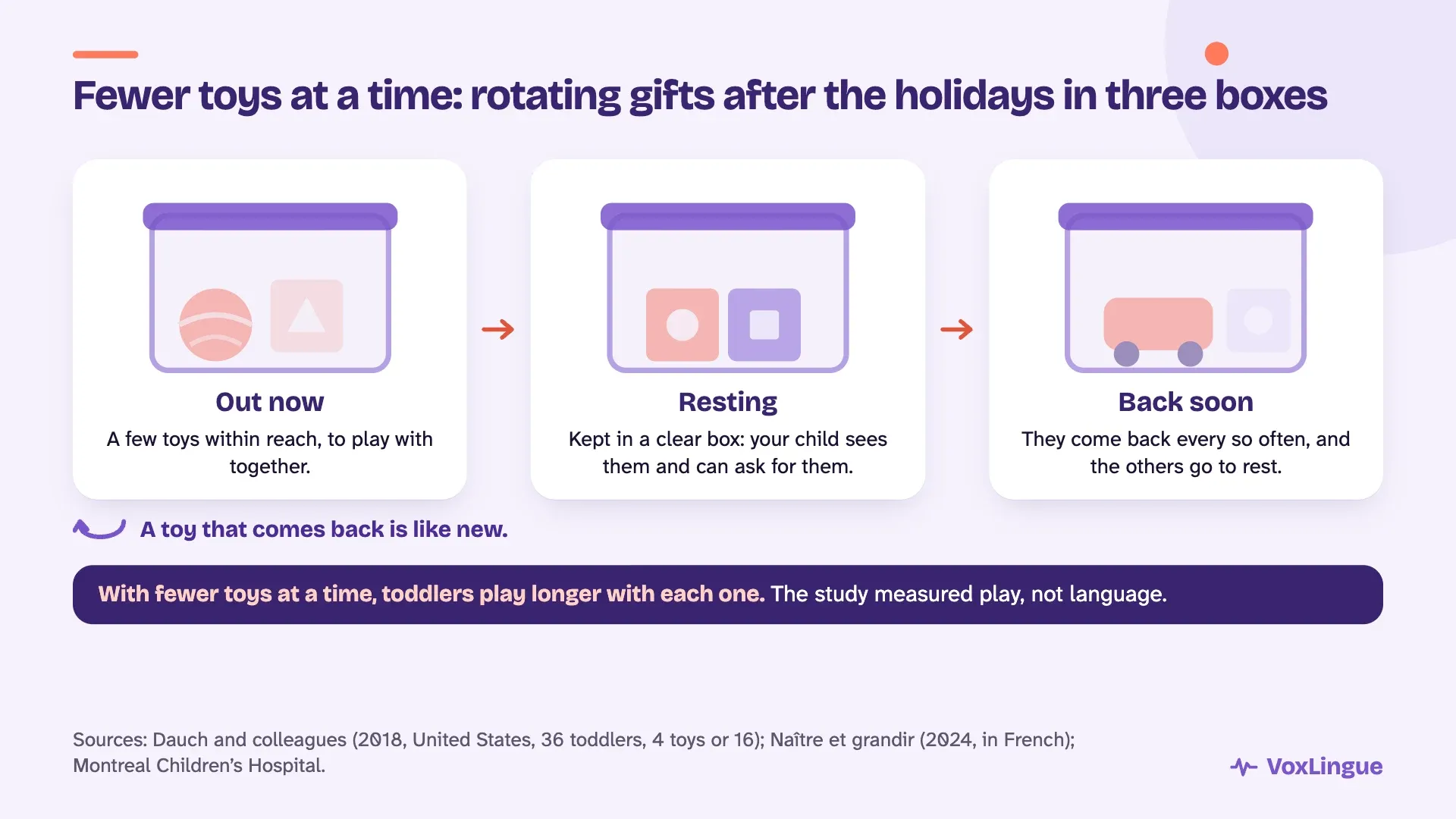
Fewer toys at a time often means more play. In a US study, 36 toddlers played once with 4 toys and once with 16. With 4 toys, they played longer with each one, and in more ways (Dauch and colleagues, 2018). The study measured play, not language.
Naître et grandir says it in its own way: when a child has too many toys, they stop seeing them. Better to buy fewer, of better quality.
After the holidays, put some of the gifts away in clear boxes, as the Montreal Children’s Hospital suggests: your child sees the toy and can ask for it. Every so often, rotate the toys. A toy that comes back is like new.
How to give the toy and play so the words can come
Sit on the floor at your child’s level, let them choose, and name what they do. Say the word yourself, wait a few seconds, then give them what they want, even if they don’t say it. Never “say it” before giving: it’s the pause, not pressure, that leaves room for their words.
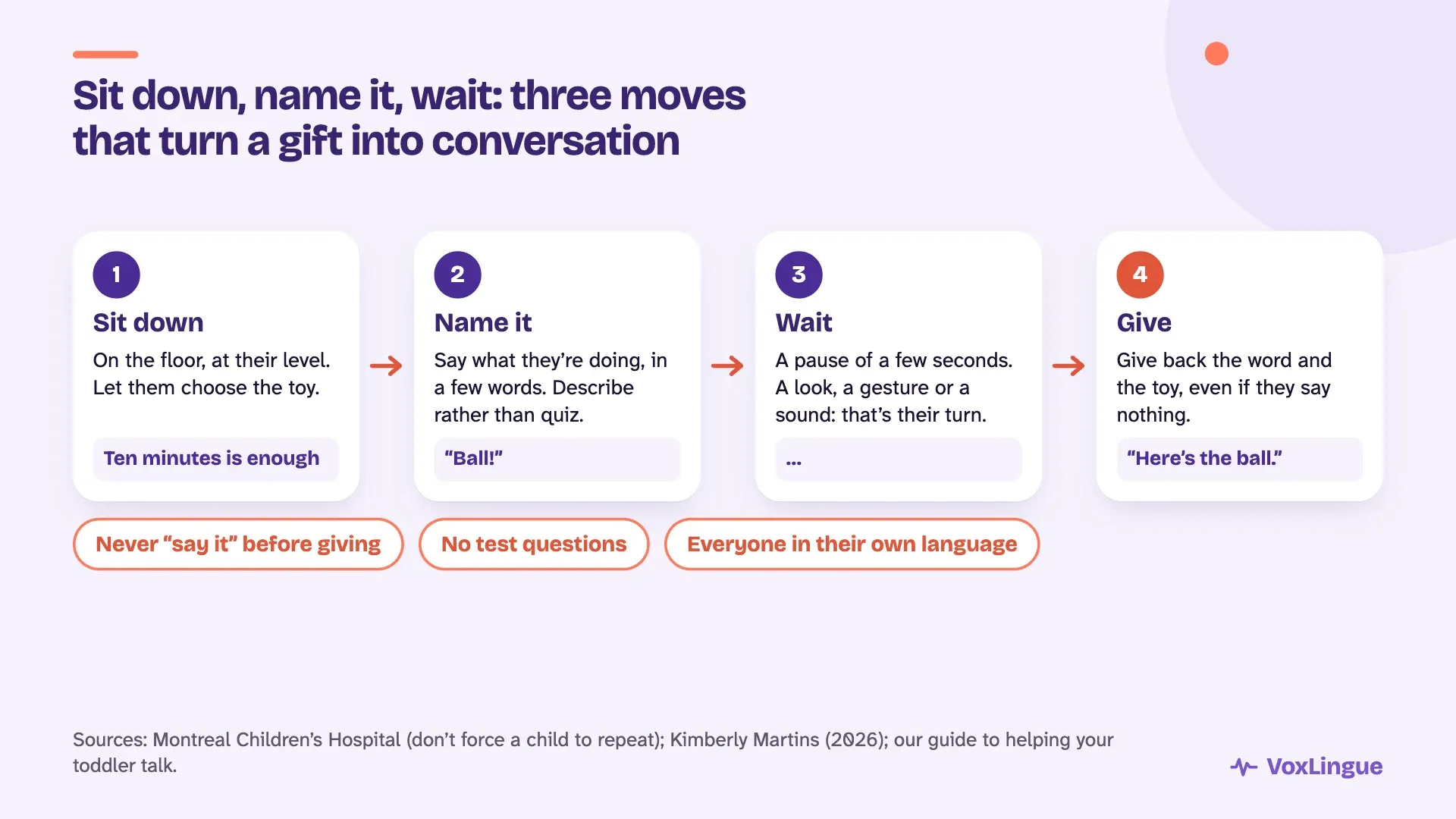
The word, a pause, then the toy, even with no answer
Say the word, wait, then give, whether your child answers or not. Kimberly Martins is clear on this: making a child repeat before giving them something has to stop right away. The Montreal Children’s Hospital agrees: forcing a child to repeat can put pressure on them and make them less keen to talk.
Describe rather than quiz: “The cow’s in the barn!” invites, while “What’s that?” turns play into a little test.
Here is what it looks like with three simple gifts:
The ball: “Ball!” You hold it for a moment and wait. Your child reaches out or makes a sound. “Here’s the ball.” It rolls: “Boom!”
The bubbles: you hold the closed jar and wait. Your child looks at you or reaches out. “Bubbles!” You blow. “Pop, pop!”
The farm: your child puts the horse in the barn. “Horse is sleeping. Shh!” You wait. If they say “night night”, you answer: “Yes, the horse is going night night.”
You can also keep a favourite toy out of reach, in a clear box. Your child sees it and has a reason to ask, with a gesture, a sound or a word. Give it without a long wait: the goal is an exchange, not frustration.
Several languages: the toy doesn’t choose, people do
The toy doesn’t choose the language: the people who play with it do. Each adult can play in the language they know best. The Montreal Children’s Hospital says it too: each family member can use the language they prefer.
A grandmother can play kitchen in Arabic, and you in English or French. Kimberly Martins wrote in her series that her play tips work in either language. There’s no need for a toy “in English”.
And to see where your child is, remember counting words across all their languages, including the ones they only say at their grandparents’.
The printable gift list for grandparents
The list fits on one page. It gives toy types by age, without brands, what can stay at the store, and three moves for playing with your child. Print it or send it before the holidays: it helps grandparents choose with confidence, and sit down to play.
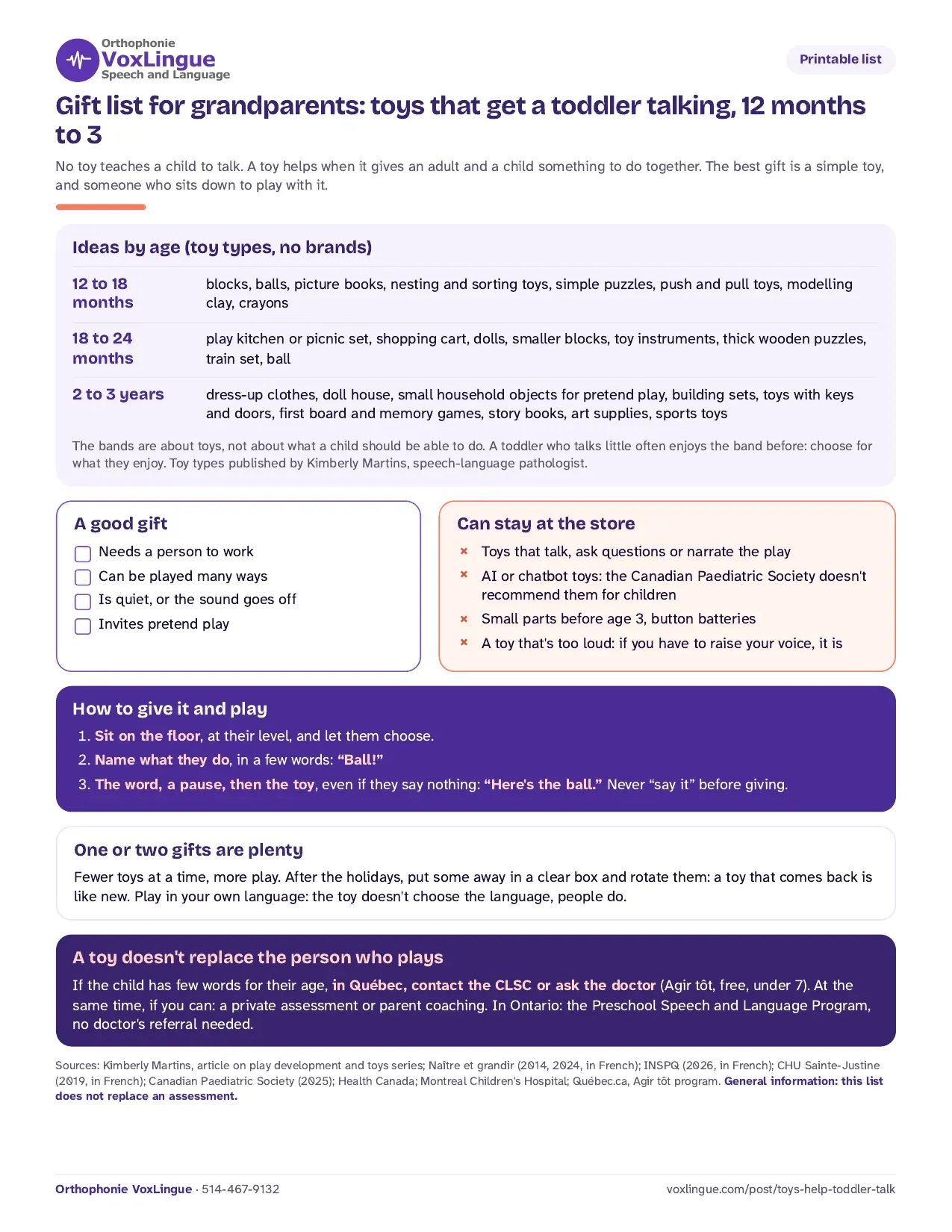
Printable list: Gift list for grandparents: toys that get a toddler talking, 12 months to 3 (PDF, 1 page).
The toy types come from the list Kimberly Martins published. Share it gently: “Here’s what helps them right now” goes down better than a rule.
And if the talking toy is already wrapped under the tree? Just say thank you. Turn the sound off or play with it together, then add it to the rotation after the holidays. It isn’t a mistake: it’s one more gift to play with together.
When a toy isn’t enough: who to talk to in Québec and Ontario
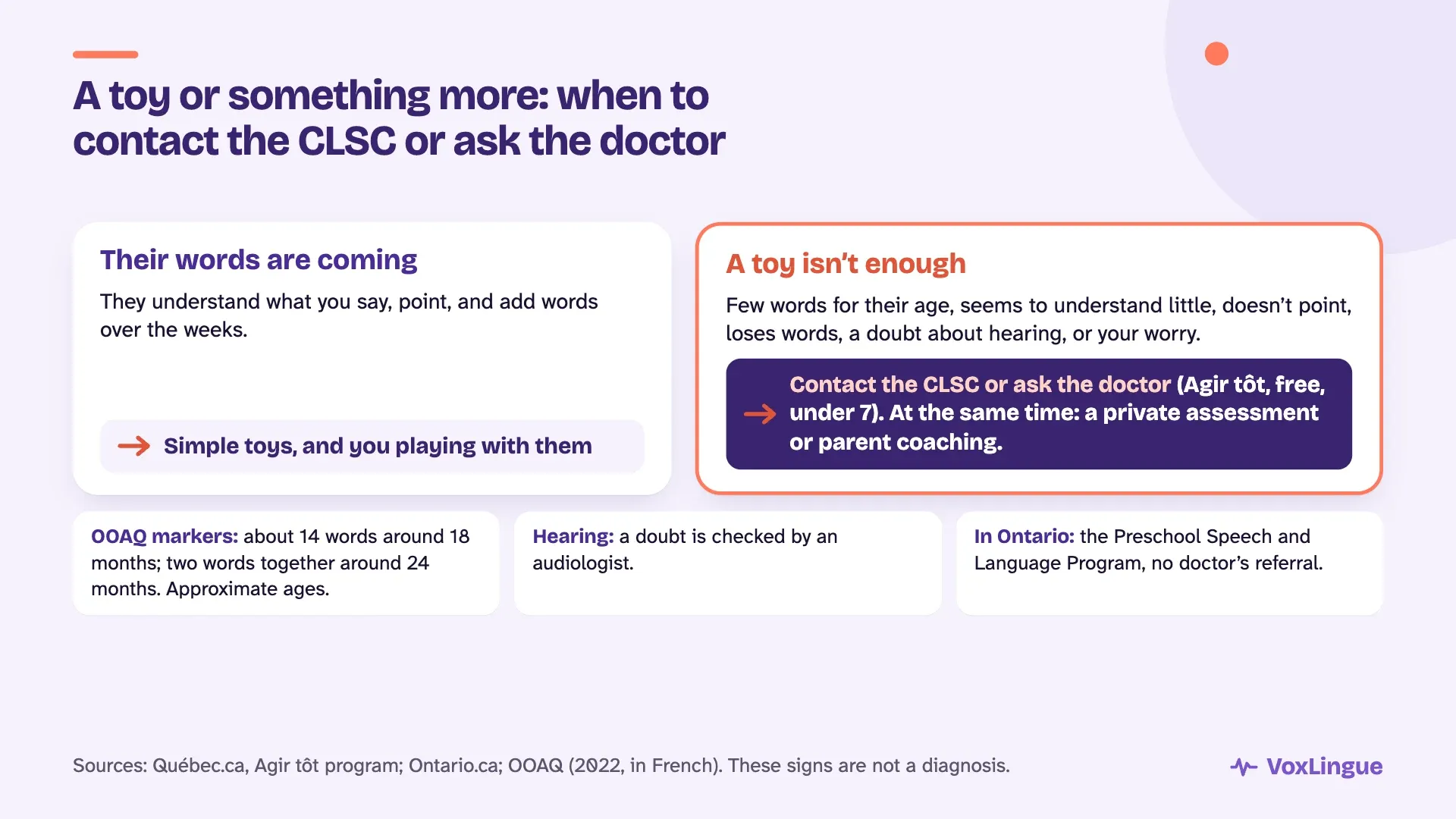
A toy doesn’t replace the person who plays. If your child has few words for their age, contact the CLSC or ask the doctor. At the same time, if you can, book a private assessment or parent coaching. The two go together.
Talk to someone without waiting if your child:
- says few words around 18 months (the OOAQ, Québec’s professional order of speech-language pathologists and audiologists, uses about 14 words at that age as a marker);
- isn’t yet putting two words together around 24 months, like “daddy gone” or “want apple”;
- seems to understand little of what you say, or doesn’t point to show you things;
- loses words they used to say;
- doesn’t seem to hear well.
Talk to someone, too, if you’re simply worried. These ages are approximate. See also our article on a 2-year-old who isn’t putting two words together yet. A doubt about hearing is checked by an audiologist.
In Québec, start with the public network. The Agir tôt program serves children under 7, free of charge, and you can contact your CLSC directly (Agir tôt program, Québec.ca). The 18-month vaccination visit is another chance to raise it. At the same time, going private lets you move forward without waiting.
In Ontario, the Preschool Speech and Language Program sees children with no doctor’s referral needed. We also offer online sessions for Ontario families.
Parent coaching means a speech-language pathologist helps you use these moves in play, with your child and their toys. A few members of our team are Hanen-trained, and all of us use Hanen principles. See our parent coaching, inspired by Hanen programs.
Key takeaways
The best toys that help speech development are simple, and they need you.
- No toy teaches talking. A toy helps when it creates back-and-forth with an adult.
- With a talking toy, parents and children talk less, according to small studies. A sound toy can stay: turn the sound off or play with it together.
- The Canadian Paediatric Society doesn’t recommend AI toys for children. No trial shows they help children talk.
- One or two simple gifts are plenty: a ball, blocks, a play kitchen, a farm, bubbles, a book. The word, a pause, then the toy, never “say it”.
- If your child has few words for their age, contact the CLSC or ask the doctor, and at the same time, a private assessment or parent coaching.
Next step
The most useful gift may be the one that changes the conversation. Discover our parent coaching, inspired by Hanen programs: a speech-language pathologist helps you turn play into back-and-forth. If their words worry you, see a language assessment for your toddler. Our speech-language pathologists see families at our Marché Central clinic in Montréal, and by telepractice across Québec and Ontario.
For the grandparents, print our list: Gift list for grandparents: toys that get a toddler talking, 12 months to 3 (PDF, 1 page).
Frequently asked questions
Is a talking toy bad if we play with it together?
No. If you play with it together, you take the turns, and the toy becomes a reason to talk. Turn the sound off or down to the minimum, and become the toy’s voice. What the small studies suggest is mainly to avoid toys that narrate the play or ask questions in your child’s place.
My toddler loves a toy that sings: should I take it away?
No. Keep it for short periods, lower the volume or take the battery out, as the CHU Sainte-Justine audiologists advise. Sing along with your child, stop before the end of a line and wait: a sound or a gesture from them is enough to keep going. The toy stays a pleasure, and the song becomes an exchange.
Do “educational” or “learning” toys help toddlers talk?
No better than everyday objects, according to the INSPQ (in French). Many so-called “educational” toys are expensive and don’t support development any better. What helps children talk is the back-and-forth with you around the object, more than the object itself, whatever the box promises.
Do we need toys in each of our languages?
No. The language lives in the person who plays, not in the toy. Each adult can play in the language they know best: kitchen in Arabic with Grandma, blocks in English with you. Count your child’s words across all their languages together, and choose toys that don’t talk.
Is a book a good gift for a toddler who talks little?
Yes. In a Polish study of 104 babies, parents talked more while looking at a book than while playing with a toy or a rattle. A picture book, like the ones on Kimberly Martins’s list, works very well. You don’t need to read the text: name what your child points at, wait, and let them turn the pages.
The grandparents already bought a talking toy: what now?
Just thank them. Turn the sound off or play with it together, and put it into the rotation after the holidays so it comes back like new. Next year, send them our printable list before they go shopping. It gives them simple toy ideas, and three moves for playing with their grandchild.
Can a toy replace speech therapy for a toddler who talks little?
No. A toy doesn’t replace the person who plays, or an assessment. If your child has few words for their age, contact the CLSC or ask the doctor. At the same time, if you can, a private assessment or parent coaching. For what comes next, see our article: will their difficulties pass?