My toddler won't sit for a book: what's normal from 1 to 3 when they run off, flip the pages or chew the book, and how to read with a child on the move

You open the book and your toddler grabs it. They flip three pages at once, chew the corner of the cardboard, then head back to their toy cars. Later that evening, you type the question: my toddler won’t sit for a book, or even sit still for a story. Is that normal?
At this age, a book isn’t read the way it is with an older child. Kimberly Martins, speech-language pathologist and founder of VoxLingue, wrote in 2024 that with toddlers, books are mostly for talking about the pictures together, not for reading every word. For how to do that, see how to share a book without reading the words. This guide doesn’t repeat it.
Here we look at what your child is doing with the book, and why. You’ll also find how to read with a child on the move, where the “minutes per year of age” myth comes from, and which signs matter more than sitting still.
My toddler won’t sit for a book: is it normal?
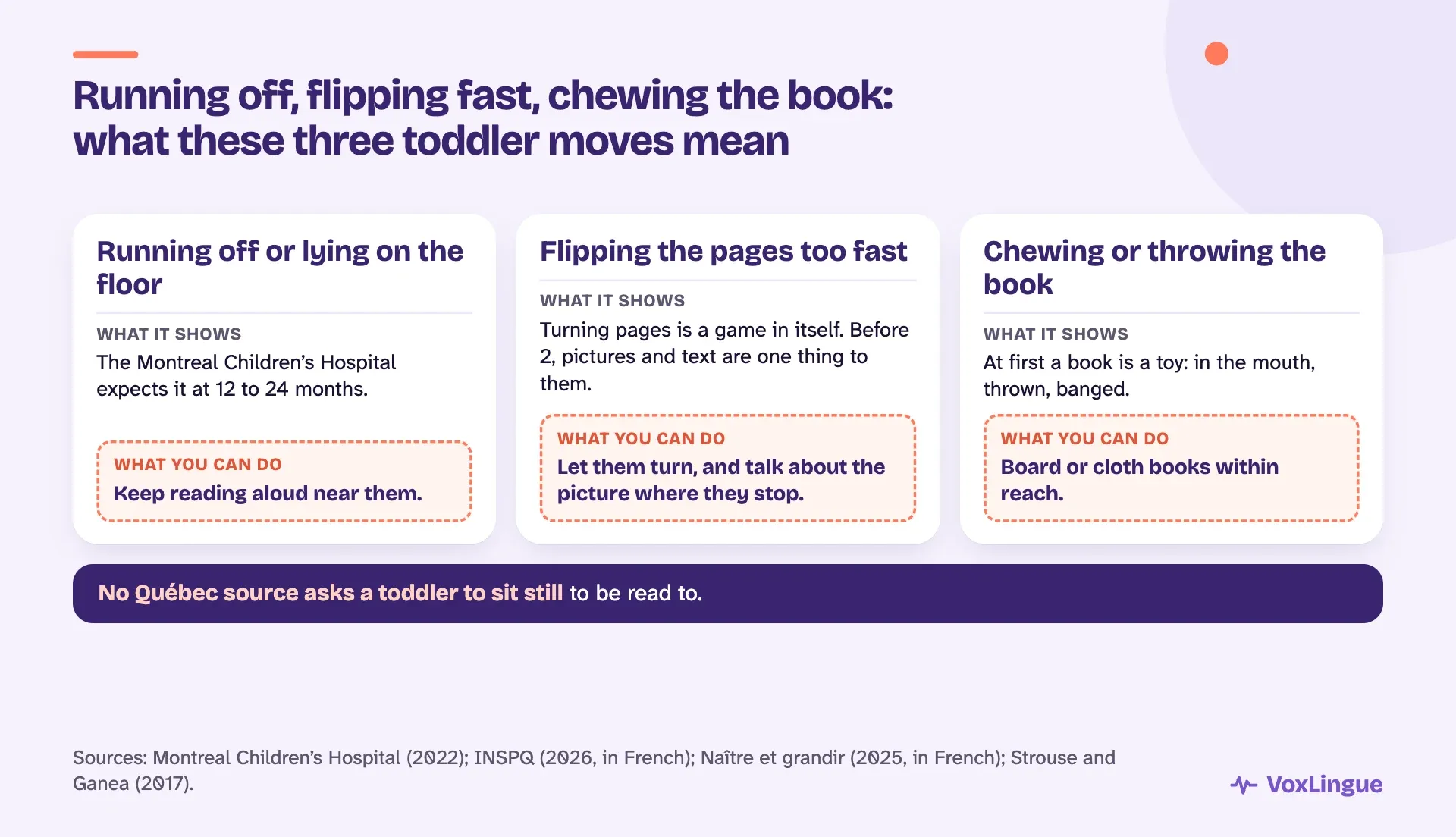
Yes, it’s common between 1 and 3. The Montreal Children’s Hospital expects toddlers to lie on the floor or move around while you read. The INSPQ, Québec’s public health institute, says that at first a book is a toy. Running off, flipping fast or chewing is often how a toddler explores a book.
Two Québec institutions say so plainly. The Montreal Children’s Hospital has a leaflet for parents of children aged 0 to 2 (Read to your baby and young toddler, 2022). It says that at 12 to 24 months, children may want to lie on the floor or on the bed, or move around while reading books.
The Institut national de santé publique du Québec (INSPQ) agrees. At first, it writes, a book is a toy for your child: they put it in their mouth, throw it, bang it. Its advice fits in three words: let them explore (Livres, 2026, in French).
Naître et grandir, in a page reviewed by a speech-language pathologist, adds that a toddler’s attention span is short: don’t insist on finishing if they’ve lost interest (2025, in French).
None of these sources asks a toddler to sit still to be read to. Sitting still is not what makes book time count. For more questions like this one, see our articles on reading, storytelling and literacy.
Running off or lying on the floor
A toddler who leaves halfway through the story is doing what the Montreal Children’s Hospital describes. They get up, fetch a toy, come back, lie down on the rug. For the hospital, that is a normal way to take part in book time between 12 and 24 months.
So there’s no need to bring them back to their spot. You can keep reading aloud near them, or take the book to where they’re playing. The section on reading with a child on the move gives practical ways to do this.
My toddler only wants to turn the pages
For a toddler, turning pages is a game in itself. A Toronto research team sums up older studies this way: page turning is very popular through the second year of life, then becomes less frequent around 24 months (Strouse and Ganea, 2017). The Montreal Children’s Hospital even suggests letting babies help turn the pages.
There’s a simpler reason too. According to the INSPQ, before age 2, children don’t yet tell pictures and text apart. For your toddler, there is no story to follow from one page to the next yet, only pictures to discover. They aren’t skipping the story: for them, it doesn’t exist yet.
Chewing, throwing or tearing the book
Putting a book in the mouth is part of exploring it. The INSPQ describes it this way: at first, a book goes in the mouth, gets thrown and gets banged. For younger babies, the Montreal Children’s Hospital even encourages letting them put the book in their mouth and mimic sounds.
Little by little, a finger takes over. Before age 1, the American Academy of Pediatrics warns that books often end up in the mouth. Between 12 and 18 months, it describes children who answer “Where is…?” by pointing to a picture with one finger.
From 12 months to 3: how a toddler goes from chewing books to listening to a short story
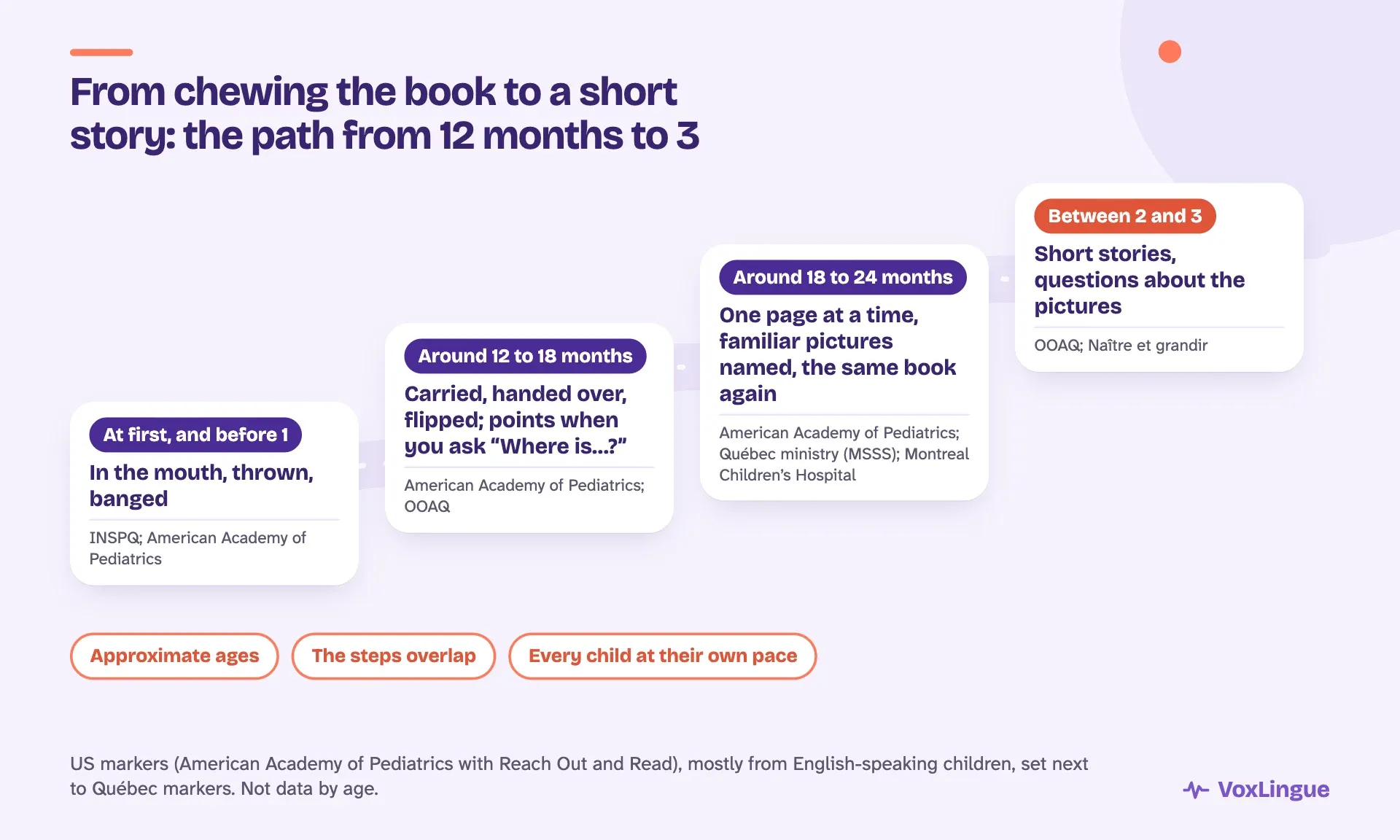
A book changes role between 1 and 3. First something to mouth and throw, it becomes something to carry, hand to you and flip through, then pictures to point at. Between 2 and 3, short stories take up more room. Every child moves at their own pace.
The ages below are approximate, and the steps overlap. Several markers come from the American Academy of Pediatrics with Reach Out and Read, so mostly from English-speaking children in the United States. We’ve set them next to Québec markers from the OOAQ, the Ministry of Health and Social Services, the INSPQ and the Montreal Children’s Hospital, which describe the same path for French-speaking families.
Around 12 to 18 months: something to explore, carry and hand to you
Between 12 and 18 months, books go for walks. According to the American Academy of Pediatrics, many toddlers carry their books around and hand them to you. They answer “Where is…?” by pointing to a picture with one finger. A book becomes a way of coming over to you.
Québec’s order of speech-language pathologists and audiologists (OOAQ) describes the same age from the communication side. The child points and tries to name things. They also start exchanges, for example by pointing to an object to show it to you. Kimberly Martins lists “identifies pictures in books by pointing” among her toddler milestones (2024).
Around 18 to 24 months: pointing, one page at a time, and the same book again
Around 18 to 24 months, little hands get more precise. According to the American Academy of Pediatrics, toddlers turn the pages of a board book and name familiar pictures. The Québec ministry’s two-year Agir tôt sheet lists turning the pages of a book one at a time among 24-month skills.
The OOAQ notes that between 18 and 24 months, children enjoy listening to short stories. According to the Toronto team’s summary, page turning for its own sake becomes less frequent around 24 months.
Your toddler often asks for the same book. The Montreal Children’s Hospital notes that at 12 to 24 months, toddlers like to hear the same book. Naître et grandir adds that this is normal: rereading reassures them, and they understand the story a little better each time.
Between 2 and 3: short stories and questions about the pictures
Between 2 and 3, short stories take up more room. The OOAQ describes adults reading short stories at this age and asking questions about the pictures. Naître et grandir suggests letting your child choose the book, reading the text and explaining it in your own words when needed, and using their name in the story.
Sitting longer is not, in itself, a marker for this age: none of the sources above sets it as a step to reach.
Around 3, Naître et grandir suggests following the words with your finger, to show that you’re reading the text and not the pictures. That’s the start of another stage, which builds gently before kindergarten.
How do I read to a toddler who never stops moving?
Let them move and keep reading aloud near them. The Montreal Children’s Hospital expects toddlers to move around during book time, and Naître et grandir says to follow their pace without insisting. Read at other times than bedtime, too, like bath time or before supper.
We found no study that tests reading with a toddler on the move. What follows puts the advice of these three Québec sources into practice. For how to share the book itself, see our guide linked above.
Read where they are
When they get up, the book can follow them. Sit near them, on the floor if that’s where they’re playing, and keep reading or talking about the picture out loud. The Montreal Children’s Hospital names the floor and the bed as normal places to read with a toddler.
Let them hold the book, open it, close it and turn the pages: that’s what the INSPQ means by letting them explore.
You don’t have to finish the book
You don’t need to reach the last page. Naître et grandir is clear: don’t insist on finishing the story if your child has lost interest. One page looked at together is still time spent around a book, however short.
You can come back to it later, at the same page if they want. No study has measured how many pages are “enough”: this advice comes from Québec sources, not from a trial comparing ways of reading.
Other times than bedtime
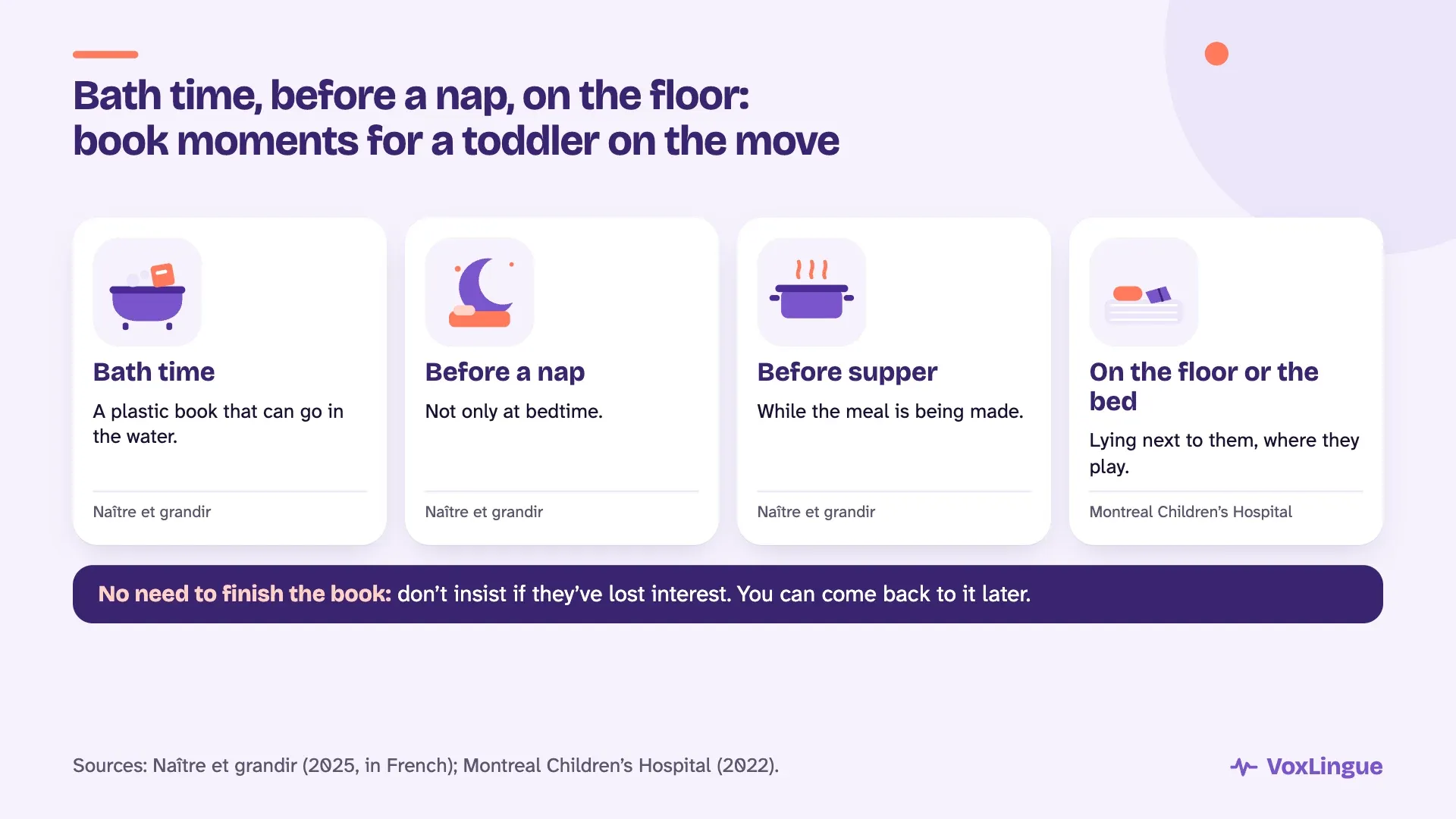
Bedtime isn’t the only time to read. Naître et grandir reminds parents that books fit other times of day, and the Montreal Children’s Hospital mentions reading lying down. A few times to try:
- bath time, with a plastic bath book;
- before a nap;
- before supper, while the meal is being made;
- lying on the floor or on the bed, next to them.
Some days, no book works. Nursery rhymes and songs also offer repeated words, no book needed: see ready-made words: nursery rhymes, songs and books.
Books that survive a toddler on the move
A sturdy book with few pages holds up better to an active toddler. The Montreal Children’s Hospital suggests a book made of board or cloth, with not too many pages. It also notes that babies like books with mirrors or materials they can touch. For the bath, Naître et grandir mentions plastic books.
Kimberly Martins wrote in 2024 that with toddlers aged 1 to 3, she likes using books with flaps and hidden items to get more engagement. She also suggests books without a lot of writing, as she explains in her article on early communication strategies. If you’re choosing a gift, see our ideas for toys and books to give a toddler: the same pointers apply.
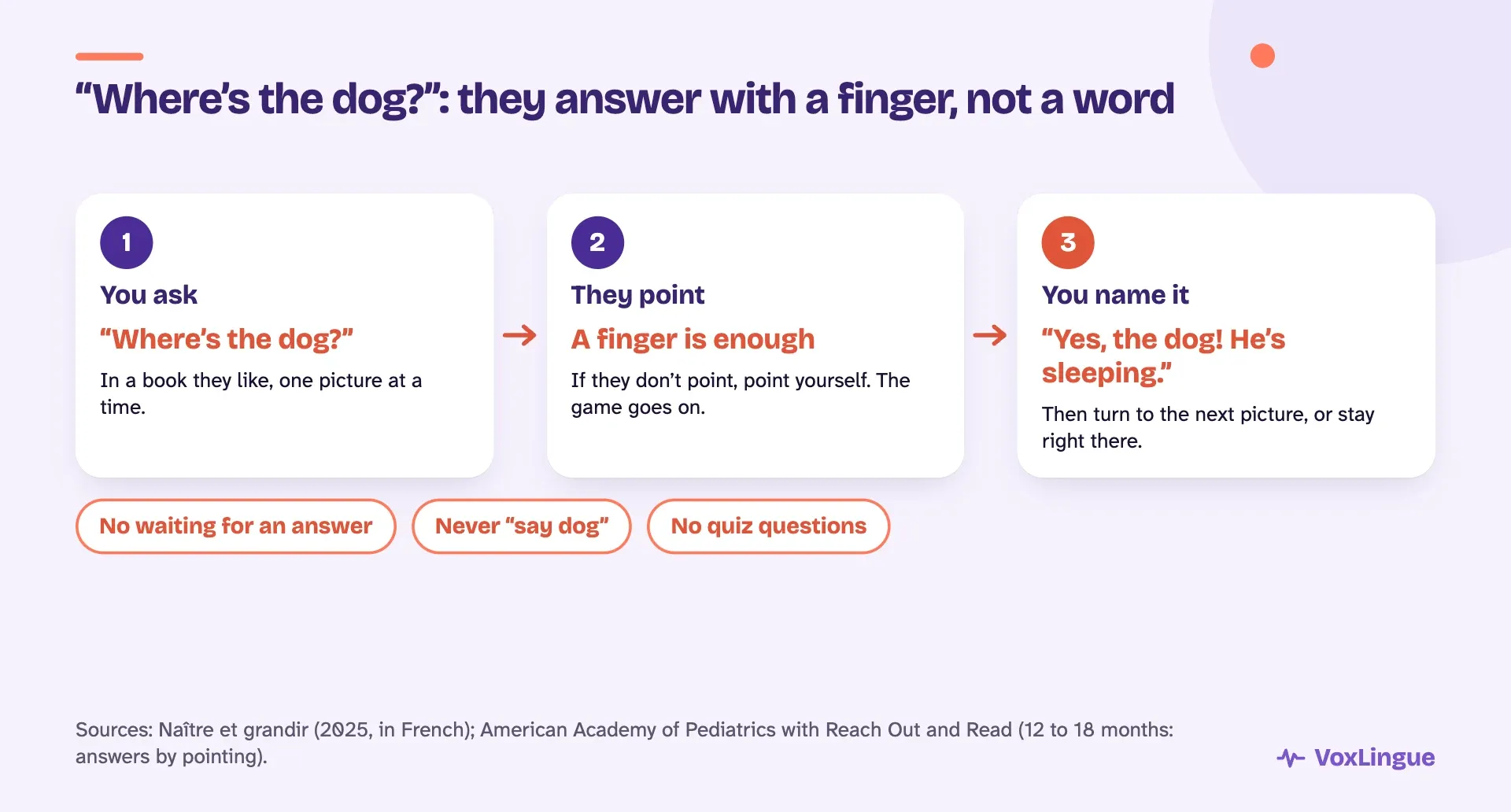
“Where’s the dog?”: a pointing game, not a test
“Where’s the dog?” can become a game where a finger is a full answer. Naître et grandir suggests naming the pictures as you point to them, and asking your child to show you things on the page (in French). It also suggests a few simple questions that start with “where” and “who”.
The game is simple. You ask, “Where’s the dog?” They point, and you name it: “Yes, the dog! He’s sleeping.” If they don’t point, point yourself and name it: “There’s the dog.” The game goes on, without waiting for an answer.
In a book they know by heart, you can pause briefly before a familiar word, if you like. Then say the word yourself, without waiting for them to say it.
What to skip: “Say dog,” or “What’s that?” when you already know the answer. These quiz questions turn the exchange into a test, and toddlers aren’t made to repeat words. Our guide on helping a toddler talk explains why, in its section on quizzing and “say it”.
When to stop
Stop when they’ve lost interest, without bargaining for one more page, as Naître et grandir advises. The INSPQ adds that some children develop an interest in reading less easily or less quickly. Its advice: keep books within reach and keep reading aloud beside them.
A book left open on the rug may well get picked up later, in their own way.
How long should a 2-year-old sit for a story? The minutes-per-year-of-age myth
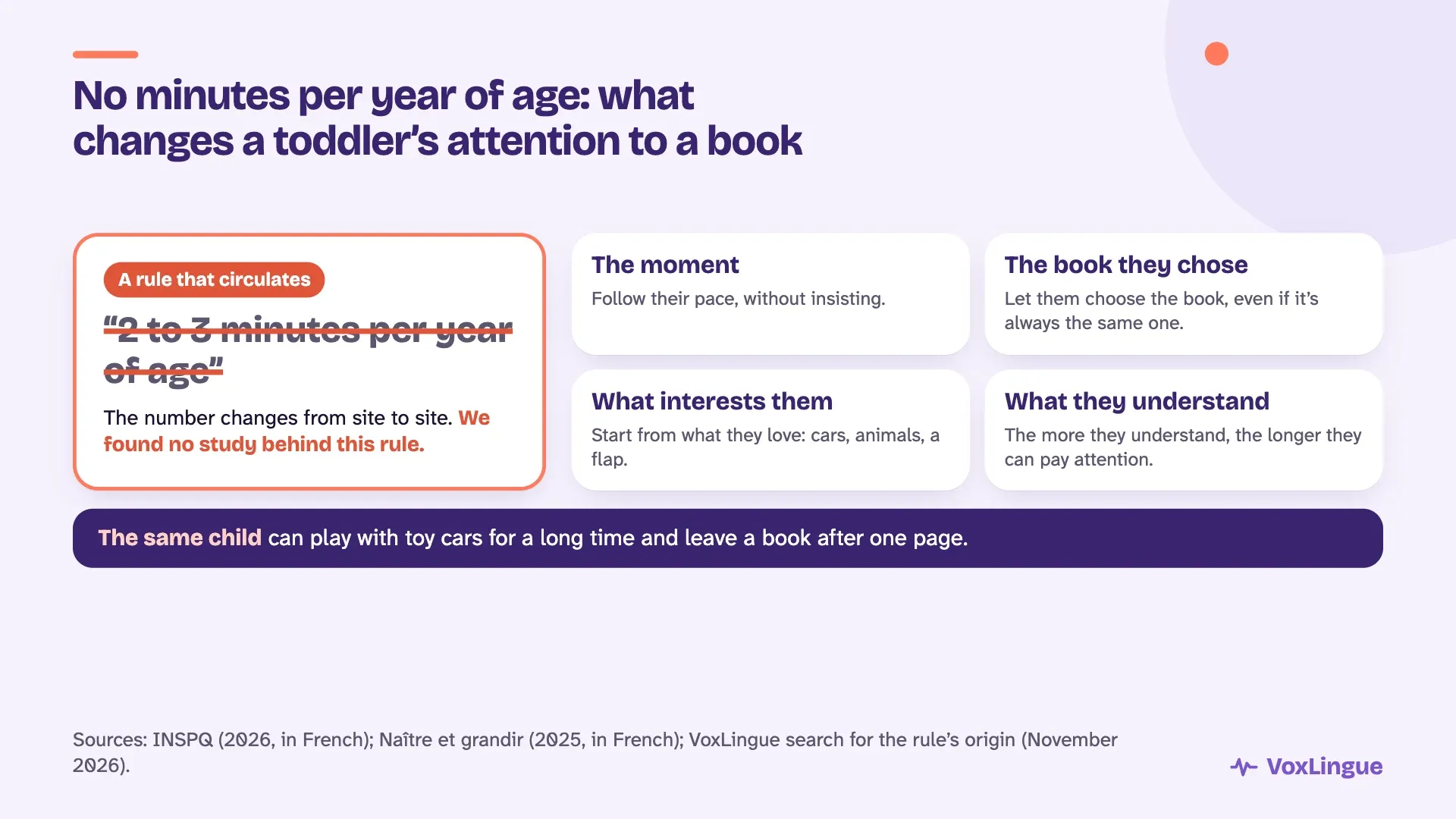
There is no normal length in minutes. The “minutes per year of age” rule circulates online, but we found no study behind it. A toddler’s attention grows as they understand more, and it changes with the moment, the book and what interests them.
You may have read that a child can pay attention for 2 to 3 minutes per year of age, or 5 according to other sites. This rule circulates on parenting advice sites and commercial sites, with a number that changes from one site to the next and no study cited.
We looked for its source and didn’t find one, and none of the Québec organisations we checked uses it: not the INSPQ, Naître et grandir, the OOAQ or the Montreal Children’s Hospital. We’re not saying no study exists, only that we found none.
The INSPQ explains instead that as children understand more, they can pay attention for longer. Naître et grandir advises following your toddler’s pace and attention span, letting them choose the book and starting from what interests them.
In practice, the same child can play with toy cars for a long time and leave a book after one page. Attention isn’t a fixed number: it depends on the moment, the activity and the book. Rather than counting minutes, notice what catches them: a flap, an animal, a page they know.
If my toddler doesn’t like books, are they missing out?
Books help a little, but they aren’t the only good time to talk. A large analysis brought together 54 studies with 5,569 children aged 7 or under, who mostly spoke one language, most often English (Noble and colleagues, 2019).
The result: reading books with children helps their language a little. But reading didn’t help more than other activities where an adult talks with the child, and the effect didn’t change with age.
In Québec, the INSPQ gives parents similar advice: some children come to books more slowly, and you can keep leaving books within reach. A book is a good setting for talk, not the only one. A toddler who prefers other shared moments isn’t missing the essentials if the talk happens elsewhere: at meals, in the bath, during play.
What do Québec families do with books? What the 2026 Growing Up in Québec data show
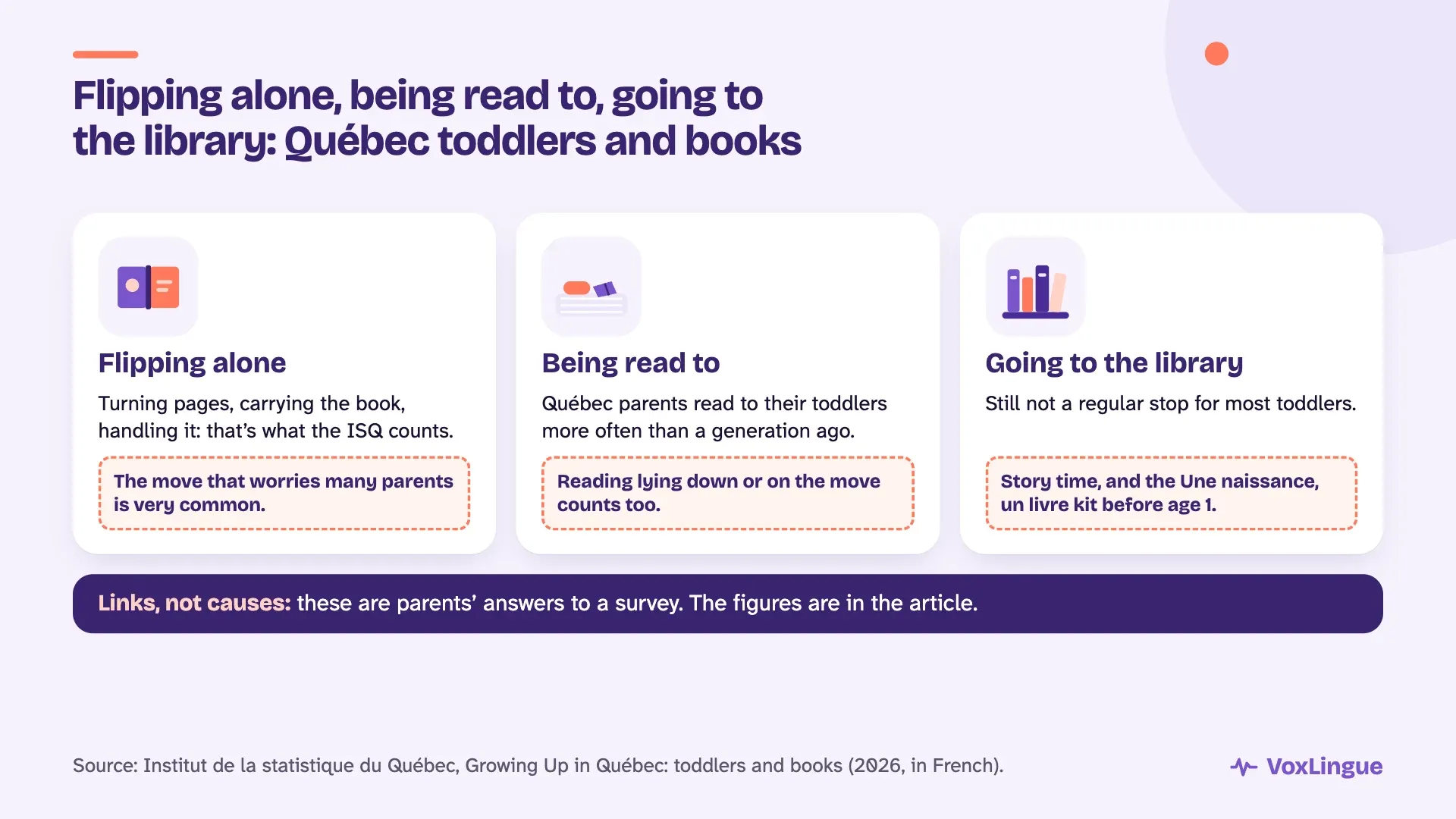
Québec parents read to their toddlers more than a generation ago. Today, an adult reads every day to 65% of 29-month-olds. And more than half of toddlers look through books on their own every day. That flipping is the very behaviour that worries many parents.
These figures come from the Institut de la statistique du Québec (ISQ). Its Growing Up in Québec study (Grandir au Québec) follows children born in Québec in 2020-2021: 4,703 at the start. At about 29 months, 3,589 families answered, from May 2023 to March 2024. In April 2026, the ISQ published what these families do with books (in French).
Québec toddlers meet books early: 82% were first read to before 6 months of age. An adult reads every day to 39% of 5-month-old babies and to 65% of 29-month-olds. A generation ago, among children born in 1997-1998, it was 40% at that age.
The ISQ also counts children who handle or flip through books on their own every day: about 62% of 17-month-olds and 57% of 29-month-olds. At about 2½, it was 66% a generation ago.
Yet “handling or flipping through books alone” is exactly what worries many parents: flipping fast, carrying the book around, chewing it. In the Québec data, a toddler who flips through books alone is the rule, not the exception.
The ISQ also sees a link with screens. Among children who spend more than 2 hours a day in front of a screen, 46% look through a book every day, compared with 67% of those who spend less than 30 minutes. Like all this survey data, it’s a link, not proof that screens are the cause. See what research says about screens and toddler language.
The library: story time and the Une naissance, un livre kit
Few Québec toddlers go to the library. According to the ISQ, at 2½, 59% never go, compared with 75% at 1½. About one child in four goes at least once a month, an estimate the ISQ flags as less precise.
Among toddlers who do go, 29% go for the Une naissance, un livre kit and 23% for a reading activity. This free kit, with a board book, is given when you sign up a child under 1 at a participating library. The INSPQ notes that many libraries offer it: worth remembering for a younger brother or sister.
Many libraries also offer story time and other activities for parents and toddlers, the Montreal Children’s Hospital and Naître et grandir point out.
When the book isn’t the real question: shared attention, hearing and vision
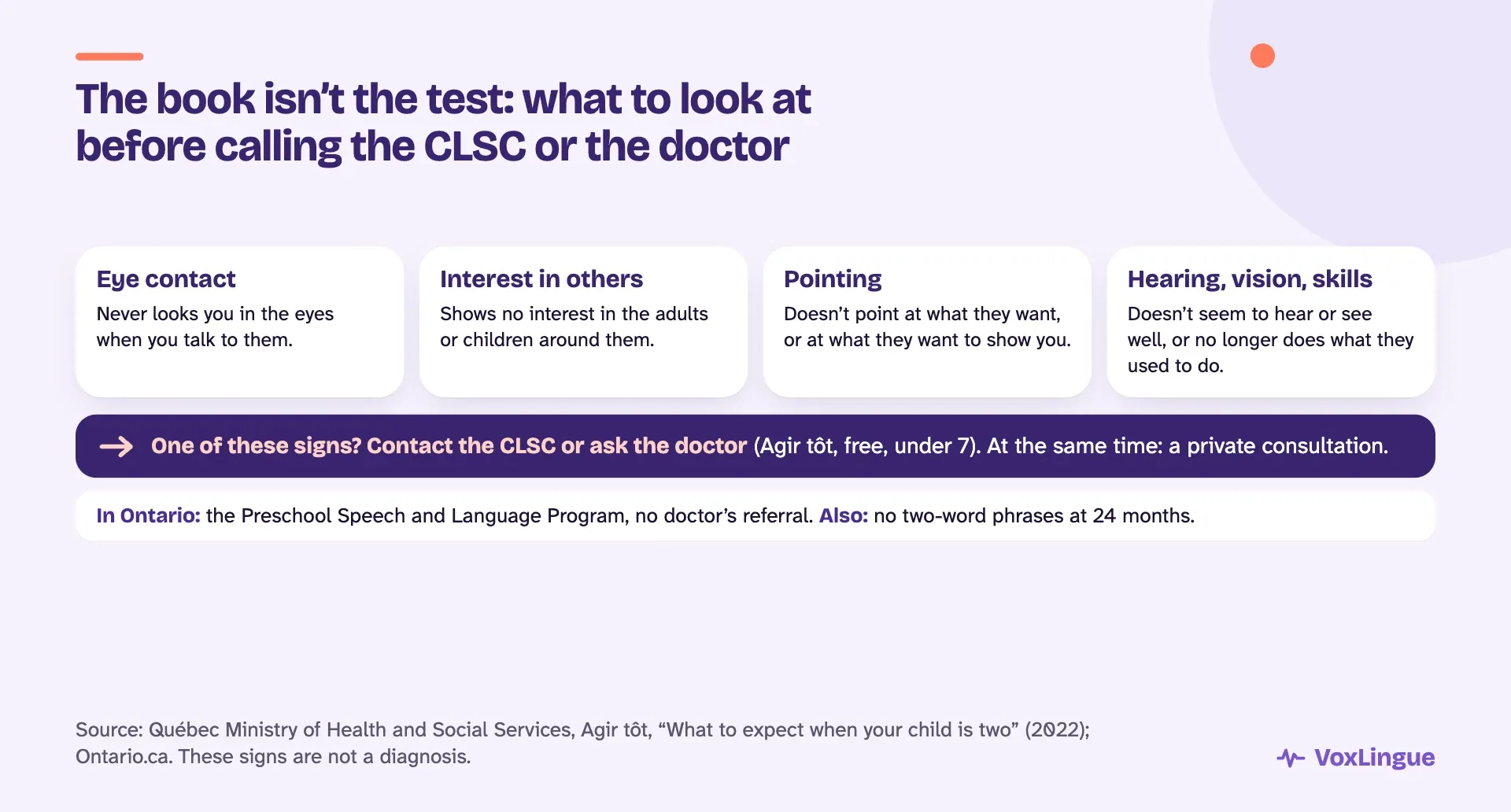
Sitting for a story isn’t on the Québec ministry’s list of warning signs. Its two-year Agir tôt sheet looks at eye contact, interest in others, pointing, hearing and vision instead. Those signs, all through the day, are the ones worth watching.
Between about 12 and 18 months, most children point to ask, then to show. Professionals call it joint attention when you both look at the same thing, knowing you’re looking at it together. See what professionals look at beyond words, like pointing to show.
A child who won’t sit for a book, but who points at a plane and checks that you saw it, is sharing attention with you. That’s what the ministry’s sheet asks parents to watch.
The Ministry of Health and Social Services sheet What to expect when your child is two (2022) says to contact the doctor, the specialized nurse practitioner or the CLSC without waiting if your child:
- never looks you in the eyes when you talk to them;
- shows no interest in the adults or children around them;
- doesn’t point with a finger at what they want, or at what they want to show you;
- doesn’t seem to hear or see well;
- no longer does something they used to do (see a toddler who stops saying words they used to say).
The same sheet also names no two-word phrases at 24 months. These signs are not a diagnosis. They mean it’s better to talk to someone without waiting.
Who to contact in Québec and Ontario
In Québec, start with the public system. Contact the CLSC or ask the doctor: the Agir tôt program offers free screening to children under 7. At the same time, a private consultation lets you find out without waiting what’s recommended, if you can.
If ear infections keep coming back, the doctor checks the ears and hearing. See our article on ear infections that keep coming back and hearing.
In Ontario, you can contact the Preschool Speech and Language Program yourself. It serves children from birth until they start school, and you don’t need a doctor’s referral. We also offer online sessions for Ontario families.
Key takeaways
A toddler who won’t sit for a book is often doing what other toddlers do.
- The Montreal Children’s Hospital expects toddlers to move during book time, and the INSPQ says that at first a book is a toy.
- Between 1 and 3, a book moves from the mouth to the hands, then to a pointing finger, then to short stories.
- Read where they are, without finishing the book, and at other times than bedtime. “Where’s the dog?” is played with a finger, never with “say dog”.
- There’s no minutes-per-year-of-age rule. Books help a little, like other moments when you talk together.
- If shared attention, hearing or vision worries you, contact the CLSC or ask the doctor, and see someone privately at the same time if you can.
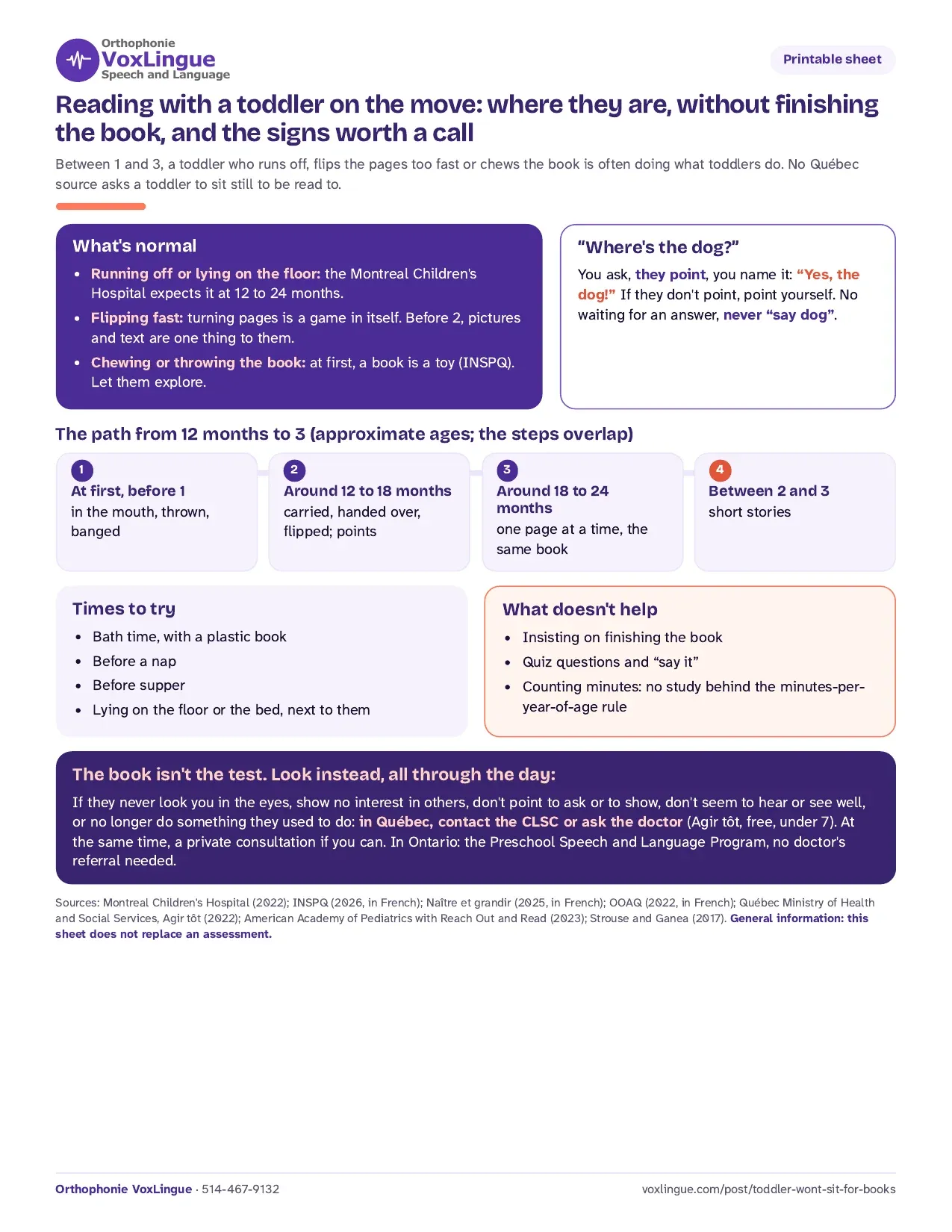
Printable sheet: Reading with a toddler on the move: where they are, without finishing the book, and the signs worth a call (PDF, 1 page).
Next step
Would you like to learn how to share a book or a game with a toddler on the move? Explore parent coaching inspired by Hanen programs. If shared attention, words or hearing worry you, see a language assessment. Our speech-language pathologists see families at our Marché Central clinic in Montréal, and by telepractice across Québec and Ontario.
Frequently asked questions
At what age do toddlers sit for a story?
There’s no set age. According to the OOAQ, between 18 and 24 months many children enjoy listening to short stories. But the Montreal Children’s Hospital still expects toddlers up to age 2 to lie down or move around during book time. Reading lying down or on the move counts too.
Do I need to finish the book?
No. Naître et grandir advises not insisting if your child has lost interest, because a toddler’s attention span is short. One page looked at together is still time around a book. You can pick it up later, at the same page if they want.
My toddler wants the same book every time: is that a problem?
No, it’s normal. The Montreal Children’s Hospital notes that at 12 to 24 months, toddlers like to hear the same book and choose it themselves. According to Naître et grandir, rereading the same book reassures them, and they understand the story a little better each time.
My toddler chews or tears books: what can I do?
At first, it’s expected. For the INSPQ, a book is first a toy that goes in the mouth, gets thrown and gets banged. Leave board or cloth books within reach, as the Montreal Children’s Hospital suggests. Keep paper books for reading together, up high the rest of the time. There’s no need to scold.
My toddler prefers the tablet to books: what can I do?
Start by making a book easy to grab. The ISQ found that toddlers who spend more than 2 hours a day in front of a screen look through a book every day less often: a link, not a cause. Leave a board book or lift-the-flap book within reach, where the tablet was, and look at it together for a few moments.
If my child doesn’t like books now, will they dislike reading later?
We found no study that predicts it from how a child behaves with books at 2. The INSPQ notes that some children develop an interest in reading less quickly. Its advice: keep books within reach and keep reading aloud beside them, without pressure.
Which language should we read in if we speak another language at home?
Read in the language you know best. You can also tell the story of the pictures in your own language, whatever language the text is in. Wordless books work in every language. Our article on language milestones in children growing up with several languages explains more.