My 2-year-old talks with a pacifier in their mouth all day: what it changes for words and speech sounds, and how to cut daytime use without a battle
Daycare pickup, end of the day. Your toddler is talking with a pacifier in their mouth, telling you something with great energy, and you catch one word in three. The pacifier (or soother) goes everywhere: playtime, the car, story time. You wonder whether it makes a difference to how they learn to talk.
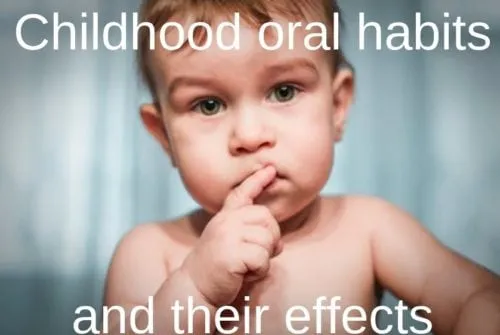
Kimberly Martins, speech-language pathologist and founder of VoxLingue, wrote it plainly in her article on childhood oral habits: as soon as a child is speaking, the pacifier should go. She has seen toddlers of 2 or 3 talking with a pacifier in their mouth throughout the day.
This guide separates two questions that often get mixed up: words and speech sounds. You’ll find what studies have found, with their limits, and the Québec and Canadian age guidance brought together. Then comes what you can notice at home, a gentle plan to take the pacifier out during the day, and when to contact the CLSC or ask the doctor.
My 2-year-old talks with a pacifier in their mouth: can it slow down their talking?
Studies don’t show that a pacifier, on its own, causes language difficulties. What matters is how long it sits in their mouth while they’re awake and talking. During those hours, the tongue and lips move less freely, children are less inclined to talk, and they’re harder to understand. A pacifier at bedtime is a different question.
Québec and Canadian sources draw the same line. The Canadian Paediatric Society says that using a pacifier all day long can affect a child’s ability to learn to talk, and advises keeping it for sleep and comfort (Caring for Kids, 2022). Naître et grandir, Québec’s parenting resource, notes that children who talk with a pacifier in can be hard to understand (in French).
In an answer reviewed by a speech-language pathologist, Naître et grandir adds that after 12 months, a pacifier can encourage a poor tongue position when the child swallows or speaks. A child with something in their mouth is also less inclined to communicate (2025, in French). Québec’s order of speech-language pathologists and audiologists (OOAQ) lists speech among what prolonged use could affect, along with breathing and swallowing (2026, in French).
Another Naître et grandir page points out that a pacifier soothes a child and supports some important learning. That isn’t a contradiction. The pacifier that settles a big upset or helps them fall asleep is not the pacifier that stays in their mouth for hours while they play, ask and tell you things.
So the moment matters more than the object. A few minutes to calm down, the pacifier at bedtime: that’s comfort. The pacifier all morning while they play and talk: that’s time when their mouth isn’t free to talk.
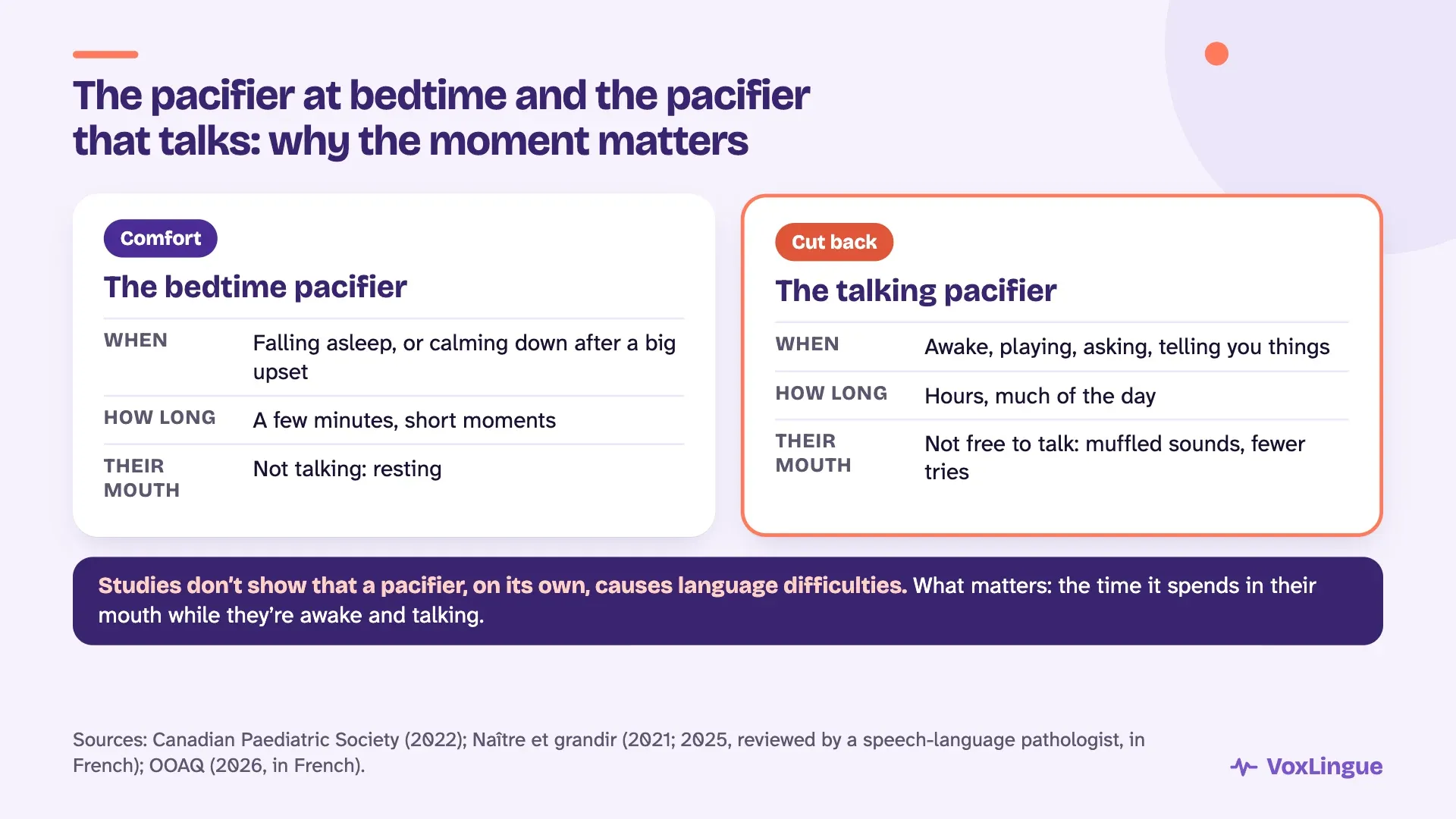
To see what studies really say, it helps to split two questions: words (vocabulary) and speech sounds (pronunciation). The results are not the same, and the next sections take them one at a time. For other questions, see our guides on pacifiers, thumb sucking and oral habits.
Pacifiers and words: what two recent studies found about toddlers’ vocabulary
For words, studies don’t all say the same thing. A large Norwegian study found smaller vocabularies in children who had the pacifier for more hours during the day, especially in recent months. A smaller Italian study found no link. Neither shows that a pacifier causes language difficulties.
The largest study comes from Oslo, Norway. Researchers surveyed the parents of 1,187 children: 452 children aged 12 months and 735 aged 24 months. Parents reported how many hours a day their child had used a pacifier since birth, and filled in a vocabulary checklist (Muñoz, Kartushina and Mayor, 2024).
The result: the more daytime hours a child had spent with a pacifier, the smaller their vocabulary, and the higher their odds of a low score. Later use mattered more than use in the first months. At 24 months, pacifier hours in the two months before the birthday predicted a low vocabulary best.
This study has limits. It looks at children at a single point in time, and pacifier hours were recalled by parents. The children were Norwegian, monolingual and born at term. It shows a link, not a cause. Its result does fit the Canadian Paediatric Society’s warning: it’s all-day use that can affect learning to talk (2022).
In Italy, a study published in 2025 looked at 98 children aged 18 to 36 months in three daycares. It found no link between pacifier use and the number of words children said, or with abstract words (Barca, Mazzuca and Borghi, 2025).
It has limits too: a small sample, a lot of missing data, and no record of when the pacifier was used, day or night. Speech sounds were not measured. Yet sounds are exactly what Naître et grandir flags, along with tongue position after 12 months.
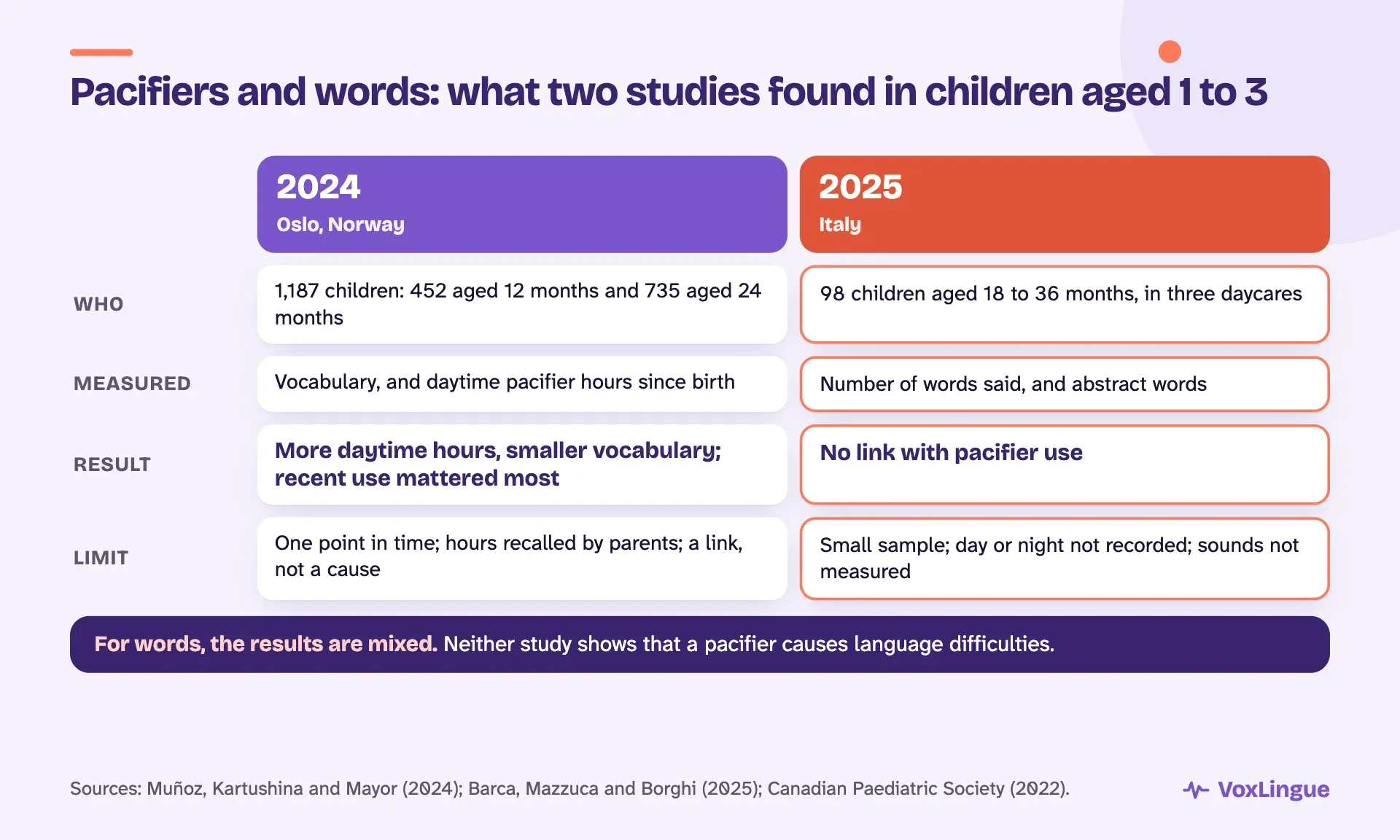
What do the two studies say together? For words, the results are mixed. The one large study points to recent daytime pacifier hours in children aged 1 and 2. The smaller one finds nothing, but without knowing whether the pacifier was given during the day or at night.
No guilt about the months behind you: the pacifier soothed your baby, and that was a good choice. If there is a link, recent daytime use matters most. It’s also the use you can change this week.
Pacifiers and speech sounds: why a toddler talking with a pacifier is harder to understand
With a pacifier in, the tongue stays low and forward, and the lips stay open. Sounds that need closed lips or a raised tongue tip come out muffled. Studies on speech sounds are small, but they point the same way: frequent daytime use, and use that lasts several years.
What happens in their mouth when they talk with a pacifier
Talking takes precise, quick movements. For “p”, “b” and “m”, the two lips touch: “mama”, “ball”, “bubble”. For “t”, “d”, “n” and “l”, the tip of the tongue rises behind the top teeth: “teddy”, “dog”, “no”, “lion”. For “s” and “z”, the tongue stays behind the teeth, not between them: “sun”, “zoo”.
With a pacifier between the lips, none of this happens freely. The lips stay open around the pacifier. The tongue is pushed down and forward. Sounds come out muffled, and the tongue can slip between the teeth on “s”.
That’s a lisp. According to the Naître et grandir answer reviewed by a speech-language pathologist, a pacifier after 12 months can encourage a tongue position that leads to one. Not every child with a pacifier lisps, but it’s one of the signs to listen for.
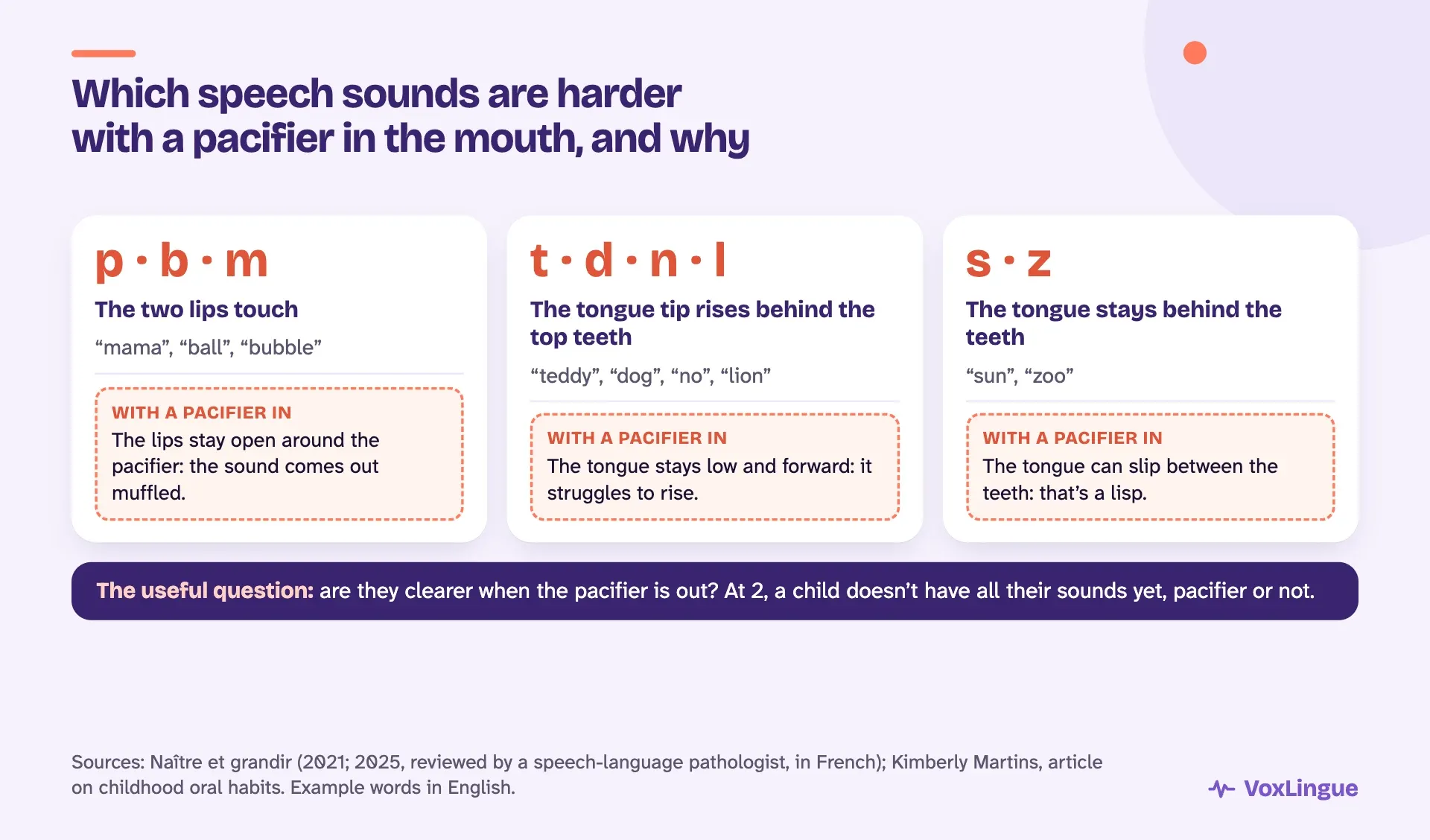
At 2, a child doesn’t have all their speech sounds yet, pacifier or not, and sounds and ages differ a little between French and English. So the useful question isn’t “do they have all their sounds?” but “are they clearer when the pacifier is out?” To see how well a 2-year-old is usually understood, read our guide.
What studies show about speech sounds
Studies on pacifiers and speech sounds are few, and small. In the United Kingdom, 100 children aged 2 to 5 took a speech test. Most results were not linked to pacifier use. But in the younger children, more frequent daytime use went with more unusual speech errors. The link no longer showed beyond about 38 months (Strutt, Khattab and Willoughby, 2021).
In that study, only how often the pacifier was used during the day mattered: not the total duration, and not night-time use. The authors note that these errors may resolve over time, and that very few studies exist on the question. Their result fits Naître et grandir: a child talking with a pacifier in can be hard to understand.
In Chile, a study of 128 children aged 3 to 5 found no link between ever having used a pacifier and speech sound difficulties. Using one for more than 3 years, though, went with about three times the risk, with a wide margin of uncertainty (Barbosa et al., 2009). For teeth, Québec’s public health institute (INSPQ) advises stopping the pacifier before 3 to 4 (2026, in French).
In Australia, a study of 199 preschoolers found no link between sucking habits (pacifier, thumb, bottle, breastfeeding) and a speech sound disorder (Baker et al., 2018). The OOAQ is careful too: prolonged use could affect speech, but it isn’t automatic.
A small, non-randomised Brazilian study saw some tongue-related sound distortions decrease in the year after children of about 4 stopped the pacifier: an association, not proof (Scudine et al., 2021).
The common thread is frequent daytime use, and use that lasts several years. None of these studies shows that a pacifier causes a speech sound disorder. The Canadian Paediatric Society reaches the same practical advice: keep the pacifier for sleep and comfort.
This table sums up the six studies, for words and for speech sounds.
| Study | Children | What was measured | What was found | Main limit |
|---|---|---|---|---|
| Oslo, Norway, 2024 | 1,187 children aged 12 and 24 months | Vocabulary, daytime pacifier hours | More daytime hours, smaller vocabulary | One point in time; hours recalled by parents |
| Italy, 2025 | 98 children aged 18 to 36 months | Number of words said | No link | Small sample; day or night not recorded; sounds not measured |
| United Kingdom, 2021 | 100 children aged 2 to 5 | Speech sounds (test) | Frequent daytime use, more unusual errors, in the younger children only | Small sample |
| Chile, 2009 | 128 children aged 3 to 5 | Speech sounds (test) | Ever used a pacifier: no link. More than 3 years of use: a link | Use reported by parents |
| Australia, 2018 | 199 preschoolers | Speech sound disorder | No link with sucking habits | Observational study |
| Brazil, 2021 | 60 children aged about 4 | Sounds in the year after stopping | Some distortions less frequent after stopping | Small, not randomised |
When should a toddler stop using a pacifier? Québec and Canadian guidance, brought together
Start cutting back on the pacifier around 12 months. Take it out of their mouth when they talk, as soon as they start talking, and aim for it to be gone by about 2. The “3 to 4 years” you’ll read elsewhere is the outer limit to protect teeth, not a goal for speech.
Depending on the source, parents read 12 months, 2 years or 3 to 4 years. These numbers don’t answer the same question. Here is where each one comes from.
Around 12 months: start cutting back. Naître et grandir and the OOAQ report that the Canadian Paediatric Society recommends starting to wean from 12 months. That marker comes from the Society’s 2003 guide: the pacifier only for sleep and comfort until about 12 months, then plan to stop. The same guide advised against letting an older child walk around all day with a pacifier, which could get in the way of their language.
As soon as they talk: out of the mouth when they talk. That’s the position Kimberly Martins published in her article on oral habits: as soon as a child is speaking, the pacifier should go.
By about 2: gone. The same article notes that the negative effects come into play past a certain age, usually around 2.
3 to 4 years: the outer limit for teeth. The Canadian Paediatric Society’s current page (2022) says to plan to stop by 3 to 4 years to prevent dental problems. The INSPQ says “before 3 to 4”, and adds that you can of course stop earlier (2026, in French). It’s a limit not to go past, not a goal.
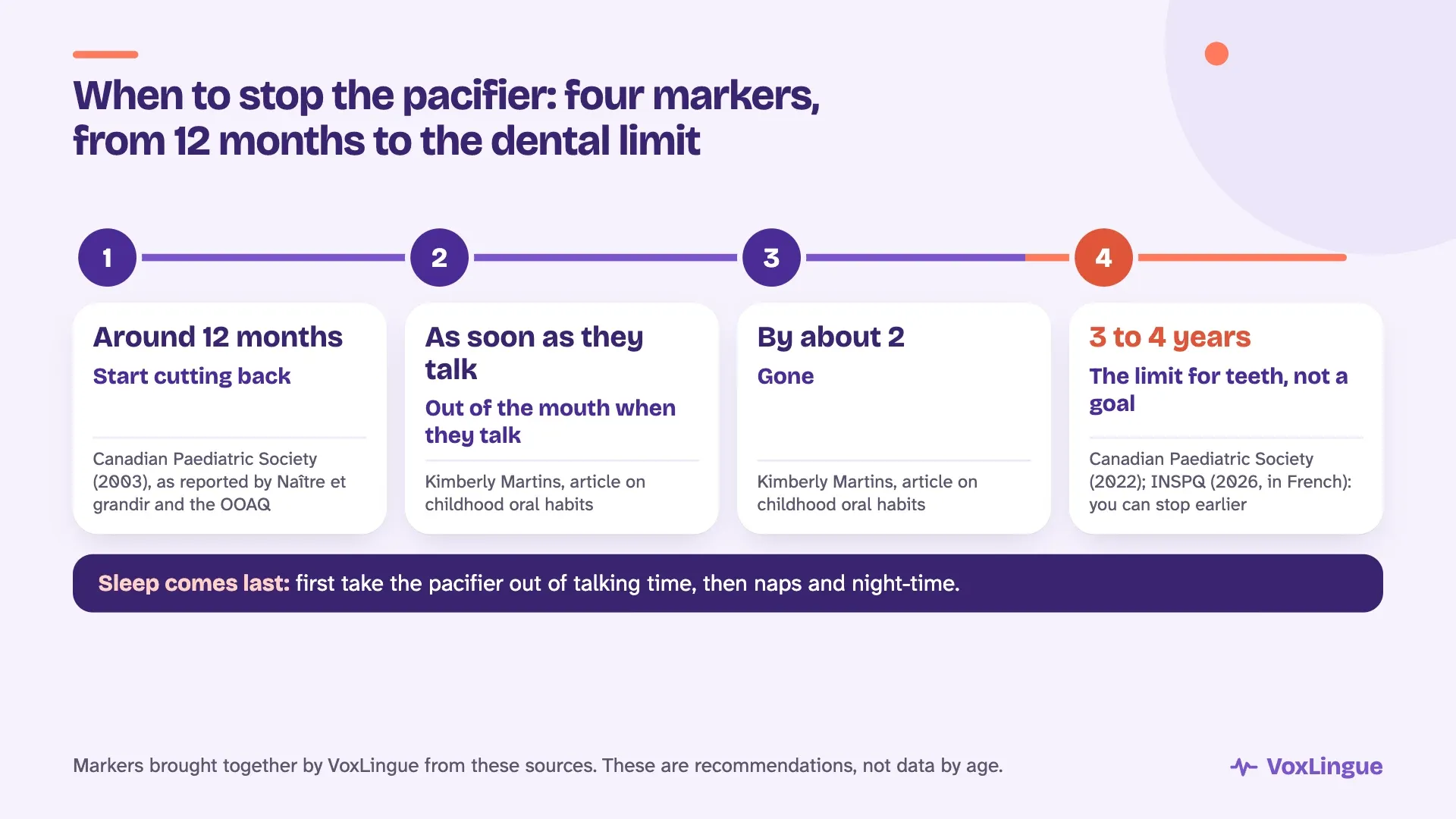
Our markers bring these sources together: cut back around 12 months, out of the mouth when they talk, gone by about 2, and not past 3 to 4. Naître et grandir also notes that sucking can remain a need until 2 or 3. That’s why the plan below first takes the pacifier out of talking time, and leaves sleep for last.
Why teeth? According to the INSPQ, after 18 months, sucking can influence how the jaws and teeth develop. The dentist is the one who checks how the teeth meet. Our article on stopping thumb sucking says more about teeth.
What you may notice at home when your toddler talks with a pacifier
The easiest thing to notice: they talk around the pacifier instead of taking it out. And they’re easier to understand when it’s out. Listen to their sounds too, watch where their tongue sits, and note whether they try to talk less. One week of noticing, with and without the pacifier, will tell you a lot.
Here is what parents may notice, according to Québec sources:
- they keep the pacifier in to talk, rather than taking it out;
- people who know them less have trouble understanding them when it’s in;
- their sounds are muffled, especially “p, b, m” and “t, d, n, l”;
- their tongue pushes between their teeth on “s” and “z”;
- they drool more;
- they try to talk less: they point or take your hand instead of saying it.
If their mouth often stays open at rest, even without the pacifier, that’s a separate question. See our article on an open mouth at rest and mouth breathing.
To get a clear picture, watch for one week. Write down each moment they have the pacifier: playtime, the car, daycare drop-off, screens, naps. For each moment, note whether they talk with the pacifier in, what they said, and who understood. Do the same when the pacifier is out.
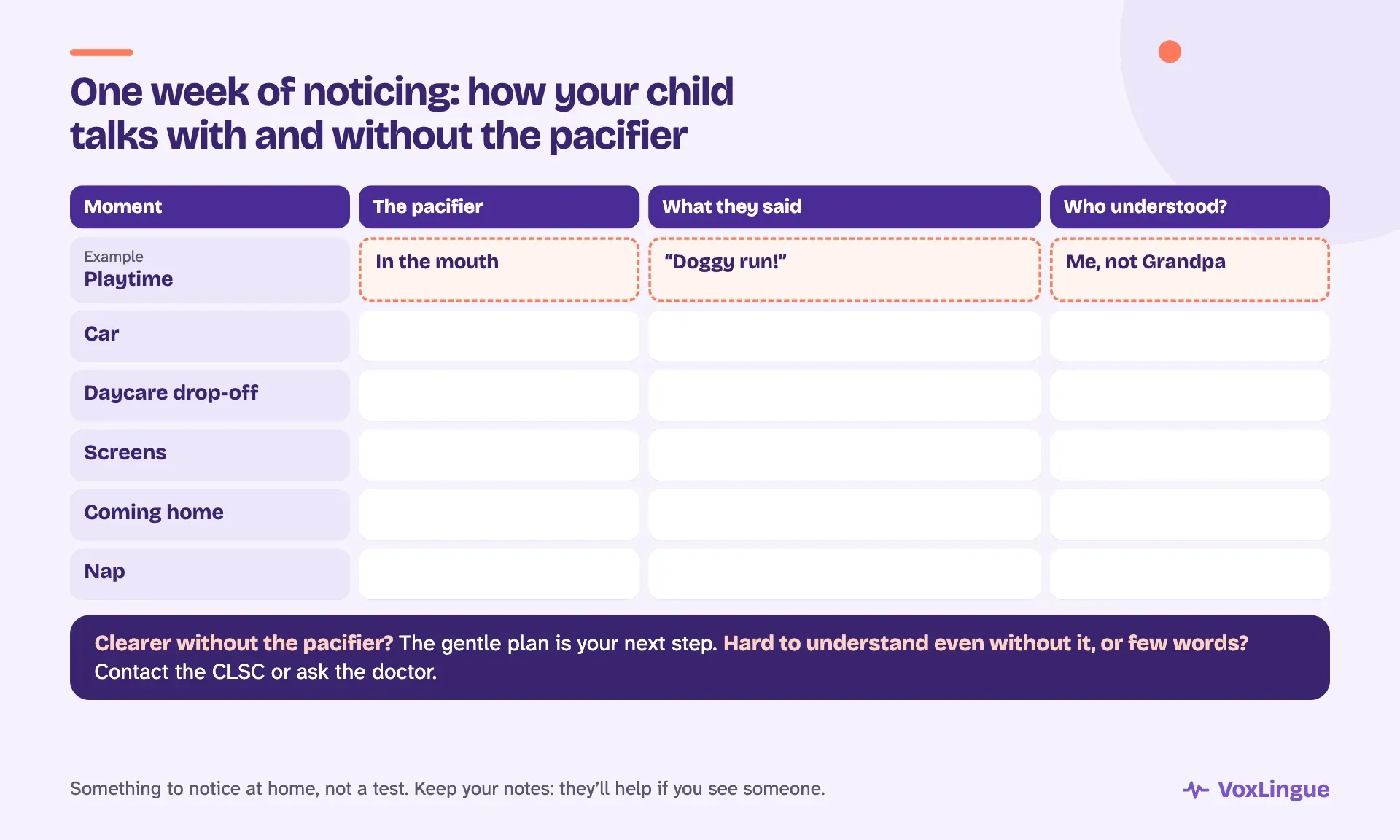
If they’re much clearer without the pacifier, the gentle plan below is your next step. If they’re hard to understand even without it, or say few words, the pacifier isn’t the whole story: see below for who to talk to. Your notes from the week will also help if you see someone.
How to stop the pacifier during the day without a battle: a gentle plan, one moment at a time
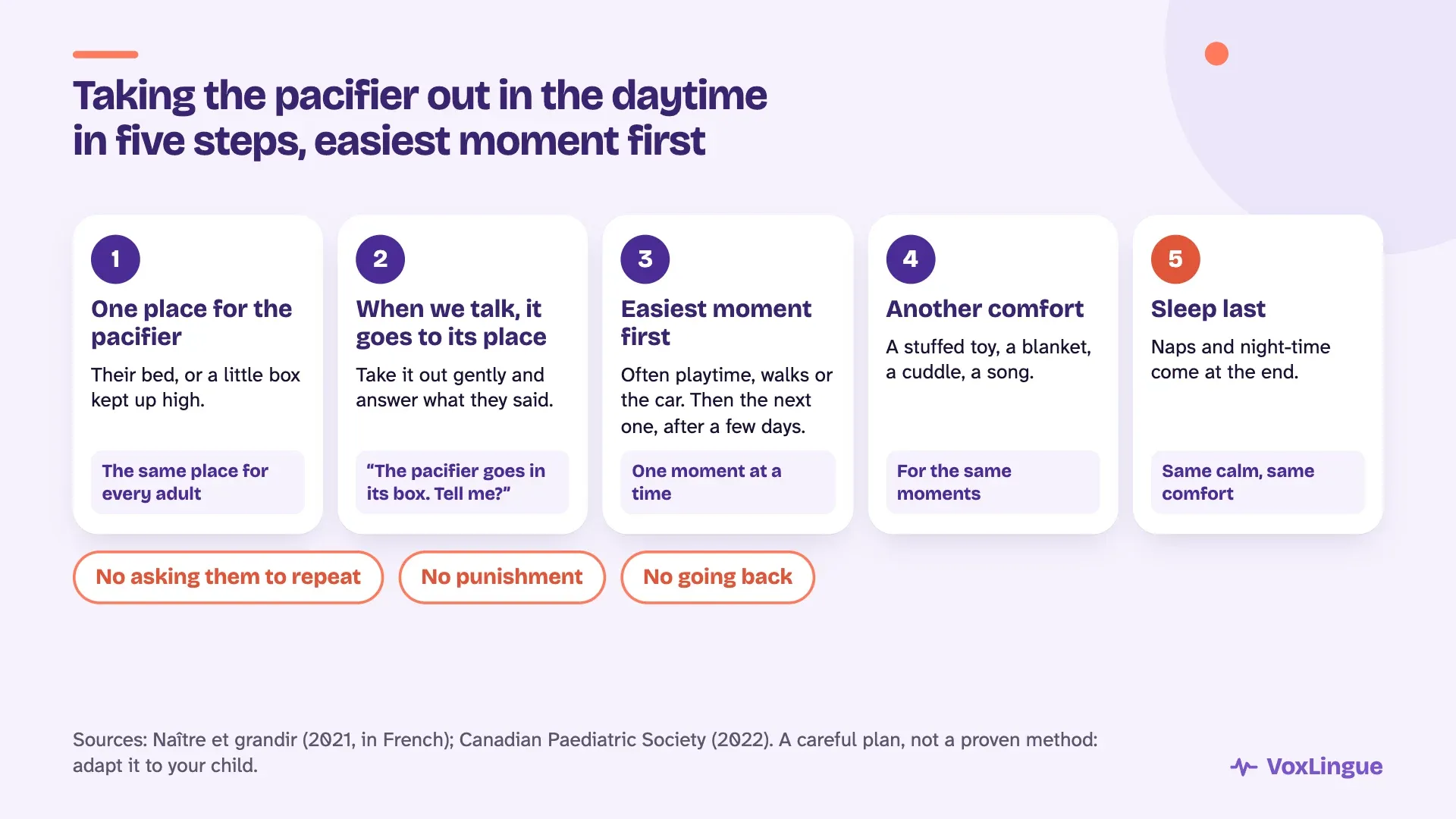
Give the pacifier one place, and take it out gently when your child talks. Then drop one moment of the day at a time, starting with the easiest, and offer another comfort for that moment. Leave sleep for last. No punishment, and no going back.
This plan follows advice from Naître et grandir and the Canadian Paediatric Society. We found no study comparing ways to stop a pacifier: this is a careful plan, not a proven method. Adapt it to your child and your family.
“When we talk, the pacifier goes to its place”
Choose one place for the pacifier: their bed, or a little box. Naître et grandir suggests just that, a little box kept up high. Then set one simple rule, the same for every adult: when we talk, the pacifier goes to its place.
When your child comes to tell you something with the pacifier in, take it out gently, without scolding: “The pacifier goes in its box. Tell me?” Then listen, and answer what you understood. Don’t ask them to repeat: they already made the effort to talk to you.
An example. They come up with the pacifier in and say: “Doggy run!” You take the pacifier out, put it in its box, and answer: “Yes, the dog is running fast! Where is he going?” The conversation goes on, without the pacifier and without a lesson.
One moment at a time, from easiest to hardest
Go back to your notes from the week of noticing. Then move forward one moment at a time, for example in this order:
- Start with the easiest moment for your child: often playtime, walks or the car.
- When that moment has gone well for a few days, move to the next one, such as screens or daycare drop-off.
- Keep calm-down moments, like coming home at the end of the day, for later.
- Finish with naps and night-time.
Prepare your child before you start. Naître et grandir advises choosing a calm period, involving your child, and not making the pacifier disappear overnight without preparing them. Before age 2, gradually cut down the moments when you offer it.
Another comfort for the same moments
The pacifier met a need for comfort, and that need stays. For each moment you drop, plan something else: a stuffed toy, a blanket, a cuddle, a song, as Naître et grandir suggests. The Canadian Paediatric Society also advises praising your child’s efforts and letting them express their feelings. If they start sucking their thumb, see the question about it below.
At daycare: the same plan on both sides
If your child goes to daycare, tell the educator about the plan. Say where the pacifier stays, which moments you’ve already dropped and the words you use. Ask what is possible on their side: each setting has its own ways, and the idea is to agree. To prepare that conversation, see how to talk it through with the educator.
Naps and night-time: last
Sleep can wait a little. In the UK study, night-time use was not linked to speech errors: only daytime use mattered. The Canadian Paediatric Society advises keeping the pacifier for sleep and comfort. After age 2, Naître et grandir suggests keeping it only for naps and the night, and then ending it.
Once the daytime moments are gone, bedtime is the last step. Keep the same calm as with the other moments, and the same comfort.
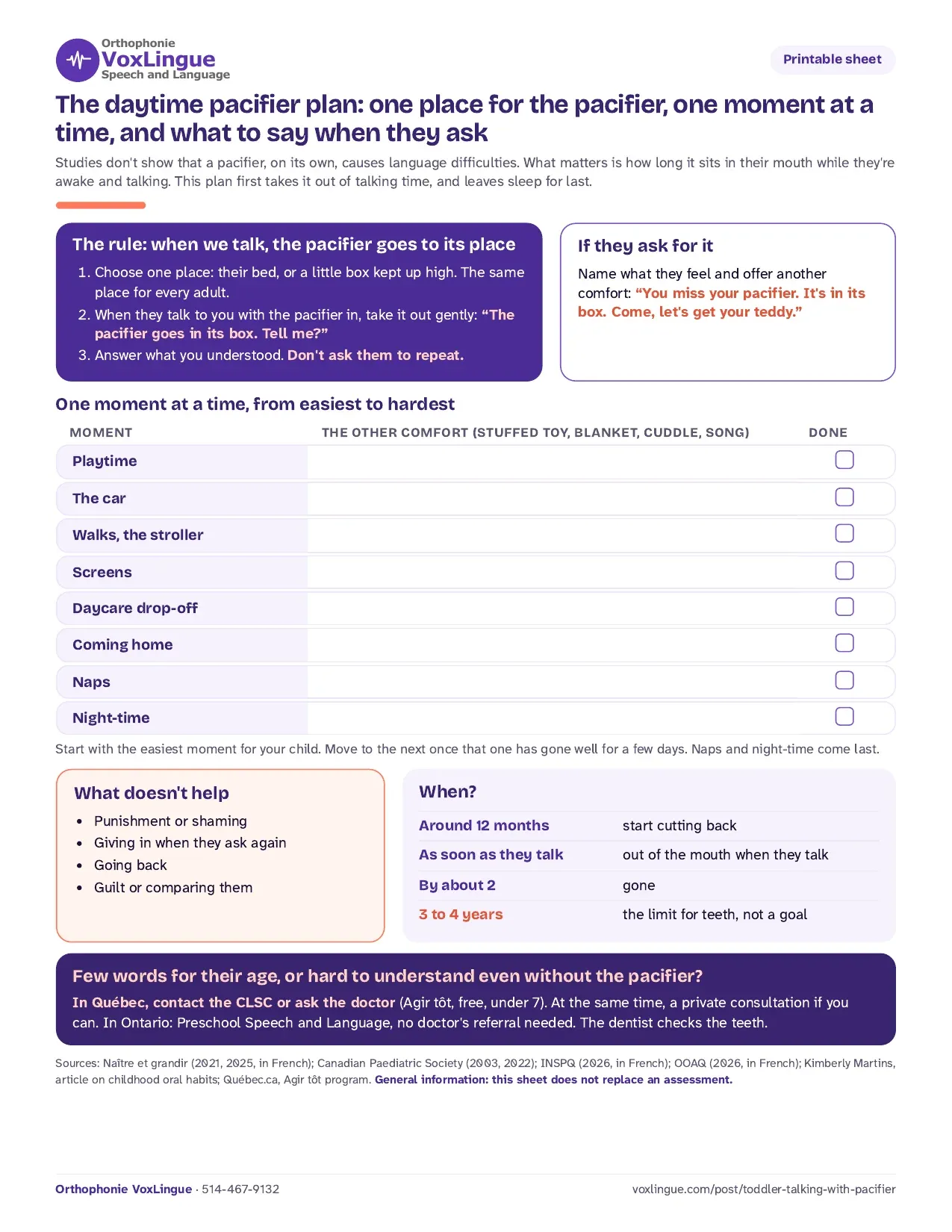
Printable sheet: The daytime pacifier plan: one place for the pacifier, one moment at a time, and what to say when they ask (PDF, 1 page).
What doesn’t help: punishing, giving in, going back
Some reactions make weaning harder. The Canadian Paediatric Society says never to use punishment or humiliation, and not to give in when your child asks for the pacifier again. Naître et grandir advises avoiding any going back, and not making your child feel guilty or comparing them with other children.
Keep a calm, steady tone. If they ask for it, name what they feel and offer the other comfort: “You miss your pacifier. It’s in its box. Come, let’s get your teddy.”
Once the pacifier is gone during the day, simply keep talking and playing with your child. See simple ways to help your toddler talk, no repeating needed.
When the pacifier isn’t the whole story: who to talk to in Québec and Ontario
If your child says few words for their age, don’t wait for the pacifier to be gone. The same goes if they’re hard to understand even without it. Contact the CLSC or ask the doctor, and book a private consultation at the same time if you can. The dentist checks the teeth.
Talk to someone without waiting if your child:
- says few words for their age;
- is hard to understand even without the pacifier, including for people who know them well;
- seems to understand little of what’s said to them;
- loses words they used to say (see our article on a toddler who stops saying words they used to say).
In Québec, start with the public system. Contact the CLSC or ask the doctor: the Agir tôt program offers free screening to children under 7. At the same time, a private consultation lets you find out what is recommended without waiting. Both can move forward while you follow the plan.
In Ontario, the Preschool Speech and Language program sees children without a doctor’s referral. We also offer online sessions for Ontario families.
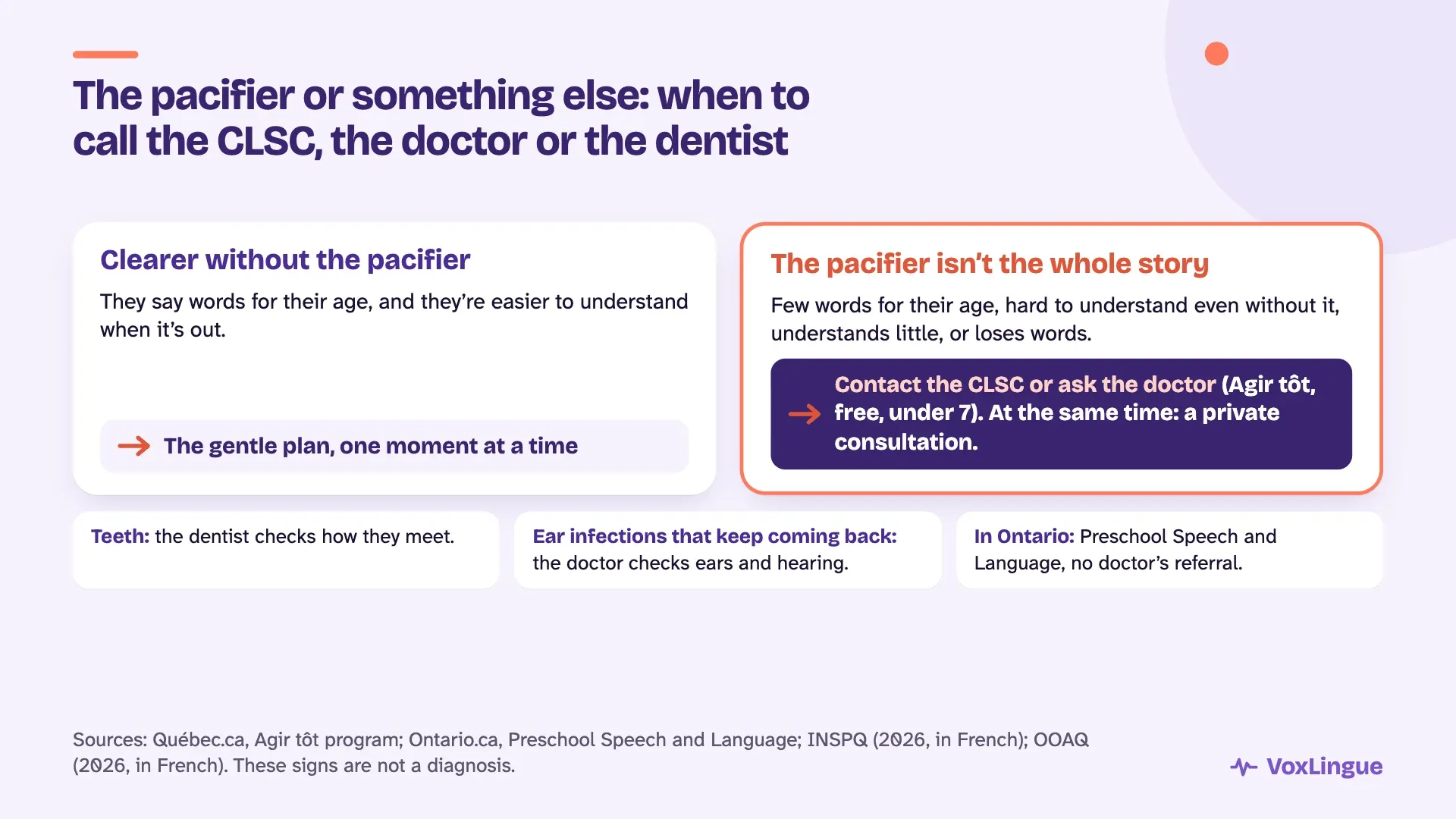
Other professionals have their part. The dentist checks the teeth and how they meet. If ear infections keep coming back, the doctor checks the ears and hearing: according to the INSPQ, after 12 months, a pacifier can raise the risk of ear infections. See our article on ear infections that keep coming back and language.
A speech-language pathologist can also support parents through this transition, the OOAQ notes (2026, in French). Before about age 4, our help for toddlers’ oral habits is mostly parent coaching, including how to reduce a habit gently.
Key takeaways
When your toddler talks with a pacifier in, it’s the moment that matters, not the pacifier.
- Studies don’t show that a pacifier, on its own, causes language difficulties.
- For words, studies are mixed. For speech sounds, they point to frequent daytime use and use that lasts for years.
- Start cutting back around 12 months, take it out when they talk and aim for it to be gone by about 2. Ages 3 to 4 are the limit for teeth.
- One moment at a time, another comfort, sleep last: no punishment, and never asking them to repeat.
- If they say few words or are hard to understand even without the pacifier, contact the CLSC or ask the doctor, and see someone privately at the same time if you can.
Next step
Would you like help cutting back the pacifier gently? Learn about our help for toddlers’ oral habits. If their words or the clarity of their speech worry you, see a speech and language assessment. Our speech-language pathologists see families at our clinic in Marché Central, Montréal, and online across Québec and Ontario.
To keep the plan in view, print our sheet: The daytime pacifier plan: one place for the pacifier, one moment at a time, and what to say when they ask (PDF, 1 page).
Frequently asked questions
Can a pacifier cause a lisp?
It can contribute. According to a Naître et grandir answer reviewed by a speech-language pathologist, a pacifier after 12 months can encourage a tongue position that leads to a lisp. The tongue then pushes between the teeth on “s” and “z”. Not every child with a pacifier develops one. If the lisp stays once the pacifier is gone, talk to a speech-language pathologist.
Should I take the pacifier out every time my toddler talks?
Yes, gently, and without making it a lesson. Take it out, put it in its place, then answer what they said. Don’t ask them to repeat: what matters is that the conversation goes on, with a free mouth. Little by little, you can invite them to put it in its box themselves before talking to you.
Is a pacifier just for sleep OK at 2?
For a while, yes: sleep is the last moment to drop. In the UK study, night-time use was not linked to speech errors, and the Canadian Paediatric Society advises keeping the pacifier for sleep and comfort. Once the daytime moments are gone, move on to bedtime, without going past 3 to 4, the limit for teeth.
They stopped the pacifier and started sucking their thumb: what now?
It happens often: the need for comfort looks for another way to settle. Stay calm, and offer another comfort for the same moments: a stuffed toy, a cuddle, a song. Try not to turn it into a battle. For what comes next, see our gentle plan to stop thumb sucking, day and night.
My toddler asks for the pacifier again since the new baby arrived: is that normal?
Yes. A step back after a big change is common: a new baby, a move, starting daycare. Stay calm, offer comfort and one-on-one time with you, without going back to the pacifier. If they’re also losing words they used to say, contact the CLSC or ask the doctor.
Is it better to stop all at once or gradually?
Gradually, with a child who has been prepared. Naître et grandir advises not making the pacifier disappear overnight without preparing the child, and, before age 2, gradually cutting down the moments when you offer it. The Canadian Paediatric Society also advises limiting how long it’s used. The one-moment-at-a-time plan follows that advice.
Speech-language pathologist, dentist or doctor: who should we see?
It depends on what worries you. For words or speech clarity, contact the CLSC or ask the doctor, and book a private speech-language consultation at the same time if you can. For teeth, see the dentist. If ear infections keep coming back, the doctor checks the ears and hearing.