How to stop thumb sucking: a gentle plan for day and night

Does your child suck their thumb at story time, in the car or curled up with a favourite stuffed animal? You may be wondering how to stop thumb sucking, whether now is the right time, and how to do it without turning it into a battle.
Perhaps the dentist mentioned it at the last checkup. A grandparent noticed the top teeth sticking out, or your child’s “s” sounds a little like “th”. These comments are well meant, but they often leave parents with more questions than answers.
Thumb sucking is not a bad habit. It is a way of self-soothing that children learn before they are born. So the goal is not to take that comfort away, but to replace it, at the right time and with your child on board.
This guide explains when to start and how to go about it, first during the day and then at night. It also covers what thumb sucking can change in the teeth and in speech, what to avoid, and who to see in Québec and Ontario. The guidance comes from the Canadian Paediatric Society and Canadian public health sources, rather than the American pages that often fill search results.
Why does my child suck their thumb?
Sucking is a reflex that begins before birth and calms babies. After about 6 months, the thumb is mostly a way to self-soothe: when a child is tired, bored, sad or falling asleep. Unlike a pacifier, a thumb is always there. That is why stopping depends on the child’s own motivation and on another source of comfort.
Babies already suck their fingers around the 16th week of pregnancy, notes Naître et grandir, Québec’s parenting reference. After birth, sucking feeds a baby, but it also calms them. By about 6 months, the need to suck for food lessens, and sucking becomes mostly a way to settle. Our guide to baby feeding milestones from 0 to 12 months describes those first months.
A thumb, two fingers, an index finger: for the teeth and for stopping, it is the same habit. Researchers group them together as “digit sucking”.
The thumb rarely appears at random. It comes back at particular moments, and those moments are the key to the plan described below.
Thumb or pacifier: why the thumb is harder to give up
A pacifier can be put away; a thumb cannot. That is why Québec’s public health institute (INSPQ) and the Canadian Paediatric Society point out that a pacifier is often easier to control than a thumb. With a pacifier, the parent decides when it goes. With a thumb, the child decides.
They gave up the pacifier and started sucking their thumb
This is common, and there is a reason for it. The American Academy of Pediatric Dentistry (AAPD, 2024) notes that forcing a very early end to pacifier use has been associated with longer finger sucking. The need for comfort has not gone away.
When the pacifier goes, plan another comfort for the same moments: a stuffed animal, a bedtime routine, a cuddle. If the thumb has already taken over, the plan in this article works the same way.
When should a child stop sucking their thumb?
In Canada, the advice is to help children stop before about 3 to 4 years of age. A Québec dental health guide aims for about age 3, and at the latest when the first adult teeth come in, around 5 or 6. Many children stop on their own between 2 and 4. How long and how hard a child sucks matter more than how often.
According to the INSPQ, sucking a thumb or fingers after 18 months can influence how the jaws and teeth develop. Its parenting guide repeats the Canadian Paediatric Society’s advice to stop before 3 to 4. The Society’s parent site, Caring for Kids, explains why it advises giving up the pacifier by 3 to 4, and why a thumb is harder to stop.
In a large study of about 800 children in Iowa (Bishara and colleagues, 2006), 31% sucked a thumb or fingers at age 1, and 12% still did at age 4. The number then levelled off, and 4% were still doing it at age 8.
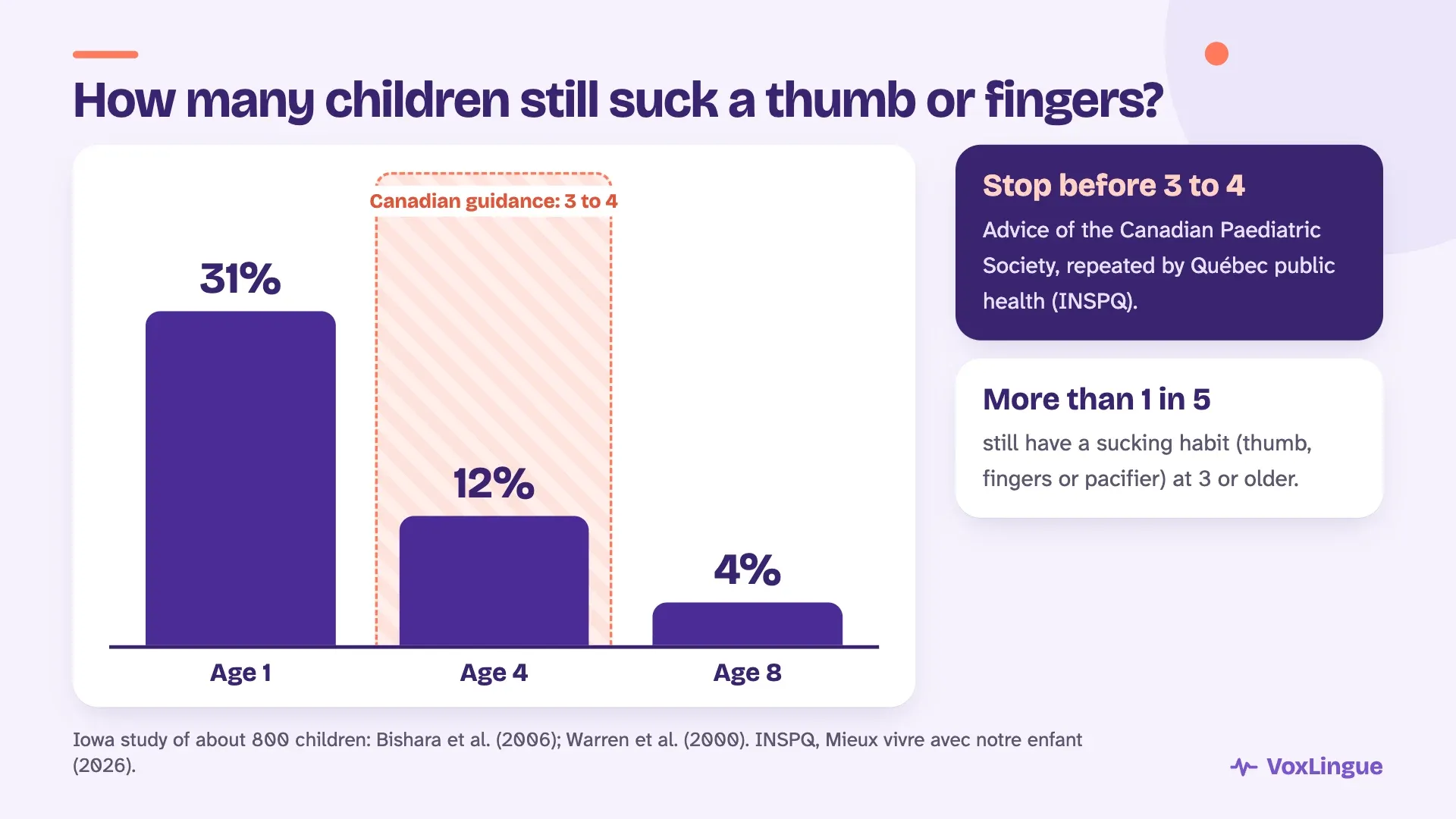
The same researchers found that more than 1 child in 5 still had a sucking habit, thumb, fingers or pacifier, at 3 or older (Warren and colleagues, 2000). So it is common. That is not a reason to wait indefinitely, but it is a reason to approach it without worry.
| Age (approximate) | What is common | What you can do | At the dentist |
|---|---|---|---|
| Under 3 | The thumb helps with sleep and settling. | Nothing in particular; offer other comforts. | First visit by age 1, then once a year. |
| 3 to 4 | Many stop; others keep going, often at bedtime. | Start gently: stories, a signal, a sticker chart. | The dentist watches the teeth and bite. |
| 5 to 7 | First adult teeth arrive; friends notice. | Your child becomes a partner in the plan. | Mention it if the habit continues. |
| Over 7 | Less common (4% at 8 in the Iowa study). | Keep the plan going and ask for advice. | The dentist assesses the teeth and refers if needed. |
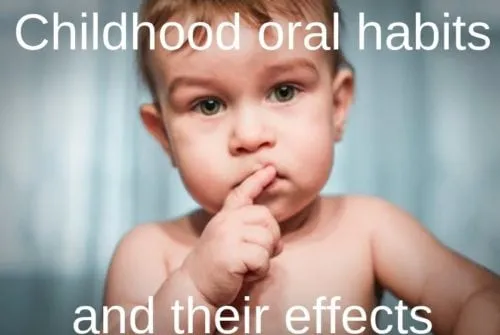
What a long-lasting pacifier, thumb or mouth-breathing habit can do is covered in our article on childhood oral habits and their effects.
Why the advice differs from one country to another
You may read on American pages that a thumb habit up to 4 or 5 is nothing to worry about. That is not what Canadian guidance says. Even the AAPD recommends ending sucking habits by 36 months. In Canada, follow the Canadian Paediatric Society; your dentist will adapt the advice to your child.
A resting thumb or vigorous sucking
Not every thumb habit is the same. According to the AAPD, how long the habit lasts matters more than how often it happens. The American Dental Association adds that a thumb resting passively in the mouth carries less risk than vigorous, active sucking. A child who sucks for a few minutes to fall asleep is in a different situation from a child who sucks hard for hours.
Does thumb sucking ruin teeth?
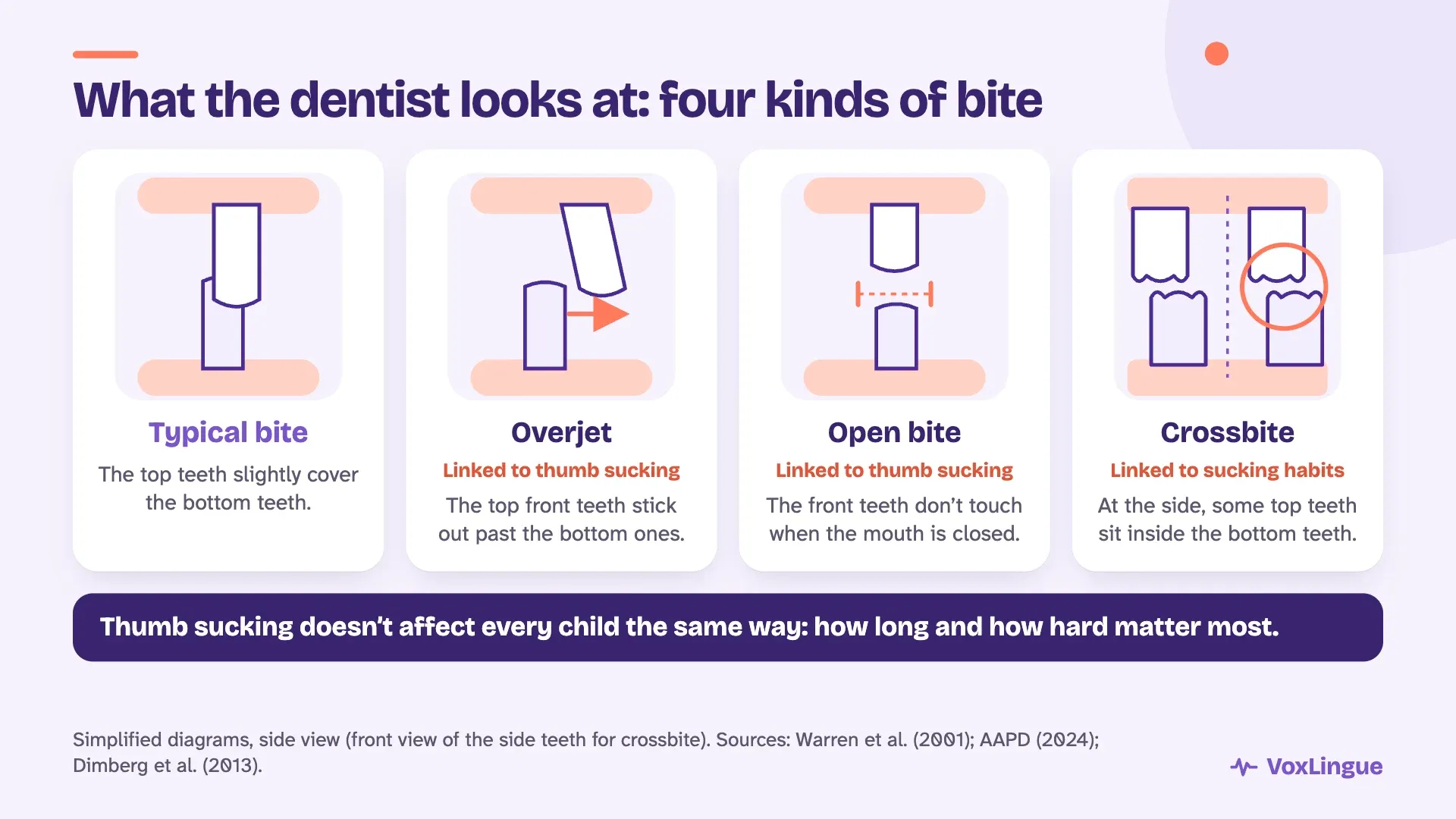
Not in every child. When the habit lasts past about age 4, or the sucking is strong, the teeth can change. The top front teeth may stick out (overjet), or the front teeth may no longer meet (open bite). The upper arch can also become narrower, sometimes with a crossbite.
Children in the Iowa study were examined at 4 and 5 (Warren and colleagues, 2001). Those whose habit lasted to 4 or beyond more often had a narrow upper arch, top teeth sticking out, an open bite or a crossbite. Small differences were already visible when the habit had lasted to 2 or 3.
Thumbs and pacifiers do not have quite the same effects. According to the AAPD and a 2016 meta-analysis (Doğramacı and Rossi-Fedele), a thumb or finger habit is more strongly linked to top teeth sticking out than a pacifier habit.
What about the palate? Naître et grandir explains that the thumb does not reshape the palate itself as much as the dental arch and the bone that holds the teeth. In some children, the habit has no effect at all. Our articles on oral habits also cover pacifiers, tongue posture and breathing.
What corrects itself, and what may not?
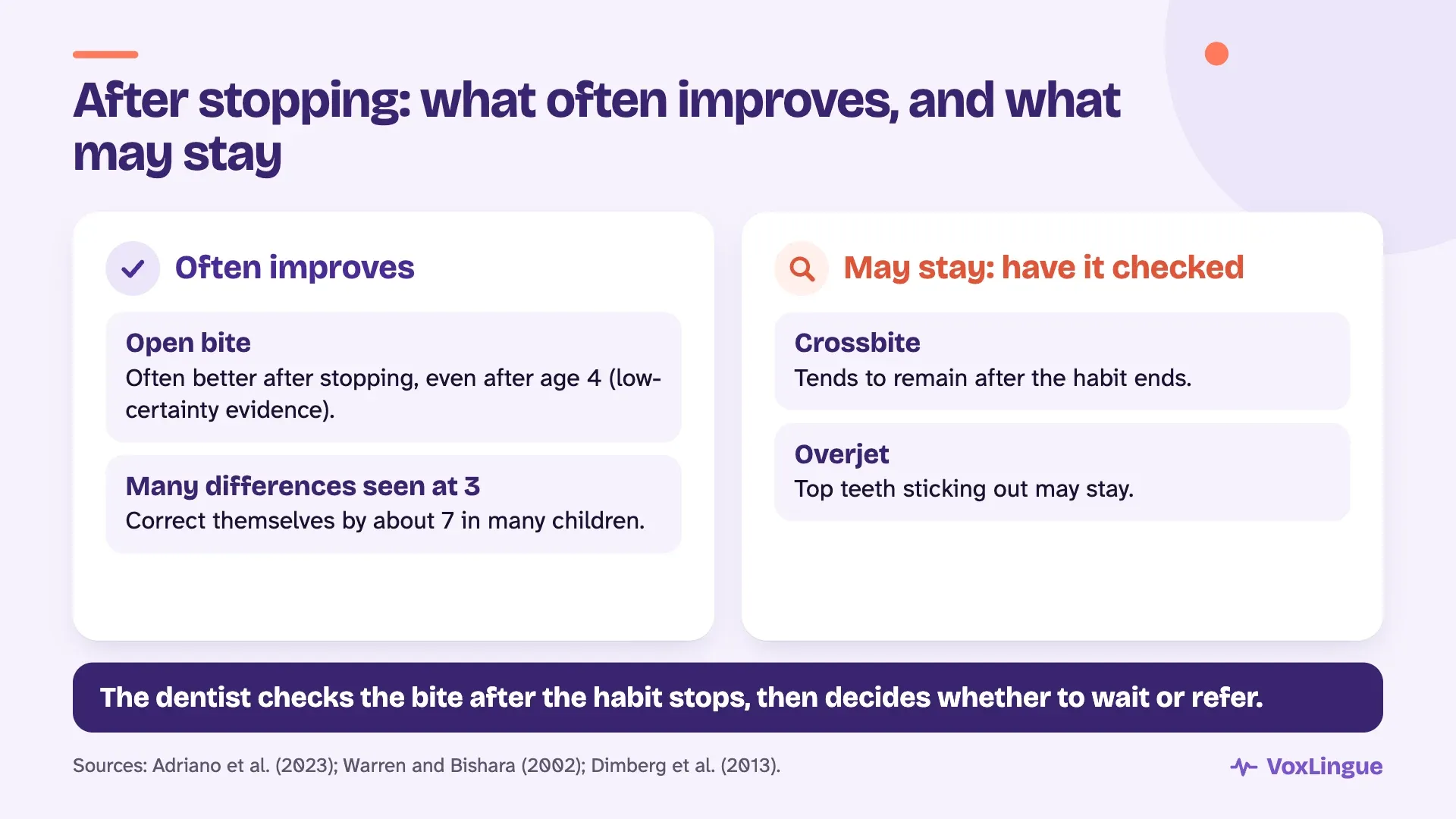
Stopping helps, but not everything goes back on its own. A 2023 systematic review (Adriano and colleagues) brought together five studies: open bite often improved after the habit stopped, even after age 4, in 50% to 100% of children depending on the study. The authors rate this evidence as very low certainty, and nobody knows the age after which self-correction becomes unlikely.
Other changes can stay. In the Iowa study, crossbite and top teeth sticking out were still present in some children well after the habit had ended (Warren and Bishara, 2002).
A Swedish study followed 386 children from 3 to 7 (Dimberg and colleagues, 2013). Many bite differences seen at 3 had corrected themselves by 7. Open bite and crossbite were the two traits linked to sucking habits. This is one reason dentists watch and wait, and why orthodontic decisions are often made later.
The words your dentist may use
Dental terms can be confusing, so here they are in plain words. An open bite means the front teeth don’t touch when your child closes their mouth. Overjet means the top front teeth stick out in front of the bottom ones. A crossbite means some top teeth sit inside the bottom teeth.
One more term causes confusion: overbite, or deep bite. Strictly, it describes top teeth that cover too much of the bottom teeth vertically. Many people say “overbite” when they mean overjet, the top teeth sticking out, which is the change more typical of thumb sucking.
Can thumb sucking cause a lisp?
There is a link, but no proof that the thumb causes it. Children who sucked for longer more often have difficulty with speech sounds, but the studies don’t agree. What matters more is where the tongue sits: between the teeth at rest, when swallowing or when saying “s”.
A 2021 systematic review (Burr and colleagues) looked at research on sucking habits and speech sound development. It described the evidence as “inconsistent and inconclusive”. The most consistent finding was that longer sucking went with more speech sound difficulties. That is an association, not proof of cause.
A Slovenian study of 446 children aged 3 to 7 points the same way (Kravanja and colleagues, 2018). About 7% had an open bite. Those children more often had a low or forward tongue posture, and more often had articulation difficulties.
The link probably runs through the tongue. The American Speech-Language-Hearing Association (ASHA) notes in its practice portal on orofacial myofunctional disorders that a tongue resting between the teeth can contribute to an open bite. And when the front teeth don’t meet, the tongue slips forward more easily on “s”.
What a speech-language pathologist looks at
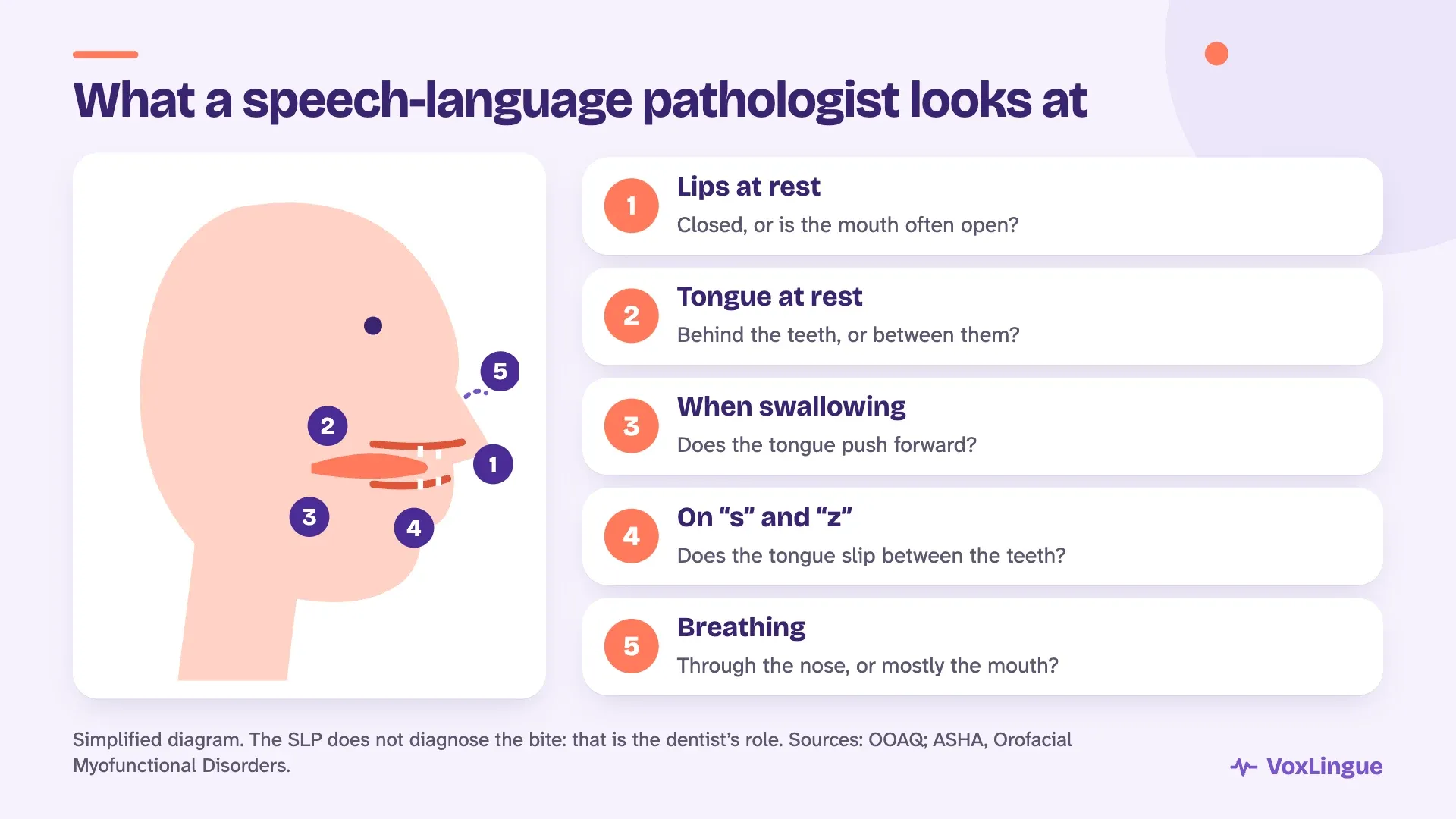
Speech-language pathologists (SLPs) look at how a child swallows and how the tongue and lips rest. Québec’s professional order for SLPs (OOAQ) notes that a tongue or lips resting in the wrong place can affect health, the shape of the face and the position of the teeth.
The signs are concrete: mouth breathing that lasts, drooling, a tongue that comes forward between the teeth at rest or when talking. The sounds most often affected are “s” and “z”, sometimes “sh”, “ch” and “j”. The SLP does not diagnose the bite: that is the dentist’s role.
Is a lisp at 4 normal?
Many young children lisp a little. “Thoup” for “soup” or “thoo” for “zoo” is common in preschoolers. Our guide to speech sound development helps you place what you are hearing.
A lisp is worth a closer look when it lasts, or when it comes with other signs: a tongue between the teeth at rest, an open bite, a mouth that is often open. There is no single age at which to worry. Speech sound norms also come mostly from English-speaking children, and they can differ for French-speaking or bilingual children.
Myofunctional therapy: from what age?
Myofunctional therapy works on tongue and lip posture, swallowing and nose breathing. According to ASHA, exercises are usually not suitable before about age 4, or before a child can notice their own habits. Younger children are helped mainly through their parents, with guidance from the SLP.
This therapy supports what the dentist or orthodontist does; it does not replace it. Our page on orofacial myofunctional therapy explains who it is for and how it works.
How to stop thumb sucking: a gentle plan for the day
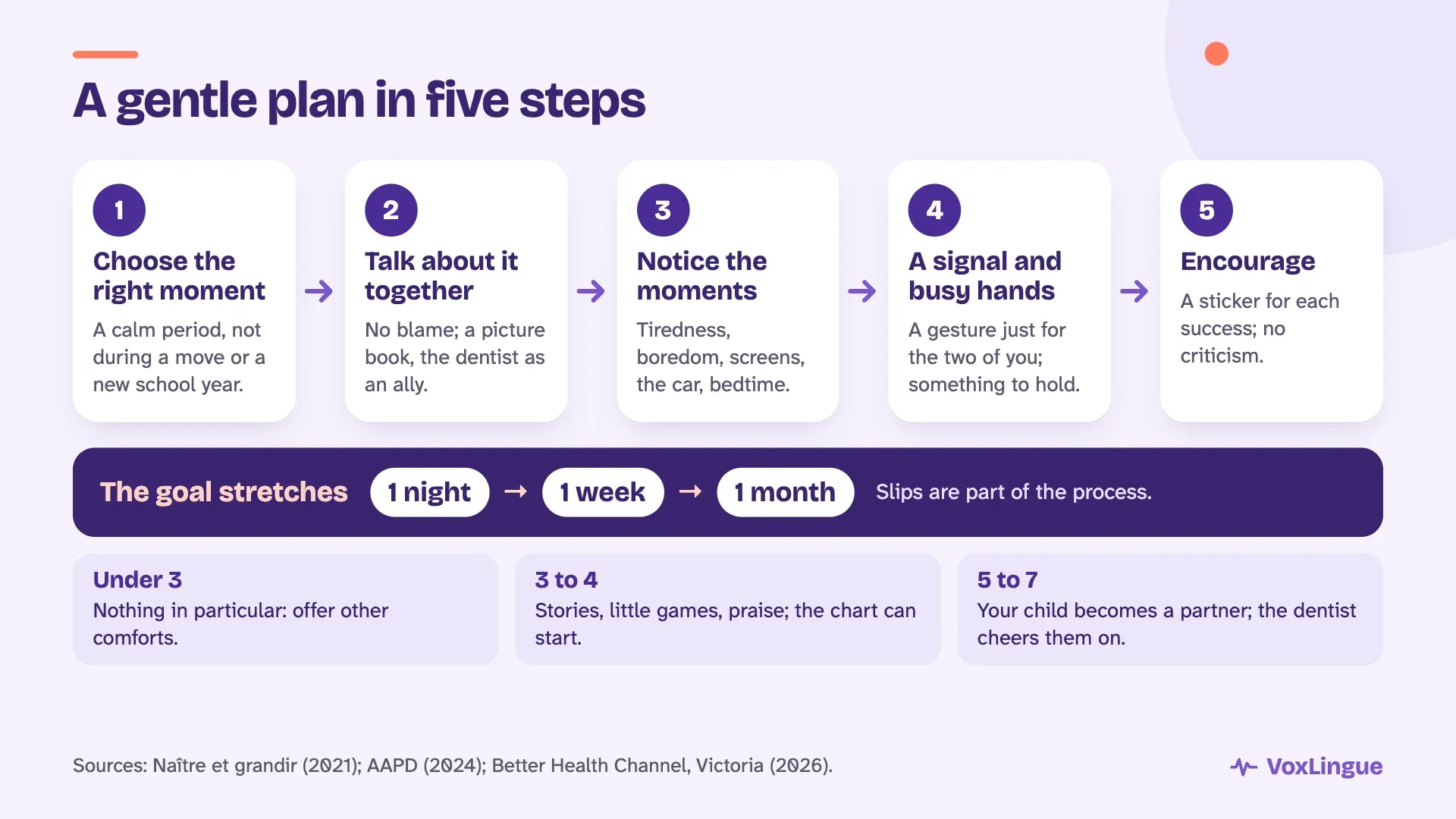
Your child has to want to stop. Choose a calm period, talk about it together, notice when the thumb goes in, agree on a discreet signal, keep their hands busy and offer another comfort. Celebrate each success, and stretch the goal gradually: one night, then a week, then a month. Slips are part of the process.
You can’t put a thumb in a drawer. Unlike a pacifier, you cannot take it away: your child decides whether it goes in their mouth. So a plan that works rests on your child’s motivation, not on your supervision. The five steps below follow that idea.
1. Choose the right moment
The right moment is a calm one. A move, a new baby, starting daycare or kindergarten already ask a lot of a child. During those times, the thumb helps them get through the change. It is better to wait a few weeks than to take that comfort away at the wrong moment.
2. Talk about it together
Talk about it simply, without blame. You can explain that the thumb helped them when they were little, and that they can now learn other ways to feel calm. Ask what they think, and what might help. A child who helps build the plan is more invested in it, and they are the one who has to want to stop.
A picture book about giving up the thumb is a good way to start the conversation. The dentist can also become an ally: in simple words, they can explain to your child what the thumb does to their teeth, and cheer them on.
3. Notice the thumb moments
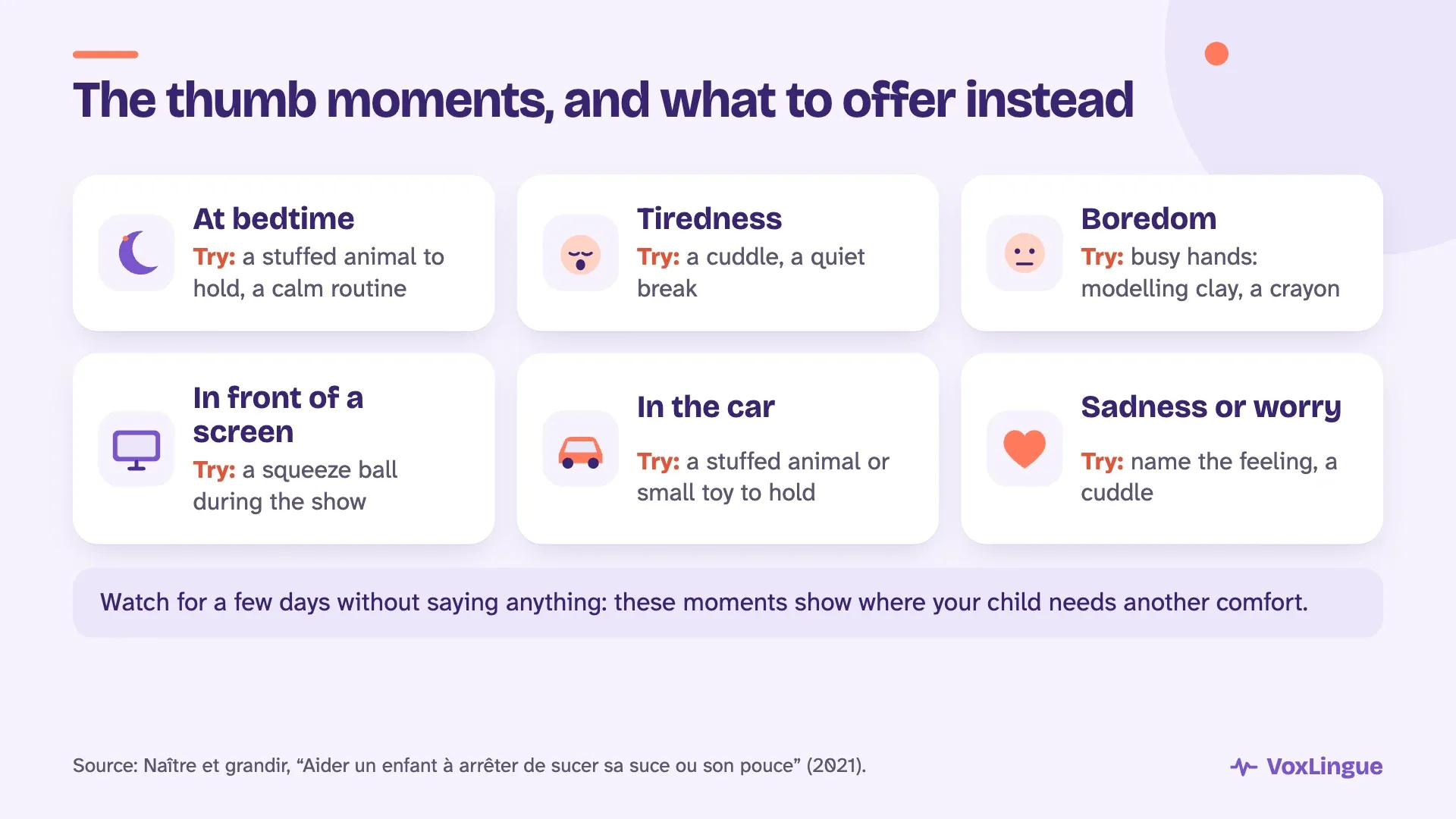
For a few days, watch when the thumb goes in, without saying anything. It might be a moment of tiredness, boredom or sadness, in front of a screen, in the car or at bedtime. These moments show you where your child needs something else. They also save you from mentioning the thumb all day long.
4. A discreet signal and busy hands
Agree on a signal that only the two of you know. Naître et grandir suggests a half smile with a thumbs-up. The signal replaces a “take your thumb out” said in front of others, which can embarrass a child.
At the moments you noticed, give their hands something to do: a squeeze ball, modelling clay, a crayon or a stuffed animal to hold. Think about the feeling behind the habit, too. If your child is sad or worried, naming the feeling and giving them a hug meets the same need as the thumb.
5. Encourage rather than monitor
Celebrate each success. The AAPD recommends recognizing or rewarding each day without sucking, rather than criticizing or restraining the child. Criticism sets up a power struggle, and that struggle can make the habit last longer.
A sticker chart makes progress visible. At first, a sticker rewards a single day or a single night. Then the goal stretches to a week, then a month, as suggested by the Better Health Channel, the public health site of the State of Victoria in Australia. Try not to remind your child all day long: constant reminders turn the plan into supervision.
Slips are part of the process. A tired evening or a busy week, and the thumb comes back. It is not a failure: start the chart again the next day, without comment.
So a plan that works rests on your child’s motivation, not on your supervision.
By age
Before 3, there is usually nothing in particular to do. The thumb is still a normal comfort at this age. Offer other ways to settle, without treating it as a problem.
Between 3 and 4 is the age Canadian guidance aims for. Stories, little games and praise suit this age well. Naître et grandir suggests starting a sticker chart from about age 3.
From 5 to 7, the first adult teeth come in. Your child can become a real partner: they choose their rewards, put on their stickers, and the dentist can cheer them on. According to the American Academy of Pediatrics, many children stop once they are in school, often because of what friends say.
After 7, or if nothing changes despite your efforts, talk to the dentist and, if needed, to a speech-language pathologist. The last section of this guide explains who does what.
How do I stop thumb sucking at night?
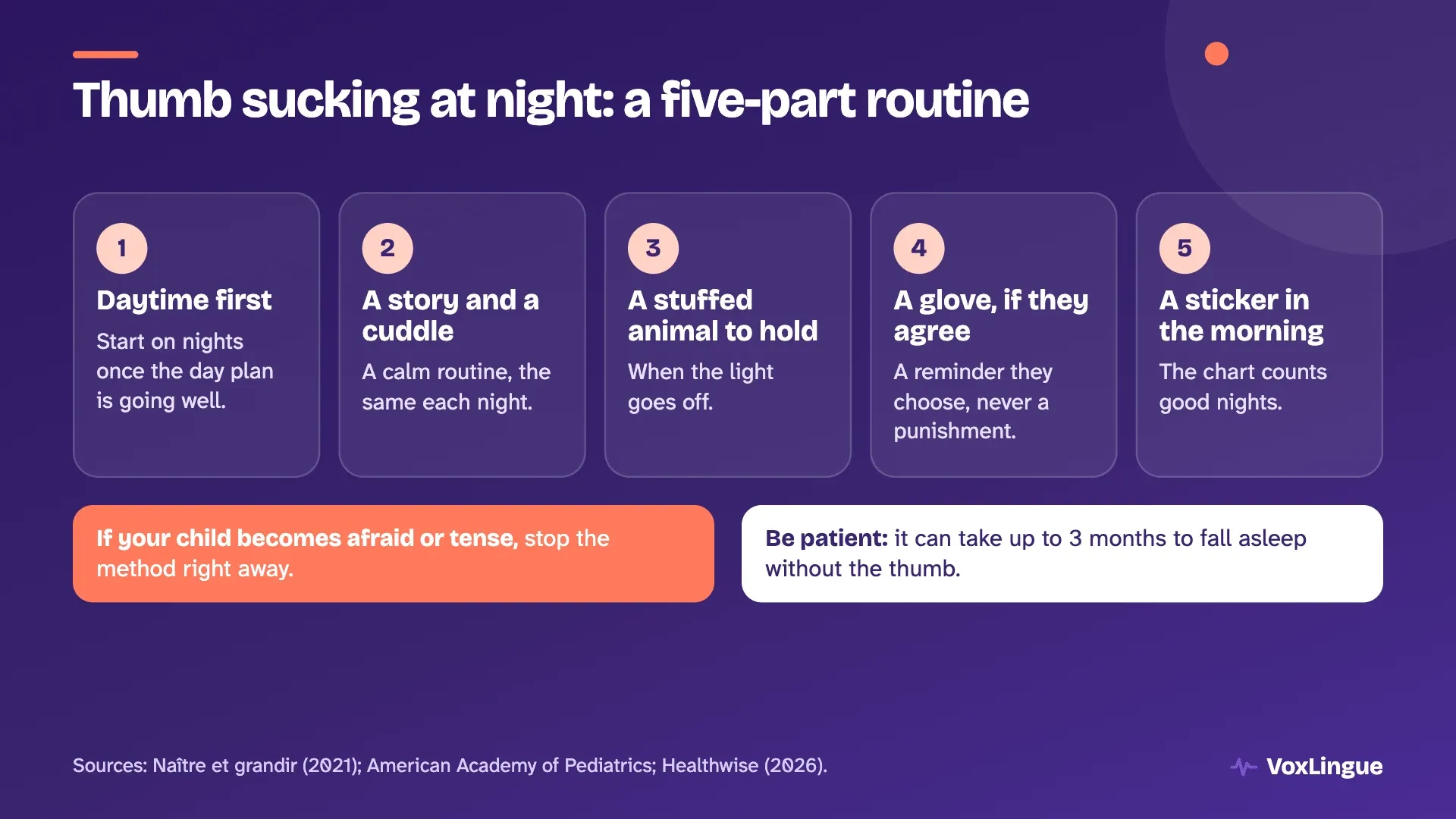
At night, the thumb is often harder to give up. Your child falls asleep with it and may suck without knowing. Work on the day first. In the evening, rely on a calm routine and a stuffed animal to hold. If your child agrees, a glove or sock can serve as a reminder, never as a punishment.
Bedtime is when the need for comfort is strongest. When the daytime plan is going well, your child feels more able to take on the evening. So start with the day, and keep the night for a second step.
A routine helps with the transition. A story, a cuddle, then a stuffed animal in their hands when the light goes off: Naître et grandir suggests a cuddly toy for falling asleep. The same sticker chart can count nights instead of days.
A cotton glove, a sock or a bandage over the thumb can act as a reminder during sleep. Present it as a helper your child chooses, not as a punishment. The American Academy of Pediatrics is clear: if a method makes your child afraid or tense, stop it right away.
They suck their thumb in their sleep without knowing
This is not a lack of willpower. Once asleep, your child doesn’t control what their hands do. It would be unfair to scold them for it in the morning. The glove or sock is for exactly these moments, and some parents gently remove the thumb once their child is asleep.
A thumb that only comes out at bedtime, in private, is less of a concern than one that is there all day. What matters most for the teeth is how long and how hard the sucking is. The habit is still worth working on as the adult teeth come in.
How long does it take?
It takes patience. According to Healthwise patient information, night-time thumb sucking is the hardest habit to break, and it may take up to three months before a child falls asleep without it. Every good night counts, even with steps back along the way.
Bitter nail polish, thumb guards, habit appliances: do they work?
The evidence is thin. The only systematic review on the topic (Cochrane, 2015) includes six small, low-quality studies. Behavioural approaches (rewards, or unpleasant reminders such as a bitter taste) and dental appliances seemed to help. No study tested gloves or bandages. So encouragement comes first.
The Cochrane review (Borrie and colleagues, 2015) included 252 children, in studies all at high risk of bias, and only one measured the effect over the long term. No method has strong proof behind it, and encouragement has as much support as the gadgets.
Dental appliances, such as a thumb crib, are fitted by a dentist or orthodontist: they are a dental decision. ASHA notes that appliances designed to punish have limited success, with reported side effects such as pain and difficulty eating.
| Method | What it is | What the studies say | Our advice |
|---|---|---|---|
| Encouragement and a chart | Praise, stickers, a goal that stretches | Behavioural approaches: weak evidence, but favourable | The starting point, at any age |
| Signal and busy hands | An agreed gesture, something to hold | Recommended by Québec’s Naître et grandir; not tested on its own | Combine with encouragement |
| Glove or sock at night | A reminder during sleep | No studies | If your child agrees; stop if they are tense |
| Bitter nail polish | An unpleasant taste on the nail | Part of the approaches studied, weak evidence | Only if your child agrees; ask your pharmacist or dentist first |
| Thumb guard | A cover that prevents sucking | No studies | Same caution as the glove |
| Dental appliance | A crib or bar fitted in the mouth | Weak evidence; possible side effects | A decision for the dentist or orthodontist |
What to avoid
Scolding, shaming, teasing or comparing your child with others doesn’t work. The American Academy of Pediatrics says so clearly, and the AAPD adds that the power struggle that follows can make the habit last longer. Naître et grandir also advises avoiding guilt and comparisons.
Avoid pulling the thumb out of your child’s mouth in front of others, or announcing the plan to family without their agreement. A child who feels watched or talked about loses the wish to cooperate.
Who should we see: dentist, orthodontist, speech-language pathologist or doctor?
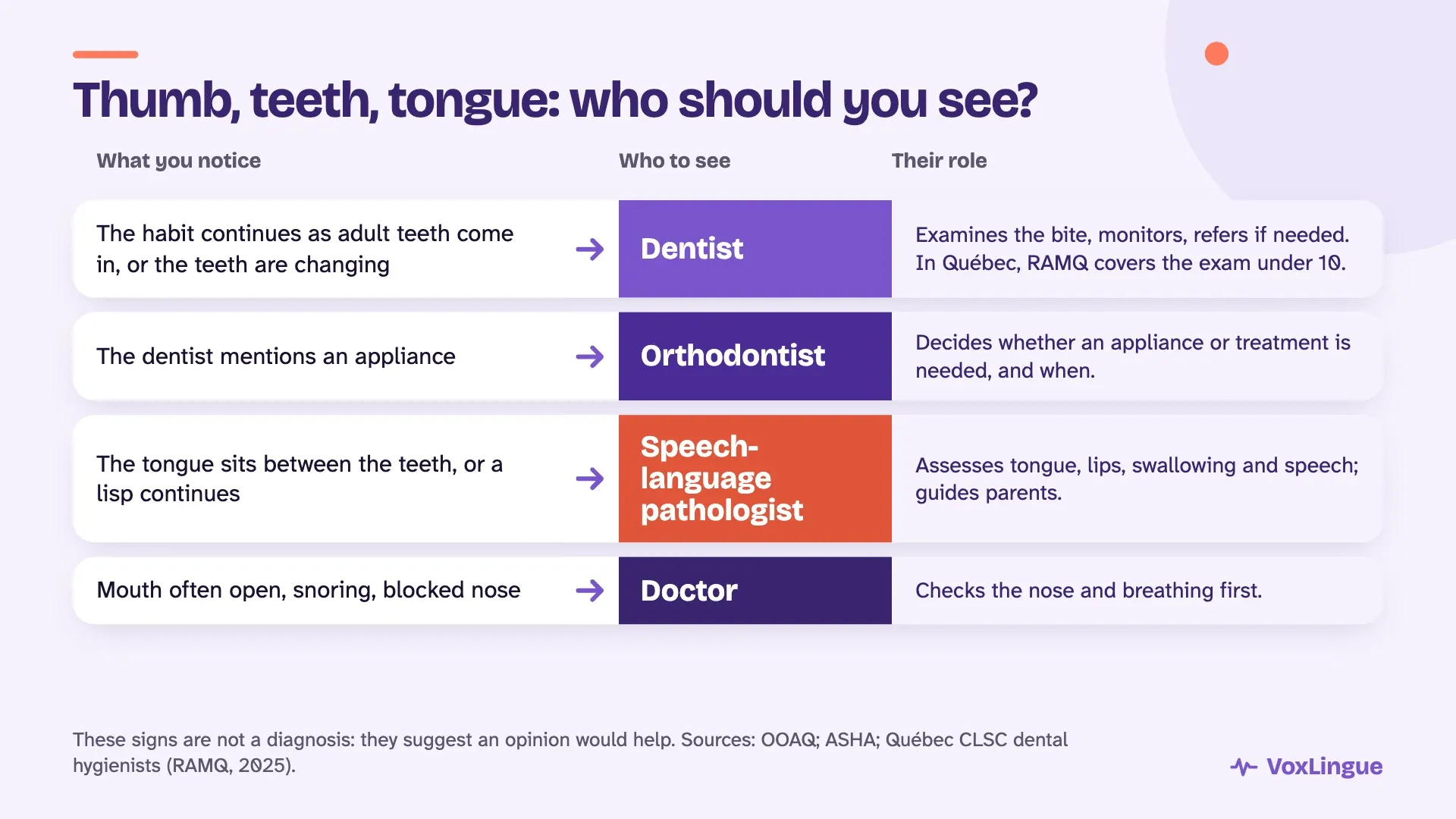
The dentist checks the teeth and the bite. In Québec, RAMQ covers that exam for children under 10. The orthodontist decides whether an appliance is needed. A speech-language pathologist assesses the tongue, lips, swallowing and speech. A doctor checks the nose and breathing if the mouth is often open or your child snores.
Each one looks at a different part of the question, and the SLP works alongside the dentist and orthodontist. The table below helps you decide where to start.
| What you notice | Who to see | Their role |
|---|---|---|
| The habit continues as adult teeth come in, or the teeth are changing position | The dentist | Examines the bite, monitors changes and refers to an orthodontist if needed |
| The dentist mentions an appliance | The orthodontist | Decides whether an appliance or treatment is needed, and when |
| The tongue sits between the teeth, or a lisp continues | The speech-language pathologist | Assesses tongue and lip posture, swallowing and speech, and offers support |
| The mouth is often open, your child snores or often has a blocked nose | The doctor | Checks the nose and breathing before any work on mouth posture |
Signs worth a professional opinion
These signs are not a diagnosis. They suggest that a professional opinion would help:
- the thumb habit continues as the first adult teeth come in, around 5 or 6;
- the top teeth stick out, or the front teeth no longer touch when your child closes their mouth;
- the tongue rests between the teeth, or comes forward when swallowing or talking;
- a lisp that lasts, especially with a tongue that pushes forward;
- the mouth is often open, or your child breathes through the mouth, drools or snores.
If you have followed a gentle plan for several weeks without any progress, that is also a good reason to ask.
What dental coverage pays for
In Québec, RAMQ pays for dental exams and most care for children under 10 with a valid health insurance card: exams, X-rays, fillings, extractions and emergencies. CLSC dental hygienists point out that some care is not covered, including cleanings, fluoride, sealants and orthodontic treatment. A dental visit once a year is recommended from age 1, and it is a good time to bring up the thumb.
In Ontario, Healthy Smiles Ontario covers checkups, cleanings, fillings and urgent care for children 17 and under in families below an income threshold; braces are not covered. In both provinces, the federal Canadian Dental Care Plan can help families without private dental insurance and with a net income under $90,000.
What the speech-language pathologist does
The SLP starts with your questions and your child’s history. They then observe how the tongue and lips rest, how your child swallows and breathes, and how certain sounds are made.
Before about age 4, support mostly goes through you, with practical advice for home. Later, if it is indicated, the SLP may offer myofunctional therapy, working with the dentist or orthodontist. Our page on speech and language assessment explains how a first appointment works.
How to stop thumb sucking: what to remember
Thumb sucking is a comfort, not a misbehaviour. To help your child stop, you replace that comfort rather than fight it.
Keep three things in mind. Aim for about age 3 to 4, gently and with your child on board. Work on the day first, then the night, and celebrate each success. And if the habit lasts as the adult teeth come in, or the tongue rests between the teeth, talk to your dentist and to a speech-language pathologist.
Next step
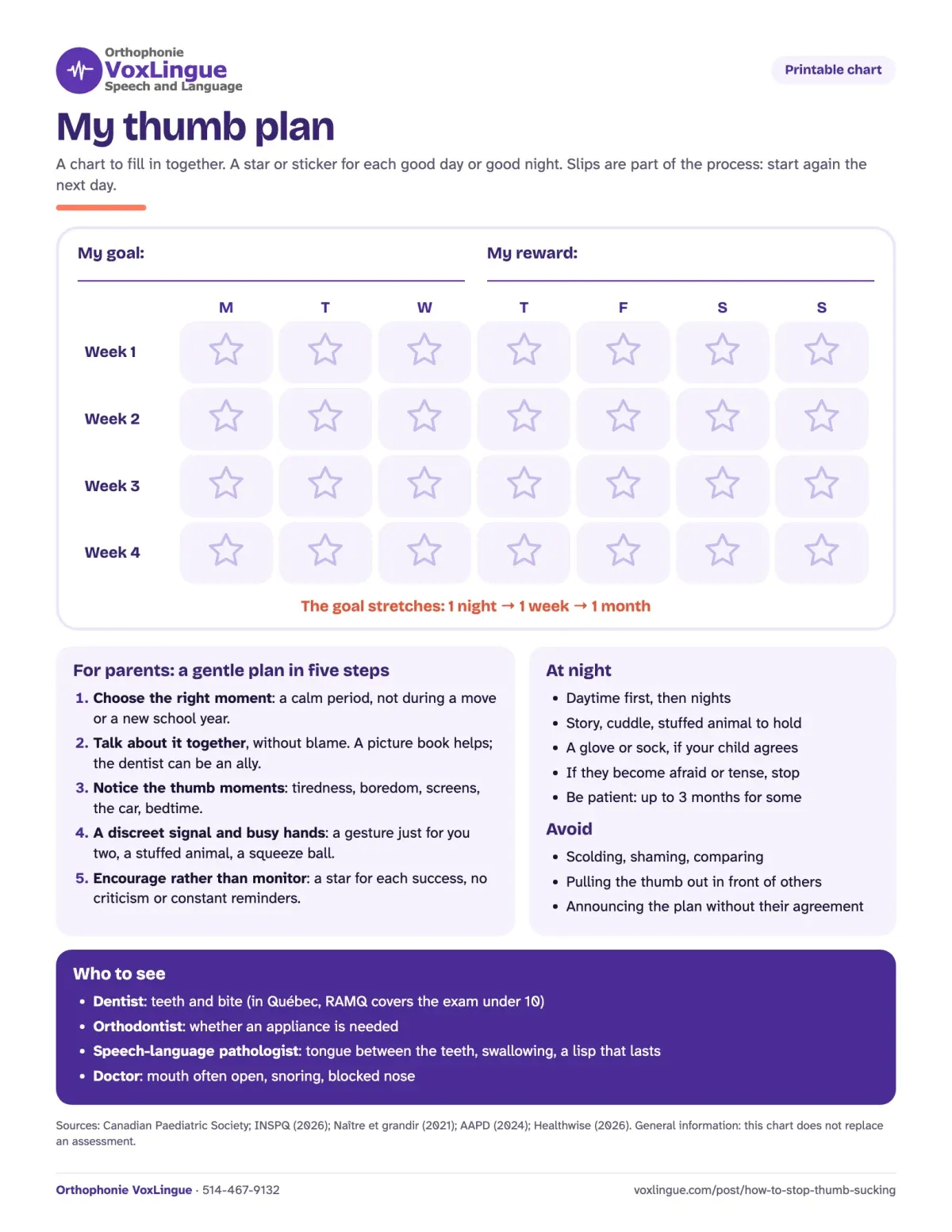
Printable: My thumb plan (PDF, 1 page). A four-week chart to fill in with your child, and the parent’s plan on the back.
If the tongue, the mouth at rest or speech is a concern, our speech-language pathologists support families at our Marché Central clinic in Montréal and by telepractice across Ontario and Québec.
Frequently asked questions
Is it normal for a 5-year-old to suck their thumb?
Yes, it happens. In a large American study, about 1 child in 8 still sucked a thumb or fingers at age 4. A Québec dental health guide still aims for stopping by about 5 or 6 at the latest, as the first adult teeth arrive. So this is a good time for a gentle plan, and for a word with the dentist.
Is thumb sucking worse than a pacifier?
Both matter more the longer the habit lasts. A thumb habit is more strongly linked to top teeth sticking out. A pacifier, on the other hand, is easier to stop, because a parent can put it away. That is also why a pacifier shouldn’t be taken away too abruptly from a toddler: sometimes the thumb takes over.
Is sucking two fingers the same as sucking a thumb?
Yes. Researchers group thumbs and fingers together as “digit sucking”, and the possible effects on the teeth are similar. The plan is the same: notice the moments, keep the hands busy, offer another comfort and celebrate each success.
Does thumb sucking change the shape of the palate?
Not really the palate itself. According to Naître et grandir, the pressure of the thumb acts mainly on the dental arch and the bone that holds the teeth. A long-lasting habit can make the upper arch narrower. In some children, it has no visible effect. Your dentist can tell you what is happening in your child’s mouth.
Will my child’s teeth go back to normal after they stop?
Often, in part. An open bite frequently improves after the habit stops, even after age 4, but there are few studies. A crossbite and top teeth sticking out may remain. That is why the dentist checks the bite after the habit ends, and decides whether to wait or refer to an orthodontist.
Should I just ignore it?
Before about age 3, often yes: the thumb is a normal comfort at that age, and the American Academy of Pediatrics suggests leaving it alone as a first step. After that, a gentle plan made with your child works better. What you ignore then are the slips: no comment, and a fresh start on the chart the next day.
Does thumb sucking cause mouth breathing?
That link has not been established. Our article on mouth breathing and snoring in children explains its causes, such as a nose that is often blocked. If your child’s mouth is often open, or they snore or breathe noisily, talk to the doctor first. They will check the nose and breathing before any work on mouth posture.
My child is being teased about thumb sucking at daycare. What should I do?
Listen and name what they are feeling, without adding pressure. Comments from friends often motivate children to stop on their own, but they can also hurt. Offer the discreet signal and the chart as their own project. If the teasing continues, talk to the educator.
Can a speech therapist help with thumb sucking?
Yes, especially when the thumb comes with a tongue between the teeth, a mouth that is often open, an unusual swallow or a lisp. A speech-language pathologist assesses tongue and lip posture, swallowing and speech. Before about age 4, they mainly guide parents; later, they can work directly with the child.
Does RAMQ cover the dentist for my child?
Yes, for children under 10 in Québec with a valid health insurance card. The yearly exam, X-rays, fillings, extractions and emergencies are covered. Cleanings, fluoride, sealants and orthodontics are not. In Ontario, Healthy Smiles Ontario and the Canadian Dental Care Plan can help eligible families.