Mouth breathing and snoring in children: common, but not typical
A soft snore from the next room. A mouth hanging open in front of the TV. And a line many parents hear: “Everyone in our family snores.” Mouth breathing in children, and snoring, are so common that it is easy to assume they don’t matter.
But common is not the same as typical. At rest and during sleep, children typically breathe quietly through the nose. When a child snores most nights or keeps the mouth open most of the time, that is a signal. Not an emergency, but a reason to take a closer look.
This guide explains what is typical and what isn’t, the signs to watch at night and during the day, and why it is worth addressing. It also covers who to see in Québec and Ontario, in what order, and what a speech-language pathologist can and cannot do.
Is it normal for a child to snore or breathe through the mouth?
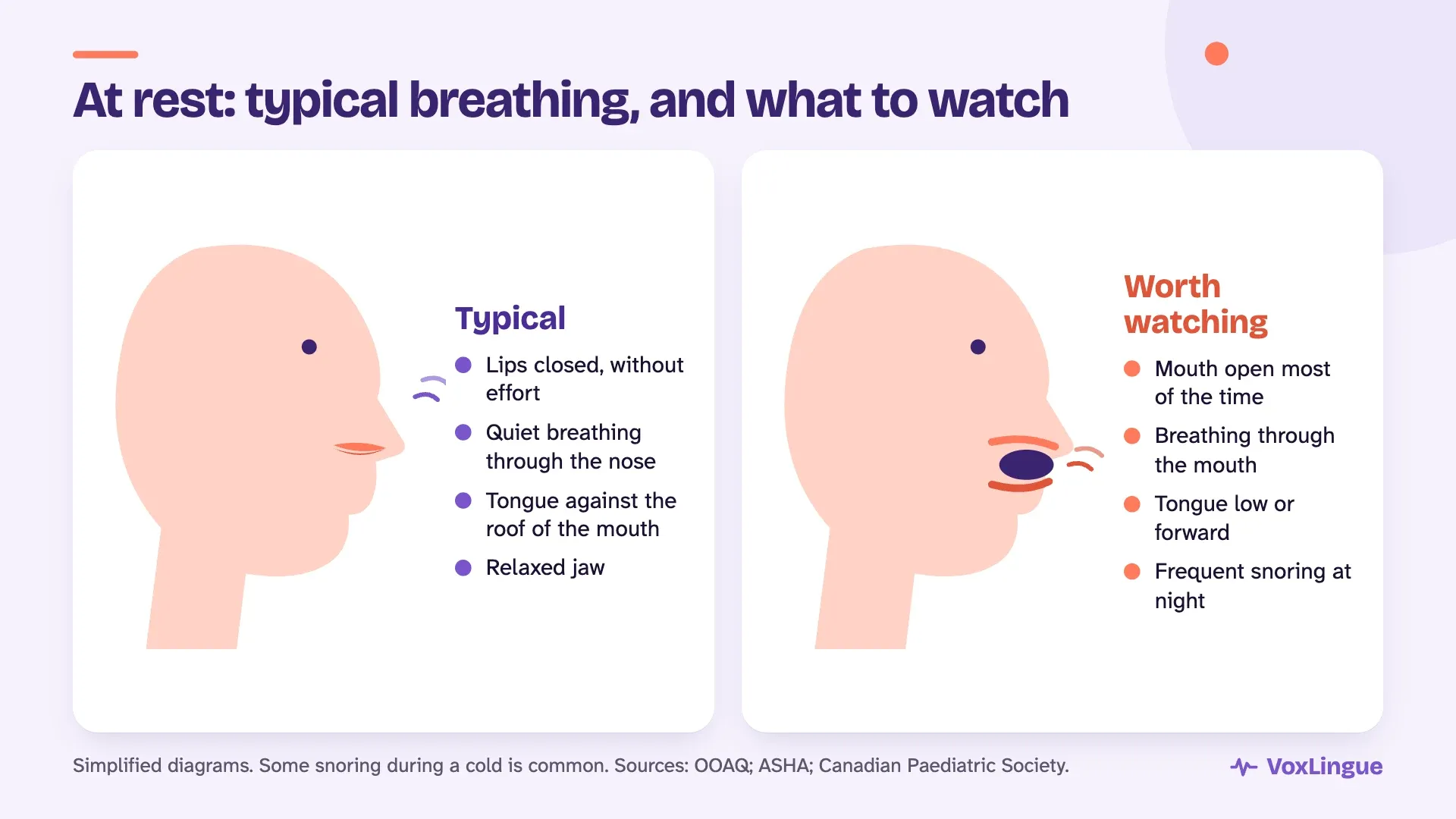
It is common, but it is not what we expect. At rest and during sleep, a child typically breathes quietly through the nose, lips closed, tongue against the roof of the mouth. A little snoring during a cold is common. Snoring most nights, or a mouth that is open most of the time, is a signal to check.
Common doesn’t mean typical
A speech-language pathologist interviewed by Québec’s professional order for SLPs (OOAQ) put it plainly (in French): snoring is never part of normal human development, and it shouldn’t be brushed off. Regular snoring is not a developmental stage, like losing baby teeth. It is a symptom worth noticing.
The numbers explain why it gets brushed off. According to a 2008 research review (Lumeng and Chervin), about 7 to 8% of children snore according to their parents, and 1.5 to 6% snore “always”. Sleep apnea affects about 1 to 5 children in 100, most often between ages 2 and 8, according to SickKids hospital in Toronto.
So many children who snore do not have sleep apnea. But regular snoring is still the doorway to finding the ones who do.
Mouth breathing is even more widespread. Studies give very different figures depending on how it is measured: day or night, by parent report or by examination. The takeaway is simply that it is common, and that it is not the expected way to breathe. Our articles on oral habits also cover pacifiers, thumb sucking and tongue posture.
What typical breathing looks like
At rest, when a child isn’t talking or eating, the lips touch without effort. Breathing happens through the nose. The tongue rests against the roof of the mouth, just behind the top teeth, and the jaw is relaxed. Québec’s order of SLPs describes this rest posture as the natural, effortless position of the tongue and lips.
During sleep, typical breathing is quiet and regular. A child moves around a little, but doesn’t struggle to breathe. Snoring is rare and short-lived, for example during a cold.
How can I tell if my child is mouth breathing or has sleep apnea?
Watch at night and during the day. At night: loud snoring most nights, pauses followed by a gasp, restless or sweaty sleep, an open mouth. During the day: tiredness, irritability, trouble concentrating, a mouth that is often open. Only a medical assessment can tell whether it is sleep apnea.
Sleep apnea is when breathing stops or slows for moments during sleep because the airway gets blocked. According to SickKids’ guide to obstructive sleep apnea, it is linked to snoring, breathing only through the mouth, restless sleep and pauses in breathing. A child with sleep apnea rarely complains of being tired. Parents more often notice restlessness, irritability, hyperactivity or trouble focusing.
The table below helps tell the difference. It is not a diagnosis: it tells you what to note, and when to bring it up.
| Common | Worth watching | Show the doctor soon | |
|---|---|---|---|
| Snoring | During a cold, for a few nights | Several nights a week, without a cold | Loud and regular, or with pauses followed by a gasp |
| Mouth | Open when the nose is blocked | Open most of the time, day and night | Breathes only through the mouth; nose always seems blocked |
| Sleep | A few wakings | Restless sleep, unusual positions | Heavy sweating, waking with a start, head tipped far back, bedwetting |
| Daytime | Tired after a big day | Irritable, distracted, often tired | Sleepiness, attention or learning difficulties, growth that worries you |
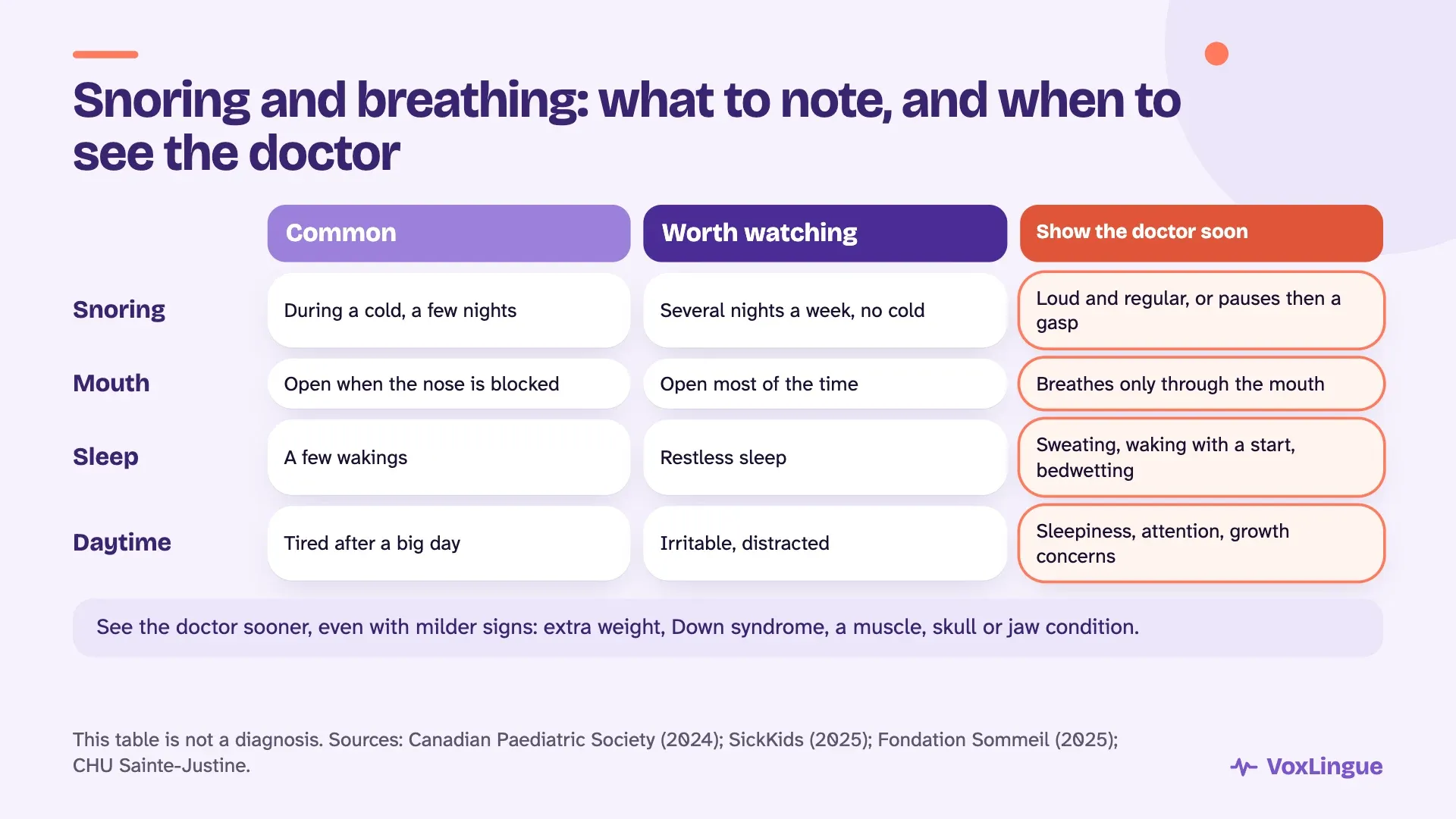
Some children need a medical opinion sooner, even with milder signs. That includes children with extra weight, Down syndrome, or a condition affecting the muscles, the skull or the jaw. Their doctor already knows about this risk, so bring up their sleep.
The Canadian Paediatric Society sums up the rule: if your child regularly snores loudly, or seems to stop breathing for a short time and then gasps, talk to your doctor. Its parent handout on healthy sleep for your baby and child also covers sleep at each age.
My child only snores when sick
Snoring that starts with a cold and goes away with it is common. The nose is blocked, air goes through the mouth, and then things settle. What is worth noting is snoring that stays after the cold, or a cold that never seems to end. Québec’s parenting reference Naître et grandir notes that a stuffy nose that lasts or keeps coming back can be linked to allergies or large adenoids.
Film a night for the doctor
Sleep signs are hard to describe in an appointment. A short video of your sleeping child, with sound, can show the doctor the snoring, the pauses or the effort to breathe. For a week or two, also note the nights with snoring, the open mouth and what you see during the day. The printable log at the end of this guide is made for exactly that.
Why do children breathe through their mouth?
Most often because the nose is partly blocked. Common causes: large adenoids or tonsils, allergies, or congestion that lasts. Sometimes the habit stays even when the nose is clear, or comes with a thumb or pacifier habit. Finding the cause comes first, and that is the doctor’s job.
The adenoids sit at the back of the nose. Montréal’s CHU Sainte-Justine children’s hospital explains that when they are too large, they can get in the way of nose breathing and contribute to snoring and sleep apnea. The tonsils, at the back of the throat, can also narrow the airway when they are large.
Allergies, such as hay fever, and congestion that lingers keep the nose blocked for weeks at a time. CHU Sainte-Justine and Montréal’s Fondation Sommeil list other factors: extra weight, the shape of the jaw (a receding chin or a narrow palate, for example), and some medical conditions.
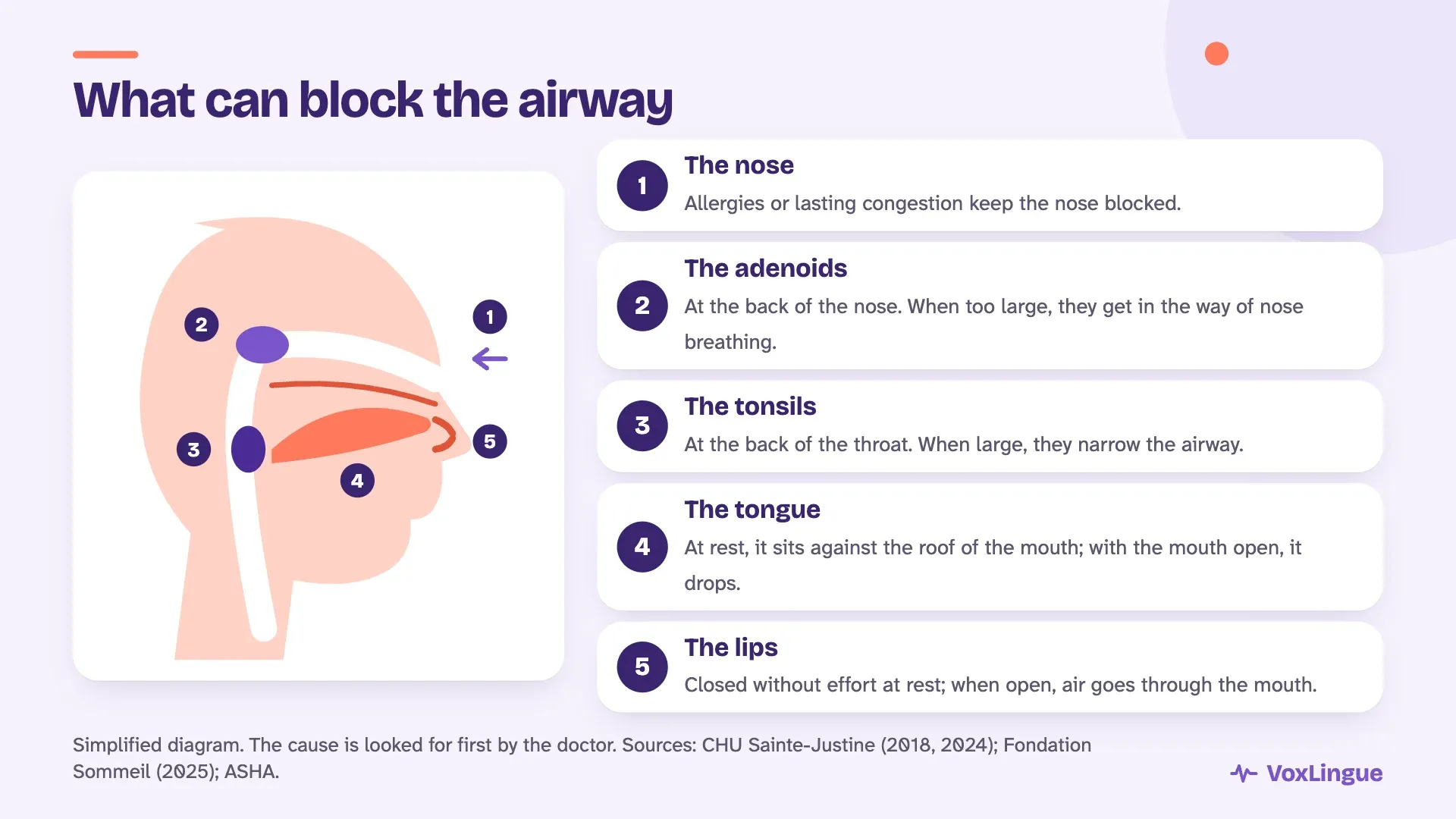
Then there is habit. A mouth that opened during months of congestion can stay open once the nose is clear. Thumb or pacifier sucking past age 3 is also among the contributing factors described by the American Speech-Language-Hearing Association (ASHA). Our article on childhood oral habits and their effects covers these habits in more detail, and our guide on how to stop thumb sucking offers a gentle plan.
The cause decides the solution. That is why the doctor comes first: they look for what is blocking the airway before anyone works on habits.
Why is it worth addressing?
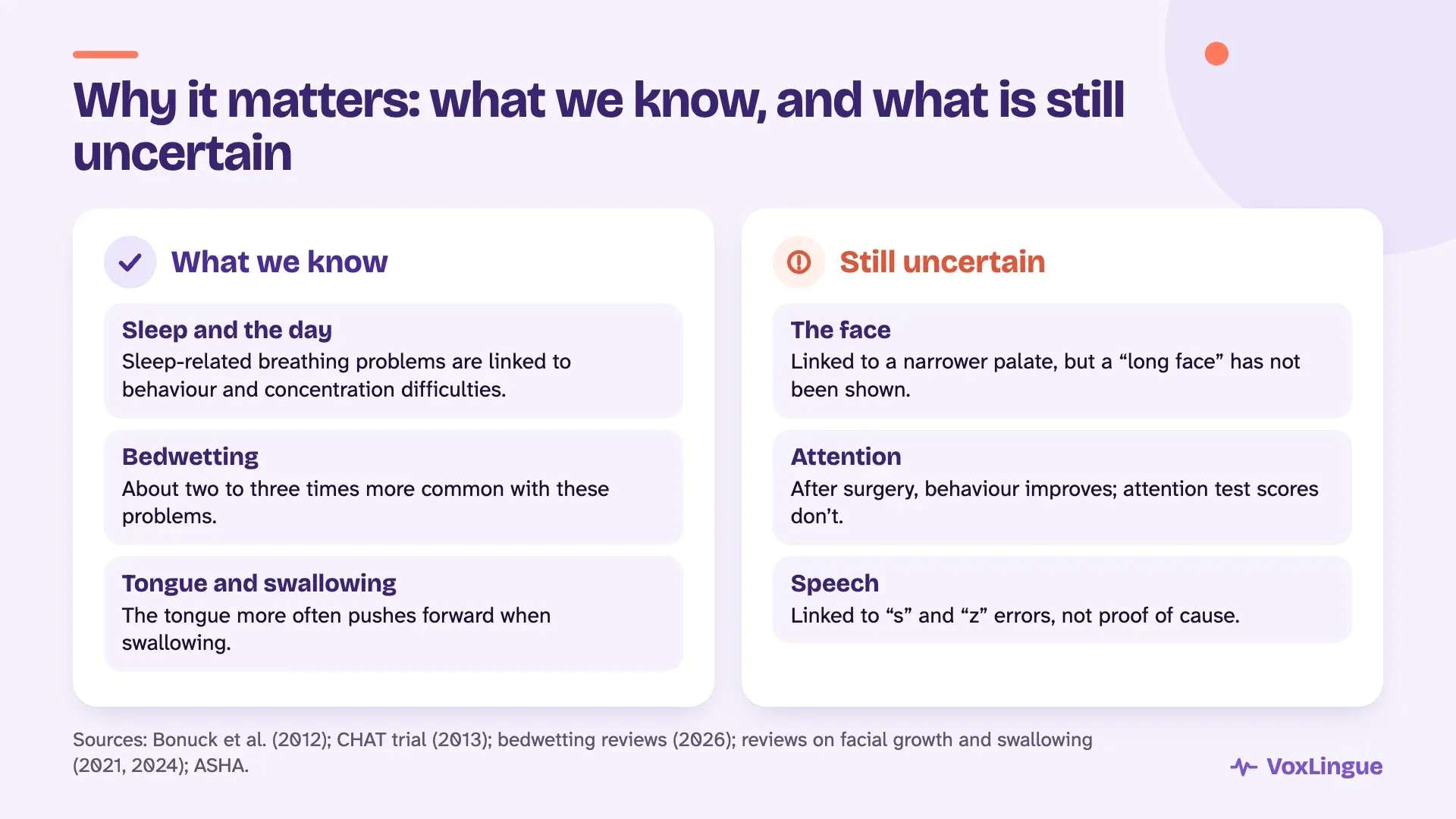
Because sleep and nose breathing matter, by day and by night. Sleep-related breathing problems are linked to behaviour and concentration difficulties, and to bedwetting. Mouth breathing is linked to a narrower palate and a tongue that pushes forward, both when swallowing and when talking.
Sleep and the day ahead
Sleep broken by breathing pauses is less restful. A large British study followed about 9,000 children (Bonuck and colleagues, 2012). Toddlers who snored, breathed through the mouth or had breathing pauses more often had behaviour difficulties at ages 4 and 7. That is an association, not proof of cause.
The CHAT trial, published in 2013, studied 464 children aged 5 to 9 with sleep apnea. Removing the tonsils and adenoids improved behaviour, quality of life and sleep, but not scores on attention tests. Many children in the “watch and wait” group also improved: 46% had normal sleep results after seven months, compared with 79% after surgery.
So the message is balanced. It is worth checking, but not every child needs surgery, and that decision belongs to the doctor. Left without follow-up, though, sleep apnea is linked to higher blood pressure, slower growth, and learning and behaviour difficulties, according to SickKids.
Bedwetting
Bedwetting is more common in children with sleep-related breathing problems. Two research reviews published in 2026 put it at about two to three times more likely. US ear, nose and throat guidelines ask doctors to ask about bedwetting, growth, school and behaviour in a child who snores.
Teeth, palate and face: what we actually know
You may read that mouth breathing “causes a long face”. That has not been shown. Studies find a link between mouth breathing and a narrower palate, a crossbite, or a jaw that grows more downward and backward. But these are mostly observational studies of low to moderate quality, and genetics also plays a role.
Evidence that surgery changes facial growth is of very low quality. The sensible step is simple: ask your dentist to check the teeth and palate. They can tell you whether anything needs to be followed.
Swallowing and speech
When the mouth stays open, the tongue often rests lower and further forward. A 2024 review found that children who breathe through the mouth more often swallow with the tongue pushing forward.
In one Brazilian clinic, about 3 in 10 children referred for mouth breathing also had a speech difference, most often the tongue between the teeth on “s”. That study had no comparison group: it shows a link, not a cause. The sounds most often affected are “s” and “z”, sometimes “sh”: “thoup” for “soup”, for example. Our guide to speech sound development helps you place what you are hearing.
Who should we see in Québec and Ontario?
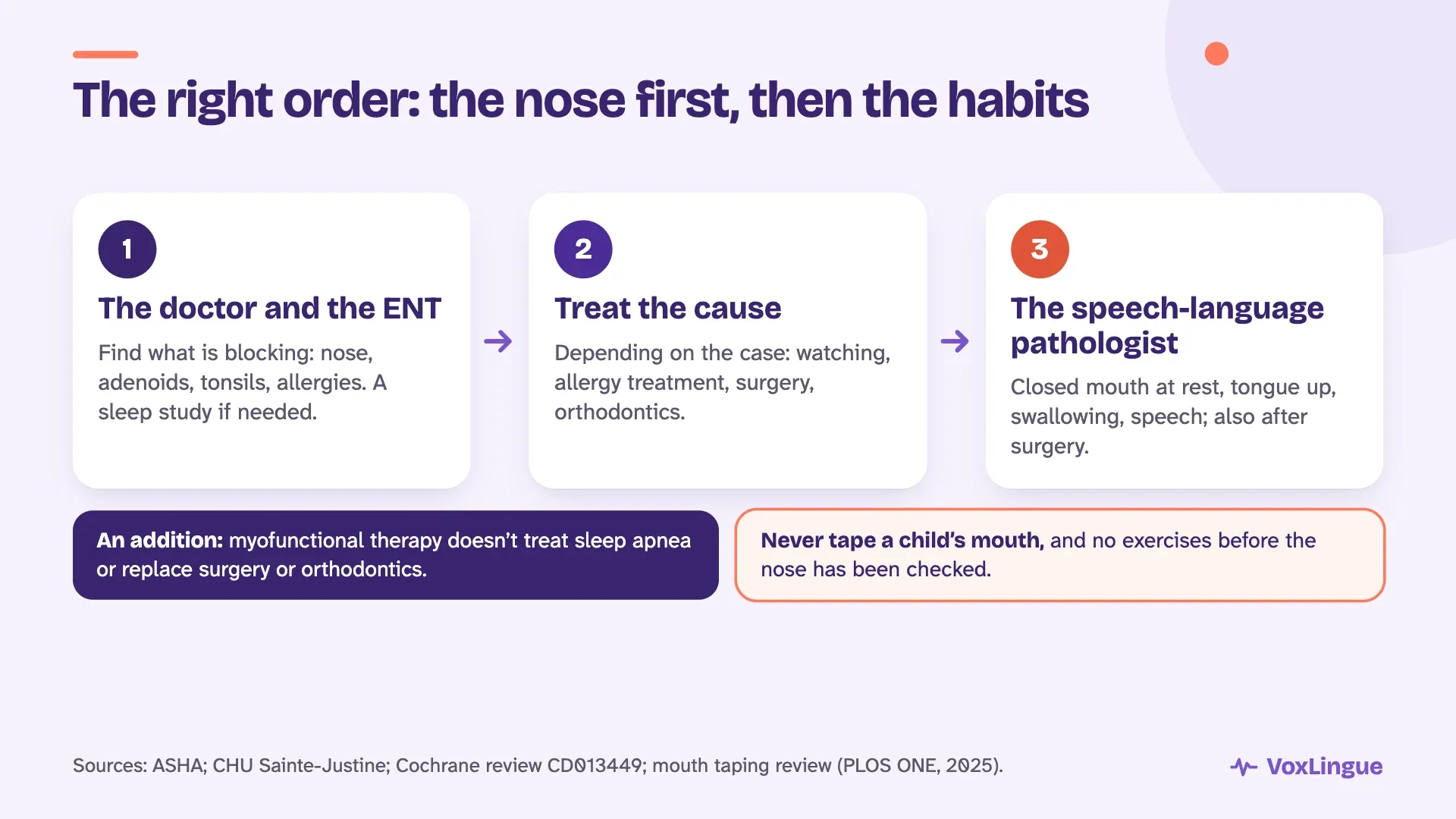
Start with your family doctor, pediatrician or nurse practitioner, or call 811. The doctor can refer to an ENT and order a sleep study, usually done in hospital. The dentist or orthodontist checks the teeth and palate. A speech-language pathologist works on mouth posture, swallowing and speech, once the nose and throat have been checked.
Order matters. Mouth breathing and snoring often have a physical cause in the nose or throat, and that cause is treated medically first. Mouth habits are worked on afterward, or at the same time with the doctor’s agreement.
| What you notice | Who to see | Their role |
|---|---|---|
| Loud, regular snoring, pauses, restless sleep, daytime tiredness or behaviour | Family doctor, pediatrician or nurse practitioner | Assesses, looks for the cause, orders a sleep study if needed and refers to a specialist |
| Large tonsils or adenoids, a nose that is always blocked | ENT (ear, nose and throat specialist) | Examines the nose and throat; decides on treatment or surgery |
| Allergies blocking the nose | Doctor, sometimes an allergist | Treats allergies and congestion |
| Teeth that don’t close well, a narrow palate | Dentist or orthodontist | Checks the bite and palate; may suspect sleep apnea and tell the doctor |
| Mouth open at rest, low or forward tongue, a lisp | Speech-language pathologist | Assesses tongue and lip posture, swallowing and speech; coaches new habits |
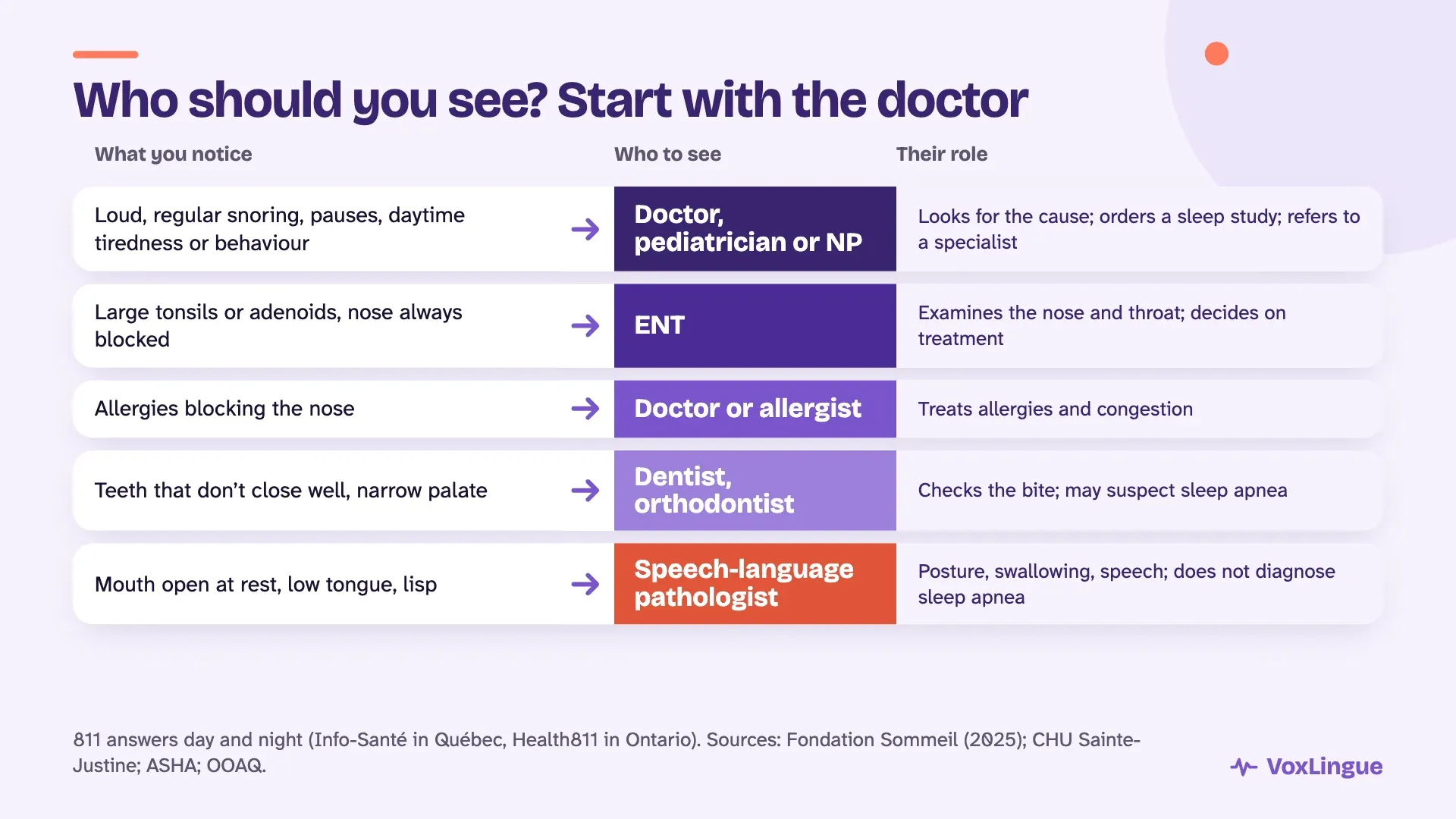
Montréal’s Fondation Sommeil is clear about the roles: a dentist or orthodontist can suspect sleep apnea, but it is the doctor or nurse practitioner who orders the test. A speech-language pathologist does not diagnose sleep apnea either. If an SLP notices signs during an assessment, they will refer you to the doctor.
What is a sleep study?
A sleep study, or polysomnography, records a child’s sleep overnight. Sensors measure breathing, oxygen in the blood and the stages of sleep. CHU Sainte-Justine describes it as the best test to find out whether a child has sleep apnea, and it is done in hospital.
In 2026, Canada’s respiratory and sleep societies confirmed that the overnight sleep study remains the standard for diagnosing sleep apnea in children. A questionnaire or a home oxygen reading is not enough to make the diagnosis. The same societies note that access to sleep studies is limited in many regions, so waits can be long.
In Ontario
The path is similar. Start with your family doctor or nurse practitioner, or call Health811 for advice. The doctor can refer your child to a pediatric ENT or a sleep clinic. Hospital sleep labs exist across the province, but the waits mentioned above apply there too.
While you wait
While you wait, a few everyday habits can help, according to Fondation Sommeil. They don’t replace the assessment:
- physical activity every day;
- a regular sleep schedule and enough hours of sleep;
- a smoke-free home, which is less irritating for the airways;
- if allergies are suspected, fewer allergens in the bedroom: dust with a damp cloth, wash bedding often, limit stuffed animals.
The Fondation also suggests getting children used to sleeping on their side. This advice is for children, not babies: a baby always sleeps on their back. Finally, keep the nose clear. Québec’s public health institute notes that young children can’t blow their nose effectively, and recommends rinsing the nose with saline, not medicated sprays.
Keep notes on what you see, too: the printable log at the end of this guide helps you arrive at the appointment with specific examples.
How does a speech-language pathologist help?
A speech-language pathologist (SLP) steps in once the nose and throat have been checked. They look at how the lips, tongue and jaw rest and move, and how your child swallows and speaks. Then they help build the habit of a closed mouth and nose breathing. It is an addition to medical care, not a treatment for sleep apnea.
Mouth rest posture and swallowing are part of an SLP’s work. ASHA’s practice portal on orofacial myofunctional disorders describes chronic mouth breathing, a low or forward tongue and a tongue thrust swallow among the patterns SLPs assess. When the rest posture or movements of the mouth and face differ from what is expected, this is called an orofacial myofunctional disorder, or OMD.
An assessment starts with your observations and your child’s history: sleep, colds, habits, and what the doctor or dentist has already said. The SLP then looks at the mouth at rest, the tongue, the lips, swallowing, chewing and speech. Therapy uses short exercises and habits built into daily routines, with your involvement. Our page on orofacial myofunctional therapy explains how it works.
The nose first, then the habits
You can’t ask a child to keep their mouth closed if air can’t get through their nose. ASHA is clear: a closed-mouth rest posture “cannot be consistently established until any airway interferences have been successfully resolved”. That is why SLPs work with the doctor, ENT, allergist and orthodontist, not instead of them.
This order also protects your child and your budget. Exercises started while the adenoids are still blocking the nose are likely to frustrate everyone, without lasting results.
After tonsil or adenoid surgery
Removing the tonsils or adenoids opens up the airway. But sometimes the mouth has learned to stay open, and that habit can continue after surgery. A small 2020 study found that some children kept mouth breathing after successful surgery, especially older children and those whose teeth or jaw were already affected.
This is often when an SLP is most useful. The nose is clear; now your child has to learn to use it. Therapy then focuses on a closed mouth at rest, the tongue against the roof of the mouth, and a swallow without the tongue pushing forward.
What myofunctional therapy can and cannot do
Myofunctional therapy has mostly been studied in adults. In those studies, mouth and throat exercises reduced sleep apnea, as an addition to medical treatment. In children, there are few studies, and they are small. The Cochrane review on the topic included only 13 children, and its authors rated the results as unreliable.
Another known challenge is consistency. In one trial, only 10 of 54 children were still doing their exercises correctly after six months. Parent involvement is essential, and the program has to stay simple and short.
The bottom line: in children, myofunctional therapy helps build better habits for rest posture, swallowing and breathing. It does not treat sleep apnea, and it does not replace surgery, orthodontics or medical follow-up. It doesn’t promise to change the shape of the face either.
The nose is clear; now your child has to learn to use it.
Mouth taping, gadgets and online exercises
On social media, some adults tape their mouth shut to sleep. Never do this to a child. A 2025 review by a team in London, Ontario, found almost no evidence that it works. It flagged a potentially serious risk, especially when the nose is blocked. No studies have been done in children.
Be equally careful with devices and exercise programs found online. Without an assessment of the nose and throat, they may miss the real cause.
What about adults?
Snoring isn’t harmless in adults either. Loud snoring with pauses, or sleepiness during the day, calls for a visit to the doctor first, to rule out sleep apnea. Myofunctional exercises have been studied more in adults, as an addition to medical treatment.
Québec’s order of dentists points out that snoring is often wrongly seen as a harmless problem. Before snoring is treated, sleep apnea needs to be ruled out, an assessment done by a doctor. According to Statistics Canada, 6.4% of Canadians reported in 2016 and 2017 that they had been diagnosed with sleep apnea.
Once sleep apnea has been assessed, several treatments exist: an oral appliance from the dentist, a breathing machine (CPAP), weight loss, and sometimes mouth and throat exercises. Those exercises come from speech therapy. Our page on speech therapy for adults describes the services we offer adults.
Mouth breathing and snoring in children: what to remember
Mouth breathing and snoring in children are common, but they are not the norm. They are signals, not emergencies.
Keep three things in mind. Loud, regular snoring, breathing pauses or a mouth that is almost always open are worth showing the doctor. The cause is found and treated first, often in the nose or throat. Then a speech-language pathologist can help your child build the habit of a closed mouth and nose breathing.
Next step
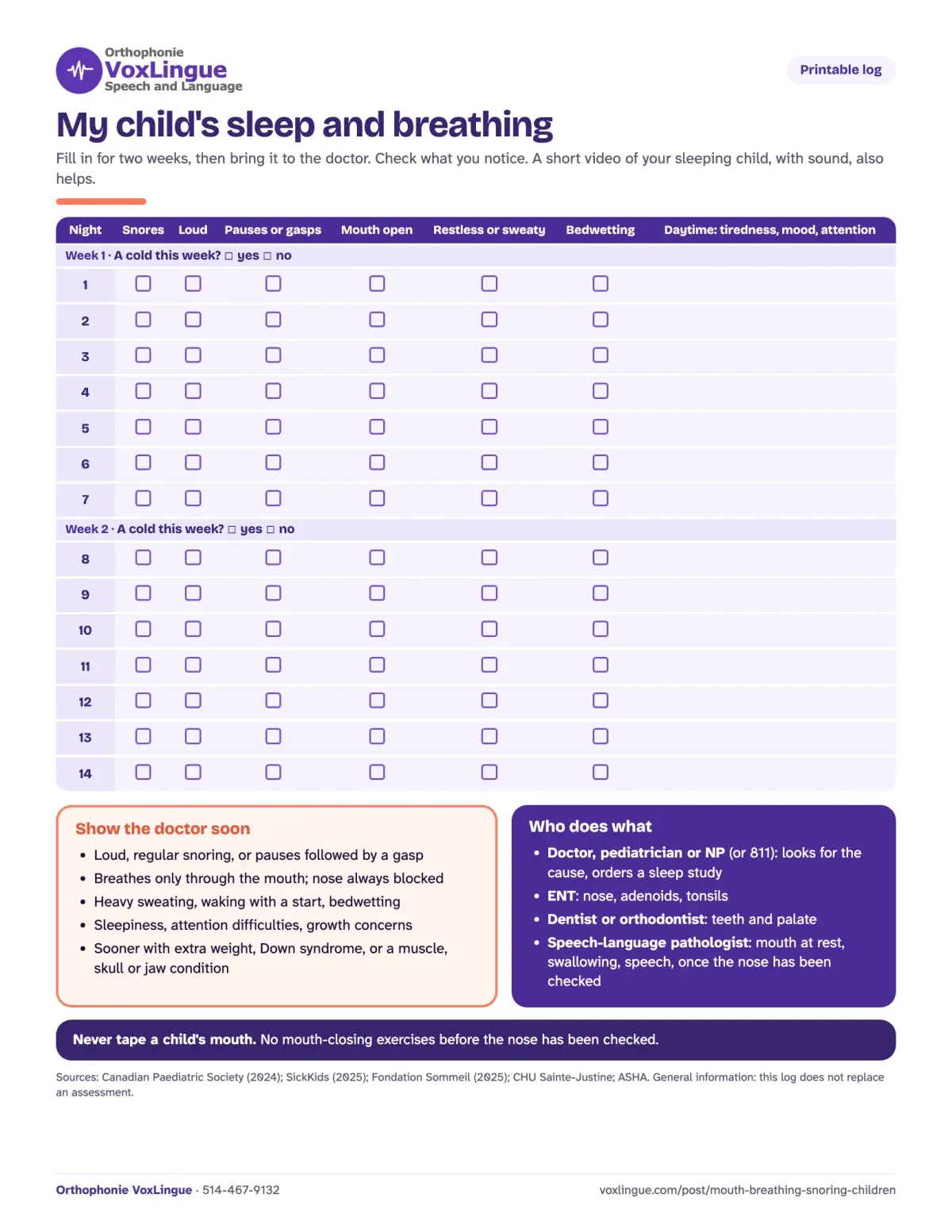
Printable: My child’s sleep and breathing (PDF, 1 page). A two-week log to fill in, and the signs to show the doctor.
If mouth posture, swallowing or speech is a concern, our speech-language pathologists support families at our Marché Central clinic in Montréal and through online speech therapy in Ontario and Québec.
Frequently asked questions
At what age should I worry about my child’s snoring?
There is no set age. Loud, regular snoring is worth mentioning to the doctor at any age. Sleep apnea most often shows up between ages 2 and 8, according to SickKids. Occasional snoring during a cold, on the other hand, is common and usually nothing to worry about.
My child only snores when they have a cold. Is that a problem?
Usually not. A nose blocked by a cold often causes snoring for a few nights, then things go back to normal. Note instead whether the snoring continues after the cold, or whether the nose always seems blocked. Congestion that lasts may be linked to allergies or large adenoids, and is worth a visit to the doctor.
Why does my child sleep with their mouth open, and what should I do?
Often because the nose is partly blocked, sometimes out of habit. Watch for a week or two first: snoring, pauses, an open mouth during the day, tiredness. Then talk to the doctor, who will check the nose and throat. Once the cause is treated, if the mouth stays open out of habit, an SLP can help.
Does mouth breathing change the shape of the face?
That has not been shown. Studies find a link between mouth breathing and a narrower palate or a jaw that grows more downward, but mostly in observational studies of limited quality. Genetics also plays a role. A dentist or orthodontist can check your child’s teeth and palate.
Should my child have their tonsils and adenoids removed?
That decision belongs to the doctor and the ENT. When large tonsils cause sleep apnea, surgery is often the first treatment, according to CHU Sainte-Justine. But not every child who snores needs it. In a large trial, many children improved with watchful waiting alone.
Why is my child still mouth breathing after adenoid removal?
Because the mouth may have kept the habit of staying open. The nose is now clear, but your child isn’t using it fully yet. This is a good time to see a speech-language pathologist, who works on a closed mouth at rest, the tongue against the roof of the mouth and nose breathing. Check with the doctor that the nose is fully clear too.
Is mouth taping safe for kids?
No. The trend comes from adults, and a Canadian review published in 2025 found almost no evidence that it works, even for them. It flagged a serious risk when the nose is blocked, and there are no studies in children. If your child breathes through the mouth, look for the cause with the doctor.
Can snoring cause attention problems?
Sleep-related breathing problems are linked to behaviour and concentration difficulties. In the CHAT trial, removing the tonsils and adenoids improved behaviour, but not attention test scores. If your child has trouble focusing and also snores, mention both to the doctor.
Can a speech therapist diagnose sleep apnea?
No. Sleep apnea is a medical diagnosis made by a doctor, usually with a sleep study. A speech-language pathologist may notice signs during an assessment, such as an open mouth or a low tongue, and will then refer you to the doctor. Their role is mouth posture, swallowing and speech.
At what age can a child start myofunctional therapy?
There is no fixed minimum age. The exercises require a child to notice their own habits, which comes with age. With younger children, the SLP works mainly through parents, with tips for home and simple games. An assessment helps decide what suits your child.