
Stuttering or a normal stumble? What to listen for, and what to look for
Clinically reviewed by Kimberly Martins, M.A. CCC-SLP · · Editorial policy
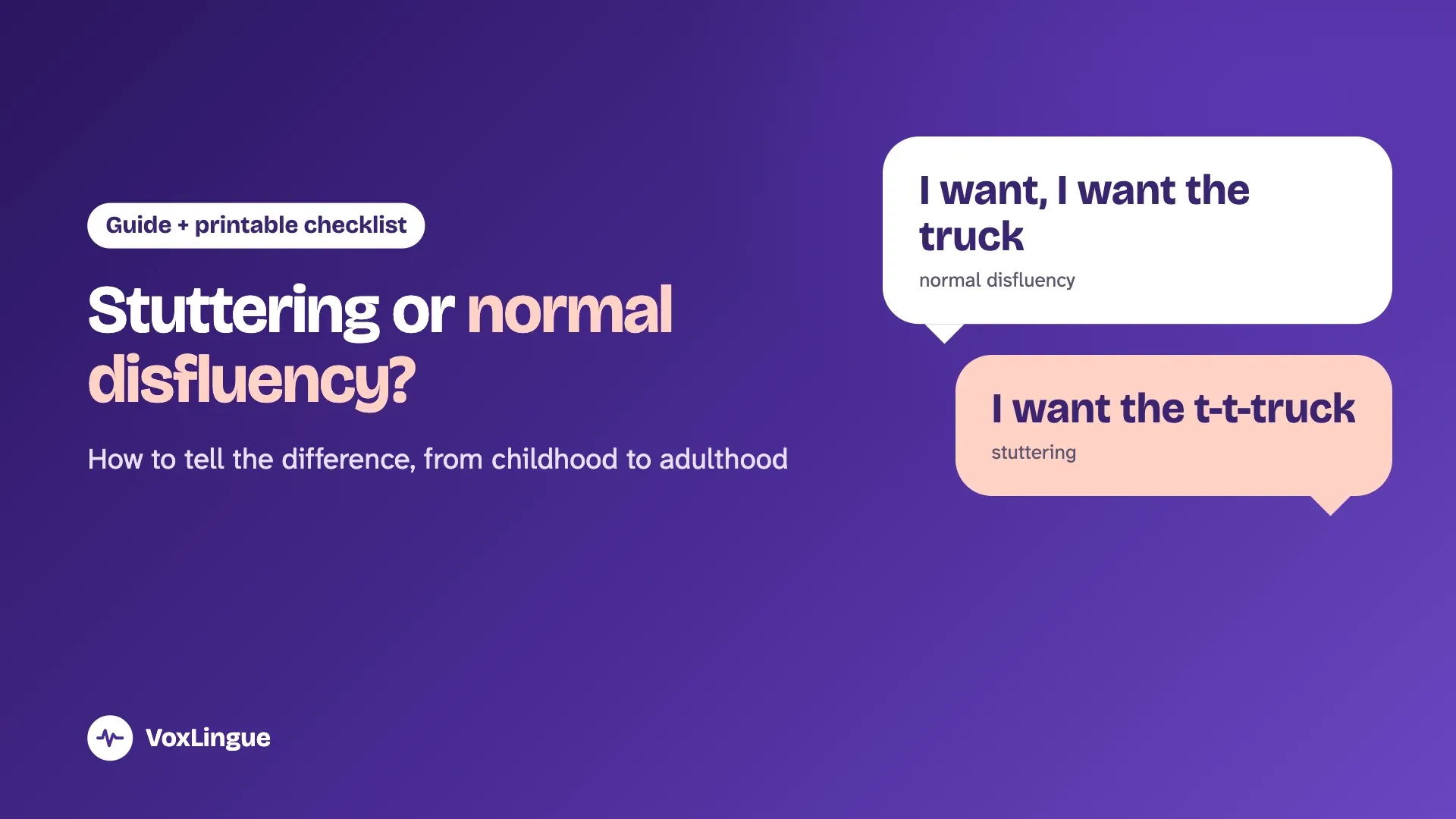
Today, October 22, is International Stuttering Awareness Day. It’s a good moment to answer a question many parents of children aged 2 to 5 years end up asking: is my child stuttering, or just stumbling the way every child that age does?
It’s a fair question. In a large Australian study, about 1 child in 9 had started to stutter by 4 years of age (Cochrane review, 2021). And almost every child trips over words while learning to build longer sentences. From a distance, the two look alike. Up close, much less so.
What to know
Normal stumbles are relaxed. Children repeat whole words (“Cookies cookies and milk”) or phrases, sometimes the whole sentence (“He is, he is 4 years old”), or add “um” and start the sentence over. It happens most when they’re learning lots of new words, and they rarely seem to notice (ASHA).
Stuttering sounds different: repeated sounds or syllables (“I w-w-want a drink”), stretched sounds (“ssssoup”), and blocks, where the mouth is ready but nothing comes out. It usually starts between 2 and 5 years of age.
Sometimes later, even at puberty.
The most reliable clue is often something you see. Stuttering frequently comes with tension or effort: eye blinks, a grimace, or avoiding certain words (ASHA). Normal stumbles have none of that.
Will it go away? Often, but slowly: according to Québec’s Naître et grandir, 65 to 75% of children who stutter recover within 5 years of it starting.
When to ask? Here is our guidance, based on Naître et grandir’s (in French).
- Under 6 years: see a speech-language pathologist if the stuttering has lasted more than 6 months, someone in the family stutters or stuttered, your child reacts to it (avoids talking, gets angry or embarrassed), or you’re worried.
- 6 years and older: as soon as you notice it.
In preschoolers, hesitations or words that won’t come can also be a sign of a language difficulty rather than stuttering. So talk to a speech-language pathologist either way: together, you can decide to monitor for six months or to go ahead with an assessment.
Kimberly has written that she is “a strong believer in early intervention.” When we assess a child who stutters, we start with the story: when it began, whether anyone else in the family stuttered, and how it changes from one situation to another. Then we listen to the child talk in several settings. Under 6, we also assess their whole language development, to rule out a language difficulty that could be adding to the bumps; from 6 on, only if something concerns us. In Québec, your CLSC can also point you in the right direction.
Two last points. Stuttering doesn’t come from emotions, intelligence or the way you parent; genes play a part. And speaking two languages doesn’t cause stuttering. Bilingual children naturally repeat more words and sounds without stuttering. Don’t drop your home language.
Try this week
Five minutes, no questions. For children 2 to 6 years old: good for any child, and especially helpful if you hear stuttering.
Pick five minutes a day, at the same time each day: after dinner, or at bath time. Your child picks the game. You follow.
For those five minutes, ask no questions. Instead of “What are you building?”, describe what you see, unhurried: “You’re putting the red block… right on top.” Then wait. Count to three in your head before you speak again.
If they get stuck on a word, keep looking at them, let them finish, then answer what they said: “Yes! That tower is taller than you!” Don’t finish the word for them. Skip “slow down” and “take your time” too.
Why it works: according to the Stuttering Foundation, children speak more freely when they’re sharing their own ideas than when they’re answering an adult’s questions. And your own unhurried speech helps more than any advice. By the end of the week, notice whether they talk for longer.
For adults
About 1% of people stutter. Every adult stumbles more when tired or nervous. Stuttering is different: it keeps showing up across situations, and it often comes with tension or avoidance, like swapping a word at the last second or letting someone else make the call.
If stuttering starts suddenly in an adult who has never stuttered, especially after an illness or a head injury, see a doctor first. If it comes with other sudden signs, such as weakness on one side of the body or vision changes, call 911.
The Canadian Stuttering Association lists support groups and awareness-day events across the country. In Montréal, the French-language Association bégaiement communication holds its annual meeting day on Saturday, October 24, from 9 a.m. to 4 p.m.
Worth reading
Understanding developmental stuttering, AboutKidsHealth (SickKids): Canadian, updated in October 2025, with a clear list of what a speech-language pathologist looks for, and where to find help in Ontario.
From VoxLingue
Our new guide, Stuttering or normal disfluency?, compares the two from childhood to adulthood. It includes a printable sheet for noting what you hear, to bring to a speech-language pathologist.
Your question: what advice have you been given about talking to a child who stutters? Reply to this email in one line: we read every reply.
This newsletter is for information and does not replace an assessment. Lire en français