Autism in girls: understanding masking and how to support them
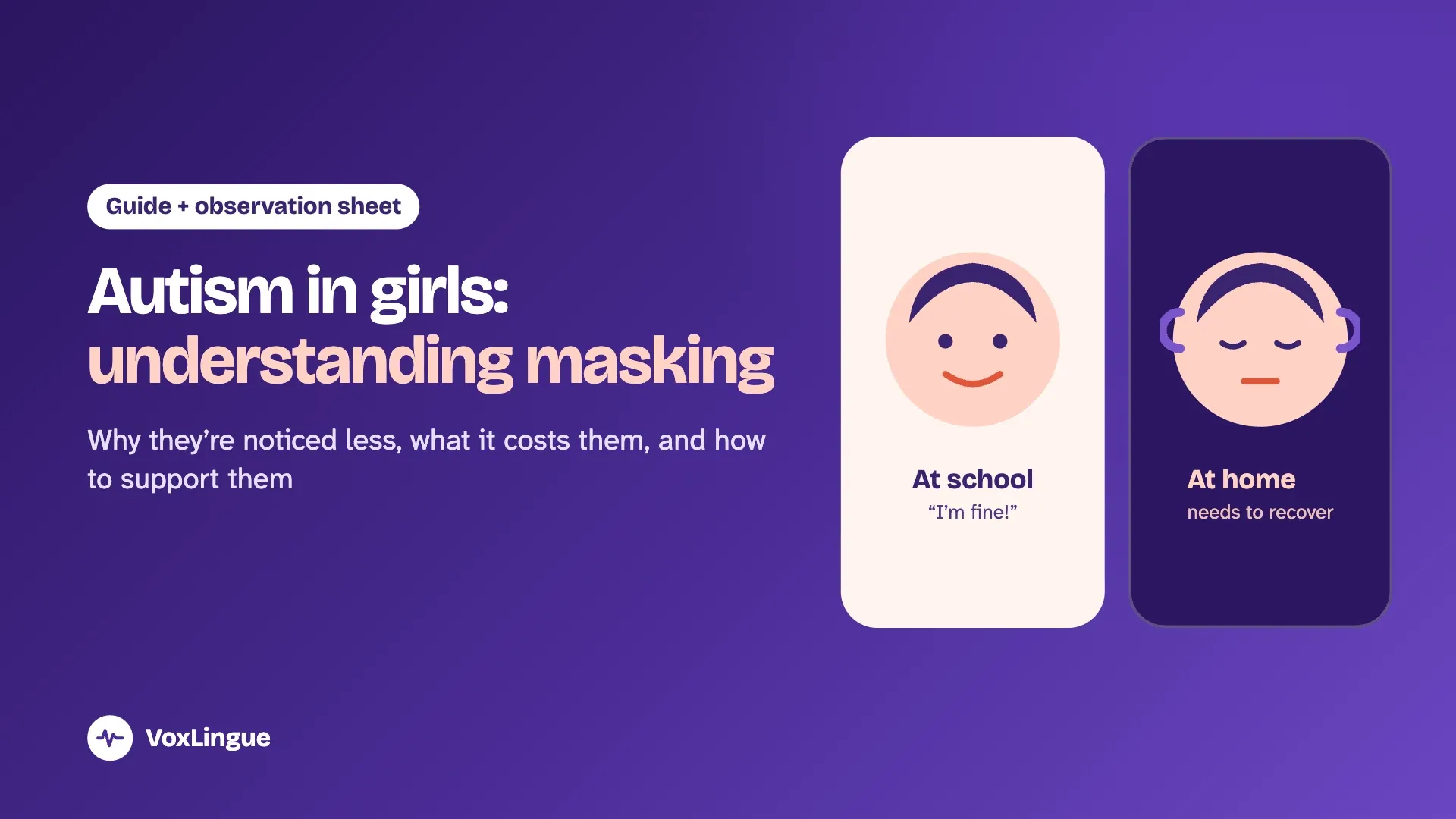
“She’s doing really well in class,” the teacher tells you. Yet at home, your daughter falls apart: she cries, explodes, or needs hours alone in her room. She has friends, copies the way her best friend talks, and rehearses in her head what she’ll say tomorrow. Someone may have told you she’s “too social to be autistic.”
Autism in girls is sometimes missed, and masking plays a big part. Some girls learn early on to watch, copy and hide what makes them different so they can fit in. From the outside, everything looks fine. On the inside, it takes an enormous amount of energy.
This guide explains what masking is, why autistic girls are noticed less, what it costs them, and how to support them at home, at school and with a speech-language pathologist, without asking them to hide even more. Masking isn’t only a girl thing: boys and nonbinary or trans young people mask too. And not every autistic girl masks.
What is masking?
Masking, or camouflaging, means changing or hiding your natural ways of being, acting or communicating to fit in. It can mean copying others, using rehearsed phrases, forcing eye contact, or holding back certain movements or interests. For an autistic person, it can be constant and exhausting. It’s a response to the environment, not a fault.
Québec’s autism federation, the Fédération québécoise de l’autisme, defines it simply: masking is changing or hiding one’s ways of being, acting or communicating. Researchers describe two parts: hiding what might look different, and making up for social differences with learned strategies (Hull and colleagues, 2017).
Everyone adjusts their behaviour a little depending on the situation. You don’t talk the same way at a job interview as at dinner with friends. For many autistic people, though, this effort is almost continuous, and it applies to things other people do without thinking. Autistic adults describe it as exhausting.
Masking is often a response to stigma: people hide what earned them stares, teasing or corrections (Miller and colleagues, 2021). So it isn’t a flaw in the child, or a skill to polish. The UK’s National Autistic Society has a helpful page on what masking is and why people do it. Our articles on social communication also explain how this kind of communication develops.
What it can look like
Masking looks very different from one person to the next. There’s no checklist, but here is what autistic people and researchers often describe:
- copying a friend’s way of talking, dressing or interests;
- preparing phrases or answers in advance, and replaying them mentally;
- forcing eye contact, or looking at someone’s forehead or mouth to give that impression;
- holding back movements that are calming, or hiding an interest seen as “weird”;
- saying “I’m fine” when she isn’t.
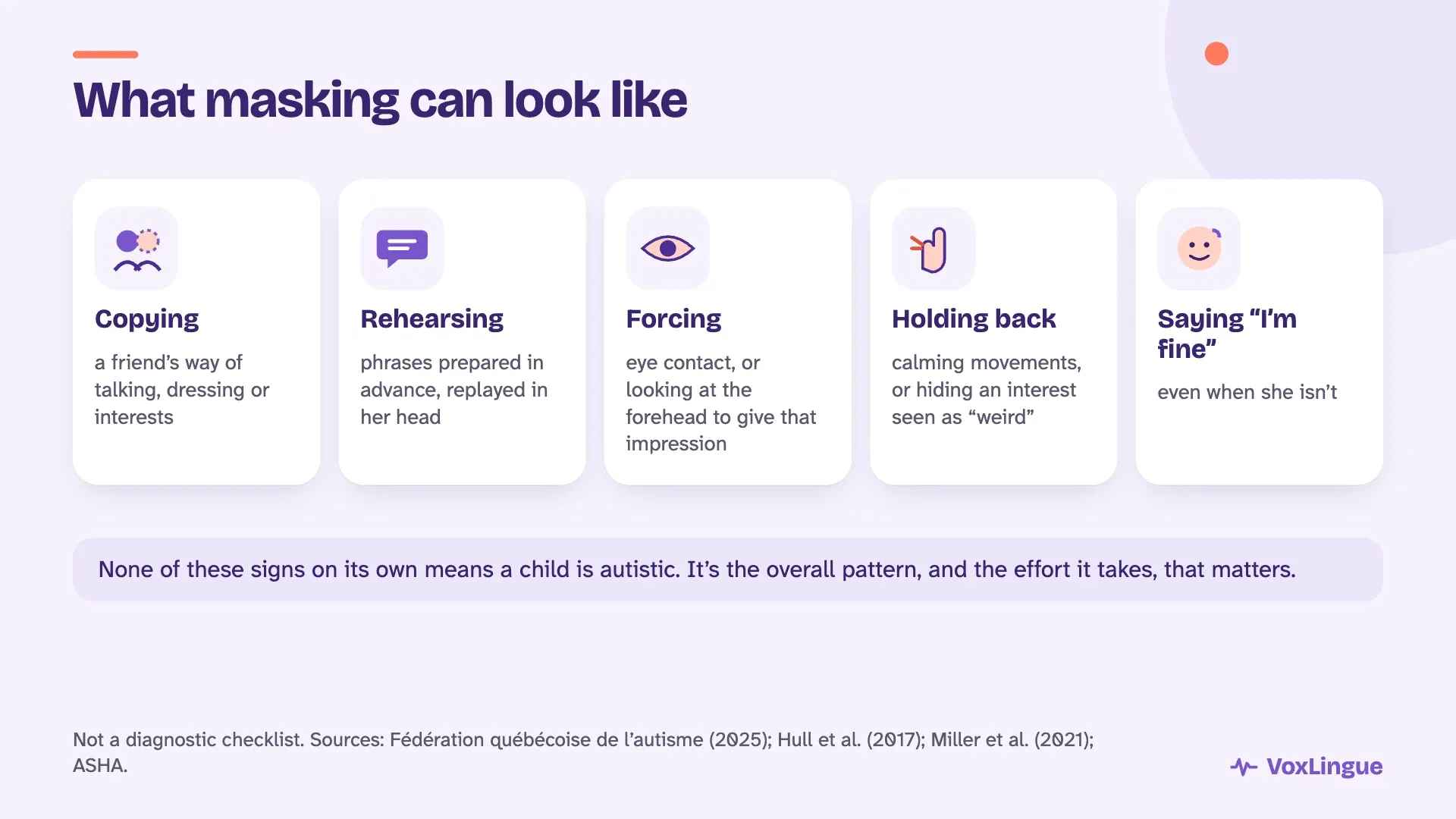
None of these behaviours on its own means a child is autistic. It’s the overall pattern, and the effort it takes her, that matters.
Why is autism sometimes missed in girls?
In Québec, about three times as many boys as girls are diagnosed with autism. Part of that gap may come from how we look: studies that screen whole populations find a smaller difference. Girls often stay close to peers, have interests that seem ordinary, and struggle quietly.
The numbers, without exaggeration
According to Québec’s public health institute (INSPQ), three times as many boys as girls aged 1 to 24 have an autism diagnosis, and the number is rising. Among people under 25, that’s about 40 boys and 14 girls per 1,000. Across Canada, about 1 child or youth in 50 has been diagnosed: about 1 boy in 32 and 1 girl in 125, according to the Public Health Agency of Canada.
These numbers only count young people who’ve been diagnosed. An analysis of 54 studies found about four boys for every girl on average, but closer to three for every girl in studies that screened whole populations (Loomes and colleagues, 2017). The authors see this as a sign that some girls are never identified.
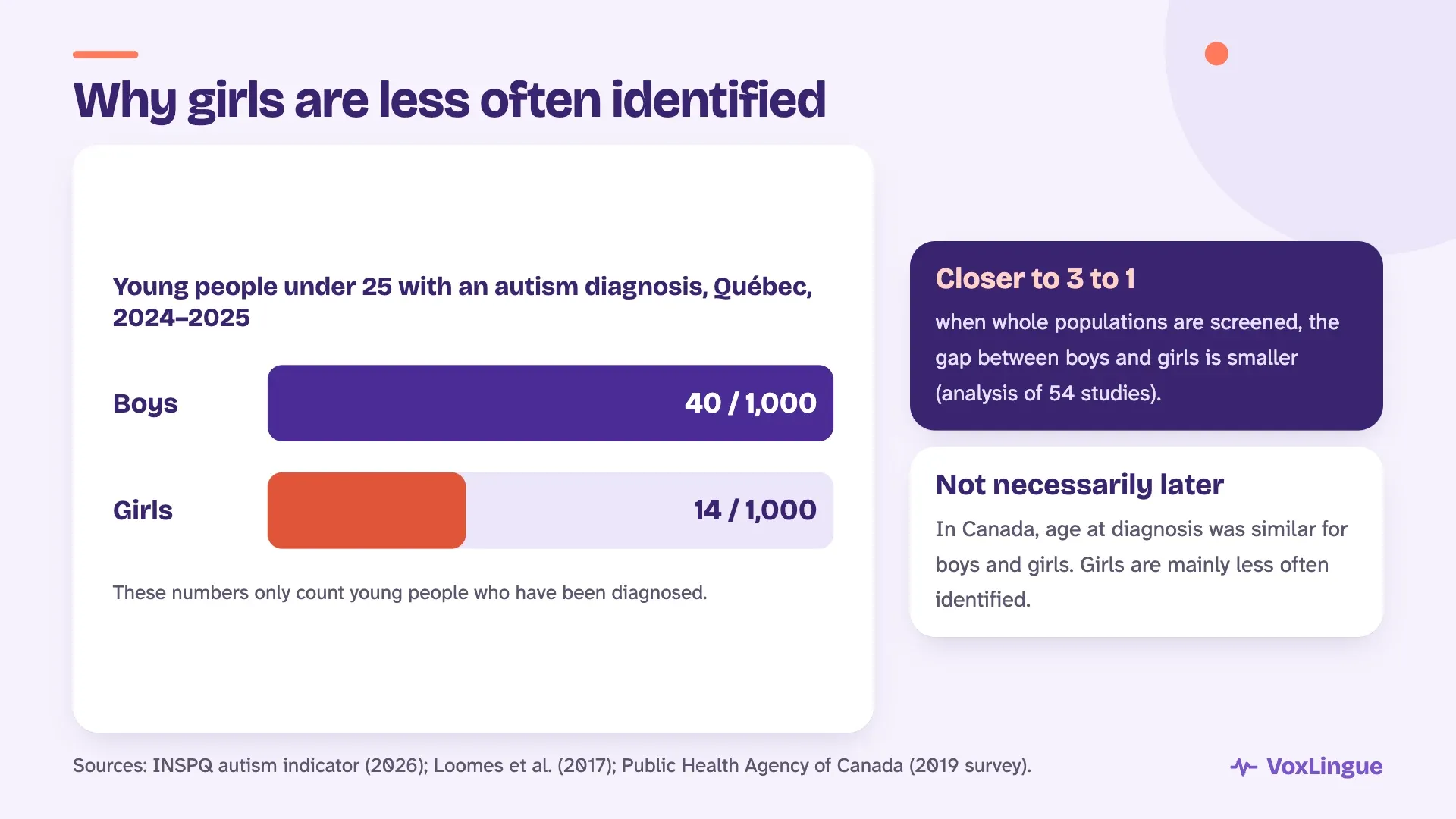
One important detail: in the Canadian survey, the age at diagnosis was similar for boys and girls. So it’s fair to say girls are less often identified, not necessarily identified later. Results vary between countries and studies.
Tools built around boys
Much of what we know about autism comes from studying boys. The American Speech-Language-Hearing Association (ASHA) recognizes this bias in diagnosis. In a British study, girls with many autistic traits were mostly diagnosed when they also had other difficulties (Dworzynski and colleagues, 2012). Another found that girls who did well on intellectual tests were less likely to reach the thresholds of a standard assessment tool (Ratto and colleagues, 2018).
Their interests can also go unnoticed: animals, books, a TV series or a band seem ordinary, even when the interest is very intense. Researchers describe a profile that is more common in girls, but it isn’t a separate type of autism. There is no distinct “female autism”; there is one autism, which shows up in many ways.
What about ADHD?
Attention deficit hyperactivity disorder (ADHD) is also more often missed in girls. Their inattention tends to be quiet: a dreamy, disorganized or exhausted student is less disruptive than a restless one. ADHD and autism can also occur together. Our article on ADHD and language explains how attention shapes communication.
What can it look like at school and at home?
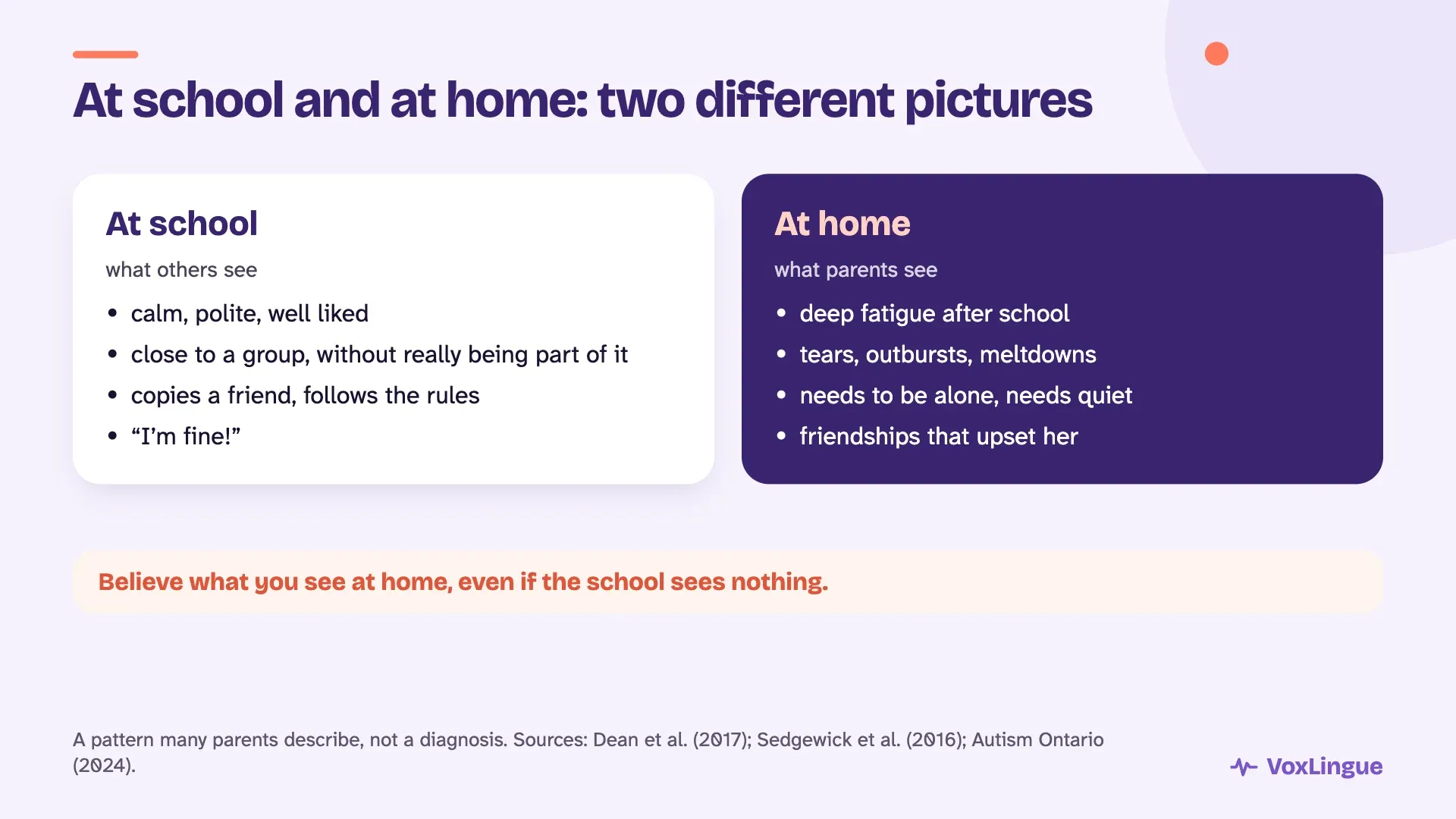
At school, a girl who masks may seem calm, polite and well liked. She often stays close to a group without really being part of it. At home, the effort shows: fatigue, tears, outbursts or a strong need to be alone. Many parents sum it up the same way: “She’s fine at school, then she falls apart at home.”
An American study observed children on the playground (Dean and colleagues, 2017). Autistic girls stayed close to other girls and moved in and out of their games. Adults looking for the child alone in a corner didn’t notice them. Being in a group isn’t the same as feeling connected.
Autism Ontario makes a similar point: girls may experience anxiety at school that is often masked and shows up as distress at home. It adds that strong verbal skills can hide social communication difficulties. Our article on social communication and pragmatic language explains what these skills involve.
Friendships that take a lot
Many autistic girls want friends, and have them. A study of autistic teen girls found they often had intense friendships, but also more conflict and break-ups (Sedgewick and colleagues, 2016). Unwritten group rules, sarcasm, ambiguous text messages and shifting alliances take enormous effort.
Some girls attach to a single friend and copy her way of being. When that friendship ends, everything can fall apart.
“She’s fine at school”
What many parents describe, a child who holds it together all day and lets go at home, hasn’t been well studied yet. It isn’t a diagnosis. But it fits what autistic adults say about masking: energy spent all day has to come out somewhere, often where you feel safe.
Believe what you see at home, even if the school sees nothing. What the teacher doesn’t see is no less real.
What masking costs
Masking takes a lot of energy. In studies, more masking is linked to more anxiety and depressive symptoms, in autistic adults and in girls aged 11 to 14. Autistic adults also describe a deep exhaustion called autistic burnout. Being accepted as you are, and being able to drop the mask, helps.
A review of 29 studies found early signs that more masking is linked to poorer mental health (Cook and colleagues, 2021). A recent study of girls aged 11 to 14 points the same way: masking was linked to anxiety and depressive symptoms, whether or not the girls were neurodivergent (McKinney and colleagues, 2024).
These studies show links, not causes, and most were done with adults.
Autistic adults also describe a particular kind of exhaustion: fatigue that lasts, losing some skills, and becoming more sensitive to noise or light. The researchers who studied it describe a load that builds up without enough relief (Raymaker and colleagues, 2020). What helped most was acceptance, fewer demands, and being able to be yourself without a mask. The same researchers warn against teaching autistic people to mask.
If your child seems exhausted, anxious or sad, talk to her doctor, a psychologist or your CLSC (Info-Social 811 in Québec). A speech-language pathologist doesn’t treat anxiety or depression, but can work alongside these professionals.
If you’re worried about her safety. If your child talks about not wanting to live or about hurting herself, get help right away: 911 in an emergency; 9-8-8, the Suicide Crisis Helpline, by call or text, 24/7; in Québec, 1 866 APPELLE (1 866 277-3553) or text 535353; Kids Help Phone at 1-800-668-6868, or text CONNECT to 686868.
Communication goes both ways
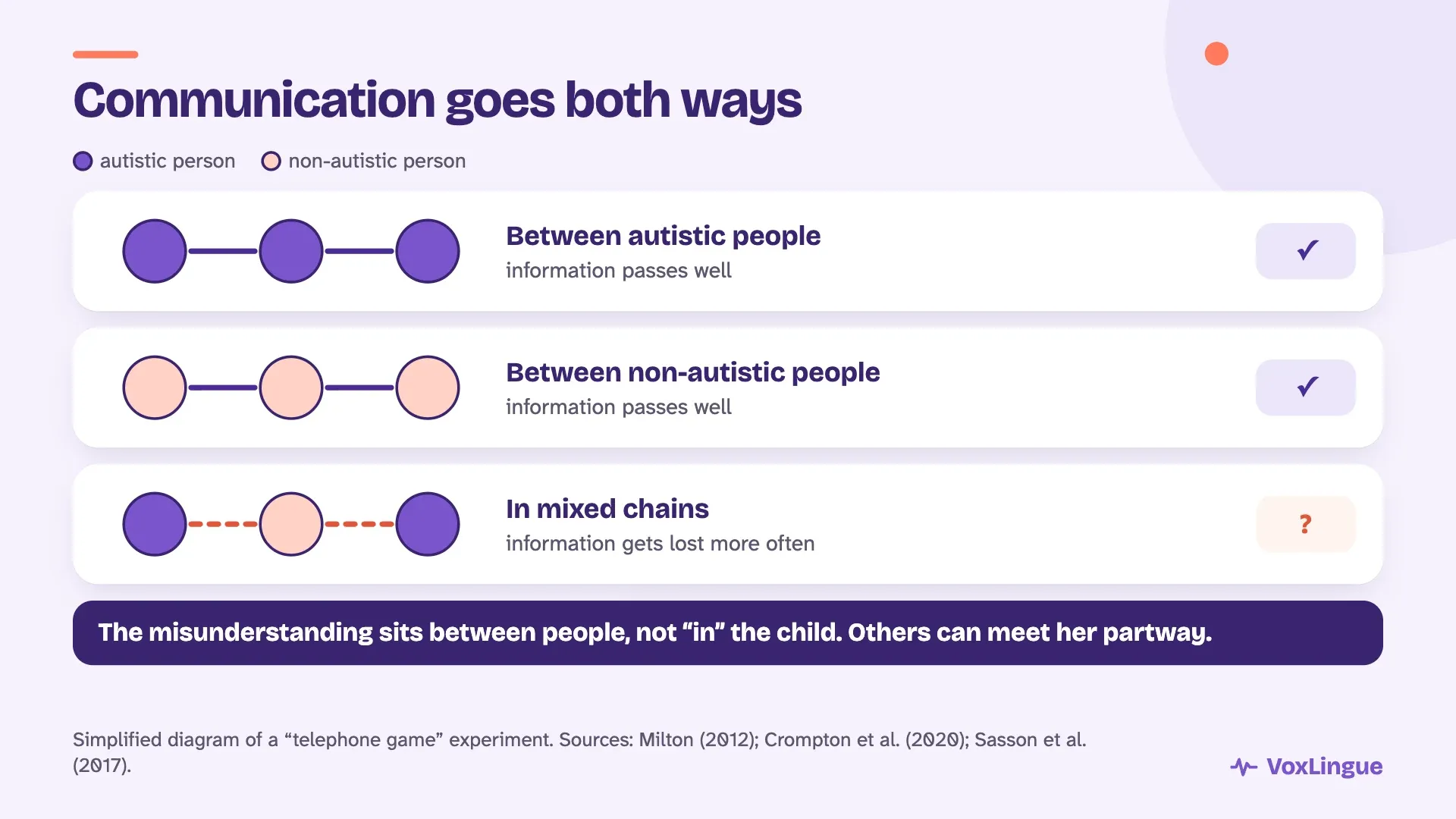
Social misunderstandings go both ways. Studies show that autistic people often understand each other very well, and that difficulties come up mostly between autistic and non-autistic people. So support isn’t only about the child: the people around her can adjust too.
Autistic researcher Damian Milton called this the double empathy problem (2012). A Scottish study tested it with a game of telephone, passing a story from one person to the next (Crompton and colleagues, 2020). Information passed well between autistic people, and between non-autistic people. It got lost mostly in mixed chains.
Other research shows that non-autistic people form negative first impressions within seconds, based on style rather than content (Sasson and colleagues, 2017). So the problem isn’t “in” the child. It sits between her and others, and others can meet her partway.
How can I help at home and at school?
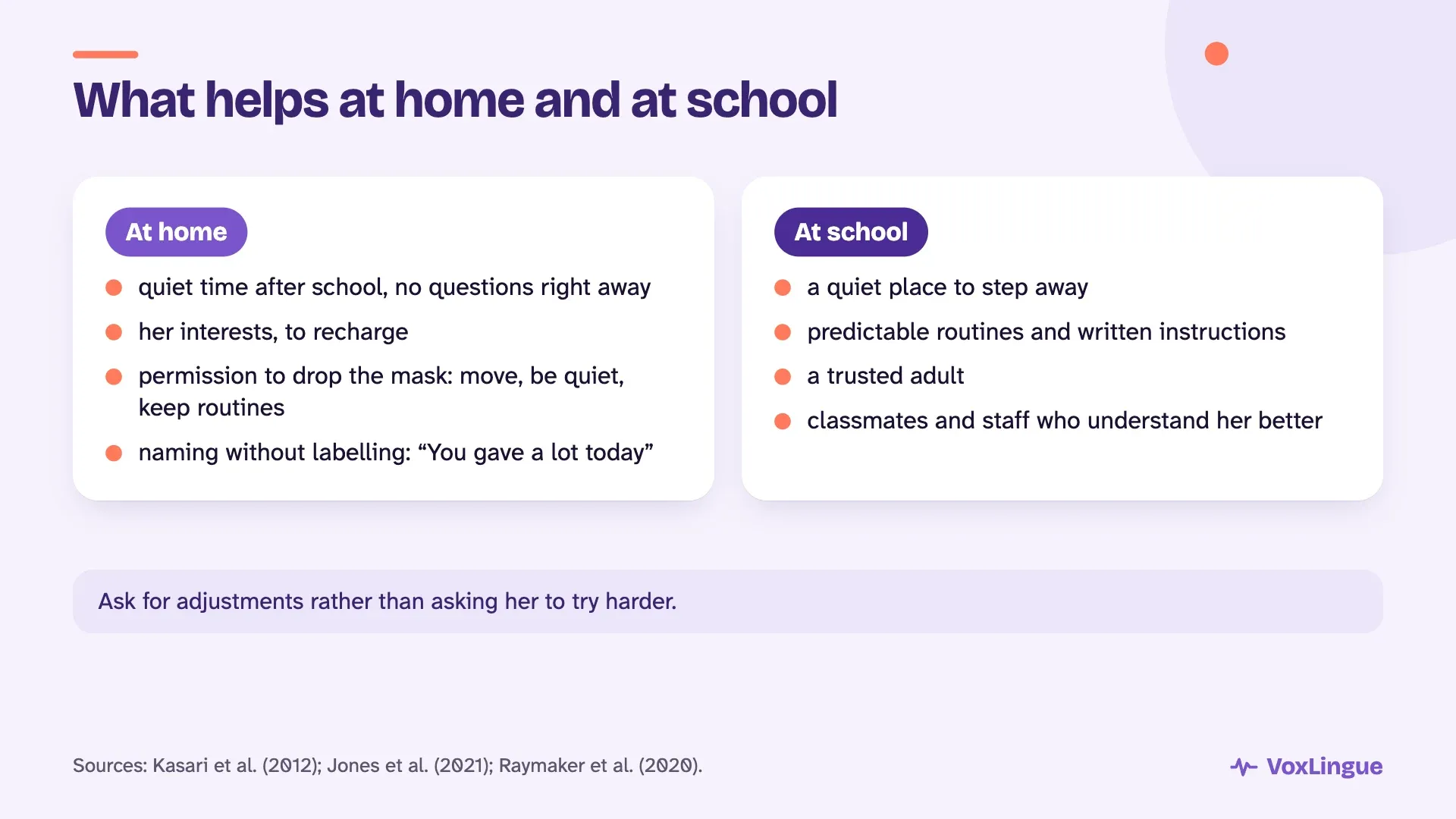
Start by believing what you see at home. Build in time to recover after school, protect her interests, and let her be herself without correcting her. At school, ask for small adjustments, like quiet breaks, clear instructions and a trusted adult, rather than asking her to try harder.
At home
Plan a quiet time after school, without questions right away. A snack, a calm corner, her music or her current interest can help her rest. Her interests aren’t a whim to cut back on: they’re often how she recharges.
Let her take off the mask at home: move, stay quiet, follow her routines. Name what you see without labelling it: “You gave a lot today.” And talk with her about what’s hard, when she’s ready, so she learns to recognize her own fatigue.
With the school
Share with the school what you see at home, and ask what they notice during breaks, group work and transitions. Small adjustments often make a big difference: a quiet place to step away, predictable routines, written instructions, a trusted adult, choice in group work.
Support can also come through other students. In a school-based trial, working with classmates improved autistic children’s social connections more than working with the child alone (Kasari and colleagues, 2012). And autism training improves non-autistic people’s attitudes (Jones and colleagues, 2021).
How can a speech-language pathologist help?
A speech-language pathologist (SLP) looks at how your daughter uses language with other people. That includes implied meanings, figurative language, group conversations and how she expresses her needs. Goals are chosen with her. The aim is for her to be understood and comfortable, not to seem less autistic.
At VoxLingue, our approach is neurodiversity-affirming. We don’t work on eye contact, ask a child to stop movements that calm them, or teach scripts to hide who they are. ASHA’s practice portal on autism says the same: the goal is not to force autistic people to mask their traits. In the UK, the professional body for speech and language therapists has committed to the same direction.
So what does the work look like? It starts from what your daughter finds hard or tiring, and from what she wants to change. It covers understanding as much as expression, and it includes the people around her.
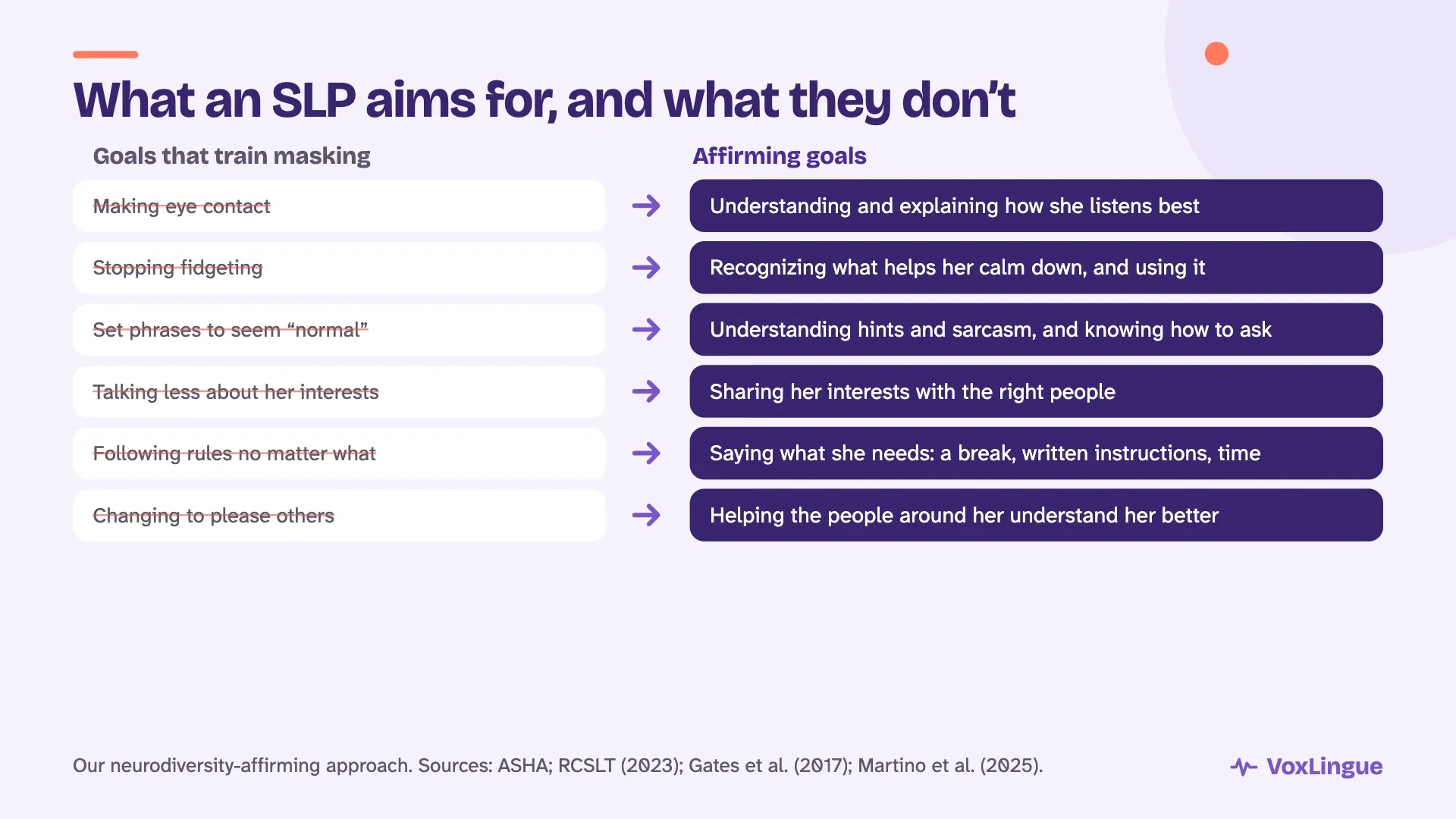
| Goals that train masking | Affirming goals |
|---|---|
| Making eye contact | Understanding and explaining how she listens best |
| Stopping moving or fidgeting | Recognizing what helps her calm down, and being able to use it |
| Learning set phrases to seem “normal” | Understanding hints, sarcasm and expressions, and knowing how to ask when something isn’t clear |
| Talking less about her interests | Sharing her interests and finding people she enjoys sharing them with |
| Following social rules no matter what | Saying what she needs: a break, written instructions, time to answer |
| Changing to please others | Helping the adults and friends around her understand her better |
With a younger child, the SLP works a lot with parents. With a preteen or teen, the SLP works mostly with her, using real situations: a group project, a conflict with a friend, a misunderstood text. Our page on social communication and autism describes this approach in more detail.
Why not classic “social skills training”?
Programs that teach social rules in groups mostly improved what young people know about those rules, much less what they do day to day, according to an analysis of 19 trials (Gates and colleagues, 2017). Researchers add that learning a list of rules can push young people to play a role, and can increase stigma (Bottema-Beutel and colleagues, 2018). For a girl who already masks a lot, learning to mask better isn’t the answer.
On the other hand, knowing what you need and being able to ask for it is linked to better outcomes for autistic teens and young adults (Martino and colleagues, 2025).
Groups
Some young people enjoy meeting others who are like them. In one study, groups built around shared interests led to less social stress than groups focused on rules (Dean and colleagues, 2020). Our groups focus on the pleasure of connecting rather than on fitting in.
Getting your child assessed in Québec and Ontario
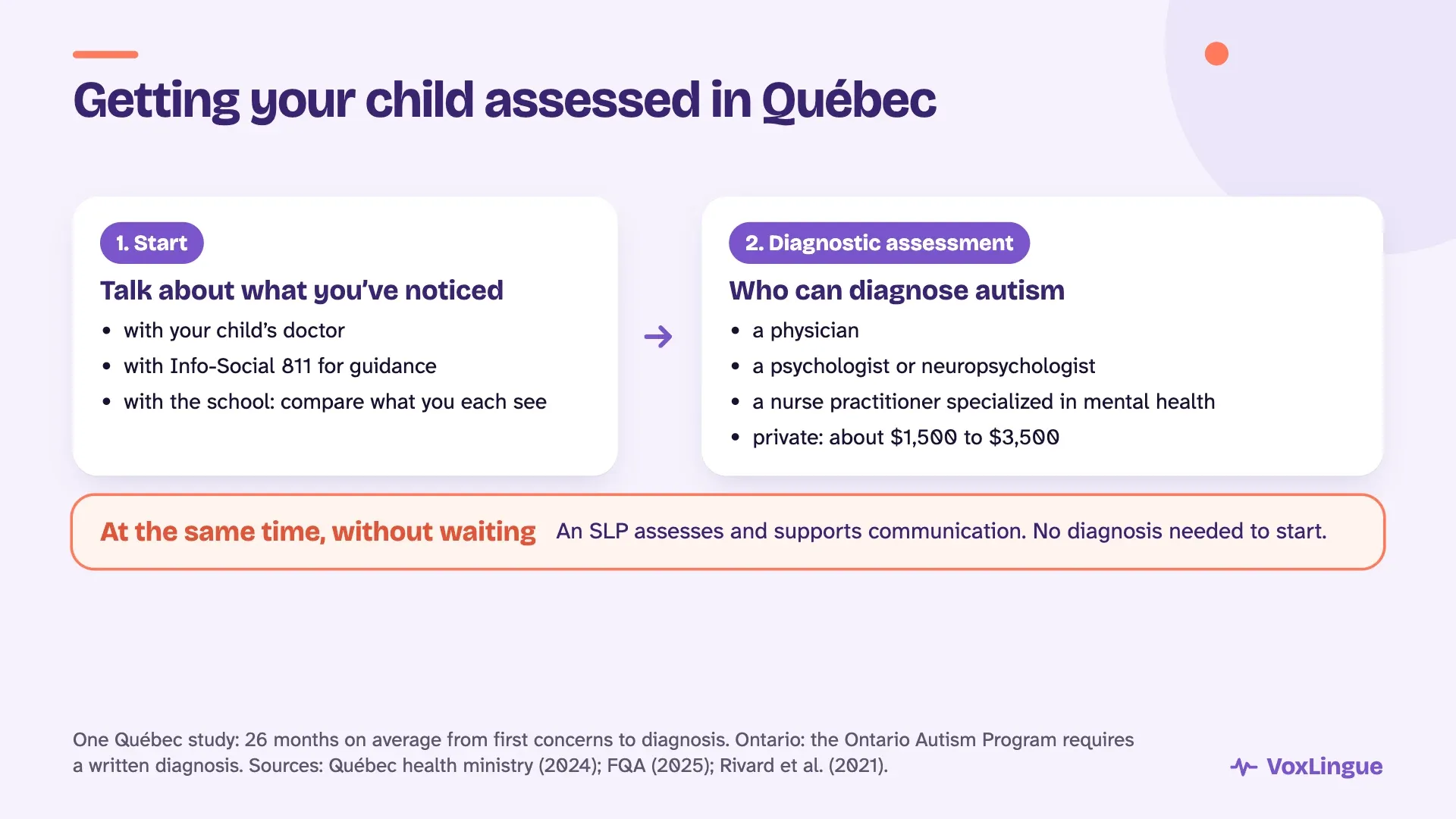
In Québec, four professionals can diagnose autism. They are physicians, psychologists, neuropsychologists and nurse practitioners specialized in mental health. An SLP assesses communication and contributes to the evaluation, but doesn’t make that diagnosis. Public waits can be long, and private assessments are costly. You don’t need a diagnosis to get help with communication.
Québec’s health ministry guidelines (2024) reserve this diagnosis to these professionals. They often work as a team with an SLP, an occupational therapist and others. The SLP’s report describes the child’s communication and can help the team get a clear picture.
Where to start in Québec
- Talk about what you’ve noticed with your child’s doctor, or call Info-Social 811 for guidance.
- Ask the school what they observe, and share what you see at home.
- If the public wait is long, a private assessment is possible: Québec’s autism federation estimates it at $1,500 to $3,500.
One Québec study found an average of 26 months between parents’ first concerns and the diagnosis (Rivard and colleagues, 2021). That’s a long time, which is why it matters not to wait for a diagnosis before getting support.
In Ontario
In Ontario, registering for the Ontario Autism Program requires a written autism diagnosis from a qualified professional. Families often face long waits for funded services. Communication support can start before then, and we see Ontario families through online speech therapy.
You don’t need to wait for a diagnosis
You don’t need a diagnosis to see an SLP. A communication assessment can start while you wait for, or think about, a diagnostic evaluation. Our page on speech and language assessment explains how a first appointment works.
What if this sounds like me?
Many women and teen girls recognize themselves in these descriptions, sometimes while reading about their child. It’s not unusual: more and more women are being identified as autistic in adulthood. Understanding yourself better can be a relief. An assessment is also possible as an adult, and communication support doesn’t depend on a diagnosis.
Women identified as autistic later in life often describe being seen for years as shy, anxious or “too sensitive” (Bargiela and colleagues, 2016). Putting words to how you function often helps you pace your energy and ask for what you need. Our page on speech therapy for adults describes the services we offer adults.
Autism in girls: what to remember
Masking isn’t a whim or a talent. It’s often a child’s response to a world that doesn’t always understand her.
Keep three things in mind. Believe what you see at home, even if the school sees nothing. Try to reduce her reasons to hide, rather than helping her hide better. And don’t wait for a diagnosis to get support: an SLP can work with her now, with you and with the school.
Next step
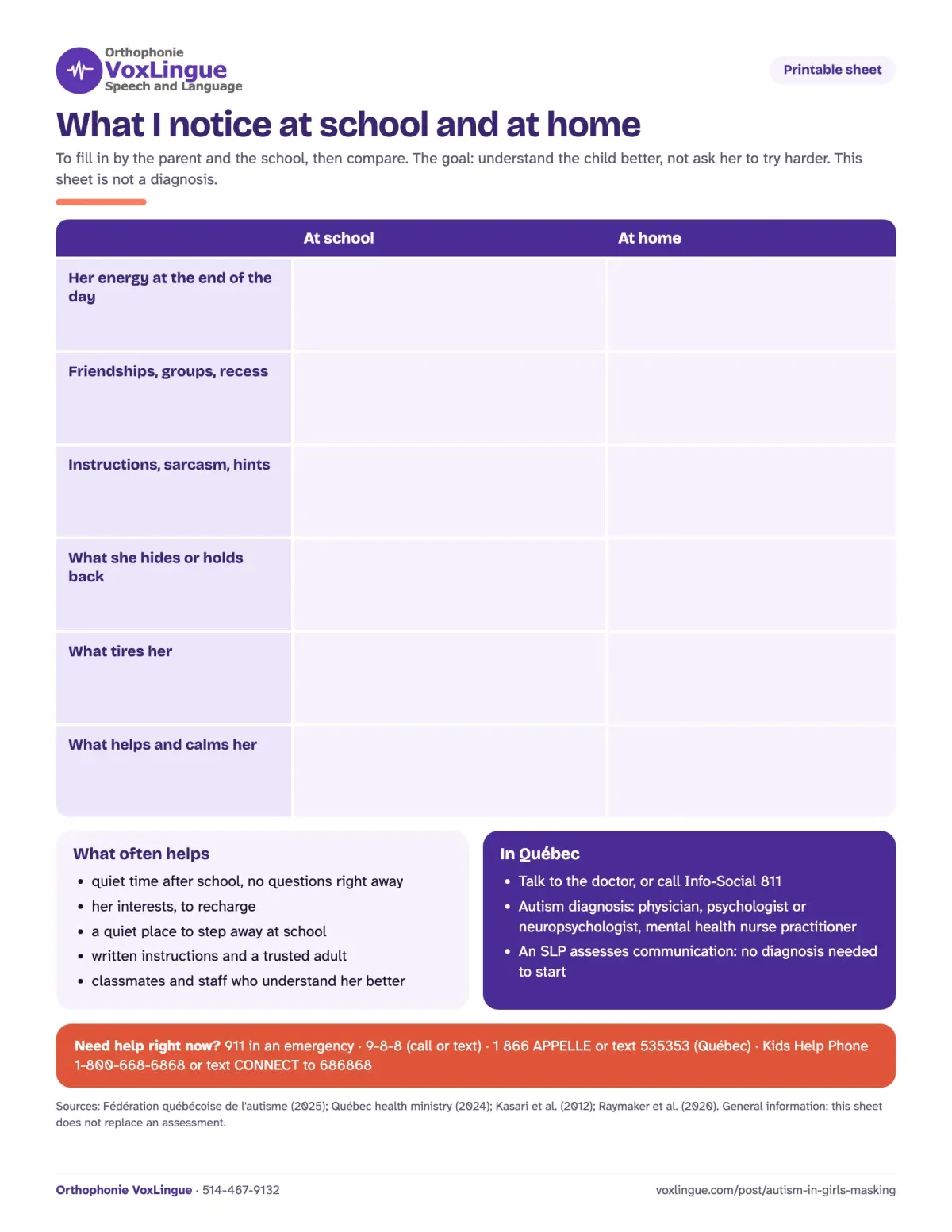
Printable: What I notice at school and at home (PDF, 1 page). A sheet to fill in with the school to compare what each of you sees, plus useful resources.
Our page on social communication and autism explains how we support children, teens and adults, at our Marché Central clinic in Montréal or online.
Frequently asked questions
Can you be autistic and have friends?
Yes. Many autistic girls have friends and care deeply about those friendships. But they may put in a lot of effort: understanding group rules, sarcasm and shifting alliances. So having friends doesn’t rule out autism. What matters is how she experiences those relationships, and how much energy they take.
Do all autistic girls mask?
No. Some mask a lot, others a little or not at all. Boys and nonbinary or trans young people mask too. Studies only find that, on average, autistic women report masking more than autistic men. Every child is different, and no single sign is enough to draw a conclusion.
Is masking bad? Should she stop?
It isn’t a fault. Masking is often a response to people who judge or correct. The goal isn’t to force your child to stop, but to reduce her reasons to hide: an accepting environment, adjustments, and people who understand her. Over time, she can choose where and when she feels free to be herself.
Why is she fine at school but falls apart at home?
Many parents describe this. A child who masks spends a lot of energy all day holding it together. At home, where she feels safe, the built-up fatigue and emotions come out. It isn’t a tantrum, and it doesn’t mean home is the problem. It’s often a sign she needs more recovery time.
Can a speech therapist diagnose autism?
Not in Québec. The diagnosis is made by a physician, a psychologist or neuropsychologist, or a nurse practitioner specialized in mental health. An SLP assesses communication and can contribute to the team’s evaluation. The SLP’s report helps everyone better understand your child’s strengths and challenges.
Do we need a diagnosis to see an SLP?
No. You can see an SLP without an autism diagnosis. A communication assessment can start while you wait for a diagnostic evaluation, or even if you don’t seek one. Support focuses on what your child experiences day to day, not on a label.
How much does a private assessment cost?
In Québec, the Fédération québécoise de l’autisme puts a private diagnostic assessment at $1,500 to $3,500. In the public system it’s free, but the wait can be long. Some private insurance plans cover part of the cost, so check your plan. And an SLP can start helping without waiting.
Do boys mask too?
Yes. Masking isn’t only a girl thing. Boys and nonbinary or trans young people mask too, sometimes a lot. Studies only find an average difference, with a lot of variation between individuals. The advice in this guide applies to any child or teen who seems worn out from “holding it together.”
What about ADHD in girls?
ADHD is also more often missed in girls. Their inattention tends to be quiet, and they can compensate for a long time with a lot of effort. ADHD and autism can occur together. If you notice disorganization, exhaustion or distraction, talk to your child’s doctor.
Should I encourage her to make eye contact?
No. For many autistic people, eye contact takes effort and gets in the way of listening. It’s better to ask her what helps her listen, and to share that with the adults around her. A child who looks away is often listening very well.