Stuttering or normal disfluency? How to tell the difference in children and adults
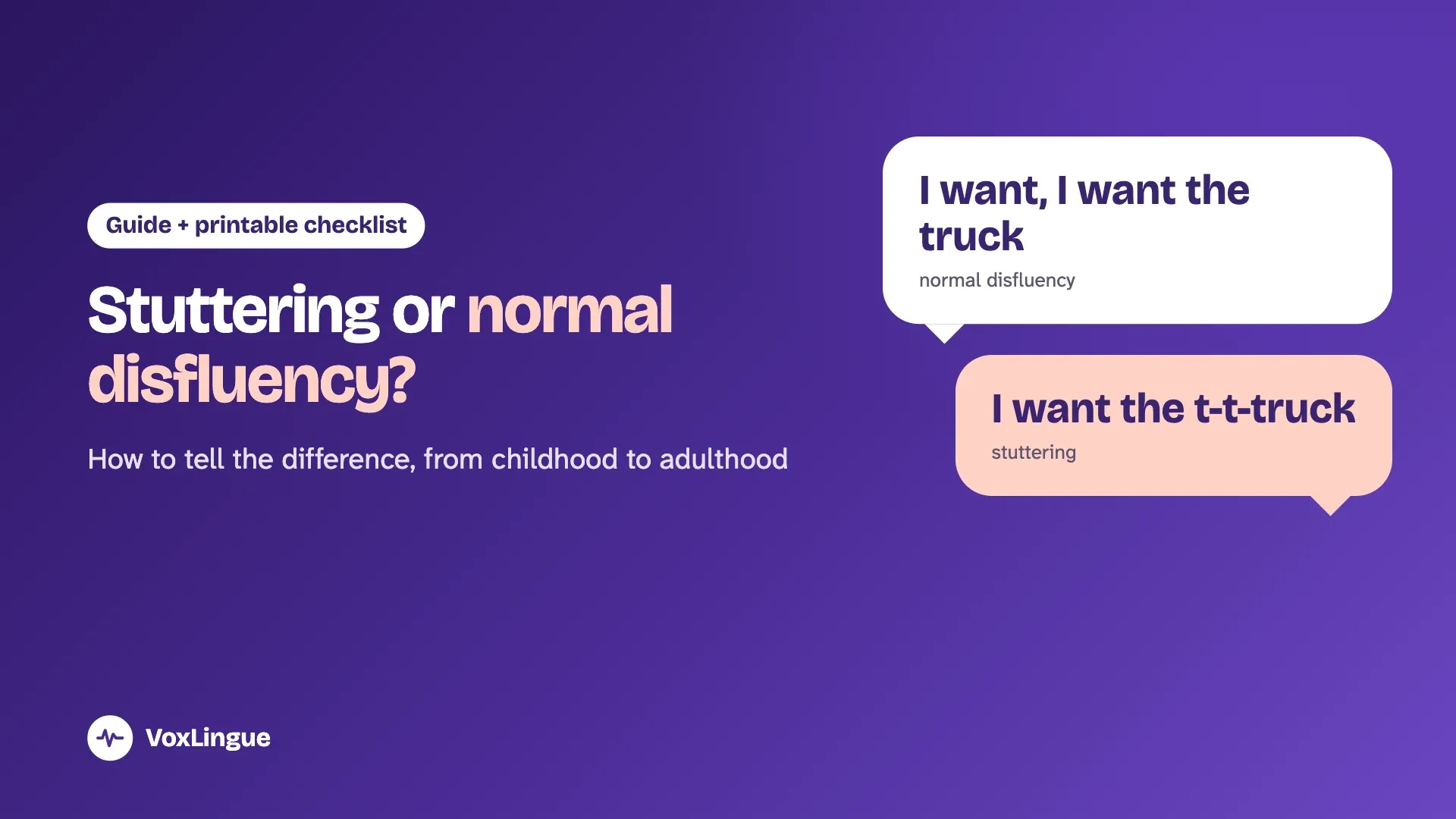
“I want, I want the truck!” Your 3-year-old has been repeating words for a few weeks, and you’re wondering whether it’s stuttering. Or maybe it’s you: you trip over words in meetings, on the phone or when you’re tired, and you’re asking yourself the same question.
Everyone hesitates when they talk. The “ums”, restarted sentences and repeated words are part of everyday speech. So the difference between stuttering and normal disfluency isn’t simply whether speech has bumps in it. As Québec’s professional order of speech-language pathologists (OOAQ) explains, it’s the type of bumps, how often they happen, how long they last, how many repetitions there are, and the tension that comes with them.
This guide helps you recognize those differences, first in children, then in teens and adults. It explains when to see a speech-language pathologist (SLP), and why stuttering that appears suddenly in an adult needs a doctor first.
Everyone hesitates: what does normal disfluency look like?
Everyone’s speech has bumps. They include “um”, “like” and “you know”, a sentence that starts over, or a phrase or longer word repeated once. These hesitations increase with fatigue, excitement or an idea that’s hard to put into words. They are relaxed, and the speaker rarely notices them.
The American Speech-Language-Hearing Association (ASHA) describes these everyday bumps, called disfluencies, as something all speakers have at times. In children, they include interjections, repeated phrases, revisions and unfinished thoughts, and they are common while a child is learning lots of new words. Our articles on stuttering also cover how to help a young child who stutters.
In children aged 2 to 5
Between 2 and 5, language grows very fast. Children have a lot to say, and their words don’t always keep up with their ideas. Québec’s parenting reference Naître et grandir notes that in most cases, a young child’s repetitions are normal hesitations, not stuttering. They often come back when the child is tired or excited.
What do they sound like? The child repeats a phrase (“I’m going, I’m going to the park”) or a longer word (“after, after lunch”), usually just once. These repetitions sound relaxed, as if the child were thinking, with no tension or facial movements. The child rarely notices them.
In adults
Adults hesitate too, and more often than we think. A study of conversations between adults found that hesitations increase when an idea is harder to plan (Bortfeld and colleagues, 2001). Fatigue, nerves or presenting to a group have the same effect. These ordinary bumps are not stuttering.
What does stuttering look like?
Stuttering has its own shapes. A sound or syllable is repeated (“b-b-ball”), a short one-syllable word is repeated (“my-my cat”), a sound is stretched (“mmmmommy”), or the speaker blocks and no sound comes out. It often comes with effort or tension. It’s the type of bump, more than the number, that matters.
SLPs call these stuttering-like disfluencies. A person who stutters also has ordinary hesitations, like everyone else. What’s different are these particular shapes, and often the effort that comes with them.
A team of American researchers compared young children who had just started stuttering with children of the same age who didn’t stutter. From the first months, the difference wasn’t only how many bumps there were: it was what kind (Ambrose and Yairi, 1999).
| Normal disfluency | Stuttering | |
|---|---|---|
| What you hear | “Um”, “like”, “you know”; a restarted sentence; a longer word or phrase repeated | A sound or syllable repeated (“b-b-ball”, “so-so-soccer”); a one-syllable word repeated (“my-my cat”); a stretched sound (“mmmmommy”); a silent block |
| How it sounds | Relaxed, as if thinking | Often tense, with effort |
| What you see | Nothing in particular | Sometimes blinking, a grimace, a head or body movement |
| What the person notices | Rarely anything | Often: surprise, frustration, wanting to avoid certain words |
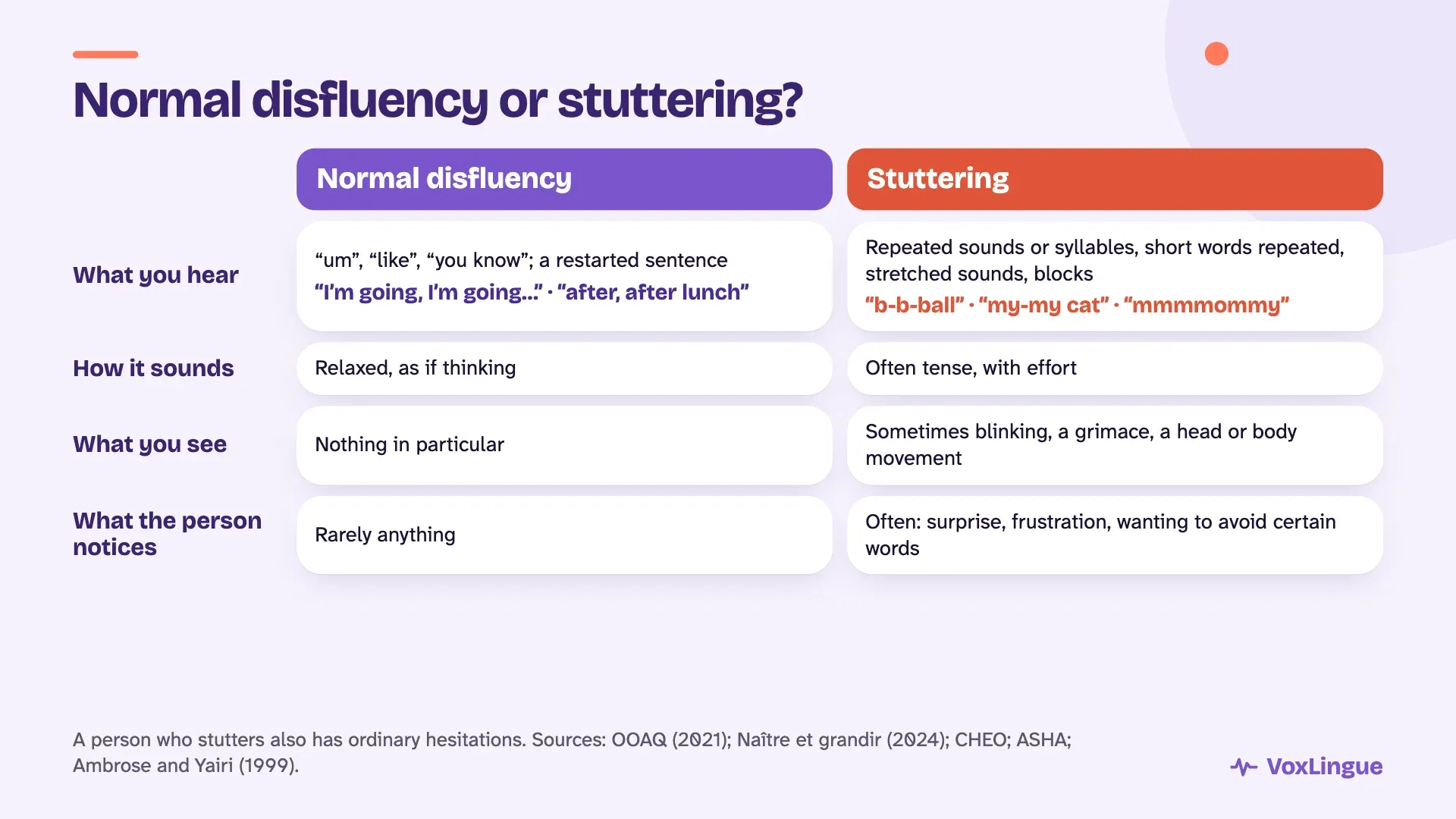
ASHA’s chart of typical disfluency and stuttering makes the same point for clinicians: what separates them is the shape of the bump and what comes with it. Ottawa’s CHEO children’s hospital puts it simply: no one’s speech is perfectly fluent. Our page on stuttering therapy describes how we assess these differences.
Why counting isn’t enough
You may read that a child stutters if they have more than three bumps per hundred words. That guideline exists in some English-language assessments, but it isn’t a test to do at home. Bilingual children, for example, naturally repeat more sounds and words. A study of bilingual children who didn’t stutter found rates from 3% to 22% (Byrd and colleagues, 2015).
A number on its own can cause needless worry, or false reassurance. The SLP looks at the whole picture: the shapes, the tension, the reactions and the person’s history.
Beyond the sounds: tension, avoidance and hidden stuttering
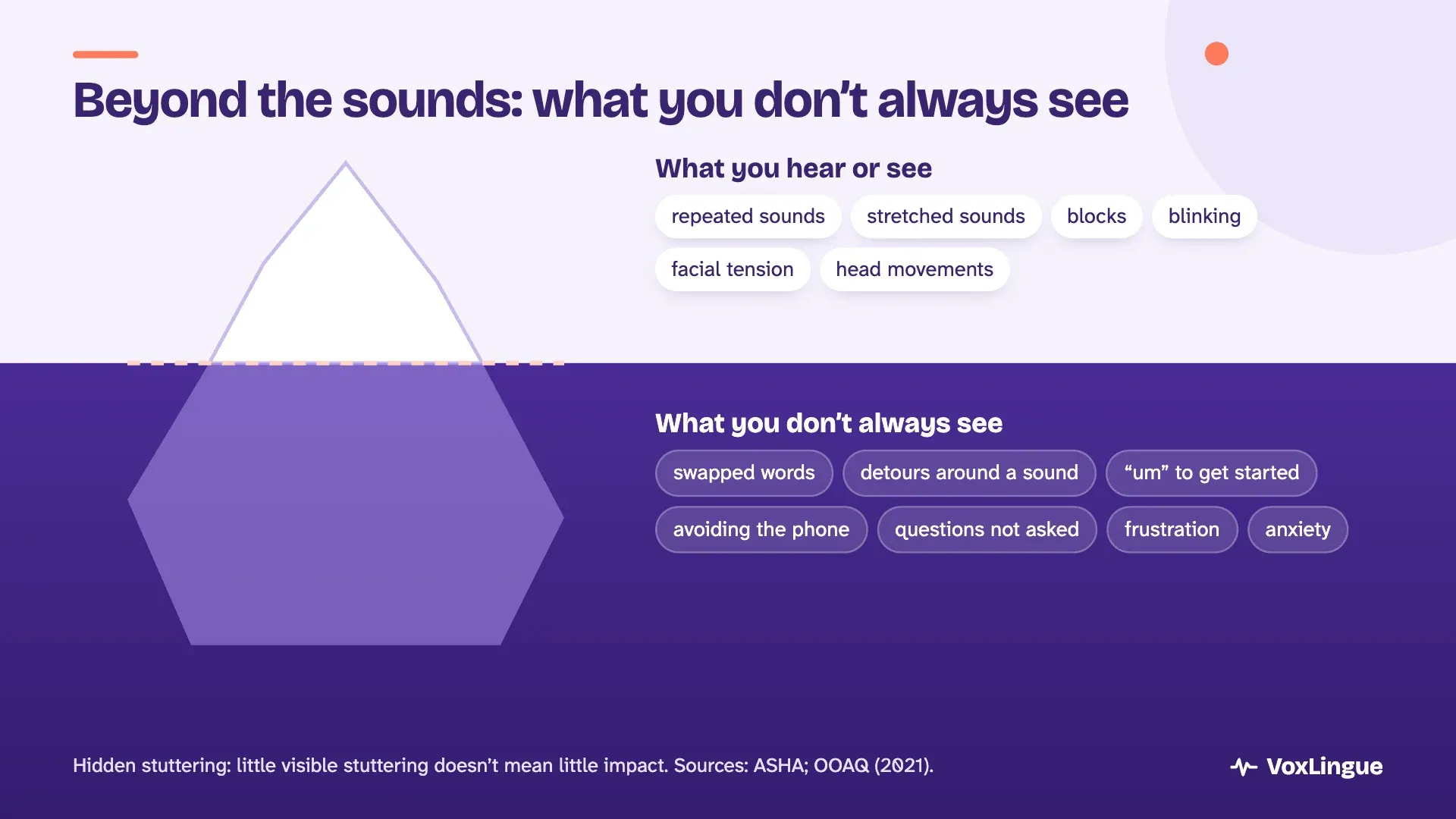
What you hear is only part of stuttering. There can also be tension in the face or neck, blinking, head movements, words swapped for others, and situations avoided, like the phone or ordering at a restaurant. Some people hide their stuttering so well that others barely notice it.
ASHA calls these secondary behaviours. You might see the jaw tighten, the eyes blink, a small head nod or a foot tap to “push through” a word. Other signs are barely audible: an “um” added to get a sentence started, one word replaced by another, a detour around a difficult sound.
Over time, some people learn to hide their stuttering almost completely. This is called covert or hidden stuttering. From the outside, speech seems fluent. From the inside, the person monitors every sentence, swaps words, gives up on asking a question. According to ASHA, hiding stuttering is linked to more anxiety and a lower quality of life. Little visible stuttering doesn’t mean little impact.
Stuttering also varies from day to day and from one situation to another. The phone and groups are often harder. Singing or speaking in unison with someone often reduces it. That is normal, and it doesn’t mean the person “could talk without stuttering if they wanted to”.
In children: will it go away?
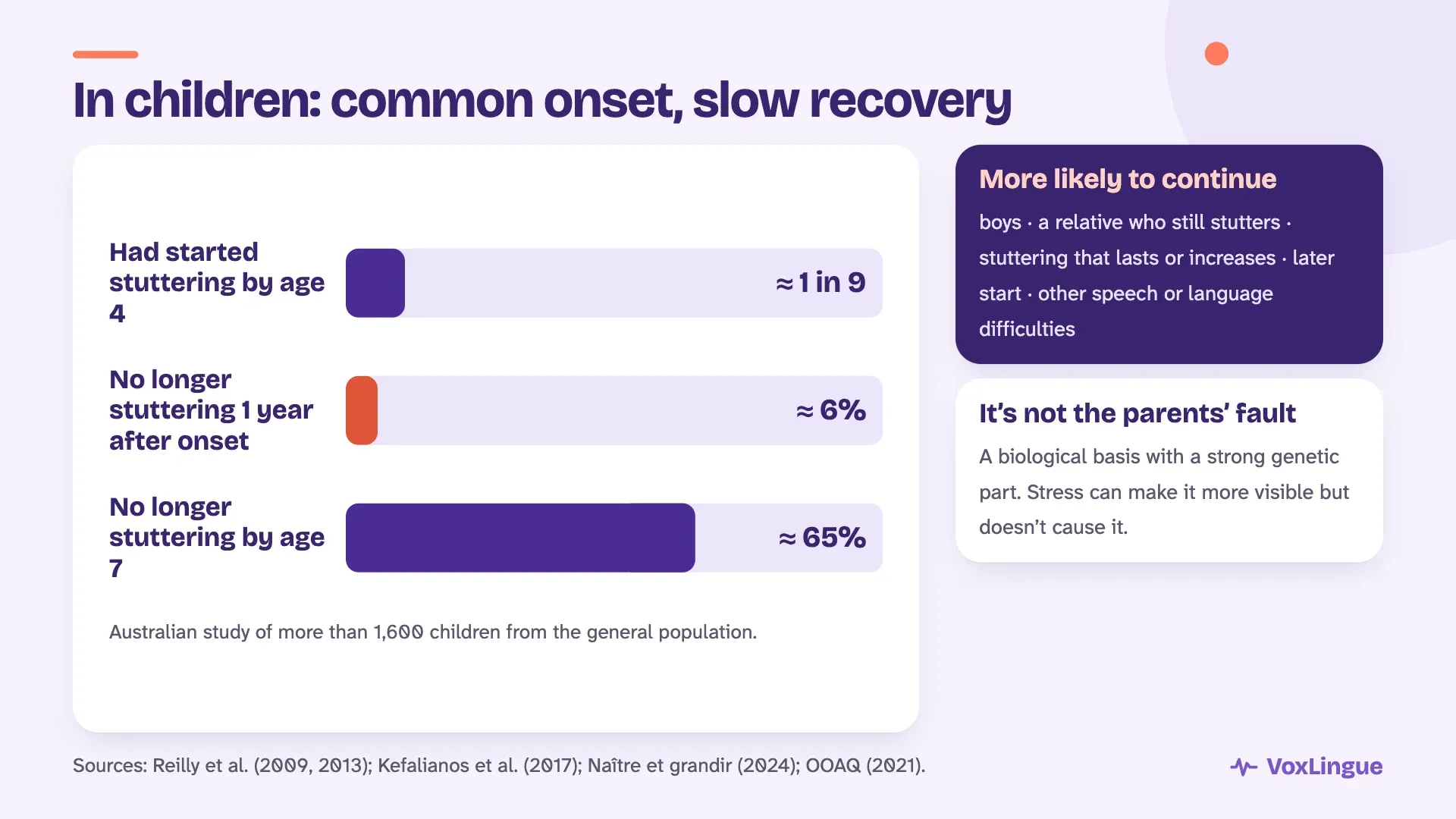
Often, but not always, and rarely within a few weeks. Stuttering usually starts between 2 and 5, sometimes over just a few days. In an Australian study, about 1 child in 9 had started stuttering by age 4, and about 65% were no longer stuttering by age 7.
That study followed more than 1,600 children from the general population (Reilly and colleagues, 2009 and 2013). In nearly half the children, stuttering started over one to three days. Children who began stuttering were not shyer than others before it started, and their family environment wasn’t the cause.
Recovery takes time. In the same study, only about 6% of children had stopped stuttering one year after it began. By age 7, about 65% were no longer stuttering (Kefalianos and colleagues, 2017). A US clinical study found about 74% recovered over up to four years (Yairi and Ambrose, 1999).
Some factors make stuttering more likely to continue: being a boy, having a relative who still stutters, stuttering that lasts or increases, a later start, or other speech or language difficulties. None of these factors can predict the future for any one child.
Why the numbers differ
You’ll see recovery figures from 65% to 90%. They vary with the type of study: children from the general population or children seen in a clinic, followed for two years or for ten.
Even the OOAQ’s own documents don’t all give the same figure. Montréal’s CHU Sainte-Justine acknowledges that we still don’t know well which children will recover on their own. That’s why the guidelines for when to consult, below, matter more than any percentage.
It’s not the parents’ fault
Stuttering has a biological basis. In a Finnish twin study, most of the differences between children were explained by genetics (Rautakoski and colleagues, 2012). Specific genes have also been linked to stuttering. And stuttering often runs in families.
The OOAQ is clear: stuttering is not caused by emotional problems, trauma, shyness or a lack of intelligence. It isn’t caught by imitating someone either.
Québec’s Association bégaiement communication puts it this way: stress doesn’t cause stuttering, though in some cases it can affect it or make it stronger. Fatigue, excitement or a busy day can make stuttering more visible, without being its cause. SickKids’ guide to developmental stuttering says the same for parents.
When should I get my child assessed?
As soon as you’re worried. Before age 4, Naître et grandir advises consulting if the stuttering has lasted more than 6 months, if someone in the family stutters, if your child reacts to it, or if you’re worried. From age 4, consult as soon as you notice stuttering.
Québec’s guidance is clear on one point: you don’t have to wait six months if something worries you. Your concern counts. An American study of 472 young children found that parents’ concern matched what SLPs measured (Tumanova and colleagues, 2014).
Consult without waiting, at any age, if you notice:
- tension, effort or face or body movements when your child talks;
- stuttering that is becoming more frequent or lasting longer;
- frustration, crying or anger about talking;
- a child who avoids talking, whispers or says it’s too hard.
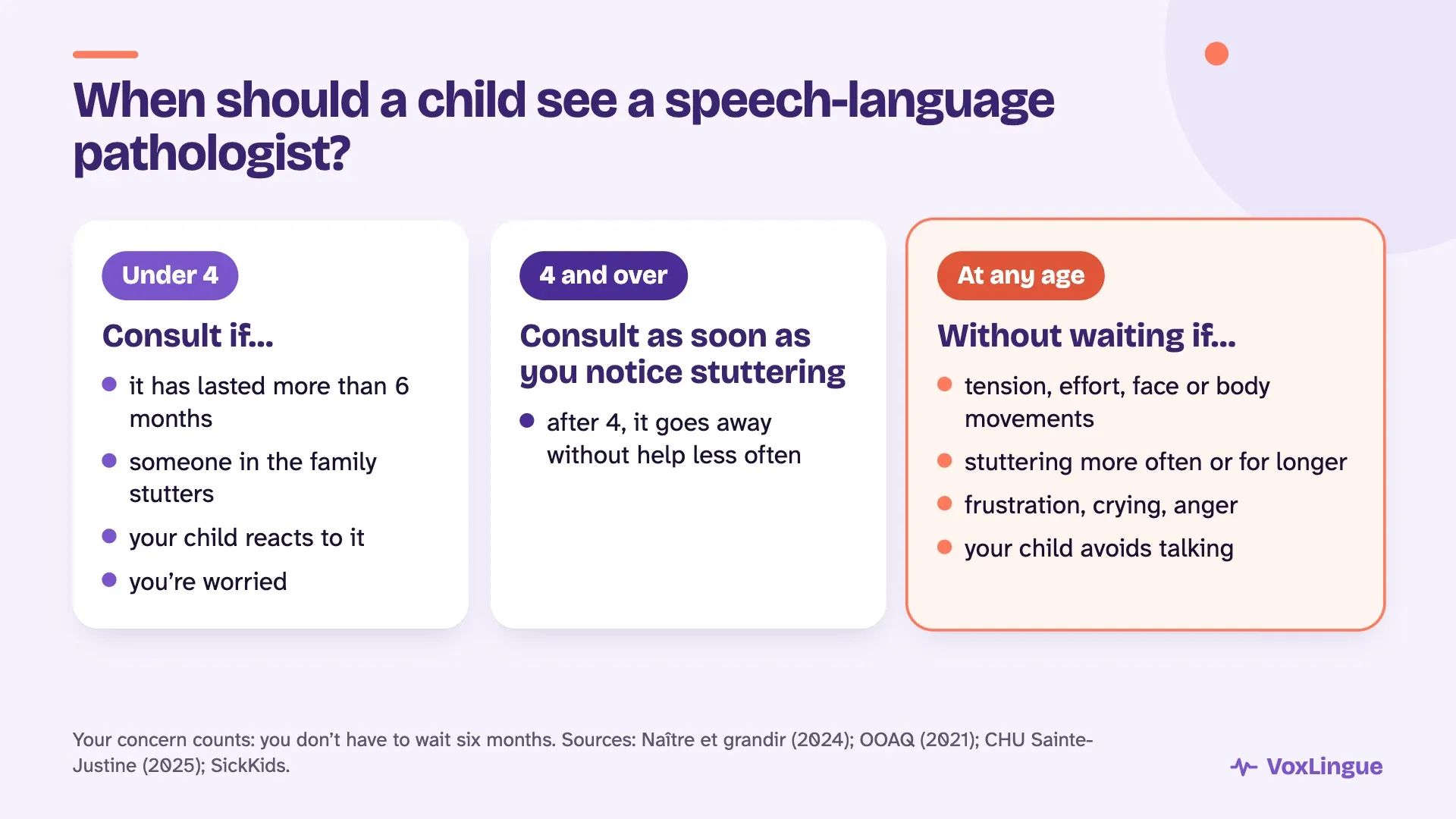
These guidelines come from the OOAQ, Naître et grandir and CHU Sainte-Justine, and match what SickKids and ASHA recommend. Why age 4? Because after that age, stuttering is less likely to go away without help, as Naître et grandir explains.
At school and in the teen years
Stuttering can also start, or become more noticeable, at school age. Oral presentations, reading aloud and teasing can weigh heavily. If your school-age child still stutters, the stuttering is likely to stay, notes CHEO. The goal then becomes helping your child communicate with ease and confidence, and supporting the school in the same direction.
My child is bilingual
Bilingual children who stutter usually stutter in all their languages, so the assessment should cover each one. On the other hand, a child learning two languages may repeat more words and sounds without stuttering. What points toward stuttering is mainly effort, blocks and how the child reacts.
There’s no good evidence that speaking two languages causes stuttering, even if studies don’t all agree. Never stop speaking your language with your child because of stuttering. Our article on identifying language disorders in bilingual children explains how assessments take both languages into account.
Meanwhile: how to respond
Listen to what your child says, rather than how they say it. Give them time to finish, without completing their words. Avoid “slow down”, “take a breath” or “take your time”: Québec and international guidance advise against these instructions. Our article on stuttering in young children has more ideas for home.
In adults: hesitation, nerves or stuttering?
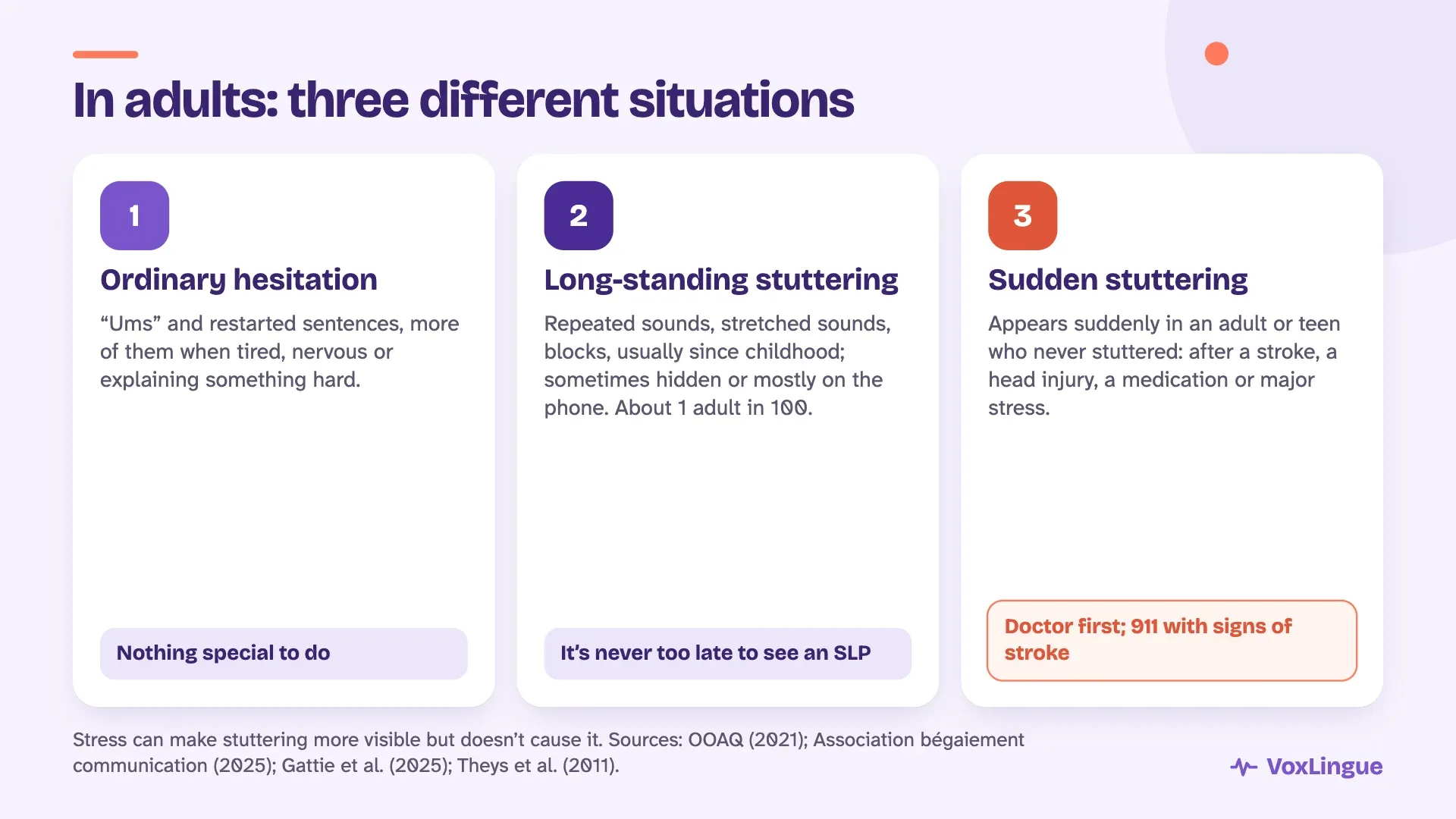
All adults hesitate more when they’re tired, nervous or explaining something difficult. Stuttering is different: the same blocks or repetitions, usually since childhood, and sometimes a long habit of avoiding certain words or situations. About 1 adult in 100 stutters. Stress can make stuttering more visible, but it doesn’t cause it.
A 2025 review estimated that just under 1% of adults stutter, including those who hide it (Gattie and colleagues). The OOAQ and Québec’s stuttering association both cite about 1% of the population, with about four men for every woman.
How can you tell whether your bumps are stuttering? An adult’s ordinary hesitations look like the ones described above: “ums”, restarted sentences, more of them when you’re nervous.
Stuttering takes the shapes in the table instead: repeated sounds, stretched sounds and blocks, often on the same sounds or words. In the vast majority of cases, it started in childhood. Our page on speech therapy for adults describes the services we offer adults.
“I only stutter on the phone”
Stuttering that shows up mostly in certain situations is typical: on the phone, introducing yourself, ordering food, in front of a group. Some people know their difficult words and swap them so fast that no one notices. If you recognize yourself, an SLP can help you see more clearly. Adults usually come on their own, and can describe their experience well.
Stuttering and anxiety
On average, adults who stutter experience more social anxiety than other adults, according to a 2014 meta-analysis (Craig and Tran). That anxiety can build over the years, through negative reactions and situations avoided. It isn’t what causes stuttering. SLPs and psychologists often work together, and cognitive behavioural therapy has shown good results in a clinical trial.
If stuttering comes with anxiety, sadness or dark thoughts, talk to a doctor or a psychologist. In Québec, Info-Social 811 offers free, confidential consultation, day and night. Anywhere in Canada, you can call or text 9-8-8 in a crisis.
What therapy aims for in adults
It’s never too late to consult, notes the OOAQ, which adds that stuttering “can be lived well”. In adults, therapy doesn’t try to erase stuttering. It aims for easier speech and more confident communication. Techniques can help you stutter with less effort, speak more fluently, or change your relationship with stuttering. Results vary from person to person, and goals are set together.
Sudden stuttering in an adult: see a doctor first
Stuttering that starts suddenly in adulthood is a medical question first. That’s also true for a teen who has never stuttered. It can follow a stroke, a head injury or another brain condition, and more rarely major stress or a medication. With signs of a stroke, call 911.
This kind of stuttering is rare, but don’t wait. In a Belgian study of 319 people hospitalized after a stroke, about 5% had developed stuttering (Theys and colleagues, 2011). This is called neurogenic stuttering. So-called psychogenic stuttering, linked to stress or a shock, is even rarer.
Call 911 right away if the stuttering appears with any of these signs:
- one side of the face drooping, or an arm or leg that is weak or numb;
- trouble speaking or understanding;
- vision changes, a sudden severe headache or loss of balance.
Heart & Stroke reminds us that stroke is a medical emergency. Don’t drive yourself to the hospital; an ambulance will take you to the closest hospital that provides urgent stroke care.
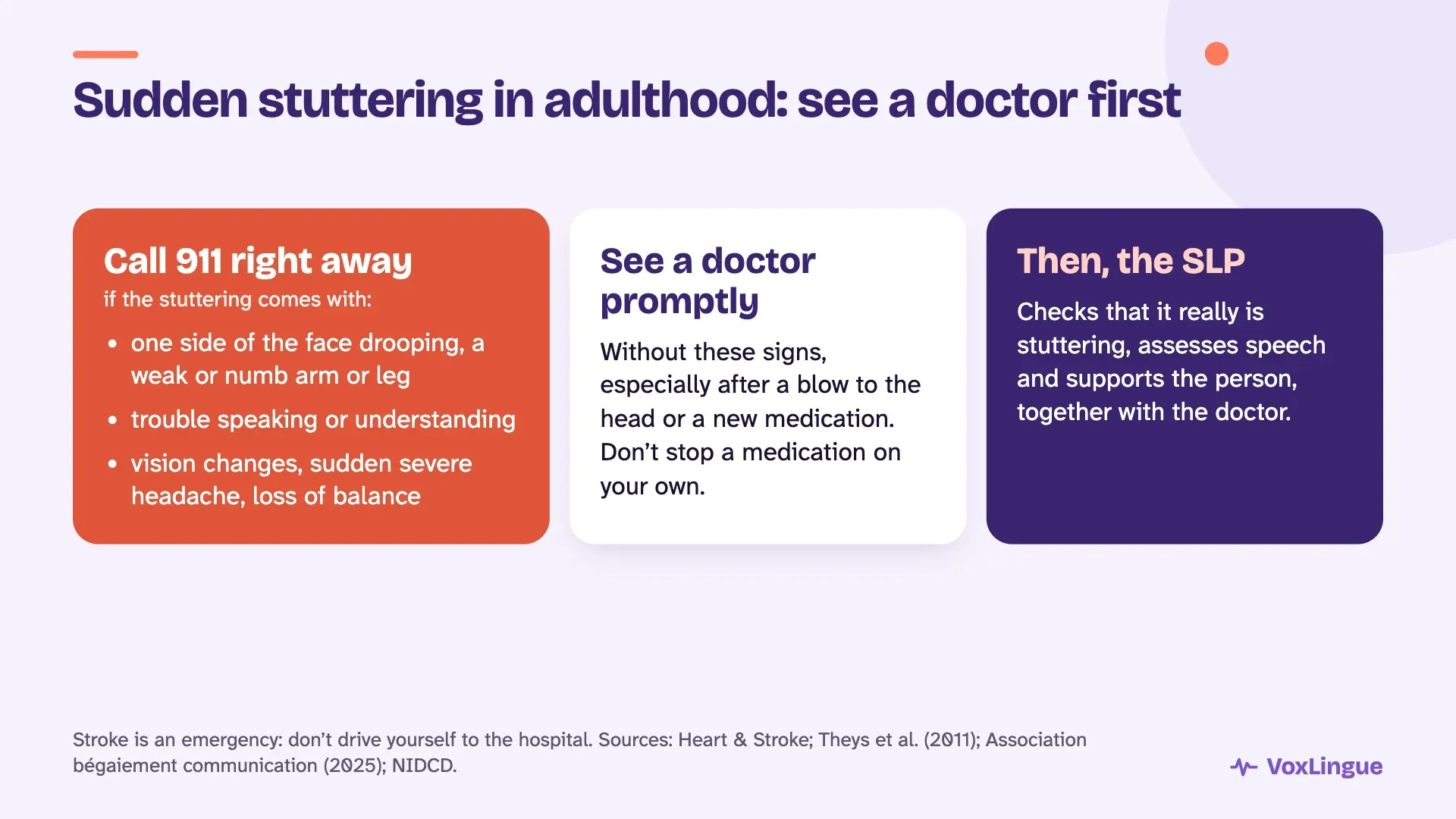
Without these signs, see your doctor promptly, especially if the stuttering started after a blow to the head or after starting a new medication. Don’t stop a medication on your own: talk to your doctor or pharmacist.
Québec’s stuttering association also points out that it’s important to check that it really is stuttering, and not a memory or language difficulty. That’s why the doctor and the SLP work together. The doctor looks for the cause; the SLP assesses speech and communication, and supports the person once the cause is known.
What about cluttering?
Cluttering is a different fluency difference. Speech seems very fast or uneven, syllables run together, there are many ordinary hesitations, and the person is often not very aware of it. It can occur alongside stuttering. An SLP can tell them apart.
A person who clutters might say “Iwannagotograndma’s” in a single breath, swallowing syllables. Listeners often ask them to repeat.
Unlike stuttering, cluttering often decreases when the person pays attention to their speech, for example in a formal situation. It’s rarely identified before age 8, and we don’t yet know how many people it affects. Therapy focuses mainly on rate, pausing, clarity and awareness of one’s own speech.
What a speech-language pathologist does
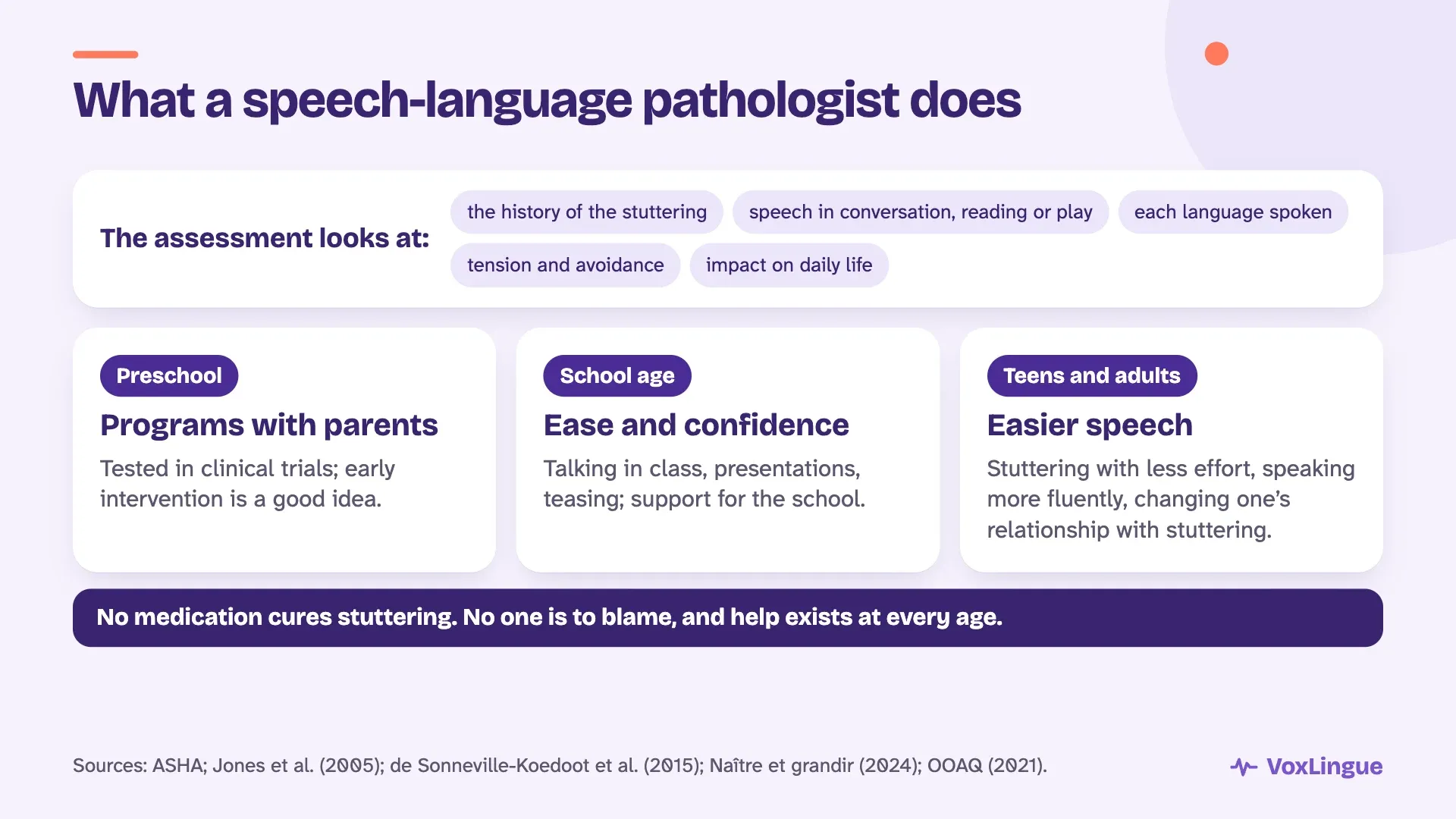
The SLP looks at speech as a whole. They observe it in different situations and in each of the person’s languages, along with tension, avoidance and the impact on daily life. For young children, programs that involve parents have been tested in clinical trials. For teens and adults, the goal is easier, more confident communication.
The assessment starts with the history: when the stuttering began, how it has changed, whether others in the family stutter, and what the person or parents have noticed. The SLP then listens to speech in conversation, reading or play, and tries to understand how the stuttering is experienced. Our page on speech and language assessment explains how a first appointment works.
For preschool children, programs that guide parents at home have been studied in clinical trials. In a trial published in 2005, children in the program stuttered much less than children who hadn’t yet started treatment (Jones and colleagues). In another, in the Netherlands, two different approaches gave similar results after 18 months (2015). As Naître et grandir puts it, whether stuttering is temporary or persistent, early intervention is a good idea.
There is no medication or treatment that “cures” stuttering. But no one is to blame, and help exists at every age.
Resources in Québec, Ontario and across Canada
In Québec, your CLSC can point you in the right direction, and some rehabilitation centres offer public stuttering services with age and duration criteria. The OOAQ keeps a directory of SLPs in private practice. Québec’s Association bégaiement communication offers French-language information, groups and support.
In Ontario, the Preschool Speech and Language Program serves young children, and SLPs in private practice are registered with CASLPO. Across Canada, the Canadian Stuttering Association offers information and support groups, and we see families and adults in Ontario through online speech therapy.
Stuttering vs normal disfluency: what to remember
Everyone hesitates. Stuttering is recognized by its particular shapes, repeated sounds or short words, stretched sounds, blocks, and often by the effort that comes with them.
Keep three things in mind. In children, your concern is reason enough to consult, and from age 4, consult as soon as you notice stuttering. In adults, it’s never too late to talk to an SLP. And stuttering that appears suddenly in adulthood goes to a doctor first.
Next step
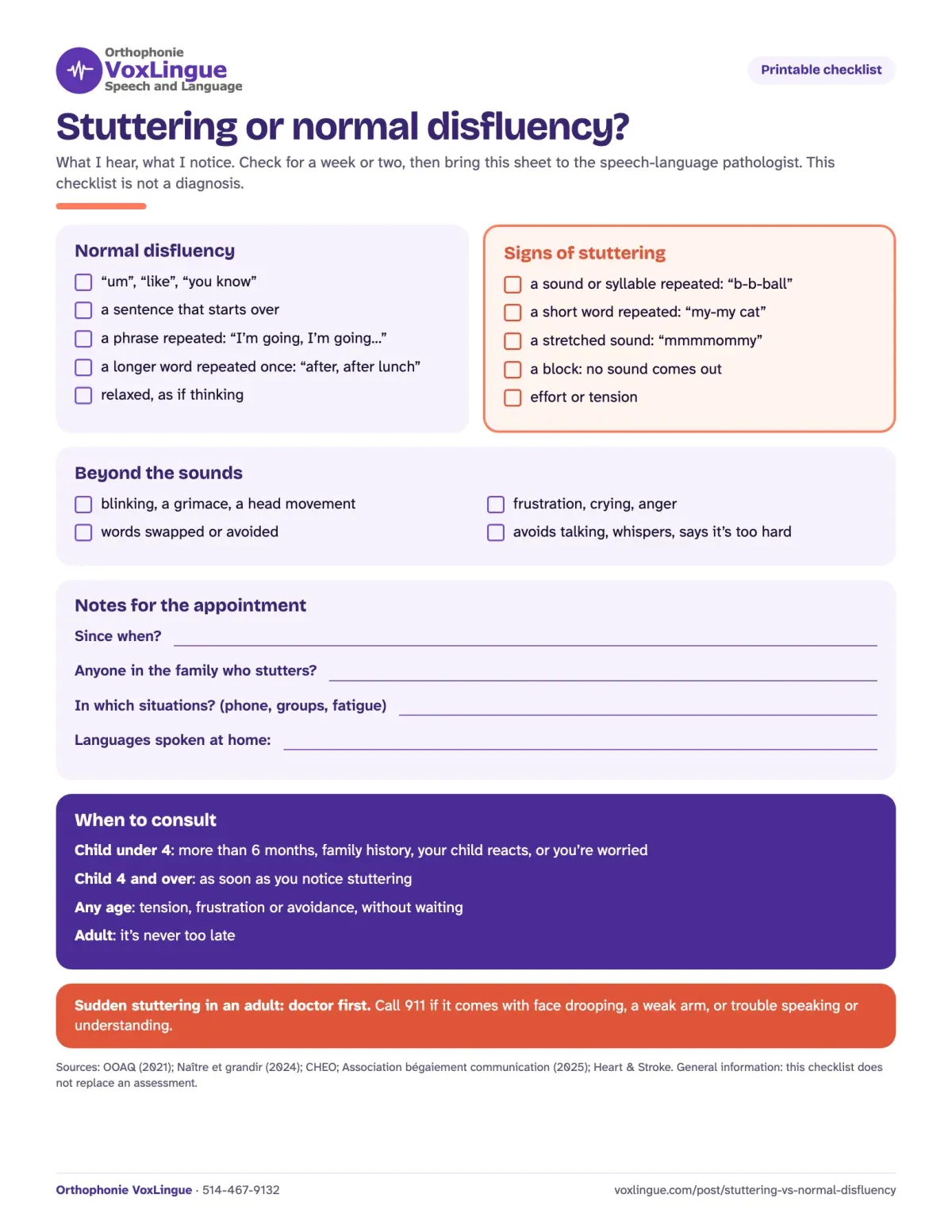
Printable: Stuttering or normal disfluency? (PDF, 1 page). A checklist to note what you hear and notice, with the guidelines for when to consult.
Our page on stuttering therapy explains how we support children, teens and adults, at our Marché Central clinic in Montréal or online.
Frequently asked questions
Is it normal for a 3-year-old to repeat words?
Often, yes. Between 2 and 5, many children repeat a phrase or a longer word calmly, as if thinking: these are normal hesitations. Repeating sounds, syllables or short words with effort is different. If you hear both, or if you’re worried, see a speech-language pathologist.
Does repeating whole words count as stuttering?
It depends on the word. Repeating a word of two syllables or more once, without tension, is a normal hesitation according to Naître et grandir. Repeating a short one-syllable word, like “my-my cat”, looks more like stuttering, according to CHEO and ASHA. The whole picture, with tension and frequency, is what settles it.
Will my child outgrow stuttering?
Many young children do, but slowly. In a large Australian study, about 65% of children who had started stuttering were no longer stuttering by age 7. After age 4, stuttering is less likely to go away without help. That’s why consulting as soon as you notice it from that age is recommended.
Does stress cause stuttering?
No. Stuttering has a biological basis, with a strong genetic part. Stress, fatigue or excitement can make it more visible, but they don’t cause it. The OOAQ also notes that it isn’t caused by emotional problems, trauma or shyness. Parents are not to blame.
Should I tell my child to slow down?
No. Instructions like “slow down”, “take a breath” or “take your time” are not recommended. They put the focus on how your child talks rather than what they’re saying. Listen to the message, give your child time to finish, and speak calmly yourself, without pointing it out.
Does being bilingual cause stuttering?
There’s no good evidence that it does, even if studies don’t all agree. Bilingual children naturally repeat more words and sounds, which can look like stuttering without being stuttering. Children who stutter usually stutter in all their languages. Don’t stop speaking your language with your child because of stuttering.
Can adults start stuttering suddenly?
It’s rare. Most adults who stutter started in childhood. Stuttering that appears suddenly in adulthood can follow a stroke, a head injury or another brain condition, and more rarely major stress or a medication. See a doctor first, and call 911 if there are any signs of stroke.
Why do I stutter more when I’m tired or nervous?
Stuttering varies from day to day and between situations. Fatigue, nerves or pressure to hurry often make it more visible, without being its cause. The phone and groups are often harder. If your bumps take the shapes of stuttering, an SLP can help you understand what’s going on.
What’s the difference between stuttering and cluttering?
Stuttering shows up as repeated sounds, stretched sounds and blocks, often with effort. Cluttering shows up as very fast or uneven speech where syllables run together, with many ordinary hesitations. People who clutter are often not very aware of it. The two can occur together.
Can stuttering be cured?
There is no medication or treatment that cures stuttering. Many young children do stop stuttering, though, and early intervention helps. For teens and adults, therapy aims for easier speech and more confident communication. As the OOAQ puts it, stuttering can be lived well.