My 3 to 5-year-old talks to themselves while playing: what this private speech means, how talking to yourself, voices for toys and lines from shows differ, and when to ask a speech-language pathologist
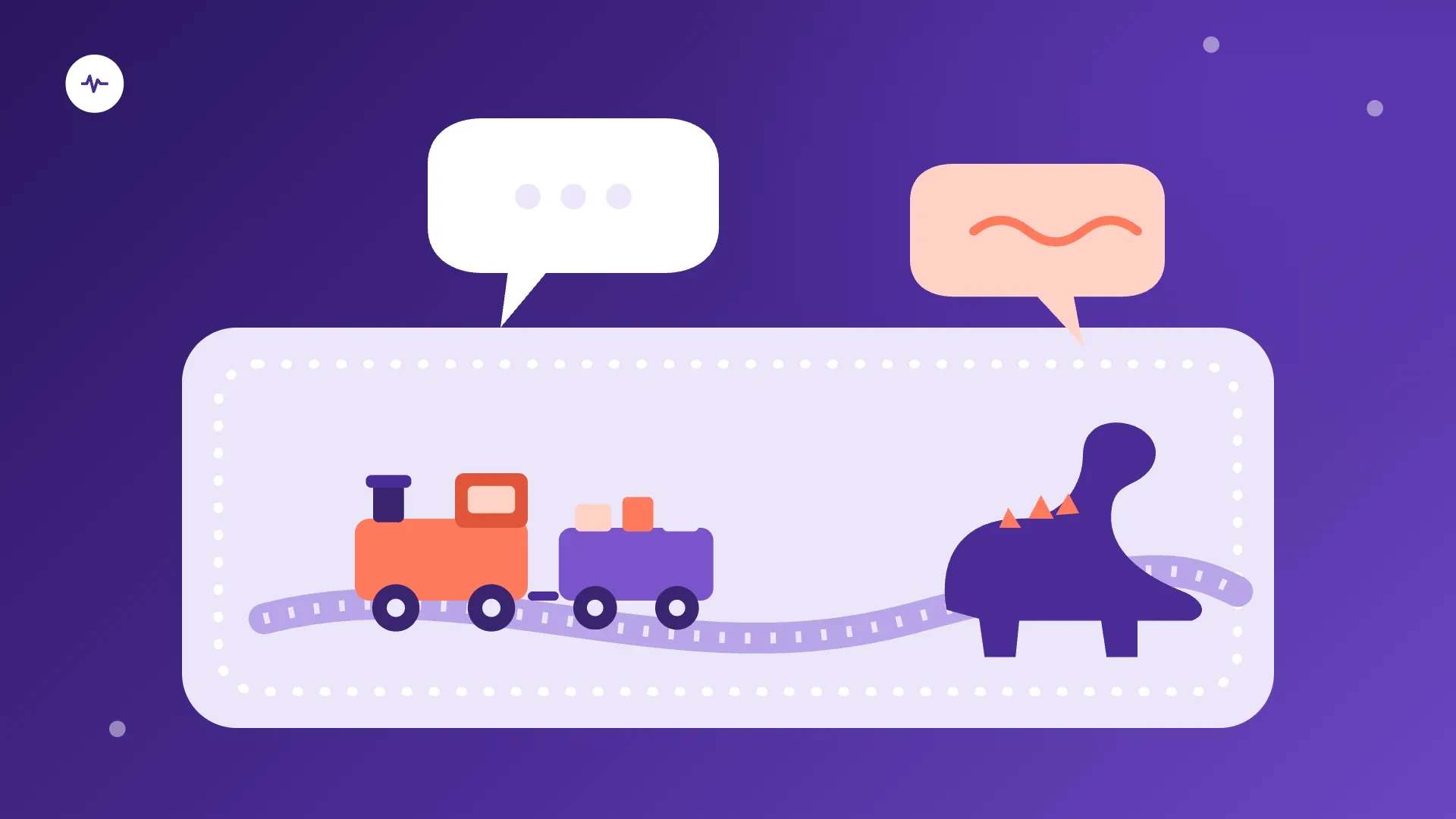
From the living room, you hear it. “Watch out, the bridge is gonna fall! No, no, the dinosaur’s too big. I’ll make another bridge.” Your child is alone with their toys, and they haven’t stopped talking. Sometimes in their own voice, sometimes in a growly dinosaur voice, sometimes with a line from their favourite show.
My child talks to themselves while playing: is it normal? The short answer is yes. Between 3 and 5, talking out loud during play is expected, and researchers see it as a tool for thinking.
This guide explains what researchers call private speech, why your child talks more when something is hard, and how to tell apart three things that sound alike: talking to themselves, giving toys voices and repeating lines from shows. You’ll also see how to join their play, and the one pattern worth a closer look.
My child talks to themselves while playing: is it normal?
Yes. Between 3 and 5, many children talk out loud while playing, without speaking to anyone. They announce what they’re about to do, comment on what happens and give themselves instructions. Researchers call this private speech. It isn’t loneliness, and it isn’t strange.
Private speech is audible speech that isn’t addressed to anyone. Researchers who study it describe it as the out-loud, sometimes whispered, talk children direct at themselves while they work on something or play (Winsler, 2009). It is different from inner speech, which is thinking in words, fully silent.
Some children talk to themselves a lot, others very little. Both can be completely typical. What matters most, as you’ll see further down, is what your child also does with the people around them.
What researchers call private speech
The idea comes from the Russian psychologist Lev Vygotsky, in the 1930s. In his view, children take the words adults used to guide them and turn them toward themselves. “Gently,” “first this, then that”: what you said to them yesterday, they say to themselves today. Over time, those words move inside their head.
Jean Piaget, at the same time, saw this talk as a sign that a young child finds it hard to take other people’s point of view. Later research has mostly sided with Vygotsky. The psychologist Laura Berk summed it up in Scientific American in 1994: talking out loud helps children direct what they do and master new skills (Why Children Talk to Themselves).
They talk more when it gets hard
Listen to your child doing a puzzle. While the pieces fit, they may be quiet. When they get stuck, the talking starts: “No, not there. That one goes at the top. Where’s the blue edge?”
That’s no accident. In a study published in 2007, Adam Winsler and colleagues found that children talked to themselves mostly at moments when the task got difficult, and that what they said was about what they were doing (Winsler et al., 2007). Private speech isn’t background noise. It’s often the sound of a child thinking.
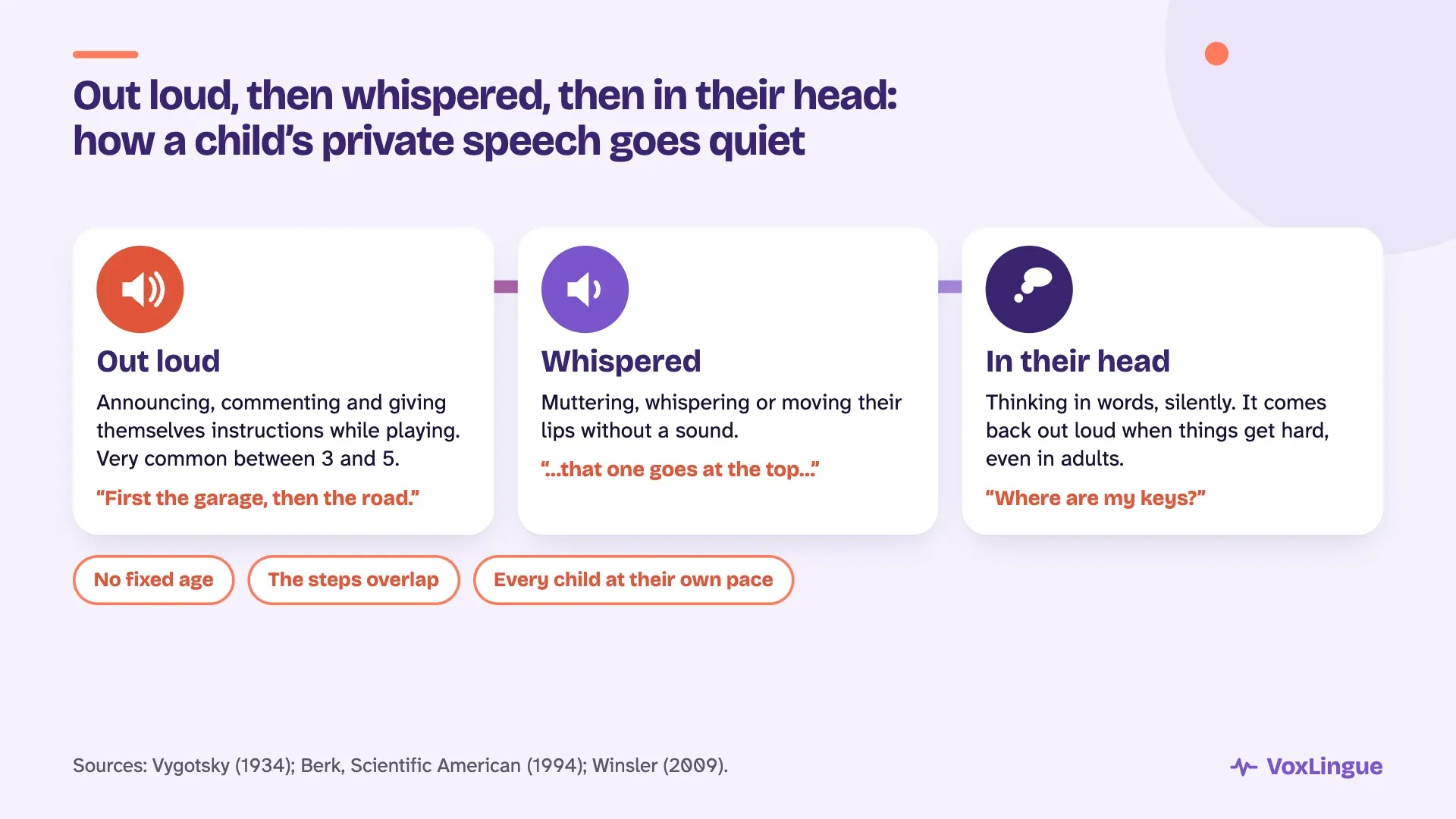
Out loud, then whispered, then in their head
Over the years, this talk gets quieter. Children talk out loud, then mutter or whisper, then sometimes move their lips without a sound. Bit by bit, much of it becomes inner speech. There’s no fixed age for this, and talking out loud never disappears completely. Plenty of adults still talk to themselves while assembling furniture or hunting for their keys.
Why your child talks to themselves: planning, guiding, calming down
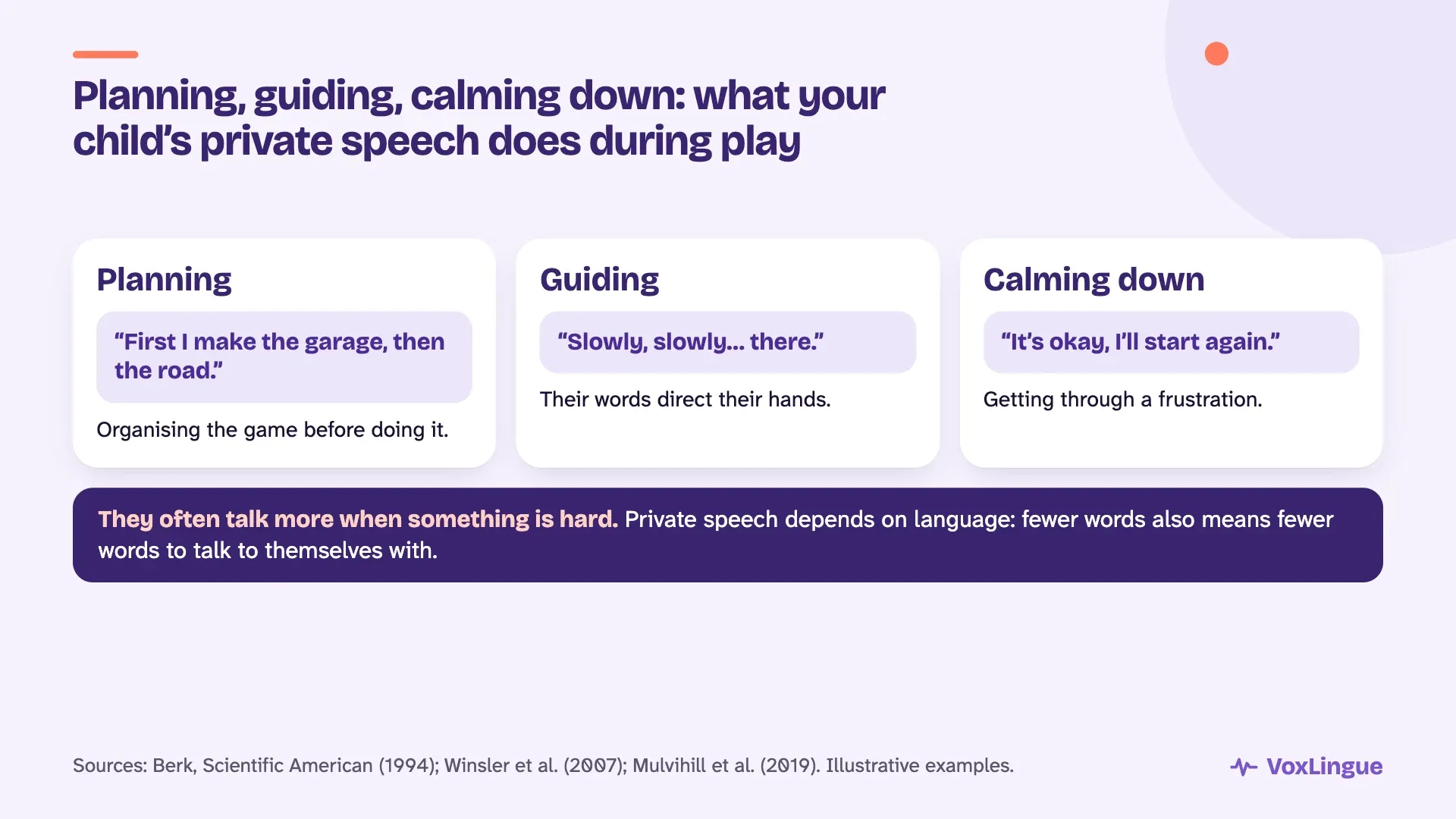
Your child mostly talks to themselves to organise what they’re doing. Their words help them plan their play, guide their hands and get through a frustration. In a way, you’re hearing their thinking before it goes silent.
If you listen for a while, you’ll often hear three uses:
- Planning: “First I make the garage, then the road, then the cars come.”
- Guiding: “Slowly, slowly… there.” as they set the last block on the tower.
- Calming down: “It’s okay, I’ll start again” when the tower falls.
Play talk also shows the language they’re building. The CISSS de Chaudière-Appalaches, a Québec health and social services centre, describes it in its information session for parents of 3 to 4-year-olds. At this age, communication moves beyond the here and now, and children express ideas, talk about past events, tell stories and build their conversation skills (language at 3 to 4, in French, revised 2024). The little monologue over the blocks is often all of that at once.
In children with language difficulties, researchers see that this self-directed talk sometimes develops differently. A 2019 review of 19 studies found this across several groups of children, without one single pattern (Mulvihill et al.). For you, the lesson is simple: private speech depends on language. A child with fewer words also has fewer words to talk to themselves with.
Talking to themselves, voices for toys, lines from shows: three kinds of talk in play
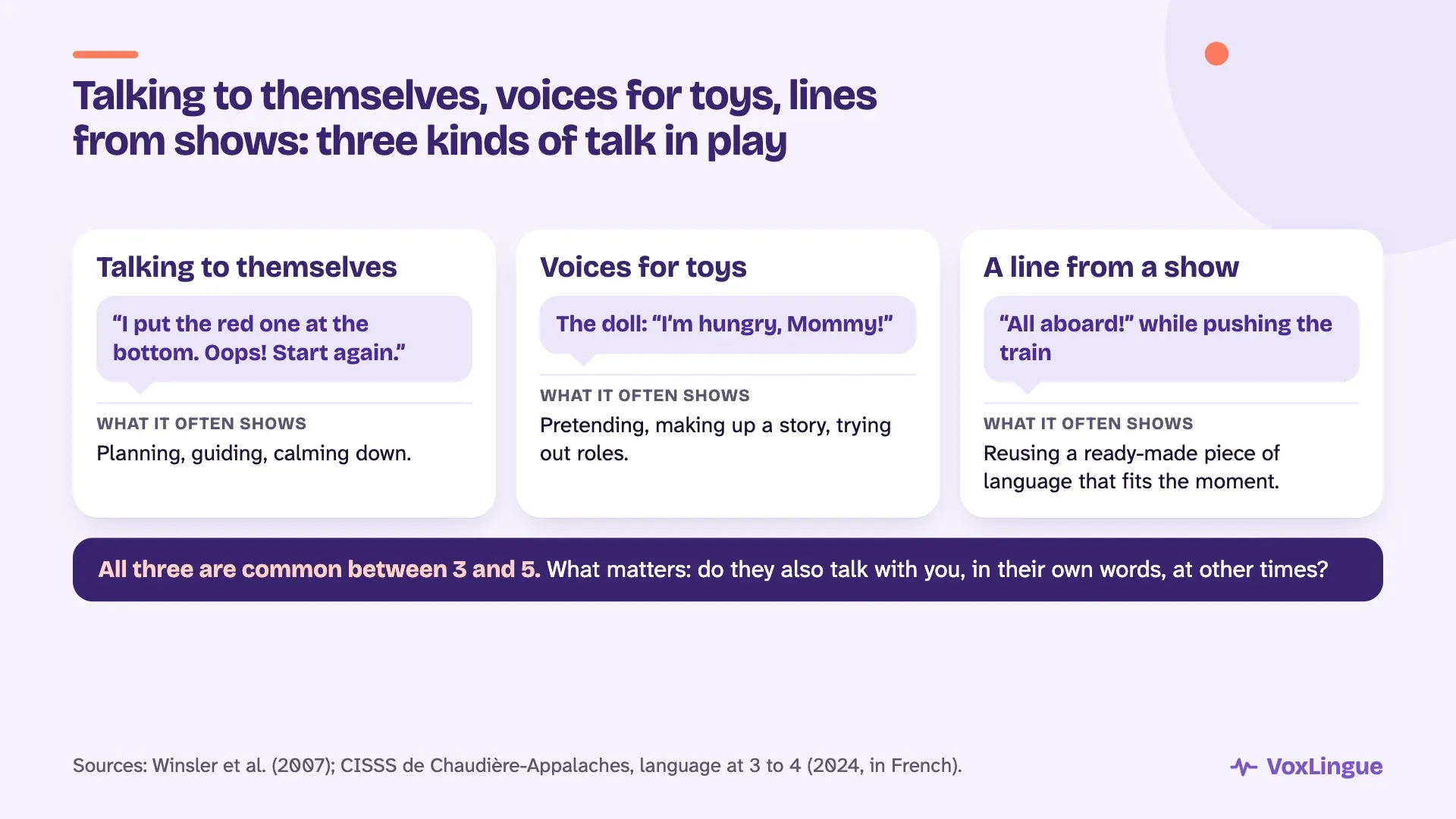
Three things sound alike from the living room. Your child may be talking to themselves, giving their toys voices, or using a line they heard somewhere else. All three are common between 3 and 5, and all three can mix in the same minute.
| What you hear | An example | What it often shows |
|---|---|---|
| Talking to themselves | “I put the red one at the bottom. Oops! Start again.” | Planning, guiding, calming down |
| Voices for toys | The doll, in a tiny voice: “I’m hungry, Mommy!” | Pretending, making up a story, trying out roles |
| A line from a show | “All aboard!” while pushing the train | Reusing a ready-made piece of language that fits the moment |
They narrate what they’re doing
This is private speech in the strict sense. They comment on their actions, announce what’s next, correct themselves. Often they don’t even notice you’re listening. If they stop when you walk in, they aren’t hiding anything: they were talking for themselves, not for you.
They give their toys voices
The dinosaur growls, the baby cries, the firefighter gives orders. Here, your child is pretending. They give each character a voice, change their tone and make up dialogue. Role play is one of the activities the CISSS de Chaudière-Appalaches suggests to parents of 3 to 4-year-olds.
In these scenes, your child tries out ways of talking they don’t use with you yet: the cross parent’s voice, the doctor’s, the daycare educator’s. It’s a way to practise language in different roles.
They repeat lines from their shows
Your child pushes the train and calls out “All aboard!”, exactly like in their show. They’re using a ready-made piece of language at the right moment. Many children do this. Some even learn much of their language in big chunks like these before breaking them into words. We explain this in our article on gestalt language processing and echolalia.
Repeating phrases they’ve heard is one way children learn. It’s seen in autistic children and in other children. Private speech is also found in both groups. In the 2007 study by Winsler and colleagues, autistic children who spoke fluently talked to themselves as often as other children, and their talk was just as related to the task. Talking to themselves during play says nothing, on its own, about autism.
A more useful question than “are they repeating?” is this. Does the line fit what’s happening in the game? And does your child also talk with you, in their own words, at other times of the day?
“Self-talk”: the same word for a parent strategy
If you search online, you’ll find “self-talk” used in another sense. In speech therapy, it also names a strategy for parents: describing out loud what you yourself are doing (“I’m cutting the apple. I’m putting the pieces in the bowl.”). Its cousin, “parallel talk”, means describing what your child is doing. These are ways of talking to your child, not ways your child talks to themselves. More on that below.
They play in English and talk to us in French: the language of play
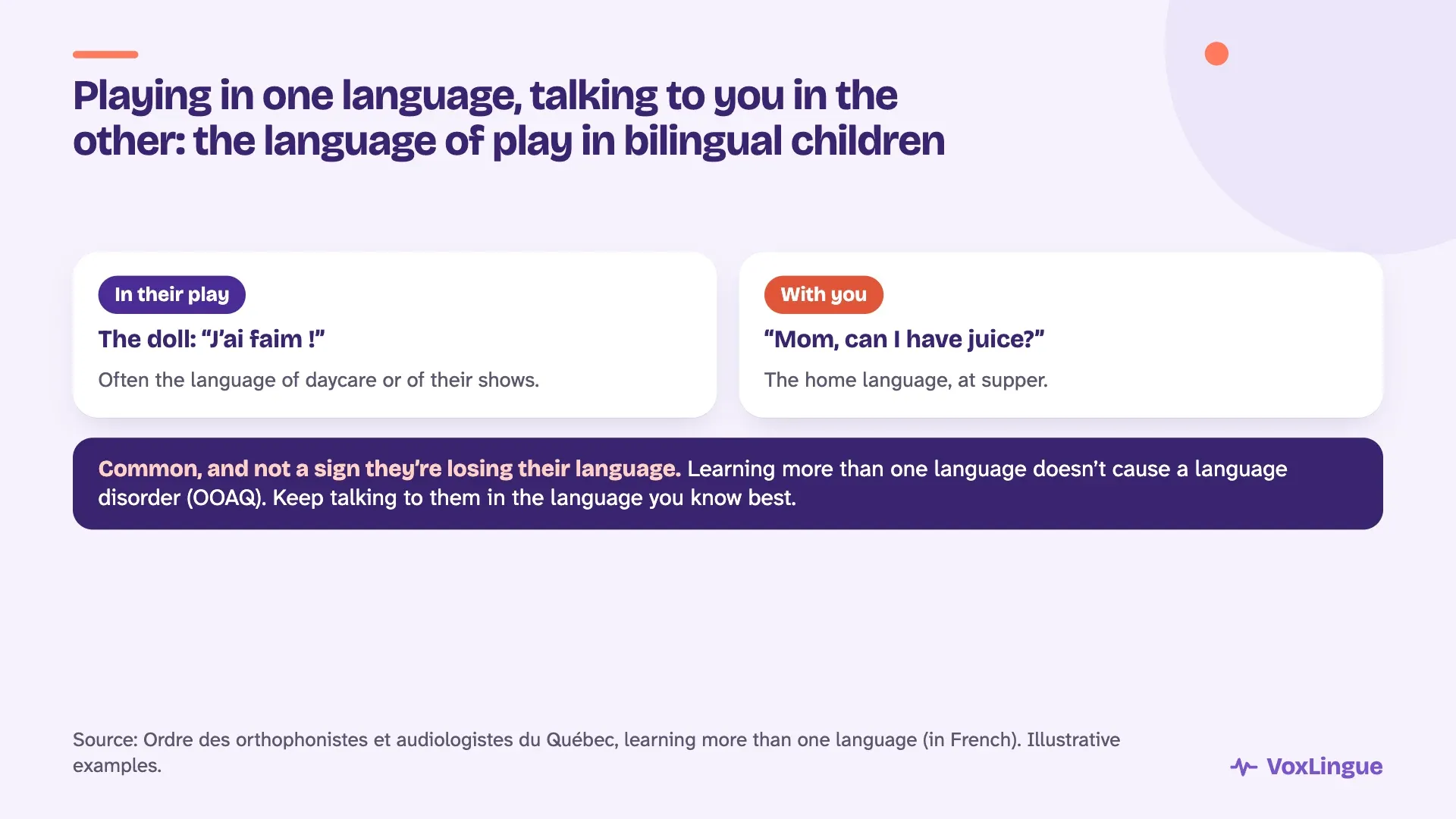
A child growing up with two languages may play in one language and speak the other at home. Often the play language is the language of daycare or of their shows. That’s common, and it doesn’t mean they’re losing their home language.
For example, your daughter makes her dolls talk in English because her shows are in English, but she talks to you in French at supper. Or your son narrates his trucks in French, the language of his daycare, while the family speaks Spanish at home. In our article on when daycare is worried about your child’s language, “talks to themselves while playing” is listed among what’s expected for a child learning French at daycare.
The Ordre des orthophonistes et audiologistes du Québec (OOAQ) is clear: learning more than one language doesn’t cause a language disorder, and children tell the languages they hear apart very early (learning more than one language, in French). A bilingual child can have different strengths in each language. Mixing both languages in one sentence is common too. See our article on children mixing French and English.
So there’s no need to “fix” the language of their play. Keep talking to them in the language you know best. If you join their game, you can do it in your language, even if they’re playing in the other one.
How to join their play without making it a lesson
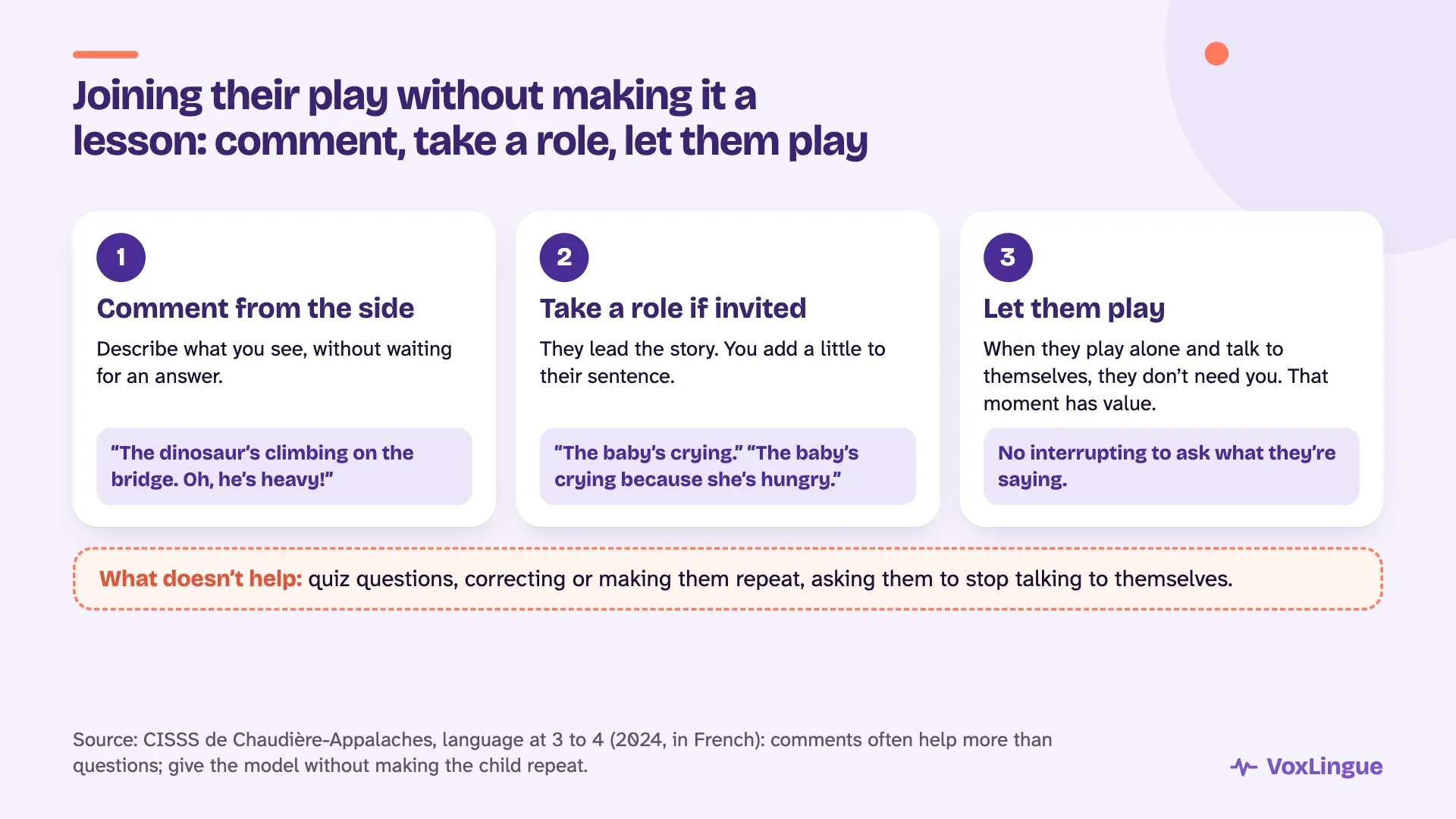
The simplest way: comment on their play from the side, take a role if they invite you, and leave them be when they play alone. No quiz questions, no corrections, and never “say it after me”. Their play stays theirs.
Comment from the side
Sit near them and describe what you see, without waiting for an answer: “The dinosaur’s climbing on the bridge. Oh, he’s heavy!” The CISSS de Chaudière-Appalaches reminds parents that comments can help a child even more than questions. When you describe your actions or theirs, they hear examples of varied sentences.
Take a role if they invite you
If they hand you a character, step into the story. Let them lead: they decide the firefighter saves the cat. You can add a little to what they say. If they say “The baby’s crying”, you answer “The baby’s crying because she’s hungry”. That’s the CISSS’s own example: say their sentence back with one more piece of information.
Don’t correct, don’t make them repeat
If they say “the dinosaur falled down”, they don’t need a correction. You can simply use the right form in your answer, without asking them to repeat it: “Oh, the dinosaur fell down! Is he getting up?” The CISSS gives the same advice: give the model, without asking the child to repeat.
Leave their play alone
When your child is playing alone and talking to themselves, they don’t need you. That moment has value. Try not to interrupt to ask what they’re saying, or to tell them to talk more quietly at home. If you’re somewhere quiet is expected, you can suggest they “talk in a whisper”, without making it a reproach.
For more play ideas by age, see our tips to help a toddler talk through play.
They talk a lot alone but little with you: when to look closer
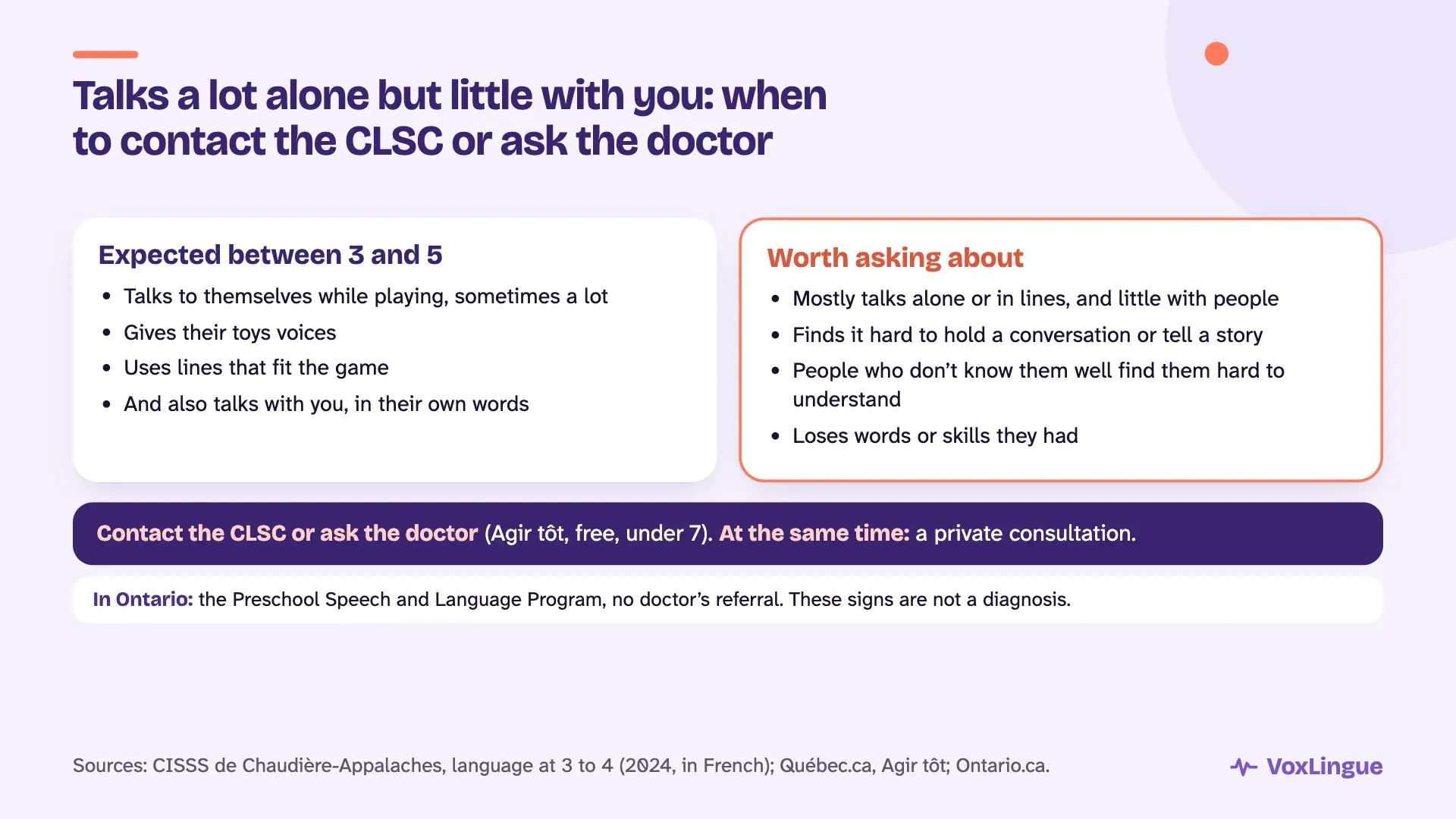
The pattern worth a closer look isn’t a child who talks to themselves a lot. It’s a child who talks a lot alone but little with people, and whose sentences are mostly lines. That isn’t a diagnosis, but it’s a good reason to ask.
In practice, look at their whole day, not only their play. These signs are worth raising with someone:
- They talk a lot while playing alone, but rarely with you or other children, even when rested and at ease.
- Most of what they say, all day long, is lines from shows, and they rarely use them to ask for or show you something.
- Between 3 and 4, they find it hard to hold a conversation, to tell a story or to report on something that happened, or people who don’t know them well have a hard time understanding them. These are two of the signs the CISSS de Chaudière-Appalaches gives parents.
- They lose words or skills they had.
Jot down what you notice for a week: who they talk to, in which language, with which words. These notes help a lot at a first appointment. If autism is on your mind, our article on language difficulties and autism explains what professionals look at. And if your child mostly repeats your questions instead of answering them, see our guide to the 3-year-old who doesn’t answer questions.
Who to ask in Québec and Ontario
In Québec, contact the CLSC or ask the doctor. The Agir tôt program offers free screening for children under 7. At the same time, a private consultation gets you an opinion without waiting. Both can happen in parallel.
In Ontario, the Preschool Speech and Language Program accepts children without a doctor’s referral. We also offer online services for Ontario families.
Key takeaways
- Between 3 and 5, talking to themselves while playing is common. Researchers call it private speech, and it helps children plan, guide themselves and calm down.
- Your child often talks more when something is hard. Over the years, this talk gets quieter, with no fixed age.
- Talking to themselves, giving toys voices and using a line from a show are three different things, and all three are common.
- Playing in a language other than the home language is common in bilingual children.
- To join in: comment from the side, take a role if invited, add a little to their sentences. Don’t correct them and don’t make them repeat.
- The pattern worth asking about: they talk a lot alone but little with people. Contact the CLSC or ask the doctor and, at the same time, consider a private consultation.
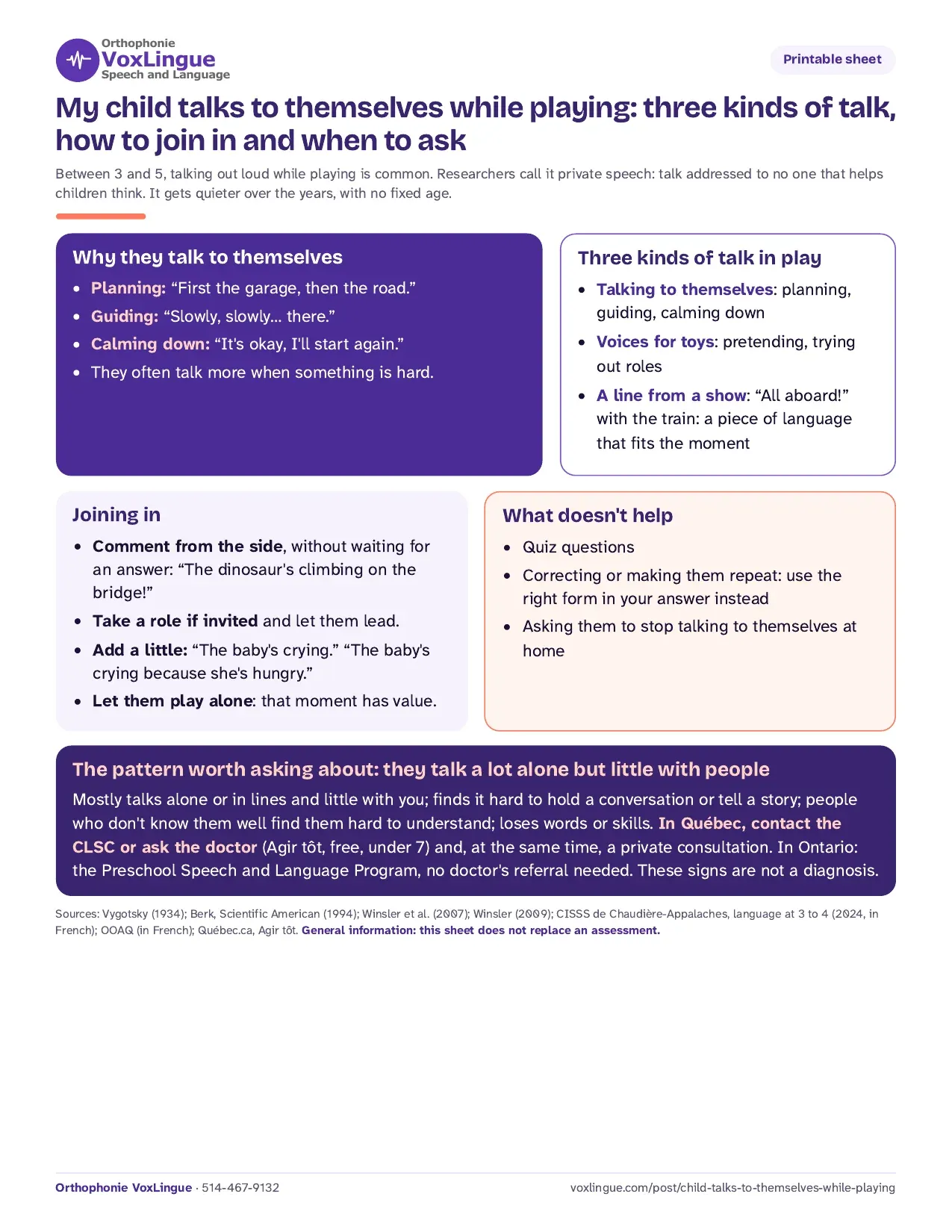
Printable sheet: My child talks to themselves while playing: three kinds of talk, how to join in and when to ask (PDF, 1 page).
Next step
Would you like to learn how to join your child’s play to help them talk? Explore parent coaching inspired by Hanen programs. If they talk a lot alone but little with you, see a language assessment, in all their languages. Our speech-language pathologists see families at our Marché Central clinic in Montréal, and by telepractice across Québec and Ontario.
Frequently asked questions
At what age do children stop talking to themselves?
There’s no fixed age. Talking out loud slowly gets quieter: muttered, whispered, then largely silent. It never disappears completely. A school-age child, and even an adult, still talks to themselves sometimes when a task is hard.
My child talks to themselves all the time: is it too much?
Not necessarily. Some children think out loud more than others; it’s a matter of style. What matters is that they also talk with you and with others, and that people understand them. If they talk a lot alone but little with people, contact the CLSC or ask the doctor.
Is talking to themselves a sign of autism?
No, not on its own. Private speech is seen in autistic children and in other children. Repeating lines from shows is also seen in both groups. Professionals look at communication as a whole, especially with people. Our article on language difficulties and autism covers this.
Should I ask them to stop or talk more quietly?
At home, no: talking to themselves helps them organise their play. Somewhere quiet is expected, you can suggest they whisper, without making it a reproach. Try not to tease them about their voices or lines in front of others.
They repeat their shows in English but we speak French at home: is that a problem?
It’s common in children who watch shows in another language. If the line fits the game and they also talk to you in French at other times, there’s no reason to worry. Keep talking to them in your language, and pick shows in French if you’d like.
What if they never talk to themselves while playing?
That isn’t a problem in itself: some children play quietly and think in their head. Look instead at whether they talk to you, understand you and play pretend. If their words or understanding worry you, contact the CLSC or ask the doctor.