Talking toy, AI plush or a ball with no batteries: what helps a toddler talk, what the studies found, and what to put under the tree this year
All Their Languages · Issue 5 · November 25, 2026 · 14-min read
The Brief
No toy teaches a child to talk. What gets a toddler talking is the back-and-forth with a person: you say a word, you wait, and they answer with a look, a sound or part of a word. So the best holiday gift for a child between 12 months and 3 who isn’t saying much is a toy that needs you to work, and someone who sits on the floor to play with it. Naître et grandir, Québec’s parenting site, puts it in one line: the child’s best toy is us.
Kimberly Martins, our founder, wrote the same thing in her series on toys: “the best way to help your children develop and grow is to play with them.” The studies agree. In one of them, parents playing with electronic toys said about 40 words a minute to their baby, compared with 67 when they looked at a book together.
This week in 60 seconds
- What’s changing: on November 2, Health Canada warned about two balloon-blowing kits for children, a product banned in Canada. A study published this month finds toddlers are more likely to know words for things they can see, hear and touch.
- The Deep Dive: when the toy talks, the parent talks less, and so does the child. Keep noisy toys with the sound off, leave the ones that talk for the child at the store, and keep AI plush toys out from under the tree for children under 5.
- Try this week: the button toy with no batteries. You’re the cow.
- What the research says: the first filmed study of young children with an AI plush toy, in Cambridge. A 3-year-old says “I’m sad,” and the toy answers that it’s a happy little bot.
- Your question: which toy does your child bring you most often to play together?
What’s changing
November 2, 2026: Health Canada warns about balloon-blowing kits for children
On November 2, Health Canada issued a warning about two “Colour Balloon” balloon-blowing kits sold on Walmart.ca Marketplace. The child blows through a straw to make a bubble from a tube of paste, and can breathe in the solvent fumes. Prolonged exposure can affect the nervous system.
Health Canada notes that balloon-blowing kits for children that contain solvents are banned in Canada. Six units were sold here between June and October, and no incidents have been reported. If you have one, stop using it and dispose of it with your municipality’s household hazardous waste.
It isn’t the only one. The government’s recall database also lists two recalls of similar kits on October 26 and an expanded warning on October 29. On October 7, an activity board for toddlers was recalled for a choking hazard.
What it means for your family: before you buy, especially online from a seller you don’t know, type the toy’s name into the recall database. Health Canada’s toy safety tips come down to three habits for children under 3: no small parts (if a piece fits inside a toilet paper roll, it’s too small), extra care with button batteries, and be wary of a toy whose noise feels uncomfortable to you.
November 2026: toddlers know more words for things they can touch and hear
A study in the November issue of Cognitive Science, from teams at Purdue University and the University of Delaware, asked whether the senses matter when toddlers learn words. Their example: you can only see the moon. Popcorn you can see, smell, touch and hear popping.
In a first experiment with toddlers about 22 months old on average, children were more likely to know words for objects they can see, hear and touch. In a third, exploratory experiment, a smell presented while children learned a new word helped, mostly in the older children, around 25 months. It’s a US lab study, and the abstract doesn’t say how many children took part.
What it means for your family: real objects have a head start on pictures. A ball he squeezes, rolls and hears land with a “boom” gives his word more to hold on to than a ball drawn on a screen. One more reason to choose gifts you handle together, as the Deep Dive explains.
The Deep Dive
December is coming and the family wants gift ideas. The grandparents have seen a toy that sings the alphabet and a plush toy that answers questions. Your child is 2 and still doesn’t say many words. Can a toy help?
The short answer: a toy helps when it gives an adult and a child something to do together. Rolling, stacking, pretending, looking at a book. A toy that talks, sings or lights up on its own can take the turns in the conversation, yours and your child’s.
What studies found when the toy does the talking
The study most often cited is American. Published in 2016 in JAMA Pediatrics, it recorded 26 parents and their babies aged 10 to 16 months at home, in 15-minute play sessions with three kinds of toys: electronic toys, traditional toys and books.
The numbers are clear. With electronic toys, parents said 39.6 words a minute on average. With traditional toys, 55.6. With books, 66.9. There were also fewer conversational turns, and parents responded less often to their baby’s sounds.
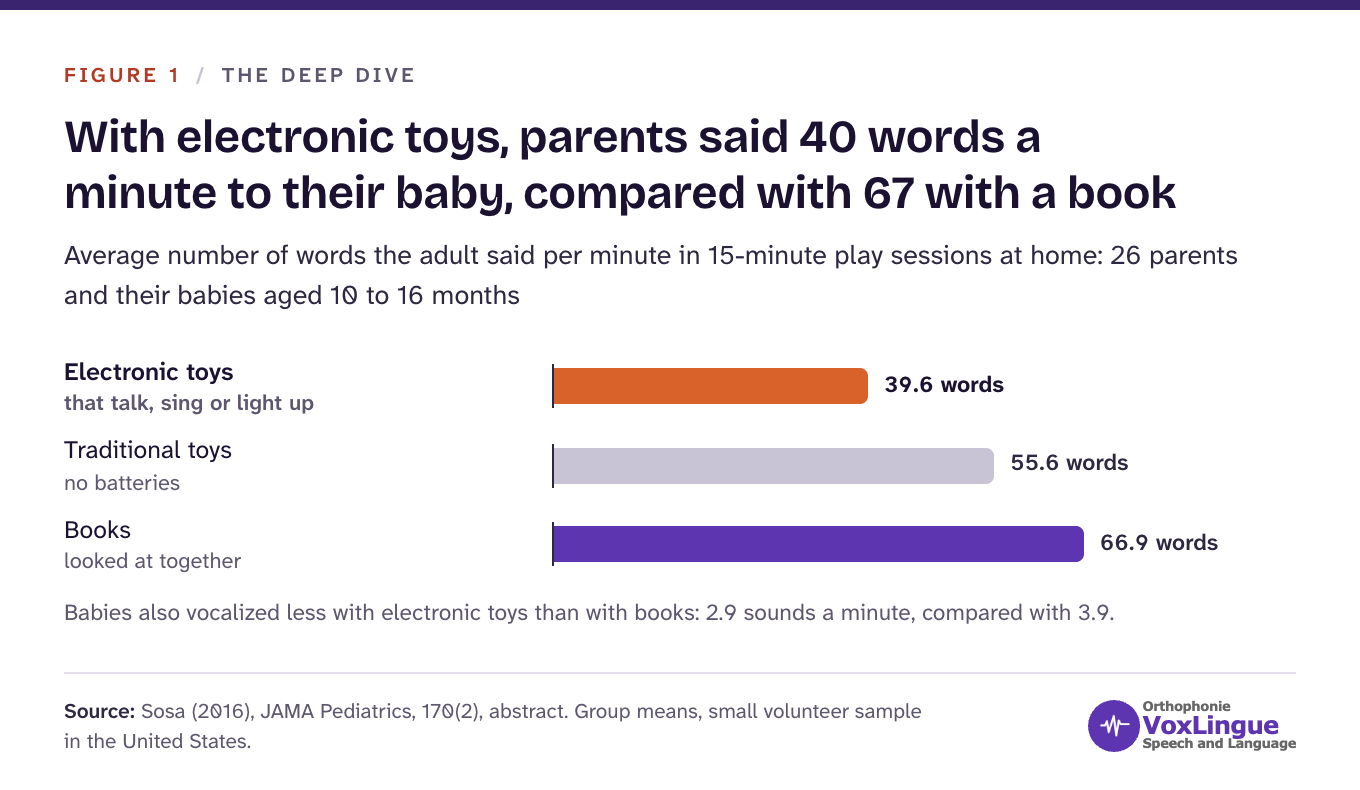
When the toy talks, the adult talks less: about 27 fewer words a minute than with a book.
And the child? In the same study, babies vocalized less with electronic toys than with books: 2.9 sounds a minute, compared with 3.9. In 2022, a Michigan State University team had 28 parents and their children, 14 autistic and 14 typically developing, play with electronic toys and then traditional ones. In both groups, children talked less and used fewer different words with the electronic toys. The authors write that children appear to “take a backseat” to electronic toys.
Two limits, plainly stated. These studies are modest in size and short: 26 to 28 families, and a few minutes to a quarter of an hour per toy. And none shows that a talking toy causes language difficulties. What they show is more useful for a parent: while the toy is talking, there’s less room for your voice and for your child’s.
Noise makes speech harder to understand
There’s also a reason that has to do with the ear. Three audiologists at the Marie Enfant rehabilitation centre of CHU Sainte-Justine, Montréal’s children’s hospital, explain it in a pamphlet for parents (in French): noisy toys, like other sources of noise, can stop a child from understanding speech well. An adult fills in the words drowned out by noise from context. A toddler learning first words doesn’t yet know enough to fill the gaps.
The same pamphlet notes that, according to the World Health Organization, noise above 70 decibels isn’t safe for hearing, and that toddlers tend to hold toys against their ear. Their store test is easy: if, in a quiet store, you have to raise your voice to talk while the toy is on, it’s too loud.
Does every toy that makes a sound have to go? No. In her toy series, Kimberly herself picked a ball popper that plays music, noting that it “can be a little noisy.” Naître et grandir asks the right question: when pressing the button to make noise becomes the point of the game, the child uses less imagination. Before you buy, ask whether the sound adds anything to the play. Often a truck, a stuffed animal or a doll with no sound is just as much fun.
For a noisy toy already at home, the Sainte-Justine audiologists suggest removing the battery, switching it off or taping over the speaker, and keeping it for short periods. The ones to leave at the store are toys that talk, ask questions or narrate the play for the child.
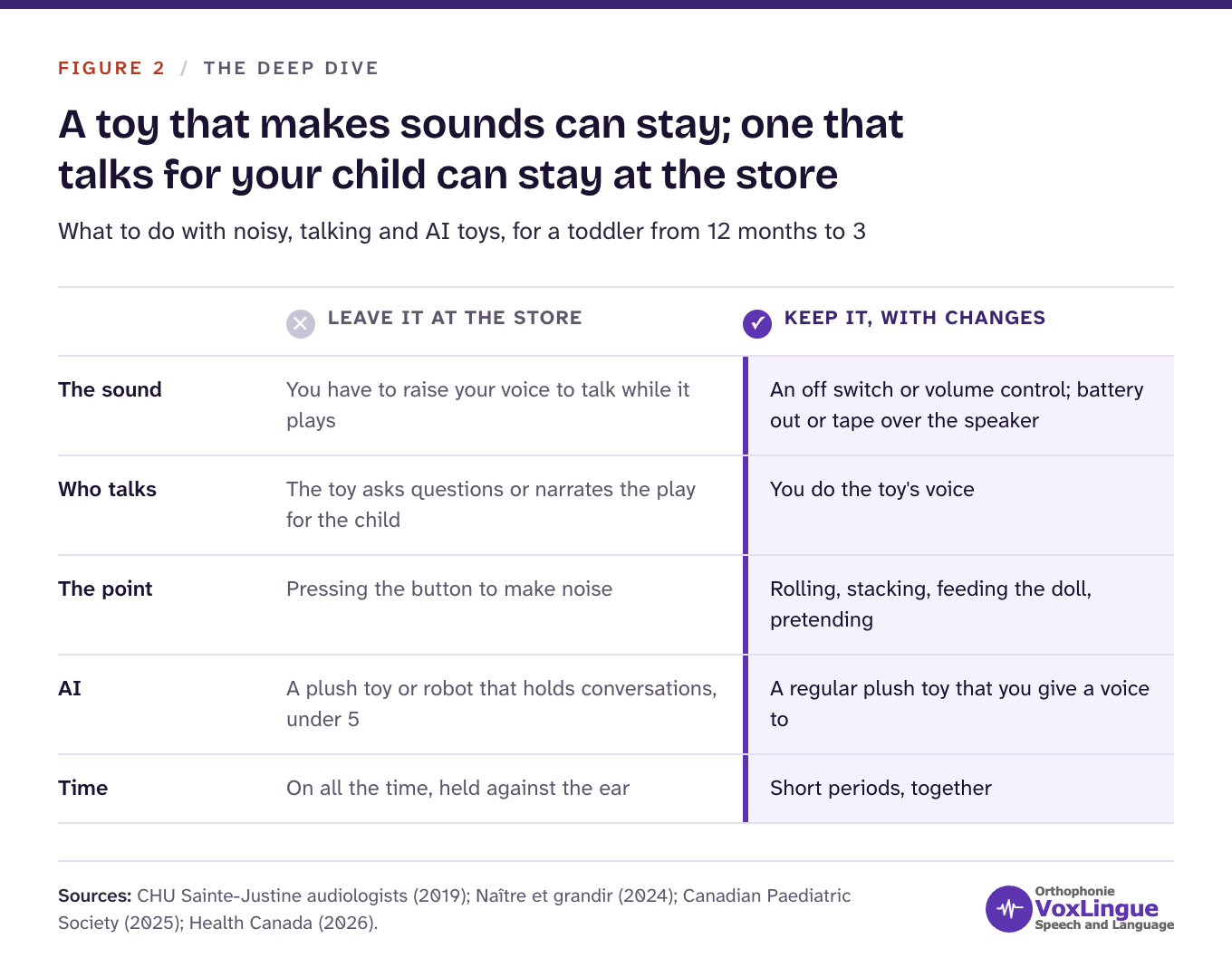
The question to ask of a toy: does it leave your child a turn, or take it?
AI plush toys: not under the tree for children under 5
A newer arrival: plush toys, dolls and mini robots connected to artificial intelligence, which listen to children and answer them. The Canadian Paediatric Society says they’re often marketed as trusted friends that respond “like humans.” Its conclusion, posted a year ago in its section for children under 5, is clear: child health and development experts don’t recommend these toys. The best toys, it says, encourage activity, imaginative play or motor skills.
In the United States, Common Sense Media goes the same way: no AI toys for children aged 5 and under. It notes that these toys share the same problems: design features that create emotional attachment in young children, extensive data collection and unreliable performance. More than 8 in 10 parents in its survey were concerned about the toys collecting their child’s personal information.
For language, the reason is concrete. A toddler still says words their own way. Your child points at the bed and says “bah.” You understand she wants her blanket, you say “Your blankie!” and you hand it over. She hears the right word at the exact moment she wants the thing, without being asked for anything. A machine first has to understand “bah.” The first filmed study of these toys, summed up in the box below, shows it does that badly.
If one is already at home, keep it in a shared room, play with it together and talk about what it says. That’s what the Cambridge researchers recommend.
What to give, from 12 months to 3
Kimberly Martins published a list of toy types by age. Here it is, without brands:
- 12 to 18 months: sorting and nesting toys, modelling clay, picture books, easy puzzles, large building blocks, push and pull toys, a ball to roll, crayons.
- 18 to 24 months: a play kitchen or picnic set, a shopping cart, dolls, smaller blocks, toy instruments, thick wooden puzzles, a train set, a ball.
- 2 to 3 years: dress-up clothes, a dollhouse, mini household objects for pretend play, construction sets, toys with keys and doors, first board and memory games, books with a story.
These ages describe toys, not what your child should be able to do. A toddler who doesn’t say much often prefers the toys from the band before, and that’s fine. The speech-language pathologist who wrote in Naître et grandir in 2014 put it this way: a toy matched to the child’s level has a better chance of hitting the mark. She also called pretend play a safe bet for language.
A book counts as a toy. A Polish study followed 104 babies at 4, 6, 9 and 12 months. From 4 months on, parents spoke more often while sharing a book than while playing with a toy or a rattle, and from 9 months there were more conversational turns with the book. These babies are younger than the toddlers in this Deep Dive, but the direction matches the 2016 study.
Fewer toys at a time. In a US study, 36 toddlers played once with 4 toys and once with 16. With 4 toys, they played longer with each one, and in more ways. The study measured play, not language. Naître et grandir says it its own way: when a child has too many toys, they stop seeing them. After the holidays, put some of the gifts away in clear boxes, as the Montreal Children’s Hospital suggests, and bring them out later. A toy that comes back is like new.
Several languages at home: the language is in the person, not the toy
There’s no need for a toy “in French” or a toy that speaks your language. Kimberly noted it in her series: “These activity tips can be done in either language.” A grandmother can play kitchen in Arabic or Portuguese, and you can play blocks in English. Each person plays in the language they know best. And when you count your child’s words, count the ones he only says at his grandparents’ too.
How to give the toy so the words come
Sit on the floor at your child’s level. Let him choose, and name what he does. Our speech-language pathologists often suggest the same sequence to parents: say the word yourself, wait a few seconds while looking at him, then give him what he wants, even if he says nothing. Never “say it” before you give. The Montreal Children’s Hospital reminds parents that forcing a child to repeat can put pressure on them and make them less keen to talk.
With bubbles, for example. You hold the jar closed and wait. She looks at you or reaches out. “Bubbles!” You blow. “Pop! Pop!” Kimberly called bubbles “a must.” With a farm, he puts the horse in the barn: “Horse is sleeping. Shh.” You wait. If he says “night night,” you answer: “Yes, night night, horse.”
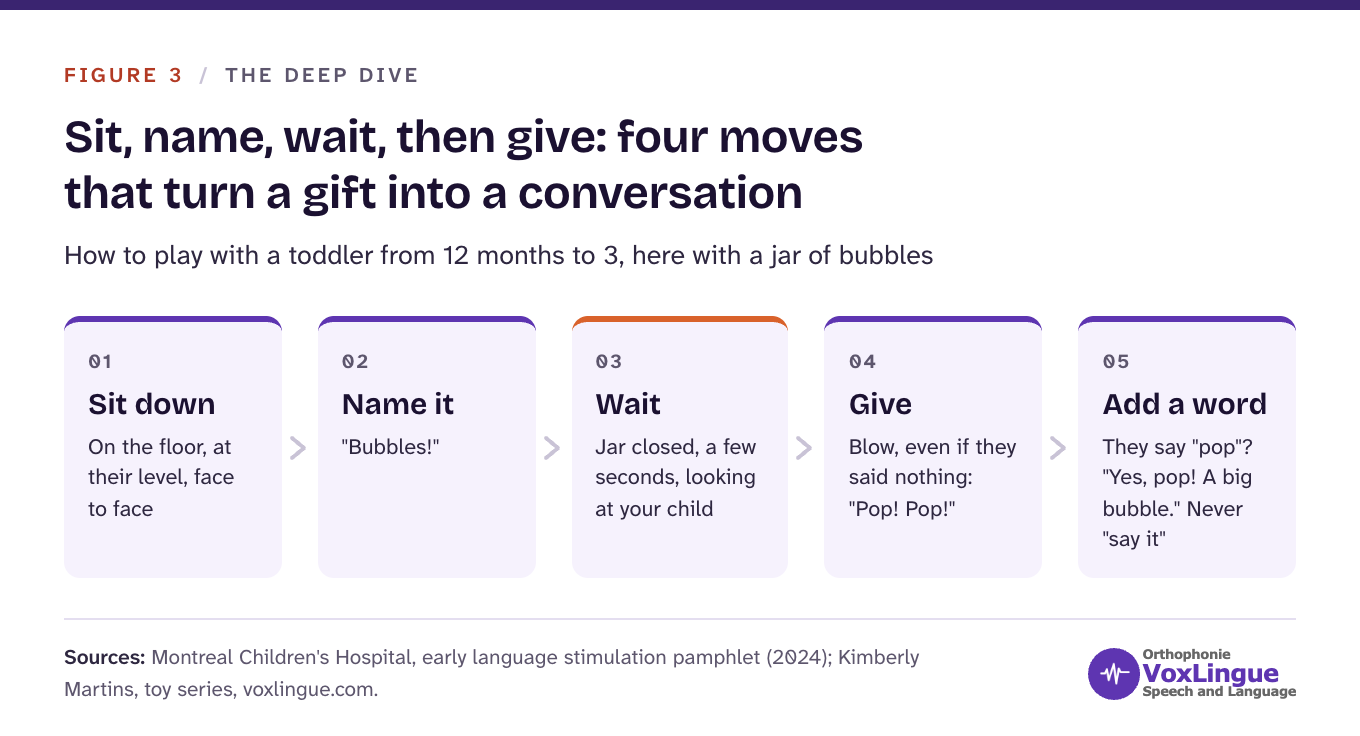
The pause is their turn: a look, a gesture or a sound is enough, and you give anyway.
When a toy isn’t enough
A toy doesn’t replace the person who plays, or an assessment. The markers Québec’s speech-language pathology order (OOAQ) recommended for the 18-month visit in the Agir tôt program are clear: at least 14 words said spontaneously around 18 months, and two-word combinations around 24 months, like “daddy gone” or “more milk.” If your child is far from that, seems to understand little, loses words he used to say, or if you’re worried, don’t wait.
Start with the public system: contact the CLSC or ask the doctor. Québec’s Agir tôt program is for children under 7, its services are free, and you can call your CLSC yourself. The 18-month vaccination visit at the CLSC is also a chance to bring it up. At the same time, a private consultation tells you what to do while you wait. In Ontario, the Preschool Speech and Language Program takes families without a doctor’s referral.
At VoxLingue, parent coaching inspired by the Hanen programs shows parents how to turn play into back-and-forth. A few members of our team are Hanen trained, and all of us use its principles.
What we suggest to families
- Before you buy, ask one question of the toy: does it need someone to work? Ball, blocks, play kitchen, farm, bubbles, book: yes.
- Leave at the store toys that talk, ask questions or narrate the play, and any AI plush toy for a child under 5.
- For a noisy toy already at home: take out the battery or tape the speaker, and be its voice (see Try this week).
- After the holidays, keep four or five toys out at a time and put the rest in clear boxes.
- Fewer than 14 words around 18 months, no two-word phrases around 2, or a worry? Contact the CLSC or ask the doctor, and book a private consultation at the same time.
Try this week
The button toy with no batteries: you’re the cow
For: 18 months to 3 years. Time: 5 to 10 minutes on the floor, three or four times this week.
Take a button toy that makes animal sounds, vehicle sounds or plays a song. Remove the battery or cover the speaker with tape. The toy won’t talk anymore: you will.
Your child presses the cow button. Nothing happens. Wait two or three seconds, looking at her, a little surprised. Then make the sound yourself, with energy: “Moo! The cow.” If she presses the truck: “Vroom! The truck’s going.” The dog: “Woof! Woof!”
After a few turns, press a button yourself and wait before making the sound. Count to five in your head. A look, a smile, an “mmm” or a “vvv”: it all counts as her turn. Say back what she did and add a word. She says “moo”? “Yes, moo! The cow says moo.” Don’t ask her to repeat. If she says nothing, make the sound yourself and keep playing.
Another language at home? Animals speak it too. In Spanish the cow says “mu” and the dog “guau.” In French, the dog says « wouf » and the duck « coin-coin ». In Arabic, Creole or Mandarin, use the sounds from your own childhood.
What to watch for: does she look at you after pressing, as if asking you to make the sound? That’s a turn in the conversation without words, and it’s exactly what a toy that talks on its own never asks of her.
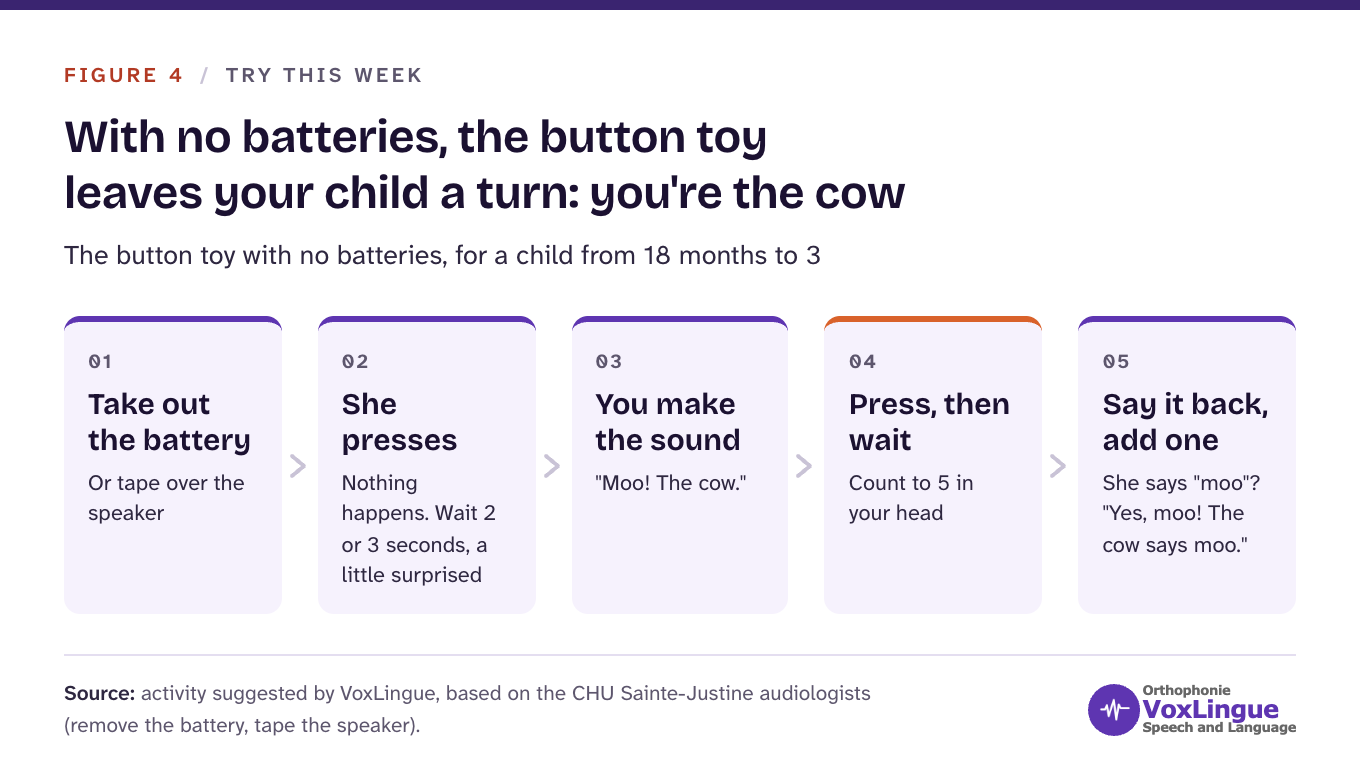
The look she gives you after pressing is already a turn in the conversation.
What the research says
An AI plush toy meets 3-year-olds: the first filmed study
In March 2026, a University of Cambridge team published the first systematic study of how young children play with a generative AI toy. The researchers filmed 14 children under 5, at children’s centres in London, playing for the first time with a plush toy that holds conversations.
What they saw goes to the heart of communication. When a 3-year-old told the toy “I’m sad,” it misheard and replied: “Don’t worry! I’m a happy little bot. Let’s keep the fun going.” The toy sometimes mistook the parent’s voice for the child’s and ignored interruptions. Several children became visibly frustrated when it didn’t seem to be listening.
Pretend play went no better. When a 3-year-old offered it an imaginary present, the toy said “I can’t open the present” and changed the subject. The children hugged it, kissed it and said they loved it.
Two caveats. Most parents and educators who were asked felt these toys could help communication: that’s an impression, not a finding. And this is a limited observational study, not a trial. The researchers recommend keeping these toys in shared family spaces and playing alongside the child to talk about what the toy says. What you already do when you say “Your blankie!” at the right moment, the plush toy can’t do.
Worth your time
- Are AI toys safe for young children?, Canadian Paediatric Society. Canadian paediatricians’ position on AI toys, in four paragraphs.
- Toy safety tips, Health Canada. The toilet paper roll test, button batteries, noise and recalls, on one page.
- Conseils sur l’utilisation de jouets sonores, CHU Sainte-Justine (in French). The audiologists’ two-page pamphlet, with the store test and the tape trick.
- Mieux choisir au rayon des jouets, Naître et grandir (in French). Québec’s most complete guide to choosing toys: age, safety, noise, rotation, no brands.
From VoxLingue
Our full guide, Which toys help a toddler who isn’t talking much, covers this Deep Dive with every study, frequent questions and play examples. It ends with a printable gift list for grandparents: toy types by age, what to leave at the store, and three ways to play. One page, to send before the shopping starts.
Your question
Which toy does your child bring you most often so you’ll play together, and how old is your child? Reply and tell us: we’ll turn your answers into a list of real toys chosen by Montréal toddlers.
Send us your question through our contact page.
Vladimir Romanov, for the VoxLingue team
Orthophonie VoxLingue · 514-467-9132 · Book a consultation
This newsletter informs and does not replace an assessment.