My child born in the summer or September has language difficulties: kindergarten at 5 or wait a year in Québec, what the admission rules really allow, and what helps their language either way

Your child was born in July, August or September. They’ll turn 5 just before school starts, they’ll be among the youngest in the class, and they have language difficulties. One question keeps coming back: kindergarten at 5, or wait a year?
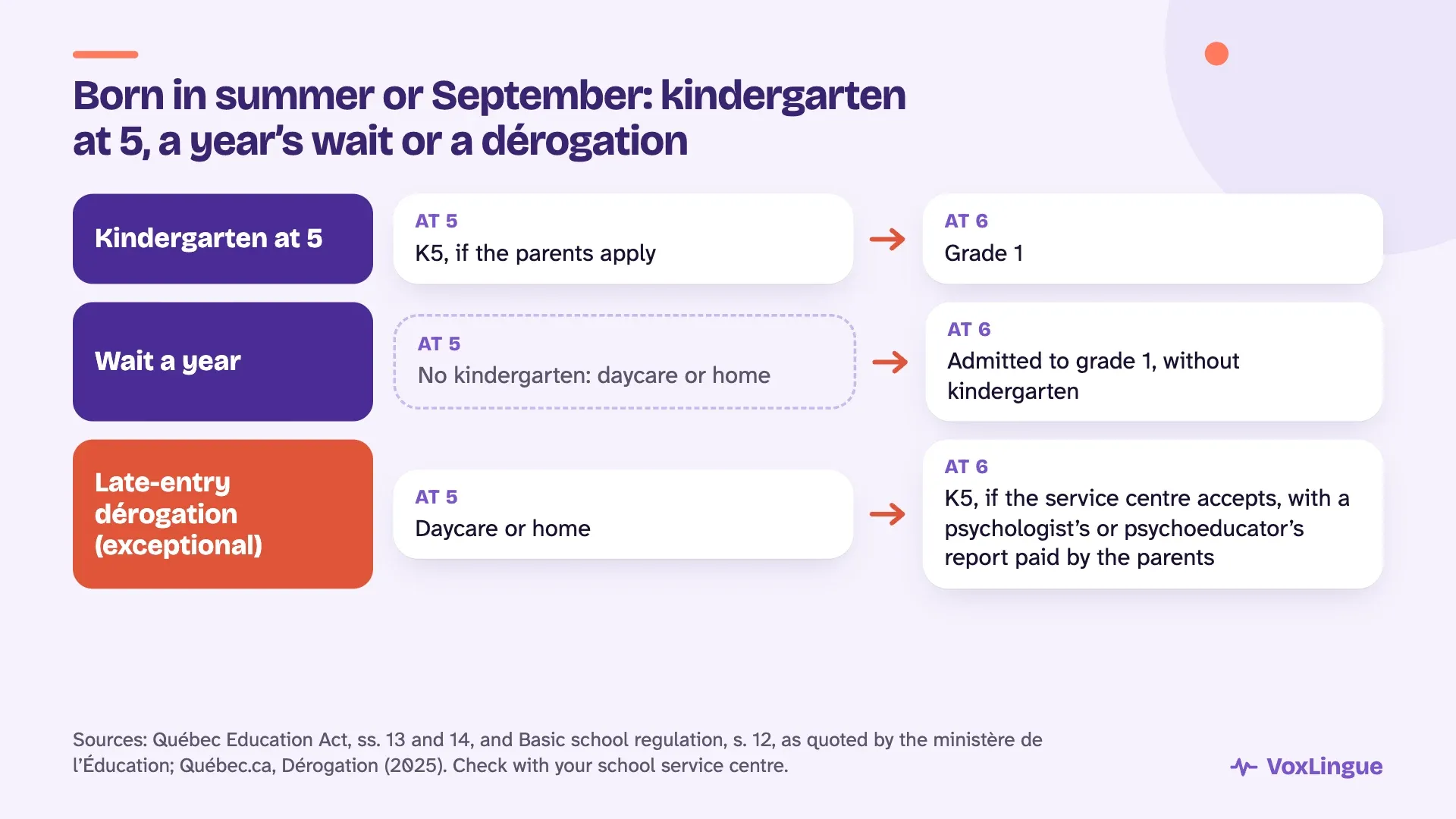
Many parents picture waiting as doing kindergarten a year later. In Québec, that usually isn’t how it works. A child who skips kindergarten at 5 (K5) is admitted to grade 1 the following year. Staying in kindergarten at 6 takes a dérogation, which is granted only as an exception.
This guide first explains what the admission rules really allow. It then sums up what research says about the youngest children in a class, and what supports your child’s language on each path. It doesn’t tell you what to choose. The useful question isn’t the age at school entry: it’s where your child will get the most support for their language next year.
This is general information. It isn’t legal advice, and it doesn’t replace the rules of your school service centre (centre de services scolaire, or CSS) or English school board, which can change from year to year.
Kindergarten at 5 or wait a year: what do Québec’s rules really allow?
In Québec, a child can start K5 if they are 5 by September 30. Kindergarten isn’t compulsory. If you wait a year, your child is admitted to grade 1 at 6, not to kindergarten. Staying in kindergarten at 6 needs an exceptional dérogation from the school service centre.
The September 30 date comes from Québec’s Basic school regulation (Régime pédagogique). A child who is 5 before October 1, and whose parents apply, “is admitted to preschool education.” A child who is 6 before October 1 “must be admitted to elementary school” (Régime pédagogique, s. 12, as quoted by the ministère de l’Éducation; our translation).
Québec.ca says it plainly: kindergarten is not compulsory (2026). It’s the usual way into school, and the vast majority of children attend. But nothing requires parents to enrol a 5-year-old.
When does school become compulsory?
The obligation starts later than many people think. Under Québec’s Education Act (Loi sur l’instruction publique), a child must attend school “from the first day of the school calendar of the school year following the one in which the child reaches 6 years of age” (s. 14, our translation). The school year runs from July 1 to June 30 (s. 13).
In practice, the ministère de l’Éducation’s sheet on school attendance (in French) separates two cases. A child who turns 6 before July 1 must be in school that September. A child who turns 6 between July 1 and September 30 may start grade 1, but isn’t required to that year.
What “waiting a year” means for a child born in summer or September
Take a child born in August 2022. They can start K5 in September 2027. If their parents wait, they turn 6 in August 2028, and they are then admitted to grade 1, without going through kindergarten. They don’t “do kindergarten later.”
| Date of birth (example: the 2027-2028 school year) | K5 in September 2027 | If you wait a year |
|---|---|---|
| Between October 1, 2021 and June 30, 2022 | Admitted if parents apply | Admitted to grade 1 in 2028, and school is then compulsory |
| Between July 1 and September 30, 2022 | Admitted if parents apply | Admitted to grade 1 in 2028; compulsory from September 2029 |
| After September 30, 2022 | Not admitted without a dérogation | K5 in 2028, as planned |
Source: Education Act, ss. 13 and 14, and Basic school regulation, s. 12, as quoted by the ministère de l’Éducation. Check your year’s dates with your school service centre or school board.
Can a child stay in kindergarten an extra year? The late-entry dérogation
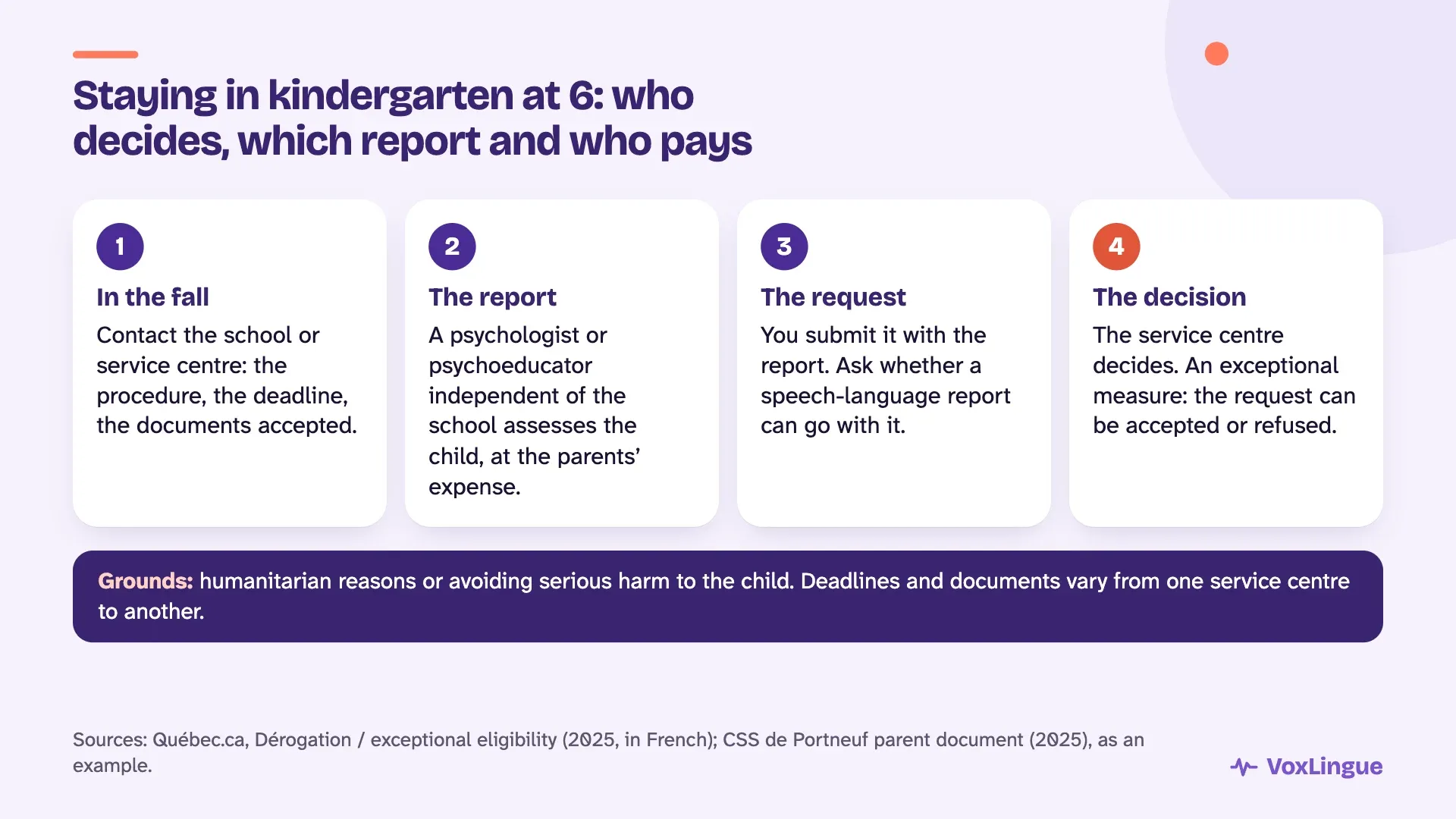
Yes, but rarely. A child who is 6 by September 30 and would start kindergarten needs a dérogation. Québec.ca describes it as an exceptional measure. The school service centre decides, based on an assessment report that the parents pay for.
According to Québec.ca’s page on the dérogation (2025, in French), the service centre can authorize a child’s early or late arrival at school. It does so “for humanitarian reasons or to avoid serious harm” to the child (our translation). The same page covers children who are 4 or 6 by September 30.
The request rests on a report from someone independent of the school: a psychologist or a psychoeducator, at your own expense. The assessment looks at the child’s intellectual, socio-emotional and psychomotor skills. Deadlines to apply vary from one service centre to another.
What changes from one service centre to the next
The details aren’t the same everywhere. The parent document of the CSS de Portneuf (2025), for example, accepts a report written by a CIUSSS professional. Otherwise, it asks for one from a private psychologist or psychoeducator. It also mentions a recommendation from the child’s CPE, if there is one.
The same document says the request “could be accepted or refused.” That’s one example outside Montréal, not a general rule. We didn’t find a procedure published by Montréal’s service centres or English boards. Check with your school service centre or board: which documents they accept, the deadline, and who receives the request.
What about a speech-language assessment report?
Québec.ca doesn’t list the speech-language pathologist among the professionals who write the report, and language isn’t a named area of the assessment. If your child already has a speech-language report, ask your service centre whether it can go with the request. It doesn’t replace the required report.
Does waiting a year help language? What research says about the youngest in the class
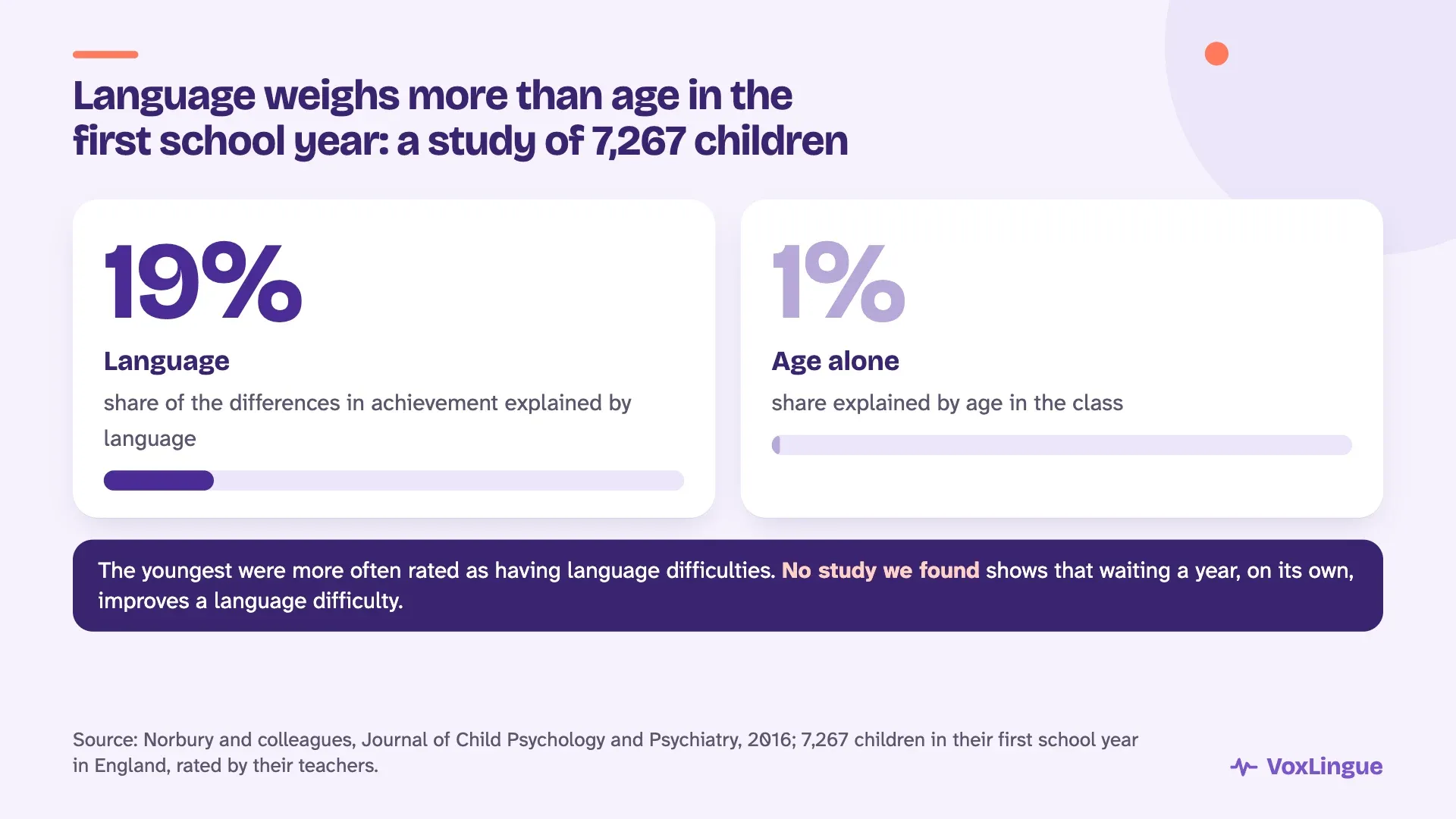
The youngest children in a class are more often judged to be struggling when school starts. But in one large study, language mattered far more than age for learning in the first school year. We found no study showing that waiting a year, on its own, improves a child’s language difficulties.
The most useful study here followed 7,267 children in their first year of school in England (Norbury and colleagues, 2016). Teachers rated the youngest children as having language difficulties more often. Yet language explained 19% of the differences in achievement, compared with 1% for age alone.
That finding doesn’t say to start early or late. It says that, for the first school year, language counts for more than the birth date. The authors conclude that it’s better to support oral language and to match expectations to children’s real age.
An extra year isn’t a language plan
A language difficulty doesn’t go away because a child is a year older. Without support, it will still be there the following year, at daycare or at school. A family may have other reasons to wait a year. But for language, what counts is what the child receives during that year.
Being younger doesn’t mean having a difficulty
The reverse is true too. Being among the youngest in the class doesn’t create a language disorder. A child who has just turned 5 can seem less mature than classmates who are nearly 6, without having any difficulty. That’s why an assessment looks at a child’s language against their own age, not against the class.
Kindergarten at 5 or another year at daycare: what supports language on each path?
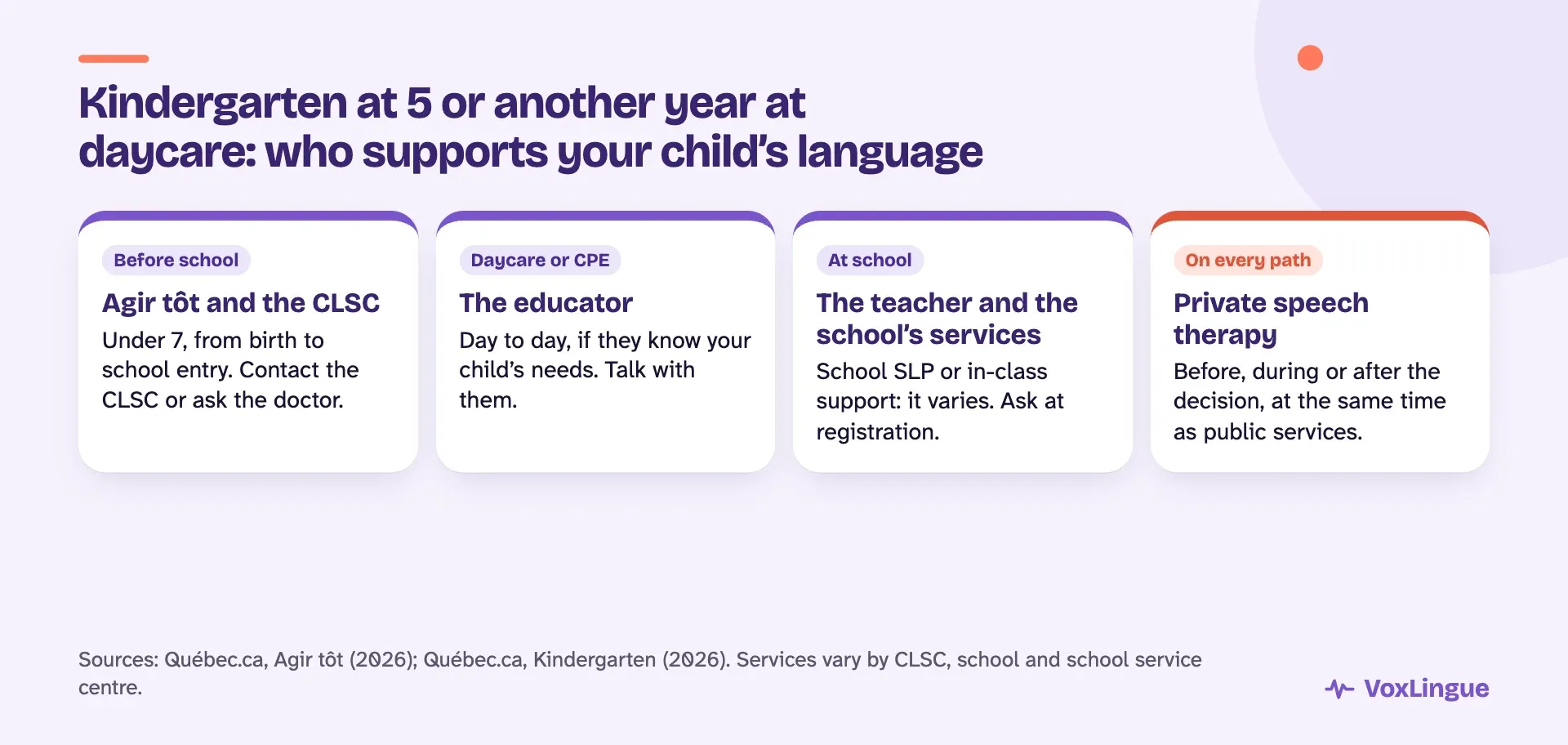
On both paths, your child can get support, but through different doors. Before school, it’s the health network, with Agir tôt and the CLSC. At school, it’s the school’s services. Private speech therapy is possible on every path, at the same time as public services.
Kimberly Martins, speech-language pathologist and founder of VoxLingue, put it this way in our guide to getting ready for kindergarten: there’s no right or wrong answer, it depends on each child and family. The aim is for your child to be where they will have the support they need.
Before school: Agir tôt and the CLSC
Québec’s Agir tôt program is for children under 7. Its screening runs “between birth and school entry,” and it also helps prepare the move to kindergarten (Québec.ca, Agir tôt, 2026). If you’re worried, don’t wait for registration: contact the CLSC or ask the doctor.
If your child spends another year at daycare or at home, they haven’t started school yet. Ask the CLSC what continues during that year, and what changes when school starts. Waiting lists exist: our article on the speech therapy waiting list in Québec explains what to do in the meantime.
At daycare or the CPE
Another year in child care can be rich in language, especially if the educator knows your child’s needs. Talk with them: what they see, and what they can do day to day. Our article on what to do when daycare is concerned about your child’s speech helps you prepare that conversation.
At school: the school’s services
In kindergarten, support comes from the school: the teacher, and sometimes a school speech-language pathologist or other professionals. Services vary from one school and one service centre to another. At registration, mention your child’s difficulties and ask what support the school can offer. The reports you choose to share help the school get to know your child.
Alongside: private speech therapy
A private speech-language pathologist can assess your child and follow them, whichever path you choose. That follow-up can start before the decision and continue during kindergarten. It doesn’t replace public services: you can do both at the same time.
| What supports language | Kindergarten at 5 | Another year at daycare or at home |
|---|---|---|
| Agir tôt and the CLSC | Until school entry; ask the CLSC how the handover works | Your child hasn’t started school; ask the CLSC what continues |
| Everyday adults | The teacher and the school team | The educator or the parents |
| Specialized services | Depends on the school: school SLP, in-class support | Depends on the CLSC and wait times |
| Private speech therapy | Possible, at the same time | Possible, at the same time |
| Next | Grade 1 at 6 | Grade 1 at 6, without kindergarten |
What if your child is learning French?
Learning French as a second language is common in Montréal. On its own, it isn’t a language difficulty. To know whether there is a difficulty, a speech-language pathologist looks at all of a child’s languages. Our article on French or English school covers that choice for a child with language difficulties.
What questions should you ask before deciding?
The useful questions are about support, not the birth date. Where will your child have the most chances to talk, be understood and be helped next year? Who around them knows their difficulties? The answers depend on your school, your daycare and your CLSC.
Here are questions to ask the school, the school service centre, the daycare and the speech-language pathologist who knows your child:
- What services does the school offer a kindergarten child with language difficulties, and how soon?
- Is there a school speech-language pathologist, and how often are they at the school?
- What does your child’s educator see: how do they communicate in the group, with adults and with other children?
- Is your child followed at the CLSC or on a waiting list? What changes when school starts?
- If you’re considering a dérogation: what is your service centre’s procedure, deadline and list of accepted documents?
- What does the speech-language pathologist who assessed your child think, if there is one?
- What works for your family: schedules, siblings, a daycare place next year?
Our guide to kindergarten readiness describes the language expected at 4 and 5 and the language form some schools hand out at registration. We don’t repeat it here.
When should you get help without waiting for the decision?
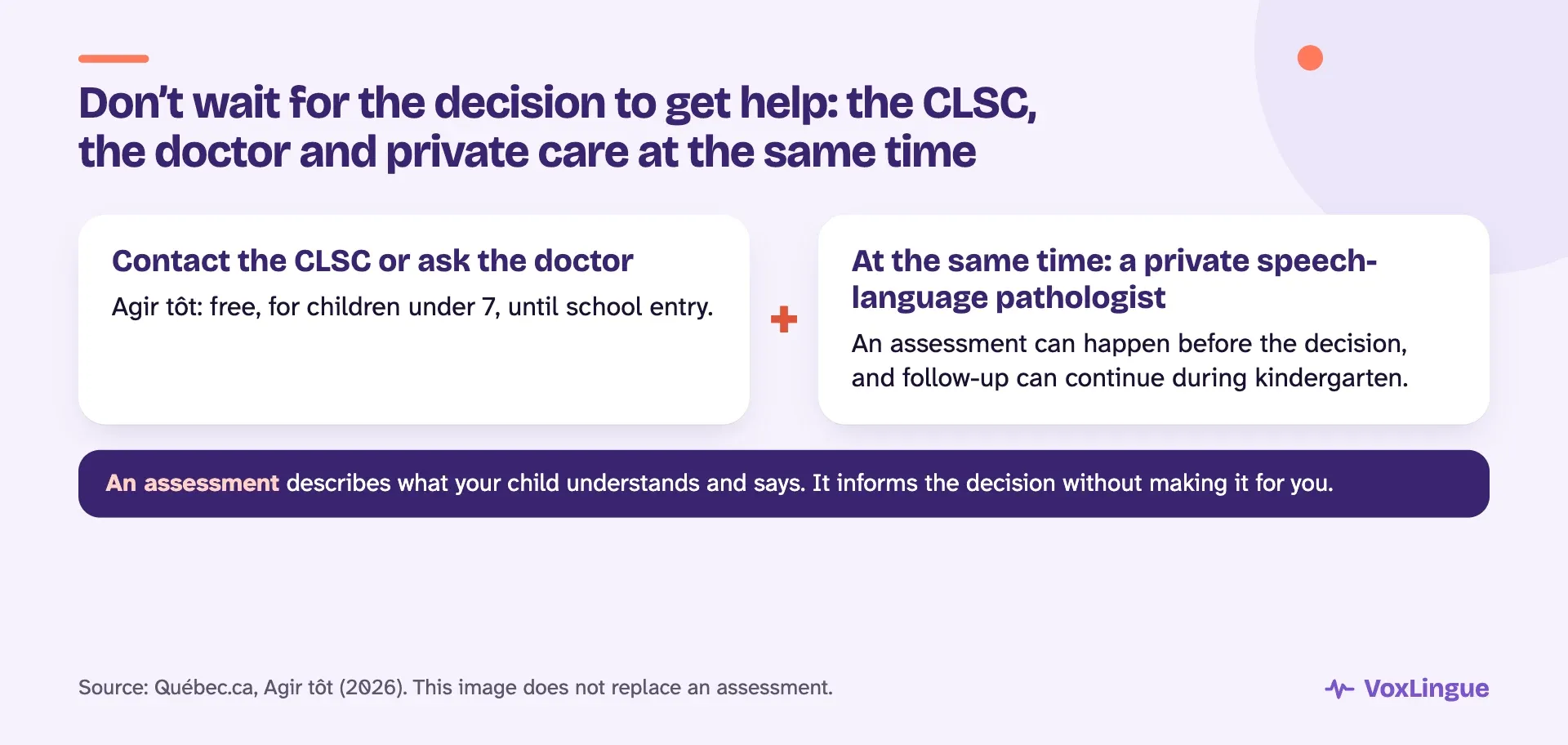
Don’t wait until you’ve decided to have your child assessed. If their language worries you, or the daycare has raised it, contact the CLSC or ask the doctor. At the same time, you can see a private speech-language pathologist. An assessment also informs the decision.
A speech-language assessment describes what your child understands, what they say and how they make themselves understood. It tells you whether there are language difficulties and what support would help. It doesn’t choose the school year for you, but it gives everyone the same information.
Some situations call for help quickly, whatever the school year: your child doesn’t seem to hear well, no longer does something they used to do, or is very frustrated at not being understood. To learn more, see what a speech-language assessment involves and our articles on assessment.
The timeline: from the fall to the first day of school
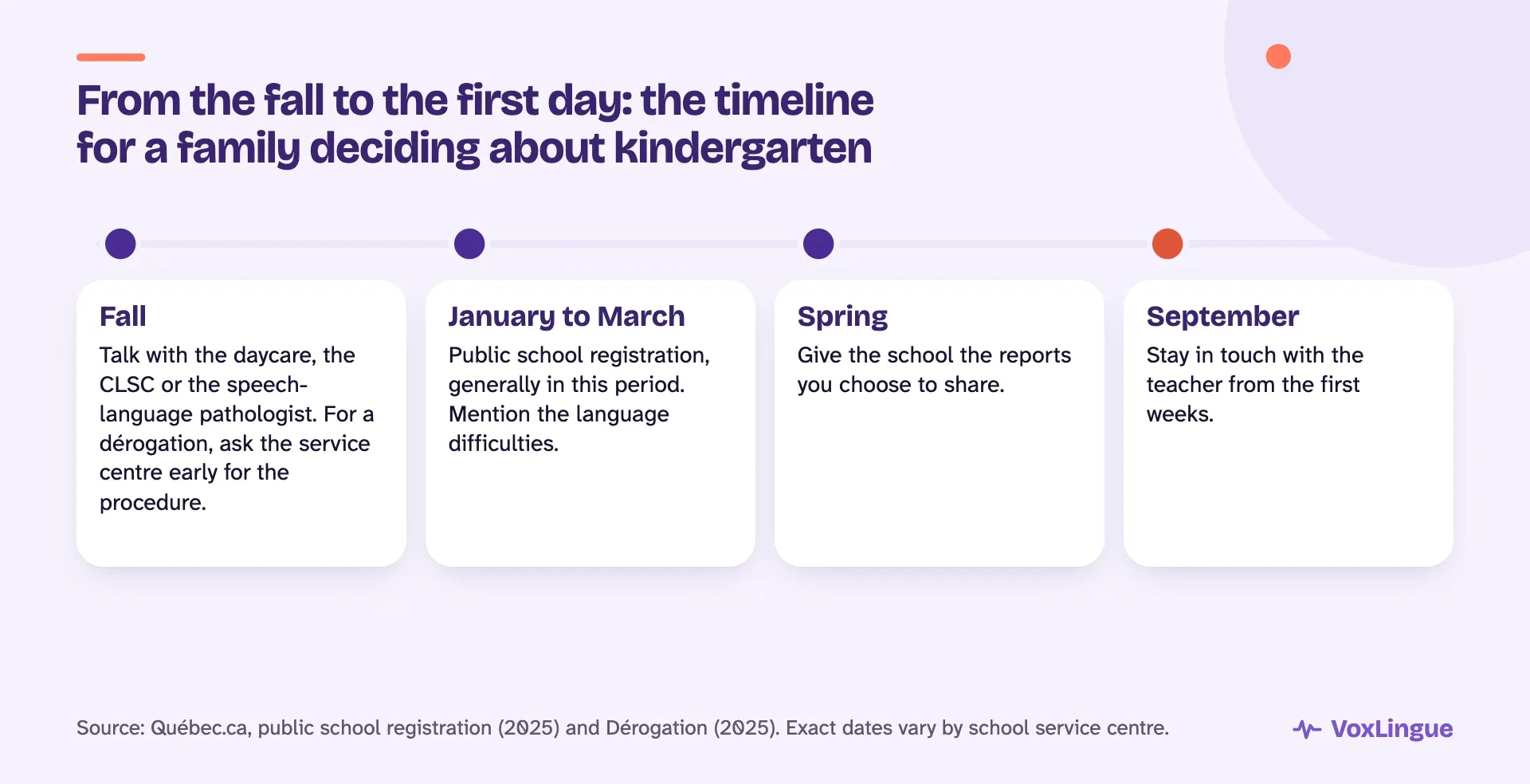
Registration for public school “generally” happens between January and March (Québec.ca, 2025). Dérogation requests have their own deadlines. If you’re unsure, start in the fall before: it’s the time to ask questions and have your child assessed.
In the fall, talk with the daycare and, if relevant, the CLSC or the speech-language pathologist. If you’re interested in a dérogation, ask your school or service centre for the procedure. Québec.ca advises doing this early, because deadlines vary.
In January, registration opens. Registering your child for kindergarten doesn’t stop you from talking it over with the school. In the spring, schools prepare for September: it’s the time to pass on the reports you choose to share. In September, stay in touch with the teacher from the first weeks.
Key takeaways
For a child born in the summer or September who has language difficulties, “kindergarten at 5 or wait a year” has precise answers on the rules side. On the language side, it has no single answer.
- K5 isn’t compulsory; a child is admitted if they are 5 by September 30.
- Waiting a year usually means going straight into grade 1 at 6.
- Staying in kindergarten at 6 takes an exceptional dérogation, decided by the service centre, with a report the parents pay for.
- Language counts for more than age in the first year, and a year of waiting without support doesn’t resolve a language difficulty.
- Agir tôt and the CLSC, the school and private services can all support your child: ask where they’ll get the most.
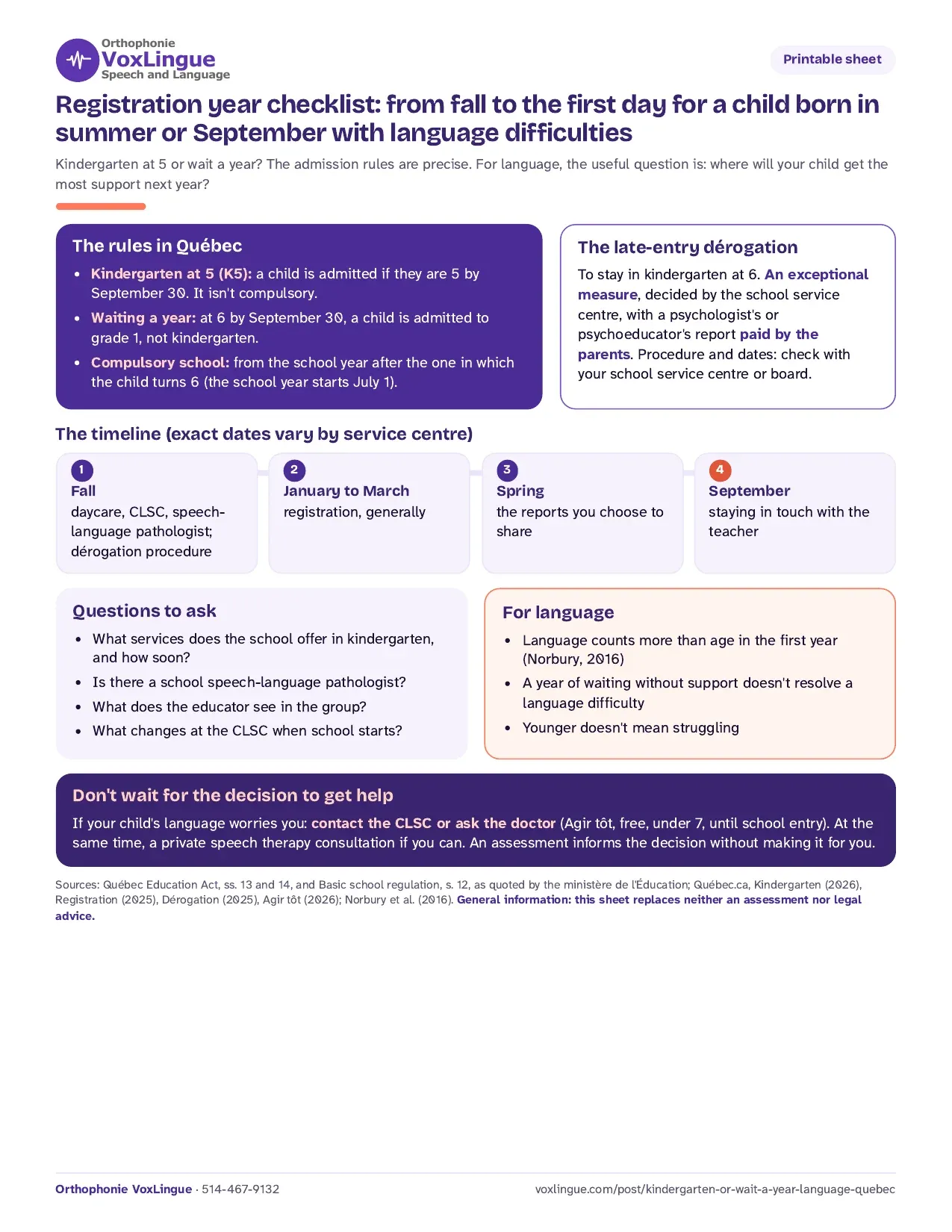
Printable: Registration year checklist: from fall to the first day for a child born in summer or September (PDF, 1 page).
Next step
If you’re unsure and your child’s language concerns you, an assessment gives you solid information before you decide. Contact the CLSC or ask the doctor and, if you wish, book with a VoxLingue speech-language pathologist, in Montréal or by telepractice.
Frequently asked questions
Is kindergarten at 5 compulsory in Québec?
No. Québec.ca states that kindergarten is not compulsory. School becomes compulsory from the school year after the one in which the child turns 6 (Education Act, s. 14). So a child who turns 6 before July 1 must be in school that September.
If I wait a year, will my child do kindergarten at 6?
Usually not. A child who is 6 before October 1 must be admitted to elementary school (Basic school regulation, s. 12). They start grade 1. To do kindergarten at 6, they need a dérogation, which the school service centre grants only as an exception.
What is a late-entry dérogation?
It’s permission from the school service centre for a child who is 6 by September 30 to enter kindergarten. Québec.ca describes it as an exceptional measure, for humanitarian reasons or to avoid serious harm. The request rests on a report from a psychologist or psychoeducator, at the parents’ expense.
Is a speech-language report enough to get a dérogation?
Québec.ca names a psychologist or psychoeducator, not a speech-language pathologist. A speech-language report doesn’t replace the required report. Ask your school service centre whether it can go with the request, and which other documents they accept.
My September-born child will be the youngest in the class: is that a problem for their language?
Being the youngest doesn’t create a language difficulty. The youngest are more often judged to be struggling when school starts, but in a study of 7,267 children, language mattered far more than age (Norbury and colleagues, 2016). An assessment compares their language with their real age.
Does waiting a year help a child with language difficulties?
We found no study showing that it does. A language difficulty doesn’t go away with an extra year. What counts is the support the child receives during that year, at daycare, through the CLSC, privately or at school.
Can my child keep Agir tôt if they start kindergarten?
Agir tôt is for children under 7, from birth to school entry, and helps prepare the move to kindergarten (Québec.ca). Before registration, ask the CLSC what happens when your child starts school.
When do you register a child for kindergarten?
Public school registration generally takes place between January and March for the following September (Québec.ca). Exact dates and dérogation deadlines vary: check with your school, service centre or board from the fall.
What about kindergarten at 4?
Full-time kindergarten at 4 (K4) is open to all eligible children, but it’s being rolled out gradually, and it isn’t compulsory (Québec.ca, 2026). For a child with language difficulties, it can be a chance for support a year earlier. Ask your school.
Who decides in the end?
Parents decide whether to enrol their child in K5. For a dérogation, the school service centre accepts or refuses the request. The speech-language pathologist, the daycare and the CLSC give you information; they don’t decide for you.