My child understands their grandparents' language but only answers in English or French: why this is common in bilingual children, what helps them speak it during holiday visits, and when to see a speech-language pathologist
Grandma asks in Greek whether he wants more cake. He nods, smiles and answers “Yes please!” in English. He understood every word. But he doesn’t say a single word in her language. And as the holidays come closer, the question comes back: my child understands their grandparents’ language but only answers in English or French. Is that normal?
It’s a very common situation in bilingual and multilingual Montréal families. Arabic, Spanish, Greek or Portuguese at the grandparents’ house, French at daycare, English with the cousins. Many children understand a language long before they speak it, and some understand it without ever choosing it.
This guide explains why a child picks English or French, even with someone who understands their language. You’ll see what helps during holiday visits, what often backfires, what grandparents can do, and how to tell a language choice from a language difficulty.
They understand their grandparents’ language but answer in English: is it normal?
Yes, it’s common in bilingual children. A child can understand a language well without speaking it, or while speaking very little of it. A guide written by speech-language pathologists at a Québec health authority still counts that child as bilingual. Understanding without answering isn’t, on its own, a sign of a language difficulty.
In every child, understanding comes before speaking. In a bilingual child, the gap can be wider in one language than in the other. They understand Grandpa’s language, but they have fewer chances to speak it, and fewer words ready at the right moment.
The speech-language pathologists of the CIUSSS de la Capitale-Nationale, a public health authority in Québec City, write it in their guide to assessing bilingual children. A child can be considered bilingual even if they don’t use the languages around them, because understanding and speaking don’t develop at the same pace (L’évaluation orthophonique des enfants en situation de bilinguisme, 2022, in French).
Naître et grandir, Québec’s parenting reference, describes the same thing. A child may refuse to use their home language because French goes with their new friendships. That can lead them to understand it but not know how to speak it (L’apprentissage de plusieurs langues, 2021, in French).
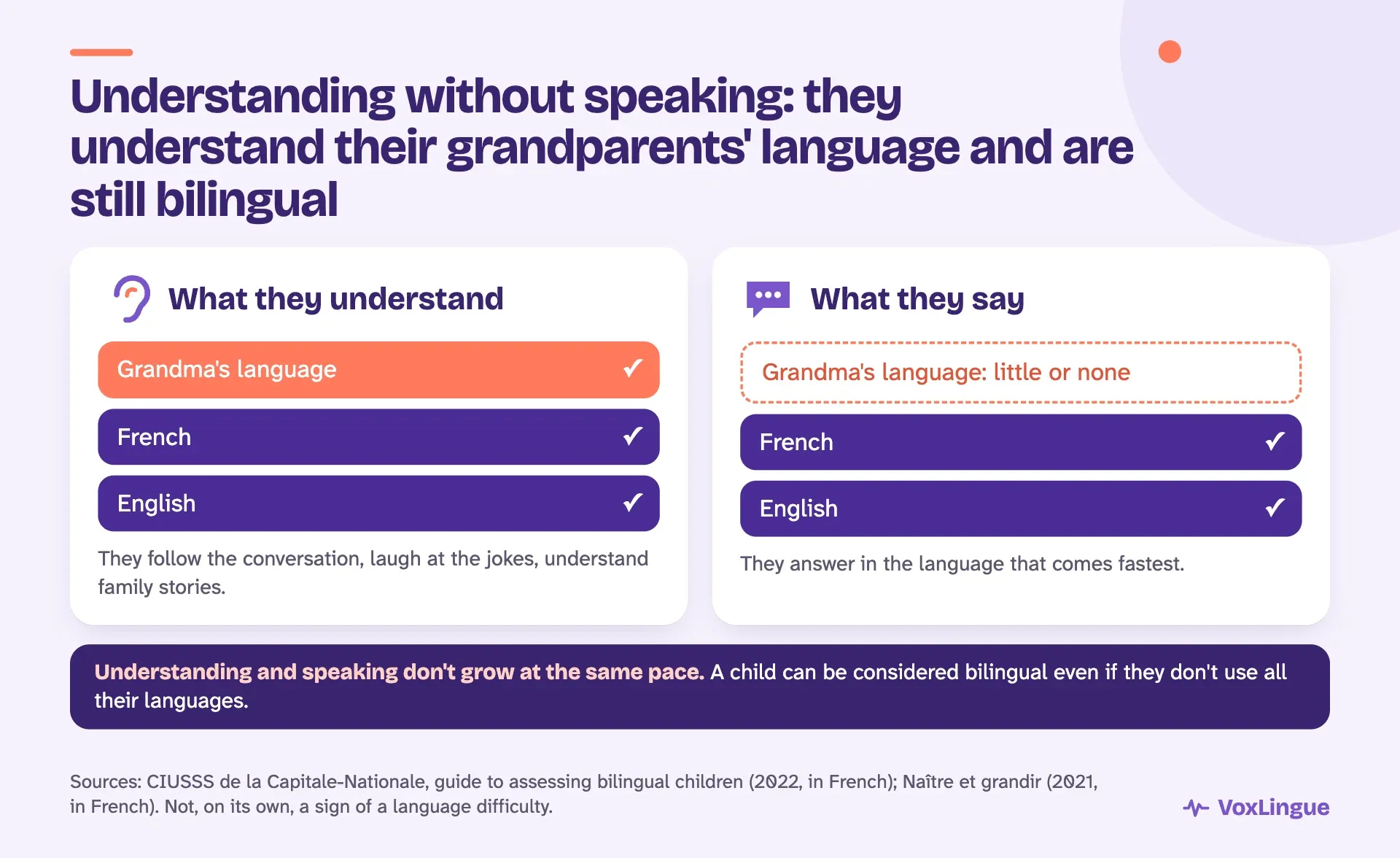
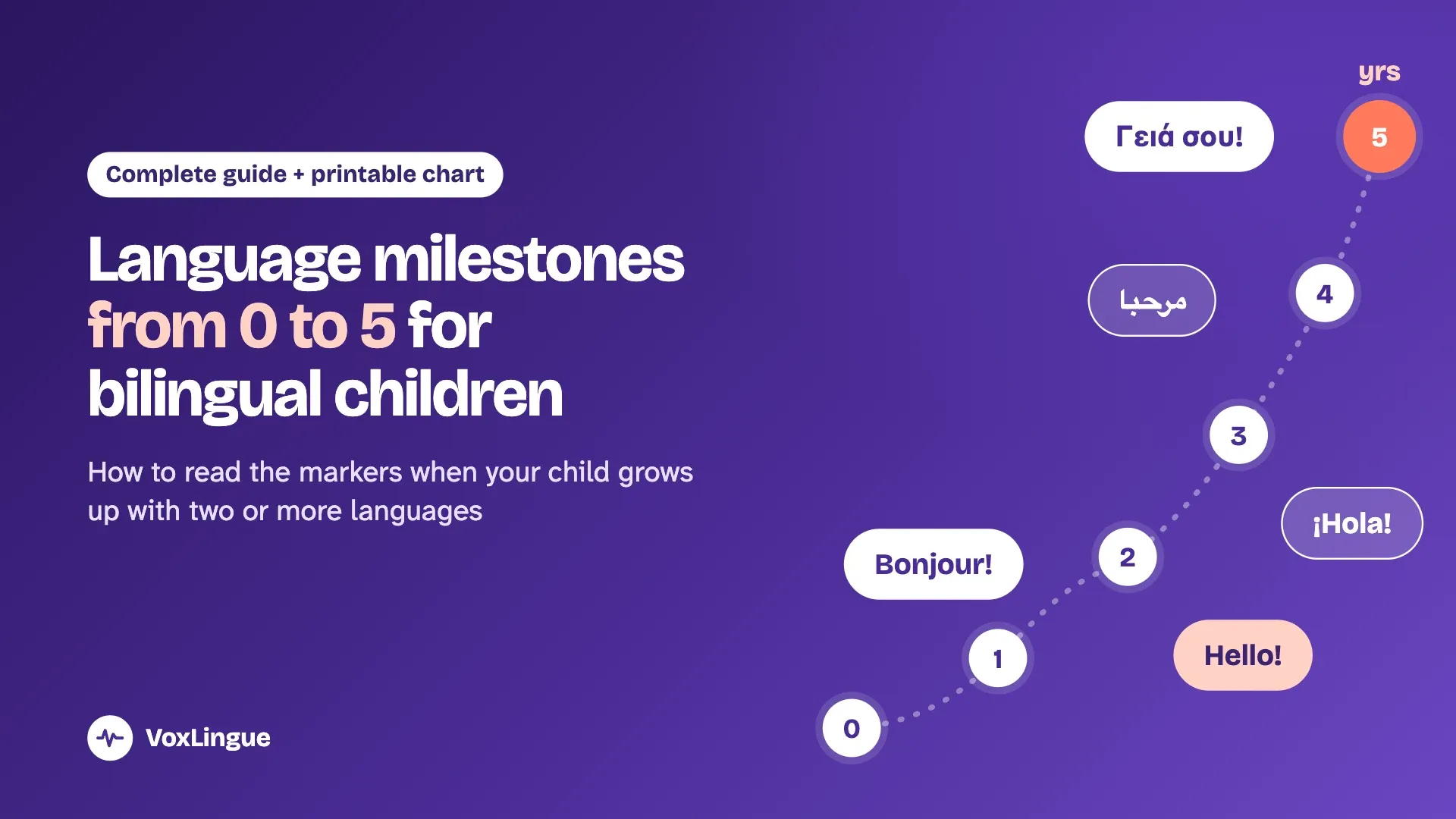
That understanding counts. It’s the base on which they may, one day, start speaking the language. It already lets them follow the conversation at the table, laugh at Grandpa’s jokes and understand family stories. For language milestones in bilingual children, see our guide to milestones from birth to 5.
Why they choose English or French, even with people who understand their language
Children mostly speak the language they need. If they know Grandma understands English, they often reach for the language that comes fastest. It’s a choice that makes sense to them, not a rejection of their family.
Three reasons come up often, and they add up.
The first: they know the adult understands. Bilingual children adjust their language to the person, very early. A Canadian study of 26 French-English bilingual children aged 2 and 3 showed it: they switched languages to match the adult (Comeau, Genesee and Mendelson, 2007).
If Grandma understands English, nothing pushes them to search for words in the other language. Our article on the 3-year-old who answers in the other language shows this choice in everyday life.
The second: English or French is the language of their days. They play in it, make friends in it, learn the words of daycare and school in it. Naître et grandir notes that a child’s strongest language can change with people and settings (2021). The words of their day come faster in English.
The third: they hear the home language less than before. To speak a language, a child needs to hear it often and have chances to speak it, Naître et grandir reminds parents.
The Montreal Children’s Hospital gives a benchmark. According to its leaflet, a child needs to hear a language about 30 to 40% of their waking time, over years, to be able to use it (Le bilinguisme et le multilinguisme chez les enfants, in French). It’s a general benchmark, not a rule to measure at home.
A large Belgian study points the same way. In 1,899 bilingual families in Flanders, the way parents used their languages at home was linked to whether children spoke the minority language (De Houwer, 2007). “One parent, one language” was neither necessary nor sufficient. What mattered was the place the language had in the home.
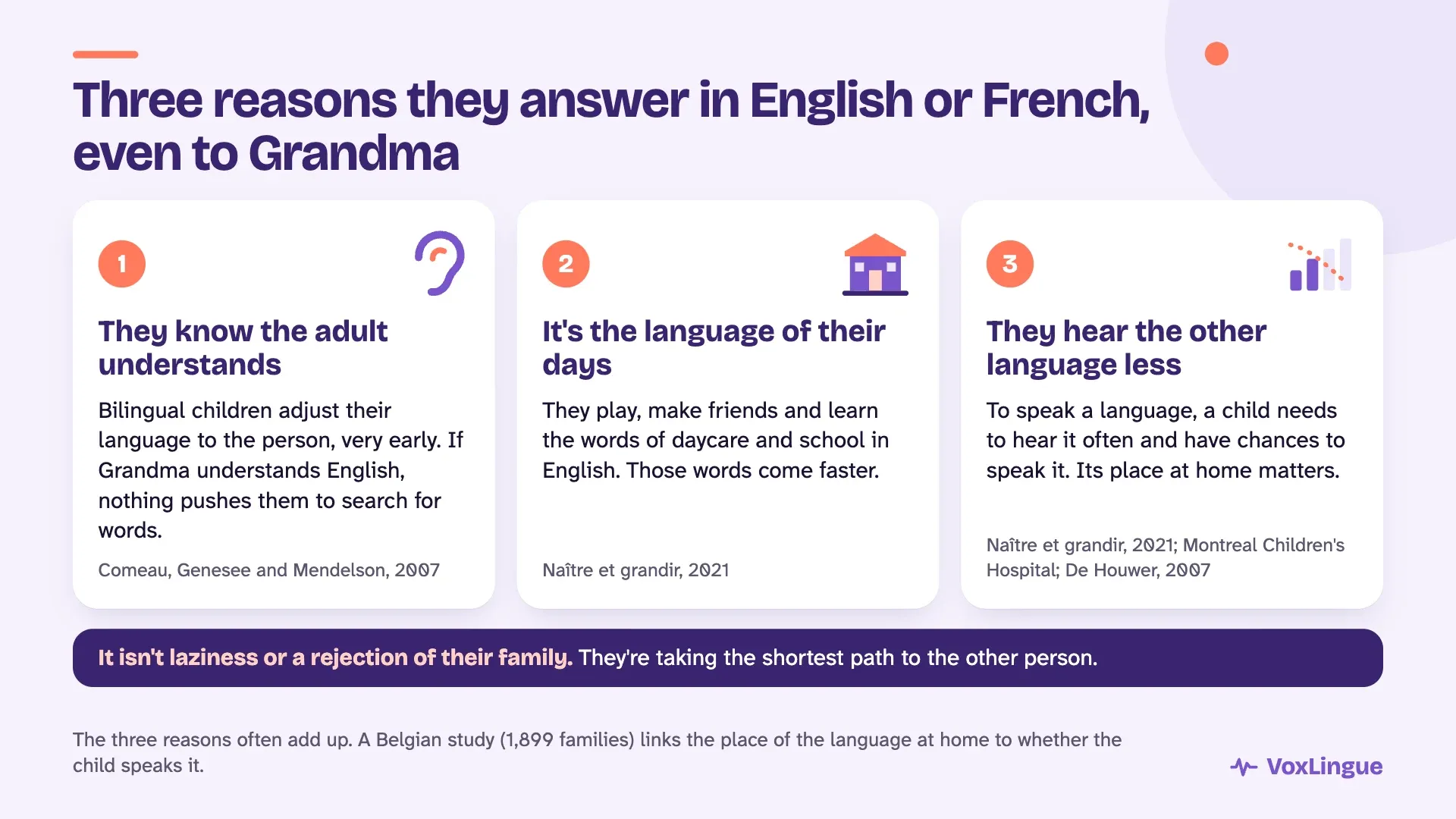
None of this means your child is lazy or ashamed of their family. They’re doing what many children do: taking the shortest path to the other person. That path can be stretched a little toward the home language, without pressure.
What often backfires: “say it in Spanish”, pretending, comparing
Avoid asking them to repeat it in the other language. “Say it in Arabic”, or “I don’t understand English” when it isn’t true, turns the language into a test. Comparing them with their cousins adds shame. These habits come from a good place, but they can push a child away from the language.
These habits are very common, and they’re easy to understand. A parent or grandparent sees the child understand everything and wants, finally, to hear a word. Here’s why we don’t recommend them.
Asking “Say it in Spanish” or “How do you say that in Greek?” puts the child on the spot. They search for words in front of everyone. If they can’t find them, they live a small failure, in the very language we want them to love. Next time, they may say even less.
Pretending not to understand English is advice you’ll often read online. We don’t recommend it. The child often knows the adult understands, and the conversation stops instead of going on. What they wanted to say gets lost. It’s better to answer what they said, in your language.
Comparing them with a cousin who speaks the language well (“Look, he speaks Arabic!”) or laughing at their mispronounced words can make them feel ashamed. A child who feels ashamed of a language speaks it even less.
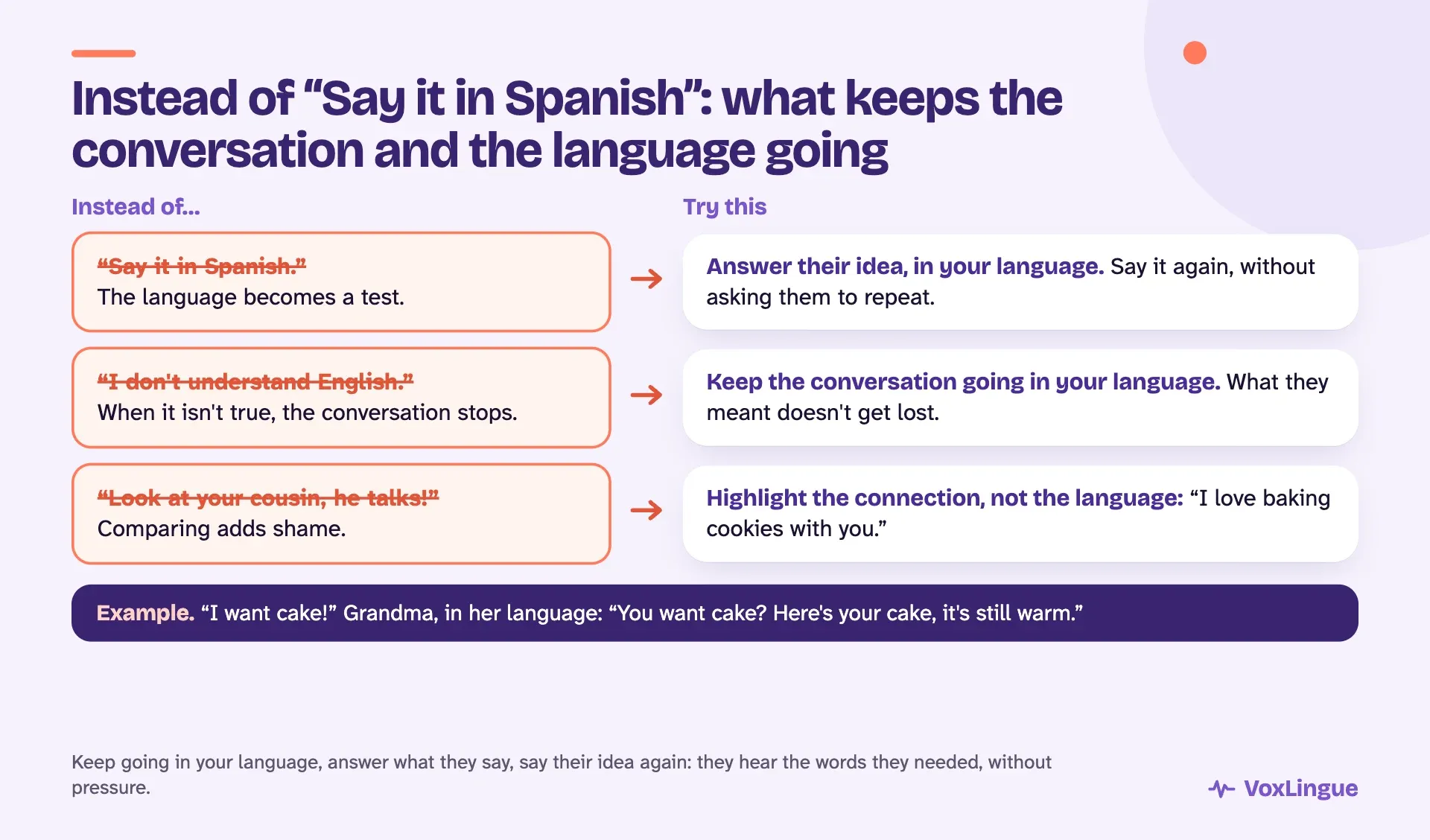
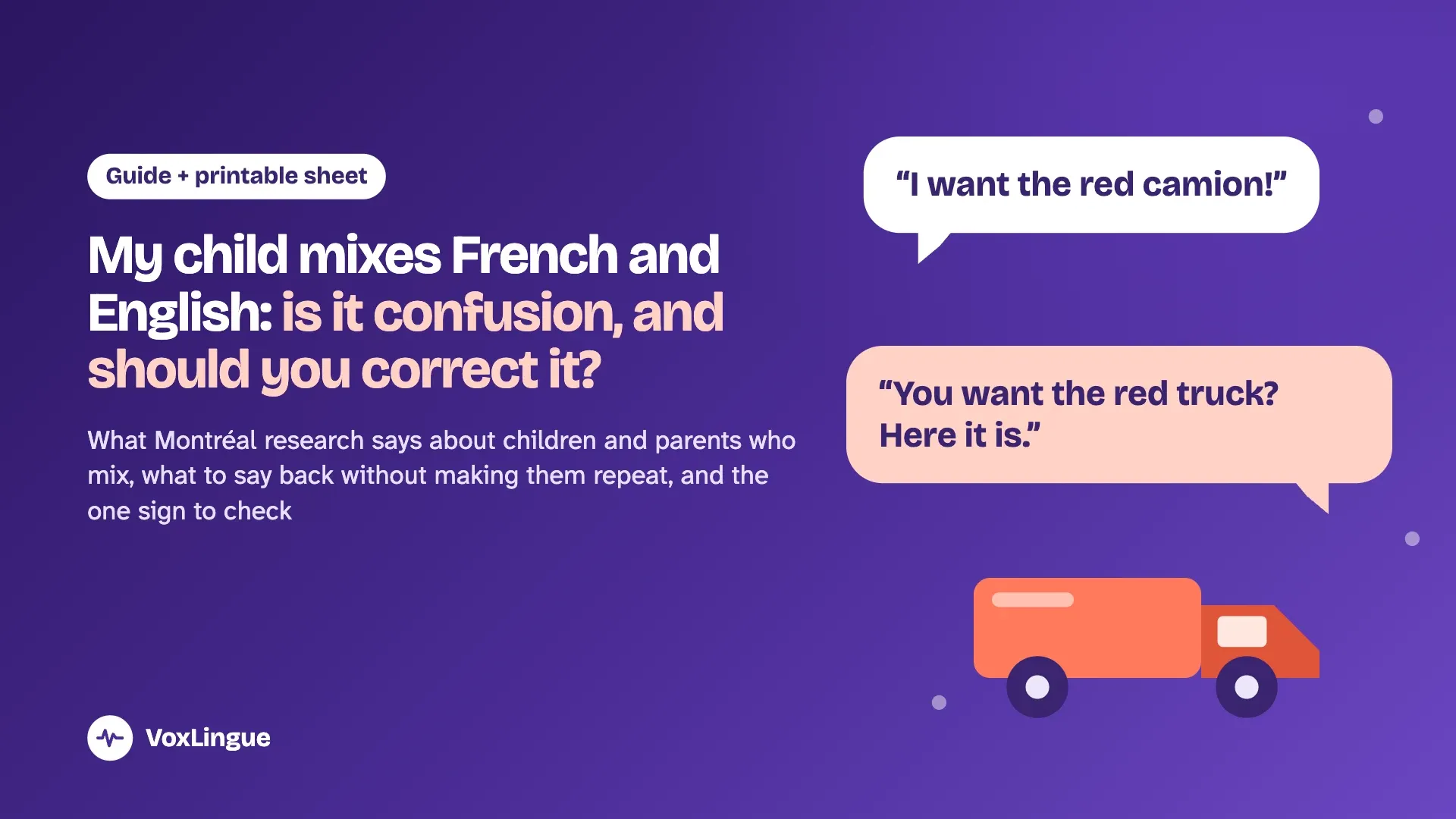
What helps comes down to three moves, already set out in our article on mixing French and English. Keep going in your language. Answer what they said, still in your language. If they were missing a word, say their idea again in your language, without asking them to repeat it. As Kimberly Martins, speech-language pathologist and founder of VoxLingue, points out, by continuing to use it, you keep up their exposure to your language.
They say “I want cake!” Grandma answers, in Greek: “You want cake? Here’s your cake, it’s still warm.” They heard the words they needed, with no test. If one day they pick them up on their own, wonderful.
During the holiday visit: what helps them dare to speak the language
The holiday visit is a good time for the language, because the child hears new voices and gets new reasons to speak it. Naître et grandir notes that visits from extended family help a child learn the language. What helps most: time in a small group, things you do together, and no expectation of an answer.
Kimberly Martins wrote about her own childhood in 2024. At her grandparents’ house, the family spoke mostly Portuguese, because it was their dominant language. In her words, “it was the ideal time to practice that language.” She also advised sticking to the language of the household you’re visiting.
During the visit, a few simple ideas help:
- time alone or in a small group with a grandparent, away from the noise of the big table;
- something to do together: a family recipe, a card game, a puzzle, a walk;
- a song, a nursery rhyme or a finger play from Grandma’s childhood, repeated from one visit to the next;
- old photos or a family album, looked at while naming the people;
- objects from the home country, and their story told in the language.
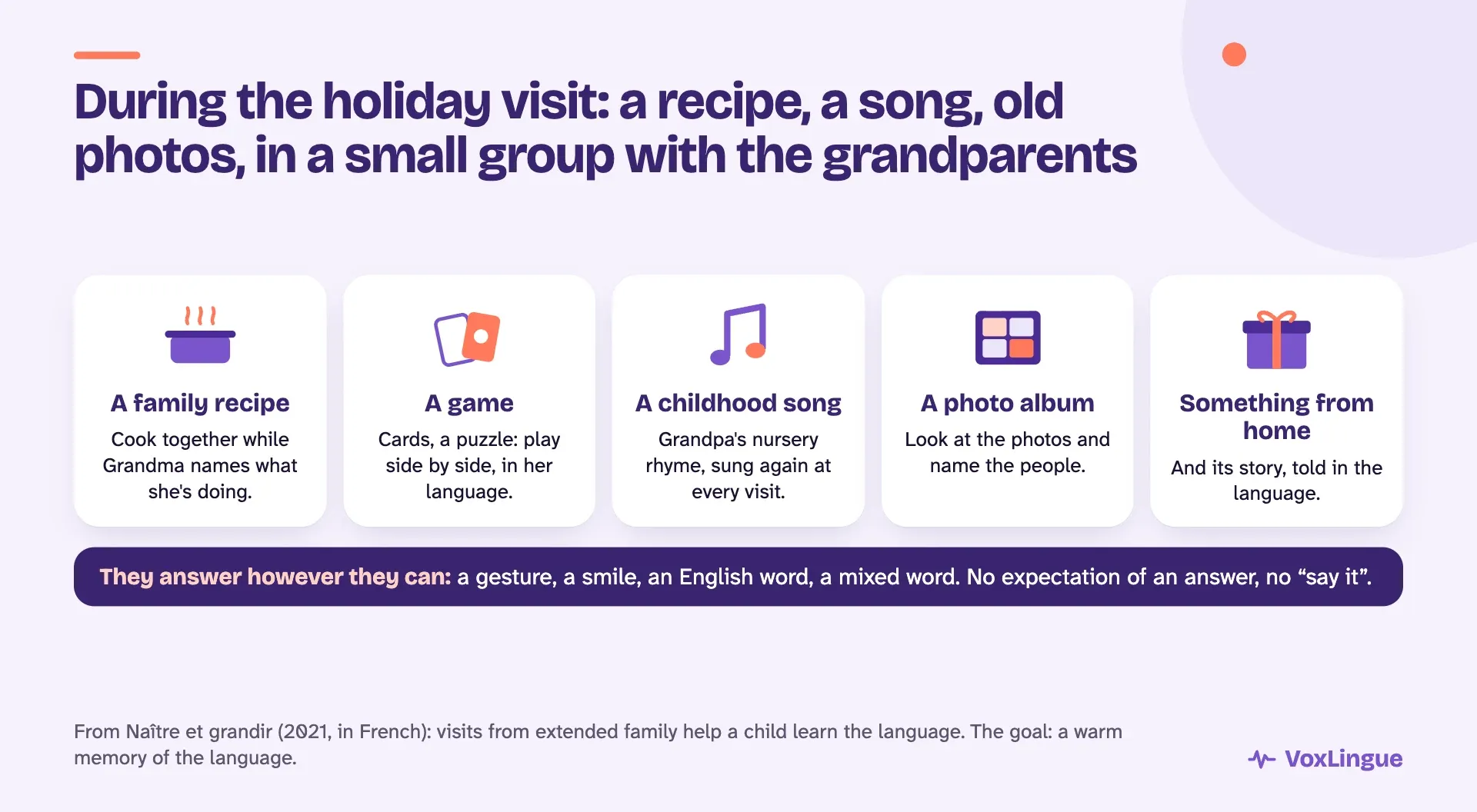
In these moments, let them answer however they can. A gesture, a smile, an English word, a mixed word: all of these are answers. The grandparent keeps going in their language, and the conversation moves on. Mixing languages is common in bilingual children, and it isn’t a sign of confusion.
If a word in the home language comes out, welcome it like any other word, without a big celebration in front of everyone. A child who feels watched hesitates. What you can highlight is the connection: “I love baking cookies with you.”
Visits often last only a few days. Don’t expect them to speak the language by the end of the stay. What matters is that they leave with a memory of the language that feels like warmth, warm cake and songs.
For grandparents: what to do when they answer you in English
Speak to them in your language, the one you know best, and answer what they say, even if they answer in English or French. Don’t correct them and don’t compare them with their cousins. For a bilingual child, a grandparent who speaks their language is often their best ally.
The Montreal Children’s Hospital puts it simply: family members should use the language they prefer with the child. For a grandparent, that’s often the language of their home country. It’s the one where they have the most words, stories and songs to pass on.
Hearing a language from several people also helps a child develop it (Place and Hoff, 2011). So a grandparent isn’t just one more voice. They bring their own words, their way of telling stories, their expressions. For many children, it’s the language of affection.
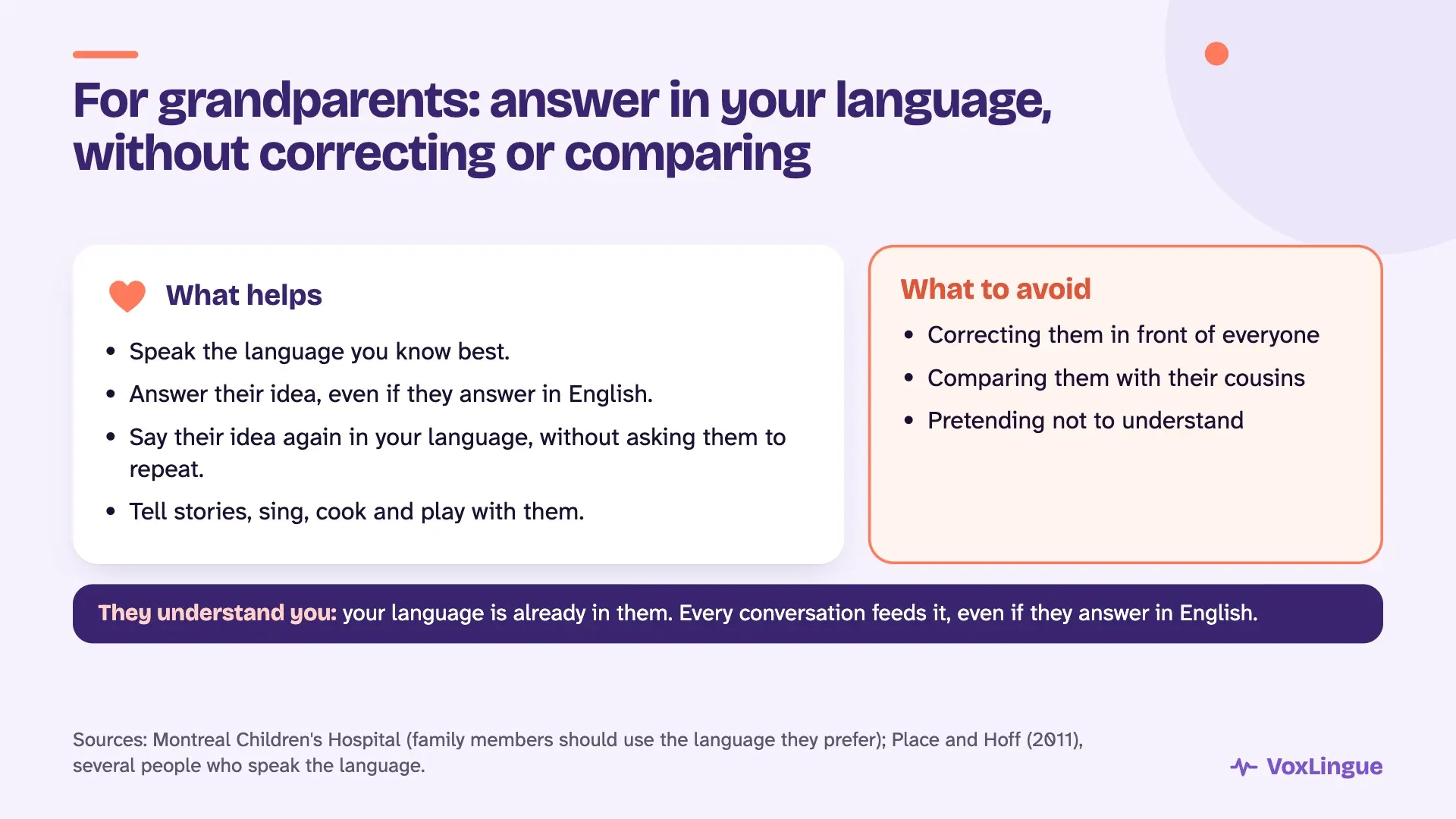
When your grandchild answers you in English, keep going in your language, warmly, on the topic they chose. Answer their idea rather than the language they chose, and say it again in your language, without asking them to repeat it.
The rest happens through play. Tell stories from your childhood, sing, cook and play with them. And if it hurts, keep that to yourself and talk about it with their parents instead.
Many grandparents feel this moment as a loss. That’s understandable. But a child who understands your language already carries it. Every conversation where they understand you feeds that language, even if they answer in English.
The printable sheet below sums up this advice for grandparents. You can give it to them before the visit.
After the holidays: keeping the language alive at home
After the holidays, the language needs to come back into the week, not just the visits. The more room it has at home and in the child’s life, the more reasons and chances they have to speak it. The goal isn’t perfection: it’s to keep it alive.
A language heard less can weaken over time. The CIUSSS de la Capitale-Nationale guide calls this attrition and links it to less exposure or less use. It isn’t inevitable, and it isn’t anyone’s fault. It’s a reason to keep the language in the week.
Video calls with the grandparents help when they’re treated as real conversations: show a drawing, sing the song from the visit, plan the next recipe. Books and songs in the home language fit naturally at bath time or bedtime.
Other voices count too: aunts, uncles, family friends, neighbours. If your community offers an activity in the language, such as a playgroup or a Saturday school, that’s one more chance. And the parent who speaks the language can keep it with the child, even when the child answers in English or French.
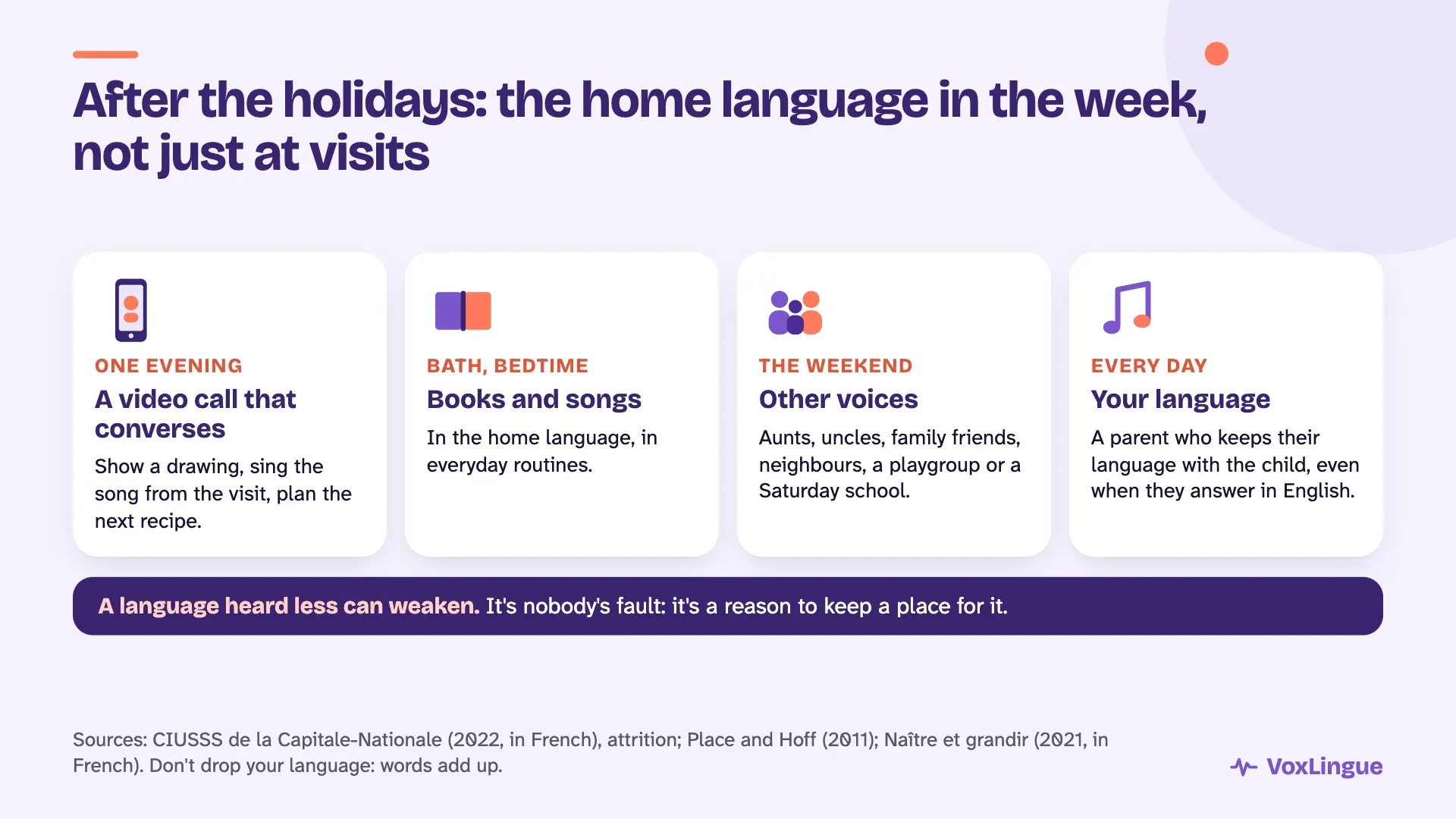
If you’re wondering whether to drop the home language to help their English or French, the answer is no. Naître et grandir and the Montreal Children’s Hospital both advise speaking the language you know best. Their words in your languages add up.
Language choice or language difficulty: look at all their languages
A child who understands the home language but answers in English is often making a language choice. A language difficulty shows in all of their languages, including English or French. To know where they stand, look at what they understand and say across all their languages.
The CIUSSS de la Capitale-Nationale guide recommends assessing the child in each of their significant languages. Naître et grandir also reminds parents to consider all of a child’s words and sentences, in both languages. A child who speaks little of their grandparents’ language, but speaks English very well, isn’t showing a language difficulty.
Talk to someone if, in all of their languages, including English or French, your child:
- says few words or uses very short sentences for their age;
- is hard to understand for people who know them less well;
- has trouble following a simple instruction without a gesture, like “Go get your boots”;
- has trouble telling what happened, or making themselves understood by friends;
- no longer does something they used to do, or doesn’t seem to hear well.
These signs aren’t a diagnosis. They’re reasons to ask for an opinion. Our article on language difference or language disorder in bilingual children explains how speech-language pathologists tell them apart.
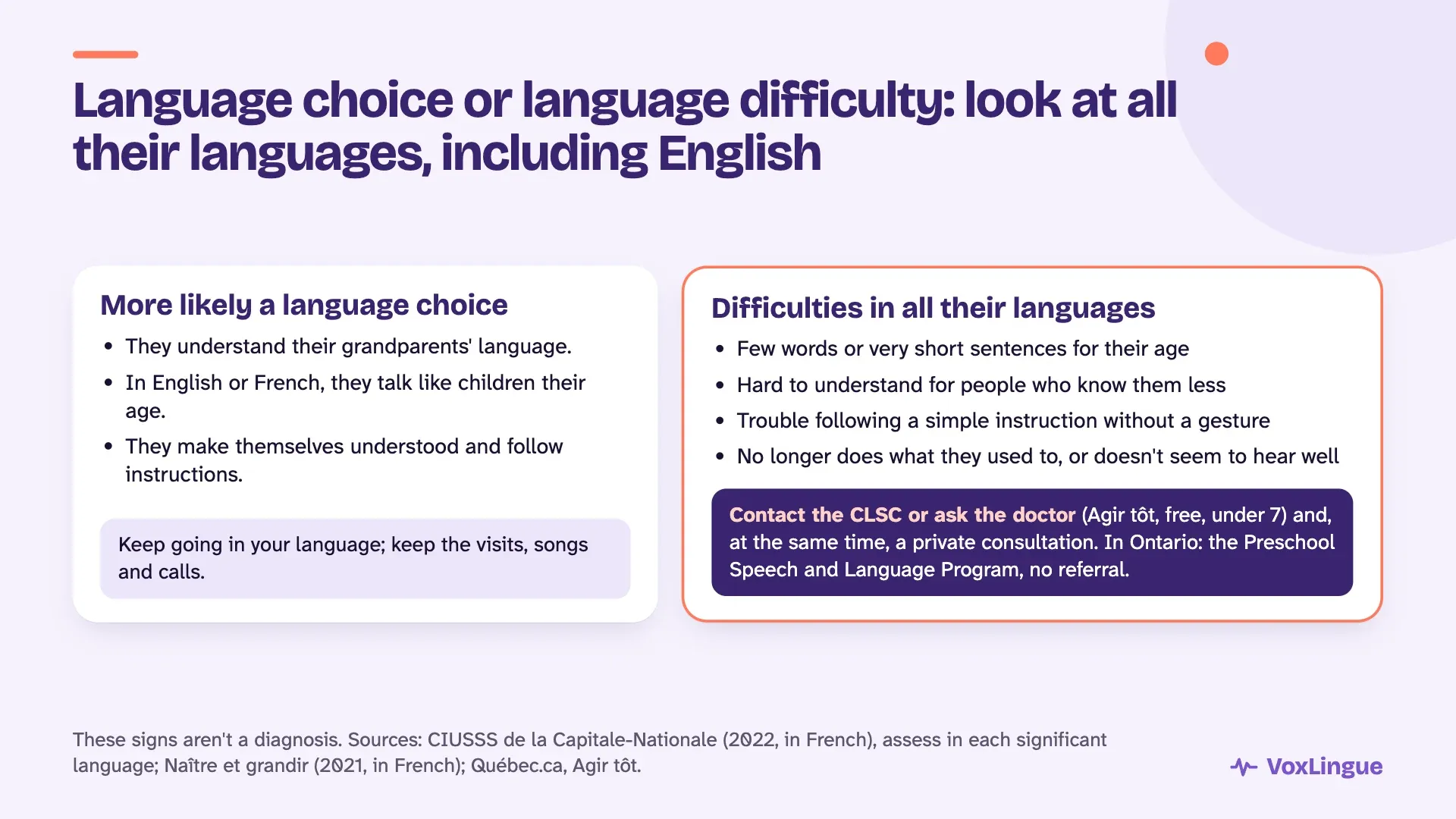
In Québec, start with the public network. Contact the CLSC or ask the doctor: the Agir tôt program (in French) offers free screening for children under 7. At the same time, a private consultation lets you get an opinion without waiting.
In Ontario, the Preschool Speech and Language Program sees children without a doctor’s referral. We also offer online sessions for Ontario families.
What if the speech-language pathologist doesn’t speak Grandma’s language? At VoxLingue, our speech-language pathologists assess and coach families in English and French, as well as Arabic, Armenian, Greek, Spanish and Portuguese. For other languages, the clinician relies on a questionnaire filled in by the parent and on observing the child. If needed, she guides the parent or a relative to interpret during the session.
Key takeaways when your child understands their grandparents’ language but answers in English
Understanding a language without speaking it is common in bilingual children, and it isn’t, on its own, a sign of a language difficulty.
- They choose English or French because they know the adult understands, because it’s the language of their days, and because they hear the other language less.
- Avoid “Say it in Spanish”, pretending not to understand and comparisons with cousins.
- Keep going in your language, answer their idea and say it again in your language, without asking them to repeat.
- During the visit: time in a small group with the grandparents, a recipe, a song, photos, no expectation of an answer.
- A language difficulty shows in all their languages. If that’s the case, contact the CLSC or ask the doctor, and see a private clinician at the same time if you can.
Next step: talk with a speech-language pathologist who looks at all their languages
Would you like practical ways to keep your language alive in your routines? Discover our parent coaching inspired by the Hanen programs. If you see difficulties in all their languages, see an assessment that looks at all their languages. Our speech-language pathologists see families at our clinic in Marché Central, Montréal, and by telepractice across Québec and Ontario.
Before the visit, print our sheet for grandparents and slip it into the holiday card, or send it by email.
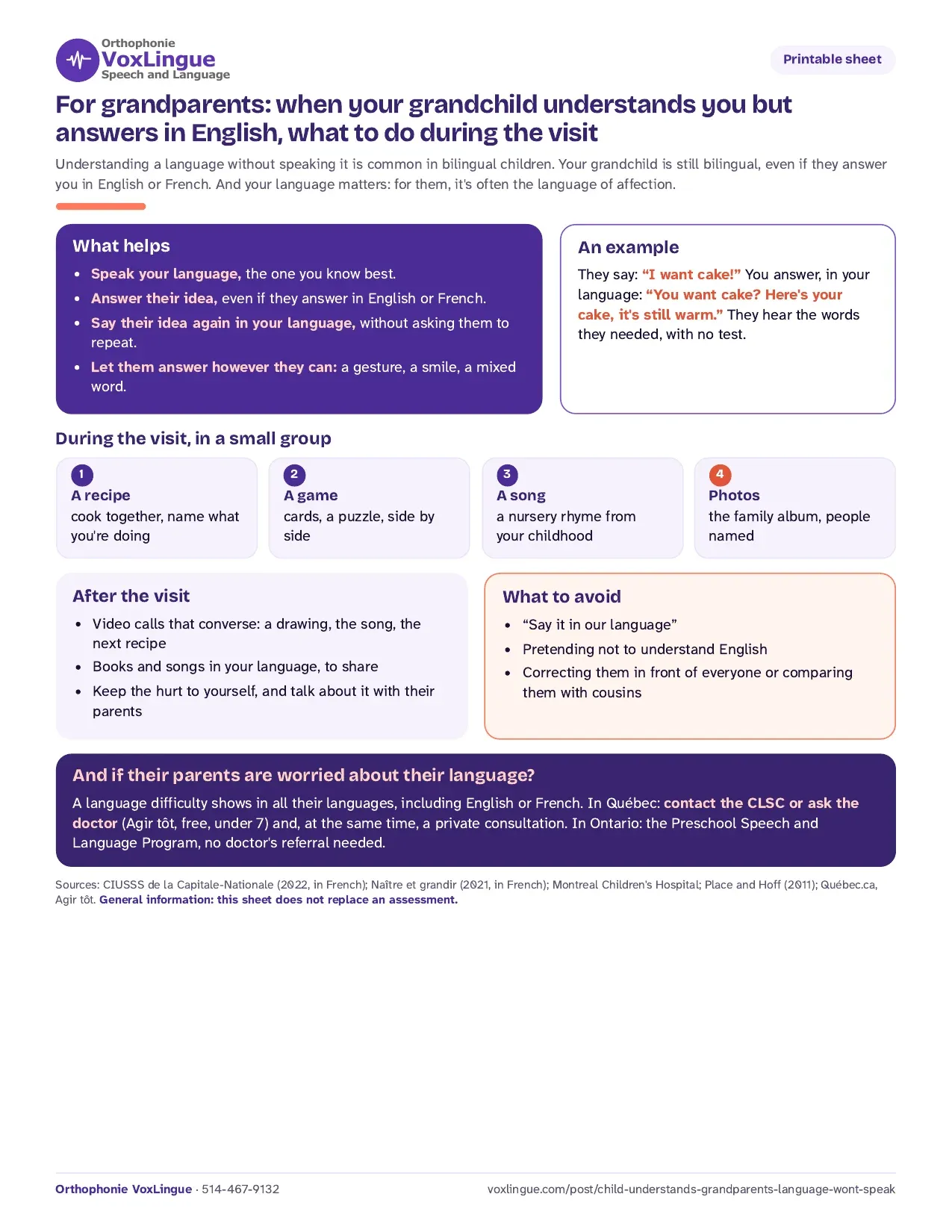
Printable sheet: For grandparents: when your grandchild understands you but answers in English, what to do during the visit (PDF, 1 page).
Frequently asked questions from parents of bilingual children
My child understands our language but doesn’t speak it: will they lose it?
Not necessarily. A language heard less can weaken, but a child who understands it has a solid base. The more room it keeps in your home and in their life, the more chances they’ll have to speak it one day. Grandparents, songs and video calls all count.
Should I make them answer in our language?
No. Asking them to answer or repeat in your language turns the conversation into a test. Keep going in your language, answer what they said and say their idea again in your language. That way they hear the words they needed, without pressure.
Is it a sign of a language difficulty?
Not on its own. Understanding one language and answering in another is common in bilingual children. A language difficulty shows in all their languages, including English or French. Look at all of their languages before worrying.
Should we stop speaking our language to help their English or French?
No. Naître et grandir and the Montreal Children’s Hospital advise speaking the language you know best. Their words in both languages add up, and English or French will also come from daycare and school. For children who talk little, see our bilingual language milestones.
They mix languages when talking to their grandparents: is that a problem?
No. Mixing languages is common in bilingual children, and it isn’t a sign of confusion. A word in the home language inside an English sentence is the language already coming out. See when your child mixes French and English.
Their cousins speak the language, but they don’t: why?
Every family gives the language a different place. The cousins may hear it more often, from more people, or go to a daycare in the language. Comparing children doesn’t help. What helps is giving your child more chances to hear it and live it.
Can the speech-language pathologist assess my child if she doesn’t speak our language?
Yes. At VoxLingue, our speech-language pathologists assess in English, French, Arabic, Armenian, Greek, Spanish and Portuguese. For another language, they rely on a questionnaire filled in by the parent and on observing the child, and if needed they guide the parent or a relative to interpret.